LINE CODING
BY- VAIBHAV SINHA
OBJECTIVES
•WHY LINE CODING?
•INTRODUCTION TO LINE CODING
•PROPERTIES OF LINE CODING
•TYPES OF LINE CODING
•EXAMPLE OF LINE CODING
WHY LINE CODING?
• Spectrum Shaping and Relocation without modulation
or filtering.
• Bit clock recovery can be simplified.
• Error detection capabilities.
• Bandwidth usage; the possibility of transmitting at a
higher rate than other schemes over the same
bandwidth.
INTRODUCTION TO LINE CODING
Binary data can be transmitted using a number of different types of pulses. The
choice of a particular pair of pulses to represent the symbols 1 and 0 is called Line
Coding and the choice is generally made on the grounds of one or more of the
following considerations:
– Presence or absence of a DC level.
– Power Spectral Density- particularly its value at 0 Hz.
– Bandwidth.
– BER performance (this particular aspect is not covered in this lecture).
–Transparency (i.e. the property that any arbitrary symbol, or bit, pattern can be
transmitted and received).
– Ease of clock signal recovery for symbol synchronisation.
– Presence or absence of inherent error detection properties.
After line coding pulses may be filtered or otherwise shaped to further improve
their properties: for example, their spectral efficiency and/ or immunity to
intersymbol interference.
PROPERTIES OF LINE CODING
•Transmission Bandwidth: as small as possible
• Power Efficiency: As small as possible for given BWand probability of error
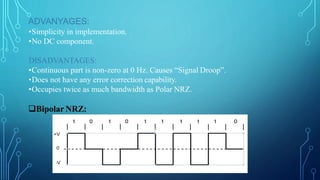
• Error Detection and Correction capability: Ex: Bipolar
• Favorable power spectral density: dc=0
• Adequate timing content: Extract timing from pulses
• Transparency: Prevent long strings of 0s or 1s
TYPES OF LINE CODING
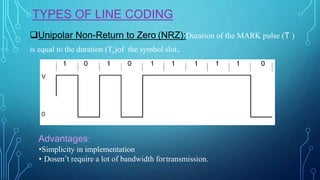
Unipolar Non-Return to Zero (NRZ):Duration of the MARK pulse (Ƭ )
is equal to the duration (To)of the symbol slot.
Advantages:
•Simplicity in implementation
• Dosen’t require a lot of bandwidth fortransmission.
DISADVANTAGES:
•Presence of DC level (indicated by spectral line at 0 Hz).
•Contains low frequency components. Causes “Signal Droop”
•Does not have any error correction capability.
•Does not posses any clocking component for ease of synchronisation.
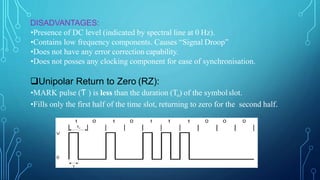
Unipolar Return to Zero (RZ):
•MARK pulse (Ƭ ) is less than the duration (To) of the symbolslot.
•Fills only the first half of the time slot, returning to zero for the second half.
ADVANYAGES:
•Simplicity in implementation.
•Presence of a spectral line at symbol rate which can be used as symbol timing
clock signal.
DISADVANYAGES:
•Presence of DC level (indicated by spectral line at 0 Hz).
•Continuous part is non-zero at 0 Hz. Causes “Signal Droop”.
•Does not have any error correction capability.
•Occupies twice as much bandwidth as Unipolar NRZ.
•Is not Transparent
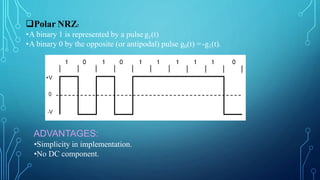
Polar NRZ:
•A binary 1 is represented by a pulseg1(t)
•A binary 0 by the opposite (or antipodal) pulse g0(t) =-g1(t).
ADVANTAGES:
•Simplicity in implementation.
•No DC component.
DISADVANTAGES:
•Continuous part is non-zero at 0 Hz. Causes “Signal Droop”.
•Does not have any error correction capability.
•Does no posses any clocking component for ease of synchronisation.
•Is not transparent.
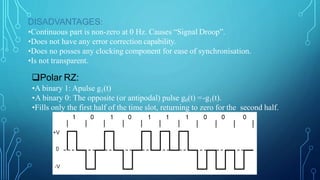
Polar RZ:
•A binary 1: Apulse g1(t)
•A binary 0: The opposite (or antipodal) pulse g0(t) =-g1(t).
•Fills only the first half of the time slot, returning to zero for the second half.
ADVANYAGES:
•Simplicity in implementation.
•No DC component.
DISADVANTAGES:
•Continuous part is non-zero at 0 Hz. Causes “Signal Droop”.
•Does not have any error correction capability.
•Occupies twice as much bandwidth as Polar NRZ.
Bipolar NRZ:
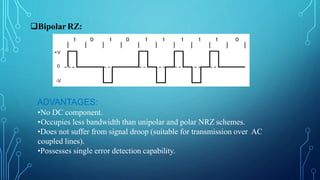
Bipolar RZ:
ADVANTAGES:
•No DC component.
•Occupies less bandwidth than unipolar and polar NRZ schemes.
•Does not suffer from signal droop (suitable for transmission over AC
coupled lines).
•Possesses single error detection capability.
DISADVANTAGES:
•Does not posses any clocking component for ease of
synchronisation.
•Is not Transparent
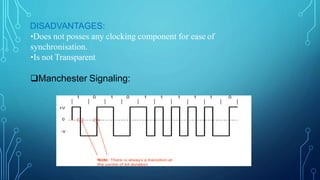
Manchester Signaling:
ADVANTAGES:
•No DC component.
•Does not suffer from signal droop (suitable for transmission over AC
coupled lines).
•Easy to synchronise.
•Is Transparent.
DISADVANTAGES:
•Because of the greater number of transitions it occupies a
significantly large bandwidth.
•Does not have error detection capability.
LINE CODING EXAMPLE
THANK YOU

Line coding

  • 1.
  • 2.
    OBJECTIVES •WHY LINE CODING? •INTRODUCTIONTO LINE CODING •PROPERTIES OF LINE CODING •TYPES OF LINE CODING •EXAMPLE OF LINE CODING
  • 3.
    WHY LINE CODING? •Spectrum Shaping and Relocation without modulation or filtering. • Bit clock recovery can be simplified. • Error detection capabilities. • Bandwidth usage; the possibility of transmitting at a higher rate than other schemes over the same bandwidth.
  • 4.
    INTRODUCTION TO LINECODING Binary data can be transmitted using a number of different types of pulses. The choice of a particular pair of pulses to represent the symbols 1 and 0 is called Line Coding and the choice is generally made on the grounds of one or more of the following considerations: – Presence or absence of a DC level. – Power Spectral Density- particularly its value at 0 Hz. – Bandwidth. – BER performance (this particular aspect is not covered in this lecture). –Transparency (i.e. the property that any arbitrary symbol, or bit, pattern can be transmitted and received). – Ease of clock signal recovery for symbol synchronisation. – Presence or absence of inherent error detection properties. After line coding pulses may be filtered or otherwise shaped to further improve their properties: for example, their spectral efficiency and/ or immunity to intersymbol interference.
  • 5.
    PROPERTIES OF LINECODING •Transmission Bandwidth: as small as possible • Power Efficiency: As small as possible for given BWand probability of error • Error Detection and Correction capability: Ex: Bipolar • Favorable power spectral density: dc=0 • Adequate timing content: Extract timing from pulses • Transparency: Prevent long strings of 0s or 1s
  • 6.
    TYPES OF LINECODING Unipolar Non-Return to Zero (NRZ):Duration of the MARK pulse (Ƭ ) is equal to the duration (To)of the symbol slot. Advantages: •Simplicity in implementation • Dosen’t require a lot of bandwidth fortransmission.
  • 7.
    DISADVANTAGES: •Presence of DClevel (indicated by spectral line at 0 Hz). •Contains low frequency components. Causes “Signal Droop” •Does not have any error correction capability. •Does not posses any clocking component for ease of synchronisation. Unipolar Return to Zero (RZ): •MARK pulse (Ƭ ) is less than the duration (To) of the symbolslot. •Fills only the first half of the time slot, returning to zero for the second half.
  • 8.
    ADVANYAGES: •Simplicity in implementation. •Presenceof a spectral line at symbol rate which can be used as symbol timing clock signal. DISADVANYAGES: •Presence of DC level (indicated by spectral line at 0 Hz). •Continuous part is non-zero at 0 Hz. Causes “Signal Droop”. •Does not have any error correction capability. •Occupies twice as much bandwidth as Unipolar NRZ. •Is not Transparent
  • 9.
    Polar NRZ: •A binary1 is represented by a pulseg1(t) •A binary 0 by the opposite (or antipodal) pulse g0(t) =-g1(t). ADVANTAGES: •Simplicity in implementation. •No DC component.
  • 10.
    DISADVANTAGES: •Continuous part isnon-zero at 0 Hz. Causes “Signal Droop”. •Does not have any error correction capability. •Does no posses any clocking component for ease of synchronisation. •Is not transparent. Polar RZ: •A binary 1: Apulse g1(t) •A binary 0: The opposite (or antipodal) pulse g0(t) =-g1(t). •Fills only the first half of the time slot, returning to zero for the second half.
  • 11.
    ADVANYAGES: •Simplicity in implementation. •NoDC component. DISADVANTAGES: •Continuous part is non-zero at 0 Hz. Causes “Signal Droop”. •Does not have any error correction capability. •Occupies twice as much bandwidth as Polar NRZ. Bipolar NRZ:
  • 12.
    Bipolar RZ: ADVANTAGES: •No DCcomponent. •Occupies less bandwidth than unipolar and polar NRZ schemes. •Does not suffer from signal droop (suitable for transmission over AC coupled lines). •Possesses single error detection capability.
  • 13.
    DISADVANTAGES: •Does not possesany clocking component for ease of synchronisation. •Is not Transparent Manchester Signaling:
  • 14.
    ADVANTAGES: •No DC component. •Doesnot suffer from signal droop (suitable for transmission over AC coupled lines). •Easy to synchronise. •Is Transparent. DISADVANTAGES: •Because of the greater number of transitions it occupies a significantly large bandwidth. •Does not have error detection capability.
  • 15.
  • 16.