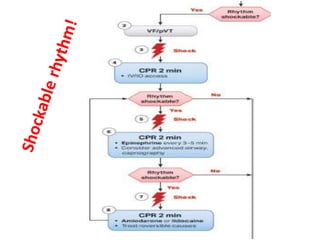
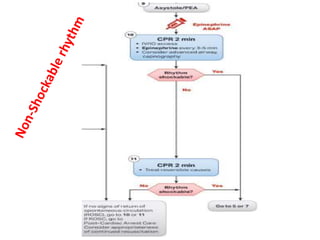
Advanced Life Support Course
(updated 2020)
,
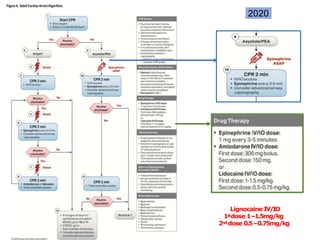
2015
2020
2020
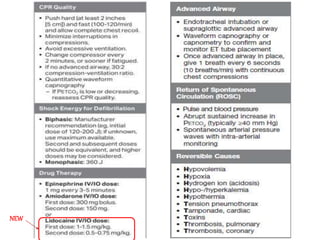
Lignocaine IV/IO
1stdose 1–1.5mg/kg
2nddose 0.5–0.75mg/kg
NEW
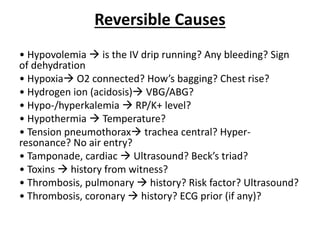
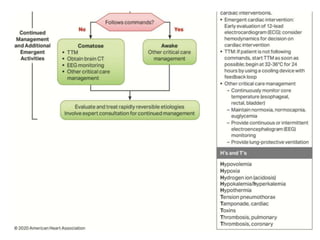
Reversible Causes
• Hypovolemia  is the IV drip running? Any bleeding? Sign
of dehydration
• Hypoxia O2 connected? How’s bagging? Chest rise?
• Hydrogen ion (acidosis) VBG/ABG?
• Hypo-/hyperkalemia  RP/K+ level?
• Hypothermia  Temperature?
• Tension pneumothorax trachea central? Hyper-
resonance? No air entry?
• Tamponade, cardiac  Ultrasound? Beck’s triad?
• Toxins  history from witness?
• Thrombosis, pulmonary  history? Risk factor? Ultrasound?
• Thrombosis, coronary  history? ECG prior (if any)?
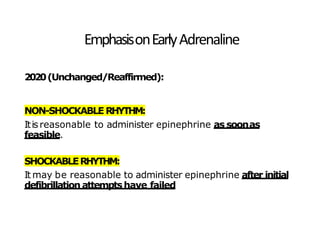
EmphasisonEarlyAdrenaline
2020(Unchanged/Reaffirmed):
NON-SHOCKABLE RHYTHM:
Itisreasonable to administer epinephrine as soonas
feasible.
SHOCKABLERHYTHM:
It may be reasonable to administer epinephrine after initial
defibrillation attemptshave failed
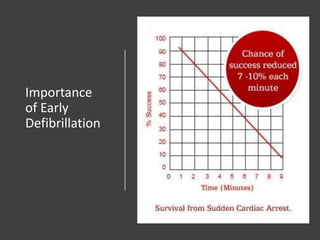
Importance
of Early
Defibrillation
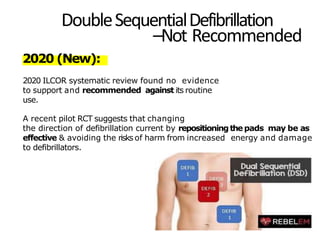
DoubleSequentialDefibrillation
–Not Recommended
2020 (New):
2020 ILCOR systematic review found no evidence
to support and recommended against its routine
use.
A recent pilot RCT suggests that changing
the direction of defibrillation current by repositioningthepads may be as
effective & avoiding the risks of harm from increased energy and damage
to defibrillators.
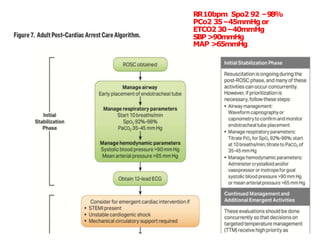
RR10bpm Spo2 92 –98%
PCo2 35–45mmHgor
ETCO2 30–40mmHg
SBP >90mmHg
MAP >65mmHg
Standard dose adrenaline
• Standard-dose epinephrine (1 mg every 3 to
5minutes) may be reasonable for patients in
cardiac arrest (Class IIb, LOE B-R).
• High-dose epinephrine is not recommended
for routine use in cardiac arrest (Class III: No
Benefit,LOE B-R).
Early adrenaline?
• For initial non-shockable rhythm: It may be
reasonable to administer adrenaline as soon as
feasible after the onset of cardiac arrest (Class
IIb,LOE C-LD).
• For initial shockable rhyhtm: There is insufficient
evidence to make a recommendation as to the
optimal timing of adrenaline, particularly in
relation to defibrillation
Amiodarone & Lidocaine
• Amiodarone may be considered for VF/pVT
that is unresponsive to CPR, defibrillation, and
a vasopressor therapy (Class IIb, LOE B-R).
• Lidocaine may be considered as an alternative
to amiodarone for VF/pVT that is unresponsive
to CPR, defibrillation, and vasopressor therapy
(Class IIb, LOE C-LD).
IV access
• “…none (of the antiarrhythmics) have yet been
proven to increase long term survival or
survival with good neurologic outcome. Thus
establishing vascular access to enable drug
administration should not compromise the
quality of CPR or timely defibrillation, which
are known to improve survival.”
FOCUS ECHOCARDIOGRAPHIC
EVALUTION IN LIFE SUPPORT = FEEL
Ultrasound (cardiac or noncardiac )may be
considered during the management of
cardiac arrest, although its usefulness has
not been well established (Class IIb, LOE CEO).
If a qualified sonographer is present and
use of ultrasound does not interfere with the
standard cardiac arrest treatment protocol,
then ultrasound may be considered as an
adjunct to standard patient evaluation (Class
IIb, LOE C-EO).
Hypothermia post ROSC
“…..Nevertheless, it is important to acknowledge
that there may be a clinically relevant benefit of
controlling the body temperature at 36°C,
instead of allowing fever to develop in patients
who have been resuscitated after cardiac
arrest.”
- No fever please.
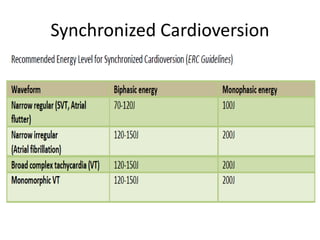
Synchronized Cardioversion
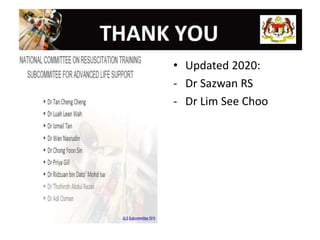
• Updated 2020:
- Dr Sazwan RS
- Dr Lim See Choo

ALS Algorithm update 2020.pptx

  • 1.
    Advanced Life SupportCourse (updated 2020)
  • 2.
  • 4.
  • 5.
  • 8.
  • 9.
    Reversible Causes • Hypovolemia is the IV drip running? Any bleeding? Sign of dehydration • Hypoxia O2 connected? How’s bagging? Chest rise? • Hydrogen ion (acidosis) VBG/ABG? • Hypo-/hyperkalemia  RP/K+ level? • Hypothermia  Temperature? • Tension pneumothorax trachea central? Hyper- resonance? No air entry? • Tamponade, cardiac  Ultrasound? Beck’s triad? • Toxins  history from witness? • Thrombosis, pulmonary  history? Risk factor? Ultrasound? • Thrombosis, coronary  history? ECG prior (if any)?
  • 10.
    EmphasisonEarlyAdrenaline 2020(Unchanged/Reaffirmed): NON-SHOCKABLE RHYTHM: Itisreasonable toadminister epinephrine as soonas feasible. SHOCKABLERHYTHM: It may be reasonable to administer epinephrine after initial defibrillation attemptshave failed
  • 11.
  • 12.
    DoubleSequentialDefibrillation –Not Recommended 2020 (New): 2020ILCOR systematic review found no evidence to support and recommended against its routine use. A recent pilot RCT suggests that changing the direction of defibrillation current by repositioningthepads may be as effective & avoiding the risks of harm from increased energy and damage to defibrillators.
  • 13.
    RR10bpm Spo2 92–98% PCo2 35–45mmHgor ETCO2 30–40mmHg SBP >90mmHg MAP >65mmHg
  • 15.
    Standard dose adrenaline •Standard-dose epinephrine (1 mg every 3 to 5minutes) may be reasonable for patients in cardiac arrest (Class IIb, LOE B-R). • High-dose epinephrine is not recommended for routine use in cardiac arrest (Class III: No Benefit,LOE B-R).
  • 16.
    Early adrenaline? • Forinitial non-shockable rhythm: It may be reasonable to administer adrenaline as soon as feasible after the onset of cardiac arrest (Class IIb,LOE C-LD). • For initial shockable rhyhtm: There is insufficient evidence to make a recommendation as to the optimal timing of adrenaline, particularly in relation to defibrillation
  • 17.
    Amiodarone & Lidocaine •Amiodarone may be considered for VF/pVT that is unresponsive to CPR, defibrillation, and a vasopressor therapy (Class IIb, LOE B-R). • Lidocaine may be considered as an alternative to amiodarone for VF/pVT that is unresponsive to CPR, defibrillation, and vasopressor therapy (Class IIb, LOE C-LD).
  • 18.
    IV access • “…none(of the antiarrhythmics) have yet been proven to increase long term survival or survival with good neurologic outcome. Thus establishing vascular access to enable drug administration should not compromise the quality of CPR or timely defibrillation, which are known to improve survival.”
  • 19.
    FOCUS ECHOCARDIOGRAPHIC EVALUTION INLIFE SUPPORT = FEEL Ultrasound (cardiac or noncardiac )may be considered during the management of cardiac arrest, although its usefulness has not been well established (Class IIb, LOE CEO). If a qualified sonographer is present and use of ultrasound does not interfere with the standard cardiac arrest treatment protocol, then ultrasound may be considered as an adjunct to standard patient evaluation (Class IIb, LOE C-EO).
  • 20.
    Hypothermia post ROSC “…..Nevertheless,it is important to acknowledge that there may be a clinically relevant benefit of controlling the body temperature at 36°C, instead of allowing fever to develop in patients who have been resuscitated after cardiac arrest.” - No fever please.
  • 29.
  • 31.
    • Updated 2020: -Dr Sazwan RS - Dr Lim See Choo