Tapeshwar
Yadav
(Lecturer)
BMLT, DNHE,
So then, what is biochemistry?
Biochemistry:
 Biochemistry is a basic science which deals with chemical
nature and chemical behaviour of living matter and with the
reactions and processes they undergo.
Biochemistry involves the study of:
 Chemical constituents of living matter.
 Chemical changes which occur in the organism during
digestion, absorption and excretion.
 Chemical changes which occur during growth and
multiplication of the organism.
 Transformation of one form of chemical constituent to the
other.
 Energy changes involved in such transformation.
Note:- The term “Biochemistry” was first introduced by
German chemist Carl Neuberg in 1903 from Greek
word “bios” means “life”.
Clinical Biochemistry:
 It is mainly deals with the biochemical aspects that are
involved in several conditions.
 The results of qualitative and quantitative analysis of body
fluids assist the clinicians in the diagnosis, treatment and
prevention of the disease and drug monitoring, tissue and
organ transplantation, forensic investigations and so on.
 Various biological fluids subjected to chemical tests and
assays include blood, plasma, serum, urine, cerebrospinal
fluid (CSF), ascetic fluid, pleural fluid, faeces, calculi and
tissues.
Note:- Modern day medical practice is highly dependent on the
laboratory analysis of body fluids, especially the blood. The
disease manifestations are reflected in the composition of
blood and other tissues.
Hence, the demarcation of abnormal from normal
constituents of the body is another aim of the study of clinical
biochemistry.
Clinical Biochemistry Laboratory:
 In the era of modern technology, health care delivery
system involves so many different personnel and
specialties that the caregiver must have an
understanding and working knowledge of other
professional endeavors, including the role of
diagnostic evaluation.
 Basically, laboratory and diagnostic tests are tools by
and of themselves, they are not therapeutic.
 In conjunction with a pertinent history and physical
examination, these tests can confirm a diagnosis or
provide valuable information about a patient status
and response to therapy.
 In addition to these, laboratory findings are essential
for epidemiological surveillance and research
purposes.
Scopes Of Clinical Biochemistry:
 Biochemistry deals with the chemical nature, structure
and functions of the chemicals of life so is involved in
various research related works.
 It is used in clinical diagnosis, manufacture of various
biological products, treatment of diseases ,in nutrition,
agriculture.
 Also, biochemistry has revealed the abnormalities in
their metabolism and their relationship to various
diseases.
 Biochemistry has helped to correct these disorders
with dietary modifications or genetic manipulations.
 Biochemistry has ramified into many branches of
science like Medicine, pharmacy, Microbiology,
Agriculture etc.
Role of medical/Clinical laboratory
science in Health Care:
 The medical laboratory services play a pivotal role in
the promotion, curative and preventive aspects of a
nation’s health delivery system.
 The service gives a scientific foundation by providing
accurate information to those with the responsibility
for:
 Treating patients and monitoring their response to
treatment,
 Monitoring the development and spread of infectious
and dangerous pathogens (disease causing
organisms),
 Deciding effective control measures against major
prevalent disease,
Contd…
Without reliable laboratory services:
 The source of a disease may not be identified
correctly.
 Patients are less likely to receive the best
possible care.
 Resistance to essential drugs may develop and
continue to spread.
 Epidemic diseases may not be identified on time
and with confidence.
CODE OF CONDUCT FOR CLINICAL
BIOCHEMISTRY LABORATORY PERSONNEL:
 Place the well-being and service of the sick above your
own interests.
 Be loyal to your medical laboratory profession by maintain
high standards of work and strive to improve your
professional knowledge.
 Work scientifically and with complete honesty.
 Do not misuse your professional skills or knowledge for
personal gain.
 Never take anything from your place of work that does not
belong to you.
 Do not disclose to a patient or any unauthorized person
the result of your investigations.
 Treat with utmost confidentiality and personal information
that you may learn about a patient.
 Respect and work in harmony with the other members of
your hospital staff or health center team.
Contd…
 Be at all times courteous, patient, and considerate to
the sick (patients) and their relations.
 Promote health care and the prevention and control of
disease.
 Follow safety procedures and know how to apply first
aid.
 Do not drink alcohol during laboratory working hours
or when on emergency standby.
 Use equipment and laboratory-ware correctly and with
care.
 Do not waste reagents or other laboratory supplies.
 Fulfil reliably and completely the terms and conditions
of your employment.
“ALWAYS REMEMBER THAT YOU CAN BE A
PATIENT TOMORROW, TREAT OTHERSAS YOU
UNIVERSAL PRECAUTIONS TO BE TAKEN
IN BIOCHEMISTRY LABORATORY
Following precautions should be
applied on biochemistry lab:
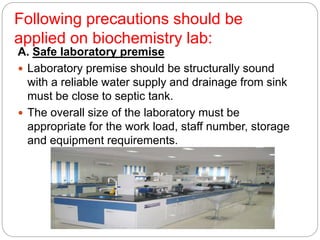
A. Safe laboratory premise
 Laboratory premise should be structurally sound
with a reliable water supply and drainage from sink
must be close to septic tank.
 The overall size of the laboratory must be
appropriate for the work load, staff number, storage
and equipment requirements.
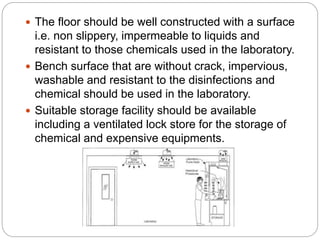
 The floor should be well constructed with a surface
i.e. non slippery, impermeable to liquids and
resistant to those chemicals used in the laboratory.
 Bench surface that are without crack, impervious,
washable and resistant to the disinfections and
chemical should be used in the laboratory.
 Suitable storage facility should be available
including a ventilated lock store for the storage of
chemical and expensive equipments.
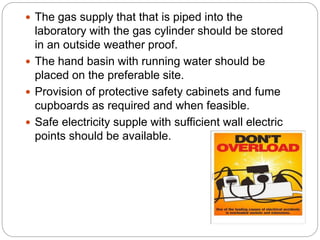
 The gas supply that that is piped into the
laboratory with the gas cylinder should be stored
in an outside weather proof.
 The hand basin with running water should be
placed on the preferable site.
 Provision of protective safety cabinets and fume
cupboards as required and when feasible.
 Safe electricity supple with sufficient wall electric
points should be available.
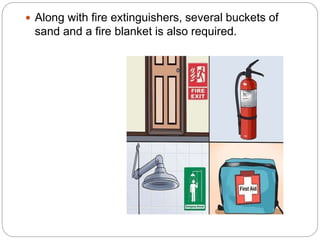
 Along with fire extinguishers, several buckets of
sand and a fire blanket is also required.
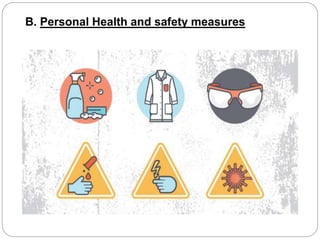
B. Personal Health and safety measures
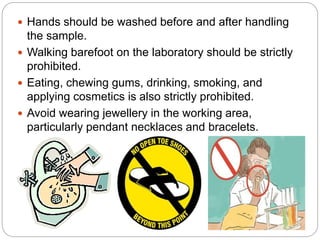
 Hands should be washed before and after handling
the sample.
 Walking barefoot on the laboratory should be strictly
prohibited.
 Eating, chewing gums, drinking, smoking, and
applying cosmetics is also strictly prohibited.
 Avoid wearing jewellery in the working area,
particularly pendant necklaces and bracelets.
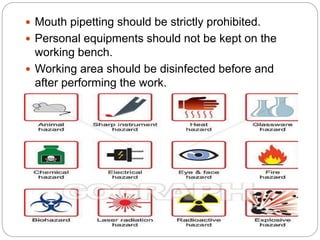
 Mouth pipetting should be strictly prohibited.
 Personal equipments should not be kept on the
working bench.
 Working area should be disinfected before and
after performing the work.
Basic Equipments Used In Biochemistry
Laboratory:
1. Centrifuges
2. Water Baths
3. Hot Air Oven
4. Colorimeter
5. Spectrophotometer
6. Flame photometer
7. Micro Pipettes
8. Auto analyzer
9. Refrigerator
10.Computer etc.
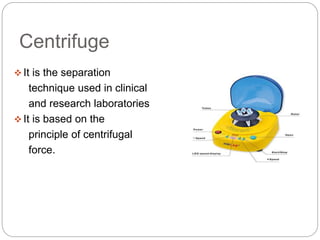
Centrifuge
 It is the separation
technique used in clinical
and research laboratories
 It is based on the
principle of centrifugal
force.
The factors which govern the speed
of centrifugation are:-
 The revolution per minute.
 Length of radius
 Shape and size of the particles.
 Viscosity and specific gravity of the fluid under
centrifugation
 Gravitational force acting on the particles.
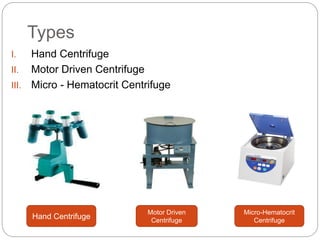
Types
I. Hand Centrifuge
II. Motor Driven Centrifuge
III. Micro - Hematocrit Centrifuge
Hand Centrifuge
Motor Driven
Centrifuge
Micro-Hematocrit
Centrifuge
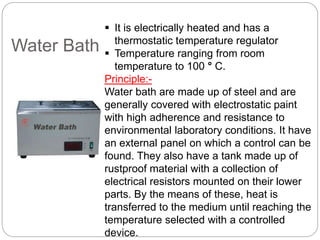
Water Bath
 It is electrically heated and has a
thermostatic temperature regulator
 Temperature ranging from room
temperature to 100 ° C.
Principle:-
Water bath are made up of steel and are
generally covered with electrostatic paint
with high adherence and resistance to
environmental laboratory conditions. It have
an external panel on which a control can be
found. They also have a tank made up of
rustproof material with a collection of
electrical resistors mounted on their lower
parts. By the means of these, heat is
transferred to the medium until reaching the
temperature selected with a controlled
device.
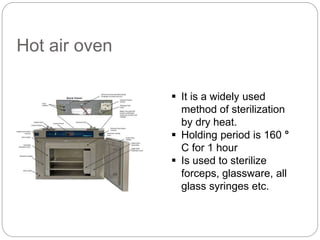
Hot air oven
 It is a widely used
method of sterilization
by dry heat.
 Holding period is 160 °
C for 1 hour
 Is used to sterilize
forceps, glassware, all
glass syringes etc.
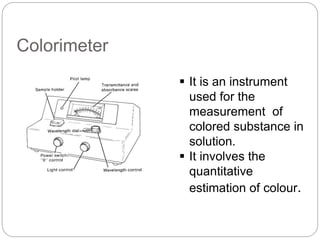
Colorimeter
 It is an instrument
used for the
measurement of
colored substance in
solution.
 It involves the
quantitative
estimation of colour.
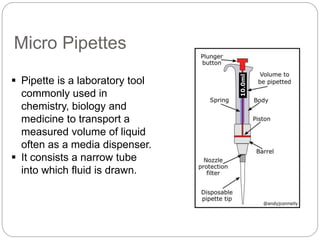
Micro Pipettes
 Pipette is a laboratory tool
commonly used in
chemistry, biology and
medicine to transport a
measured volume of liquid
often as a media dispenser.
 It consists a narrow tube
into which fluid is drawn.
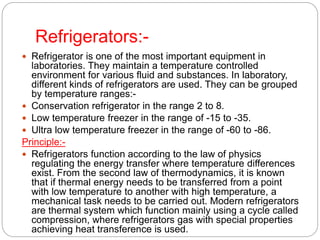
Refrigerators:-
 Refrigerator is one of the most important equipment in
laboratories. They maintain a temperature controlled
environment for various fluid and substances. In laboratory,
different kinds of refrigerators are used. They can be grouped
by temperature ranges:-
 Conservation refrigerator in the range 2 to 8.
 Low temperature freezer in the range of -15 to -35.
 Ultra low temperature freezer in the range of -60 to -86.
Principle:-
 Refrigerators function according to the law of physics
regulating the energy transfer where temperature differences
exist. From the second law of thermodynamics, it is known
that if thermal energy needs to be transferred from a point
with low temperature to another with high temperature, a
mechanical task needs to be carried out. Modern refrigerators
are thermal system which function mainly using a cycle called
compression, where refrigerators gas with special properties
achieving heat transference is used.
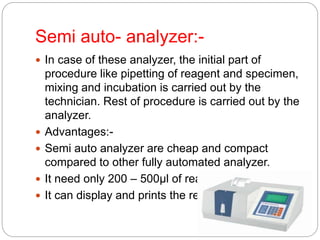
Semi auto- analyzer:-
 In case of these analyzer, the initial part of
procedure like pipetting of reagent and specimen,
mixing and incubation is carried out by the
technician. Rest of procedure is carried out by the
analyzer.
 Advantages:-
 Semi auto analyzer are cheap and compact
compared to other fully automated analyzer.
 It need only 200 – 500µl of reagent per test.
 It can display and prints the result.
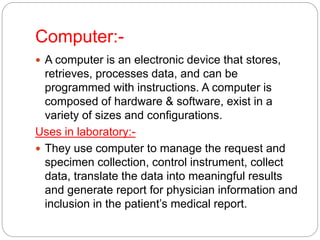
Computer:-
 A computer is an electronic device that stores,
retrieves, processes data, and can be
programmed with instructions. A computer is
composed of hardware & software, exist in a
variety of sizes and configurations.
Uses in laboratory:-
 They use computer to manage the request and
specimen collection, control instrument, collect
data, translate the data into meaningful results
and generate report for physician information and
inclusion in the patient’s medical report.
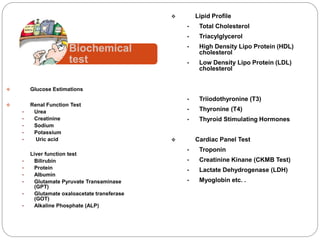
 Glucose Estimations
 Renal Function Test
• Urea
• Creatinine
• Sodium
• Potassium
• Uric acid
 Liver function test
• Bilirubin
• Protein
• Albumin
• Glutamate Pyruvate Transaminase
(GPT)
• Glutamate oxaloacetate transferase
(GOT)
• Alkaline Phosphate (ALP)
 Lipid Profile
• Total Cholesterol
• Triacylglycerol
• High Density Lipo Protein (HDL)
cholesterol
• Low Density Lipo Protein (LDL)
cholesterol
 Thyroid Function Test
• Triiodothyronine (T3)
• Thyronine (T4)
• Thyroid Stimulating Hormones
 Cardiac Panel Test
• Troponin
• Creatinine Kinane (CKMB Test)
• Lactate Dehydrogenase (LDH)
• Myoglobin etc. .
 Amylase Estimation
 Calcium Estimation
 Phosphorus Estimation
Biochemical
test
Thank
YOU !!!
 Biochemical test

Clinical Biochemistry Laboratory

  • 1.
  • 2.
    So then, whatis biochemistry?
  • 3.
    Biochemistry:  Biochemistry isa basic science which deals with chemical nature and chemical behaviour of living matter and with the reactions and processes they undergo. Biochemistry involves the study of:  Chemical constituents of living matter.  Chemical changes which occur in the organism during digestion, absorption and excretion.  Chemical changes which occur during growth and multiplication of the organism.  Transformation of one form of chemical constituent to the other.  Energy changes involved in such transformation. Note:- The term “Biochemistry” was first introduced by German chemist Carl Neuberg in 1903 from Greek word “bios” means “life”.
  • 4.
    Clinical Biochemistry:  Itis mainly deals with the biochemical aspects that are involved in several conditions.  The results of qualitative and quantitative analysis of body fluids assist the clinicians in the diagnosis, treatment and prevention of the disease and drug monitoring, tissue and organ transplantation, forensic investigations and so on.  Various biological fluids subjected to chemical tests and assays include blood, plasma, serum, urine, cerebrospinal fluid (CSF), ascetic fluid, pleural fluid, faeces, calculi and tissues. Note:- Modern day medical practice is highly dependent on the laboratory analysis of body fluids, especially the blood. The disease manifestations are reflected in the composition of blood and other tissues. Hence, the demarcation of abnormal from normal constituents of the body is another aim of the study of clinical biochemistry.
  • 5.
    Clinical Biochemistry Laboratory: In the era of modern technology, health care delivery system involves so many different personnel and specialties that the caregiver must have an understanding and working knowledge of other professional endeavors, including the role of diagnostic evaluation.  Basically, laboratory and diagnostic tests are tools by and of themselves, they are not therapeutic.  In conjunction with a pertinent history and physical examination, these tests can confirm a diagnosis or provide valuable information about a patient status and response to therapy.  In addition to these, laboratory findings are essential for epidemiological surveillance and research purposes.
  • 6.
    Scopes Of ClinicalBiochemistry:  Biochemistry deals with the chemical nature, structure and functions of the chemicals of life so is involved in various research related works.  It is used in clinical diagnosis, manufacture of various biological products, treatment of diseases ,in nutrition, agriculture.  Also, biochemistry has revealed the abnormalities in their metabolism and their relationship to various diseases.  Biochemistry has helped to correct these disorders with dietary modifications or genetic manipulations.  Biochemistry has ramified into many branches of science like Medicine, pharmacy, Microbiology, Agriculture etc.
  • 8.
    Role of medical/Clinicallaboratory science in Health Care:  The medical laboratory services play a pivotal role in the promotion, curative and preventive aspects of a nation’s health delivery system.  The service gives a scientific foundation by providing accurate information to those with the responsibility for:  Treating patients and monitoring their response to treatment,  Monitoring the development and spread of infectious and dangerous pathogens (disease causing organisms),  Deciding effective control measures against major prevalent disease,
  • 9.
    Contd… Without reliable laboratoryservices:  The source of a disease may not be identified correctly.  Patients are less likely to receive the best possible care.  Resistance to essential drugs may develop and continue to spread.  Epidemic diseases may not be identified on time and with confidence.
  • 10.
    CODE OF CONDUCTFOR CLINICAL BIOCHEMISTRY LABORATORY PERSONNEL:  Place the well-being and service of the sick above your own interests.  Be loyal to your medical laboratory profession by maintain high standards of work and strive to improve your professional knowledge.  Work scientifically and with complete honesty.  Do not misuse your professional skills or knowledge for personal gain.  Never take anything from your place of work that does not belong to you.  Do not disclose to a patient or any unauthorized person the result of your investigations.  Treat with utmost confidentiality and personal information that you may learn about a patient.  Respect and work in harmony with the other members of your hospital staff or health center team.
  • 11.
    Contd…  Be atall times courteous, patient, and considerate to the sick (patients) and their relations.  Promote health care and the prevention and control of disease.  Follow safety procedures and know how to apply first aid.  Do not drink alcohol during laboratory working hours or when on emergency standby.  Use equipment and laboratory-ware correctly and with care.  Do not waste reagents or other laboratory supplies.  Fulfil reliably and completely the terms and conditions of your employment. “ALWAYS REMEMBER THAT YOU CAN BE A PATIENT TOMORROW, TREAT OTHERSAS YOU

  • 13.
    UNIVERSAL PRECAUTIONS TOBE TAKEN IN BIOCHEMISTRY LABORATORY
  • 14.
    Following precautions shouldbe applied on biochemistry lab: A. Safe laboratory premise  Laboratory premise should be structurally sound with a reliable water supply and drainage from sink must be close to septic tank.  The overall size of the laboratory must be appropriate for the work load, staff number, storage and equipment requirements.
  • 15.
     The floorshould be well constructed with a surface i.e. non slippery, impermeable to liquids and resistant to those chemicals used in the laboratory.  Bench surface that are without crack, impervious, washable and resistant to the disinfections and chemical should be used in the laboratory.  Suitable storage facility should be available including a ventilated lock store for the storage of chemical and expensive equipments.
  • 16.
     The gassupply that that is piped into the laboratory with the gas cylinder should be stored in an outside weather proof.  The hand basin with running water should be placed on the preferable site.  Provision of protective safety cabinets and fume cupboards as required and when feasible.  Safe electricity supple with sufficient wall electric points should be available.
  • 17.
     Along withfire extinguishers, several buckets of sand and a fire blanket is also required.
  • 18.
    B. Personal Healthand safety measures
  • 19.
     Hands shouldbe washed before and after handling the sample.  Walking barefoot on the laboratory should be strictly prohibited.  Eating, chewing gums, drinking, smoking, and applying cosmetics is also strictly prohibited.  Avoid wearing jewellery in the working area, particularly pendant necklaces and bracelets.
  • 20.
     Mouth pipettingshould be strictly prohibited.  Personal equipments should not be kept on the working bench.  Working area should be disinfected before and after performing the work.
  • 22.
    Basic Equipments UsedIn Biochemistry Laboratory: 1. Centrifuges 2. Water Baths 3. Hot Air Oven 4. Colorimeter 5. Spectrophotometer 6. Flame photometer 7. Micro Pipettes 8. Auto analyzer 9. Refrigerator 10.Computer etc.
  • 23.
    Centrifuge  It isthe separation technique used in clinical and research laboratories  It is based on the principle of centrifugal force.
  • 24.
    The factors whichgovern the speed of centrifugation are:-  The revolution per minute.  Length of radius  Shape and size of the particles.  Viscosity and specific gravity of the fluid under centrifugation  Gravitational force acting on the particles.
  • 25.
    Types I. Hand Centrifuge II.Motor Driven Centrifuge III. Micro - Hematocrit Centrifuge Hand Centrifuge Motor Driven Centrifuge Micro-Hematocrit Centrifuge
  • 26.
    Water Bath  Itis electrically heated and has a thermostatic temperature regulator  Temperature ranging from room temperature to 100 ° C. Principle:- Water bath are made up of steel and are generally covered with electrostatic paint with high adherence and resistance to environmental laboratory conditions. It have an external panel on which a control can be found. They also have a tank made up of rustproof material with a collection of electrical resistors mounted on their lower parts. By the means of these, heat is transferred to the medium until reaching the temperature selected with a controlled device.
  • 27.
    Hot air oven It is a widely used method of sterilization by dry heat.  Holding period is 160 ° C for 1 hour  Is used to sterilize forceps, glassware, all glass syringes etc.
  • 28.
    Colorimeter  It isan instrument used for the measurement of colored substance in solution.  It involves the quantitative estimation of colour.
  • 29.
    Micro Pipettes  Pipetteis a laboratory tool commonly used in chemistry, biology and medicine to transport a measured volume of liquid often as a media dispenser.  It consists a narrow tube into which fluid is drawn.
  • 31.
    Refrigerators:-  Refrigerator isone of the most important equipment in laboratories. They maintain a temperature controlled environment for various fluid and substances. In laboratory, different kinds of refrigerators are used. They can be grouped by temperature ranges:-  Conservation refrigerator in the range 2 to 8.  Low temperature freezer in the range of -15 to -35.  Ultra low temperature freezer in the range of -60 to -86. Principle:-  Refrigerators function according to the law of physics regulating the energy transfer where temperature differences exist. From the second law of thermodynamics, it is known that if thermal energy needs to be transferred from a point with low temperature to another with high temperature, a mechanical task needs to be carried out. Modern refrigerators are thermal system which function mainly using a cycle called compression, where refrigerators gas with special properties achieving heat transference is used.
  • 32.
    Semi auto- analyzer:- In case of these analyzer, the initial part of procedure like pipetting of reagent and specimen, mixing and incubation is carried out by the technician. Rest of procedure is carried out by the analyzer.  Advantages:-  Semi auto analyzer are cheap and compact compared to other fully automated analyzer.  It need only 200 – 500µl of reagent per test.  It can display and prints the result.
  • 33.
    Computer:-  A computeris an electronic device that stores, retrieves, processes data, and can be programmed with instructions. A computer is composed of hardware & software, exist in a variety of sizes and configurations. Uses in laboratory:-  They use computer to manage the request and specimen collection, control instrument, collect data, translate the data into meaningful results and generate report for physician information and inclusion in the patient’s medical report.
  • 34.
     Glucose Estimations Renal Function Test • Urea • Creatinine • Sodium • Potassium • Uric acid  Liver function test • Bilirubin • Protein • Albumin • Glutamate Pyruvate Transaminase (GPT) • Glutamate oxaloacetate transferase (GOT) • Alkaline Phosphate (ALP)  Lipid Profile • Total Cholesterol • Triacylglycerol • High Density Lipo Protein (HDL) cholesterol • Low Density Lipo Protein (LDL) cholesterol  Thyroid Function Test • Triiodothyronine (T3) • Thyronine (T4) • Thyroid Stimulating Hormones  Cardiac Panel Test • Troponin • Creatinine Kinane (CKMB Test) • Lactate Dehydrogenase (LDH) • Myoglobin etc. .  Amylase Estimation  Calcium Estimation  Phosphorus Estimation Biochemical test
  • 37.