Fundamental of Biochemistry: Objective
● Biochemistry is a basic science which deals with study the
nature and behaviour of chemical constituents of living
matter and the biochemical reactions and processes they
undergo.
● Any deficit or derangement in its function leads to
disease.
● Thus, the knowledge of its principles helps define the
health status – aiding in diagnosis, treatment and
monitoring of disease.
Introduction to clinical biochemistry in Medical
Lab Science
● Clinical biochemistry is that branch of laboratory medicine in which chemical and
biochemical methods are applied to the study of disease
● Clinical biochemistry plays a crucial role in the identification and monitoring of
disease.
● By measuring the levels of biochemical markers in bodily fluids, healthcare
professionals can detect the presence of disease, monitor its progression, and
evaluate the effectiveness of treatments.
● It provide students with advanced knowledge of biochemical basis of disease,
specialized laboratory testing and associated analytical methods and
interpretation and communication of biochemical data as applied in the current
clinical biochemistry laboratory.
● Clinical Biochemistry: is the application part of Biochemistry for diagnosis of the
clinical condition by determining various constituents in different body fluids
Purpose of Clinical Chemistry Tests
• The results of qualitative and quantitative analysis of body fluids assist
the clinicians in the diagnosis, treatment and prevention of the disease
and drug monitoring, tissue and organ transplantation, forensic investigations
and so on.
• Advances in technology and instrumentation have made clinical
biochemistry more accessible and reliable, allowing for faster and more
accurate diagnoses.
Purpose of Clinical Chemistry Tests
• Note:- Modern day medical practice is highly dependent on the
laboratory analysis of body fluids, especially the blood. The disease
manifestations are reflected in the composition of blood and other tissues.
• Hence, the demarcation of abnormal from normal constituents of the
body is another aim of the study of clinical biochemistry.
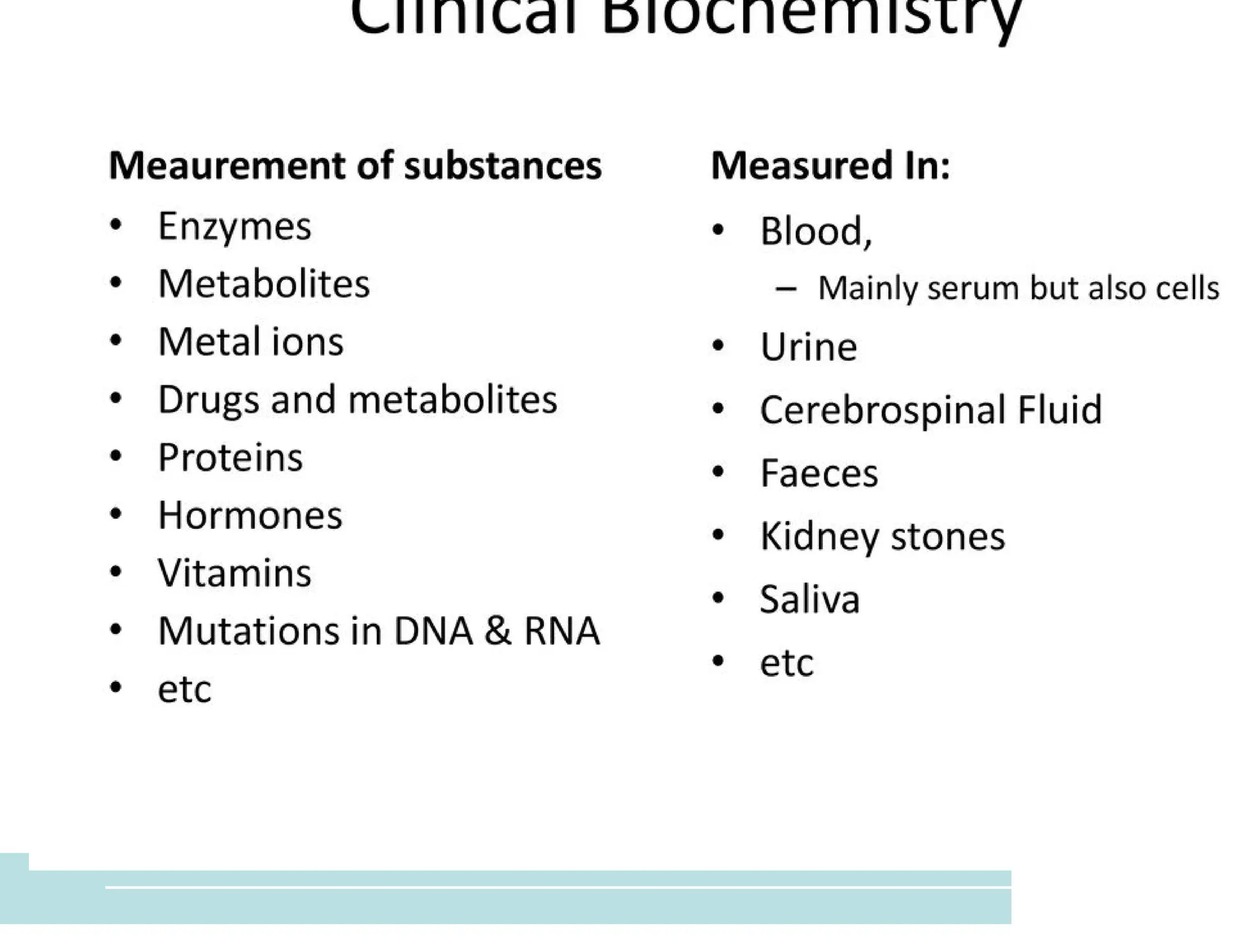
• • Determination can be qualitative or quantitative.
• • Quantitative determination of urea and creatinine in blood and urine help
in the assessment of kidney functioning..
• determination inorganic substances like Na, K, Ca, Cl...etc. or may be
enzymes or hormones in order to diagnose a disease by many methods as
manual , kit and automated .
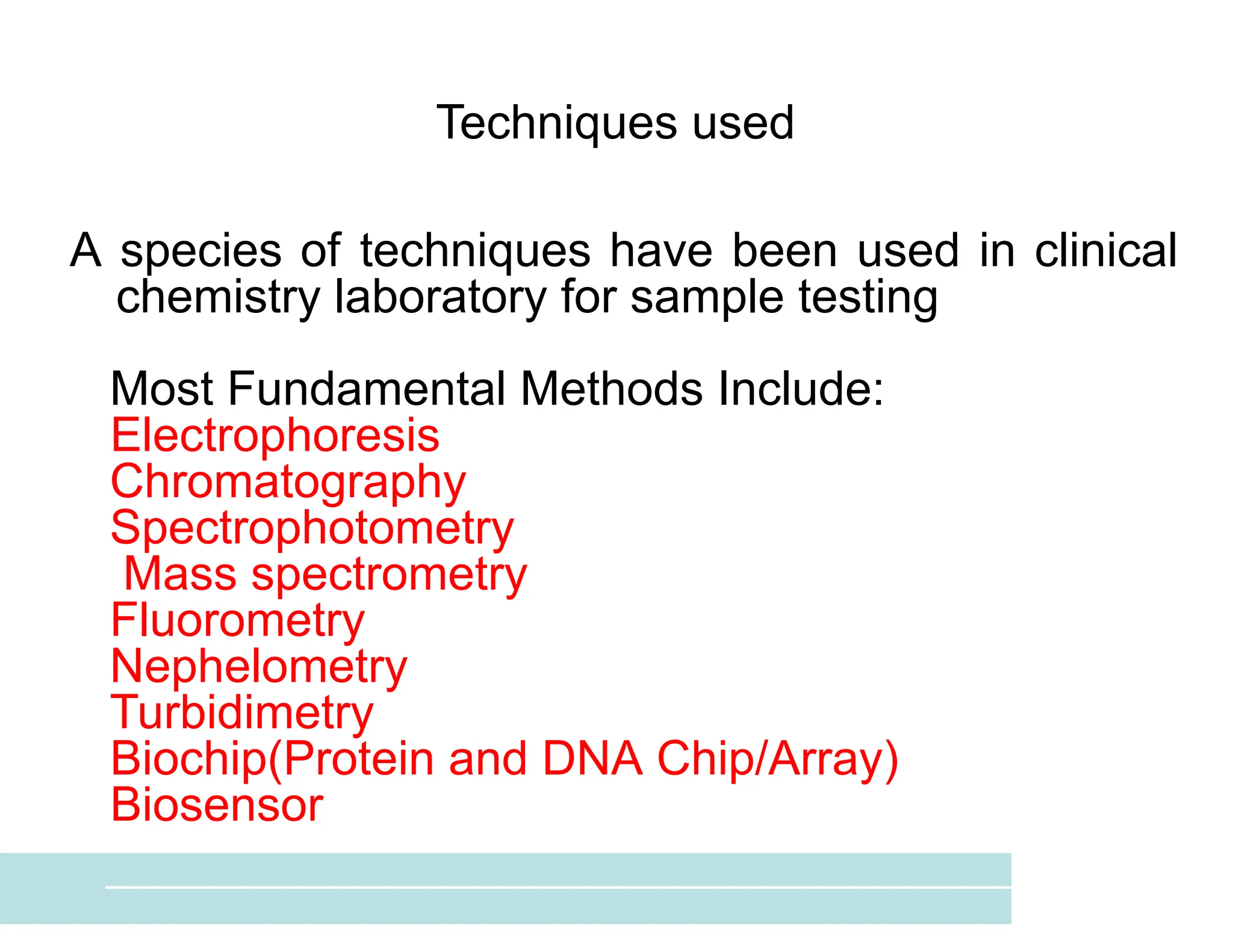
Techniques used
A species of techniques have been used in clinical
chemistry laboratory for sample testing
Most Fundamental Methods Include:
Electrophoresis
Chromatography
Spectrophotometry
Mass spectrometry
Fluorometry
Nephelometry
Turbidimetry
Biochip(Protein and DNA Chip/Array)
Biosensor
Safety measures in clinical biochemistry
laboratory
Safety is an important aspect of any clinical laboratory. Every clinical
laboratory must have a formal safety program to ensure a safe and
healthy working environment.
Personal equipments should not be kept on the working bench. Working
area should be disinfected before and after performing the work.
Hazards in a clinical laboratory can be broadly classified into chemical
hazards, electrical hazards, fire hazards & biohazards.
ELECTRICAL HAZARD AND ITS MANAGEMENT
• Electrical equipment should not be handled with wet hands, nor should
electrical equipment be used after liquid has been spilled on it.
• The equipment must be turned off immediately and dried thoroughly.
• Use of extension cords is Prohibited.
• Bodily damage by electric shock: The symptoms are fainting and asphyxia
• Before doing anything else, put off the main switch.
• Begin giving mouth to mouth respiration immediately
● BIOHAZARDS Can be infectious agents themselves or items
(solutions, specimens or objects) contaminated with anything that
can cause disease in humans regardless of its source. To operate a
clinical laboratory safely, it is essential to prevent the exposure of
laboratory workers to infectious agents such as the hepatitis B virus
(HBV) andthehuman immunodeficiency virus (HIV).
● Use proper biohazard disposal techniques (e.g., Red Bag) . Never
leave a discarded tube or infected material unattended or unlabeled.
● Periodically clean out freezer and dry-ice chests to remove broken
ampules and tubes of biological specimens
CHEMICAL HAZARDS AND ITS MANAGEMENT
● Common chemical hazards found in a lab are Explosives, Compressed gases, Flammables,
Oxidizers, Toxic materials, and Corrosive materials.
● FLAMMABLES: Substances which have a flash point or ignition point belowroomtemperature. E.g.
Oil and Gasoline, Ether etc. Storage rooms, cabinets and containersshould be specially designed
for such flammable liquids.
● COMBUSTIBLES: Flash point at or above room temperature. It is better to chooseacombustible
product over a flammable product if all other considerations are equal. Clearing agents offer this
choice.
● EXPLOSIVES: Picric acid forms dangerous salts with certain metals which explodewhen wet (5).
Avoid them altogether. Certain silver solutions, on ageing, explode byshaking. So never store these
solutions after use.
● OXIDATIVES: Oxidatives promote combustion in other materials, but are harmlessthemselves.
They have a risk of fire hazard when in contact with suitable material. E.g. Sodium iodate , Mercuric
oxides , Organic peroxides.
● TOXIC MATERIALS: Causes death by ingestion, skin contact or inhalation, at certain specific
concentration. E.g. Methanol- toxic, Formalin- toxic by ingestionandinhalation, Chromic acid,
Osmium tetroxide and Uranyl nitratehighly toxic.
● COMPRESSED GAS: Gas at room temperature (20°C) and pressure, packagedas apressurized
gas by compression or refrigeration and is usually quite heavy. Thepotential hazard of compressed
gases occurs when sudden rupturing of the container causes it to become a dangerous projectile. E.
g. Propane & Acetylene bottles.
● CORROSIVE MATERIALS: Causes destruction of living tissue or irreversiblealteration and destroy
materials e.g. Bleach, Battery Acid, Ammonia &HydrochloricAcid.
● IRRITANTS: Reversible inflammatory effects at the site of contact. Eyes, skinandrespiratory
passages are affected. Formalin is a skin and respiratory irritant.
● SENSITIZER: Causes allergic reaction. Sensitization lasts for life &gets worse withsubsequent
exposure. Formalin is a prime example.
Acid/Alkali splashes on the skin: Wash thoroughly; bath the affected skin with cotton wool soaked in 5%
aqueous sodium carbonate if acid and 5%acetic acid or undiluted vinegar, if alkali.
Acid/Alkali splashes in the eye: Water spray from a wash bottle or rubber bulb into the medial corner of the eye .
Put 4 drops of 2% Aqueous Sodiumbicarbonate into the eye, if acid, and saturated solution of boric acid, if alkali.
Swallowing acid: Make the patient drink some 5% soap solution immediately. Makehim gargle with the soap
solution. Give him 3 or 4 glasses of ordinary water. If thelips and tongue are burned by the acid, rinse thoroughly
with water. Bathe with2%aqueous sodium bicarbonate.
Swallowing alkalies: Make the patient drink 5% solution of acetic acid or lemon juice or dilute vinegar. Make him
gargle with the same acid solution. Give him3 or 4glasses of ordinary water. If the lips and tongue are burned by
the alkali, rinsethoroughly with water; bathe with 5% acetic acid.
Poisoning :Send for a physician or qualified nurse,specifying the toxic substanceinvolved. Place the victim in
the open air while waiting for the physician. Burns caused by heat: They fall into two categories Severe burns: If
the victim is on fire, roll him in a blanket or overall to smoothentheflames. Inform the physician. Lay the victim on
the ground. Do not remove hisclothing. Cover him if he is cold. Do not apply any treatment to the burns. This
must be left to the physician. Minor burns: Plunge the affected part into cold water or ice-water to soothe the
pain. Apply Mercurochrome or Acriflavine ointment to the burn. Apply dry gauze dressingloosely. If the burn
becomes infected or does not heal, refer the patient to a physician. Never tear off the blisters that form over the
burns.

introduction to clinical biochemistry (f).ppt.pdf

  • 1.
    Fundamental of Biochemistry:Objective ● Biochemistry is a basic science which deals with study the nature and behaviour of chemical constituents of living matter and the biochemical reactions and processes they undergo. ● Any deficit or derangement in its function leads to disease. ● Thus, the knowledge of its principles helps define the health status – aiding in diagnosis, treatment and monitoring of disease.
  • 2.
    Introduction to clinicalbiochemistry in Medical Lab Science ● Clinical biochemistry is that branch of laboratory medicine in which chemical and biochemical methods are applied to the study of disease ● Clinical biochemistry plays a crucial role in the identification and monitoring of disease. ● By measuring the levels of biochemical markers in bodily fluids, healthcare professionals can detect the presence of disease, monitor its progression, and evaluate the effectiveness of treatments. ● It provide students with advanced knowledge of biochemical basis of disease, specialized laboratory testing and associated analytical methods and interpretation and communication of biochemical data as applied in the current clinical biochemistry laboratory. ● Clinical Biochemistry: is the application part of Biochemistry for diagnosis of the clinical condition by determining various constituents in different body fluids
  • 3.
    Purpose of ClinicalChemistry Tests • The results of qualitative and quantitative analysis of body fluids assist the clinicians in the diagnosis, treatment and prevention of the disease and drug monitoring, tissue and organ transplantation, forensic investigations and so on. • Advances in technology and instrumentation have made clinical biochemistry more accessible and reliable, allowing for faster and more accurate diagnoses.
  • 4.
    Purpose of ClinicalChemistry Tests • Note:- Modern day medical practice is highly dependent on the laboratory analysis of body fluids, especially the blood. The disease manifestations are reflected in the composition of blood and other tissues. • Hence, the demarcation of abnormal from normal constituents of the body is another aim of the study of clinical biochemistry. • • Determination can be qualitative or quantitative. • • Quantitative determination of urea and creatinine in blood and urine help in the assessment of kidney functioning.. • determination inorganic substances like Na, K, Ca, Cl...etc. or may be enzymes or hormones in order to diagnose a disease by many methods as manual , kit and automated .
  • 8.
    Techniques used A speciesof techniques have been used in clinical chemistry laboratory for sample testing Most Fundamental Methods Include: Electrophoresis Chromatography Spectrophotometry Mass spectrometry Fluorometry Nephelometry Turbidimetry Biochip(Protein and DNA Chip/Array) Biosensor
  • 15.
    Safety measures inclinical biochemistry laboratory Safety is an important aspect of any clinical laboratory. Every clinical laboratory must have a formal safety program to ensure a safe and healthy working environment. Personal equipments should not be kept on the working bench. Working area should be disinfected before and after performing the work. Hazards in a clinical laboratory can be broadly classified into chemical hazards, electrical hazards, fire hazards & biohazards.
  • 18.
    ELECTRICAL HAZARD ANDITS MANAGEMENT • Electrical equipment should not be handled with wet hands, nor should electrical equipment be used after liquid has been spilled on it. • The equipment must be turned off immediately and dried thoroughly. • Use of extension cords is Prohibited. • Bodily damage by electric shock: The symptoms are fainting and asphyxia • Before doing anything else, put off the main switch. • Begin giving mouth to mouth respiration immediately
  • 19.
    ● BIOHAZARDS Canbe infectious agents themselves or items (solutions, specimens or objects) contaminated with anything that can cause disease in humans regardless of its source. To operate a clinical laboratory safely, it is essential to prevent the exposure of laboratory workers to infectious agents such as the hepatitis B virus (HBV) andthehuman immunodeficiency virus (HIV). ● Use proper biohazard disposal techniques (e.g., Red Bag) . Never leave a discarded tube or infected material unattended or unlabeled. ● Periodically clean out freezer and dry-ice chests to remove broken ampules and tubes of biological specimens
  • 21.
    CHEMICAL HAZARDS ANDITS MANAGEMENT ● Common chemical hazards found in a lab are Explosives, Compressed gases, Flammables, Oxidizers, Toxic materials, and Corrosive materials. ● FLAMMABLES: Substances which have a flash point or ignition point belowroomtemperature. E.g. Oil and Gasoline, Ether etc. Storage rooms, cabinets and containersshould be specially designed for such flammable liquids. ● COMBUSTIBLES: Flash point at or above room temperature. It is better to chooseacombustible product over a flammable product if all other considerations are equal. Clearing agents offer this choice. ● EXPLOSIVES: Picric acid forms dangerous salts with certain metals which explodewhen wet (5). Avoid them altogether. Certain silver solutions, on ageing, explode byshaking. So never store these solutions after use. ● OXIDATIVES: Oxidatives promote combustion in other materials, but are harmlessthemselves. They have a risk of fire hazard when in contact with suitable material. E.g. Sodium iodate , Mercuric oxides , Organic peroxides. ● TOXIC MATERIALS: Causes death by ingestion, skin contact or inhalation, at certain specific concentration. E.g. Methanol- toxic, Formalin- toxic by ingestionandinhalation, Chromic acid, Osmium tetroxide and Uranyl nitratehighly toxic. ● COMPRESSED GAS: Gas at room temperature (20°C) and pressure, packagedas apressurized gas by compression or refrigeration and is usually quite heavy. Thepotential hazard of compressed gases occurs when sudden rupturing of the container causes it to become a dangerous projectile. E. g. Propane & Acetylene bottles. ● CORROSIVE MATERIALS: Causes destruction of living tissue or irreversiblealteration and destroy materials e.g. Bleach, Battery Acid, Ammonia &HydrochloricAcid. ● IRRITANTS: Reversible inflammatory effects at the site of contact. Eyes, skinandrespiratory passages are affected. Formalin is a skin and respiratory irritant. ● SENSITIZER: Causes allergic reaction. Sensitization lasts for life &gets worse withsubsequent exposure. Formalin is a prime example.
  • 22.
    Acid/Alkali splashes onthe skin: Wash thoroughly; bath the affected skin with cotton wool soaked in 5% aqueous sodium carbonate if acid and 5%acetic acid or undiluted vinegar, if alkali. Acid/Alkali splashes in the eye: Water spray from a wash bottle or rubber bulb into the medial corner of the eye . Put 4 drops of 2% Aqueous Sodiumbicarbonate into the eye, if acid, and saturated solution of boric acid, if alkali. Swallowing acid: Make the patient drink some 5% soap solution immediately. Makehim gargle with the soap solution. Give him 3 or 4 glasses of ordinary water. If thelips and tongue are burned by the acid, rinse thoroughly with water. Bathe with2%aqueous sodium bicarbonate. Swallowing alkalies: Make the patient drink 5% solution of acetic acid or lemon juice or dilute vinegar. Make him gargle with the same acid solution. Give him3 or 4glasses of ordinary water. If the lips and tongue are burned by the alkali, rinsethoroughly with water; bathe with 5% acetic acid. Poisoning :Send for a physician or qualified nurse,specifying the toxic substanceinvolved. Place the victim in the open air while waiting for the physician. Burns caused by heat: They fall into two categories Severe burns: If the victim is on fire, roll him in a blanket or overall to smoothentheflames. Inform the physician. Lay the victim on the ground. Do not remove hisclothing. Cover him if he is cold. Do not apply any treatment to the burns. This must be left to the physician. Minor burns: Plunge the affected part into cold water or ice-water to soothe the pain. Apply Mercurochrome or Acriflavine ointment to the burn. Apply dry gauze dressingloosely. If the burn becomes infected or does not heal, refer the patient to a physician. Never tear off the blisters that form over the burns.