)
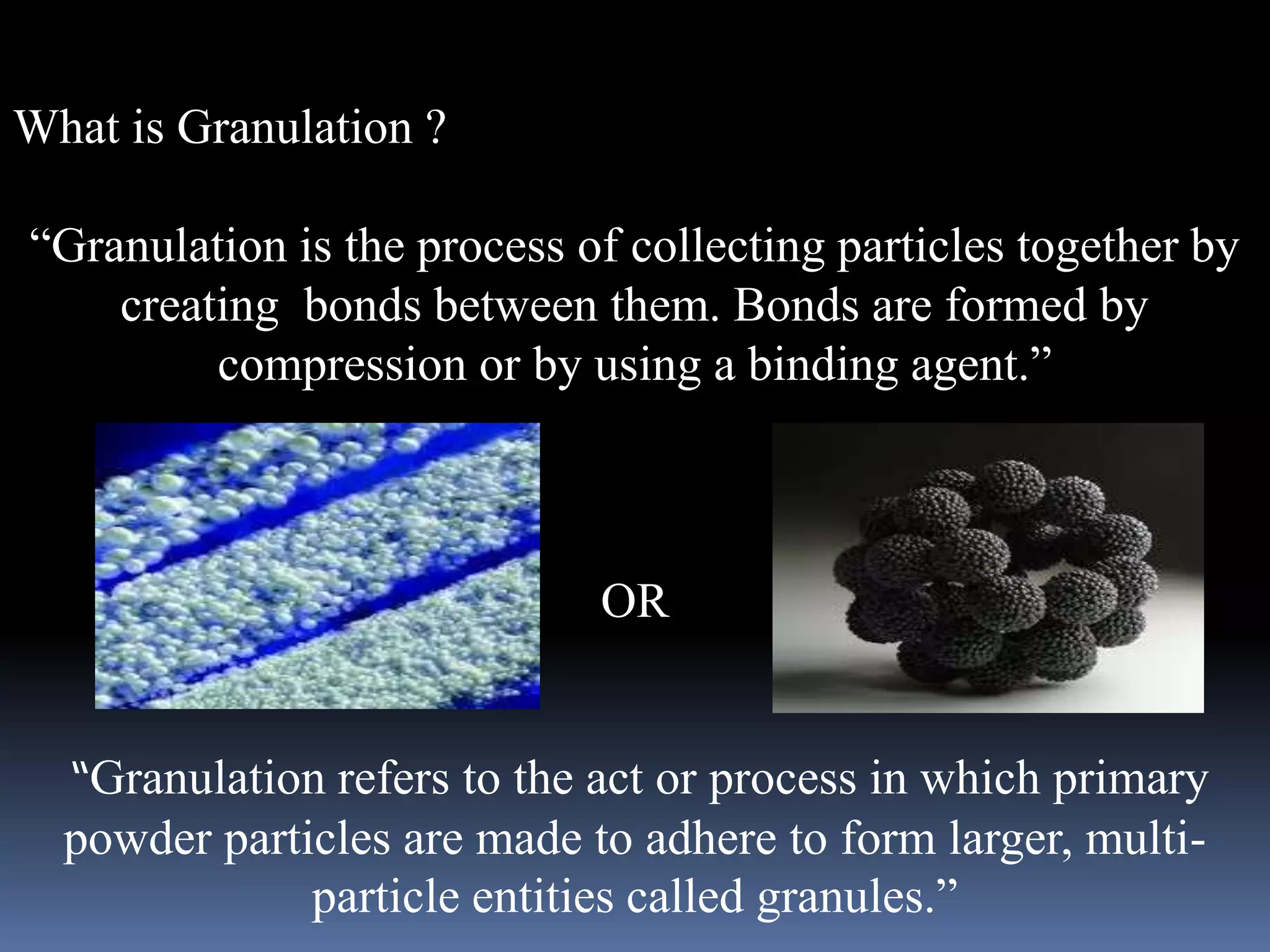
What is Granulation ? 
“Granulation is the process of collecting particles together by 
creating bonds between them. Bonds are formed by 
compression or by using a binding agent.” 
OR 
“Granulation refers to the act or process in which primary 
powder particles are made to adhere to form larger, multi-particle 
entities called granules.”
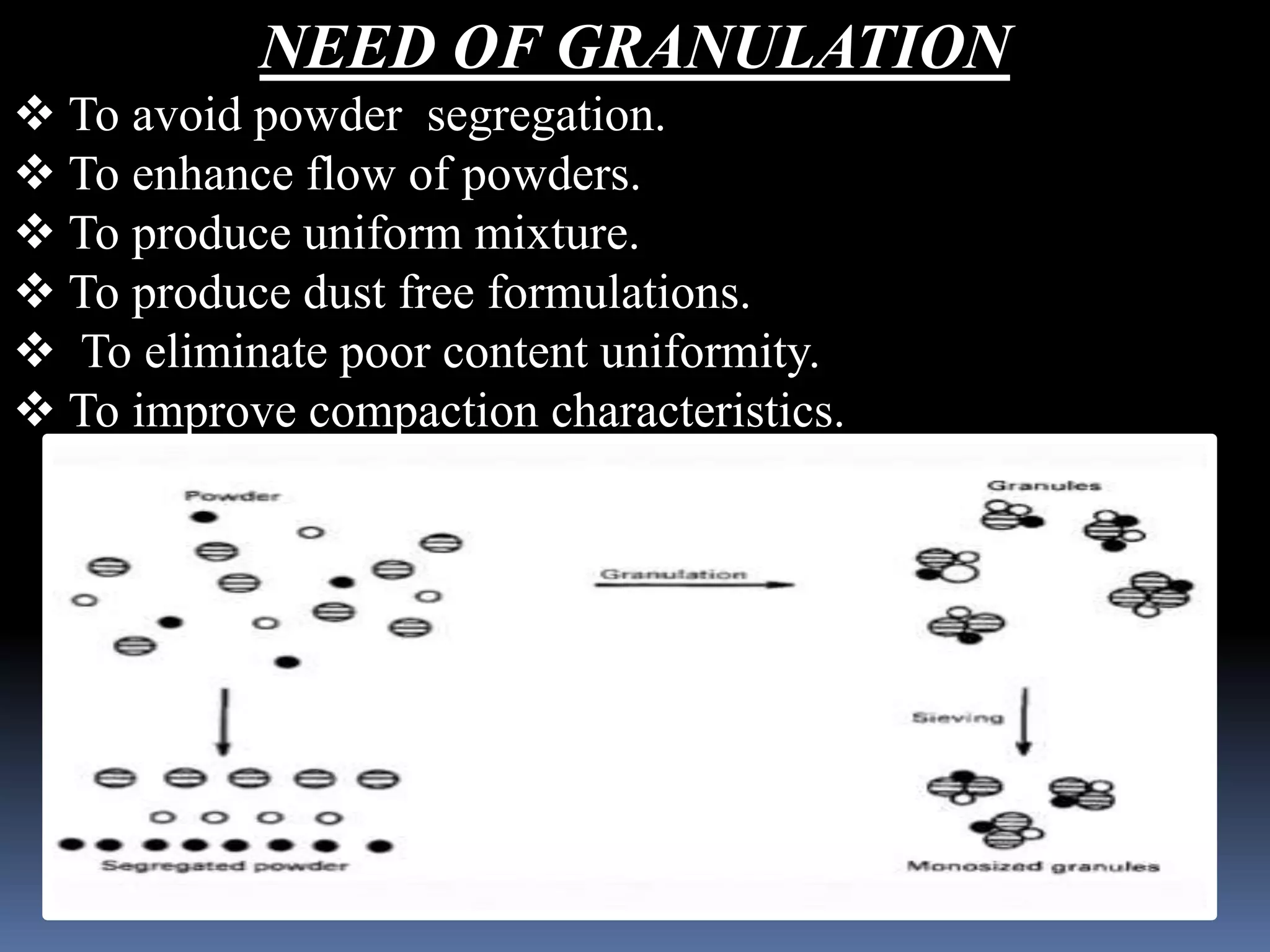
NEED OF GRANULATION 
 To avoid powder segregation. 
 To enhance flow of powders. 
 To produce uniform mixture. 
 To produce dust free formulations. 
 To eliminate poor content uniformity. 
 To improve compaction characteristics.
TECHNIQUES FOR 
GRANULATION PROCESS 
Following are frequently used techniques employed in 
industries for tablet manufacturing. 
Wet Granulation 
 Dry Granulation 
 Direct Compression
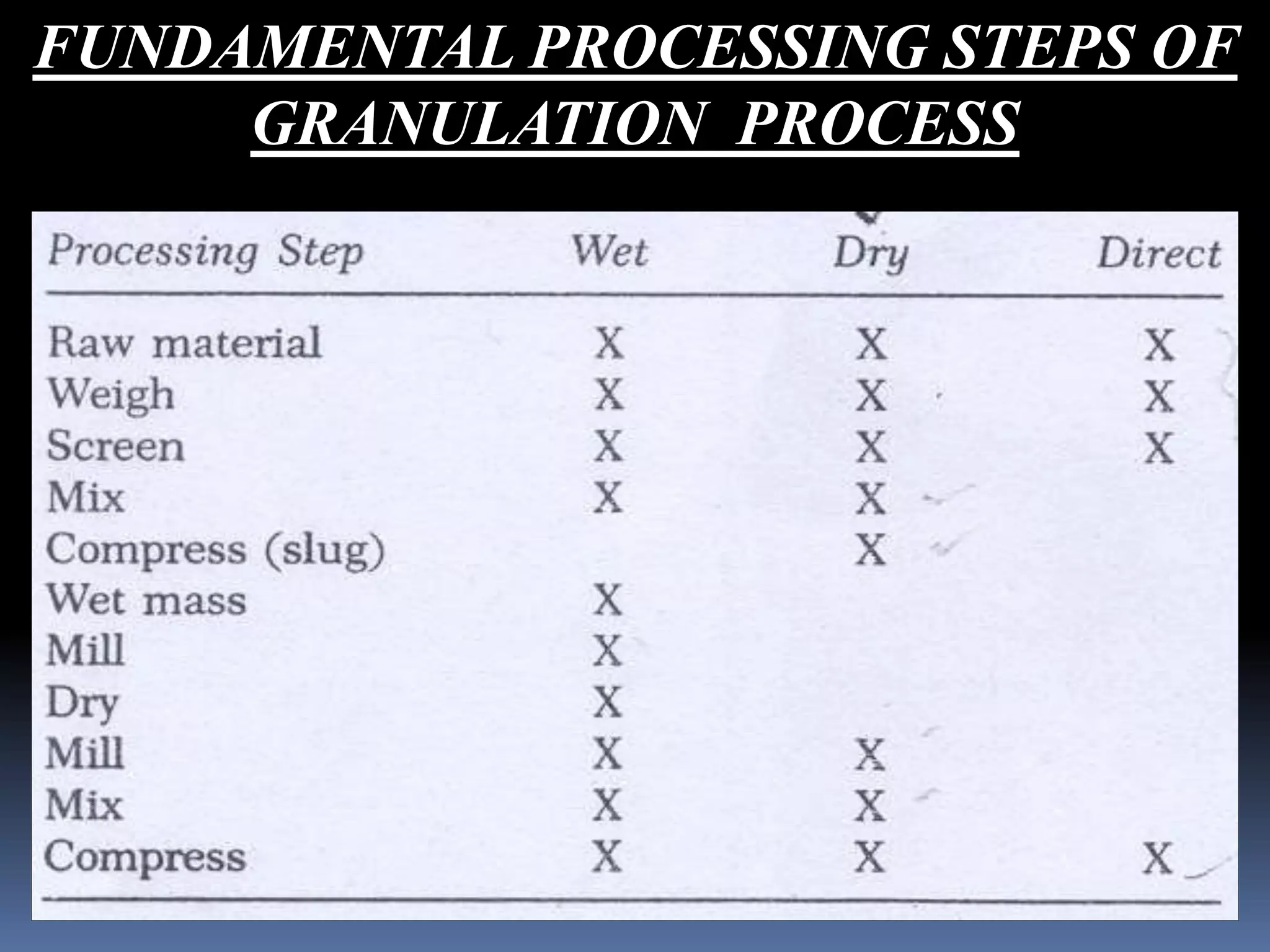
FUNDAMENTAL PROCESSING STEPS OF 
GRANULATION PROCESS
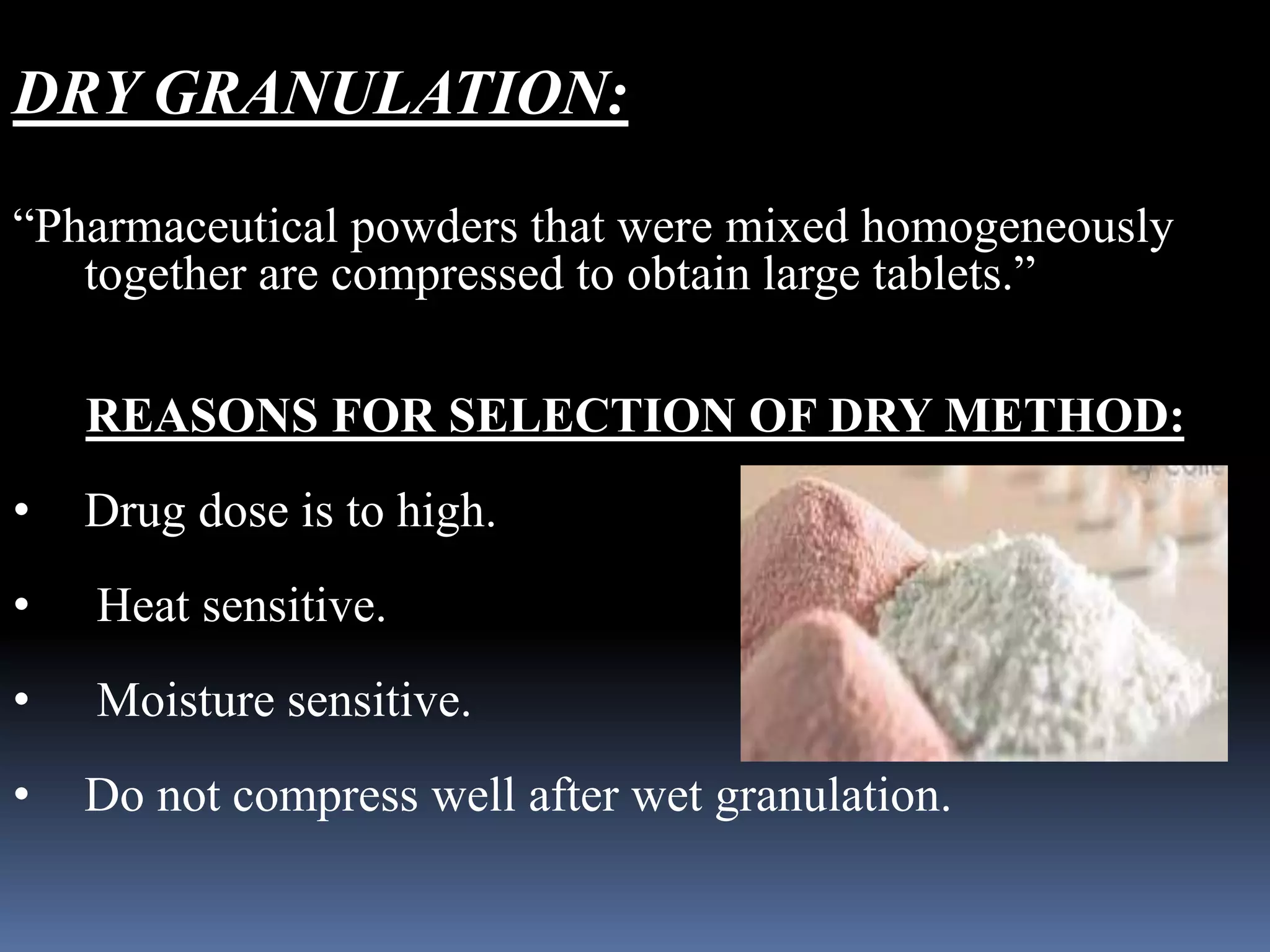
DRY GRANULATION: 
“Pharmaceutical powders that were mixed homogeneously 
together are compressed to obtain large tablets.” 
REASONS FOR SELECTION OF DRY METHOD: 
• Drug dose is to high. 
• Heat sensitive. 
• Moisture sensitive. 
• Do not compress well after wet granulation.
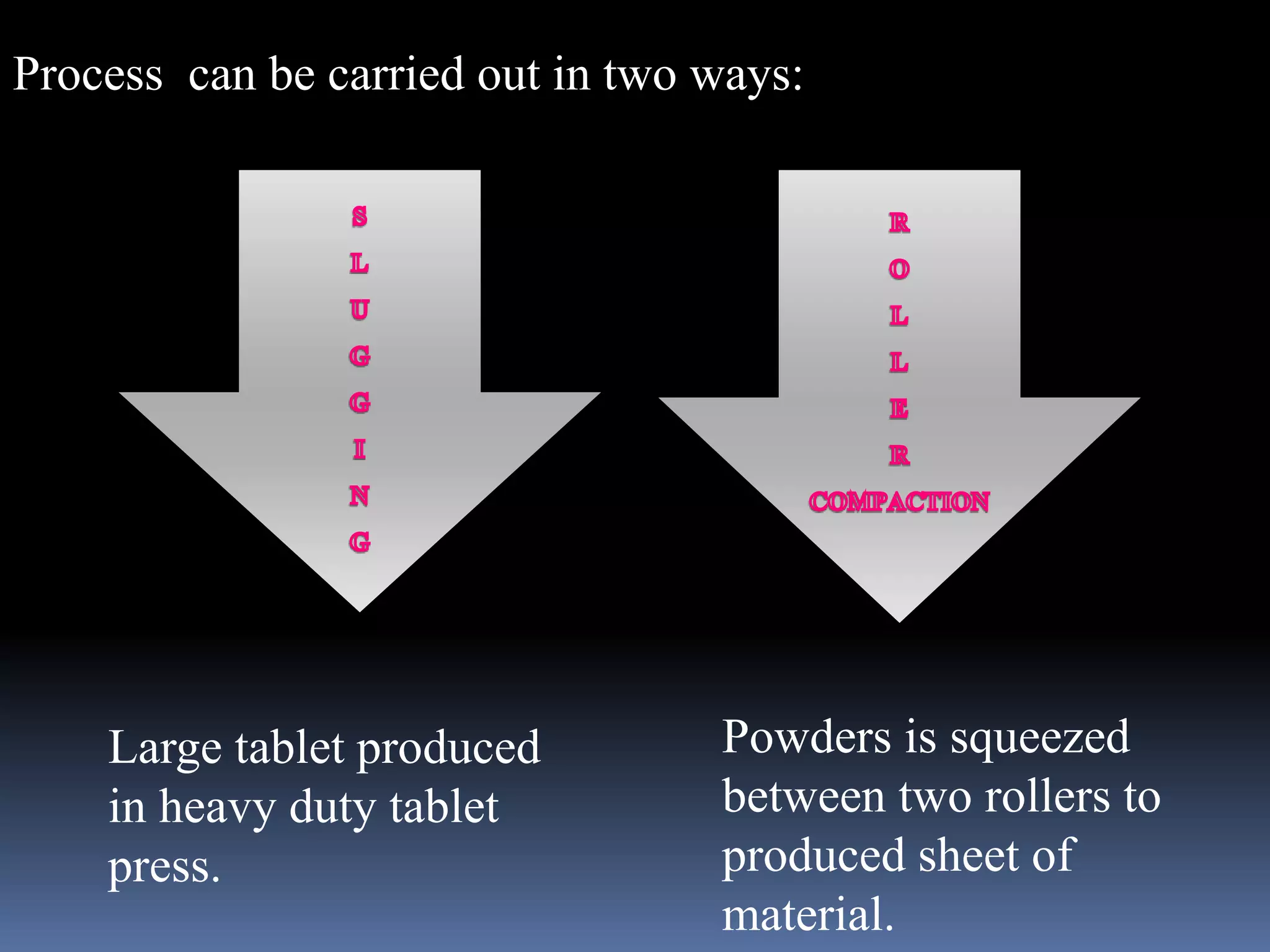
Process can be carried out in two ways: 
Large tablet produced 
in heavy duty tablet 
press. 
Powders is squeezed 
between two rollers to 
produced sheet of 
material.
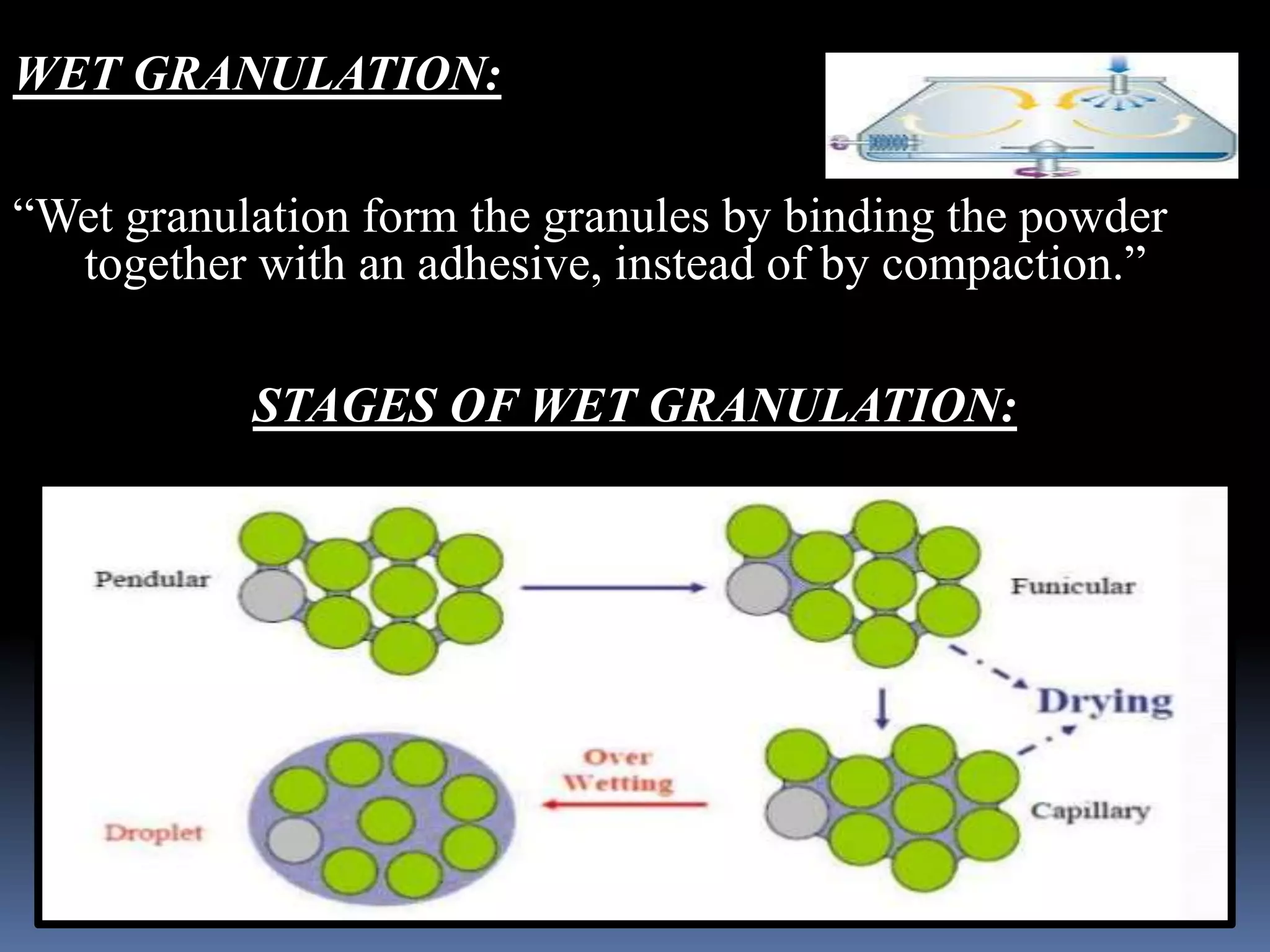
WET GRANULATION: 
“Wet granulation form the granules by binding the powder 
together with an adhesive, instead of by compaction.” 
STAGES OF WET GRANULATION:
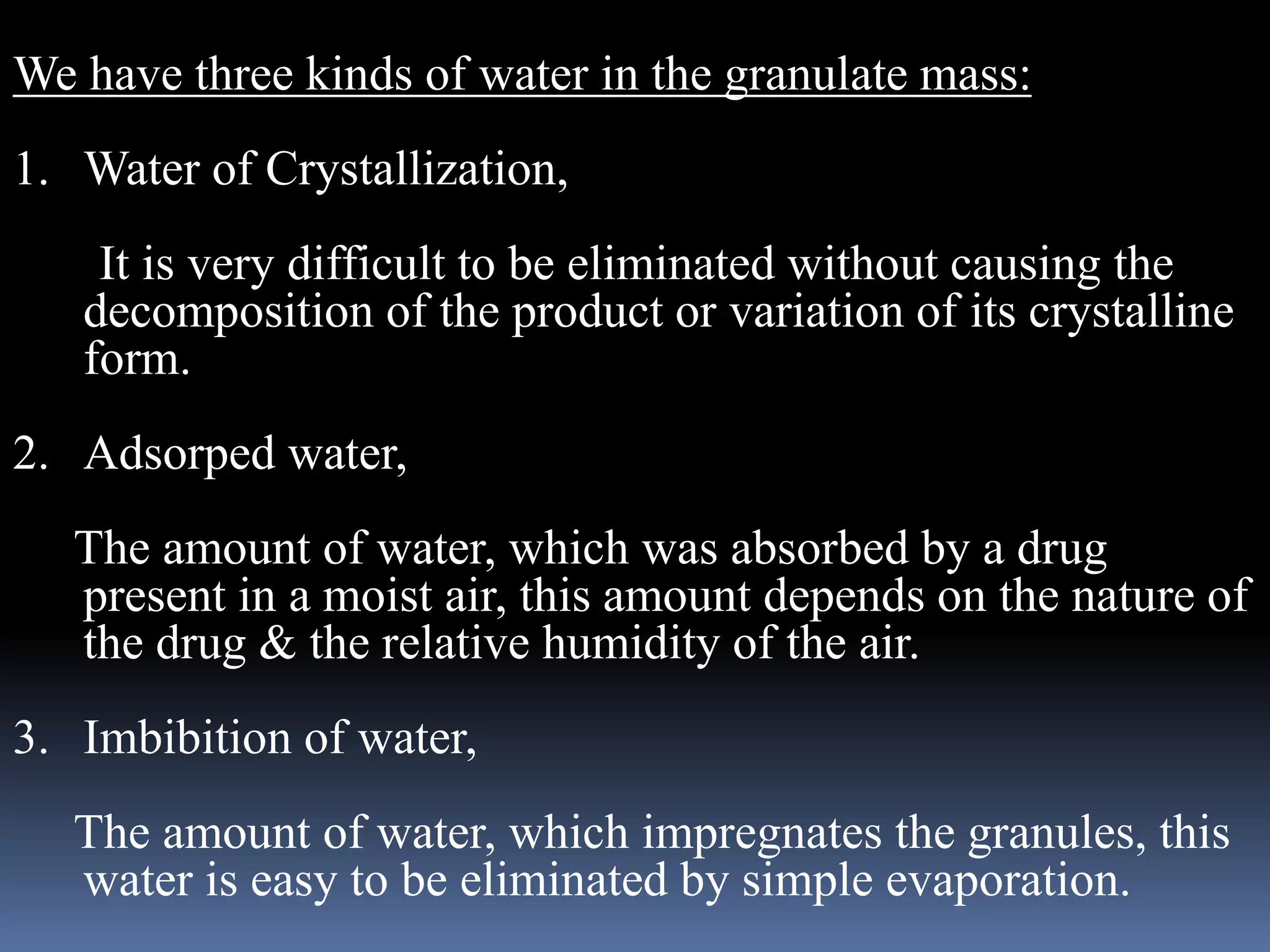
We have three kinds of water in the granulate mass: 
1. Water of Crystallization, 
It is very difficult to be eliminated without causing the 
decomposition of the product or variation of its crystalline 
form. 
2. Adsorped water, 
The amount of water, which was absorbed by a drug 
present in a moist air, this amount depends on the nature of 
the drug & the relative humidity of the air. 
3. Imbibition of water, 
The amount of water, which impregnates the granules, this 
water is easy to be eliminated by simple evaporation.
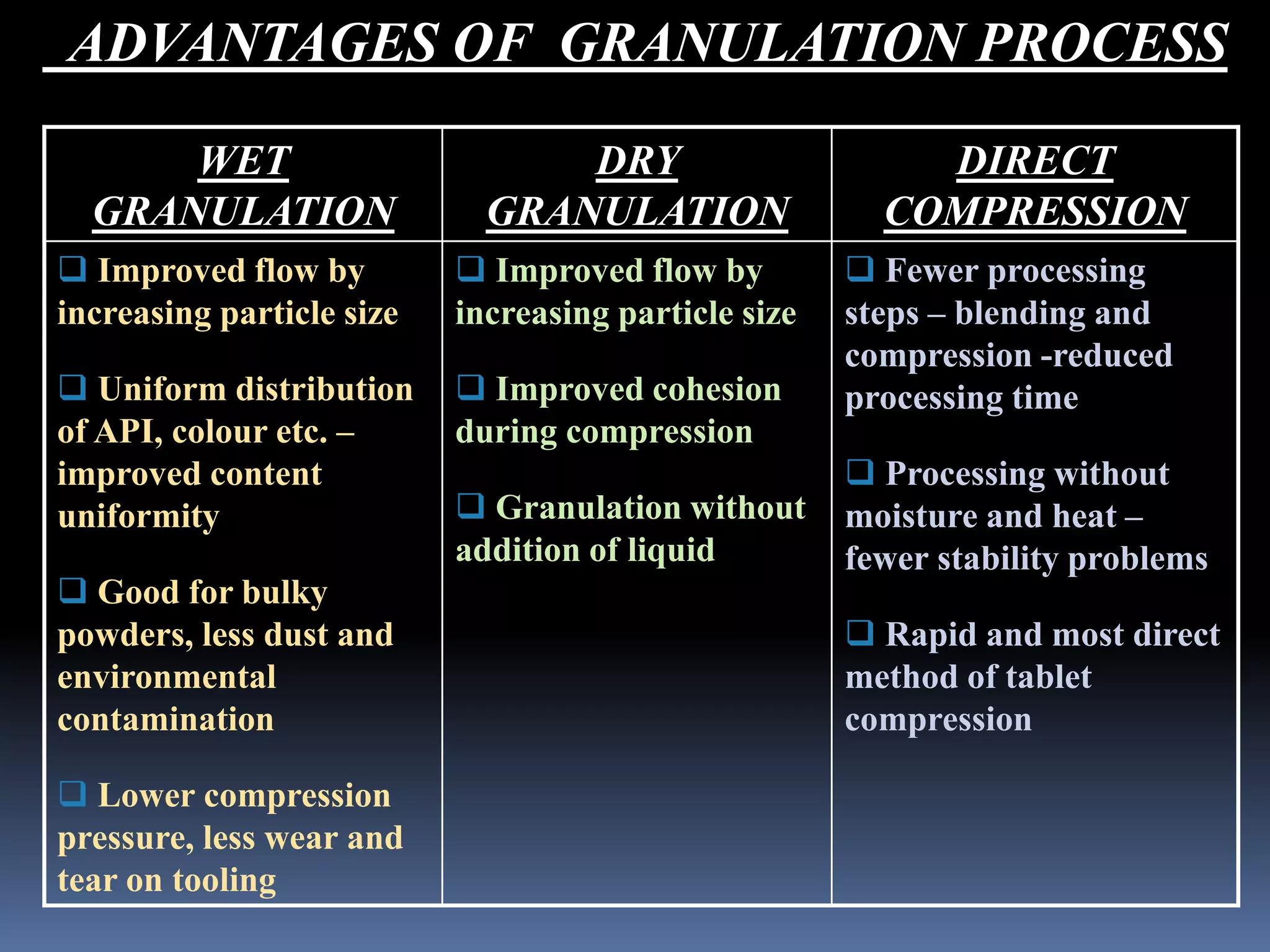
ADVANTAGES OF GRANULATION PROCESS 
DIRECT 
COMPRESSION 
DRY 
GRANULATION 
WET 
GRANULATION 
 Fewer processing 
steps – blending and 
compression -reduced 
processing time 
 Processing without 
moisture and heat – 
fewer stability problems 
 Rapid and most direct 
method of tablet 
compression 
 Improved flow by 
increasing particle size 
 Improved cohesion 
during compression 
 Granulation without 
addition of liquid 
 Improved flow by 
increasing particle size 
 Uniform distribution 
of API, colour etc. – 
improved content 
uniformity 
 Good for bulky 
powders, less dust and 
environmental 
contamination 
 Lower compression 
pressure, less wear and 
tear on tooling
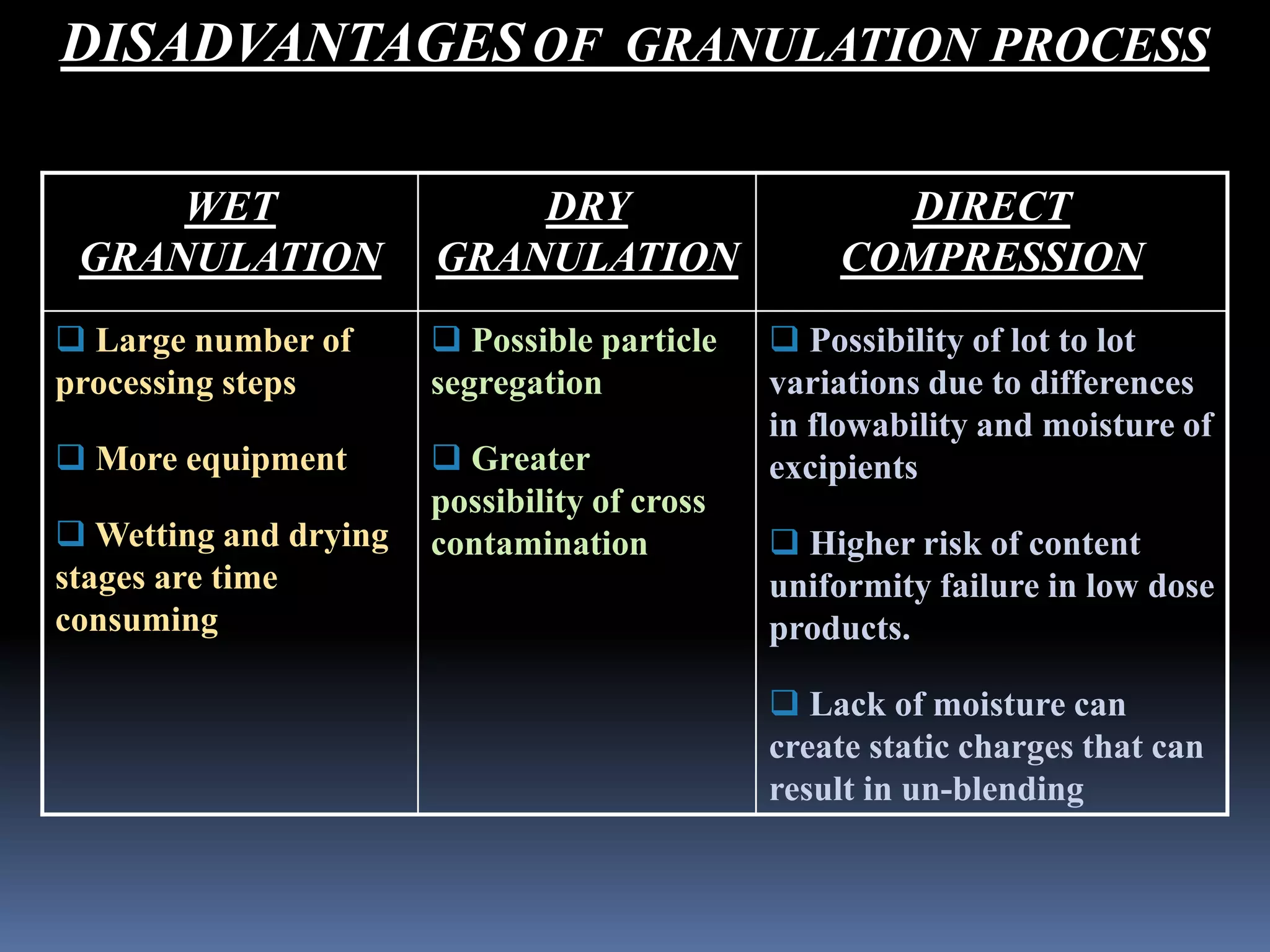
DISADVANTAGESOF GRANULATION PROCESS 
DIRECT 
COMPRESSION 
DRY 
GRANULATION 
WET 
GRANULATION 
 Possibility of lot to lot 
variations due to differences 
in flowability and moisture of 
excipients 
 Higher risk of content 
uniformity failure in low dose 
products. 
 Lack of moisture can 
create static charges that can 
result in un-blending 
 Possible particle 
segregation 
 Greater 
possibility of cross 
contamination 
 Large number of 
processing steps 
 More equipment 
Wetting and drying 
stages are time 
consuming
 Steam Granulation 
 Melt Granulation / Thermoplastic Granulation 
 Moisture Activated Dry Granulation (MADG) 
 Moist Granulation Technique (MGT) 
Thermal Adhesion Granulation Process (TAGP) 
 Foam Granulation
STEAM GRANULATION 
It is a modification of wet granulation; steam is used as a 
binder instead of water; granules are more spherical and 
exhibit higher rate of dissolution. 
MELT GRANULATION 
Granulation is achieved by the addition of meltable binder i.e. 
binder is in solid state at room temperature but melts in the 
temperature range of 50 – 80˚C e.g. PEG (water soluble), 
stearic acid, cetyl or stearyl alcohol (water insoluble). 
However drying phase unnecessary since dried granules are 
obtained by cooling them to room temperature.
MOISTURE ACTIVATED DRY GRANULATION (MADG): 
Involves distribution of moisture to induce agglomeration – 
drying time is reduced. 
MOIST GRANULATION TECHNIQUE (MGT) 
A small amount of granulating fluid is added to activate dry 
binder and to facilitate agglomeration. Then a moisture 
absorbing material like Microcrystalline Cellulose (MCC) is 
added to absorb any excess moisture making drying step 
unnecessary. Mainly employed for controlled release 
formulations.
THERMAL ADHESION GRANULATION PROCESS 
(TAGP) 
Granules are prepared by moisturizing excipient mixtures with 
very little solvent in a closed system (tumble mixing) with low 
heating – mainly employed for preparing direct compression 
formulations 
FOAM GRANULATION 
Binders are added as aqueous foam.
Granulation
Granulation

Granulation

  • 2.
  • 3.
    What is Granulation? “Granulation is the process of collecting particles together by creating bonds between them. Bonds are formed by compression or by using a binding agent.” OR “Granulation refers to the act or process in which primary powder particles are made to adhere to form larger, multi-particle entities called granules.”
  • 4.
    NEED OF GRANULATION  To avoid powder segregation.  To enhance flow of powders.  To produce uniform mixture.  To produce dust free formulations.  To eliminate poor content uniformity.  To improve compaction characteristics.
  • 5.
    TECHNIQUES FOR GRANULATIONPROCESS Following are frequently used techniques employed in industries for tablet manufacturing. Wet Granulation  Dry Granulation  Direct Compression
  • 6.
    FUNDAMENTAL PROCESSING STEPSOF GRANULATION PROCESS
  • 7.
    DRY GRANULATION: “Pharmaceuticalpowders that were mixed homogeneously together are compressed to obtain large tablets.” REASONS FOR SELECTION OF DRY METHOD: • Drug dose is to high. • Heat sensitive. • Moisture sensitive. • Do not compress well after wet granulation.
  • 8.
    Process can becarried out in two ways: Large tablet produced in heavy duty tablet press. Powders is squeezed between two rollers to produced sheet of material.
  • 9.
    WET GRANULATION: “Wetgranulation form the granules by binding the powder together with an adhesive, instead of by compaction.” STAGES OF WET GRANULATION:
  • 10.
    We have threekinds of water in the granulate mass: 1. Water of Crystallization, It is very difficult to be eliminated without causing the decomposition of the product or variation of its crystalline form. 2. Adsorped water, The amount of water, which was absorbed by a drug present in a moist air, this amount depends on the nature of the drug & the relative humidity of the air. 3. Imbibition of water, The amount of water, which impregnates the granules, this water is easy to be eliminated by simple evaporation.
  • 11.
    ADVANTAGES OF GRANULATIONPROCESS DIRECT COMPRESSION DRY GRANULATION WET GRANULATION  Fewer processing steps – blending and compression -reduced processing time  Processing without moisture and heat – fewer stability problems  Rapid and most direct method of tablet compression  Improved flow by increasing particle size  Improved cohesion during compression  Granulation without addition of liquid  Improved flow by increasing particle size  Uniform distribution of API, colour etc. – improved content uniformity  Good for bulky powders, less dust and environmental contamination  Lower compression pressure, less wear and tear on tooling
  • 12.
    DISADVANTAGESOF GRANULATION PROCESS DIRECT COMPRESSION DRY GRANULATION WET GRANULATION  Possibility of lot to lot variations due to differences in flowability and moisture of excipients  Higher risk of content uniformity failure in low dose products.  Lack of moisture can create static charges that can result in un-blending  Possible particle segregation  Greater possibility of cross contamination  Large number of processing steps  More equipment Wetting and drying stages are time consuming
  • 13.
     Steam Granulation  Melt Granulation / Thermoplastic Granulation  Moisture Activated Dry Granulation (MADG)  Moist Granulation Technique (MGT) Thermal Adhesion Granulation Process (TAGP)  Foam Granulation
  • 14.
    STEAM GRANULATION Itis a modification of wet granulation; steam is used as a binder instead of water; granules are more spherical and exhibit higher rate of dissolution. MELT GRANULATION Granulation is achieved by the addition of meltable binder i.e. binder is in solid state at room temperature but melts in the temperature range of 50 – 80˚C e.g. PEG (water soluble), stearic acid, cetyl or stearyl alcohol (water insoluble). However drying phase unnecessary since dried granules are obtained by cooling them to room temperature.
  • 15.
    MOISTURE ACTIVATED DRYGRANULATION (MADG): Involves distribution of moisture to induce agglomeration – drying time is reduced. MOIST GRANULATION TECHNIQUE (MGT) A small amount of granulating fluid is added to activate dry binder and to facilitate agglomeration. Then a moisture absorbing material like Microcrystalline Cellulose (MCC) is added to absorb any excess moisture making drying step unnecessary. Mainly employed for controlled release formulations.
  • 16.
    THERMAL ADHESION GRANULATIONPROCESS (TAGP) Granules are prepared by moisturizing excipient mixtures with very little solvent in a closed system (tumble mixing) with low heating – mainly employed for preparing direct compression formulations FOAM GRANULATION Binders are added as aqueous foam.