Behaviour
Management
BY – SUMAN TIWARI ( M.Sc.,M.Ed.)
To clarify the behaviour problem concept and
some of the behaviour problems faced in the
classroom .
Five Primary cause of Misbehaviour.
General principles of crisis Intervention.
Five guidelines for handling common
misbehaviours.
Behaviour Management models.
 Why to manage behaviour?
Objectives
Any behaviour that undermines the teacher’s ability to
establish and maintain effective learning experience in
the class. When students disrupt the learning
environment , it takes up teaching time and affects the
quality of the students learning experience.
Behaviour Problem
 It includes creating a positive environment for
learning and uses strategies that encourage positive
behaviour in schools. It also involves a range of
strategies to reduce the chance of poor or antisocial
behaviour. Behaviour Management is also about
having effective ways to deal with poor behaviour so
that students can learn from their mistakes and at the
same time, take responsibility for wrong doing.
 Think for a while for the challenging
behaviour you have faced in your
classroom!!!!
Lack of respect
Paying no heed
Incessant talk
Rude talk/ Answering back
Note passing
Naming is blaming
Stealing/Lying
Swearing
Poor homework
Bullying
Some of the behavioural problems
faced in the classroom
Five Primary causes of
Misbehaviour
Boredom:
Teaching strategies, Instructional practices, Use
manipulative, Group & pair activities, Avoid pen/paper
use white boards, Use card games, free time/break in
between.
Need for attention:
More attention to quiet students, Task to spotlight
students.
Chronic Lying and Stealing- keep evidence, one on one
meeting, Counselling.
Power:
Leads to aggression. More-Engage them in helping
others, tattling- making others feel inferior.
Struggle- Needs encouragement and validation.
Revenge:
Feel like don’t belong. Always complain about
rules and not being fair
Needs: Build trust, Reflective listening, Utilise their
strengths and explain to them that it will cost them.
Note writing- Take signature as a proof for future
record.
Self- confidence:
Too much- Task and responsibility.
Not enough- Encourage, Give easy task, Do not
pity instead set up opportunity for their success,
Pair them with someone who can help them, Put
them in win-win situation.
Activity:
Challenging
Scenarios....
General Principles of Behaviour
Crisis Intervention
Early Intervention:
Catch potentially explosive situations as soon as possible. Look
for clues- Students tone, Body language, isolation and time
out allowances only work if the student clearly understands
why it is being allowed.
Communication:
Teacher should tell what behaviour is
expected rather than focusing on what he/she
is doing.
Focus Area
“primary”
Intrude on the learning process
Infringe safety (physical or psychological)
Ignore respectful and dignified treatment of others
“secondary”
non verbal- Pulling a face, Sulking, Sighing or tutting
Verbal-“the last word syndrome” -direct riposte/response
from the child to “defend” their position
Example-“I was only……..
“He’s doing it too”
“No body else minds when we…..”
(disrespectful tone of voice!!!)
Five Guidelines for Handling
Common Misbehaviours
1. Negotiate
(Give option/ guidelines and let them choose, never
humiliate, some control to students )
2. Deal with Problems quickly
( Use few words, reoccurring problem keep record, use 3star)
3. Use direct language
(Tell what you want)
4. Know Your Bottom Line
( Aware of school policy, when to call
the parents, when to send a student to the principal)
5. Follow up
(talking to the offending student, express something
positive but make a connection, document problems
throughout the year- Anecdotal)
Activity Time
Role Play...
It’s a Game Time...
Behaviour Management
models
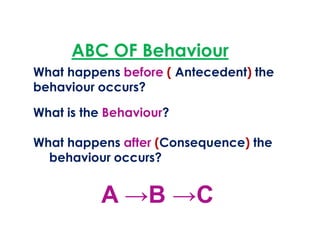
What happens before ( Antecedent) the
behaviour occurs?
What is the Behaviour?
What happens after (Consequence) the
behaviour occurs?
A →B →C
ABC OF Behaviour
Reinforcing Consequence
A →B →C
If the consequence is
rewarding/desired.
Behaviour will continue in the Future
Positive Reinforcement
( Get something good )
Negative Reinforcement
( Avoid something good )
Penality
( Lose something good )
Sanction
( Get something bad )
Increase
Behaviour
Decrease
Behaviour
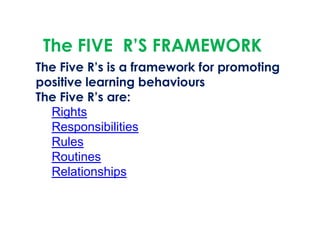
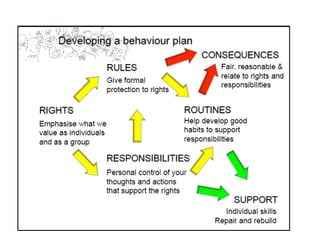
The Five R’s is a framework for promoting
positive learning behaviours
The Five R’s are:
Rights
Responsibilities
Rules
Routines
Relationships
The FIVE R’S FRAMEWORK
Why to Manage Behaviour?
 To create a climate where learning can flourish.
 To protect basic rights of safety, learning and
respect.
 To set the boundaries in which children can feel
successful.
 To teach children about socially appropriate
and acceptable choices.
Activity Time
Case Study...
Summary...
Positive Note
“The most effective strategies will fail to
impact students in the absence of sincerity,
respect, and obvious joy in teaching
• So…….enjoy being a teacher
&
• Focus on the student, not the behaviour.
• Adapt the environment and your teaching.
• Stay calm and be positive.
Behaviour management workshop

Behaviour management workshop

  • 1.
    Behaviour Management BY – SUMANTIWARI ( M.Sc.,M.Ed.)
  • 2.
    To clarify thebehaviour problem concept and some of the behaviour problems faced in the classroom . Five Primary cause of Misbehaviour. General principles of crisis Intervention. Five guidelines for handling common misbehaviours. Behaviour Management models.  Why to manage behaviour? Objectives
  • 3.
    Any behaviour thatundermines the teacher’s ability to establish and maintain effective learning experience in the class. When students disrupt the learning environment , it takes up teaching time and affects the quality of the students learning experience. Behaviour Problem
  • 4.
     It includescreating a positive environment for learning and uses strategies that encourage positive behaviour in schools. It also involves a range of strategies to reduce the chance of poor or antisocial behaviour. Behaviour Management is also about having effective ways to deal with poor behaviour so that students can learn from their mistakes and at the same time, take responsibility for wrong doing.
  • 6.
     Think fora while for the challenging behaviour you have faced in your classroom!!!!
  • 8.
    Lack of respect Payingno heed Incessant talk Rude talk/ Answering back Note passing Naming is blaming Stealing/Lying Swearing Poor homework Bullying Some of the behavioural problems faced in the classroom
  • 10.
    Five Primary causesof Misbehaviour Boredom: Teaching strategies, Instructional practices, Use manipulative, Group & pair activities, Avoid pen/paper use white boards, Use card games, free time/break in between. Need for attention: More attention to quiet students, Task to spotlight students. Chronic Lying and Stealing- keep evidence, one on one meeting, Counselling. Power: Leads to aggression. More-Engage them in helping others, tattling- making others feel inferior. Struggle- Needs encouragement and validation.
  • 11.
    Revenge: Feel like don’tbelong. Always complain about rules and not being fair Needs: Build trust, Reflective listening, Utilise their strengths and explain to them that it will cost them. Note writing- Take signature as a proof for future record. Self- confidence: Too much- Task and responsibility. Not enough- Encourage, Give easy task, Do not pity instead set up opportunity for their success, Pair them with someone who can help them, Put them in win-win situation.
  • 12.
  • 13.
    General Principles ofBehaviour Crisis Intervention Early Intervention: Catch potentially explosive situations as soon as possible. Look for clues- Students tone, Body language, isolation and time out allowances only work if the student clearly understands why it is being allowed. Communication: Teacher should tell what behaviour is expected rather than focusing on what he/she is doing.
  • 16.
    Focus Area “primary” Intrude onthe learning process Infringe safety (physical or psychological) Ignore respectful and dignified treatment of others “secondary” non verbal- Pulling a face, Sulking, Sighing or tutting Verbal-“the last word syndrome” -direct riposte/response from the child to “defend” their position Example-“I was only…….. “He’s doing it too” “No body else minds when we…..” (disrespectful tone of voice!!!)
  • 17.
    Five Guidelines forHandling Common Misbehaviours 1. Negotiate (Give option/ guidelines and let them choose, never humiliate, some control to students ) 2. Deal with Problems quickly ( Use few words, reoccurring problem keep record, use 3star) 3. Use direct language (Tell what you want)
  • 18.
    4. Know YourBottom Line ( Aware of school policy, when to call the parents, when to send a student to the principal) 5. Follow up (talking to the offending student, express something positive but make a connection, document problems throughout the year- Anecdotal)
  • 19.
  • 20.
  • 21.
  • 22.
    What happens before( Antecedent) the behaviour occurs? What is the Behaviour? What happens after (Consequence) the behaviour occurs? A →B →C ABC OF Behaviour
  • 23.
    Reinforcing Consequence A →B→C If the consequence is rewarding/desired. Behaviour will continue in the Future
  • 24.
    Positive Reinforcement ( Getsomething good ) Negative Reinforcement ( Avoid something good ) Penality ( Lose something good ) Sanction ( Get something bad ) Increase Behaviour Decrease Behaviour
  • 25.
    The Five R’sis a framework for promoting positive learning behaviours The Five R’s are: Rights Responsibilities Rules Routines Relationships The FIVE R’S FRAMEWORK
  • 29.
    Why to ManageBehaviour?  To create a climate where learning can flourish.  To protect basic rights of safety, learning and respect.  To set the boundaries in which children can feel successful.  To teach children about socially appropriate and acceptable choices.
  • 30.
  • 31.
  • 32.
    Positive Note “The mosteffective strategies will fail to impact students in the absence of sincerity, respect, and obvious joy in teaching • So…….enjoy being a teacher & • Focus on the student, not the behaviour. • Adapt the environment and your teaching. • Stay calm and be positive.