

Session 2
Unit 9
Management Accounting
Classify different
Types of Costs
Review

of Last session
Test of baseline
knowledge
Types of Costs
What

are direct costs?
Name 5 direct costs
What are indirect
costs?
Name 5 indirect costs
A

price that can be
completely attributed to the
production of specific goods
or services. Direct costs
refer to materials, labor and
expenses related to the
production of a product.
Costs

which cannot be accurately
attributed to specific cost objects
are called indirect costs. These
typically benefit multiple cost
objects and it is impracticable to
accurately trace them to
individual products, activities or
departments etc.
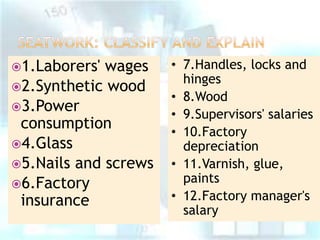
1.Laborers'

wages
2.Synthetic wood
3.Power
consumption
4.Glass
5.Nails and screws
6.Factory
insurance

• 7.Handles, locks and
hinges
• 8.Wood
• 9.Supervisors' salaries
• 10.Factory
depreciation
• 11.Varnish, glue,
paints
• 12.Factory manager's
salary
things

that are used in making a
product that become a part of that
product when it is finished
(Cambridge)

All

of the materials that go into
making a product. (Regis)
In order for a raw material to be classified as a direct
material, the amount of raw material must be easily
counted or kept track of.
 Here is an example. When making grocery bags, it is
pretty easy to keep track of the amount of paper being
used for each bag, but it is very difficult to know exactly
how much glue is being used to hold the paper bag
together.




In a nutshell, direct materials are those materials that
become part of the finished product... providing it is
possible and worth the effort to keep track of those
materials on a per product basis.
 In

what Industry (ies) do these materials
classified as direct/indirect materials:
(Name at least 5 each – 5 direct; 5
indirect)
 Paper
 Rubber
 Land
 Building
 Hairbrush
Employees

or workers who are
directly
involved
in
the
production of goods or services.
(accounting coach)
Direct labor represents the
people who do the core work of
the business. (Regis)


Construction

company, - people
actually constructing the building.
Retail store- people helping on the
sales floor doing the basic work that
takes place serving the customers.
Grocery bag factory- people running
the machines actually making the
bags.


In a Job order businesses. Almost any time a product is
customized for a customer, the company will operate on
a "job order" basis.



The labor must clearly be associated with a particular
job, in order for the labor to be called "direct
labor."



One last thought... If a person's labor cannot be easily
linked to a specific customer's order or the person does
not directly build the product, the person's labor is
called "indirect labor."
 In

what Industry (ies) do these Labor
classified as direct/indirect labor : (Name
at least 5 each – 5 direct; 5 indirect)
 Secretary
 Inspector
 Accountant
 Lawyer
 Carpenter
If a cost is not direct labor or direct materials, the
cost is overhead. (Regis)
Direct Overhead- Expense directly associated with
the production of goods or services, such as for
lighting, maintenance, and rent of a business
premises.
Indirect Overhead - Overhead not directly
associated (such as office expenses, telephone
expenses, R&D) with the
production of goods or services.
Fixed, Variable and SemiVariable
A

cost that does not change
with an increase or decrease
in the amount of goods or
services produced. Fixed
costs are expenses that have
to be paid by a company,
independent of any business
activity.
A

mobile phone manufacturing
company rents a building for its
factory for $5,000 per month, it will
have to pay $5,000 for every month
even no mobile phone is produced
during the month.

Required: Draw a graph of expense per
production level 1, 50, 100, 150, 200, 250,
300 units and explain
A

corporate expense that
varies
with
production
output. Variable costs are
those
costs
that
vary
depending on a company's
production volume; they rise
as production increases and
fall as production decreases.
A

mobile phone manufacturing
company purchases speakers from
another company at a cost of $2 per
speaker.
The speaker is a direct materials
cost for mobile phone manufacturing
company.
One speaker is used to complete a
mobile phone.
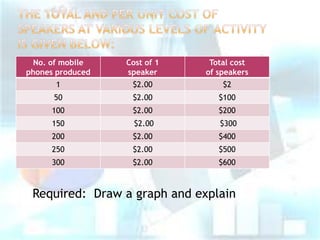
No. of mobile
phones produced

Cost of 1
speaker

Total cost
of speakers

1

$2.00

$2

50

$2.00

$100

100

$2.00

$200

150

$2.00

$300

200

$2.00

$400

250

$2.00

$500

300

$2.00

$600

Required: Draw a graph and explain
Compute

the fixed cost on a
per unit basis (per level of
production)
Compute the variable cost
per unit basis (per level of
production)
Explain your findings
A

cost composed of a mixture of
fixed and variable components. Costs
are fixed for a set level of production
or consumption, becoming variable
after the level is exceeded.

Sample:

Labor cost on regular and
overtime
Total

Cost = Direct Materials +
Direct Labor + Overhead

Total

Cost = Total Fixed Cost +
Total Variable Cost + Total
Semi-Variable Cost
Costing

methods:

job costing;
batch costing;
process costing;
contract costing;
service costing


Go Top
Use different costing
methods

Go Top
Unit 9  types of costs

Unit 9 types of costs

  • 1.
  • 2.
  • 3.
  • 4.
    Review of Last session Testof baseline knowledge Types of Costs
  • 6.
    What are direct costs? Name5 direct costs What are indirect costs? Name 5 indirect costs
  • 7.
    A price that canbe completely attributed to the production of specific goods or services. Direct costs refer to materials, labor and expenses related to the production of a product.
  • 8.
    Costs which cannot beaccurately attributed to specific cost objects are called indirect costs. These typically benefit multiple cost objects and it is impracticable to accurately trace them to individual products, activities or departments etc.
  • 9.
    1.Laborers' wages 2.Synthetic wood 3.Power consumption 4.Glass 5.Nails andscrews 6.Factory insurance • 7.Handles, locks and hinges • 8.Wood • 9.Supervisors' salaries • 10.Factory depreciation • 11.Varnish, glue, paints • 12.Factory manager's salary
  • 11.
    things that are usedin making a product that become a part of that product when it is finished (Cambridge) All of the materials that go into making a product. (Regis)
  • 12.
    In order fora raw material to be classified as a direct material, the amount of raw material must be easily counted or kept track of.  Here is an example. When making grocery bags, it is pretty easy to keep track of the amount of paper being used for each bag, but it is very difficult to know exactly how much glue is being used to hold the paper bag together.   In a nutshell, direct materials are those materials that become part of the finished product... providing it is possible and worth the effort to keep track of those materials on a per product basis.
  • 13.
     In what Industry(ies) do these materials classified as direct/indirect materials: (Name at least 5 each – 5 direct; 5 indirect)  Paper  Rubber  Land  Building  Hairbrush
  • 14.
    Employees or workers whoare directly involved in the production of goods or services. (accounting coach) Direct labor represents the people who do the core work of the business. (Regis) 
  • 15.
    Construction company, - people actuallyconstructing the building. Retail store- people helping on the sales floor doing the basic work that takes place serving the customers. Grocery bag factory- people running the machines actually making the bags.
  • 16.
     In a Joborder businesses. Almost any time a product is customized for a customer, the company will operate on a "job order" basis.  The labor must clearly be associated with a particular job, in order for the labor to be called "direct labor."  One last thought... If a person's labor cannot be easily linked to a specific customer's order or the person does not directly build the product, the person's labor is called "indirect labor."
  • 17.
     In what Industry(ies) do these Labor classified as direct/indirect labor : (Name at least 5 each – 5 direct; 5 indirect)  Secretary  Inspector  Accountant  Lawyer  Carpenter
  • 18.
    If a costis not direct labor or direct materials, the cost is overhead. (Regis) Direct Overhead- Expense directly associated with the production of goods or services, such as for lighting, maintenance, and rent of a business premises. Indirect Overhead - Overhead not directly associated (such as office expenses, telephone expenses, R&D) with the production of goods or services.
  • 19.
    Fixed, Variable andSemiVariable
  • 20.
    A cost that doesnot change with an increase or decrease in the amount of goods or services produced. Fixed costs are expenses that have to be paid by a company, independent of any business activity.
  • 21.
    A mobile phone manufacturing companyrents a building for its factory for $5,000 per month, it will have to pay $5,000 for every month even no mobile phone is produced during the month. Required: Draw a graph of expense per production level 1, 50, 100, 150, 200, 250, 300 units and explain
  • 22.
    A corporate expense that varies with production output.Variable costs are those costs that vary depending on a company's production volume; they rise as production increases and fall as production decreases.
  • 23.
    A mobile phone manufacturing companypurchases speakers from another company at a cost of $2 per speaker. The speaker is a direct materials cost for mobile phone manufacturing company. One speaker is used to complete a mobile phone.
  • 24.
    No. of mobile phonesproduced Cost of 1 speaker Total cost of speakers 1 $2.00 $2 50 $2.00 $100 100 $2.00 $200 150 $2.00 $300 200 $2.00 $400 250 $2.00 $500 300 $2.00 $600 Required: Draw a graph and explain
  • 25.
    Compute the fixed coston a per unit basis (per level of production) Compute the variable cost per unit basis (per level of production) Explain your findings
  • 26.
    A cost composed ofa mixture of fixed and variable components. Costs are fixed for a set level of production or consumption, becoming variable after the level is exceeded. Sample: Labor cost on regular and overtime
  • 27.
    Total Cost = DirectMaterials + Direct Labor + Overhead Total Cost = Total Fixed Cost + Total Variable Cost + Total Semi-Variable Cost
  • 28.
    Costing methods: job costing; batch costing; processcosting; contract costing; service costing  Go Top
  • 29.