




Srinivasa Reddy. Edururi
Aurobindo Pharma Limited.
 Friability (the condition of being Friable)
testing is used to test the durability of
tablets during packing processes and
transit. This involves repeatedly dropping a
sample of tablets over a fixed time, using a
rotating drum with a baffle.
 In simple words, friability test tells how
much mechanical stress tablets are able to
withstand during their manufacturing,
distribution and handling by the customer.
 The friability tests should be performed for
compressed, uncoated tablets.
 For delayed release tablets, friability is
usually controlled on the tablet core prior to
the coating operation.
 Measurement of tablet friability
supplements other physical strength
measurements, such as tablet breaking
force.
 Throughout pharmaceutical industry,
friability testing has become an accepted
technology and the instrument used in to
perform this process is called Friabilator or
Friability Tester.
 Friability apparatus is having a drum with
following characteristics.
◦ Material of construction (MOC): Synthetic Polymer
with polished internal surfaces, and subject to
minimum static build-up
◦ Internal diameter: Between 283 mm and 291 mm
◦ Depth: Between 36 mm and 40 mm
◦ Inside radius: between 75.5 mm to 85.5 mm
◦ Rotating speed: 25±1 rpm.
Single Drum Double Drum
 Number of tablets to be taken:
◦ Tablets with a unit weight equal to or less than
650 mg: Take sample of whole tablets
corresponding as near as possible to 6.5 g.
◦ Tablets with a unit weight of more than 650 mg:
Take a sample of 10 whole tablets.
 The tablets should be carefully dedusted
prior to testing.
 Accurately weigh the tablet sample, and
place the tablets in the drum.
 Rotate the drum 100 times, with a speed of
25 rpm and remove the tablets.
 Remove any loose dust from the tablets as
before, and accurately weigh.
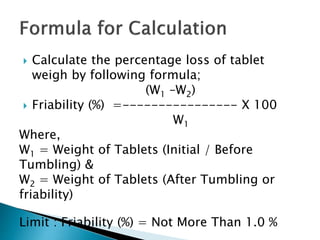
 Calculate the percentage loss of tablet
weigh by following formula;
(W1 –W2)
 Friability (%) =---------------- X 100
W1
Where,
W1 = Weight of Tablets (Initial / Before
Tumbling) &
W2 = Weight of Tablets (After Tumbling or
friability)
Limit : Friability (%) = Not More Than 1.0 %
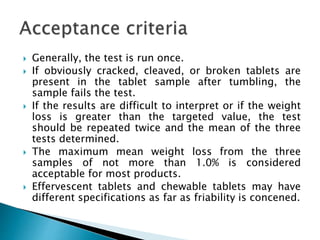
 Generally, the test is run once.
 If obviously cracked, cleaved, or broken tablets are
present in the tablet sample after tumbling, the
sample fails the test.
 If the results are difficult to interpret or if the weight
loss is greater than the targeted value, the test
should be repeated twice and the mean of the three
tests determined.
 The maximum mean weight loss from the three
samples of not more than 1.0% is considered
acceptable for most products.
 Effervescent tablets and chewable tablets may have
different specifications as far as friability is concened.
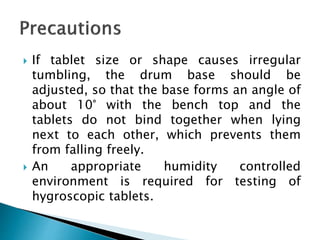
 If tablet size or shape causes irregular
tumbling, the drum base should be
adjusted, so that the base forms an angle of
about 10° with the bench top and the
tablets do not bind together when lying
next to each other, which prevents them
from falling freely.
 An appropriate humidity controlled
environment is required for testing of
hygroscopic tablets.
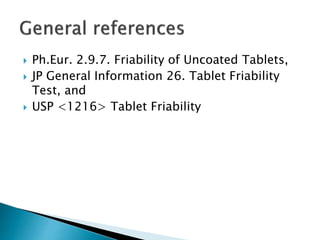
 Ph.Eur. 2.9.7. Friability of Uncoated Tablets,
 JP General Information 26. Tablet Friability
Test, and
 USP <1216> Tablet Friability

Friability testing

  • 1.
  • 2.
     Friability (thecondition of being Friable) testing is used to test the durability of tablets during packing processes and transit. This involves repeatedly dropping a sample of tablets over a fixed time, using a rotating drum with a baffle.  In simple words, friability test tells how much mechanical stress tablets are able to withstand during their manufacturing, distribution and handling by the customer.
  • 3.
     The friabilitytests should be performed for compressed, uncoated tablets.  For delayed release tablets, friability is usually controlled on the tablet core prior to the coating operation.  Measurement of tablet friability supplements other physical strength measurements, such as tablet breaking force.
  • 4.
     Throughout pharmaceuticalindustry, friability testing has become an accepted technology and the instrument used in to perform this process is called Friabilator or Friability Tester.
  • 5.
     Friability apparatusis having a drum with following characteristics. ◦ Material of construction (MOC): Synthetic Polymer with polished internal surfaces, and subject to minimum static build-up ◦ Internal diameter: Between 283 mm and 291 mm ◦ Depth: Between 36 mm and 40 mm ◦ Inside radius: between 75.5 mm to 85.5 mm ◦ Rotating speed: 25±1 rpm.
  • 7.
  • 8.
     Number oftablets to be taken: ◦ Tablets with a unit weight equal to or less than 650 mg: Take sample of whole tablets corresponding as near as possible to 6.5 g. ◦ Tablets with a unit weight of more than 650 mg: Take a sample of 10 whole tablets.
  • 9.
     The tabletsshould be carefully dedusted prior to testing.  Accurately weigh the tablet sample, and place the tablets in the drum.  Rotate the drum 100 times, with a speed of 25 rpm and remove the tablets.  Remove any loose dust from the tablets as before, and accurately weigh.
  • 10.
     Calculate thepercentage loss of tablet weigh by following formula; (W1 –W2)  Friability (%) =---------------- X 100 W1 Where, W1 = Weight of Tablets (Initial / Before Tumbling) & W2 = Weight of Tablets (After Tumbling or friability) Limit : Friability (%) = Not More Than 1.0 %
  • 11.
     Generally, thetest is run once.  If obviously cracked, cleaved, or broken tablets are present in the tablet sample after tumbling, the sample fails the test.  If the results are difficult to interpret or if the weight loss is greater than the targeted value, the test should be repeated twice and the mean of the three tests determined.  The maximum mean weight loss from the three samples of not more than 1.0% is considered acceptable for most products.  Effervescent tablets and chewable tablets may have different specifications as far as friability is concened.
  • 12.
     If tabletsize or shape causes irregular tumbling, the drum base should be adjusted, so that the base forms an angle of about 10° with the bench top and the tablets do not bind together when lying next to each other, which prevents them from falling freely.  An appropriate humidity controlled environment is required for testing of hygroscopic tablets.
  • 13.
     Ph.Eur. 2.9.7.Friability of Uncoated Tablets,  JP General Information 26. Tablet Friability Test, and  USP <1216> Tablet Friability