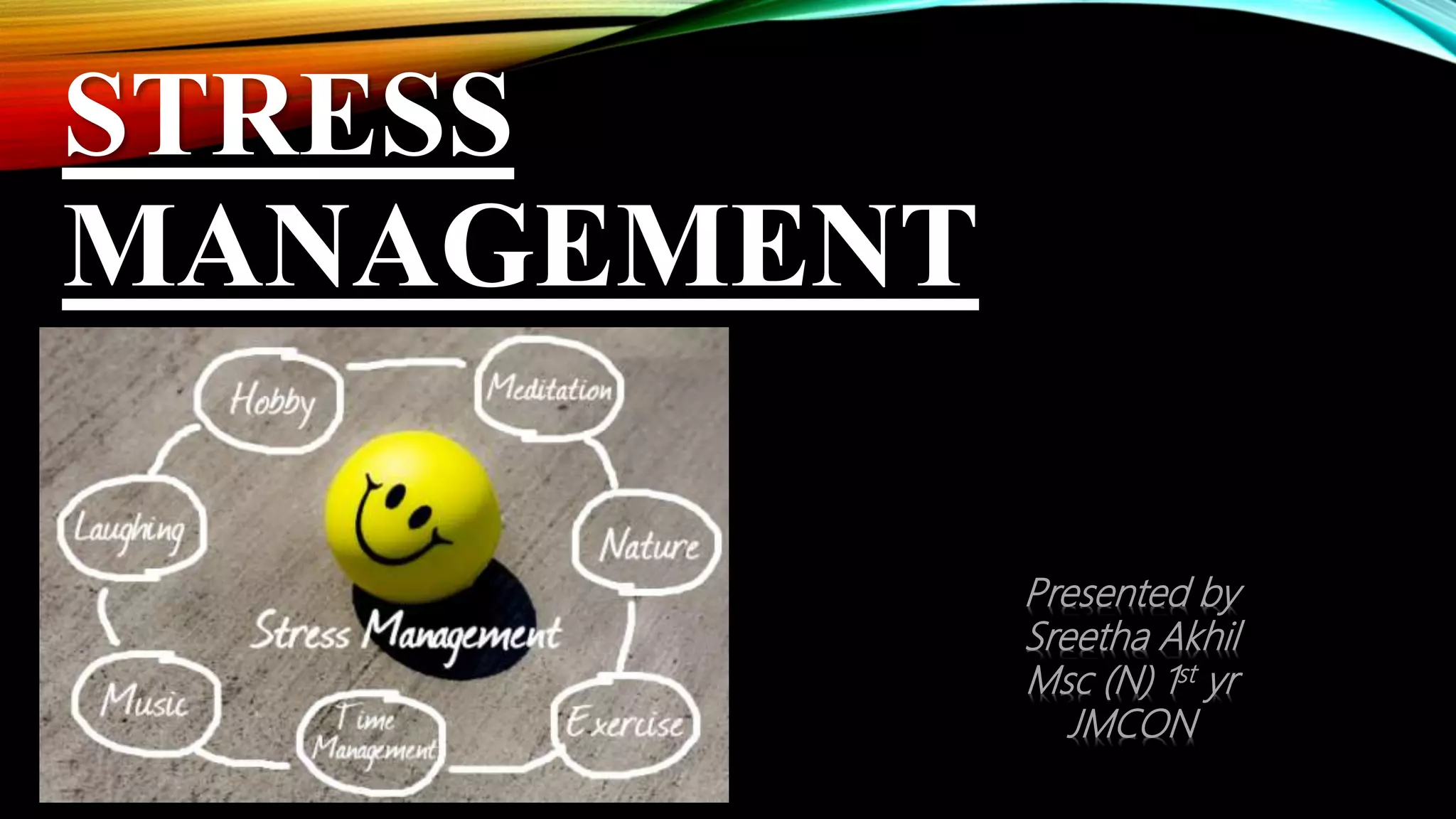
STRESS
MANAGEMENT
Presented by
Sreetha Akhil
Msc (N) 1st yr
JMCON
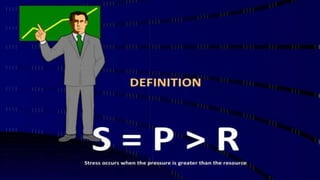
DEFINITION
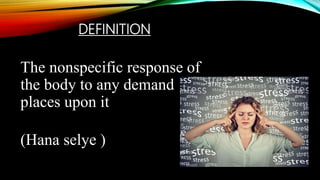
The nonspecific response of
the body to any demand
places upon it
(Hana selye )
•Stress is the physiological, psychological
and behavioural response by an individual
when they perceive a lack of equilibrium
between the demand placed upon them and
their ability to meet those demand, which,
over a period of time leads to ill health.
(palmer 1989)
CONCEPTS OF STRESS
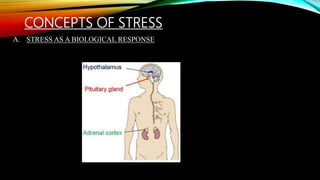
A. STRESS AS A BIOLOGICAL RESPONSE
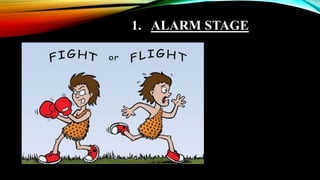
1. ALARM STAGE
•Heart rate and strength of the cardiac muscle
contraction increases.
•Blood vessels supplying to the skin and viscera
constrict
•Liver converts glycogen into glucose and releases
it into the blood steam.
•The rate of breathing increases
•Sweating increases.
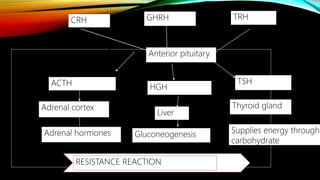
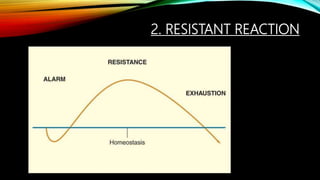
2. RESISTANT REACTION
CRH GHRH TRH
Anterior pituitary
ACTH HGH
TSH
Adrenal cortex
Liver
Thyroid gland
Adrenal hormones Gluconeogenesis Supplies energy through
carbohydrate
mechanism
RESISTANCE REACTION
3. EXHAUSTION STAGE
•. The manifestations are ulcers trouble with
digestive problem along with other mental
illness.
B.STRESS AS AN ENVIORNMENTAL
EVENT
C. STRESS AS A TRANSACTION BETWEEN THE
INDIVIDUAL AND THE ENVIORNMENT
STRESS MANAGEMENT STRATEGIES
LIFE STYLE CHANGES
1) Regular aerobic
exercises
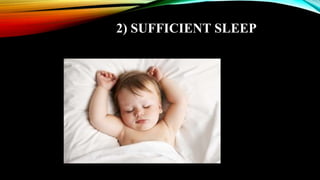
2) SUFFICIENT SLEEP
3) RELAXATION TECHNIQUES
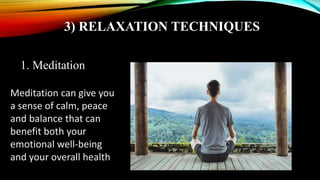
1. Meditation
Meditation can give you
a sense of calm, peace
and balance that can
benefit both your
emotional well-being
and your overall health
2. Autogenic training and imagery
. It retained the feeling of
heaviness and warmth from
hypnosis .
dilate the blood vessels,
increase blood circulation
and body temperature, relax
muscles and create a sense
of heaviness so as to help
people to deal with stressors
effectively.
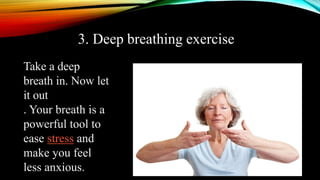
3. Deep breathing exercise
Take a deep
breath in. Now let
it out
. Your breath is a
powerful tool to
ease stress and
make you feel
less anxious.
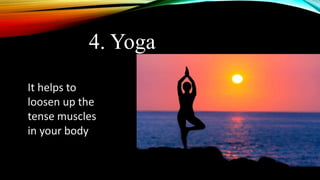
4. Yoga
It helps to
loosen up the
tense muscles
in your body
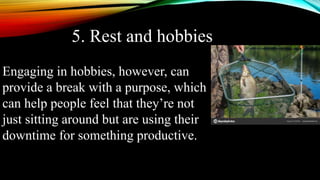
5. Rest and hobbies
Engaging in hobbies, however, can
provide a break with a purpose, which
can help people feel that they’re not
just sitting around but are using their
downtime for something productive.
HUMOUR
•Laughter enhances your intake of oxygen-rich air,
stimulates your heart, lungs and muscles, and increases
the endorphins that are released by your brain
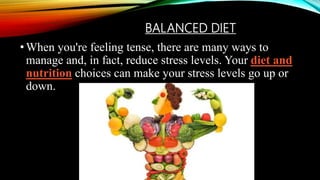
BALANCED DIET
•When you're feeling tense, there are many ways to
manage and, in fact, reduce stress levels. Your diet and
nutrition choices can make your stress levels go up or
down.
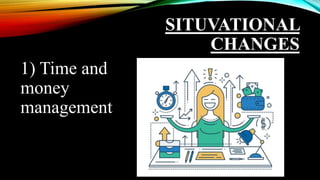
SITUVATIONAL
CHANGES
1) Time and
money
management
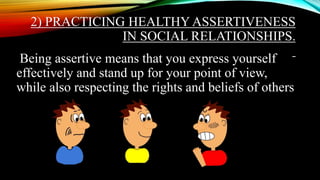
2) PRACTICING HEALTHY ASSERTIVENESS
IN SOCIAL RELATIONSHIPS.
Being assertive means that you express yourself
effectively and stand up for your point of view,
while also respecting the rights and beliefs of others
3) CREATIVE PROBLEM SOLVING
COGINITIVE CHANGES
1) SEE PROBLEMS ARE OPPORTUNITIES
Talk to any successful entrepreneur, or
any professional with a positive attitude,
and you'll find one key trait in common:
all of them have a unique mentality that
allows them to handle challenges
differently.
2) FOCUS ON POSITIVES
•“Some people grumble that roses have thorns; I am
grateful that thorns have roses.”
– Alphonse Karr
SEEING THE GLASS HALF FULL
INSTEAD OF HALF EMPTY
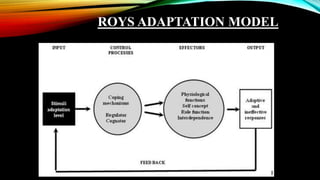
ROYS ADAPTATION MODEL
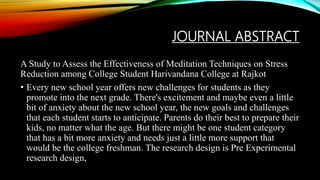
JOURNAL ABSTRACT
A Study to Assess the Effectiveness of Meditation Techniques on Stress
Reduction among College Student Harivandana College at Rajkot
• Every new school year offers new challenges for students as they
promote into the next grade. There's excitement and maybe even a little
bit of anxiety about the new school year, the new goals and challenges
that each student starts to anticipate. Parents do their best to prepare their
kids, no matter what the age. But there might be one student category
that has a bit more anxiety and needs just a little more support that
would be the college freshman. The research design is Pre Experimental
research design,
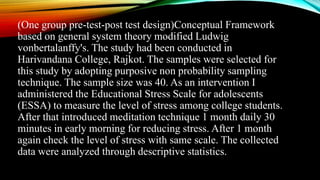
(One group pre-test-post test design)Conceptual Framework
based on general system theory modified Ludwig
vonbertalanffy's. The study had been conducted in
Harivandana College, Rajkot. The samples were selected for
this study by adopting purposive non probability sampling
technique. The sample size was 40. As an intervention I
administered the Educational Stress Scale for adolescents
(ESSA) to measure the level of stress among college students.
After that introduced meditation technique 1 month daily 30
minutes in early morning for reducing stress. After 1 month
again check the level of stress with same scale. The collected
data were analyzed through descriptive statistics.
BIBLIOGRAPHY
• Sreevani R. A guide to mental health and psychiatric nursing. 3rd
edition. New Delhi: Jaypee brother medical publication.2010.
• Towsand MC. Essentials of psychiatric mental health nursing. 3rd
edition. Philadelphia; F A Davis company publication.2005
• Keltness, Schwecke, Bostrom. Psychiatric nursing .4th edition.
Missouri;Elsevier publication. 2003
• Eby L, Brown NJ. Mental health nursing care. New Jeisey;Pearson
education publication.2005
• Basheer SP, Khan SY. A consise text book of advanced nursing
practice. Bangalore;EMMESS medical publications.2013
• Stuart G W,Laraia M T. Principles practice of psychiatry nursing.
Seventh edition. Delhi; Harcrout private limited.2001.
• Gupta R K. Mental health nursing. Third edition. Bikrampura;S
vikas & company medical publications. 2016
JOURNALS
• Asmitha V, Nancy RV,Justin D J. A Study to Assess the
Effectiveness of Meditation Techniques on Stress Reduction
among College Student Harivandana College at Rajkot.
International journal of advances in nursing management.
2017;5(1);73-76
• ONLINE REFERENCE
• https://scholar.google.co.in/scholar?start=30&q=schizoaffective+disorders&hl=en&
s_sdt=0,5&as_ylo=2018
• https://www.sciencedirect.com/science/article/pii/S0165178117319388
• www.ncbi.nlm.nih.gov › NCBI › Literature
• https://twitter.com/PubMedHealth
THANK
YOU

Stress management

  • 1.
  • 3.
    DEFINITION The nonspecific responseof the body to any demand places upon it (Hana selye )
  • 4.
    •Stress is thephysiological, psychological and behavioural response by an individual when they perceive a lack of equilibrium between the demand placed upon them and their ability to meet those demand, which, over a period of time leads to ill health. (palmer 1989)
  • 6.
    CONCEPTS OF STRESS A.STRESS AS A BIOLOGICAL RESPONSE
  • 7.
  • 8.
    •Heart rate andstrength of the cardiac muscle contraction increases. •Blood vessels supplying to the skin and viscera constrict •Liver converts glycogen into glucose and releases it into the blood steam. •The rate of breathing increases •Sweating increases.
  • 9.
  • 10.
    CRH GHRH TRH Anteriorpituitary ACTH HGH TSH Adrenal cortex Liver Thyroid gland Adrenal hormones Gluconeogenesis Supplies energy through carbohydrate mechanism RESISTANCE REACTION
  • 11.
    3. EXHAUSTION STAGE •.The manifestations are ulcers trouble with digestive problem along with other mental illness.
  • 12.
    B.STRESS AS ANENVIORNMENTAL EVENT
  • 14.
    C. STRESS ASA TRANSACTION BETWEEN THE INDIVIDUAL AND THE ENVIORNMENT
  • 15.
    STRESS MANAGEMENT STRATEGIES LIFESTYLE CHANGES 1) Regular aerobic exercises
  • 16.
  • 17.
    3) RELAXATION TECHNIQUES 1.Meditation Meditation can give you a sense of calm, peace and balance that can benefit both your emotional well-being and your overall health
  • 18.
    2. Autogenic trainingand imagery . It retained the feeling of heaviness and warmth from hypnosis . dilate the blood vessels, increase blood circulation and body temperature, relax muscles and create a sense of heaviness so as to help people to deal with stressors effectively.
  • 19.
    3. Deep breathingexercise Take a deep breath in. Now let it out . Your breath is a powerful tool to ease stress and make you feel less anxious.
  • 20.
    4. Yoga It helpsto loosen up the tense muscles in your body
  • 21.
    5. Rest andhobbies Engaging in hobbies, however, can provide a break with a purpose, which can help people feel that they’re not just sitting around but are using their downtime for something productive.
  • 22.
    HUMOUR •Laughter enhances yourintake of oxygen-rich air, stimulates your heart, lungs and muscles, and increases the endorphins that are released by your brain
  • 23.
    BALANCED DIET •When you'refeeling tense, there are many ways to manage and, in fact, reduce stress levels. Your diet and nutrition choices can make your stress levels go up or down.
  • 24.
  • 25.
    2) PRACTICING HEALTHYASSERTIVENESS IN SOCIAL RELATIONSHIPS. Being assertive means that you express yourself effectively and stand up for your point of view, while also respecting the rights and beliefs of others
  • 26.
  • 27.
    COGINITIVE CHANGES 1) SEEPROBLEMS ARE OPPORTUNITIES Talk to any successful entrepreneur, or any professional with a positive attitude, and you'll find one key trait in common: all of them have a unique mentality that allows them to handle challenges differently.
  • 28.
    2) FOCUS ONPOSITIVES •“Some people grumble that roses have thorns; I am grateful that thorns have roses.” – Alphonse Karr
  • 29.
    SEEING THE GLASSHALF FULL INSTEAD OF HALF EMPTY
  • 30.
  • 31.
    JOURNAL ABSTRACT A Studyto Assess the Effectiveness of Meditation Techniques on Stress Reduction among College Student Harivandana College at Rajkot • Every new school year offers new challenges for students as they promote into the next grade. There's excitement and maybe even a little bit of anxiety about the new school year, the new goals and challenges that each student starts to anticipate. Parents do their best to prepare their kids, no matter what the age. But there might be one student category that has a bit more anxiety and needs just a little more support that would be the college freshman. The research design is Pre Experimental research design,
  • 32.
    (One group pre-test-posttest design)Conceptual Framework based on general system theory modified Ludwig vonbertalanffy's. The study had been conducted in Harivandana College, Rajkot. The samples were selected for this study by adopting purposive non probability sampling technique. The sample size was 40. As an intervention I administered the Educational Stress Scale for adolescents (ESSA) to measure the level of stress among college students. After that introduced meditation technique 1 month daily 30 minutes in early morning for reducing stress. After 1 month again check the level of stress with same scale. The collected data were analyzed through descriptive statistics.
  • 33.
    BIBLIOGRAPHY • Sreevani R.A guide to mental health and psychiatric nursing. 3rd edition. New Delhi: Jaypee brother medical publication.2010. • Towsand MC. Essentials of psychiatric mental health nursing. 3rd edition. Philadelphia; F A Davis company publication.2005 • Keltness, Schwecke, Bostrom. Psychiatric nursing .4th edition. Missouri;Elsevier publication. 2003 • Eby L, Brown NJ. Mental health nursing care. New Jeisey;Pearson education publication.2005
  • 34.
    • Basheer SP,Khan SY. A consise text book of advanced nursing practice. Bangalore;EMMESS medical publications.2013 • Stuart G W,Laraia M T. Principles practice of psychiatry nursing. Seventh edition. Delhi; Harcrout private limited.2001. • Gupta R K. Mental health nursing. Third edition. Bikrampura;S vikas & company medical publications. 2016 JOURNALS • Asmitha V, Nancy RV,Justin D J. A Study to Assess the Effectiveness of Meditation Techniques on Stress Reduction among College Student Harivandana College at Rajkot. International journal of advances in nursing management. 2017;5(1);73-76
  • 35.
    • ONLINE REFERENCE •https://scholar.google.co.in/scholar?start=30&q=schizoaffective+disorders&hl=en& s_sdt=0,5&as_ylo=2018 • https://www.sciencedirect.com/science/article/pii/S0165178117319388 • www.ncbi.nlm.nih.gov › NCBI › Literature • https://twitter.com/PubMedHealth
  • 36.