Submitted by:-
Gaurav Tiwari(16/imb/013)
Vivek Malik(16/imb/038)
Shyamveer(16/imb/045)
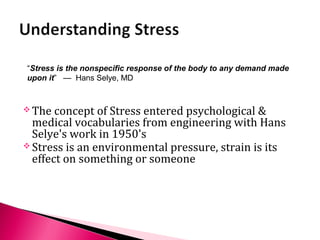
 The concept of Stress entered psychological &
medical vocabularies from engineering with Hans
Selye's work in 1950's
 Stress is an environmental pressure, strain is its
effect on something or someone
“Stress is the nonspecific response of the body to any demand made
upon it” — Hans Selye, MD
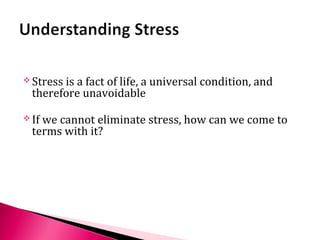
 Stress is a fact of life, a universal condition, and
therefore unavoidable
 If we cannot eliminate stress, how can we come to
terms with it?
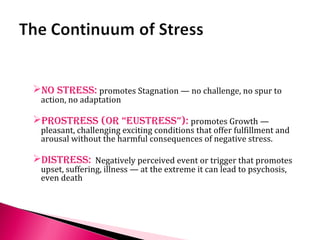
No stress: promotes Stagnation — no challenge, no spur to
action, no adaptation
Prostress (or “eustress”): promotes Growth —
pleasant, challenging exciting conditions that offer fulfillment and
arousal without the harmful consequences of negative stress.
Distress: Negatively perceived event or trigger that promotes
upset, suffering, illness — at the extreme it can lead to psychosis,
even death
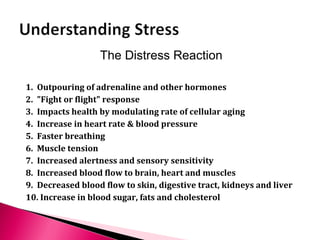
1. Outpouring of adrenaline and other hormones
2. "Fight or flight" response
3. Impacts health by modulating rate of cellular aging
4. Increase in heart rate & blood pressure
5. Faster breathing
6. Muscle tension
7. Increased alertness and sensory sensitivity
8. Increased blood flow to brain, heart and muscles
9. Decreased blood flow to skin, digestive tract, kidneys and liver
10. Increase in blood sugar, fats and cholesterol
The Distress Reaction
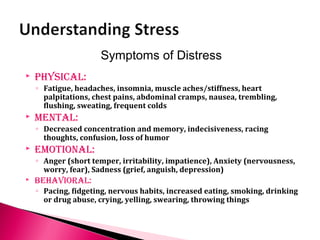
 Physical:
◦ Fatigue, headaches, insomnia, muscle aches/stiffness, heart
palpitations, chest pains, abdominal cramps, nausea, trembling,
flushing, sweating, frequent colds
 Mental:
◦ Decreased concentration and memory, indecisiveness, racing
thoughts, confusion, loss of humor
 eMotional:
◦ Anger (short temper, irritability, impatience), Anxiety (nervousness,
worry, fear), Sadness (grief, anguish, depression)
 Behavioral:
◦ Pacing, fidgeting, nervous habits, increased eating, smoking, drinking
or drug abuse, crying, yelling, swearing, throwing things
Symptoms of Distress
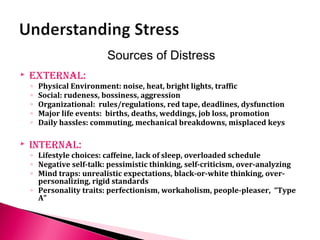
 external:
◦ Physical Environment: noise, heat, bright lights, traffic
◦ Social: rudeness, bossiness, aggression
◦ Organizational: rules/regulations, red tape, deadlines, dysfunction
◦ Major life events: births, deaths, weddings, job loss, promotion
◦ Daily hassles: commuting, mechanical breakdowns, misplaced keys
 internal:
◦ Lifestyle choices: caffeine, lack of sleep, overloaded schedule
◦ Negative self-talk: pessimistic thinking, self-criticism, over-analyzing
◦ Mind traps: unrealistic expectations, black-or-white thinking, over-
personalizing, rigid standards
◦ Personality traits: perfectionism, workaholism, people-pleaser, “Type
A”
Sources of Distress
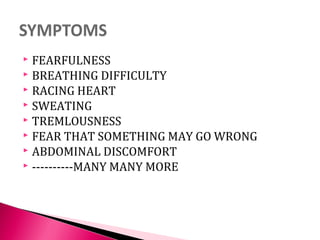
 FEARFULNESS
 BREATHING DIFFICULTY
 RACING HEART
 SWEATING
 TREMLOUSNESS
 FEAR THAT SOMETHING MAY GO WRONG
 ABDOMINAL DISCOMFORT
 ----------MANY MANY MORE
 FAMILIAL PROBLEM
 WORK RELATED STRESS
 WORRIES OF VARIOUS THINGS
 PERFORMANCE ANXIETY
 COMORBID ILLNESS
 --OR-----
 WRITE DOWN
- ALL SITUATIONS / REASONS
WHICH PRODUCE ANXIETY
- YOUR OWN GOALS
 ACKNOWLEDGE
 IDENTIFY YOUR RESOURCES
 PLAN YOUR STRATEGY
 REALISTIC APPROACH
 GOAL DIRECTED EFFORTS
1. Decrease or discontinue caffeine
2. Regular exercise
3. Relaxation/Meditation
4. Sufficient Sleep
5. Time-outs and Leisure (pacing & work/leisure balance)
6. Realistic expectations
7. Reframing/Reinterpreting stressful situations
8. Belief/Value systems
9. Ventilation/Support system
10. Humor
11. Balanced diet
Lifestyle Changes
 Breathing Exercises
 Meditation
 Guided Imagery
 Visualizations
 Self-hypnosis
 Progressive Muscle Relaxation
 Music
 Yoga
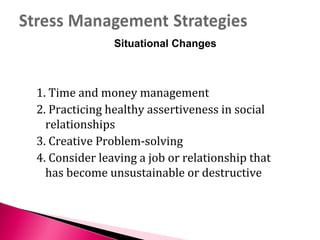
1. Time and money management
2. Practicing healthy assertiveness in social
relationships
3. Creative Problem-solving
4. Consider leaving a job or relationship that
has become unsustainable or destructive
Situational Changes
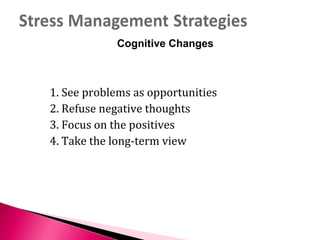
1. See problems as opportunities
2. Refuse negative thoughts
3. Focus on the positives
4. Take the long-term view
Cognitive Changes
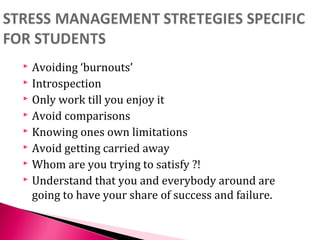
 Avoiding ‘burnouts’
 Introspection
 Only work till you enjoy it
 Avoid comparisons
 Knowing ones own limitations
 Avoid getting carried away
 Whom are you trying to satisfy ?!
 Understand that you and everybody around are
going to have your share of success and failure.
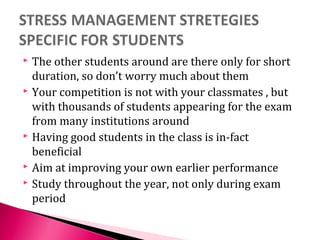
 The other students around are there only for short
duration, so don’t worry much about them
 Your competition is not with your classmates , but
with thousands of students appearing for the exam
from many institutions around
 Having good students in the class is in-fact
beneficial
 Aim at improving your own earlier performance
 Study throughout the year, not only during exam
period
 JPMR
 CYCLIC RELAXATION
 VISUAL IMAGERY
 SELF – SUGGESTIONS
 SELF MOTIVATING SENTENCES
 COMBINING ABOVE WITH TRUE PRAYERS
THANK YOU

Studentstressmanagment ppt

  • 1.
    Submitted by:- Gaurav Tiwari(16/imb/013) VivekMalik(16/imb/038) Shyamveer(16/imb/045)
  • 2.
     The conceptof Stress entered psychological & medical vocabularies from engineering with Hans Selye's work in 1950's  Stress is an environmental pressure, strain is its effect on something or someone “Stress is the nonspecific response of the body to any demand made upon it” — Hans Selye, MD
  • 3.
     Stress isa fact of life, a universal condition, and therefore unavoidable  If we cannot eliminate stress, how can we come to terms with it?
  • 4.
    No stress: promotesStagnation — no challenge, no spur to action, no adaptation Prostress (or “eustress”): promotes Growth — pleasant, challenging exciting conditions that offer fulfillment and arousal without the harmful consequences of negative stress. Distress: Negatively perceived event or trigger that promotes upset, suffering, illness — at the extreme it can lead to psychosis, even death
  • 5.
    1. Outpouring ofadrenaline and other hormones 2. "Fight or flight" response 3. Impacts health by modulating rate of cellular aging 4. Increase in heart rate & blood pressure 5. Faster breathing 6. Muscle tension 7. Increased alertness and sensory sensitivity 8. Increased blood flow to brain, heart and muscles 9. Decreased blood flow to skin, digestive tract, kidneys and liver 10. Increase in blood sugar, fats and cholesterol The Distress Reaction
  • 6.
     Physical: ◦ Fatigue,headaches, insomnia, muscle aches/stiffness, heart palpitations, chest pains, abdominal cramps, nausea, trembling, flushing, sweating, frequent colds  Mental: ◦ Decreased concentration and memory, indecisiveness, racing thoughts, confusion, loss of humor  eMotional: ◦ Anger (short temper, irritability, impatience), Anxiety (nervousness, worry, fear), Sadness (grief, anguish, depression)  Behavioral: ◦ Pacing, fidgeting, nervous habits, increased eating, smoking, drinking or drug abuse, crying, yelling, swearing, throwing things Symptoms of Distress
  • 7.
     external: ◦ PhysicalEnvironment: noise, heat, bright lights, traffic ◦ Social: rudeness, bossiness, aggression ◦ Organizational: rules/regulations, red tape, deadlines, dysfunction ◦ Major life events: births, deaths, weddings, job loss, promotion ◦ Daily hassles: commuting, mechanical breakdowns, misplaced keys  internal: ◦ Lifestyle choices: caffeine, lack of sleep, overloaded schedule ◦ Negative self-talk: pessimistic thinking, self-criticism, over-analyzing ◦ Mind traps: unrealistic expectations, black-or-white thinking, over- personalizing, rigid standards ◦ Personality traits: perfectionism, workaholism, people-pleaser, “Type A” Sources of Distress
  • 8.
     FEARFULNESS  BREATHINGDIFFICULTY  RACING HEART  SWEATING  TREMLOUSNESS  FEAR THAT SOMETHING MAY GO WRONG  ABDOMINAL DISCOMFORT  ----------MANY MANY MORE
  • 9.
     FAMILIAL PROBLEM WORK RELATED STRESS  WORRIES OF VARIOUS THINGS  PERFORMANCE ANXIETY  COMORBID ILLNESS  --OR-----
  • 10.
     WRITE DOWN -ALL SITUATIONS / REASONS WHICH PRODUCE ANXIETY - YOUR OWN GOALS  ACKNOWLEDGE  IDENTIFY YOUR RESOURCES  PLAN YOUR STRATEGY  REALISTIC APPROACH  GOAL DIRECTED EFFORTS
  • 11.
    1. Decrease ordiscontinue caffeine 2. Regular exercise 3. Relaxation/Meditation 4. Sufficient Sleep 5. Time-outs and Leisure (pacing & work/leisure balance) 6. Realistic expectations 7. Reframing/Reinterpreting stressful situations 8. Belief/Value systems 9. Ventilation/Support system 10. Humor 11. Balanced diet Lifestyle Changes
  • 12.
     Breathing Exercises Meditation  Guided Imagery  Visualizations  Self-hypnosis  Progressive Muscle Relaxation  Music  Yoga
  • 13.
    1. Time andmoney management 2. Practicing healthy assertiveness in social relationships 3. Creative Problem-solving 4. Consider leaving a job or relationship that has become unsustainable or destructive Situational Changes
  • 14.
    1. See problemsas opportunities 2. Refuse negative thoughts 3. Focus on the positives 4. Take the long-term view Cognitive Changes
  • 15.
     Avoiding ‘burnouts’ Introspection  Only work till you enjoy it  Avoid comparisons  Knowing ones own limitations  Avoid getting carried away  Whom are you trying to satisfy ?!  Understand that you and everybody around are going to have your share of success and failure.
  • 16.
     The otherstudents around are there only for short duration, so don’t worry much about them  Your competition is not with your classmates , but with thousands of students appearing for the exam from many institutions around  Having good students in the class is in-fact beneficial  Aim at improving your own earlier performance  Study throughout the year, not only during exam period
  • 17.
     JPMR  CYCLICRELAXATION  VISUAL IMAGERY  SELF – SUGGESTIONS  SELF MOTIVATING SENTENCES  COMBINING ABOVE WITH TRUE PRAYERS
  • 18.