Defects in Materials
DISCONTINUTIES & DEFECTS
• NATURE OF DEFECTS
– Microscopic Defects
– Macroscopic Defects
• ORIGIN OF DEFECTS
– Inherent Defects
– Processing Defects
– Service Defects
• DETERIORATES PHYSICAL and MECHANICAL
PROPERTIES of MATERIALS
• DETECTION of DEFECTS
– Destructive Testing
– Non-Destructive Testing
CASTING DEFECTS : Inclusions
• Inclusions are nonmetallic
materials (oxides or sulphides)
• a lower melting point than the
metal
• relative brittleness
• these defects occur near the
surface as a “skin” effect.
• occur at the centre of the
casting
• they tend to be irregular in
shape, not spherical or oval.
CASTING DEFECTS : Porosity
• gas trapped in the molten
metal
• formed by
– release from the molten
metal itself
– release from the green sand
mold, water vapour, or
turbulence caused when
pouring the metal
• form of small pockets or voids
appears as round, irregular or
elongated shapes
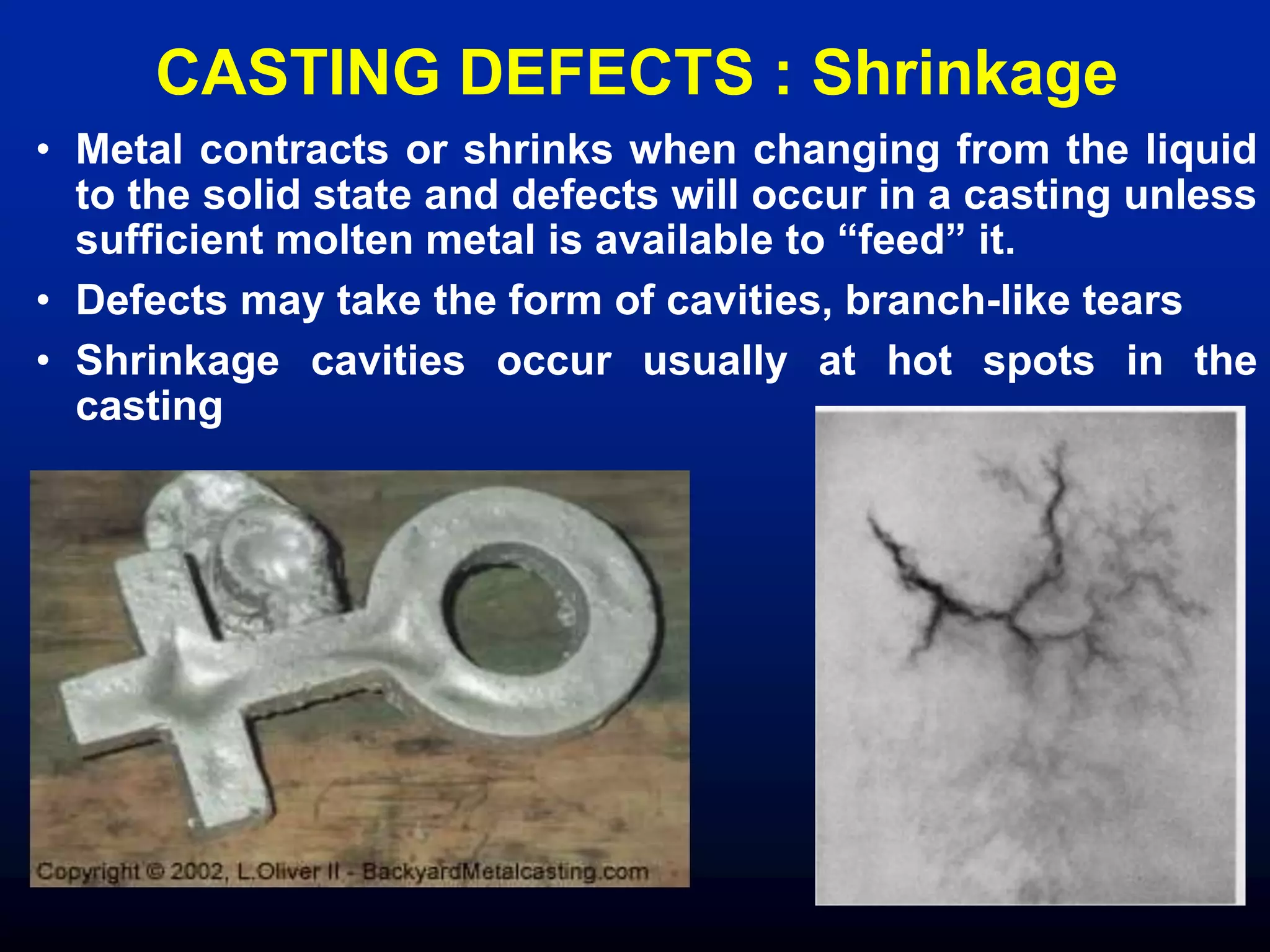
CASTING DEFECTS : Shrinkage
• Metal contracts or shrinks when changing from the liquid
to the solid state and defects will occur in a casting unless
sufficient molten metal is available to “feed” it.
• Defects may take the form of cavities, branch-like tears
• Shrinkage cavities occur usually at hot spots in the
casting
CASTING DEFECTS
• Piping : Central Cavity
• As the casting
solidifies, the metal
contracts if there is
not an adequate
supply of molten
metal to the centre of
the casting
• usually occurs in pure
metals and alloys
having narrow ranges
of solidification
temperature
• causes lamination
Hot Tears : If a section
begins to shrink while
still hot and there is not a
sufficient supply of liquid
metal, the resulting
internal stress will tear
the metal. This is
because while hot, the
metal has relatively low
strength.
CASTING DEFECTS
• Cold Shot
• Cold Shut
•Flash
•Mold Shift
•Short Casting
Bulk Deformation Processes
• Forging
– Open Die Forging
– Impression Die Forging
– Closed Die Forging
• Rolling
Products of Bulk Deformation
Processes
Open Die Forging Defects
Fracture -
– exhausted ductility
– Intergranular fracture
in hot working
• Barreling - Friction
• Solution -
– limited deformation per
step
– Process anneal
between steps
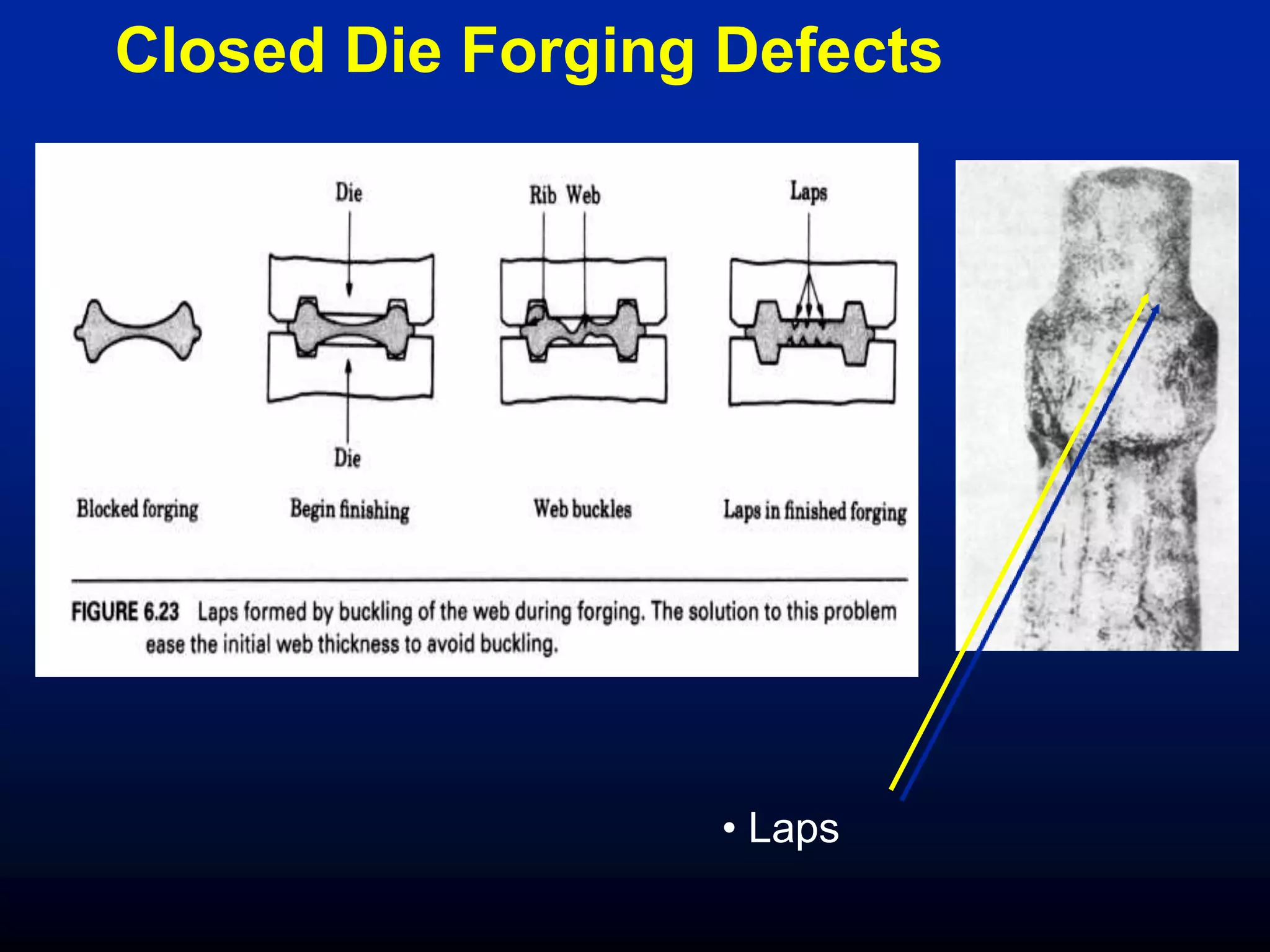
Closed Die Forging Defects
• Laps
Closed Die Forging Defects
• Flow Lines
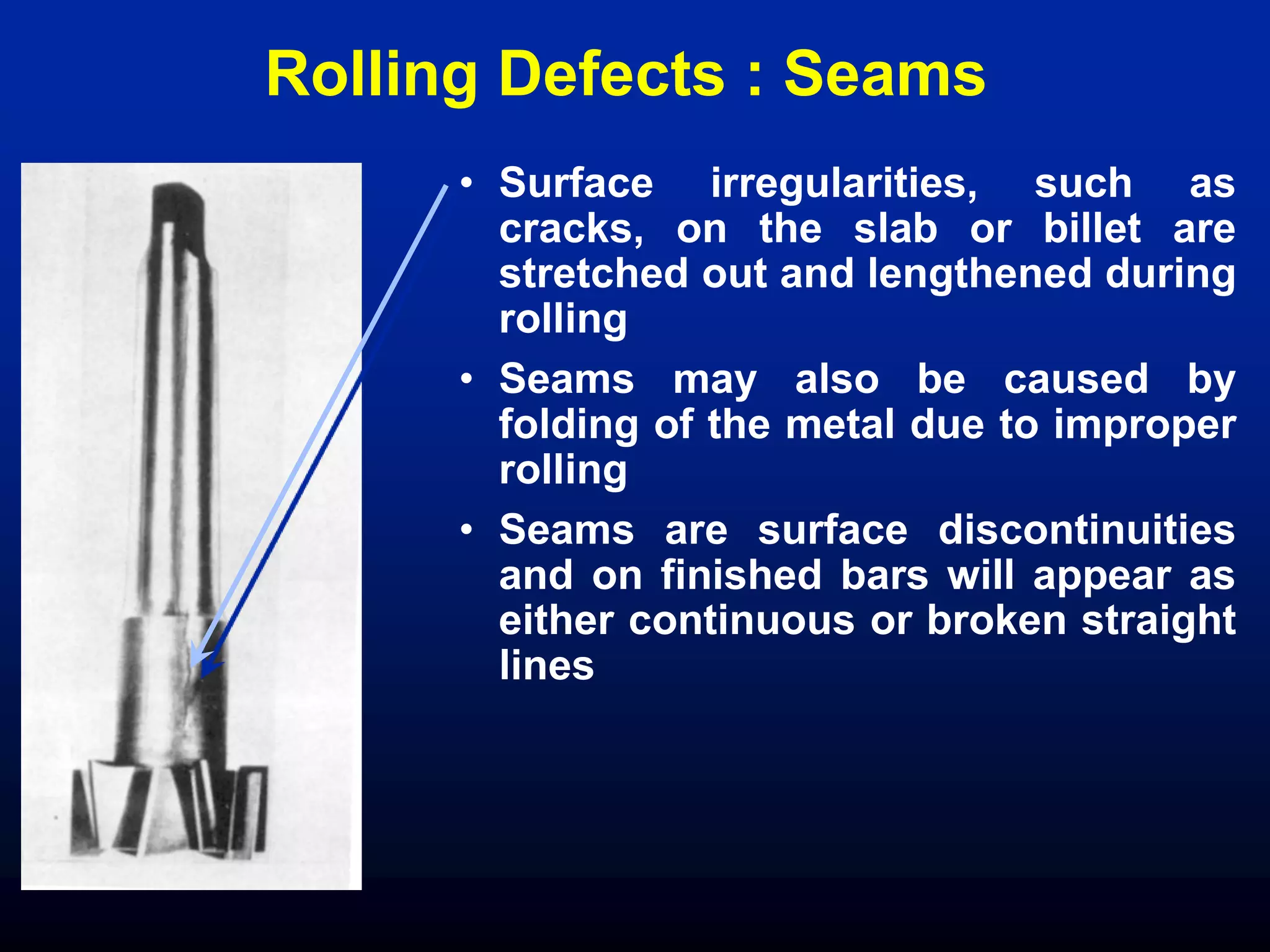
Rolling Defects : Seams
• Surface irregularities, such as
cracks, on the slab or billet are
stretched out and lengthened during
rolling
• Seams may also be caused by
folding of the metal due to improper
rolling
• Seams are surface discontinuities
and on finished bars will appear as
either continuous or broken straight
lines
Rolling Defects : Stringers
• Nonmetallic inclusions in slabs or billets, that are thinned
and lengthened in the direction of rolling, by the rolling
process, are called stringers.
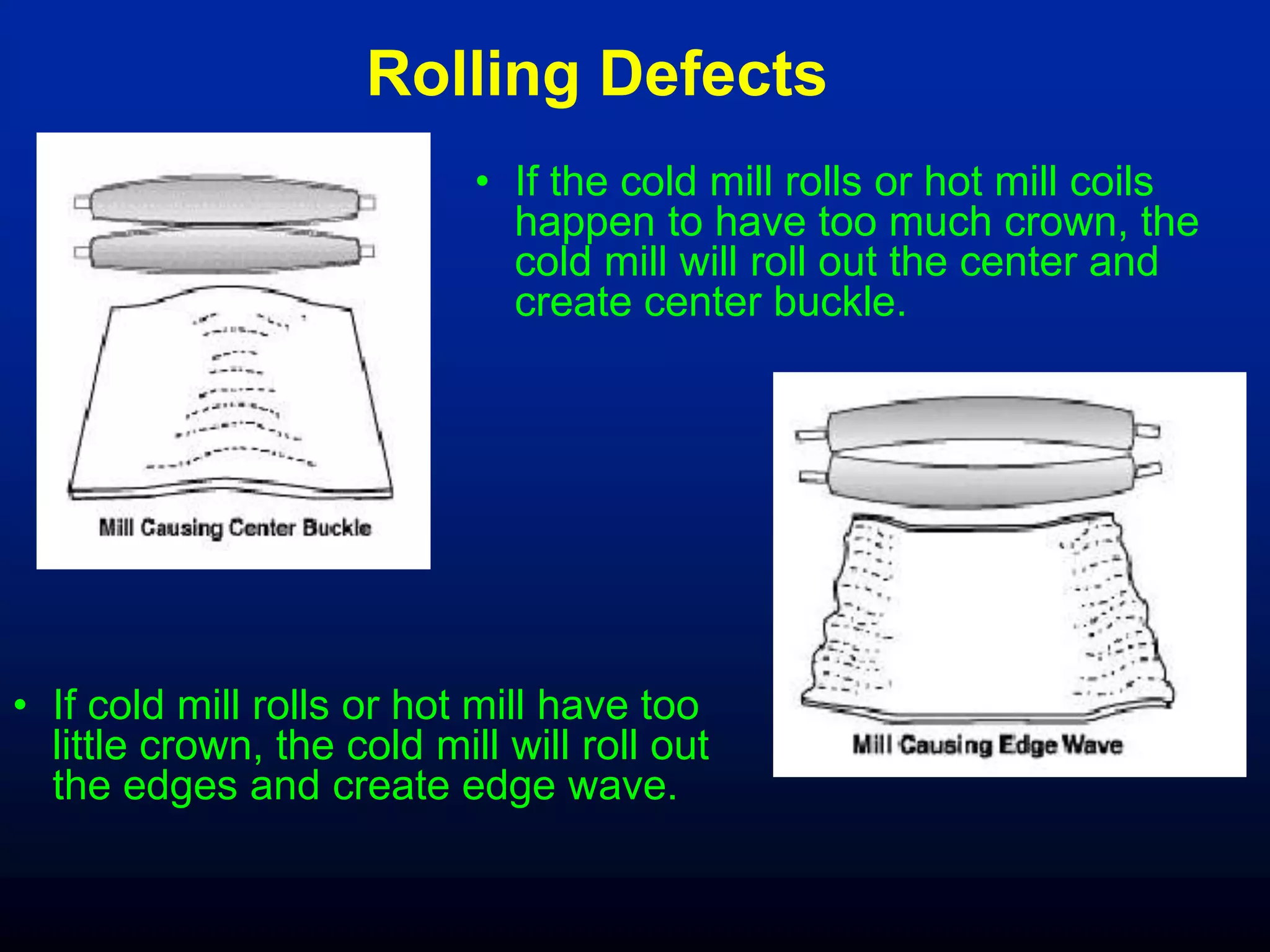
Rolling Defects
• If the cold mill rolls or hot mill coils
happen to have too much crown, the
cold mill will roll out the center and
create center buckle.
• If cold mill rolls or hot mill have too
little crown, the cold mill will roll out
the edges and create edge wave.
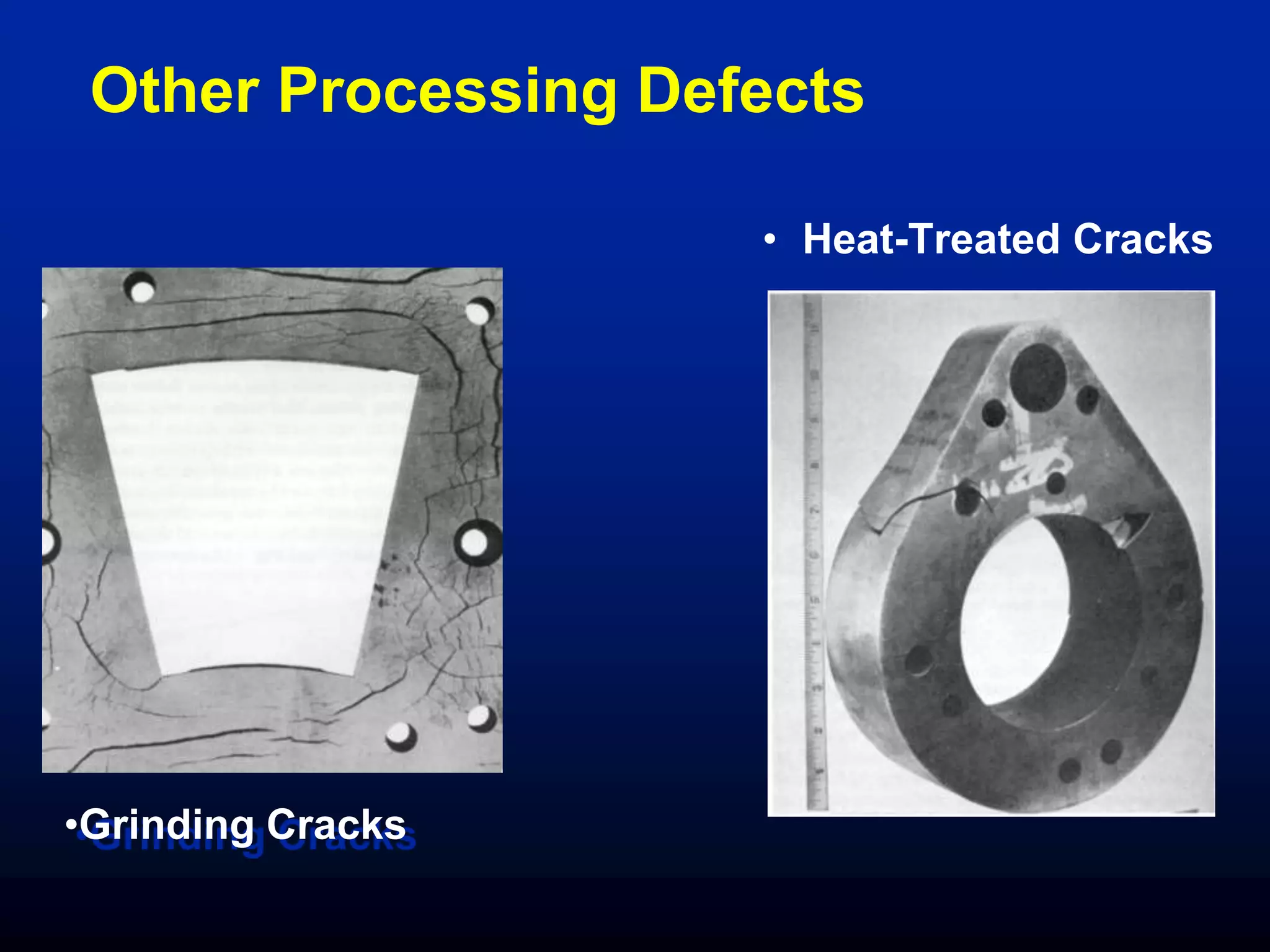
Other Processing Defects
• Heat-Treated Cracks
•Grinding Cracks
Extrusion Defects
 Defects in Extrusion
• Surface Crack – Lack of proper
lubrication
• Axial Hole or Funneling
Fatigue Failure
Fractography of Fractured Surface
direction of
rotation
final
rupture
crack origin
dull, fibrous
brittle failure
smooth circular
“beachmark”
practical example of fatigue failure
Fatigue Failure
Fractography of Fractured Surface
Transmission electron fractograph
showing fatigue striations.
Creep Failure
Fractography of Fractured Surface
Fractured surface
showing oxide films
Service Defects
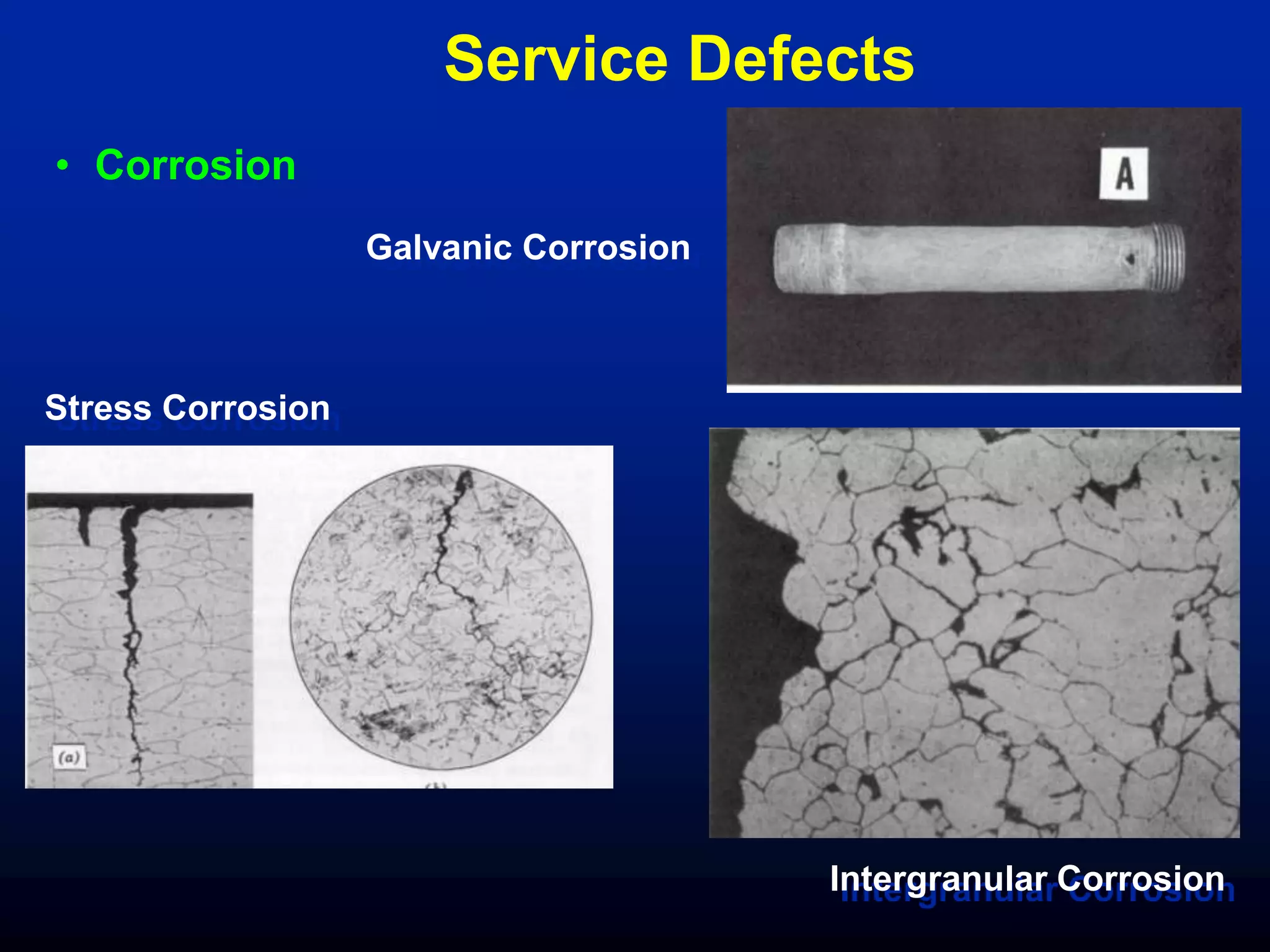
• Corrosion
Stress Corrosion
Intergranular Corrosion
Galvanic Corrosion
Service Defects
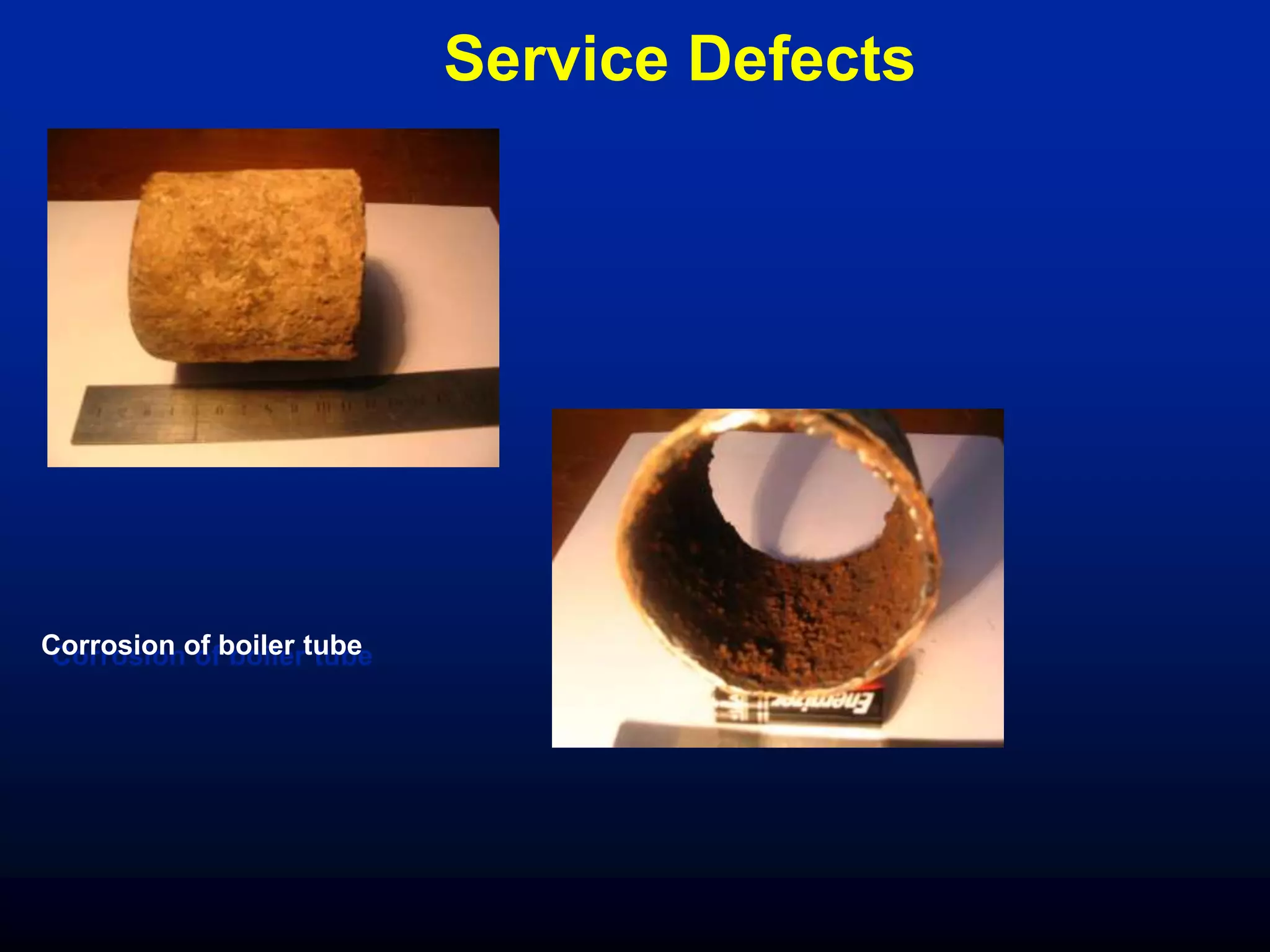
Corrosion of boiler tube
Service Defects
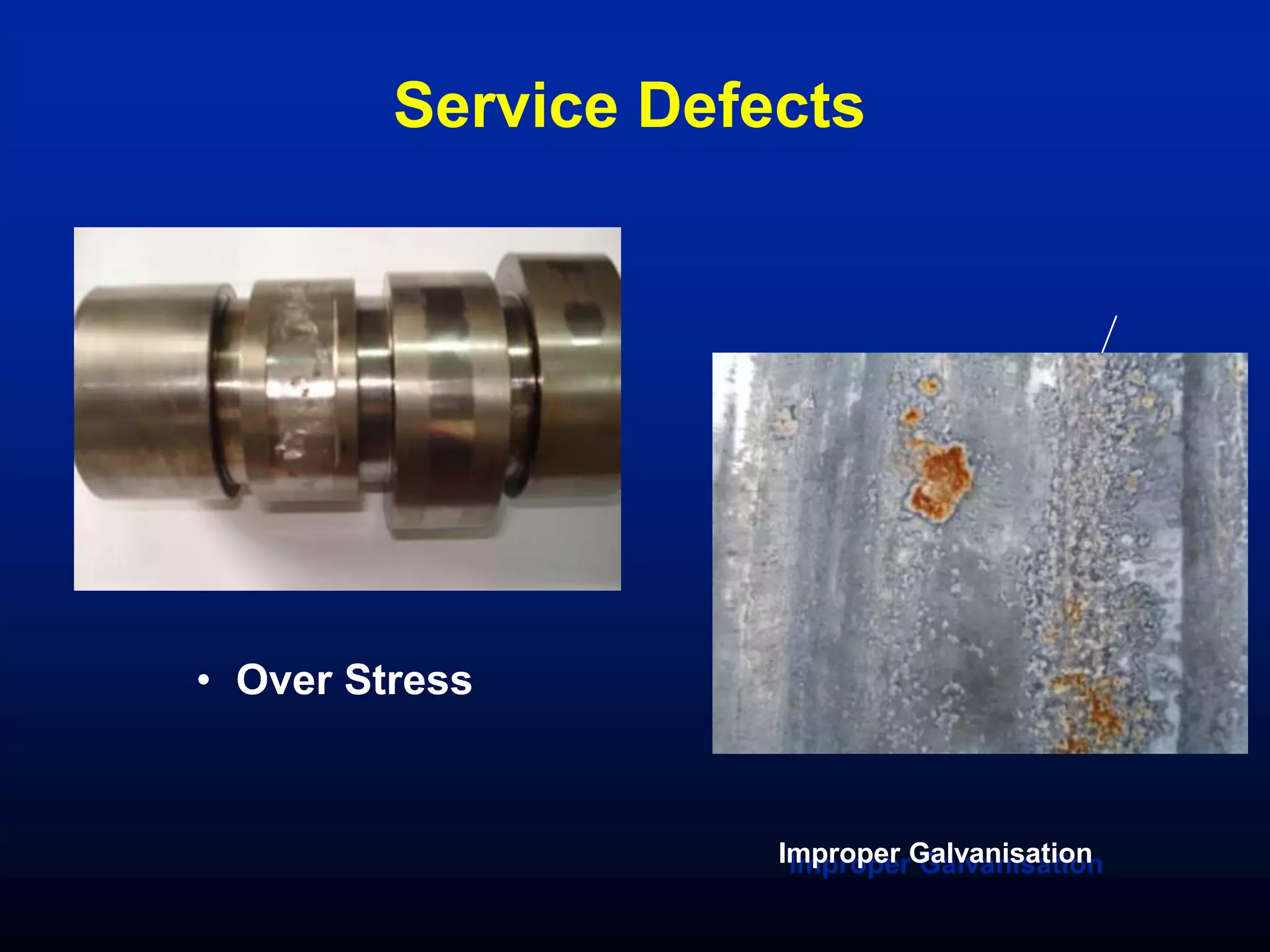
• Over Stress
Improper Galvanisation
Service Defects
Creep of Super heater tube
Fish mouth effect
(a)
(b)
Service Defects
Hydrogen Embrittlement
Creep – Overheating of Reformer Tubes
Service Defects
Cracking during welding
Failure of the weld

Defects in Materials

  • 1.
  • 2.
    DISCONTINUTIES & DEFECTS •NATURE OF DEFECTS – Microscopic Defects – Macroscopic Defects • ORIGIN OF DEFECTS – Inherent Defects – Processing Defects – Service Defects • DETERIORATES PHYSICAL and MECHANICAL PROPERTIES of MATERIALS • DETECTION of DEFECTS – Destructive Testing – Non-Destructive Testing
  • 3.
    CASTING DEFECTS :Inclusions • Inclusions are nonmetallic materials (oxides or sulphides) • a lower melting point than the metal • relative brittleness • these defects occur near the surface as a “skin” effect. • occur at the centre of the casting • they tend to be irregular in shape, not spherical or oval.
  • 4.
    CASTING DEFECTS :Porosity • gas trapped in the molten metal • formed by – release from the molten metal itself – release from the green sand mold, water vapour, or turbulence caused when pouring the metal • form of small pockets or voids appears as round, irregular or elongated shapes
  • 5.
    CASTING DEFECTS :Shrinkage • Metal contracts or shrinks when changing from the liquid to the solid state and defects will occur in a casting unless sufficient molten metal is available to “feed” it. • Defects may take the form of cavities, branch-like tears • Shrinkage cavities occur usually at hot spots in the casting
  • 6.
    CASTING DEFECTS • Piping: Central Cavity • As the casting solidifies, the metal contracts if there is not an adequate supply of molten metal to the centre of the casting • usually occurs in pure metals and alloys having narrow ranges of solidification temperature • causes lamination Hot Tears : If a section begins to shrink while still hot and there is not a sufficient supply of liquid metal, the resulting internal stress will tear the metal. This is because while hot, the metal has relatively low strength.
  • 7.
    CASTING DEFECTS • ColdShot • Cold Shut •Flash •Mold Shift •Short Casting
  • 8.
    Bulk Deformation Processes •Forging – Open Die Forging – Impression Die Forging – Closed Die Forging • Rolling
  • 9.
    Products of BulkDeformation Processes
  • 10.
    Open Die ForgingDefects Fracture - – exhausted ductility – Intergranular fracture in hot working • Barreling - Friction • Solution - – limited deformation per step – Process anneal between steps
  • 11.
    Closed Die ForgingDefects • Laps
  • 12.
    Closed Die ForgingDefects • Flow Lines
  • 13.
    Rolling Defects :Seams • Surface irregularities, such as cracks, on the slab or billet are stretched out and lengthened during rolling • Seams may also be caused by folding of the metal due to improper rolling • Seams are surface discontinuities and on finished bars will appear as either continuous or broken straight lines
  • 14.
    Rolling Defects :Stringers • Nonmetallic inclusions in slabs or billets, that are thinned and lengthened in the direction of rolling, by the rolling process, are called stringers.
  • 15.
    Rolling Defects • Ifthe cold mill rolls or hot mill coils happen to have too much crown, the cold mill will roll out the center and create center buckle. • If cold mill rolls or hot mill have too little crown, the cold mill will roll out the edges and create edge wave.
  • 16.
    Other Processing Defects •Heat-Treated Cracks •Grinding Cracks
  • 17.
    Extrusion Defects  Defectsin Extrusion • Surface Crack – Lack of proper lubrication • Axial Hole or Funneling
  • 18.
    Fatigue Failure Fractography ofFractured Surface direction of rotation final rupture crack origin dull, fibrous brittle failure smooth circular “beachmark” practical example of fatigue failure
  • 19.
    Fatigue Failure Fractography ofFractured Surface Transmission electron fractograph showing fatigue striations.
  • 20.
    Creep Failure Fractography ofFractured Surface Fractured surface showing oxide films
  • 21.
    Service Defects • Corrosion StressCorrosion Intergranular Corrosion Galvanic Corrosion
  • 22.
  • 23.
    Service Defects • OverStress Improper Galvanisation
  • 24.
    Service Defects Creep ofSuper heater tube Fish mouth effect
  • 25.
  • 26.
    Creep – Overheatingof Reformer Tubes
  • 27.
    Service Defects Cracking duringwelding Failure of the weld