JONA S, IZAAKS C, KEENDAWALA JGROUP 10
Content
 What is the Location-Time Diagram?
 Advantages of Location-time Diagram
 Disadvantages of Location-time Diagram
 Example
 Similarities
 Conclusion
 References
1.What is the Location-Time
Diagram?
 Is also known as Time-Chainage diagrams, is a c
ombination of the bar chart and line-of-balance s
cheduling formats .
 method of graphically presenting a time schedul
e for all types of longitudinal projects such as :
 Pipelines
 Railways
 Bridges
 Tunnels
 Road
What is the Location-Time
Diagram?...
 Activities in location-time diagrams are displayed
both along a time axis and along a distance axis
according to their relative linear position.
 It shows not only the location of the activity but al
so the direction of progress and the progress rat
e.
 Activities can be presented as geometrical shape
s showing the occupation of the work site over ti
me such that conflicting access can be detected
visually.
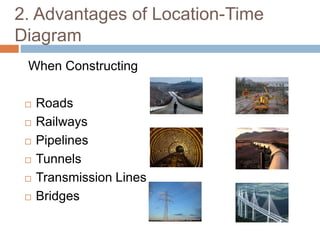
2. Advantages of Location-Time
Diagram
When Constructing
 Roads
 Railways
 Pipelines
 Tunnels
 Transmission Lines
 Bridges
Advantages of Location-Time
Diagram...
 Clearly communicate the scope by showing the p
roject details and the schedule in one view.
Easy to know :
 The order of activities or operations
 Where activities are happening locationally
 How activities must progress in relation to
direction and distance
 Time, key dates and holidays, etc.
3.Disadvantages of Location-Time
Diagram
 It does not retain the logical relationship among a
ctivities, so both planning and updating are very
difficult in cases of large project.
 Time consuming to produce and a good deal of p
ractice is required to get them right.
 Can be costly to rearrange the existing layout an
d not very robust to disruption.
 Critical path and float is only apparent through vi
sual interpretation.
Activities
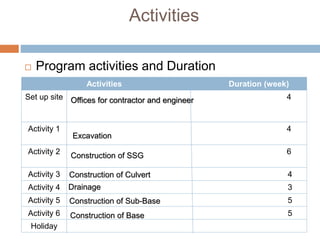
 Program activities and Duration
Activities Duration (week)
Set up site 4
Activity 1 4
Activity 2 6
Activity 3 4
Activity 4 3
Activity 5 5
Activity 6 5
Holiday
Offices for contractor and engineer
Excavation
Construction of SSG
Construction of Culvert
Drainage
Construction of Sub-Base
Construction of Base
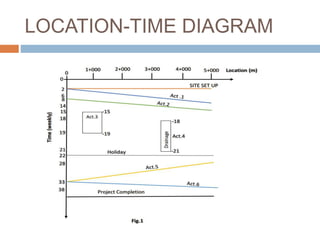
LOCATION-TIME DIAGRAM
5.SIMILARITIES
 all clearly depict time and sequence
 Applied to repetitive project ,except the bar char
t
 Good pictorial presentation of construction sequ
ences
 Indicate the progress
6.CONCLUSION
 Location time diagram is more superior to the
other two scheduling methods or tools
7.REFERENCES
 Cook,B & Williams,P.(2009). Construction plan
ning programming and control (3rd ed.). Singap
ore: john Wiley & Sons ltd.
 Peter, M, P. (2014). Time chainage: what is tim
e chainage. Retrieved from: http://www.timech
ainage.co.uk/principles.html

Location time diagram

  • 1.
    JONA S, IZAAKSC, KEENDAWALA JGROUP 10
  • 2.
    Content  What isthe Location-Time Diagram?  Advantages of Location-time Diagram  Disadvantages of Location-time Diagram  Example  Similarities  Conclusion  References
  • 3.
    1.What is theLocation-Time Diagram?  Is also known as Time-Chainage diagrams, is a c ombination of the bar chart and line-of-balance s cheduling formats .  method of graphically presenting a time schedul e for all types of longitudinal projects such as :  Pipelines  Railways  Bridges  Tunnels  Road
  • 4.
    What is theLocation-Time Diagram?...  Activities in location-time diagrams are displayed both along a time axis and along a distance axis according to their relative linear position.  It shows not only the location of the activity but al so the direction of progress and the progress rat e.  Activities can be presented as geometrical shape s showing the occupation of the work site over ti me such that conflicting access can be detected visually.
  • 5.
    2. Advantages ofLocation-Time Diagram When Constructing  Roads  Railways  Pipelines  Tunnels  Transmission Lines  Bridges
  • 6.
    Advantages of Location-Time Diagram... Clearly communicate the scope by showing the p roject details and the schedule in one view. Easy to know :  The order of activities or operations  Where activities are happening locationally  How activities must progress in relation to direction and distance  Time, key dates and holidays, etc.
  • 7.
    3.Disadvantages of Location-Time Diagram It does not retain the logical relationship among a ctivities, so both planning and updating are very difficult in cases of large project.  Time consuming to produce and a good deal of p ractice is required to get them right.  Can be costly to rearrange the existing layout an d not very robust to disruption.  Critical path and float is only apparent through vi sual interpretation.
  • 8.
    Activities  Program activitiesand Duration Activities Duration (week) Set up site 4 Activity 1 4 Activity 2 6 Activity 3 4 Activity 4 3 Activity 5 5 Activity 6 5 Holiday Offices for contractor and engineer Excavation Construction of SSG Construction of Culvert Drainage Construction of Sub-Base Construction of Base
  • 9.
  • 10.
    5.SIMILARITIES  all clearlydepict time and sequence  Applied to repetitive project ,except the bar char t  Good pictorial presentation of construction sequ ences  Indicate the progress
  • 11.
    6.CONCLUSION  Location timediagram is more superior to the other two scheduling methods or tools
  • 12.
    7.REFERENCES  Cook,B &Williams,P.(2009). Construction plan ning programming and control (3rd ed.). Singap ore: john Wiley & Sons ltd.  Peter, M, P. (2014). Time chainage: what is tim e chainage. Retrieved from: http://www.timech ainage.co.uk/principles.html