Gonioscopy is a critical clinical technique for examining the anterior chamber angle, essential for diagnosing and managing glaucoma. It involves either direct or indirect methods, using specialized lenses to overcome reflection issues inherent in standard examinations. While both techniques have advantages and disadvantages, gonioscopy serves various diagnostic and therapeutic purposes related to glaucoma and other anterior segment conditions.
• GOLDMANN(1938): introducedthe
gonioprism
• BARKAN: Established the use of gonioscopy in
management of glaucoma
4.
Gonioscopy
• Gonioscopy isa clinical technique that is used
to examine structure in the anterior chamber
angle
• The assessment is essential for both
diagnosing the type of glaucoma and for
planning the appropriate therapy
5.
Purpose
• The angleof AC is the configuration of
pathogenesis of glaucoma
• Contact between the peripheral iris and the
cornea signifies a closed angle, which precludes
aqueous assess to the trabecular meshwork
• It involves the examination of analysis of AC angle
6.
Principle of Gonioscopy
•A direct view of the angle of AC is not
normally possible with the slit-lamp because
of overhanging opaque scleral shelf and the
fact that light which emanates from the angle
is reflected back into the eye by cornea owing
to phenomenon of total internal reflection
• A Gonio lens is used to eliminate the total
internal reflection
7.
Indications
• Closure ofthe AC angle
• Historical evidence of Angle closure
• Documented increased IOP
• C:D greater than 0.6:1
• AC neovascularisation
• Diabetes :early or established PDR
• Recent or previous CRVO
8.
Cont..
• Anisocoria
• Hyphaema
•Sectorial variation in AC depth
• H/O or signs of penetrating ocular foreign
body
• Degenerative condition
• Iris heterochromia
• Corneal oedema
• History of evidence of trauma
Direct Gonioscopy
• Allowsfor direct visualization of the chamber
angle
• Examples of direct goniolenses include
Koeppe lens
Huskins Barkan lens
Worth lens
Swan-Jacob lens
Richadrson lense
Sieback lens
11.
Cont..
• During directgonioscopy, the viewer has an
erect view of the angle structures
• Direct gonioscopy is most easily performed
with the patient supine position and in the
operating room for an exam under
anaesthesia
12.
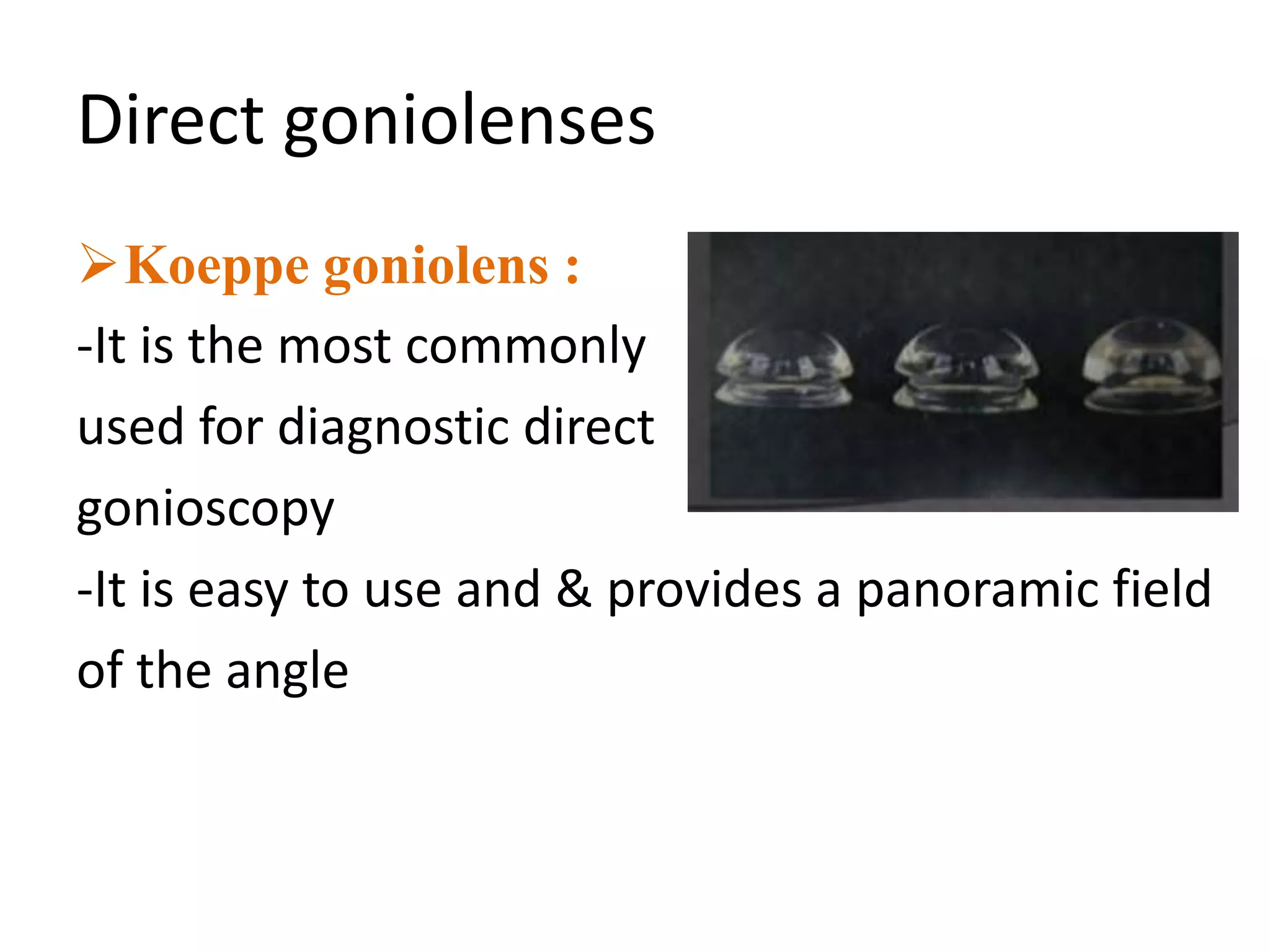
Direct goniolenses
Koeppe goniolens:
-It is the most commonly
used for diagnostic direct
gonioscopy
-It is easy to use and & provides a panoramic field
of the angle
13.
Huskins Barkan’s lens:prototype surgical
goniolens used for goniotomy
Worth goniolens: it anchors to cornea by
partial vacuum
Swan-Jacob lens: also used for surgical
purpose
Richadrson- Shaffers goniolens: basically a
small koeppe lens used for infants
Sieback goniolens: Tiny goniolens which floats
on the cornea
14.
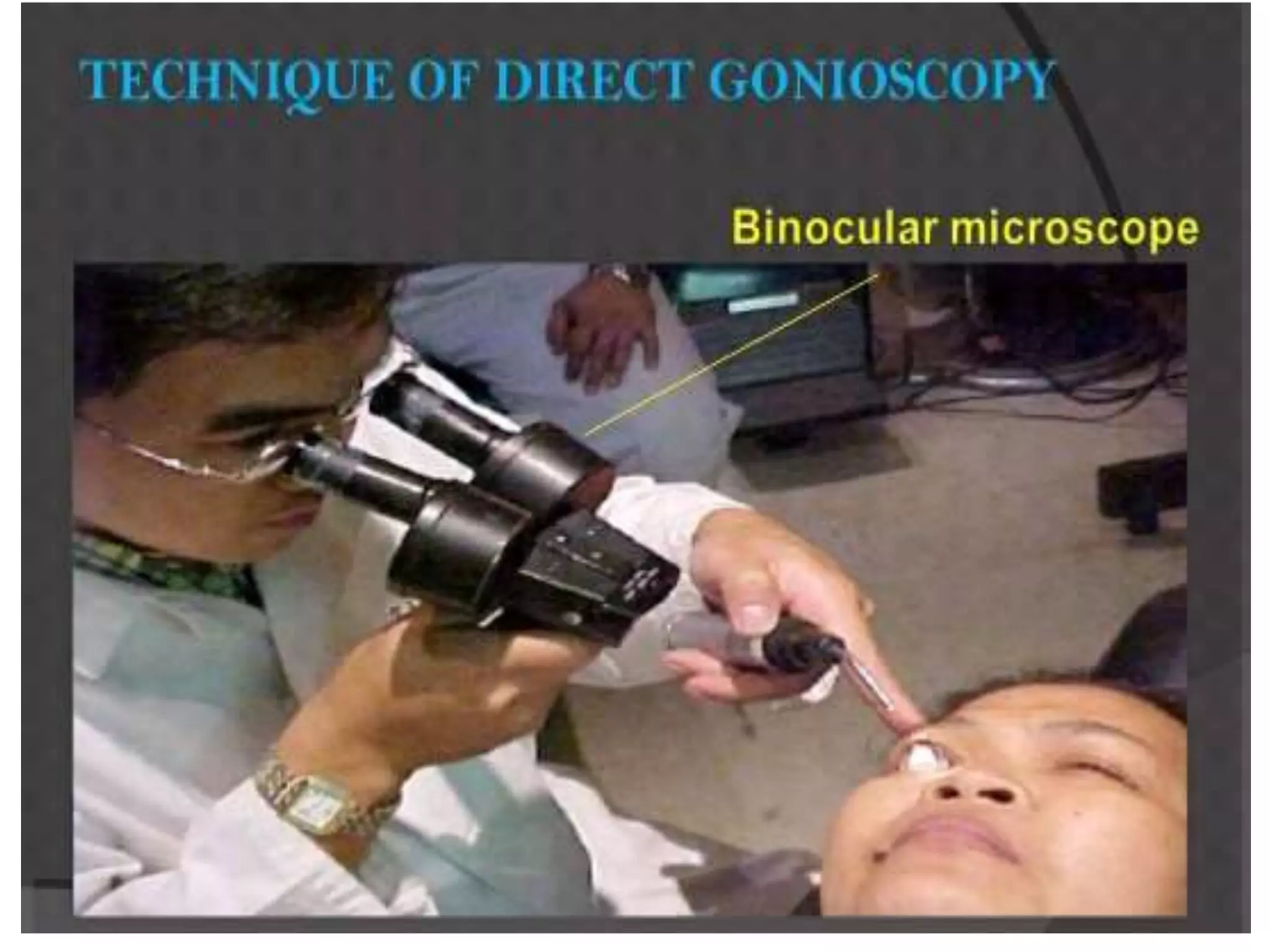
Technique of directgonioscopy
• Cornea is first anaesthetized with 4%
Xylocaine instilled topically
• The ideal position for direct gonioscopy is
patient lying supine with examiner sitting on
the side of the eye to be examined
• After topical anaesthesia, goniolens is
positioned on the cornea, using balanced salt
solution or methyl cellulose
15.
Cont…
• Examiner holdsthe goniolens in one hand and
the light source in other and scans the anterior
chamber angle by shifting the examiners
position until all 360 degrees have been studied
17.
Advantages
• Greater flexibilityas position of observer can
be changed
• Panoramic view is obtained so one part of
angle could be compared with the other
• Angle becomes deep in supine position so it is
easy to see the angle
• Can be used in sedated patient and also in
infants
18.
Cont..
• Provides astraight view rather than inverted
view
• Can be used for surgical procedures like
goniotomy
19.
Disadvantages
• Inconvenient
• Annoyinglight reflexes from cornea
• Time consuming
• Benefits of slit-lamp (like variable light and
better clarity) are not available
20.
Indirect gonioscopy
• Usesmirrors or prisms to overcome the
problem of total internal reflection
• Gonioprisms have an angled mirror through
which light rays from anterior chamber angle
are reflected so that they emerge
perpendicular to the lens-air interface
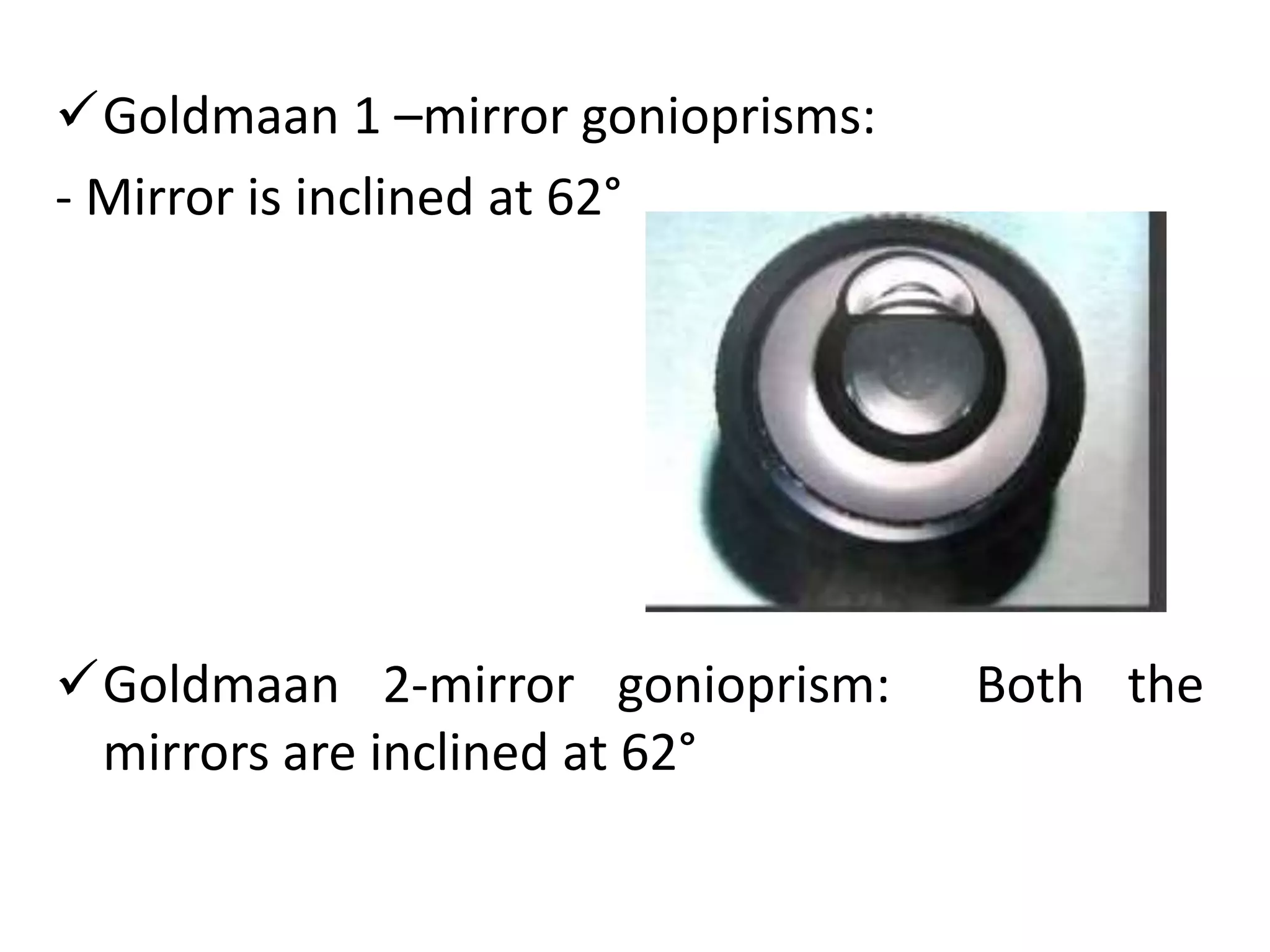
Goldmaan 1 –mirrorgonioprisms:
- Mirror is inclined at 62°
Goldmaan 2-mirror gonioprism: Both the
mirrors are inclined at 62°
23.
Advantages of Goldmaangonioprisms
• Easy to use
• Excellent view
• Peripheral retina can be seen
• Goldmaan 2-mirror gives best in-situ view of
the angle
24.
Disadvantages
• Curvature oflens is more than that of the
cornea so a coupling material is required. It
blurs vision and fundus , therefore direct and
indirect ophthalmoscopy can not be done
immediately after its use
25.
2. Gonioprisms notrequiring coupling
agents:
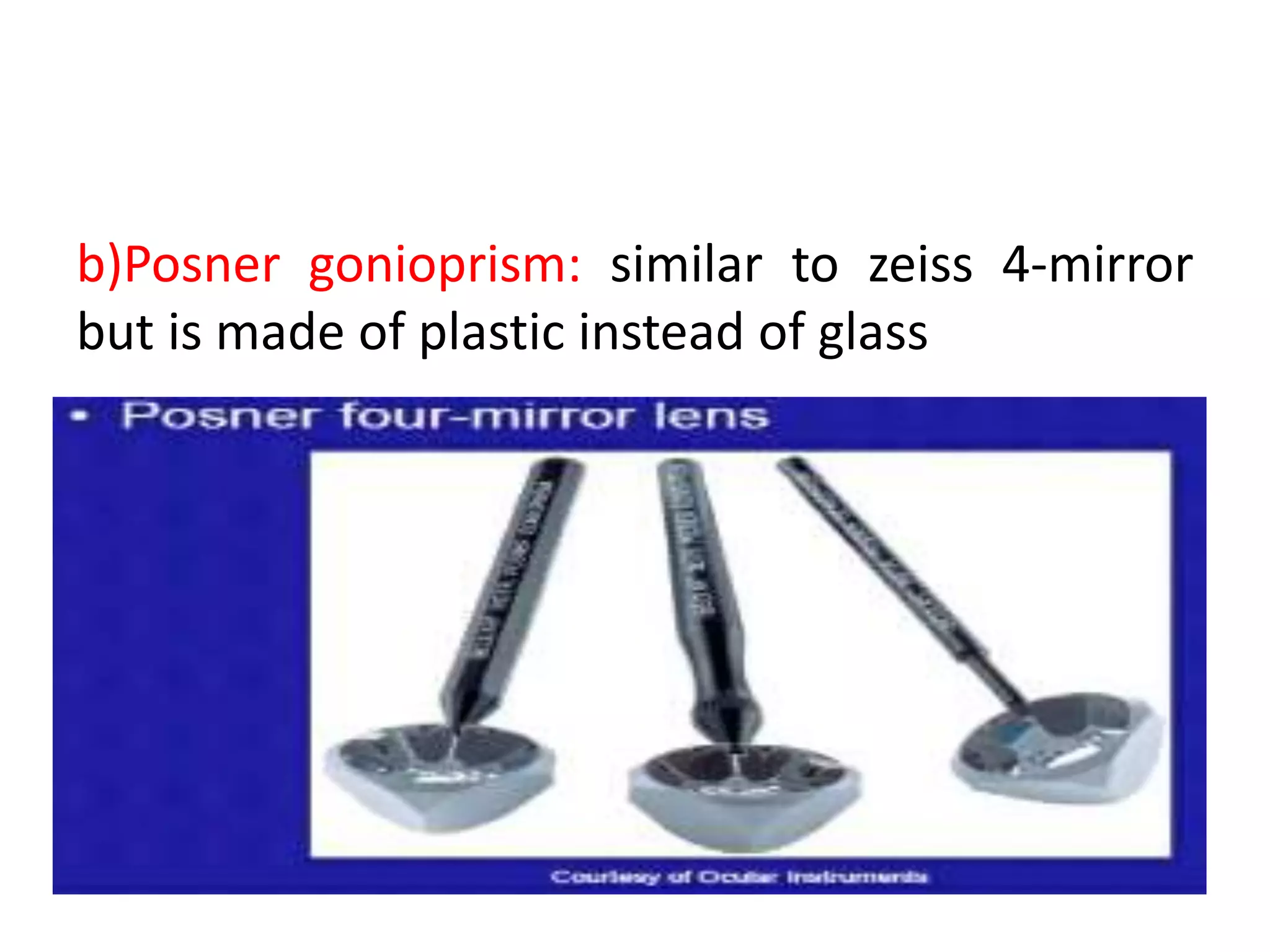
a) Zeiss 4-mirror gonioprism: it has four identical
mirrors angled at 64° which allow examination
of the four quadrants without rotation of the
lens
c)Sussmann lens:
Similar tozeiss 4-mirror
d)Tokel gonioprism:
Single mirror gonioprism and has got a wider field
of view
28.
Advantages of Zeiss4-mirror lens
• Coupling material is not required
• Easy to perform
• All the four quadrants are visible at the same
time so no need to rotate the gonioscope
• Visualization of fundus and photography is
possible
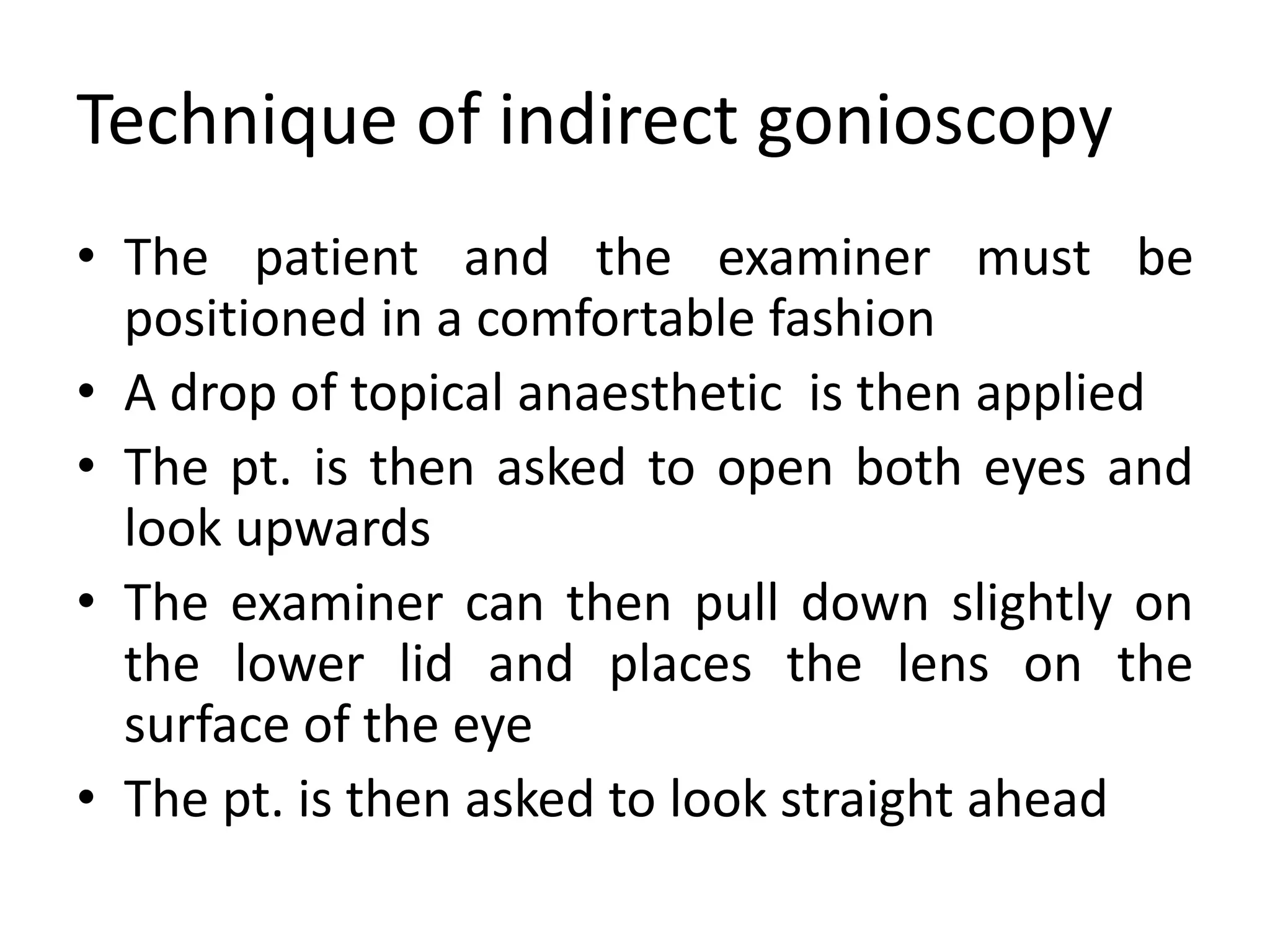
Technique of indirectgonioscopy
• The patient and the examiner must be
positioned in a comfortable fashion
• A drop of topical anaesthetic is then applied
• The pt. is then asked to open both eyes and
look upwards
• The examiner can then pull down slightly on
the lower lid and places the lens on the
surface of the eye
• The pt. is then asked to look straight ahead
31.
Cont..
• Most examinerschoose to start with the
inferior angle as it is usually a bit more open,
and pigmentation of TM is slightly more
prominent, allowing for easier identification of
the angle structures
• Continue identifying all angle structures and
then repeat with the other eye
32.
Advantages
• Easier tolearn
• Faster to perform
• Requires less instrumentation and space
• Slit-lamp provides better optics and lighting
• Magnified stereoscopic view of optic disc can
also be obtained
33.
Disadvantages
• Limited positioningof light rays
• Difficult to perform in the horizontal meridian
• Mirror image seen so confusing
• Excessive pressure may open or close the
angle artefactually
34.
Gonioscopic view ofangle structures
1. Schwalbe’s line:
It is a condensation
of collagen tissue and
notes the edge of the
Descemet’s membrane
35.
2. Trabecular meshwork:
It lies between the Schwalbe’s line anteriorly and
scleral spur posteriorly and has an avg. width of
600µm
Smooth in infants but becomes pigmented with
age
36.
3. Scleral spur:made up of collagen tissue
-situated just posterior to the TM
4. Ciliary Body Band: lies just behind the scleral
spur. Width of CBB varies (narrow – hyperopes &
wide in myopes or aphakics)
5. Roots of Iris: iris contour is slightly convex or
flat
37.
Grading system forthe angle of AC
A. Scheie’s grading
B. Shaffers grading
38.
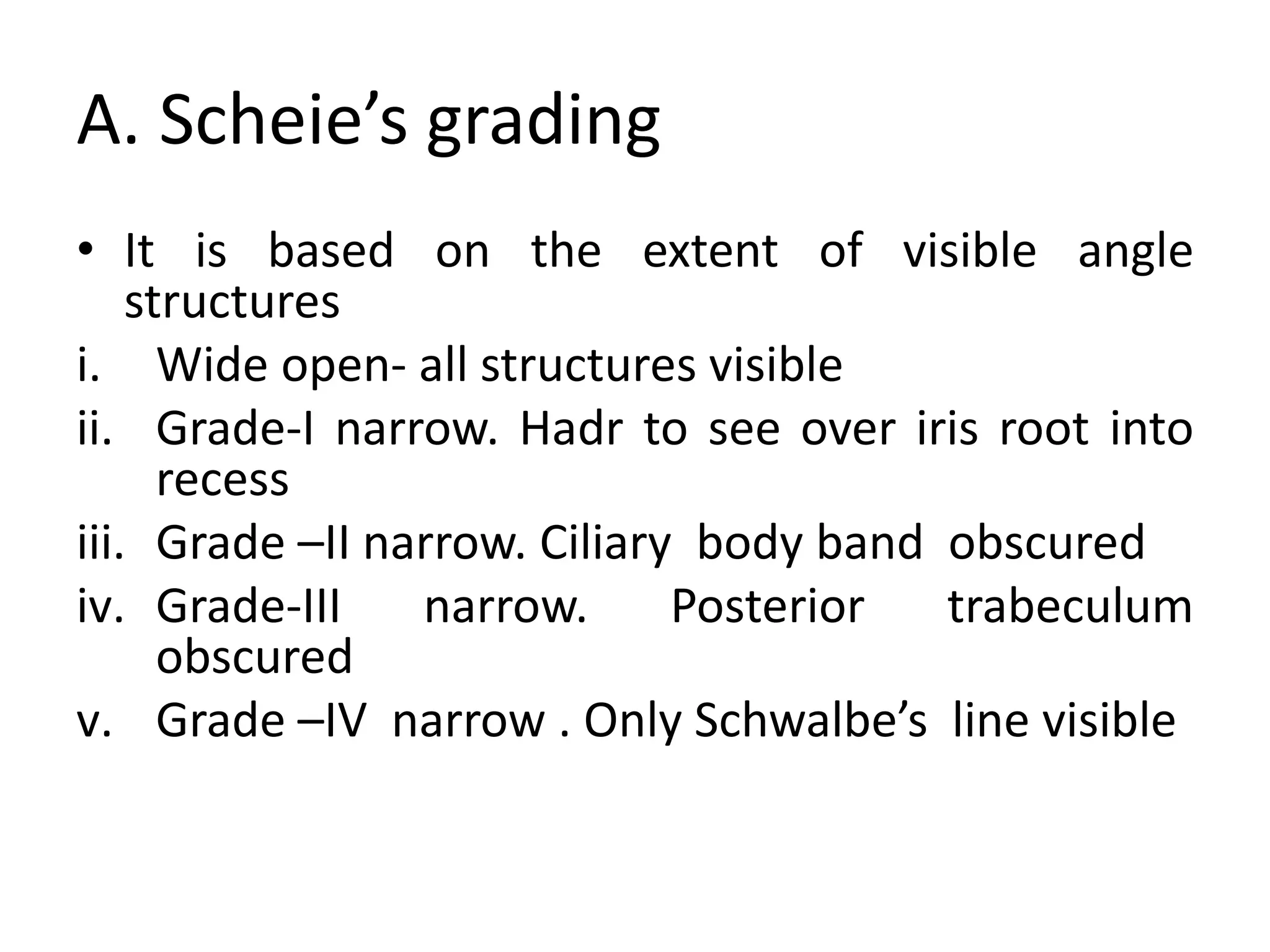
A. Scheie’s grading
•It is based on the extent of visible angle
structures
i. Wide open- all structures visible
ii. Grade-I narrow. Hadr to see over iris root into
recess
iii. Grade –II narrow. Ciliary body band obscured
iv. Grade-III narrow. Posterior trabeculum
obscured
v. Grade –IV narrow . Only Schwalbe’s line visible
39.
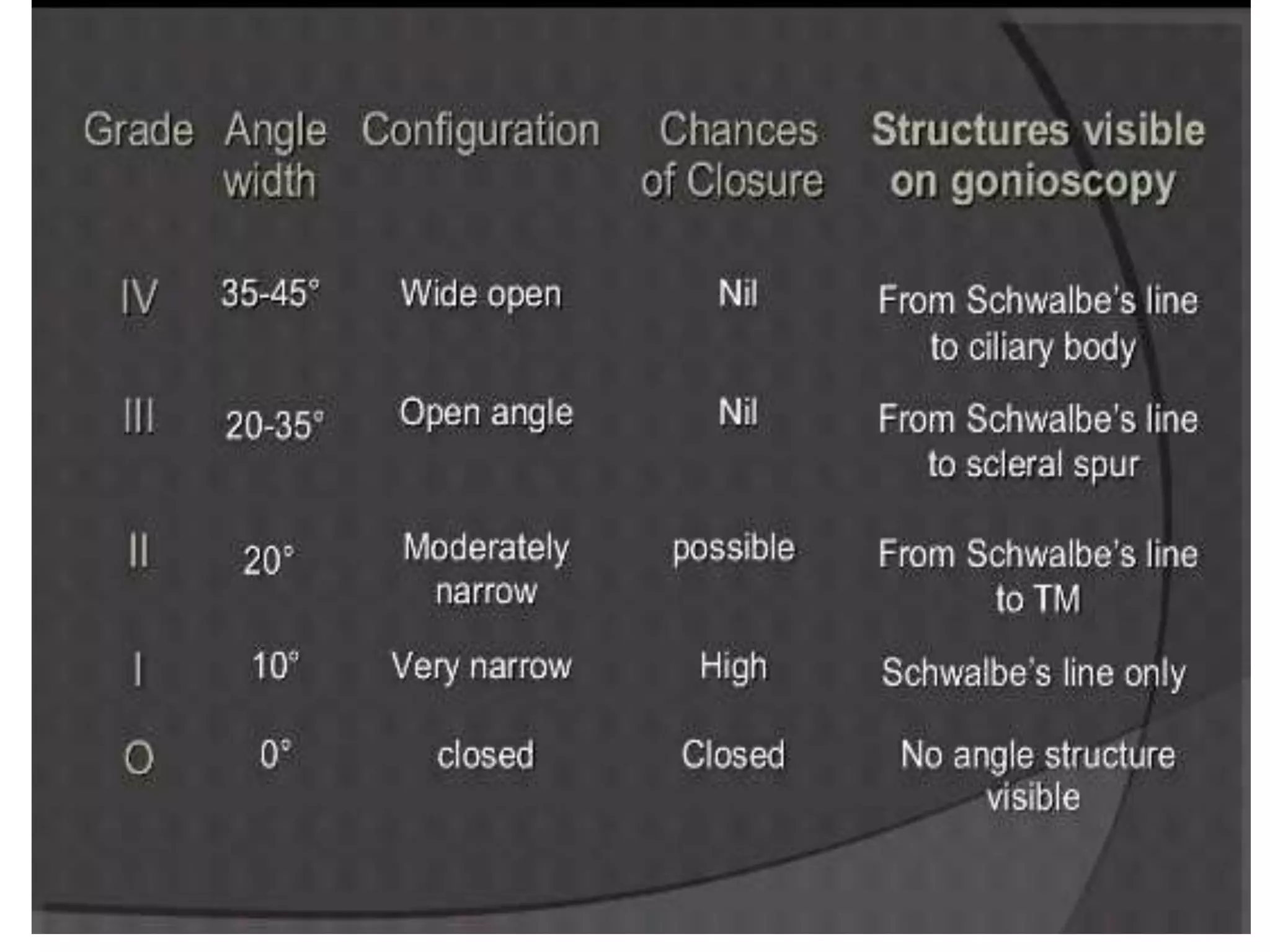
B. Shaffer’s grading
•Estimation of the angle width is achieved by
observing the angle between the imaginary
lines, constructed tangential to inner surface
of trabeculum and the anterior iris durface
Clinical uses ofgonioscopy
DIAGNOSTIC:
• Differential between primary open angle
glaucoma(POAG) and primary angle closure
glaucoma(PACG)
• To diagnose secondary glaucomas
-Angle recession
-Uveitic glaucoma
• Diagnose tumors of anterior segment
46.
THERAPEUTIC
• To performargon laser trabeculoplasty
• Laser iridoplasty
• Laser cyclophotocoagulation
• Laser sclerotomy
• Goniotomy and trabeculotomy
47.
Limitations of Gonioscopy
•Can not be performed in painful inflamed eyes
• Difficult to perform in cases of acute glaucoma
where eyes are painful and have oedematous
cornea
• Hyphema
• Compromised cornea
• Perforated globe
• COMPLICATION- Corneal abrasion
48.
Reference
• A KKhurana, Theory and Practice of Optics
and Refraction, 2nd edition, page no-(305 to
313)
• Eyewiki.aao.org/Gonioscopy
• https://en.m.wikipedia.org/wiki/file:Gonio.pn
g