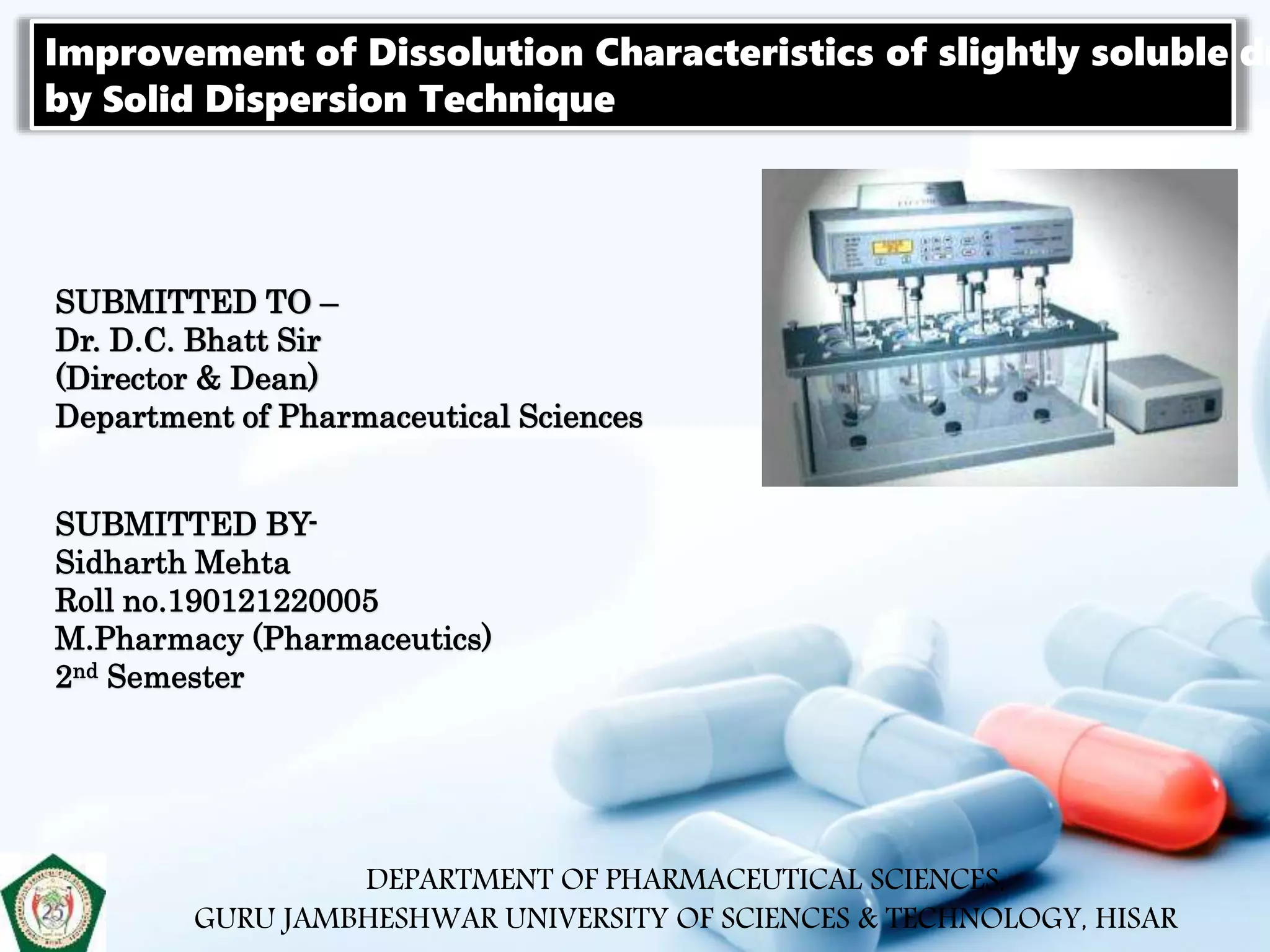

Improvement of Dissolution Characteristics of slightly soluble dr
by Solid Dispersion Technique
SUBMITTED TO –
Dr. D.C. Bhatt Sir
(Director & Dean)
Department of Pharmaceutical Sciences
SUBMITTED BY-
Sidharth Mehta
Roll no.190121220005
M.Pharmacy (Pharmaceutics)
2nd Semester
DEPARTMENT OF PHARMACEUTICAL SCIENCES,
GURU JAMBHESHWAR UNIVERSITY OF SCIENCES & TECHNOLOGY, HISAR
CONTENTS
 AIM
 REFERENCES
 REQUIREMENTS
 THEORETICAL BACKGROUND
(a) Overview of Hydrochlorothiazide (Drug)
(b) Mechanism of action of Hydrochlorothiazide
(c) Overview about Poloxamer 407 (Polymer)
(d) Overview about Polyethylene Glycol 6000
(polymer)
(e) Solid Dispersion Technique
(f) Mechanism of Bioavailability Enhancement
 PROCEDURE
(a) Assay of Hydrochlorothiazide
(b) Preparation of Solid Dispersion
 EVALUATION
(a) Fourier transforms infrared spectroscopy
(b) Differential scanning calorimetry
(c) Determination of the drug dissolution
 CONCLUSION
6/16/2020
AIM- Improvement of Dissolution Characteristics of Hydrochlorothiazide
(slightly soluble drug) by Solid Dispersion Technique.
REFERENCES- (a) Gamal M EL Maghraby, Amel Y EL Gohary,
Mohammed A Osman. Enhancement of dissolution rate of hydrochlorothiazide.
Int J Pharm Pharm Sci 2016;8(7):427-433.
(b) DM Brahmankar, Sunil B. Jaiswal; Biopharmaceutics & Pharmacokinetics;
Vallabh Prakashan, 3rd edition 2017: 358-359.
REQUIREMENTS-
(1) CHEMICALS- Hydrochlorothiazide, Poloxamer 407, Polyethylene
glycol 6000 (PEG 6000) and aerosil 200.
(2) EQUIPMENTS- Dissolution Apparatus Type 2 USP, Water Bath,
Weighing Machine and Heating Mantle.
THEORETICAL BACKGROUND-
(a) Overview of Hydrochlorothiazide (Drug)-
 Hydrochlorothiazide (HCTZ) belongs to an important group
of drugs benzothiadiazine thiazide diuretics.
 It is used alone or in combination with other therapeutic agents in the
treatment of hypertension.
 It is also indicated in the management of edema resulting from
mild-to-moderate congestive heart failure or from chronic hepatic or
renal disease.
 Other uses include diabetes insipidus, renal tubular acidosis, and to
decrease the risk of kidney stones in those with a high calcium level
in the urine.
(b) Mechanism of action of Hydrochlorothiazide-
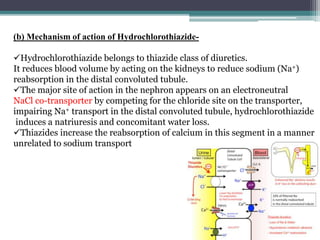
Hydrochlorothiazide belongs to thiazide class of diuretics.
It reduces blood volume by acting on the kidneys to reduce sodium (Na+)
reabsorption in the distal convoluted tubule.
The major site of action in the nephron appears on an electroneutral
NaCl co-transporter by competing for the chloride site on the transporter,
impairing Na+ transport in the distal convoluted tubule, hydrochlorothiazide
induces a natriuresis and concomitant water loss.
Thiazides increase the reabsorption of calcium in this segment in a manner
unrelated to sodium transport
(c) Overview about Poloxamer 407 (Polymer)-
Poloxamer 407 is a hydrophilic non-ionic surfactant of the more general
class of copolymers known as poloxamers.
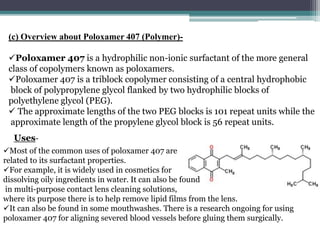
Poloxamer 407 is a triblock copolymer consisting of a central hydrophobic
block of polypropylene glycol flanked by two hydrophilic blocks of
polyethylene glycol (PEG).
 The approximate lengths of the two PEG blocks is 101 repeat units while the
approximate length of the propylene glycol block is 56 repeat units.
Most of the common uses of poloxamer 407 are
related to its surfactant properties.
For example, it is widely used in cosmetics for
dissolving oily ingredients in water. It can also be found
in multi-purpose contact lens cleaning solutions,
where its purpose there is to help remove lipid films from the lens.
It can also be found in some mouthwashes. There is a research ongoing for using
poloxamer 407 for aligning severed blood vessels before gluing them surgically.
Uses-
(d) Overview about Polyethylene Glycol 6000 (Polymer)-
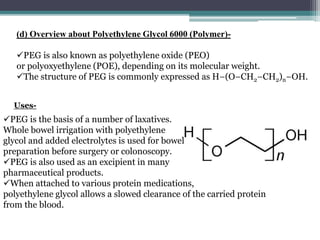
PEG is also known as polyethylene oxide (PEO)
or polyoxyethylene (POE), depending on its molecular weight.
The structure of PEG is commonly expressed as H−(O−CH2−CH2)n−OH.
PEG is the basis of a number of laxatives.
Whole bowel irrigation with polyethylene
glycol and added electrolytes is used for bowel
preparation before surgery or colonoscopy.
PEG is also used as an excipient in many
pharmaceutical products.
When attached to various protein medications,
polyethylene glycol allows a slowed clearance of the carried protein
from the blood.
Uses-
(e) Solid Dispersion Technique-
The drugs which are having poor water solubility they often show poor oral
bioavailability due to the low levels of absorption.
Development of solid dispersions of poorly bioavailable drugs overcame
the drawbacks of the previous approaches.
Solid dispersion is defined as dispersion of one or more active ingredients
(hydrophobic) in an inert carrier (hydrophillic) at solid state prepared by
melting (fusion) method, solvent, or melting solvent method.
When the solid dispersion comes in contact with the aqueous medium,
the inert carrier dissolves and the drug is released, the increased surface area
produces a higher dissolution rate thus increasing the bioavailability of
the poorly soluble drug.
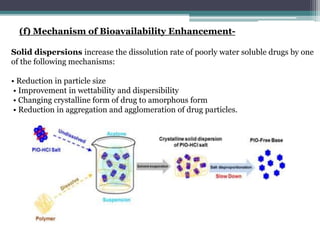
(f) Mechanism of Bioavailability Enhancement-
Solid dispersions increase the dissolution rate of poorly water soluble drugs by one
of the following mechanisms:
• Reduction in particle size
• Improvement in wettability and dispersibility
• Changing crystalline form of drug to amorphous form
• Reduction in aggregation and agglomeration of drug particles.
PROCEDURE-
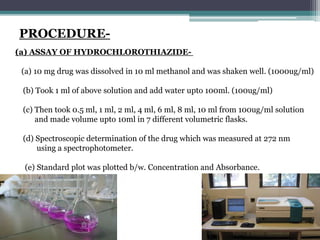
(a) ASSAY OF HYDROCHLOROTHIAZIDE-
(a) 10 mg drug was dissolved in 10 ml methanol and was shaken well. (1000ug/ml)
(b) Took 1 ml of above solution and add water upto 100ml. (100ug/ml)
(c) Then took 0.5 ml, 1 ml, 2 ml, 4 ml, 6 ml, 8 ml, 10 ml from 100ug/ml solution
and made volume upto 10ml in 7 different volumetric flasks.
(d) Spectroscopic determination of the drug which was measured at 272 nm
using a spectrophotometer.
(e) Standard plot was plotted b/w. Concentration and Absorbance.
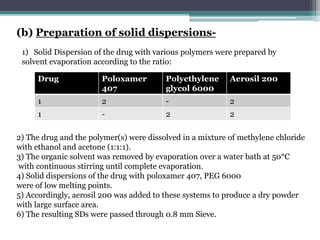
(b) Preparation of solid dispersions-
1) Solid Dispersion of the drug with various polymers were prepared by
solvent evaporation according to the ratio:
Drug Poloxamer
407
Polyethylene
glycol 6000
Aerosil 200
1 2 - 2
1 - 2 2
2) The drug and the polymer(s) were dissolved in a mixture of methylene chloride
with ethanol and acetone (1:1:1).
3) The organic solvent was removed by evaporation over a water bath at 50°C
with continuous stirring until complete evaporation.
4) Solid dispersions of the drug with poloxamer 407, PEG 6000
were of low melting points.
5) Accordingly, aerosil 200 was added to these systems to produce a dry powder
with large surface area.
6) The resulting SDs were passed through 0.8 mm Sieve.
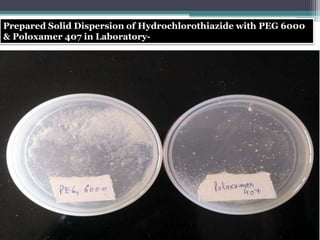
Prepared Solid Dispersion of Hydrochlorothiazide with PEG 6000
& Poloxamer 407 in Laboratory-
EVALUATION-
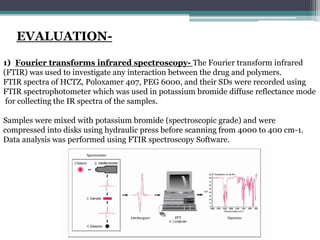
1) Fourier transforms infrared spectroscopy- The Fourier transform infrared
(FTIR) was used to investigate any interaction between the drug and polymers.
FTIR spectra of HCTZ, Poloxamer 407, PEG 6000, and their SDs were recorded using
FTIR spectrophotometer which was used in potassium bromide diffuse reflectance mode
for collecting the IR spectra of the samples.
Samples were mixed with potassium bromide (spectroscopic grade) and were
compressed into disks using hydraulic press before scanning from 4000 to 400 cm-1.
Data analysis was performed using FTIR spectroscopy Software.
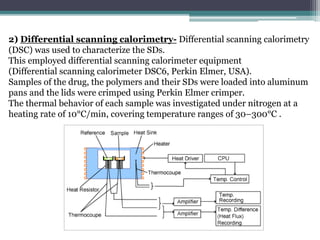
2) Differential scanning calorimetry- Differential scanning calorimetry
(DSC) was used to characterize the SDs.
This employed differential scanning calorimeter equipment
(Differential scanning calorimeter DSC6, Perkin Elmer, USA).
Samples of the drug, the polymers and their SDs were loaded into aluminum
pans and the lids were crimped using Perkin Elmer crimper.
The thermal behavior of each sample was investigated under nitrogen at a
heating rate of 10°C/min, covering temperature ranges of 30–300°C .
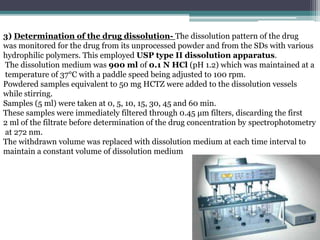
3) Determination of the drug dissolution- The dissolution pattern of the drug
was monitored for the drug from its unprocessed powder and from the SDs with various
hydrophilic polymers. This employed USP type II dissolution apparatus.
The dissolution medium was 900 ml of 0.1 N HCl (pH 1.2) which was maintained at a
temperature of 37°C with a paddle speed being adjusted to 100 rpm.
Powdered samples equivalent to 50 mg HCTZ were added to the dissolution vessels
while stirring.
Samples (5 ml) were taken at 0, 5, 10, 15, 30, 45 and 60 min.
These samples were immediately filtered through 0.45 μm filters, discarding the first
2 ml of the filtrate before determination of the drug concentration by spectrophotometry
at 272 nm.
The withdrawn volume was replaced with dissolution medium at each time interval to
maintain a constant volume of dissolution medium
CONCLUSION- Formation of a binary SD of HCTZ with different
polymers in the presence of aerosil 200 resulted in significant enhancement
in the dissolution rate of the drug.
This enhancement may be attributed to change in the crystalline structure
of the drug after SD formation and the wetting effect or
the micellar solubilization and the selfemulsifying property of the polymer.
Solid dispersion technique

Solid dispersion technique

  • 1.
    Improvement of DissolutionCharacteristics of slightly soluble dr by Solid Dispersion Technique SUBMITTED TO – Dr. D.C. Bhatt Sir (Director & Dean) Department of Pharmaceutical Sciences SUBMITTED BY- Sidharth Mehta Roll no.190121220005 M.Pharmacy (Pharmaceutics) 2nd Semester DEPARTMENT OF PHARMACEUTICAL SCIENCES, GURU JAMBHESHWAR UNIVERSITY OF SCIENCES & TECHNOLOGY, HISAR
  • 2.
    CONTENTS  AIM  REFERENCES REQUIREMENTS  THEORETICAL BACKGROUND (a) Overview of Hydrochlorothiazide (Drug) (b) Mechanism of action of Hydrochlorothiazide (c) Overview about Poloxamer 407 (Polymer) (d) Overview about Polyethylene Glycol 6000 (polymer) (e) Solid Dispersion Technique (f) Mechanism of Bioavailability Enhancement  PROCEDURE (a) Assay of Hydrochlorothiazide (b) Preparation of Solid Dispersion  EVALUATION (a) Fourier transforms infrared spectroscopy (b) Differential scanning calorimetry (c) Determination of the drug dissolution  CONCLUSION
  • 3.
    6/16/2020 AIM- Improvement ofDissolution Characteristics of Hydrochlorothiazide (slightly soluble drug) by Solid Dispersion Technique. REFERENCES- (a) Gamal M EL Maghraby, Amel Y EL Gohary, Mohammed A Osman. Enhancement of dissolution rate of hydrochlorothiazide. Int J Pharm Pharm Sci 2016;8(7):427-433. (b) DM Brahmankar, Sunil B. Jaiswal; Biopharmaceutics & Pharmacokinetics; Vallabh Prakashan, 3rd edition 2017: 358-359. REQUIREMENTS- (1) CHEMICALS- Hydrochlorothiazide, Poloxamer 407, Polyethylene glycol 6000 (PEG 6000) and aerosil 200. (2) EQUIPMENTS- Dissolution Apparatus Type 2 USP, Water Bath, Weighing Machine and Heating Mantle.
  • 4.
    THEORETICAL BACKGROUND- (a) Overviewof Hydrochlorothiazide (Drug)-  Hydrochlorothiazide (HCTZ) belongs to an important group of drugs benzothiadiazine thiazide diuretics.  It is used alone or in combination with other therapeutic agents in the treatment of hypertension.  It is also indicated in the management of edema resulting from mild-to-moderate congestive heart failure or from chronic hepatic or renal disease.  Other uses include diabetes insipidus, renal tubular acidosis, and to decrease the risk of kidney stones in those with a high calcium level in the urine.
  • 5.
    (b) Mechanism ofaction of Hydrochlorothiazide- Hydrochlorothiazide belongs to thiazide class of diuretics. It reduces blood volume by acting on the kidneys to reduce sodium (Na+) reabsorption in the distal convoluted tubule. The major site of action in the nephron appears on an electroneutral NaCl co-transporter by competing for the chloride site on the transporter, impairing Na+ transport in the distal convoluted tubule, hydrochlorothiazide induces a natriuresis and concomitant water loss. Thiazides increase the reabsorption of calcium in this segment in a manner unrelated to sodium transport
  • 6.
    (c) Overview aboutPoloxamer 407 (Polymer)- Poloxamer 407 is a hydrophilic non-ionic surfactant of the more general class of copolymers known as poloxamers. Poloxamer 407 is a triblock copolymer consisting of a central hydrophobic block of polypropylene glycol flanked by two hydrophilic blocks of polyethylene glycol (PEG).  The approximate lengths of the two PEG blocks is 101 repeat units while the approximate length of the propylene glycol block is 56 repeat units. Most of the common uses of poloxamer 407 are related to its surfactant properties. For example, it is widely used in cosmetics for dissolving oily ingredients in water. It can also be found in multi-purpose contact lens cleaning solutions, where its purpose there is to help remove lipid films from the lens. It can also be found in some mouthwashes. There is a research ongoing for using poloxamer 407 for aligning severed blood vessels before gluing them surgically. Uses-
  • 7.
    (d) Overview aboutPolyethylene Glycol 6000 (Polymer)- PEG is also known as polyethylene oxide (PEO) or polyoxyethylene (POE), depending on its molecular weight. The structure of PEG is commonly expressed as H−(O−CH2−CH2)n−OH. PEG is the basis of a number of laxatives. Whole bowel irrigation with polyethylene glycol and added electrolytes is used for bowel preparation before surgery or colonoscopy. PEG is also used as an excipient in many pharmaceutical products. When attached to various protein medications, polyethylene glycol allows a slowed clearance of the carried protein from the blood. Uses-
  • 8.
    (e) Solid DispersionTechnique- The drugs which are having poor water solubility they often show poor oral bioavailability due to the low levels of absorption. Development of solid dispersions of poorly bioavailable drugs overcame the drawbacks of the previous approaches. Solid dispersion is defined as dispersion of one or more active ingredients (hydrophobic) in an inert carrier (hydrophillic) at solid state prepared by melting (fusion) method, solvent, or melting solvent method. When the solid dispersion comes in contact with the aqueous medium, the inert carrier dissolves and the drug is released, the increased surface area produces a higher dissolution rate thus increasing the bioavailability of the poorly soluble drug.
  • 9.
    (f) Mechanism ofBioavailability Enhancement- Solid dispersions increase the dissolution rate of poorly water soluble drugs by one of the following mechanisms: • Reduction in particle size • Improvement in wettability and dispersibility • Changing crystalline form of drug to amorphous form • Reduction in aggregation and agglomeration of drug particles.
  • 10.
    PROCEDURE- (a) ASSAY OFHYDROCHLOROTHIAZIDE- (a) 10 mg drug was dissolved in 10 ml methanol and was shaken well. (1000ug/ml) (b) Took 1 ml of above solution and add water upto 100ml. (100ug/ml) (c) Then took 0.5 ml, 1 ml, 2 ml, 4 ml, 6 ml, 8 ml, 10 ml from 100ug/ml solution and made volume upto 10ml in 7 different volumetric flasks. (d) Spectroscopic determination of the drug which was measured at 272 nm using a spectrophotometer. (e) Standard plot was plotted b/w. Concentration and Absorbance.
  • 11.
    (b) Preparation ofsolid dispersions- 1) Solid Dispersion of the drug with various polymers were prepared by solvent evaporation according to the ratio: Drug Poloxamer 407 Polyethylene glycol 6000 Aerosil 200 1 2 - 2 1 - 2 2 2) The drug and the polymer(s) were dissolved in a mixture of methylene chloride with ethanol and acetone (1:1:1). 3) The organic solvent was removed by evaporation over a water bath at 50°C with continuous stirring until complete evaporation. 4) Solid dispersions of the drug with poloxamer 407, PEG 6000 were of low melting points. 5) Accordingly, aerosil 200 was added to these systems to produce a dry powder with large surface area. 6) The resulting SDs were passed through 0.8 mm Sieve.
  • 12.
    Prepared Solid Dispersionof Hydrochlorothiazide with PEG 6000 & Poloxamer 407 in Laboratory-
  • 13.
    EVALUATION- 1) Fourier transformsinfrared spectroscopy- The Fourier transform infrared (FTIR) was used to investigate any interaction between the drug and polymers. FTIR spectra of HCTZ, Poloxamer 407, PEG 6000, and their SDs were recorded using FTIR spectrophotometer which was used in potassium bromide diffuse reflectance mode for collecting the IR spectra of the samples. Samples were mixed with potassium bromide (spectroscopic grade) and were compressed into disks using hydraulic press before scanning from 4000 to 400 cm-1. Data analysis was performed using FTIR spectroscopy Software.
  • 14.
    2) Differential scanningcalorimetry- Differential scanning calorimetry (DSC) was used to characterize the SDs. This employed differential scanning calorimeter equipment (Differential scanning calorimeter DSC6, Perkin Elmer, USA). Samples of the drug, the polymers and their SDs were loaded into aluminum pans and the lids were crimped using Perkin Elmer crimper. The thermal behavior of each sample was investigated under nitrogen at a heating rate of 10°C/min, covering temperature ranges of 30–300°C .
  • 15.
    3) Determination ofthe drug dissolution- The dissolution pattern of the drug was monitored for the drug from its unprocessed powder and from the SDs with various hydrophilic polymers. This employed USP type II dissolution apparatus. The dissolution medium was 900 ml of 0.1 N HCl (pH 1.2) which was maintained at a temperature of 37°C with a paddle speed being adjusted to 100 rpm. Powdered samples equivalent to 50 mg HCTZ were added to the dissolution vessels while stirring. Samples (5 ml) were taken at 0, 5, 10, 15, 30, 45 and 60 min. These samples were immediately filtered through 0.45 μm filters, discarding the first 2 ml of the filtrate before determination of the drug concentration by spectrophotometry at 272 nm. The withdrawn volume was replaced with dissolution medium at each time interval to maintain a constant volume of dissolution medium
  • 16.
    CONCLUSION- Formation ofa binary SD of HCTZ with different polymers in the presence of aerosil 200 resulted in significant enhancement in the dissolution rate of the drug. This enhancement may be attributed to change in the crystalline structure of the drug after SD formation and the wetting effect or the micellar solubilization and the selfemulsifying property of the polymer.