BY:-Fathima Shazna
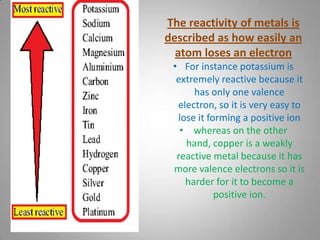
The reactivity of metals is
described as how easily an
atom loses an electron
• For instance potassium is
extremely reactive because it
has only one valence
electron, so it is very easy to
lose it forming a positive ion
• whereas on the other
hand, copper is a weakly
reactive metal because it has
more valence electrons so it is
harder for it to become a
positive ion.
A displacement reaction is a type of reaction where
part of one reactants is replaced by another reactant.
• Single displacement reactions are reactions where
one reactant replaces part of the other
• Double displacement reactions are reactions
where part of one reactant is replaced by part of
another reactant.
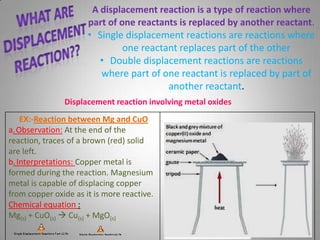
EX:-Reaction between Mg and CuO
a.Observation: At the end of the
reaction, traces of a brown (red) solid
are left.
b.Interpretations: Copper metal is
formed during the reaction. Magnesium
metal is capable of displacing copper
from copper oxide as it is more reactive.
Chemical equation :
Mg(s) + CuO(s)  Cu(s) + MgO(s)
Displacement reaction involving metal oxides
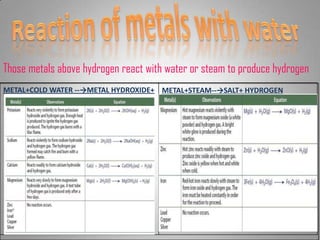
Those metals above hydrogen react with water or steam to produce hydrogen
METAL+COLD WATER --→METAL HYDROXIDE+
HYDROGEN
METAL+STEAM--→SALT+ HYDROGEN
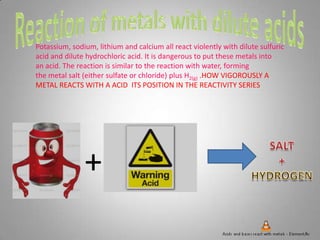
Potassium, sodium, lithium and calcium all react violently with dilute sulfuric
acid and dilute hydrochloric acid. It is dangerous to put these metals into
an acid. The reaction is similar to the reaction with water, forming
the metal salt (either sulfate or chloride) plus H2(g) .HOW VIGOROUSLY A
METAL REACTS WITH A ACID ITS POSITION IN THE REACTIVITY SERIES
+
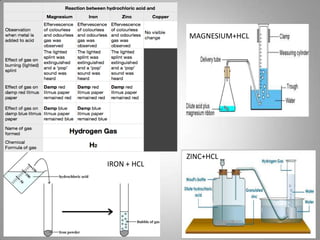
IRON + HCL
MAGNESIUM+HCL
ZINC+HCL
THE POSITION OF THE METALS CAN BE PREDICTED BY
CARRYING OUT REACTIONS USING THE REACTIVITY
SERIES, I.E, WHETHER A METAL BELONGS TO MOST
REACTIVE METALS, MODERATE REACTIVE METALS OR THE
LEAST REACTIVE METALS.
YOU CAN MAKE PREDICTIONS ABOUT THE REACTIONS OF
UNFAMILLIAR METALS IF YOU KNOW THEIR POSITIONS IN
THE REACTIVITY SERIES
EX:-a)Use the reactivity series to predict whether manganese would react
with copper(ǁ) sulfate solution
Reactivity Series
Reactivity Series
Reactivity Series

Reactivity Series

  • 1.
  • 2.
    The reactivity ofmetals is described as how easily an atom loses an electron • For instance potassium is extremely reactive because it has only one valence electron, so it is very easy to lose it forming a positive ion • whereas on the other hand, copper is a weakly reactive metal because it has more valence electrons so it is harder for it to become a positive ion.
  • 3.
    A displacement reactionis a type of reaction where part of one reactants is replaced by another reactant. • Single displacement reactions are reactions where one reactant replaces part of the other • Double displacement reactions are reactions where part of one reactant is replaced by part of another reactant. EX:-Reaction between Mg and CuO a.Observation: At the end of the reaction, traces of a brown (red) solid are left. b.Interpretations: Copper metal is formed during the reaction. Magnesium metal is capable of displacing copper from copper oxide as it is more reactive. Chemical equation : Mg(s) + CuO(s)  Cu(s) + MgO(s) Displacement reaction involving metal oxides
  • 4.
    Those metals abovehydrogen react with water or steam to produce hydrogen METAL+COLD WATER --→METAL HYDROXIDE+ HYDROGEN METAL+STEAM--→SALT+ HYDROGEN
  • 5.
    Potassium, sodium, lithiumand calcium all react violently with dilute sulfuric acid and dilute hydrochloric acid. It is dangerous to put these metals into an acid. The reaction is similar to the reaction with water, forming the metal salt (either sulfate or chloride) plus H2(g) .HOW VIGOROUSLY A METAL REACTS WITH A ACID ITS POSITION IN THE REACTIVITY SERIES +
  • 6.
  • 7.
    THE POSITION OFTHE METALS CAN BE PREDICTED BY CARRYING OUT REACTIONS USING THE REACTIVITY SERIES, I.E, WHETHER A METAL BELONGS TO MOST REACTIVE METALS, MODERATE REACTIVE METALS OR THE LEAST REACTIVE METALS. YOU CAN MAKE PREDICTIONS ABOUT THE REACTIONS OF UNFAMILLIAR METALS IF YOU KNOW THEIR POSITIONS IN THE REACTIVITY SERIES EX:-a)Use the reactivity series to predict whether manganese would react with copper(ǁ) sulfate solution