MobiDeke: Fuzzing the GSM Protocol Stack
S´ebastien Dudek
Guillaume Delugr´e
Sogeti / ESEC
Hack.lu 2012
Introduction
Fuzzing over-the-air
The MobiDeke Framework
Conclusion
Who we are
S´ebastien Dudek
• Has joined the ESEC R&D lab this year (2012) after his internship
• Subject: Attacking the GSM Protocol Stack
• Developer of a GSM fuzzing framework (‘MobiDeke’)
Guillaume Delugr´e
• Researcher working at Sogeti ESEC R&D lab
• Working on embedded devices / reverse engineering
• Developer of ‘qcombbdbg’ (Qualcomm 3G key Icon255 debugger) and
‘Origami’
MobiDeke: Fuzzing the GSM Protocol Stack 2/38
Introduction
Fuzzing over-the-air
The MobiDeke Framework
Conclusion
Summary
1 Introduction
2 Fuzzing over-the-air
3 The MobiDeke Framework
4 Conclusion
MobiDeke: Fuzzing the GSM Protocol Stack 3/38
Introduction
Fuzzing over-the-air
The MobiDeke Framework
Conclusion
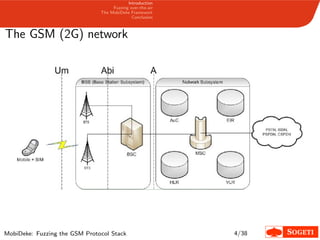
The GSM (2G) network
MobiDeke: Fuzzing the GSM Protocol Stack 4/38
Introduction
Fuzzing over-the-air
The MobiDeke Framework
Conclusion
User Equipments (mobile phones)
Radio control functions are highly timing dependant, so most of the phones use
two separated CPUs nowadays
The application processor
• Runs the user OS: Android, iOS, Windows Mobile, and so on
• Documented (often)
The baseband processor
• Responsible for handling telecommunications
• Includes stacks for telephony protocols
• Closed binary blob running RTOS
See the talk of Guillaume at 28c3 (Chaos Computer Congress) for more
information.
MobiDeke: Fuzzing the GSM Protocol Stack 5/38
Introduction
Fuzzing over-the-air
The MobiDeke Framework
Conclusion
Existing attacks
Many papers have been published:
• Harald Welte: Fuzzing your GSM phone using OpenBSC (2009);
• Collin Mulliner: Fuzzing the Phone in your Phone (2009);
• Collin Mulliner, Nico Golde and Jean-Pierre Seifert : SMS of Death: from
analyzing to attacking mobile phones on a large scale (2011);
• Nico Golde: SMS Vulnerability Analysis on Feature Phones (2011);
• Ralf-Philipp Weinmann: Baseband Attacks, WOOT 2012
• ...
MobiDeke: Fuzzing the GSM Protocol Stack 6/38
Introduction
Fuzzing over-the-air
The MobiDeke Framework
Conclusion
What we are looking for
• The baseband: new angle of attack
• Setup a network is easy today thanks to SDR contributions (OpenBTS,
OpenBSC, and so on)
⇒ Attacking a cellphone ‘over-the-air’ could be fun! (+ not completely
explored)
Typical scenario
• The attacker controls a rogue base station
• The victim joins the cell and gets remotely exploited
*SDR: Software-Defined Radio
MobiDeke: Fuzzing the GSM Protocol Stack 7/38
Introduction
Fuzzing over-the-air
The MobiDeke Framework
Conclusion
To reach our goal
• Baseband code is proprietary
How to find bugs?
• Reverse-engineering: Hard because the code is very complex
• Fuzzing: The easier way, but need some knowledge and a radio device like
the USRP (we’ve won one at hack.lu;) or a nanoBTS, UmTRX, Phi card...
For more information: Harald Welte’s presentation at SSTIC 2010 gives also a
good overview of the GSM industry and security
MobiDeke: Fuzzing the GSM Protocol Stack 8/38
Introduction
Fuzzing over-the-air
The MobiDeke Framework
Conclusion
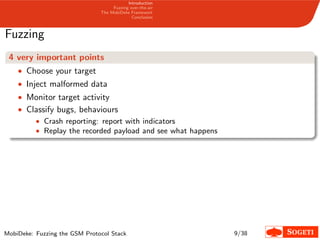
Fuzzing
4 very important points
• Choose your target
• Targeting the baseband GSM stack (2G), not 3G, HSDPA, LTE...
• SMS are usually not parsed by the baseband (passed as raw PDUs to the APP)
• Smartphones: HTC Desire S, Desire Z, iPhone 4S. . .
• Inject malformed data
• Monitor target activity
• Classify bugs, behaviours
MobiDeke: Fuzzing the GSM Protocol Stack 9/38
Introduction
Fuzzing over-the-air
The MobiDeke Framework
Conclusion
Fuzzing
4 very important points
• Choose your target
• Inject malformed data
• Smart generation of GSM packets (specs, existing librairies. . . )
• Mutate each field of the generated message (describe a structure with Sulley)
• Monitor target activity
• Classify bugs, behaviours
MobiDeke: Fuzzing the GSM Protocol Stack 9/38
Introduction
Fuzzing over-the-air
The MobiDeke Framework
Conclusion
Fuzzing
4 very important points
• Choose your target
• Inject malformed data
• Monitor target activity
• Quite difficult because we don’t have a debugger
• Check if the phone is responding
• Look for strange behaviors / side-effects
• ...
• Classify bugs, behaviours
MobiDeke: Fuzzing the GSM Protocol Stack 9/38
Introduction
Fuzzing over-the-air
The MobiDeke Framework
Conclusion
Fuzzing
4 very important points
• Choose your target
• Inject malformed data
• Monitor target activity
• Classify bugs, behaviours
• Crash reporting: report with indicators
• Replay the recorded payload and see what happens
MobiDeke: Fuzzing the GSM Protocol Stack 9/38
Introduction
Fuzzing over-the-air
The MobiDeke Framework
Conclusion
Summary
1 Introduction
2 Fuzzing over-the-air
3 The MobiDeke Framework
4 Conclusion
MobiDeke: Fuzzing the GSM Protocol Stack 10/38
Introduction
Fuzzing over-the-air
The MobiDeke Framework
Conclusion
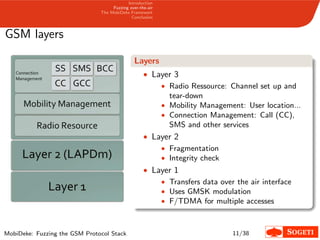
GSM layers
Layers
• Layer 3
• Radio Ressource: Channel set up and
tear-down
• Mobility Management: User location...
• Connection Management: Call (CC),
SMS and other services
• Layer 2
• Fragmentation
• Integrity check
• Layer 1
• Transfers data over the air interface
• Uses GMSK modulation
• F/TDMA for multiple accesses
MobiDeke: Fuzzing the GSM Protocol Stack 11/38
Introduction
Fuzzing over-the-air
The MobiDeke Framework
Conclusion
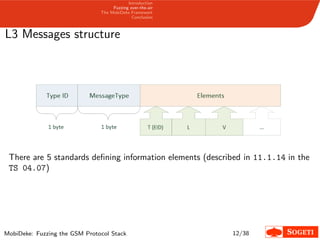
L3 Messages structure
There are 5 standards defining information elements (described in 11.1.14 in the
TS 04.07)
MobiDeke: Fuzzing the GSM Protocol Stack 12/38
Introduction
Fuzzing over-the-air
The MobiDeke Framework
Conclusion
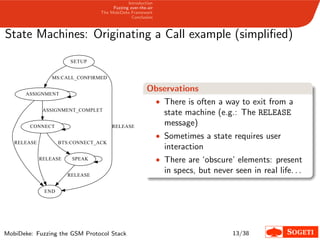
State Machines: Originating a Call example (simplified)
SETUP
ASSIGNMENT
MS:CALL_CONFIRMED
END
RELEASE
RELEASE
CONNECT
ASSIGNMENT_COMPLET
RELEASE SPEAK
BTS:CONNECT_ACK
RELEASE
Observations
• There is often a way to exit from a
state machine (e.g.: The RELEASE
message)
• Sometimes a state requires user
interaction
• There are ‘obscure’ elements: present
in specs, but never seen in real life. . .
MobiDeke: Fuzzing the GSM Protocol Stack 13/38
Introduction
Fuzzing over-the-air
The MobiDeke Framework
Conclusion
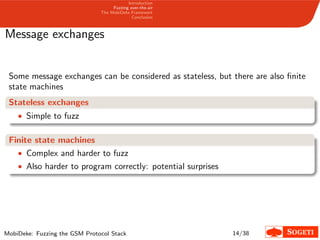
Message exchanges
Some message exchanges can be considered as stateless, but there are also finite
state machines
Stateless exchanges
• Simple to fuzz
Finite state machines
• Complex and harder to fuzz
• Also harder to program correctly: potential surprises
MobiDeke: Fuzzing the GSM Protocol Stack 14/38
Introduction
Fuzzing over-the-air
The MobiDeke Framework
Conclusion
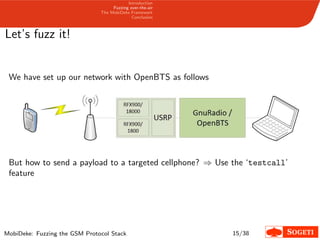
Let’s fuzz it!
We have set up our network with OpenBTS as follows
But how to send a payload to a targeted cellphone? ⇒ Use the ‘testcall’
feature
MobiDeke: Fuzzing the GSM Protocol Stack 15/38
Introduction
Fuzzing over-the-air
The MobiDeke Framework
Conclusion
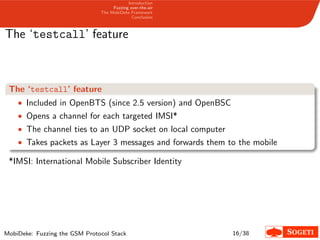
The ‘testcall’ feature
• Included in OpenBTS (since 2.5 version) and OpenBSC
• Opens a channel for each targeted IMSI*
• The channel ties to an UDP socket on local computer
• Takes packets as Layer 3 messages and forwards them to the mobile
*IMSI: International Mobile Subscriber Identity
MobiDeke: Fuzzing the GSM Protocol Stack 16/38
Introduction
Fuzzing over-the-air
The MobiDeke Framework
Conclusion
Fuzzing problems...
Testcall exists for fuzzing handsets, but it’s not enough because
• It works for a limited time
• OpenBTS crashes a lot
• The reserved channel is not very stable
• You’re stuck to your chair while trying to send all your testcases...
• What about the monitoring?
MobiDeke: Fuzzing the GSM Protocol Stack 17/38
Introduction
Fuzzing over-the-air
The MobiDeke Framework
Conclusion
Testcases generation and mutation
Monitoring
Report
Future enhancement
Summary
1 Introduction
2 Fuzzing over-the-air
3 The MobiDeke Framework
Testcases generation and mutation
Monitoring
Report
Future enhancement
4 Conclusion
MobiDeke: Fuzzing the GSM Protocol Stack 18/38
Introduction
Fuzzing over-the-air
The MobiDeke Framework
Conclusion
Testcases generation and mutation
Monitoring
Report
Future enhancement
MobiDeke?
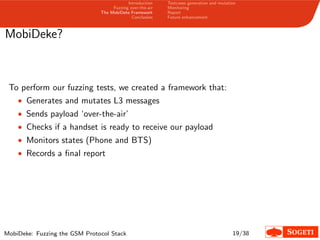
To perform our fuzzing tests, we created a framework that:
• Generates and mutates L3 messages
• Sends payload ‘over-the-air’
• Checks if a handset is ready to receive our payload
• Monitors states (Phone and BTS)
• Records a final report
MobiDeke: Fuzzing the GSM Protocol Stack 19/38
Introduction
Fuzzing over-the-air
The MobiDeke Framework
Conclusion
Testcases generation and mutation
Monitoring
Report
Future enhancement
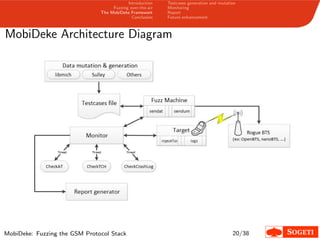
MobiDeke Architecture Diagram
MobiDeke: Fuzzing the GSM Protocol Stack 20/38
Introduction
Fuzzing over-the-air
The MobiDeke Framework
Conclusion
Testcases generation and mutation
Monitoring
Report
Future enhancement
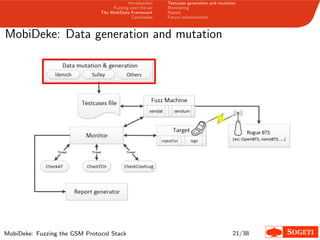
MobiDeke: Data generation and mutation
MobiDeke: Fuzzing the GSM Protocol Stack 21/38
Introduction
Fuzzing over-the-air
The MobiDeke Framework
Conclusion
Testcases generation and mutation
Monitoring
Report
Future enhancement
Methods for data generation and mutation
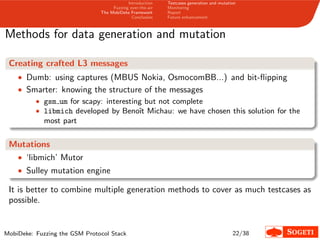
Creating crafted L3 messages
• Dumb: using captures (MBUS Nokia, OsmocomBB...) and bit-flipping
• Smarter: knowing the structure of the messages
• gsm um for scapy: interesting but not complete
• libmich developed by Benoˆıt Michau: we have chosen this solution for the
most part
Mutations
• ‘libmich’ Mutor
• Sulley mutation engine
It is better to combine multiple generation methods to cover as much testcases as
possible.
MobiDeke: Fuzzing the GSM Protocol Stack 22/38
Introduction
Fuzzing over-the-air
The MobiDeke Framework
Conclusion
Testcases generation and mutation
Monitoring
Report
Future enhancement
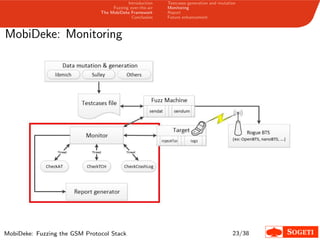
MobiDeke: Monitoring
MobiDeke: Fuzzing the GSM Protocol Stack 23/38
Introduction
Fuzzing over-the-air
The MobiDeke Framework
Conclusion
Testcases generation and mutation
Monitoring
Report
Future enhancement
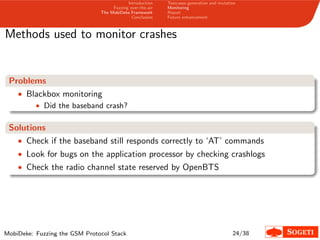
Methods used to monitor crashes
Problems
• Blackbox monitoring
• Did the baseband crash?
Solutions
• Check if the baseband still responds correctly to ‘AT’ commands
• Look for bugs on the application processor by checking crashlogs
• Check the radio channel state reserved by OpenBTS
MobiDeke: Fuzzing the GSM Protocol Stack 24/38
Introduction
Fuzzing over-the-air
The MobiDeke Framework
Conclusion
Testcases generation and mutation
Monitoring
Report
Future enhancement
Check the reserved channel: ’over-the-air’
Motivations
• OpenBTS crashes a lot! During that time your fuzzer continues to send
payloads...
• Is the reserved channel stable enough?
• Is the baseband ready to receive the next payload?
• Did the baseband crash?
Solutions
• Check the radio channel state regularly ⇒ Transaction entries, paging states
in OpenBTS.
• Send ‘ping’ requests to the baseband ‘over-the-air’
• Send a IDENTITY REQUEST, the mobile will respond with an IDENTITY
RESPONSE
MobiDeke: Fuzzing the GSM Protocol Stack 25/38
Introduction
Fuzzing over-the-air
The MobiDeke Framework
Conclusion
Testcases generation and mutation
Monitoring
Report
Future enhancement
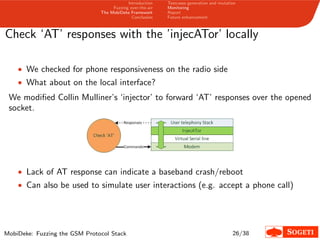
Check ‘AT’ responses with the ’injecATor’ locally
• We checked for phone responsiveness on the radio side
• What about on the local interface?
We modified Collin Mulliner’s ‘injector’ to forward ‘AT’ responses over the opened
socket.
• Lack of AT response can indicate a baseband crash/reboot
• Can also be used to simulate user interactions (e.g. accept a phone call)
MobiDeke: Fuzzing the GSM Protocol Stack 26/38
Introduction
Fuzzing over-the-air
The MobiDeke Framework
Conclusion
Testcases generation and mutation
Monitoring
Report
Future enhancement
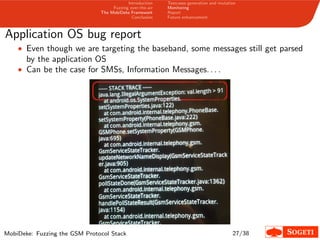
Application OS bug report
• Even though we are targeting the baseband, some messages still get parsed
by the application OS
• Can be the case for SMSs, Information Messages.. . .
MobiDeke: Fuzzing the GSM Protocol Stack 27/38
Introduction
Fuzzing over-the-air
The MobiDeke Framework
Conclusion
Testcases generation and mutation
Monitoring
Report
Future enhancement
Logfiles: Android logcats
Some useful data...
• When something crashes, it is likely to be reported in the logcat (Android
syslogs)
Extract the information
• Fetch the logs using adb and filter this information
• Check for any known vocabulary in the log that could be related to a crash:
‘***’, ‘uncaught exception’, ‘Error Process’...
MobiDeke: Fuzzing the GSM Protocol Stack 28/38
Introduction
Fuzzing over-the-air
The MobiDeke Framework
Conclusion
Testcases generation and mutation
Monitoring
Report
Future enhancement
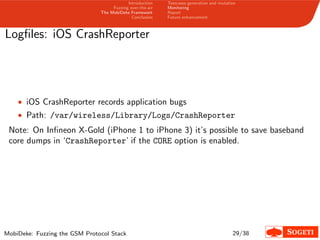
Logfiles: iOS CrashReporter
• iOS CrashReporter records application bugs
• Path: /var/wireless/Library/Logs/CrashReporter
Note: On Infineon X-Gold (iPhone 1 to iPhone 3) it’s possible to save baseband
core dumps in ‘CrashReporter’ if the CORE option is enabled.
MobiDeke: Fuzzing the GSM Protocol Stack 29/38
Introduction
Fuzzing over-the-air
The MobiDeke Framework
Conclusion
Testcases generation and mutation
Monitoring
Report
Future enhancement
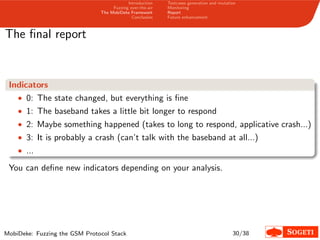
The final report
Indicators
• 0: The state changed, but everything is fine
• 1: The baseband takes a little bit longer to respond
• 2: Maybe something happened (takes to long to respond, applicative crash...)
• 3: It is probably a crash (can’t talk with the baseband at all...)
• ...
You can define new indicators depending on your analysis.
MobiDeke: Fuzzing the GSM Protocol Stack 30/38
Introduction
Fuzzing over-the-air
The MobiDeke Framework
Conclusion
Testcases generation and mutation
Monitoring
Report
Future enhancement
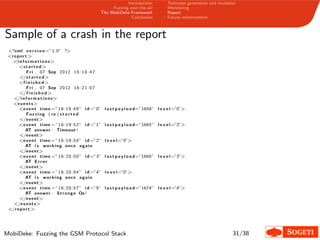
Sample of a crash in the report
<?xml v e r s i o n =”1.0” ?>
<report >
<i nformat i ons>
<s t art ed>
Fri , 07 Sep 2012 16:18:47
</s t art ed>
<f i n i s h e d>
Fri , 07 Sep 2012 16:21:07
</f i n i s h e d>
</i nformat i ons>
<events>
<event time =”16:18:49” i d =”0” l a s t p a y l o a d=”1658” l e v e l =”0”>
Fuzzing ( re ) s t a r t e d
</event>
<event time =”16:19:52” i d =”1” l a s t p a y l o a d=”1665” l e v e l =”2”>
AT answer : Timeout !
</event>
<event time =”16:19:54” i d =”2” l e v e l=”0”>
AT i s working once again
</event>
<event time =”16:20:00” i d =”3” l a s t p a y l o a d=”1666” l e v e l =”3”>
AT E rror
</event>
<event time =”16:20:04” i d =”4” l e v e l=”0”>
AT i s working once again
</event>
<event time =”16:20:57” i d =”5” l a s t p a y l o a d=”1674” l e v e l =”4”>
AT answer : Strange Oo!
</event>
</events>
</report >
MobiDeke: Fuzzing the GSM Protocol Stack 31/38
Introduction
Fuzzing over-the-air
The MobiDeke Framework
Conclusion
Testcases generation and mutation
Monitoring
Report
Future enhancement
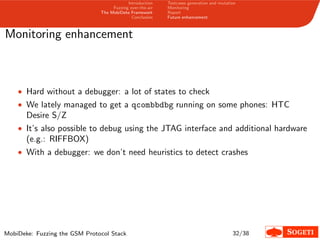
Monitoring enhancement
• Hard without a debugger: a lot of states to check
• We lately managed to get a qcombbdbg running on some phones: HTC
Desire S/Z
• It’s also possible to debug using the JTAG interface and additional hardware
(e.g.: RIFFBOX)
• With a debugger: we don’t need heuristics to detect crashes
MobiDeke: Fuzzing the GSM Protocol Stack 32/38
Introduction
Fuzzing over-the-air
The MobiDeke Framework
Conclusion
Testcases generation and mutation
Monitoring
Report
Future enhancement
Demo!
The fuzzing platform (injecATor, OpenBTS and MobiDeke)
MobiDeke: Fuzzing the GSM Protocol Stack 33/38
Introduction
Fuzzing over-the-air
The MobiDeke Framework
Conclusion
Summary
1 Introduction
2 Fuzzing over-the-air
3 The MobiDeke Framework
4 Conclusion
MobiDeke: Fuzzing the GSM Protocol Stack 34/38
Introduction
Fuzzing over-the-air
The MobiDeke Framework
Conclusion
Problems
• Mostly the unstability of OpenBTS for fuzzing tests
• Deadlocked phones can require human intervention to reboot
• Did not have time to test all layers yet:
• A lot of fixes required on the monitoring part
• Checking the phone state slows down fuzzing
• We don’t have debuggers for every phone models
• A debugger is always needed to decide about exploitability
MobiDeke: Fuzzing the GSM Protocol Stack 35/38
Introduction
Fuzzing over-the-air
The MobiDeke Framework
Conclusion
Our results
• MobiDeke is a handy way to automate fuzzing tests on GSMs
• Not a lot of bugs have been found with stateless messages
• MM INFORMATION: few DoS and applicative crashes
• TMSI RELOCATION COMMAND: few DoS
• 1 state of Call Origin: 1 crash and a lot of DoS
• LOCATION UPDATING: not tested completely, few DoS
• A fuzzing test takes time: days, weeks or months (depends on the number of
testcases and complexity)
*DoS: The phone was not responding
MobiDeke: Fuzzing the GSM Protocol Stack 36/38
Introduction
Fuzzing over-the-air
The MobiDeke Framework
Conclusion
Todo
• There are still plenty of vectors to fuzz
• Integration with a debugger (e.g. JTAG)
• Implement state machines
• Source code not to be released at the moment
MobiDeke: Fuzzing the GSM Protocol Stack 37/38
Introduction
Fuzzing over-the-air
The MobiDeke Framework
Conclusion
Thank you! ;)
Any questions?
MobiDeke: Fuzzing the GSM Protocol Stack 38/38

Hack.lu 2012 - Fuzzing the GSM protocol stack

  • 1.
    MobiDeke: Fuzzing theGSM Protocol Stack S´ebastien Dudek Guillaume Delugr´e Sogeti / ESEC Hack.lu 2012
  • 2.
    Introduction Fuzzing over-the-air The MobiDekeFramework Conclusion Who we are S´ebastien Dudek • Has joined the ESEC R&D lab this year (2012) after his internship • Subject: Attacking the GSM Protocol Stack • Developer of a GSM fuzzing framework (‘MobiDeke’) Guillaume Delugr´e • Researcher working at Sogeti ESEC R&D lab • Working on embedded devices / reverse engineering • Developer of ‘qcombbdbg’ (Qualcomm 3G key Icon255 debugger) and ‘Origami’ MobiDeke: Fuzzing the GSM Protocol Stack 2/38
  • 3.
    Introduction Fuzzing over-the-air The MobiDekeFramework Conclusion Summary 1 Introduction 2 Fuzzing over-the-air 3 The MobiDeke Framework 4 Conclusion MobiDeke: Fuzzing the GSM Protocol Stack 3/38
  • 4.
    Introduction Fuzzing over-the-air The MobiDekeFramework Conclusion The GSM (2G) network MobiDeke: Fuzzing the GSM Protocol Stack 4/38
  • 5.
    Introduction Fuzzing over-the-air The MobiDekeFramework Conclusion User Equipments (mobile phones) Radio control functions are highly timing dependant, so most of the phones use two separated CPUs nowadays The application processor • Runs the user OS: Android, iOS, Windows Mobile, and so on • Documented (often) The baseband processor • Responsible for handling telecommunications • Includes stacks for telephony protocols • Closed binary blob running RTOS See the talk of Guillaume at 28c3 (Chaos Computer Congress) for more information. MobiDeke: Fuzzing the GSM Protocol Stack 5/38
  • 6.
    Introduction Fuzzing over-the-air The MobiDekeFramework Conclusion Existing attacks Many papers have been published: • Harald Welte: Fuzzing your GSM phone using OpenBSC (2009); • Collin Mulliner: Fuzzing the Phone in your Phone (2009); • Collin Mulliner, Nico Golde and Jean-Pierre Seifert : SMS of Death: from analyzing to attacking mobile phones on a large scale (2011); • Nico Golde: SMS Vulnerability Analysis on Feature Phones (2011); • Ralf-Philipp Weinmann: Baseband Attacks, WOOT 2012 • ... MobiDeke: Fuzzing the GSM Protocol Stack 6/38
  • 7.
    Introduction Fuzzing over-the-air The MobiDekeFramework Conclusion What we are looking for • The baseband: new angle of attack • Setup a network is easy today thanks to SDR contributions (OpenBTS, OpenBSC, and so on) ⇒ Attacking a cellphone ‘over-the-air’ could be fun! (+ not completely explored) Typical scenario • The attacker controls a rogue base station • The victim joins the cell and gets remotely exploited *SDR: Software-Defined Radio MobiDeke: Fuzzing the GSM Protocol Stack 7/38
  • 8.
    Introduction Fuzzing over-the-air The MobiDekeFramework Conclusion To reach our goal • Baseband code is proprietary How to find bugs? • Reverse-engineering: Hard because the code is very complex • Fuzzing: The easier way, but need some knowledge and a radio device like the USRP (we’ve won one at hack.lu;) or a nanoBTS, UmTRX, Phi card... For more information: Harald Welte’s presentation at SSTIC 2010 gives also a good overview of the GSM industry and security MobiDeke: Fuzzing the GSM Protocol Stack 8/38
  • 9.
    Introduction Fuzzing over-the-air The MobiDekeFramework Conclusion Fuzzing 4 very important points • Choose your target • Targeting the baseband GSM stack (2G), not 3G, HSDPA, LTE... • SMS are usually not parsed by the baseband (passed as raw PDUs to the APP) • Smartphones: HTC Desire S, Desire Z, iPhone 4S. . . • Inject malformed data • Monitor target activity • Classify bugs, behaviours MobiDeke: Fuzzing the GSM Protocol Stack 9/38
  • 10.
    Introduction Fuzzing over-the-air The MobiDekeFramework Conclusion Fuzzing 4 very important points • Choose your target • Inject malformed data • Smart generation of GSM packets (specs, existing librairies. . . ) • Mutate each field of the generated message (describe a structure with Sulley) • Monitor target activity • Classify bugs, behaviours MobiDeke: Fuzzing the GSM Protocol Stack 9/38
  • 11.
    Introduction Fuzzing over-the-air The MobiDekeFramework Conclusion Fuzzing 4 very important points • Choose your target • Inject malformed data • Monitor target activity • Quite difficult because we don’t have a debugger • Check if the phone is responding • Look for strange behaviors / side-effects • ... • Classify bugs, behaviours MobiDeke: Fuzzing the GSM Protocol Stack 9/38
  • 12.
    Introduction Fuzzing over-the-air The MobiDekeFramework Conclusion Fuzzing 4 very important points • Choose your target • Inject malformed data • Monitor target activity • Classify bugs, behaviours • Crash reporting: report with indicators • Replay the recorded payload and see what happens MobiDeke: Fuzzing the GSM Protocol Stack 9/38
  • 13.
    Introduction Fuzzing over-the-air The MobiDekeFramework Conclusion Summary 1 Introduction 2 Fuzzing over-the-air 3 The MobiDeke Framework 4 Conclusion MobiDeke: Fuzzing the GSM Protocol Stack 10/38
  • 14.
    Introduction Fuzzing over-the-air The MobiDekeFramework Conclusion GSM layers Layers • Layer 3 • Radio Ressource: Channel set up and tear-down • Mobility Management: User location... • Connection Management: Call (CC), SMS and other services • Layer 2 • Fragmentation • Integrity check • Layer 1 • Transfers data over the air interface • Uses GMSK modulation • F/TDMA for multiple accesses MobiDeke: Fuzzing the GSM Protocol Stack 11/38
  • 15.
    Introduction Fuzzing over-the-air The MobiDekeFramework Conclusion L3 Messages structure There are 5 standards defining information elements (described in 11.1.14 in the TS 04.07) MobiDeke: Fuzzing the GSM Protocol Stack 12/38
  • 16.
    Introduction Fuzzing over-the-air The MobiDekeFramework Conclusion State Machines: Originating a Call example (simplified) SETUP ASSIGNMENT MS:CALL_CONFIRMED END RELEASE RELEASE CONNECT ASSIGNMENT_COMPLET RELEASE SPEAK BTS:CONNECT_ACK RELEASE Observations • There is often a way to exit from a state machine (e.g.: The RELEASE message) • Sometimes a state requires user interaction • There are ‘obscure’ elements: present in specs, but never seen in real life. . . MobiDeke: Fuzzing the GSM Protocol Stack 13/38
  • 17.
    Introduction Fuzzing over-the-air The MobiDekeFramework Conclusion Message exchanges Some message exchanges can be considered as stateless, but there are also finite state machines Stateless exchanges • Simple to fuzz Finite state machines • Complex and harder to fuzz • Also harder to program correctly: potential surprises MobiDeke: Fuzzing the GSM Protocol Stack 14/38
  • 18.
    Introduction Fuzzing over-the-air The MobiDekeFramework Conclusion Let’s fuzz it! We have set up our network with OpenBTS as follows But how to send a payload to a targeted cellphone? ⇒ Use the ‘testcall’ feature MobiDeke: Fuzzing the GSM Protocol Stack 15/38
  • 19.
    Introduction Fuzzing over-the-air The MobiDekeFramework Conclusion The ‘testcall’ feature The ‘testcall’ feature • Included in OpenBTS (since 2.5 version) and OpenBSC • Opens a channel for each targeted IMSI* • The channel ties to an UDP socket on local computer • Takes packets as Layer 3 messages and forwards them to the mobile *IMSI: International Mobile Subscriber Identity MobiDeke: Fuzzing the GSM Protocol Stack 16/38
  • 20.
    Introduction Fuzzing over-the-air The MobiDekeFramework Conclusion Fuzzing problems... Testcall exists for fuzzing handsets, but it’s not enough because • It works for a limited time • OpenBTS crashes a lot • The reserved channel is not very stable • You’re stuck to your chair while trying to send all your testcases... • What about the monitoring? MobiDeke: Fuzzing the GSM Protocol Stack 17/38
  • 21.
    Introduction Fuzzing over-the-air The MobiDekeFramework Conclusion Testcases generation and mutation Monitoring Report Future enhancement Summary 1 Introduction 2 Fuzzing over-the-air 3 The MobiDeke Framework Testcases generation and mutation Monitoring Report Future enhancement 4 Conclusion MobiDeke: Fuzzing the GSM Protocol Stack 18/38
  • 22.
    Introduction Fuzzing over-the-air The MobiDekeFramework Conclusion Testcases generation and mutation Monitoring Report Future enhancement MobiDeke? To perform our fuzzing tests, we created a framework that: • Generates and mutates L3 messages • Sends payload ‘over-the-air’ • Checks if a handset is ready to receive our payload • Monitors states (Phone and BTS) • Records a final report MobiDeke: Fuzzing the GSM Protocol Stack 19/38
  • 23.
    Introduction Fuzzing over-the-air The MobiDekeFramework Conclusion Testcases generation and mutation Monitoring Report Future enhancement MobiDeke Architecture Diagram MobiDeke: Fuzzing the GSM Protocol Stack 20/38
  • 24.
    Introduction Fuzzing over-the-air The MobiDekeFramework Conclusion Testcases generation and mutation Monitoring Report Future enhancement MobiDeke: Data generation and mutation MobiDeke: Fuzzing the GSM Protocol Stack 21/38
  • 25.
    Introduction Fuzzing over-the-air The MobiDekeFramework Conclusion Testcases generation and mutation Monitoring Report Future enhancement Methods for data generation and mutation Creating crafted L3 messages • Dumb: using captures (MBUS Nokia, OsmocomBB...) and bit-flipping • Smarter: knowing the structure of the messages • gsm um for scapy: interesting but not complete • libmich developed by Benoˆıt Michau: we have chosen this solution for the most part Mutations • ‘libmich’ Mutor • Sulley mutation engine It is better to combine multiple generation methods to cover as much testcases as possible. MobiDeke: Fuzzing the GSM Protocol Stack 22/38
  • 26.
    Introduction Fuzzing over-the-air The MobiDekeFramework Conclusion Testcases generation and mutation Monitoring Report Future enhancement MobiDeke: Monitoring MobiDeke: Fuzzing the GSM Protocol Stack 23/38
  • 27.
    Introduction Fuzzing over-the-air The MobiDekeFramework Conclusion Testcases generation and mutation Monitoring Report Future enhancement Methods used to monitor crashes Problems • Blackbox monitoring • Did the baseband crash? Solutions • Check if the baseband still responds correctly to ‘AT’ commands • Look for bugs on the application processor by checking crashlogs • Check the radio channel state reserved by OpenBTS MobiDeke: Fuzzing the GSM Protocol Stack 24/38
  • 28.
    Introduction Fuzzing over-the-air The MobiDekeFramework Conclusion Testcases generation and mutation Monitoring Report Future enhancement Check the reserved channel: ’over-the-air’ Motivations • OpenBTS crashes a lot! During that time your fuzzer continues to send payloads... • Is the reserved channel stable enough? • Is the baseband ready to receive the next payload? • Did the baseband crash? Solutions • Check the radio channel state regularly ⇒ Transaction entries, paging states in OpenBTS. • Send ‘ping’ requests to the baseband ‘over-the-air’ • Send a IDENTITY REQUEST, the mobile will respond with an IDENTITY RESPONSE MobiDeke: Fuzzing the GSM Protocol Stack 25/38
  • 29.
    Introduction Fuzzing over-the-air The MobiDekeFramework Conclusion Testcases generation and mutation Monitoring Report Future enhancement Check ‘AT’ responses with the ’injecATor’ locally • We checked for phone responsiveness on the radio side • What about on the local interface? We modified Collin Mulliner’s ‘injector’ to forward ‘AT’ responses over the opened socket. • Lack of AT response can indicate a baseband crash/reboot • Can also be used to simulate user interactions (e.g. accept a phone call) MobiDeke: Fuzzing the GSM Protocol Stack 26/38
  • 30.
    Introduction Fuzzing over-the-air The MobiDekeFramework Conclusion Testcases generation and mutation Monitoring Report Future enhancement Application OS bug report • Even though we are targeting the baseband, some messages still get parsed by the application OS • Can be the case for SMSs, Information Messages.. . . MobiDeke: Fuzzing the GSM Protocol Stack 27/38
  • 31.
    Introduction Fuzzing over-the-air The MobiDekeFramework Conclusion Testcases generation and mutation Monitoring Report Future enhancement Logfiles: Android logcats Some useful data... • When something crashes, it is likely to be reported in the logcat (Android syslogs) Extract the information • Fetch the logs using adb and filter this information • Check for any known vocabulary in the log that could be related to a crash: ‘***’, ‘uncaught exception’, ‘Error Process’... MobiDeke: Fuzzing the GSM Protocol Stack 28/38
  • 32.
    Introduction Fuzzing over-the-air The MobiDekeFramework Conclusion Testcases generation and mutation Monitoring Report Future enhancement Logfiles: iOS CrashReporter • iOS CrashReporter records application bugs • Path: /var/wireless/Library/Logs/CrashReporter Note: On Infineon X-Gold (iPhone 1 to iPhone 3) it’s possible to save baseband core dumps in ‘CrashReporter’ if the CORE option is enabled. MobiDeke: Fuzzing the GSM Protocol Stack 29/38
  • 33.
    Introduction Fuzzing over-the-air The MobiDekeFramework Conclusion Testcases generation and mutation Monitoring Report Future enhancement The final report Indicators • 0: The state changed, but everything is fine • 1: The baseband takes a little bit longer to respond • 2: Maybe something happened (takes to long to respond, applicative crash...) • 3: It is probably a crash (can’t talk with the baseband at all...) • ... You can define new indicators depending on your analysis. MobiDeke: Fuzzing the GSM Protocol Stack 30/38
  • 34.
    Introduction Fuzzing over-the-air The MobiDekeFramework Conclusion Testcases generation and mutation Monitoring Report Future enhancement Sample of a crash in the report <?xml v e r s i o n =”1.0” ?> <report > <i nformat i ons> <s t art ed> Fri , 07 Sep 2012 16:18:47 </s t art ed> <f i n i s h e d> Fri , 07 Sep 2012 16:21:07 </f i n i s h e d> </i nformat i ons> <events> <event time =”16:18:49” i d =”0” l a s t p a y l o a d=”1658” l e v e l =”0”> Fuzzing ( re ) s t a r t e d </event> <event time =”16:19:52” i d =”1” l a s t p a y l o a d=”1665” l e v e l =”2”> AT answer : Timeout ! </event> <event time =”16:19:54” i d =”2” l e v e l=”0”> AT i s working once again </event> <event time =”16:20:00” i d =”3” l a s t p a y l o a d=”1666” l e v e l =”3”> AT E rror </event> <event time =”16:20:04” i d =”4” l e v e l=”0”> AT i s working once again </event> <event time =”16:20:57” i d =”5” l a s t p a y l o a d=”1674” l e v e l =”4”> AT answer : Strange Oo! </event> </events> </report > MobiDeke: Fuzzing the GSM Protocol Stack 31/38
  • 35.
    Introduction Fuzzing over-the-air The MobiDekeFramework Conclusion Testcases generation and mutation Monitoring Report Future enhancement Monitoring enhancement • Hard without a debugger: a lot of states to check • We lately managed to get a qcombbdbg running on some phones: HTC Desire S/Z • It’s also possible to debug using the JTAG interface and additional hardware (e.g.: RIFFBOX) • With a debugger: we don’t need heuristics to detect crashes MobiDeke: Fuzzing the GSM Protocol Stack 32/38
  • 36.
    Introduction Fuzzing over-the-air The MobiDekeFramework Conclusion Testcases generation and mutation Monitoring Report Future enhancement Demo! The fuzzing platform (injecATor, OpenBTS and MobiDeke) MobiDeke: Fuzzing the GSM Protocol Stack 33/38
  • 37.
    Introduction Fuzzing over-the-air The MobiDekeFramework Conclusion Summary 1 Introduction 2 Fuzzing over-the-air 3 The MobiDeke Framework 4 Conclusion MobiDeke: Fuzzing the GSM Protocol Stack 34/38
  • 38.
    Introduction Fuzzing over-the-air The MobiDekeFramework Conclusion Problems • Mostly the unstability of OpenBTS for fuzzing tests • Deadlocked phones can require human intervention to reboot • Did not have time to test all layers yet: • A lot of fixes required on the monitoring part • Checking the phone state slows down fuzzing • We don’t have debuggers for every phone models • A debugger is always needed to decide about exploitability MobiDeke: Fuzzing the GSM Protocol Stack 35/38
  • 39.
    Introduction Fuzzing over-the-air The MobiDekeFramework Conclusion Our results • MobiDeke is a handy way to automate fuzzing tests on GSMs • Not a lot of bugs have been found with stateless messages • MM INFORMATION: few DoS and applicative crashes • TMSI RELOCATION COMMAND: few DoS • 1 state of Call Origin: 1 crash and a lot of DoS • LOCATION UPDATING: not tested completely, few DoS • A fuzzing test takes time: days, weeks or months (depends on the number of testcases and complexity) *DoS: The phone was not responding MobiDeke: Fuzzing the GSM Protocol Stack 36/38
  • 40.
    Introduction Fuzzing over-the-air The MobiDekeFramework Conclusion Todo • There are still plenty of vectors to fuzz • Integration with a debugger (e.g. JTAG) • Implement state machines • Source code not to be released at the moment MobiDeke: Fuzzing the GSM Protocol Stack 37/38
  • 41.
    Introduction Fuzzing over-the-air The MobiDekeFramework Conclusion Thank you! ;) Any questions? MobiDeke: Fuzzing the GSM Protocol Stack 38/38