Giuseppe Carella, giuseppe.carella@fokus.fraunhofer.de
Internet: http://openbaton.org
Contact: info@openbaton.org
@openbaton
©MatthiasHeyde/FraunhoferFOKUS
Open Baton
The Open Source Network Function
Virtualization Orchestrator (NFVO)
2
What is Open Baton?
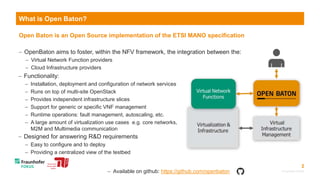
Open Baton is an Open Source implementation of the ETSI MANO specification
 OpenBaton aims to foster, within the NFV framework, the integration between the:
 Virtual Network Function providers
 Cloud Infrastructure providers
© Fraunhofer FOKUS
 Functionality:
 Installation, deployment and configuration of network services
 Runs on top of multi-site OpenStack
 Provides independent infrastructure slices
 Support for generic or specific VNF management
 Runtime operations: fault management, autoscaling, etc.
 A large amount of virtualization use cases e.g. core networks,
M2M and Multimedia communication
 Designed for answering R&D requirements
 Easy to configure and to deploy
 Providing a centralized view of the testbed
 Available on github: https://github.com/openbaton
3
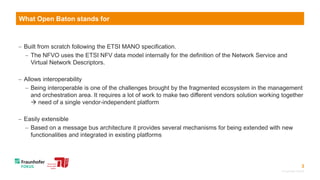
 Built from scratch following the ETSI MANO specification.
 The NFVO uses the ETSI NFV data model internally for the definition of the Network Service and
Virtual Network Descriptors.
 Allows interoperability
 Being interoperable is one of the challenges brought by the fragmented ecosystem in the management
and orchestration area. It requires a lot of work to make two different vendors solution working together
 need of a single vendor-independent platform
 Easily extensible
 Based on a message bus architecture it provides several mechanisms for being extended with new
functionalities and integrated in existing platforms
© Fraunhofer FOKUS
What Open Baton stands for
4
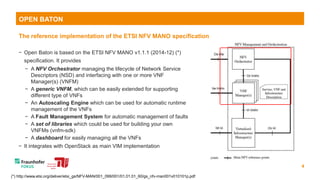
The reference implementation of the ETSI NFV MANO specification
− Open Baton is based on the ETSI NFV MANO v1.1.1 (2014-12) (*)
specification. It provides
− A NFV Orchestrator managing the lifecycle of Network Service
Descriptors (NSD) and interfacing with one or more VNF
Manager(s) (VNFM)
− A generic VNFM, which can be easily extended for supporting
different type of VNFs
− An Autoscaling Engine which can be used for automatic runtime
management of the VNFs
− A Fault Management System for automatic management of faults
− A set of libraries which could be used for building your own
VNFMs (vnfm-sdk)
− A dashboard for easily managing all the VNFs
− It integrates with OpenStack as main VIM implementation
OPEN BATON
(*) http://www.etsi.org/deliver/etsi_gs/NFV-MAN/001_099/001/01.01.01_60/gs_nfv-man001v010101p.pdf
5
© Fraunhofer FOKUS
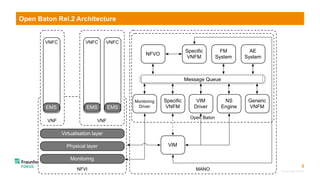
Open Baton Rel.2 Architecture
MANO
Open Baton
NFVI
VNF
Message Queue
NFVO
Specific
VNFM
FM
System
AE
System
Generic
VNFM
NS
Engine
VIM
Driver
Specific
VNFM
Monitoring
Driver
VIM
Monitoring
Physical layer
Virtualisation layer
VNFC
VNF
VNFC VNFC
EMS EMS EMS
6
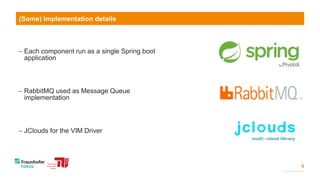
 Each component run as a single Spring boot
application
 RabbitMQ used as Message Queue
implementation
 JClouds for the VIM Driver
© Fraunhofer FOKUS
(Some) Implementation details
7
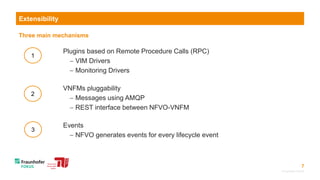
Three main mechanisms
Plugins based on Remote Procedure Calls (RPC)
 VIM Drivers
 Monitoring Drivers
VNFMs pluggability
 Messages using AMQP
 REST interface between NFVO-VNFM
Events
 NFVO generates events for every lifecycle event
© Fraunhofer FOKUS
Extensibility
1
2
3
8
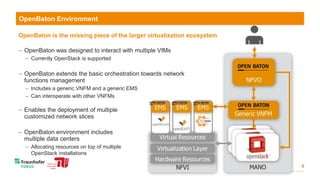
OpenBaton is the missing piece of the larger virtualization ecosystem
 OpenBaton was designed to interact with multiple VIMs
 Currently OpenStack is supported
 OpenBaton extends the basic orchestration towards network
functions management
 Includes a generic VNFM and a generic EMS
 Can interoperate with other VNFMs
© Fraunhofer FOKUS
OpenBaton Environment
 Enables the deployment of multiple
customized network slices
 OpenBaton environment includes
multiple data centers
 Allocating resources on top of multiple
OpenStack installations
9
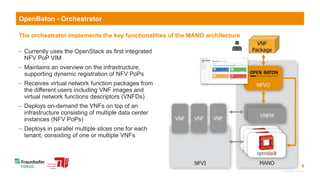
OpenBaton - Orchestrator
The orchestrator implements the key functionalities of the MANO architecture
 Currently uses the OpenStack as first integrated
NFV PoP VIM
 Maintains an overview on the infrastructure,
supporting dynamic registration of NFV PoPs
 Receives virtual network function packages from
the different users including VNF images and
virtual network functions descriptors (VNFDs)
 Deploys on-demand the VNFs on top of an
infrastructure consisting of multiple data center
instances (NFV PoPs)
 Deploys in parallel multiple slices one for each
tenant, consisting of one or multiple VNFs
© Fraunhofer FOKUS
10
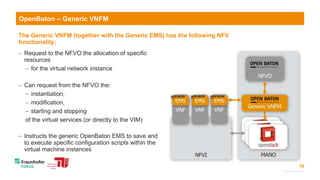
OpenBaton – Generic VNFM
The Generic VNFM (together with the Generic EMS) has the following NFV
functionality:
 Request to the NFVO the allocation of specific
resources
 for the virtual network instance
 Can request from the NFVO the:
 instantiation,
 modification,
 starting and stopping
of the virtual services (or directly to the VIM)
 Instructs the generic OpenBaton EMS to save and
to execute specific configuration scripts within the
virtual machine instances
© Fraunhofer FOKUS
11
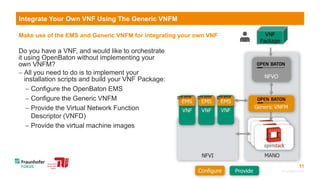
Make use of the EMS and Generic VNFM for integrating your own VNF
Do you have a VNF, and would like to orchestrate
it using OpenBaton without implementing your
own VNFM?
 All you need to do is to implement your
installation scripts and build your VNF Package:
 Configure the OpenBaton EMS
 Configure the Generic VNFM
 Provide the Virtual Network Function
Descriptor (VNFD)
 Provide the virtual machine images
© Fraunhofer FOKUS
Integrate Your Own VNF Using The Generic VNFM
12
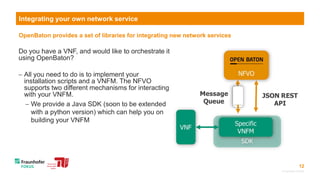
OpenBaton provides a set of libraries for integrating new network services
Do you have a VNF, and would like to orchestrate it
using OpenBaton?
 All you need to do is to implement your
installation scripts and a VNFM. The NFVO
supports two different mechanisms for interacting
with your VNFM.
 We provide a Java SDK (soon to be extended
with a python version) which can help you on
building your VNFM
© Fraunhofer FOKUS
Integrating your own network service
13
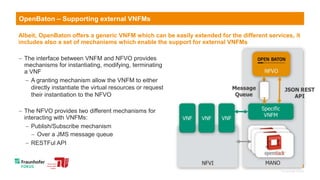
OpenBaton – Supporting external VNFMs
Albeit, OpenBaton offers a generic VNFM which can be easily extended for the different services, it
includes also a set of mechanisms which enable the support for external VNFMs
 The interface between VNFM and NFVO provides
mechanisms for instantiating, modifying, terminating
a VNF
 A granting mechanism allow the VNFM to either
directly instantiate the virtual resources or request
their instantiation to the NFVO
 The NFVO provides two different mechanisms for
interacting with VNFMs:
 Publish/Subscribe mechanism
 Over a JMS message queue
 RESTFul API
© Fraunhofer FOKUS
14
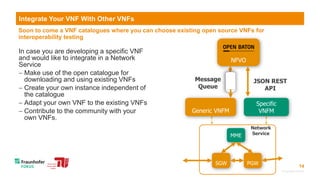
Soon to come a VNF catalogues where you can choose existing open source VNFs for
interoperability testing
In case you are developing a specific VNF
and would like to integrate in a Network
Service
 Make use of the open catalogue for
downloading and using existing VNFs
 Create your own instance independent of
the catalogue
 Adapt your own VNF to the existing VNFs
 Contribute to the community with your
own VNFs.
© Fraunhofer FOKUS
Integrate Your VNF With Other VNFs
NFVO
Specific
VNFM
MME
PGWSGW
Message
Queue
JSON REST
API
Generic VNFM
Network
Service
15
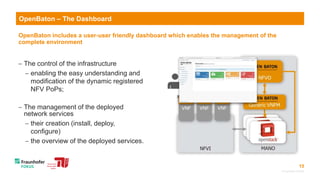
OpenBaton – The Dashboard
OpenBaton includes a user-user friendly dashboard which enables the management of the
complete environment
 The control of the infrastructure
 enabling the easy understanding and
modification of the dynamic registered
NFV PoPs;
 The management of the deployed
network services
 their creation (install, deploy,
configure)
 the overview of the deployed services.
© Fraunhofer FOKUS
16
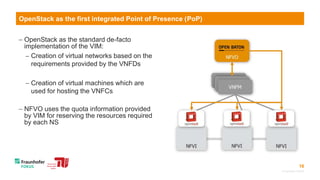
 OpenStack as the standard de-facto
implementation of the VIM:
 Creation of virtual networks based on the
requirements provided by the VNFDs
 Creation of virtual machines which are
used for hosting the VNFCs
 NFVO uses the quota information provided
by VIM for reserving the resources required
by each NS
© Fraunhofer FOKUS
OpenStack as the first integrated Point of Presence (PoP)
17
© Fraunhofer FOKUS
Monitoring integration
 Using Zabbix as monitoring
system for monitoring:
 NFVI components
 VNF components
 The plugin offers an interface
compliant with the draft
IFA005_Or-
Vi_ref_point_Spec [1] for
retrieving monitoring
information
[1] https://docbox.etsi.org/isg/nfv/open/Drafts/IFA005_Or-Vi_ref_point_Spec/
MANO
Open Baton
NFVI
VNF
Message Queue
NFVO
Generic
VNFM
VIM
Driver
Specific
VNFM
Monitoring
Driver
VIM
Monitoring
Physical layer
Virtualisation layer
VNFC
VNF
VNFC VNFC
EMS EMS EMS
18
© Fraunhofer FOKUS
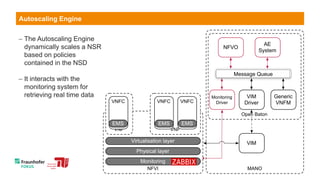
Autoscaling Engine
 The Autoscaling Engine
dynamically scales a NSR
based on policies
contained in the NSD
 It interacts with the
monitoring system for
retrieving real time data
MANO
Open Baton
Message Queue
NFVO
AE
System
Generic
VNFM
VIM
Driver
Monitoring
Driver
VIM
NFVI
VNF
Monitoring
Physical layer
Virtualisation layer
VNFC
VNF
VNFC VNFC
EMS EMS EMS
19
 It registers to the event
INSTANTIATION_FINISHED generated by
the NFVO at the end of the NSR deployment
 It retrieves the policy contained in the NSD
 It starts a task checking whether the
conditions are met or not
 It uses different algorithms for optimising the
instantiation of new VNFCs
 It can integrate with different monitoring
systems using the plugin mechanism
© Fraunhofer FOKUS
Autoscaling Engine
{
"name":”scale-out",
"threshold":100,
"comparisonOperator":">=",
"period":30,
"cooldown":60,
"mode":"REACTIVE",
"type":"VOTED",
"alarms": [
{
"metric":”CPU",
"statistic":"avg",
"comparisonOperator":">=",
"threshold":50,
"weight":1
}
],
"actions": [
{
"type":"SCALE_OUT",
"value":"2"
}
]
}
20
© Fraunhofer FOKUS
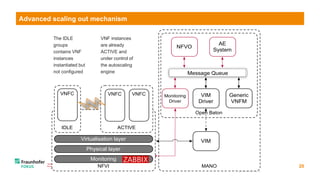
Advanced scaling out mechanism
The IDLE
groups
contains VNF
instances
instantiated but
not configured
VNF instances
are already
ACTIVE and
under control of
the autoscaling
engine
MANO
Open Baton
Message Queue
NFVO
AE
System
Generic
VNFM
VIM
Driver
Monitoring
Driver
VIM
NFVI
IDLE
Monitoring
Physical layer
Virtualisation layer
VNFC
ACTIVE
VNFC VNFC
21
© Fraunhofer FOKUS
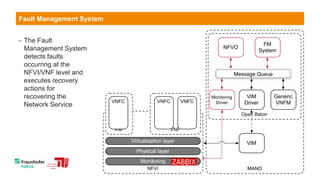
Fault Management System
MANO
Open Baton
Message Queue
NFVO
FM
System
Generic
VNFM
VIM
Driver
Monitoring
Driver
VIM
NFVI
VNF
Monitoring
Physical layer
Virtualisation layer
VNFC
VNF
VNFC VNFC
 The Fault
Management System
detects faults
occurring at the
NFVI/VNF level and
executes recovery
actions for
recovering the
Network Service
22
 It registers to the event
INSTANTIATION_FINISHED generated
by the NFVO at the end of the NSR
deployment
 It retrieves the policy contained in the
NSD
 It creates rules for detecting faults on the
monitoring system and registers triggers
 Every time a trigger is received, it
executes an action which can be
(depending on the level of criticality):
 Heal the VNF
 Switch to standby the VNF
© Fraunhofer FOKUS
Fault Management System
"fault_management_policy":[
{
"name":"web server not
available", "isVNFAlarm":
true,
"criteria":[ {
"parameter_ref":"net.tcp.lis
ten[80]",
"function":"last()",
"vnfc_selector":"at_least_on
e",
"comparison_operator":"=",
"threshold":"0"
} ],
"period":5,
"severity":"CRITICAL"
}]
23
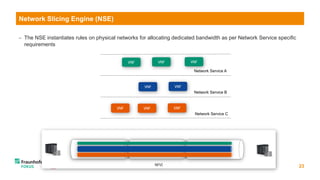
Network Slicing Engine (NSE)
 The NSE instantiates rules on physical networks for allocating dedicated bandwidth as per Network Service specific
requirements
© Fraunhofer FOKUS
NFVI
Virtual Networks A
Virtual Network B
VNF VNFVNF
VNF VNF
Network Service B
Network Service A
VNF VNF
Network Service C
VNF
24
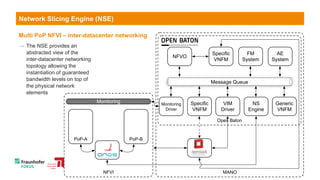
Multi PoP NFVI – inter-datacenter networking
Network Slicing Engine (NSE)
 The NSE provides an
abstracted view of the
inter-datacenter networking
topology allowing the
instantiation of guaranteed
bandwidth levels on top of
the physical network
elements
MANO
Open Baton
NFVI
Message Queue
NFVO
Specific
VNFM
FM
System
AE
System
Generic
VNFM
NS
Engine
VIM
Driver
Specific
VNFM
Monitoring
Driver
PoP-A PoP-B
Monitoring
25
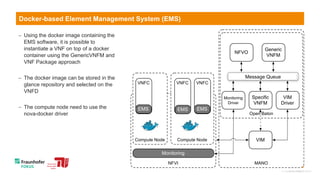
 Using the docker image containing the
EMS software, it is possible to
instantiate a VNF on top of a docker
container using the GenericVNFM and
VNF Package approach
 The docker image can be stored in the
glance repository and selected on the
VNFD
 The compute node need to use the
nova-docker driver
© Fraunhofer FOKUS
Docker-based Element Management System (EMS)
© Fraunhofer FOKUS
MANO
Open Baton
NFVI
Compute Node
Message Queue
NFVO
VIM
Driver
Specific
VNFM
Monitoring
Driver
VIM
Monitoring
VNFC
Compute Node
VNFC VNFC
Generic
VNFM
EMS EMS EMS
26
Projects, Roles, Users,
 Possibility of defining different projects:
 Separation of resources, very important for resource orchestrations
 Possibility of registering users and assign them different roles:
 Admins, services, users, developers
 Possibility of registering users and assign them to different projects:
 Assign user X to project Y
© Fraunhofer FOKUS
Identity Management (available since 2.1.0)
27
© Fraunhofer FOKUS
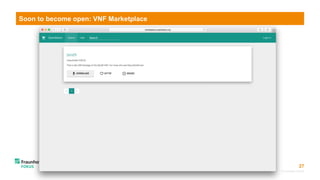
Soon to become open: VNF Marketplace
28
Travis-ci (public)
 Builds after commits
 Unit Tests
© Fraunhofer FOKUS
Continuous Integration
Jenkins (in our premises)
 Integration tests with
complex scenarios
 Nightly builds
29
OpenSDNCore
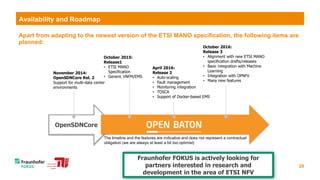
Apart from adapting to the newest version of the ETSI MANO specification, the following items are
planned:
Availability and Roadmap
November 2014:
OpenSDNCore Rel. 2
Support for multi-data center
environments
October 2015:
Release1
• ETSI MANO
Specification
• Generic VNFM/EMS
April 2016:
Release 2
• Auto-scaling
• Fault management
• Monitoring integration
• TOSCA
• Support of Docker-based EMS
October 2016:
Release 3
• Alignment with new ETSI MANO
specification drafts/releases
• Basic integration with Machine
Learning
• Integration with OPNFV
• Many new features
Fraunhofer FOKUS is actively looking for
partners interested in research and
development in the area of ETSI NFV
The timeline and the features are indicative and does not represent a contractual
obligation (we are always at least a bit too optimist)
30
For further information, technical questions, research
information and project requests, contact us at
info@openbaton.org

Open Baton: a Framework for Virtual Network Function Management and Orchestration (MANO) for emerging Software-based 5G Networks

  • 1.
    Giuseppe Carella, giuseppe.carella@fokus.fraunhofer.de Internet:http://openbaton.org Contact: info@openbaton.org @openbaton ©MatthiasHeyde/FraunhoferFOKUS Open Baton The Open Source Network Function Virtualization Orchestrator (NFVO)
  • 2.
    2 What is OpenBaton? Open Baton is an Open Source implementation of the ETSI MANO specification  OpenBaton aims to foster, within the NFV framework, the integration between the:  Virtual Network Function providers  Cloud Infrastructure providers © Fraunhofer FOKUS  Functionality:  Installation, deployment and configuration of network services  Runs on top of multi-site OpenStack  Provides independent infrastructure slices  Support for generic or specific VNF management  Runtime operations: fault management, autoscaling, etc.  A large amount of virtualization use cases e.g. core networks, M2M and Multimedia communication  Designed for answering R&D requirements  Easy to configure and to deploy  Providing a centralized view of the testbed  Available on github: https://github.com/openbaton
  • 3.
    3  Built fromscratch following the ETSI MANO specification.  The NFVO uses the ETSI NFV data model internally for the definition of the Network Service and Virtual Network Descriptors.  Allows interoperability  Being interoperable is one of the challenges brought by the fragmented ecosystem in the management and orchestration area. It requires a lot of work to make two different vendors solution working together  need of a single vendor-independent platform  Easily extensible  Based on a message bus architecture it provides several mechanisms for being extended with new functionalities and integrated in existing platforms © Fraunhofer FOKUS What Open Baton stands for
  • 4.
    4 The reference implementationof the ETSI NFV MANO specification − Open Baton is based on the ETSI NFV MANO v1.1.1 (2014-12) (*) specification. It provides − A NFV Orchestrator managing the lifecycle of Network Service Descriptors (NSD) and interfacing with one or more VNF Manager(s) (VNFM) − A generic VNFM, which can be easily extended for supporting different type of VNFs − An Autoscaling Engine which can be used for automatic runtime management of the VNFs − A Fault Management System for automatic management of faults − A set of libraries which could be used for building your own VNFMs (vnfm-sdk) − A dashboard for easily managing all the VNFs − It integrates with OpenStack as main VIM implementation OPEN BATON (*) http://www.etsi.org/deliver/etsi_gs/NFV-MAN/001_099/001/01.01.01_60/gs_nfv-man001v010101p.pdf
  • 5.
    5 © Fraunhofer FOKUS OpenBaton Rel.2 Architecture MANO Open Baton NFVI VNF Message Queue NFVO Specific VNFM FM System AE System Generic VNFM NS Engine VIM Driver Specific VNFM Monitoring Driver VIM Monitoring Physical layer Virtualisation layer VNFC VNF VNFC VNFC EMS EMS EMS
  • 6.
    6  Each componentrun as a single Spring boot application  RabbitMQ used as Message Queue implementation  JClouds for the VIM Driver © Fraunhofer FOKUS (Some) Implementation details
  • 7.
    7 Three main mechanisms Pluginsbased on Remote Procedure Calls (RPC)  VIM Drivers  Monitoring Drivers VNFMs pluggability  Messages using AMQP  REST interface between NFVO-VNFM Events  NFVO generates events for every lifecycle event © Fraunhofer FOKUS Extensibility 1 2 3
  • 8.
    8 OpenBaton is themissing piece of the larger virtualization ecosystem  OpenBaton was designed to interact with multiple VIMs  Currently OpenStack is supported  OpenBaton extends the basic orchestration towards network functions management  Includes a generic VNFM and a generic EMS  Can interoperate with other VNFMs © Fraunhofer FOKUS OpenBaton Environment  Enables the deployment of multiple customized network slices  OpenBaton environment includes multiple data centers  Allocating resources on top of multiple OpenStack installations
  • 9.
    9 OpenBaton - Orchestrator Theorchestrator implements the key functionalities of the MANO architecture  Currently uses the OpenStack as first integrated NFV PoP VIM  Maintains an overview on the infrastructure, supporting dynamic registration of NFV PoPs  Receives virtual network function packages from the different users including VNF images and virtual network functions descriptors (VNFDs)  Deploys on-demand the VNFs on top of an infrastructure consisting of multiple data center instances (NFV PoPs)  Deploys in parallel multiple slices one for each tenant, consisting of one or multiple VNFs © Fraunhofer FOKUS
  • 10.
    10 OpenBaton – GenericVNFM The Generic VNFM (together with the Generic EMS) has the following NFV functionality:  Request to the NFVO the allocation of specific resources  for the virtual network instance  Can request from the NFVO the:  instantiation,  modification,  starting and stopping of the virtual services (or directly to the VIM)  Instructs the generic OpenBaton EMS to save and to execute specific configuration scripts within the virtual machine instances © Fraunhofer FOKUS
  • 11.
    11 Make use ofthe EMS and Generic VNFM for integrating your own VNF Do you have a VNF, and would like to orchestrate it using OpenBaton without implementing your own VNFM?  All you need to do is to implement your installation scripts and build your VNF Package:  Configure the OpenBaton EMS  Configure the Generic VNFM  Provide the Virtual Network Function Descriptor (VNFD)  Provide the virtual machine images © Fraunhofer FOKUS Integrate Your Own VNF Using The Generic VNFM
  • 12.
    12 OpenBaton provides aset of libraries for integrating new network services Do you have a VNF, and would like to orchestrate it using OpenBaton?  All you need to do is to implement your installation scripts and a VNFM. The NFVO supports two different mechanisms for interacting with your VNFM.  We provide a Java SDK (soon to be extended with a python version) which can help you on building your VNFM © Fraunhofer FOKUS Integrating your own network service
  • 13.
    13 OpenBaton – Supportingexternal VNFMs Albeit, OpenBaton offers a generic VNFM which can be easily extended for the different services, it includes also a set of mechanisms which enable the support for external VNFMs  The interface between VNFM and NFVO provides mechanisms for instantiating, modifying, terminating a VNF  A granting mechanism allow the VNFM to either directly instantiate the virtual resources or request their instantiation to the NFVO  The NFVO provides two different mechanisms for interacting with VNFMs:  Publish/Subscribe mechanism  Over a JMS message queue  RESTFul API © Fraunhofer FOKUS
  • 14.
    14 Soon to comea VNF catalogues where you can choose existing open source VNFs for interoperability testing In case you are developing a specific VNF and would like to integrate in a Network Service  Make use of the open catalogue for downloading and using existing VNFs  Create your own instance independent of the catalogue  Adapt your own VNF to the existing VNFs  Contribute to the community with your own VNFs. © Fraunhofer FOKUS Integrate Your VNF With Other VNFs NFVO Specific VNFM MME PGWSGW Message Queue JSON REST API Generic VNFM Network Service
  • 15.
    15 OpenBaton – TheDashboard OpenBaton includes a user-user friendly dashboard which enables the management of the complete environment  The control of the infrastructure  enabling the easy understanding and modification of the dynamic registered NFV PoPs;  The management of the deployed network services  their creation (install, deploy, configure)  the overview of the deployed services. © Fraunhofer FOKUS
  • 16.
    16  OpenStack asthe standard de-facto implementation of the VIM:  Creation of virtual networks based on the requirements provided by the VNFDs  Creation of virtual machines which are used for hosting the VNFCs  NFVO uses the quota information provided by VIM for reserving the resources required by each NS © Fraunhofer FOKUS OpenStack as the first integrated Point of Presence (PoP)
  • 17.
    17 © Fraunhofer FOKUS Monitoringintegration  Using Zabbix as monitoring system for monitoring:  NFVI components  VNF components  The plugin offers an interface compliant with the draft IFA005_Or- Vi_ref_point_Spec [1] for retrieving monitoring information [1] https://docbox.etsi.org/isg/nfv/open/Drafts/IFA005_Or-Vi_ref_point_Spec/ MANO Open Baton NFVI VNF Message Queue NFVO Generic VNFM VIM Driver Specific VNFM Monitoring Driver VIM Monitoring Physical layer Virtualisation layer VNFC VNF VNFC VNFC EMS EMS EMS
  • 18.
    18 © Fraunhofer FOKUS AutoscalingEngine  The Autoscaling Engine dynamically scales a NSR based on policies contained in the NSD  It interacts with the monitoring system for retrieving real time data MANO Open Baton Message Queue NFVO AE System Generic VNFM VIM Driver Monitoring Driver VIM NFVI VNF Monitoring Physical layer Virtualisation layer VNFC VNF VNFC VNFC EMS EMS EMS
  • 19.
    19  It registersto the event INSTANTIATION_FINISHED generated by the NFVO at the end of the NSR deployment  It retrieves the policy contained in the NSD  It starts a task checking whether the conditions are met or not  It uses different algorithms for optimising the instantiation of new VNFCs  It can integrate with different monitoring systems using the plugin mechanism © Fraunhofer FOKUS Autoscaling Engine { "name":”scale-out", "threshold":100, "comparisonOperator":">=", "period":30, "cooldown":60, "mode":"REACTIVE", "type":"VOTED", "alarms": [ { "metric":”CPU", "statistic":"avg", "comparisonOperator":">=", "threshold":50, "weight":1 } ], "actions": [ { "type":"SCALE_OUT", "value":"2" } ] }
  • 20.
    20 © Fraunhofer FOKUS Advancedscaling out mechanism The IDLE groups contains VNF instances instantiated but not configured VNF instances are already ACTIVE and under control of the autoscaling engine MANO Open Baton Message Queue NFVO AE System Generic VNFM VIM Driver Monitoring Driver VIM NFVI IDLE Monitoring Physical layer Virtualisation layer VNFC ACTIVE VNFC VNFC
  • 21.
    21 © Fraunhofer FOKUS FaultManagement System MANO Open Baton Message Queue NFVO FM System Generic VNFM VIM Driver Monitoring Driver VIM NFVI VNF Monitoring Physical layer Virtualisation layer VNFC VNF VNFC VNFC  The Fault Management System detects faults occurring at the NFVI/VNF level and executes recovery actions for recovering the Network Service
  • 22.
    22  It registersto the event INSTANTIATION_FINISHED generated by the NFVO at the end of the NSR deployment  It retrieves the policy contained in the NSD  It creates rules for detecting faults on the monitoring system and registers triggers  Every time a trigger is received, it executes an action which can be (depending on the level of criticality):  Heal the VNF  Switch to standby the VNF © Fraunhofer FOKUS Fault Management System "fault_management_policy":[ { "name":"web server not available", "isVNFAlarm": true, "criteria":[ { "parameter_ref":"net.tcp.lis ten[80]", "function":"last()", "vnfc_selector":"at_least_on e", "comparison_operator":"=", "threshold":"0" } ], "period":5, "severity":"CRITICAL" }]
  • 23.
    23 Network Slicing Engine(NSE)  The NSE instantiates rules on physical networks for allocating dedicated bandwidth as per Network Service specific requirements © Fraunhofer FOKUS NFVI Virtual Networks A Virtual Network B VNF VNFVNF VNF VNF Network Service B Network Service A VNF VNF Network Service C VNF
  • 24.
    24 Multi PoP NFVI– inter-datacenter networking Network Slicing Engine (NSE)  The NSE provides an abstracted view of the inter-datacenter networking topology allowing the instantiation of guaranteed bandwidth levels on top of the physical network elements MANO Open Baton NFVI Message Queue NFVO Specific VNFM FM System AE System Generic VNFM NS Engine VIM Driver Specific VNFM Monitoring Driver PoP-A PoP-B Monitoring
  • 25.
    25  Using thedocker image containing the EMS software, it is possible to instantiate a VNF on top of a docker container using the GenericVNFM and VNF Package approach  The docker image can be stored in the glance repository and selected on the VNFD  The compute node need to use the nova-docker driver © Fraunhofer FOKUS Docker-based Element Management System (EMS) © Fraunhofer FOKUS MANO Open Baton NFVI Compute Node Message Queue NFVO VIM Driver Specific VNFM Monitoring Driver VIM Monitoring VNFC Compute Node VNFC VNFC Generic VNFM EMS EMS EMS
  • 26.
    26 Projects, Roles, Users, Possibility of defining different projects:  Separation of resources, very important for resource orchestrations  Possibility of registering users and assign them different roles:  Admins, services, users, developers  Possibility of registering users and assign them to different projects:  Assign user X to project Y © Fraunhofer FOKUS Identity Management (available since 2.1.0)
  • 27.
    27 © Fraunhofer FOKUS Soonto become open: VNF Marketplace
  • 28.
    28 Travis-ci (public)  Buildsafter commits  Unit Tests © Fraunhofer FOKUS Continuous Integration Jenkins (in our premises)  Integration tests with complex scenarios  Nightly builds
  • 29.
    29 OpenSDNCore Apart from adaptingto the newest version of the ETSI MANO specification, the following items are planned: Availability and Roadmap November 2014: OpenSDNCore Rel. 2 Support for multi-data center environments October 2015: Release1 • ETSI MANO Specification • Generic VNFM/EMS April 2016: Release 2 • Auto-scaling • Fault management • Monitoring integration • TOSCA • Support of Docker-based EMS October 2016: Release 3 • Alignment with new ETSI MANO specification drafts/releases • Basic integration with Machine Learning • Integration with OPNFV • Many new features Fraunhofer FOKUS is actively looking for partners interested in research and development in the area of ETSI NFV The timeline and the features are indicative and does not represent a contractual obligation (we are always at least a bit too optimist)
  • 30.
    30 For further information,technical questions, research information and project requests, contact us at info@openbaton.org