CONTENTS
FOREWORD iii
A NOTE FOR THE TEACHERS AND STUDENTS vii
UNIT I
DIVERSITY IN THE LIVING WORLD 1-62
Chapter 1 : The Living World 3
Chapter 2 : Biological Classification 16
Chapter 3 : Plant Kingdom 29
Chapter 4 : Animal Kingdom 46
UNIT II
STRUCTURAL ORGANISATION IN PLANTS AND ANIMALS 63-122
Chapter 5 : Morphology of Flowering Plants 65
Chapter 6 : Anatomy of Flowering Plants 84
Chapter 7 : Structural Organisation in Animals 100
UNIT III
CELL : STRUCTURE AND FUNCTIONS 123-172
Chapter 8 : Cell : The Unit of Life 125
Chapter 9 : Biomolecules 142
Chapter 10 : Cell Cycle and Cell Division 162
Download From: http://iasexamportal.com
UNIT IV
PLANT PHYSIOLOGY 173-254
Chapter 11 : Transport in Plants 175
Chapter 12 : Mineral Nutrition 194
Chapter 13 : Photosynthesis in Higher Plants 206
Chapter 14 : Respiration in Plants 226
Chapter 15 : Plant Growth and Development 239
UNIT V
HUMAN PHYSIOLOGY 255-342
Chapter 16 : Digestion and Absorption 257
Chapter 17 : Breathing and Exchange of Gases 268
Chapter 18 : Body Fluids and Circulation 278
Chapter 19 : Excretory Products and their Elimination 290
Chapter 20 : Locomotion and Movement 302
Chapter 21 : Neural Control and Coordination 315
Chapter 22 : Chemical Coordination and Integration 330
Download From: http://iasexamportal.com
Biology is the science of life forms and living processes. The living world
comprises an amazing diversity of living organisms. Early man could
easily perceive the difference between inanimate matter and living
organisms. Early man deified some of the inanimate matter (wind, sea,
fire etc.) and some among the animals and plants. A common feature of
all such forms of inanimate and animate objects was the sense of awe
or fear that they evoked. The description of living organisms including
human beings began much later in human history. Societies which
indulged in anthropocentric view of biology could register limited
progress in biological knowledge. Systematic and monumental
description of life forms brought in, out of necessity, detailed systems
of identification, nomenclature and classification. The biggest spin off
of such studies was the recognition of the sharing of similarities among
living organisms both horizontally and vertically. That all present day
living organisms are related to each other and also to all organisms
that ever lived on this earth, was a revelation which humbled man and
led to cultural movements for conservation of biodiversity. In the
following chapters of this unit, you will get a description, including
classification, of animals and plants from a taxonomist’s perspective.
DIVERSITY IN THE LIVING WORLD
Chapter 1
The Living World
Chapter 2
Biological Classification
Chapter 3
Plant Kingdom
Chapter 4
Animal Kingdom
UNIT 1
Download From: http://iasexamportal.com
Born on 5 July 1904, in Kempten, Germany, ERNST MAYR, the
Harvard University evolutionary biologist who has been called
‘The Darwin of the 20th
century’, was one of the 100 greatest
scientists of all time. Mayr joined Harvard’s Faculty of Arts
and Sciences in 1953 and retired in 1975, assuming the title
Alexander Agassiz Professor of Zoology Emeritus. Throughout
his nearly 80-year career, his research spanned ornithology,
taxonomy, zoogeography, evolution, systematics, and the
history and philosophy of biology. He almost single-handedly
made the origin of species diversity the central question of
evolutionary biology that it is today. He also pioneered the
currently accepted definition of a biological species. Mayr was
awarded the three prizes widely regarded as the triple crown of
biology: the Balzan Prize in 1983, the International Prize for
Biology in 1994, and the Crafoord Prize in 1999. Mayr died at
the age of 100 in the year 2004.
Ernst Mayr
(1904 – 2004)
Download From: http://iasexamportal.com
How wonderful is the living world ! The wide range of living types is
amazing. The extraordinary habitats in which we find living organisms,
be it cold mountains, deciduous forests, oceans, fresh water lakes, deserts
or hot springs, leave us speechless. The beauty of a galloping horse, of
the migrating birds, the valley of flowers or the attacking shark evokes
awe and a deep sense of wonder. The ecological conflict and cooperation
among members of a population and among populations of a community
or even the molecular traffic inside a cell make us deeply reflect on – what
indeed is life? This question has two implicit questions within it. The first
is a technical one and seeks answer to what living is as opposed to the
non-living, and the second is a philosophical one, and seeks answer to
what the purpose of life is. As scientists, we shall not attempt answering
the second question. We will try to reflect on – what is living?
1.1 WHAT IS ‘LIVING’?
When we try to define ‘living’, we conventionally look for distinctive
characteristics exhibited by living organisms. Growth, reproduction, ability
to sense environment and mount a suitable response come to our mind
immediately as unique features of living organisms. One can add a few
more features like metabolism, ability to self-replicate, self-organise,
interact and emergence to this list. Let us try to understand each of these.
All living organisms grow. Increase in mass and increase in number
of individuals are twin characteristics of growth. A multicellular organism
THE LIVING WORLD
CHAPTER 1
1.1 What is ‘Living’?
1.2 Diversity in the
Living World
1.3 Taxonomic
Categories
1.4 Taxonomical
Aids
Download From: http://iasexamportal.com
4 BIOLOGY
grows by cell division. In plants, this growth by cell division occurs
continuously throughout their life span. In animals, this growth is seen
only up to a certain age. However, cell division occurs in certain tissues to
replace lost cells. Unicellular organisms also grow by cell division. One
can easily observe this in in vitro cultures by simply counting the number
of cells under the microscope. In majority of higher animals and plants,
growth and reproduction are mutually exclusive events. One must
remember that increase in body mass is considered as growth. Non-living
objects also grow if we take increase in body mass as a criterion for growth.
Mountains, boulders and sand mounds do grow. However, this kind of
growth exhibited by non-living objects is by accumulation of material on
the surface. In living organisms, growth is from inside. Growth, therefore,
cannot be taken as a defining property of living organisms. Conditions
under which it can be observed in all living organisms have to be explained
and then we understand that it is a characteristic of living systems. A
dead organism does not grow.
Reproduction, likewise, is a characteristic of living organisms.
In multicellular organisms, reproduction refers to the production of
progeny possessing features more or less similar to those of parents.
Invariably and implicitly we refer to sexual reproduction. Organisms
reproduce by asexual means also. Fungi multiply and spread easily due
to the millions of asexual spores they produce. In lower organisms like
yeast and hydra, we observe budding. In Planaria (flat worms), we observe
true regeneration, i.e., a fragmented organism regenerates the lost part of
its body and becomes, a new organism. The fungi, the filamentous algae,
the protonema of mosses, all easily multiply by fragmentation. When it
comes to unicellular organisms like bacteria, unicellular algae or Amoeba,
reproduction is synonymous with growth, i.e., increase in number of cells.
We have already defined growth as equivalent to increase in cell number
or mass. Hence, we notice that in single-celled organisms, we are not very
clear about the usage of these two terms – growth and reproduction.
Further, there are many organisms which do not reproduce (mules, sterile
worker bees, infertile human couples, etc). Hence, reproduction also cannot
be an all-inclusive defining characteristic of living organisms. Of course,
no non-living object is capable of reproducing or replicating by itself.
Another characteristic of life is metabolism. All living organisms
are made of chemicals. These chemicals, small and big, belonging to
various classes, sizes, functions, etc., are constantly being made and
changed into some other biomolecules. These conversions are chemical
reactions or metabolic reactions. There are thousands of metabolic
reactions occurring simultaneously inside all living organisms, be they
Download From: http://iasexamportal.com
THE LIVING WORLD 5
unicellular or multicellular. All plants, animals, fungi and microbes exhibit
metabolism. The sum total of all the chemical reactions occurring in our
body is metabolism. No non-living object exhibits metabolism. Metabolic
reactions can be demonstrated outside the body in cell-free systems. An
isolated metabolic reaction(s) outside the body of an organism, performed
in a test tube is neither living nor non-living. Hence, while metabolism is
a defining feature of all living organisms without exception, isolated
metabolic reactions in vitro are not living things but surely living reactions.
Hence, cellular organisation of the body is the defining feature of
life forms.
Perhaps, the most obvious and technically complicated feature of all
living organisms is this ability to sense their surroundings or environment
and respond to these environmental stimuli which could be physical,
chemical or biological. We sense our environment through our sense
organs. Plants respond to external factors like light, water, temperature,
other organisms, pollutants, etc. All organisms, from the prokaryotes to
the most complex eukaryotes can sense and respond to environmental
cues. Photoperiod affects reproduction in seasonal breeders, both plants
and animals. All organisms handle chemicals entering their bodies. All
organisms therefore, are ‘aware’ of their surroundings. Human being is
the only organism who is aware of himself, i.e., has self-consciousness.
Consciousness therefore, becomes the defining property of living
organisms.
When it comes to human beings, it is all the more difficult to define
the living state. We observe patients lying in coma in hospitals virtually
supported by machines which replace heart and lungs. The patient is
otherwise brain-dead. The patient has no self-consciousness. Are such
patients who never come back to normal life, living or non-living?
In higher classes, you will come to know that all living phenomena
are due to underlying interactions. Properties of tissues are not present
in the constituent cells but arise as a result of interactions among the
constituent cells. Similarly, properties of cellular organelles are not present
in the molecular constituents of the organelle but arise as a result of
interactions among the molecular components comprising the organelle.
These interactions result in emergent properties at a higher level of
organisation. This phenomenon is true in the hierarchy of organisational
complexity at all levels. Therefore, we can say that living organisms are
self-replicating, evolving and self-regulating interactive systems capable
of responding to external stimuli. Biology is the story of life on earth.
Biology is the story of evolution of living organisms on earth. All living
organisms – present, past and future, are linked to one another by the
sharing of the common genetic material, but to varying degrees.
Download From: http://iasexamportal.com
6 BIOLOGY
1.2 DIVERSITY IN THE LIVING WORLD
If you look around you will see a large variety of living organisms, be it
potted plants, insects, birds, your pets or other animals and plants. There
are also several organisms that you cannot see with your naked eye but
they are all around you. If you were to increase the area that you make
observations in, the range and variety of organisms that you see would
increase. Obviously, if you were to visit a dense forest, you would probably
see a much greater number and kinds of living organisms in it. Each
different kind of plant, animal or organism that you see, represents a
species. The number of species that are known and described range
between 1.7-1.8 million. This refers to biodiversity or the number and
types of organisms present on earth. We should remember here that as
we explore new areas, and even old ones, new organisms are continuously
being identified.
As stated earlier, there are millions of plants and animals in the world;
we know the plants and animals in our own area by their local names.
These local names would vary from place to place, even within a country.
Probably you would recognise the confusion that would be created if we
did not find ways and means to talk to each other, to refer to organisms
we are talking about.
Hence, there is a need to standardise the naming of living organisms
such that a particular organism is known by the same name all over the
world. This process is called nomenclature. Obviously, nomenclature or
naming is only possible when the organism is described correctly and we
know to what organism the name is attached to. This is identification.
In order to facilitate the study, number of scientists have established
procedures to assign a scientific name to each known organism. This is
acceptable to biologists all over the world. For plants, scientific names are
based on agreed principles and criteria, which are provided in International
Code for Botanical Nomenclature (ICBN). You may ask, how are animals
named? Animal taxonomists have evolved International Code of Zoological
Nomenclature (ICZN). The scientific names ensure that each organism
has only one name. Description of any organism should enable the people
(in any part of the world) to arrive at the same name. They also ensure
that such a name has not been used for any other known organism.
Biologists follow universally accepted principles to provide scientific
names to known organisms. Each name has two components – the
Generic name and the specific epithet. This system of providing a name
with two components is called Binomial nomenclature. This naming
system given by Carolus Linnaeus is being practised by biologists all
over the world. This naming system using a two word format was found
convenient. Let us take the example of mango to understand the way of
Download From: http://iasexamportal.com
THE LIVING WORLD 7
providing scientific names better. The scientific name of mango is written
as Mangifera indica. Let us see how it is a binomial name. In this name
Mangifera represents the genus while indica, is a particular species, or a
specific epithet. Other universal rules of nomenclature are as follows:
1. Biological names are generally in Latin and written in italics.
They are Latinised or derived from Latin irrespective of their
origin.
2. The first word in a biological name represents the genus while
the second component denotes the specific epithet.
3. Both the words in a biological name, when handwritten, are
separately underlined, or printed in italics to indicate their Latin
origin.
4. The first word denoting the genus starts with a capital letter
while the specific epithet starts with a small letter. It can be
illustrated with the example of Mangifera indica.
Name of the author appears after the specific epithet, i.e., at the end of
the biological name and is written in an abbreviated form, e.g., Mangifera
indica Linn. It indicates that this species was first described by Linnaeus.
Since it is nearly impossible to study all the living organisms, it is
necessary to devise some means to make this possible. This process is
classification. Classification is the process by which anything is grouped
into convenient categories based on some easily observable characters.
For example, we easily recognise groups such as plants or animals or
dogs, cats or insects. The moment we use any of these terms, we associate
certain characters with the organism in that group. What image do you
see when you think of a dog ? Obviously, each one of us will see ‘dogs’
and not ‘cats’. Now, if we were to think of ‘Alsatians’ we know what we are
talking about. Similarly, suppose we were to say ‘mammals’, you would,
of course, think of animals with external ears and body hair. Likewise, in
plants, if we try to talk of ‘Wheat’, the picture in each of our minds will be
of wheat plants, not of rice or any other plant. Hence, all these - ‘Dogs’,
‘Cats’, ‘Mammals’, ‘Wheat’, ‘Rice’, ‘Plants’, ‘Animals’, etc., are convenient
categories we use to study organisms. The scientific term for these
categories is taxa. Here you must recognise that taxa can indicate
categories at very different levels. ‘Plants’ – also form a taxa. ‘Wheat’ is
also a taxa. Similarly, ‘animals’, ‘mammals’, ‘dogs’ are all taxa – but you
know that a dog is a mammal and mammals are animals. Therefore,
‘animals’, ‘mammals’ and ‘dogs’ represent taxa at different levels.
Hence, based on characteristics, all living organisms can be classified
into different taxa. This process of classification is taxonomy. External
and internal structure, along with the structure of cell, development
Download From: http://iasexamportal.com
8 BIOLOGY
process and ecological information of organisms are essential and form
the basis of modern taxonomic studies.
Hence, characterisation, identification, classification and nomenclature
are the processes that are basic to taxonomy.
Taxonomy is not something new. Human beings have always been
interested in knowing more and more about the various kinds of
organisms, particularly with reference to their own use. In early days,
human beings needed to find sources for their basic needs of food, clothing
and shelter. Hence, the earliest classifications were based on the ‘uses’ of
various organisms.
Human beings were, since long, not only interested in knowing more
about different kinds of organisms and their diversities, but also the
relationships among them. This branch of study was referred to as
systematics. The word systematics is derived from the Latin word
‘systema’ which means systematic arrangement of organisms. Linnaeus
used Systema Naturae as the title of his publication. The scope of
systematics was later enlarged to include identification, nomenclature
and classification. Systematics takes into account evolutionary
relationships between organisms.
1.3 TAXONOMIC CATEGORIES
Classification is not a single step process but involves hierarchy of steps
in which each step represents a rank or category. Since the category is a
part of overall taxonomic arrangement, it is called the taxonomic category
and all categories together constitute the taxonomic hierarchy. Each
category, referred to as a unit of classification, in fact, represents a rank
and is commonly termed as taxon (pl.: taxa).
Taxonomic categories and hierarchy can be illustrated by an example.
Insects represent a group of organisms sharing common features like
three pairs of jointed legs. It means insects are recognisable concrete
objects which can be classified, and thus were given a rank or category.
Can you name other such groups of organisms? Remember, groups
represent category. Category further denotes rank. Each rank or taxon,
in fact, represents a unit of classification. These taxonomic groups/
categories are distinct biological entities and not merely morphological
aggregates.
Taxonomical studies of all known organisms have led to the
development of common categories such as kingdom, phylum or division
(for plants), class, order, family, genus and species. All organisms,
including those in the plant and animal kingdoms have species as the
lowest category. Now the question you may ask is, how to place an
Download From: http://iasexamportal.com
THE LIVING WORLD 9
organism in various categories? The basic requirement is the knowledge
of characters of an individual or group of organisms. This helps in
identifying similarities and dissimilarities among the individuals of the
same kind of organisms as well as of other kinds of organisms.
1.3.1 Species
Taxonomic studies consider a group of individual organisms with
fundamental similarities as a species. One should be able to distinguish
one species from the other closely related species based on the distinct
morphological differences. Let us consider Mangifera indica, Solanum
tuberosum (potato) and Panthera leo (lion). All the three names, indica,
tuberosum and leo, represent the specific epithets, while the first words
Mangifera, Solanum and Panthera are genera and represents another
higher level of taxon or category. Each genus may have one or more than
one specific epithets representing different organisms, but having
morphological similarities. For example, Panthera has another specific
epithet called tigris and Solanum includes species like nigrum and
melongena. Human beings belong to the species sapiens which is
grouped in genus Homo. The scientific name thus, for human being, is
written as Homo sapiens.
1.3.2 Genus
Genus comprises a group of related species which has more characters
in common in comparison to species of other genera. We can say that
genera are aggregates of closely related species. For example, potato,
tomato and brinjal are three different species but all belong to the genus
Solanum. Lion (Panthera leo), leopard (P. pardus) and tiger (P. tigris) with
several common features, are all species of the genus Panthera. This genus
differs from another genus Felis which includes cats.
1.3.3 Family
The next category, Family, has a group of related genera with still less
number of similarities as compared to genus and species. Families are
characterised on the basis of both vegetative and reproductive features of
plant species. Among plants for example, three different genera Solanum,
Petunia and Datura are placed in the family Solanaceae. Among animals
for example, genus Panthera, comprising lion, tiger, leopard is put along
with genus, Felis (cats) in the family Felidae. Similarly, if you observe the
features of a cat and a dog, you will find some similarities and some
differences as well. They are separated into two different families – Felidae
and Cancidae, respectively.
Download From: http://iasexamportal.com
10 BIOLOGY
1.3.4 Order
You have seen earlier that categories like species, genus and
families are based on a number of similar characters. Generally,
order and other higher taxonomic categories are identified based
on the aggregates of characters. Order being a higher category,
is the assemblage of families which exhibit a few similar
characters. The similar characters are less in number as
compared to different genera included in a family. Plant families
like Convolvulaceae, Solanaceae are included in the order
Polymoniales mainly based on the floral characters. The animal
order, Carnivora, includes families like Felidae and Cancidae.
1.3.5 Class
This category includes related orders. For example, order Primata
comprising monkey, gorilla and gibbon is placed in class
Mammalia along with order Carnivora that includes animals like
tiger, cat and dog. Class Mammalia has other orders also.
1.3.6 Phylum
Classes comprising animals like fishes, amphibians, reptiles, birds
along with mammals constitute the next higher category called
Phylum. All these, based on the common features like presence
of notochord and dorsal hollow neural system, are included in
phylum Chordata. In case of plants, classes with a few similar
characters are assigned to a higher category called Division.
1.3.7 Kingdom
All animals belonging to various phyla are assigned to the
highest category called Kingdom Animalia in the classification
system of animals. The Kingdom Plantae, on the other hand, is
distinct, and comprises all plants from various divisions.
Henceforth, we will refer to these two groups as animal and
plant kingdoms.
The taxonomic categories from species to kingdom have been
shown in ascending order starting with species in Figure 1.1.
These are broad categories. However, taxonomists have also
developed sub-categories in this hierarchy to facilitate more
sound and scientific placement of various taxa.
Look at the hierarchy in Figure 1.1. Can you recall the basis
of arrangement? Say, for example, as we go higher from species
to kingdom, the number of common characteristics goes on
Figure 1.1 Taxonomic
c a t e g o r i e s
s h o w i n g
hierarchial
arrangement
in ascending
order
Download From: http://iasexamportal.com
THE LIVING WORLD 11
1.4 TAXONOMICAL AIDS
Taxonomic studies of various species of plants, animals and other
organisms are useful in agriculture, forestry, industry and in general in
knowing our bio-resources and their diversity. These studies would
require correct classification and identification of organisms. Identification
of organisms requires intensive laboratory and field studies. The collection
of actual specimens of plant and animal species is essential and is the
prime source of taxonomic studies. These are also fundamental to studies
and essential for training in systematics. It is used for classification of an
organism, and the information gathered is also stored along with the
specimens. In some cases the specimen is preserved for future studies.
Biologists have established certain procedures and techniques to store
and preserve the information as well as the specimens. Some of these are
explained to help you understand the usage of these aids.
1.4.1 Herbarium
Herbarium is a store house of collected plant specimens that are dried,
pressed and preserved on sheets. Further, these sheets are arranged
decreasing. Lower the taxa, more are the characteristics that the members
within the taxon share. Higher the category, greater is the difficulty of
determining the relationship to other taxa at the same level. Hence, the
problem of classification becomes more complex.
Table 1.1 indicates the taxonomic categories to which some common
organisms like housefly, man, mango and wheat belong.
Common Biological Genus Family Order Class Phylum/
Name Name Division
Man Homo sapiens Homo Hominidae Primata Mammalia Chordata
Housefly Musca Musca Muscidae Diptera Insecta Arthropoda
domestica
Mango Mangifera Mangifera Anacardiaceae Sapindales Dicotyledonae Angiospermae
indica
Wheat Triticum Triticum Poaceae Poales Monocotyledonae Angiospermae
aestivum
TABLE 1.1 Organisms with their Taxonomic Categories
Download From: http://iasexamportal.com
12 BIOLOGY
according to a universally accepted system of classification. These
specimens, along with their descriptions on herbarium sheets, become a
store house or repository for future use (Figure 1.2). The herbarium sheets
also carry a label providing information about date and place of collection,
English, local and botanical names, family, collector’s name, etc. Herbaria
also serve as quick referral systems in taxonomical studies.
1.4.2 Botanical Gardens
These specialised gardens have collections of living plants for reference.
Plant species in these gardens are grown for identification purposes and
each plant is labelled indicating its botanical/scientific name and its family.
The famous botanical gardens are at Kew (England), Indian Botanical
Garden, Howrah (India) and at National Botanical Research Institute,
Lucknow (India).
1.4.3 Museum
Biological museums are generally set up in educational institutes such
as schools and colleges. Museums have collections of preserved plant
and animal specimens for study and reference. Specimens are preserved
in the containers or jars in preservative solutions. Plant and animal
specimens may also be preserved as dry specimens. Insects are preserved
in insect boxes after collecting, killing and pinning. Larger animals like
birds and mammals are usually stuffed and preserved. Museums often
have collections of skeletons of animals too.
Figure 1.2 Herbarium showing stored specimens
Download From: http://iasexamportal.com
THE LIVING WORLD 13
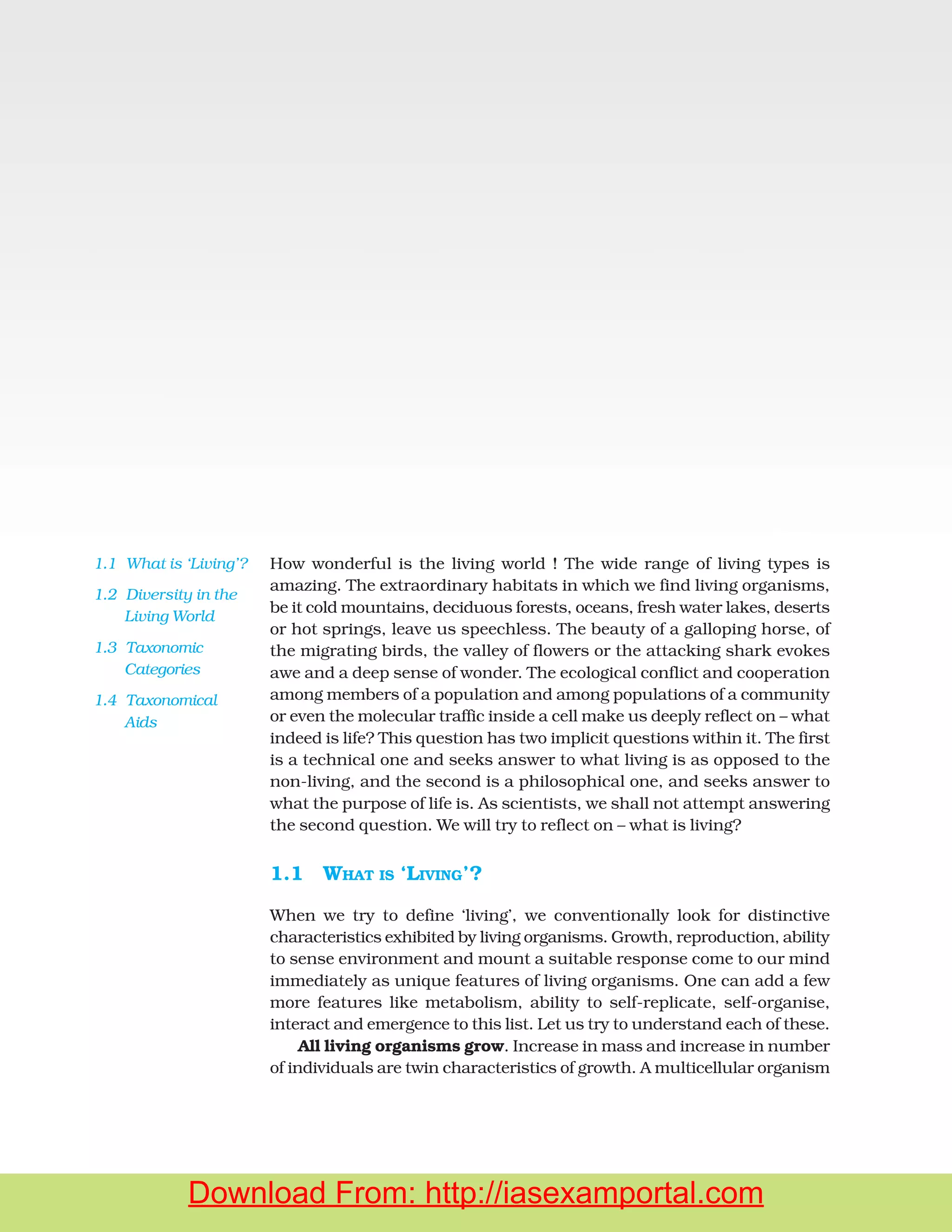
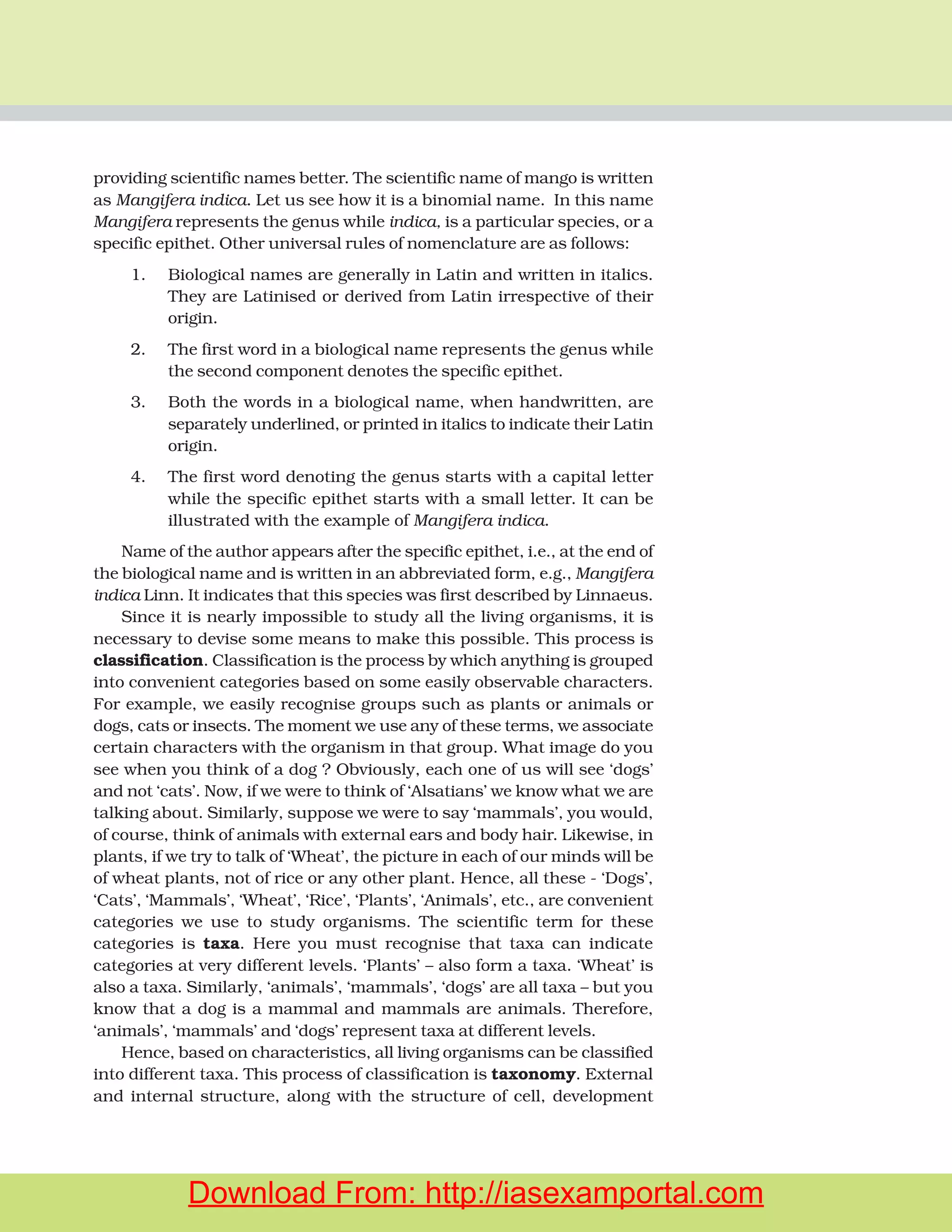
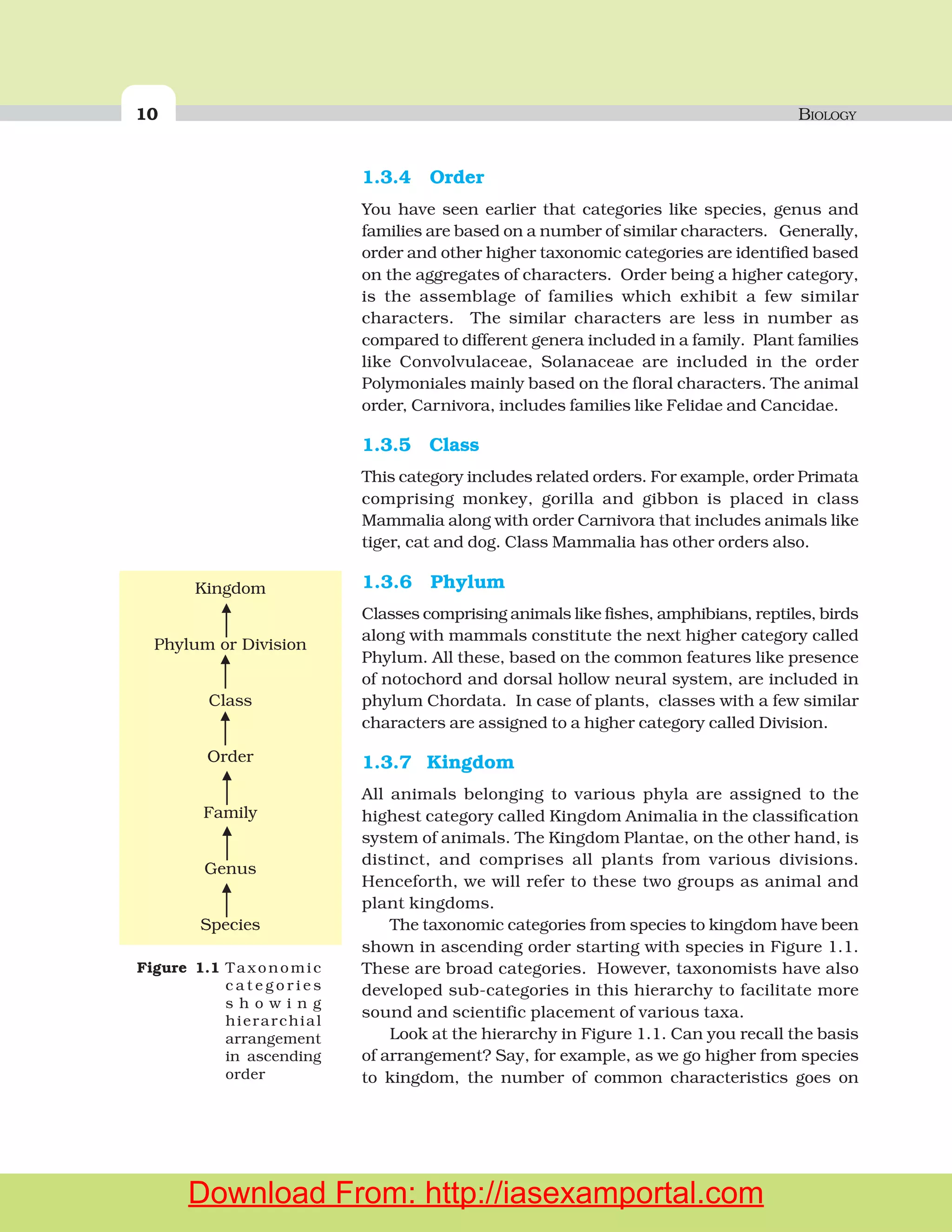
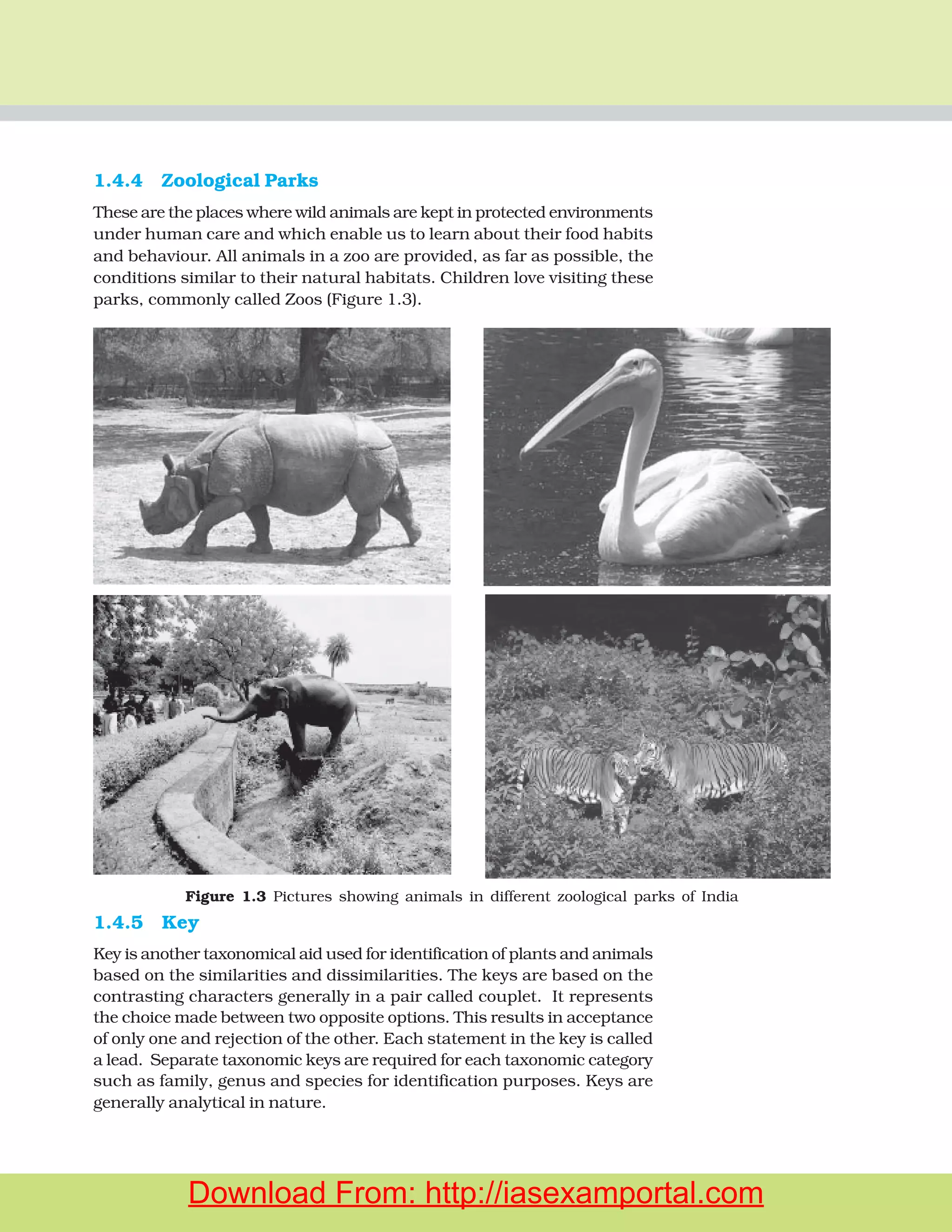
1.4.4 Zoological Parks
These are the places where wild animals are kept in protected environments
under human care and which enable us to learn about their food habits
and behaviour. All animals in a zoo are provided, as far as possible, the
conditions similar to their natural habitats. Children love visiting these
parks, commonly called Zoos (Figure 1.3).
Figure 1.3 Pictures showing animals in different zoological parks of India
1.4.5 Key
Key is another taxonomical aid used for identification of plants and animals
based on the similarities and dissimilarities. The keys are based on the
contrasting characters generally in a pair called couplet. It represents
the choice made between two opposite options. This results in acceptance
of only one and rejection of the other. Each statement in the key is called
a lead. Separate taxonomic keys are required for each taxonomic category
such as family, genus and species for identification purposes. Keys are
generally analytical in nature.
Download From: http://iasexamportal.com
14 BIOLOGY
SUMMARY
The living world is rich in variety. Millions of plants and animals have been
identified and described but a large number still remains unknown. The very
range of organisms in terms of size, colour, habitat, physiological and
morphological features make us seek the defining characteristics of living
organisms. In order to facilitate the study of kinds and diversity of organisms,
biologists have evolved certain rules and principles for identification, nomenclature
and classification of organisms. The branch of knowledge dealing with these aspects
is referred to as taxonomy. The taxonomic studies of various species of plants
and animals are useful in agriculture, forestry, industry and in general for knowing
our bio-resources and their diversity. The basics of taxonomy like identification,
naming and classification of organisms are universally evolved under international
codes. Based on the resemblances and distinct differences, each organism is
identified and assigned a correct scientific/biological name comprising two words
as per the binomial system of nomenclature. An organism represents/occupies a
place or position in the system of classification. There are many categories/ranks
and are generally referred to as taxonomic categories or taxa. All the categories
constitute a taxonomic hierarchy.
Taxonomists have developed a variety of taxonomic aids to facilitate
identification, naming and classification of organisms. These studies are carried
out from the actual specimens which are collected from the field and preserved as
referrals in the form of herbaria, museums and in botanical gardens and zoological
parks. It requires special techniques for collection and preservation of specimens
in herbaria and museums. Live specimens, on the other hand, of plants and
animals, are found in botanical gardens or in zoological parks. Taxonomists also
prepare and disseminate information through manuals and monographs for
further taxonomic studies. Taxonomic keys are tools that help in identification
based on characteristics.
Flora, manuals, monographs and catalogues are some other means
of recording descriptions. They also help in correct identification. Flora
contains the actual account of habitat and distribution of plants of a
given area. These provide the index to the plant species found in a
particular area. Manuals are useful in providing information for
identification of names of species found in an area. Monographs contain
information on any one taxon.
Download From: http://iasexamportal.com
THE LIVING WORLD 15
EXERCISES
1. Why are living organisms classified?
2. Why are the classification systems changing every now and then?
3. What different criteria would you choose to classify people that you meet often?
4. What do we learn from identification of individuals and populations?
5. Given below is the scientific name of Mango. Identify the correctly written name.
Mangifera Indica
Mangifera indica
6. Define a taxon. Give some examples of taxa at different hierarchical levels.
7. Can you identify the correct sequence of taxonomical categories?
(a) Species Order Phylum Kingdom
(b) Genus Species Order Kingdom
(c) Species Genus Order Phylum
8. Try to collect all the currently accepted meanings for the word ‘species’. Discuss
with your teacher the meaning of species in case of higher plants and animals
on one hand, and bacteria on the other hand.
9. Define and understand the following terms:
(i) Phylum (ii) Class (iii) Family (iv) Order (v) Genus
10. How is a key helpful in the identification and classification of an organism?
11. Illustrate the taxonomical hierarchy with suitable examples of a plant and an
animal.
Download From: http://iasexamportal.com
16 BIOLOGY
Since the dawn of civilisation, there have been many attempts to classify
living organisms. It was done instinctively not using criteria that were
scientific but borne out of a need to use organisms for our own use – for
food, shelter and clothing. Aristotle was the earliest to attempt a more
scientific basis for classification. He used simple morphological characters
to classify plants into trees, shrubs and herbs. He also divided animals
into two groups, those which had red blood and those that did not.
In Linnaeus' time a Two Kingdom system of classification with
Plantae and Animalia kingdoms was developed that included all plants
and animals respectively. This system was used till very recently. This
system did not distinguish between the eukaryotes and prokaryotes,
unicellular and multicellular organisms and photosynthetic (green algae)
and non-photosynthetic (fungi) organisms. Classification of organisms
into plants and animals was easily done and was easy to understand,
inspite, a large number of organisms did not fall into either category.
Hence the two kingdom classification used for a long time was found
inadequate. A need was also felt for including, besides gross morphology,
other characteristics like cell structure, nature of wall, mode of nutrition,
habitat, methods of reproduction, evolutionary relationships, etc.
Classification systems for the living organisms have hence, undergone
several changes over time. Though plant and animal kingdoms have
been a constant under all different systems, the understanding of what
groups/organisms be included under these kingdoms have been
changing; the number and nature of other kingdoms have also been
understood differently by different scientists over time.
BIOLOGICAL CLASSIFICATION
CHAPTER 2
2.1 Kingdom Monera
2.2 Kingdom Protista
2.3 Kingdom Fungi
2.4 Kingdom Plantae
2.5 Kingdom
Animalia
2.6 Viruses, Viroids
and Lichens
Download From: http://iasexamportal.com
BIOLOGICAL CLASSIFICATION 17
R.H. Whittaker (1969) proposed a Five Kingdom Classification.
The kingdoms defined by him were named Monera, Protista, Fungi,
Plantae and Animalia. The main criteria for classification used by him
include cell structure, thallus organisation, mode of nutrition,
reproduction and phylogenetic relationships. Table 2.1 gives a
comparative account of different characteristics of the five kingdoms.
Let us look at this five kingdom classification to understand the issues
and considerations that influenced the classification system. Earlier
classification systems included bacteria, blue green algae, fungi, mosses,
ferns, gymnosperms and the angiosperms under ‘Plants’. The character
that unified this whole kingdom was that all the organisms included had
a cell wall in their cells. This placed together groups which widely differed
in other characterstics. It brought together the prokaryotic bacteria and
the blue green algae with other groups which were eukaryotic. It also
grouped together the unicellular organisms and the multicellular ones,
say, for example, Chlamydomonas and Spirogyra were placed together
under algae. The classification did not differentiate between the
heterotrophic group – fungi, and the autotrophic green plants, though
they also showed a characteristic difference in their walls composition –
the fungi had chitin in their walls while the green plants had a cellulosic
Five Kingdoms
Characters
Cell type
Cell wall
Nuclear
membrane
Body
organisation
Mode of
nutrition
Monera
Prokaryotic
Noncellular
(Polysaccharide
+ amino acid)
Absent
Cellular
Autotrophic
(chemosyn-
thetic and
photosynthetic)
and Hetero-
trophic (sapro-
phyte/para-
site)
Protista
Eukaryotic
Present in
some
Present
Cellular
Autotrophic
(Photosyn-
thetic) and
Hetero-
trophic
Fungi
Eukaryotic
Present
(without
cellulose)
Present
Multiceullar/
loose tissue
Heterotrophic
(Saprophytic/
Parasitic)
Plantae
Eukaryotic
Present
(cellulose)
Present
Tissue/
organ
Autotrophic
(Photosyn-
thetic)
Animalia
Eukaryotic
Absent
Present
Tissue/organ/
organ system
Heterotrophic
( H o l o z o i c /
S a p r o p h y t i c
etc.)
TABLE 2.1 Characteristics of the Five Kingdoms
Download From: http://iasexamportal.com
18 BIOLOGY
cell wall. When such characterstics were considered, the fungi were placed
in a separate kingdom – Kingdom Fungi. All prokaryotic organisms were
grouped together under Kingdom Monera and the unicellular eukaryotic
organisms were placed in Kingdom Protista. Kingdom Protista has
brought together Chlamydomonas, Chlorella (earlier placed in Algae
within Plants and both having cell walls) with Paramoecium and Amoeba
(which were earlier placed in the animal kingdom) which lack it. It has
put together organisms which, in earlier classifications, were placed in
different kingdoms. This happened because the criteria for classification
changed. This kind of changes will take place in future too depending on
the improvement in our understanding of characteristics and evolutionary
relationships. Over time, an attempt has been made to evolve a
classification system which reflects not only the morphological,
physiological and reproductive similarities, but is also phylogenetic, i.e.,
is based on evolutionary relationships.
In this chapter we will study characteristics of Kingdoms Monera,
Protista and Fungi of the Whittaker system of classification. The Kingdoms
Plantae and Animalia, commonly referred to as plant and animal
kingdoms, respectively, will be dealt with separately in chapters 3 and 4.
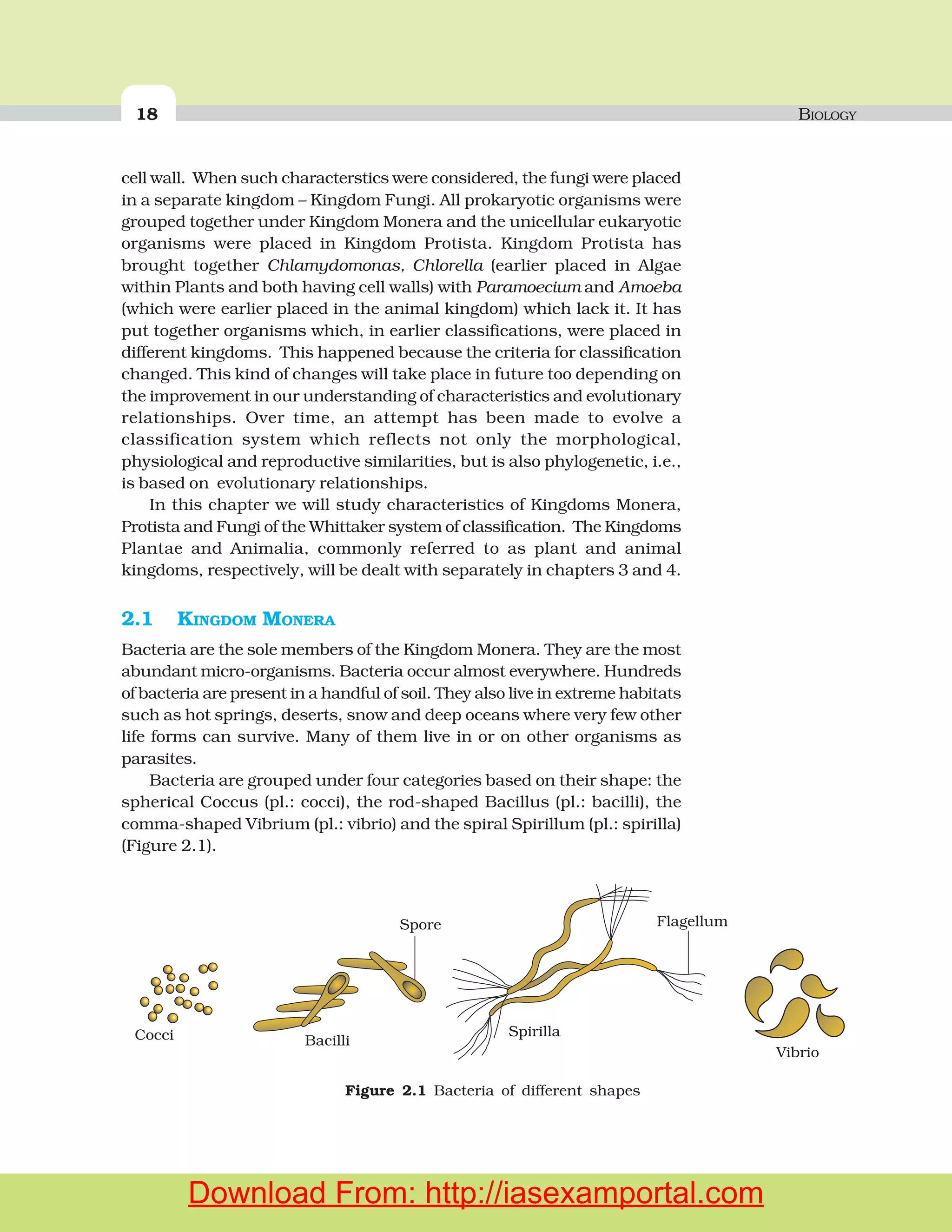
2.1 KINGDOM MONERA
Spore Flagellum
Cocci Bacilli
Spirilla
Vibrio
Figure 2.1 Bacteria of different shapes
Bacteria are the sole members of the Kingdom Monera. They are the most
abundant micro-organisms. Bacteria occur almost everywhere. Hundreds
of bacteria are present in a handful of soil. They also live in extreme habitats
such as hot springs, deserts, snow and deep oceans where very few other
life forms can survive. Many of them live in or on other organisms as
parasites.
Bacteria are grouped under four categories based on their shape: the
spherical Coccus (pl.: cocci), the rod-shaped Bacillus (pl.: bacilli), the
comma-shaped Vibrium (pl.: vibrio) and the spiral Spirillum (pl.: spirilla)
(Figure 2.1).
Download From: http://iasexamportal.com
BIOLOGICAL CLASSIFICATION 19
Though the bacterial structure is very simple, they are very complex
in behaviour. Compared to many other organisms, bacteria as a group
show the most extensive metabolic diversity. Some of the bacteria are
autotrophic, i.e., they synthesise their own food from inorganic substrates.
They may be photosynthetic autotrophic or chemosynthetic autotrophic.
The vast majority of bacteria are heterotrophs, i.e., they do not synthesise
their own food but depend on other organisms or on dead organic matter
for food.
2.1.1 Archaebacteria
These bacteria are special since they live in some of the most harsh habitats
such as extreme salty areas (halophiles), hot springs (thermoacidophiles)
and marshy areas (methanogens). Archaebacteria differ from other bacteria
in having a different cell wall structure and this feature is responsible for
their survival in extreme conditions. Methanogens are present in the guts
of several ruminant animals such as cows and buffaloes and they are
responsible for the production of methane (biogas) from the dung of these
animals.
Figure 2.2 A filamentous blue-green
algae – Nostoc
2.1.2 Eubacteria
There are thousands of different eubacteria or ‘true
bacteria’. They are characterised by the presence of
a rigid cell wall, and if motile, a flagellum. The
cyanobacteria (also referred to as blue-green algae)
have chlorophyll a similar to green plants and are
photosynthetic autotrophs (Figure 2.2). The
cyanobacteria are unicellular, colonial or
filamentous, marine or terrestrial algae. The colonies
are generally surrounded by gelatinous sheath. They
often form blooms in polluted water bodies. Some of
these organisms can fix atmospheric nitrogen in
specialised cells called heterocysts, e.g., Nostoc and
Anabaena. Chemosynthetic autotrophic bacteria
oxidise various inorganic substances such as
nitrates, nitrites and ammonia and use the released
energy for their ATP production. They play a great
role in recycling nutrients like nitrogen,
phosphorous, iron and sulphur.
Heterotrophic bacteria are the most abundant
in nature. The majority are important decomposers.
Many of them have a significant impact on human
affairs. They are helpful in making curd from milk,
production of antibiotics, fixing nitrogen in legume
Download From: http://iasexamportal.com
20 BIOLOGY
roots, etc. Some are pathogens causing damage
to human beings, crops, farm animals and pets.
Cholera, typhoid, tetanus, citrus canker are well
known diseases caused by different bacteria.
Bacteria reproduce mainly by fission (Figure
2.3). Sometimes, under unfavourable conditions,
they produce spores. They also reproduce by a
sort of sexual reproduction by adopting a
primitive type of DNA transfer from one bacterium
to the other.
The Mycoplasmas are organisms that
completely lack a cell wall. They are the smallest
living cells known and can survive without oxygen. Many mycoplasma
are pathogenic in animals and plants.
2.2 KINGDOM PROTISTA
All single-celled eukaryotes are placed under Protista, but the boundaries
of this kingdom are not well defined. What may be ‘a photosynthetic
protistan’ to one biologist may be ‘a plant’ to another. In this book we
include Chrysophytes, Dianoflagellates, Euglenoids, Slime moulds and
Protozoans under Protista. Members of Protista are primarily aquatic.
This kingdom forms a link with the others dealing with plants, animals
and fungi. Being eukaryotes, the protistan cell body contains a well defined
nucleus and other membrane-bound organelles. Some have flagella or
cilia. Protists reproduce asexually and sexually by a process involving
cell fusion and zygote formation.
2.2.1 Chrysophytes
This group includes diatoms and golden algae (desmids). They are found
in fresh water as well as in marine environments. They are microscopic
and float passively in water currents (plankton). Most of them are
photosynthetic. In diatoms the cell walls form two thin overlapping shells,
which fit together as in a soap box. The walls are embedded with silica
and thus the walls are indestructible. Thus, diatoms have left behind
large amount of cell wall deposits in their habitat; this accumulation over
billions of years is referred to as ‘diatomaceous earth’. Being gritty this
soil is used in polishing, filtration of oils and syrups. Diatoms are the
chief ‘producers’ in the oceans.
Figure 2.3 A dividing bacterium
Download From: http://iasexamportal.com
BIOLOGICAL CLASSIFICATION 21
2.2.2 Dianoflagellates
These organisms are mostly marine and photosynthetic.
They appear yellow, green, brown, blue or red depending
on the main pigments present in their cells. The cell wall
has stiff cellulose plates on the outer surface. Most of
them have two flagella; one lies longitudinally and the
other transversely in a furrow between the wall plates.
Very often, red dianoflagellates (Example: Gonyaulax)
undergo such rapid multiplication that they make the
sea appear red (red tides). Toxins released by such large
numbers may even kill other marine animals such as
fishes.
2.2.3 Euglenoids
Majority of them are fresh water organisms found in
stagnant water. Instead of a cell wall, they have a protein
rich layer called pellicle which makes their body flexible.
They have two flagella, a short and a long one. Though
they are photosynthetic in the presence of sunlight, when
deprived of sunlight they behave like heterotrophs by
predating on other smaller organisms. Interestingly, the
pigments of euglenoids are identical to those present in
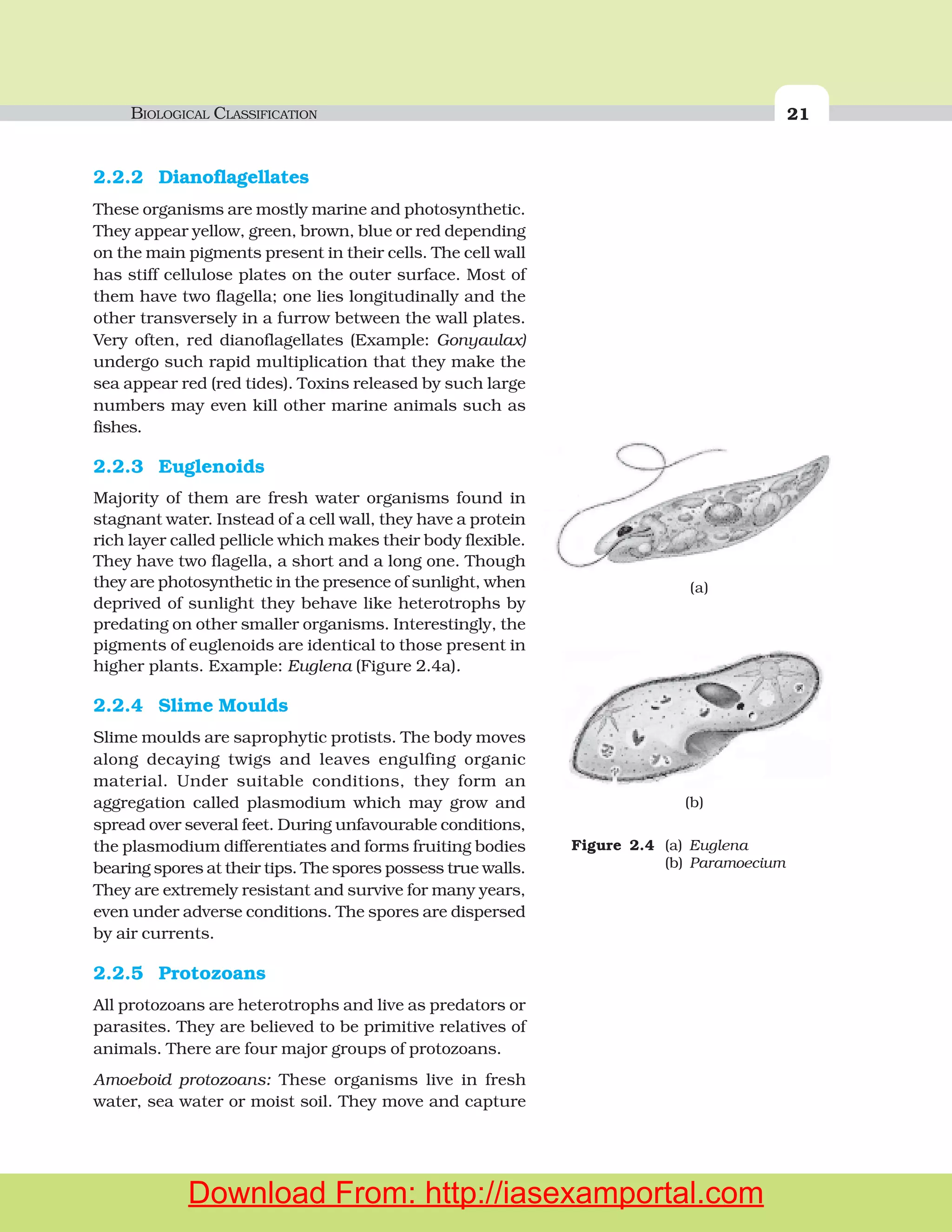
higher plants. Example: Euglena (Figure 2.4a).
2.2.4 Slime Moulds
Slime moulds are saprophytic protists. The body moves
along decaying twigs and leaves engulfing organic
material. Under suitable conditions, they form an
aggregation called plasmodium which may grow and
spread over several feet. During unfavourable conditions,
the plasmodium differentiates and forms fruiting bodies
bearing spores at their tips. The spores possess true walls.
They are extremely resistant and survive for many years,
even under adverse conditions. The spores are dispersed
by air currents.
2.2.5 Protozoans
All protozoans are heterotrophs and live as predators or
parasites. They are believed to be primitive relatives of
animals. There are four major groups of protozoans.
Amoeboid protozoans: These organisms live in fresh
water, sea water or moist soil. They move and capture
Figure 2.4 (a) Euglena
(b) Paramoecium
(b)
(a)
Download From: http://iasexamportal.com
22 BIOLOGY
their prey by putting out pseudopodia (false feet) as in Amoeba. Marine
forms have silica shells on their surface. Some of them such as Entamoeba
are parasites.
Flagellated protozoans: The members of this group are either free-living
or parasitic. They have flagella. The parasitic forms cause diaseases such
as sleeping sickness. Example: Trypanosoma.
Ciliated protozoans: These are aquatic, actively moving organisms because
of the presence of thousands of cilia. They have a cavity (gullet) that opens
to the outside of the cell surface. The coordinated movement of rows of
cilia causes the water laden with food to be steered into the gullet. Example:
Paramoecium (Figure 2.4b).
Sporozoans: This includes diverse organisms that have an infectious
spore-like stage in their life cycle. The most notorious is Plasmodium
(malarial parasite) which causes malaria which has a staggering effect on
human population.
2.3 KINGDOM FUNGI
The fungi constitute a unique kingdom of heterotrophic organisms. They
show a great diversity in morphology and habitat. When your bread
develops a mould or your orange rots it is because of fungi. The common
mushroom you eat and toadstools are also fungi. White spots seen on
mustard leaves are due to a parasitic fungus. Some unicellular fungi,
e.g., yeast are used to make bread and beer. Other fungi cause diseases
in plants and animals; wheat rust-causing Puccinia is an important
example. Some are the source of antibiotics, e.g., Penicillium. Fungi are
cosmopolitan and occur in air, water, soil and on animals and plants.
They prefer to grow in warm and humid places. Have you ever wondered
why we keep food in the refrigerator ? Yes, it is to prevent food from going
bad due to bacterial or fungal infections.
With the exception of yeasts which are unicellular, fungi are
filamentous. Their bodies consist of long, slender thread-like structures
called hyphae. The network of hyphae is known as mycelium. Some hyphae
are continuous tubes filled with multinucleated cytoplasm – these are
called coenocytic hyphae. Others have septae or cross walls in their
hyphae. The cell walls of fungi are composed of chitin and polysaccharides.
Most fungi are heterotrophic and absorb soluble organic matter from
dead substrates and hence are called saprophytes. Those that depend
on living plants and animals are called parasites. They can also live as
symbionts – in association with algae as lichens and with roots of higher
plants as mycorrhiza.
Reproduction in fungi can take place by vegetative means –
fragmentation, fission and budding. Asexual reproduction is by spores
Download From: http://iasexamportal.com
BIOLOGICAL CLASSIFICATION 23
called conidia or sporangiospores or zoospores, and sexual reproduction
is by oospores, ascospores and basidiospores. The various spores are
produced in distinct structures called fruiting bodies. The sexual cycle
involves the following three steps:
(i) Fusion of protoplasms between two motile or non-motile gametes
called plasmogamy.
(ii) Fusion of two nuclei called karyogamy.
(iii) Meiosis in zygote resulting in haploid spores.
When a fungus reproduces sexually, two haploid
hyphae of compatible mating types come together and
fuse. In some fungi the fusion of two haploid cells
immediately results in diploid cells (2n). However, in other
fungi (ascomycetes and basidiomycetes), an intervening
dikaryotic stage (n + n i.e. two nuclei per cell) occurs; such
a condition is called a dikaryon and the phase is called
dikaryophase of fungus. Later, the parental nuclei fuse
and the cells become diploid. The fungi form fruiting
bodies in which reduction division occurs, leading to
formation of haploid spores.
The morphology of the mycelium, mode of spore
formation and fruiting bodies form the basis for the
division of the kingdom into various classes.
2.3.1 Phycomycetes
Members of phycomycetes are found in aquatic habitats
and on decaying wood in moist and damp places or as
obligate parasites on plants. The mycelium is aseptate
and coenocytic. Asexual reproduction takes place by
zoospores (motile) or by aplanospores (non-motile). These
spores are endogeneously produced in sporangium.
Zygospores are formed by fusion of two gametes. These
gametes are similar in morphology (isogamous) or
dissimilar (anisogamous or oogamous). Some common
examples are Mucor (Figure 2.5a), Rhizopus (the bread
mould mentioned earlier) and Albugo (the parasitic fungi
on mustard).
2.3.2 Ascomycetes
Commonly known as sac-fungi, the ascomycetes are
unicellular, e.g., yeast (Sacharomyces) or multicellular,
e.g., Penicillium. They are saprophytic, decomposers,
parasitic or coprophilous (growing on dung). Mycelium
Figure 2.5 Fungi: (a) Mucor
(b) Aspergillus (c) Agaricus
(c)
(a)
(b)
Download From: http://iasexamportal.com
24 BIOLOGY
is branched and septate. The asexual spores are conidia produced
exogenously on the special mycelium called conidiophores. Conidia on
germination produce mycelium. Sexual spores are called ascospores
which are produced endogenously in sac like asci (singular ascus). These
asci are arranged in different types of fruiting bodies called ascocarps.
Some examples are Aspergillus (Figure 2.5b), Claviceps and Neurospora.
Neurospora is used extensively in biochemical and genetic work. Many
members like morels and buffles are edible and are considered delicacies.
2.3.3 Basidiomycetes
Commonly known forms of basidiomycetes are mushrooms, bracket fungi
or puffballs. They grow in soil, on logs and tree stumps and in living
plant bodies as parasites, e.g., rusts and smuts. The mycelium is branched
and septate. The asexual spores are generally not found, but vegetative
reproduction by fragmentation is common. The sex organs are absent,
but plasmogamy is brought about by fusion of two vegetative or somatic
cells of different strains or genotypes. The resultant structure is dikaryotic
which ultimately gives rise to basidium. Karyogamy and meiosis take
place in the basidium producing four basidiospores. The basidiospores
are exogenously produced on the basidium (pl.: basidia). The basidia are
arranged in fruiting bodies called basidiocarps. Some common members
are Agaricus (mushroom) (Figure 2.5c), Ustilago (smut) and Puccinia (rust
fungus).
2.3.4 Deuteromycetes
Commonly known as imperfect fungi because only the asexual or
vegetative phases of these fungi are known. When the sexual forms of
these fungi were discovered they were moved into classes they rightly
belong to. It is also possible that the asexual and vegetative stage have
been given one name (and placed under deuteromycetes) and the sexual
stage another (and placed under another class). Later when the linkages
were established, the fungi were correctly identified and moved out of
deuteromycetes. Once perfect (sexual) stages of members of
dueteromycetes were discovered they were often moved to ascomycetes
and basidiomycetes. The deuteromycetes reproduce only by asexual spores
known as conidia. The mycelium is septate and branched. Some members
are saprophytes or parasites while a large number of them are
decomposers of litter and help in mineral cycling. Some examples are
Alternaria, Colletotrichum and Trichoderma.
Download From: http://iasexamportal.com
BIOLOGICAL CLASSIFICATION 25
2.4 KINGDOM PLANTAE
Kingdom Plantae includes all eukaryotic chlorophyll-containing
organisms commonly called plants. A few members are partially
heterotrophic such as the insectivorous plants or parasites. Bladderwort
and Venus fly trap are examples of insectivorous plants and Cuscuta is a
parasite. The plant cells have an eukaryotic structure with prominent
chloroplasts and cell wall mainly made of cellulose. You will study the
eukaryotic cell structure in detail in Chapter 8. Plantae includes algae,
bryophytes, pteridophytes, gymnosperms and angiosperms.
Life cycle of plants has two distinct phases – the diploid sporophytic
and the haploid gametophytic – that alternate with each other. The lengths
of the haploid and diploid phases, and whether these phases are free–
living or dependent on others, vary among different groups in plants.
This phenomenon is called alternation of generation. You will study
further details of this kingdom in Chapter 3.
2.5 KINGDOM ANIMALIA
This kingdom is characterised by heterotrophic eukaryotic organisms
that are multicellular and their cells lack cell walls. They directly or
indirectly depend on plants for food. They digest their food in an internal
cavity and store food reserves as glycogen or fat. Their mode of nutrition
is holozoic – by ingestion of food. They follow a definite growth pattern
and grow into adults that have a definite shape and size. Higher forms
show elaborate sensory and neuromotor mechanism. Most of them are
capable of locomotion.
The sexual reproduction is by copulation of male and female followed
by embryological development. Salient features of various phyla are
described in Chapter 4.
2.6 VIRUSES, VIROIDS AND LICHENS
In the five kingdom classification of Whittaker there is no mention of some
acellular organisms like viruses and viroids, and lichens. These are briefly
introduced here.
All of us who have suffered the illeffects of common cold or ‘flu’ know
what effects viruses can have on us, even if we do not associate it with our
condition. Viruses did not find a place in classification since they are not
truly ‘living’, if we understand living as those organisms that have a cell
structure. The viruses are non-cellular organisms that are characterised
by having an inert crystalline structure outside the living cell. Once they
Download From: http://iasexamportal.com
26 BIOLOGY
infect a cell they take over the machinery of the host cell to replicate
themselves, killing the host. Would you call viruses living or non-living?
The name virus that means venom or poisonous fluid was given by
Pasteur. D.J. Ivanowsky (1892) recognised certain microbes as causal
organism of the mosaic disease of tobacco. These were found to be smaller
than bacteria because they passed through bacteria-proof filters. M.W.
Beijerinek (1898) demonstrated that the extract of the infected plants of
tobacco could cause infection in healthy plants and called the fluid as
Contagium vivum fluidum (infectious living fluid). W.M. Stanley (1935)
showed that viruses could be crystallised and crystals consist largely of
proteins. They are inert outside their specific host cell. Viruses are obligate
parasites.
In addition to proteins viruses also contain genetic material, that could
be either RNA or DNA. No virus contains both RNA and DNA. A virus is
a nucleoprotein and the genetic material is infectious. In general, viruses
that infect plants have single stranded RNA and viruses that infect animals
have either single or double stranded RNA or double stranded DNA.
Bacterial viruses or bacteriophages (viruses that infect the bacteria) are
usually double stranded DNA viruses. The protein coat called capsid made
of small subunits called capsomeres, protects the nucleic acid. These
capsomeres are arranged in helical or polyhedral geometric forms. Viruses
cause diseases like mumps, small pox, herpes and influenza. AIDS in
humans is also caused by a virus. In plants, the symptoms can be mosaic
formation, leaf rolling and curling, yellowing and vein clearing, dwarfing
and stunted growth.
RNA Capsid
(a)
Sheath
Head
Tail fibres
Collar
(b)
Figure 2.6 (a) Tobacco Mosaic Virus (TMV) (b) Bacteriophage
Download From: http://iasexamportal.com
BIOLOGICAL CLASSIFICATION 27
SUMMARY
Biological classification of plants and animals was first proposed by Aristotle on
the basis of simple morphlogical characters. Linnaeus later classified all living
organisms into two kingdoms – Plantae and Animalia. Whittaker proposed an
elaborate five kindgom classification – Monera, Protista, Fungi, Plantae and
Animalia. The main criteria of the five kingdom classification were cell structure,
body organisation, mode of nutrition and reproduction, and phylogenetic
relationships.
In the five kingdom classification, bacteria are included in Kingdom Monera.
Bacteria are cosmopolitan in distribution. These organisms show the most extensive
metabolic diversity. Bacteria may be autotrophic or heterotrophic in their mode of
nutrition. Kingdom Protista includes all single-celled eukaryotes such as
Chrysophytes, Dianoflagellates, Euglenoids, Slime-moulds and Protozoans.
Protists have defined nucleus and other membrane bound organelles. They
reproduce both asexually and sexually. Members of Kingdom Fungi show a great
diversity in structures and habitat. Most fungi are saprophytic in their mode of
nutrition. They show asexual and sexual reproduction. Phycomycetes,
Ascomycetes, Basidiomycetes and Deuteromycetes are the four classes under this
kingdom. The plantae includes all eukaryotic chlorophyll-containing organisms.
Algae, bryophytes, pteridophytes, gymnosperms and angiosperms are included
in this group. The life cycle of plants exhibit alternation of generations –
gametophytic and sporophytic generations. The heterotrophic eukaryotic,
multicellular organisms lacking a cell wall are included in the Kingdom Animalia.
The mode of nutrition of these organisms is holozoic. They reproduce mostly by
the sexual mode. Some acellular organisms like viruses and viroids as well as the
lichens are not included in the five kingdom system of classification.
Viroids : In 1971 T.O. Diener discovered a new infectious agent that was
smaller than viruses and caused potato spindle tuber disease. It was
found to be a free RNA; it lacked the protein coat that is found in viruses,
hence the name viroid. The RNA of the viroid was of low molecular weight.
Lichens : Lichens are symbiotic associations i.e. mutually useful
associations, between algae and fungi. The algal component is known as
phycobiont and fungal component as mycobiont, which are autotrophic
and heterotrophic, respectively. Algae prepare food for fungi and fungi
provide shelter and absorb mineral nutrients and water for its partner.
So close is their association that if one saw a lichen in nature one would
never imagine that they had two different organisms within them. Lichens
are very good pollution indicators – they do not grow in polluted areas.
Download From: http://iasexamportal.com
28 BIOLOGY
EXERCISES
1. Discuss how classification systems have undergone several changes over a
period of time?
2. State two economically important uses of:
(a) heterotrophic bacteria
(b) archaebacteria
3. What is the nature of cell-walls in diatoms?
4. Find out what do the terms ‘algal bloom’ and ‘red-tides’ signify.
5. How are viroids different from viruses?
6. Describe briefly the four major groups of Protozoa.
7. Plants are autotrophic. Can you think of some plants that are partially
heterotrophic?
8. What do the terms phycobiont and mycobiont signify?
9. Give a comparative account of the classes of Kingdom Fungi under the following:
(i) mode of nutrition
(ii) mode of reproduction
10. What are the characteristic features of Euglenoids?
11. Give a brief account of viruses with respect to their structure and nature of
genetic material. Also name four common viral diseases.
12. Organise a discussion in your class on the topic – Are viruses living or non-
living?
Download From: http://iasexamportal.com
PLANT KINGDOM 29
In the previous chapter, we looked at the broad classification of living
organisms under the system proposed by Whittaker (1969) wherein he
suggested the Five Kingdom classification viz. Monera, Protista, Fungi,
Animalia and Plantae. In this chapter, we will deal in detail with further
classification within Kingdom Plantae popularly known as the ‘plant
kingdom’.
We must stress here that our understanding of the plant kingdom
has changed over time. Fungi, and members of the Monera and Protista
having cell walls have now been excluded from Plantae though earlier
classifications put them in the same kingdom. So, the cyanobacteria that
are also referred to as blue green algae are not ‘algae’ any more. In this
chapter, we will describe Plantae under Algae, Bryophytes, Pteridophytes,
Gymnosperms and Angiosperms.
Let us also look at classification within angiosperms to understand
some of the concerns that influenced the classification systems. The
earliest systems of classification used only gross superficial morphological
characters such as habit, colour, number and shape of leaves, etc. They
were based mainly on vegetative characters or on the androecium
structure (system given by Linnaeus). Such systems were artificial; they
separated the closely related species since they were based on a few
characteristics. Also, the artificial systems gave equal weightage to
vegetative and sexual characteristics; this is not acceptable since we know
that often the vegetative characters are more easily affected by
environment. As against this, natural classification systems developed,
which were based on natural affinities among the organisms and consider,
PLANT KINGDOM
CHAPTER 3
3.1 Algae
3.2 Bryophytes
3.3 Pteridophytes
3.4 Gymnosperms
3.5 Angiosperms
3.6 Plant Life Cycles
and Alternation
of Generations
Download From: http://iasexamportal.com
30 BIOLOGY
not only the external features, but also internal features, like ultra-
structure, anatomy, embryology and phytochemistry. Such a
classification for flowering plants was given by George Bentham and
Joseph Dalton Hooker.
At present phylogenetic classification systems based on
evolutionary relationships between the various organisms are acceptable.
This assumes that organisms belonging to the same taxa have a common
ancestor. We now use information from many other sources too to help
resolve difficulties in classification. These become more important when
there is no supporting fossil evidence. Numerical Taxonomy which is
now easily carried out using computers is based on all observable
characteristics. Number and codes are assigned to all the characters and
the data are then processed. In this way each character is given equal
importance and at the same time hundreds of characters can be
considered. Cytotaxonomy that is based on cytological information like
chromosome number, structure, behaviour and chemotaxonomy that
uses the chemical constituents of the plant to resolve confusions, are also
used by taxonomists these days.
3.1 ALGAE
Algae are chlorophyll-bearing, simple, thalloid, autotrophic and largely
aquatic (both fresh water and marine) organisms. They occur in a variety
of other habitats: moist stones, soils and wood. Some of them also occur
in association with fungi (lichen) and animals (e.g., on sloth bear).
The form and size of algae is highly variable (Figure 3.1). The size
ranges from the microscopic unicellular forms like Chlamydomonas, to
colonial forms like Volvox and to the filamentous forms like Ulothrix and
Spirogyra. A few of the marine forms such as kelps, form massive plant
bodies.
The algae reproduce by vegetative, asexual and sexual methods.
Vegetative reproduction is by fragmentation. Each fragment develops into
a thallus. Asexual reproduction is by the production of different types of
spores, the most common being the zoospores. They are flagellated
(motile) and on germination gives rise to new plants. Sexual reproduction
takes place through fusion of two gametes. These gametes can be
flagellated and similar in size (as in Chlamydomonas) or non-flagellated
(non-motile) but similar in size (as in Spirogyra). Such reproduction is
called isogamous. Fusion of two gametes dissimilar in size, as in some
species of Chlamydomonas is termed as anisogamous. Fusion between
one large, non-motile (static) female gamete and a smaller, motile male
gamete is termed oogamous, e.g., Volvox, Fucus.
Download From: http://iasexamportal.com
PLANT KINGDOM 31
Figure 3.1 Algae : (a) Green algae (i) Volvox (ii) Chlamydomonas (iii) Chara
(b) Brown algae (i) Laminaria (ii) Fucus (iii) Dictyota
(c) Red algae (i) Porphyra (ii) Polysiphonia
Download From: http://iasexamportal.com
32 BIOLOGY
Algae are useful to man in a variety of ways. At least a half of the total
carbon dioxide fixation on earth is carried out by algae through
photosynthesis. Being photosynthetic they increase the level of dissolved
oxygen in their immediate environment. They are of paramount
importance as primary producers of energy-rich compounds which form
the basis of the food cycles of all aquatic animals. Many species of Porphyra,
Laminaria and Sargassum are among the 70 species of marine algae
used as food. Certain marine brown and red algae produce large amounts
of hydrocolloids (water holding substances), e.g., algin (brown algae) and
carrageen (red algae) are used commercially. Agar, one of the commercial
products obtained from Gelidium and Gracilaria are used to grow
microbes and in preparations of ice-creams and jellies. Chlorella and
Spirullina are unicellular algae, rich in proteins and are used as food
supplements even by space travellers. The algae are divided into three
main classes: Chlorophyceae, Phaeophyceae and Rhodophyceae.
3.1.1 Chlorophyceae
The members of chlorophyceae are commonly called green algae. The
plant body may be unicellular, colonial or filamentous. They are usually
grass green due to the dominance of pigments chlorophyll a and b. The
pigments are localised in definite chloroplasts. The chloroplasts may be
discoid, plate-like, reticulate, cup-shaped, spiral or ribbon-shaped in
different species. Most of the members have one or more storage bodies
called pyrenoids located in the chloroplasts. Pyrenoids contain protein
besides starch. Some algae may store food in the form of oil droplets.
Green algae usually have a rigid cell wall made of an inner layer of cellulose
and an outer layer of pectose.
Vegetative reproduction usually takes place by fragmentation or by
formation of different types of spores. Asexual reproduction is by
flagellated zoospores produced in zoosporangia. The sexual reproduction
shows considerable variation in the type and formation of sex cells and it
may be isogamous, anisogamous or oogamous. Some commonly found
green algae are: Chlamydomonas, Volvox, Ulothrix, Spirogyra and Chara
(Figure 3.1a).
3.1.2 Phaeophyceae
The members of phaeophyceae or brown algae are found primarily in
marine habitats. They show great variation in size and form. They range
from simple branched, filamentous forms (Ectocarpus) to profusely
branched forms as represented by kelps, which may reach a height of
100 metres. They possess chlorophyll a, c, carotenoids and xanthophylls.
They vary in colour from olive green to various shades of brown depending
upon the amount of the xanthophyll pigment, fucoxanthin present in
Download From: http://iasexamportal.com
PLANT KINGDOM 33
them. Food is stored as complex carbohydrates, which may be in the
form of laminarin or mannitol. The vegetative cells have a cellulosic wall
usually covered on the outside by a gelatinous coating of algin. The
protoplast contains, in addition to plastids, a centrally located vacuole
and nucleus. The plant body is usually attached to the substratum by a
holdfast, and has a stalk, the stipe and leaf like photosynthetic organ –
the frond. Vegetative reproduction takes place by fragmentation. Asexual
reproduction in most brown algae is by biflagellate zoospores that are
pear-shaped and have two unequal laterally attached flagella.
Sexual reproduction may be isogamous, anisogamous or oogamous.
Union of gametes may take place in water or within the oogonium
(oogamous species). The gametes are pyriform (pear-shaped) and bear
two laterally attached flagella. The common forms are Ectocarpus, Dictyota,
Laminaria, Sargassum and Fucus (Figure 3.1b).
3.1.3 Rhodophyceae
Rhodophyta are commonly called red algae because of the predominance
of the red pigment, r-phycoerythrin in their body. Majority of the red
algae are marine with greater concentrations found in the warmer areas.
They occur in both well-lighted regions close to the surface of water and
also at great depths in oceans where relatively little light penetrates.
The red thalli of most of the red algae are multicellular. Some of them
have complex body organisation. The food is stored as floridean starch
which is very similar to amylopectin and glycogen in structure.
The red algae usually reproduce vegetatively by fragmentation. They
reproduce asexually by non-motile spores and sexually by non-motile
TABLE 3.1 Divisions of Algae and their Main Characteristics
Classes Common Major Stored Cell Wall Flagellar Habitat
Name Pigments Food Number and
Position of
Insertions
Chlorophyceae Green Chlorophyll Starch Cellulose 2-8, equal, Fresh water,
algae a, b apical brackish water,
salt water
Phaeophyceae Brown Chlorophyll Mannitol, Cellulose 2, unequal, Fresh water
algae a, c, laminarin and algin lateral (rare) brackish
fucoxanthin water, salt
water
Rhodophyceae Red Chlorophyll Floridean Cellulose Absent Fresh water
algae a, d, starch (some),
phycoerythrin brackish
water, salt
water (most)
Download From: http://iasexamportal.com
34 BIOLOGY
gametes. Sexual reproduction is oogamous and accompanied by complex
post fertilisation developments. The common members are: Polysiphonia,
Porphyra (Figure 3.1c), Gracilaria and Gelidium.
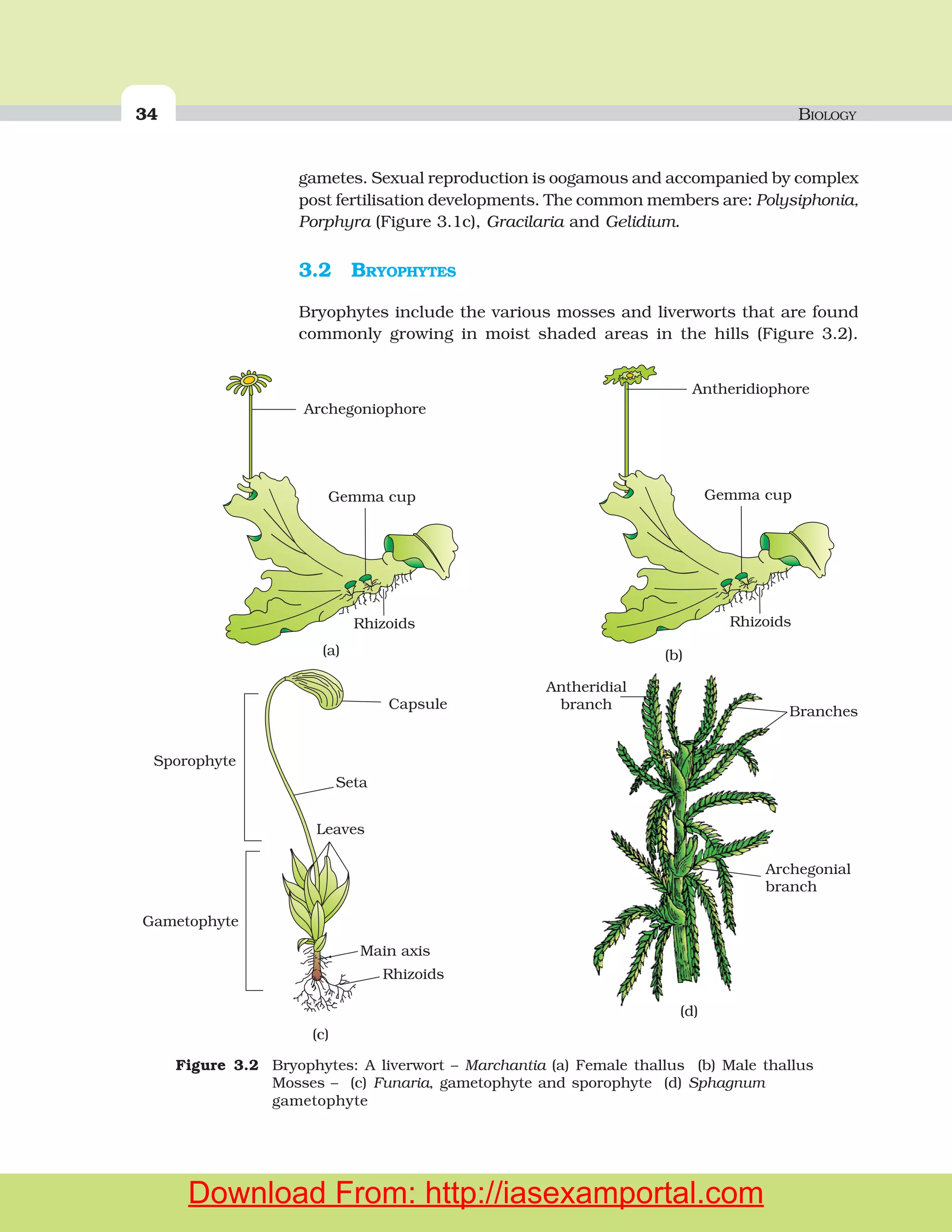
3.2 BRYOPHYTES
Bryophytes include the various mosses and liverworts that are found
commonly growing in moist shaded areas in the hills (Figure 3.2).
Archegoniophore
(a) (b)
(c)
(d)
Antheridiophore
Capsule
Antheridial
branch Branches
Archegonial
branch
Seta
Sporophyte
Gametophyte
Leaves
Main axis
Rhizoids
Gemma cup
Rhizoids
Gemma cup
Rhizoids
Figure 3.2 Bryophytes: A liverwort – Marchantia (a) Female thallus (b) Male thallus
Mosses – (c) Funaria, gametophyte and sporophyte (d) Sphagnum
gametophyte
Download From: http://iasexamportal.com
PLANT KINGDOM 35
Bryophytes are also called amphibians of the plant kingdom because
these plants can live in soil but are dependent on water for sexual
reproduction. They usually occur in damp, humid and shaded localities.
They play an important role in plant succession on bare rocks/soil.
The plant body of bryophytes is more differentiated than that of algae.
It is thallus-like and prostrate or erect, and attached to the substratum
by unicellular or multicellular rhizoids. They lack true roots, stem or
leaves. They may possess root-like, leaf-like or stem-like structures. The
main plant body of the bryophyte is haploid. It produces gametes, hence
is called a gametophyte. The sex organs in bryophytes are multicellular.
The male sex organ is called antheridium. They produce biflagellate
antherozoids. The female sex organ called archegonium is flask-shaped
and produces a single egg. The antherozoids are released into water where
they come in contact with archegonium. An antherozoid fuses with the
egg to produce the zygote. Zygotes do not undergo reduction division
immediately. They produce a multicellular body called a sporophyte.
The sporophyte is not free-living but attached to the photosynthetic
gametophyte and derives nourishment from it. Some cells of the
sporophyte undergo reduction division (meiosis) to produce haploid
spores. These spores germinate to produce gametophyte.
Bryophytes in general are of little economic importance but some
mosses provide food for herbaceous mammals, birds and other animals.
Species of Sphagnum, a moss, provide peat that have long been used as
fuel, and because of their capacity to hold water as packing material for
trans-shipment of living material. Mosses along with lichens are the first
organisms to colonise rocks and hence, are of great ecological importance.
They decompose rocks making the substrate suitable for the growth of
higher plants. Since mosses form dense mats on the soil, they reduce the
impact of falling rain and prevent soil erosion. The bryophytes are divided
into liverworts and mosses.
3.2.1 Liverworts
The liverworts grow usually in moist, shady habitats such as banks of
streams, marshy ground, damp soil, bark of trees and deep in the woods.
The plant body of a liverwort is thalloid, e.g., Marchantia. The thallus is
dorsiventral and closely appressed to the substrate. The leafy members
have tiny leaf-like appendages in two rows on the stem-like structures.
Asexual reproduction in liverworts takes place by fragmentation of
thalli, or by the formation of specialised structures called gemmae
(sing. gemma). Gemmae are green, multicellular, asexual buds, which
develop in small receptacles called gemma cups located on the thalli.
The gemmae become detached from the parent body and germinate to
form new individuals. During sexual reproduction, male and female sex
Download From: http://iasexamportal.com
36 BIOLOGY
organs are produced either on the same or on different thalli. The
sporophyte is differentiated into a foot, seta and capsule. After meiosis,
spores are produced within the capsule. These spores germinate to form
free-living gametophytes.
3.2.2 Mosses
The predominant stage of the life cycle of a moss is the gametophyte which
consists of two stages. The first stage is the protonema stage, which
develops directly from a spore. It is a creeping, green, branched and
frequently filamentous stage. The second stage is the leafy stage, which
develops from the secondary protonema as a lateral bud. They consist of
upright, slender axes bearing spirally arranged leaves. They are attached
to the soil through multicellular and branched rhizoids. This stage bears
the sex organs.
Vegetative reproduction in mosses is by fragmentation and budding
in the secondary protonema. In sexual reproduction, the sex organs
antheridia and archegonia are produced at the apex of the leafy shoots.
After fertilisation, the zygote develops into a sporophyte, consisting of a
foot, seta and capsule. The sporophyte in mosses is more elaborate than
that in liverworts. The capsule contains spores. Spores are formed after
meiosis. The mosses have an elaborate mechanism of spore dispersal.
Common examples of mosses are Funaria, Polytrichum and Sphagnum
(Figure 3.2).
3.3 PTERIDOPHYTES
The Pteridophytes include horsetails and ferns. Pteridophytes are used
for medicinal purposes and as soil-binders. They are also frequently grown
as ornamentals. Evolutionarily, they are the first terrestrial plants to
possess vascular tissues – xylem and phloem. You shall study more about
these tissues in Chapter 6. The pteridophytes are found in cool, damp,
shady places though some may flourish well in sandy-soil conditions.
You may recall that in bryophytes the dominant phase in the life
cycle is the gametophytic plant body. However, in pteridophytes, the
main plant body is a sporophyte which is differentiated into true root,
stem and leaves (Figure 3.3). These organs possess well-differentiated
vascular tissues. The leaves in pteridophyta are small (microphylls) as
in Selaginella or large (macrophylls) as in ferns. The sporophytes bear
sporangia that are subtended by leaf-like appendages called
sporophylls. In some cases sporophylls may form distinct compact
structures called strobili or cones (Selaginella, Equisetum). The
sporangia produce spores by meiosis in spore mother cells. The spores
germinate to give rise to inconspicuous, small but multicellular,
Download From: http://iasexamportal.com
PLANT KINGDOM 37
Figure 3.3 Pteridophytes : (a) Selaginella (b) Equisetum (c) Fern (d) Salvinia
Strobilus
Node
Internode
Branch
Rhizome
(b)
(c)
(d)
Download From: http://iasexamportal.com
38 BIOLOGY
free-living, mostly photosynthetic thalloid gametophytes called
prothallus. These gametophytes require cool, damp, shady places to
grow. Because of this specific restricted requirement and the need for
water for fertilisation, the spread of living pteridophytes is limited and
restricted to narrow geographical regions. The gametophytes bear male
and female sex organs called antheridia and archegonia, respectively.
Water is required for transfer of antherozoids – the male gametes released
from the antheridia, to the mouth of archegonium. Fusion of male gamete
with the egg present in the archegonium result in the formation of zygote.
Zygote thereafter produces a multicellular well-differentiated sporophyte
which is the dominant phase of the pteridophytes. In majority of the
pteridophytes all the spores are of similar kinds; such plants are called
homosporous. Genera like Selaginella and Salvinia which produce
two kinds of spores, macro (large) and micro (small) spores, are known
as heterosporous. The megaspores and microspores germinate and give
rise to female and male gametophytes, respectively. The female
gametophytes in these plants are retained on the parent sporophytes
for variable periods. The development of the zygotes into young embryos
take place within the female gametophytes. This event is a precursor to
the seed habit considered an important step in evolution.
The pteridophytes are further classified into four classes: Psilopsida
(Psilotum); Lycopsida (Selaginella, Lycopodium), Sphenopsida (Equisetum)
and Pteropsida (Dryopteris, Pteris, Adiantum).
3.4 GYMNOSPERMS
The gymnosperms (gymnos : naked, sperma : seeds) are plants in which
the ovules are not enclosed by any ovary wall and remain exposed, both
before and after fertilisation. The seeds that develop post-fertilisation, are
not covered, i.e., are naked. Gymnosperms include medium-sized trees
or tall trees and shrubs (Figure 3.4). One of the gymnosperms, the giant
redwood tree Sequoia is one of the tallest tree species. The roots are
generally tap roots. Roots in some genera have fungal association in the
form of mycorrhiza (Pinus), while in some others (Cycas) small specialised
roots called coralloid roots are associated with N2
- fixing cyanobacteria.
The stems are unbranched (Cycas) or branched (Pinus, Cedrus). The leaves
may be simple or compound. In Cycas the pinnate leaves persist for a few
years. The leaves in gymnosperms are well-adapted to withstand extremes
of temperature, humidity and wind. In conifers, the needle-like leaves
reduce the surface area. Their thick cuticle and sunken stomata also
help to reduce water loss.
Download From: http://iasexamportal.com
PLANT KINGDOM 39
The gymnosperms are heterosporous; they produce
haploid microspores and megaspores. The two kinds
of spores are produced within sporangia that are borne
on sporophylls which are arranged spirally along an
axis to form lax or compact strobili or cones. The
strobili bearing microsporophylls and
microsporangia are called microsporangiate or male
strobili. The microspores develop into a male
gametophytic generation which is highly reduced and
is confined to only a limited number of cells. This
reduced gametophyte is called a pollen grain. The
development of pollen grains take place within the
microsporangia. The cones bearing megasporophylls
with ovules or megasporangia are called
macrosporangiate or female strobili. The male or
female cones or strobili may be borne on the same tree
(Pinus) or on different trees (Cycas). The megaspore
mother cell is differentiated from one of the cells of the
nucellus. The nucellus is protected by envelopes and
the composite structure is called an ovule. The ovules
are borne on megasporophylls which may be clustered
to form the female cones. The megaspore mother cell
divides meiotically to form four megaspores. One of the
megaspores enclosed within the megasporangium
(nucellus) develops into a multicellular female
gametophyte that bears two or more archegonia or
female sex organs. The multicellular female
gametophyte is also retained within megasporangium.
Unlike bryophytes and pteridophytes, in
gymnosperms the male and the female gametophytes
do not have an independent free-living existence. They
remain within the sporangia retained on the
sporophytes. The pollen grain is released from the
microsporangium. They are carried in air currents and
come in contact with the opening of the ovules borne
on megasporophylls. The pollen tube carrying the male
gametes grows towards archegonia in the ovules and
discharge their contents near the mouth of the
archegonia. Following fertilisation, zygote develops into
an embryo and the ovules into seeds. These seeds are
not covered.
(c)
Figure 3.4 Gymnosperms: (a) Cycas
(b) Pinus (c) Ginkgo
Seeds
Dwarf
shoot
Long
shoot
Dwarf Shoot
Long Shoot
Seeds
(b)
(a)
Download From: http://iasexamportal.com
40 BIOLOGY
3.5 ANGIOSPERMS
Unlike the gymnosperms where the ovules are naked, in the angiosperms
or flowering plants, the pollen grains and ovules are developed in specialised
structures called flowers. In angiosperms, the seeds are enclosed by fruits.
The angiosperms are an exceptionally large group of plants occurring in
wide range of habitats. They range in size from tiny, almost microscopic
Wolfia to tall trees of Eucalyptus (over 100 metres). They provide us with
food, fodder, fuel, medicines and several other commercially important
products. They are divided into two classes : the dicotyledons and the
monocotyledons (Figure 3.5). The dicotyledons are characterised by
having two cotyledons in their seeds while the monocolyledons have only
one. The male sex organs in a flower is the stamen. Each stamen consists of
a slender filament with an anther at the tip. The anthers, following meiosis,
produce pollen grains. The female sex organs in a flower is the pistil or the
carpel. Pistil consists of an ovary enclosing one to many ovules. Within
ovules are present highly reduced female gametophytes termed embryo-
sacs. The embryo-sac formation is preceded by meiosis. Hence, each of the
cells of an embryo-sac is haploid. Each embryo-sac has a three-celled egg
apparatus – one egg cell and two synergids, three antipodal cells and
two polar nuclei. The polar nuclei eventually fuse to produce a diploid
secondary nucleus. Pollen grain, after dispersal from the anthers, are carried
by wind or various other agencies to the stigma of a pistil. This is termed as
(b)(a)
Figure 3.5 Angiosperms : (a) A dicotyledon (b) A monocotyledon
Download From: http://iasexamportal.com
PLANT KINGDOM 41
pollination. The pollen grains germinate on the stigma and the resulting
pollen tubes grow through the tissues of stigma and style and reach the
ovule. The pollen tubes enter the embryo-sac where two male gametes are
discharged. One of the male gametes fuses with the egg cell to form a zygote
(syngamy). The other male gamete fuses with the diploid secondary nucleus
to produce the triploid primary endosperm nucleus (PEN). Because of the
involvement of two fusions, this event is termed as double fertilisation,
an event unique to angiosperms. The zygote develops into an embryo (with
one or two cotyledons) and the PEN develops into endosperm which provides
nourishment to the developing embryo. The synergids and antipodals
degenerate after fertilisation. During these events the ovules develop into
seeds and the ovaries develop into fruit. The life cycle of an angiosperm is
shown in Figure 3.6.
Figure 3.6 Life cycle of an angiosperm
Download From: http://iasexamportal.com
42 BIOLOGY
3.6 PLANT LIFE CYCLES AND ALTERNATION OF
GENERATIONS
In plants, both haploid and diploid cells can divide by
mitosis. This ability leads to the formation of different
plant bodies - haploid and diploid. The haploid plant
body produces gametes by mitosis. This plant body
represents a gametophyte. Following fertilisation the
zygote also divides by mitosis to produce a diploid
sporophytic plant body. Haploid spores are produced
by this plant body by meiosis. These in turn, divide by
mitosis to form a haploid plant body once again. Thus,
during the life cycle of any sexually reproducing plant,
there is an alternation of generations between gamete
producing haploid gametophyte and spore producing
diploid sporophyte.
However, different plant groups, as well as individuals
representing them, differ in the following patterns:
1. Sporophytic generation is represented only by the
one-celled zygote. There are no free-living
sporophytes. Meiosis in the zygote results in the
formation of haploid spores. The haploid spores
divide mitotically and form the gametophyte. The
dominant, photosynthetic phase in such plants is
the free-living gametophyte. This kind of life cycle
is termed as haplontic. Many algae such as Volvox,
Spirogyra and some species of Chlamydomomas
represent this pattern (Figure 3.7 a).
2. On the other extreme, is the type wherein the diploid
sporophyte is the dominant, photosynthetic,
independent phase of the plant. The gametophytic
phase is represented by the single to few-celled
haploid gametophyte. This kind of lifecycle is termed
as diplontic. All seed-bearing plants i.e.
gymnosperms and angiosperms, follow this pattern
(Figure 3.7 b).
3. Bryophytes and pteridophytes, interestingly, exhibit
an intermediate condition (Haplo-diplontic); both
phases are multicellular and often free-living.
However, they differ in their dominant phases.
Syngam
y
Zygote
(2n)
Spores
(n)
Haplontic
A
B
Gametogenesis
Meiosis
Gametophyte
(n)
(a)
Diplontic
Gametogenesis
Meiosis
Sporophyte
(2n)
Zygote (2n)
Syngam
y
(b)
A
B
(n)
B
A
Haplo-diplontic
Spores
(n)
Meiosis
Gametophyte
(n)
Syngamy
Zygote
(2n)
Gametogenesis
Sporophyte
(2n)
(c)
Figure 3.7 Life cycle patterns : (a) Haplontic
(b) Diplontic (c) Haplo-diplontic
Download From: http://iasexamportal.com
PLANT KINGDOM 43
SUMMARY
Plant kingdom includes algae, bryophytes, pteridophytes, gymnosperms and
angiosperms. Algae are chlorophyll-bearing simple, thalloid, autotrophic and
largely aquatic organisms. Depending on the type of pigment possesed and the
type of stored food, algae are classfied into three classes, namely Chlorophyceae,
Phaeophyceae and Rhodophyceae. Algae usually reproduce vegetatively by
fragmentation, asexually by formation of different types of spores and sexually by
formation of gametes which may show isogamy, anisogamy or oogamy.
Bryophytes are plants which can live in soil but are dependent on water for
sexual reproduction. Their plant body is more differentiated than that of algae. It
is thallus-like and prostrate or erect and attached to the substratum by rhizoids.
They possess root-like, leaf-like and stem-like structures. The bryophytes are
divided into liverworts and mosses. The plant body of liverworts is thalloid and
dorsiventral whereas mosses have upright, slender axes bearing spirally arranged
leaves. The main plant body of a bryophyte is gamete-producing and is called a
gametophyte. It bears the male sex organs called antheridia and female sex organs
called archegonia. The male and female gametes produced fuse to form zygote
which produces a multicellular body called a sporophyte. It produces haploid
spores. The spores germinate to form gametophytes.
In pteridophytes the main plant is a sporophyte which is differentiated into
true root, stem and leaves. These organs possess well-differentiated vascular
tissues. The sporophytes bear sporangia which produce spores. The spores
germinate to form gametophytes which require cool, damp places to grow. The
gametophytes bear male and female sex organs called antheridia and archegonia,
respectively. Water is required for transfer of male gametes to archegonium where
zygote is formed after fertilisation. The zygote produces a sporophyte.
A dominant, independent, photosynthetic, thalloid or erect phase is
represented by a haploid gametophyte and it alternates with the short-
lived multicelluler sporophyte totally or partially dependent on the
gametophyte for its anchorage and nutrition. All bryophytes represent
this pattern.
The diploid sporophyte is represented by a dominant, independent,
photosynthetic, vascular plant body. It alternates with multicellular,
saprophytic/autotrophic, independent but short-lived haploid
gametophyte. Such a pattern is known as haplo-diplontic life cycle. All
pteridophytes exhibit this pattern (Figure 3.7 c).
Interestingly, while most algal genera are haplontic, some of them
such as Ectocarpus, Polysiphonia, kelps are haplo-diplontic. Fucus, an
alga is diplontic.
Download From: http://iasexamportal.com
44 BIOLOGY
The gymnosperms are the plants in which ovules are not enclosed by any
ovary wall. After fertilisation the seeds remain exposed and therefore these plants
are called naked-seeded plants. The gymnosperms produce microspores and
megaspores which are produced in microsporangia and megasporangia borne on
the sporophylls. The sporophylls – microsporophylls and megasporophylls – are
arranged spirally on axis to form male and female cones, respectively. The pollen
grain germinates and pollen tube releases the male gamete into the ovule, where it
fuses with the egg cell in archegonia. Following fertilisation, the zygote develops
into embryo and the ovules into seeds.
In angiosperms, the male sex organs (stamen) and female sex organs (pistil)
are borne in a flower. Each stamen consists of a filament and an anther. The anther
produces pollen grains (male gametophyte) after meiosis. The pistil consists of an
ovary enclosing one to many ovules. Within the ovule is the female gametophyte
or embryo sac which contains the egg cell. The pollen tube enters the embryo-sac
where two male gametes are discharged. One male gamete fuses with egg cell
(syngamy) and other fuses with diploid secondary nucleus (triple fusion). This
phenomenon of two fusions is called double fertilisation and is unique to
angiosperms. The angiosperms are divided into two classes – the dictyledons and
the monocotyledons.
During the life cycle of any sexually reproducing plant, there is alternation of
generations between gamete producing haploid gametophyte and spore producing
diploid sporophyte. However, different plant groups as well as individuals may
show different patterns of life cycles – haplontic, diplontic or intermediate.
EXERCISES
1. What is the basis of classification of algae?
2. When and where does reduction division take place in the life cycle of a liverwort,
a moss, a fern, a gymnosperm and an angiosperm?
3. Name three groups of plants that bear archegonia. Briefly describe the life cycle
of any one of them.
4. Mention the ploidy of the following: protonemal cell of a moss; primary endosperm
nucleus in dicot, leaf cell of a moss; prothallus cell of a ferm; gemma cell in
Marchantia; meristem cell of monocot, ovum of a liverwort, and zygote of a fern.
5. Write a note on economic importance of algae and gymnosperms.
6. Both gymnosperms and angiosperms bear seeds, then why are they classified
separately?
7. What is heterospory? Briefly comment on its significance. Give two examples.
Download From: http://iasexamportal.com
PLANT KINGDOM 45
8. Explain briefly the following terms with suitable examples:-
(i) protonema
(ii) antheridium
(iii) archegonium
(iv) diplontic
(v) sporophyll
(vi) isogamy
9. Differentiate between the following:-
(i) red algae and brown algae
(ii) liverworts and moss
(iii) homosporous and heterosporous pteridophyte
(iv) syngamy and triple fusion
10. How would you distinguish monocots from dicots?
11. Match the followings (column I with column II)
Column I Column II
(a) Chlamydomonas (i) Moss
(b) Cycas (ii) Pteridophyte
(c) Selaginella (iii) Algae
(d) Sphagnum (iv) Gymnosperm
12. Describe the important characteristics of gymnosperms.
Download From: http://iasexamportal.com
46 BIOLOGY
When you look around, you will observe different animals with different
structures and forms. As over a million species of animals have been
described till now, the need for classification becomes all the more
important. The classification also helps in assigning a systematic position
to newly described species.
4.1 BASIS OF CLASSIFICATION
Inspite of differences in structure and form of different animals, there are
fundamental features common to various individuals in relation to the
arrangement of cells, body symmetry, nature of coelom, patterns of
digestive, circulatory or reproductive systems. These features are used
as the basis of animal classification and some of them are discussed here.
4.1.1 Levels of Organisation
Though all members of Animalia are multicellular, all of them do not
exhibit the same pattern of organisation of cells. For example, in sponges,
the cells are arranged as loose cell aggregates, i.e., they exhibit cellular
level of organisation. Some division of labour (activities) occur among
the cells. In coelenterates, the arrangement of cells is more complex. Here
the cells performing the same function are arranged into tissues, hence is
called tissue level of organisation. A still higher level of organisation, i.e.,
organ level is exhibited by members of Platyhelminthes and other higher
phyla where tissues are grouped together to form organs, each specialised
for a particular function. In animals like Annelids, Arthropods, Molluscs,
ANIMAL KINGDOM
CHAPTER 4
4.1 Basis of
Classification
4.2 Classification of
Animals
Download From: http://iasexamportal.com
ANIMAL KINGDOM 4747ANIMAL KINGDOM
Echinoderms and Chordates, organs have
associated to form functional systems, each
system concerned with a specific physiological
function. This pattern is called organ system
level of organisation. Organ systems in different
groups of animals exhibit various patterns of
complexities. For example, the digestive system
in Platyhelminthes has only a single opening
to the outside of the body that serves as both
mouth and anus, and is hence called
incomplete. A complete digestive system has
two openings, mouth and anus. Similarly, the
circulatory system may be of two types:
(i) open type in which the blood is pumped
out of the heart and the cells and tissues are
directly bathed in it or
(ii) closed type in which the blood is circulated
through a series of vessels of varying diameters
(arteries, veins and capillaries).
4.1.2 Symmetry
Animals can be categorised on the basis of their
symmetry. Sponges are mostly asymmetrical,
i.e., any plane that passes through the centre
does not divide them into equal halves. When
any plane passing through the central axis of
the body divides the organism into two identical
halves, it is called radial symmetry.
Coelenterates, ctenophores and echinoderms
have this kind of body plan (Figure 4.1a).
Animals like annelids, arthropods, etc., where
the body can be divided into identical left and
right halves in only one plane, exhibit bilateral
symmetry (Figure 4.1b).
4.1.3 Diploblastic and Triploblastic
Organisation
Animals in which the cells are arranged in two
embryonic layers, an external ectoderm and
an internal endoderm, are called diploblastic
animals, e.g., coelenterates. An undifferentiated
layer, mesoglea, is present in between the
ectoderm and the endoderm (Figure 4.2a).
Figure 4.2 Showing germinal layers :
(a) Diploblastic (b) Triploblastic
(a) (b)
Ectoderm
Mesoglea
Endoderm
Mesoderm
Figure 4.1 (b) Bilateral symmetry
Figure 4.1 (a) Radial symmetry
Download From: http://iasexamportal.com
48 BIOLOGY
4.1.4 Coelom
Presence or absence of a cavity between the body
wall and the gut wall is very important in
classification. The body cavity, which is lined
by mesoderm is called coelom. Animals
possessing coelom are called coelomates, e.g.,
annelids, molluscs, arthropods, echinoderms,
hemichordates and chordates (Figure 4.3a). In
some animals, the body cavity is not lined by
mesoderm, instead, the mesoderm is present as
scattered pouches in between the ectoderm and
endoderm. Such a body cavity is called
pseudocoelom and the animals possessing them
are called pseudocoelomates, e.g.,
aschelminthes (Figure 4.3b). The animals in
which the body cavity is absent are called
acoelomates, e.g., platyhelminthes (Figure 4.3c).
(a) (b)
(c)
PseudocoelomCoelom
Figure 4.3 Diagrammatic sectional view of :
(a) Coelomate (b) Pseudocoelomate
(c) Acoelomate
Those animals in which the developing embryo has a third germinal layer,
mesoderm, in between the ectoderm and endoderm, are called
triploblastic animals (platyhelminthes to chordates, Figure 4.2b).
4.1.5 Segmentation
In some animals, the body is externally and internally divided into
segments with a serial repetition of at least some organs. For example, in
earthworm, the body shows this pattern called metameric segmentation
and the phenomenon is known as metamerism.
4.1.6 Notochord
Notochord is a mesodermally derived rod-like structure formed on the
dorsal side during embryonic development in some animals. Animals with
notochord are called chordates and those animals which do not form this
structure are called non-chordates, e.g., porifera to echinoderms.
4.2 CLASSIFICATION OF ANIMALS
The broad classification of Animalia based on common fundamental
features as mentioned in the preceding sections is given in Figure 4.4.
Download From: http://iasexamportal.com
ANIMAL KINGDOM 4949ANIMAL KINGDOM
The important characteristic features of the
different phyla are described.
4.2.1 Phylum – Porifera
Members of this phylum are commonly known
as sponges. They are generally marine and mostly
asymmetrical animals (Figure 4.5). These are
primitive multicellular animals and have cellular
level of organisation. Sponges have a water
transport or canal system. Water enters through
minute pores (ostia) in the body wall into a central
cavity, spongocoel, from where it goes out
through the osculum. This pathway of water
transport is helpful in food gathering, respiratory
exchange and removal of waste. Choanocytes
or collar cells line the spongocoel and the canals.
Digestion is intracellular. The body is supported
by a skeleton made up of spicules or spongin
fibres. Sexes are not separate (hermaphrodite),
i.e., eggs and sperms are produced by the same
individual. Sponges reproduce asexually by
fragmentation and sexually by formation of
gametes. Fertilisation is internal and development
is indirect having a larval stage which is
morphologically distinct from the adult.
Figure 4.4 Broad classification of Kingdom Animalia based on common fundamental features
(a)
(b)
(c)
Figure 4.5 Examples for Porifera : (a) Sycon
(b) Euspongia (c) Spongilla
Download From: http://iasexamportal.com
50 BIOLOGY
cnidoblasts or cnidocytes (which contain the stinging capsules or
nematocytes) present on the tentacles and the body. Cnidoblasts are used
for anchorage, defense and for the capture of prey (Figure 4.7). Cnidarians
exhibit tissue level of organisation and are diploblastic. They have a central
gastro-vascular cavity with a single opening, hypostome. Digestion is
extracellular and intracellular. Some of the cnidarians, e.g., corals have a
skeleton composed of calcium carbonate. Cnidarians exhibit two basic
body forms called polyp and medusa (Figure 4.6). The former is a sessile
and cylindrical form like Hydra, Adamsia, etc. whereas, the latter is
umbrella-shaped and free-swimming like Aurelia or jelly fish. Those
cnidarians which exist in both forms exhibit alternation of generation
(Metagenesis), i.e., polyps produce medusae asexually and medusae form
the polyps sexually (e.g., Obelia).
Examples: Physalia (Portuguese man-of-war), Adamsia (Sea anemone),
Pennatula (Sea-pen), Gorgonia (Sea-fan) and Meandrina (Brain coral).
Figure 4.7
Diagrammatic view of
Cnidoblast
Figure 4.6 Examples of Coelenterata indicating outline of their body form :
(a) Aurelia (Medusa) (b) Adamsia (Polyp)
(b)(a)
Examples: Sycon (Scypha), Spongilla (Fresh water sponge) and Euspongia
(Bath sponge).
4.2.2 Phylum – Coelenterata (Cnidaria)
They are aquatic, mostly marine, sessile or free-swimming, radially
symmetrical animals (Figure 4.6). The name cnidaria is derived from the
Download From: http://iasexamportal.com
ANIMAL KINGDOM 5151ANIMAL KINGDOM
4.2.3 Phylum – Ctenophora
Ctenophores, commonly known as sea walnuts or comb jellies
are exclusively marine, radially symmetrical, diploblastic
organisms with tissue level of organisation. The body bears
eight external rows of ciliated comb plates, which help in
locomotion (Figure 4.8). Digestion is both extracellular and
intracellular. Bioluminescence (the property of a living
organism to emit light) is well-marked in ctenophores. Sexes
are not separate. Reproduction takes place only by sexual
means. Fertilisation is external with indirect development.
Examples: Pleurobrachia and Ctenoplana.
4.2.4 Phylum – Platyhelminthes
They have dorso-ventrally flattened body, hence are called
flatworms (Figure 4.9). These are mostly endoparasites found
in animals including human beings. Flatworms are bilaterally
symmetrical, triploblastic and acoelomate animals with organ
level of organisation. Hooks and suckers are present in the
parasitic forms. Some of them absorb nutrients from the host
directly through their body surface. Specialised cells called
flame cells help in osmoregulation and excretion. Sexes are not
separate. Fertilisation is internal and development is through
many larval stages. Some members like Planaria possess high
regeneration capacity.
Examples: Taenia (Tapeworm), Fasciola (Liver fluke).
Figure 4.8 Example of
Ctenophora
(Pleurobrachia)
(a) (b)
Figure 4.9 Examples of Platyhelminthes : (a) Tape worm (b) Liver fluke
Download From: http://iasexamportal.com
52 BIOLOGY
4.2.5 Phylum – Aschelminthes
The body of the aschelminthes is circular in
cross-section, hence, the name roundworms
(Figure 4.10). They may be freeliving, aquatic
and terrestrial or parasitic in plants and animals.
Roundworms have organ-system level of body
organisation. They are bilaterally symmetrical,
triploblastic and pseudocoelomate animals.
Alimentary canal is complete with a well-
developed muscular pharynx. An excretory
tube removes body wastes from the body cavity
through the excretory pore. Sexes are separate
(dioecious), i.e., males and females are distinct.
Often females are longer than males. Fertilisation
is internal and development may be direct (the
young ones resemble the adult) or indirect.
Examples : Ascaris (Round Worm), Wuchereria
(Filaria worm), Ancylostoma (Hookworm).
4.2.6 Phylum – Annelida
They may be aquatic (marine and fresh water)
or terrestrial; free-living, and sometimes
parasitic. They exhibit organ-system level of
body organisation and bilateral symmetry. They
are triploblastic, metamerically segmented and
coelomate animals. Their body surface is
distinctly marked out into segments or
metameres (Latin, annulus : little ring) and,
hence, the phylum name Annelida (Figure 4.11).
They possess longitudinal and circular muscles
which help in locomotion. Aquatic annelids like
Nereis possess lateral appendages, parapodia,
which help in swimming. A closed circulatory
system is present. Nephridia (sing. nephridium)
help in osmoregulation and excretion. Neural
system consists of paired ganglia (sing. ganglion)
connected by lateral nerves to a double ventral
nerve cord. Nereis, an aquatic form, is dioecious,
but earthworms and leeches are monoecious.
Reproduction is sexual.
Examples : Nereis, Pheretima (Earthworm) and
Hirudinaria (Blood sucking leech).
Male Female
Figure 4.10 Aschelminthes
– Roundworm
Figure 4.11 Examples of Annelida : (a) Nereis
(b) Hirudinaria
Download From: http://iasexamportal.com
ANIMAL KINGDOM 5353ANIMAL KINGDOM
4.2.7 Phylum – Arthropoda
This is the largest phylum of Animalia which
includes insects. Over two-thirds of all named
species on earth are arthropods (Figure 4.12).
They have organ-system level of organisation.
They are bilaterally symmetrical, triploblastic,
segmented and coelomate animals. The body
of arthropods is covered by chitinous
exoskeleton. The body consists of head, thorax
and abdomen. They have jointed appendages
(arthros-joint, poda-appendages). Respiratory
organs are gills, book gills, book lungs or
tracheal system. Circulatory system is of open
type. Sensory organs like antennae, eyes
(compound and simple), statocysts or balance
organs are present. Excretion takes place
through malpighian tubules. They are mostly
dioecious. Fertilisation is usually internal.
They are mostly oviparous. Development may
be direct or indirect.
Examples: Economically important insects –
Apis (Honey bee), Bombyx (Silkworm), Laccifer
(Lac insect)
Vectors – Anopheles, Culex and Aedes
(Mosquitoes)
Gregarious pest – Locusta (Locust)
Living fossil – Limulus (King crab).
4.2.8 Phylum – Mollusca
This is the second largest animal phylum
(Figure 4.13). Molluscs are terrestrial or
aquatic (marine or fresh water) having an
organ-system level of organisation. They are
bilaterally symmetrical, triploblastic and
coelomate animals. Body is covered by a
calcareous shell and is unsegmented with a
distinct head, muscular foot and visceral
hump. A soft and spongy layer of skin forms a
mantle over the visceral hump. The space
between the hump and the mantle is called the
mantle cavity in which feather like gills are
present. They have respiratory and excretory
functions. The anterior head region has sensory
tentacles. The mouth contains a file-like
rasping organ for feeding, called radula.
Figure 4.12 Examples of Arthropoda :
(a) Locust (b) Butterfly
(c) Scorpion (d) Prawn
(a)
(c)
(b)
(d)
Figure 4.13 Examples of Mollusca :
(a) Pila (b) Octopus
(b)
(a)
Download From: http://iasexamportal.com
54 BIOLOGY
They are usually dioecious and oviparous with indirect
development.
Examples: Pila (Apple snail), Pinctada (Pearl oyster), Sepia
(Cuttlefish), Loligo (Squid), Octopus (Devil fish), Aplysia (Sea-
hare), Dentalium (Tusk shell) and Chaetopleura (Chiton).
4.2.9 Phylum – Echinodermata
These animals have an endoskeleton of calcareous ossicles
and, hence, the name Echinodermata (Spiny bodied, Figure
4.14). All are marine with organ-system level of organisation.
The adult echinoderms are radially symmetrical but larvae
are bilaterally symmetrical. They are triploblastic and
coelomate animals. Digestive system is complete with mouth
on the lower (ventral) side and anus on the upper (dorsal)
side. The most distinctive feature of echinoderms is the
presence of water vascular system which helps in
locomotion, capture and transport of food and respiration.
An excretory system is absent. Sexes are separate.
Reproduction is sexual. Fertilisation is usually external.
Development is indirect with free-swimming larva.
Examples: Asterias (Star fish), Echinus (Sea urchin), Antedon
(Sea lily), Cucumaria (Sea cucumber) and Ophiura (Brittle
star).
4.2.10 Phylum – Hemichordata
Hemichordata was earlier considered as a sub-phylum under
phylum Chordata. But now it is placed as a separate phylum
under non-chordata.
This phylum consists of a small group of worm-like
marine animals with organ-system level of organisation. They
are bilaterally symmetrical, triploblastic and coelomate
animals. The body is cylindrical and is composed of an
anterior proboscis, a collar and a long trunk (Figure 4.15).
Circulatory system is of open type. Respiration takes place
through gills. Excretory organ is proboscis gland. Sexes are
separate. Fertilisation is external. Development is indirect.
Examples: Balanoglossus and Saccoglossus.
4.2.11 Phylum – Chordata
Animals belonging to phylum Chordata are fundamentally
characterised by the presence of a notochord, a dorsal
Figure 4.14 Examples for
Echinodermata :
(a) Asterias
(b) Ophiura
(a)
(b)
Figure 4.15 Balanoglossus
Download From: http://iasexamportal.com
ANIMAL KINGDOM 5555ANIMAL KINGDOM
hollow nerve cord and paired pharyngeal
gill slits (Figure 4.16). These are bilaterally
symmetrical, triploblastic, coelomate with
organ-system level of organisation. They
possess a post anal tail and a closed circulatory
system.
Table 4.1 presents a comparison of salient
features of chordates and non-chordates.
Phylum Chordata is divided into three
subphyla: Urochordata or Tunicata,
Cephalochordata and Vertebrata.
Subphyla Urochordata and
Cephalochordata are often referred to as
protochordates (Figure 4.17) and are
exclusively marine. In Urochordata, notochord
is present only in larval tail, while in
Cephalochordata, it extends from head to tail
region and is persistent throughout their life.
Examples: Urochordata – Ascidia, Salpa,
Doliolum; Cephalochordata – Branchiostoma
(Amphioxus or Lancelet).
The members of subphylum Vertebrata
possess notochord during the embryonic
period. The notochord is replaced by a
cartilaginous or bony vertebral column in the
adult. Thus all vertebrates are chordates but
all chordates are not vertebrates. Besides the
basic chordate characters, vertebrates have a
ventral muscular heart with two, three or four
chambers, kidneys for excretion and
osmoregulation and paired appendages which
may be fins or limbs.
Nerve cord Notochord
Post-anal part
Gill slits
Figure 4.16 Chordata characteristics
Figure 4.17 Ascidia
TABLE 4.1 Comparison of Chordates and Non-chordates
S.No. Chordates Non-chordates
1. Notochord present. Notochord absent.
2. Central nervous system is dorsal, Central nervous system is ventral, solid
hollow and single. and double.
3. Pharynx perforated by gill slits. Gill slits are absent.
4. Heart is ventral. Heart is dorsal (if present).
5. A post-anal part (tail) is present. Post-anal tail is absent.
Download From: http://iasexamportal.com
56 BIOLOGY
Figure 4.18 A jawless vertebrate - Petromyzon
Figure 4.19 Example of Cartilaginous fishes :
(a) Scoliodon (b) Pristis
(a)
(b)
4.2.11.1 Class – Cyclostomata
All living members of the class Cyclostomata are
ectoparasites on some fishes. They have an
elongated body bearing 6-15 pairs of gill slits
for respiration. Cyclostomes have a sucking and
circular mouth without jaws (Fig. 4.18). Their
body is devoid of scales and paired fins.
Cranium and vertebral column are
cartilaginous. Circulation is of closed type.
Cyclostomes are marine but migrate for
spawning to fresh water. After spawning, within
a few days, they die. Their larvae, after
metamorphosis, return to the ocean.
Examples: Petromyzon (Lamprey) and Myxine
(Hagfish).
4.2.11.2 Class – Chondrichthyes
They are marine animals with streamlined body
and have cartilaginous endoskeleton
(Figure 4.19). Mouth is located ventrally.
Notochord is persistent throughout life. Gill
slits are separate and without operculum (gill
cover). The skin is tough, containing minute
placoid scales. Teeth are modified placoid
scales which are backwardly directed. Their
jaws are very powerful. These animals are
predaceous. Due to the absence of air bladder,
they have to swim constantly to avoid sinking.
Vertebrata
Division
Agnatha
(lacks jaw)
Class
1. Cyclostomata
Gnathostomata
(bears jaw)
Super Class
Pisces
(bear fins)
Tetrapoda
(bear limbs)
Class
1. Amphibia
2. Reptilia
3. Aves
4. Mammals
Class
1. Chondrichthyes
2. Osteichthyes
The subphylum Vertebrata is further divided as follows:
Download From: http://iasexamportal.com
ANIMAL KINGDOM 5757ANIMAL KINGDOM
Heart is two-chambered (one auricle and one ventricle).
Some of them have electric organs (e.g., Torpedo) and
some possess poison sting (e.g., Trygon). They are
cold-blooded (poikilothermous) animals, i.e., they lack
the capacity to regulate their body temperature. Sexes
are separate. In males pelvic fins bear claspers. They
have internal fertilisation and many of them are
viviparous.
Examples: Scoliodon (Dog fish), Pristis (Saw fish),
Carcharodon (Great white shark), Trygon (Sting ray).
4.2.11.3 Class – Osteichthyes
It includes both marine and fresh water fishes with bony
endoskeleton. Their body is streamlined. Mouth is
mostly terminal (Figure 4.20). They have four pairs of
gills which are covered by an operculum on each side.
Skin is covered with cycloid/ctenoid scales. Air bladder
is present which regulates buoyancy. Heart is two-
chambered (one auricle and one ventricle). They are
cold-blooded animals. Sexes are separate. Fertilisation
is usually external. They are mostly oviparous and
development is direct.
Examples: Marine – Exocoetus (Flying fish),
Hippocampus (Sea horse); Freshwater – Labeo (Rohu),
Catla (Katla), Clarias (Magur); Aquarium – Betta
(Fighting fish), Pterophyllum (Angel fish).
4.2.11.4 Class – Amphibia
As the name indicates (Gr., Amphi : dual, bios, life),
amphibians can live in aquatic as well as terrestrial
habitats (Figure 4.21). Most of them have two pairs of
limbs. Body is divisible into head and trunk. Tail may
be present in some. The amphibian skin is moist
(without scales). The eyes have eyelids. A tympanum
represents the ear. Alimentary canal, urinary and
reproductive tracts open into a common chamber called
cloaca which opens to the exterior. Respiration is by
gills, lungs and through skin. The heart is three-
chambered (two auricles and one ventricle). These are
cold-blooded animals. Sexes are separate. Fertilisation
is external. They are oviparous and development is
direct or indirect.
Examples: Bufo (Toad), Rana (Frog), Hyla (Tree frog),
Salamandra (Salamander), Ichthyophis (Limbless
amphibia).
Figure 4.21 Examples of Amphibia :
(a) Salamandra
(b) Rana
(a)
(b)
Figure 4.20 Examples of Bony fishes :
(a) Hippocampus (b) Catla
(b)(a)
Download From: http://iasexamportal.com
58 BIOLOGY
4.2.11.5 Class – Reptilia
The class name refers to their creeping or crawling mode of locomotion
(Latin, repere or reptum, to creep or crawl). They are mostly terrestrial
animals and their body is covered by dry and cornified skin, epidermal
scales or scutes (Fig. 4.22). They do not have external ear openings.
Tympanum represents ear. Limbs, when present, are two pairs. Heart is
usually three-chambered, but four-chambered in crocodiles. Reptiles are
poikilotherms. Snakes and lizards shed their scales as skin cast. Sexes
are separate. Fertilisation is internal. They are oviparous and development
is direct.
Examples: Chelone (Turtle), Testudo (Tortoise), Chameleon (Tree lizard),
Calotes (Garden lizard), Crocodilus (Crocodile), Alligator (Alligator).
Hemidactylus (Wall lizard), Poisonous snakes – Naja (Cobra), Bangarus
(Krait), Vipera (Viper).
4.2.11.6 Class – Aves
The characteristic features of Aves (birds) are the presence of feathers
and most of them can fly except flightless birds (e.g., Ostrich). They possess
beak (Figure 4.23). The forelimbs are modified into wings. The hind limbs
generally have scales and are modified for walking, swimming or clasping
the tree branches. Skin is dry without glands except the oil gland at the
base of the tail. Endoskeleton is fully ossified (bony) and the long bones
are hollow with air cavities (pneumatic). The digestive tract of birds has
additional chambers, the crop and gizzard. Heart is completely four-
chambered. They are warm-blooded (homoiothermous) animals, i.e.,
they are able to maintain a constant body temperature. Respiration is by
Figure 4.22 Reptiles : (a) Chameleon (b) Crocodilus (c) Chelone (d) Naja
(b) (c)(a) (d)
Download From: http://iasexamportal.com
ANIMAL KINGDOM 5959ANIMAL KINGDOM
lungs. Air sacs connected to lungs supplement respiration. Sexes are
separate. Fertilisation is internal. They are oviparous and development is
direct.
Examples : Corvus (Crow), Columba (Pigeon), Psittacula (Parrot), Struthio
(Ostrich), Pavo (Peacock), Aptenodytes (Penguin), Neophron (Vulture).
4.2.11.7 Class – Mammalia
They are found in a variety of habitats – polarice caps, deserts, mountains,
forests, grasslands and dark caves. Some of them have adapted to fly or
live in water. The most unique mammalian characteristic is the presence
of milk producing glands (mammary glands) by which the young ones
are nourished. They have two pairs of limbs, adapted for walking, running,
climbing, burrowing, swimming or flying (Figure 4.24). The skin of
(a)
Figure 4.23 Some birds : (a) Neophron (b) Struthio (c) Psittacula (d) Pavo
(b) (c) (d)
Figure 4.24 Some mammals : (a) Ornithorhynchus (b) Macropus (c) Pteropus (d) Balaenoptera
(a)
(b)
(c)
(d)
Download From: http://iasexamportal.com
60 BIOLOGY
mammals is unique in possessing hair. External ears or pinnae are
present. Different types of teeth are present in the jaw. Heart is four-
chambered. They are homoiothermous. Respiration is by lungs. Sexes
are separate and fertilisation is internal. They are viviparous with few
exceptions and development is direct.
Examples: Oviparous-Ornithorhynchus (Platypus); Viviparous -
Macropus (Kangaroo), Pteropus (Flying fox), Camelus (Camel), Macaca
(Monkey), Rattus (Rat), Canis (Dog), Felis (Cat), Elephas (Elephant),
Equus (Horse), Delphinus (Common dolphin), Balaenoptera (Blue whale),
Panthera tigris (Tiger), Panthera leo (Lion).
The salient distinguishing features of all phyla under animal kingdom
is comprehensively given in the Table 4.2.
Level of
Organi-
sation
Cellular
Tissue
Tissue
Organ &
Organ-
system
Organ-
system
Organ-
system
Organ-
system
Organ-
system
Organ-
system
Organ-
system
Organ-
system
Symme-
try
Many
Radial
Radial
Bilateral
Bilateral
Bilateral
Bilateral
Bilateral
Radial
Bilateral
Bilateral
Coelom
Absent
Absent
Absent
Absent
Pseudo
coelo-
mate
Coelo-
mate
Coelo-
mate
Coelo-
mate
Coelo-
mate
Coelo-
mate
Coelo-
mate
Segmen-
tation
Absent
Absent
Absent
Absent
Absent
Present
Present
Absent
Absent
Absent
Present
Digestive
System
Absent
Incomplete
Incomplete
Incomplete
Complete
Complete
Complete
Complete
Complete
Complete
Complete
Circu-
latory
System
Absent
Absent
Absent
Absent
Absent
Present
Present
Present
Present
Present
Present
Respi-
ratory
System
Absent
Absent
Absent
Absent
Absent
Present
Present
Present
Present
Present
Present
Distinctive
Features
Body with pores
and canals in walls.
Cnidoblasts
present.
Comb plates for
locomotion.
Flat body, suckers.
Often worm-
shaped,
elongated.
Body segment
ation like rings.
Exoskeleton of cu-
ticle, jointed ap-
pendages.
External skeleton
shell usually
present.
Water vascular
system, radial
symmetry.
Worm-like with
proboscis, collar
and trunk.
Notochord, dorsal
hollow nerve cord,
gill slits with
limbs or fins.
Phylum
Porifera
Coelenterata
(Cnidaria)
Ctenophora
Platyhelm-
inthes
Aschelmin
thes
Annelida
Arthropoda
Mollusca
Echino-
dermata
Hemi-
chordata
Chordata
TABLE 4.2 Salient Features of Different Phyla in the Animal Kingdom
Download From: http://iasexamportal.com
ANIMAL KINGDOM 6161ANIMAL KINGDOM
SUMMARY
The basic fundamental features such as level of organisation, symmetry, cell
organisation, coelom, segmentation, notochord, etc., have enabled us to broadly
classify the animal kingdom. Besides the fundamental features, there are many
other distinctive characters which are specific for each phyla or class.
Porifera includes multicellular animals which exhibit cellular level of
organisation and have characteristic flagellated choanocytes. The coelenterates
have tentacles and bear cnidoblasts. They are mostly aquatic, sessile or free-floating.
The ctenophores are marine animals with comb plates. The platyhelminthes have
flat body and exhibit bilateral symmetry. The parasitic forms show distinct suckers
and hooks. Aschelminthes are pseudocoelomates and include parasitic as well as
non-parasitic round worms.
Annelids are metamerically segmented animals with a true coelom. The
arthropods are the most abundant group of animals characterised by the presence
of jointed appendages. The molluscs have a soft body surrounded by an external
calcareous shell. The body is covered with external skeleton made of chitin. The
echinoderms possess a spiny skin. Their most distinctive feature is the presence
of water vascular system. The hemichordates are a small group of worm-like marine
animals. They have a cylindrical body with proboscis, collar and trunk.
Phylum Chordata includes animals which possess a notochord either
throughout or during early embryonic life. Other common features observed in
the chordates are the dorsal, hollow nerve cord and paired pharyngeal gill slits.
Some of the vertebrates do not possess jaws (Agnatha) whereas most of them possess
jaws (Gnathostomata). Agnatha is represented by the class, Cyclostomata. They
are the most primitive chordates and are ectoparasites on fishes. Gnathostomata
has two super classes, Pisces and Tetrapoda. Classes Chondrichthyes and
Osteichthyes bear fins for locomotion and are grouped under Pisces. The
Chondrichthyes are fishes with cartilaginous endoskeleton and are marine. Classes,
Amphibia, Reptilia, Aves and Mammalia have two pairs of limbs and are thus
grouped under Tetrapoda. The amphibians have adapted to live both on land and
water. Reptiles are characterised by the presence of dry and cornified skin. Limbs
are absent in snakes. Fishes, amphibians and reptiles are poikilothermous (cold-
blooded). Aves are warm-blooded animals with feathers on their bodies and
forelimbs modified into wings for flying. Hind limbs are adapted for walking,
swimming, perching or clasping. The unique features of mammals are the presence
of mammary glands and hairs on the skin. They commonly exhibit viviparity.
Download From: http://iasexamportal.com
62 BIOLOGY
EXERCISES
1. What are the difficulties that you would face in classification of animals, if common
fundamental features are not taken into account?
2. If you are given a specimen, what are the steps that you would follow to classify
it?
3. How useful is the study of the nature of body cavity and coelom in the
classification of animals?
4. Distinguish between intracellular and extracellular digestion?
5. What is the difference between direct and indirect development?
6. What are the peculiar features that you find in parasitic platyhelminthes?
7. What are the reasons that you can think of for the arthropods to constitute the
largest group of the animal kingdom?
8. Water vascular system is the characteristic of which group of the following:
(a) Porifera (b) Ctenophora (c) Echinodermata (d) Chordata
9. “All vertebrates are chordates but all chordates are not vertebrates”. Justify the
statement.
10. How important is the presence of air bladder in Pisces?
11. What are the modifications that are observed in birds that help them fly?
12. Could the number of eggs or young ones produced by an oviparous and viviparous
mother be equal? Why?
13. Segmentation in the body is first observed in which of the following:
(a) Platyhelminthes (b) Aschelminthes (c) Annelida (d) Arthropoda
14. Match the following:
(i) Operculum (a) Ctenophora
(ii) Parapodia (b) Mollusca
(iii) Scales (c) Porifera
(iv) Comb plates (d) Reptilia
(v) Radula (e) Annelida
(vi) Hairs (f) Cyclostomata and Chondrichthyes
(vii) Choanocytes (g) Mammalia
(viii) Gill slits (h) Osteichthyes
15. Prepare a list of some animals that are found parasitic on human beings.
Download From: http://iasexamportal.com
UNIT 2
The description of the diverse forms of life on earth was made only by
observation – through naked eyes or later through magnifying lenses
and microscopes. This description is mainly of gross structural features,
both external and internal. In addition, observable and perceivable
living phenomena were also recorded as part of this description. Before
experimental biology or more specifically, physiology, was established
as a part of biology, naturalists described only biology. Hence, biology
remained as a natural history for a long time. The description, by itself,
was amazing in terms of detail. While the initial reaction of a student
could be boredom, one should keep in mind that the detailed description,
was utilised in the later day reductionist biology where living processes
drew more attention from scientists than the description of life forms
and their structure. Hence, this description became meaningful and
helpful in framing research questions in physiology or evolutionary
biology. In the following chapters of this unit, the structural organisation
of plants and animals, including the structural basis of physiologial or
behavioural phenomena, is described. For convenience, this description
of morphological and anatomical features is presented separately for
plants and animals.
STRUCTURAL ORGANISATION
IN PLANTS AND ANIMALS
Chapter 5
Morphology of
Flowering Plants
Chapter 6
Anatomy of Flowering
Plants
Chapter 7
Structural Organisation in
Animals
Download From: http://iasexamportal.com
KATHERINE ESAU was born in Ukraine in 1898. She studied
agriculture in Russia and Germany and received her doctorate
in 1931 in United States. She reported in her early publications
that the curly top virus spreads through a plant via the food-
conducting or phloem tissue. Dr Esau’s Plant Anatomy published
in 1954 took a dynamic, developmental approach designed to
enhance one’s understanding of plant structure and an
enormous impact worldwide, literally bringing about a revival
of the discipline. The Anatomy of Seed Plants by Katherine Esau
was published in 1960. It was referred to as Webster’s of plant
biology – it is encyclopediac. In 1957 she was elected to the
National Academy of Sciences, becoming the sixth woman to
receive that honour. In addition to this prestigious award, she
received the National Medal of Science from President George
Bush in 1989.
When Katherine Esau died in the year 1997, Peter Raven,
director of Anatomy and Morphology, Missouri Botanical
Garden, remembered that she ‘absolutely dominated’ the field
of plant biology even at the age of 99.
Katherine Esau
(1898 – 1997)
Download From: http://iasexamportal.com
The wide range in the structure of higher plants will never fail to fascinate
us. Even though the angiosperms show such a large diversity in external
structure or morphology, they are all characterised by presence of roots,
stems, leaves, flowers and fruits.
In chapters 2 and 3, we talked about classification of plants based
on morphological and other characteristics. For any successful attempt
at classification and at understanding any higher plant (or for that
matter any living organism) we need to know standard technical terms
and standard definitions. We also need to know about the possible
variations in different parts, found as adaptations of the plants to their
environment, e.g., adaptions to various habitats, for protection,
climbing, storage, etc.
If you pull out any weed you will see that all of them have roots, stems
and leaves. They may be bearing flowers and fruits. The underground
part of the flowering plant is the root system while the portion above the
ground forms the shoot system (Figure 5.1).
5.1 THE ROOT
In majority of the dicotyledonous plants, the direct elongation of the radicle
leads to the formation of primary root which grows inside the soil.
It bears lateral roots of several orders that are referred to as secondary,
tertiary, etc. roots. The primary roots and its branches constitute the
MORPHOLOGY OF FLOWERING PLANTS
CHAPTER 5
5.1 The Root
5.2 The Stem
5.3 The Leaf
5.4 The Inflorescence
5.5 The Flower
5.6 The Fruit
5.7 The Seed
5.8 Semi-technical
Description of a
Typical
Flowering Plant
5.9 Description of
Some Important
Families
Download From: http://iasexamportal.com
66 BIOLOGY
Flower
Shoot
system
Root
system
Fruit
Bud
Stem
Leaf
Node
Internode
Primary
root
Secondary
root
{
Figure 5.2 Different types of roots : (a) Tap (b) Fibrous (c) Adventitious
(c)(b)
Figure 5.1 Parts of a flowering plant
l
Fibrous roots Adventitious roots
Laterals
(a)
Main root
tap root system, as seen in the mustard
plant (Figure 5.2a). In monocotyledonous
plants, the primary root is short lived and
is replaced by a large number of roots.
These roots originate from the base of the
stem and constitute the fibrous root
system, as seen in the wheat plant (Figure
5.2b). In some plants, like grass,
Monstera and the banyan tree, roots arise
from parts of the plant other than the
radicle and are called adventitious roots
(Figure 5.2c). The main functions of the
root system are absorption of water and
minerals from the soil, providing a proper
anchorage to the plant parts, storing
reserve food material and synthesis of
plant growth regulators.
Download From: http://iasexamportal.com
MORPHOLOGY OF FLOWERING PLANTS 67
5.1.1 Regions of the Root
The root is covered at the apex by a thimble-like
structure called the root cap (Figure 5.3). It
protects the tender apex of the root as it makes
its way through the soil. A few millimetres above
the root cap is the region of meristematic
activity. The cells of this region are very small,
thin-walled and with dense protoplasm. They
divide repeatedly. The cells proximal to this
region undergo rapid elongation and
enlargement and are responsible for the growth
of the root in length. This region is called the
region of elongation. The cells of the elongation
zone gradually differentiate and mature. Hence,
this zone, proximal to region of elongation, is
called the region of maturation. From this
region some of the epidermal cells form very fine
and delicate, thread-like structures called root
hairs. These root hairs absorb water and
minerals from the soil.
5.1.2 Modifications of Root
Roots in some plants change their shape and
structure and become modified to perform
functions other than absorption and
conduction of water and minerals. They are
modified for support storage of food and
respiration (Figure 5.4 and 5.5). Tap roots of
carrot, turnips and adventitious roots of sweet
potato, get swollen and store food. Can you give
some more such examples? Have you ever
wondered what those hanging structures are
that support a banyan tree? These are called
prop roots. Similarly, the stems of maize and
sugarcane have supporting roots coming out
of the lower nodes of the stem. These are called
stilt roots. In some plants such as Rhizophora
growing in swampy areas, many roots come out
of the ground and grow vertically upwards.
Such roots, called pneumatophores, help to
get oxygen for respiration.
Figure 5.3 The regions of the root-tip
Figure 5.4 Modification of root for support:
Banyan tree
Download From: http://iasexamportal.com
68 BIOLOGY
5.2 THE STEM
What are the features that distinguish a stem from a root? The stem is the
ascending part of the axis bearing branches, leaves, flowers and fruits. It
develops from the plumule of the embryo of a germinating seed. The stem
bears nodes and internodes. The region of the stem where leaves are
born are called nodes while internodes are the portions between two nodes.
The stem bears buds, which may be terminal or axillary. Stem is generally
green when young and later often become woody and dark brown.
The main function of the stem is spreading out branches bearing
leaves, flowers and fruits. It conducts water, minerals and photosynthates.
Some stems perform the function of storage of food, support, protection
and of vegetative propagation.
5.2.1 Modifications of Stem
The stem may not always be typically like what they are expected to be.
They are modified to perform different functions (Figure 5.6). Underground
stems of potato, ginger, turmeric, zaminkand, Colocasia are modified to
store food in them. They also act as organs of perenation to tide over
conditions unfavourable for growth. Stem tendrils which develop from
axillary buds, are slender and spirally coiled and help plants to climb
such as in gourds (cucumber, pumpkins, watermelon) and grapevines.
Axillary buds of stems may also get modified into woody, straight and
pointed thorns. Thorns are found in many plants such as Citrus,
Bougainvillea. They protect plants from browsing animals. Some plants
of arid regions modify their stems into flattened (Opuntia), or fleshy
cylindrical (Euphorbia) structures. They contain chlorophyll and carry
Figure 5.5 Modification of root for : (a) storage (b) respiration: pneumatophore in
Rhizophora
(b)( a )
CarrotTurnip Sweet
potato
Asparagus
Download From: http://iasexamportal.com
MORPHOLOGY OF FLOWERING PLANTS 69
Figure 5.6 Modifications of stem for : (a) storage (b) support (c) protection
(d) spread and vegetative propagation
(a) (b)
(c) (d)
Stem modified
into tendril
Roots arising
from nodes
Stem modified
into spine
out photosynthesis. Underground stems of some plants such as grass
and strawberry, etc., spread to new niches and when older parts die new
plants are formed. In plants like mint and jasmine a slender lateral branch
arises from the base of the main axis and after growing aerially for some
time arch downwards to touch the ground. A lateral branch with short
internodes and each node bearing a rosette of leaves and a tuft of roots is
found in aquatic plants like Pistia and Eichhornia. In banana, pineapple
and Chrysanthemum, the lateral branches originate from the basal and
underground portion of the main stem, grow horizontally beneath the
soil and then come out obliquely upward giving rise to leafy shoots.
5.3 THE LEAF
The leaf is a lateral, generally flattened structure borne on the stem. It
develops at the node and bears a bud in its axil. The axillary bud later
develops into a branch. Leaves originate from shoot apical meristems and
are arranged in an acropetal order. They are the most important vegetative
organs for photosynthesis.
A typical leaf consists of three main parts: leaf base, petiole and lamina
(Figure 5.7 a). The leaf is attached to the stem by the leaf base and may
Download From: http://iasexamportal.com
70 BIOLOGY
bear two lateral small leaf like structures called
stipules. In monocotyledons, the leaf base expands
into a sheath covering the stem partially or wholly.
In some leguminous plants the leafbase may
become swollen, which is called the pulvinus. The
petiole help hold the blade to light. Long thin flexible
petioles allow leaf blades to flutter in wind, thereby
cooling the leaf and bringing fresh air to leaf surface.
The lamina or the leaf blade is the green expanded
part of the leaf with veins and veinlets. There is,
usually, a middle prominent vein, which is known
as the midrib. Veins provide rigidity to the leaf blade
and act as channels of transport for water, minerals
and food materials. The shape, margin, apex, surface
and extent of incision of lamina varies in different
leaves.
5.3.1 Venation
The arrangement of veins and the veinlets in the
lamina of leaf is termed as venation. When the
veinlets form a network, the venation is termed as
reticulate (Figure 5.7 b). When the veins run
parallel to each other within a lamina, the venation
is termed as parallel (Figure 5.7 c). Leaves of
dicotyledonous plants generally possess reticulate
venation, while parallel venation is the characteristic
of most monocotyledons.
5.3.2 Types of Leaves
A leaf is said to be simple, when its lamina is entire
or when incised, the incisions do not touch the
midrib. When the incisions of the lamina reach up
to the midrib breaking it into a number of leaflets,
the leaf is called compound. A bud is present
in the axil of petiole in both simple and compound
leaves, but not in the axil of leaflets of the compound
leaf.
The compound leaves may be of two types
(Figure 5.8). In a pinnately compound leaf a
number of leaflets are present on a common axis,
the rachis, which represents the midrib of the leaf
as in neem.
Figure 5.7 Structure of a leaf :
(a) Parts of a leaf
(b) Reticulate venation
(c) Parallel venation
(b) (c)
(b)
(a)
Lamina
Petiole
Stipule
Leaf
base
Axillary
bud
(a)
Figure 5.8 Compound leaves :
(a) pinnately compound leaf
(b) palmately compound leaf
Download From: http://iasexamportal.com
MORPHOLOGY OF FLOWERING PLANTS 71
In palmately compound leaves, the
leaflets are attached at a common point, i.e.,
at the tip of petiole, as in silk cotton.
5.3.3 Phyllotaxy
Phyllotaxy is the pattern of arrangement of
leaves on the stem or branch. This is usually
of three types – alternate, opposite and
whorled (Figure 5.9). In alternate type of
phyllotaxy, a single leaf arises at each node
in alternate manner, as in china rose,
mustard and sun flower plants. In opposite
type, a pair of leaves arise at each node and
lie opposite to each other as in Calotropis
and guava plants. If more than two leaves
arise at a node and form a whorl, it is called
whorled, as in Alstonia.
5.3.4 Modifications of Leaves
Leaves are often modified to perform
functions other than photosynthesis. They
are converted into tendrils for climbing as
in peas or into spines for defence as in cacti
(Figure 5.10 a, b). The fleshy leaves of onion
and garlic store food (Figure 5.10c). In some
plants such as Australian acacia, the leaves
are small and short-lived. The petioles in
these plants expand, become green and
synthesise food. Leaves of certain
insectivorous plants such as pitcher plant,
venus-fly trap are also modified leaves.
5.4 THE INFLORESCENCE
A flower is a modified shoot wherein the shoot
apical meristem changes to floral meristem.
Internodes do not elongate and the axis gets
condensed. The apex produces different
kinds of floral appendages laterally at
successive nodes instead of leaves. When a
shoot tip transforms into a flower, it is always
solitary. The arrangement of flowers on the
Figure 5.10 Modifications of leaf for :
(a) support: tendril (b) protection:
spines (c) storage: fleshy leaves
(c)
Fleshy
leaves
Leaf
tendril
(a) (b)
Leaves
modified
into spines
Figure 5.9 Different types of phyllotaxy :
(a) Alternate (b) Opposite
(c) Whorled
(b)(a)
(c)
Download From: http://iasexamportal.com
72 BIOLOGY
floral axis is termed as inflorescence. Depending
on whether the apex gets converted into a flower or
continues to grow, two major types of inflorescences
are defined – racemose and cymose. In racemose
type of inflorescences the main axis continues to
grow, the flowers are borne laterally in an acropetal
succession (Figure 5.11).
In cymose type of inflorescence the main axis
terminates in a flower, hence is limited in growth.The
flowers are borne in a basipetal order (Figure 5.12).
5.5 THE FLOWER
The flower is the reproductive unit in the
angiosperms. It is meant for sexual reproduction.
A typical flower has four different kinds of whorls
arranged successively on the swollen end of the
stalk or pedicel, called thalamus or receptacle.
These are calyx, corolla, androecium and
gynoecium. Calyx and corolla are accessory organs,
while androecium and gynoecium are reproductive
organs. In some flowers like lily, the calyx and
corolla are not distinct and are termed as perianth.
When a flower has both androecium and
gynoecium, it is bisexual. A flower having either
only stamens or only carpels is unisexual.
In symmetry, the flower may be
actinomorphic (radial symmetry) or
zygomorphic (bilateral symmetry). When a flower
can be divided into two equal radial halves in any
radial plane passing through the centre, it is said
to be actinomorphic, e.g., mustard, datura, chilli.
When it can be divided into two similar halves only
in one particular vertical plane, it is zygomorphic,
e.g., pea, gulmohur, bean, Cassia. A flower is
asymmetric (irregular) if it cannot be divided into
two similar halves by any vertical plane passing
through the centre, as in canna.
A flower may be trimerous, tetramerous or
pentamerous when the floral appendages are in
multiple of 3, 4 or 5, respectively. Flowers with
bracts, reduced leaf found at the base of the pedicel,
are called bracteate and those without bracts,
ebracteate.
Figure 5.12 Cymose inflorescence
Figure 5.11 Racemose inflorescence
Download From: http://iasexamportal.com
MORPHOLOGY OF FLOWERING PLANTS 73
Based on the position of calyx, corolla and androecium in respect of
the ovary on thalamus, the flowers are described as hypogynous
perigynous and epigynous (Figure 5.13). In the hypogynous flower the
gynoecium occupies the highest position while the other parts are situated
below it. The ovary in such flowers is said to be superior, e.g., mustard,
china rose and brinjal. If gynoecium is situated in the centre and other
parts of the flower are located on the rim of the thalamus almost at the
same level, it is called perigynous. The ovary here is said to be half
inferior, e.g., plum, rose, peach. In epigynous flowers, the margin of
thalamus grows upward enclosing the ovary completely and getting fused
with it, the other parts of flower arise above the ovary. Hence, the ovary is
said to be inferior as in flowers of guava and cucumber, and the ray
florets of sunflower.
5.5.1 Parts of a Flower
Each flower normally has four floral whorls, viz., calyx, corolla,
androecium and gynoecium (Figure 5.14).
5.5.1.1 Calyx
The calyx is the outermost whorl of the flower and the members are called
sepals. Generally, sepals are green, leaf like and protect the flower in the
bud stage. The calyx may be gamosepalous (sepals united) or
polysepalous (sepals free).
5.5.1.2 Corolla
Corolla is composed of petals. Petals are usually brightly coloured to
attract insects for pollination. Like calyx, corolla may be also free
Figure 5.13 Position of floral parts on thalamus : (a) Hypogynous (b) and (c)
Perigynous (d) Epigynous
(a) (b) (c) (d)
Download From: http://iasexamportal.com
74 BIOLOGY
(gamopetalous) or united (polypetalous). The shape and colour of corolla
vary greatly in plants. Corolla may be tubular, bell-shaped, funnel-shaped
or wheel-shaped.
Aestivation: The mode of arrangement of sepals or petals in floral bud
with respect to the other members of the same whorl is known as
aestivation. The main types of aestivation are valvate, twisted, imbricate
and vexillary (Figure 5.15). When sepals or petals in a whorl just touch
one another at the margin, without overlapping, as in Calotropis, it is
said to be valvate. If one margin of the appendage overlaps that of the
next one and so on as in china rose, lady’s finger and cotton, it is called
twisted. If the margins of sepals or petals overlap one another but not in
any particular direction as in Cassia and gulmohur, the aestivation is
called imbricate. In pea and bean flowers, there are five petals, the largest
(standard) overlaps the two lateral petals (wings) which in turn overlap
the two smallest anterior petals (keel); this type of aestivation is known
as vexillary or papilionaceous.
Pedicel
Calyx
Corolla
Androecium
Gynoecium
Figure 5.14 Parts of a flower
Figure 5.15 Types of aestivation in corolla : (a) Valvate (b) Twisted (c) Imbricate (d) Vexillary
(a) (b) (c) (d)
Download From: http://iasexamportal.com
MORPHOLOGY OF FLOWERING PLANTS 75
5.5.1.3 Androecium
Androecium is composed of stamens. Each stamen which
represents the male reproductive organ consists of a stalk or a
filament and an anther. Each anther is usually bilobed and each
lobe has two chambers, the pollen-sacs. The pollen grains are
produced in pollen-sacs. A sterile stamen is called staminode.
Stamens of flower may be united with other members such as
petals or among themselves. When stamens are attached to the
petals, they are epipetalous as in brinjal, or epiphyllous when
attached to the perianth as in the flowers of lily. The stamens in a
flower may either remain free (polyandrous) or may be united in
varying degrees. The stamens may be united into one bunch or
one bundle (monoadelphous) as in china rose, or two bundles
(diadelphous) as in pea, or into more than two bundles
(polyadelphous) as in citrus. There may be a variation in the length
of filaments within a flower, as in Salvia and mustard.
5.5.1.4 Gynoecium
Gynoecium is the female reproductive part of the flower and is made
up of one or more carpels. A carpel consists of three parts namely
stigma, style and ovary. Ovary is the enlarged basal part, on which
lies the elongated tube, the style. The style connects the ovary to the
stigma. The stigma is usually at the tip of the style and is the
receptive surface for pollen grains. Each ovary bears one or more
ovules attached to a flattened, cushion-like placenta. When more
than one carpel is present, they may be free (as in lotus and rose)
and are called apocarpous. They are termed syncarpous when
carpels are fused, as in mustard and tomato. After fertilisation, the
ovules develop into seeds and the ovary matures into a fruit.
Placentation: The arrangement of ovules within the ovary is known
as placentation. The placentation are of different types namely,
marginal, axile, parietal, basal, central and free central (Figure 5.16).
In marginal placentation the placenta forms a ridge along the
ventral suture of the ovary and the ovules are borne on this ridge
forming two rows, as in pea. When the placenta is axial and the
ovules are attached to it in a multilocular ovary, the placentaion is
said to be axile, as in china rose, tomato and lemon. In parietal
placentation, the ovules develop on the inner wall of the ovary or
on peripheral part. Ovary is one-chambered but it becomes two-
chambered due to the formation of the false septum, e.g., mustard
and Argemone. When the ovules are borne on central axis and
septa are absent, as in Dianthus and Primrose the placentation is
Figure 5.16 Types of
placentation :
(a) Marginal
(b) Axile
(c) Parietal
(d) Free central
(e) Basal
(a)
(e)
(b)
(d)
(c)
(a)
Download From: http://iasexamportal.com
76 BIOLOGY
called free central. In basal placentation, the placenta develops at the
base of ovary and a single ovule is attached to it, as in sunflower, marigold.
5.6 THE FRUIT
The fruit is a characteristic feature of the flowering plants. It is a mature
or ripened ovary, developed after fertilisation. If a fruit is formed without
fertilisation of the ovary, it is called a parthenocarpic fruit.
Generally, the fruit consists of a wall or pericarp and seeds. The
pericarp may be dry or fleshy. When pericarp is thick and fleshy, it is
differentiated into the outer epicarp, the middle mesocarp and the inner
endocarp.
In mango and coconut, the fruit is known as a drupe (Figure 5.17).
They develop from monocarpellary superior ovaries and are one seeded.
In mango the pericarp is well differentiated into an outer thin epicarp, a
middle fleshy edible mesocarp and an inner stony hard endocarp. In
coconut which is also a drupe, the mesocarp is fibrous.
5.7 THE SEED
The ovules after fertilisation, develop into seeds. A seed is made up of a
seed coat and an embryo. The embryo is made up of a radicle, an embryonal
axis and one (as in wheat, maize) or two cotyledons (as in gram and pea).
5.7.1 Structure of a Dicotyledonous Seed
The outermost covering of a seed is the seed coat. The seed coat has two
layers, the outer testa and the inner tegmen. The hilum is a scar on the
seed coat through which the developing seeds were attached to the fruit.
Above the hilum is a small pore called the micropyle. Within the seed
Figure 5.17 Parts of a fruit : (a) Mango (b) Coconut
(a) (b)
Download From: http://iasexamportal.com
MORPHOLOGY OF FLOWERING PLANTS 77
coat is the embryo, consisting of an
embryonal axis and two cotyledons. The
cotyledons are often fleshy and full of reserve
food materials. At the two ends of the
embryonal axis are present the radicle and
the plumule (Figure 5.18). In some seeds
such as castor the endosperm formed as a
result of double fertilisation, is a food storing
tissue. In plants such as bean, gram and
pea, the endosperm is not present in mature
seeds and such seeds are called non-
endospermous.
Seed coat
Hilum
Micropyle
Cotyledon
Plumule
Radicle
Figure 5.18 Structure of dicotyledonous seed
Figure 5.19 Structure of a monocotyledonous seed
Seed coat & fruit-wall
Aleurone layer
Endosperm
Scutellum
Coleoptile
Plumule
Radicle
Coleorhiza
Endosperm
Embryo
5.7.2 Structure of Monocotyledonous Seed
Generally, monocotyledonous seeds are endospermic but some as in
orchids are non-endospermic. In the seeds of cereals such as maize the
seed coat is membranous and generally fused with the fruit wall. The
endosperm is bulky and stores food. The outer covering of endosperm
separates the embryo by a proteinous layer called aleurone layer. The
embryo is small and situated in a groove at one end of the endosperm. It
consists of one large and shield shaped cotyledon known as scutellum
and a short axis with a plumule and a radicle. The plumule and radicle
are enclosed in sheaths which are called coleoptile and coleorhiza
respectively (Figure 5.19).
Download From: http://iasexamportal.com
78 BIOLOGY
5.8 SEMI-TECHNICAL DESCRIPTION OF A TYPICAL
FLOWERING PLANT
Various morphological features are used to describe a
flowering plant. The description has to be brief, in a simple
and scientific language and presented in a proper
sequence. The plant is described beginning with its habit,
vegetative characters – roots, stem and leaves and then
floral characters inflorescence and flower parts. After
describing various parts of plant, a floral diagram and a
floral formula are presented. The floral formula is
represented by some symbols. In the floral formula, Br
stands for bracteate K stands for calyx , C for corolla, P for
perianth, A for androecium and G for Gynoecium, G for
superior ovary and G for inferior ovary, for male, for
female , for bisexual plants, ⊕ for actinomorphic and
for zygomorphic nature of flower. Fusion is indicated
by enclosing the figure within bracket and adhesion by a
line drawn above the symbols of the floral parts. A floral
diagram provides information about the number of parts
of a flower, their arrangement and the relation they have
with one another (Figure 5.20). The position of the mother
axis with respect to the flower is represented by a dot on
the top of the floral diagram. Calyx, corolla, androecium
and gynoecium are drawn in successive whorls, calyx being
the outermost and the gynoecium being in the centre.
Floral formula also shows cohesion and adhesion within
parts of whorls and in between whorls. The floral diagram
and floral formula in Figure 5.20 represents the mustard
plant (Family: Brassicaceae).
5.9 DESCRIPTION OF SOME IMPORTANT FAMILIES
5.9.1 Fabaceae
This family was earlier called Papilonoideae, a subfamily
of family Leguminosae. It is distributed all over the world
(Figure 5.21).
Vegetative Characters
Trees, shrubs, herbs; root with root nodules
Stem: erect or climber
Leaves: alternate, pinnately compound or simple; leaf base,
pulvinate; stipulate; venation reticulate.
Figure 5.20 Floral diagram with
floral formula
⊕ K2+2
C4
A2+4
G(2)
Download From: http://iasexamportal.com
MORPHOLOGY OF FLOWERING PLANTS 79
(b)
(c)
(a) (d)
(e) (f)
Figure 5.21 Pisum sativum (pea) plant : (a) Flowering twig (b) Flower (c) Petals
(d) Reproductive parts (e) L.S.carpel (f) Floral diagram
Floral characters
Inflorescence: racemose
Flower: bisexual, zygomorphic
Calyx: sepals five, gamosepalous; imbricate aestivation
Corolla: petals five, polypetalous, papilionaceous, consisting of a posterior
standard, two lateral wings, two anterior ones forming a keel (enclosing
stamens and pistil), vexillary aestivation
Androecium: ten, diadelphous, anther dithecous
Gynoecium: ovary superior, mono carpellary, unilocular with many
ovules, style single
Fruit: legume; seed: one to many, non-endospermic
Floral Formula: ⊕ K(5)
C1+2+(2)
A(9)+1
G1
Economic importance
Many plants belonging to the family are sources of pulses (gram, arhar,
sem, moong, soyabean; edible oil (soyabean, groundnut); dye (indigofera);
fibres (sunhemp); fodder (Sesbania, Trifolium), ornamentals (lupin, sweet
pea); medicine (muliathi).
5.9.2 Solanaceae
It is a large family, commonly called as the ‘potato family’. It is widely
distributed in tropics, subtropics and even temperate zones (Figure 5.22).
Vegetative Characters
Plants mostly, herbs, shrubs and small trees
Stem: herbaceous rarely woody, aerial; erect, cylindrical, branched, solid
Download From: http://iasexamportal.com
80 BIOLOGY
or hollow, hairy or glabrous, underground stem in potato (Solanum
tuberosum)
Leaves: alternate, simple, rarely pinnately compound, exstipulate;
venation reticulate
Floral Characters
Inflorescence : Solitary, axillary or cymose as in Solanum
Flower: bisexual, actinomorphic
Calyx: sepals five, united, persistent, valvate aestivation
Corolla: petals five, united; valvate aestivation
Androecium: stamens five, epipetalous
Gynoecium: bicarpellary, syncarpous; ovary superior, bilocular, placenta
swollen with many ovules
Fruits: berry or capsule
Seeds: many, endospermous
Floral Formula: ⊕
Economic Importance
Many plants belonging to this family are source of food (tomato, brinjal,
potato), spice (chilli); medicine (belladonna, ashwagandha); fumigatory
(tobacco); ornamentals (petunia).
(b)
(a)
(c)
(d)
(e) (f)
Figure 5.22 Solanum nigrum (makoi) plant : (a) Flowering twig (b) Flower
(c) L.S. of flower (d) Stamens (e) Carpel (f) Floral diagram
Download From: http://iasexamportal.com
MORPHOLOGY OF FLOWERING PLANTS 81
(a)
(b)
(c)
(d)
Figure 5.23 Allium cepa (onion) plant : (a) Plant (b) Inflorescence (c) Flower
(d) Floral diagram
5.9.3 Lilaceae
Commonly called the ‘Lily family’ is a characteristic representative of
monocotyledonous plants. It is distributed world wide (Figure 5.23).
Vegetative characters: Perennial herbs with underground bulbs/corms/
rhizomes
Leaves mostly basal, alternate, linear, exstipulate with parallel venation
Floral characters
Inflorescence: solitary / cymose; often umbellate clusters
Flower: bisexual; actinomorphic
Perianth tepal six (3+3), often united into tube; valvate aestivation
Androcium: stamen six, (3+3)
Gynoecium: tricarpellary, syncarpous, ovary superior, trilocular with
many ovules; axile placentation
Fruit: capsule, rarely berry
Seed: endospermous
Floral Formula: ⊕ P3+3
A3+3
G(3)
Economic Importance
Many plants belonging to this family are good ornamentals (tulip,
Gloriosa), source of medicine (Aloe), vegetables (Asparagus), and
colchicine (Colchicum autumnale).
Download From: http://iasexamportal.com
82 BIOLOGY
SUMMARY
Flowering plants exhibit enormous variation in shape, size, structure, mode of
nutrition, life span, habit and habitat. They have well developed root and shoot
systems. Root system is either tap root or fibrous. Generally, dicotyledonous plants
have tap roots while monocotyledonous plants have fibrous roots. The roots in
some plants get modified for storage of food, mechanical support and respiration.
The shoot system is differentiated into stem, leaves, flowers and fruits. The
morphological features of stems like the presence of nodes and internodes,
multicellular hair and positively phototropic nature help to differentiate the stems
from roots. Stems also get modified to perform diverse functions such as storage
of food, vegetative propagation and protection under different conditions. Leaf is a
lateral outgrowth of stem developed exogeneously at the node. These are green in
colour to perform the function of photosynthesis. Leaves exhibit marked variations
in their shape, size, margin, apex and extent of incisions of leaf blade (lamina).
Like other parts of plants, the leaves also get modified into other structures such
as tendrils, spines for climbing and protection respectively.
The flower is a modified shoot, meant for sexual reproduction. The flowers are
arranged in different types of inflorescences. They exhibit enormous variation in
structure, symmetry, position of ovary in relation to other parts, arrangement of
petals, sepals, ovules etc. After fertilisation, the ovary is converted into fruits and
ovules into seeds. Seeds either may be monocotyledonous or dicotyledonous. They
vary in shape, size and period of viability. The floral characteristics form the basis
of classification and identification of flowering plants. This can be illustrated
through semi-technical descriptions of families. Hence, a flowering plant is
described in a definite sequence by using scientific terms. The floral features are
represented in the summarised form as floral diagrams and floral formula.
EXERCISES
1. What is meant by modification of root? What type of modification of root is found
in the:
(a) Banyan tree (b) Turnip (c) Mangrove trees
2. Justify the following statements on the basis of external features:
(i) Underground parts of a plant are not always roots.
(ii) Flower is a modified shoot.
3. How is a pinnately compound leaf different from a palmately compound leaf?
4. Explain with suitable examples the different types of phyllotaxy.
Download From: http://iasexamportal.com
MORPHOLOGY OF FLOWERING PLANTS 83
5. Define the following terms:
(a) aestivation (b) placentation (c) actinomorphic
(d) zygomorphic (e) superior ovary (f) perigynous flower
(g) epipetalous stamen
6. Differentiate between
(a) Racemose and cymose inflorescence
(b) Fibrous root and adventitious root
(c) Apocarpous and syncarpous ovary
7. Draw the labelled diagram of the following:
(i) gram seed (ii) V.S. of maize seed
8. Describe modifications of stem with suitable examples.
9. Take one flower each of the families Fabaceae and Solanaceae and write its
semi-technical description. Also draw their floral diagram after studying them.
10. Describe the various types of placentations found in flowering plants.
11. What is a flower? Describe the parts of a typical angiosperm flower.
12. How do the various leaf modifications help plants?
13. Define the term inflorescence. Explain the basis for the different types
inflorescence in flowering plants.
14. Write the floral formula of a actinomorphic, bisexual, hypogynous flower with
five united sepals, five free petals, five free stamens and two united carples
with superior ovary and axile placentation.
15. Describe the arrangement of floral members in relation to their insertion on
thalamus.
Download From: http://iasexamportal.com
84 BIOLOGY
You can very easily see the structural similarities and variations in the
external morphology of the larger living organism, both plants and
animals. Similarly, if we were to study the internal structure, one also
finds several similarities as well as differences. This chapter introduces
you to the internal structure and functional organisation of higher plants.
Study of internal structure of plants is called anatomy. Plants have cells
as the basic unit, cells are organised into tissues and in turn the tissues
are organised into organs. Different organs in a plant show differences in
their internal structure. Within angiosperms, the monocots and dicots
are also seen to be anatomically different. Internal structures also show
adaptations to diverse environments.
6.1 THE TISSUES
A tissue is a group of cells having a common origin and usually performing
a common function. A plant is made up of different kinds of tissues. Tissues
are classified into two main groups, namely, meristematic and permanent
tissues based on whether the cells being formed are capable of dividing
or not.
6.1.1 Meristematic Tissues
Growthinplantsislargelyrestrictedtospecialisedregionsofactivecelldivision
called meristems (Gk. meristos: divided). Plants have different kinds of
meristems. The meristems which occur at the tips of roots and shoots and
produce primary tissues are called apical meristems (Figure 6.1).
ANATOMY OF FLOWERING PLANTS
CHAPTER 6
6.1 The Tissues
6.2 The Tissue
System
6.3 Anatomy of
Dicotyledonous
and
Monocotyledonous
Plants
6.4 Secondary
Growth
Download From: http://iasexamportal.com
ANATOMY OF FLOWERING PLANTS 85
Root apical meristem occupies the tip of a root while the shoot apical
meristem occupies the distant most region of the stem axis. During the
formation of leaves and elongation of stem, some cells ‘left behind’ from
shoot apical meristem, constitute the axillary bud. Such buds are present
in the axils of leaves and are capable of forming a branch or a flower. The
meristem which occurs between mature tissues is known as intercalary
meristem. They occur in grasses and regenerate parts removed by the
grazing herbivores. Both apical meristems and intercalary meristems are
primary meristems because they appear early in life of a plant and
contribute to the formation of the primary plant body.
The meristem that occurs in the mature regions of roots and shoots of
many plants, particularly those that produce woody axis and appear
later than primary meristem is called the secondary or lateral meristem.
They are cylindrical meristems. Fascicular vascular cambium,
interfascicular cambium and cork-cambium are examples of lateral
meristems. These are responsible for producing the secondary tissues.
Following divisions of cells in both primary and as well as secondary
meristems, the newly formed cells become structurally and functionally
specialised and lose the ability to divide. Such cells are termed permanent
or mature cells and constitute the permanent tissues. During the
formation of the primary plant body, specific regions of the apical meristem
produce dermal tissues, ground tissues and vascular tissues.
Central cylinder
Cortex
Protoderm
Initials of central
cylinder
and cortex
Initials of
cap root
Root cap
Root apical
meristem
Leaf primordium
Shoot apical
Meristematic zone
Axillary bud
Differentiating
vascular tissue
Figure 6.1 Apical meristem: (a) Root (b) Shoot
Download From: http://iasexamportal.com
86 BIOLOGY
6.1.2 Permanent Tissues
The cells of the permanent tissues do not generally
divide further. Permanent tissues having all cells
similar in structure and function are called simple
tissues. Permanent tissues having many different
types of cells are called complex tissues.
6.1.2.1 Simple Tissues
A simple tissue is made of only one type of cells.
The various simple tissues in plants are
parenchyma, collenchyma and sclerenchyma
(Figure 6.2). Parenchyma forms the major
component within organs. The cells of the
parenchyma are generally isodiametric. They
may be spherical, oval, round, polygonal or
elongated in shape. Their walls are thin and made
up of cellulose. They may either be closely packed
or have small intercellular spaces. The
parenchyma performs various functions like
photosynthesis, storage, secretion.
The collenchyma occurs in layers below the
epidermis in dicotyledonous plants. It is found
either as a homogeneous layer or in patches. It
consists of cells which are much thickened at the
corners due to a deposition of cellulose,
hemicellulose and pectin. Collenchymatous cells
may be oval, spherical or polygonal and often
contain chloroplasts. These cells assimilate food
when they contain chloroplasts. Intercellular
spaces are absent. They provide mechanical
support to the growing parts of the plant such as
young stem and petiole of a leaf.
Sclerenchyma consists of long, narrow cells
with thick and lignified cell walls having a few or
numerous pits. They are usually dead and without
protoplasts. On the basis of variation in form,
structure, origin and development, sclerenchyma
may be either fibres or sclereids. The fibres are
thick-walled, elongated and pointed cells,
generally occuring in groups, in various parts of
the plant. The sclereids are spherical, oval or
cylindrical, highly thickened dead cells with very
Intercelluar space
Figure 6.2 Simple tissues :
(a) Parenchyma
(b) Collenchyma
(c) Sclerenchyma
A fibre
A sclereid
(c)
Lumen
Thick
cell wall
Lumen
Pith
Thick
cell wall
(b)
Thickened corners
Protoplasm
Vacuole
Cell wall
(a)
Download From: http://iasexamportal.com
ANATOMY OF FLOWERING PLANTS 87
narrow cavities (lumen). These are commonly found in the fruit
walls of nuts; pulp of fruits like guava, pear and sapota; seed
coats of legumes and leaves of tea. Sclerenchyma provides
mechanical support to organs.
6.1.2.2 Complex Tissues
The complex tissues are made of more than one type of cells
and these work together as a unit. Xylem and phloem constitute
the complex tissues in plants (Figure 6.3).
Xylem functions as a conducting tissue for water and
minerals from roots to the stem and leaves. It also provides
mechanical strength to the plant parts. It is composed of four
different kinds of elements, namely, tracheids, vessels, xylem
fibres and xylem parenchyma. Gymnosperms lack vessels in
their xylem. Tracheids are elongated or tube like cells with
thick and lignified walls and tapering ends. These are dead and
are without protoplasm. The inner layers of the cell walls have
thickenings which vary in form. In flowering plants, tracheids
and vessels are the main water transporting elements. Vessel is
a long cylindrical tube-like structure made up of many cells
called vessel members, each with lignified walls and a large
central cavity. The vessel cells are also devoid of protoplasm.
Vessel members are interconnected through perforations in their
common walls. The presence of vessels is a characteristic feature
of angiosperms. Xylem fibres have highly thickened walls and
obliterated central lumens. These may either be septate or
aseptate. Xylem parenchyma cells are living and thin-walled,
and their cell walls are made up of cellulose. They store food
materials in the form of starch or fat, and other substances like
tannins. The radial conduction of water takes place by the ray
parenchymatous cells.
Primary xylem is of two types – protoxylem and metaxylem.
The first formed primary xylem elements are called protoxylem
and the later formed primary xylem is called metaxylem. In
stems, the protoxylem lies towards the centre (pith) and the
metaxylem lies towards the periphery of the organ. This type
of primary xylem is called endarch. In roots, the protoxylem
lies towards periphery and metaxylem lies towards the centre.
Such arrangement of primary xylem is called exarch.
Phloem transports food materials, usually from leaves to
other parts of the plant. Phloem in angiosperms is composed
of sieve tube elements, companion cells, phloem parenchyma
Phloem
parenchyma
Companion
cell
(b)
Sieve pore
Sieve tube
element
Figure 6.3 (a) Xylem
(b) Phloem tissues
(a)
Tracheid
Vessels
Download From: http://iasexamportal.com
88 BIOLOGY
and phloem fibres. Gymnosperms have albuminous cells and sieve cells.
They lack sieve tubes and companion cells. Sieve tube elements are
also long, tube-like structures, arranged longitudinally and are
associated with the companion cells. Their end walls are perforated in a
sieve-like manner to form the sieve plates. A mature sieve element
possesses a peripheral cytoplasm and a large vacuole but lacks a nucleus.
The functions of sieve tubes are controlled by the nucleus of companion
cells. The companion cells are specialised parenchymatous cells, which
are closely associated with sieve tube elements. The sieve tube elements
and companion cells are connected by pit fields present between their
common longitudinal walls. The companion cells help in maintaining the
pressure gradient in the sieve tubes. Phloem parenchyma is made up
of elongated, tapering cylindrical cells which have dense cytoplasm and
nucleus. The cell wall is composed of cellulose and has pits through which
plasmodesmatal connections exist between the cells. The phloem
parenchyma stores food material and other substances like resins, latex
and mucilage. Phloem parenchyma is absent in most of the
monocotyledons. Phloem fibres (bast fibres) are made up of
sclerenchymatous cells. These are generally absent in the primary phloem
but are found in the secondary phloem. These are much elongated,
unbranched and have pointed, needle like apices. The cell wall of phloem
fibres is quite thick. At maturity, these fibres lose their protoplasm and
become dead. Phloem fibres of jute, flax and hemp are used commercially.
The first formed primary phloem consists of narrow sieve tubes and is
referred to as protophloem and the later formed phloem has bigger sieve
tubes and is referred to as metaphloem.
6.2 THE TISSUE SYSTEM
We were discussing types of tissues based on the types of cells present.
Let us now consider how tissues vary depending on their location in the
plant body. Their structure and function would also be dependent on
location. On the basis of their structure and location, there are three types
of tissue systems. These are the epidermal tissue system, the ground or
fundamental tissue system and the vascular or conducting tissue system.
6.2.1 Epidermal Tissue System
The epidermal tissue system forms the outer-most covering of the whole
plant body and comprises epidermal cells, stomata and the epidermal
appendages – the trichomes and hairs. The epidermis is the outermost
layer of the primary plant body. It is made up of elongated, compactly
Download From: http://iasexamportal.com
ANATOMY OF FLOWERING PLANTS 89
The cells of epidermis bear a number of hairs. The root hairs are
unicellular elongations of the epidermal cells and help absorb water and
minerals from the soil. On the stem the epidermal hairs are called
trichomes. The trichomes in the shoot system are usually multicellular.
They may be branched or unbranched and soft or stiff. They may even
be secretory. The trichomes help in preventing water loss due to
transpiration.
6.2.2 The Ground Tissue System
All tissues except epidermis and vascular bundles constitute the ground
tissue. It consists of simple tissues such as parenchyma, collenchyma
and sclerenchyma. Parenchymatous cells are usually present in cortex,
pericycle, pith and medullary rays, in the primary stems and roots. In
leaves, the ground tissue consists of thin-walled chloroplast containing
cells and is called mesophyll.
arranged cells, which form a continuous layer. Epidermis is usually single-
layered. Epidermal cells are parenchymatous with a small amount of
cytoplasm lining the cell wall and a large vacuole. The outside of the
epidermis is often covered with a waxy thick layer called the cuticle which
prevents the loss of water. Cuticle is absent in roots. Stomata are structures
present in the epidermis of leaves. Stomata regulate the process of
transpiration and gaseous exchange. Each stoma is composed of two bean-
shaped cells known as guard cells. In grasses, the guard cells are dumb-
bell shaped. The outer walls of guard cells (away from the stomatal pore)
are thin and the inner walls (towards the stomatal pore) are highly thickened.
The guard cells possess chloroplasts and regulate the opening and closing
of stomata. Sometimes, a few epidermal cells, in the vicinity of the guard
cells become specialised in their shape and size and are known as subsidiary
cells. The stomatal aperture, guard cells and the surrounding subsidiary
cells are together called stomatal apparatus (Figure 6.4).
Figure 6.4 Diagrammatic representation: (a) stomata with bean-shaped guard cells
(b) stomata with dumb-bell shaped guard cell
Epidermal cells
Subsidiary cells
Guard cells
Stomatal
aperture
Chloroplast
Download From: http://iasexamportal.com
90 BIOLOGY
6.2.3 The Vascular Tissue System
The vascular system consists of complex tissues,
the phloem and the xylem.The xylem and
phloem together constitute vascular bundles
(Figure 6.5). In dicotyledonous stems, cambium
is present between phloem and xylem. Such
vascular bundles because of the presence of
cambium possess the ability to form secondary
xylem and phloem tissues, and hence are called
open vascular bundles. In the monocotyledons,
the vascular bundles have no cambium present
in them. Hence, since they do not form secondary
tissues they are referred to as closed. When
xylem and phloem within a vascular bundle are
arranged in an alternate manner on different
radii, the arrangement is called radial such as
in roots. In conjoint type of vascular bundles,
the xylem and phloem are situated at the same
radius of vascular bundles. Such vascular
bundles are common in stems and leaves. The
conjoint vascular bundles usually have the
phloem located only on the outer side of xylem.
6.3 ANATOMY OF DICOTYLEDONOUS AND
MONOCOTYLEDONOUS PLANTS
For a better understanding of tissue
organisation of roots, stems and leaves, it is
convenient to study the transverse sections of
the mature zones of these organs.
6.3.1 Dicotyledonous Root
Look at Figure 6.6 (a), it shows the transverse
section of the sunflower root. The internal tissue
organisation is as follows:
The outermost layer is epidermis. Many of
the epidermal cells protrude in the form of
unicellular root hairs. The cortex consists of
several layers of thin-walled parenchyma cells
Figure 6.5 Various types of vascular bundles :
(a) radial (b) conjoint closed
(c) conjoint open
Download From: http://iasexamportal.com
ANATOMY OF FLOWERING PLANTS 91
with intercellular spaces. The innermost layer
of the cortex is called endodermis. It
comprises a single layer of barrel-shaped cells
without any intercellular spaces. The
tangential as well as radial walls of the
endodermal cells have a deposition of water-
impermeable, waxy material-suberin-in the
form of casparian strips. Next to endodermis
lies a few layers of thick-walled
parenchyomatous cells referred to as
pericycle. Initiation of lateral roots and
vascular cambium during the secondary
growth takes place in these cells. The pith is
small or inconspicuous. The parenchymatous
cells which lie between the xylem and the
phloem are called conjuctive tissue. There
are usually two to four xylem and phloem
patches. Later, a cambium ring develops
between the xylem and phloem. All tissues
on the innerside of the endodermis such as
pericycle, vascular bundles and pith
constitute the stele.
6.3.2 Monocotyledonous Root
The anatomy of the monocot root is similar to
the dicot root in many respects (Figure 6.6 b).
It has epidermis, cortex, endodermis,
pericycle, vascular bundles and pith. As
compared to the dicot root which have fewer
xylem bundles, there are usually more than
six (polyarch) xylem bundles in the monocot
root. Pith is large and well developed.
Monocotyledonous roots do not undergo any
secondary growth.
6.3.3 Dicotyledonous Stem
The transverse section of a typical young
dicotyledonous stem shows that the epidermis
is the outermost protective layer of the stem
Root hair
Epidermis
Cortex
Endodermis
Protoxylem
Metaxylem
Pith
Phloem
(a)
Pericycle
Root hair
Cortex
Endodermis
Phloem
Protoxylem
Pith
Metaxylem
(b)
Epidermis
Pericycle
Figure 6.6 T.S (a) Dicot root (Primary) :
(b) Monocot root
Download From: http://iasexamportal.com
92 BIOLOGY
(Figure 6.7 a). Covered with a thin layer of cuticle, it may bear trichomes and
a few stomata. The cells arranged in multiple layers between epidermis and
pericycle constitute the cortex. It consists of three sub-zones. The outer
hypodermis, consists of a few layers of collenchymatous cells just below the
epidermis, which provide mechanical strength to the young stem. Cortical
layers below hypodermis consist of rounded thin walled parenchymatous
cells with conspicuous intercellular spaces. The innermost layer of the cortex
is called the endodermis. The cells of the endodermis are rich in starch
grains and the layer is also referred to as the starch sheath. Pericycle is
Figure 6.7 T.S. of stem : (a) Dicot (b) Monocot
Download From: http://iasexamportal.com
ANATOMY OF FLOWERING PLANTS 93
present on the inner side of the endodermis and above the phloem in the
form of semi-lunar patches of sclerenchyma. In between the vascular bundles
thereareafewlayersofradiallyplacedparenchymatouscells,whichconstitute
medullary rays. A large number of vascular bundles are arranged in a ring ;
the ‘ring’ arrangement of vascular bundles is a characteristic of dicot stem.
Each vascular bundle is conjoint, open, and with endarch protoxylem. A
large number of rounded, parenchymatous cells with large intercellular
spaces which occupy the central portion of the stem constitute the pith.
6.3.4 Monocotyledonous Stem
The monocot stem has a sclerenchymatous hypodermis, a large number
of scattered vascular bundles, each surrounded by a sclerenchymatous
bundle sheath, and a large, conspicuous parenchymatous ground tissue
(Figure 6.7b). Vascular bundles are conjoint and closed. Peripheral
vascular bundles are generally smaller than the centrally located ones.
The phloem parenchyma is absent, and water-containing cavities are
present within the vascular bundles.
6.3.5 Dorsiventral (Dicotyledonous) Leaf
The vertical section of a dorsiventral leaf through the lamina shows three
main parts, namely, epidermis, mesophyll and vascular system. The
epidermis which covers both the upper surface (adaxial epidermis) and
lower surface (abaxial epidermis) of the leaf has a conspicuous cuticle.
The abaxial epidermis generally bears more stomata than the adaxial
epidermis. The latter may even lack stomata. The tissue between the upper
and the lower epidermis is called the mesophyll. Mesophyll, which
possesses chloroplasts and carry out photosynthesis, is made up of
parenchyma. It has two types of cells – the palisade parenchyma and
the spongy parenchyma. The adaxially placed palisade parenchyma is
made up of elongated cells, which are arranged vertically and parallel to
each other. The oval or round and loosely arranged spongy parenchyma
is situated below the palisade cells and extends to the lower epidermis.
There are numerous large spaces and air cavities between these cells.
Vascular system includes vascular bundles, which can be seen in the
veins and the midrib. The size of the vascular bundles are dependent on
the size of the veins. The veins vary in thickness in the reticulate venation
of the dicot leaves. The vascular bundles are surrounded by a layer of
thick walled bundle sheath cells. Look at Figure 6.8 (a) and find the
position of xylem in the vascular bundle.
6.3.6 Isobilateral (Monocotyledonous) Leaf
The anatomy of isobilateral leaf is similar to that of the dorsiventral leaf in
many ways. It shows the following characteristic differences. In an
Download From: http://iasexamportal.com
94 BIOLOGY
isobilateral leaf, the stomata are present
on both the surfaces of the epidermis; and
the mesophyll is not differentiated into
palisade and spongy parenchyma (Figure
6.8 b).
In grasses, certain adaxial epidermal
cells along the veins modify themselves
into large, empty, colourless cells. These
are called bulliform cells. When the
bulliform cells in the leaves have absorbed
water and are turgid, the leaf surface is
exposed. When they are flaccid due to
water stress, they make the leaves curl
inwards to minimise water loss.
The parallel venation in monocot
leaves is reflected in the near similar sizes
of vascular bundles (except in main veins)
as seen in vertical sections of the leaves.
6.4 SECONDARY GROWTH
The growth of the roots and stems in
length with the help of apical meristem is
called the primary growth. Apart from
primary growth most dicotyledonous
plants exhibit an increase in girth. This
increase is called the secondary growth.
The tissues involved in secondary growth
are the two lateral meristems: vascular
cambium and cork cambium.
6.4.1 Vascular Cambium
The meristematic layer that is responsible
for cutting off vascular tissues – xylem and
pholem – is called vascular cambium. In
the young stem it is present in patches as
a single layer between the xylem and
phloem. Later it forms a complete ring.
6.4.1.1 Formation of cambial ring
In dicot stems, the cells of cambium present
between primary xylem and primary
phloem is the intrafascicular cambium.
Figure 6.8 T.S. of leaf : (a) Dicot (b) Monocot
Download From: http://iasexamportal.com
ANATOMY OF FLOWERING PLANTS 95
The cells of medullary cells, adjoining these intrafascicular cambium become
meristematic and form the interfascicular cambium. Thus, a continuous
ring of cambium is formed.
6.4.1.2 Activity of the cambial ring
The cambial ring becomes active and begins to cut off new cells, both
towards the inner and the outer sides. The cells cut off towards pith,
mature into secondary xylem and the cells cut off towards periphery
mature into secondary phloem. The cambium is generally more active
on the inner side than on the outer. As a result, the amount of secondary
xylem produced is more than secondary phloem and soon forms a
compact mass. The primary and secondary phloems get gradually
crushed due to the continued formation and accumulation of secondary
xylem. The primary xylem however remains more or less intact, in or
around the centre. At some places, the cambium forms a narrow band of
parenchyma, which passes through the secondary xylem and the
secondary phloem in the radial directions. These are the secondary
medullary rays (Figure 6.9).
Figure 6.9 Secondary growth in a dicot stem (diagrammatic) – stages in transverse views
Download From: http://iasexamportal.com
96 BIOLOGY
6.4.1.3 Spring wood and autumn wood
The activity of cambium is under the control of many physiological and
environmental factors. In temperate regions, the climatic conditions are
not uniform through the year. In the spring season, cambium is very
active and produces a large number of xylary elements having vessels
with wider cavities. The wood formed during this season is called spring
wood or early wood. In winter, the cambium is less active and forms
fewer xylary elements that have narrow vessels, and this wood is called
autumn wood or late wood.
The spring wood is lighter in colour and has a lower density whereas
the autumn wood is darker and has a higher density. The two kinds of
woods that appear as alternate concentric rings, constitute an annual ring.
Annual rings seen in a cut stem give an estimate of the age of the tree.
6.4.1.4 Heartwood and sapwood
In old trees, the greater part of secondary xylem is dark brown due to
deposition of organic compounds like tannins, resins, oils, gums, aromatic
substances and essential oils in the central or innermost layers of the stem.
These substances make it hard, durable and resistant to the attacks of micro-
organisms and insects. This region comprises dead elements with highly
lignified walls and is called heartwood. The heartwood does not conduct
water but it gives mechanical support to the stem. The peripheral region of
the secondary xylem, is lighter in colour and is known as the sapwood. It is
involved in the conduction of water and minerals from root to leaf.
6.4.2 Cork Cambium
As the stem continues to increase in girth due to the activity of vascular
cambium, the outer cortical and epidermis layers get broken and need to
be replaced to provide new protective cell layers. Hence, sooner or later,
another meristematic tissue called cork cambium or phellogen develops,
usually in the cortex region. Phellogen is a couple of layers thick. It is
made of narrow, thin-walled and nearly rectangular cells. Phellogen cuts
off cells on both sides. The outer cells differentiate into cork or phellem
while the inner cells differentiate into secondary cortex or phelloderm.
The cork is impervious to water due to suberin deposition in the cell wall.
The cells of secondary cortex are parenchymatous. Phellogen, phellem,
and phelloderm are collectively known as periderm. Due to activity of
the cork cambium, pressure builds up on the remaining layers peripheral
Download From: http://iasexamportal.com
ANATOMY OF FLOWERING PLANTS 97
Figure 6.10 (a) Lenticel and (b) Bark
(b)
(a)
Epidermis
Complimentary
cells
Cork cambium
Secondary
cortex
(a)
to phellogen and ultimately these
layers die and slough off. Bark is a
non-technical term that refers to all
tissues exterior to the vascular
cambium, therefore including
secondary phloem. Bark refers to a
number of tissue types, viz.,
periderm and secondary phloem.
Bark that is formed early in the
season is called early or soft bark.
Towards the end of the season late
or hard bark is formed. Name the
various kinds of cell layers which
constitute the bark.
At certain regions, the phellogen
cuts off closely arranged
parenchymatous cells on the outer
side instead of cork cells. These
parenchymatous cells soon rupture
the epidermis, forming a lens-
shaped openings called lenticels.
Lenticels permit the exchange of
gases between the outer atmosphere
and the internal tissue of the stem.
These occur in most woody trees
(Figure 6.10).
6.4.3 Secondary Growth in
Roots
In the dicot root, the vascular
cambium is completely secondary in
origin. It originates from the tissue
located just below the phloem
bundles, a portion of pericycle tissue,
above the protoxylem forming a
complete and continuous wavy ring,
which later becomes circular (Figure
6.11). Further events are similar to
those already described above for a
dicotyledon stem.
Download From: http://iasexamportal.com
98 BIOLOGY
Secondary growth also occurs in stems and roots of gymnosperms.
However, secondary growth does not occur in monocotyledons.
Epidermis
Cortex
Primary phloem
Cambial ring
Endodermis
Pericycle
Protoxylem
Epidermis
Vascular cambium
Secondary phloem
Primary xylem
Secondary xylem
Cortex
Epidermis/periderm
Cortex
Primary phloem
Annual ring
Secondary xylem
Secondary
phloem rays
Figure 6.11 Different stages of the secondary growth in a typical dicot root
Cortex
SUMMARY
Anatomically, a plant is made of different kinds of tissues. The plant tissues are
broadly classified into meristematic (apical, lateral and intercalary) and permanent
(simple and complex). Assimilation of food and its storage, transportation of water,
minerals and photosynthates, and mechanical support are the main functions of
tissues. There are three types of tissue systems – epidermal, ground and vascular.
The epidermal tissue systems are made of epidermal cells, stomata and the
epidermal appendages. The ground tissue system forms the main bulk of the
plant. It is divided into three zones – cortex, pericycle and pith. The vascular
tissue system is formed by the xylem and phloem. On the basis of presence of
cambium, location of xylem and phloem, the vascular bundles are of different
types. The vascular bundles form the conducting tissue and translocate water,
minerals and food material.
Download From: http://iasexamportal.com
ANATOMY OF FLOWERING PLANTS 99
Monocotyledonous and dicotyledonous plants show marked variation in their
internal structures. They differ in type, number and location of vascular bundles.
The secondary growth occurs in most of the dicotyledonous roots and stems and
it increases the girth (diameter) of the organs by the activity of the vascular cambium
and the cork cambium. The wood is actually a secondary xylem. There are different
types of wood on the basis of their composition and time of production.
EXERCISES
1. State the location and function of different types of meristems.
2. Cork cambium forms tissues that form the cork. Do you agree with this
statement? Explain.
3. Explain the process of secondary growth in the stems of woody angiosperms
with the help of schematic diagrams. What is its significance?
4. Draw illustrations to bring out the anatomical difference between
(a) Monocot root and Dicot root
(b) Monocot stem and Dicot stem
5. Cut a transverse section of young stem of a plant from your school garden and
observe it under the microscope. How would you ascertain whether it is a
monocot stem or a dicot stem? Give reasons.
6. The transverse section of a plant material shows the following anatomical
features - (a) the vascular bundles are conjoint, scattered and surrounded by a
sclerenchymatous bundle sheaths. (b) phloem parenchyma is absent. What
will you identify it as?
7. Why are xylem and phloem called complex tissues?
8. What is stomatal apparatus? Explain the structure of stomata with a labelled
diagram.
9. Name the three basic tissue systems in the flowering plants. Give the tissue
names under each system.
10. How is the study of plant anatomy useful to us?
11, What is periderm? How does periderm formation take place in the dicot stems?
12. Describe the internal structure of a dorsiventral leaf with the help of labelled
diagrams.
Download From: http://iasexamportal.com
100 BIOLOGY
In the preceding chapters you came across a large variety of organisms,
both unicellular and multicellular, of the animal kingdom. In unicellular
organisms, all functions like digestion, respiration and reproduction
are performed by a single cell. In the complex body of multicellular
animals the same basic functions are carried out by different groups of
cells in a well organised manner. The body of a simple organism like
Hydra is made of different types of cells and the number of cells in each
type can be in thousands. The human body is composed of billions of
cells to perform various functions. How do these cells in the body work
together? In multicellular animals, a group of similar cells alongwith
intercellular substances perform a specific function. Such an organisation
is called tissue.
You may be surprised to know that all complex animals consist of
only four basic types of tissues. These tissues are organised in specific
proportion and pattern to form an organ like stomach, lung, heart and
kidney. When two or more organs perform a common function by their
physical and/or chemical interaction, they together form organ system,
e.g., digestive system, respiratory system, etc. Cells, tissues, organs and
organ systems split up the work in a way that exhibits division of labour
and contribute to the survival of the body as a whole.
7.1 ANIMAL TISSUES
The structure of the cells vary according to their function. Therefore, the
tissues are different and are broadly classified into four types : (i) Epithelial,
(ii) Connective, (iii) Muscular and (iv) Neural.
STRUCTURAL ORGANISATION IN
ANIMALS
CHAPTER 7
7.1 Animal Tissues
7.2 Organ and Organ
System
7.3 Earthworm
7.4 Cockroach
7.5 Frogs
Download From: http://iasexamportal.com
STRUCTURAL ORGANISATION IN ANIMALS 101
7.1.1 Epithelial Tissue
We commonly refer to an epithelial tissue as epithelium (pl.: epithelia).
This tissue has a free surface, which faces either a body fluid or the outside
environment and thus provides a covering or a lining for some part of the
body. The cells are compactly packed with little intercellular matrix. There
are two types of epithelial tissues namely simple epithelium and
compound epithelium. Simple epithelium is composed of a single layer
of cells and functions as a lining for body cavities, ducts, and tubes. The
compound epithelium consists of two or more cell layers and has protective
function as it does in our skin.
On the basis of structural modification of the cells, simple epithelium
is further divided into three types. These are (i) Squamous, (ii) Cuboidal,
(iii) Columnar (Figure 7.1).
The squamous epithelium is made of a single thin layer of flattened
cells with irregular boundaries. They are found in the walls of blood vessels
and air sacs of lungs and are involved in a functions like forming a diffusion
boundary. The cuboidal epithelium is composed of a single layer of
cube-like cells. This is commonly found in ducts of glands and tubular
parts of nephrons in kidneys and its main functions are secretion and
absorption. The epithelium of proximal convoluted tubule (PCT) of
nephron in the kidney has microvilli. The columnar epithelium is
composed of a single layer of tall and slender cells. Their nuclei are located
at the base. Free surface may have microvilli. They are found in the lining
of stomach and intestine and help in secretion and absorption. If the
columnar or cuboidal cells bear cilia on their free surface they are called
ciliated epithelium (Figure 7.1d). Their function is to move particles or
mucus in a specific direction over the epithelium. They are mainly present
in the inner surface of hollow organs like bronchioles and fallopian tubes.
Figure 7.1 Simple epithelium: (a) Squamous (b) Cuboidal (c) Columnar
(d) Columnar cells bearing cilia
(a)
Flattened cell
Cube-like cell
Tall cell
(b)
(d)
(c)
Download From: http://iasexamportal.com
102 BIOLOGY
Some of the columnar or cuboidal cells
get specialised for secretion and are called
glandular epithelium (Figure 7.2). They
are mainly of two types: unicellular,
consisting of isolated glandular cells (goblet
cells of the alimentary canal), and
multicellular, consisting of cluster of cells
(salivary gland). On the basis of the mode of
pouring of their secretions, glands are
divided into two categories namely
exocrine and endocrine glands. Exocrine
glands secrete mucus, saliva, earwax, oil,
milk, digestive enzymes and other cell
products. These products are released
through ducts or tubes. In contrast,
endocrine glands do not have ducts. Their
products called hormones are secreted
directly into the fluid bathing the gland.
Compound epithelium is made of more
than one layer (multi-layered) of cells and thus
has a limited role in secretion and absorption
(Figure 7.3). Their main function is to provide
protection against chemical and mechanical
stresses.Theycoverthedrysurfaceoftheskin,
the moist surface of buccal cavity, pharynx,
inner lining of ducts of salivary glands and of
pancreatic ducts.
All cells in epithelium are held together with little intercellular material.
In nearly all animal tissues, specialised junctions provide both structural
and functional links between its individual cells. Three types of cell junctions
are found in the epithelium and other tissues. These are called as tight,
adhering and gap junctions. Tight junctions help to stop substances
from leaking across a tissue. Adhering junctions perform cementing to
keep neighbouring cells together. Gap junctions facilitate the cells to
communicate with each other by connecting the cytoplasm of adjoining
cells, for rapid transfer of ions, small molecules and sometimes big molecules.
7.1.2 Connective Tissue
Connective tissues are most abundant and widely distributed in the body
of complex animals. They are named connective tissues because of their
special function of linking and supporting other tissues/organs of the
body. They range from soft connective tissues to specialised types, which
Figure 7.2 Glandular epithelium : (a) Unicellular
(b) Multicellular
unicellular
gland
Multicelluar
gland
(a) (b)
Figure 7.3 Compound epithelium
Multi-
layered
cells
Download From: http://iasexamportal.com
STRUCTURAL ORGANISATION IN ANIMALS 103
Fat storage
area
Nucleus
Macro-
phage
Mast
cell
Fibroblast
Collagen
fibers
Plasma
Membrane
include cartilage, bone, adipose, and blood. In all
connective tissues except blood, the cells secrete fibres of
structural proteins called collagen or elastin. The fibres
provide strength, elasticity and flexibility to the tissue.
These cells also secrete modified polysaccharides, which
accumulate between cells and fibres and act as matrix
(ground substance). Connective tissues are classified into
three types: (i) Loose connective tissue, (ii) Dense
connective tissue and (iii) Specialised connective
tissue.
Loose connective tissue has cells and fibres loosely
arranged in a semi-fluid ground substance, for example,
areolar tissue present beneath the skin (Figure 7.4). Often
it serves as a support framework for epithelium. It
contains fibroblasts (cells that produce and secrete fibres),
macrophages and mast cells. Adipose tissue is another
type of loose connective tissue located mainly beneath the
skin. The cells of this tissue are specialised to store fats.
The excess of nutrients which are not used immediately
are converted into fats and are stored in this tissue.
Fibres and fibroblasts are compactly packed in the
dense connective tissues. Orientation of fibres show a
regular or irregular pattern and are called dense regular
and dense irregular tissues. In the dense regular
connective tissues, the collagen fibres are present in rows
between many parallel bundles of fibres. Tendons, which
attach skeletal muscles to bones and ligaments which
attach one bone to another are examples of this tissue.
Dense irregular connective tissue has fibroblasts and
many fibres (mostly collagen) that are oriented differently
(Figure 7.5). This tissue is present in the skin. Cartilage,
Figure 7.4 Loose connective tissue : (a) Areolar tissue (b) Adipose tissue
(a)
(b)
fibres
Collagen fibre
(a)
(b)
Figure 7.5 Dense connective tissue:
(a) Dense regular
(b) Dense irregular
Download From: http://iasexamportal.com
104 BIOLOGY
bones and blood are various types of specialised
connective tissues.
The intercellular material of cartilage is solid and pliable
and resists compression. Cells of this tissue (chondrocytes)
are enclosed in small cavities within the matrix secreted by
them (Figure 7.6a). Most of the cartilages in vertebrate
embryos are replaced by bones in adults. Cartilage is
present in the tip of nose, outer ear joints, between adjacent
bones of the vertebral column, limbs and hands in adults.
Bones have a hard and non-pliable ground substance
rich in calcium salts and collagen fibres which give bone
its strength (Figure 7.6b). It is the main tissue that provides
structural frame to the body. Bones support and protect
softer tissues and organs. The bone cells (osteocytes) are
present in the spaces called lacunae. Limb bones, such as
the long bones of the legs, serve weight-bearing functions.
They also interact with skeletal muscles attached to them
to bring about movements. The bone marrow in some bones
is the site of production of blood cells.
Blood is a fluid connective tissue containing plasma,
red blood cells (RBC), white blood cells (WBC) and platelets
(Figure 7.6c). It is the main circulating fluid that helps in
the transport of various substances. You will learn more
about blood in Chapters 17 and 18.
7.1.3 Muscle Tissue
Each muscle is made of many long, cylindrical fibres
arranged in parallel arrays. These fibres are composed of
numerous fine fibrils, called myofibrils. Muscle fibres
contract (shorten) in response to stimulation, then relax
(lengthen) and return to their uncontracted state in a
coordinated fashion. Their action moves the body to adjust
to the changes in the environment and to maintain the
positions of the various parts of the body. In general,
muscles play an active role in all the movements of the body.
Muscles are of three types, skeletal, smooth, and cardiac.
Skeletal muscle tissue is closely attached to skeletal
bones. In a typical muscle such as the biceps, striated
(striped) skeletal muscle fibres are bundled together in a
parallel fashion (Figure 7.7a). A sheath of tough connective
tissue encloses several bundles of muscle fibres (You will
learn more about this in Chapter 20).
Platelets
WBC
RBC
Compact bone
tissue
Bone cell
(osteocyte)
Collagen fibres
Cartilage cell
(chondrocyte)
(a)
(b)
(c)
Figure 7.6 Specialised connective
tissues : (a) Cartilage
(b) Bone (c) Blood
Download From: http://iasexamportal.com
STRUCTURAL ORGANISATION IN ANIMALS 105
The smooth muscle fibres taper at both ends (fusiform) and do not
show striations (Figure 7.7b). Cell junctions hold them together and they
are bundled together in a connective tissue sheath. The wall of internal
organs such as the blood vessels, stomach and intestine contains this type
of muscle tissue. Smooth muscles are ‘involuntary’ as their functioning
cannot be directly controlled. We usually are not able to make it contract
merely by thinking about it as we can do with skeletal muscles.
Cardiac muscle tissue is a contractile tissue present only in the heart.
Cell junctions fuse the plasma membranes of cardiac muscle cells and
make them stick together (Figure 7.7c). Communication junctions
(intercalated discs) at some fusion points allow the cells to contract as a
unit, i.e., when one cell receives a signal to contract, its neighbours are
also stimulated to contract.
7.1.4 Neural Tissue
Neural tissue exerts the greatest control over
the body’s responsiveness to changing
conditions. Neurons, the unit of neural
system are excitable cells (Figure 7.8). The
neuroglial cell which constitute the rest of
the neural system protect and support
neurons. Neuroglia make up more than one-
half the volume of neural tissue in our body.
When a neuron is suitably stimulated,
an electrical disturbance is generated
which swiftly travels along its plasma
Nucleus
Striations
Junction
between
adjacent
cells
Nucleus
StriationsSmooth
muscle
fibers
Figure 7.7 Muscle tissue : (a) Skeletal (striated) muscle tissue (b) Smooth muscle tissue
(c) Cardiac muscle tissue
(a) (b) (c)
Figure 7.8 Neural tissue (Neuron with
neuroglea)
Dendrite
Cell
body
with
nucleus
Axon
Neuroglea
Download From: http://iasexamportal.com
106 BIOLOGY
membrane. Arrival of the disturbance at the neuron’s endings, or output
zone, triggers events that may cause stimulation or inhibition of adjacent
neurons and other cells (You will study the details in Chapter 21).
7.2 ORGAN AND ORGAN SYSTEM
The basic tissues mentioned above organise to form organs which in turn
associate to form organ systems in the multicellular organisms. Such an
organisation is essential for more efficient and better coordinated activities
of millions of cells constituting an organism. Each organ in our body is
made of one or more type of tissues. For example, our heart consists of all
the four types of tissues, i.e., epithelial, connective, muscular and neural.
We also notice, after some careful study that the complexity in organ and
organ systems displays certain discernable trend. This discernable trend
is called evolutionary trend (You will study the details in class XII). You
are being introduced to morphology and anatomy of three organisms at
different evolutionary levels to show their organisation and functioning.
Morphology refers to study of form or externally visible features. In the
case of plants or microbes, the term morphology precisely means only
this. In case of animals this refers to the external appearance of the organs
or parts of the body. The word anatomy conventionally is used for the
study of morphology of internal organs in the animals. You will learn the
morphology and anatomy of earthworm, cockroach and frog representing
invertebrates and vertebrates.
7.3 EARTHWORM
Earthworm is a reddish brown terrestrial invertebrate that inhabits the
upper layer of the moist soil. During day time, they live in burrows made
by boring and swallowing the soil. In the gardens, they can be traced by
their faecal deposits known as worm castings. The common Indian
earthworms are Pheretima and Lumbricus.
7.3.1 Morphology
Earthworms have long cylindrical body. The body is divided into more
than hundred short segments which are similar (metameres about
100-120 in number). The dorsal surface of the body is marked by a dark
median mid dorsal line (dorsal blood vessel) along the longitudinal axis of
the body. The ventral surface is distinguished by the presence of genital
openings (pores). Anterior end consists of the mouth and the prostomium,
a lobe which serves as a covering for the mouth and as a wedge to force
open cracks in the soil into which the earthworm may crawl. The prostomium
is sensory in function. The first body segment is called the peristomium
(buccal segment) which contains the mouth. In a mature worm, segments
Download From: http://iasexamportal.com
STRUCTURAL ORGANISATION IN ANIMALS 107
14-16 are covered by a prominent dark band of glandular tissue called
clitellum. Thus the body is divisible into three prominent regions –
preclitellar, clitellar and postclitellar segments (Figure 7.9).
Four pairs of spermathecal apertures are situated on the ventro-lateral
sides of the intersegmental grooves, i.e., 5th
-9th
segments. A single female
genital pore is present in the mid-ventral line of 14th
segment. A pair of
male genital pores are present on the ventro-lateral sides of the 18th
segment. Numerous minute pores called nephridiopores open on the
surface of the body. In each body segment, except the first, last and
clitellum, there are rows of S-shaped setae, embedded in the epidermal
pits in the middle of each segment. Setae can be extended or retracted.
Their principal role is in locomotion.
7.3.2 Anatomy
The body wall of the earthworm is covered externally by a thin non-cellular
cuticle below which is the epidermis, two muscle layers (circular and
longitudinal) and an innermost coelomic epithelium. The epidermis is made
Cliteillum
Prostomium
(a)
Ring of setae
Mouth
opening
Peristomium
(c)
Anus
Clitellum
Genital
papillae
(b)
Metameres
Transverse
Setae
Female
genital
aperture
Male
genital
aperture
grooves
or
annuli
Figure 7.9 Body of earthworm : (a) dorsal view (b) ventral view (c) lateral view
showing mouth opening
Download From: http://iasexamportal.com
108 BIOLOGY
up of a single layer of columnar epithelial cells
which contain secretory gland cells.
The alimentary canal is a straight tube and
runs between first to last segment of the body.
(Figure 7.10). A terminal mouth opens into the
buccal cavity (1-3 segments) which leads into
muscular pharynx. A small narrow tube,
oesophagus (5-7 segments), continues into a
muscular gizzard (8-9 segments). It helps in
grinding the soil particles and decaying leaves,
etc. The stomach extends from 9-14 segments.
The food of the earthworm is decaying leaves and
organic matter mixed with soil. Calciferous
glands, present in the stomach, neutralise the
humic acid present in humus. Intestine starts
from the 15th
segment onwards and continues
till the last segment. A pair of short and conical
intestinal caecae project from the intestine on
the 26th
segment. The characteristic feature of
the intestine between 26-35 segments is the
presence of internal median fold of dorsal wall
called typhlosole. This increases the effective
area of absorption in the intestine. The
alimentary canal opens to the exterior by a small
rounded aperture called anus. The ingested
organic rich soil passes through the digestive
tract where digestive enzymes breakdown
complex food into smaller absorbable units.
These simpler molecules are absorbed through
intestinal membranes and are utilised.
Pheretima exhibits a closed type of
blood vascular system, consisting of blood
vessels, capillaries and heart. (Figure 7.11). Due
to closed circulatory system, blood is confined
to the heart and blood vessels. Contractions
keep blood circulating in one direction. Smaller
blood vessels supply the gut, nerve cord, and
the body wall. Blood glands are present on the
4th
, 5th
and 6th
segments. They produce blood
cells and haemoglobin which is dissolved in
blood plasma. Blood cells are phagocytic in
nature. Earthworms lack specialised breathing
devices. Respiratory exchange occurs through
moist body surface into their blood stream.
Mouth
Pharynx
Oesophagus
Gizzard
Stomach
Pre-typhlosolar
part of intestine
Intestinal
caecum
Lymph gland
Typhlosolar
part of intestine
Intestinal lumen
Typhlosole
1
2
3
4
5
6
7
8
9
10
11
12
13
14
15
16
17
18
19
20
21
22
23
24
25
26
27
28
29
30
31
32
33
34
Figure 7.10 Alimentary canal of earthworm
Download From: http://iasexamportal.com
STRUCTURAL ORGANISATION IN ANIMALS 109
The excretory organs occur as segmentally
arranged coiled tubules called nephridia
(sing.: nephridium). They are of three types:
(i) septal nephridia, present on both the sides of
intersegmental septa of segment 15 to the last
that open into intestine, (ii) integumentary
nephridia, attached to lining of the body wall of
segment 3 to the last that open on the body
surface and (iii) pharyngeal nephridia, present
as three paired tufts in the 4th
, 5th
and 6th
segments (Figure 7.12). These different types of
nephridia are basically similar in structure.
Nephridia regulate the volume and composition
of the body fluids. A nephridium starts out as a
funnel that collects excess fluid from coelomic
chamber. The funnel connects with a tubular part
of the nephridium which delivers the wastes
through a pore to the surface in the body wall
into the digestive tube.
Nervous system is basically represented by
ganglia arranged segmentwise on the ventral
paired nerve cord. The nerve cord in the anterior
region (3rd
and 4th
segments) bifurcates, laterally
encircling the pharynx and joins the cerebral
ganglia dorsally to form a nerve ring. The cerebral
ganglia alongwith other nerves in the ring
integrate sensory input as well as command
muscular responses of the body.
Figure 7.11 Closed circulatory system
Mouth
Buccal cavity
Pharynx
Blood
glands
Ducts of
pharyngeal
nephridia
Tufts of
pharyngeal
nephridia
Intergumentary
nephridia
Forests of
integumentary
nephridia
Septal
nephridia
Figure 7.12 Nephridial system in earthworm
Download From: http://iasexamportal.com
110 BIOLOGY
Sensory system does not have eyes but does
possess light and touch sensitive organs (receptor
cells) to distinguish the light intensities and to feel
the vibrations in the ground. Worms have
specialised chemoreceptors (taste receptors) which
react to chemical stimuli. These sense organs are
located on the anterior part of the worm.
Earthworm is hermaphrodite (bisexual), i.e.,
testes and ovaries are present in the same
individual (Figure 7.13). There are two pairs of
testes present in the 10th
and 11th
segments.
Their vasa deferentia run up to the 18th
segment
where they join the prostatic duct. Two pairs of
accessory glands are present one pair each in
the 17th
and 19th
segments. The common
prostrate and spermatic duct (vary differential)
opens to the exterior by a pair of male genital
pores on the ventro-lateral side of the 18th
segment. Four pairs of spermathecae are located
in 6th
-9th
segments (one pair in each segment).
They receive and store spermatozoa during
copulation. One pair of ovaries is attached at the
inter-segmental septum of the 12th
and 13th
segments. Ovarian funnels are present beneath
the ovaries which continue into oviduct, join
together and open on the ventral side as a single
median female genital pore on the 14th
segment.
A mutual exchange of sperm occurs between
two worms during mating. One worm has to find
another worm and they mate juxtaposing
opposite gonadal openings exchanging packets
of sperms called spermatophores. Mature sperm
and egg cells and nutritive fluid are deposited in
cocoons produced by the gland cells of clitellum.
Fertilisation and development occur within the
cocoons which are deposited in soil. The ova
(eggs) are fertilised by the sperm cells within the
cocoon which then slips off the worm and is
deposited in or on the soil. The cocoon holds the
worm embryos. After about 3 weeks, each cocoon
produces two to twenty baby worms with an
average of four. Earthworms development is
direct, i.e., there is no larva formed.
Spermathecae
Testis sac
with testes
Spermiducal
funnels
Seminal
vesicles
Ovary
Ovarian
funnel
Vasa deferentia
Accessory glands
Common prostatic
and spermatic duct
Prostate Gland
1
2
3
4
5
6
7
8
9
10
11
12
13
14
15
16
17
18
19
20
Figure 7.13 Reproductive system of earthworm
Download From: http://iasexamportal.com
STRUCTURAL ORGANISATION IN ANIMALS 111
Earthworms are known as ‘friends of farmers’ because they make
burrows in the soil and make it porous which helps in respiration and
penetration of the developing plant roots. The process of increasing fertility
of soil by the earthworms is called vermicomposting. They are also used
as bait in game fishing.
7.4 COCKROACH
Cockroaches are brown or black bodied animals that are included in
class Insecta of Phylum Arthropoda. Bright yellow, red and green coloured
cockroaches have also been reported in tropical regions. Their size ranges
from ¼ inches to 3 inches (0.6-7.6 cm) and have long antenna, legs and
flat extension of the upper body wall that conceals head. They are
nocturnal omnivores that live in damp places throughout the world. They
have become residents of human homes and thus are serious pests and
vectors of several diseases.
7.4.1 Morphology
The adults of the common species of cockroach, Periplaneta americana
are about 34-53 mm long with wings that extend beyond the tip of the
abdomen in males. The body of the cockroach is segmented and divisible
into three distinct regions – head, thorax and abdomen (Figure 7.14).
The entire body is covered by a hard chitinous exoskeleton (brown in
colour). In each segment, exoskeleton has hardened plates called sclerites
(tergites dorsally and sternites ventrally) that are joined to each other by
a thin and flexible articular membrane (arthrodial membrane).
Filiform antennae
Compound eye
Pronotum
Mesothorax
Prothoracie leg
Metathorax
Mesothoracic leg
Metathoracic leg
Anal cerci
Head
Tegmina
Hind wing
Abdomen
Figure 7.14 External features of cockroach
Download From: http://iasexamportal.com
112 BIOLOGY
Head is triangular in shape and lies anteriorly at right angles to the
longitudinal body axis. It is formed by the fusion of six segments and
shows great mobility in all directions due to flexible neck (Figure 7.15).
The head capsule bears a pair of compound eyes. A pair of thread like
antennae arise from membranous sockets lying in front of eyes. Antennae
have sensory receptors that help in monitoring the environment. Anterior
end of the head bears appendages forming biting and chewing type of
mouth parts. The mouthparts consisting of a labrum (upper lip), a pair
of mandibles, a pair of maxillae and a labium (lower lip). A median flexible
lobe, acting as tongue (hypopharynx), lies within the cavity enclosed by
the mouthparts (Figure 7.15b). Thorax consists of three parts – prothorax,
mesothorax and metathorax. The head is connected with thorax by a
short extension of the prothorax known as the neck. Each thoracic segment
bears a pair of walking legs. The first pair of wings arises from mesothorax
and the second pair from metathorax. Forewings (mesothoracic) called
tegmina are opaque dark and leathery and cover the hind wings when at
rest. The hind wings are transparent, membranous and are used in flight.
The abdomen in both males and females consists of 10 segments. In
females, the 7th
sternum is boat shaped and together with the 8th
and 9th
sterna forms a brood or genital pouch whose anterior part contains female
gonopore, spermathecal pores and collateral glands. In males, genital pouch
or chamber lies at the hind end of abdomen bounded dorsally by 9th
and
10th
terga and ventrally by the 9th
sternum. It contains dorsal anus, ventral
male genital pore and gonapophysis. Males bear a pair of short, thread-
like anal styles which are absent in females. In both sexes, the 10th
segment
bears a pair of jointed filamentous structures called anal cerci.
Ocellus
Compound eye
Mandible
Maxilla
Labrum
Labium(a)
Figure 7.15 Head region of cockroach : (a) parts of head region (b) mouth parts
Grinding
region
Incising
regionMandible
Maxilla
Labrum
Hypopharynx
Labium
Mandible
Maxilla
(b)
Download From: http://iasexamportal.com
STRUCTURAL ORGANISATION IN ANIMALS 113
7.4.2 Anatomy
The alimentary canal present in the body cavity
is divided into three regions: foregut, midgut
and hindgut (Figure 7.16). The mouth opens
into a short tubular pharynx, leading to a
narrow tubular passage called oesophagus.
This in turn opens into a sac like structure
called crop used for storing of food. The crop
is followed by gizzard or proventriculus. It has
an outer layer of thick circular muscles and
thick inner culicle forming six highly chitinous
plate called teeth. Gizzard helps in grinding the
food particles. The entire foregut is lined by
cuticle. A ring of 6-8 blind tubules called
hepatic or gastric caecae is present at the
junction of foregut and midgut, which secrete
digestive juice. At the junction of midgut and
hindgut is present another ring of 100-150
yellow coloured thin filamentous Malphigian
tubules. They help in removal of excretory
products from haemolymph. The hindgut is
broader than midgut and is differentiated into
ileum, colon and rectum. The rectum opens
out through anus.
Blood vascular system of cockroach is an
open type (Figure 7.17). Blood vessels are
poorly developed and open into space
(haemocoel). Visceral organs located in the
haemocoel are bathed in blood (haemolymph).
The haemolymph is composed of colourless
plasma and haemocytes. Heart of cockroach
consists of elongated muscular tube lying
along mid dorsal line of thorax and abdomen.
It is differentiated into funnel shaped chambers
with ostia on either side. Blood from sinuses
enter heart through ostia and is pumped
anteriorly to sinuses again.
The respiratory system consists of a
network of trachea, that open through 10 pairs
of small holes called spiracles present on the
lateral side of the body. Thin branching tubes
(tracheal tubes subdivided into tracheoles)
carry oxygen from the air to all the parts. The
Salivary gland
Pharynx
Salivary
reservoir
Oesophagus
Crop
Gizzard
Hepatic caeca
Mesentron
or midgut
Malpighian
tubules
Ileum
Colon
Rectum
Figure 7.16 Alimentary canal of cockroach
Anterior aorta
Alary muscles
Chambers
of heart
Figure 7.17 Open circulatory system of cockroach
Download From: http://iasexamportal.com
114 BIOLOGY
opening of the spiracles is regulated by the sphincters. Exchange of gases
take place at the tracheoles by diffusion.
Excretion is performed by Malpighian tubules. Each tubule is lined
by glandular and ciliated cells. They absorb nitrogenous waste products
and convert them into uric acid which is excreted out through the hindgut.
Therefore, this insect is called uricotelic. In addition, the fat body,
nephrocytes and urecose glands also help in excretion.
The nervous system of cockroach consists of a series of fused,
segmentally arranged ganglia joined by paired longitudinal connectives
on the ventral side. Three ganglia lie in the thorax, and six in the abdomen.
The nervous system of cockroach is spread throughout the body. The
head holds a bit of a nervous system while the rest is situated along the
ventral (belly-side) part of its body. So, now you understand that if the
head of a cockroach is cut off, it will still live for as long as one week. In
the head region, the brain is represented by supra-oesophageal ganglion
which supplies nerves to antennae and compound eyes. In cockroach,
the sense organs are antennae, eyes, maxillary palps, labial palps, anal
cerci, etc. The compound eyes are situated at the dorsal surface of the
head. Each eye consists of about 2000 hexagonal ommatidia
(sing.: ommatidium). With the help of several ommatidia, a cockroach can
receive several images of an object. This kind of vision is known as mosaic
vision with more sensitivity but less resolution, being common during
night (hence called nocturnal vision).
Cockroaches are dioecious and both sexes have well developed
reproductive organs (Figure 7.18). Male reproductive system consists of
a pair of testes lying one on each lateral side in the 4th
-6th
abdominal
segments. From each testis arises a thin vas deferens, which opens into
ejaculatory duct through seminal vesicle. The ejaculatory duct opens into
male gonopore situated ventral to anus. A characteristic mushroom-
shaped gland is present in the 6th
-7th
abdominal segments which functions
as an accessory reproductive gland. The external genitalia are represented
by male gonapophysis or phallomere (chitinous asymmetrical structures,
surrounding the male gonopore). The sperms are stored in the seminal
vesicles and are glued together in the form of bundles called
spermatophores which are discharged during copulation. The female
reproductive sysytem consists of two large ovaries, lying laterally in the
2nd
– 6th
abdominal segments. Each ovary is formed of a group of eight
ovarian tubules or ovarioles, containing a chain of developing ova.
Oviducts of each ovary unite into a single median oviduct (also called
vagina) which opens into the genital chamber. A pair of spermatheca is
present in the 6th
segment which opens into the genital chamber.
Sperms are transferred through spermatophores. Their fertilised eggs
are encased in capsules called oothecae. Ootheca is a dark reddish to
blackish brown capsule, about 3/8" (8 mm) long. They are dropped or
Download From: http://iasexamportal.com
STRUCTURAL ORGANISATION IN ANIMALS 115
glued to a suitable surface, usually in a crack or crevice of high relative
humidity near a food source. On an average, females produce 9-10
oothecae, each containing 14-16 eggs. The development of P. americana
is paurometabolous, meaning there is development through nymphal
stage. The nymphs look very much like adults. The nymph grows by
moulting about 13 times to reach the adult form. The next to last nymphal
stage has wing pads but only adult cockroaches have wings.
Many species of cockroaches are wild and are of no economic importance.
A few species thrive in and around human habitat. They are pests because
they destroy food and contaminate it with their smelly excreta. They can
transmit a variety of bacterial diseases by contaminating food material.
Testis
Phallic gland
Small tubules
Long tubules
Seminal vesicle
Vas deferens
Ejaculatory duct
Right phallomere
Ventral phallomere
Anal cercus
Caudal style
Pseudopenis
Titillator
Left phallomere
Ovary
Oviduct
Common oviduct
or vagina
Collaterial glands
Genital chamber
Vestibulum
Genital
pouch
Spermatheca
gonapophyses
]
Figure 7.18 Reproductive system of cockroach : (a) male (b) female
(a)
(b)
Download From: http://iasexamportal.com
116 BIOLOGY
7.5 FROGS
Frogs can live both on land and in freshwater and belong to class
Amphibia of phylum Chordata. The most common species of frog found
in India is Rana tigrina.
They do not have constant body temperature i.e., their body
temperature varies with the temperature of the environment. Such animals
are called cold blooded or poikilotherms. You might have also noticed
changes in the colour of the frogs while they are in grasses and on dry
land. They have the ability to change the colour to hide them from their
enemies (camouflage). This protective coloration is called mimicry. You
may also know that the frogs are not seen during peak summer and
winter. During this period they take shelter in deep burrows to protect
them from extreme heat and cold. This is called as summer sleep
(aestivation) and winter sleep (hibernation).
7.5.1 Morphology
Have you ever touched the skin of frog? The skin is smooth and slippery
due to the presence of mucus. The skin is always maintained in a moist
condition. The colour of dorsal side of body is generally olive green with
dark irregular spots. On the ventral side the skin is uniformly pale yellow.
The frog never drinks water but absorb it through the skin.
Body of a frog is divisible into head and trunk (Figure 7.19). A neck
and tail are absent. Above the mouth, a pair of nostrils is present. Eyes
are bulged and covered by a nictitating membrane that protects them
while in water. On either side of eyes a membranous
tympanum (ear) receives sound signals. The
forelimbs and hind limbs help in swimming,
walking, leaping and burrowing. The hind limbs end
in five digits and they are larger and muscular than
fore limbs that end in four digits. Feet have webbed
digits that help in swimming. Frogs exhibit sexual
dimorphism. Male frogs can be distinguished by the
presence of sound producing vocal sacs and also a
copulatory pad on the first digit of the fore limbs
which are absent in female frogs.
7.5.2 Anatomy
The body cavity of frogs accommodate different organ systems such as
digestive, circulatory, respiratory, nervous, excretory and reproductive
systems with well developed structures and functions (Figure 7.20).
The digestive system consists of alimentary canal and digestive glands.
The alimentary canal is short because frogs are carnivores and hence the
length of intestine is reduced. The mouth opens into the buccal cavity
Figure 7.19 External features of frog
Eye
Fore limb
Hind limb
Head
Trunk
Download From: http://iasexamportal.com
STRUCTURAL ORGANISATION IN ANIMALS 117
that leads to the oesophagus through pharynx. Oesophagus is a short
tube that opens into the stomach which in turn continues as the intestine,
rectum and finally opens outside by the cloaca. Liver secretes bile that is
stored in the gall bladder. Pancreas, a digestive gland produces pancreatic
juice containing digestive enzymes. Food is captured by the bilobed
tongue. Digestion of food takes place by the action of HCl and gastric
juices secreted from the walls of the stomach. Partially digested food
called chyme is passed from stomach to the first part of the intestine, the
duodenum. The duodenum receives bile from gall bladder and pancreatic
juices from the pancreas through a common bile duct. Bile emulsifies fat
and pancreatic juices digest carbohydrates and proteins. Final digestion
takes place in the intestine. Digested food is absorbed by the numerous
finger-like folds in the inner wall of intestine called villi and microvilli. The
undigested solid waste moves into the rectum and passes out through cloaca.
Frogs respire on land and in the water by two different methods. In
water, skin acts as aquatic respiratory organ (cutaneous respiration).
Dissolved oxygen in the water is exchanged through the skin by diffusion.
Figure 7.20 Diagrammatic representation of internal organs of frog showing
complete digestive system
IntestineUreter
Rectum
Cloaca
Urinary
bladder
Oesophagus
Liver
Stomach
Kidney
Gall
bladder
Fat bodies
Lung
Heart
Cloacal Aperture
Download From: http://iasexamportal.com
118 BIOLOGY
On land, the buccal cavity, skin and lungs act as the respiratory organs.
The respiration by lungs is called pulmonary respiration. The lungs are
a pair of elongated, pink coloured sac-like structures present in the upper
part of the trunk region (thorax). Air enters through the nostrils into the
buccal cavity and then to lungs. During aestivation and hibernation
gaseous exchange takes place through skin.
The vascular system of frog is well-developed closed type. Frogs have
a lymphatic system also. The blood vascular system involves heart, blood
vessels and blood. The lymphatic system consists of lymph, lymph
channels and lymph nodes. Heart is a muscular structure situated in the
upper part of the body cavity. It has three chambers, two atria and one
ventricle and is covered by a membrane called pericardium. A triangular
structure called sinus venosus joins the right atrium. It receives blood
through the major veins called vena cava. The ventricle opens into a sac-
like conus arteriosus on the ventral side of the heart. The blood from the
heart is carried to all parts of the body by the arteries (arterial system).
The veins collect blood from different parts of body to the heart and form
the venous system. Special venous connection between liver and intestine
as well as the kidney and lower parts of the body are present in frogs. The
former is called hepatic portal system and the latter is called renal portal
system. The blood is composed of plasma and cells. The blood cells are
RBC (red blood cells) or erythrocytes, WBC (white blood cells) or leucocytes
and platelets. RBC’s are nucleated and contain red coloured pigment
namely haemoglobin. The lymph is different from blood. It lacks few
proteins and RBCs. The blood carries nutrients, gases and water to the
respective sites during the circulation. The circulation of blood is achieved
by the pumping action of the muscular heart.
The elimination of nitrogenous wastes is carried out by a well
developed excretory system. The excretory system consists of a pair of
kidneys, ureters, cloaca and urinary bladder. These are compact, dark
red and bean like structures situated a little posteriorly in the body cavity
on both sides of vertebral column. Each kidney is composed of several
structural and functional units called uriniferous tubules or nephrons.
Two ureters emerge from the kidneys in the male frogs. The ureters act as
urinogenital duct which opens into the cloaca. In females the ureters and
oviduct open seperately in the cloaca. The thin-walled urinary bladder is
present ventral to the rectum which also opens in the cloaca. The frog
excretes urea and thus is a ureotelic animal. Excretory wastes are carried
by blood into the kidney where it is separated and excreted.
The system for control and coordination is highly evolved in the frog. It
includes both neural system and endocrine glands. The chemical
coordination of various organs of the body is achieved by hormones which
are secreted by the endocrine glands. The prominent endocrine glands
found in frog are pituitary, thyroid, parathyroid, thymus, pineal body,
pancreatic islets, adrenals and gonads. The nervous system is organised
Download From: http://iasexamportal.com
STRUCTURAL ORGANISATION IN ANIMALS 119
into a central nervous system (brain and spinal
cord), a peripheral nervous system (cranial and
spinal nerves) and an autonomic nervous system
(sympathetic and parasympathetic). There are ten
pairs of cranial nerves arising from the brain. Brain
is enclosed in a bony structure called brain box
(cranium). The brain is divided into fore-brain,
mid-brain and hind-brain. Forebrain includes
olfactory lobes, paired cerebral hemispheres and
unpaired diencephalon. The midbrain is
characterised by a pair of optic lobes. Hind-brain
consists of cerebellum and medulla oblongata.
The medulla oblongata passes out through the
foramen magnum and continues into spinal cord,
which is enclosed in the vertebral column.
Froghasdifferenttypesofsenseorgans,namely
organs of touch (sensory papillae), taste (taste
buds), smell (nasal epithelium), vision (eyes) and
hearing (tympanum with internal ears). Out of
these, eyes and internal ears are well-organised
structures and the rest are cellular aggregations
around nerve endings. Eyes in a frog are a pair of
spherical structures situated in the orbit in skull.
These are simple eyes (possessing only one unit).
External ear is absent in frogs and only tympanum
can be seen externally. The ear is an organ of
hearing as well as balancing (equilibrium).
Frogs have well organised male and female
reproductive systems. Male reproductive organs
consist of a pair of yellowish ovoid testes (Figure
7.21), which are found adhered to the upper part
of kidneys by a double fold of peritoneum called
mesorchium. Vasa efferentia are 10-12 in
number that arise from testes. They enter the
kidneys on their side and open into Bidder’s
canal. Finally it communicates with the
urinogenital duct that comes out of the kidneys
and opens into the cloaca. The cloaca is a small,
median chamber that is used to pass faecal
matter, urine and sperms to the exterior.
The female reproductive organs include a pair
of ovaries (Figure 7.22). The ovaries are situated
near kidneys and there is no functional
connection with kidneys. A pair of oviduct arising Figure 7.22 Female reproductive system
Oviduct
Ovary
Ova
Ureter
Cloaca
Cloacal aperture
Urinary
bladder
Figure 7.21 Male reproductive system
Fat
bodies
Kidney
Urino
genital duct
Cloaca
Cloacal
aperture
Testis
Adrenal
gland
Urinary
bladder
Rectum
Vasa
efferentia
Download From: http://iasexamportal.com
120 BIOLOGY
from the ovaries opens into the cloaca separately. A mature female can
lay 2500 to 3000 ova at a time. Fertilisation is external and takes place in
water. Development involves a larval stage called tadpole. Tadpole
undergoes metamorphosis to form the adult.
Frogs are beneficial for mankind because they eat insects and protect
the crop. Frogs maintain ecological balance because these serve as an
important link of food chain and food web in the ecosystem. In some
countries the muscular legs of frog are used as food by man.
SUMMARY
Cells, tissues, organs and organ systems split up the work in a way that ensures
the survival of the body as a whole and exhibit division of labour. A tissue is
defined as group of cells along with intercellular substances performing one or
more functions in the body. Epithelia are sheet like tissues lining the body’s surface
and its cavities, ducts and tubes. Epithelia have one free surface facing a body
fluid or the outside environment. Their cells are structurally and functionally
connected at junctions.
Diverse types of connective tissues bind together, support, strengthen, protect,
and insulate other tissue in the body. Soft connective tissues consist of protein
fibres as well as a variety of cells arranged in a ground substance. Cartilage, bone,
blood, and adipose tissue are specialised connective tissues. Cartilage and bone
are both structural materials. Blood is a fluid tissue with transport functions.
Adipose tissue is a reservoir of stored energy. Muscle tissue, which can contract
(shorten) in response to stimulation, helps in movement of the body and specific
body parts. Skeletal muscle is the muscle tissue attached to bones. Smooth muscle
is a component of internal organs. Cardiac muscle makes up the contractile walls
of the heart. Connective tissue covers all three types of tissues. Nervous tissue
exerts greatest control over the response of body. Neurons are the basic units of
nervous tissue.
Earthworm, Cockroach and Frog show characteristic features in body
organisation. In Pheretima posthuma (earthworm), the body is covered by cuticle.
All segments of its body are alike except the 14th
, 15th
and 16th
segment, which are
thick and dark and glandular, forming clitellum. A ring of S-shaped chitinous
setae is found in each segment. These setae help in locomotion. On the ventral
side spermathecal openings are present in between the grooves of 5 and 6, 6 and
7, 7 and 8 and 8 and 9 segments. Female genital pores are present on 14th
segment
and male genital pores on 18th
segment. The alimentary canal is a narrow tube
made of mouth, buccal cavity, pharynx, gizzard, stomach, intestine and anus.
The blood vascular system is of closed type with heart and valves. Nervous system
is represented by ventral nerve cord. Earthworm is hermaphorodite. Two pairs of
Download From: http://iasexamportal.com
STRUCTURAL ORGANISATION IN ANIMALS 121
testes occur in the 10th
and 11th
segment, respectively. A pair of ovaries are present
on 12 and 13th
intersegmental septum. It is a protandrous animal with cross-
fertilisation. Fertilisation and development take place in cocoon secreted by the
glands of clitellum.
The body of Cockroach (Periplaneta americana) is covered by chitinous
exoskeleton. It is divided into head, thorax and abdomen. Segments bear jointed
appendages. There are three segments of thorax, each bearing a pair of walking
legs. Two pairs of wings are present, one pair each on 2nd
and 3rd
segment. There
are ten segments in abdomen. Alimentary canal is well developed with a mouth
surrounded by mouth parts, a pharynx, oesophagus, crop, gizzard, midgut,
hindgut and anus. Hepatic caecae are present at the junction of foregut and
midgut. Malpighian tubules are present at the junction of midgut and hindgut
and help in excretion. A pair of salivary gland is present near crop. The blood
vascular system is of open type. Respiration takes place by network of tracheae.
Trachea opens outside with spiracles. Nervous system is represented by
segmentally arranged ganglia and ventral nerve cord. A pair of testes is present in
4th
and 5th
segments and ovaries in 4th
, 5th
and 6th
segments. Fertilisation is internal.
Female produces 10-40 ootheca bearing developing embryos. After rupturing of
single ootheca sixteen young ones, called nymphs come out.
The Indian bullfrog, Rana tigrina, is the common frog found in India. Body is
covered by skin. Mucous glands are present in the skin which is highly vascularised
and helps in respiration in water and on land. Body is divisible into head and trunk.
A muscular tongue is present, which is bilobed at the tip and is used in capturing
the prey. The alimentary canal consists of oesophagous, stomach, intestine and
rectum, which open into the cloaca. The main digestive glands are liver and pancreas.
It can respire in water through skin and through lungs on land. Circulatory system
is closed with single circulation. RBCs are nucleated. Nervous system is organised
into central, peripheral and autonomic. The organs of urinogenital system are kidneys
and urinogenital ducts, which open into the cloaca. The male reproductive organ is
a pair of testes. The female reproductive organ is a pair of ovaries. A female lays
2500-3000 ova at a time. The fertilisation and development are external. The eggs
hatch into tadpoles, which metamorphose into frogs.
EXERCISES
1. Answer in one word or one line.
(i) Give the common name of Periplanata americana.
(ii) How many spermathecae are found in earthworm?
(iii) What is the position of ovaries in cockroach?
(iv) How many segments are present in the abdomen of cockroach?
(v) Where do you find Malpighian tubules?
Download From: http://iasexamportal.com
122 BIOLOGY
2. Answer the following:
(i) What is the function of nephridia?
(ii) How many types of nephridia are found in earthworm based on
their location?
3. Draw a labelled diagram of the reproductive organs of an earthworm.
4. Draw a labelled diagram of alimentary canal of a cockroach.
5. Distingusish between the followings
(a) Prostomium and peristomium
(b) Septal nephridium and pharyngeal nephridium
6. What are the cellular components of blood?
7. What are the following and where do you find them in animal body.
(a) Chondriocytes
(b) Axons
(c) Ciliated epithelium
8. Describe various types of epithelial tissues with the help of labelled diagrams.
9. Distinguish between
(a) Simple epithelium and compound epithelium
(b) Cardiac muscle and striated muscle
(c) Dense regular and dense irregular connective tissues
(d) Adipose and blood tissue
(e) Simple gland and compound gland
10. Mark the odd one in each series:
(a) Areolar tissue; blood; neuron; tendon
(b) RBC; WBC; platelets; cartilage
(c) Exocrine; endocrime; salivary gland; ligament
(d) Maxilla; mandible; labrum; antenae
(e) Protonema; mesothorax; metathorax; coxa
11. Match the terms in column I with those in column II:
Column I Column II
(a) Compound epithelium (i) Alimentry canal
(b) Compound eye (ii) Cockroach
(c) Septal nephridia (iii) Skin
(d) Open circulatory system (iv) Mosaic vision
(e) Typhlosole (v) Earthworm
(f) Osteocytes (vi) Phallomere
(g) Genitalia (vii) Bone
12. Mention breifly about the circulatory system of earthworm
13. Draw a neat diagram of digestive system of frog.
14. Mention the function of the following
(a) Ureters in frog
(b) Malpighian tubules
(c) Body wall in earthworm
Download From: http://iasexamportal.com
UNIT 3
Biology is the study of living organisms. The detailed description of
their form and appearance only brought out their diversity. It is the
cell theory that emphasised the unity underlying this diversity of forms,
i.e., the cellular organisation of all life forms. A description of cell
structure and cell growth by division is given in the chapters comprising
this unit. Cell theory also created a sense of mystery around living
phenomena, i.e., physiological and behavioural processes. This mystery
was the requirement of integrity of cellular organisation for living
phenomena to be demonstrated or observed. In studying and
understanding the physiological and behavioural processes, one can
take a physico-chemical approach and use cell-free systems to
investigate. This approach enables us to describe the various processes
in molecular terms. The approach is established by analysis of living
tissues for elements and compounds. It will tell us what types of organic
compounds are present in living organisms. In the next stage, one can
ask the question: What are these compounds doing inside a cell? And,
in what way they carry out gross physiological processes like digestion,
excretion, memory, defense, recognition, etc. In other words we answer
the question, what is the molecular basis of all physiological processes?
It can also explain the abnormal processes that occur during any
diseased condition. This physico-chemical approach to study and
understand living organisms is called ‘Reductionist Biology’. The
concepts and techniques of physics and chemistry are applied to
understand biology. In Chapter 9 of this unit, a brief discription of
biomolecules is provided.
CELL: STRUCTURE AND FUNCTIONS
Chapter 8
Cell: The Unit of Life
Chapter 9
Biomolecules
Chapter 10
Cell Cycle and
Cell Division
Download From: http://iasexamportal.com
G.N. RAMACHANDRAN, an outstanding figure in the field of protein
structure, was the founder of the ‘Madras school’ of
conformational analysis of biopolymers. His discovery of the triple
helical structure of collagen published in Nature in 1954 and his
analysis of the allowed conformations of proteins through the
use of the ‘Ramachandran plot’ rank among the most outstanding
contributions in structural biology. He was born on October 8,
1922, in a small town, not far from Cochin on the southwestern
coast of India. His father was a professor of mathematics at a
local college and thus had considerable influence in shaping
Ramachandran’s interest in mathematics. After completing his
school years, Ramachandran graduated in 1942 as the top-
ranking student in the B.Sc. (Honors) Physics course of the
University of Madras. He received a Ph.D. from Cambridge
University in 1949. While at Cambridge, Ramachandran met
Linus Pauling and was deeply influenced by his publications on
models of the α-helix and β-sheet structures that directed his
attention to solving the structure of collagen. He passed away at
the age of 78, on April 7, 2001.G.N. Ramachandran
(1922 – 2001)
Download From: http://iasexamportal.com
When you look around, you see both living and non-living things. You
must have wondered and asked yourself – ‘what is it that makes an
organism living, or what is it that an inanimate thing does not have which
a living thing has’ ? The answer to this is the presence of the basic unit of
life – the cell in all living organisms.
All organisms are composed of cells. Some are composed of a single
cell and are called unicellular organisms while others, like us, composed
of many cells, are called multicellular organisms.
8.1 WHAT IS A CELL?
Unicellular organisms are capable of (i) independent existence and
(ii) performing the essential functions of life. Anything less than a complete
structure of a cell does not ensure independent living. Hence, cell is the
fundamental structural and functional unit of all living organisms.
Anton Von Leeuwenhoek first saw and described a live cell. Robert
Brown later discovered the nucleus. The invention of the microscope and
its improvement leading to the electron microscope revealed all the
structural details of the cell.
8.2 CELL THEORY
In 1838, Malthias Schleiden, a German botanist, examined a large number
of plants and observed that all plants are composed of different kinds of
cells which form the tissues of the plant. At about the same time, Theodore
CELL: THE UNIT OF LIFE
CHAPTER 8
8.1 What is a Cell?
8.2 Cell Theory
8.3 An Overview of
Cell
8.4 Prokaryotic Cells
8.5 Eukaryotic Cells
Download From: http://iasexamportal.com
126 BIOLOGY
Schwann (1839), a British Zoologist, studied different types of animal cells
and reported that cells had a thin outer layer which is today known as the
‘plasma membrane’. He also concluded, based on his studies on plant
tissues, that the presence of cell wall is a unique character of the plant
cells. On the basis of this, Schwann proposed the hypothesis that the bodies
of animals and plants are composed of cells and products of cells.
Schleiden and Schwann together formulated the cell theory. This theory
however, did not explain as to how new cells were formed. Rudolf Virchow
(1855) first explained that cells divided and new cells are formed from
pre-existing cells (Omnis cellula-e cellula). He modified the hypothesis of
Schleiden and Schwann to give the cell theory a final shape. Cell theory
as understood today is:
(i) all living organisms are composed of cells and products of cells.
(ii) all cells arise from pre-existing cells.
8.3 AN OVERVIEW OF CELL
You have earlier observed cells in an onion peel and/or human cheek
cells under the microscope. Let us recollect their structure. The onion cell
which is a typical plant cell, has a distinct cell wall as its outer boundary
and just within it is the cell membrane. The cells of the human cheek
have an outer membrane as the delimiting structure of the cell. Inside
each cell is a dense membrane bound structure called nucleus. This
nucleus contains the chromosomes which in turn contain the genetic
material, DNA. Cells that have membrane bound nuclei are called
eukaryotic whereas cells that lack a membrane bound nucleus are
prokaryotic. In both prokaryotic and eukaryotic cells, a semi-fluid matrix
called cytoplasm occupies the volume of the cell. The cytoplasm is the
main arena of cellular activities in both the plant and animal cells. Various
chemical reactions occur in it to keep the cell in the ‘living state’.
Besides the nucleus, the eukaryotic cells have other membrane bound
distinct structures called organelles like the endoplasmic reticulum (ER),
the golgi complex, lysosomes, mitochondria, microbodies and vacuoles.
The prokaryotic cells lack such membrane bound organelles.
Ribosomes are non-membrane bound organelles found in all cells –
both eukaryotic as well as prokaryotic. Within the cell, ribosomes are
found not only in the cytoplasm but also within the two organelles –
chloroplasts (in plants) and mitochondria and on rough ER.
Animal cells contain another non-membrane bound organelle called
centriole which helps in cell division.
Cells differ greatly in size, shape and activities (Figure 8.1). For example,
Mycoplasmas, the smallest cells, are only 0.3 μm in length while bacteria
Download From: http://iasexamportal.com
CELL: THE UNIT OF LIFE 127
Red blood cells
(round and biconcave)
White blood cells
(Branched and long)
Columnar epithelial cells
(long and narrow)(amoeboid)
Nerve cell
Mesophyll cells
(round and oval)
A tracheid
(elongated)
Figure 8.1 Diagram showing different shapes of the cells
could be 3 to 5 μm. The largest isolated single cell is the egg of an ostrich.
Among multicellular organisms, human red blood cells are about 7.0
μm in diameter. Nerve cells are some of the longest cells. Cells also vary
greatly in their shape. They may be disc-like, polygonal, columnar, cuboid,
thread like, or even irregular. The shape of the cell may vary with the
function they perform.
8.4 PROKARYOTIC CELLS
The prokaryotic cells are represented by bacteria, blue-green algae,
mycoplasma and PPLO (Pleuro Pneumonia Like Organisms). They are
generally smaller and multiply more rapidly than the eukaryotic cells
(Figure 8.2). They may vary greatly in shape and size. The four basic
shapes of bacteria are bacillus (rod like), coccus (spherical), vibrio (comma
shaped) and spirillum (spiral).
The organisation of the prokaryotic cell is fundamentally similar even
though prokaryotes exhibit a wide variety of shapes and functions. All
Download From: http://iasexamportal.com
128 BIOLOGY
prokaryotes have a cell wall surrounding the
cell membrane. The fluid matrix filling the cell
is the cytoplasm. There is no well-defined
nucleus. The genetic material is basically naked,
not enveloped by a nuclear membrane. In
addition to the genomic DNA (the single
chromosome/circular DNA), many bacteria have
small circular DNA outside the genomic DNA.
These smaller DNA are called plasmids. The
plasmid DNA confers certain unique phenotypic
characters to such bacteria. One such character
is resistance to antibiotics. In higher classes you
will learn that this plasmid DNA is used to
monitor bacterial transformation with foreign
DNA. Nuclear membrane is found in eukaryotes.
No organelles, like the ones in eukaryotes, are
found in prokaryotic cells except for ribosomes.
Prokaryotes have something unique in the form
of inclusions. A specialised differentiated form
of cell membrane called mesosome is the characteristic of prokaryotes.
They are essentially infoldings of cell membrane.
8.4.1 Cell Envelope and its Modifications
Most prokaryotic cells, particularly the bacterial cells, have a chemically
complex cell envelope. The cell envelope consists of a tightly bound three
layered structure i.e., the outermost glycocalyx followed by the cell wall and
then the plasma membrane. Although each layer of the envelope performs
distinct function, they act together as a single protective unit. Bacteria can
be classified into two groups on the basis of the differences in the cell envelopes
and the manner in which they respond to the staining procedure developed
by Gram viz., those that take up the gram stain are Gram positive and the
others that do not are called Gram negative bacteria.
Glycocalyx differs in composition and thickness among different
bacteria. It could be a loose sheath called the slime layer in some, while
in others it may be thick and tough, called the capsule. The cell wall
determines the shape of the cell and provides a strong structural support
to prevent the bacterium from bursting or collapsing.
The plasma membrane is semi-permeable in nature and interacts with
the outside world. This membrane is similar structurally to that of the
eukaryotes.
A special membranous structure is the mesosome which is formed
by the extensions of plasma membrane into the cell. These extensions are
in the form of vesicles, tubules and lamellae. They help in cell wall
Typical bacteria
(1-2 m)m
PPLO
(about 0.1 m)m
Viruses
(0.02-0.2 m)m
A typical eukaryotic cell
(10-20 m)m
Figure 8.2 Diagram showing comparison of
eukaryotic cell with other
organisms
Download From: http://iasexamportal.com
CELL: THE UNIT OF LIFE 129
formation, DNA replication and distribution to daughter cells. They also
help in respiration, secretion processes, to increase the surface area of
the plasma membrane and enzymatic content. In some prokaryotes like
cyanobacteria, there are other membranous extensions into the cytoplasm
called chromatophores which contain pigments.
Bacterial cells may be motile or non-motile. If motile, they have thin
filamentous extensions from their cell wall called flagella. Bacteria show a
range in the number and arrangement of flagella. Bacterial flagellum is
composed of three parts – filament, hook and basal body. The filament
is the longest portion and extends from the cell surface to the outside.
Besides flagella, Pili and Fimbriae are also surface structures of the
bacteria but do not play a role in motility. The pili are elongated tubular
structures made of a special protein. The fimbriae are small bristle like
fibres sprouting out of the cell. In some bacteria, they are known to help
attach the bacteria to rocks in streams and also to the host tissues.
8.4.2 Ribosomes and Inclusion Bodies
In prokaryotes ribosomes are associated with the plasma membrane of
the cell. They are about 15 nm by 20 nm in size and are made of two
subunits - 50S and 30S units which when present together form 70S
prokaryotic ribosomes. Ribosomes are the site of protein synthesis. Several
ribosomes may attach to a single mRNA and form a chain called
polyribosomes or polysome. The ribosomes of a polysome translate the
mRNA into proteins.
Inclusion bodies: Reserve material in prokaryotic cells are stored in
the cytoplasm in the form of inclusion bodies. These are not bounded by
any membrane system and lie free in the cytoplasm, e.g., phosphate
granules, cyanophycean granules and glycogen granules. Gas vacuoles
are found in blue green and purple and green photosynthetic bacteria.
8.5 EUKARYOTIC CELLS
The eukaryotes include all the protists, plants, animals and fungi. In
eukaryotic cells there is an extensive compartmentalisation of cytoplasm
through the presence of membrane bound organelles. Eukaryotic cells
possess an organised nucleus with a nuclear envelope. In addition,
eukaryotic cells have a variety of complex locomotory and cytoskeletal
structures. Their genetic material is organised into chromosomes.
All eukaryotic cells are not identical. Plant and animal cells are different
as the former possess cell walls, plastids and a large central vacuole which
are absent in animal cells. On the other hand, animal cells have centrioles
which are absent in almost all plant cells (Figure 8.3).
Download From: http://iasexamportal.com
130 BIOLOGY
Rough endoplasmic
reticulum
Lysosome
Smooth
endoplasmic
reticulum
Plasmodesmata
Microtubule
Nucleus
Nucleolus
Golgi
apparatus
Nuclear
envelope
Vacuole
Middle lamella
Plasma
membrane
Cell wall
Mitochondrion
RibosomesChloroplast
Cytoplasm
Peroxisome
Figure 8.3 Diagram showing : (a) Plant cell (b) Animal cell
Golgi
apparatus
Smooth
endoplasmic
reticulum
Nuclear
envelope
Nucleolus
Nucleus
Microvilli
Plasma
membrane
Centriole
Peroxiome
Lysosome
Ribosomes
Mitochondrion
Rough
endoplasmic
reticulum
Cytoplasm
(a)
(b)
Download From: http://iasexamportal.com
CELL: THE UNIT OF LIFE 131
Figure 8.4 Fluid mosaic model of plasma membrane
Cholesterol
Sugar Protein
Lipid bilayer
Let us now look at individual cell organelles to understand their
structure and functions.
8.5.1 Cell Membrane
The detailed structure of the membrane was studied only after the advent
of the electron microscope in the 1950s. Meanwhile, chemical studies on
the cell membrane, especially in human red blood cells (RBCs), enabled
the scientists to deduce the possible structure of plasma membrane.
These studies showed that the cell membrane is composed of lipids
that are arranged in a bilayer. Also, the lipids are arranged within the
membrane with the polar head towards the outer sides and the
hydrophobic tails towards the inner part.This ensures that the nonpolar
tail of saturated hydrocarbons is protected from the aqueous environment
(Figure 8.4). The lipid component of the membrane mainly consists of
phosphoglycerides.
Later, biochemical investigation clearly revealed that the cell membranes
also possess protein and carbohydrate. The ratio of protein and lipid varies
considerably in different cell types. In human beings, the membrane of the
erythrocyte has approximately 52 per cent protein and 40 per cent lipids.
Depending on the ease of extraction, membrane proteins can be
classified as integral or peripheral. Peripheral proteins lie on the surface
of membrane while the integral proteins are partially or totally buried in
the membrane.
Download From: http://iasexamportal.com
132 BIOLOGY
An improved model of the structure of cell membrane was proposed
by Singer and Nicolson (1972) widely accepted as fluid mosaic model
(Figure 8.4). According to this, the quasi-fluid nature of lipid enables
lateral movement of proteins within the overall bilayer. This ability to move
within the membrane is measured as its fluidity.
The fluid nature of the membrane is also important from the point of
view of functions like cell growth, formation of intercellular junctions,
secretion, endocytosis, cell division etc.
One of the most important functions of the plasma membrane is the
transport of the molecules across it. The membrane is selectively permeable
to some molecules present on either side of it. Many molecules can move
briefly across the membrane without any requirement of energy and this
is called the passive transport. Neutral solutes may move across the
membrane by the process of simple diffusion along the concentration
gradient, i.e., from higher concentration to the lower. Water may also move
across this membrane from higher to lower concentration. Movement of
water by diffusion is called osmosis. As the polar molecules cannot pass
through the nonpolar lipid bilayer, they require a carrier protein of the
membrane to facilitate their transport across the membrane. A few ions
or molecules are transported across the membrane against their
concentration gradient, i.e., from lower to the higher concentration. Such
a transport is an energy dependent process, in which ATP is utilised and
is called active transport, e.g., Na+
/K+
Pump.
8.5.2 Cell Wall
As you may recall, a non-living rigid structure called the cell wall forms
an outer covering for the plasma membrane of fungi and plants. Cell wall
not only gives shape to the cell and protects the cell from mechanical
damage and infection, it also helps in cell-to-cell interaction and provides
barrier to undesirable macromolecules. Algae have cell wall, made of
cellulose, galactans, mannans and minerals like calcium carbonate, while
in other plants it consists of cellulose, hemicellulose, pectins and proteins.
The cell wall of a young plant cell, the primary wall is capable of growth,
which gradually diminishes as the cell matures and the secondary wall is
formed on the inner (towards membrane) side of the cell.
The middle lamella is a layer mainly of calcium pectate which holds
or glues the different neighbouring cells together. The cell wall and middle
lamellae may be traversed by plasmodesmata which connect the cytoplasm
of neighbouring cells.
8.5.3 Endomembrane System
While each of the membranous organelles is distinct in terms of its
structure and function, many of these are considered together as an
Download From: http://iasexamportal.com
CELL: THE UNIT OF LIFE 133
Nucleus
Nuclear pore Rough
Ribosome
endoplasmic
Endoplasmic
reticulum
Smooth
reticulum
endomembrane system because their functions
are coordinated. The endomembrane system
include endoplasmic reticulum (ER), golgi
complex, lysosomes and vacuoles. Since the
functions of the mitochondria, chloroplast and
peroxisomes are not coordinated with the above
components, these are not considered as part of
the endomembrane system.
8.5.3.1 The Endoplasmic Reticulum (ER)
Electron microscopic studies of eukaryotic cells
reveal the presence of a network or reticulum of
tiny tubular structures scattered in the cytoplasm
that is called the endoplasmic reticulum (ER)
(Figure 8.5). Hence, ER divides the intracellular
space into two distinct compartments, i.e., luminal
(inside ER) and extra luminal (cytoplasm)
compartments.
The ER often shows ribosomes attached to
their outer surface. The endoplasmic reticulun
bearing ribosomes on their surface is called rough
endoplasmic reticulum (RER). In the absence of
ribosomes they appear smooth and are called
smooth endoplasmic reticulum (SER).
RER is frequently observed in the cells actively
involved in protein synthesis and secretion. They
are extensive and continuous with the outer
membrane of the nucleus.
The smooth endoplasmic reticulum is the major
site for synthesis of lipid. In animal cells lipid-like
steroidal hormones are synthesised in SER.
8.5.3.2 Golgi apparatus
Camillo Golgi (1898) first observed densely stained
reticular structures near the nucleus. These were
later named Golgi bodies after him. They consist
of many flat, disc-shaped sacs or cisternae of
0.5μm to 1.0μm diameter (Figure 8.6). These are
stacked parallel to each other. Varied number of
cisternae are present in a Golgi complex. The Golgi
cisternae are concentrically arranged near the
nucleus with distinct convex cis or the forming
face and concave trans or the maturing face.
Figure 8.5 Endoplasmic reticulum
Cisternae
Figure 8.6 Golgi apparatus
Download From: http://iasexamportal.com
134 BIOLOGY
The cis and the trans faces of the organelle are entirely different, but
interconnected.
The golgi apparatus principally performs the function of packaging
materials, to be delivered either to the intra-cellular targets or secreted
outside the cell. Materials to be packaged in the form of vesicles from
the ER fuse with the cis face of the golgi apparatus and move towards
the maturing face. This explains, why the golgi apparatus remains in
close association with the endoplasmic reticulum. A number of proteins
synthesised by ribosomes on the endoplasmic reticulum are modified
in the cisternae of the golgi apparatus before they are released from its
trans face. Golgi apparatus is the important site of formation of
glycoproteins and glycolipids.
8.5.3.3 Lysosomes
These are membrane bound vesicular structures formed by the process
of packaging in the golgi apparatus. The isolated lysosomal vesicles
have been found to be very rich in almost all types of hydrolytic
enzymes (hydrolases – lipases, proteases, carbohydrases) optimally
active at the acidic pH. These enzymes are capable of digesting
carbohydrates, proteins, lipids and nucleic acids.
8.5.3.4 Vacuoles
The vacuole is the membrane-bound space found in the cytoplasm. It contains
water, sap, excretory product and other materials not useful for the cell. The
vacuole is bound by a single membrane called tonoplast. In plant cells the
vacuoles can occupy up to 90 per cent of the volume of the cell.
In plants, the tonoplast facilitates the transport of a number of ions
and other materials against concentration gradients into the vacuole, hence
their concentration is significantly higher in the vacuole than in the
cytoplasm.
In Amoeba the contractile vacuole is important for excretion. In many
cells, as in protists, food vacuoles are formed by engulfing the food
particles.
8.5.4 Mitochondria
Mitochondria (sing.: mitochondrion), unless specifically stained, are not
easily visible under the microscope. The number of mitochondria per cell
is variable depending on the physiological activity of the cells. In terms of
shape and size also, considerable degree of variability is observed. Typically
it is sausage-shaped or cylindrical having a diameter of 0.2-1.0μm (average
0.5μm) and length 1.0-4.1μm. Each mitochondrion is a double
membrane-bound structure with the outer membrane and the inner
Download From: http://iasexamportal.com
CELL: THE UNIT OF LIFE 135
membrane dividing its lumen distinctly into two aqueous compartments,
i.e., the outer compartment and the inner compartment. The inner
compartment is called the matrix. The outer membrane forms the
continuous limiting boundary of the organelle. The inner membrane forms
a number of infoldings called the cristae (sing.: crista) towards the matrix
(Figure 8.7). The cristae increase the surface area. The two membranes
have their own specific enzymes associated with the mitochondrial
function. Mitochondria are the sites of aerobic respiration. They produce
cellular energy in the form of ATP, hence they are called ‘power houses’ of
the cell. The matrix also possesses single circular DNA molecule, a few
RNA molecules, ribosomes (70S) and the components required for the
synthesis of proteins. The mitochondria divide by fission.
8.5.5 Plastids
Plastids are found in all plant cells and in euglenoides. These are easily
observed under the microscope as they are large. They bear some specific
pigments, thus imparting specific colours to the plants. Based on the
type of pigments plastids can be classified into chloroplasts,
chromoplasts and leucoplasts.
The chloroplasts contain chlorophyll and carotenoid pigments which
are responsible for trapping light energy essential for photosynthesis. In
the chromoplasts fat soluble carotenoid pigments like carotene,
xanthophylls and others are present. This gives the part of the plant a
yellow, orange or red colour. The leucoplasts are the colourless plastids
of varied shapes and sizes with stored nutrients: Amyloplasts store
carbohydrates (starch), e.g., potato; elaioplasts store oils and fats whereas
the aleuroplasts store proteins.
Outer
membrane
Inner
membrane
Matrix Crista
Figure 8.7 Structure of mitochondrion (Longitudinal section)
Inter-membrane
space
Download From: http://iasexamportal.com
136 BIOLOGY
Majority of the chloroplasts of the
green plants are found in the mesophyll
cells of the leaves. These are lens-shaped,
oval, spherical, discoid or even ribbon-like
organelles having variable length
(5-10mm) and width (2-4mm). Their
number varies from 1 per cell of the
Chlamydomonas, a green alga to 20-40
per cell in the mesophyll.
Like mitochondria, the chloroplasts
are also double membrane bound. Of the
two, the inner chloroplast membrane is
relatively less permeable. The space
limited by the inner membrane of the chloroplast is called the stroma. A
number of organised flattened membranous sacs called the thylakoids,
are present in the stroma (Figure 8.8). Thylakoids are arranged in stacks
like the piles of coins called grana (singular: granum) or the intergranal
thylakoids. In addition, there are flat membranous tubules called the
stroma lamellae connecting the thylakoids of the different grana. The
membrane of the thylakoids enclose a space called a lumen. The stroma
of the chloroplast contains enzymes required for the synthesis of
carbohydrates and proteins. It also contains small, double-stranded
circular DNA molecules and ribosomes. Chlorophyll pigments are
present in the thylakoids. The ribosomes of the chloroplasts are smaller
(70S) than the cytoplasmic ribosomes (80S).
8.5.6 Ribosomes
Ribosomes are the granular structures first observed under the electron
microscope as dense particles by George Palade (1953). They are
composed of ribonucleic acid (RNA) and proteins and are not surrounded
by any membrane.
The eukaryotic ribosomes are 80S while the prokaryotic ribosomes
are 70S. Here ‘S’ stands for the sedimentation coefficient; it indirectly is a
measure of density and size. Both 70S and 80S ribosomes are composed
of two subunits.
8.5.7 Cytoskeleton
An elaborate network of filamentous proteinaceous structures present in
the cytoplasm is collectively referred to as the cytoskeleton. The
cytoskeleton in a cell are involved in many functions such as mechanical
support, motility, maintenance of the shape of the cell.
Outer membrane
Inner membrane
Granum
Thylakoid
Stroma
lamella
Stroma
Figure 8.8 Sectional view of chloroplast
Download From: http://iasexamportal.com
CELL: THE UNIT OF LIFE 137
8.5.8 Cilia and Flagella
Cilia (sing.: cilium) and flagella (sing.: flagellum) are hair-like outgrowths
of the cell membrane. Cilia are small structures which work like oars,
causing the movement of either the cell or the surrounding fluid. Flagella
are comparatively longer and responsible for cell movement. The
prokaryotic bacteria also possess flagella but these are structurally
different from that of the eukaryotic flagella.
The electron microscopic study of a cilium or the flagellum show that
they are covered with plasma membrane. Their core called the axoneme,
possesses a number of microtubules running parallel to the long axis.
The axoneme usually has nine pairs of doublets of radially arranged
peripheral microtubules, and a pair of centrally located microtubules.
Such an arrangement of axonemal microtubules is referred to as the 9+2
array (Figure 8.9). The central tubules are connected by bridges and is
also enclosed by a central sheath, which is connected to one of the tubules
of each peripheral doublets by a radial spoke. Thus, there are nine radial
spokes. The peripheral doublets are also interconnected by linkers. Both
the cilium and flagellum emerge from centriole-like structure called the
basal bodies.
8.5.9 Centrosome and Centrioles
Centrosome is an organelle usually containing two cylindrical structures
called centrioles. They are surrounded by amorphous pericentriolar
materials. Both the centrioles in a centrosome lie perpendicular to each
other in which each has an organisation like the cartwheel. They are
Plasma
membrane
Peripheral
microtubules
(doublets)
Interdoublet
bridge
Central
microtubleRadial
spoke
Central
sheath
Figure 8.9 Section of cilia/flagella showing different parts : (a) Electron micrograph
(b) Diagrammatic representation of internal structure
(a) (b)
Download From: http://iasexamportal.com
138 BIOLOGY
made up of nine evenly spaced peripheral fibrils of tubulin. Each of the
peripheral fibril is a triplet.The adjacent triplets are also linked. The
central part of the centriole is also proteinaceous and called the hub,
which is connected with tubules of the peripheral triplets by radial spokes
made of protein. The centrioles form the basal body of cilia or flagella,
and spindle fibres that give rise to spindle apparatus during cell division
in animal cells.
8.5.10 Nucleus
Nucleus as a cell organelle was first described by Robert Brown as early
as 1831. Later the material of the nucleus stained by the basic dyes was
given the name chromatin by Flemming.
The interphase nucleus (nucleus of a
cell when it is not dividing) has highly
extended and elaborate nucleoprotein
fibres called chromatin, nuclear matrix and
one or more spherical bodies called
nucleoli (sing.: nucleolus) (Figure 8.10).
Electron microscopy has revealed that the
nuclear envelope, which consists of two
parallel membranes with a space between
(10 to 50 nm) called the perinuclear space,
forms a barrier between the materials
present inside the nucleus and that of the
cytoplasm. The outer membrane usually
remains continuous with the endoplasmic
reticulum and also bears ribosomes on it.
At a number of places the nuclear envelope is interrupted by minute
pores, which are formed by the fusion of its two membranes. These nuclear
pores are the passages through which movement of RNA and protein
molecules takes place in both directions between the nucleus and the
cytoplasm. Normally, there is only one nucleus per cell, variations in the
number of nuclei are also frequently observed. Can you recollect names
of organisms that have more than one nucleus per cell? Some mature
cells even lack nucleus, e.g., erythrocytes of many mammals and sieve
tube cells of vascular plants. Would you consider these cells as ‘living’?
The nuclear matrix or the nucleoplasm contains nucleolus and
chromatin. The nucleoli are spherical structures present in the
nucleoplasm. The content of nucleolus is continuous with the rest of the
nucleoplasm as it is not a membrane bound structure. It is a site for
active ribosomal RNA synthesis. Larger and more numerous nucleoli are
present in cells actively carrying out protein synthesis.
Figure 8.10 Structure of nucleus
Nucleoplasm
Nucleolus
Nuclear pore
Nuclear
membrane
Download From: http://iasexamportal.com
CELL: THE UNIT OF LIFE 139
Kinetochore
Figure 8.11 Chromosome with
kinetochore
Centromere
Centromere
Secondary
constriction
Satellite
Short armShort arm
Long arm
Figure 8.12 Types of chromosomes based on the position of centromere
You may recall that the interphase nucleus has a loose
and indistinct network of nucleoprotein fibres called
chromatin. But during different stages of cell division, cells
show structured chromosomes in place of the nucleus.
Chromatin contains DNA and some basic proteins called
histones, some non-histone proteins and also RNA. A
single human cell has approximately two metre long
thread of DNA distributed among its forty six (twenty three
pairs) chromosomes. You will study the details of DNA
packaging in the form of a chromosome in class XII.
Every chromosome essentially has a primary
constriction or the centromere on the sides of which disc
shaped structures called kinetochores are present
(Figure 8.11). Based on the position of the centromere,
the chromosomes can be classified into four types (Figure
8.12). The metacentric chromosome has middle
centromere forming two equal arms of the chromosome.
The sub-metacentric chromosome has centromere nearer
to one end of the chromosome resulting into one shorter
arm and one longer arm. In case of acrocentric
chromosome the centromere is situated close to its end
forming one extremely short and one very long arm,
whereas the telocentric chromosome has a terminal
centromere.
Download From: http://iasexamportal.com
140 BIOLOGY
Sometimes a few chromosomes have non-staining secondary
constrictions at a constant location. This gives the appearance of a small
fragment called the satellite.
8.5.11 Microbodies
Many membrane bound minute vesicles called microbodies that contain
various enzymes, are present in both plant and animal cells.
SUMMARY
All organisms are made of cells or aggregates of cells. Cells vary in their shape, size
and activities/functions. Based on the presence or absence of a membrane bound
nucleus and other organelles, cells and hence organisms can be named as
eukaryotic or prokaryotic.
A typical eukaryotic cell consists of a cell membrane, nucleus and cytoplasm.
Plant cells have a cell wall outside the cell membrane. The plasma membrane is
selectively permeable and facilitates transport of several molecules. The
endomembrane system includes ER, golgi complex, lysosomes and vacuoles. All
the cell organelles perform different but specific functions. Centrosome and centriole
form the basal body of cilia and flagella that facilitate locomotion. In animal cells,
centrioles also form spindle apparatus during cell division. Nucleus contains
nucleoli and chromatin network. It not only controls the activities of organelles
but also plays a major role in heredity.
Endoplasmic reticulum contains tubules or cisternae. They are of two types:
rough and smooth. ER helps in the transport of substances, synthesis of
proteins, lipoproteins and glycogen. The golgi body is a membranous organelle
composed of flattened sacs. The secretions of cells are packed in them and
transported from the cell. Lysosomes are single membrane structures
containing enzymes for digestion of all types of macromolecules. Ribosomes
are involved in protein synthesis. These occur freely in the cytoplasm or are
associated with ER. Mitochondria help in oxidative phosphorylation and
generation of adenosine triphosphate. They are bound by double membrane;
the outer membrane is smooth and inner one folds into several cristae. Plastids
are pigment containing organelles found in plant cells only. In plant cells,
chloroplasts are responsible for trapping light energy essential for
photosynthesis. The grana, in the plastid, is the site of light reactions and the
stroma of dark reactions. The green coloured plastids are chloroplasts, which
contain chlorophyll, whereas the other coloured plastids are chromoplasts,
which may contain pigments like carotene and xanthophyll. The nucleus is
enclosed by nuclear envelop, a double membrane structure with nuclear pores.
The inner membrane encloses the nucleoplasm and the chromatin material.
Thus, cell is the structural and functional unit of life.
Download From: http://iasexamportal.com
CELL: THE UNIT OF LIFE 141
EXERCISES
1. Which of the following is not correct?
(a) Robert Brown discovered the cell.
(b) Schleiden and Schwann formulated the cell theory.
(c) Virchow explained that cells are formed from pre-existing cells.
(d) A unicellular organism carries out its life activities within a single cell.
2. New cells generate from
(a) bacterial fermentation (b) regeneration of old cells
(c) pre-existing cells (d) abiotic materials
3. Match the following
(a) Cristae (i) Flat membranous sacs in stroma
(b) Cisternae (ii) Infoldings in mitochondria
(c) Thylakoids (iii) Disc-shaped sacs in Golgi apparatus
4. Which of the following is correct:
(a) Cells of all living organisms have a nucleus.
(b) Both animal and plant cells have a well defined cell wall.
(c) In prokaryotes, there are no membrane bound organelles.
(d) Cells are formed de novo from abiotic materials.
5. What is a mesosome in a prokaryotic cell? Mention the functions that it performs.
6. How do neutral solutes move across the plasma membrane? Can the polar
molecules also move across it in the same way? If not, then how are these
transported across the membrane?
7. Name two cell-organelles that are double membrane bound. What are the
characteristics of these two organelles? State their functions and draw labelled
diagrams of both.
8. What are the characteristics of prokaryotic cells.
9. Multicellular organisms have division of labour. Explain.
10. Cell is the basic unit of life. Discuss in brief.
11. What are nuclear pores? State their function.
12. Both lysosomes and vacuoles are endomembrane structures, yet they differ in
terms of their functions. Comment.
13. Describe the structure of the following with the help of labelled diagrams.
(i) Nucleus (ii) Centrosome
14. What is a centromere? How does the position of centromere form the basis of
classification of chromosomes. Support your answer with a diagram showing
the position of centromere on different types of chromosomes.
Download From: http://iasexamportal.com
142 BIOLOGY
There is a wide diversity in living organisms in our biosphere. Now a
question that arises in our minds is: Are all living organisms made of the
same chemicals, i.e., elements and compounds? You have learnt in
chemistry how elemental analysis is performed. If we perform such an
analysis on a plant tissue, animal tissue or a microbial paste, we obtain a
list of elements like carbon, hydrogen, oxygen and several others and
their respective content per unit mass of a living tissue. If the same analysis
is performed on a piece of earth’s crust as an example of non-living matter,
we obtain a similar list. What are the differences between the two lists? In
absolute terms, no such differences could be made out. All the elements
present in a sample of earth’s crust are also present in a sample of living
tissue. However, a closer examination reveals that the relative abundance
of carbon and hydrogen with respect to other elements is higher in any
living organism than in earth’s crust (Table 9.1).
9.1 HOW TO ANALYSE CHEMICAL COMPOSITION?
We can continue asking in the same way, what type of organic compounds
are found in living organisms? How does one go about finding the answer?
To get an answer, one has to perform a chemical analysis. We can take any
living tissue (a vegetable or a piece of liver, etc.) and grind it in trichloroacetic
acid (Cl3
CCOOH) using a mortar and a pestle. We obtain a thick slurry. If
we were to strain this through a cheesecloth or cotton we would obtain two
fractions. One is called the filtrate or more technically, the acid-soluble
pool, and the second, the retentate or the acid-insoluble fraction. Scientists
have found thousands of organic compounds in the acid-soluble pool.
BIOMOLECULES
CHAPTER 9
9.1 How to Analyse
Chemical
Composition?
9.2 Primary and
Secondary
Metabolites
9.3 Biomacromolecules
9.4 Proteins
9.5 Polysaccharides
9.6 Nucleic Acids
9.7 Structure of
Proteins
9.8 Nature of Bond
Linking Monomers
in a Polymer
9.9 Dynamic State of
Body Constituents
- Concept of
Metabolism
9.10 Metabolic Basis for
Living
9.11 The Living State
9.12 Enzymes
Download From: http://iasexamportal.com
BIOMOLECULES 143
In higher classes you will learn about how
to analyse a living tissue sample and identify a
particular organic compound. It will suffice to
say here that one extracts the compounds, then
subjects the extract to various separation
techniques till one has separated a compound
from all other compounds. In other words, one
isolates and purifies a compound. Analytical
techniques, when applied to the compound give
us an idea of the molecular formula and the
probable structure of the compound. All the
carbon compounds that we get from living
tissues can be called ‘biomolecules’. However,
living organisms have also got inorganic
elements and compounds in them. How do we
know this? A slightly different but destructive
experiment has to be done. One weighs a small
amount of a living tissue (say a leaf or liver and
this is called wet weight) and dry it. All the water,
evaporates. The remaining material gives dry
weight. Now if the tissue is fully burnt, all the
carbon compounds are oxidised to gaseous
form (CO2
, water vapour) and are removed. What
is remaining is called ‘ash’. This ash contains
inorganic elements (like calcium, magnesium
etc). Inorganic compounds like sulphate,
phosphate, etc., are also seen in the acid-soluble
fraction. Therefore elemental analysis gives
elemental composition of living tissues in the
form of hydrogen, oxygen, chlorine, carbon etc.
while analysis for compounds gives an idea of
Element % Weight of
Earth’s crust Human body
Hydrogen (H) 0.14 0.5
Carbon (C) 0.03 18.5
Oxygen (O) 46.6 65.0
Nitrogen (N) very little 3.3
Sulphur (S) 0.03 0.3
Sodium (Na) 2.8 0.2
Calcium (Ca) 3.6 1.5
Magnesium (Mg) 2.1 0.1
Silicon (Si) 27.7 negligible
* Adapted from CNR Rao, Understanding Chemistry,
Universities Press, Hyderabad.
TABLE 9.1 A Comparison of Elements Present
in Non-living and Living Matter*
Component Formula
Sodium Na+
Potassium K+
Calcium Ca++
Magnesium Mg++
Water H2
O
Compounds NaCl, CaCO3
,
PO SO4
3
4
2− −
,
TABLE 9.2 A List of Representative Inorganic
Constituents of Living Tissues
the kind of organic (Figure 9.1) and inorganic constituents (Table 9.2)
present in living tissues. From a chemistry point of view, one can identify
functional groups like aldehydes, ketones, aromatic compounds, etc. But
from a biological point of view, we shall classify them into amino acids,
nucleotide bases, fatty acids etc.
Amino acids are organic compounds containing an amino group and
an acidic group as substituents on the same carbon i.e., the α-carbon.
Hence, they are called α-amino acids. They are substituted methanes. There
are four substituent groups occupying the four valency positions. These
are hydrogen, carboxyl group, amino group and a variable group
designated as R group. Based on the nature of R group there are many
amino acids. However, those which occur in proteins are only of twenty
Download From: http://iasexamportal.com
144 BIOLOGY
one types. The R group in these proteinaceous amino acids could be a
hydrogen (the amino acid is called glycine), a methyl group (alanine), hydroxy
methyl (serine), etc. Three of the twenty one are shown in Figure 9.1.
The chemical and physical properties of amino acids are essentially
of the amino, carboxyl and the R functional groups. Based on number of
amino and carboxyl groups, there are acidic (e.g., glutamic acid), basic
(lysine) and neutral (valine) amino acids. Similarly, there are aromatic
amino acids (tyrosine, phenylalanine, tryptophan). A particular property
of amino acids is the ionizable nature of –NH2
and –COOH groups. Hence
in solutions of different pHs, the structure of amino acids changes.
B is called zwitterionic form.
Lipids are generally water insoluble. They could be simple fatty acids.
A fatty acid has a carboxyl group attached to an R group. The R group
could be a methyl (–CH3
), or ethyl (–C2
H5
) or higher number of –CH2
groups (1 carbon to 19 carbons). For example, palmitic acid has 16
carbons including carboxyl carbon. Arachidonic acid has 20 carbon
atoms including the carboxyl carbon. Fatty acids could be saturated
(without double bond) or unsaturated (with one or more C=C double
bonds). Another simple lipid is glycerol which is trihydroxy propane. Many
lipids have both glycerol and fatty acids. Here the fatty acids are found
esterified with glycerol. They can be then monoglycerides, diglycerides
and triglycerides. These are also called fats and oils based on melting
point. Oils have lower melting point (e.g., gingely oil) and hence remain as
oil in winters. Can you identify a fat from the market? Some lipids have
phosphorous and a phosphorylated organic compound in them. These
are phospholipids. They are found in cell membrane. Lecithin is one
example. Some tissues especially the neural tissues have lipids with more
complex structures.
Living organisms have a number of carbon compounds in which
heterocyclic rings can be found. Some of these are nitrogen bases –
adenine, guanine, cytosine, uracil, and thymine. When found attached to
a sugar, they are called nucleosides. If a phosphate group is also found
esterified to the sugar they are called nucleotides. Adenosine, guanosine,
thymidine, uridine and cytidine are nucleosides. Adenylic acid, thymidylic
acid, guanylic acid, uridylic acid and cytidylic acid are nucleotides. Nucleic
acids like DNA and RNA consist of nucleotides only. DNA and RNA function
as genetic material.
Download From: http://iasexamportal.com
BIOMOLECULES 145
HO
Cholesterol
O
O
O
O
O
O
R3
R1
R2
C
C
C CH
CH2
CH2
O
N
O
O
O
O
OH
O
O
R1
R2
P
C
C CH
CH2 CH2 CH2
CH3
CH3 CH3
CH2
Phospholipid (Lecithin)
Fats and oils (lipids)
(CH )2 14CH3 COOH OHCH2
OHCH
OHCH2
Fatty acid
(Palmitic acid)
Glycerol Triglyceride (R1
, R2
and R3
are fatty acids)
Nitrogen bases
OHOH
AdenineO
OCH2PHO
OH
O
Adenylic acid
Nucleotide
OHOH
HOCH2
AdenineO
OHOH
HOCH2
UracilO
Adenosine
Uridine
Nucleosides
OH
OHOH
HOCH2
O
OH
OH
HO OH
CH OH2
O
C6
H12
O6
(Glucose) C5
H10
O5
(Ribose)
Sugars (Carbohydrates)
CH
H
COOH
NH2 CH
CH3
COOH
NH2 CH
OHCH2
COOH
NH2
SerineGlycine
Amino acids
Alanine
Figure 9.1 Diagrammatic representation of small molecular weight organic
compounds in living tissues
NH2
N
N
N N
O
O
HN
N
H
Adenine (Purine)
Uracil (Pyrimidine)
Download From: http://iasexamportal.com
146 BIOLOGY
9.2 PRIMARY AND SECONDARY METABOLITES
The most exciting aspect of chemistry deals with isolating thousands of
compounds, small and big, from living organisms, determining their
structure and if possible synthesising them.
If one were to make a list of biomolecules, such a list would have
thousands of organic compounds including amino acids, sugars, etc.
For reasons that are given in section 9.10, we can call these biomolecules
as ‘metabolites’. In animal tissues, one notices the presence of all such
categories of compounds shown in Figure 9.1. These are called primary
metabolites. However, when one analyses plant, fungal and microbial cells,
one would see thousands of compounds other than these called primary
metabolites, e.g. alkaloides, flavonoides, rubber, essential oils, antibiotics,
coloured pigments, scents, gums, spices. These
are called secondary metabolites (Table 9.3).
While primary metabolites have identifiable
functions and play known roles in normal
physiologial processes, we do not at the moment,
understand the role or functions of all the
‘secondary metabolites’ in host organisms.
However, many of them are useful to ‘human
welfare’ (e.g., rubber, drugs, spices, scents and
pigments). Some secondary metabolites have
ecological importance. In the later chapters and
years you will learn more about this.
9.3 BIOMACROMOLECULES
There is one feature common to all those compounds found in the acid
soluble pool. They have molecular weights ranging from 18 to around
800 daltons (Da) approximately.
The acid insoluble fraction, has only four types of organic compounds
i.e., proteins, nucleic acids, polysaccharides and lipids. These classes of
compounds with the exception of lipids, have molecular weights in the
range of ten thousand daltons and above. For this very reason,
biomolecules, i.e., chemical compounds found in living organisms are of
two types. One, those which have molecular weights less than one
thousand dalton and are usually referred to as micromolecules or simply
biomolecules while those which are found in the acid insoluble fraction
are called macromolecules or biomacromolecules.
The molecules in the insoluble fraction with the exception of lipids
are polymeric substances. Then why do lipids, whose molecular weights
do not exceed 800 Da, come under acid insoluble fraction, i.e.,
macromolecular fraction? Lipids are indeed small molecular weight
Pigments Carotenoids, Anthocyanins,
etc.
Alkaloids Morphine, Codeine, etc.
Terpenoides Monoterpenes, Diterpenes etc.
Essential oils Lemon grass oil, etc.
Toxins Abrin, Ricin
Lectins Concanavalin A
Drugs Vinblastin, curcumin, etc.
Polymeric Rubber, gums, cellulose
substances
TABLE 9.3 Some Secondary Metabolites
Download From: http://iasexamportal.com
BIOMOLECULES 147
Component % of the total
cellular mass
Water 70-90
Proteins 10-15
Carbohydrates 3
Lipids 2
Nucleic acids 5-7
Ions 1
TABLE 9.4 Average Composition of Cells
compounds and are present not only as such but also
arranged into structures like cell membrane and other
membranes. When we grind a tissue, we are disrupting
the cell structure. Cell membrane and other
membranes are broken into pieces, and form vesicles
which are not water soluble. Therefore, these
membrane fragments in the form of vesicles get
separated along with the acid insoluble pool and hence
in the macromolecular fraction. Lipids are not strictly
macromolecules.
The acid soluble pool represents roughly the
cytoplasmic composition. The macromolecules from
cytoplasm and organelles become the acid insoluble
fraction. Together they represent the entire chemical
composition of living tissues or organisms.
In summary if we represent the chemical
composition of living tissue from abundance point of
view and arrange them class-wise, we observe that
water is the most abundant chemical in living
organisms (Table 9.4).
9.4 PROTEINS
Proteins are polypeptides. They are linear chains of
amino acids linked by peptide bonds as shown in
Figure 9.2.
Each protein is a polymer of amino acids. As there
are 21 types of amino acids (e.g., alanine, cysteine,
proline, tryptophan, lysine, etc.), a protein is a
heteropolymer and not a homopolymer. A
homopolymer has only one type of monomer repeating
‘n’ number of times. This information about the amino
acid content is important as later in your nutrition
lessons, you will learn that certain amino acids are
essential for our health and they have to be supplied
through our diet. Hence, dietary proteins are the
source of essential amino acids. Therefore, amino acids
can be essential or non-essential. The latter are those
which our body can make, while we get essential amino
acids through our diet/food. Proteins carry out many
functions in living organisms, some transport
nutrients across cell membrane, some fight infectious
organisms, some are hormones, some are enzymes,
TABLE 9.5 Some Proteins and their
Functions
Protein Functions
Collagen Intercellular ground
substance
Trypsin Enzyme
Insulin Hormone
Antibody Fights infectious agents
Receptor Sensory reception
(smell, taste, hormone,
etc.)
GLUT-4 Enables glucose
transport
into cells
Download From: http://iasexamportal.com
148 BIOLOGY
CH OH2 CH OH2
CH2
OH
OH
OHOH
OH
O
O O
O
O O
O
OOOO
O
O
Figure 9.2 Diagrammatic representation of a portion of glycogen
etc. (Table 9.5). Collagen is the most abundant protein in animal world
and Ribulose bisphosphate Carboxylase-Oxygenase (RUBISCO) is the
most abundant protein in the whole of the biosphere.
9.5 POLYSACCHARIDES
The acid insoluble pellet also has polysaccharides (carbohydrates) as
another class of macromolecules. Polysaccharides are long chains of
sugars. They are threads (literally a cotton thread) containing different
monosaccharides as building blocks. For example cellulose is a
polymeric polysaccharide consisting of only one type of monosaccharide
i.e., glucose. Cellulose is a homopolymer. Starch is a variant of this but
present as a store house of energy in plant tissues. Animals have another
variant called glycogen. Inulin is a polymer of fructose. In a
polysaccharide chain (say glycogen), the right end is called the reducing
end and the left end is called the non-reducing end. It has branches as
shown in the form of a cartoon (Figure 9.2). Starch forms helical
secondary structures. In fact, starch can hold I2
molecules in the helical
portion. The starch-I2
is blue in colour. Cellulose does not contain
complex helices and hence cannot hold I2
.
Plant cell walls are made of cellulose. Paper made from plant pulp is
Download From: http://iasexamportal.com
BIOMOLECULES 149
cellulose. Cotton fibre is cellulose. There are more complex
polysaccharides in nature. They have as building blocks, amino-sugars
and chemically modified sugars (e.g., glucosamine, N-acetyl
galactosamine, etc.). Exoskeletons of arthropods, for example, have a
complex polysaccharide called chitin. These complex polysaccharides are
heteropolymers.
9.6 NUCLEIC ACIDS
The other type of macromolecule that one would find in the acid insoluble
fraction of any living tissue is the nucleic acid. These are polynucleotides.
Together with polysaccharides and polypeptides these comprise the true
macromolecular fraction of any living tissue or cell. For nucleic acids, the
building block is a nucleotide. A nucleotide has three chemically distinct
components. One is a heterocyclic compound, the second is a
monosaccharide and the third a phosphoric acid or phosphate.
As you notice in Figure 9.1, the heterocyclic compounds in nucleic
acids are the nitrogenous bases named adenine, guanine, uracil, cytosine,
and thymine. Adenine and Guanine are substituted purines while the
rest are substituted pyrimidines. The skeletal heterocyclic ring is called
as purine and pyrimidine respectively. The sugar found in polynucleotides
is either ribose (a monosaccharide pentose) or 2’ deoxyribose. A nucleic
acid containing deoxyribose is called deoxyribonucleic acid (DNA) while
that which contains ribose is called ribonucleic acid (RNA).
9.7 STRUCTURE OF PROTEINS
Proteins, as mentioned earlier, are heteropolymers containing strings of
amino acids. Structure of molecules means different things in different
contexts. In inorganic chemistry, the structure invariably refers to the
molecular formulae (e.g., NaCl, MgCl2
, etc.). Organic chemists always write
a two dimensional view of the molecules while representing the structure
of the molecules (e.g., benzene, naphthalene, etc.). Physicists conjure up
the three dimensional views of molecular structures while biologists
describe the protein structure at four levels. The sequence of amino acids
i.e., the positional information in a protein – which is the first amino acid,
which is second, and so on – is called the primary structure (Figure 9.3)
of a protein. A protein is imagined as a line, the left end represented by
the first amino acid and the right end represented by the last amino acid.
The first aminoacid is also called as N-terminal amino acid. The last amino
acid is called the C-terminal amino acid. A protein thread does not exist
throughout as an extended rigid rod. The thread is folded in the form of a
helix (similar to a revolving staircase). Of course, only some portions of
Download From: http://iasexamportal.com
150 BIOLOGY
the protein thread are arranged in the form
of a helix. In proteins, only right handed
helices are observed. Other regions of the
protein thread are folded into other forms
in what is called the secondary structure.
In addition, the long protein chain is also
folded upon itself like a hollow wollen ball,
giving rise to the tertiary structure (Figure
9.4 a, b). This gives us a 3-dimensional view
of a protein. Tertiary structure is absolutely
necessary for the many biological activities
of proteins.
Some proteins are an assembly of more
than one polypeptide or subunits. The
manner in which these individual folded
polypeptides or subunits are arranged with
respect to each other (e.g. linear string of
spheres, spheres arranged one upon each
other in the form of a cube or plate etc.) is
the architecture of a protein otherwise called
the quaternary structure of a protein. Adult
Aminoacid
Residue:
n-2 n-1 n n+1
Serine_______Cysteine________Tyrosine________Glutamic acid
(Ser) (Cys) (Tyr) (Glu)
(S) (C) (Y) (E)
- HN - CH - CO - NH - CH - CO - NH - CH - CO - NH - CH - CO -
CH OH2 CH2
CH2
CH -COOH2
CH2
CH2
OH
-
-
-
---
-
SH
N
C
Figure 9.3 Primary structure of a portion of a hypothetical protein. N and C refer to
the two termini of every protein. Single letter codes and three letter
abbreviations for amino acids are also indicated.
N
C
Figure 9.4 Cartoon showing : (a) A secondary
structure and (b) A tertiary structure
of proteins
(a) (b)
Download From: http://iasexamportal.com
BIOMOLECULES 151
human haemoglobin consists of 4 subunits. Two of these are identical to
each other. Hence, two subunits of α type and two subunits of β type
together constitute the human haemoglobin (Hb).
9.8 NATURE OF BOND LINKING MONOMERS IN A POLYMER
In a polypeptide or a protein, amino acids are linked by a peptide bond
which is formed when the carboxyl (-COOH) group of one amino acid
reacts with the amino (-NH2
) group of the next amino acid with the
elimination of a water moiety (the process is called dehydration). In a
polysaccharide the individual monosaccharides are linked by a glycosidic
bond. This bond is also formed by dehydration. This bond is formed
between two carbon atoms of two adjacent monosaccharides. In a nucleic
acid a phosphate moiety links the 3’-carbon of one sugar of one nucleotide
to the 5’-carbon of the sugar of the succeeding nucleotide. The bond
between the phosphate and hydroxyl group of sugar is an ester bond. As
there is one such ester bond on either side, it is called phosphodiester
bond (Figure 9.5).
Nucleic acids exhibit a wide variety of secondary structures. For
example, one of the secondary structures exhibited by DNA is the famous
Watson-Crick model. This model says that DNA exists as a double helix.
The two strands of polynucleotides are antiparallel i.e., run in the opposite
direction. The backbone is formed by the sugar-phosphate-sugar chain.
The nitrogen bases are projected more or less perpendicular to this
backbone but face inside. A and G of one strand compulsorily base pairs
O
O
O
O
O
O
O
OHOOH
O
O
PP
CH2
CH2
CH2
OCH2
Adenine
Guanine Cytosine
Thymine O
O
O
.......
.......
.......
..............
5' 3'
3'5'
Figure 9.5 Diagram indicating secondary structure of DNA
Download From: http://iasexamportal.com
152 BIOLOGY
with T and C, respectively, on the other strand. There are two hydrogen
bonds between A and T. There are three hydrogen bonds between G and
C. Each strand appears like a helical staircase. Each step of ascent is
represented by a pair of bases. At each step of ascent, the strand turns
36°. One full turn of the helical strand would involve ten steps or ten base
pairs. Attempt drawing a line diagram. The pitch would be 34Å. The rise
per base pair would be 3.4Å. This form of DNA with the above mentioned
salient features is called B-DNA. In higher classes, you will be told that
there are more than a dozen forms of DNA named after English alphabets
with unique structural features.
9.9 DYNAMIC STATE OF BODY CONSTITUENTS – CONCEPT OF
METABOLISM
What we have learnt till now is that living organisms, be it a simple bacterial
cell, a protozoan, a plant or an animal, contain thousands of organic
compounds. These compounds or biomolecules are present in certain
concentrations (expressed as mols/cell or mols/litre etc.). One of the greatest
discoveries ever made was the observation that all these biomolecules have
a turn over. This means that they are constantly being changed into some
other biomolecules and also made from some other biomolecules. This
breaking and making is through chemical reactions constantly occuring
in living organisms. Together all these chemical reactions are called
metabolism. Each of the metabolic reactions results in the transformation
of biomolecules. A few examples for such metabolic transformations are:
removal of CO2
from amino acids making an amino acid into an amine,
removal of amino group in a nucleotide base; hydrolysis of a glycosidic
bond in a disaccharide, etc. We can list tens and thousands of such
examples. Majority of these metabolic reactions do not occur in isolation
but are always linked to some other reactions. In other words, metabolites
are converted into each other in a series of linked reactions called metabolic
pathways. These metabolic pathways are similar to the automobile traffic
in a city. These pathways are either linear or circular. These pathways criss-
cross each other, i.e., there are traffic junctions. Flow of metabolites through
metabolic pathway has a definite rate and direction like automobile traffic.
This metabolite flow is called the dynamic state of body constituents. What
is most important is that this interlinked metabolic traffic is very smooth
and without a single reported mishap for healthy conditions. Another feature
of these metabolic reactions is that every chemical reaction is a catalysed
reaction. There is no uncatalysed metabolic conversion in living systems.
Even CO2
dissolving in water, a physical process, is a catalysed reaction in
living systems. The catalysts which hasten the rate of a given metabolic
conversation are also proteins. These proteins with catalytic power are
named enzymes.
Download From: http://iasexamportal.com
BIOMOLECULES 153
9.10 METABOLIC BASIS FOR LIVING
Metabolic pathways can lead to a more complex structure from a simpler
structure (for example, acetic acid becomes cholesterol) or lead to a simpler
structure from a complex structure (for example, glucose becomes lactic
acid in our skeletal muscle). The former cases are called biosynthetic
pathways or anabolic pathways. The latter constitute degradation and
hence are called catabolic pathways. Anabolic pathways, as expected,
consume energy. Assembly of a protein from amino acids requires energy
input. On the other hand, catabolic pathways lead to the release of energy.
For example, when glucose is degraded to lactic acid in our skeletal muscle,
energy is liberated. This metabolic pathway from glucose to lactic acid which
occurs in 10 metabolic steps is called glycolysis. Living organisms have
learnt to trap this energy liberated during degradation and store it in the
form of chemical bonds. As and when needed, this bond energy is utilised
for biosynthetic, osmotic and mechanical work that we perform. The most
important form of energy currency in living systems is the bond energy in
a chemical called adenosine triphosphate (ATP).
How do living organisms derive their energy? What strategies have they
evolved? How do they store this energy and in what form? How do they
convert this energy into work? You will study and understand all this under
a sub-discipline called ‘Bioenergetics’ later in your higher classes.
9.11 THE LIVING STATE
At this level, you must understand that the tens and thousands of
chemical compounds in a living organism, otherwise called metabolites,
or biomolecules, are present at concentrations characteristic of each of
them. For example, the blood concentration of glucose in a normal healthy
individual is 4.5-5.0 mM, while that of hormones would be nanograms/
mL. The most important fact of biological systems is that all living
organisms exist in a steady-state characterised by concentrations of each
of these biomolecules. These biomolecules are in a metabolic flux. Any
chemical or physical process moves spontaneously to equilibrium. The
steady state is a non-equilibirium state. One should remember from
physics that systems at equilibrium cannot perform work. As living
organisms work continuously, they cannot afford to reach equilibrium.
Hence the living state is a non-equilibrium steady-state to be able
to perform work; living process is a constant effort to prevent falling
into equilibrium. This is achieved by energy input. Metabolism provides
a mechanism for the production of energy. Hence the living state and
metabolism are synonymous. Without metabolism there cannot be a
living state.
Download From: http://iasexamportal.com
154 BIOLOGY
9.12 ENZYMES
Almost all enzymes are proteins. There are some nucleic acids that behave
like enzymes. These are called ribozymes. One can depict an enzyme by a
line diagram. An enzyme like any protein has a primary structure, i.e.,
amino acid sequence of the protein. An enzyme like any protein has the
secondary and the tertiary structure. When you look at a tertiary structure
(Figure 9.4 b) you will notice that the backbone of the protein chain folds
upon itself, the chain criss-crosses itself and hence, many crevices or
pockets are made. One such pocket is the ‘active site’. An active site of an
enzyme is a crevice or pocket into which the substrate fits. Thus enzymes,
through their active site, catalyse reactions at a high rate. Enzyme catalysts
differ from inorganic catalysts in many ways, but one major difference
needs mention. Inorganic catalysts work efficiently at high temperatures
and high pressures, while enzymes get damaged at high temperatures
(say above 40°C). However, enzymes isolated from organisms who normally
live under extremely high temperatures (e.g., hot vents and sulphur
springs), are stable and retain their catalytic power even at high
temperatures (upto 80°-90°C). Thermal stability is thus an important
quality of such enzymes isolated from thermophilic organisms.
9.12.1 Chemical Reactions
How do we understand these enzymes? Let us first understand a chemical
reaction. Chemical compounds undergo two types of changes. A physical
change simply refers to a change in shape without breaking of bonds.
This is a physical process. Another physical process is a change in state
of matter: when ice melts into water, or when water becomes a vapour.
These are physical processes. However, when bonds are broken and new
bonds are formed during transformation, this will be called a chemical
reaction. For example:
Ba(OH)2 + H2SO4
→ BaSO4 + 2H2O
is an inorganic chemical reaction. Similarly, hydrolysis of starch into
glucose is an organic chemical reaction. Rate of a physical or chemical
process refers to the amount of product formed per unit time. It can be
expressed as:
rate =
δ
δ
P
t
Rate can also be called velocity if the direction is specified. Rates of physical
and chemical processes are influenced by temperature among other
factors. A general rule of thumb is that rate doubles or decreases by half
Download From: http://iasexamportal.com
BIOMOLECULES 155
for every 10°C change in either direction. Catalysed reactions proceed at
rates vastly higher than that of uncatalysed ones. When enzyme catalysed
reactions are observed, the rate would be vastly higher than the same but
uncatalysed reaction. For example
CO2 + H2O ⎯⎯⎯⎯⎯⎯⎯⎯⎯⎯→
Carbonic anhydrase
H2CO3
carbon dioxide water carbonic acid
In the absence of any enzyme this reaction is very slow, with about
200 molecules of H2
CO3
being formed in an hour. However, by using the
enzyme present within the cytoplasm called carbonic anhydrase, the
reaction speeds dramatically with about 600,000 molecules being formed
every second. The enzyme has accelerated the reaction rate by about 10
million times. The power of enzymes is incredible indeed!
There are thousands of types of enzymes each catalysing a unique
chemical or metabolic reaction. A multistep chemical reaction, when each
of the steps is catalysed by the same enzyme complex or different enzymes,
is called a metabolic pathway. For example,
Glucose → 2 Pyruvic acid
C6
H12
O6
+ O2
→ 2C3
H4
O3
+ 2H2
O
is actually a metabolic pathway in which glucose becomes pyruvic acid
through ten different enzyme catalysed metabolic reactions. When you
study respiration in Chapter 14 you will study these reactions. At this
stage you should know that this very metabolic pathway with one or two
additional reactions gives rise to a variety of metabolic end products. In
our skeletal muscle, under anaerobic conditions, lactic acid is formed.
Under normal aerobic conditions, pyruvic acid is formed. In yeast, during
fermentation, the same pathway leads to the production of ethanol
(alcohol). Hence, in different conditions different products are possible.
9.12.2 How do Enzymes bring about such High Rates of
Chemical Conversions?
To understand this we should study enzymes a little more. We have already
understood the idea of an ‘active site’. The chemical or metabolic conversion
refers to a reaction. The chemical which is converted into a product is
called a ‘substrate’. Hence enzymes, i.e. proteins with three dimensional
structures including an ‘active site’, convert a substrate (S) into a product
(P). Symbolically, this can be depicted as:
S → P
It is now understood that the substrate ‘S’ has to bind the enzyme at
its ‘active site’ within a given cleft or pocket. The substrate has to diffuse
Download From: http://iasexamportal.com
156 BIOLOGY
towards the ‘active site’. There is thus, an
obligatory formation of an ‘ES’ complex. E
stands for enzyme. This complex formation is
a transient phenomenon. During the state
where substrate is bound to the enzyme active
site, a new structure of the substrate called
transition state structure is formed. Very soon,
after the expected bond breaking/making is
completed, the product is released from the
active site. In other words, the structure of
substrate gets transformed into the structure
of product(s). The pathway of this
transformation must go through the so-called
transition state structure. There could be
many more ‘altered structural states’ between
the stable substrate and the product. Implicit
in this statement is the fact that all other
intermediate structural states are unstable. Stability is something related
to energy status of the molecule or the structure. Hence, when we look at
this pictorially through a graph it looks like something as in Figure 9.6.
The y-axis represents the potential energy content. The x-axis
represents the progression of the structural transformation or states
through the ‘transition state’. You would notice two things. The energy
level difference between S and P. If ‘P’ is at a lower level than ‘S’, the reaction
is an exothermic reaction. One need not supply energy (by heating) in
order to form the product. However, whether it is an exothermic or
spontaneous reaction or an endothermic or energy requiring reaction,
the ‘S’ has to go through a much higher energy state or transition state.
The difference in average energy content of ‘S’ from that of this transition
state is called ‘activation energy’.
Enzymes eventually bring down this energy barrier making the
transition of ‘S’ to ‘P’ more easy.
9.12.3 Nature of Enzyme Action
Each enzyme (E) has a substrate (S) binding site in its molecule so that a
highly reactive enzyme-substrate complex (ES) is produced. This
complex is short-lived and dissociates into its product(s) P and the
unchanged enzyme with an intermediate formation of the enzyme-product
complex (EP).
The formation of the ES complex is essential for catalysis.
E + S ˆ ˆ ˆ†‡ ˆ ˆˆ ES ⎯ →⎯ EP ⎯ →⎯ E + P
Activation energy
without enzyme
PotentialEnergy
Activation
energy with enzyme
Substrate (s)
Product (P)
Progress of reaction
Transition state
Figure 9.6 Concept of activation energy
Download From: http://iasexamportal.com
BIOMOLECULES 157
The catalytic cycle of an enzyme action can be described in the following
steps:
1. First, the substrate binds to the active site of the enzyme, fitting
into the active site.
2. The binding of the substrate induces the enzyme to alter its shape,
fitting more tightly around the substrate.
3. The active site of the enzyme, now in close proximity of the
substrate breaks the chemical bonds of the substrate and the
new enzyme- product complex is formed.
4. The enzyme releases the products of the reaction and the free
enzyme is ready to bind to another molecule of the substrate and
run through the catalytic cycle once again.
9.12.4 Factors Affecting Enzyme Activity
The activity of an enzyme can be affected by a change in the conditions
which can alter the tertiary structure of the protein. These include
temperature, pH, change in substrate concentration or binding of specific
chemicals that regulate its activity.
Temperature and pH
Enzymes generally function in a narrow range of temperature and pH
(Figure 9.7). Each enzyme shows its highest activity at a particular
temperature and pH called the optimum temperature and optimum pH.
Activity declines both below and above the optimum value. Low
temperature preserves the enzyme in a temporarily inactive state whereas
high temperature destroys enzymatic activity because proteins are
denatured by heat.
Figure 9.7 Effect of change in : (a) pH (b) Temperature and (c) Concentration of
substrate on enzyme activity
Vmax
Velocityofreaction(V)
[S]
V
2
max
Km
(a) (b) (c)
pH Temperature
Enzymeactivity
Download From: http://iasexamportal.com
158 BIOLOGY
Concentration of Substrate
With the increase in substrate concentration, the velocity of the enzymatic
reaction rises at first. The reaction ultimately reaches a maximum velocity
(Vmax) which is not exceeded by any further rise in concentration of the
substrate. This is because the enzyme molecules are fewer than the
substrate molecules and after saturation of these molecules, there are no
free enzyme molecules to bind with the additional substrate molecules
(Figure 9.7).
The activity of an enzyme is also sensitive to the presence of specific
chemicals that bind to the enzyme. When the binding of the chemical
shuts off enzyme activity, the process is called inhibition and the chemical
is called an inhibitor.
When the inhibitor closely resembles the substrate in its molecular
structure and inhibits the activity of the enzyme, it is known as
competitive inhibitor. Due to its close structural similarity with the
substrate, the inhibitor competes with the substrate for the substrate-
binding site of the enzyme. Consequently, the substrate cannot bind and
as a result, the enzyme action declines, e.g., inhibition of succinic
dehydrogenase by malonate which closely resembles the substrate
succinate in structure. Such competitive inhibitors are often used in the
control of bacterial pathogens.
9.12.5 Classification and Nomenclature of Enzymes
Thousands of enzymes have been discovered, isolated and studied. Most
of these enzymes have been classified into different groups based on the
type of reactions they catalyse. Enzymes are divided into 6 classes each
with 4-13 subclasses and named accordingly by a four-digit number.
Oxidoreductases/dehydrogenases: Enzymes which catalyse
oxidoreduction between two substrates S and S’ e.g.,
S reduced + S’ oxidised ⎯ →⎯ S oxidised + S’ reduced.
Transferases: Enzymes catalysing a transfer of a group, G (other than
hydrogen) between a pair of substrate S and S’ e.g.,
S - G + S’ ⎯ →⎯ S + S’ - G
Hydrolases: Enzymes catalysing hydrolysis of ester, ether, peptide,
glycosidic, C-C, C-halide or P-N bonds.
Lyases: Enzymes that catalyse removal of groups from substrates by
mechanisms other than hydrolysis leaving double bonds.
Download From: http://iasexamportal.com
BIOMOLECULES 159
Isomerases: Includes all enzymes catalysing inter-conversion of optical,
geometric or positional isomers.
Ligases: Enzymes catalysing the linking together of 2 compounds, e.g.,
enzymes which catalyse joining of C-O, C-S, C-N, P-O etc. bonds.
9.12.6 Co-factors
Enzymes are composed of one or several polypeptide chains. However,
there are a number of cases in which non-protein constituents called co-
factors are bound to the the enzyme to make the enzyme catalytically
active. In these instances, the protein portion of the enzymes is called the
apoenzyme. Three kinds of cofactors may be identified: prosthetic groups,
co-enzymes and metal ions.
Prosthetic groups are organic compounds and are distinguished from
other cofactors in that they are tightly bound to the apoenzyme. For
example, in peroxidase and catalase, which catalyze the breakdown of
hydrogen peroxide to water and oxygen, haem is the prosthetic group
and it is a part of the active site of the enzyme.
Co-enzymes are also organic compounds but their association with
the apoenzyme is only transient, usually occurring during the course of
catalysis. Furthermore, co-enzymes serve as co-factors in a number of
different enzyme catalyzed reactions. The essential chemical components
of many coenzymes are vitamins, e.g., coenzyme nicotinamide adenine
dinucleotide (NAD) and NADP contain the vitamin niacin.
A number of enzymes require metal ions for their activity which form
coordination bonds with side chains at the active site and at the same
time form one or more cordination bonds with the substrate, e.g., zinc is
a cofactor for the proteolytic enzyme carboxypeptidase.
Catalytic activity is lost when the co-factor is removed from the enzyme
which testifies that they play a crucial role in the catalytic activity of the
enzyme.
SUMMARY
Although there is a bewildering diversity of living organisms, their chemical
composition and metabolic reactions appear to be remarkably similar. The
elemental composition of living tissues and non-living matter appear also to be
similar when analysed qualitatively. However, a closer examination reveals that
the relative abundance of carbon, hydrogen and oxygen is higher in living systems
when compared to inanimate matter. The most abundant chemical in living
organisms is water. There are thousands of small molecular weight (<1000 Da)
Download From: http://iasexamportal.com
160 BIOLOGY
biomolecules. Amino acids, monosaccharide and disaccharide sugars, fatty acids,
glycerol, nucleotides, nucleosides and nitrogen bases are some of the organic
compounds seen in living organisms. There are 21 types of amino acids and 5
types of nucleotides. Fats and oils are glycerides in which fatty acids are esterified
to glycerol. Phospholipids contain, in addition, a phosphorylated nitrogenous
compound.
Only three types of macromolecules, i.e., proteins, nucleic acids and
polysaccharides are found in living systems. Lipids, because of their association
with membranes separate in the macromolecular fraction. Biomacromolecules
are polymers. They are made of building blocks which are different. Proteins
are heteropolymers made of amino acids. Nucleic acids (RNA and DNA) are
composed of nucleotides. Biomacromolecules have a hierarchy of structures –
primary, secondary, tertiary and quaternary. Nucleic acids serve as genetic
material. Polysaccharides are components of cell wall in plants, fungi and also
of the exoskeleton of arthropods. They also are storage forms of energy (e.g.,
starch and glycogen). Proteins serve a variety of cellular functions. Many of
them are enzymes, some are antibodies, some are receptors, some are hormones
and some others are structural proteins. Collagen is the most abundant protein
in animal world and Ribulose bisphosphate Carboxylase-Oxygenase (RUBISCO)
is the most abundant protein in the whole of the biosphere.
Enzymes are proteins which catalyse biochemical reactions in the cells.
Ribozymes are nucleic acids with catalytic power. Proteinaceous enzymes
exhibit substrate specificity, require optimum temperature and pH for maximal
activity. They are denatured at high temperatures. Enzymes lower activation
energy of reactions and enhance greatly the rate of the reactions. Nucleic acids
carry hereditary information and are passed on from parental generation to
progeny.
EXERCISES
1. What are macromolecules? Give examples.
2. Illustrate a glycosidic, peptide and a phospho-diester bond.
3. What is meant by tertiary structure of proteins?
4. Find and write down structures of 10 interesting small molecular weight
biomolecules. Find if there is any industry which manufactures the compounds
by isolation. Find out who are the buyers.
5. Proteins have primary structure. If you are given a method to know which amino
acid is at either of the two termini (ends) of a protein, can you connect this
information to purity or homogeneity of a protein?
6. Find out and make a list of proteins used as therapeutic agents. Find other
applications of proteins (e.g., Cosmetics etc.)
7. Explain the composition of triglyceride.
Download From: http://iasexamportal.com
BIOMOLECULES 161
8. Can you describe what happens when milk is converted into curd or yoghurt,
from your understanding of proteins.
9. Can you attempt building models of biomolecules using commercially available
atomic models (Ball and Stick models).
10. Attempt titrating an amino acid against a weak base and discover the number
of dissociating ( ionizable ) functional groups in the amino acid.
11. Draw the structure of the amino acid, alanine.
12. What are gums made of? Is Fevicol different?
13. Find out a qualitative test for proteins, fats and oils, amino acids and test any
fruit juice, saliva, sweat and urine for them.
14. Find out how much cellulose is made by all the plants in the biosphere and
compare it with how much of paper is manufactured by man and hence what is
the consumption of plant material by man annually. What a loss of vegetation!
15. Describe the important properties of enzymes.
Download From: http://iasexamportal.com
162 BIOLOGY
Are you aware that all organisms, even the largest, start their life from a
single cell? You may wonder how a single cell then goes on to form such
large organisms. Growth and reproduction are characteristics of cells,
indeed of all living organisms. All cells reproduce by dividing into two,
with each parental cell giving rise to two daughter cells each time they
divide. These newly formed daughter cells can themselves grow and divide,
giving rise to a new cell population that is formed by the growth and
division of a single parental cell and its progeny. In other words, such
cycles of growth and division allow a single cell to form a structure
consisting of millions of cells.
10.1 CELL CYCLE
Cell division is a very important process in all living organisms. During
the division of a cell, DNA replication and cell growth also take place. All
these processes, i.e., cell division, DNA replication, and cell growth, hence,
have to take place in a coordinated way to ensure correct division and
formation of progeny cells containing intact genomes. The sequence of
events by which a cell duplicates its genome, synthesises the other
constituents of the cell and eventually divides into two daughter cells is
termed cell cycle. Although cell growth (in terms of cytoplasmic increase)
is a continuous process, DNA synthesis occurs only during one specific
stage in the cell cycle. The replicated chromosomes (DNA) are then
distributed to daughter nuclei by a complex series of events during cell
division. These events are themselves under genetic control.
CELL CYCLE AND CELL DIVISION
CHAPTER 10
10.1 Cell Cycle
10.2 M Phase
10.3 Significance of
Mitosis
10.4 Meiosis
10.5 Significance of
Meiosis
Download From: http://iasexamportal.com
CELL CYCLE AND CELL DIVISION 163
10.1.1 Phases of Cell Cycle
A typical eukaryotic cell cycle is illustrated by
human cells in culture. These cells divide once
in approximately every 24 hours (Figure 10.1).
However, this duration of cell cycle can vary
from organism to organism and also from cell
type to cell type. Yeast for example, can progress
through the cell cycle in only about 90 minutes.
The cell cycle is divided into two basic
phases:
Interphase
M Phase (Mitosis phase)
The M Phase represents the phase when the
actual cell division or mitosis occurs and the
interphase represents the phase between two
successive M phases. It is significant to note
that in the 24 hour average duration of cell
cycle of a human cell, cell division proper lasts
for only about an hour. The interphase lasts
more than 95% of the duration of cell cycle.
The M Phase starts with the nuclear division, corresponding to the
separation of daughter chromosomes (karyokinesis) and usually ends
with division of cytoplasm (cytokinesis). The interphase, though called
the resting phase, is the time during which the cell is preparing for division
by undergoing both cell growth and DNA replication in an orderly manner.
The interphase is divided into three further phases:
G1
phase (Gap 1)
S phase (Synthesis)
G2
phase (Gap 2)
G1
phase corresponds to the interval between mitosis and initiation
of DNA replication. During G1
phase the cell is metabolically active and
continuously grows but does not replicate its DNA. S or synthesis phase
marks the period during which DNA synthesis or replication takes place.
During this time the amount of DNA per cell doubles. If the initial amount
of DNA is denoted as 2C then it increases to 4C. However, there is no
increase in the chromosome number; if the cell had diploid or 2n number
of chromosomes at G1
, even after S phase the number of chromosomes
remains the same, i.e., 2n.
In animal cells, during the S phase, DNA replication begins in the
nucleus, and the centriole duplicates in the cytoplasm. During the G2
phase, proteins are synthesised in preparation for mitosis while cell growth
continues.
How do plants and
animals continue to
grow all their lives?
Do all cells in a plant
divide all the time?
Do you think all cells
continue to divide in
all plants and
animals? Can you
tell the name and the
location of tissues
having cells that
divide all their life in
higher plants? Do
animals have similar
m e r i s t e m a t i c
tissues?
G1
G
0
Cytokinesis
Telophase
Anaphase
M
etaphase
Prophase
G2
S
Figure 10.1 A diagrammatic view of cell cycle
indicating formation of two cells
from one cell
M
Phase
Download From: http://iasexamportal.com
164 BIOLOGY
Some cells in the adult animals do not appear to exhibit division (e.g.,
heart cells) and many other cells divide only occasionally, as needed to
replace cells that have been lost because of injury or cell death. These
cells that do not divide further exit G1
phase to enter an inactive stage
called quiescent stage (G0
) of the cell cycle. Cells in this stage remain
metabolically active but no longer proliferate unless called on to do so
depending on the requirement of the organism.
In animals, mitotic cell division is only seen in the diploid somatic
cells. Against this, the plants can show mitotic divisions in both haploid
and diploid cells. From your recollection of examples of alternation of
generations in plants (Chapter 3) identify plant species and stages at which
mitosis is seen in haploid cells.
10.2 M PHASE
This is the most dramatic period of the cell cycle, involving a major
reorganisation of virtually all components of the cell. Since the number of
chromosomes in the parent and progeny cells is the same, it is also called as
equational division. Though for convenience mitosis has been divided into
four stages of nuclear division, it is very essential to understand that cell
division is a progressive process and very clear-cut lines cannot be drawn
between various stages. Mitosis is divided into the following four stages:
Prophase
Metaphase
Anaphase
Telophase
10.2.1 Prophase
Prophase which is the first stage of mitosis follows the S and G2
phases of
interphase. In the S and G2
phases the new DNA molecules formed are not
distinct but interwined. Prophase is marked by the initiation of condensation
of chromosomal material. The chromosomal material becomes untangled
during the process of chromatin condensation (Figure 10.2 a). The centriole,
which had undergone duplication during S phase of interphase, now begins
to move towards opposite poles of the cell. The completion of prophase can
thus be marked by the following characteristic events:
Chromosomal material condenses to form compact mitotic
chromosomes. Chromosomes are seen to be composed of two
chromatids attached together at the centromere.
Initiation of the assembly of mitotic spindle, the microtubules, the
proteinaceous components of the cell cytoplasm help in the
process.
You have studied
mitosis in onion root
tip cells. It has 14
chromosomes in
each cell. Can you
tell how many
chromosomes will
the cell have at G1
phase, after S phase,
and after M phase?
Also, what will be the
DNA content of the
cells at G1
, after S
and at G2
, if the
content after M
phase is 2C?
Download From: http://iasexamportal.com
CELL CYCLE AND CELL DIVISION 165
Cells at the end of prophase, when viewed under the
microscope, do not show golgi complexes, endoplasmic
reticulum, nucleolus and the nuclear envelope.
10.2.2 Metaphase
The complete disintegration of the nuclear envelope marks
the start of the second phase of mitosis, hence the
chromosomes are spread through the cytoplasm of the cell.
By this stage, condensation of chromosomes is completed
and they can be observed clearly under the microscope. This
then, is the stage at which morphology of chromosomes is
most easily studied. At this stage, metaphase chromosome
is made up of two sister chromatids, which are held together
by the centromere (Figure 10.2 b). Small disc-shaped
structures at the surface of the centromeres are called
kinetochores. These structures serve as the sites of attachment
of spindle fibres (formed by the spindle fibres) to the
chromosomes that are moved into position at the centre of
the cell. Hence, the metaphase is characterised by all the
chromosomes coming to lie at the equator with one chromatid
of each chromosome connected by its kinetochore to spindle
fibres from one pole and its sister chromatid connected by
its kinetochore to spindle fibres from the opposite pole (Figure
10.2 b). The plane of alignment of the chromosomes at
metaphase is referred to as the metaphase plate. The key
features of metaphase are:
Spindle fibres attach to kinetochores of
chromosomes.
Chromosomes are moved to spindle equator and get
aligned along metaphase plate through spindle fibres
to both poles.
10.2.3 Anaphase
At the onset of anaphase, each chromosome arranged at
the metaphase plate is split simultaneously and the two
daughter chromatids, now referred to as chromosomes of
the future daughter nuclei, begin their migration towards
the two opposite poles. As each chromosome moves away
from the equatorial plate, the centromere of each
chromosome is towards the pole and hence at the leading
edge, with the arms of the chromosome trailing behind
(Figure 10.2 c). Thus, anaphase stage is characterised by
Figure 10.2 a and b : A diagrammatic
view of stages in mitosis
Download From: http://iasexamportal.com
166 BIOLOGY
the following key events:
Centromeres split and chromatids separate.
Chromatids move to opposite poles.
10.2.4 Telophase
At the beginning of the final stage of mitosis, i.e., telophase,
the chromosomes that have reached their respective poles
decondense and lose their individuality. The individual
chromosomes can no longer be seen and chromatin material
tends to collect in a mass in the two poles (Figure 10.2 d).
This is the stage which shows the following key events:
Chromosomes cluster at opposite spindle poles and their
identity is lost as discrete elements.
Nuclear envelope assembles around the chromosome
clusters.
Nucleolus, golgi complex and ER reform.
10.2.5 Cytokinesis
Mitosis accomplishes not only the segregation of duplicated
chromosomes into daughter nuclei (karyokinesis), but the
cell itself is divided into two daughter cells by a separate
process called cytokinesis at the end of which cell division is
complete (Figure 10.2 e). In an animal cell, this is achieved
by the appearance of a furrow in the plasma membrane.
The furrow gradually deepens and ultimately joins in the
centre dividing the cell cytoplasm into two. Plant cells
however, are enclosed by a relatively inextensible cell wall,
thererfore they undergo cytokinesis by a different
mechanism. In plant cells, wall formation starts in the centre
of the cell and grows outward to meet the existing lateral
walls. The formation of the new cell wall begins with the
formation of a simple precursor, called the cell-plate that
represents the middle lamella between the walls of two
adjacent cells. At the time of cytoplasmic division, organelles
like mitochondria and plastids get distributed between the
two daughter cells. In some organisms karyokinesis is not
followed by cytokinesis as a result of which multinucleate
condition arises leading to the formation of syncytium (e.g.,
liquid endosperm in coconut).Figure 10.2 c to e : A diagrammatic
view of stages in Mitosis
Download From: http://iasexamportal.com
CELL CYCLE AND CELL DIVISION 167
10.3 Significance of Mitosis
Mitosis or the equational division is usually restricted to the diploid cells
only. However, in some lower plants and in some social insects haploid
cells also divide by mitosis. It is very essential to understand the
significance of this division in the life of an organism. Are you aware of
some examples where you have studied about haploid and diploid insects?
Mitosis results in the production of diploid daughter cells with identical
genetic complement usually. The growth of multicellular organisms is
due to mitosis. Cell growth results in disturbing the ratio between the
nucleus and the cytoplasm. It therefore becomes essential for the cell to
divide to restore the nucleo-cytoplasmic ratio. A very significant
contribution of mitosis is cell repair. The cells of the upper layer of the
epidermis, cells of the lining of the gut, and blood cells are being constantly
replaced. Mitotic divisions in the meristematic tissues – the apical and
the lateral cambium, result in a continuous growth of plants throughout
their life.
10.4 MEIOSIS
The production of offspring by sexual reproduction includes the fusion
of two gametes, each with a complete haploid set of chromosomes. Gametes
are formed from specialised diploid cells. This specialised kind of cell
division that reduces the chromosome number by half results in the
production of haploid daughter cells. This kind of division is called
meiosis. Meiosis ensures the production of haploid phase in the life cycle
of sexually reproducing organisms whereas fertilisation restores the diploid
phase. We come across meiosis during gametogenesis in plants and
animals. This leads to the formation of haploid gametes. The key features
of meiosis are as follows:
Meiosis involves two sequential cycles of nuclear and cell division called
meiosis I and meiosis II but only a single cycle of DNA replication.
Meiosis I is initiated after the parental chromosomes have replicated
to produce identical sister chromatids at the S phase.
Meiosis involves pairing of homologous chromosomes and
recombination between them.
Four haploid cells are formed at the end of meiosis II.
Meiotic events can be grouped under the following phases:
Meiosis I Meiosis II
Prophase I Prophase II
Metaphase I Metaphase II
Anaphase I Anaphase II
Telophase I Telophase II
Download From: http://iasexamportal.com
168 BIOLOGY
10.4.1 Meiosis I
Prophase I: Prophase of the first meiotic division is typically longer and
more complex when compared to prophase of mitosis. It has been further
subdivided into the following five phases based on chromosomal
behaviour, i.e., Leptotene, Zygotene, Pachytene, Diplotene and Diakinesis.
During leptotene stage the chromosomes become gradually visible
under the light microscope. The compaction of chromosomes continues
throughout leptotene. This is followed by the second stage of prophase
I called zygotene. During this stage chromosomes start pairing together
and this process of association is called synapsis. Such paired
chromosomes are called homologous chromosomes. Electron
micrographs of this stage indicate that chromosome synapsis is
accompanied by the formation of complex structure called
synaptonemal complex. The complex formed by a pair of synapsed
homologous chromosomes is called a bivalent or a tetrad. However,
these are more clearly visible at the next stage. The first two stages of
prophase I are relatively short-lived compared to the next stage that is
pachytene. During this stage bivalent chromosomes now clearly appears
as tetrads. This stage is characterised by the appearance of
recombination nodules, the sites at which crossing over occurs between
non-sister chromatids of the homologous chromosomes. Crossing over
is the exchange of genetic material between two homologous
chromosomes. Crossing over is also an enzyme-mediated process and
the enzyme involved is called recombinase. Crossing over leads to
recombination of genetic material on the two chromosomes.
Recombination between homologous chromosomes is completed by
the end of pachytene, leaving the chromosomes linked at the sites of
crossing over.
The beginning of diplotene is recognised by the dissolution of the
synaptonemal complex and the tendency of the recombined
homologous chromosomes of the bivalents to separate from each other
except at the sites of crossovers. These X-shaped structures, are called
chiasmata. In oocytes of some vertebrates, diplotene can last for
months or years.
The final stage of meiotic prophase I is diakinesis. This is marked by
terminalisation of chiasmata. During this phase the chromosomes are
fully condensed and the meiotic spindle is assembled to prepare the
homologous chromosomes for separation. By the end of diakinesis, the
nucleolus disappears and the nuclear envelope also breaks down.
Diakinesis represents transition to metaphase.
Metaphase I: The bivalent chromosomes align on the equatorial plate
(Figure 10.3). The microtubules from the opposite poles of the spindle
attach to the pair of homologous chromosomes.
Download From: http://iasexamportal.com
CELL CYCLE AND CELL DIVISION 169
Anaphase I: The homologous chromosomes separate, while sister
chromatids remain associated at their centromeres (Figure 10.3).
Telophase I: The nuclear membrane and nucleolus reappear, cytokinesis
follows and this is called as diad of cells (Figure 10.3). Although in many
cases the chromosomes do undergo some dispersion, they do not reach
the extremely extended state of the interphase nucleus. The stage between
the two meiotic divisions is called interkinesis and is generally short lived.
Interkinesis is followed by prophase II, a much simpler prophase than
prophase I.
10.4.2 Meiosis II
Prophase II: Meiosis II is initiated immediately after cytokinesis, usually
before the chromosomes have fully elongated. In contrast to meiosis I,
meiosis II resembles a normal mitosis. The nuclear membrane disappears
by the end of prophase II (Figure 10.4). The chromosomes again become
compact.
Metaphase II: At this stage the chromosomes align at the equator and
the microtubules from opposite poles of the spindle get attached to the
kinetochores (Figure 10.4) of sister chromatids.
Anaphase II: It begins with the simultaneous splitting of the centromere
of each chromosome (which was holding the sister chromatids together),
allowing them to move toward opposite poles of the cell (Figure 10.4).
Figure 10.3 Stages of Meiosis I
Download From: http://iasexamportal.com
170 BIOLOGY
Telophase II: Meiosis ends with telophase II, in which the two
groups of chromosomes once again get enclosed by a nuclear
envelope; cytokinesis follows resulting in the formation of tetrad
of cells i.e., four haploid daughter cells (Figure 10.4).
10.5 SIGNIFICANCE OF MEIOSIS
Meiosis is the mechanism by which conservation of specific
chromosome number of each species is achieved across
generations in sexually reproducing organisms, even though the
process, per se, paradoxically, results in reduction of chromosome
number by half. It also increases the genetic variability in the
population of organisms from one generation to the next. Variations
are very important for the process of evolution.
Figure 10.4 Stages of Meiosis II
SUMMARY
According to the cell theory, cells arise from preexisting cells. The process by
which this occurs is called cell division. Any sexually reproducing organism
starts its life cycle from a single-celled zygote. Cell division does not stop with
the formation of the mature organism but continues throughout its life cycle.
Download From: http://iasexamportal.com
CELL CYCLE AND CELL DIVISION 171
The stages through which a cell passes from one division to the next is called
the cell cycle. Cell cycle is divided into two phases called (i) Interphase – a
period of preparation for cell division, and (ii) Mitosis (M phase) – the actual
period of cell division. Interphase is further subdivided into G1
, S and G2
. G1
phase is the period when the cell grows and carries out normal metabolism.
Most of the organelle duplication also occurs during this phase. S phase marks
the phase of DNA replication and chromosome duplication. G2
phase is the
period of cytoplasmic growth. Mitosis is also divided into four stages namely
prophase, metaphase, anaphase and telophase. Chromosome condensation
occurs during prophase. Simultaneously, the centrioles move to the opposite
poles. The nuclear envelope and the nucleolus disappear and the spindle
fibres start appearing. Metaphase is marked by the alignment of chromosomes
at the equatorial plate. During anaphase the centromeres divide and the
chromatids start moving towards the two opposite poles. Once the chromatids
reach the two poles, the chromosomal elongation starts, nucleolus and the
nuclear membrane reappear. This stage is called the telophase. Nuclear
division is then followed by the cytoplasmic division and is called cytokinesis.
Mitosis thus, is the equational division in which the chromosome number of
the parent is conserved in the daughter cell.
In contrast to mitosis, meiosis occurs in the diploid cells, which are destined to
form gametes. It is called the reduction division since it reduces the chromosome
number by half while making the gametes. In sexual reproduction when the two
gametes fuse the chromosome number is restored to the value in the parent.
Meiosis is divided into two phases – meiosis I and meiosis II. In the first meiotic
division the homologous chromosomes pair to form bivalents, and undergo crossing
over. Meiosis I has a long prophase, which is divided further into five phases.
These are leptotene, zygotene, pachytene, diplotene and diakinesis. During
metaphase I the bivalents arrange on the equatorial plate. This is followed by
anaphase I in which homologous chromosomes move to the opposite poles with
both their chromatids. Each pole receives half the chromosome number of the
parent cell. In telophase I, the nuclear membrane and nucleolus reappear. Meiosis
II is similar to mitosis. During anaphase II the sister chromatids separate. Thus at
the end of meiosis four haploid cells are formed.
EXERCISES
1. What is the average cell cycle span for a mammalian cell?
2. Distinguish cytokinesis from karyokinesis.
3. Describe the events taking place during interphase.
4. What is Go (quiescent phase) of cell cycle?
Download From: http://iasexamportal.com
172 BIOLOGY
5. Why is mitosis called equational division?
6. Name the stage of cell cycle at which one of the following events occur:
(i) Chromosomes are moved to spindle equator.
(ii) Centromere splits and chromatids separate.
(iii) Pairing between homologous chromosomes takes place.
(iv) Crossing over between homologous chromosomes takes place.
7. Describe the following:
(a) synapsis (b) bivalent (c) chiasmata
Draw a diagram to illustrate your answer.
8. How does cytokinesis in plant cells differ from that in animal cells?
9. Find examples where the four daughter cells from meiosis are equal in size and
where they are found unequal in size.
10. Distinguish anaphase of mitosis from anaphase I of meiosis.
11. List the main differences between mitosis and meiosis.
12. What is the significance of meiosis?
13. Discuss with your teacher about
(i) haploid insects and lower plants where cell-division occurs, and
(ii) some haploid cells in higher plants where cell-division does not occur.
14. Can there be mitosis without DNA replication in ‘S’ phase?
15. Can there be DNA replication without cell division?
16. Analyse the events during every stage of cell cycle and notice how the following
two parameters change
(i) number of chromosomes (N) per cell
(ii) amount of DNA content (C) per cell
Download From: http://iasexamportal.com
UNIT 4
The description of structure and variation of living organisms over a
period of time, ended up as two, apparently irreconcilable perspectives
on biology. The two perspectives essentially rested on two levels of
organisation of life forms and phenomena. One described at organismic
and above level of organisation while the second described at cellular
and molecular level of organisation. The first resulted in ecology and
related disciplines. The second resulted in physiology and biochemistry.
Description of physiological processes, in flowering plants as an
example, is what is given in the chapters in this unit. The processes of
mineral nutrition of plants, photosynthesis, transport, respiration and
ultimately plant growth and development are described in molecular
terms but in the context of cellular activities and even at organism
level. Wherever appropriate, the relation of the physiological processes
to environment is also discussed.
PLANT PHYSIOLOGY
Chapter 11
Transport in Plants
Chapter 12
Mineral Nutrition
Chapter 13
Photosynthesis in Higher
Plants
Chapter 14
Respiration in Plants
Chapter 15
Plant Growth and
Development
Download From: http://iasexamportal.com
MELVIN CALVIN born in Minnesota in April, 1911 received his
Ph.D. in Chemistry from the University of Minnesota. He served
as Professor of Chemistry at the University of California,
Berkeley.
Just after world war II, when the world was under shock
after the Hiroshima-Nagasaki bombings, and seeing the ill-
effects of radio-activity, Calvin and co-workers put radio-
activity to beneficial use. He along with J.A. Bassham studied
reactions in green plants forming sugar and other substances
from raw materials like carbon dioxide, water and minerals
by labelling the carbon dioxide with C14
. Calvin proposed that
plants change light energy to chemical energy by transferring
an electron in an organised array of pigment molecules and
other substances. The mapping of the pathway of carbon
assimilation in photosynthesis earned him Nobel Prize in 1961.
The principles of photosynthesis as established by Calvin
are, at present, being used in studies on renewable resource
for energy and materials and basic studies in solar energy
research.Melvin Calvin
(1911 – )
Download From: http://iasexamportal.com
Have you ever wondered how water reaches the top of tall trees, or for that
matter how and why substances move from one cell to the other, whether
all substances move in a similar way, in the same direction and whether
metabolic energy is required for moving substances. Plants need to move
molecules over very long distances, much more than animals do; they also
do not have a circulatory system in place. Water taken up by the roots has
to reach all parts of the plant, up to the very tip of the growing stem. The
photosynthates or food synthesised by the leaves have also to be moved to
all parts including the root tips embedded deep inside the soil. Movement
across short distances, say within the cell, across the membranes and from
cell to cell within the tissue has also to take place. To understand some of
the transport processes that take place in plants, one would have to recollect
one’s basic knowledge about the structure of the cell and the anatomy of
the plant body. We also need to revisit our understanding of diffusion,
besides gaining some knowledge about chemical potential and ions.
When we talk of the movement of substances we need first to define
what kind of movement we are talking about, and also what substances
we are looking at. In a flowering plant the substances that would need to
be transported are water, mineral nutrients, organic nutrients and plant
growth regulators. Over small distances substances move by diffusion
and by cytoplasmic streaming supplemented by active transport.
Transport over longer distances proceeds through the vascular system
(the xylem and the phloem) and is called translocation.
An important aspect that needs to be considered is the direction of
transport. In rooted plants, transport in xylem (of water and minerals) is
essentially unidirectional, from roots to the stems. Organic and mineral
nutrients however, undergo multidirectional transport. Organic
TRANSPORT IN PLANTS
CHAPTER 11
11.1 Means of
Transport
11.2 Plant-Water
Relations
11.3 Long Distance
Transport of
Water
11.4 Transpiration
11.5 Uptake and
Transport of
Mineral
Nutrients
11.6 Phloem
Transport: Flow
from Source to
Sink
Download From: http://iasexamportal.com
176 BIOLOGY
compounds synthesised in the photosynthetic leaves are exported to all
other parts of the plant including storage organs. From the storage organs
they are later re-exported. The mineral nutrients are taken up by the
roots and transported upwards into the stem, leaves and the growing
regions. When any plant part undergoes senescence, nutrients may be
withdrawn from such regions and moved to the growing parts. Hormones
or plant growth regulators and other chemical stimuli are also transported,
though in very small amounts, sometimes in a strictly polarised or
unidirectional manner from where they are synthesised to other parts.
Hence, in a flowering plant there is a complex traffic of compounds (but
probably very orderly) moving in different directions, each organ receiving
some substances and giving out some others.
11.1 MEANS OF TRANSPORT
11.1.1 Diffusion
Movement by diffusion is passive, and may be from one part of the cell to
the other, or from cell to cell, or over short distances, say, from the inter-
cellular spaces of the leaf to the outside. No energy expenditure takes
place. In diffusion, molecules move in a random fashion, the net result
being substances moving from regions of higher concentration to regions
of lower concentration. Diffusion is a slow process and is not dependent on
a ‘living system’. Diffusion is obvious in gases and liquids, but diffusion in
solids rather than of solids is more likely. Diffusion is very important to
plants since it the only means for gaseous movement within the plant body.
Diffusion rates are affected by the gradient of concentration, the
permeability of the membrane separating them, temperature and pressure.
11.1.2 Facilitated Diffusion
As pointed out earlier, a gradient must already be present for diffusion to
occur. The diffusion rate depends on the size of the substances; obviously
smaller substances diffuse faster. The diffusion of any substance across a
membrane also depends on its solubility in lipids, the major constituent of
the membrane. Substances soluble in lipids diffuse through the membrane
faster. Substances that have a hydrophilic moiety, find it difficult to pass
through the membrane; their movement has to be facilitated. Membrane
proteins provide sites at which such molecules cross the membrane. They
do not set up a concentration gradient: a concentration gradient must
already be present for molecules to diffuse even if facilitated by the proteins.
This process is called facilitated diffusion.
In facilitated diffusion special proteins help move substances across
membranes without expenditure of ATP energy. Facilitated diffusion
cannot cause net transport of molecules from a low to a high concentration
– this would require input of energy. Transport rate reaches a maximum
when all of the protein transporters are being used (saturation). Facilitated
Download From: http://iasexamportal.com
TRANSPORT IN PLANTS 177
diffusion is very specific: it allows cell to
select substances for uptake. It is
sensitive to inhibitors which react with
protein side chains.
The proteins form channels in the
membrane for molecules to pass through.
Some channels are always open; others
can be controlled. Some are large,
allowing a variety of molecules to cross.
The porins are proteins that form huge
pores in the outer membranes of the
plastids, mitochondria and some bacteria
allowing molecules up to the size of small
proteins to pass through.
Figure 11.1 shows an extracellular
molecule bound to the transport protein;
the transport protein then rotates and
releases the molecule inside the cell, e.g.,
water channels – made up of eight
different types of aquaporins.
11.1.2.1 Passive symports and
antiports
Some carrier or transport proteins allow
diffusion only if two types of molecules
move together. In a symport, both
molecules cross the membrane in the same
direction; in an antiport, they move in
opposite directions (Figure 11.2). When a
Figure 11.1 Facilitated diffusion
Uniport
Carrier protein
Membrane
Antiport
Symport
A
A
A
B
B
Figure 11.2 Facilitated diffusion
Download From: http://iasexamportal.com
178 BIOLOGY
molecule moves across a membrane independent of other molecules, the
process is called uniport.
11.1.3 Active Transport
Active transport uses energy to pump molecules against a concentration
gradient. Active transport is carried out by membrane-proteins. Hence
different proteins in the membrane play a major role in both active as well
as passive transport. Pumps are proteins that use energy to carry
substances across the cell membrane. These pumps can transport
substances from a low concentration to a high concentration (‘uphill’
transport). Transport rate reaches a maximum when all the protein
transporters are being used or are saturated. Like enzymes the carrier
protein is very specific in what it carries across the membrane. These
proteins are sensitive to inhibitors that react with protein side chains.
11.1.4 Comparison of Different Transport Processes
Table 11.1 gives a comparison of the different transport mechanisms.
Proteins in the membrane are responsible for facilitated diffusion and
active transport and hence show common characterstics of being highly
selective; they are liable to saturate, respond to inhibitors and are under
hormonal regulation. But diffusion whether facilitated or not – take place
only along a gradient and do not use energy.
TABLE 11.1 Comparison of Different Transport Mechanisms
Property Simple Facilitated Active
Diffusion Transport Transport
Requires special membrane proteins No Yes Yes
Highly selective No Yes Yes
Transport saturates No Yes Yes
Uphill transport No No Yes
Requires ATP energy No No Yes
11.2 PLANT-WATER RELATIONS
Water is essential for all physiological activities of the plant and plays a
very important role in all living organisms. It provides the medium in
which most substances are dissolved. The protoplasm of the cells is
nothing but water in which different molecules are dissolved and (several
particles) suspended. A watermelon has over 92 per cent water; most
herbaceous plants have only about 10 to 15 per cent of its fresh weight
as dry matter. Of course, distribution of water within a plant varies –
woody parts have relatively very little water, while soft parts mostly contain
Download From: http://iasexamportal.com
TRANSPORT IN PLANTS 179
water. A seed may appear dry but it still has water – otherwise it would
not be alive and respiring!
Terrestrial plants take up huge amount water daily but most of it is
lost to the air through evaporation from the leaves, i.e., transpiration. A
mature corn plant absorbs almost three litres of water in a day, while a
mustard plant absorbs water equal to its own weight in about 5 hours.
Because of this high demand for water, it is not surprising that water is
often the limiting factor for plant growth and productivity in both
agricultural and natural environments.
11.2.1 Water Potential
To comprehend plant-water relations, an understanding of certain
standard terms is necessary. Water potential (ΨΨΨΨΨw) is a concept
fundamental to understanding water movement. Solute potential
(ΨΨΨΨΨs) and pressure potential (ΨΨΨΨΨp) are the two main components that
determine water potential.
Water molecules possess kinetic energy. In liquid and gaseous form
they are in random motion that is both rapid and constant. The greater
the concentration of water in a system, the greater is its kinetic energy or
‘water potential’. Hence, it is obvious that pure water will have the greatest
water potential. If two systems containing water are in contact, random
movement of water molecules will result in net movement of water
molecules from the system with higher energy to the one with lower energy.
Thus water will move from the system containing water at higher water
potentialto the one having low water potential.
This process of movement
of substances down a gradient of free energy is called diffusion. Water
potential is denoted by the Greek symbol Psi or ΨΨΨΨΨ and is expressed in
pressure units such as pascals (Pa). By convention, the water potential
of pure water at standard temperatures, which is not under any pressure,
is taken to be zero.
If some solute is dissolved in pure water, the solution has fewer free
water and the concentration of water decreases, reducing its water
potential. Hence, all solutions have a lower water potential than pure
water; the magnitude of this lowering due to dissolution of a solute is
called solute potential or ΨΨΨΨΨs. ΨΨΨΨΨs is always negative. The more the
solute molecules, the lower (more negative) is the Ψs . For a solution at
atmospheric pressure (water potential) Ψw = (solute potential) Ψs.
If a pressure greater than atmospheric pressure is applied to pure
water or a solution, its water potential increases. It is equivalent to
pumping water from one place to another. Can you think of any system
in our body where pressure is built up? Pressure can build up in a plant
systemwhen water enters a plant cell due to diffusion causing a pressure
built up against the cell wall, it makes the cell turgid (see section 11.2.2);
Download From: http://iasexamportal.com
180 BIOLOGY
this increases the pressure potential. Pressure potential is usually
positive, though in plants negative potential or tension in the water column
in the xylem plays a major role in water transport up a stem. Pressure
potential is denoted as ΨΨΨΨΨp.
Water potential of a cell is affected by both solute and pressure
potential. The relationship between them is as follows:
ΨΨΨΨΨw = ΨΨΨΨΨs + ΨΨΨΨΨp
11.2.2 Osmosis
The plant cell is surrounded by a cell membrane and a cell wall. The cell
wall is freely permeable to water and substances in solution hence is not
a barrier to movement. In plants the cells usually contain a large central
vacuole, whose contents, the vacuolar sap, contribute to the solute
potential of the cell. In plant cells, the cell membrane and the membrane
of the vacuole, the tonoplast together are important determinants of
movement of molecules in or out of the cell.
Osmosis is the term used to refer specifically to the diffusion of water
across a differentially- or semi-permeable membrane. Osmosis occurs
spontaneously in response to a driving force. The net direction and rate of
osmosisdependsonboththepressure gradientandconcentration gradient.
Water will move from its region of higher chemical potential (or concentration)
to its region of lower chemical potential until equilibrium is reached. At
equilibrium the two chambers should have the same water potential.
You may have made a potato osmometer at some earlier stage in
school. If the tuber is placed in water, the cavity in the potato tuber
containing a concentrated solution of sugar collects water due to osmosis.
Study Figure 11.3 in which the two chambers, A and B, containing
solutions are separated by a semi-permeable membrane.
Figure 11.3
A B
Solute
molecule
Water
Semi-permeable
membrane
(a) Solution of which chamber has a
lower water potential?
(b) Solution of which chamber has a
lower solute potential?
(c) In which direction will osmosis
occur?
(d) Which solution has a higher solute
potential?
(e) At equilibrium which chamber will
have lower water potential?
(f) If one chamber has a ΨΨΨΨΨ of – 2000 kPa,
and the other – 1000 kPa, which is
the chamber that has the higher ΨΨΨΨΨ?
Download From: http://iasexamportal.com
TRANSPORT IN PLANTS 181
Let us discuss another experiment where a
solution of sucrose in water taken in a funnel is
separated from pure water in a beaker through
a semi-permeable membrane (Figure 11.4). You
can get this kind of a membrane in an egg.
Remove the yolk and albumin through a small
hole at one end of the egg, and place the shell
in dilute solution of hydrochloric acid for a few
hours. The egg shell dissolves leaving the
membrane intact. Water will move into the funnel,
resulting in rise in the level of the solution in the
funnel. This will continue till the equilibrium is
reached. In case sucrose does diffuse out
through the membrane, will this equilibrium be
ever reached?
External pressure can be applied from the
upper part of the funnel such that no water
diffuses into the funnel through the membrane.
This pressure required to prevent water from
diffusing is in fact, the osmotic pressure and this
is the function of the solute concentration; more
the solute concentration, greater will be the
pressure required to prevent water from diffusing
in. Numerically osmotic pressure is equivalent
to the osmotic potential, but the sign is
opposite.Osmotic pressure is the positive
pressure applied, while osmotic potential is
negative.
11.2.3 Plasmolysis
The behaviour of the plant cells (or tissues) with
regard to water movement depends on the
surrounding solution. If the external solution
balances the osmotic pressure of the cytoplasm,
it is said to be isotonic. If the external solution
is more dilute than the cytoplasm, it is
hypotonic and if the external solution is more
concentrated, it is hypertonic. Cells swell in
hypotonic solutions and shrink in hypertonic
ones.
Plasmolysis occurs when water moves out of
the cell and the cell membrane of a plant cell
shrinks away from its cell wall. This occurs when
Figure 11.4 A demonstration of osmosis. A
thistle funnel is filled with
sucrose solution and kept
inverted in a beaker containing
water. (a) Water will diffuse
across the membrane (as
shown by arrows) to raise the
level of the solution in the
funnel (b) Pressure can be
applied as shown to stop the
water movement into the
funnel
Sucrose
solution
Membrane
water
(a) (b)
Pressure
Download From: http://iasexamportal.com
182 BIOLOGY
the cell (or tissue) is placed in a solution that is hypertonic (has more solutes)
to the protoplasm. Water moves out; it is first lost from the cytoplasm and
then from the vacuole. The water when drawn out of the cell through
diffusion into the extracellular (outside cell) fluid causes the protoplast to
shrink away from the walls. The cell is said to be plasmolysed. The movement
of water occurred across the membrane moving from an area of high water
potential (i.e., the cell) to an area of lower water potential outside the cell
(Figure 11.5).
What occupies the space between the cell wall and the shrunken
protoplast in the plasmolysed cell?
When the cell (or tissue) is placed in an isotonic solution, there is no
net flow of water towards the inside or outside. If the external solution
balances the osmotic pressure of the cytoplasm it is said to be isotonic.
When water flows into the cell and out of the cell and are in equilibrium,
the cells are said to be flaccid.
The process of plamolysis is usually reversible. When the cells are
placed in a hypotonic solution (higher water potential or dilute solution
as compared to the cytoplasm), water diffuses into the cell causing the
cytoplasm to build up a pressure against the wall, that is called turgor
pressure. The pressure exerted by the protoplasts due to entry of water
against the rigid walls is called pressure potential ΨΨΨΨΨp.
. Because of the
rigidity of the cell wall, the cell does not rupture. This turgor pressure is
ultimately responsible for enlargement and extension growth of cells.
What would be the ΨΨΨΨΨp of a flaccid cell? Which organisms other than
plants possess cell wall ?
11.2.4 Imbibition
Imbibition is a special type of diffusion when water is absorbed by solids
– colloids – causing them to enormously increase in volume. The classical
A B C
H O2
H O2 H O2
Plamolysed Turgid
Figure 11.5 Plant cell plasmolysis
Download From: http://iasexamportal.com
TRANSPORT IN PLANTS 183
examples of imbibition are absorption of water by seeds and dry wood.
The pressure that is produced by the swelling of wood had been used by
prehistoric man to split rocks and boulders. If it were not for the pressure
due to imbibition, seedlings would not have been able to emerge out of
the soil into the open; they probably would not have been able to establish!
Imbibition is also diffusion since water movement is along a
concentration gradient; the seeds and other such materials have almost no
water hence they absorb water easily. Water potential gradient between
the absorbent and the liquid imbibed is essential for imbibition. In addition,
for any substance to imbibe any liquid, affinity between the adsorbant and
the liquid is also a pre-requisite.
11.3 LONG DISTANCE TRANSPORT OF WATER
At some earlier stage you might have carried out an experiment where
you had placed a twig bearing white flowers in coloured water and had
watched it turn colour. On examining the cut end of the twig after a few
hours you had noted the region through which the coloured water moved.
That experiment very easily demonstrates that the path of water movement
is through the vascular bundles, more specifically, the xylem. Now we
have to go further and try and understand the mechanism of movement
of water and other substances up a plant.
Long distance transport of substances within a plant cannot be by
diffusion alone. Diffusion is a slow process. It can account for only short
distance movement of molecules. For example, the movement of a molecule
across a typical plant cell (about 50 µm) takes approximately 2.5 s. At this
rate, can you calculate how many years it would take for the movement
of molecules over a distance of 1 m within a plant by diffusion alone?
In large and complex organisms, often substances have to be moved
across very large distances. Sometimes the sites of production or
absorption and sites of storage are too far from each other; diffusion or
active transport would not suffice. Special long distance transport systems
become necessary so as to move substances across long distances and at
a much faster rate. Water and minerals, and food are generally moved by
a mass or bulk flow system. Mass flow is the movement of substances in
bulk or en masse from one point to another as a result of pressure
differences between the two points. It is a characteristic of mass flow that
substances, whether in solution or in suspension, are swept along at the
same pace, as in a flowing river. This is unlike diffusion where different
substances move independently depending on their concentration
gradients. Bulk flow can be achieved either through a positive hydrostatic
pressure gradient (e.g., a garden hose) or a negative hydrostatic pressure
gradient (e.g., suction through a straw).
Download From: http://iasexamportal.com
184 BIOLOGY
The bulk movement of substances through the conducting or vascular
tissues of plants is called translocation.
Do you remember studying cross sections of roots, stems and leaves
of higher plants and studying the vascular system? The higher plants
have highly specialised vascular tissues – xylem and phloem. Xylem is
associated with translocation of mainly water, mineral salts, some organic
nitrogen and hormones, from roots to the aerial parts of the plants. The
phloem translocates a variety of organic and inorganic solutes, mainly
from the leaves to other parts of the plants.
11.3.1 How do Plants Absorb Water?
We know that the roots absorb most of the water that goes into plants;
obviously that is why we apply water to the soil and not on the leaves.
The responsibility of absorption of water and minerals is more specifically
the function of the root hairs that are present in millions at the tips of the
roots. Root hairs are thin-walled slender extensions of root epidermal
cells that greatly increase the surface area for absorption. Water is
absorbed along with mineral solutes, by the root hairs, purely by diffusion.
Once water is absorbed by the root hairs, it can move deeper into root
layers by two distinct pathways:
• apoplast pathway
• symplast pathway
The apoplast is the system of adjacent cell walls that is continuous
throughout the plant, except at the casparian strips of the endodermis
in the roots (Figure 11.6). The apoplastic movement of water occurs
exclusively through the intercellular spaces and the walls of the cells.
Movement through the apoplast does not involve crossing the cell
Plasmodesmata Plasma membrane
Epidermis Cortex Endodermis Pericycle
Casparian strip= apoplast
= symplast
Xylem
Figure 11.6 Pathway of water movement in the root
Download From: http://iasexamportal.com
TRANSPORT IN PLANTS 185
membrane. This movement is dependent on the gradient. The apoplast
does not provide any barrier to water movement and water movement is
through mass flow. As water evaporates into the intercellular spaces or
the atmosphere, tension develop in the continuous stream of water in the
apoplast, hence mass flow of water occurs due to the adhesive and cohesive
properties of water.
The symplastic system is the system of interconnected protoplasts.
Neighbouring cells are connected through cytoplasmic strands that
extend through plasmodesmata. During symplastic movement, the water
travels through the cells – their cytoplasm; intercellular movement is
through the plasmodesmata. Water has to enter the cells through the
cell membrane, hence the movement is relatively slower. Movement is again
down a potential gradient. Symplastic movement may be aided by
cytoplasmic streaming. You may have observed cytoplasmic streaming
in cells of the Hydrilla leaf; the movement of chloroplast due to streaming
is easily visible.
Most of the water flow in the roots occurs via the apoplast since the
cortical cells are loosely packed, and hence offer no resistance to water
movement. However, the inner boundary of the cortex, the endodermis,
is impervious to water because of a band of suberised matrix called the
casparian strip. Water molecules are unable to penetrate the layer, so
they are directed to wall regions that are not suberised, into the cells
proper through the membranes. The water then moves through the
symplast and again crosses a membrane to reach the cells of the xylem.
The movement of water through the root layers is ultimately symplastic
in the endodermis. This is the only
way water and other solutes can
enter the vascular cylinder.
Once inside the xylem, water is
again free to move between cells as
well as through them. In young
roots, water enters directly into the
xylem vessels and/or tracheids.
These are non-living conduits and
so are parts of the apoplast. The
path of water and mineral ions into
the root vascular system is
summarised in Figure 11.7.
Some plants have additional
structures associated with them
that help in water (and mineral)
absorption. A mycorrhiza is a
symbiotic association of a fungus
with a root system. The fungal
Pericycle
PhloemCasparian
stripApoplastic
path
Symplastic
path
Endodermis Xylem
Cortex
Figure 11.7 Symplastic and apoplastic pathways of
water and ion absorption and movement in
roots
Download From: http://iasexamportal.com
186 BIOLOGY
filaments form a network around the young root or they penetrate the
root cells. The hyphae have a very large surface area that absorb mineral
ions and water from the soil from a much larger volume of soil that perhaps
a root cannot do. The fungus provides minerals and water to the roots, in
turn the roots provide sugars and N-containing compounds to the
mycorrhizae. Some plants have an obligate association with the
mycorrhizae. For example, Pinus seeds cannot germinate and establish
without the presence of mycorrhizae.
11.3.2 Water Movement up a Plant
We looked at how plants absorb water from the soil, and move it into the
vascular tissues. We now have to try and understand how this water is
transported to various parts of the plant. Is the water movement active, or
is it still passive? Since the water has to be moved up a stem against
gravity, what provides the energy for this?
11.3.2.1 Root Pressure
As various ions from the soil are actively transported into the vascular
tissues of the roots, water follows (its potential gradient) and increases
the pressure inside the xylem. This positive pressure is called root
pressure, and can be responsible for pushing up water to small heights
in the stem. How can we see that root pressure exists? Choose a small
soft-stemmed plant and on a day, when there is plenty of atmospheric
moisture, cut the stem horizontally near the base with a sharp blade,
early in the morning. You will soon see drops of solution ooze out of the
cut stem; this comes out due to the positive root pressure. If you fix a
rubber tube to the cut stem as a sleeve you can actually collect and
measure the rate of exudation, and also determine the composition of the
exudates. Effects of root pressure is also observable at night and early
morning when evaporation is low, and excess water collects in the form of
droplets around special openings of veins near the tip of grass blades,
and leaves of many herbaceous parts. Such water loss in its liquid phase
is known as guttation.
Root pressure can, at best, only provide a modest push in the overall
process of water transport. They obviously do not play a major role in
water movement up tall trees. The greatest contribution of root pressure
may be to re-establish the continuous chains of water molecules in the
xylem which often break under the enormous tensions created by
transpiration. Root pressure does not account for the majority of water
transport; most plants meet their need by transpiratory pull.
11.3.2.2 Transpiration pull
Despite the absence of a heart or a circulatory system in plants, the flow
of water upward through the xylem in plants can achieve fairly high rates,
Download From: http://iasexamportal.com
TRANSPORT IN PLANTS 187
up to 15 metres per hour. How is this movement accomplished? A long
standing question is, whether water is ‘pushed’ or ‘pulled’ through the
plant. Most researchers agree that water is mainly ‘pulled’ through the
plant, and that the driving force for this process is transpiration from the
leaves. This is referred to as the cohesion-tension-transpiration pull
model of water transport. But, what generates this transpirational pull?
Water is transient in plants. Less than 1 per cent of the water reaching
the leaves is used in photosynthesis and plant growth. Most of it is lost
through the stomata in the leaves. This water loss is known as
transpiration.
You have studied transpiration in an earlier class by enclosing a healthy
plant in polythene bag and observing the droplets of water formed inside
the bag. You could also study water loss from a leaf using cobalt chloride
paper, which turns colour on absorbing water.
11.4 TRANSPIRATION
Transpiration is the evaporative loss of water by plants. It occurs mainly
through the stomata in the leaves. Besides the loss of water vapour in
transpiration, exchange of oxygen and carbon dioxide in the leaf also
occurs through pores called stomata (sing. : stoma). Normally stomata
are open in the day time and close during the night. The immediate cause
of the opening or closing of the stomata is a change in the turgidity of the
guard cells. The inner wall of each guard cell, towards the pore or stomatal
aperture, is thick and elastic. When turgidity increases within the two
guard cells flanking each stomatal aperture or pore, the thin outer walls
bulge out and force the inner walls into a crescent shape. The opening of
the stoma is also aided due to the orientation of the microfibrils in the cell
walls of the guard cells. Cellulose microfibrils are oriented radially rather
than longitudinally making it easier for the stoma to open. When the
guard cells lose turgor, due to water loss (or water stress) the elastic inner
walls regain their original shape, the guard cells become flaccid and the
stoma closes.
Usually the lower surface of a
dorsiventral (often dicotyledonous) leaf
has a greater number of stomata while in
an isobilateral (often monocotyledonous)
leaf they are about equal on both surfaces.
Transpiration is affected by several
external factors: temperature, light,
humidity, wind speed. Plant factors that
affect transpiration include number and
distribution of stomata, number of Figure11.8 A stomatal aperture with guard cells
Download From: http://iasexamportal.com
188 BIOLOGY
stomata open, per cent, water status of the plant, canopy structure etc.
The transpiration driven ascent of xylem sap depends mainly on the
following physical properties of water:
• Cohesion – mutual attraction between water molecules.
• Adhesion – attraction of water molecules to polar surfaces (such
as the surface of tracheary elements).
• Surface Tension – water molecules are attracted to each other in
the liquid phase more than to water in the gas phase.
These properties give water high tensile strength, i.e., an ability to
resist a pulling force, and high capillarity, i.e., the ability to rise in thin
tubes. In plants capillarity is aided by the small diameter of the tracheary
elements – the tracheids and vessel elements.
The process of photosynthesis requires water. The system of xylem
vessels from the root to the leaf vein can supply the needed water. But
what force does a plant use to move water molecules into the leaf
parenchyma cells where they are needed? As water evaporates through
the stomata, since the thin film of water over the cells is continuous, it
results in pulling of water, molecule by molecule, into the leaf from the
xylem. Also, because of lower concentration of water vapour in the
atmosphere as compared to the substomatal cavity and intercellular
spaces, water diffuses into the surrounding air. This creates a ‘pull’
(Figure 11.9).
Measurements reveal that the forces generated by transpiration can
create pressures sufficient to lift a xylem sized column of water over 130
metres high.
Xylem
Phloem
Diffusion into
surrounding air
Stoma
Guard Cell
Palisade
Figure11.9 Water movement in the leaf. Evaporation from the leaf sets up
a pressure gradient between the outside air and the air spaces of the
leaf. The gradient is transmitted into the photosynthetic cells and on
the water-filled xylem in the leaf vein.
Stomatal
pore
Download From: http://iasexamportal.com
TRANSPORT IN PLANTS 189
11.4.1 Transpiration and Photosynthesis – a Compromise
Transpiration has more than one purpose; it
• creates transpiration pull for absorption and transport of plants
• supplies water for photosynthesis
• transports minerals from the soil to all parts of the plant
• cools leaf surfaces, sometimes 10 to 15 degrees, by evaporative
cooling
• maintains the shape and structure of the plants by keeping cells
turgid
An actively photosynthesising plant has an insatiable need for water.
Photosynthesis is limited by available water which can be swiftly depleted
by transpiration. The humidity of rainforests is largely due to this vast
cycling of water from root to leaf to atmosphere and back to the soil.
The evolution of the C4
photosynthetic system is probably one of the
strategies for maximising the availability of CO2
while minimising water
loss. C4
plants are twice as efficient as C3
plants in terms of fixing carbon
(making sugar). However, a C4
plant loses only half as much water as a C3
plant for the same amount of CO2
fixed.
11.5 UPTAKE AND TRANSPORT OF MINERAL NUTRIENTS
Plants obtain their carbon and most of their oxygen from CO2
in the
atmosphere. However, their remaining nutritional requirements are
obtained from minerals and water for hydrogen in the soil.
11.5.1 Uptake of Mineral Ions
Unlike water, all minerals cannot be passively absorbed by the roots.
Two factors account for this: (i) minerals are present in the soil as charged
particles (ions) which cannot move across cell membranes and (ii) the
concentration of minerals in the soil is usually lower than the concentration
of minerals in the root. Therefore, most minerals must enter the root by
active absorption into the cytoplasm of epidermal cells. This needs energy
in the form of ATP. The active uptake of ions is partly responsible for the
water potential gradient in roots, and therefore for the uptake of water by
osmosis. Some ions also move into the epidermal cells passively.
Ions are absorbed from the soil by both passive and active transport.
Specific proteins in the membranes of root hair cells actively pump ions
from the soil into the cytoplasms of the epidermal cells. Like all cells, the
endodermal cells have many transport proteins embedded in their plasma
membrane; they let some solutes cross the membrane, but not others.
Transport proteins of endodermal cells are control points, where a plant
adjusts the quantity and types of solutes that reach the xylem. Note
that the root endodermis because of the layer of suberin has the ability to
actively transport ions in one direction only.
Download From: http://iasexamportal.com
190 BIOLOGY
11.5.2 Translocation of Mineral Ions
After the ions have reached xylem through active or passive uptake, or a
combination of the two, their further transport up the stem to all parts of
the plant is through the transpiration stream.
The chief sinks for the mineral elements are the growing regions of the
plant, such as the apical and lateral meristems, young leaves, developing
flowers, fruits and seeds, and the storage organs. Unloading of mineral
ions occurs at the fine vein endings through diffusion and active uptake
by these cells.
Mineral ions are frequently remobilised, particularly from older,
senescing parts. Older dying leaves export much of their mineral content
to younger leaves. Similarly, before leaf fall in decidous plants, minerals
are removed to other parts. Elements most readily mobilised are
phosphorus, sulphur, nitrogen and potassium. Some elements that are
structural components like calcium are not remobilised.
An analysis of the xylem exudates shows that though some of the
nitrogen travels as inorganic ions, much of it is carried in the organic
form as amino acids and related compounds. Similarly, small amounts
of P and S are carried as organic compounds. In addition, small amount
of exchange of materials does take place between xylem and phloem.
Hence, it is not that we can clearly make a distinction and say categorically
that xylem transports only inorganic nutrients while phloem transports
only organic materials, as was traditionally believed.
11.6 PHLOEM TRANSPORT: FLOW FROM SOURCE TO SINK
Food, primarily sucrose, is transported by the vascular tissue phloem
from a source to a sink. Usually the source is understood to be that
part of the plant which synthesises the food, i.e., the leaf, and sink, the
part that needs or stores the food. But, the source and sink may be
reversed depending on the season, or the plant’s needs. Sugar stored
in roots may be mobilised to become a source of food in the early spring
when the buds of trees, act as sink; they need energy for growth and
development of the photosynthetic apparatus. Since the source-sink
relationship is variable, the direction of movement in the phloem can
be upwards or downwards, i.e., bi-directional. This contrasts with
that of the xylem where the movement is always unidirectional, i.e.,
upwards. Hence, unlike one-way flow of water in transpiration, food
in phloem sap can be transported in any required direction so long
as there is a source of sugar and a sink able to use, store or remove
the sugar.
Phloem sap is mainly water and sucrose, but other sugars, hormones
and amino acids are also transported or translocated through phloem.
Download From: http://iasexamportal.com
TRANSPORT IN PLANTS 191
11.6.1 The Pressure Flow or Mass Flow Hypothesis
The accepted mechanism used for the translocation of sugars from source
to sink is called the pressure flow hypothesis. (see Figure 11.10). As
glucose is prepared at the source (by photosynthesis) it is converted to
sucrose (a dissacharide). The sugar is then moved in the form of sucrose
into the companion cells and then into the living phloem sieve tube cells
by active transport. This process of loading at the source produces a
hypertonic condition in the phloem. Water in the adjacent xylem moves
into the phloem by osmosis. As osmotic pressure builds up the phloem
sap will move to areas of lower pressure. At the sink osmotic pressure
must be reduced. Again active transport is necessary to move the sucrose
out of the phloem sap and into the cells which will use the sugar –
converting it into energy, starch, or cellulose. As sugars are removed, the
osmotic pressure decreases and water moves out of the phloem.
To summarise, the movement of sugars in the phloem begins at the
source, where sugars are loaded (actively transported) into a sieve tube.
Loading of the phloem sets up a water potential gradient that facilitates
the mass movement in the phloem.
Phloem tissue is composed of sieve tube cells, which form long columns
with holes in their end walls called sieve plates. Cytoplasmic strands pass
through the holes in the sieve plates, so forming continuous filaments. As
hydrostatic pressure in the phloem sieve tube increases, pressure flow
begins, and the sap moves through the phloem. Meanwhile, at the sink,
incoming sugars are actively transported out of the phloem and removed
Sugars leave sieve tube
for metabolism and
storage; water follows
by osmosis
=High
Phloem
turgor
pressure
Root
Sugars enter sieve tubes;
water follows by osmosis
Sugar solution flows
to regions of low
turgor pressure
Tip of stem
Sugars leave sieve tubes;
water follows by osmosis
Figure11.10 Diagrammatic presentation of mechanism of translocation
Download From: http://iasexamportal.com
192 BIOLOGY
as complex carbohydrates. The loss of solute produces a high water
potential in the phloem, and water passes out, returning eventually to xylem.
A simple experiment, called girdling, was used to identify the tissues
through which food is transported. On the trunk of a tree a ring of bark
up to a depth of the phloem layer, can be carefully removed. In the absence
of downward movement of food the portion of the bark above the ring on
the stem becomes swollen after a few weeks. This simple experiment
shows that phloem is the tissue responsible for translocation of food; and
that transport takes place in one direction, i.e., towards the roots. This
experiment can be performed by you easily.
SUMMARY
Plants obtain a variety of inorganic elements (ions) and salts from their
surroundings especially from water and soil. The movement of these nutrients
from environment into the plant as well as from one plant cell to another plant cell
essentially involves movement across a cell membrane. Transport across cell
membrane can be through diffusion, facilitated transport or active transport. Water
and minerals absorbed by roots are transported by xylem and the organic material
synthesised in the leaves is transported to other parts of plant through phloem.
Passive transport (diffusion, osmosis) and active transport are the two modes
of nutrient transport across cell membranes in living organisms. In passive
transport, nutrients move across the membrane by diffusion, without any use of
energy as it is always down the concentration gradient and hence entropy driven.
This diffusion of substances depends on their size, solubility in water or organic
solvents. Osmosis is the special type of diffusion of water across a semi-permeable
membrane which depends on pressure gradient and concentration gradient. In
active transport, energy in the form of ATP is utilised to pump molecules against
a concentration gradient across membranes. Water potential is the potential energy
of water which helps in the movement of water. It is determined by solute potential
and pressure potential. The behaviour of the cells depends on the surrounding
solution. If the surrounding solution of the cell is hypertonic, it gets plasmolysed.
The absorption of water by seeds and drywood takes place by a special type of
diffusion called imbibition.
In higher plants, there is a vascular system, xylem and phloem, responsible
for translocation. Water minerals and food cannot be moved within the body of a
plant by diffusion alone. They are therefore, transported by a mass flow system –
movement of substance in bulk from one point to another as a result of pressure
differences between the two points.
Water absorbed by root hairs moves deeper into the root by two distinct
pathways, i.e., apoplast and symplast. Various ions, and water from soil can be
transported upto a small height in stems by root pressure. Transpiration pull
model is the most acceptable to explain the transport of water. Transpiration is
Download From: http://iasexamportal.com
TRANSPORT IN PLANTS 193
the loss of water in the form of vapours from the plant parts through stomata.
Temperature, light, humidity, wind speed and number of stomata affect the rate
of transpiration. Excess water is also removed through tips of leaves of plants by
guttation.
Phloem is responsible for transport of food (primarily) sucrose from the source
to the sink. The translocation in phloem is bi-directional; the source-sink
relationship is variable. The translocation in phloem is explained by the pressure-
flow hypothesis.
EXERCISES
1. What are the factors affecting the rate of diffusion?
2. What are porins? What role do they play in diffusion?
3. Describe the role played by protein pumps during active transport in plants.
4. Explain why pure water has the maximum water potential.
5. Differentiate between the following:
(a) Diffusion and Osmosis
(b) Transpiration and Evaporation
(c) Osmotic Pressure and Osmotic Potential
(d) Imbibition and Diffusion
(e) Apoplast and Symplast pathways of movement of water in plants.
(f) Guttation and Transpiration.
6. Briefly describe water potential. What are the factors affecting it?
7. What happens when a pressure greater than the atmospheric pressure is applied
to pure water or a solution?
8. (a) With the help of well-labelled diagrams, describe the process of plasmolysis
in plants, giving appropriate examples.
(b) Explain what will happen to a plant cell if it is kept in a solution having
higher water potential.
9. How is the mycorrhizal association helpful in absorption of water and minerals
in plants?
10. What role does root pressure play in water movement in plants?
11. Describe transpiration pull model of water transport in plants. What are the
factors influencing transpiration? How is it useful to plants?
12. Discuss the factors responsible for ascent of xylem sap in plants.
13. What essential role does the root endodermis play during mineral absorption in
plants?
14. Explain why xylem transport is unidirectional and phloem transport
bi-directional.
15. Explain pressure flow hypothesis of translocation of sugars in plants.
16. What causes the opening and closing of guard cells of stomata during
transpiration?
Download From: http://iasexamportal.com
194 BIOLOGY
The basic needs of all living organisms are essentially the same. They
require macromolecules, such as carbohydrates, proteins and fats, and
water and minerals for their growth and development.
This chapter focusses mainly on inorganic plant nutrition, wherein
you will study the methods to identify elements essential to growth and
development of plants and the criteria for establishing the essentiality.
You will also study the role of the essential elements, their major deficiency
symptoms and the mechanism of absorption of these essential elements.
The chapter also introduces you briefly to the significance and the
mechanism of biological nitrogen fixation.
12.1 METHODS TO STUDY THE MINERAL REQUIREMENTS OF PLANTS
In 1860, Julius von Sachs, a prominent German botanist, demonstrated,
for the first time, that plants could be grown to maturity in a defined
nutrient solution in complete absence of soil. This technique of growing
plants in a nutrient solution is known as hydroponics. Since then, a
number of improvised methods have been employed to try and determine
the mineral nutrients essential for plants. The essence of all these methods
involves the culture of plants in a soil-free, defined mineral solution. These
methods require purified water and mineral nutrient salts. Can you
explain why this is so essential?
After a series of experiments in which the roots of the plants were
immersed in nutrient solutions and wherein an element was added /
removed or given in varied concentration, a mineral solution suitable for
MINERAL NUTRITION
CHAPTER 12
12.1 Methods to
Study the
Mineral
Requirements of
Plants
12.2 Essential
Mineral
Elements
12.3 Mechanism of
Absorption of
Elements
12.4 Translocation of
Solutes
12.5 Soil as Reservoir
of Essential
Elements
12.6 Metabolism of
Nitrogen
Download From: http://iasexamportal.com
MINERAL NUTRITION 195
the plant growth was obtained. By this method,
essential elements were identified and their
deficiency symptoms discovered. Hydroponics has
been successfully employed as a technique for the
commercial production of vegetables such as
tomato, seedless cucumber and lettuce. It must be
emphasised that the nutrient solutions must be
adequately aerated to obtain the optimum growth.
What would happen if solutions were poorly
aerated? Diagrammatic views of the hydroponic
technique is given in Figures 12.1 and 12.2.
12.2 ESSENTIAL MINERAL ELEMENTS
Most of the minerals present in soil can enter plants
through roots. In fact, more than sixty elements of
the 105 discovered so far are found in different
plants. Some plant species accumulate selenium,
some others gold, while some plants growing near
nuclear test sites take up radioactive strontium.
There are techniques that are able to detect the
minerals even at a very low concentration (10-8
g/
mL). The question is, whether all the diverse mineral
elements present in a plant, for example, gold and
selenium as mentioned above, are really necessary
for plants? How do we decide what is essential for
plants and what is not?
12.2.1 Criteria for Essentiality
The criteria for essentiality of an element are given
below:
(a) The element must be absolutely necessary for
supporting normal growth and reproduction.
In the absence of the element the plants do not
complete their life cycle or set the seeds.
(b) The requirement of the element must be specific
and not replaceable by another element. In
other words, deficiency of any one element
cannot be met by supplying some other
element.
(c) The element must be directly involved in the
metabolism of the plant.
Figure 12.1 Diagram of a typical set-up for
nutrient solution culture
Figure 12.2 Hydroponic plant production.
Plants are grown in a tube or
trough placed on a slight
incline. A pump circulates a
nutrient solution from a
reservoir to the elevated end of
the tube. The solution flows
down the tube and returns to
the reservoir due to gravity.
Inset shows a plant whose
roots are continuously bathed
in aerated nutrient solution.
The arrows indicates the
direction of the flow.
Nutrient
solution Pump
Download From: http://iasexamportal.com
196 BIOLOGY
Based upon the above criteria only a few elements have been found to
be absolutely essential for plant growth and metabolism. These elements
are further divided into two broad categories based on their quantitative
requirements.
(i) Macronutrients, and
(ii) Micronutrients
Macronutrients are generally present in plant tissues in large amounts
(in excess of 10 mmole Kg –1
of dry matter). The macronutrients include
carbon, hydrogen, oxygen, nitrogen, phosphorous, sulphur, potassium,
calcium and magnesium. Of these, carbon, hydrogen and oxygen are
mainly obtained from CO2
and H2
O, while the others are absorbed from
the soil as mineral nutrition.
Micronutrients or trace elements, are needed in very small amounts
(less than 10 mmole Kg –1
of dry matter). These include iron, manganese,
copper, molybdenum, zinc, boron, chlorine and nickel.
In addition to the 17 essential elements named above, there are some
beneficial elements such as sodium, silicon, cobalt and selenium. They
are required by higher plants.
Essential elements can also be grouped into four broad categories on
the basis of their diverse functions. These categories are:
(i) Essential elements as components of biomolecules and hence
structural elements of cells (e.g., carbon, hydrogen, oxygen and
nitrogen).
(ii) Essential elements that are components of energy-related chemical
compounds in plants (e.g., magnesium in chlorophyll and
phosphorous in ATP).
(iii) Essential elements that activate or inhibit enzymes, for example
Mg2+
is an activator for both ribulose bisphosphate carboxylase-
oxygenase and phosphoenol pyruvate carboxylase, both of which
are critical enzymes in photosynthetic carbon fixation; Zn2+
is an
activator of alcohol dehydrogenase and Mo of nitrogenase during
nitrogen metabolism. Can you name a few more elements that
fall in this category? For this, you will need to recollect some of
the biochemical pathways you have studied earlier.
(iv) Some essential elements can alter the osmotic potential of a cell.
Potassium plays an important role in the opening and closing of
stomata. You may recall the role of minerals as solutes in
determining the water potential of a cell.
12.2.2 Role of Macro- and Micro-nutrients
Essential elements perform several functions. They participate in various
metabolic processes in the plant cells such as permeability of cell
Download From: http://iasexamportal.com
MINERAL NUTRITION 197
membrane, maintenance of osmotic concentration of cell sap, electron-
transport systems, buffering action, enzymatic activity and act as major
constituents of macromolecules and co-enzymes.
Various forms and functions of mineral elements are given below.
Nitrogen : This is the mineral element required by plants in the greatest
amount. It is absorbed mainly as NO3
–
though some are also taken up as
NO2
–
or NH4
+
. Nitrogen is required by all parts of a plant, particularly the
meristematic tissues and the metabolically active cells. Nitrogen is one of
the major constituents of proteins, nucleic acids, vitamins and hormones.
Phosphorus: Phosphorus is absorbed by the plants from soil in the form
of phosphate ions (either as H PO2 4
−
or HPO4
2−
). Phosphorus is a
constituent of cell membranes, certain proteins, all nucleic acids and
nucleotides, and is required for all phosphorylation reactions.
Potassium: It is absorbed as potassium ion (K+
). In plants, this is required
in more abundant quantities in the meristematic tissues, buds, leaves
and root tips. Potassium helps to maintain an anion-cation balance in
cells and is involved in protein synthesis, opening and closing of stomata,
activation of enzymes and in the maintenance of the turgidity of cells.
Plant absorbs calcium from the soil in the form of calcium ions
(Ca2+
). Calcium is required by meristematic and differentiating tissues.
During cell division it is used in the synthesis of cell wall, particularly as
calcium pectate in the middle lamella. It is also needed during the
formation of mitotic spindle. It accumulates in older leaves. It is involved
in the normal functioning of the cell membranes. It activates certain
enzymes and plays an important role in regulating metabolic activities.
It is absorbed by plants in the form of divalent Mg2+
. It
activates the enzymes of respiration, photosynthesis and are involved
in the synthesis of DNA and RNA. Magnesium is a constituent of the
ring structure of chlorophyll and helps to maintain the ribosome
structure.
Plants obtain sulphur in the form of sulphate ( )SO4
2−
. Sulphur is
present in two amino acids – cysteine and methionine and is the main
constituent of several coenzymes, vitamins (thiamine, biotin, Coenzyme A)
and ferredoxin.
Plants obtain iron in the form of ferric ions (Fe3+
). It is required in
larger amounts in comparison to other micronutrients. It is an important
constituent of proteins involved in the transfer of electrons like ferredoxin
and cytochromes. It is reversibly oxidised from Fe2+
to Fe3+
during electron
transfer. It activates catalase enzyme, and is essential for the formation of
chlorophyll.
Download From: http://iasexamportal.com
198 BIOLOGY
It is absorbed in the form of manganous ions (Mn2+
). It
activates many enzymes involved in photosynthesis, respiration and
nitrogen metabolism. The best defined function of manganese is in the
splitting of water to liberate oxygen during photosynthesis.
Plants obtain zinc as Zn2+
ions. It activates various enzymes,
especially carboxylases. It is also needed in the synthesis of auxin.
It is absorbed as cupric ions (Cu2+
). It is essential for the overall
metabolism in plants. Like iron, it is associated with certain enzymes
involved in redox reactions and is reversibly oxidised from Cu+
to Cu2+
.
It is absorbed as BO3
3−
or B O4 7
2−
. Boron is required for uptake
and utilisation of Ca2+
, membrane functioning, pollen germination, cell
elongation, cell differentiation and carbohydrate translocation.
Plants obtain it in the form of molybdate ions ( )MoO2
2+
. It
is a component of several enzymes, including nitrogenase and nitrate
reductase both of which participate in nitrogen metabolism.
It is absorbed in the form of chloride anion (Cl–
). Along with
Na+
and K+
, it helps in determining the solute concentration and the anion-
cation balance in cells. It is essential for the water-splitting reaction in
photosynthesis, a reaction that leads to oxygen evolution.
12.2.3 Deficiency Symptoms of Essential Elements
Whenever the supply of an essential element becomes limited, plant growth
is retarded. The concentration of the essential element below which plant
growth is retarded is termed as The element is
said to be deficient when present below the critical concentration.
Since each element has one or more specific structural or functional
role in plants, in the absence of any particular element, plants show certain
morphological changes. These morphological changes are indicative of
certain element deficiencies and are called deficiency symptoms. The
deficiency symptoms vary from element to element and they disappear
when the deficient mineral nutrient is provided to the plant. However, if
deprivation continues, it may eventually lead to the death of the plant. The
parts of the plants that show the deficiency symptoms also depend on the
mobility of the element in the plant. For elements that are actively mobilised
within the plants and exported to young developing tissues, the deficiency
symptoms tend to appear first in the older tissues. For example, the
deficiency symptoms of nitrogen, potassium and magnesium are visible
first in the senescent leaves. In the older leaves, biomolecules containing
these elements are broken down, making these elements available for
mobilising to younger leaves.
The deficiency symptoms tend to appear first in the young tissues
whenever the elements are relatively immobile and are not transported
out of the mature organs, for example, elements like sulphur and calcium
Download From: http://iasexamportal.com
MINERAL NUTRITION 199
are a part of the structural component of the cell and hence are not easily
released. This aspect of mineral nutrition of plants is of a great significance
and importance to agriculture and horticulture.
The kind of deficiency symptoms shown in plants include chlorosis,
necrosis, stunted plant growth, premature fall of leaves and buds, and
inhibition of cell division. Chlorosis is the loss of chlorophyll leading to
yellowing in leaves. This symptom is caused by the deficiency of elements
N, K, Mg, S, Fe, Mn, Zn and Mo. Likewise, necrosis, or death of tissue,
particularly leaf tissue, is due to the deficiency of Ca, Mg, Cu, K. Lack or
low level of N, K, S, Mo causes an inhibition of cell division. Some elements
like N, S, Mo delay flowering if their concentration in plants is low.
You can see from the above that the deficiency of any element can
cause multiple symptoms and that the same symptoms may be caused
by the deficiency of one of several different elements. Hence, to identify
the deficient element, one has to study all the symptoms developed in all
the various parts of the plant and compare them with the available
standard tables. We must also be aware that different plants also respond
differently to the deficiency of the same element.
12.2.4 Toxicity of Micronutrients
The requirement of micronutrients is always in low amounts while their
moderate decrease causes the deficiency symptoms and a moderate increase
causes toxicity. In other words, there is a narrow range of concentration at
which the elements are optimum. Any mineral ion concentration in tissues
that reduces the dry weight of tissues by about 10 per cent is considered
toxic. Such critical concentrations vary widely among different
micronutrients. The toxicity symptoms are difficult to identify. Toxicity levels
for any element also vary for different plants. Many a times, excess of an
element may inhibit the uptake of another element. For example, the
prominent symptom of manganese toxicity is the appearance of brown
spots surrounded by chlorotic veins. It is important to know that
manganese competes with iron and magnesium for uptake and with
magnesium for binding with enzymes. Manganese also inhibit calcium
translocation in shoot apex. Therefore, excess of manganese may, in fact,
induce deficiencies of iron, magnesium and calcium. Thus, what appears
as symptoms of manganese toxicity may actually be the deficiency
symptoms of iron, magnesium and calcium. Can this knowledge be of some
importance to a farmer? a gardener? or even for you in your kitchen-garden?
12.3 MECHANISM OF ABSORPTION OF ELEMENTS
Much of the studies on mechanism of absorption of elements by plants
has been carried out in isolated cells, tissues or organs. These studies
Download From: http://iasexamportal.com
200 BIOLOGY
revealed that the process of absorption can be demarcated into two main
phases. In the first phase, an initial rapid uptake of ions into the ‘free
space’ or ‘outer space’ of cells – the apoplast, is passive. In the second
phase of uptake, the ions are taken in slowly into the ‘inner space’ – the
symplast of the cells. The passive movement of ions into the apoplast
usually occurs through ion-channels, the trans-membrane proteins that
function as selective pores. On the other hand, the entry or exit of ions to
and from the symplast requires the expenditure of metabolic energy, which
is an process. The movement of ions is usually called the
inward movement into the cells is influx and the outward movement, efflux.
You have read the aspects of mineral nutrient uptake and translocation
in plants in Chapter 11.
12.4 TRANSLOCATION OF SOLUTES
Mineral salts are translocated through xylem along with the ascending
stream of water, which is pulled up through the plant by transpirational
pull. Analysis of xylem sap shows the presence of mineral salts in it. Use
of radioisotopes of mineral elements also substantiate the view that they
are transported through the xylem. You have already discussed the
movement of water in xylem in Chapter 11.
12.5 SOIL AS RESERVOIR OF ESSENTIAL ELEMENTS
Majority of the nutrients that are essential for the growth and
development of plants become available to the roots due to weathering
and breakdown of rocks. These processes enrich the soil with dissolved
ions and inorganic salts. Since they are derived from the rock minerals,
their role in plant nutrition is referred to as mineral nutrition. Soil
consists of a wide variety of substances. Soil not only supplies minerals
but also harbours nitrogen-fixing bacteria, other microbes, holds water,
supplies air to the roots and acts as a matrix that stabilises the plant.
Since deficiency of essential minerals affect the crop-yield, there is often
a need for supplying them through fertilisers. Both macro-nutrients
(N, P, K, S, etc.) and micro-nutrients (Cu, Zn, Fe, Mn, etc.) form
components of fertilisers and are applied as per need.
12.6 METABOLISM OF NITROGEN
12.6.1 Nitrogen Cycle
Apart from carbon, hydrogen and oxygen, nitrogen is the most
prevalent element in living organisms. Nitrogen is a constituent of
amino acids, proteins, hormones, chlorophylls and many of the
vitamins. Plants compete with microbes for the limited nitrogen that
Download From: http://iasexamportal.com
MINERAL NUTRITION 201
is available in soil. Thus, nitrogen is
a limiting nutrient for both natural
and agricultural eco-systems.
Nitrogen exists as two nitrogen atoms
joined by a very strong triple covalent
bond (N ≡ N). The process of
conversion of nitrogen (N2
) to
ammonia is termed as
In nature, lightning and
ultraviolet radiation provide enough
energy to convert nitrogen to nitrogen
oxides (NO, NO2
, N2
O). Industrial
combustions, forest fires, automobile
exhausts and power -generating
stations are also sources of
atmospheric nitrogen oxides.
Decomposition of organic nitrogen of
dead plants and animals into
ammonia is called ammonification.
Some of this ammonia volatilises and
re-enters the atmosphere but most of
it is converted into nitrate by soil
bacteria in the following steps:
Figure 12.3 The nitrogen cycle showing
relationship between the three
main nitrogen pools – atmospheric
soil, and biomass
2 3 2 2 23 2 2 2NH O NO H H O+ ⎯ →⎯ + +− +
.... (i)
2 22 2 3NO O NO− −
+ ⎯ →⎯ ...... (ii)
Ammonia is first oxidised to nitrite by the bacteria Nitrosomonas and/or
Nitrococcus. The nitrite is further oxidised to nitrate with the help of the
bacterium Nitrobacter
Pseudomonas Thiobacillus
12.6.2 Biological Nitrogen Fixation
2
,available
abundantly in the air. Only certain prokaryotic species are capable of
fixing nitrogen. Reduction of nitrogen to ammonia by living organisms is
Download From: http://iasexamportal.com
202 BIOLOGY
2
- fixers.
N N NH
Nitrogenase
≡ ⎯ →⎯⎯⎯⎯⎯⎯ 3
The nitrogen-fixing microbes could be free-living or symbiotic. Examples
of free-living nitrogen-fixing aerobic microbes are Azotobacter
Beijernickia Rhodospirillum Bacillus
Anabaena Nostoc
Rhizobium
Frankia,
Rhizobium Frankia
Rhizobium
Download From: http://iasexamportal.com
MINERAL NUTRITION 203
–
2 3 2 iN 8e 8H 16ATP 2NH H 16ADP 16P+
+ + + ⎯⎯→ + + +
Soil
particles
Root hair
Bacteria
Inner cortex and
pericycle cells
under division
Infection
thread
containing
bacteria
Mature nodule
Hook
Bacteria
Figure 12.4 Development of root nodules in soyabean : (a) Rhizobium bacteria contact
a susceptible root hair, divide near it, (b) Upon successful infection of
the root hair cause it to curl, (c) Infected thread carries the bacteria to
the inner cortex. The bacteria get modified into rod-shaped bacteroids
and cause inner cortical and pericycle cells to divide. Division and
growth of cortical and pericycle cells lead to nodule formation, (d) A
mature nodule is complete with vascular tissues continuous with those
of the root
(a)
N
+2 H
H
H
HH
H
H
H
H
HH
H
H
H
H
H
N
N N
N N
N
Enzyme
Substrate
[nitrogen gas (N )]2
Reduction Reduction
Reduction
Binding
of substrate(nitrogenase)
Product
[ammonia (NH )]3
Release
of products
Free nitrogenase
can bind another
molecule of N2
+2 H +2 H
N
N
H
HN
H
N
N
Figure 12.5 Steps of conversion of atmospheric nitrogen to ammonia by nitrogenase
enzyme complex found in nitrogen-fixing bacteria
Download From: http://iasexamportal.com
204 BIOLOGY
3
produced). The energy required,
thus, is obtained from the respiration of the host cells.
NH4
+
NH4
+
α
2
, the amino group takes
place and other amino acids are formed through transamination. The
enzyme
4 2
Glutamate
Dehydrogenase
ketoglutaric acid NH NADPH glutamate H O NADP
2
–
radicle. Since amides contain more nitrogen than the
amino acids, they are transported to other parts of the plant via xylem
vessels. In addition, along with the transpiration stream the nodules of
some plants (e.g., soyabean) export the fixed nitrogen as ureides. These
compounds also have a particularly high nitrogen to carbon ratio.
SUMMARY
Download From: http://iasexamportal.com
MINERAL NUTRITION 205
2
-fixing
bacteria, especially roots of legumes, can fix this atmospheric nitrogen into
biologically usable forms. Nitrogen fixation requires a strong reducing agent and
energy in the form of ATP. N2
-fixation is accomplished with the help of nitrogen-
fixing microbes, mainly Rhizobium.
2
fixation is very sensitive to oxygen. Most of the
processes take place in anaerobic environment. The energy, ATP, required is
provided by the respiration of the host cells. Ammonia produced following N2
fixation
is incorporated into amino acids as the amino group.
EXERCISES
1. ‘All elements that are present in a plant need not be essential to its survival’.
Comment.
2. Why is purification of water and nutrient salts so important in studies involving
mineral nutrition using hydroponics.
3. Explain with examples: macronutrients, micronutrients, beneficial nutrients,
toxic elements and essential elements.
4. Name at least five different deficiency symptoms in plants. Describe them and
correlate them with the concerned mineral deficiency.
5. If a plant shows a symptom which could develop due to deficiency of more than
one nutrient, how would you find out experimentally, the real deficient mineral
element?
6. Why is that in certain plants deficiency symptoms appear first in younger parts
of the plant while in others they do so in mature organs?
7. How are the minerals absorbed by the plants?
8. What are the conditions necessary for fixation of atmospheric nitrogen by
Rhizobium. What is their role in N2
-fixation?
9. What are the steps involved in formation of a root nodule?
10. Which of the following statements are true? If false, correct them:
(a) Boron deficiency leads to stout axis.
(b) Every mineral element that is present in a cell is needed by the cell.
(c) Nitrogen as a nutrient element, is highly immobile in the plants.
(d) It is very easy to establish the essentiality of micronutrients because they
are required only in trace quantities.
Download From: http://iasexamportal.com
206 BIOLOGY
All animals including human beings depend on plants for their food. Have
you ever wondered from where plants get their food? Green plants, in
fact, have to make or rather synthesise the food they need and all other
organisms depend on them for their needs. Green plants carry out
‘photosynthesis’, a physico-chemical process by which they use light
energy to drive the synthesis of organic compounds. Ultimately, all living
forms on earth depend on sunlight for energy. The use of energy from
sunlight by plants doing photosynthesis is the basis of life on earth.
Photosynthesis is important due to two reasons: it is the primary source
of all food on earth. It is also responsible for the release of oxygen into the
atmosphere by green plants. Have you ever thought what would happen
if there were no oxygen to breath? This chapter focusses on the structure
of the photosynthetic machinery and the various reactions that transform
light energy into chemical energy.
13.1 WHAT DO WE KNOW?
Let us try to find out what we already know about photosynthesis. Some
simple experiments you may have done in the earlier classes have shown
that chlorophyll (green pigment of the leaf), light and CO2
are required for
photosynthesis to occur.
You may have carried out the experiment to look for starch formation
in two leaves – a variegated leaf or a leaf that was partially covered with
black paper, and one that was exposed to light. On testing these leaves
for starch it was clear that photosynthesis occurred only in the green
parts of the leaves in the presence of light.
PHOTOSYNTHESIS IN HIGHER PLANTS
CHAPTER 13
13.1 What do we
Know?
13.2 Early
Experiments
13.3 Where does
Photosynthesis
take place?
13.4 How many
Pigments are
involved in
Photosynthesis?
13.5 What is Light
Reaction?
13.6 The Electron
Transport
13.7 Where are the
ATP and NADPH
Used?
13.8 The C4
Pathway
13.9 Photorespiration
13.10 Factors
affecting
Photosynthesis
Download From: http://iasexamportal.com
PHOTOSYNTHESIS IN HIGHER PLANTS 207
Another experiment you may have carried out
is the half-leaf experiment, where a part of a leaf is
enclosed in a test tube containing some KOH soaked
cotton (which absorbs CO2
), while the other half is
exposed to air. The setup is then placed in light for
some time. On testing for starch later in the two
halves of the leaf, you must have found that the
exposed part of the leaf tested positive for starch
while the portion that was in the tube, tested
negative. This showed that CO2
was required for
photosynthesis. Can you explain how this
conclusion could be drawn?
13.2 EARLY EXPERIMENTS
It is interesting to learn about those simple
experiments that led to a gradual development in
our understanding of photosynthesis.
Joseph Priestley (1733-1804) in 1770
performed a series of experiments that revealed the
essential role of air in the growth of green plants.
Priestley, you may recall, discovered oxygen in
1774. Priestley observed that a candle burning in
a closed space – a bell jar, soon gets extinguished
(Figure 13.1 a, b, c, d). Similarly, a mouse would
soon suffocate in a closed space. He concluded that
a burning candle or an animal that breathe the air,
both somehow, damage the air. But when he placed a mint plant in the
same bell jar, he found that the mouse stayed alive and the candle
continued to burn. Priestley hypothesised as follows: Plants restore to
the air whatever breathing animals and burning candles remove.
Can you imagine how Priestley would have conducted the experiment
using a candle and a plant? Remember, he would need to rekindle the
candle to test whether it burns after a few days. How many different
ways can you think of to light the candle without disturbing the set-up?
Using a similar setup as the one used by Priestley, but by placing it
once in the dark and once in the sunlight, Jan Ingenhousz (1730-1799)
showed that sunlight is essential to the plant process that somehow
purifies the air fouled by burning candles or breathing animals.
Ingenhousz in an elegant experiment with an aquatic plant showed that
in bright sunlight, small bubbles were formed around the green parts
while in the dark they did not. Later he identified these bubbles to be of
oxygen. Hence he showed that it is only the green part of the plants that
could release oxygen.
(a)
(c)
(b)
(d)
Figure 13.1 Priestley’s experiment
Download From: http://iasexamportal.com
208 BIOLOGY
It was not until about 1854 that Julius von Sachs provided evidence
for production of glucose when plants grow. Glucose is usually stored as
starch. His later studies showed that the green substance in plants
(chlorophyll as we know it now) is located in special bodies (later called
chloroplasts) within plant cells. He found that the green parts in plants is
where glucose is made, and that the glucose is usually stored as starch.
Now consider the interesting experiments done by T.W Engelmann
(1843 – 1909). Using a prism he split light into its spectral components
and then illuminated a green alga, Cladophora, placed in a suspension
of aerobic bacteria. The bacteria were used to detect the sites of O2
evolution. He observed that the bacteria accumulated mainly in the region
of blue and red light of the split spectrum. A first action spectrum of
photosynthesis was thus described. It resembles roughly the absorption
spectra of chlorophyll a and b (discussed in section 13.4).
By the middle of the nineteenth century the key features of plant
photosynthesis were known, namely, that plants could use light energy
to make carbohydrates from CO2
and water. The empirical equation
representing the total process of photosynthesis for oxygen evolving
organisms was then understood as:
CO H O CH O O
Light
2 2 2 2+ ⎯ →⎯⎯⎯⎯ +[ ]
where [CH2
O] represented a carbohydrate (e.g., glucose, a six-carbon
sugar).
A milestone contribution to the understanding of photosynthesis was
that made by a microbiologist, Cornelius van Niel (1897-1985), who,
based on his studies of purple and green bacteria, demonstrated that
photosynthesis is essentially a light-dependent reaction in which
hydrogen from a suitable oxidisable compound reduces carbon dioxide
to carbohydrates. This can be expressed by:
2 22 2 2 2H A CO A CH O H O
Light
+ ⎯ →⎯⎯⎯⎯ + +
In green plants H2
O is the hydrogen donor and is oxidised to O2
. Some
organisms do not release O2
during photosynthesis. When H2
S, instead
is the hydrogen donor for purple and green sulphur bacteria, the
‘oxidation’ product is sulphur or sulphate depending on the organism
and not O2
. Hence, he inferred that the O2
evolved by the green plant
comes from H2
O, not from carbon dioxide. This was later proved by using
radioisotopic techniques. The correct equation, that would represent the
overall process of photosynthesis is therefore:
6 12 6 62 2 6 12 6 2 2CO H O C H O H O O
Light
+ ⎯ →⎯⎯⎯⎯ + +
where C6
H12
O6
represents glucose. The O2
released is from water; this
was proved using radio isotope techniques. Note that this is not a single
Download From: http://iasexamportal.com
PHOTOSYNTHESIS IN HIGHER PLANTS 209
reaction but description of a multistep process called photosynthesis.
Can you explain why twelve molecules of water as substrate are used
in the equation given above?
13.3 WHERE DOES PHOTOSYNTHESIS TAKE PLACE?
You would of course answer: in ‘the green leaf’ or you may add, ‘in the
chloroplasts’ based on what you earlier read in Chapter 8. You are
definitely right. Photosynthesis does take place in the green leaves of plants
but it does so also in other green parts of the plants. Can you name some
other parts where you think photosynthesis may occur?
You would recollect from previous unit that the mesophyll cells in the
leaves, have a large number of chloroplasts. Usually the chloroplasts align
themselves along the walls of the mesophyll cells, such that they get the
optimum quantity of the incident light. When do you think the
chloroplasts will be aligned with their flat surfaces parallel to the walls?
When would they be perpendicular to the incident light?
You have studied the structure of chloroplast in Chapter 8. Within
the chloroplast there is the membranous system consisting of grana, the
stroma lamellae, and the fluid stroma (Figure 13.2). There is a clear division
of labour within the chloroplast. The membrane system is responsible for
trapping the light energy and also for the synthesis of ATP and NADPH.
In stroma, enzymatic reactions incorporate CO2
into the plant leading to
the synthesis of sugar, which in turn forms starch. The former set of
reactions, since they are directly light driven are called light reactions.
The latter are not directly light driven but are dependent on the products
of light reactions (ATP and NADPH). Hence, to distinguish the latter they
are called, by convention, as dark reactions. However, this should not be
construed to mean that they occur in darkness or that they are not light-
dependent.
Figure 13.2 Diagrammatic representation of an electron micrograph of a section of
chloroplast
Outer membrane
Inner membrane
Stromal lamella
Grana
Stroma
Ribosomes
Starch granule
Lipid droplet
Download From: http://iasexamportal.com
210 BIOLOGY
13.4 HOW MANY PIGMENTS ARE INVOLVED
IN PHOTOSYNTHESIS?
Looking at plants have you ever wondered why
and how there are so many shades of green in
their leaves – even in the same plant? We can
look for an answer to this question by trying to
separate the leaf pigments of any green plant
through paper chromatography. A
chromatographic separation of the leaf pigments
shows that the colour that we see in leaves is
not due to a single pigment but due to four
pigments: Chlorophyll a (bright or blue green
in the chromatogram), chlorophyll b (yellow
green), xanthophylls (yellow) and carotenoids
(yellow to yellow-orange). Let us now see what
roles various pigments play in photosynthesis.
Pigments are substances that have an ability
to absorb light, at specific wavelengths. Can you
guess which is the most abundant plant
pigment in the world? Let us study the graph
showing the ability of chlorophyll a pigment to
absorb lights of different wavelengths (Figure
13.3 a). Of course, you are familiar with the
wavelength of the visible spectrum of light as
well as the VIBGYOR.
From Figure 13.3a can you determine the
wavelength (colour of light) at which chlorophyll
a shows the maximum absorption? Does it
show another absorption peak at any other
wavelengths too? If yes, which one?
Now look at Figure 13.3b showing the
wavelengths at which maximum photosynthesis
occurs in a plant. Can you see that the
wavelengths at which there is maximum
absorption by chlorophyll a, i.e., in the blue and
the red regions, also shows higher rate of
photosynthesis. Hence, we can conclude that
chlorophyll a is the chief pigment associated
with photosynthesis. But by looking at Figure
13.3c can you say that there is a complete
one-to-one overlap between the absorption
spectrum of chlorophyll a and the action
spectrum of photosynthesis?
Figure 13.3a Graph showing the absorption
spectrum of chlorophyll a, b and
the carotenoids
Figure 13.3b Graph showing action
spectrum of photosynthesis
Figure 13.3c Graph showing action
spectrum of photosynthesis
superimposed on absorption
spectrum of chlorophyll a
(a)
(b)
(c)
Chlorophyll a
Carotenoids
Absorbanceoflightby
chloroplastpigments
Rateofphotosynthesis
(measuredbyOrelease)2
Rate of photosynthesis
Absorption
Lightabsorbed
400 500 600 700
Wavelength of light in nanometres (nm)
Chlorophyll b
Download From: http://iasexamportal.com
PHOTOSYNTHESIS IN HIGHER PLANTS 211
These graphs, together, show that most of the photosynthesis takes
place in the blue and red regions of the spectrum; some photosynthesis
does take place at the other wavelengths of the visible spectrum. Let us
see how this happens. Though chlorophyll is the major pigment
responsible for trapping light, other thylakoid pigments like chlorophyll
b, xanthophylls and carotenoids, which are called accessory pigments,
also absorb light and transfer the energy to chlorophyll a. Indeed, they
not only enable a wider range of wavelength of incoming light to be utilised
for photosyntesis but also protect chlorophyll a from photo-oxidation.
13.5 WHAT IS LIGHT REACTION?
Light reactions or the ‘Photochemical’ phase
include light absorption, water splitting, oxygen
release, and the formation of high-energy
chemical intermediates, ATP and NADPH.
Several complexes are involved in the process.
The pigments are organised into two discrete
photochemical light harvesting complexes
(LHC) within the Photosystem I (PS I) and
Photosystem II (PS II). These are named in
the sequence of their discovery, and not in the
sequence in which they function during the light
reaction. The LHC are made up of hundreds of
pigment molecules bound to proteins. Each
photosystem has all the pigments (except one
molecule of chlorophyll a) forming a light
harvesting system also called antennae (Figure
13.4). These pigments help to make
photosynthesis more efficient by absorbing
different wavelengths of light. The single chlorophyll a molecule forms
the reaction centre. The reaction centre is different in both the
photosystems. In PS I the reaction centre chlorophyll a has an absorption
peak at 700 nm, hence is called P700, while in PS II it has absorption
maxima at 680 nm, and is called P680.
13.6 THE ELECTRON TRANSPORT
In photosystem II the reaction centre chlorophyll a absorbs 680 nm
wavelength of red light causing electrons to become excited and jump
into an orbit farther from the atomic nucleus. These electrons are picked
up by an electron acceptor which passes them to an electrons transport
Photon Reaction
centre
Pigment
molecules
Primary acceptor
Figure 13.4 The light harvesting complex
Download From: http://iasexamportal.com
212 BIOLOGY
system consisting of cytochromes (Figure
13.5). This movement of electrons is downhill,
in terms of an oxidation-reduction or redox
potential scale. The electrons are not used up
as they pass through the electron transport
chain, but are passed on to the pigments of
photosystem PS I. Simultaneously, electrons
in the reaction centre of PS I are also excited
when they receive red light of wavelength 700
nm and are transferred to another accepter
molecule that has a greater redox potential.
These electrons then are moved downhill
again, this time to a molecule of energy-rich
NADP+
. The addition of these electrons reduces
NADP+
to NADPH + H+
. This whole scheme of
transfer of electrons, starting from the PS II,
uphill to the accepter, down the electron
transport chain to PS I, excitation of electrons,
transfer to another accepter, and finally down hill to NADP+
causing it to
be reduced to NADPH + H+
is called the Z scheme, due to its characterstic
shape (Figure 13.5). This shape is formed when all the carriers are placed
in a sequence on a redox potential scale.
13.6.1 Splitting of Water
You would then ask, How does PS II supply electrons continuously? The
electrons that were moved from photosystem II must be replaced. This is
achieved by electrons available due to splitting of water. The splitting of
water is associated with the PS II; water is split into H+
, [O] and electrons.
This creates oxygen, one of the net products of photosynthesis. The
electrons needed to replace those removed from photosystem I are provided
by photosystem II.
2 4 42 2H O H O e⎯ →⎯ + ++ −
We need to emphasise here that the water splitting complex is associated
with the PS II, which itself is physically located on the inner side of the
membrane of the thylakoid. Then, where are the protons and O2
formed
likely to be released – in the lumen? or on the outer side of the membrane?
13.6.2 Cyclic and Non-cyclic Photo-phosphorylation
Living organisms have the capability of extracting energy from oxidisable
substances and store this in the form of bond energy. Special substances
like ATP, carry this energy in their chemical bonds. The process of which
Electron
transport
system
-
-
e acceptor
e acceptor
Light
Photosystem II Photosystem I
NADPH
NADP+
LHC
LHC
H O 2e + 2H + [O]2 - +
ADP+iP ATP
Figure 13.5 Z scheme of light reaction
Download From: http://iasexamportal.com
PHOTOSYNTHESIS IN HIGHER PLANTS 213
ATP is synthesised by cells (in mitochondria and
chloroplasts) is named phosphorylation. Photo-
phosphorylation is the synthesis of ATP from
ADP and inorganic phosphate in the presence
of light. When the two photosystems work in a
series, first PS II and then the PS I, a process
called non-cyclic photo-phosphorylation
occurs. The two photosystems are connected
through an electron transport chain, as seen
earlier – in the Z scheme. Both ATP and
NADPH + H+
are synthesised by this kind of
electron flow (Figure 13.5).
When only PS I is functional, the electron is
circulated within the photosystem and the
phosphorylation occurs due to cyclic flow of
electrons (Figure 13.6). A possible location
where this could be happening is in the stroma
lamellae. While the membrane or lamellae of the grana have both PS I
and PS II the stroma lamellae membranes lack PS II as well as NADP
reductase enzyme. The excited electron does not pass on to NADP+
but is
cycled back to the PS I complex through the electron transport chain
(Figure 13.6). The cyclic flow hence, results only in the synthesis of ATP,
but not of NADPH + H+
. Cyclic photophosphorylation also occurs when
only light of wavelengths beyond 680 nm are available for excitation.
13.6.3 Chemiosmotic Hypothesis
Let us now try and understand how actually ATP is synthesised in the
chloroplast. The chemiosmotic hypothesis has been put forward to explain
the mechanism. Like in respiration, in photosynthesis too, ATP synthesis is
linked to development of a proton gradient across a membrane. This time
these are membranes of the thylakoid. There is one difference though, here
the proton accumulation is towards the inside of the membrane, i.e., in the
lumen. In respiration, protons accumulate in the intermembrane space of
the mitochondria when electrons move through the ETS (Chapter 14).
Let us understand what causes the proton gradient across the
membrane. We need to consider again the processes that take place during
the activation of electrons and their transport to determine the steps that
cause a proton gradient to develop (Figure 13.7).
(a) Since splitting of the water molecule takes place on the inner side of
the membrane, the protons or hydrogen ions that are produced by
the splitting of water accumulate within the lumen of the thylakoids.
Figure 13.6 Cyclic photophosphorylation
Photosystem I
Light
e- acceptor
Electron
transport
system
Chlorophyll
P 700
ADP+iP
ATP
Download From: http://iasexamportal.com
214 BIOLOGY
(b) As electrons move through the photosystems, protons are transported
across the membrane. This happens because the primary accepter of
electron which is located towards the outer side of the membrane
transfers its electron not to an electron carrier but to an H carrier.
Hence, this molecule removes a proton from the stroma while
transporting an electron. When this molecule passes on its electron
to the electron carrier on the inner side of the membrane, the proton
is released into the inner side or the lumen side of the membrane.
(c) The NADP reductase enzyme is located on the stroma side of the
membrane. Along with electrons that come from the accepter of
electrons of PS I, protons are necessary for the reduction of NADP+
to
NADPH+ H+
. These protons are also removed from the stroma.
Hence, within the chloroplast, protons in the stroma decrease in
number, while in the lumen there is accumulation of protons. This creates
a proton gradient across the thylakoid membrane as well as a measurable
decrease in pH in the lumen.
Why are we so interested in the proton gradient? This gradient is
important because it is the breakdown of this gradient that leads to release
of energy. The gradient is broken down due to the movement of protons
across the membrane to the stroma through the transmembrane channel
H
+
H
+
H
+
H
+
H
+
NADP
+
NADPH
F0
F1
Photosystem Photosystem
II I
Cytochromes
b & f
Thylakoid
membrane
Stroma
Lumen
ATP synthase
ADP ATP
Figure 13.7 ATP synthesis through chemiosmosis
Download From: http://iasexamportal.com
PHOTOSYNTHESIS IN HIGHER PLANTS 215
of the F0
of the ATPase. The ATPase enzyme consists of two parts: one
called the F0
is embedded in the membrane and forms a transmembrane
channel that carries out facilitated diffusion of protons across the
membrane. The other portion is called F1
and protrudes on the outer
surface of the thylakoid membrane on the side that faces the stroma. The
break down of the gradient provides enough energy to cause a
conformational change in the F1
particle of the ATPase, which makes the
enzyme synthesise several molecules of energy-packed ATP.
Chemiosmosis requires a membrane, a proton pump, a proton
gradient and ATPase. Energy is used to pump protons across a membrane,
to create a gradient or a high concentration of protons within the thylakoid
lumen. ATPase has a channel that allows diffusion of protons back across
the membrane; this releases enough energy to activate ATPase enzyme
that catalyses the formation of ATP.
Along with the NADPH produced by the movement of electrons, the
ATP will be used immediately in the biosynthetic reaction taking place in
the stroma, responsible for fixing CO2
, and synthesis of sugars.
13.7 WHERE ARE THE ATP AND NADPH USED?
We learnt that the products of light reaction are ATP, NADPH and O2
. Of
these O2
diffuses out of the chloroplast while ATP and NADPH are used to
drive the processes leading to the synthesis of food, more accurately,
sugars. This is the biosynthetic phase of photosynthesis. This process
does not directly depend on the presence of light but is dependent on the
products of the light reaction, i.e., ATP and NADPH, besides CO2
and
H2
O. You may wonder how this could be verified; it is simple: immediately
after light becomes unavailable, the biosynthetic process continues for
some time, and then stops. If then, light is made available, the synthesis
starts again.
Can we, hence, say that calling the biosynthetic phase as the dark
reaction is a misnomer? Discuss this amongst yourselves.
Let us now see how the ATP and NADPH are used in the biosynthetic
phase. We saw earlier that CO2
is combined with H2
O to produce (CH2
O)n
or sugars. It was of interest to scientists to find out how this reaction
proceeded, or rather what was the first product formed when CO2
is taken
into a reaction or fixed. Just after world war II, among the several efforts
to put radioisotopes to beneficial use, the work of Melvin Calvin is
exemplary. The use of radioactive 14
C by him in algal photosynthesis
studies led to the discovery that the first CO2
fixation product was a
3-carbon organic acid. He also contributed to working out the complete
biosynthetic pathway; hence it was called Calvin cycle after him. The
first product identified was 3-phosphoglyceric acid or in short PGA.
How many carbon atoms does it have?
Download From: http://iasexamportal.com
216 BIOLOGY
Scientists also tried to know whether all plants have PGA as the first
product of CO2
fixation, or whether any other product was formed in
other plants. Experiments conducted over a wide range of plants led to
the discovery of another group of plants, where the first stable product of
CO2
fixation was again an organic acid, but one which had 4 carbon
atoms in it. This acid was identified to be oxaloacetic acid or OAA. Since
then CO2
assimilation during photosynthesis was said to be of two main
types: those plants in which the first product of CO2
fixation is a C3
acid
(PGA), i.e., the C3
pathway, and those in which the first product was a C4
acid (OAA), i.e., the C4
pathway. These two groups of plants showed
other associated characteristics that we will discuss later.
13.7.1 The Primary Acceptor of CO2
Let us now ask ourselves a question that was asked by the scientists who
were struggling to understand the ‘dark reaction’. How many carbon atoms
would a molecule have which after accepting (fixing) CO2
, would have 3
carbons (of PGA)?
The studies very unexpectedly showed that the accepter molecule
was a 5-carbon ketose sugar – it was ribulose bisphosphate (RuBP).
Did any of you think of this possibility? Do not worry; the scientists
also took a long time and conducted many experiments to reach this
conclusion. They also believed that since the first product was a C3
acid, the primary acceptor would be a 2-carbon compound; they spent
many years trying to identify a 2-carbon compound before they
discovered the 5-carbon RuBP.
13.7.2 The Calvin Cycle
Calvin and his co-workers then worked out the whole pathway and showed
that the pathway operated in a cyclic manner; the RuBP was regenerated.
Let us now see how the Calvin pathway operates and where the sugar is
synthesised. Let us at the outset understand very clearly that the Calvin
pathway occurs in all photosynthetic plants; it does not matter whether
they have C3
or C4
(or any other) pathways (Figure 13.8).
For ease of understanding, the Calvin cycle can be described under
three stages: carboxylation, reduction and regeneration.
1. Carboxylation – Carboxylation is the fixation of CO2
into a stable organic
intermediate. Carboxylation is the most crucial step of the Calvin cycle
where CO2
is utilised for the carboxylation of RuBP. This reaction is
catalysed by the enzyme RuBP carboxylase which results in the formation
of two molecules of 3-PGA. Since this enzyme also has an oxygenation
activity it would be more correct to call it RuBP carboxylase-oxygenase
or RuBisCO.
Download From: http://iasexamportal.com
PHOTOSYNTHESIS IN HIGHER PLANTS 217
2. Reduction – These are a series of reactions that lead to the formation
of glucose. The steps involve utilisation of 2 molecules of ATP for
phosphorylation and two of NADPH for reduction per CO2
molecule
fixed. The fixation of six molecules of CO2
and 6 turns of the cycle are
required for the removal of one molecule of glucose from the pathway.
3. Regeneration – Regeneration of the CO2
acceptor molecule RuBP is
crucial if the cycle is to continue uninterrupted. The regeneration
steps require one ATP for phosphorylation to form RuBP.
Ribulose-1,5-
bisphosphate
Atmosphere
C02
+ H2
O
Carboxylation
ADP
Regeneration
3-phosphoglycerate
Triose
phosphate
Reduction
ATP
+
NADPH
ADP
+
Pi
+NADP+
Sucrose, starch
ATP
Figure 13.8 The Calvin cycle proceeds in three stages : (1) carboxylation, during which
CO2
combines with ribulose-1,5-bisphosphate; (2) reduction, during which
carbohydrate is formed at the expense of the photochemically made ATP
and NADPH; and (3) regeneration during which the CO2
acceptor ribulose-
1,5-bisphosphate is formed again so that the cycle continues
Download From: http://iasexamportal.com
218 BIOLOGY
Hence for every CO2
molecule entering the Calvin cycle, 3 molecules
of ATP and 2 of NADPH are required. It is probably to meet this difference
in number of ATP and NADPH used in the dark reaction that the cyclic
phosphorylation takes place.
To make one molecule of glucose 6 turns of the cycle are required.
Work out how many ATP and NADPH molecules will be required to make
one molecule of glucose through the Calvin pathway.
It might help you to understand all of this if we look at what goes in
and what comes out of the Calvin cycle.
In Out
Six CO2
One glucose
18 ATP 18 ADP
12 NADPH 12 NADP
13.8 THE C4
PATHWAY
Plants that are adapted to dry tropical regions have the C4
pathway
mentioned earlier. Though these plants have the C4
oxaloacetic acid as
the first CO2
fixation product they use the C3
pathway or the Calvin cycle
as the main biosynthetic pathway. Then, in what way are they different
from C3
plants? This is a question that you may reasonably ask.
C4
plants are special: They have a special type of leaf anatomy, they
tolerate higher temperatures, they show a response to highlight intensities,
they lack a process called photorespiration and have greater productivity
of biomass. Let us understand these one by one.
Study vertical sections of leaves, one of a C3
plant and the other of a C4
plant. Did you notice the differences? Do both have the same types of
mesophylls? Do they have similar cells around the vascular bundle sheath?
The particularly large cells around the vascular bundles of the C4
pathway plants are called bundle sheath cells, and the leaves which
have such anatomy are said to have ‘Kranz’ anatomy. ‘Kranz’ means
‘wreath’ and is a reflection of the arrangement of cells. The bundle sheath
cells may form several layers around the vascular bundles; they are
characterised by having a large number of chloroplasts, thick walls
impervious to gaseous exchange and no intercellular spaces. You may
like to cut a section of the leaves of C4
plants – maize or sorghum – to
observe the Kranz anatomy and the distribution of mesophyll cells.
It would be interesting for you to collect leaves of diverse species of
plants around you and cut vertical sections of the leaves. Observe under
the microscope – look for the bundle sheath around the vascular
bundles. The presence of the bundle sheath would help you identify
the C4
plants.
Download From: http://iasexamportal.com
PHOTOSYNTHESIS IN HIGHER PLANTS 219
Now study the pathway shown in Figure 13.9. This pathway that has
been named the Hatch and Slack Pathway, is again a cyclic process. Let
us study the pathway by listing the steps.
The primary CO2
acceptor is a 3-carbon molecule phosphoenol
pyruvate (PEP) and is present in the mesophyll cells. The enzyme
responsible for this fixation is PEP carboxylase or PEPcase. It is important
to register that the mesophyll cells lack RuBisCO enzyme. The C4
acid
OAA is formed in the mesophyll cells.
It then forms other 4-carbon compounds like malic acid or aspartic
acid in the mesophyll cells itself, which are transported to the bundle
sheath cells. In the bundle sheath cells these C4
acids are broken down
to release CO2
and a 3-carbon molecule.
The 3-carbon molecule is transported back to the mesophyll where it
is converted to PEP again, thus, completing the cycle.
The CO2
released in the bundle sheath cells enters the C3
or the Calvin
pathway, a pathway common to all plants. The bundle sheath cells are
Figure 13.9 Diagrammatic representation of the Hatch and Slack Pathway
Download From: http://iasexamportal.com
220 BIOLOGY
rich in an enzyme Ribulose bisphosphate carboxylase-oxygenase
(RuBisCO), but lack PEPcase. Thus, the basic pathway that results in
the formation of the sugars, the Calvin pathway, is common to the C3
and
C4
plants.
Did you note that the Calvin pathway occurs in all the mesophyll
cells of the C3
plants? In the C4
plants it does not take place in the
mesophyll cells but does so only in the bundle sheath cells.
13.9 PHOTORESPIRATION
Let us try and understand one more process that creates an important
difference between C3
and C4
plants – Photorespiration. To understand
photorespiration we have to know a little bit more about the first step of
the Calvin pathway – the first CO2
fixation step. This is the reaction
where RuBP combines with CO2
to form 2 molecules of 3PGA, that is
catalysed by RuBisCO.
RuBP CO PGARubisco+ ⎯ →⎯⎯⎯⎯⎯ ×2 2 3
RuBisCO that is the most abundant enzyme in the world (Do you
wonder why?) is characterised by the fact that its active site can bind to
both CO2
and O2
– hence the name. Can you think how this could be
possible? RuBisCO has a much greater affinity for CO2
than for O2
. Imagine
what would happen if this were not so! This binding is competitive. It is
the relative concentration of O2
and CO2
that determines which of the two
will bind to the enzyme.
In C3
plants some O2
does bind to RuBisCO, and hence CO2
fixation is
decreased. Here the RuBP instead of being converted to 2 molecules of
PGA binds with O2
to form one molecule and phosphoglycolate in a
pathway called photorespiration. In the photorespiratory pathway, there
is neither synthesis of sugars, nor of ATP. Rather it results in the release
of CO2
with the utilisation of ATP. In the photorespiratory pathway there
is no synthesis of ATP or NADPH. Therefore, photorespiration is a wasteful
process.
In C4
plants photorespiration does not occur. This is because they
have a mechanism that increases the concentration of CO2
at the enzyme
site. This takes place when the C4
acid from the mesophyll is broken
down in the bundle cells to release CO2
– this results in increasing the
intracellular concentration of CO2
. In turn, this ensures that the RuBisCO
functions as a carboxylase minimising the oxygenase activity.
Now that you know that the C4
plants lack photorespiration, you
probably can understand why productivity and yields are better in these
plants. In addition these plants show tolerance to higher temperatures.
Based on the above discussion can you compare plants showing
the C3
and the C4
pathway? Use the table format given and fill in the
information.
Download From: http://iasexamportal.com
PHOTOSYNTHESIS IN HIGHER PLANTS 221
TABLE 13.1 Fill in the Columns 2 and 3 in this table to bring the Differences
between C3
and C4
Plants
Characteristics C3
Plants C4
Plants Choose from
Cell type in which the Calvin Mesophyll/Bundle sheath/both
cycle takes place
Cell type in which the initial Mesophyll/Bundle sheath /both
carboxylation reaction occurs
How many cell types does the Two: Bundle sheath and
leaf have that fix CO2
. mesophyll
One: Mesophyll
Three: Bundle sheath, palisade,
spongy mesophyll
Which is the primary CO2
acceptor RuBP/PEP/PGA
Number of carbons in the 5 / 4 / 3
primary CO2
acceptor
Which is the primary CO2
PGA/OAA/RuBP/PEP
fixation product
No. of carbons in the primary 3 / 4 / 5
CO2
fixation product
Does the plant have RuBisCO? Yes/No/Not always
Does the plant have PEP Case? Yes/No/Not always
Which cells in the plant have Mesophyll/Bundle sheath/none
Rubisco?
CO2
fixation rate under high Low/ high/ medium
light conditions
Whether photorespiration is High/negligible/sometimes
present at low light intensities
Whether photorespiration is High/negligible/sometimes
present at high light intensities
Whether photorespiration would be High/negligible/sometimes
present at low CO2
concentrations
Whether photorespiration would be High/negligible/sometimes
present at high CO2
concentrations
Temperature optimum 30-40 C/20-25C/above 40 C
Examples Cut vertical sections of leaves of
different plants and observe under
the microscope for Kranz anatomy
and list them in the appropriate
columns.
Download From: http://iasexamportal.com
222 BIOLOGY
13.10 FACTORS AFFECTING PHOTOSYNTHESIS
An understanding of the factors that affect photosynthesis is necessary.
The rate of photosynthesis is very important in determining the yield of
plants including crop plants. Photosynthesis is under the influence of
several factors, both internal (plant) and external. The plant factors include
the number, size, age and orientation of leaves, mesophyll cells and
chloroplasts, internal CO2
concentration and the amount of chlorophyll.
The plant or internal factors are dependent on the genetic predisposition
and the growth of the plant.
The external factors would include the availability of sunlight,
temperature, CO2
concentration and water. As a plant photosynthesises,
all these factors will simultaneously affect its rate. Hence, though several
factors interact and simultaneously affect photosynthesis or CO2
fixation,
usually one factor is the major cause or is the one that limits the rate.
Hence, at any point the rate will be determined by the factor available at
sub-optimal levels.
When several factors affect any [bio] chemical process, Blackman’s
(1905) Law of Limiting Factors comes into effect. This states the following:
If a chemical process is affected by more than one factor, then its
rate will be determined by the factor which is nearest to its minimal
value: it is the factor which directly affects the process if its quantity is
changed.
For example, despite the presence of a green
leaf and optimal light and CO2
conditions, the
plant may not photosynthesise if the temperature
is very low. This leaf, if given the optimal
temperature, will start photosynthesising.
13.10.1 Light
We need to distinguish between light quality, light
intensity and the duration of exposure to light,
while discussing light as a factor that affects
photosynthesis. There is a linear relationship
between incident light and CO2
fixation rates at
low light intensities. At higher light intensities,
gradually the rate does not show further increase
as other factors become limiting (Figure 13.10).
What is interesting to note is that light saturation
occurs at 10 per cent of the full sunlight. Hence,
except for plants in shade or in dense forests, light
is rarely a limiting factor in nature. Increase in
Figure 13.10 Graph of light intensity on the
rate of photosynthesis
Rateofphotosynthesis
Light intensity
A
B C
D
E
Download From: http://iasexamportal.com
PHOTOSYNTHESIS IN HIGHER PLANTS 223
incident light beyond a point causes the breakdown of chlorophyll and a
decrease in photosynthesis.
13.10.2 Carbon dioxide Concentration
Carbon dioxide is the major limiting factor for photosynthesis. The
concentration of CO2
is very low in the atmosphere (between 0.03 and
0.04 per cent). Increase in concentration upto 0.05 per cent can cause an
increase in CO2
fixation rates; beyond this the levels can become damaging
over longer periods.
The C3
and C4
plants respond differently to CO2
concentrations. At
low light conditions neither group responds to high CO2
conditions. At
high light intensities, both C3
and C4
plants show increase in the rates of
photosynthesis. What is important to note is that the C4
plants show
saturation at about 360 μlL-1 while C3
responds to increased CO2
concentration and saturation is seen only beyond 450 μlL-1. Thus, current
availability of CO2
levels is limiting to the C3
plants.
The fact that C3
plants respond to higher CO2
concentration by
showing increased rates of photosynthesis leading to higher productivity
has been used for some greenhouse crops such as tomatoes and bell
pepper. They are allowed to grow in carbon dioxide enriched atmosphere
that leads to higher yields.
13.10.3 Temperature
The dark reactions being enzymatic are temperature controlled. Though
the light reactions are also temperature sensitive they are affected to a
much lesser extent. The C4
plants respond to higher temperatures and
show higher rate of photosynthesis while C3
plants have a much lower
temperature optimum.
The temperature optimum for photosynthesis of different plants also
depends on the habitat that they are adapted to. Tropical plants have a
higher temperature optimum than the plants adapted to temperate
climates.
13.10.4 Water
Even though water is one of the reactants in the light reaction, the effect of
water as a factor is more through its effect on the plant, rather than directly
on photosynthesis. Water stress causes the stomata to close hence reducing
the CO2
availability. Besides, water stress also makes leaves wilt, thus,
reducing the surface area of the leaves and their metabolic activity as well.
Download From: http://iasexamportal.com
224 BIOLOGY
SUMMARY
Green plants make their own food by photosynthesis. During this process carbon
dioxide from the atmosphere is taken in by leaves through stomata and used for
making carbohydrates, principally glucose and starch. Photosynthesis takes place
only in the green parts of the plants, mainly the leaves. Within the leaves, the
mesophyll cells have a large number of chloroplasts that are responsible for CO2
fixation. Within the chloroplasts, the membranes are sites for the light reaction,
while the chemosynthetic pathway occurs in the stromatal aperture.
Photosynthesis has two stages: the light reaction and the carbon fixing reactions.
In the light reaction the light energy is absorbed by the pigments present in the
antenna, and funnelled to special chlorophyll a molecules called reaction centre
chlorophylls. There are two photosystems, PS I and PS II. PS I has a 700 nm
absorbing chlorophyll a P700 molecule at its reaction centre, while PS II has a
P680 reaction centre that absorbs red light at 680 nm. After absorbing light,
electrons are excited and transferred through PS II and PS I and finally to NAD
forming NADH. During this process a proton gradient is created across the
membrane of the thylakoid. The breakdown of the protons gradient due to
movement through the F0
part of the ATPase enzyme releases enough energy for
synthesis of ATP. Splitting of water molecules is associated with PS II resulting in
the release of O2
, protons and transfer of electrons to PS II.
In the carbon fixation cycle, CO2
is added by the enzyme, RuBisCO, to a 5-
carbon compound RuBP that is converted to 2 molecules of 3-carbon PGA. This
is then converted to sugar by the Calvin cycle, and the RuBP is regenerated. During
this process ATP and NADPH synthesised in the light reaction are utilised. RuBisCO
also catalyses a wasteful oxygenation reaction in C3
plants: photorespiration.
Some tropical plants show a special type of photosynthesis called C4
pathway.
In these plants the first product of CO2
fixation that takes place in the mesophyll,
is a 4-carbon compound. In the bundle sheath cells the Calvin pathway is carried
out for the synthesis of carbohydrates.
EXERCISES
1. By looking at a plant externally can you tell whether a plant is C3
or C4
? Why and
how?
2. By looking at which internal structure of a plant can you tell whether a plant is
C3
or C4
? Explain.
3. Even though a very few cells in a C4
plant carry out the biosynthetic – Calvin
pathway, yet they are highly productive. Can you discuss why?
Download From: http://iasexamportal.com
PHOTOSYNTHESIS IN HIGHER PLANTS 225
4. RuBisCO is an enzyme that acts both as a carboxylase and oxygenase. Why do
you think RuBisCO carries out more carboxylation in C4
plants?
5. Suppose there were plants that had a high concentration of Chlorophyll b, but
lacked chlorophyll a, would it carry out photosynthesis? Then why do plants
have chlorophyll b and other accessory pigments?
6. Why is the colour of a leaf kept in the dark frequently yellow, or pale green?
Which pigment do you think is more stable?
7. Look at leaves of the same plant on the shady side and compare it with the
leaves on the sunny side. Or, compare the potted plants kept in the sunlight with
those in the shade. Which of them has leaves that are darker green ? Why?
8. Figure shows the effect of light on the rate of photosynthesis. Based on the
graph, answer the following questions:
(a) At which point/s (A, B or C) in the curve is light a limiting factor?
(b) What could be the limiting factor/s in region A?
(c) What do C and D represent on the curve?
9. Give comparison between the following:
(a) C3
and C4
pathways
(b) Cyclic and non-cyclic photophosphorylation
(c) Anatomy of leaf in C3
and C4
plants
Download From: http://iasexamportal.com
226 BIOLOGY
All of us breathe to live, but why is breathing so essential to life? What
happens when we breathe? Also, do all living organisms, including plants
and microbes, breathe? If so, how?
All living organisms need energy for carrying out daily life activities,
be it absorption, transport, movement, reproduction or even breathing.
Where does all this energy come from? We know we eat food for energy –
but how is this energy taken from food? How is this energy utilised? Do
all foods give the same amount of energy? Do plants ‘eat’? Where do plants
get their energy from? And micro-organisms – for their energy
requirements, do they eat ‘food’?
You may wonder at the several questions raised above – they may
seem to be very disconnected. But in reality, the process of breathing is
very much connected to the process of release of energy from food. Let us
try and understand how this happens.
All the energy required for ‘life’ processes is obtained by oxidation of
some macromolecules that we call ‘food’. Only green plants and
cyanobacteria can prepare their own food; by the process of photosynthesis
they trap light energy and convert it into chemical energy that is stored in
the bonds of carbohydrates like glucose, sucrose and starch. We must
remember that in green plants too, not all cells, tissues and organs
photosynthesise; only cells containing chloroplasts, that are most often
located in the superficial layers, carry out photosynthesis. Hence, even
in green plants all other organs, tissues and cells that are non-green,
need food for oxidation. Hence, food has to be translocated to all non-
green parts. Animals are heterotrophic, i.e., they obtain food from plants
RESPIRATION IN PLANTS
CHAPTER 14
14.1 Do Plants
Breathe?
14.2 Glycolysis
14.3 Fermentation
14.4 Aerobic
Respiration
14.5 The Respiratory
Balance Sheet
14.6 Amphibolic
Pathway
14.7 Respiratory
Quotient
Download From: http://iasexamportal.com
RESPIRATION IN PLANTS 227
directly (herbivores) or indirectly (carnivores). Saprophytes like fungi are
dependent on dead and decaying matter. What is important to recognise
is that ultimately all the food that is respired for life processes comes from
photosynthesis. This chapter deals with cellular respiration or the
mechanism of breakdown of food materials within the cell to release
energy, and the trapping of this energy for synthesis of ATP.
Photosynthesis, of course, takes place within the chloroplasts (in the
eukaryotes), whereas the breakdown of complex molecules to yield energy
takes place in the cytoplasm and in the mitochondria (also only in
eukaryotes). The breaking of the C-C bonds of complex compounds
through oxidation within the cells, leading to release of considerable
amount of energy is called respiration. The compounds that are oxidised
during this process are known as respiratory substrates. Usually
carbohydrates are oxidised to release energy, but proteins, fats and even
organic acids can be used as respiratory substances in some plants, under
certain conditions. During oxidation within a cell, all the energy contained
in respiratory substrates is not released free into the cell, or in a single
step. It is released in a series of slow step-wise reactions controlled by
enzymes, and it is trapped as chemical energy in the form of ATP. Hence,
it is important to understand that the energy released by oxidation in
respiration is not (or rather cannot be) used directly but is used to
synthesise ATP, which is broken down whenever (and wherever) energy
needs to be utilised. Hence, ATP acts as the energy currency of the cell.
This energy trapped in ATP is utilised in various energy-requiring
processes of the organisms, and the carbon skeleton produced during
respiration is used as precursors for biosynthesis of other molecules in
the cell.
14.1 DO PLANTS BREATHE?
Well, the answer to this question is not quite so direct. Yes, plants require
O2
for respiration to occur and they also give out CO2
. Hence, plants have
systems in place that ensure the availability of O2
. Plants, unlike animals,
have no specialised organs for gaseous exchange but they have stomata
and lenticels for this purpose. There are several reasons why plants can
get along without respiratory organs. First, each plant part takes care of
its own gas-exchange needs. There is very little transport of gases from
one plant part to another. Second, plants do not present great demands
for gas exchange. Roots, stems and leaves respire at rates far lower than
animals do. Only during photosynthesis are large volumes of gases
exchanged and, each leaf is well adapted to take care of its own needs
during these periods. When cells photosynthesise, availability of O2
is not
a problem in these cells since O2
is released within the cell. Third, the
Download From: http://iasexamportal.com
228 BIOLOGY
distance that gases must diffuse even in large, bulky plants is not great.
Each living cell in a plant is located quite close to the surface of the plant.
‘This is true for leaves’, you may ask, ‘but what about thick, woody stems
and roots?’ In stems, the ‘living’ cells are organised in thin layers inside
and beneath the bark. They also have openings called lenticels. The cells
in the interior are dead and provide only mechanical support. Thus, most
cells of a plant have at least a part of their surface in contact with air. This
is also facilitated by the loose packing of parenchyma cells in leaves, stems
and roots, which provide an interconnected network of air spaces.
The complete combustion of glucose, which produces CO2
and H2
O
as end products, yields energy most of which is given out as heat.
C H O O CO H O Energy6 12 6 2 2 26 6 6+ ⎯ →⎯ + +
If this energy is to be useful to the cell, it should be able to utilise it to
synthesise other molecules that the cell requires. The strategy that the
plant cell uses is to catabolise the glucose molecule in such a way that
not all the liberated energy goes out as heat. The key is to oxidise glucose
not in one step but in several small steps enabling some steps to be just
large enough such that the energy released can be coupled to ATP
synthesis. How this is done is, essentially, the story of respiration.
During the process of respiration, oxygen is utilised, and carbon
dioxide, water and energy are released as products. The combustion
reaction requires oxygen. But some cells live where oxygen may or may
not be available. Can you think of such situations (and organisms) where
O2
is not available? There are sufficient reasons to believe that the first
cells on this planet lived in an atmosphere that lacked oxygen. Even
among present-day living organisms, we know of several that are adapted
to anaerobic conditions. Some of these organisms are facultative
anaerobes, while in others the requirement for anaerobic condition is
obligate. In any case, all living organisms retain the enzymatic machinery
to partially oxidise glucose without the help of oxygen. This breakdown
of glucose to pyruvic acid is called glycolysis.
14.2 GLYCOLYSIS
The term glycolysis has originated from the Greek words, glycos for sugar,
and lysis for splitting. The scheme of glycolysis was given by Gustav
Embden, Otto Meyerhof, and J. Parnas, and is often referred to as the
EMP pathway. In anaerobic organisms, it is the only process in respiration.
Glycolysis occurs in the cytoplasm of the cell and is present in all living
organisms. In this process, glucose undergoes partial oxidation to form
two molecules of pyruvic acid. In plants, this glucose is derived from
sucrose, which is the end product of photosynthesis, or from storage
Download From: http://iasexamportal.com
RESPIRATION IN PLANTS 229
carbohydrates. Sucrose is converted into glucose
and fructose by the enzyme, invertase, and these
two monosaccharides readily enter the glycolytic
pathway. Glucose and fructose are
phosphorylated to give rise to glucose-6-
phosphate by the activity of the enzyme
hexokinase. This phosphorylated form of glucose
then isomerises to produce
fructose-6-phosphate. Subsequent steps of
metabolism of glucose and fructose are same.
The various steps of glycolysis are depicted in
Figure 14.1. In glycolysis, a chain of ten
reactions, under the control of different enzymes,
takes place to produce pyruvate from glucose.
While studying the steps of glycolysis, please note
the steps at which utilisation (ATP energy) or
synthesis of ATP or (in this case of) NADH + H+
take place.
ATP is utilised at two steps: first in the
conversion of glucose into glucose 6-phosphate
and second in the conversion of fructose
6-phosphate to fructose 1, 6-diphosphate.
The fructose 1, 6-diphosphate is split
into dihydroxyacetone phosphate and
3-phosphoglyceraldehyde (PGAL). We find
that there is one step where NADH + H+
is
formed from NAD+
; this is when
3-phosphoglyceraldehyde (PGAL) is converted
to 1, 3-bisphosphoglycerate (DPGA). Two
redox-equivalents are removed (in the form of
two hydrogen atoms) from PGAL and transferred
to a molecule of NAD+
. PGAL is oxidised and
with inorganic phosphate to get converted into
DPGA. The conversion of DPGA to
3-phosphoglyceric acid (PGA), is also an energy
yielding process; this energy is trapped by the
formation of ATP. Another ATP is synthesised
during the conversion of PEP to pyruvic acid.
Can you then calculate how many ATP
molecules are directly synthesised in this
pathway from one glucose molecule?
Pyruvic acid is then the key product of
glycolysis. What is the metabolic fate of
Glucose
(6C)
Glucose-6-phosphate
(6C)
Fructose-6-phosphate
(6C)
Fructose1, 6-bisphosphate
(6C)
Triose phosphate
(glyceraldehyde-3-phosphate)
(3C)
Triose phosphate
(Dihydroxy acetone
phosphate)
(3C)
2 × Triose bisphosphate
(1,3 bisphosphoglyceric acid)
(3C)
2 × Triose phosphate
(3-phosphoglyceric acid)
(3C)
2 × 2-phosphoglycerate
2 × phosphoenolpyruvate
2 × Pyruvic acid
(3C)
ADP
ATP
ADP
ATP
ADP
ATP
ADP
NADH
NAD+
H2O
ATP
Figure 14.1 Steps of glycolysis
Download From: http://iasexamportal.com
230 BIOLOGY
pyruvate? This depends on the cellular need. There are three major
ways in which different cells handle pyruvic acid produced by glycolysis.
These are lactic acid fermentation, alcoholic fermentation and aerobic
respiration. Fermentation takes place under anaerobic conditions in many
prokaryotes and unicellular eukaryotes. For the complete oxidation of
glucose to CO2
and H2
O, however, organisms adopt Krebs’ cycle which is
also called as aerobic respiration. This requires O2
supply.
14.3 FERMENTATION
In fermentation, say by yeast, the incomplete oxidation of glucose is
achieved under anaerobic conditions by sets of reactions where pyruvic
acid is converted to CO2
and ethanol. The enzymes, pyruvic acid
decarboxylase and alcohol dehydrogenase catalyse these reactions. Other
organisms like some bacteria produce lactic acid from pyruvic acid. The
steps involved are shown in Figure 14.2. In animal cells also, like muscles
during exercise, when oxygen is inadequate for cellular respiration pyruvic
acid is reduced to lactic acid by lactate dehydrogenase. The reducing
agent is NADH+H+
which is reoxidised to NAD+
in both the processes.
In both lactic acid and alcohol
fermentation not much energy is released; less
than seven per cent of the energy in glucose
is released and not all of it is trapped as high
energy bonds of ATP. Also, the processes are
hazardous – either acid or alcohol is
produced. What is the net ATPs that is
synthesised (calculate how many ATP are
synthesised and deduct the number of ATP
utilised during glycolysis) when one molecule
of glucose is fermented to alcohol or lactic
acid? Yeasts poison themselves to death when
the concentration of alcohol reaches about 13
per cent. What then would be the maximum
concentration of alcohol in beverages that
are naturally fermented? How do you think
alcoholic beverages of alcohol content greater
than this concentration are obtained?
What then is the process by which
organisms can carryout complete oxidation of
glucose and extract the energy stored to
synthesise a larger number of ATP molecules
Figure 14.2 Major pathways of anaerobic
respiration
Download From: http://iasexamportal.com
RESPIRATION IN PLANTS 231
needed for cellular metabolism? In eukaryotes these steps take place
within the mitochondria and this requires O2
.Aerobic respiration is the
process that leads to a complete oxidation of organic substances in the
presence of oxygen, and releases CO2
, water and a large amount of energy
present in the substrate. This type of respiration is most common in higher
organisms. We will look at these processes in the next section.
14.4 AEROBIC RESPIRATION
For aerobic respiration to take place within the mitochondria, the final
product of glycolysis, pyruvate is transported from the cytoplasm into
the mitochondria. The crucial events in aerobic respiration are:
• The complete oxidation of pyruvate by the stepwise removal of all
the hydrogen atoms, leaving three molecules of CO2.
• The passing on of the electrons removed as part of the hydrogen
atoms to molecular O2
with simultaneous synthesis of ATP.
What is interesting to note is that the first process takes place in the
matrix of the mitochondria while the second process is located on the
inner membrane of the mitochondria.
Pyruvate, which is formed by the glycolytic catabolism of
carbohydrates in the cytosol, after it enters mitochondrial matrix
undergoes oxidative decarboxylation by a complex set of reactions
catalysed by pyruvic dehydrogenase. The reactions catalysed by pyruvic
dehydrogenase require the participation of several coenzymes, including
NAD+
and Coenzyme A.
+ +
+
+ + ⎯⎯⎯⎯⎯⎯⎯⎯⎯⎯⎯⎯⎯→ + + +2
2Mg
Pyruvatedehydrogenase
Pyruvic acid CoA NAD Acetyl CoA CO NADH H
During this process, two molecules of NADH are produced from the
metabolism of two molecules of pyruvic acid (produced from one glucose
molecule during glycolysis).
The acetyl CoA then enters a cyclic pathway, tricarboxylic acid cycle,
more commonly called as Krebs’ cycle after the scientist Hans Krebs who
first elucidated it.
14.4.1 Tricarboxylic Acid Cycle
The TCA cycle starts with the condensation of acetyl group with oxaloacetic
acid (OAA) and water to yield citric acid (Figure 14.3). The reaction is
catalysed by the enzyme citrate synthase and a molecule of CoA is released.
Citrate is then isomerised to isocitrate. It is followed by two successive
steps of decarboxylation, leading to the formation of α-ketoglutaric acid
Download From: http://iasexamportal.com
232 BIOLOGY
Figure 14.3 The Citric acid cycle
Pyruvate
(3C)
Acetyl coenzyme A
(2C)
Citric acid
(6C)
Oxaloacetic acid
(4C)
CO2
NAD+
NADH+H+
NADH+H+
NAD+
NAD+
CO2
CITRIC ACID CYCLE
α-ketoglutaric acid
(5C)
NADH+H+
ADP
ATP
Succinic acid
(4C)
Malic acid
(4C)
FADH2
FAD+
+ + +
+ + + + + ⎯⎯⎯⎯⎯⎯⎯⎯⎯⎯⎯⎯→ + +2 2
Mitochondrial MatrixPyruvicacid 4NAD FAD 2H O ADP Pi 3CO 4NADH 4H
and then succinyl-CoA. In the remaining steps
of citric acid cycle, succinyl-CoA is oxidised to
OAA allowing the cycle to continue. During the
conversion of succinyl-CoA to succinic acid a
molecule of GTP is synthesised. This is a
substrate level phosphorylation. In a coupled
reaction GTP is converted to GDP with the
simultaneous synthesis of ATP from ADP. Also
there are three points in the cycle where NAD+
is reduced to NADH + H+ and one point where
FAD+
is reduced to FADH2
. The continued
oxidation of acetic acid via the TCA cycle
requires the continued replenishment of
oxaloacetic acid, the first member of the cycle.
In addition it also requires regeneration of NAD+
and FAD+ from NADH and FADH2 respectively.
The summary equation for this phase of
respiration may be written as follows:
We have till now seen that glucose has been broken down to release
CO2 and eight molecules of NADH + H+
; two of FADH2
have been
synthesised besides just two molecules of ATP. You may be wondering
why we have been discussing respiration at all – neither O2
has come into
the picture nor the promised large number of ATP has yet been
synthesised. Also what is the role of the NADH + H+
and FADH2
that is
synthesised?Let us now understand the role of O2
in respiration and how
ATP is synthesised.
14.4.2 Electron Transport System (ETS) and Oxidative
Phosphorylation
The following steps in the respiratory process are to release and utilise
the energy stored in NADH+H+
and FADH2.
This is accomplished when
they are oxidised through the electron transport system and the electrons
are passed on to O2
resulting in the formation of H2
O. The metabolic
pathway through which the electron passes from one carrier to another,
is called the electron transport system (ETS) (Figure 14.4) and it is
present in the inner mitochondrial membrane. Electrons from NADH
+ +2FADH ATP
Download From: http://iasexamportal.com
RESPIRATION IN PLANTS 233
produced in the mitochondrial matrix during
citric acid cycle are oxidised by an NADH
dehydrogenase (complex I), and electrons are
then transferred to ubiquinone located
within the inner membrane. Ubiquinone also
receives reducing equivalents via FADH2
(complex II) that is generated during
oxidation of succinate in the citric acid cycle.
The reduced ubiquinone (ubiquinol) is then
oxidised with the transfer of electrons to
cytochrome c via cytochrome bc1
complex
(complex III). Cytochrome c is a small protein
attached to the outer surface of the inner
membrane and acts as a mobile carrier for
transfer of electrons between complex III and
IV. Complex IV refers to cytochrome c oxidase
complex containing cytochromes a and a3
,
and two copper centres.
When the electrons pass from one carrier
to another via complex I to IV in the electron
transport chain, they are coupled to ATP
synthase (complex V) for the production of
ATP from ADP and inorganic phosphate. The
number of ATP molecules synthesised
depends on the nature of the electron donor.
Oxidation of one molecule of NADH gives rise
to 3 molecules of ATP, while that of one
molecule of FADH2
produces 2 molecules of
ATP. Although the aerobic process of
respiration takes place only in the presence
of oxygen, the role of oxygen is limited to the
terminal stage of the process. Yet, the
presence of oxygen is vital, since it drives the
whole process by removing hydrogen from the system. Oxygen acts as
the final hydrogen acceptor. Unlike photophosphorylation where it is the
light energy that is utilised for the production of proton gradient required
for phosphorylation, in respiration it is the energy of oxidation-reduction
utilised for the same process. It is for this reason that the process is called
oxidative phosphorylation.
You have already studied about the mechanism of membrane-linked
ATP synthesis as explained by chemiosmotic hypothesis in the earlier
chapter. As mentioned earlier, the energy released during the electron
Figure 14.4 Electron Transport System (ETS)
Download From: http://iasexamportal.com
234 BIOLOGY
transport system is utilised in synthesising ATP
with the help of ATP synthase (complex V). This
complex consists of two major components, F1
and F0
(Figure 14.5). The F1
headpiece is a
peripheral membrane protein complex and
contains the site for synthesis of ATP from ADP
and inorganic phosphate. F0
is an integral
membrane protein complex that forms the
channel through which protons cross the inner
membrane. The passage of protons through the
channel is coupled to the catalytic site of the F1
component for the production of ATP. For each
ATP produced, 2H+
passes through F0
from the
intermembrane space to the matrix down the
electrochemical proton gradient.
14.5 THE RESPIRATORY BALANCE SHEET
It is possible to make calculations of the net gain of ATP for every glucose
molecule oxidised; but in reality this can remain only a theoretical exercise.
These calculations can be made only on certain assumptions that:
• There is a sequential, orderly pathway functioning, with one
substrate forming the next and with glycolysis, TCA cycle and ETS
pathway following one after another.
• The NADH synthesised in glycolysis is transferred into the
mitochondria and undergoes oxidative phosphorylation.
• None of the intermediates in the pathway are utilised to synthesise
any other compound.
• Only glucose is being respired – no other alternative substrates are
entering in the pathway at any of the intermediary stages.
But this kind of assumptions are not really valid in a living system; all
pathways work simultaneously and do not take place one after another;
substrates enter the pathways and are withdrawn from it as and when
necessary; ATP is utilised as and when needed; enzymatic rates are
controlled by multiple means. Yet, it is useful to do this exercise to
appreciate the beauty and efficiency of the living system in extraction
and storing energy. Hence, there can be a net gain of 36 ATP molecules
during aerobic respiration of one molecule of glucose.
Figure 14.5 Diagramatic presentation of ATP
synthesis in mitochondria
Download From: http://iasexamportal.com
RESPIRATION IN PLANTS 235
Now let us compare fermentation and aerobic respiration:
• Fermentation accounts for only a partial breakdown of glucose
whereas in aerobic respiration it is completely degraded to CO2
and
H2
O.
• In fermentation there is a net gain of only two molecules of ATP for
each molecule of glucose degraded to pyruvic acid whereas many
more molecules of ATP are generated under aerobic conditions.
• NADH is oxidised to NAD+
rather slowly in fermentation, however
the reaction is very vigorous in case of aerobic respiration.
14.6 AMPHIBOLIC PATHWAY
Glucose is the favoured substrate for respiration. All carbohydrates are
usually first converted into glucose before they are used for respiration.
Other substrates can also be respired, as has been mentioned earlier, but
then they do not enter the respiratory pathway at the first step. See Figure
14.6 to see the points of entry of different substrates in the respiratory
pathway. Fats would need to be broken down into glycerol and fatty acids
first. If fatty acids were to be respired they would first be degraded to
acetyl CoA and enter the pathway. Glycerol would enter the pathway
after being converted to PGAL. The proteins would be degraded by
proteases and the individual amino acids (after deamination) depending
on their structure would enter the pathway at some stage within the Krebs’
cycle or even as pyruvate or acetyl CoA.
Since respiration involves breakdown of substrates, the respiratory
process has traditionally been considered a catabolic process and the
respiratory pathway as a catabolic pathway. But is this understanding
correct? We have discussed above, at which points in the respiratory
pathway different substrates would enter if they were to be respired and
used to derive energy. What is important to recognise is that it is these very
compounds that would be withdrawn from the respiratory pathway for the
synthesis of the said substrates. Hence, fatty acids would be broken down
to acetyl CoA before entering the respiratory pathway when it is used as a
substrate. But when the organism needs to synthesise fatty acids, acetyl
CoA would be withdrawn from the respiratory pathway for it. Hence, the
respiratory pathway comes into the picture both during breakdown and
synthesis of fatty acids. Similarly, during breakdown and synthesis of
protein too, respiratory intermediates form the link. Breaking down
processes within the living organism is catabolism, and synthesis is
anabolism. Because the respiratory pathway is involved in both anabolism
and catabolism, it would hence be better to consider the respiratory pathway
Download From: http://iasexamportal.com
236 BIOLOGY
as an amphibolic pathway rather than as a catabolic one.
14.7 RESPIRATORY QUOTIENT
Let us now look at another aspect of respiration. As you know, during
aerobic respiration, O2
is consumed and CO2
is released. The ratio of the
volume of CO2
evolved to the volume of O2
consumed in respiration is
called the respiratory quotient (RQ) or respiratory ratio.
RQ
volumeof CO evolved
volumeof O consumed
= 2
2
The respiratory quotient depends upon the type of respiratory
substrate used during respiration.
When carbohydrates are used as substrate and are completely
Figure 14.6 Interrelationship among metabolic pathways showing respiration
mediated breakdown of different organic molecules to CO2
and H2
0
Download From: http://iasexamportal.com
RESPIRATION IN PLANTS 237
oxidised, the RQ will be 1, because equal amounts of CO2
and O2
are
evolved and consumed, respectively, as shown in the equation below :
C H O O CO H O Energy6 12 6 2 2 26 6 6+ ⎯ →⎯ + +
RQ
CO
O
= =
6
6
1 02
2
.
When fats are used in respiration, the RQ is less than 1. Calculations
for a fatty acid, tripalmitin, if used as a substrate is shown:
2 145 102 9851 98 6 2 2 2( )C H O O CO H O energy+ ⎯ →⎯ + +
Tripalmitin
RQ
CO
O
= =
102
145
0 72
2
.
When proteins are respiratory substrates the ratio would be about
0.9.
What is important to recognise is that in living organisms respiratory
substances are often more than one; pure proteins or fats are never used as
respiratory substrates.
SUMMARY
Plants unlike animals have no special systems for breathing or gaseous exchange.
Stomata and lenticels allow gaseous exchange by diffusion. Almost all living cells
in a plant have their surfaces exposed to air.
The breaking of C-C bonds of complex organic molecules by oxidation cells
leading to the release of a lot of energy is called cellular respiration. Glucose is the
favoured substrate for respiration. Fats and proteins can also be broken down to
yield energy. The initial stage of cellular respiration takes place in the cytoplasm.
Each glucose molecule is broken through a series of enzyme catalysed reactions
into two molecules of pyruvic acid. This process is called glycolysis. The fate of the
pyruvate depends on the availability of oxygen and the organism. Under anaerobic
conditions either lactic acid fermentation or alcohol fermentation occurs.
Fermentation takes place under anerobic conditions in many prokaryotes,
unicellular eukaryotes and in germinating seeds. In eukaryotic organisms aerobic
respiration occurs in the presence of oxygen. Pyruvic acid is transported into the
mitochondria where it is converted into acetyl CoA with the release of CO2
. Acetyl
CoA then enters the tricarboxylic acid pathway or Krebs’ cycle operating in the
matrix of the mitochondria. NADH + H+
and FADH2
are generated in the Krebs’
Download From: http://iasexamportal.com
238 BIOLOGY
cycle. The energy in these molecules as well as that in the NADH+ H+
synthesised
during glycolysis are used to synthesise ATP. This is accomplished through a
system of electron carriers called electron transport system (ETS) located on the
inner membrane of the mitochondria. The electrons, as they move through the
system, release enough energy that are trapped to synthesise ATP. This is called
oxidative phosphorylation. In this process O2
is the ultimate acceptor of electrons
and it gets reduced to water.
The respiratory pathway is an amphibolic pathway as it involves both anabolism
and catabolism. The respiratory quotient depends upon the type of respiratory
substance used during respiration.
EXERCISES
1. Differentiate between
(a) Respiration and Combustion
(b) Glycolysis and Krebs’ cycle
(c) Aerobic respiration and Fermentation
2. What are respiratory substrates? Name the most common respiratory substrate.
3. Give the schematic representation of glyolysis?
4. What are the main steps in aerobic respiration? Where does it take place?
5. Give the schematic representation of an overall view of Krebs’ cycle.
6. Explain ETS.
7. Distinguish between the following:
(a) Aerobic respiration and Anaerobic respiration
(b) Glycolysis and Fermentation
(c) Glycolysis and Citric acid Cycle
8. What are the assumptions made during the calculation of net gain of ATP?
9. Discuss “The respiratory pathway is an amphibolic pathway.”
10. Define RQ. What is its value for fats?
11. What is oxidative phosphorylation?
12. What is the significance of step-wise release of energy in respiration?
Download From: http://iasexamportal.com
PLANT GROWTH AND DEVELOPMENT 239
You have already studied the organisation of a flowering plant in Chapter
5. Have you ever thought about where and how the structures like roots,
stems, leaves, flowers, fruits and seeds arise and that too in an orderly
sequence? You are, by now, aware of the terms seed, seedling plantlet,
mature plant. You have also seen that trees continue to increase in height
or girth over a period of time. However, the leaves, flowers and fruits of the
same tree not only have limited dimensions but also appear and fall
periodically and some time repeatedly. Why does vegetative phase precede
flowering in a plant? All plant organs are made up of a variety of tissues;
is there any relationship between the structure of a cell, a tissue, an organ
and the function they perform? Can the structure and the function of
these be altered? All cells of a plant are descendents of the zygote. The
question is, then, why and how do they have different structural and
functional attributes? Development is the sum of two processes: growth
and differentiation. To begin with, it is essential and sufficient to know
that the development of a mature plant from a zygote (fertilised egg) follow
a precise and highly ordered succession of events. During this process a
complex body organisation is formed that produces roots, leaves,
branches, flowers, fruits, and seeds, and eventually they die (Figure 15.1).
In this chapter, you shall also study some of the factors which govern
and control these developmental processes. These factors are both intrinsic
(internal) and extrinsic (external) to the plant.
PLANT GROWTH AND DEVELOPMENT
CHAPTER 15
15.1 Growth
15.2 Differentiation,
Dedifferentiation
and
Redifferentiation
15.3 Development
15.4 Plant Growth
Regulators
15.5 Photoperiodism
15.6 Vernalisation
Download From: http://iasexamportal.com
240 BIOLOGY
15.1 GROWTH
Growth is regarded as one of the most fundamental and conspicuous
characteristics of a living being. What is growth? Growth can be defined
as an irreversible permanent increase in size of an organ or its parts or
even of an individual cell. Generally, growth is accompanied by metabolic
processes (both anabolic and catabolic), that occur at the expense of
energy. Therefore, for example, expansion of a leaf is growth. How would
you describe the swelling of piece of wood when placed in water?
15.1.1 Plant Growth Generally is Indeterminate
Plant growth is unique because plants retain the capacity for unlimited
growth throughout their life. This ability of the plants is due to the presence
of meristems at certain locations in their body. The cells of such meristems
have the capacity to divide and self-perpetuate. The product, however,
soon loses the capacity to divide and such cells make up the plant body.
This form of growth wherein new cells are always being added to the
plant body by the activity of the meristem is called the open form of growth.
What would happen if the meristem ceases to divide? Does this ever
happen?
In Chapter 6, you have studied about the root apical meristem and
the shoot apical meristem. You know that they are responsible for the
Seed coat
Epicotyl
hook
Cotyledons
CotyledonSoil line
Epicotyl
Hypocotyl
Hypocotyl
Figure 15.1 Germination and seedling development in bean
Download From: http://iasexamportal.com
PLANT GROWTH AND DEVELOPMENT 241
primary growth of the plants and principally
contribute to the elongation of the plants along
their axis. You also know that in dicotyledonous
plants and gymnosperms, the lateral meristems,
vascular cambium and cork-cambium appear
later in life. These are the meristems that cause
the increase in the girth of the organs in which
they are active. This is known as secondary
growth of the plant (see Figure 15.2).
15.1.2 Growth is Measurable
Growth, at a cellular level, is principally a
consequence of increase in the amount of
protoplasm. Since increase in protoplasm is
difficult to measure directly, one generally
measures some quantity which is more or less
proportional to it. Growth is, therefore,
measured by a variety of parameters some of
which are: increase in fresh weight, dry weight,
length, area, volume and cell number. You may
find it amazing to know that one single maize
root apical mersitem can give rise to more than
17,500 new cells per hour, whereas cells in a
watermelon may increase in size by upto
3,50,000 times. In the former, growth is
expressed as increase in cell number; the latter
expresses growth as increase in size of the cell.
While the growth of a pollen tube is measured
in terms of its length, an increase in surface area
denotes the growth in a dorsiventral leaf.
15.1.3 Phases of Growth
The period of growth is generally divided into
three phases, namely, meristematic, elongation
and maturation (Figure 15.3). Let us
understand this by looking at the root tips. The
constantly dividing cells, both at the root apex
and the shoot apex, represent the meristematic
phase of growth. The cells in this region are rich
in protoplasm, possess large conspicuous
nuclei. Their cell walls are primary in nature,
thin and cellulosic with abundant
plasmodesmatal connections. The cells
proximal (just next, away from the tip) to the
Shoot apical
meristem
Vascular
cambium
Vascular
cambium
Root apical
meristem
Shoot
Root
Figure 15.2 Diagrammatic representation of
locations of root apical meristem,
shoot aplical meristem and
vascular cambium. Arrows exhibit
the direction of growth of cells and
organ
G
F
E
D
C
B
A
Figure 15.3 Detection of zones of elongation by
the parallel line technique. Zones
A, B, C, D immediately behind the
apex have elongated most.
Download From: http://iasexamportal.com
242 BIOLOGY
meristematic zone represent the phase of elongation. Increased
vacuolation, cell enlargement and new cell wall deposition are the
characteristics of the cells in this phase. Further away from the apex, i.e.,
more proximal to the phase of elongation, lies the portion of axis which is
undergoing the phase of maturation. The cells of this zone, attain their
maximal size in terms of wall thickening and protoplasmic modifications.
Most of the tissues and cell types you have studied in Chapter 6 represent
this phase.
15.1.4 Growth Rates
The increased growth per unit time is termed as growth rate. Thus, rate
of growth can be expressed mathematically. An organism, or a part of the
organism can produce more cells in a variety of ways.
Figure15.4 Diagrammatic representation of : (a) Arithmetic (b) Geometric growth and
(c) Stages during embryo development showing geometric and arithematic
phases
Download From: http://iasexamportal.com
PLANT GROWTH AND DEVELOPMENT 243
The growth rate shows an increase that may be
arithmetic or geometrical (Figure 15.4).
In arithmetic growth, following mitotic cell
division, only one daughter cell continues to divide
while the other differentiates and matures. The
simplest expression of arithmetic growth is
exemplified by a root elongating at a constant rate.
Look at Figure 15.5. On plotting the length of the
organ against time, a linear curve is obtained.
Mathematically, it is expressed as
Lt
= L0
+ rt
Lt
= length at time ‘t’
L0
= length at time ‘zero’
r = growth rate / elongation per unit time.
Let us now see what happens in geometrical
growth. In most systems, the initial growth is slow
(lag phase), and it increases rapidly thereafter – at
an exponential rate (log or exponential phase). Here,
both the progeny cells following mitotic cell division
retain the ability to divide and continue to do so.
However, with limited nutrient supply, the growth
slows down leading to a stationary phase. If we plot
the parameter of growth against time, we get a typical
sigmoid or S-curve (Figure 15.6). A sigmoid curve
is a characteristic of living organism growing in a
natural environment. It is typical for all cells, tissues
and organs of a plant. Can you think of more similar
examples? What kind of a curve can you expect in
a tree showing seasonal activities?
The exponential growth can be expressed as
W1 = W0 ert
W1
= final size (weight, height, number etc.)
W0
= initial size at the beginning of the period
r = growth rate
t = time of growth
e = base of natural logarithms
Here, r is the relative growth rate and is also the
measure of the ability of the plant to produce new
plant material, referred to as efficiency index. Hence,
the final size of W1
depends on the initial size, W0
.
Figure 15.5 Constant linear growth, a plot
of length L against time t
a
b
Heightoftheplant
Time
Figure 15.6 An idealised sigmoid growth
curve typical of cells in culture,
and many higher plants and
plant organs
Size/weightoftheorgan
Exponentialphase
Lag phase
Time
Stationary phase
Download From: http://iasexamportal.com
244 BIOLOGY
Quantitative comparisons between the growth of living system can
also be made in two ways : (i) measurement and the comparison of total
growth per unit time is called the absolute growth rate. (ii) The growth of
the given system per unit time expressed on a common basis, e.g., per
unit initial parameter is called the relative growth rate. In Figure 15.7
two leaves, A and B, are drawn that are of different sizes but shows
absolute increase in area in the given time to give leaves, A1
and B1
. However,
one of them shows much higher relative growth rate. Which one and why?
15.1.5 Conditions for Growth
Why do you not try to write down what you think are necessary conditions
for growth? This list may have water, oxygen and nutrients as very essential
elements for growth. The plant cells grow in size by cell enlargement which
in turn requires water. Turgidity of cells helps in extension growth. Thus,
plant growth and further development is intimately linked to the water
status of the plant. Water also provides the medium for enzymatic activities
needed for growth. Oxygen helps in releasing metabolic energy essential
for growth activities. Nutrients (macro and micro essential elements) are
required by plants for the synthesis of protoplasm and act as source of
energy.
In addition, every plant organism has an optimum temperature range
best suited for its growth. Any deviation from this range could be
detrimental to its survival. Environmental signals such as light and gravity
also affect certain phases/stages of growth.
Figure15.7 Diagrammatic comparison of absolute and relative growth rates. Both
leaves A and B have increased their area by 5 cm2 in a given time to
produce A1
, B1
leaves.
Download From: http://iasexamportal.com
PLANT GROWTH AND DEVELOPMENT 245
15.2 DIFFERENTIATION, DEDIFFERENTIATION AND
REDIFFERENTIATION
The cells derived from root apical and shoot-apical meristems and
cambium differentiate and mature to perform specific functions. This act
leading to maturation is termed as differentiation. During differentiation,
cells undergo few to major structural changes both in their cell walls and
protoplasm. For example, to form a tracheary element, the cells would
lose their protoplasm. They also develops a very strong, elastic,
lignocellulosic secondary cell walls, to carry water to long distances even
under extreme tension. Try to correlate the various anatomical features
you encounter in plants to the functions they perform.
Plants show another interesting phenomenon. The living differentiated
cells, that by now have lost the capacity to divide can regain the capacity
of division under certain conditions. This phenomenon is termed as
dedifferentiation. For example, formation of meristems – interfascicular
cambium and cork cambium from fully differentiated parenchyma cells.
While doing so, such meristems/tissues are able to divide and produce
cells that once again lose the capacity to divide but mature to perform
specific functions, i.e., get redifferentiated. List some of the tissues in a
woody dicotyledenous plant that are the products of redifferentiation.
How would you describe a tumour? What would you call the parenchyma
cells that are made to divide under controlled laboratory conditions during
plant tissue culture?
Recall, in Section 15.1.1, we have mentioned that the growth in plants
is open, i.e., it can be indeterminate or determinate. Now, we may say that
even differentiation in plants is open, because cells/tissues arising out of
the same meristem have different structures at maturity. The final
structure at maturity of a cell/tissue is also determined by the location of
the cell within. For example, cells positioned away from root apical
meristems differentiate as root-cap cells, while those pushed to the
periphery mature as epidermis. Can you add a few more examples of
open differentiation correlating the position of a cell to its position in an
organ?
15.3 DEVELOPMENT
Development is a term that includes all changes that an organism goes
through during its life cycle from germination of the seed to senescence.
Diagrammatic representation of the sequence of processes which
constitute the development of a cell of a higher plant is given in Figure
15.8. It is also applicable to tissues/organs.
Download From: http://iasexamportal.com
246 BIOLOGY
Plants follow different pathways in response to environment or phases
of life to form different kinds of structures. This ability is called plasticity,
e.g., heterophylly in cotton, coriander and larkspur. In such plants, the
leaves of the juvenile plant are different in shape from those in mature
plants. On the other hand, difference in shapes of leaves produced in air
and those produced in water in buttercup also represent the
heterophyllous development due to environment (Figure 15.9). This
phenomenon of heterophylly is an example of plasticity.
Figure 15.8 Sequence of the developmental process in a plant cell
Cell Division Death
Plasmatic growth Differentiation
Expansion
(Elongation)
Maturation
MERISTEMATIC
CELL
SENESCENCE
MATURE
CELL
Figure 15.9 Heterophylly in (a) larkspur and (b) buttercup
Download From: http://iasexamportal.com
PLANT GROWTH AND DEVELOPMENT 247
Thus, growth, differentiation and development are very closely related
events in the life of a plant. Broadly, development is considered as the
sum of growth and differentiation. Development in plants (i.e., both growth
and differentiation) is under the control of intrinsic and extrinsic factors.
The former includes both intracellular (genetic) or intercellular factors
(chemicals such as plant growth regulators) while the latter includes light,
temperature, water, oxygen, nutrition, etc.
15.4 PLANT GROWTH REGULATORS
15.4.1 Characteristics
The plant growth regulators (PGRs) are small, simple molecules of diverse
chemical composition. They could be indole compounds (indole-3-acetic
acid, IAA); adenine derivatives (N6
-furfurylamino purine, kinetin),
derivatives of carotenoids (abscisic acid, ABA); terpenes (gibberellic acid,
GA3
) or gases (ethylene, C2
H4
). Plant growth regulators are variously
described as plant growth substances, plant hormones or phytohormones
in literature.
The PGRs can be broadly divided into two groups based on their
functions in a living plant body. One group of PGRs are involved in growth
promoting activities, such as cell division, cell enlargement, pattern
formation, tropic growth, flowering, fruiting and seed formation. These
are also called plant growth promoters, e.g., auxins, gibberellins and
cytokinins. The PGRs of the other group play an important role in plant
responses to wounds and stresses of biotic and abiotic origin. They are
also involved in various growth inhibiting activities such as dormancy
and abscission. The PGR abscisic acid belongs to this group. The gaseous
PGR, ethylene, could fit either of the groups, but it is largely an inhibitor
of growth activities.
15.4.2 The Discovery of Plant Growth Regulators
Interestingly, the discovery of each of the five
major groups of PGRs have been accidental. All
this started with the observation of Charles
Darwin and his son Francis Darwin when they
observed that the coleoptiles of canary grass
responded to unilateral illumination by growing
towards the light source (phototropism). After
a series of experiments, it was concluded that
the tip of coleoptile was the site of transmittable
influence that caused the bending of the entire
coleoptile (Figure 15.10). Auxin was isolated by
F.W. Went from tips of coleoptiles of oat
seedlings.
a b c d
Figure 15.10 Experiment used to demonstrate
that tip of the coleoptile is the
source of auxin. Arrows indicate
direction of light
Download From: http://iasexamportal.com
248 BIOLOGY
The ‘bakane’ (foolish seedling) a disease of rice seedlings, was caused
by a fungal pathogen Gibberalla fujikuroi. E. Kurosawa reported the
appearance of symptoms of the disease in uninfected rice seedlings when
they were treated with sterile filtrates of the fungus. The active substances
were later identified as gibberellic acid.
F. Skoog and his co-workers observed that from the internodal
segments of tobacco stems the callus (a mass of undifferentiated cells)
proliferated only if, in addition to auxins the nutrients medium was
supplemented with one of the following: extracts of vascular tissues, yeast
extract, coconut milk or DNA. Skoog and Miller, later identified and
crystallised the cytokinesis promoting active substance that they termed
kinetin.
During mid-1960s, three independent researches reported the
purification and chemical characterisation of three different kinds of
inhibitors: inhibitor-B, abscission II and dormin. Later all the three were
proved to be chemically identical. It was named abscisic acid (ABA).
Cousins confirmed the release of a volatile substance from ripened
oranges that hastened the ripening of stored unripened bananas. Later
this volatile substance was identified as ethylene, a gaseous PGR.
Let us study some of the physiological effects of these five categories
of PGRs in the next section.
15.4.3 Physiological Effects of Plant Growth Regulators
15.4.3.1 Auxins
Auxins (from Greek ‘auxein’ : to grow) was first isolated from human urine.
The term ‘auxin’ is applied to the indole-3-acetic acid (IAA), and to other
natural and synthetic compounds having certain growth regulating
properties. They are generally produced by the growing apices of the stems
and roots, from where they migrate to the regions of their action. Auxins
like IAA and indole butyric acid (IBA) have been isolated from plants.
NAA (naphthalene acetic acid) and 2, 4-D (2, 4-dichlorophenoxyacetic)
are synthetic auxins. All these auxins have been used extensively in
agricultural and horticultural practices.
They help to initiate rooting in stem cuttings, an application widely
used for plant propagation. Auxins promote flowering e.g. in pineapples.
They help to prevent fruit and leaf drop at early stages but promote the
abscission of older mature leaves and fruits.
In most higher plants, the growing apical bud inhibits the growth of
the lateral (axillary) buds, a phenomenon called apical dominance.
Removal of shoot tips (decapitation) usually results in the growth of lateral
buds (Figure 15.11). It is widely applied in tea plantations, hedge-making.
Can you explain why?
Download From: http://iasexamportal.com
PLANT GROWTH AND DEVELOPMENT 249
Auxins also induce parthenocarpy, e.g., in
tomatoes. They are widely used as herbicides.
2, 4-D, widely used to kill dicotyledonous
weeds, does not affect mature
monocotyledonous plants. It is used to prepare
weed-free lawns by gardeners. Auxin also
controls xylem differentiation and helps in cell
division.
15.4.3.2 Gibberellins
Gibberellins are another kind of promotery
PGR. There are more than 100 gibberellins
reported from widely different organisms such
as fungi and higher plants. They are denoted
as GA1
, GA2
, GA3
and so on. However,
Gibberellic acid (GA3
) was one of the first
gibberellins to be discovered and remains the
most intensively studied form. All GAs are
acidic. They produce a wide range of
physiological responses in the plants. Their ability to cause an increase
in length of axis is used to increase the length of grapes stalks. Gibberellins,
cause fruits like apple to elongate and improve its shape. They also delay
senescence. Thus, the fruits can be left on the tree longer so as to extend
the market period. GA3
is used to speed up the malting process in brewing
industry.
Sugarcane stores carbohydrate as sugar in their stems. Spraying
sugarcane crop with gibberellins increases the length of the stem, thus
increasing the yield by as much as 20 tonnes per acre.
Spraying juvenile conifers with GAs hastens the maturity period, thus
leading to early seed production. Gibberellins also promotes bolting
(internode elongation just prior to flowering) in beet, cabbages and many
plants with rosette habit.
15.4.3.3 Cytokinins
Cytokinins have specific effects on cytokinesis, and were discovered as
kinetin (a modified form of adenine, a purine) from the autoclaved herring
sperm DNA. Kinetin does not occur naturally in plants. Search for natural
substances with cytokinin-like activities led to the isolation of zeatin from
corn-kernels and coconut milk. Since the discovery of zeatin, several
naturally occurring cytokinins, and some synthetic compounds with cell
division promoting activity, have been identified. Natural cytokinins are
synthesised in regions where rapid cell division occurs, for example, root
apices, developing shoot buds, young fruits etc. It helps to produce new
Figure 15.11 Apical dominance in plants :
(a) A plant with apical bud intact
(b) A plant with apical bud removed
Note the growth of lateral buds into
branches after decapitation.
(a) (b)
Download From: http://iasexamportal.com
250 BIOLOGY
leaves, chloroplasts in leaves, lateral shoot growth and adventitious shoot
formation. Cytokinins help overcome the apical dominance. They promote
nutrient mobilisation which helps in the delay of leaf senescence.
15.4.3.4 Ethylene
Ethylene is a simple gaseous PGR. It is synthesised in large amounts by
tissues undergoing senescence and ripening fruits. Influences of ethylene
on plants include horizontal growth of seedlings, swelling of the axis and
apical hook formation in dicot seedlings. Ethylene promotes senescence
and abscission of plant organs especially of leaves and flowers. Ethylene
is highly effective in fruit ripening. It enhances the respiration rate during
ripening of the fruits. This rise in rate of respiration is called respiratory
climactic.
Ethylene breaks seed and bud dormancy, initiates germination in
peanut seeds, sprouting of potato tubers. Ethylene promotes rapid
internode/petiole elongation in deep water rice plants. It helps leaves/
upper parts of the shoot to remain above water. Ethylene also promotes
root growth and root hair formation, thus helping the plants to increase
their absorption surface.
Ethylene is used to initiate flowering and for synchronising fruit-set
in pineapples. It also induces flowering in mango. Since ethylene regulates
so many physiological processes, it is one of the most widely used PGR in
agriculture. The most widely used compound as source of ethylene is
ethephon. Ethephon in an aqueous solution is readily absorbed and
transported within the plant and releases ethylene slowly. Ethephon
hastens fruit ripening in tomatoes and apples and accelerates abscission
in flowers and fruits (thinning of cotton, cherry, walnut). It promotes female
flowers in cucumbers thereby increasing the yield.
15.4.3.5 Abscisic acid
As mentioned earlier, abscisic acid (ABA) was discovered for its role in
regulating abscission and dormancy. But like other PGRs, it also has
other wide ranging effects on plant growth and development. It acts as a
general plant growth inhibitor and an inhibitor of plant metabolism. ABA
inhibits seed germination. ABA stimulates the closure of stomata in the
epidermis and increases the tolerance of plants to various kinds of stresses.
Therefore, it is also called the stress hormone. ABA plays an important
role in seed development, maturation and dormancy. By inducing
dormancy, ABA helps seeds to withstand desiccation and other factors
unfavourable for growth. In most situations, ABA acts as an antagonist
to GAs.
We may summarise that for any and every phase of growth,
differentiation and development of plants, one or the other PGR has some
role to play. Such roles could be complimentary or antagonistic. These
could be individualistic or synergistic.
Download From: http://iasexamportal.com
PLANT GROWTH AND DEVELOPMENT 251
Similarly, there are a number of events in the life of a plant where
more than one PGR interact to affect that event, e.g., dormancy in seeds/
buds, abscission, senescence, apical dominance, etc.
Remember, the role of PGR is of only one kind of intrinsic control.
Along with genomic control and extrinsic factors, they play an important
role in plant growth and development. Many of the extrinsic factors such
as temperature and light, control plant growth and development via PGR.
Some of such events could be: vernalisation, flowering, dormancy, seed
germination, plant movements, etc.
We shall discuss briefly the role of light and temperature (both of them,
the extrinsic factors) on initiation of flowering.
15.5 PHOTOPERIODISM
It has been observed that some plants require a periodic exposure to
light to induce flowering. It is also seen that such plants are able to
measure the duration of exposure to light. For example, some plants
require the exposure to light for a period exceding a well defined critical
duration, while others must be exposed to light for a period less than this
critical duration before the flowering is initiated in them. The former group
of plants are called long day plants while the latter ones are termed
short day plants. The critical duration is different for different plants.
There are many plants, however, where there is no such correlation
between exposure to light duration and inducation of flowering response;
such plants are called day-neutral plants (Figure 15.12). It is now also
Figure 15.12 Photoperiodism : Long day, short day and day neutral plants
Long day plant Short day plant Day neutral plant
Download From: http://iasexamportal.com
252 BIOLOGY
SUMMARY
Growth is one of the most conspicuous events in any living organism. It is an
irreversible increase expressed in parameters such as size, area, length, height,
volume, cell number etc. It conspicuously involves increased protoplasmic material.
In plants, meristems are the sites of growth. Root and shoot apical meristems
sometimes alongwith intercalary meristem, contribute to the elongation growth of
known that not only the duration of light period but that the duration of
dark period is also of equal importance. Hence, it can be said that flowering
in certain plants depends not only on a combination of light and dark
exposures but also their relative durations. This response of plants to
periods of day/night is termed photoperiodism. It is also interesting to
note that while shoot apices modify themselves into flowering apices prior
to flowering, they (i.e., shoot apices of plants) by themselves cannot percieve
photoperiods. The site of perception of light/dark duration are the leaves.
It has been hypothesised that there is a hormonal substance(s) that is
responsible for flowering. This hormonal substance migrates from leaves
to shoot apices for inducing flowering only when the plants are exposed
to the necessary inductive photoperiod.
15.6 VERNALISATION
There are plants for which flowering is either quantitatively or qualitatively
dependent on exposure to low temperature. This phenomenon is termed
vernalisation. It prevents precocious reproductive development late in
the growing season, and enables the plant to have sufficient time to reach
maturity. Vernalisation refers specially to the promotion of flowering by a
period of low temperature. Some important food plants, wheat, barley,
rye have two kinds of varieties: winter and spring varieties. The ‘spring’
variety are normally planted in the spring and come to flower and produce
grain before the end of the growing season. Winter varieties, however, if
planted in spring would normally fail to flower or produce mature grain
within a span of a flowering season. Hence, they are planted in autumn.
They germinate, and over winter come out as small seedlings, resume
growth in the spring, and are harvested usually around mid-summer.
Another example of vernalisation is seen in biennial plants. Biennials
are monocarpic plants that normally flower and die in the second season.
Sugerbeet, cabbages, carrots are some of the common biennials.
Subjecting the growing of a biennial plant to a cold treatment stimulates
a subsequent photoperiodic flowering response.
Download From: http://iasexamportal.com
PLANT GROWTH AND DEVELOPMENT 253
plant axes. Growth is indeterminate in higher plants. Following cell division in root
and shoot apical meristem cells, the growth could be arithmetic or geometrical.
Growth may not be and generally is not sustained at a high rate throughout the
life of cell/tissue/organ/organism. One can define three principle phases of growth
– the lag, the log and the senescent phase. When a cell loses the capacity to divide,
it leads to differentiation. Differentiation results in development of structures that
is commensurate with the function the cells finally has to perform. General principles
for differentiation for cell, tissues and organs are similar. A differentiated cell may
dedifferentiate and then redifferentiate. Since differentiation in plants is open, the
development could also be flexible, i.e., the development is the sum of growth and
differentiation. Plant exhibit plasticity in development.
Plant growth and development are under the control of both intrinsic and
extrinsic factors. Intercellular intrinsic factors are the chemical substances, called
plant growth regulators (PGR). There are diverse groups of PGRs in plants,
principally belonging to five groups: auxins, gibberellins, cytokinins, abscisic acid
and ethylene. These PGRs are synthesised in various parts of the plant; they control
different differentiation and developmental events. Any PGR has diverse
physiological effects on plants. Diverse PGRs also manifest similar effects. PGRs
may act synergistically or antagonistically. Plant growth and development is also
affected by light, temperature, nutrition, oxygen status, gravity and such external
factors.
Flowering in some plants is induced only when exposed to certain duration of
photoperiod. Depending on the nature of photoperiod requirements, the plants
are called short day plants, long day plants and day-neutral plants. Certain plants
also need to be exposed to low temperature so as to hasten flowering later in life.
This treatement is known as vernalisation.
EXERCISES
1. Define growth, differentiation, development, dedifferentiation, redifferentiation,
determinate growth, meristem and growth rate.
2. Why is not any one parameter good enough to demonstrate growth throughout
the life of a flowering plant?
3. Describe briefly:
(a) Arithmetic growth
(b) Geometric growth
(c) Sigmoid growth curve
(d) Absolute and relative growth rates
4. List five main groups of natural plant growth regulators. Write a note on discovery,
physiological functions and agricultural/horticultural applications of any one
of them.
Download From: http://iasexamportal.com
254 BIOLOGY
5. What do you understand by photoperiodism and vernalisation? Describe their
significance.
6. Why is abscisic acid also known as stress hormone?
7. ‘Both growth and differentiation in higher plants are open’. Comment.
8. ‘Both a short day plant and a long day plant can produce can flower
simultaneously in a given place’. Explain.
9. Which one of the plant growth regulators would you use if you are asked to:
(a) induce rooting in a twig
(b) quickly ripen a fruit
(c) delay leaf senescence
(d) induce growth in axillary buds
(e) ‘bolt’ a rosette plant
(f) induce immediate stomatal closure in leaves.
10. Would a defoliated plant respond to photoperiodic cycle? Why?
11. What would be expected to happen if:
(a) GA3
is applied to rice seedlings
(b) dividing cells stop differentiating
(c) a rotten fruit gets mixed with unripe fruits
(d) you forget to add cytokinin to the culture medium.
Download From: http://iasexamportal.com
UNIT 5
The reductionist approach to study of life forms resulted in increasing
use of physico-chemical concepts and techniques. Majority of these
studies employed either surviving tissue model or straightaway cell-
free systems. An explosion of knowledge resulted in molecular biology.
Molecular physiology became almost synonymous with biochemistry
and biophysics. However, it is now being increasingly realised that
neither a purely organismic approach nor a purely reductionistic
molecular approach would reveal the truth about biological processes
or living phenomena. Systems biology makes us believe that all living
phenomena are emergent properties due to interaction among
components of the system under study. Regulatory network of molecules,
supra molecular assemblies, cells, tissues, organisms and indeed,
populations and communities, each create emergent properties. In the
chapters under this unit, major human physiological processes like
digestion, exchage of gases, blood circulation, locomotion and movement
are described in cellular and molecular terms. The last two chapters
point to the coordination and regulation of body events at the organismic
level.
HUMAN PHYSIOLOGY
Chapter 16
Digestion and Absorption
Chapter 17
Breathing and Exchange
of Gases
Chapter 18
Body Fluids and
Circulation
Chapter 19
Excretory Products and
their Elimination
Chapter 20
Locomotion and Movement
Chapter 21
Neural Control and
Coordination
Chapter 22
Chemical Control and
Coordination
Download From: http://iasexamportal.com
ALFONSO CORTI, Italian anatomist, was born in 1822. Corti began
his scientific career studying the cardiovascular systems of
reptiles. Later, he turned his attention to the mammalian
auditory system. In 1851, he published a paper describing a
structure located on the basilar membrane of the cochlea
containing hair cells that convert sound vibrations into nerve
impulses, the organ of Corti. He died in the year 1888.
Alfonso Corti
(1822 – 1888)
Download From: http://iasexamportal.com
Food is one of the basic requirements of all living organisms. The major
components of our food are carbohydrates, proteins and fats. Vitamins
and minerals are also required in small quantities. Food provides energy
and organic materials for growth and repair of tissues. The water we take
in, plays an important role in metabolic processes and also prevents
dehydration of the body. Biomacromolecules in food cannot be utilised
by our body in their original form. They have to be broken down and
converted into simple substances in the digestive system. This process of
conversion of complex food substances to simple absorbable forms is
called digestion and is carried out by our digestive system by mechanical
and biochemical methods. General organisation of the human digestive
system is shown in Figure 16.1.
16.1 DIGESTIVE SYSTEM
The human digestive system consists of the alimentary canal and the
associated glands.
16.1.1 Alimentary Canal
The alimentary canal begins with an anterior opening – the mouth, and it
opens out posteriorly through the anus. The mouth leads to the buccal
cavity or oral cavity. The oral cavity has a number of teeth and a muscular
tongue. Each tooth is embedded in a socket of jaw bone (Figure16.2).
This type of attachment is called thecodont. Majority of mammals
including human being forms two sets of teeth during their life, a set of
DIGESTION AND ABSORPTION
CHAPTER 16
16.1 Digestive
System
16.2 Digestion of
Food
16.3 Absorption of
Digested
Products
16.4 Disorders of
Digestive
System
Download From: http://iasexamportal.com
258 BIOLOGY
Pancreas
Jejunum
Ascending colon
Transverse colon
Duodenum
Gall bladder
Liver
Ileum
Caecum
Vermiform appendix
Anus
Rectum
Descending colon
Oral cavity
Mouth
Submaxillary and
sublingual glands
Parotid gland
Pharynx
Oesophagus
Stomach
Figure 16.1 The human digestive system
temporary milk or deciduous teeth replaced by a set of permanent or
adult teeth. This type of dentition is called diphyodont. An adult human
has 32 permanent teeth which are of four different types (Heterodont
dentition), namely, incisors (I), canine (C), premolars (PM) and molars
(M). Arrangement of teeth in each half of the upper and lower jaw in the
order I, C, PM, M is represented by a dental formula which in human
is
2123
2123
. The hard chewing surface of the teeth, made up of enamel, helps
in the mastication of food. The tongue is a freely movable muscular organ
attached to the floor of the oral cavity by the frenulum. The upper surface
of the tongue has small projections called papillae, some of which bear
taste buds.
The oral cavity leads into a short pharynx which serves as a common
passage for food and air. The oesophagus and the trachea (wind pipe)
Download From: http://iasexamportal.com
DIGESTION AND ABSORPTION 259
open into the pharynx. A cartilaginous flap
called epiglottis prevents the entry of food
into the glottis – opening of the wind pipe –
during swallowing. The oesophagus is a
thin, long tube which extends posteriorly
passing through the neck, thorax and
diaphragm and leads to a ‘J’ shaped bag like
structure called stomach. A muscular
sphincter (gastro-oesophageal) regulates the
opening of oesophagus into the stomach.
The stomach, located in the upper left
portion of the abdominal cavity, has three
major parts – a cardiac portion into which
the oesophagus opens, a fundic region and
a pyloric portion which opens into the first
part of small intestine (Figure 16.3). Small
intestine is distinguishable into three
regions, a ‘U’ shaped duodenum, a long
coiled middle portion jejunum and a highly
coiled ileum. The opening of the stomach
into the duodenum is guarded by the pyloric
sphincter. Ileum opens into the large
intestine. It consists of caecum, colon and
rectum. Caecum is a small blind sac which
hosts some symbiotic micro-organisms. A
narrow finger-like tubular projection, the
vermiform appendix which is a vestigial
organ, arises from the caecum. The caecum
opens into the colon. The colon is divided
into three parts – an ascending, a transverse
and a descending part. The descending part
opens into the rectum which opens out
through the anus.
The wall of alimentary canal from
oesophagus to rectum possesses four layers
(Figure 16.4) namely serosa, muscularis,
sub-mucosa and mucosa. Serosa is the
outermost layer and is made up of a thin
mesothelium (epithelium of visceral organs)
with some connective tissues. Muscularis is
formed by smooth muscles usually
arranged into an inner circular and an outer
longitudinal layer. An oblique muscle layer
may be present in some regions. The sub-
mucosal layer is formed of loose connective
Figure 16.3 Anatomical regions of human
stomach
Figure 16.2 Arrangement of different types of
teeth in the jaws on one side and
the sockets on the other side
Download From: http://iasexamportal.com
260 BIOLOGY
Figure 16.4 Diagrammatic representation of transverse section of gut
tissues containing nerves, blood and lymph
vessels. In duodenum, glands are also present in
sub-mucosa. The innermost layer lining the
lumen of the alimentary canal is the mucosa. This
layer forms irregular folds (rugae) in the stomach
and small finger-like foldings called villi in the
small intestine (Figure 16.5). The cells lining the
villi produce numerous microscopic projections
called microvilli giving a brush border
appearance. These modifications increase the
surface area enormously. Villi are supplied with
a network of capillaries and a large lymph vessel
called the lacteal. Mucosal epithelium has goblet
cells which secrete mucus that help in lubrication.
Mucosa also forms glands in the stomach (gastric
glands) and crypts in between the bases of villi in
the intestine (crypts of Lieberkuhn). All the four
layers show modifications in different parts of the
alimentary canal.
16.1.2 Digestive Glands
The digestive glands associated with the alimentary canal include the
salivary glands, the liver and the pancreas.
Saliva is mainly produced by three pairs of salivary glands, the parotids
(cheek), the sub-maxillary/sub-mandibular (lower jaw) and the sub-
linguals (below the tongue). These glands situated just outside the buccal
cavity secrete salivary juice into the buccal cavity.
Figure 16.5 A section of small intestinal
mucosa showing villi
Villi
Lacteal
Capillaries
Crypts
Artery
Vein
Download From: http://iasexamportal.com
DIGESTION AND ABSORPTION 261
Liver is the largest gland of the body weighing about 1.2 to 1.5 kg in
an adult human. It is situated in the abdominal cavity, just below the
diaphragm and has two lobes. The hepatic lobules are the structural and
functional units of liver containing hepatic cells arranged in the form of
cords. Each lobule is covered by a thin connective tissue sheath called
the Glisson’s capsule. The bile secreted by the hepatic cells passes through
the hepatic ducts and is stored and concentrated in a thin muscular sac
called the gall bladder. The duct of gall bladder (cystic duct) along with
the hepatic duct from the liver forms the common bile duct (Figure 16.6).
Figure 16.6 The duct systems of liver, gall bladder and pancreas
The bile duct and the pancreatic duct open together into the duodenum
as the common hepato-pancreatic duct which is guarded by a sphincter
called the sphincter of Oddi.
The pancreas is a compound (both exocrine and endocrine) elongated
organ situated between the limbs of the ‘U’ shaped duodenum. The
exocrine portion secretes an alkaline pancreatic juice containing enzymes
and the endocrine portion secretes hormones, insulin and glucagon.
16.2 DIGESTION OF FOOD
The process of digestion is accomplished by mechanical and chemical
processes.
The buccal cavity performs two major functions, mastication of food
and facilitation of swallowing. The teeth and the tongue with the help of
Download From: http://iasexamportal.com
262 BIOLOGY
saliva masticate and mix up the food thoroughly. Mucus in saliva helps
in lubricating and adhering the masticated food particles into a bolus.
The bolus is then conveyed into the pharynx and then into the oesophagus
by swallowing or deglutition. The bolus further passes down through
the oesophagus by successive waves of muscular contractions called
peristalsis. The gastro-oesophageal sphincter controls the passage of food
into the stomach. The saliva secreted into the oral cavity contains
electrolytes (Na+
, K+
, Cl
–
, HCO
–
) and enzymes, salivary amylase and
lysozyme. The chemical process of digestion is initiated in the oral cavity
by the hydrolytic action of the carbohydrate splitting enzyme, the salivary
amylase. About 30 per cent of starch is hydrolysed here by this enzyme
(optimum pH 6.8) into a disaccharide – maltose. Lysozyme present in
saliva acts as an antibacterial agent that prevents infections.
⎯⎯⎯⎯⎯⎯⎯⎯⎯→
Salivary Amylase
pH 6.8
Starch Maltose
The mucosa of stomach has gastric glands. Gastric glands have three
major types of cells namely -
(i) mucus neck cells which secrete mucus;
(ii) peptic or chief cells which secrete the proenzyme pepsinogen; and
(iii) parietal or oxyntic cells which secrete HCl and intrinsic factor
(factor essential for absorption of vitamin B12).
The stomach stores the food for 4-5 hours. The food mixes thoroughly
with the acidic gastric juice of the stomach by the churning movements
of its muscular wall and is called the chyme. The proenzyme pepsinogen,
on exposure to hydrochloric acid gets converted into the active enzyme
pepsin, the proteolytic enzyme of the stomach. Pepsin converts proteins
into proteoses and peptones (peptides). The mucus and bicarbonates
present in the gastric juice play an important role in lubrication and
protection of the mucosal epithelium from excoriation by the highly
concentrated hydrochloric acid. HCl provides the acidic pH (pH 1.8)
optimal for pepsins. Rennin is a proteolytic enzyme found in gastric juice
of infants which helps in the digestion of milk proteins. Small amounts of
lipases are also secreted by gastric glands.
Various types of movements are generated by the muscularis layer of
the small intestine. These movements help in a thorough mixing up of
the food with various secretions in the intestine and thereby facilitate
digestion. The bile, pancreatic juice and the intestinal juice are the
secretions released into the small intestine. Pancreatic juice and bile are
released through the hepato-pancreatic duct. The pancreatic juice
contains inactive enzymes – trypsinogen, chymotrypsinogen,
procarboxypeptidases, amylases, lipases and nucleases. Trypsinogen is
activated by an enzyme, enterokinase, secreted by the intestinal mucosa
Download From: http://iasexamportal.com
DIGESTION AND ABSORPTION 263
into active trypsin, which in turn activates the other enzymes in the
pancreatic juice. The bile released into the duodenum contains bile
pigments (bilirubin and bili-verdin), bile salts, cholesterol and
phospholipids but no enzymes. Bile helps in emulsification of fats, i.e.,
breaking down of the fats into very small micelles. Bile also activates lipases.
The intestinal mucosal epithelium has goblet cells which secrete mucus.
The secretions of the brush border cells of the mucosa alongwith the
secretions of the goblet cells constitute the intestinal juice or
succus entericus. This juice contains a variety of enzymes like
disaccharidases (e.g., maltase), dipeptidases, lipases, nucleosidases, etc.
The mucus alongwith the bicarbonates from the pancreas protects the
intestinal mucosa from acid as well as provide an alkaline medium (pH
7.8) for enzymatic activities. Sub-mucosal glands (Brunner’s glands) also
help in this.
Proteins, proteoses and peptones (partially hydrolysed proteins) in
the chyme reaching the intestine are acted upon by the proteolytic
enzymes of pancreatic juice as given below:
⎫
⎪
⎯⎯⎯⎯⎯⎯⎯⎯⎯⎯⎯⎯→⎬
⎪
⎭
Trypsin Chymotrypsin/
Carboxypeptidase
Proteins
Peptones Dipeptides
Proteoses
Carbohydrates in the chyme are hydrolysed by pancreatic amylase
into disaccharides.
⎯⎯⎯⎯⎯⎯→
Amylase
Polysaccharides (starch) Disaccharides
Fats are broken down by lipases with the help of bile into di-and
monoglycerides.
⎯⎯⎯⎯⎯→ ⎯⎯→
Lipases
Fats Diglycerides Monoglycerides
Nucleases in the pancreatic juice acts on nucleic acids to form
nucleotides and nucleosides
⎯⎯⎯⎯⎯⎯⎯→ ⎯⎯→NucleasesNucleicacids Nucleotides Nucleosides
The enzymes in the succus entericus act on the end products of the
above reactions to form the respective simple absorbable forms. These
final steps in digestion occur very close to the mucosal epithelial cells of
the intestine.
Download From: http://iasexamportal.com
264 BIOLOGY
⎯⎯⎯⎯⎯⎯⎯⎯→
Dipeptidases
Dipeptides Amino acids
⎯⎯⎯⎯⎯→Maltase
Maltose Glucose + Glucose
⎯⎯⎯⎯⎯→LactaseLactose Glucose+Galactose
⎯⎯⎯⎯⎯→ +SucraseSucrose Glucose Fructose
⎯⎯⎯⎯⎯⎯⎯⎯→ ⎯⎯⎯⎯⎯⎯⎯⎯→ +Nucleotidases Nucleosidases
Nucleotides Nucleosides Sugars Bases
⎯⎯⎯⎯⎯⎯→ +
Lipases
Di andMonoglycerides Fatty acids Glycerol
The breakdown of biomacromolecules mentioned above occurs in the
duodenum region of the small intestine. The simple substances thus
formed are absorbed in the jejunum and ileum regions of the small
intestine. The undigested and unabsorbed substances are passed on to
the large intestine.
No significant digestive activity occurs in the large intestine. The
functions of large intestine are:
(i) absorption of some water, minerals and certain drugs;
(ii) secretion of mucus which helps in adhering the waste (undigested)
particles together and lubricating it for an easy passage.
The undigested, unabsorbed substances called faeces enters into the
caecum of the large intestine through ileo-caecal valve, which prevents
the back flow of the faecal matter. It is temporarily stored in the rectum
till defaecation.
The activities of the gastro-intestinal tract are under neural and
hormonal control for proper coordination of different parts. The sight,
smell and/or the presence of food in the oral cavity can stimulate the
secretion of saliva. Gastric and intestinal secretions are also, similarly,
stimulated by neural signals. The muscular activities of different parts of
the alimentary canal can also be moderated by neural mechanisms, both
local and through CNS. Hormonal control of the secretion of digestive
juices is carried out by the local hormones produced by the gastric and
intestinal mucosa.
16.3 ABSORPTION OF DIGESTED PRODUCTS
Absorption is the process by which the end products of digestion pass
through the intestinal mucosa into the blood or lymph. It is carried out
by passive, active or facilitated transport mechanisms. Small amounts of
monosacharides like glucose, amino acids and some of electrolytes like
chloride ions are generally absorbed by simple diffusion. The passage of
these substances into the blood depends upon the concentration
gradients. However, some of the substances like fructose and some amino
acids are absorbed with the help of the carrier ions like Na+
. This
mechanism is called the facilitated transport.
Download From: http://iasexamportal.com
DIGESTION AND ABSORPTION 265
Transport of water depends upon the osmotic gradient. Active
transport occurs against the concentration gradient and hence requires
energy. Various nutrients like amino acids, monosacharides like glucose,
electrolytes like Na+
are absorbed into the blood by this mechanism.
Fatty acids and glycerol being insoluble, cannot be absorbed into the
blood. They are first incorporated into small droplets called micelles which
move into the intestinal mucosa. They are re-formed into very small protein
coated fat globules called the chylomicrons which are transported into
the lymph vessels (lacteals) in the villi. These lymph vessels ultimately
release the absorbed substances into the blood stream.
Absorption of substances takes place in different parts of the alimentary
canal, like mouth, stomach, small intestine and large intestine. However,
maximum absorption occurs in the small intestine. A summary of
absorption (sites of absorption and substances absorbed) is given in
Table 16.1.
The absorbed substances finally reach the tissues which utilise them
for their activities. This process is called assimilation.
The digestive wastes, solidified into coherent faeces in the rectum
initiate a neural reflex causing an urge or desire for its removal. The
egestion of faeces to the outside through the anal opening (defaecation) is
a voluntary process and is carried out by a mass peristaltic movement.
16.4 DISORDERS OF DIGESTIVE SYSTEM
The inflammation of the intestinal tract is the most common ailment due
to bacterial or viral infections. The infections are also caused by the
parasites of the intestine like tape worm, round worm, thread worm, hook
worm, pin worm, etc.
Jaundice: The liver is affected, skin and eyes turn yellow due to the
deposit of bile pigments.
Stomach
Absorption of
water, simple
sugars, and
alcohol etc.
takes place.
Small Intestine
Principal organ for absorption
of nutrients. The digestion is
completed here and the final
products of digestion such as
glucose, fructose, fatty acids,
glycerol and amino acids are
absorbed through the mucosa
into the blood stream and
lymph.
Mouth
Certain drugs
coming in contact
with the mucosa
of mouth and
lower side of the
tongue are
absorbed into the
blood capillaries
lining them.
Large Intestine
Absorption of
water, some
minerals and
drugs takes
place.
TABLE 16.1 The Summary of Absorption in Different Parts of Digestive System
Download From: http://iasexamportal.com
266 BIOLOGY
Vomiting: It is the ejection of stomach contents through the mouth. This
reflex action is controlled by the vomit centre in the medulla. A feeling of
nausea precedes vomiting.
Diarrhoea: The abnormal frequency of bowel movement and increased
liquidity of the faecal discharge is known as diarrhoea. It reduces the
absorption of food.
Constipation: In constipation, the faeces are retained within the rectum
as the bowel movements occur irregularly.
Indigestion: In this condition, the food is not properly digested leading to
a feeling of fullness. The causes of indigestion are inadequate enzyme
secretion, anxiety, food poisoning, over eating, and spicy food.
SUMMARY
The digestive system of humans consists of an alimentary canal and associated
digestive glands. The alimentary canal consists of the mouth, buccal cavity,
pharynx, oesophagus, stomach, small intestine, large intestine, rectum and the
anus. The accessory digestive glands include the salivary glands, the liver (with
gall bladder) and the pancreas. Inside the mouth the teeth masticates the food,
the tongue tastes the food and manipulates it for proper mastication by mixing
with the saliva. Saliva contains a starch digestive enzyme, salivary amylase that
digests the starch and converts it into maltose (disaccharide). The food then passes
into the pharynx and enters the oesophagus in the form of bolus, which is further
carried down through the oesophagus by peristalsis into the stomach. In stomach
mainly protein digestion takes place. Absorption of simple sugars, alcohol and
medicines also takes place in the stomach.
The chyme (food) enters into the duodenum portion of the small intestine
and is acted on by the pancreatic juice, bile and finally by the enzymes in the
succus entericus, so that the digestion of carbohydrates, proteins and fats is
completed. The food then enters into the jejunum and ileum portions of the small
intestine. Carbohydrates are digested and converted into monosaccharides like
glucose. Proteins are finally broken down into amino acids. The fats are converted
to fatty acids and glycerol. The digested end products are absorbed into the body
through the epithelial lining of the intestinal villi. The undigested food (faeces)
enters into the caecum of the large intestine through ileo-caecal valve, which
prevents the back flow of the faecal matter. Most of the water is absorbed in the
large intestine. The undigested food becomes semi-solid in nature and then enters
into the rectum, anal canal and is finally egested out through the anus.
Download From: http://iasexamportal.com
DIGESTION AND ABSORPTION 267
EXERCISES
1. Choose the correct answer among the following :
(a) Gastric juice contains
(i) pepsin, lipase and rennin
(ii) trypsin, lipase and rennin
(iii) trypsin, pepsin and lipase
(iv) trypsin, pepsin and renin
(b) Succus entericus is the name given to
(i) a junction between ileum and large intestine
(ii) intestinal juice
(iii) swelling in the gut
(iv) appendix
2. Match column I with column II
Column I Column II
(a) Bilirubin and biliverdin (i) Parotid
(b) Hydrolysis of starch (ii) Bile
(c) Digestion of fat (iii) Lipases
(d) Salivary gland (iv) Amylases
3. Answer briefly:
(a) Why are villi present in the intestine and not in the stomach?
(b) How does pepsinogen change into its active form?
(c) What are the basic layers of the wall of alimentary canal?
(d) How does bile help in the digestion of fats?
4. State the role of pancreatic juice in digestion of proteins.
5. Describe the process of digestion of protein in stomach.
6. Give the dental formula of human beings.
7. Bile juice contains no digestive enzymes, yet it is important for digestion. Why?
8. Describe the digestive role of chymotrypsin. Which two other digestive enzymes
of the same category are secreted by its source gland?
9. How are polysaccharides and disaccharides digested?
10. What would happen if HCl were not secreted in the stomach?
11. How does butter in your food get digested and absorbed in the body?
12. Discuss the main steps in the digestion of proteins as the food passes through
different parts of the alimentary canal.
13. Explain the term thecodont and diphyodont.
14. Name different types of teeth and their number in an adult human.
15. What are the functions of liver?
Download From: http://iasexamportal.com
268 BIOLOGY
As you have read earlier, oxygen (O2
) is utilised by the organisms to
indirectly break down nutrient molecules like glucose and to derive energy
for performing various activities. Carbon dioxide (CO2
) which is harmful
is also released during the above catabolic reactions. It is, therefore, evident
that O2
has to be continuously provided to the cells and CO2
produced
by the cells have to be released out. This process of exchange of O2
from
the atmosphere with CO2
produced by the cells is called breathing,
commonly known as respiration. Place your hands on your chest; you
can feel the chest moving up and down. You know that it is due to
breathing. How do we breathe? The respiratory organs and the mechanism
of breathing are described in the following sections of this chapter.
17.1 RESPIRATORY ORGANS
Mechanisms of breathing vary among different groups of animals
depending mainly on their habitats and levels of organisation. Lower
invertebrates like sponges, coelenterates, flatworms, etc., exchange O2
with CO2
by simple diffusion over their entire body surface. Earthworms
use their moist cuticle and insects have a network of tubes (tracheal
tubes) to transport atmospheric air within the body. Special vascularised
structures called gills are used by most of the aquatic arthropods and
molluscs whereas vascularised bags called lungs are used by the
terrestrial forms for the exchange of gases. Among vertebrates, fishes
use gills whereas reptiles, birds and mammals respire through lungs.
Amphibians like frogs can respire through their moist skin also.
Mammals have a well developed respiratory system.
BREATHING AND EXCHANGE OF GASES
CHAPTER 17
17.1 Respiratory
Organs
17.2 Mechanism of
Breathing
17.3 Exchange of
Gases
17.4 Transport of
Gases
17.5 Regulation of
Respiration
17.6 Disorders of
Respiratory
System
Download From: http://iasexamportal.com
BREATHING AND EXCHANGE OF GASES 269
17.1.1 Human Respiratory System
We have a pair of external nostrils opening out above the upper lips. It
leads to a nasal chamber through the nasal passage. The nasal chamber
opens into nasopharynx, which is a portion of pharynx, the common
passage for food and air. Nasopharynx opens through glottis of the
larynx region into the trachea. Larynx is a cartilaginous box which
helps in sound production and hence called the sound box. During
swallowing glottis can be covered by a thin elastic cartilaginous flap
called epiglottis to prevent the entry of food into the larynx. Trachea
is a straight tube extending up to the mid-thoracic cavity, which divides
at the level of 5th thoracic vertebra into a right and left primary bronchi.
Each bronchi undergoes repeated divisions to form the secondary and
tertiary bronchi and bronchioles ending up in very thin terminal
bronchioles. The tracheae, primary, secondary and tertiary bronchi,
and initial bronchioles are supported by incomplete cartilaginous rings.
Each terminal bronchiole gives rise to a number of very thin, irregular-
walled and vascularised bag-like structures called alveoli. The branching
network of bronchi, bronchioles and alveoli comprise the lungs
(Figure 17.1). We have two lungs which are covered by a double layered
pleura, with pleural fluid between them. It reduces friction on the lung-
surface. The outer pleural membrane is in close contact with the thoracic
Bronchus
Lung
heart
Diaphragm
Epiglottis
Larynx
Trachea
Cut end of rib Pleural membranes
Alveoli
Pleural fluid
Bronchiole
Figure 17.1 Diagrammatic view of human respiratory system (Sectional view of
the left lung is also shown)
Download From: http://iasexamportal.com
270 BIOLOGY
lining whereas the inner pleural membrane is in contact with the lung
surface. The part starting with the external nostrils up to the terminal
bronchioles constitute the conducting part whereas the alveoli and their
ducts form the respiratory or exchange part of the respiratory system.
The conducting part transports the atmospheric air to the alveoli, clears
it from foreign particles, humidifies and also brings the air to body
temperature. Exchange part is the site of actual diffusion of O2
and CO2
between blood and atmospheric air.
The lungs are situated in the thoracic chamber which is anatomically
an air-tight chamber. The thoracic chamber is formed dorsally by the
vertebral column, ventrally by the sternum, laterally by the ribs and on
the lower side by the dome-shaped diaphragm. The anatomical setup of
lungs in thorax is such that any change in the volume of the thoracic
cavity will be reflected in the lung (pulmonary) cavity. Such an
arrangement is essential for breathing, as we cannot directly alter the
pulmonary volume.
Respiration involves the following steps:
(i) Breathing or pulmonary ventilation by which atmospheric air
is drawn in and CO2
rich alveolar air is released out.
(ii) Diffusion of gases (O2
and CO2
) across alveolar membrane.
(iii) Transport of gases by the blood.
(iv) Diffusion of O2
and CO2
between blood and tissues.
(v) Utilisation of O2
by the cells for catabolic reactions and resultant
release of CO2
(cellular respiration as dealt in the Chapter 14 –
Respiration).
17.2 MECHANISM OF BREATHING
Breathing involves two stages : inspiration during which atmospheric
air is drawn in and expiration by which the alveolar air is released out.
The movement of air into and out of the lungs is carried out by creating a
pressure gradient between the lungs and the atmosphere. Inspiration
can occur if the pressure within the lungs (intra-pulmonary pressure) is
less than the atmospheric pressure, i.e., there is a negative pressure in
the lungs with respect to atmospheric pressure. Similarly, expiration takes
place when the intra-pulmonary pressure is higher than the atmospheric
pressure. The diaphragm and a specialised set of muscles – external and
internal intercostals between the ribs, help in generation of such gradients.
Inspiration is initiated by the contraction of diaphragm which increases
the volume of thoracic chamber in the antero-posterior axis. The
contraction of external inter-costal muscles lifts up the ribs and the
Download From: http://iasexamportal.com
BREATHING AND EXCHANGE OF GASES 271
sternum causing an increase in the volume of
the thoracic chamber in the dorso-ventral axis.
The overall increase in the thoracic volume
causes a similar increase in pulmonary
volume. An increase in pulmonary volume
decreases the intra-pulmonary pressure to less
than the atmospheric pressure which forces
the air from outside to move into the lungs,
i.e., inspiration (Figure 17.2a). Relaxation of
the diaphragm and the inter-costal muscles
returns the diaphragm and sternum to their
normal positions and reduce the thoracic
volume and thereby the pulmonary volume.
This leads to an increase in intra-pulmonary
pressure to slightly above the atmospheric
pressure causing the expulsion of air from the
lungs, i.e., expiration (Figure 17.2b). We have
the ability to increase the strength of
inspiration and expiration with the help of
additional muscles in the abdomen. On an
average, a healthy human breathes 12-16
times/minute. The volume of air involved in
breathing movements can be estimated by
using a spirometer which helps in clinical
assessment of pulmonary functions.
17.2.1 Respiratory Volumes and
Capacities
Tidal Volume (TV): Volume of air inspired or
expired during a normal respiration. It is
approx. 500 mL., i.e., a healthy man can
inspire or expire approximately 6000 to 8000
mL of air per minute.
Inspiratory Reserve Volume (IRV):
Additional volume of air, a person can inspire
by a forcible inspiration. This averages 2500
mL to 3000 mL.
Expiratory Reserve Volume (ERV):
Additional volume of air, a person can expire
by a forcible expiration. This averages 1000
mL to 1100 mL.
Figure 17.2 Mechanism of breathing showing :
(a) inspiration (b) expiration
Download From: http://iasexamportal.com
272 BIOLOGY
Residual Volume (RV): Volume of air remaining in the lungs even after a
forcible expiration. This averages 1100 mL to 1200 mL.
By adding up a few respiratory volumes described above, one can
derive various pulmonary capacities, which can be used in clinical
diagnosis.
Inspiratory Capacity (IC): Total volume of air a person can inspire after
a normal expiration. This includes tidal volume and inspiratory reserve
volume ( TV+IRV).
Expiratory Capacity (EC): Total volume of air a person can expire after
a normal inspiration. This includes tidal volume and expiratory reserve
volume (TV+ERV).
Functional Residual Capacity (FRC): Volume of air that will remain in
the lungs after a normal expiration. This includes ERV+RV.
Vital Capacity (VC): The maximum volume of air a person can breathe in
after a forced expiration. This includes ERV, TV and IRV or the maximum
volume of air a person can breathe out after a forced inspiration.
Total Lung Capacity: Total volume of air accommodated in the lungs at
the end of a forced inspiration. This includes RV, ERV, TV and IRV or
vital capacity + residual volume.
17.3 EXCHANGE OF GASES
Alveoli are the primary sites of exchange of gases. Exchange of gases also
occur between blood and tissues. O2
and CO2
are exchanged in these
sites by simple diffusion mainly based on pressure/concentration
gradient. Solubility of the gases as well as the thickness of the membranes
involved in diffusion are also some important factors that can affect the
rate of diffusion.
Pressure contributed by an individual gas in a mixture of gases is
called partial pressure and is represented as pO2
for oxygen and pCO2
for
carbon dioxide. Partial pressures of these two gases in the atmospheric
air and the two sites of diffusion are given in Table 17.1 and in
Figure 17.3. The data given in the table clearly indicates a concentration
gradient for oxygen from alveoli to blood and blood to tissues. Similarly,
TABLE 17.1 Partial Pressures (in mm Hg) of Oxygen and Carbon dioxide at Different
Parts Involved in Diffusion in Comparison to those in Atmosphere
Respiratory Atmospheric Alveoli Blood Blood Tissues
Gas Air (Deoxygenated) (Oxygenated)
O2
159 104 40 95 40
CO2
0.3 40 45 40 45
Download From: http://iasexamportal.com
BREATHING AND EXCHANGE OF GASES 273
a gradient is present for CO2
in the opposite
direction, i.e., from tissues to blood and
blood to alveoli. As the solubility of CO2
is
20-25 times higher than that of O2
, the
amount of CO2
that can diffuse through the
diffusion membrane per unit difference in
partial pressure is much higher compared
to that of O2
. The diffusion membrane is
made up of three major layers (Figure 17.4)
namely, the thin squamous epithelium of
alveoli, the endothelium of alveolar capillaries
and the basement substance in between
them. However, its total thickness is much
less than a millimetre. Therefore, all the
factors in our body are favourable for
diffusion of O2
from alveoli to tissues and that
of CO2
from tissues to alveoli.
Air
Alveolar wall
(one-celled thick)
Red blood
cell
Blood
capillary
Basement
substance
Alveolar cavity
Figure 17.4 A Diagram of a section of an
alveolus with a pulmonary
capillary.
Figure 17.3 Diagrammatic representation of exchange of gases at the alveolus and
the body tissues with blood and transport of oxygen and carbon dioxide
Expired air
Alveolus
pO = 40 mm Hg
pCO = 45 mm Hg
2
2
pO = 95 mm Hg
pCO = 40 mm Hg
2
2
Pulmonary
artery
Pulmonary
vein
Systemic veins
(carrying deoxygenated blood) (carrying oxygenated blood)
Systemic arteries
Body tissues
CO2 O2
Inspired air
CO2 O2
Alveolar air
pO =104 mmHg2
pCO =40 mmHg2
CO2
O2
CO2
CO2
O2
O2
Download From: http://iasexamportal.com
274 BIOLOGY
17.4 TRANSPORT OF GASES
Blood is the medium of transport for O2
and CO2
. About 97 per cent of O2
is
transported by RBCs in the blood. The remaining 3 per cent of O2
is carried
in a dissolved state through the plasma. Nearly 20-25 per cent of CO2
is
transported by RBCs whereas 70 per cent of it is carried as bicarbonate.
About 7 per cent of CO2
is carried in a dissolved state through plasma.
17.4.1 Transport of Oxygen
Haemoglobin is a red coloured iron containing pigment present in the
RBCs. O2
can bind with haemoglobin in a reversible manner to form
oxyhaemoglobin. Each haemoglobin molecule can carry a maximum of
four molecules of O2
. Binding of oxygen with haemoglobin is primarily
related to partial pressure of O2
. Partial pressure of CO2
, hydrogen ion
concentration and temperature are the other factors which can interfere
with this binding. A sigmoid curve is obtained when percentage saturation
of haemoglobin with O2
is plotted against the
pO2
. This curve is called the Oxygen
dissociation curve (Figure 17.5) and is highly
useful in studying the effect of factors like
pCO2
, H+
concentration, etc., on binding of O2
with haemoglobin. In the alveoli, where there
is high pO2
, low pCO2
, lesser H+
concentration
and lower temperature, the factors are
all favourable for the formation of
oxyhaemoglobin, whereas in the tissues,
where low pO2
, high pCO2
, high H+
concentration and higher temperature exist,
the conditions are favourable for dissociation
of oxygen from the oxyhaemoglobin. This
clearly indicates that O2
gets bound to
haemoglobin in the lung surface and gets
dissociated at the tissues. Every 100 ml of
oxygenated blood can deliver around 5 ml of
O2
to the tissues under normal physiological
conditions.
17.4.2 Transport of Carbon dioxide
CO2
is carried by haemoglobin as carbamino-haemoglobin (about
20-25 per cent). This binding is related to the partial pressure of CO2
.
pO2
is a major factor which could affect this binding. When pCO2
is high
and pO2
is low as in the tissues, more binding of carbon dioxide occurs
whereas, when the pCO2
is low and pO2
is high as in the alveoli, dissociation
20
0 20
40
40
60
60
80
80
100
100
Partial pressure of oxygen (mm Hg)
Percentagesaturationofhaemoglobinwithoxygen
Figure 17.5 Oxygen dissociation curve
Download From: http://iasexamportal.com
BREATHING AND EXCHANGE OF GASES 275
of CO2
from carbamino-haemoglobin takes place, i.e., CO2
which is bound
to haemoglobin from the tissues is delivered at the alveoli. RBCs contain
a very high concentration of the enzyme, carbonic anhydrase and minute
quantities of the same is present in the plasma too. This enzyme facilitates
the following reaction in both directions.
2 2 2 3 3
Carbonic Carbonic
anhydrase anhydrase
CO H O H CO HCO H− +⎯⎯⎯⎯⎯⎯→ ⎯⎯⎯⎯⎯⎯→+ +←⎯⎯⎯⎯⎯⎯ ←⎯⎯⎯⎯⎯⎯
At the tissue site where partial pressure of CO2
is high due to
catabolism, CO2
diffuses into blood (RBCs and plasma) and forms HCO3
–
and H+,
. At the alveolar site where pCO2
is low, the reaction proceeds in
the opposite direction leading to the formation of CO2
and H2
O. Thus,
CO2
trapped as bicarbonate at the tissue level and transported to the
alveoli is released out as CO2
(Figure 17.4). Every 100 ml of deoxygenated
blood delivers approximately 4 ml of CO2
to the alveoli.
17.5 REGULATION OF RESPIRATION
Human beings have a significant ability to maintain and moderate the
respiratory rhythm to suit the demands of the body tissues. This is done
by the neural system. A specialised centre present in the medulla region
of the brain called respiratory rhythm centre is primarily responsible for
this regulation. Another centre present in the pons region of the brain
called pneumotaxic centre can moderate the functions of the respiratory
rhythm centre. Neural signal from this centre can reduce the duration of
inspiration and thereby alter the respiratory rate. A chemosensitive area
is situated adjacent to the rhythm centre which is highly sensitive to CO2
and hydrogen ions. Increase in these substances can activate this centre,
which in turn can signal the rhythm centre to make necessary adjustments
in the respiratory process by which these substances can be eliminated.
Receptors associated with aortic arch and carotid artery also can recognise
changes in CO2
and H+
concentration and send necessary signals to the
rhythm centre for remedial actions. The role of oxygen in the regulation of
respiratory rhythm is quite insignificant.
17.6 DISORDERS OF RESPIRATORY SYSTEM
Asthma is a difficulty in breathing causing wheezing due to inflammation
of bronchi and bronchioles.
Emphysema is a chronic disorder in which alveolar walls are damaged
due to which respiratory surface is decreased. One of the major causes of
this is cigarette smoking.
Download From: http://iasexamportal.com
276 BIOLOGY
SUMMARY
Cells utilise oxygen for metabolism and produce energy along with substances
like carbon dioxide which is harmful. Animals have evolved different mechanisms
for the transport of oxygen to the cells and for the removal of carbon dioxide from
there. We have a well developed respiratory system comprising two lungs and
associated air passages to perform this function.
The first step in respiration is breathing by which atmospheric air is taken in
(inspiration) and the alveolar air is released out (expiration). Exchange of O2
and
CO2
between deoxygenated blood and alveoli, transport of these gases throughout
the body by blood, exchange of O2
and CO2
between the oxygenated blood and
tissues and utilisation of O2
by the cells (cellular respiration) are the other steps
involved.
Inspiration and expiration are carried out by creating pressure gradients
between the atmosphere and the alveoli with the help of specialised muscles –
intercostals and diaphragm. Volumes of air involved in these activities can be
estimated with the help of spirometer and are of clinical significance.
Exchange of O2
and CO2
at the alveoli and tissues occur by diffusion. Rate of
diffusion is dependent on the partial pressure gradients of O2
(pO2
) and CO2
(pCO2
),
their solubility as well as the thickness of the diffusion surface. These factors in
our body facilitate diffusion of O2
from the alveoli to the deoxygenated blood as
well as from the oxygenated blood to the tissues. The factors are favourable for the
diffusion of CO2
in the opposite direction, i.e., from tissues to alveoli.
Oxygen is transported mainly as oxyhaemoglobin. In the alveoli where pO2
is
higher, O2
gets bound to haemoglobin which is easily dissociated at the tissues
where pO2
is low and pCO2
and H+
concentration are high. Nearly 70 per cent of
carbon dioxide is transported as bicarbonate (HCO3
–
) with the help of the enzyme
carbonic anhydrase. 20-25 per cent of carbon dioxide is carried by haemoglobin
as carbamino-haemoglobin. In the tissues where pCO2
is high, it gets bound to
blood whereas in the alveoli where pCO2
is low and pO2
is high, it gets removed
from the blood.
Respiratory rhythm is maintained by the respiratory centre in the medulla
region of brain. A pneumotaxic centre in the pons region of the brain and a
chemosensitive area in the medulla can alter respiratory mechanism.
Occupational Respiratory Disorders: In certain industries, especially
those involving grinding or stone-breaking, so much dust is produced
that the defense mechanism of the body cannot fully cope with the
situation. Long exposure can give rise to inflammation leading to fibrosis
(proliferation of fibrous tissues) and thus causing serious lung damage.
Workers in such industries should wear protective masks.
Download From: http://iasexamportal.com
BREATHING AND EXCHANGE OF GASES 277
EXERCISES
1. Define vital capacity. What is its significance?
2. State the volume of air remaining in the lungs after a normal breathing.
3. Diffusion of gases occurs in the alveolar region only and not in the other parts of
respiratory system. Why?
4. What are the major transport mechanisms for CO2
? Explain.
5. What will be the pO2
and pCO2
in the atmospheric air compared to those in the
alveolar air ?
(i) pO2
lesser, pCO2
higher
(ii) pO2
higher, pCO2
lesser
(iii) pO2
higher, pCO2
higher
(iv) pO2
lesser, pCO2
lesser
6. Explain the process of inspiration under normal conditions.
7. How is respiration regulated?
8. What is the effect of pCO2
on oxygen transport?
9. What happens to the respiratory process in a man going up a hill?
10. What is the site of gaseous exchange in an insect?
11. Define oxygen dissociation curve. Can you suggest any reason for its sigmoidal
pattern?
12. Have you heard about hypoxia? Try to gather information about it, and discuss
with your friends.
13. Distinguish between
(a) IRV and ERV
(b) Inspiratory capacity and Expiratory capacity.
(c) Vital capacity and Total lung capacity.
14. What is Tidal volume? Find out the Tidal volume (approximate value) for a healthy
human in an hour.
Download From: http://iasexamportal.com
278 BIOLOGY
You have learnt that all living cells have to be provided with nutrients, O2
and other essential substances. Also, the waste or harmful substances
produced, have to be removed continuously for healthy functioning of
tissues. It is therefore, essential to have efficient mechanisms for the
movement of these substances to the cells and from the cells. Different
groups of animals have evolved different methods for this transport. Simple
organisms like sponges and coelenterates circulate water from their
surroundings through their body cavities to facilitate the cells to exchange
these substances. More complex organisms use special fluids within their
bodies to transport such materials. Blood is the most commonly used body
fluid by most of the higher organisms including humans for this purpose.
Another body fluid, lymph, also helps in the transport of certain substances.
In this chapter, you will learn about the composition and properties of
blood and lymph (tissue fluid) and the mechanism of circulation of blood
is also explained herein.
18.1 BLOOD
Blood is a special connective tissue consisting of a fluid matrix, plasma,
and formed elements.
18.1.1 Plasma
Plasma is a straw coloured, viscous fluid constituting nearly 55 per cent of
the blood. 90-92 per cent of plasma is water and proteins contribute 6-8
per cent of it. Fibrinogen, globulins and albumins are the major proteins.
BODY FLUIDS AND CIRCULATION
CHAPTER 18
18.1 Blood
18.2 Lymph (Tissue
Fluid)
18.3 Circulatory
Pathways
18.4 Double
Circulation
18.5 Regulation of
Cardiac Activity
18.6 Disorders of
Circulatory
System
Download From: http://iasexamportal.com
BODY FLUIDS AND CIRCULATION 279
Fibrinogens are needed for clotting or coagulation of blood. Globulins
primarly are involved in defense mechanisms of the body and the albumins
help in osmotic balance. Plasma also contains small amounts of minerals
like Na+
, Ca++
, Mg++
, HCO3
–
, Cl–
, etc. Glucose, amino acids, lipids, etc., are
also present in the plasma as they are always in transit in the body. Factors
for coagulation or clotting of blood are also present in the plasma in an
inactive form. Plasma without the clotting factors is called serum.
18.1.2 Formed Elements
Erythrocytes, leucocytes and platelets are collectively called formed
elements (Figure 18.1) and they constitute nearly 45 per cent of the blood.
Erythrocytes or red blood cells (RBC) are the most abundant of all
the cells in blood. A healthy adult man has, on an average, 5 millions to
5.5 millions of RBCs mm–3
of blood. RBCs are formed in the red bone
marrow in the adults. RBCs are devoid of nucleus in most of the mammals
and are biconcave in shape. They have a red coloured, iron containing
complex protein called haemoglobin, hence the colour and name of these
cells. A healthy individual has 12-16 gms of haemoglobin in every
100 ml of blood. These molecules play a significant role in transport of
respiratory gases. RBCs have an average life span of 120 days after which
they are destroyed in the spleen (graveyard of RBCs).
Leucocytes are also known as white blood cells (WBC) as they are
colourless due to the lack of haemoglobin. They are nucleated and are
relatively lesser in number which averages 6000-8000 mm–3 of blood.
Leucocytes are generally short lived. We have two main categories of WBCs
– granulocytes and agranulocytes. Neutrophils, eosinophils and basophils
are different types of granulocytes, while lymphocytes and monocytes
are the agranulocytes. Neutrophils are the most abundant cells (60-65
per cent) of the total WBCs and basophils are the least (0.5-1 per cent)
among them. Neutrophils and monocytes (6-8 per cent) are phagocytic
cells which destroy foreign organisms entering the body. Basophils secrete
histamine, serotonin, heparin, etc., and are involved in inflammatory
reactions. Eosinophils (2-3 per cent) resist infections and are also
R B C
Platelets
Eosinophil
Basophil
Neutrophil
Monocyte
T lymphocyte
B lymphocyte
Figure 18.1 Diagrammatic representation of formed elements in blood
Download From: http://iasexamportal.com
280 BIOLOGY
associated with allergic reactions. Lymphocytes (20-25 per cent) are of
two major types – ‘B’ and ‘T’ forms. Both B and T lymphocytes are
responsible for immune responses of the body.
Platelets also called thrombocytes, are cell fragments produced from
megakaryocytes (special cells in the bone marrow). Blood normally
contains 1,500,00-3,500,00 platelets mm–3
. Platelets can release a variety
of substances most of which are involved in the coagulation or clotting of
blood. A reduction in their number can lead to clotting disorders which
will lead to excessive loss of blood from the body.
18.1.3 Blood Groups
As you know, blood of human beings differ in certain aspects though it
appears to be similar. Various types of grouping of blood has been done.
Two such groupings – the ABO and Rh – are widely used all over the
world.
18.1.3.1 ABO grouping
ABO grouping is based on the presence or absence of two surface antigens
(chemicals that can induce immune response) on the RBCs namely A
and B. Similarly, the plasma of different individuals contain two natural
antibodies (proteins produced in response to antigens). The distribution
of antigens and antibodies in the four groups of blood, A, B, AB and O
are given in Table 18.1. You probably know that during blood transfusion,
any blood cannot be used; the blood of a donor has to be carefully matched
with the blood of a recipient before any blood transfusion to avoid severe
problems of clumping (destruction of RBC). The donor’s compatibility is
also shown in the Table 18.1.
Blood Group Antigens on Antibodies Donor’s Group
RBCs in Plasma
A A anti-B A, O
B B anti-A B, O
AB A, B nil AB, A, B, O
O nil anti-A, B O
TABLE 18.1 Blood Groups and Donor Compatibility
From the above mentioned table it is evident that group ‘O’ blood can
be donated to persons with any other blood group and hence ‘O’ group
individuals are called ‘universal donors’. Persons with ‘AB’ group can
accept blood from persons with AB as well as the other groups of blood.
Therefore, such persons are called ‘universal recipients’.
Download From: http://iasexamportal.com
BODY FLUIDS AND CIRCULATION 281
18.1.3.2 Rh grouping
Another antigen, the Rh antigen similar to one present in Rhesus monkeys
(hence Rh), is also observed on the surface of RBCs of majority (nearly 80
per cent) of humans. Such individuals are called Rh positive (Rh+ve)
and those in whom this antigen is absent are called Rh negative (Rh-ve).
An Rh-ve person, if exposed to Rh+ve blood, will form specific antibodies
against the Rh antigens. Therefore, Rh group should also be matched
before transfusions. A special case of Rh incompatibility (mismatching)
has been observed between the Rh-ve blood of a pregnant mother with
Rh+ve blood of the foetus. Rh antigens of the foetus do not get exposed to
the Rh-ve blood of the mother in the first pregnancy as the two bloods are
well separated by the placenta. However, during the delivery of the first
child, there is a possibility of exposure of the maternal blood to small
amounts of the Rh+ve blood from the foetus. In such cases, the mother
starts preparing antibodies against Rh in her blood. In case of her
subsequent pregnancies, the Rh antibodies from the mother (Rh-ve) can
leak into the blood of the foetus (Rh+ve) and destroy the foetal RBCs. This
could be fatal to the foetus or could cause severe anaemia and jaundice
to the baby. This condition is called erythroblastosis foetalis. This can
be avoided by administering anti-Rh antibodies to the mother immediately
after the delivery of the first child.
18.1.4 Coagulation of Blood
You know that when you cut your finger or hurt yourself, your wound
does not continue to bleed for a long time; usually the blood stops flowing
after sometime. Do you know why? Blood exhibits coagulation or clotting
in response to an injury or trauma. This is a mechanism to prevent
excessive loss of blood from the body. You would have observed a dark
reddish brown scum formed at the site of a cut or an injury over a period
of time. It is a clot or coagulam formed mainly of a network of threads
called fibrins in which dead and damaged formed elements of blood are
trapped. Fibrins are formed by the conversion of inactive fibrinogens in
the plasma by the enzyme thrombin. Thrombins, in turn are formed from
another inactive substance present in the plasma called prothrombin. An
enzyme complex, thrombokinase, is required for the above reaction. This
complex is formed by a series of linked enzymic reactions (cascade
process) involving a number of factors present in the plasma in an inactive
state. An injury or a trauma stimulates the platelets in the blood to release
certain factors which activate the mechanism of coagulation. Certain
factors released by the tissues at the site of injury also can initiate
coagulation. Calcium ions play a very important role in clotting.
Download From: http://iasexamportal.com
282 BIOLOGY
18.2 LYMPH (TISSUE FLUID)
As the blood passes through the capillaries in tissues, some water along
with many small water soluble substances move out into the spaces
between the cells of tissues leaving the larger proteins and most of the
formed elements in the blood vessels. This fluid released out is called the
interstitial fluid or tissue fluid. It has the same mineral distribution as
that in plasma. Exchange of nutrients, gases, etc., between the blood and
the cells always occur through this fluid. An elaborate network of vessels
called the lymphatic system collects this fluid and drains it back to the
major veins. The fluid present in the lymphatic system is called the lymph.
Lymph is a colourless fluid containing specialised lymphocytes which
are responsible for the immune responses of the body. Lymph is also an
important carrier for nutrients, hormones, etc. Fats are absorbed through
lymph in the lacteals present in the intestinal villi.
18.3 CIRCULATORY PATHWAYS
The circulatory patterns are of two types – open or closed. Open
circulatory system is present in arthropods and molluscs in which blood
pumped by the heart passes through large vessels into open spaces or
body cavities called sinuses. Annelids and chordates have a closed
circulatory system in which the blood pumped by the heart is always
circulated through a closed network of blood vessels. This pattern is
considered to be more advantageous as the flow of fluid can be more
precisely regulated.
All vertebrates possess a muscular chambered heart. Fishes have a
2-chambered heart with an atrium and a ventricle. Amphibians and the
reptiles (except crocodiles) have a 3-chambered heart with two atria and a
single ventricle, whereas crocodiles, birds and mammals possess a
4-chambered heart with two atria and two ventricles. In fishes the heart
pumps out deoxygenated blood which is oxygenated by the gills and
supplied to the body parts from where deoxygenated blood is returned to
the heart (single circulation). In amphibians and reptiles, the left atrium
receives oxygenated blood from the gills/lungs/skin and the right atrium
gets the deoxygenated blood from other body parts. However, they get mixed
up in the single ventricle which pumps out mixed blood (incomplete double
circulation). In birds and mammals, oxygenated and deoxygenated blood
received by the left and right atria respectively passes on to the ventricles of
the same sides. The ventricles pump it out without any mixing up, i.e., two
separate circulatory pathways are present in these organisms, hence, these
animals have double circulation. Let us study the human circulatory
system.
Download From: http://iasexamportal.com
BODY FLUIDS AND CIRCULATION 283
18.3.1 Human Circulatory System
Human circulatory system, also called the blood vascular system consists
of a muscular chambered heart, a network of closed branching blood
vessels and blood, the fluid which is circulated.
Heart, the mesodermally derived organ, is situated in the thoracic
cavity, in between the two lungs, slightly tilted to the left. It has the size of
a clenched fist. It is protected by a double walled membranous bag,
pericardium, enclosing the pericardial fluid. Our heart has four
chambers, two relatively small upper chambers called atria and two larger
lower chambers called ventricles. A thin, muscular wall called the inter-
atrial septum separates the right and the left atria, whereas a thick-walled,
the inter-ventricular septum, separates the left and the right ventricles
(Figure 18.2). The atrium and the ventricle of the same side are also
separated by a thick fibrous tissue called the atrio-ventricular septum.
However, each of these septa are provided with an opening through which
the two chambers of the same side are connected. The opening between
the right atrium and the right ventricle is guarded by a valve formed of
three muscular flaps or cusps, the tricuspid valve, whereas a bicuspid
or mitral valve guards the opening between the left atrium and the left
ventricle. The openings of the right and the left ventricles into the
Figure 18.2 Section of a human heart
Download From: http://iasexamportal.com
284 BIOLOGY
pulmonary artery and the aorta respectively are provided with the
semilunar valves. The valves in the heart allows the flow of blood only in
one direction, i.e., from the atria to the ventricles and from the ventricles
to the pulmonary artery or aorta. These valves prevent any backward
flow.
The entire heart is made of cardiac muscles. The walls of ventricles
are much thicker than that of the atria. A specialised cardiac musculature
called the nodal tissue is also distributed in the heart (Figure 18.2). A
patch of this tissue is present in the right upper corner of the right atrium
called the sino-atrial node (SAN). Another mass of this tissue is seen in
the lower left corner of the right atrium close to the atrio-ventricular septum
called the atrio-ventricular node (AVN). A bundle of nodal fibres, atrio-
ventricular bundle (AV bundle) continues from the AVN which passes
through the atrio-ventricular septa to emerge on the top of the inter-
ventricular septum and immediately divides into a right and left bundle.
These branches give rise to minute fibres throughout the ventricular
musculature of the respective sides and are called purkinje fibres. These
fibres alongwith right and left bundles are known as bundle of HIS. The
nodal musculature has the ability to generate action potentials without
any external stimuli, i.e., it is autoexcitable. However, the number of action
potentials that could be generated in a minute vary at different parts of
the nodal system. The SAN can generate the maximum number of action
potentials, i.e., 70-75 min–1
, and is responsible for initiating and
maintaining the rhythmic contractile activity of the heart. Therefore, it is
called the pacemaker. Our heart normally beats 70-75 times in a minute
(average 72 beats min–1
).
18.3.2 Cardiac Cycle
How does the heart function? Let us take a look. To begin with, all the
four chambers of heart are in a relaxed state, i.e., they are in joint diastole.
As the tricuspid and bicuspid valves are open, blood from the pulmonary
veins and vena cava flows into the left and the right ventricle respectively
through the left and right atria. The semilunar valves are closed at this
stage. The SAN now generates an action potential which stimulates both
the atria to undergo a simultaneous contraction – the atrial systole. This
increases the flow of blood into the ventricles by about 30 per cent. The
action potential is conducted to the ventricular side by the AVN and AV
bundle from where the bundle of HIS transmits it through the entire
ventricular musculature. This causes the ventricular muscles to contract,
(ventricular systole), the atria undergoes relaxation (diastole), coinciding
with the ventricular systole. Ventricular systole increases the ventricular
Download From: http://iasexamportal.com
BODY FLUIDS AND CIRCULATION 285
pressure causing the closure of tricuspid and bicuspid valves due to
attempted backflow of blood into the atria. As the ventricular pressure
increases further, the semilunar valves guarding the pulmonary artery
(right side) and the aorta (left side) are forced open, allowing the blood in
the ventricles to flow through these vessels into the circulatory pathways.
The ventricles now relax (ventricular diastole) and the ventricular pressure
falls causing the closure of semilunar valves which prevents the backflow
of blood into the ventricles. As the ventricular pressure declines further,
the tricuspid and bicuspid valves are pushed open by the pressure in the
atria exerted by the blood which was being emptied into them by the
veins. The blood now once again moves freely to the ventricles. The
ventricles and atria are now again in a relaxed (joint diastole) state, as
earlier. Soon the SAN generates a new action potential and the events
described above are repeated in that sequence and the process continues.
This sequential event in the heart which is cyclically repeated is called
the cardiac cycle and it consists of systole and diastole of both the atria
and ventricles. As mentioned earlier, the heart beats 72 times per minute,
i.e., that many cardiac cycles are performed per minute. From this it could
be deduced that the duration of a cardiac cycle is 0.8 seconds. During a
cardiac cycle, each ventricle pumps out approximately 70 mL of blood
which is called the stroke volume. The stroke volume multiplied by the
heart rate (no. of beats per min.) gives the cardiac output. Therefore, the
cardiac output can be defined as the volume of blood pumped out by each
ventricle per minute and averages 5000 mL or 5 litres in a healthy individual.
The body has the ability to alter the stroke volume as well as the heart rate
and thereby the cardiac output. For example, the cardiac output of an
athlete will be much higher than that of an ordinary man.
During each cardiac cycle two prominent sounds are produced which
can be easily heard through a stethoscope. The first heart sound (lub) is
associated with the closure of the tricuspid and bicuspid valves whereas
the second heart sound (dub) is associated with the closure of the
semilunar valves. These sounds are of clinical diagnostic significance.
18.3.3 Electrocardiograph (ECG)
You are probably familiar with this scene from a typical hospital television
show: A patient is hooked up to a monitoring machine that shows voltage
traces on a screen and makes the sound “... pip... pip... pip.....
peeeeeeeeeeeeeeeeeeeeee” as the patient goes into cardiac arrest. This type
of machine (electro-cardiograph) is used to obtain an electrocardiogram
(ECG). ECG is a graphical representation of the electrical activity of the
heart during a cardiac cycle. To obtain a standard ECG (as shown in the
Download From: http://iasexamportal.com
286 BIOLOGY
Figure 18.3), a patient is connected to the
machine with three electrical leads (one to each
wrist and to the left ankle) that continuously
monitor the heart activity. For a detailed
evaluation of the heart’s function, multiple
leads are attached to the chest region. Here,
we will talk only about a standard ECG.
Each peak in the ECG is identified with a
letter from P to T that corresponds to a specific
electrical activity of the heart.
The P-wave represents the electrical
excitation (or depolarisation) of the atria,
which leads to the contraction of both the atria.
The QRS complex represents the depolarisation of the ventricles,
which initiates the ventricular contraction. The contraction starts shortly
after Q and marks the beginning of the systole.
The T-wave represents the return of the ventricles from excited to
normal state (repolarisation). The end of the T-wave marks the end of
systole.
Obviously, by counting the number of QRS complexes that occur in a
given time period, one can determine the heart beat rate of an individual.
Since the ECGs obtained from different individuals have roughly the same
shape for a given lead configuration, any deviation from this shape
indicates a possible abnormality or disease. Hence, it is of a great clinical
significance.
18.4 DOUBLE CIRCULATION
As mentioned earlier, the blood pumped by the right ventricle enters the
pulmonary artery, whereas the left ventricle pumps blood into the aorta.
The deoxygenated blood pumped into the pulmonary artery is passed on
to the lungs from where the oxygenated blood is carried by the pulmonary
veins into the left atrium. This pathway constitutes the pulmonary
circulation. The oxygenated blood entering the aorta is carried by a
network of arteries, arterioles and capillaries to the tissues from where
the deoxygenated blood is collected by a system of venules, veins and
vena cava and emptied into the right atrium. This is the systemic
circulation (Figure 18.4). The systemic circulation provides nutrients, O2
and other essential substances to the tissues and takes CO2
and other
harmful substances away for elimination. A unique vascular connection
exists between the digestive tract and liver called hepatic portal system.
The hepatic portal vein carries blood from intestine to the liver before it is
delivered to the systemic circulation. A special coronary system of blood
vessels is present in our body exclusively for the circulation of blood to
and from the cardiac musculature.
Figure 18.3 Diagrammatic presentation of a
standard ECG
Download From: http://iasexamportal.com
BODY FLUIDS AND CIRCULATION 287
18.5 REGULATION OF CARDIAC ACTIVITY
Normal activities of the heart are regulated intrinsically, i.e., auto regulated
by specialised muscles (nodal tissue), hence the heart is called myogenic.
A special neural centre in the medulla oblangata can moderate the cardiac
function through autonomic nervous system (ANS). Neural signals through
the sympathetic nerves (part of ANS) can increase the rate of heart beat,
the strength of ventricular contraction and thereby the cardiac output.
On the other hand, parasympathetic neural signals (another component
of ANS) decrease the rate of heart beat, speed of conduction of action
potential and thereby the cardiac output. Adrenal medullary hormones
can also increase the cardiac output.
18.6 DISORDERS OF CIRCULATORY SYSTEM
High Blood Pressure (Hypertension): Hypertension is the term for blood
pressure that is higher than normal (120/80). In this measurement 120
mm Hg (millimetres of mercury pressure) is the systolic, or pumping,
pressure and 80 mm Hg is the diastolic, or resting, pressure. If repeated
checks of blood pressure of an individual is 140/90 (140 over 90) or
higher, it shows hypertension. High blood pressure leads to heart diseases
and also affects vital organs like brain and kidney.
Figure 18.4 Schematic plan of blood circulation in human
Download From: http://iasexamportal.com
288 BIOLOGY
SUMMARY
Vertebrates circulate blood, a fluid connective tissue, in their body, to transport
essential substances to the cells and to carry waste substances from there. Another
fluid, lymph (tissue fluid) is also used for the transport of certain substances.
Blood comprises of a fluid matrix, plasma and formed elements. Red blood
cells (RBCs, erythrocytes), white blood cells (WBCs, leucocytes) and platelets
(thrombocytes) constitute the formed elements. Blood of humans are grouped into
A, B, AB and O systems based on the presence or absence of two surface antigens,
A, B on the RBCs. Another blood grouping is also done based on the presence or
absence of another antigen called Rhesus factor (Rh) on the surface of RBCs. The
spaces between cells in the tissues contain a fluid derived from blood called tissue
fluid. This fluid called lymph is almost similar to blood except for the protein
content and the formed elements.
All vertebrates and a few invertebrates have a closed circulatory system. Our
circulatory system consists of a muscular pumping organ, heart, a network of
vessels and a fluid, blood. Heart has two atria and two ventricles. Cardiac
musculature is auto-excitable. Sino-atrial node (SAN) generates the maximum
number of action protentials per minute (70-75/min) and therefore, it sets the
pace of the activities of the heart. Hence it is called the Pacemaker. The action
potential causes the atria and then the ventricles to undergo contraction (systole)
followed by their relaxation (diastole). The systole forces the blood to move from
the atria to the ventricles and to the pulmonary artery and the aorta. The cardiac
cycle is formed by sequential events in the heart which is cyclically repeated and is
called the cardiac cycle. A healthy person shows 72 such cycles per minute. About
70 mL of blood is pumped out by each ventricle during a cardiac cycle and it is
called the stroke or beat volume. Volume of blood pumped out by each ventricle of
Coronary Artery Disease (CAD): Coronary Artery Disease, often referred
to as atherosclerosis, affects the vessels that supply blood to the heart
muscle. It is caused by deposits of calcium, fat, cholesterol and fibrous
tissues, which makes the lumen of arteries narrower.
Angina: It is also called ‘angina pectoris’. A symptom of acute chest pain
appears when no enough oxygen is reaching the heart muscle. Angina
can occur in men and women of any age but it is more common among
the middle-aged and elderly. It occurs due to conditions that affect the
blood flow.
Heart Failure: Heart failure means the state of heart when it is not pumping
blood effectively enough to meet the needs of the body. It is sometimes
called congestive heart failure because congestion of the lungs is one of
the main symptoms of this disease. Heart failure is not the same as cardiac
arrest (when the heart stops beating) or a heart attack (when the heart
muscle is suddenly damaged by an inadequate blood supply).
Download From: http://iasexamportal.com
BODY FLUIDS AND CIRCULATION 289
heart per minute is called the cardiac output and it is equal to the product of
stroke volume and heart rate (approx 5 litres). The electrical activity of the heart
can be recorded from the body surface by using electrocardiograph and the
recording is called electrocardiogram (ECG) which is of clinical importance.
We have a complete double circulation, i.e., two circulatory pathways, namely,
pulmonary and systemic are present. The pulmonary circulation starts by the
pumping of deoxygenated blood by the right ventricle which is carried to the lungs
where it is oxygenated and returned to the left atrium. The systemic circulation
starts with the pumping of oxygenated blood by the left ventricle to the aorta
which is carried to all the body tissues and the deoxygenated blood from there is
collected by the veins and returned to the right atrium. Though the heart is
autoexcitable, its functions can be moderated by neural and hormonal mechanisms.
EXERCISES
1. Name the components of the formed elements in the blood and mention one
major function of each of them.
2. What is the importance of plasma proteins?
3. Match Column I with Column II :
Column I Column II
(a) Eosinophils (i) Coagulation
(b) RBC (ii) Universal Recipient
(c) AB Group (iii) Resist Infections
(d) Platelets (iv) Contraction of Heart
(e) Systole (v) Gas transport
4. Why do we consider blood as a connective tissue?
5. What is the difference between lymph and blood?
6. What is meant by double circulation? What is its significance?
7. Write the differences between :
(a) Blood and Lymph
(b) Open and Closed system of circulation
(c) Systole and Diastole
(d) P-wave and T-wave
8. Describe the evolutionary change in the pattern of heart among the vertebrates.
9. Why do we call our heart myogenic?
10. Sino-atrial node is called the pacemaker of our heart. Why?
11. What is the significance of atrio-ventricular node and atrio-ventricular bundle
in the functioning of heart?
12. Define a cardiac cycle and the cardiac output.
13. Explain heart sounds.
14. Draw a standard ECG and explain the different segments in it.
Download From: http://iasexamportal.com
290 BIOLOGY
Animals accumulate ammonia, urea, uric acid, carbon dioxide, water
and ions like Na+
, K+
, Cl–
, phosphate, sulphate, etc., either by metabolic
activities or by other means like excess ingestion. These substances have
to be removed totally or partially. In this chapter, you will learn the
mechanisms of elimination of these substances with special emphasis on
common nitrogenous wastes. Ammonia, urea and uric acid are the major
forms of nitrogenous wastes excreted by the animals. Ammonia is the
most toxic form and requires large amount of water for its elimination,
whereas uric acid, being the least toxic, can be removed with a minimum
loss of water.
The process of excreting ammonia is Ammonotelism. Many bony fishes,
aquatic amphibians and aquatic insects are ammonotelic in nature.
Ammonia, as it is readily soluble, is generally excreted by diffusion across
body surfaces or through gill surfaces (in fish) as ammonium ions. Kidneys
do not play any significant role in its removal. Terrestrial adaptation
necessitated the production of lesser toxic nitrogenous wastes like urea
and uric acid for conservation of water. Mammals, many terrestrial
amphibians and marine fishes mainly excrete urea and are called ureotelic
animals. Ammonia produced by metabolism is converted into urea in the
liver of these animals and released into the blood which is filtered and
excreted out by the kidneys. Some amount of urea may be retained in the
kidney matrix of some of these animals to maintain a desired osmolarity.
Reptiles, birds, land snails and insects excrete nitrogenous wastes as uric
acid in the form of pellet or paste with a minimum loss of water and are
called uricotelic animals.
EXCRETORY PRODUCTS AND
THEIR ELIMINATION
CHAPTER 19
19.1 Human
Excretory
System
19.2 Urine Formation
19.3 Function of the
Tubules
19.4 Mechanism of
Concentration of
the Filtrate
19.5 Regulation of
Kidney Function
19.6 Micturition
19.7 Role of other
Organs in
Excretion
19.8 Disorders of the
Excretory
System
Download From: http://iasexamportal.com
EXCRETORY PRODUCTS AND THEIR ELIMINATION 291
A survey of animal kingdom presents a variety of excretory structures.
In most of the invertebrates, these structures are simple tubular forms
whereas vertebrates have complex tubular organs called kidneys. Some
of these structures are mentioned here. Protonephridia or flame cells are
the excretory structures in Platyhelminthes (Flatworms, e.g., Planaria),
rotifers, some annelids and the cephalochordate – Amphioxus.
Protonephridia are primarily concerned with ionic and fluid volume
regulation, i.e., osmoregulation. Nephridia are the tubular excretory
structures of earthworms and other annelids. Nephridia help to remove
nitrogenous wastes and maintain a fluid and ionic balance. Malpighian
tubules are the excretory structures of most of the insects including
cockroaches. Malpighian tubules help in the removal of nitrogenous
wastes and osmoregulation. Antennal glands or green glands perform
the excretory function in crustaceans like prawns.
19.1 HUMAN EXCRETORY SYSTEM
In humans, the excretory system consists
of a pair of kidneys, one pair of ureters, a
urinary bladder and a urethra (Figure
19.1). Kidneys are reddish brown, bean
shaped structures situated between the
levels of last thoracic and third lumbar
vertebra close to the dorsal inner wall of
the abdominal cavity. Each kidney of an
adult human measures 10-12 cm in
length, 5-7 cm in width, 2-3 cm in
thickness with an average weight of 120-
170 g. Towards the centre of the inner
concave surface of the kidney is a notch
called hilum through which ureter, blood
vessels and nerves enter. Inner to the hilum
is a broad funnel shaped space called the
renal pelvis with projections called calyces.
The outer layer of kidney is a tough
capsule. Inside the kidney, there are two
zones, an outer cortex and an inner
medulla. The medulla is divided into a few
conical masses (medullary pyramids)
projecting into the calyces (sing.: calyx).
The cortex extends in between the
Figure 19.1 Human Urinary system
Download From: http://iasexamportal.com
292 BIOLOGY
Figure 19.3 A diagrammatic representation of a nephron showing blood vessels,
duct and tubule
medullary pyramids as renal columns called
Columns of Bertini (Figure 19.2).
Each kidney has nearly one million
complex tubular structures called nephrons
(Figure 19.3), which are the functional units.
Each nephron has two parts – the
glomerulus and the renal tubule.
Glomerulus is a tuft of capillaries formed by
the afferent arteriole – a fine branch of renal
artery. Blood from the glomerulus is carried
away by an efferent arteriole.
The renal tubule begins with a double
walled cup-like structure called Bowman’s
capsule, which encloses the glomerulus.
Glomerulus alongwith Bowman’s capsule, is
called the malpighian body or renal
corpuscle (Figure 19.4). The tubule
continues further to form a highly coiled
network – proximal convoluted tubule
Figure 19.2 Longitudinal section (Diagrammatic)
of Kidney
Download From: http://iasexamportal.com
EXCRETORY PRODUCTS AND THEIR ELIMINATION 293
(PCT). A hairpin shaped Henle’s loop is the
next part of the tubule which has a
descending and an ascending limb. The
ascending limb continues as another highly
coiled tubular region called distal
convoluted tubule (DCT). The DCTs of many
nephrons open into a straight tube called
collecting duct, many of which converge and
open into the renal pelvis through medullary
pyramids in the calyces.
The Malpighian corpuscle, PCT and DCT
of the nephron are situated in the cortical
region of the kidney whereas the loop of Henle
dips into the medulla. In majority of
nephrons, the loop of Henle is too short and
extends only very little into the medulla. Such
nephrons are called cortical nephrons. In
some of the nephrons, the loop of Henle is
very long and runs deep into the medulla.
These nephrons are called juxta medullary
nephrons.
The efferent arteriole emerging from the glomerulus forms a fine
capillary network around the renal tubule called the peritubular
capillaries. A minute vessel of this network runs parallel to the Henle’s
loop forming a ‘U’ shaped vasa recta. Vasa recta is absent or highly
reduced in cortical nephrons.
19.2 URINE FORMATION
Urine formation involves three main processes namely, glomerular
filtration, reabsorption and secretion, that takes place in different parts of
the nephron.
The first step in urine formation is the filtration of blood, which is carried
out by the glomerulus and is called glomerular filtration. On an average,
1100-1200 ml of blood is filtered by the kidneys per minute which constitute
roughly 1/5th
of the blood pumped out by each ventricle of the heart in a
minute. The glomerular capillary blood pressure causes filtration of blood
through 3 layers, i.e., the endothelium of glomerular blood vessels, the
epithelium of Bowman’s capsule and a basement membrane between these
two layers. The epithelial cells of Bowman’s capsule called podocytes are
arranged in an intricate manner so as to leave some minute spaces called
filtration slits or slit pores. Blood is filtered so finely through these
membranes, that almost all the constituents of the plasma except the
proteins pass onto the lumen of the Bowman’s capsule. Therefore, it is
considered as a process of ultra filtration.
Afferent arteriole
Efferent
arteriole
Bowman’s
capsule
Proximal
convoluted tubule
Figure 19.4 Malpighian body (renal corpuscle)
Download From: http://iasexamportal.com
294 BIOLOGY
The amount of the filtrate formed by the kidneys per minute is called
glomerular filtration rate (GFR). GFR in a healthy individual is
approximately 125 ml/minute, i.e., 180 litres per day !
The kidneys have built-in mechanisms for the regulation of glomerular
filtration rate. One such efficient mechanism is carried out by juxta
glomerular apparatus (JGA). JGA is a special sensitive region formed by
cellular modifications in the distal convoluted tubule and the afferent
arteriole at the location of their contact. A fall in GFR can activate the JG
cells to release renin which can stimulate the glomerular blood flow and
thereby the GFR back to normal.
A comparison of the volume of the filtrate formed per day (180 litres
per day) with that of the urine released (1.5 litres), suggest that nearly 99
per cent of the filtrate has to be reabsorbed by the renal tubules. This
process is called reabsorption. The tubular epithelial cells in different
segments of nephron perform this either by active or passive mechanisms.
For example, substances like glucose, amino acids, Na+
, etc., in the filtrate
are reabsorbed actively whereas the nitrogenous wastes are absorbed by
passive transport. Reabsorption of water also occurs passively in the initial
segments of the nephron (Figure 19.5).
During urine formation, the tubular cells secrete substances like H+
,
K+
and ammonia into the filtrate. Tubular secretion is also an important
step in urine formation as it helps in the maintenance of ionic and acid
base balance of body fluids.
19.3 FUNCTION OF THE TUBULES
Proximal Convoluted Tubule (PCT): PCT is lined by simple cuboidal
brush border epithelium which increases the surface area for reabsorption.
Nearly all of the essential nutrients, and 70-80 per cent of electrolytes
and water are reabsorbed by this segment. PCT also helps to maintain
the pH and ionic balance of the body fluids by selective secretion of
hydrogen ions, ammonia and potassium ions into the filtrate and by
absorption of HCO3
–
from it.
Henle’s Loop: Reabsorption in this segment is minimum. However,
this region plays a significant role in the maintenance of high osmolarity
of medullary interstitial fluid. The descending limb of loop of Henle is
permeable to water but almost impermeable to electrolytes. This
concentrates the filtrate as it moves down. The ascending limb is
impermeable to water but allows transport of electrolytes actively or
passively. Therefore, as the concentrated filtrate pass upward, it gets
diluted due to the passage of electrolytes to the medullary fluid.
Distal Convoluted Tubule (DCT): Conditional reabsorption of Na+
and water takes place in this segment. DCT is also capable of reabsorption
of HCO3
–
and selective secretion of hydrogen and potassium ions and
NH3
to maintain the pH and sodium-potassium balance in blood.
Download From: http://iasexamportal.com
EXCRETORY PRODUCTS AND THEIR ELIMINATION 295
Collecting Duct: This long duct extends from the cortex of the kidney
to the inner parts of the medulla. Large amounts of water could be
reabsorbed from this region to produce a concentrated urine. This segment
allows passage of small amounts of urea into the medullary interstitium
to keep up the osmolarity. It also plays a role in the maintenance of pH
and ionic balance of blood by the selective secretion of H+
and K+
ions
(Figure 19.5).
19.4 MECHANISM OF CONCENTRATION OF THE FILTRATE
Mammals have the ability to produce a concentrated urine. The Henle’s
loop and vasa recta play a significant role in this. The flow of filtrate in
the two limbs of Henle’s loop is in opposite directions and thus forms a
counter current. The flow of blood through the two limbs of vasa recta is
Figure 19.5 Reabsorption and secretion of major substances at different parts of
the nephron (Arrows indicate direction of movement of materials.)
Download From: http://iasexamportal.com
296 BIOLOGY
also in a counter current pattern. The proximity between the Henle’s loop
and vasa recta, as well as the counter current in them help in maintaining
an increasing osmolarity towards the inner medullary interstitium, i.e.,
from 300 mOsmolL–1
in the cortex to about 1200 mOsmolL–1
in the inner
medulla. This gradient is mainly caused by NaCl and urea. NaCl is
transported by the ascending limb of Henle’s loop which is exchanged
with the descending limb of vasa recta. NaCl is returned to the interstitium
by the ascending portion of vasa recta. Similarly, small amounts of urea
enter the thin segment of the ascending limb of Henle’s loop which is
transported back to the interstitium by the collecting tubule. The above
described transport of substances facilitated by the special arrangement
of Henle’s loop and vasa recta is called the counter current mechanism
(Figure. 19.6). This mechanism helps to maintain a concentration gradient
Figure 19.6 Diagrammatic representation of a nephron and vasa recta showing
counter current mechanisms
Download From: http://iasexamportal.com
EXCRETORY PRODUCTS AND THEIR ELIMINATION 297
in the medullary interstitium. Presence of such interstitial gradient helps
in an easy passage of water from the collecting tubule thereby
concentrating the filtrate (urine). Human kidneys can produce urine nearly
four times concentrated than the initial filtrate formed.
19.5 REGULATION OF KIDNEY FUNCTION
The functioning of the kidneys is efficiently monitored and regulated by
hormonal feedback mechanisms involving the hypothalamus, JGA and
to a certain extent, the heart.
Osmoreceptors in the body are activated by changes in blood volume,
body fluid volume and ionic concentration. An excessive loss of fluid from
the body can activate these receptors which stimulate the hypothalamus
to release antidiuretic hormone (ADH) or vasopressin from the
neurohypophysis. ADH facilitates water reabsorption from latter parts of
the tubule, thereby preventing diuresis. An increase in body fluid volume
can switch off the osmoreceptors and suppress the ADH release to complete
the feedback. ADH can also affect the kidney function by its constrictory
effects on blood vessels. This causes an increase in blood pressure. An
increase in blood pressure can increase the glomerular blood flow and
thereby the GFR.
The JGA plays a complex regulatory role. A fall in glomerular blood
flow/glomerular blood pressure/GFR can activate the JG cells to release
renin which converts angiotensinogen in blood to angiotensin I and
further to angiotensin II. Angiotensin II, being a powerful
vasoconstrictor, increases the glomerular blood pressure and thereby
GFR. Angiotensin II also activates the adrenal cortex to release
Aldosterone. Aldosterone causes reabsorption of Na+
and water from
the distal parts of the tubule. This also leads to an increase in blood
pressure and GFR. This complex mechanism is generally known as
the Renin-Angiotensin mechanism.
An increase in blood flow to the atria of the heart can cause the release
of Atrial Natriuretic Factor (ANF). ANF can cause vasodilation (dilation of
blood vessels) and thereby decrease the blood pressure. ANF mechanism,
therefore, acts as a check on the renin-angiotensin mechanism.
19.6 MICTURITION
Urine formed by the nephrons is ultimately carried to the urinary bladder
where it is stored till a voluntary signal is given by the central nervous
system (CNS). This signal is initiated by the stretching of the urinary bladder
as it gets filled with urine. In response, the stretch receptors on the walls
of the bladder send signals to the CNS. The CNS passes on motor messages
Download From: http://iasexamportal.com
298 BIOLOGY
to initiate the contraction of smooth muscles of the bladder and
simultaneous relaxation of the urethral sphincter causing the release of
urine. The process of release of urine is called micturition and the neural
mechanisms causing it is called the micturition reflex. An adult human
excretes, on an average, 1 to 1.5 litres of urine per day. The urine formed
is a light yellow coloured watery fluid which is slightly acidic (pH-6.0)
and has a characterestic odour. On an average, 25-30 gm of urea is
excreted out per day. Various conditions can affect the characteristics of
urine. Analysis of urine helps in clinical diagnosis of many metabolic
discorders as well as malfunctioning of the kidney. For example, presence
of glucose (Glycosuria) and ketone bodies (Ketonuria) in urine are
indicative of diabetes mellitus.
19.7 ROLE OF OTHER ORGANS IN EXCRETION
Other than the kidneys, lungs, liver and skin also help in the elimination
of excretory wastes.
Our lungs remove large amounts of CO2
(18 litres/day) and also
significant quantities of water every day. Liver, the largest gland in our
body, secretes bile-containing substances like bilirubin, biliverdin,
cholesterol, degraded steroid hormones, vitamins and drugs. Most of these
substances ultimately pass out alongwith digestive wastes.
The sweat and sebaceous glands in the skin can eliminate certain
substances through their secretions. Sweat produced by the sweat
glands is a watery fluid containing NaCl, small amounts of urea, lactic
acid, etc. Though the primary function of sweat is to facilitate a cooling
effect on the body surface, it also helps in the removal of some of the
wastes mentioned above. Sebaceous glands eliminate certain
substances like sterols, hydrocarbons and waxes through sebum. This
secretion provides a protective oily covering for the skin. Do you know
that small amounts of nitrogenous wastes could be eliminated through
saliva too?
19.8 DISORDERS OF THE EXCRETORY SYSTEM
Malfunctioning of kidneys can lead to accumulation of urea in blood,
a condition called uremia, which is highly harmful and may lead to
kidney failure. In such patients, urea can be removed by a process
called hemodialysis. Blood drained from a convenient artery is
pumped into a dialysing unit after adding an anticoagulant like heparin.
The unit contains a coiled cellophane tube surrounded by a fluid
(dialysing fluid) having the same composition as that of plasma except
the nitrogenous wastes. The porous cellophane membrance of the tube
Download From: http://iasexamportal.com
EXCRETORY PRODUCTS AND THEIR ELIMINATION 299
SUMMARY
Many nitrogen containing substances, ions, CO2
, water, etc., that accumulate in
the body have to be eliminated. Nature of nitrogenous wastes formed and their
excretion vary among animals, mainly depending on the habitat (availability of
water). Ammonia, urea and uric acid are the major nitrogenous wastes excreted.
Protonephridia, nephridia, malpighian tubules, green glands and the kidneys
are the common excretory organs in animals. They not only eliminate nitrogenous
wastes but also help in the maintenance of ionic and acid-base balance of body
fluids.
In humans, the excretory system consists of one pair of kidneys, a pair of ureters,
a urinary bladder and a urethra. Each kidney has over a million tubular structures
called nephrons. Nephron is the functional unit of kidney and has two portions –
glomerulus and renal tubule. Glomerulus is a tuft of capillaries formed from afferent
arterioles, fine branches of renal artery. The renal tubule starts with a double walled
Bowman’s capsule and is further differentiated into a proximal convoluted tubule
(PCT), Henle’s loop (HL) and distal convoluted tubule (DCT). The DCTs of many
nephrons join to a common collecting duct many of which ultimately open into the
renal pelvis through the medullary pyramids. The Bowman’s capsule encloses the
glomerulus to form Malpighian or renal corpuscle.
Urine formation involves three main processes, i.e., filtration, reabsorption and
secretion. Filtration is a non-selective process performed by the glomerulus using
the glomerular capillary blood pressure. About 1200 ml of blood is filtered by the
allows the passage of molecules based on concentration gradient. As
nitrogenous wastes are absent in the dialysing fluid, these substances
freely move out, thereby clearing the blood. The cleared blood is
pumped back to the body through a vein after adding anti-heparin to
it. This method is a boon for thousands of uremic patients all over the
world.
Kidney transplantation is the ultimate method in the correction of
acute renal failures (kidney failure). A functioning kidney is used in
transplantation from a donor, preferably a close relative, to minimise its
chances of rejection by the immune system of the host. Modern clinical
procedures have increased the success rate of such a complicated
technique.
Renal calculi: Stone or insoluble mass of crystallised salts (oxalates,
etc.) formed within the kidney.
Glomerulonephritis: Inflammation of glomeruli of kidney.
Download From: http://iasexamportal.com
300 BIOLOGY
glomerulus per minute to form 125 ml of filtrate in the Bowman’s capsule per
minute (GFR). JGA, a specialised portion of the nephrons, plays a significant role
in the regulation of GFR. Nearly 99 per cent reabsorption of the filtrate takes place
through different parts of the nephrons. PCT is the major site of reabsorption and
selective secretion. HL primarily helps to maintain osmolar gradient
(300 mOsmolL–1
-1200 mOsmolL–1
) within the kidney interstitium. DCT and
collecting duct allow extensive reabsorption of water and certain electrolytes, which
help in osmoregulation: H+
, K+
and NH3
could be secreted into the filtrate by the
tubules to maintain the ionic balance and pH of body fluids.
A counter current mechanism operates between the two limbs of the loop of
Henle and those of vasa recta (capillary parallel to Henle’s loop). The filtrate gets
concentrated as it moves down the descending limb but is diluted by the ascending
limb. Electrolytes and urea are retained in the interstitium by this arrangement.
DCT and collecting duct concentrate the filtrate about four times, i.e., from 300
mOsmolL–1
to 1200 mOsmolL–1
, an excellent mechanism of conservation of water.
Urine is stored in the urinary bladder till a voluntary signal from CNS carries out
its release through urethra, i.e., micturition. Skin, lungs and liver also assist in
excretion.
EXERCISES
1. Define Glomerular Filtration Rate (GFR)
2. Explain the autoregulatory mechanism of GFR.
3. Indicate whether the following statements are true or false :
(a) Micturition is carried out by a reflex.
(b) ADH helps in water elimination, making the urine hypotonic.
(c) Protein-free fluid is filtered from blood plasma into the Bowman’s capsule.
(d) Henle’s loop plays an important role in concentrating the urine.
(e) Glucose is actively reabsorbed in the proximal convoluted tubule.
4. Give a brief account of the counter current mechanism.
5. Describe the role of liver, lungs and skin in excretion.
6. Explain micturition.
7. Match the items of column I with those of column II :
Column I Column II
(a) Ammonotelism (i) Birds
(b) Bowman’s capsule (ii) Water reabsorption
(c) Micturition (iii) Bony fish
(d) Uricotelism (iv) Urinary bladder
(d) ADH (v) Renal tubule
Download From: http://iasexamportal.com
EXCRETORY PRODUCTS AND THEIR ELIMINATION 301
8. What is meant by the term osmoregulation?
9. Terrestrial animals are generally either ureotelic or uricotelic, not ammonotelic,
why ?
10. What is the significance of juxta glomerular apparatus (JGA) in kidney function?
11. Name the following:
(a) A chordate animal having flame cells as excretory structures
(b) Cortical portions projecting between the medullary pyramids in the human
kidney
(c) A loop of capillary running parallel to the Henle’s loop.
12. Fill in the gaps :
(a) Ascending limb of Henle’s loop is _______ to water whereas the descending
limb is _______ to it.
(b) Reabsorption of water from distal parts of the tubules is facilitated by hormone
_______.
(c) Dialysis fluid contain all the constituents as in plasma except _______.
(d) A healthy adult human excretes (on an average) _______ gm of urea/day.
Download From: http://iasexamportal.com
302 BIOLOGY
Movement is one of the significant features of living beings. Animals and
plants exhibit a wide range of movements. Streaming of protoplasm in
the unicellular organisms like Amoeba is a simple form of movement.
Movement of cilia, flagella and tentacles are shown by many organisms.
Human beings can move limbs, jaws, eyelids, tongue, etc. Some of the
movements result in a change of place or location. Such voluntary
movements are called locomotion. Walking, running, climbing, flying,
swimming are all some forms of locomotory movements. Locomotory
structures need not be different from those affecting other types of
movements. For example, in Paramoecium, cilia helps in the movement of
food through cytopharynx and in locomotion as well. Hydra can use its
tentacles for capturing its prey and also use them for locomotion. We use
limbs for changes in body postures and locomotion as well. The above
observations suggest that movements and locomotion cannot be studied
separately. The two may be linked by stating that all locomotions are
movements but all movements are not locomotions.
Methods of locomotion performed by animals vary with their habitats
and the demand of the situation. However, locomotion is generally for
search of food, shelter, mate, suitable breeding grounds, favourable
climatic conditions or to escape from enemies/predators.
20.1 TYPES OF MOVEMENT
Cells of the human body exhibit three main types of movements, namely,
amoeboid, ciliary and muscular.
LOCOMOTION AND MOVEMENT
CHAPTER 20
20.1 Types of
Movement
20.2 Muscle
20.3 Skeletal System
20.4 Joints
20.5 Disorders of
Muscular and
Skeletal System
Download From: http://iasexamportal.com
LOCOMOTION AND MOVEMENT 303
Some specialised cells in our body like macrophages and leucocytes
in blood exhibit amoeboid movement. It is effected by pseudopodia formed
by the streaming of protoplasm (as in Amoeba). Cytoskeletal elements
like microfilaments are also involved in amoeboid movement.
Ciliary movement occurs in most of our internal tubular organs which
are lined by ciliated epithelium. The coordinated movements of cilia in
the trachea help us in removing dust particles and some of the foreign
substances inhaled alongwith the atmospheric air. Passage of ova through
the female reproductive tract is also facilitated by the ciliary movement.
Movement of our limbs, jaws, tongue, etc, require muscular movement.
The contractile property of muscles are effectively used for locomotion
and other movements by human beings and majority of multicellular
organisms. Locomotion requires a perfect coordinated activity of muscular,
skeletal and neural systems. In this chapter, you will learn about the
types of muscles, their structure, mechanism of their contraction and
important aspects of the skeletal system.
20.2 MUSCLE
Muscle is a specialised tissue of mesodermal origin. About 40-50 per
cent of the body weight of a human adult is contributed by muscles.
They have special properties like excitability, contractility, extensibility
and elasticity. Muscles have been classified using different criteria, namely
location, appearance and nature of regulation of their activities. Based on
their location, three types of muscles are identified : (i) Skeletal (ii) Visceral
and (iii) Cardiac.
Skeletal muscles are closely associated with the skeletal components
of the body. They have a striped appearance under the microscope and
hence are called striated muscles. As their activities are under the
voluntary control of the nervous system, they are known as voluntary
muscles too. They are primarily involved in locomotory actions and
changes of body postures.
Visceral muscles are located in the inner walls of hollow visceral
organs of the body like the alimentary canal, reproductive tract, etc. They
do not exhibit any striation and are smooth in appearance. Hence, they
are called smooth muscles (nonstriated muscle). Their activities are
not under the voluntary control of the nervous system and are therefore
known as involuntary muscles. They assist, for example, in the
transportation of food through the digestive tract and gametes through
the genital tract.
As the name suggests, Cardiac muscles are the muscles of heart.
Many cardiac muscle cells assemble in a branching pattern to form a
Download From: http://iasexamportal.com
304 BIOLOGY
cardiac muscle. Based on appearance, cardiac muscles are striated. They
are involuntary in nature as the nervous system does not control their
activities directly.
Let us examine a skeletal muscle in detail to understand the structure
and mechanism of contraction. Each organised skeletal muscle in our
body is made of a number of muscle bundles or fascicles held together
by a common collagenous connective tissue layer called fascia. Each
muscle bundle contains a number of muscle fibres (Figure 20.1). Each
muscle fibre is lined by the plasma membrane called sarcolemma
enclosing the sarcoplasm. Muscle fibre is a syncitium as the sarcoplasm
contains many nuclei. The endoplasmic reticulum, i.e., sarcoplasmic
reticulum of the muscle fibres is the store house of calcium ions. A
characteristic feature of the muscle fibre is the presence of a large number
of parallelly arranged filaments in the sarcoplasm called myofilaments or
myofibrils. Each myofibril has alternate dark and light bands on it. A
detailed study of the myofibril has established that the striated appearance
is due to the distribution pattern of two important proteins – Actin and
Myosin. The light bands contain actin and is called I-band or Isotropic
band, whereas the dark band called ‘A’ or Anisotropic band contains
Fascicle
(muscle bundle)
Muscle fibre
(muscle cell)
Sarcolemma
Blood capillary
Figure 20.1 Diagrammatic cross sectional view of a muscle showing muscle bundles
and muscle fibres
Download From: http://iasexamportal.com
LOCOMOTION AND MOVEMENT 305
myosin. Both the proteins are arranged as rod-like structures, parallel to
each other and also to the longitudinal axis of the myofibrils. Actin
filaments are thinner as compared to the myosin filaments, hence are
commonly called thin and thick filaments respectively. In the centre of
each ‘I’ band is an elastic fibre called ‘Z’ line which bisects it. The thin
filaments are firmly attached to the ‘Z’ line. The thick filaments in the
‘A’ band are also held together in the middle of this band by a thin fibrous
membrane called ‘M’ line. The ‘A’ and ‘I’ bands are arranged alternately
throughout the length of the myofibrils. The portion of the myofibril
between two successive ‘Z’ lines is considered as the functional unit of
contraction and is called a sarcomere (Figure 20.2). In a resting state, the
edges of thin filaments on either side of the thick filaments partially overlap
the free ends of the thick filaments leaving the central part of the thick
filaments. This central part of thick filament, not overlapped by thin
filaments is called the ‘H’ zone.
Figure 20.2 Diagrammatic representation of (a) anatomy of a muscle fibre showing
a sarcomere (b) a sarcomere
Z line
A band I band
H zone
Sarcomere
(a)
(b)
Download From: http://iasexamportal.com
306 BIOLOGY
20.2.1 Structure of Contractile Proteins
Each actin (thin) filament is made of two ‘F’ (filamentous) actins
helically wound to each other. Each ‘F’ actin is a polymer of monomeric
‘G’ (Globular) actins. Two filaments of another protein, tropomyosin
also run close to the ‘F’ actins throughout its length. A complex protein
Troponin is distributed at regular intervals on the tropomyosin. In the
resting state a subunit of troponin masks the active binding sites for
myosin on the actin filaments (Figure 20.3a).
Each myosin (thick) filament is also a polymerised protein. Many
monomeric proteins called Meromyosins (Figure 20.3b) constitute one
thick filament. Each meromyosin has two important parts, a globular
head with a short arm and a tail, the former being called the heavy
meromyosin (HMM) and the latter, the light meromyosin (LMM). The HMM
component, i.e.; the head and short arm projects outwards at regular
distance and angle from each other from the surface of a polymerised myosin
filament and is known as cross arm. The globular head is an active ATPase
enzyme and has binding sites for ATP and active sites for actin.
Figure 20.3 (a) An actin (thin) filament (b) Myosin monomer (Meromyosin)
Actin binding sites
ATP binding sites
Head
Cross arm
(a)
(b)
20.2.2 Mechanism of Muscle Contraction
Mechanism of muscle contraction is best explained by the sliding filament
theory which states that contraction of a muscle fibre takes place by the
sliding of the thin filaments over the thick filaments.
Download From: http://iasexamportal.com
LOCOMOTION AND MOVEMENT 307
Muscle contraction is initiated by a signal sent by the central nervous
system (CNS) via a motor neuron. A motor neuron alongwith the muscle
fibres connected to it constitute a motor unit. The junction between a
motor neuron and the sarcolemma of the muscle fibre is called the
neuromuscular junction or motor-end plate. A neural signal reaching
this junction releases a neurotransmitter (Acetyl choline) which generates
an action potential in the sarcolemma. This spreads through the muscle
fibre and causes the release of calcium ions into the sarcoplasm. Increase
in Ca++
level leads to the binding of calcium with a subunit of troponin on
actin filaments and thereby remove the masking of active sites for myosin.
Utilising the energy from ATP hydrolysis, the myosin head now binds to
the exposed active sites on actin to form a cross bridge (Figure 20.4). This
pulls the attached actin filaments towards the centre of ‘A’ band. The
‘Z’ line attached to these actins are also pulled inwards thereby causing a
shortening of the sarcomere, i.e., contraction. It is clear from the above
steps, that during shortening of the muscle, i.e., contraction, the ‘I’ bands
get reduced, whereas the ‘A’ bands retain the length (Figure 20.5). The
myosin, releasing the ADP and P1
goes back to its relaxed state. A new
ATP binds and the cross-bridge is broken (Figure 20.4). The ATP is again
hydrolysed by the myosin head and the cycle of cross bridge formation
Figure 20.4 Stages in cross bridge formation, rotation of head and breaking of
cross bridge
Download From: http://iasexamportal.com
308 BIOLOGY
and breakage is repeated causing further sliding. The process continues
till the Ca++
ions are pumped back to the sarcoplasmic cisternae resulting
in the masking of actin filaments. This causes the return of ‘Z’ lines back
to their original position, i.e., relaxation. The reaction time of the fibres
can vary in different muscles. Repeated activation of the muscles can lead
to the accumulation of lactic acid due to anaerobic breakdown of glycogen
in them, causing fatigue. Muscle contains a red coloured oxygen storing
pigment called myoglobin. Myoglobin content is high in some of the
muscles which gives a reddish appearance. Such muscles are called the
Red fibres. These muscles also contain plenty of mitochondria which can
utilise the large amount of oxygen stored in them for ATP production.
These muscles, therefore, can also be called aerobic muscles. On the
other hand, some of the muscles possess very less quantity of myoglobin
and therefore, appear pale or whitish. These are the White fibres. Number
of mitochondria are also few in them, but the amount of sarcoplasmic
reticulum is high. They depend on anaerobic process for energy.
Figure 20.5 Sliding-filament theory of muscle contraction (movement of the thin
filaments and the relative size of the I band and H zones)
Download From: http://iasexamportal.com
LOCOMOTION AND MOVEMENT 309
20.3 SKELETAL SYSTEM
Skeletal system consists of a framework of bones and a few cartilages.
This system has a significant role in movement shown by the body.
Imagine chewing food without jaw bones and walking around without
the limb bones. Bone and cartilage are specialised connective tissues.
The former has a very hard matrix due to calcium salts in it and the latter
has slightly pliable matrix due to chondroitin salts. In human beings,
this system is made up of 206 bones and a few cartilages. It is grouped
into two principal divisions – the axial and the appendicular skeleton.
Axial skeleton comprises 80 bones distributed along the main axis
of the body. The skull, vertebral column, sternum and ribs constitute
axial skeleton. The skull (Figure 20.6) is composed of two sets of bones –
cranial and facial, that totals to 22 bones. Cranial bones are 8 in number.
They form the hard protective outer covering, cranium for the brain. The
facial region is made up of 14 skeletal elements which form the front part
of the skull. A single U-shaped bone called hyoid is present at the base of
the buccal cavity and it is also included in the skull. Each middle ear
contains three tiny bones – Malleus, Incus and Stapes, collectively called
Ear Ossicles. The skull region articulates with the superior region of the
Parietal
bone
Frontal bone
Temporal
bone
Occipital
bone
Occipital
condyle
Sphenoid bone
Ethmoid bone
Lacrimal bone
Nasal bone
Zygomatic bone
Maxilla
Mandible
Hyoid bone
Figure 20.6 Diagrammatic view of human skull
Download From: http://iasexamportal.com
310 BIOLOGY
vertebral column with the help of two occipital
condyles (dicondylic skull).
Our vertebral column (Figure 20.7) is
formed by 26 serially arranged units called
vertebrae and is dorsally placed. It extends from
the base of the skull and constitutes the main
framework of the trunk. Each vertebra has a
central hollow portion (neural canal) through
which the spinal cord passes. First vertebra is
the atlas and it articulates with the occipital
condyles. The vertebral column is differentiated
into cervical (7), thoracic (12), lumbar (5), sacral
(1-fused) and coccygeal (1-fused) regions
starting from the skull. The number of cervical
vertebrae are seven in almost all mammals
including human beings. The vertebral column
protects the spinal cord, supports the head and
serves as the point of attachment for the ribs
and musculature of the back. Sternum is a
flat bone on the ventral midline of thorax.
There are 12 pairs of ribs. Each rib is a
thin flat bone connected dorsally to the
vertebral column and ventrally to the sternum.
It has two articulation surfaces on its dorsal
end and is hence called bicephalic. First seven
pairs of ribs are called true ribs. Dorsally, they
are attached to the thoracic vertebrae and
ventrally connected to the sternum with the
help of hyaline cartilage. The 8th
, 9th
and 10th
pairs of ribs do not articulate directly with the
sternum but join the seventh rib with the help
of hyaline cartilage. These are called
vertebrochondral (false) ribs. Last 2 pairs (11th
and 12th
) of ribs are not connected ventrally
and are therefore, called floating ribs. Thoracic
vertebrae, ribs and sternum together form the
rib cage (Figure 20.8).
The bones of the limbs alongwith their
girdles constitute the appendicular skeleton.
Each limb is made of 30 bones. The bones of
the hand (fore limb) are humerus, radius and
Cervical vertebra
Intervertebral
disc
Sacrum
Coccyx
Thoracic
vertebra
Lumbar
vertebra
Figure 20.7 Vertebral column (right lateral view)
Sternum
Vertebral
column
Ribs
Figure 20.8 Ribs and rib cage
Download From: http://iasexamportal.com
LOCOMOTION AND MOVEMENT 311
Figure 20.9 Right pectoral girdle and upper
arm. (frontal view)
ulna, carpals (wrist bones – 8 in number),
metacarpals (palm bones – 5 in number) and
phalanges (digits – 14 in number) (Figure
20.9). Femur (thigh bone – the longest bone),
tibia and fibula, tarsals (ankle bones – 7 in
number), metatarsals (5 in number) and
phalanges (digits – 14 in number) are the
bones of the legs (hind limb) (Figure 20.10). A
cup shaped bone called patella cover the knee
ventrally (knee cap).
Pectoral and Pelvic girdle bones help in
the articulation of the upper and the lower limbs
respectively with the axial skeleton. Each
girdle is formed of two halves. Each half of
pectoral girdle consists of a clavicle and a
scapula (Figure 20.9). Scapula is a large
triangular flat bone situated in the dorsal part
of the thorax between the second and the
seventh ribs. The dorsal, flat, triangular body
of scapula has a slightly elevated ridge called
the spine which projects as a flat, expanded
process called the acromion. The clavicle
articulates with this. Below the acromion is a
depression called the glenoid cavity which
articulates with the head of the humerus to
form the shoulder joint. Each clavicle is a long
slender bone with two curvatures. This bone
is commonly called the collar bone.
Pelvic girdle consists of two coxal bones
(Figure 20.10). Each coxal bone is formed by
the fusion of three bones – ilium, ischium and
pubis. At the point of fusion of the above bones
is a cavity called acetabulum to which the thigh
bone articulates. The two halves of the pelvic
girdle meet ventrally to form the pubic
symphysis containing fibrous cartilage.
20.4 JOINTS
Joints are essential for all types of movements
involving the bony parts of the body.
Locomotory movements are no exception to
Figure 20.10 Right pelvic girdle and lower limb
bones (frontal view)
Download From: http://iasexamportal.com
312 BIOLOGY
this. Joints are points of contact between bones, or between bones and
cartilages. Force generated by the muscles is used to carry out movement
through joints, where the joint acts as a fulcrum. The movability at these
joints vary depending on different factors. Joints have been classified into
three major structural forms, namely, fibrous, cartilaginous and synovial.
Fibrous joints do not allow any movement. This type of joint is shown
by the flat skull bones which fuse end-to-end with the help of dense fibrous
connective tissues in the form of sutures, to form the cranium.
In cartilaginous joints, the bones involved are joined together with
the help of cartilages. The joint between the adjacent vertebrae in the
vertebral column is of this pattern and it permits limited movements.
Synovial joints are characterised by the presence of a fluid filled synovial
cavity between the articulating surfaces of the two bones. Such an arragement
allows considerable movement. These joints help in locomotion and many
other movements. Ball and socket joint (between humerus and pectoral
girdle), Hinge joint (knee joint), Pivot joint (between atlas and axis), Gliding
joint (between the carpals) and Saddle joint (between carpal and metacarpal
of thumb) are some examples.
20.5 DISORDERS OF MUSCULAR AND SKELETAL SYSTEM
Myasthenia gravis: Auto immune disorder affecting neuromuscular
junction leading to fatigue, weakening and paralysis of skeletal muscle.
Muscular dystrophy: Progressive degeneration of skeletal muscle mostly
due to genetic disorder.
Tetany: Rapid spasms (wild contractions) in muscle due to low Ca++
in
body fluid.
Arthritis: Inflammation of joints.
Osteoporosis: Age-related disorder characterised by decreased bone mass
and increased chances of fractures. Decreased levels of estrogen is a
common cause.
Gout: Inflammation of joints due to accumulation of uric acid crystals.
SUMMARY
Movement is an essential feature of all living beings. Protoplasmic streaming, ciliary
movements, movements of fins, limbs, wings, etc., are some forms exhibited by
animals. A voluntary movement which causes the animal to change its place, is
Download From: http://iasexamportal.com
LOCOMOTION AND MOVEMENT 313
called locomotion. Animals move generally in search of food, shelter, mate, breeding
ground, better climate or to protect themselves.
The cells of the human body exhibit amoeboid, ciliary and muscular
movements. Locomotion and many other movements require coordinated muscular
activities. Three types of muscles are present in our body. Skeletal muscles are
attached to skeletal elements. They appear striated and are voluntary in nature.
Visceral muscles, present in the inner walls of visceral organs are nonstriated and
involuntary. Cardiac muscles are the muscles of the heart. They are striated,
branched and involuntary. Muscles possess excitability, contractility, extensibility
and elasticity.
Muscle fibre is the anatomical unit of muscle. Each muscle fibre has many
parallelly arranged myofibrils. Each myofibril contains many serially arranged
units called sarcomere which are the functional units. Each sarcomere has a central
‘A’ band made of thick myosin filaments, and two half ‘I’ bands made of thin actin
filaments on either side of it marked by ‘Z’ lines. Actin and myosin are polymerised
proteins with contractility. The active sites for myosin on resting actin filament are
masked by a protein-troponin. Myosin head contains ATPase and has ATP binding
sites and active sites for actin. A motor neuron carries signal to the muscle fibre
which generates an action potential in it. This causes the release of Ca++
from
sarcoplasmic reticulum. Ca++
activates actin which binds to the myosin head to
form a cross bridge. These cross bridges pull the actin filaments causing them to
slide over the myosin filaments and thereby causing contraction. Ca++
are then
returned to sarcoplasmic reticulum which inactivate the actin. Cross bridges are
broken and the muscles relax.
Repeated stimulation of muscles leads to fatigue. Muscles are classified as
Red and White fibres based primarily on the amount of red coloured myoglobin
pigment in them.
Bones and cartilages constitute our skeletal system. The skeletal system is
divisible into axial and appendicular. Skull, vertebral column, ribs and sternum
constitute the axial skeleton. Limb bones and girdles form the appendicular
skeleton. Three types of joints are formed between bones or between bone and
cartilage – fibrous, cartilaginous and synovial. Synovial joints allow considerable
movements and therefore, play a significant role in locomotion.
EXERCISES
1. Draw the diagram of a sarcomere of skeletal muscle showing different regions.
2. Define sliding filament theory of muscle contraction.
3. Describe the important steps in muscle contraction.
Download From: http://iasexamportal.com
314 BIOLOGY
4. Write true or false. If false change the statement so that it is true.
(a) Actin is present in thin filament
(b) H-zone of striated muscle fibre represents both thick and thin filaments.
(c) Human skeleton has 206 bones.
(d) There are 11 pairs of ribs in man.
(e) Sternum is present on the ventral side of the body.
5. Write the difference between :
(a) Actin and Myosin
(b) Red and White muscles
(c) Pectoral and Pelvic girdle
6. Match Column I with Column II :
Column I Column II
(a) Smooth muscle (i) Myoglobin
(b) Tropomyosin (ii) Thin filament
(c) Red muscle (iii) Sutures
(d) Skull (iv) Involuntary
7. What are the different types of movements exhibited by the cells of human
body?
8. How do you distinguish between a skeletal muscle and a cardiac muscle?
9. Name the type of joint between the following:-
(a) atlas/axis
(b) carpal/metacarpal of thumb
(c) between phalanges
(d) femur/acetabulum
(e) between cranial bones
(f) between pubic bones in the pelvic girdle
10. Fill in the blank spaces:
(a) All mammals (except a few) have __________ cervical vertebra.
(b) The number of phalanges in each limb of human is __________
(c) Thin filament of myofibril contains 2 ‘F’ actins and two other proteins namely
__________ and __________.
(d) In a muscle fibre Ca++
is stored in __________
(e) __________ and __________ pairs of ribs are called floating ribs.
(f) The human cranium is made of __________ bones.
Download From: http://iasexamportal.com
NEURAL CONTROL AND COORDINATION 315
As you know, the functions of the organs/organ systems in our body
must be coordinated to maintain homeostasis. Coordination is the
process through which two or more organs interact and complement the
functions of one another. For example, when we do physical exercises,
the energy demand is increased for maintaining an increased muscular
activity. The supply of oxygen is also increased. The increased supply of
oxygen necessitates an increase in the rate of respiration, heart beat and
increased blood flow via blood vessels. When physical exercise is stopped,
the activities of nerves, lungs, heart and kidney gradually return to their
normal conditions. Thus, the functions of muscles, lungs, heart, blood
vessels, kidney and other organs are coordinated while performing physical
exercises. In our body the neural system and the endocrine system jointly
coordinate and integrate all the activities of the organs so that they function
in a synchronised fashion.
The neural system provides an organised network of point-to-point
connections for a quick coordination. The endocrine system provides
chemical integration through hormones. In this chapter, you will learn
about the neural system of human, mechanisms of neural coordination
like transmission of nerve impulse, impulse conduction across a synapse
and the physiology of reflex action.
NEURAL CONTROL AND
COORDINATION
CHAPTER 21
21.1 Neural System
21.2 Human Neural
System
21.3 Neuron as
Structural and
Functional Unit
of Neural
System
21.4 Central Neural
System
21.5 Reflex Action
and Reflex Arc
21.6 Sensory
Reception and
Processing
Download From: http://iasexamportal.com
316 BIOLOGY
21.1 NEURAL SYSTEM
The neural system of all animals is composed of highly specialised cells
called neurons which can detect, receive and transmit different kinds of
stimuli.
The neural organisation is very simple in lower invertebrates. For
example, in Hydra it is composed of a network of neurons. The neural
system is better organised in insects, where a brain is present along with
a number of ganglia and neural tissues. The vertebrates have a more
developed neural system.
21.2 HUMAN NEURAL SYSTEM
The human neural system is divided into two parts :
(i) the central neural system (CNS)
(ii) the peripheral neural system (PNS)
The CNS includes the brain and the spinal cord and is the site of
information processing and control. The PNS comprises of all the nerves
of the body associated with the CNS (brain and spinal cord). The nerve
fibres of the PNS are of two types :
(a) afferent fibres
(b) efferent fibres
The afferent nerve fibres transmit impulses from tissues/organs to
the CNS and the efferent fibres transmit regulatory impulses from the
CNS to the concerned peripheral tissues/organs.
The PNS is divided into two divisions called somatic neural system
and autonomic neural system. The somatic neural system relays
impulses from the CNS to skeletal muscles while the autonomic neural
system transmits impulses from the CNS to the involuntary organs and
smooth muscles of the body. The autonomic neural system is further
classified into sympathetic neural system and parasympathetic neural
system.
21.3 NEURON AS STRUCTURAL AND FUNCTIONAL UNIT OF
NEURAL SYSTEM
A neuron is a microscopic structure composed of three major parts,
namely, cell body, dendrites and axon (Figure 21.1). The cell body
contains cytoplasm with typical cell organelles and certain granular bodies
called Nissl’s granules. Short fibres which branch repeatedly and project
out of the cell body also contain Nissl’s granules and are called dendrites.
These fibres transmit impulses towards the cell body. The axon is a long
Download From: http://iasexamportal.com
NEURAL CONTROL AND COORDINATION 317
fibre, the distal end of which is branched. Each
branch terminates as a bulb-like structure called
synaptic knob which possess synaptic vesicles
containing chemicals called neurotransmitters.
The axons transmit nerve impulses away from the
cell body to a synapse or to a neuro-muscular
junction. Based on the number of axon and
dendrites, the neurons are divided into three types,
i.e., multipolar (with one axon and two or more
dendrites; found in the cerebral cortex), bipolar
(with one axon and one dendrite, found in the retina
of eye) and unipolar (cell body with one axon only;
found usually in the embryonic stage). There are
two types of axons, namely, myelinated and non-
myelinated. The myelinated nerve fibres are
enveloped with Schwann cells, which form a myelin
sheath around the axon. The gaps between two
adjacent myelin sheaths are called nodes of
Ranvier. Myelinated nerve fibres are found in spinal
and cranial nerves. Unmyelinated nerve fibre is
enclosed by a Schwann cell that does not form a
myelin sheath around the axon, and is commonly
found in autonomous and the somatic neural
systems.
21.3.1 Generation and Conduction of
Nerve Impulse
Neurons are excitable cells because their membranes are in a polarised
state. Do you know why the membrane of a neuron is polarised? Different
types of ion channels are present on the neural membrane. These ion
channels are selectively permeable to different ions. When a neuron is not
conducting any impulse, i.e., resting, the axonal membrane is
comparatively more permeable to potassium ions (K
+
) and nearly
impermeable to sodium ions (Na+
). Similarly, the membrane is
impermeable to negatively charged proteins present in the axoplasm.
Consequently, the axoplasm inside the axon contains high concentration
of K+
and negatively charged proteins and low concentration of Na+
. In
contrast, the fluid outside the axon contains a low concentration of K+
, a
high concentration of Na+
and thus form a concentration gradient. These
ionic gradients across the resting membrane are maintained by the active
transport of ions by the sodium-potassium pump which transports 3
Na
+
outwards for 2 K
+
into the cell. As a result, the outer surface of the
axonal membrane possesses a positive charge while its inner surface
Figure 21.1 Structure of a neuron
Download From: http://iasexamportal.com
318 BIOLOGY
becomes negatively charged and therefore is polarised. The electrical
potential difference across the resting plasma membrane is called as the
resting potential.
You might be curious to know about the mechanisms of generation
of nerve impulse and its conduction along an axon. When a stimulus is
applied at a site (Figure 21.2 e.g., point A) on the polarised membrane,
the membrane at the site A becomes freely permeable to Na+
. This leads
to a rapid influx of Na+
followed by the reversal of the polarity at that site,
i.e., the outer surface of the membrane becomes negatively charged and
the inner side becomes positively charged. The polarity of the membrane
at the site A is thus reversed and hence depolarised. The electrical potential
difference across the plasma membrane at the site A is called the
action potential, which is in fact termed as a nerve impulse. At sites
immediately ahead, the axon (e.g., site B) membrane has a positive charge
on the outer surface and a negative charge on its inner surface. As a
result, a current flows on the inner surface from site A to site B. On the
outer surface current flows from site B to site A (Figure 21.2) to complete
the circuit of current flow. Hence, the polarity at the site is reversed, and
an action potential is generated at site B. Thus, the impulse (action
potential) generated at site A arrives at site B. The sequence is repeated
along the length of the axon and consequently the impulse is conducted.
The rise in the stimulus-induced permeability to Na+
is extremely short-
lived. It is quickly followed by a rise in permeability to K+
. Within a fraction
of a second, K+
diffuses outside the membrane and restores the resting
potential of the membrane at the site of excitation and the fibre becomes
once more responsive to further stimulation.
- -
-
- - - - - - - -
-
--------
+
+ +
++
+ + + + + +
+
+ + + + + + + + +
+++
- -
- -
-
- - - - - - - -
-
--------
+
+ +
++
+ + + + + +
+
+ + + + + + + + +
+++
- -
A
Na
B
Na
Figure 21.2 Diagrammatic representation of impulse conduction through an axon
(at points A and B)
Download From: http://iasexamportal.com
NEURAL CONTROL AND COORDINATION 319
21.3.2 Transmission of Impulses
A nerve impulse is transmitted from one neuron to another through
junctions called synapses. A synapse is formed by the membranes of a
pre-synaptic neuron and a post-synaptic neuron, which may or may not
be separated by a gap called synaptic cleft. There are two types of
synapses, namely, electrical synapses and chemical synapses. At electrical
synapses, the membranes of pre- and post-synaptic neurons are in very
close proximity. Electrical current can flow directly from one neuron into
the other across these synapses. Transmission of an impulse across
electrical synapses is very similar to impulse conduction along a single
axon. Impulse transmission across an electrical synapse is always faster
than that across a chemical synapse. Electrical synapses are rare in our
system.
At a chemical synapse, the membranes of the pre- and post-synaptic
neurons are separated by a fluid-filled space called synaptic cleft
(Figure 21.3). Do you know how the pre-synaptic neuron transmits an
impulse (action potential) across the synaptic cleft to the post-synaptic
neuron? Chemicals called neurotransmitters are involved in the
transmission of impulses at these synapses. The axon terminals contain
vesicles filled with these neurotransmitters. When an impulse (action
potential) arrives at the axon terminal, it stimulates the movement of the
synaptic vesicles towards the membrane where they fuse with the plasma
Figure 21.3 Diagram showing axon terminal and synapse
Download From: http://iasexamportal.com
320 BIOLOGY
membrane and release their neurotransmitters in the synaptic cleft. The
released neurotransmitters bind to their specific receptors, present on
the post-synaptic membrane. This binding opens ion channels allowing
the entry of ions which can generate a new potential in the post-synaptic
neuron. The new potential developed may be either excitatory or
inhibitory.
21.4 CENTRAL NEURAL SYSTEM
The brain is the central information processing organ of our body, and
acts as the ‘command and control system’. It controls the voluntary
movements, balance of the body, functioning of vital involuntary organs
(e.g., lungs, heart, kidneys, etc.), thermoregulation, hunger and thirst,
circadian (24-hour) rhythms of our body, activities of several endocrine
glands and human behaviour. It is also the site for processing of vision,
hearing, speech, memory, intelligence, emotions and thoughts.
The human brain is well protected by the skull. Inside the skull, the
brain is covered by cranial meninges consisting of an outer layer called
dura mater, a very thin middle layer called arachnoid and an inner layer
(which is in contact with the brain tissue) called pia mater. The brain can
be divided into three major parts: (i) forebrain, (ii) midbrain, and
(iii) hindbrain (Figure 21.4).
Figure 21.4 Diagram showing sagital section of the human brain
Forebrain
Download From: http://iasexamportal.com
NEURAL CONTROL AND COORDINATION 321
21.4.1 Forebrain
The forebrain consists of cerebrum, thalamus and hypothalamus (Figure
21.4). Cerebrum forms the major part of the human brain. A deep cleft
divides the cerebrum longitudinally into two halves, which are termed as
the left and right cerebral hemispheres. The hemispheres are connected
by a tract of nerve fibres called corpus callosum. The layer of cells which
covers the cerebral hemisphere is called cerebral cortex and is thrown
into prominent folds. The cerebral cortex is referred to as the grey matter
due to its greyish appearance. The neuron cell bodies are concentrated
here giving the colour. The cerebral cortex contains motor areas, sensory
areas and large regions that are neither clearly sensory nor motor in
function. These regions called as the association areas are responsible
for complex functions like intersensory associations, memory and
communication. Fibres of the tracts are covered with the myelin sheath,
which constitute the inner part of cerebral hemisphere. They give an
opaque white appearance to the layer and, hence, is called the white matter.
The cerebrum wraps around a structure called thalamus, which is a major
coordinating centre for sensory and motor signaling. Another very
important part of the brain called hypothalamus lies at the base of the
thalamus. The hypothalamus contains a number of centres which control
body temperature, urge for eating and drinking. It also contains several
groups of neurosecretory cells, which secrete hormones called
hypothalamic hormones. The inner parts of cerebral hemispheres and a
group of associated deep structures like amygdala, hippocampus, etc.,
form a complex structure called the limbic lobe or limbic system. Along
with the hypothalamus, it is involved in the regulation of sexual behaviour,
expression of emotional reactions (e.g., excitement, pleasure, rage and
fear), and motivation.
21.4.2 Midbrain
The midbrain is located between the thalamus/hypothalamus of the
forebrain and pons of the hindbrain. A canal called the cerebral aqueduct
passess through the midbrain. The dorsal portion of the midbrain consists
mainly of four round swellings (lobes) called corpora quadrigemina.
Midbrain and hindbrain form the brain stem.
21.4.3 Hindbrain
The hindbrain comprises pons, cerebellum and medulla (also called the
medulla oblongata). Pons consists of fibre tracts that interconnect different
regions of the brain. Cerebellum has very convoluted surface in order to
provide the additional space for many more neurons. The medulla of the
brain is connected to the spinal cord. The medulla contains centres which
control respiration, cardiovascular reflexes and gastric secretions.
Download From: http://iasexamportal.com
322 BIOLOGY
21.5 REFLEX ACTION AND REFLEX ARC
You must have experienced a sudden withdrawal of a body part which
comes in contact with objects that are extremely hot, cold pointed or
animals that are scary or poisonous. The entire process of response to a
peripheral nervous stimulation, that occurs involuntarily, i.e., without
conscious effort or thought and requires the involvment of a part of the
central nervous system is called a reflex action. The reflex pathway
comprises at least one afferent neuron (receptor) and one efferent (effector
or excitor) neuron appropriately arranged in a series (Figure 21.5). The
afferent neuron receives signal from a sensory organ and transmits the
impulse via a dorsal nerve root into the CNS (at the level of spinal cord).
The efferent nueuron then carries signals from CNS to the effector. The
stimulus and response thus forms a reflex arc as shown below in the
knee jerk reflex. You should carefully study Figure 21.5 to understand
the mechanism of a knee jerk reflex.
21.6 SENSORY RECEPTION AND PROCESSING
Have you ever thought how do you feel the climatic changes in the
environment? How do you see an object and its colour? How do you
hear a sound? The sensory organs detect all types of changes in the
environment and send appropriate signals to the CNS, where all the inputs
are processed and analysed. Signals are then sent to different parts/
centres of the brain. This is how you can sense changes in the environment.
Figure 21.5 Diagrammatic presentation of reflex action (showing knee jerk reflex)
Download From: http://iasexamportal.com
NEURAL CONTROL AND COORDINATION 323
In the following sections, you will be introduced to the structure and
functioning of the eye (sensory organ for vision) and the ear (sensory organ
for hearing).
21.6.1 Eye
Our paired eyes are located in sockets of the skull called orbits. A brief
account of structure and functions of the human eye is given in the
following sections.
21.6.1.1 Parts of an eye
The adult human eye ball is nearly a spherical structure. The wall of the
eye ball is composed of three layers (Figure 21.6). The external layer is
composed of a dense connective tissue and is called the sclera. The anterior
portion of this layer is called the cornea. The middle layer, choroid,
contains many blood vessels and looks bluish in colour. The choroid layer
is thin over the posterior two-thirds of the eye ball, but it becomes thick
in the anterior part to form the ciliary body. The ciliary body itself
continues forward to form a pigmented and opaque structure called the
iris which is the visible coloured portion of the eye. The eye ball contains
a transparent crystalline lens which is held in place by ligaments attached
to the ciliary body. In front of the lens, the aperture surrounded by the
iris is called the pupil. The diameter of the pupil is regulated by the muscle
fibres of iris.
The inner layer is the retina and it contains three layers of cells – from
inside to outside – ganglion cells, bipolar cells and photoreceptor cells.
Figure 21.6 Diagram showing parts of an eye
Download From: http://iasexamportal.com
324 BIOLOGY
There are two types of photoreceptor cells, namely, rods and cones. These
cells contain the light-sensitive proteins called the photopigments. The
daylight (photopic) vision and colour vision are functions of cones and
the twilight (scotopic) vision is the function of the rods. The rods contain
a purplish-red protein called the rhodopsin or visual purple, which
contains a derivative of Vitamin A. In the human eye, there are three types
of cones which possess their own characteristic photopigments that
respond to red, green and blue lights. The sensations of different colours
are produced by various combinations of these cones and their
photopigments. When these cones are stimulated equally, a sensation of
white light is produced.
The optic nerves leave the eye and the retinal blood vessels enter it at
a point medial to and slightly above the posterior pole of the eye ball.
Photoreceptor cells are not present in that region and hence it is called
the blind spot. At the posterior pole of the eye lateral to the blind spot,
there is a yellowish pigmented spot called macula lutea with a central pit
called the fovea. The fovea is a thinned-out portion of the retina where
only the cones are densely packed. It is the point where the visual acuity
(resolution) is the greatest.
The space between the cornea and the lens is called the aqueous
chamber and contains a thin watery fluid called aqueous humor. The
space between the lens and the retina is called the vitreous chamber
and is filled with a transparent gel called vitreous humor.
21.6.1.2 Mechanism of Vision
The light rays in visible wavelength focussed on the retina through the
cornea and lens generate potentials (impulses) in rods and cones. As
mentioned earlier, the photosensitive compounds (photopigments) in the
human eyes is composed of opsin (a protein) and retinal (an aldehyde of
vitamin A). Light induces dissociation of the retinal from opsin resulting
in changes in the structure of the opsin. This causes membrane
permeability changes. As a result, potential differences are generated in
the photoreceptor cells. This produces a signal that generates action
potentials in the ganglion cells through the bipolar cells. These action
potentials (impulses) are transmitted by the optic nerves to the visual
cortex area of the brain, where the neural impulses are analysed and the
image formed on the retina is recognised based on earlier memory and
experience.
21.6.2 The Ear
The ears perform two sensory functions, hearing and maintenance of body
balance. Anatomically, the ear can be divided into three major sections
called the outer ear, the middle ear and the inner ear (Figure 21.7). The
Download From: http://iasexamportal.com
NEURAL CONTROL AND COORDINATION 325
outer ear consists of the pinna and external auditory meatus (canal).
The pinna collects the vibrations in the air which produce sound. The
external auditory meatus leads inwards and extends up to the tympanic
membrane (the ear drum). There are very fine hairs and wax-secreting
sebaceous glands in the skin of the pinna and the meatus. The tympanic
membrane is composed of connective tissues covered with skin outside
and with mucus membrane inside. The middle ear contains three ossicles
called malleus, incus and stapes which are attached to one another in a
chain-like fashion. The malleus is attached to the tympanic membrane
and the stapes is attached to the oval window of the cochlea. The ear
ossicles increase the efficiency of transmission of sound waves to the inner
ear. An Eustachian tube connects the middle ear cavity with the pharynx.
The Eustachian tube helps in equalising the pressures on either sides of
the ear drum.
The fluid-filled inner ear called labyrinth consists of two parts, the
bony and the membranous labyrinths. The bony labyrinth is a series of
channels. Inside these channels lies the membranous labyrinth, which is
surrounded by a fluid called perilymph. The membranous labyrinth is
filled with a fluid called endolymph. The coiled portion of the labyrinth is
called cochlea. The membranes constituting cochlea, the reissner’s and
basilar, divide the surounding perilymph filled bony labyrinth into an
upper scala vestibuli and a lower scala tympani (Figure 21.8). The space
within cochlea called scala media is filled with endolymph. At the base of
the cochlea, the scala vestibuli ends at the oval window, while the scala
tympani terminates at the round window which opens to the middle ear.
Figure 21.7 Diagrammatic view of ear
Download From: http://iasexamportal.com
326 BIOLOGY
The organ of corti is a structure located on the basilar membrane
which contains hair cells that act as auditory receptors. The hair cells
are present in rows on the internal side of the organ of corti. The basal
end of the hair cell is in close contact with the afferent nerve fibres. A large
number of processes called stereo cilia are projected from the apical part
of each hair cell. Above the rows of the hair cells is a thin elastic membrane
called tectorial membrane.
The inner ear also contains a complex system called vestibular
apparatus, located above the cochlea. The vestibular apparatus is
composed of three semi-circular canals and the otolith organ consisting
of the saccule and utricle. Each semi-circular canal lies in a different plane
at right angles to each other. The membranous canals are suspended in
the perilymph of the bony canals. The base of canals is swollen and is
called ampulla, which contains a projecting ridge called crista ampullaris
which has hair cells. The saccule and utricle contain a projecting ridge
called macula. The crista and macula are the specific receptors of the
vestibular apparatus responsible for maintenance of balance of the body
and posture.
Figure 21.8 Diagrammatic representation of the sectional view of cochlea
Download From: http://iasexamportal.com
NEURAL CONTROL AND COORDINATION 327
SUMMARY
The neural system coordinates and integrates functions as well as metabolic
and homeostatic activities of all the organs. Neurons, the functional units of
neural system are excitable cells due to a differential concentration gradient of
ions across the membrane. The electrical potential difference across the resting
neural membrane is called the ‘resting potential’. The nerve impulse is conducted
along the axon membrane in the form of a wave of depolarisation and
repolarisation. A synapse is formed by the membranes of a pre-synaptic neuron
and a post-synaptic neuron which may or may not be separated by a gap called
synaptic cleft. Chemicals involved in the transmission of impulses at chemical
synapses are called neurotransmitters.
Human neural system consists of two parts : (i) central neural system (CNS)
and (ii) the peripheral neural system. The CNS consists of the brain and spiral
cord. The brain can be divided into three major parts : (i) forebrain, (ii) midbrain
and (iii) hindbrain. The forebrain consists of cerebrum, thalamus and
hypothalamus. The cerebrum is longitudinally divided into two halves that are
connected by the corpus callosum. A very important part of the forebrain called
hypothalamus controls the body temperature, eating and drinking. Inner parts
of cerebral hemispheres and a group of associated deep structures form a complex
structure called limbic system which is concerned with olfaction, autonomic
responses, regulation of sexual behaviour, expression of emotional reactions,
and motivation. The midbrain receives and integrates visual, tactile and auditory
inputs. The hindbrain comprises pons, cerebellum and medulla. The cerebellum
integrates information received from the semicircular canals of the ear and the
20.6.2.1 Mechanism of Hearing
How does ear convert sound waves into neural impulses, which are
sensed and processed by the brain enabling us to recognise a sound ?
The external ear receives sound waves and directs them to the ear drum.
The ear drum vibrates in response to the sound waves and these vibrations
are transmitted through the ear ossicles (malleus, incus and stapes) to
the oval window. The vibrations are passed through the oval window on
to the fluid of the cochlea, where they generate waves in the lymphs. The
waves in the lymphs induce a ripple in the basilar membrane. These
movements of the basilar membrane bend the hair cells, pressing them
against the tectorial membrane. As a result, nerve impulses are generated
in the associated afferent neurons. These impulses are transmitted by
the afferent fibres via auditory nerves to the auditory cortex of the brain,
where the impulses are analysed and the sound is recognised.
Download From: http://iasexamportal.com
328 BIOLOGY
auditory system. The medulla contains centres, which control respiration,
cardiovascular reflexes, and gastric secretions. Pons consist of fibre tracts that
interconnect different regions of the brain. The entire process of involuntary
response to a peripheral nervous stimulation is called reflex action.
Information regarding changes in the environment is received by the CNS
through the sensory organs which are processed and analysed. Signals are then
sent for necessary adjustments. The wall of the human eye ball is composed of
three layers. The external layer is composed of cornea and sclera. Inside sclera is
the middle layer, which is called the choroid. Retina, the innermost layer, contains
two types of photoreceptor cells, namely rods and cones. The daylight (photopic)
vision and colour vision are functions of cones and twilight (scotopic) vision is the
function of the rods. The light enters through cornea, the lens and the images of
objects are formed on the retina.
The ear can be divided into the outer ear, the middle ear and the inner ear. The
middle ear contains three ossicles called malleus, incus and stapes. The fluid
filled inner ear is called the labyrinth, and the coiled portion of the labyrinth is
called cochlea. The organ of corti is a structure which contains hair cells that act
as auditory receptors and is located on the basilar membrane. The vibrations
produced in the ear drum are transmitted through the ear ossicles and oval window
to the fluid-filled inner ear. Nerve impulses are generated and transmitted by the
afferent fibres to the auditory cortex of the brain. The inner ear also contains a
complex system located above the cochlea called vestibular apparatus. It is
influenced by gravity and movements, and helps us in maintaining balance of the
body and posture.
EXERCISES
1. Briefly describe the structure of the following:
(a) Brain (b) Eye (c) Ear
2. Compare the following:
(a) Central neural system (CNS) and Peripheral neural system (PNS)
(b) Resting potential and action potential
(c) Choroid and retina
3. Explain the following processes:
(a) Polarisation of the membrane of a nerve fibre
(b) Depolarisation of the membrane of a nerve fibre
(c) Conduction of a nerve impulse along a nerve fibre
(d) Transmission of a nerve impulse across a chemical synapse
4. Draw labelled diagrams of the following:
(a) Neuron (b) Brain (c) Eye (d) Ear
Download From: http://iasexamportal.com
NEURAL CONTROL AND COORDINATION 329
5. Write short notes on the following:
(a) Neural coordination (b) Forebrain (c) Midbrain
(d) Hindbrain (e) Retina (f) Ear ossicles
(g) Cochlea (h) Organ of Corti(i) Synapse
6. Give a brief account of:
(a) Mechanism of synaptic transmission
(b) Mechanism of vision
(c) Mechanism of hearing
7. Answer briefly:
(a) How do you perceive the colour of an object?
(b) Which part of our body helps us in maintaining the body balance?
(c) How does the eye regulate the amount of light that falls on the retina.
8. Explain the following:
(a) Role of Na+
in the generation of action potential.
(b) Mechanism of generation of light-induced impulse in the retina.
(c) Mechanism through which a sound produces a nerve impulse in the
inner ear.
9. Differentiate between:
(a) Myelinated and non-myelinated axons
(b) Dendrites and axons
(c) Rods and cones
(d) Thalamus and Hypothalamus
(e) Cerebrum and Cerebellum
10. Answer the following:
(a) Which part of the ear determines the pitch of a sound?
(b) Which part of the human brain is the most developed?
(c) Which part of our central neural system acts as a master clock?
11. The region of the vertebrate eye, where the optic nerve passes out of the retina,
is called the
(a) fovea
(b) iris
(c) blind spot
(d) optic chaisma
12. Distinguish between:
(a) afferent neurons and efferent neurons
(b) impulse conduction in a myelinated nerve fibre and unmyelinated nerve fibre
(c) aqueous humor and vitreous humor
(d) blind spot and yellow spot
(f) cranial nerves and spinal nerves.
Download From: http://iasexamportal.com
330 BIOLOGY
You have already learnt that the neural system provides a
point-to-point rapid coordination among organs. The neural
coordination is fast but short-lived. As the nerve fibres do not innervate
all cells of the body and the cellular functions need to be continuously
regulated; a special kind of coordination and regulation has to be
provided. This function is carried out by hormones. The neural system
and the endocrine system jointly coordinate and regulate the
physiological functions in the body.
22.1 ENDOCRINE GLANDS AND HORMONES
Endocrine glands lack ducts and are hence, called ductless glands. Their
secretions are called hormones. The classical definition of hormone as a
chemical produced by endocrine glands and released into the blood and
transported to a distantly located target organ has current scientific
definition as follows: Hormones are non-nutrient chemicals which
act as intercellular messengers and are produced in trace amounts.
The new definition covers a number of new molecules in addition to the
hormones secreted by the organised endocrine glands. Invertebrates
possess very simple endocrine systems with few hormones whereas a large
number of chemicals act as hormones and provide coordination in the
vertebrates. The human endocrine system is described here.
CHEMICAL COORDINATION
AND INTEGRATION
CHAPTER 22
22.1 Endocrine
Glands and
Hormones
22.2 Human
Endocrine
System
22.3 Hormones of
Heart, Kidney
and
Gastrointestinal
Tract
22.4 Mechanism of
Hormone Action
Download From: http://iasexamportal.com
CHEMICAL COORDINATION AND INTEGRATION 331
22.2 HUMAN ENDOCRINE SYSTEM
The endocrine glands and hormone
producing diffused tissues/cells located
in different parts of our body constitute
the endocrine system. Pituitary, pineal,
thyroid, adrenal, pancreas, parathyroid,
thymus and gonads (testis in males and
ovary in females) are the organised
endocrine bodies in our body
(Figure 22.1). In addition to these, some
other organs, e.g., gastrointestinal tract,
liver, kidney, heart also produce
hormones. A brief account of the
structure and functions of all major
endocrine glands and hypothalamus of
the human body is given in the following
sections.
22.2.1 The Hypothalamus
As you know, the hypothalamus is the
basal part of diencephalon, forebrain
(Figure 22.1) and it regulates a wide
spectrum of body functions. It contains
several groups of neurosecretory cells
called nuclei which produce hormones.
These hormones regulate the synthesis
and secretion of pituitary hormones. However, the hormones produced
by hypothalamus are of two types, the releasing hormones (which
stimulate secretion of pituitary hormones) and the inhibiting hormones
(which inhibit secretions of pituitary hormones). For example a
hypothalamic hormone called Gonadotrophin releasing hormone (GnRH)
stimulates the pituitary synthesis and release of gonadotrophins. On the
other hand, somatostatin from the hypothalamus inhibits the release of
growth hormone from the pituitary. These hormones originating in the
hypothlamic neurons, pass through axons and are released from their
nerve endings. These hormones reach the pituitary gland through a portal
circulatory system and regulate the functions of the anterior pituitary.
The posterior pituitary is under the direct neural regulation of the
hypothalamus (Figure 22.2).
Figure 22.1 Location of endocrine glands
Testis
(in male)
Ovary
(in female)
Adrenal
Pancreas
Thyroid and
Parathyroid
Thymus
Pineal
Pituitary
Hypothalamus
Download From: http://iasexamportal.com
332 BIOLOGY
22.2.2 The Pituitary Gland
The pituitary gland is located in a bony cavity
called sella tursica and is attached to
hypothalamus by a stalk (Figure 22.2). It is
divided anatomically into an adenohypophysis
and a neurohypophysis. Adenohypophysis
consists of two portions, pars distalis and pars
intermedia. The pars distalis region of pituitary,
commonly called anterior pituitary, produces
growth hormone (GH), prolactin (PRL),
thyroid stimulating hormone (TSH),
adrenocorticotrophic hormone (ACTH),
luteinizing hormone (LH) and follicle
stimulating hormone (FSH). Pars intermedia
secretes only one hormone called melanocyte
stimulating hormone (MSH). However, in
humans, the pars intermedia is almost merged
with pars distalis. Neurohypophysis (pars
nervosa) also known as posterior pituitary,
stores and releases two hormones called
oxytocin and vasopressin, which are actually
synthesised by the hypothalamus and are transported axonally to
neurohypophysis.
Over-secretion of GH stimulates abnormal growth of the body leading
to gigantism and low secretion of GH results in stunted growth resulting
in pituitary dwarfism. Prolactin regulates the growth of the mammary
glands and formation of milk in them. TSH stimulates the synthesis and
secretion of thyroid hormones from the thyroid gland. ACTH stimulates
the synthesis and secretion of steroid hormones called glucocorticoids
from the adrenal cortex. LH and FSH stimulate gonadal activity and hence
are called gonadotrophins. In males, LH stimulates the synthesis and
secretion of hormones called androgens from testis. In males, FSH and
androgens regulate spermatogenesis. In females, LH induces ovulation
of fully mature follicles (graafian follicles) and maintains the corpus
luteum, formed from the remnants of the graafian follicles after ovulation.
FSH stimulates growth and development of the ovarian follicles in females.
MSH acts on the melanocytes (melanin containing cells) and regulates
pigmentation of the skin. Oxytocin acts on the smooth muscles of our
body and stimulates their contraction. In females, it stimulates a vigorous
contraction of uterus at the time of child birth, and milk ejection from the
mammary gland. Vasopressin acts mainly at the kidney and stimulates
Posterior
pituitary
Anterior
pituitary
Hypothalamus
Hypothalamic
neurons
Portal circulation
Figure 22.2 Diagrammatic representation of
pituitary and its relationship with
hypothalamus
Download From: http://iasexamportal.com
CHEMICAL COORDINATION AND INTEGRATION 333
resorption of water and electrolytes by the distal tubules
and thereby reduces loss of water through urine
(diuresis). Hence, it is also called as anti-diuretic
hormone (ADH).
22.2.3 The Pineal Gland
The pineal gland is located on the dorsal side of
forebrain. Pineal secretes a hormone called melatonin.
Melatonin plays a very important role in the regulation
of a 24-hour (diurnal) rhythm of our body. For
example, it helps in maintaining the normal rhythms
of sleep-wake cycle, body temperature. In addition,
melatonin also influences metabolism, pigmentation,
the menstrual cycle as well as our defense capability.
22.2.4 Thyroid Gland
The thyroid gland is composed of two lobes which are
located on either side of the trachea (Figure 22.3). Both
the lobes are interconnected with a thin flap of connective
tissue called isthmus. The thyroid gland is composed
of follicles and stromal tissues. Each thyroid follicle
is composed of follicular cells, enclosing a cavity. These
follicular cells synthesise two hormones,
tetraiodothyronine or thyroxine (T4
) and
triiodothyronine (T3
). Iodine is essential for the
normal rate of hormone synthesis in the thyroid.
Deficiency of iodine in our diet results in
hypothyroidism and enlargement of the thyroid gland,
commonly called goitre. Hypothyroidism during
pregnancy causes defective development and
maturation of the growing baby leading to stunted
growth (cretinism), mental retardation, low intelligence
quotient, abnormal skin, deaf-mutism, etc. In adult
women, hypothyroidism may cause menstrual cycle
to become irregular. Due to cancer of the thyroid gland
or due to development of nodules of the thyroid glands,
the rate of synthesis and secretion of the thyroid
hormones is increased to abnormal high levels leading
to a condition called hyperthyroidism which adversely
affects the body physiology.
Figure 22.3 Diagrammatic view of the
position of Thyroid and
Parathyroid
(a) Dorsal side
(b) Ventral side
(a)
Thyroid
Trachea
Parathyroid
(b)
Download From: http://iasexamportal.com
334 BIOLOGY
Thyroid hormones play an important role in the regulation of the basal
metabolic rate. These hormones also support the process of red blood
cell formation. Thyroid hormones control the metabolism of carbohydrates,
proteins and fats. Maintenance of water and electrolyte balance is also
influenced by thyroid hormones. Thyroid gland also secretes a protein
hormone called thyrocalcitonin (TCT) which regulates the blood calcium
levels.
22.2.5 Parathyroid Gland
In humans, four parathyroid glands are present on the back side of the
thyroid gland, one pair each in the two lobes of the thyroid gland (Figure
22.3b). The parathyroid glands secrete a peptide hormone called
parathyroid hormone (PTH). The secretion of PTH is regulated by the
circulating levels of calcium ions.
Parathyroid hormone (PTH) increases the Ca2+
levels in the blood. PTH
acts on bones and stimulates the process of bone resorption (dissolution/
demineralisation). PTH also stimulates reabsorption of Ca2+
by the renal
tubules and increases Ca2+
absorption from the digested food. It is, thus,
clear that PTH is a hypercalcemic hormone, i.e., it increases the blood
Ca2+
levels. Along with TCT, it plays a significant role in calcium balance
in the body.
22.2.6 Thymus
The thymus gland is a lobular structure located on the dorsal side of the
heart and the aorta. The thymus plays a major role in the development of
the immune system. This gland secretes the peptide hormones called
thymosins. Thymosins play a major role in the differentiation of T-
lymphocytes, which provide cell-mediated immunity. In addition,
thymosins also promote production of antibodies to provide humoral
immunity. Thymus is degenerated in old individuals resulting in a
decreased production of thymosins. As a result, the immune responses
of old persons become weak.
22.2.7 Adrenal Gland
Our body has one pair of adrenal glands, one at the anterior part of each
kidney (Figure 22.4 a). The gland is composed of two types of tissues.
The centrally located tissue is called the adrenal medulla, and outside
this lies the adrenal cortex (Figure 22.4 b).
Download From: http://iasexamportal.com
CHEMICAL COORDINATION AND INTEGRATION 335
The adrenal medulla secretes two hormones called adrenaline or
epinephrine and noradrenaline or norepinephrine. These are
commonly called as catecholamines. Adrenaline and noradrenaline are
rapidly secreted in response to stress of any kind and during emergency
situations and are called emergency hormones or hormones of Fight
or Flight. These hormones increase alertness, pupilary dilation,
piloerection (raising of hairs), sweating etc. Both the hormones increase
the heart beat, the strength of heart contraction and the rate of respiration.
Catecholamines also stimulate the breakdown of glycogen resulting in
an increased concentration of glucose in blood. In addition, they also
stimulate the breakdown of lipids and proteins.
The adrenal cortex can be divided into three layers, called zona
reticularis (inner layer), zona fasciculata (middle layer) and zona
glomerulosa (outer layer). The adrenal cortex secretes many hormones,
commonly called as corticoids. The corticoids, which are involved in
carbohydrate metabolism are called glucocorticoids. In our body, cortisol
is the main glucocorticoid. Corticoids, which regulate the balance of water
and electrolytes in our body are called mineralocorticoids. Aldosterone is
the main mineralocorticoid in our body.
Glucocorticoids stimulate, gluconeogenesis, lipolysis and proteolysis;
and inhibit cellular uptake and utilisation of amino acids. Cortisol is also
involved in maintaining the cardio-vascular system as well as the kidney
functions. Glucocorticoids, particularly cortisol, produces anti-
inflamatory reactions and suppresses the immune response. Cortisol
Kidney
(a) (b)
Adrenal
cortex
Adrenal
medulla
Adrenal gland
Figure 22.4 Diagrammatic representation of : (a) Adrenal gland on kidney
(b) Section showing two parts of adrenal gland
Download From: http://iasexamportal.com
336 BIOLOGY
stimulates the RBC production. Aldosterone acts mainly at the renal
tubules and stimulates the reabsorption of Na+
and water and excretion
of K+
and phosphate ions. Thus, aldosterone helps in the maintenance of
electrolytes, body fluid volume, osmotic pressure and blood pressure.
Small amounts of androgenic steroids are also secreted by the adrenal
cortex which play a role in the growth of axial hair, pubic hair and facial
hair during puberty.
22.2.8 Pancreas
Pancreas is a composite gland (Figure 22.1) which acts as both exocrine
and endocrine gland. The endocrine pancreas consists of ‘Islets of
Langerhans’. There are about 1 to 2 million Islets of Langerhans in a
normal human pancreas representing only 1 to 2 per cent of the pancreatic
tissue. The two main types of cells in the Islet of Langerhans are called
ααααα-cells and βββββ-cells. The α-cells secrete a hormone called glucagon, while
the βββββ-cells secrete insulin.
Glucagon is a peptide hormone, and plays an important role in
maintaining the normal blood glucose levels. Glucagon acts mainly on
the liver cells (hepatocytes) and stimulates glycogenolysis resulting in an
increased blood sugar (hyperglycemia). In addition, this hormone
stimulates the process of gluconeogenesis which also contributes to
hyperglycemia. Glucagon reduces the cellular glucose uptake and
utilisation. Thus, glucagon is a hyperglycemic hormone.
Insulin is a peptide hormone, which plays a major role in the
regulation of glucose homeostasis. Insulin acts mainly on hepatocytes
and adipocytes (cells of adipose tissue), and enhances cellular glucose
uptake and utilisation. As a result, there is a rapid movement of glucose
from blood to hepatocytes and adipocytes resulting in decreased blood
glucose levels (hypoglycemia). Insulin also stimulates conversion of
glucose to glycogen (glycogenesis) in the target cells. The glucose
homeostasis in blood is thus maintained jointly by the two – insulin and
glucagons.
Prolonged hyperglycemia leads to a complex disorder called diabetes
mellitus which is associated with loss of glucose through urine and
formation of harmful compounds known as ketone bodies. Diabetic
patients are successfully treated with insulin therapy.
22.2.9 Testis
A pair of testis is present in the scrotal sac (outside abdomen) of male
individuals (Figure 22.1). Testis performs dual functions as a primary
Download From: http://iasexamportal.com
CHEMICAL COORDINATION AND INTEGRATION 337
sex organ as well as an endocrine gland. Testis is composed of
seminiferous tubules and stromal or interstitial tissue. The Leydig
cells or interstitial cells, which are present in the intertubular spaces
produce a group of hormones called androgens mainly testosterone.
Androgens regulate the development, maturation and functions of
the male accessory sex organs like epididymis, vas deferens, seminal
vesicles, prostate gland, urethra etc. These hormones stimulate muscular
growth, growth of facial and axillary hair, aggressiveness, low pitch of
voice etc. Androgens play a major stimulatory role in the process of
spermatogenesis (formation of spermatozoa). Androgens act on the central
neural system and influence the male sexual behaviour (libido). These
hormones produce anabolic (synthetic) effects on protein and carbohydrate
metabolism.
22.2.10 Ovary
Females have a pair of ovaries located in the abdomen (Figure 22.1). Ovary
is the primary female sex organ which produces one ovum during each
menstrual cycle. In addition, ovary also produces two groups of steroid
hormones called estrogen and progesterone. Ovary is composed of
ovarian follicles and stromal tissues. The estrogen is synthesised and
secreted mainly by the growing ovarian follicles. After ovulation, the
ruptured follicle is converted to a structure called corpus luteum, which
secretes mainly progesterone.
Estrogens produce wide ranging actions such as stimulation of growth
and activities of female secondary sex organs, development of growing
ovarian follicles, appearance of female secondary sex characters (e.g., high
pitch of voice, etc.), mammary gland development. Estrogens also regulate
female sexual behaviour.
Progesterone supports pregnancy. Progesterone also acts on the
mammary glands and stimulates the formation of alveoli (sac-like
structures which store milk) and milk secretion.
22.3 HORMONES OF HEART, KIDNEY AND GASTROINTESTINAL TRACT
Now you know about the endocrine glands and their hormones. However,
as mentioned earlier, hormones are also secreted by some tissues which
are not endocrine glands. For example, the atrial wall of our heart secretes
a very important peptide hormone called atrial natriuretic factor (ANF),
which decreases blood pressure. When blood pressure is increased, ANF
is secreted which causes dilation of the blood vessels. This reduces the
blood pressure.
Download From: http://iasexamportal.com
338 BIOLOGY
The juxtaglomerular cells of kidney produce a peptide hormone called
erythropoietin which stimulates erythropoiesis (formation of RBC).
Endocrine cells present in different parts of the gastro-intestinal tract
secrete four major peptide hormones, namely gastrin, secretin,
cholecystokinin (CCK) and gastric inhibitory peptide (GIP). Gastrin
acts on the gastric glands and stimulates the secretion of hydrochloric
acid and pepsinogen. Secretin acts on the exocrine pancreas and
stimulates secretion of water and bicarbonate ions. CCK acts on both
pancreas and gall bladder and stimulates the secretion of pancreatic
enzymes and bile juice, respectively. GIP inhibits gastric secretion and
motility. Several other non-endocrine tissues secrete hormones called
growth factors. These factors are essential for the normal growth of tissues
and their repairing/regeneration.
22.4 MECHANISM OF HORMONE ACTION
Hormones produce their effects on target tissues by binding to specific
proteins called hormone receptors located in the target tissues only.
Hormone receptors present on the cell membrane of the target cells are
called membrane-bound receptors and the receptors present inside the
target cell are called intracellular receptors, mostly nuclear receptors
(present in the nucleus). Binding of a hormone to its receptor leads to the
formation of a hormone-receptor complex (Figure 22.5 a, b). Each
receptor is specific to one hormone only and hence receptors are specific.
Hormone-Receptor complex formation leads to certain biochemical
changes in the target tissue. Target tissue metabolism and hence
physiological functions are regulated by hormones. On the basis of their
chemical nature, hormones can be divided into groups :
(i) peptide, polypeptide, protein hormones (e.g., insulin, glucagon,
pituitary hormones, hypothalamic hormones, etc.)
(ii) steroids (e.g., cortisol, testosterone, estradiol and progesterone)
(iii) iodothyronines (thyroid hormones)
(iv) amino-acid derivatives (e.g., epinephrine).
Hormones which interact with membrane-bound receptors normally
do not enter the target cell, but generate second messengers (e.g., cyclic
AMP, IP3
, Ca++
etc) which in turn regulate cellular metabolism (Figure
22.5a). Hormones which interact with intracellular receptors (e.g., steroid
hormones, iodothyronines, etc.) mostly regulate gene expression or
chromosome function by the interaction of hormone-receptor complex
with the genome. Cumulative biochemical actions result in physiological
and developmental effects (Figure 22.5b).
Download From: http://iasexamportal.com
CHEMICAL COORDINATION AND INTEGRATION 339
Figure 22.5 Diagramatic representation of the mechanism of hormone action :
(a) Protein hormone (b) Steroid hormone
(a)
(b)
Download From: http://iasexamportal.com
340 BIOLOGY
SUMMARY
There are special chemicals which act as hormones and provide chemical
coordination, integration and regulation in the human body. These hormones
regulate metabolism, growth and development of our organs, the endocrine glands
or certain cells. The endocrine system is composed of hypothalamus, pituitary
and pineal, thyroid, adrenal, pancreas, parathyroid, thymus and gonads (testis
and ovary). In addition to these, some other organs, e.g., gastrointestinal tract,
kidney, heart etc., also produce hormones. The pituitary gland is divided into
three major parts, which are called as pars distalis, pars intermedia and pars
nervosa. Pars distalis produces six trophic hormones. Pars intermedia secretes
only one hormone, while pars nervosa (neurohypophysis) secretes two hormones.
The pituitary hormones regulate the growth and development of somatic tissues
and activities of peripheral endocrine glands. Pineal gland secretes melatonin,
which plays a very important role in the regulation of 24-hour (diurnal) rhythms
of our body (e.g., rhythms of sleep and state of being awake, body temperature,
etc.). The thyroid gland hormones play an important role in the regulation of the
basal metabolic rate, development and maturation of the central neural system,
erythropoiesis, metabolism of carbohydrates, proteins and fats, menstrual cycle.
Another thyroid hormone, i.e., thyrocalcitonin regulates calcium levels in our blood
by decreasing it. The parathyroid glands secrete parathyroid hormone (PTH) which
increases the blood Ca2+
levels and plays a major role in calcium homeostasis. The
thymus gland secretes thymosins which play a major role in the differentiation of
T-lymphocytes, which provide cell-mediated immunity. In addition, thymosins
also increase the production of antibodies to provide humoral immunity. The
adrenal gland is composed of the centrally located adrenal medulla and the outer
adrenal cortex. The adrenal medulla secretes epinephrine and norepinephrine.
These hormones increase alertness, pupilary dilation, piloerection, sweating, heart
beat, strength of heart contraction, rate of respiration, glycogenolysis, lipolysis,
proteolysis. The adrenal cortex secretes glucocorticoids and mineralocorticoids.
Glucocorticoids stimulate gluconeogenesis, lipolysis, proteolysis, erythropoiesis,
cardio-vascular system, blood pressure, and glomerular filtration rate and inhibit
inflammatory reactions by suppressing the immune response. Mineralocorticoids
regulate water and electrolyte contents of the body. The endocrine pancreas secretes
glucagon and insulin. Glucagon stimulates glycogenolysis and gluconeogenesis
resulting in hyperglycemia. Insulin stimulates cellular glucose uptake and
utilisation, and glycogenesis resulting in hypoglycemia. Insulin deficiency
and/or insulin resistance result in a disease called diabetes mellitus.
The testis secretes androgens, which stimulate the development, maturation
and functions of the male accessory sex organs, appearance of the male secondary
sex characters, spermatogenesis, male sexual behaviour, anabolic pathways and
erythropoiesis. The ovary secretes estrogen and progesterone. Estrogen stimulates
Download From: http://iasexamportal.com
CHEMICAL COORDINATION AND INTEGRATION 341
growth and development of female accessory sex organs and secondary sex
characters. Progesterone plays a major role in the maintenance of pregnancy as
well as in mammary gland development and lactation. The atrial wall of the heart
produces atrial natriuretic factor which decreases the blood pressure. Kidney
produces erythropoietin which stimulates erythropoiesis. The gastrointestinal tract
secretes gastrin, secretin, cholecystokinin and gastric inhibitory peptide. These
hormones regulate the secretion of digestive juices and help in digestion.
EXERCISES
1. Define the following:
(a) Exocrine gland
(b) Endocrine gland
(c) Hormone
2. Diagrammatically indicate the location of the various endocrine glands in our
body.
3. List the hormones secreted by the following:
(a) Hypothalamus (b) Pituitary (c) Thyroid (d) Parathyroid
(e) Adrenal (f) Pancreas (g) Testis (h) Ovary
(i) Thymus (j) Atrium (k) Kidney (l) G-I Tract
4. Fill in the blanks:
Hormones Target gland
(a) Hypothalamic hormones __________________
(b) Thyrotrophin (TSH) __________________
(c) Corticotrophin (ACTH) __________________
(d) Gonadotrophins (LH, FSH) __________________
(e) Melanotrophin (MSH) __________________
5. Write short notes on the functions of the following hormones:
(a) Parathyroid hormone (PTH) (b) Thyroid hormones
(c) Thymosins (d) Androgens
(e) Estrogens (f) Insulin and Glucagon
6. Give example(s) of:
(a) Hyperglycemic hormone and hypoglycemic hormone
(b) Hypercalcemic hormone
(c) Gonadotrophic hormones
(d) Progestational hormone
(e) Blood pressure lowering hormone
(f) Androgens and estrogens
Download From: http://iasexamportal.com
342 BIOLOGY
7. Which hormonal deficiency is responsible for the following:
(a) Diabetes mellitus (b) Goitre (c) Cretinism
8. Briefly mention the mechanism of action of FSH.
9. Match the following:
Column I Column II
(a) T4
(i) Hypothalamus
(b) PTH (ii) Thyroid
(c) GnRH (iii) Pituitary
(d) LH (iv) Parathyroid
Download From: http://iasexamportal.com

Biology 11th-ncert

  • 1.
    CONTENTS FOREWORD iii A NOTEFOR THE TEACHERS AND STUDENTS vii UNIT I DIVERSITY IN THE LIVING WORLD 1-62 Chapter 1 : The Living World 3 Chapter 2 : Biological Classification 16 Chapter 3 : Plant Kingdom 29 Chapter 4 : Animal Kingdom 46 UNIT II STRUCTURAL ORGANISATION IN PLANTS AND ANIMALS 63-122 Chapter 5 : Morphology of Flowering Plants 65 Chapter 6 : Anatomy of Flowering Plants 84 Chapter 7 : Structural Organisation in Animals 100 UNIT III CELL : STRUCTURE AND FUNCTIONS 123-172 Chapter 8 : Cell : The Unit of Life 125 Chapter 9 : Biomolecules 142 Chapter 10 : Cell Cycle and Cell Division 162 Download From: http://iasexamportal.com
  • 2.
    UNIT IV PLANT PHYSIOLOGY173-254 Chapter 11 : Transport in Plants 175 Chapter 12 : Mineral Nutrition 194 Chapter 13 : Photosynthesis in Higher Plants 206 Chapter 14 : Respiration in Plants 226 Chapter 15 : Plant Growth and Development 239 UNIT V HUMAN PHYSIOLOGY 255-342 Chapter 16 : Digestion and Absorption 257 Chapter 17 : Breathing and Exchange of Gases 268 Chapter 18 : Body Fluids and Circulation 278 Chapter 19 : Excretory Products and their Elimination 290 Chapter 20 : Locomotion and Movement 302 Chapter 21 : Neural Control and Coordination 315 Chapter 22 : Chemical Coordination and Integration 330 Download From: http://iasexamportal.com
  • 3.
    Biology is thescience of life forms and living processes. The living world comprises an amazing diversity of living organisms. Early man could easily perceive the difference between inanimate matter and living organisms. Early man deified some of the inanimate matter (wind, sea, fire etc.) and some among the animals and plants. A common feature of all such forms of inanimate and animate objects was the sense of awe or fear that they evoked. The description of living organisms including human beings began much later in human history. Societies which indulged in anthropocentric view of biology could register limited progress in biological knowledge. Systematic and monumental description of life forms brought in, out of necessity, detailed systems of identification, nomenclature and classification. The biggest spin off of such studies was the recognition of the sharing of similarities among living organisms both horizontally and vertically. That all present day living organisms are related to each other and also to all organisms that ever lived on this earth, was a revelation which humbled man and led to cultural movements for conservation of biodiversity. In the following chapters of this unit, you will get a description, including classification, of animals and plants from a taxonomist’s perspective. DIVERSITY IN THE LIVING WORLD Chapter 1 The Living World Chapter 2 Biological Classification Chapter 3 Plant Kingdom Chapter 4 Animal Kingdom UNIT 1 Download From: http://iasexamportal.com
  • 4.
    Born on 5July 1904, in Kempten, Germany, ERNST MAYR, the Harvard University evolutionary biologist who has been called ‘The Darwin of the 20th century’, was one of the 100 greatest scientists of all time. Mayr joined Harvard’s Faculty of Arts and Sciences in 1953 and retired in 1975, assuming the title Alexander Agassiz Professor of Zoology Emeritus. Throughout his nearly 80-year career, his research spanned ornithology, taxonomy, zoogeography, evolution, systematics, and the history and philosophy of biology. He almost single-handedly made the origin of species diversity the central question of evolutionary biology that it is today. He also pioneered the currently accepted definition of a biological species. Mayr was awarded the three prizes widely regarded as the triple crown of biology: the Balzan Prize in 1983, the International Prize for Biology in 1994, and the Crafoord Prize in 1999. Mayr died at the age of 100 in the year 2004. Ernst Mayr (1904 – 2004) Download From: http://iasexamportal.com
  • 5.
    How wonderful isthe living world ! The wide range of living types is amazing. The extraordinary habitats in which we find living organisms, be it cold mountains, deciduous forests, oceans, fresh water lakes, deserts or hot springs, leave us speechless. The beauty of a galloping horse, of the migrating birds, the valley of flowers or the attacking shark evokes awe and a deep sense of wonder. The ecological conflict and cooperation among members of a population and among populations of a community or even the molecular traffic inside a cell make us deeply reflect on – what indeed is life? This question has two implicit questions within it. The first is a technical one and seeks answer to what living is as opposed to the non-living, and the second is a philosophical one, and seeks answer to what the purpose of life is. As scientists, we shall not attempt answering the second question. We will try to reflect on – what is living? 1.1 WHAT IS ‘LIVING’? When we try to define ‘living’, we conventionally look for distinctive characteristics exhibited by living organisms. Growth, reproduction, ability to sense environment and mount a suitable response come to our mind immediately as unique features of living organisms. One can add a few more features like metabolism, ability to self-replicate, self-organise, interact and emergence to this list. Let us try to understand each of these. All living organisms grow. Increase in mass and increase in number of individuals are twin characteristics of growth. A multicellular organism THE LIVING WORLD CHAPTER 1 1.1 What is ‘Living’? 1.2 Diversity in the Living World 1.3 Taxonomic Categories 1.4 Taxonomical Aids Download From: http://iasexamportal.com
  • 6.
    4 BIOLOGY grows bycell division. In plants, this growth by cell division occurs continuously throughout their life span. In animals, this growth is seen only up to a certain age. However, cell division occurs in certain tissues to replace lost cells. Unicellular organisms also grow by cell division. One can easily observe this in in vitro cultures by simply counting the number of cells under the microscope. In majority of higher animals and plants, growth and reproduction are mutually exclusive events. One must remember that increase in body mass is considered as growth. Non-living objects also grow if we take increase in body mass as a criterion for growth. Mountains, boulders and sand mounds do grow. However, this kind of growth exhibited by non-living objects is by accumulation of material on the surface. In living organisms, growth is from inside. Growth, therefore, cannot be taken as a defining property of living organisms. Conditions under which it can be observed in all living organisms have to be explained and then we understand that it is a characteristic of living systems. A dead organism does not grow. Reproduction, likewise, is a characteristic of living organisms. In multicellular organisms, reproduction refers to the production of progeny possessing features more or less similar to those of parents. Invariably and implicitly we refer to sexual reproduction. Organisms reproduce by asexual means also. Fungi multiply and spread easily due to the millions of asexual spores they produce. In lower organisms like yeast and hydra, we observe budding. In Planaria (flat worms), we observe true regeneration, i.e., a fragmented organism regenerates the lost part of its body and becomes, a new organism. The fungi, the filamentous algae, the protonema of mosses, all easily multiply by fragmentation. When it comes to unicellular organisms like bacteria, unicellular algae or Amoeba, reproduction is synonymous with growth, i.e., increase in number of cells. We have already defined growth as equivalent to increase in cell number or mass. Hence, we notice that in single-celled organisms, we are not very clear about the usage of these two terms – growth and reproduction. Further, there are many organisms which do not reproduce (mules, sterile worker bees, infertile human couples, etc). Hence, reproduction also cannot be an all-inclusive defining characteristic of living organisms. Of course, no non-living object is capable of reproducing or replicating by itself. Another characteristic of life is metabolism. All living organisms are made of chemicals. These chemicals, small and big, belonging to various classes, sizes, functions, etc., are constantly being made and changed into some other biomolecules. These conversions are chemical reactions or metabolic reactions. There are thousands of metabolic reactions occurring simultaneously inside all living organisms, be they Download From: http://iasexamportal.com
  • 7.
    THE LIVING WORLD5 unicellular or multicellular. All plants, animals, fungi and microbes exhibit metabolism. The sum total of all the chemical reactions occurring in our body is metabolism. No non-living object exhibits metabolism. Metabolic reactions can be demonstrated outside the body in cell-free systems. An isolated metabolic reaction(s) outside the body of an organism, performed in a test tube is neither living nor non-living. Hence, while metabolism is a defining feature of all living organisms without exception, isolated metabolic reactions in vitro are not living things but surely living reactions. Hence, cellular organisation of the body is the defining feature of life forms. Perhaps, the most obvious and technically complicated feature of all living organisms is this ability to sense their surroundings or environment and respond to these environmental stimuli which could be physical, chemical or biological. We sense our environment through our sense organs. Plants respond to external factors like light, water, temperature, other organisms, pollutants, etc. All organisms, from the prokaryotes to the most complex eukaryotes can sense and respond to environmental cues. Photoperiod affects reproduction in seasonal breeders, both plants and animals. All organisms handle chemicals entering their bodies. All organisms therefore, are ‘aware’ of their surroundings. Human being is the only organism who is aware of himself, i.e., has self-consciousness. Consciousness therefore, becomes the defining property of living organisms. When it comes to human beings, it is all the more difficult to define the living state. We observe patients lying in coma in hospitals virtually supported by machines which replace heart and lungs. The patient is otherwise brain-dead. The patient has no self-consciousness. Are such patients who never come back to normal life, living or non-living? In higher classes, you will come to know that all living phenomena are due to underlying interactions. Properties of tissues are not present in the constituent cells but arise as a result of interactions among the constituent cells. Similarly, properties of cellular organelles are not present in the molecular constituents of the organelle but arise as a result of interactions among the molecular components comprising the organelle. These interactions result in emergent properties at a higher level of organisation. This phenomenon is true in the hierarchy of organisational complexity at all levels. Therefore, we can say that living organisms are self-replicating, evolving and self-regulating interactive systems capable of responding to external stimuli. Biology is the story of life on earth. Biology is the story of evolution of living organisms on earth. All living organisms – present, past and future, are linked to one another by the sharing of the common genetic material, but to varying degrees. Download From: http://iasexamportal.com
  • 8.
    6 BIOLOGY 1.2 DIVERSITYIN THE LIVING WORLD If you look around you will see a large variety of living organisms, be it potted plants, insects, birds, your pets or other animals and plants. There are also several organisms that you cannot see with your naked eye but they are all around you. If you were to increase the area that you make observations in, the range and variety of organisms that you see would increase. Obviously, if you were to visit a dense forest, you would probably see a much greater number and kinds of living organisms in it. Each different kind of plant, animal or organism that you see, represents a species. The number of species that are known and described range between 1.7-1.8 million. This refers to biodiversity or the number and types of organisms present on earth. We should remember here that as we explore new areas, and even old ones, new organisms are continuously being identified. As stated earlier, there are millions of plants and animals in the world; we know the plants and animals in our own area by their local names. These local names would vary from place to place, even within a country. Probably you would recognise the confusion that would be created if we did not find ways and means to talk to each other, to refer to organisms we are talking about. Hence, there is a need to standardise the naming of living organisms such that a particular organism is known by the same name all over the world. This process is called nomenclature. Obviously, nomenclature or naming is only possible when the organism is described correctly and we know to what organism the name is attached to. This is identification. In order to facilitate the study, number of scientists have established procedures to assign a scientific name to each known organism. This is acceptable to biologists all over the world. For plants, scientific names are based on agreed principles and criteria, which are provided in International Code for Botanical Nomenclature (ICBN). You may ask, how are animals named? Animal taxonomists have evolved International Code of Zoological Nomenclature (ICZN). The scientific names ensure that each organism has only one name. Description of any organism should enable the people (in any part of the world) to arrive at the same name. They also ensure that such a name has not been used for any other known organism. Biologists follow universally accepted principles to provide scientific names to known organisms. Each name has two components – the Generic name and the specific epithet. This system of providing a name with two components is called Binomial nomenclature. This naming system given by Carolus Linnaeus is being practised by biologists all over the world. This naming system using a two word format was found convenient. Let us take the example of mango to understand the way of Download From: http://iasexamportal.com
  • 9.
    THE LIVING WORLD7 providing scientific names better. The scientific name of mango is written as Mangifera indica. Let us see how it is a binomial name. In this name Mangifera represents the genus while indica, is a particular species, or a specific epithet. Other universal rules of nomenclature are as follows: 1. Biological names are generally in Latin and written in italics. They are Latinised or derived from Latin irrespective of their origin. 2. The first word in a biological name represents the genus while the second component denotes the specific epithet. 3. Both the words in a biological name, when handwritten, are separately underlined, or printed in italics to indicate their Latin origin. 4. The first word denoting the genus starts with a capital letter while the specific epithet starts with a small letter. It can be illustrated with the example of Mangifera indica. Name of the author appears after the specific epithet, i.e., at the end of the biological name and is written in an abbreviated form, e.g., Mangifera indica Linn. It indicates that this species was first described by Linnaeus. Since it is nearly impossible to study all the living organisms, it is necessary to devise some means to make this possible. This process is classification. Classification is the process by which anything is grouped into convenient categories based on some easily observable characters. For example, we easily recognise groups such as plants or animals or dogs, cats or insects. The moment we use any of these terms, we associate certain characters with the organism in that group. What image do you see when you think of a dog ? Obviously, each one of us will see ‘dogs’ and not ‘cats’. Now, if we were to think of ‘Alsatians’ we know what we are talking about. Similarly, suppose we were to say ‘mammals’, you would, of course, think of animals with external ears and body hair. Likewise, in plants, if we try to talk of ‘Wheat’, the picture in each of our minds will be of wheat plants, not of rice or any other plant. Hence, all these - ‘Dogs’, ‘Cats’, ‘Mammals’, ‘Wheat’, ‘Rice’, ‘Plants’, ‘Animals’, etc., are convenient categories we use to study organisms. The scientific term for these categories is taxa. Here you must recognise that taxa can indicate categories at very different levels. ‘Plants’ – also form a taxa. ‘Wheat’ is also a taxa. Similarly, ‘animals’, ‘mammals’, ‘dogs’ are all taxa – but you know that a dog is a mammal and mammals are animals. Therefore, ‘animals’, ‘mammals’ and ‘dogs’ represent taxa at different levels. Hence, based on characteristics, all living organisms can be classified into different taxa. This process of classification is taxonomy. External and internal structure, along with the structure of cell, development Download From: http://iasexamportal.com
  • 10.
    8 BIOLOGY process andecological information of organisms are essential and form the basis of modern taxonomic studies. Hence, characterisation, identification, classification and nomenclature are the processes that are basic to taxonomy. Taxonomy is not something new. Human beings have always been interested in knowing more and more about the various kinds of organisms, particularly with reference to their own use. In early days, human beings needed to find sources for their basic needs of food, clothing and shelter. Hence, the earliest classifications were based on the ‘uses’ of various organisms. Human beings were, since long, not only interested in knowing more about different kinds of organisms and their diversities, but also the relationships among them. This branch of study was referred to as systematics. The word systematics is derived from the Latin word ‘systema’ which means systematic arrangement of organisms. Linnaeus used Systema Naturae as the title of his publication. The scope of systematics was later enlarged to include identification, nomenclature and classification. Systematics takes into account evolutionary relationships between organisms. 1.3 TAXONOMIC CATEGORIES Classification is not a single step process but involves hierarchy of steps in which each step represents a rank or category. Since the category is a part of overall taxonomic arrangement, it is called the taxonomic category and all categories together constitute the taxonomic hierarchy. Each category, referred to as a unit of classification, in fact, represents a rank and is commonly termed as taxon (pl.: taxa). Taxonomic categories and hierarchy can be illustrated by an example. Insects represent a group of organisms sharing common features like three pairs of jointed legs. It means insects are recognisable concrete objects which can be classified, and thus were given a rank or category. Can you name other such groups of organisms? Remember, groups represent category. Category further denotes rank. Each rank or taxon, in fact, represents a unit of classification. These taxonomic groups/ categories are distinct biological entities and not merely morphological aggregates. Taxonomical studies of all known organisms have led to the development of common categories such as kingdom, phylum or division (for plants), class, order, family, genus and species. All organisms, including those in the plant and animal kingdoms have species as the lowest category. Now the question you may ask is, how to place an Download From: http://iasexamportal.com
  • 11.
    THE LIVING WORLD9 organism in various categories? The basic requirement is the knowledge of characters of an individual or group of organisms. This helps in identifying similarities and dissimilarities among the individuals of the same kind of organisms as well as of other kinds of organisms. 1.3.1 Species Taxonomic studies consider a group of individual organisms with fundamental similarities as a species. One should be able to distinguish one species from the other closely related species based on the distinct morphological differences. Let us consider Mangifera indica, Solanum tuberosum (potato) and Panthera leo (lion). All the three names, indica, tuberosum and leo, represent the specific epithets, while the first words Mangifera, Solanum and Panthera are genera and represents another higher level of taxon or category. Each genus may have one or more than one specific epithets representing different organisms, but having morphological similarities. For example, Panthera has another specific epithet called tigris and Solanum includes species like nigrum and melongena. Human beings belong to the species sapiens which is grouped in genus Homo. The scientific name thus, for human being, is written as Homo sapiens. 1.3.2 Genus Genus comprises a group of related species which has more characters in common in comparison to species of other genera. We can say that genera are aggregates of closely related species. For example, potato, tomato and brinjal are three different species but all belong to the genus Solanum. Lion (Panthera leo), leopard (P. pardus) and tiger (P. tigris) with several common features, are all species of the genus Panthera. This genus differs from another genus Felis which includes cats. 1.3.3 Family The next category, Family, has a group of related genera with still less number of similarities as compared to genus and species. Families are characterised on the basis of both vegetative and reproductive features of plant species. Among plants for example, three different genera Solanum, Petunia and Datura are placed in the family Solanaceae. Among animals for example, genus Panthera, comprising lion, tiger, leopard is put along with genus, Felis (cats) in the family Felidae. Similarly, if you observe the features of a cat and a dog, you will find some similarities and some differences as well. They are separated into two different families – Felidae and Cancidae, respectively. Download From: http://iasexamportal.com
  • 12.
    10 BIOLOGY 1.3.4 Order Youhave seen earlier that categories like species, genus and families are based on a number of similar characters. Generally, order and other higher taxonomic categories are identified based on the aggregates of characters. Order being a higher category, is the assemblage of families which exhibit a few similar characters. The similar characters are less in number as compared to different genera included in a family. Plant families like Convolvulaceae, Solanaceae are included in the order Polymoniales mainly based on the floral characters. The animal order, Carnivora, includes families like Felidae and Cancidae. 1.3.5 Class This category includes related orders. For example, order Primata comprising monkey, gorilla and gibbon is placed in class Mammalia along with order Carnivora that includes animals like tiger, cat and dog. Class Mammalia has other orders also. 1.3.6 Phylum Classes comprising animals like fishes, amphibians, reptiles, birds along with mammals constitute the next higher category called Phylum. All these, based on the common features like presence of notochord and dorsal hollow neural system, are included in phylum Chordata. In case of plants, classes with a few similar characters are assigned to a higher category called Division. 1.3.7 Kingdom All animals belonging to various phyla are assigned to the highest category called Kingdom Animalia in the classification system of animals. The Kingdom Plantae, on the other hand, is distinct, and comprises all plants from various divisions. Henceforth, we will refer to these two groups as animal and plant kingdoms. The taxonomic categories from species to kingdom have been shown in ascending order starting with species in Figure 1.1. These are broad categories. However, taxonomists have also developed sub-categories in this hierarchy to facilitate more sound and scientific placement of various taxa. Look at the hierarchy in Figure 1.1. Can you recall the basis of arrangement? Say, for example, as we go higher from species to kingdom, the number of common characteristics goes on Figure 1.1 Taxonomic c a t e g o r i e s s h o w i n g hierarchial arrangement in ascending order Download From: http://iasexamportal.com
  • 13.
    THE LIVING WORLD11 1.4 TAXONOMICAL AIDS Taxonomic studies of various species of plants, animals and other organisms are useful in agriculture, forestry, industry and in general in knowing our bio-resources and their diversity. These studies would require correct classification and identification of organisms. Identification of organisms requires intensive laboratory and field studies. The collection of actual specimens of plant and animal species is essential and is the prime source of taxonomic studies. These are also fundamental to studies and essential for training in systematics. It is used for classification of an organism, and the information gathered is also stored along with the specimens. In some cases the specimen is preserved for future studies. Biologists have established certain procedures and techniques to store and preserve the information as well as the specimens. Some of these are explained to help you understand the usage of these aids. 1.4.1 Herbarium Herbarium is a store house of collected plant specimens that are dried, pressed and preserved on sheets. Further, these sheets are arranged decreasing. Lower the taxa, more are the characteristics that the members within the taxon share. Higher the category, greater is the difficulty of determining the relationship to other taxa at the same level. Hence, the problem of classification becomes more complex. Table 1.1 indicates the taxonomic categories to which some common organisms like housefly, man, mango and wheat belong. Common Biological Genus Family Order Class Phylum/ Name Name Division Man Homo sapiens Homo Hominidae Primata Mammalia Chordata Housefly Musca Musca Muscidae Diptera Insecta Arthropoda domestica Mango Mangifera Mangifera Anacardiaceae Sapindales Dicotyledonae Angiospermae indica Wheat Triticum Triticum Poaceae Poales Monocotyledonae Angiospermae aestivum TABLE 1.1 Organisms with their Taxonomic Categories Download From: http://iasexamportal.com
  • 14.
    12 BIOLOGY according toa universally accepted system of classification. These specimens, along with their descriptions on herbarium sheets, become a store house or repository for future use (Figure 1.2). The herbarium sheets also carry a label providing information about date and place of collection, English, local and botanical names, family, collector’s name, etc. Herbaria also serve as quick referral systems in taxonomical studies. 1.4.2 Botanical Gardens These specialised gardens have collections of living plants for reference. Plant species in these gardens are grown for identification purposes and each plant is labelled indicating its botanical/scientific name and its family. The famous botanical gardens are at Kew (England), Indian Botanical Garden, Howrah (India) and at National Botanical Research Institute, Lucknow (India). 1.4.3 Museum Biological museums are generally set up in educational institutes such as schools and colleges. Museums have collections of preserved plant and animal specimens for study and reference. Specimens are preserved in the containers or jars in preservative solutions. Plant and animal specimens may also be preserved as dry specimens. Insects are preserved in insect boxes after collecting, killing and pinning. Larger animals like birds and mammals are usually stuffed and preserved. Museums often have collections of skeletons of animals too. Figure 1.2 Herbarium showing stored specimens Download From: http://iasexamportal.com
  • 15.
    THE LIVING WORLD13 1.4.4 Zoological Parks These are the places where wild animals are kept in protected environments under human care and which enable us to learn about their food habits and behaviour. All animals in a zoo are provided, as far as possible, the conditions similar to their natural habitats. Children love visiting these parks, commonly called Zoos (Figure 1.3). Figure 1.3 Pictures showing animals in different zoological parks of India 1.4.5 Key Key is another taxonomical aid used for identification of plants and animals based on the similarities and dissimilarities. The keys are based on the contrasting characters generally in a pair called couplet. It represents the choice made between two opposite options. This results in acceptance of only one and rejection of the other. Each statement in the key is called a lead. Separate taxonomic keys are required for each taxonomic category such as family, genus and species for identification purposes. Keys are generally analytical in nature. Download From: http://iasexamportal.com
  • 16.
    14 BIOLOGY SUMMARY The livingworld is rich in variety. Millions of plants and animals have been identified and described but a large number still remains unknown. The very range of organisms in terms of size, colour, habitat, physiological and morphological features make us seek the defining characteristics of living organisms. In order to facilitate the study of kinds and diversity of organisms, biologists have evolved certain rules and principles for identification, nomenclature and classification of organisms. The branch of knowledge dealing with these aspects is referred to as taxonomy. The taxonomic studies of various species of plants and animals are useful in agriculture, forestry, industry and in general for knowing our bio-resources and their diversity. The basics of taxonomy like identification, naming and classification of organisms are universally evolved under international codes. Based on the resemblances and distinct differences, each organism is identified and assigned a correct scientific/biological name comprising two words as per the binomial system of nomenclature. An organism represents/occupies a place or position in the system of classification. There are many categories/ranks and are generally referred to as taxonomic categories or taxa. All the categories constitute a taxonomic hierarchy. Taxonomists have developed a variety of taxonomic aids to facilitate identification, naming and classification of organisms. These studies are carried out from the actual specimens which are collected from the field and preserved as referrals in the form of herbaria, museums and in botanical gardens and zoological parks. It requires special techniques for collection and preservation of specimens in herbaria and museums. Live specimens, on the other hand, of plants and animals, are found in botanical gardens or in zoological parks. Taxonomists also prepare and disseminate information through manuals and monographs for further taxonomic studies. Taxonomic keys are tools that help in identification based on characteristics. Flora, manuals, monographs and catalogues are some other means of recording descriptions. They also help in correct identification. Flora contains the actual account of habitat and distribution of plants of a given area. These provide the index to the plant species found in a particular area. Manuals are useful in providing information for identification of names of species found in an area. Monographs contain information on any one taxon. Download From: http://iasexamportal.com
  • 17.
    THE LIVING WORLD15 EXERCISES 1. Why are living organisms classified? 2. Why are the classification systems changing every now and then? 3. What different criteria would you choose to classify people that you meet often? 4. What do we learn from identification of individuals and populations? 5. Given below is the scientific name of Mango. Identify the correctly written name. Mangifera Indica Mangifera indica 6. Define a taxon. Give some examples of taxa at different hierarchical levels. 7. Can you identify the correct sequence of taxonomical categories? (a) Species Order Phylum Kingdom (b) Genus Species Order Kingdom (c) Species Genus Order Phylum 8. Try to collect all the currently accepted meanings for the word ‘species’. Discuss with your teacher the meaning of species in case of higher plants and animals on one hand, and bacteria on the other hand. 9. Define and understand the following terms: (i) Phylum (ii) Class (iii) Family (iv) Order (v) Genus 10. How is a key helpful in the identification and classification of an organism? 11. Illustrate the taxonomical hierarchy with suitable examples of a plant and an animal. Download From: http://iasexamportal.com
  • 18.
    16 BIOLOGY Since thedawn of civilisation, there have been many attempts to classify living organisms. It was done instinctively not using criteria that were scientific but borne out of a need to use organisms for our own use – for food, shelter and clothing. Aristotle was the earliest to attempt a more scientific basis for classification. He used simple morphological characters to classify plants into trees, shrubs and herbs. He also divided animals into two groups, those which had red blood and those that did not. In Linnaeus' time a Two Kingdom system of classification with Plantae and Animalia kingdoms was developed that included all plants and animals respectively. This system was used till very recently. This system did not distinguish between the eukaryotes and prokaryotes, unicellular and multicellular organisms and photosynthetic (green algae) and non-photosynthetic (fungi) organisms. Classification of organisms into plants and animals was easily done and was easy to understand, inspite, a large number of organisms did not fall into either category. Hence the two kingdom classification used for a long time was found inadequate. A need was also felt for including, besides gross morphology, other characteristics like cell structure, nature of wall, mode of nutrition, habitat, methods of reproduction, evolutionary relationships, etc. Classification systems for the living organisms have hence, undergone several changes over time. Though plant and animal kingdoms have been a constant under all different systems, the understanding of what groups/organisms be included under these kingdoms have been changing; the number and nature of other kingdoms have also been understood differently by different scientists over time. BIOLOGICAL CLASSIFICATION CHAPTER 2 2.1 Kingdom Monera 2.2 Kingdom Protista 2.3 Kingdom Fungi 2.4 Kingdom Plantae 2.5 Kingdom Animalia 2.6 Viruses, Viroids and Lichens Download From: http://iasexamportal.com
  • 19.
    BIOLOGICAL CLASSIFICATION 17 R.H.Whittaker (1969) proposed a Five Kingdom Classification. The kingdoms defined by him were named Monera, Protista, Fungi, Plantae and Animalia. The main criteria for classification used by him include cell structure, thallus organisation, mode of nutrition, reproduction and phylogenetic relationships. Table 2.1 gives a comparative account of different characteristics of the five kingdoms. Let us look at this five kingdom classification to understand the issues and considerations that influenced the classification system. Earlier classification systems included bacteria, blue green algae, fungi, mosses, ferns, gymnosperms and the angiosperms under ‘Plants’. The character that unified this whole kingdom was that all the organisms included had a cell wall in their cells. This placed together groups which widely differed in other characterstics. It brought together the prokaryotic bacteria and the blue green algae with other groups which were eukaryotic. It also grouped together the unicellular organisms and the multicellular ones, say, for example, Chlamydomonas and Spirogyra were placed together under algae. The classification did not differentiate between the heterotrophic group – fungi, and the autotrophic green plants, though they also showed a characteristic difference in their walls composition – the fungi had chitin in their walls while the green plants had a cellulosic Five Kingdoms Characters Cell type Cell wall Nuclear membrane Body organisation Mode of nutrition Monera Prokaryotic Noncellular (Polysaccharide + amino acid) Absent Cellular Autotrophic (chemosyn- thetic and photosynthetic) and Hetero- trophic (sapro- phyte/para- site) Protista Eukaryotic Present in some Present Cellular Autotrophic (Photosyn- thetic) and Hetero- trophic Fungi Eukaryotic Present (without cellulose) Present Multiceullar/ loose tissue Heterotrophic (Saprophytic/ Parasitic) Plantae Eukaryotic Present (cellulose) Present Tissue/ organ Autotrophic (Photosyn- thetic) Animalia Eukaryotic Absent Present Tissue/organ/ organ system Heterotrophic ( H o l o z o i c / S a p r o p h y t i c etc.) TABLE 2.1 Characteristics of the Five Kingdoms Download From: http://iasexamportal.com
  • 20.
    18 BIOLOGY cell wall.When such characterstics were considered, the fungi were placed in a separate kingdom – Kingdom Fungi. All prokaryotic organisms were grouped together under Kingdom Monera and the unicellular eukaryotic organisms were placed in Kingdom Protista. Kingdom Protista has brought together Chlamydomonas, Chlorella (earlier placed in Algae within Plants and both having cell walls) with Paramoecium and Amoeba (which were earlier placed in the animal kingdom) which lack it. It has put together organisms which, in earlier classifications, were placed in different kingdoms. This happened because the criteria for classification changed. This kind of changes will take place in future too depending on the improvement in our understanding of characteristics and evolutionary relationships. Over time, an attempt has been made to evolve a classification system which reflects not only the morphological, physiological and reproductive similarities, but is also phylogenetic, i.e., is based on evolutionary relationships. In this chapter we will study characteristics of Kingdoms Monera, Protista and Fungi of the Whittaker system of classification. The Kingdoms Plantae and Animalia, commonly referred to as plant and animal kingdoms, respectively, will be dealt with separately in chapters 3 and 4. 2.1 KINGDOM MONERA Spore Flagellum Cocci Bacilli Spirilla Vibrio Figure 2.1 Bacteria of different shapes Bacteria are the sole members of the Kingdom Monera. They are the most abundant micro-organisms. Bacteria occur almost everywhere. Hundreds of bacteria are present in a handful of soil. They also live in extreme habitats such as hot springs, deserts, snow and deep oceans where very few other life forms can survive. Many of them live in or on other organisms as parasites. Bacteria are grouped under four categories based on their shape: the spherical Coccus (pl.: cocci), the rod-shaped Bacillus (pl.: bacilli), the comma-shaped Vibrium (pl.: vibrio) and the spiral Spirillum (pl.: spirilla) (Figure 2.1). Download From: http://iasexamportal.com
  • 21.
    BIOLOGICAL CLASSIFICATION 19 Thoughthe bacterial structure is very simple, they are very complex in behaviour. Compared to many other organisms, bacteria as a group show the most extensive metabolic diversity. Some of the bacteria are autotrophic, i.e., they synthesise their own food from inorganic substrates. They may be photosynthetic autotrophic or chemosynthetic autotrophic. The vast majority of bacteria are heterotrophs, i.e., they do not synthesise their own food but depend on other organisms or on dead organic matter for food. 2.1.1 Archaebacteria These bacteria are special since they live in some of the most harsh habitats such as extreme salty areas (halophiles), hot springs (thermoacidophiles) and marshy areas (methanogens). Archaebacteria differ from other bacteria in having a different cell wall structure and this feature is responsible for their survival in extreme conditions. Methanogens are present in the guts of several ruminant animals such as cows and buffaloes and they are responsible for the production of methane (biogas) from the dung of these animals. Figure 2.2 A filamentous blue-green algae – Nostoc 2.1.2 Eubacteria There are thousands of different eubacteria or ‘true bacteria’. They are characterised by the presence of a rigid cell wall, and if motile, a flagellum. The cyanobacteria (also referred to as blue-green algae) have chlorophyll a similar to green plants and are photosynthetic autotrophs (Figure 2.2). The cyanobacteria are unicellular, colonial or filamentous, marine or terrestrial algae. The colonies are generally surrounded by gelatinous sheath. They often form blooms in polluted water bodies. Some of these organisms can fix atmospheric nitrogen in specialised cells called heterocysts, e.g., Nostoc and Anabaena. Chemosynthetic autotrophic bacteria oxidise various inorganic substances such as nitrates, nitrites and ammonia and use the released energy for their ATP production. They play a great role in recycling nutrients like nitrogen, phosphorous, iron and sulphur. Heterotrophic bacteria are the most abundant in nature. The majority are important decomposers. Many of them have a significant impact on human affairs. They are helpful in making curd from milk, production of antibiotics, fixing nitrogen in legume Download From: http://iasexamportal.com
  • 22.
    20 BIOLOGY roots, etc.Some are pathogens causing damage to human beings, crops, farm animals and pets. Cholera, typhoid, tetanus, citrus canker are well known diseases caused by different bacteria. Bacteria reproduce mainly by fission (Figure 2.3). Sometimes, under unfavourable conditions, they produce spores. They also reproduce by a sort of sexual reproduction by adopting a primitive type of DNA transfer from one bacterium to the other. The Mycoplasmas are organisms that completely lack a cell wall. They are the smallest living cells known and can survive without oxygen. Many mycoplasma are pathogenic in animals and plants. 2.2 KINGDOM PROTISTA All single-celled eukaryotes are placed under Protista, but the boundaries of this kingdom are not well defined. What may be ‘a photosynthetic protistan’ to one biologist may be ‘a plant’ to another. In this book we include Chrysophytes, Dianoflagellates, Euglenoids, Slime moulds and Protozoans under Protista. Members of Protista are primarily aquatic. This kingdom forms a link with the others dealing with plants, animals and fungi. Being eukaryotes, the protistan cell body contains a well defined nucleus and other membrane-bound organelles. Some have flagella or cilia. Protists reproduce asexually and sexually by a process involving cell fusion and zygote formation. 2.2.1 Chrysophytes This group includes diatoms and golden algae (desmids). They are found in fresh water as well as in marine environments. They are microscopic and float passively in water currents (plankton). Most of them are photosynthetic. In diatoms the cell walls form two thin overlapping shells, which fit together as in a soap box. The walls are embedded with silica and thus the walls are indestructible. Thus, diatoms have left behind large amount of cell wall deposits in their habitat; this accumulation over billions of years is referred to as ‘diatomaceous earth’. Being gritty this soil is used in polishing, filtration of oils and syrups. Diatoms are the chief ‘producers’ in the oceans. Figure 2.3 A dividing bacterium Download From: http://iasexamportal.com
  • 23.
    BIOLOGICAL CLASSIFICATION 21 2.2.2Dianoflagellates These organisms are mostly marine and photosynthetic. They appear yellow, green, brown, blue or red depending on the main pigments present in their cells. The cell wall has stiff cellulose plates on the outer surface. Most of them have two flagella; one lies longitudinally and the other transversely in a furrow between the wall plates. Very often, red dianoflagellates (Example: Gonyaulax) undergo such rapid multiplication that they make the sea appear red (red tides). Toxins released by such large numbers may even kill other marine animals such as fishes. 2.2.3 Euglenoids Majority of them are fresh water organisms found in stagnant water. Instead of a cell wall, they have a protein rich layer called pellicle which makes their body flexible. They have two flagella, a short and a long one. Though they are photosynthetic in the presence of sunlight, when deprived of sunlight they behave like heterotrophs by predating on other smaller organisms. Interestingly, the pigments of euglenoids are identical to those present in higher plants. Example: Euglena (Figure 2.4a). 2.2.4 Slime Moulds Slime moulds are saprophytic protists. The body moves along decaying twigs and leaves engulfing organic material. Under suitable conditions, they form an aggregation called plasmodium which may grow and spread over several feet. During unfavourable conditions, the plasmodium differentiates and forms fruiting bodies bearing spores at their tips. The spores possess true walls. They are extremely resistant and survive for many years, even under adverse conditions. The spores are dispersed by air currents. 2.2.5 Protozoans All protozoans are heterotrophs and live as predators or parasites. They are believed to be primitive relatives of animals. There are four major groups of protozoans. Amoeboid protozoans: These organisms live in fresh water, sea water or moist soil. They move and capture Figure 2.4 (a) Euglena (b) Paramoecium (b) (a) Download From: http://iasexamportal.com
  • 24.
    22 BIOLOGY their preyby putting out pseudopodia (false feet) as in Amoeba. Marine forms have silica shells on their surface. Some of them such as Entamoeba are parasites. Flagellated protozoans: The members of this group are either free-living or parasitic. They have flagella. The parasitic forms cause diaseases such as sleeping sickness. Example: Trypanosoma. Ciliated protozoans: These are aquatic, actively moving organisms because of the presence of thousands of cilia. They have a cavity (gullet) that opens to the outside of the cell surface. The coordinated movement of rows of cilia causes the water laden with food to be steered into the gullet. Example: Paramoecium (Figure 2.4b). Sporozoans: This includes diverse organisms that have an infectious spore-like stage in their life cycle. The most notorious is Plasmodium (malarial parasite) which causes malaria which has a staggering effect on human population. 2.3 KINGDOM FUNGI The fungi constitute a unique kingdom of heterotrophic organisms. They show a great diversity in morphology and habitat. When your bread develops a mould or your orange rots it is because of fungi. The common mushroom you eat and toadstools are also fungi. White spots seen on mustard leaves are due to a parasitic fungus. Some unicellular fungi, e.g., yeast are used to make bread and beer. Other fungi cause diseases in plants and animals; wheat rust-causing Puccinia is an important example. Some are the source of antibiotics, e.g., Penicillium. Fungi are cosmopolitan and occur in air, water, soil and on animals and plants. They prefer to grow in warm and humid places. Have you ever wondered why we keep food in the refrigerator ? Yes, it is to prevent food from going bad due to bacterial or fungal infections. With the exception of yeasts which are unicellular, fungi are filamentous. Their bodies consist of long, slender thread-like structures called hyphae. The network of hyphae is known as mycelium. Some hyphae are continuous tubes filled with multinucleated cytoplasm – these are called coenocytic hyphae. Others have septae or cross walls in their hyphae. The cell walls of fungi are composed of chitin and polysaccharides. Most fungi are heterotrophic and absorb soluble organic matter from dead substrates and hence are called saprophytes. Those that depend on living plants and animals are called parasites. They can also live as symbionts – in association with algae as lichens and with roots of higher plants as mycorrhiza. Reproduction in fungi can take place by vegetative means – fragmentation, fission and budding. Asexual reproduction is by spores Download From: http://iasexamportal.com
  • 25.
    BIOLOGICAL CLASSIFICATION 23 calledconidia or sporangiospores or zoospores, and sexual reproduction is by oospores, ascospores and basidiospores. The various spores are produced in distinct structures called fruiting bodies. The sexual cycle involves the following three steps: (i) Fusion of protoplasms between two motile or non-motile gametes called plasmogamy. (ii) Fusion of two nuclei called karyogamy. (iii) Meiosis in zygote resulting in haploid spores. When a fungus reproduces sexually, two haploid hyphae of compatible mating types come together and fuse. In some fungi the fusion of two haploid cells immediately results in diploid cells (2n). However, in other fungi (ascomycetes and basidiomycetes), an intervening dikaryotic stage (n + n i.e. two nuclei per cell) occurs; such a condition is called a dikaryon and the phase is called dikaryophase of fungus. Later, the parental nuclei fuse and the cells become diploid. The fungi form fruiting bodies in which reduction division occurs, leading to formation of haploid spores. The morphology of the mycelium, mode of spore formation and fruiting bodies form the basis for the division of the kingdom into various classes. 2.3.1 Phycomycetes Members of phycomycetes are found in aquatic habitats and on decaying wood in moist and damp places or as obligate parasites on plants. The mycelium is aseptate and coenocytic. Asexual reproduction takes place by zoospores (motile) or by aplanospores (non-motile). These spores are endogeneously produced in sporangium. Zygospores are formed by fusion of two gametes. These gametes are similar in morphology (isogamous) or dissimilar (anisogamous or oogamous). Some common examples are Mucor (Figure 2.5a), Rhizopus (the bread mould mentioned earlier) and Albugo (the parasitic fungi on mustard). 2.3.2 Ascomycetes Commonly known as sac-fungi, the ascomycetes are unicellular, e.g., yeast (Sacharomyces) or multicellular, e.g., Penicillium. They are saprophytic, decomposers, parasitic or coprophilous (growing on dung). Mycelium Figure 2.5 Fungi: (a) Mucor (b) Aspergillus (c) Agaricus (c) (a) (b) Download From: http://iasexamportal.com
  • 26.
    24 BIOLOGY is branchedand septate. The asexual spores are conidia produced exogenously on the special mycelium called conidiophores. Conidia on germination produce mycelium. Sexual spores are called ascospores which are produced endogenously in sac like asci (singular ascus). These asci are arranged in different types of fruiting bodies called ascocarps. Some examples are Aspergillus (Figure 2.5b), Claviceps and Neurospora. Neurospora is used extensively in biochemical and genetic work. Many members like morels and buffles are edible and are considered delicacies. 2.3.3 Basidiomycetes Commonly known forms of basidiomycetes are mushrooms, bracket fungi or puffballs. They grow in soil, on logs and tree stumps and in living plant bodies as parasites, e.g., rusts and smuts. The mycelium is branched and septate. The asexual spores are generally not found, but vegetative reproduction by fragmentation is common. The sex organs are absent, but plasmogamy is brought about by fusion of two vegetative or somatic cells of different strains or genotypes. The resultant structure is dikaryotic which ultimately gives rise to basidium. Karyogamy and meiosis take place in the basidium producing four basidiospores. The basidiospores are exogenously produced on the basidium (pl.: basidia). The basidia are arranged in fruiting bodies called basidiocarps. Some common members are Agaricus (mushroom) (Figure 2.5c), Ustilago (smut) and Puccinia (rust fungus). 2.3.4 Deuteromycetes Commonly known as imperfect fungi because only the asexual or vegetative phases of these fungi are known. When the sexual forms of these fungi were discovered they were moved into classes they rightly belong to. It is also possible that the asexual and vegetative stage have been given one name (and placed under deuteromycetes) and the sexual stage another (and placed under another class). Later when the linkages were established, the fungi were correctly identified and moved out of deuteromycetes. Once perfect (sexual) stages of members of dueteromycetes were discovered they were often moved to ascomycetes and basidiomycetes. The deuteromycetes reproduce only by asexual spores known as conidia. The mycelium is septate and branched. Some members are saprophytes or parasites while a large number of them are decomposers of litter and help in mineral cycling. Some examples are Alternaria, Colletotrichum and Trichoderma. Download From: http://iasexamportal.com
  • 27.
    BIOLOGICAL CLASSIFICATION 25 2.4KINGDOM PLANTAE Kingdom Plantae includes all eukaryotic chlorophyll-containing organisms commonly called plants. A few members are partially heterotrophic such as the insectivorous plants or parasites. Bladderwort and Venus fly trap are examples of insectivorous plants and Cuscuta is a parasite. The plant cells have an eukaryotic structure with prominent chloroplasts and cell wall mainly made of cellulose. You will study the eukaryotic cell structure in detail in Chapter 8. Plantae includes algae, bryophytes, pteridophytes, gymnosperms and angiosperms. Life cycle of plants has two distinct phases – the diploid sporophytic and the haploid gametophytic – that alternate with each other. The lengths of the haploid and diploid phases, and whether these phases are free– living or dependent on others, vary among different groups in plants. This phenomenon is called alternation of generation. You will study further details of this kingdom in Chapter 3. 2.5 KINGDOM ANIMALIA This kingdom is characterised by heterotrophic eukaryotic organisms that are multicellular and their cells lack cell walls. They directly or indirectly depend on plants for food. They digest their food in an internal cavity and store food reserves as glycogen or fat. Their mode of nutrition is holozoic – by ingestion of food. They follow a definite growth pattern and grow into adults that have a definite shape and size. Higher forms show elaborate sensory and neuromotor mechanism. Most of them are capable of locomotion. The sexual reproduction is by copulation of male and female followed by embryological development. Salient features of various phyla are described in Chapter 4. 2.6 VIRUSES, VIROIDS AND LICHENS In the five kingdom classification of Whittaker there is no mention of some acellular organisms like viruses and viroids, and lichens. These are briefly introduced here. All of us who have suffered the illeffects of common cold or ‘flu’ know what effects viruses can have on us, even if we do not associate it with our condition. Viruses did not find a place in classification since they are not truly ‘living’, if we understand living as those organisms that have a cell structure. The viruses are non-cellular organisms that are characterised by having an inert crystalline structure outside the living cell. Once they Download From: http://iasexamportal.com
  • 28.
    26 BIOLOGY infect acell they take over the machinery of the host cell to replicate themselves, killing the host. Would you call viruses living or non-living? The name virus that means venom or poisonous fluid was given by Pasteur. D.J. Ivanowsky (1892) recognised certain microbes as causal organism of the mosaic disease of tobacco. These were found to be smaller than bacteria because they passed through bacteria-proof filters. M.W. Beijerinek (1898) demonstrated that the extract of the infected plants of tobacco could cause infection in healthy plants and called the fluid as Contagium vivum fluidum (infectious living fluid). W.M. Stanley (1935) showed that viruses could be crystallised and crystals consist largely of proteins. They are inert outside their specific host cell. Viruses are obligate parasites. In addition to proteins viruses also contain genetic material, that could be either RNA or DNA. No virus contains both RNA and DNA. A virus is a nucleoprotein and the genetic material is infectious. In general, viruses that infect plants have single stranded RNA and viruses that infect animals have either single or double stranded RNA or double stranded DNA. Bacterial viruses or bacteriophages (viruses that infect the bacteria) are usually double stranded DNA viruses. The protein coat called capsid made of small subunits called capsomeres, protects the nucleic acid. These capsomeres are arranged in helical or polyhedral geometric forms. Viruses cause diseases like mumps, small pox, herpes and influenza. AIDS in humans is also caused by a virus. In plants, the symptoms can be mosaic formation, leaf rolling and curling, yellowing and vein clearing, dwarfing and stunted growth. RNA Capsid (a) Sheath Head Tail fibres Collar (b) Figure 2.6 (a) Tobacco Mosaic Virus (TMV) (b) Bacteriophage Download From: http://iasexamportal.com
  • 29.
    BIOLOGICAL CLASSIFICATION 27 SUMMARY Biologicalclassification of plants and animals was first proposed by Aristotle on the basis of simple morphlogical characters. Linnaeus later classified all living organisms into two kingdoms – Plantae and Animalia. Whittaker proposed an elaborate five kindgom classification – Monera, Protista, Fungi, Plantae and Animalia. The main criteria of the five kingdom classification were cell structure, body organisation, mode of nutrition and reproduction, and phylogenetic relationships. In the five kingdom classification, bacteria are included in Kingdom Monera. Bacteria are cosmopolitan in distribution. These organisms show the most extensive metabolic diversity. Bacteria may be autotrophic or heterotrophic in their mode of nutrition. Kingdom Protista includes all single-celled eukaryotes such as Chrysophytes, Dianoflagellates, Euglenoids, Slime-moulds and Protozoans. Protists have defined nucleus and other membrane bound organelles. They reproduce both asexually and sexually. Members of Kingdom Fungi show a great diversity in structures and habitat. Most fungi are saprophytic in their mode of nutrition. They show asexual and sexual reproduction. Phycomycetes, Ascomycetes, Basidiomycetes and Deuteromycetes are the four classes under this kingdom. The plantae includes all eukaryotic chlorophyll-containing organisms. Algae, bryophytes, pteridophytes, gymnosperms and angiosperms are included in this group. The life cycle of plants exhibit alternation of generations – gametophytic and sporophytic generations. The heterotrophic eukaryotic, multicellular organisms lacking a cell wall are included in the Kingdom Animalia. The mode of nutrition of these organisms is holozoic. They reproduce mostly by the sexual mode. Some acellular organisms like viruses and viroids as well as the lichens are not included in the five kingdom system of classification. Viroids : In 1971 T.O. Diener discovered a new infectious agent that was smaller than viruses and caused potato spindle tuber disease. It was found to be a free RNA; it lacked the protein coat that is found in viruses, hence the name viroid. The RNA of the viroid was of low molecular weight. Lichens : Lichens are symbiotic associations i.e. mutually useful associations, between algae and fungi. The algal component is known as phycobiont and fungal component as mycobiont, which are autotrophic and heterotrophic, respectively. Algae prepare food for fungi and fungi provide shelter and absorb mineral nutrients and water for its partner. So close is their association that if one saw a lichen in nature one would never imagine that they had two different organisms within them. Lichens are very good pollution indicators – they do not grow in polluted areas. Download From: http://iasexamportal.com
  • 30.
    28 BIOLOGY EXERCISES 1. Discusshow classification systems have undergone several changes over a period of time? 2. State two economically important uses of: (a) heterotrophic bacteria (b) archaebacteria 3. What is the nature of cell-walls in diatoms? 4. Find out what do the terms ‘algal bloom’ and ‘red-tides’ signify. 5. How are viroids different from viruses? 6. Describe briefly the four major groups of Protozoa. 7. Plants are autotrophic. Can you think of some plants that are partially heterotrophic? 8. What do the terms phycobiont and mycobiont signify? 9. Give a comparative account of the classes of Kingdom Fungi under the following: (i) mode of nutrition (ii) mode of reproduction 10. What are the characteristic features of Euglenoids? 11. Give a brief account of viruses with respect to their structure and nature of genetic material. Also name four common viral diseases. 12. Organise a discussion in your class on the topic – Are viruses living or non- living? Download From: http://iasexamportal.com
  • 31.
    PLANT KINGDOM 29 Inthe previous chapter, we looked at the broad classification of living organisms under the system proposed by Whittaker (1969) wherein he suggested the Five Kingdom classification viz. Monera, Protista, Fungi, Animalia and Plantae. In this chapter, we will deal in detail with further classification within Kingdom Plantae popularly known as the ‘plant kingdom’. We must stress here that our understanding of the plant kingdom has changed over time. Fungi, and members of the Monera and Protista having cell walls have now been excluded from Plantae though earlier classifications put them in the same kingdom. So, the cyanobacteria that are also referred to as blue green algae are not ‘algae’ any more. In this chapter, we will describe Plantae under Algae, Bryophytes, Pteridophytes, Gymnosperms and Angiosperms. Let us also look at classification within angiosperms to understand some of the concerns that influenced the classification systems. The earliest systems of classification used only gross superficial morphological characters such as habit, colour, number and shape of leaves, etc. They were based mainly on vegetative characters or on the androecium structure (system given by Linnaeus). Such systems were artificial; they separated the closely related species since they were based on a few characteristics. Also, the artificial systems gave equal weightage to vegetative and sexual characteristics; this is not acceptable since we know that often the vegetative characters are more easily affected by environment. As against this, natural classification systems developed, which were based on natural affinities among the organisms and consider, PLANT KINGDOM CHAPTER 3 3.1 Algae 3.2 Bryophytes 3.3 Pteridophytes 3.4 Gymnosperms 3.5 Angiosperms 3.6 Plant Life Cycles and Alternation of Generations Download From: http://iasexamportal.com
  • 32.
    30 BIOLOGY not onlythe external features, but also internal features, like ultra- structure, anatomy, embryology and phytochemistry. Such a classification for flowering plants was given by George Bentham and Joseph Dalton Hooker. At present phylogenetic classification systems based on evolutionary relationships between the various organisms are acceptable. This assumes that organisms belonging to the same taxa have a common ancestor. We now use information from many other sources too to help resolve difficulties in classification. These become more important when there is no supporting fossil evidence. Numerical Taxonomy which is now easily carried out using computers is based on all observable characteristics. Number and codes are assigned to all the characters and the data are then processed. In this way each character is given equal importance and at the same time hundreds of characters can be considered. Cytotaxonomy that is based on cytological information like chromosome number, structure, behaviour and chemotaxonomy that uses the chemical constituents of the plant to resolve confusions, are also used by taxonomists these days. 3.1 ALGAE Algae are chlorophyll-bearing, simple, thalloid, autotrophic and largely aquatic (both fresh water and marine) organisms. They occur in a variety of other habitats: moist stones, soils and wood. Some of them also occur in association with fungi (lichen) and animals (e.g., on sloth bear). The form and size of algae is highly variable (Figure 3.1). The size ranges from the microscopic unicellular forms like Chlamydomonas, to colonial forms like Volvox and to the filamentous forms like Ulothrix and Spirogyra. A few of the marine forms such as kelps, form massive plant bodies. The algae reproduce by vegetative, asexual and sexual methods. Vegetative reproduction is by fragmentation. Each fragment develops into a thallus. Asexual reproduction is by the production of different types of spores, the most common being the zoospores. They are flagellated (motile) and on germination gives rise to new plants. Sexual reproduction takes place through fusion of two gametes. These gametes can be flagellated and similar in size (as in Chlamydomonas) or non-flagellated (non-motile) but similar in size (as in Spirogyra). Such reproduction is called isogamous. Fusion of two gametes dissimilar in size, as in some species of Chlamydomonas is termed as anisogamous. Fusion between one large, non-motile (static) female gamete and a smaller, motile male gamete is termed oogamous, e.g., Volvox, Fucus. Download From: http://iasexamportal.com
  • 33.
    PLANT KINGDOM 31 Figure3.1 Algae : (a) Green algae (i) Volvox (ii) Chlamydomonas (iii) Chara (b) Brown algae (i) Laminaria (ii) Fucus (iii) Dictyota (c) Red algae (i) Porphyra (ii) Polysiphonia Download From: http://iasexamportal.com
  • 34.
    32 BIOLOGY Algae areuseful to man in a variety of ways. At least a half of the total carbon dioxide fixation on earth is carried out by algae through photosynthesis. Being photosynthetic they increase the level of dissolved oxygen in their immediate environment. They are of paramount importance as primary producers of energy-rich compounds which form the basis of the food cycles of all aquatic animals. Many species of Porphyra, Laminaria and Sargassum are among the 70 species of marine algae used as food. Certain marine brown and red algae produce large amounts of hydrocolloids (water holding substances), e.g., algin (brown algae) and carrageen (red algae) are used commercially. Agar, one of the commercial products obtained from Gelidium and Gracilaria are used to grow microbes and in preparations of ice-creams and jellies. Chlorella and Spirullina are unicellular algae, rich in proteins and are used as food supplements even by space travellers. The algae are divided into three main classes: Chlorophyceae, Phaeophyceae and Rhodophyceae. 3.1.1 Chlorophyceae The members of chlorophyceae are commonly called green algae. The plant body may be unicellular, colonial or filamentous. They are usually grass green due to the dominance of pigments chlorophyll a and b. The pigments are localised in definite chloroplasts. The chloroplasts may be discoid, plate-like, reticulate, cup-shaped, spiral or ribbon-shaped in different species. Most of the members have one or more storage bodies called pyrenoids located in the chloroplasts. Pyrenoids contain protein besides starch. Some algae may store food in the form of oil droplets. Green algae usually have a rigid cell wall made of an inner layer of cellulose and an outer layer of pectose. Vegetative reproduction usually takes place by fragmentation or by formation of different types of spores. Asexual reproduction is by flagellated zoospores produced in zoosporangia. The sexual reproduction shows considerable variation in the type and formation of sex cells and it may be isogamous, anisogamous or oogamous. Some commonly found green algae are: Chlamydomonas, Volvox, Ulothrix, Spirogyra and Chara (Figure 3.1a). 3.1.2 Phaeophyceae The members of phaeophyceae or brown algae are found primarily in marine habitats. They show great variation in size and form. They range from simple branched, filamentous forms (Ectocarpus) to profusely branched forms as represented by kelps, which may reach a height of 100 metres. They possess chlorophyll a, c, carotenoids and xanthophylls. They vary in colour from olive green to various shades of brown depending upon the amount of the xanthophyll pigment, fucoxanthin present in Download From: http://iasexamportal.com
  • 35.
    PLANT KINGDOM 33 them.Food is stored as complex carbohydrates, which may be in the form of laminarin or mannitol. The vegetative cells have a cellulosic wall usually covered on the outside by a gelatinous coating of algin. The protoplast contains, in addition to plastids, a centrally located vacuole and nucleus. The plant body is usually attached to the substratum by a holdfast, and has a stalk, the stipe and leaf like photosynthetic organ – the frond. Vegetative reproduction takes place by fragmentation. Asexual reproduction in most brown algae is by biflagellate zoospores that are pear-shaped and have two unequal laterally attached flagella. Sexual reproduction may be isogamous, anisogamous or oogamous. Union of gametes may take place in water or within the oogonium (oogamous species). The gametes are pyriform (pear-shaped) and bear two laterally attached flagella. The common forms are Ectocarpus, Dictyota, Laminaria, Sargassum and Fucus (Figure 3.1b). 3.1.3 Rhodophyceae Rhodophyta are commonly called red algae because of the predominance of the red pigment, r-phycoerythrin in their body. Majority of the red algae are marine with greater concentrations found in the warmer areas. They occur in both well-lighted regions close to the surface of water and also at great depths in oceans where relatively little light penetrates. The red thalli of most of the red algae are multicellular. Some of them have complex body organisation. The food is stored as floridean starch which is very similar to amylopectin and glycogen in structure. The red algae usually reproduce vegetatively by fragmentation. They reproduce asexually by non-motile spores and sexually by non-motile TABLE 3.1 Divisions of Algae and their Main Characteristics Classes Common Major Stored Cell Wall Flagellar Habitat Name Pigments Food Number and Position of Insertions Chlorophyceae Green Chlorophyll Starch Cellulose 2-8, equal, Fresh water, algae a, b apical brackish water, salt water Phaeophyceae Brown Chlorophyll Mannitol, Cellulose 2, unequal, Fresh water algae a, c, laminarin and algin lateral (rare) brackish fucoxanthin water, salt water Rhodophyceae Red Chlorophyll Floridean Cellulose Absent Fresh water algae a, d, starch (some), phycoerythrin brackish water, salt water (most) Download From: http://iasexamportal.com
  • 36.
    34 BIOLOGY gametes. Sexualreproduction is oogamous and accompanied by complex post fertilisation developments. The common members are: Polysiphonia, Porphyra (Figure 3.1c), Gracilaria and Gelidium. 3.2 BRYOPHYTES Bryophytes include the various mosses and liverworts that are found commonly growing in moist shaded areas in the hills (Figure 3.2). Archegoniophore (a) (b) (c) (d) Antheridiophore Capsule Antheridial branch Branches Archegonial branch Seta Sporophyte Gametophyte Leaves Main axis Rhizoids Gemma cup Rhizoids Gemma cup Rhizoids Figure 3.2 Bryophytes: A liverwort – Marchantia (a) Female thallus (b) Male thallus Mosses – (c) Funaria, gametophyte and sporophyte (d) Sphagnum gametophyte Download From: http://iasexamportal.com
  • 37.
    PLANT KINGDOM 35 Bryophytesare also called amphibians of the plant kingdom because these plants can live in soil but are dependent on water for sexual reproduction. They usually occur in damp, humid and shaded localities. They play an important role in plant succession on bare rocks/soil. The plant body of bryophytes is more differentiated than that of algae. It is thallus-like and prostrate or erect, and attached to the substratum by unicellular or multicellular rhizoids. They lack true roots, stem or leaves. They may possess root-like, leaf-like or stem-like structures. The main plant body of the bryophyte is haploid. It produces gametes, hence is called a gametophyte. The sex organs in bryophytes are multicellular. The male sex organ is called antheridium. They produce biflagellate antherozoids. The female sex organ called archegonium is flask-shaped and produces a single egg. The antherozoids are released into water where they come in contact with archegonium. An antherozoid fuses with the egg to produce the zygote. Zygotes do not undergo reduction division immediately. They produce a multicellular body called a sporophyte. The sporophyte is not free-living but attached to the photosynthetic gametophyte and derives nourishment from it. Some cells of the sporophyte undergo reduction division (meiosis) to produce haploid spores. These spores germinate to produce gametophyte. Bryophytes in general are of little economic importance but some mosses provide food for herbaceous mammals, birds and other animals. Species of Sphagnum, a moss, provide peat that have long been used as fuel, and because of their capacity to hold water as packing material for trans-shipment of living material. Mosses along with lichens are the first organisms to colonise rocks and hence, are of great ecological importance. They decompose rocks making the substrate suitable for the growth of higher plants. Since mosses form dense mats on the soil, they reduce the impact of falling rain and prevent soil erosion. The bryophytes are divided into liverworts and mosses. 3.2.1 Liverworts The liverworts grow usually in moist, shady habitats such as banks of streams, marshy ground, damp soil, bark of trees and deep in the woods. The plant body of a liverwort is thalloid, e.g., Marchantia. The thallus is dorsiventral and closely appressed to the substrate. The leafy members have tiny leaf-like appendages in two rows on the stem-like structures. Asexual reproduction in liverworts takes place by fragmentation of thalli, or by the formation of specialised structures called gemmae (sing. gemma). Gemmae are green, multicellular, asexual buds, which develop in small receptacles called gemma cups located on the thalli. The gemmae become detached from the parent body and germinate to form new individuals. During sexual reproduction, male and female sex Download From: http://iasexamportal.com
  • 38.
    36 BIOLOGY organs areproduced either on the same or on different thalli. The sporophyte is differentiated into a foot, seta and capsule. After meiosis, spores are produced within the capsule. These spores germinate to form free-living gametophytes. 3.2.2 Mosses The predominant stage of the life cycle of a moss is the gametophyte which consists of two stages. The first stage is the protonema stage, which develops directly from a spore. It is a creeping, green, branched and frequently filamentous stage. The second stage is the leafy stage, which develops from the secondary protonema as a lateral bud. They consist of upright, slender axes bearing spirally arranged leaves. They are attached to the soil through multicellular and branched rhizoids. This stage bears the sex organs. Vegetative reproduction in mosses is by fragmentation and budding in the secondary protonema. In sexual reproduction, the sex organs antheridia and archegonia are produced at the apex of the leafy shoots. After fertilisation, the zygote develops into a sporophyte, consisting of a foot, seta and capsule. The sporophyte in mosses is more elaborate than that in liverworts. The capsule contains spores. Spores are formed after meiosis. The mosses have an elaborate mechanism of spore dispersal. Common examples of mosses are Funaria, Polytrichum and Sphagnum (Figure 3.2). 3.3 PTERIDOPHYTES The Pteridophytes include horsetails and ferns. Pteridophytes are used for medicinal purposes and as soil-binders. They are also frequently grown as ornamentals. Evolutionarily, they are the first terrestrial plants to possess vascular tissues – xylem and phloem. You shall study more about these tissues in Chapter 6. The pteridophytes are found in cool, damp, shady places though some may flourish well in sandy-soil conditions. You may recall that in bryophytes the dominant phase in the life cycle is the gametophytic plant body. However, in pteridophytes, the main plant body is a sporophyte which is differentiated into true root, stem and leaves (Figure 3.3). These organs possess well-differentiated vascular tissues. The leaves in pteridophyta are small (microphylls) as in Selaginella or large (macrophylls) as in ferns. The sporophytes bear sporangia that are subtended by leaf-like appendages called sporophylls. In some cases sporophylls may form distinct compact structures called strobili or cones (Selaginella, Equisetum). The sporangia produce spores by meiosis in spore mother cells. The spores germinate to give rise to inconspicuous, small but multicellular, Download From: http://iasexamportal.com
  • 39.
    PLANT KINGDOM 37 Figure3.3 Pteridophytes : (a) Selaginella (b) Equisetum (c) Fern (d) Salvinia Strobilus Node Internode Branch Rhizome (b) (c) (d) Download From: http://iasexamportal.com
  • 40.
    38 BIOLOGY free-living, mostlyphotosynthetic thalloid gametophytes called prothallus. These gametophytes require cool, damp, shady places to grow. Because of this specific restricted requirement and the need for water for fertilisation, the spread of living pteridophytes is limited and restricted to narrow geographical regions. The gametophytes bear male and female sex organs called antheridia and archegonia, respectively. Water is required for transfer of antherozoids – the male gametes released from the antheridia, to the mouth of archegonium. Fusion of male gamete with the egg present in the archegonium result in the formation of zygote. Zygote thereafter produces a multicellular well-differentiated sporophyte which is the dominant phase of the pteridophytes. In majority of the pteridophytes all the spores are of similar kinds; such plants are called homosporous. Genera like Selaginella and Salvinia which produce two kinds of spores, macro (large) and micro (small) spores, are known as heterosporous. The megaspores and microspores germinate and give rise to female and male gametophytes, respectively. The female gametophytes in these plants are retained on the parent sporophytes for variable periods. The development of the zygotes into young embryos take place within the female gametophytes. This event is a precursor to the seed habit considered an important step in evolution. The pteridophytes are further classified into four classes: Psilopsida (Psilotum); Lycopsida (Selaginella, Lycopodium), Sphenopsida (Equisetum) and Pteropsida (Dryopteris, Pteris, Adiantum). 3.4 GYMNOSPERMS The gymnosperms (gymnos : naked, sperma : seeds) are plants in which the ovules are not enclosed by any ovary wall and remain exposed, both before and after fertilisation. The seeds that develop post-fertilisation, are not covered, i.e., are naked. Gymnosperms include medium-sized trees or tall trees and shrubs (Figure 3.4). One of the gymnosperms, the giant redwood tree Sequoia is one of the tallest tree species. The roots are generally tap roots. Roots in some genera have fungal association in the form of mycorrhiza (Pinus), while in some others (Cycas) small specialised roots called coralloid roots are associated with N2 - fixing cyanobacteria. The stems are unbranched (Cycas) or branched (Pinus, Cedrus). The leaves may be simple or compound. In Cycas the pinnate leaves persist for a few years. The leaves in gymnosperms are well-adapted to withstand extremes of temperature, humidity and wind. In conifers, the needle-like leaves reduce the surface area. Their thick cuticle and sunken stomata also help to reduce water loss. Download From: http://iasexamportal.com
  • 41.
    PLANT KINGDOM 39 Thegymnosperms are heterosporous; they produce haploid microspores and megaspores. The two kinds of spores are produced within sporangia that are borne on sporophylls which are arranged spirally along an axis to form lax or compact strobili or cones. The strobili bearing microsporophylls and microsporangia are called microsporangiate or male strobili. The microspores develop into a male gametophytic generation which is highly reduced and is confined to only a limited number of cells. This reduced gametophyte is called a pollen grain. The development of pollen grains take place within the microsporangia. The cones bearing megasporophylls with ovules or megasporangia are called macrosporangiate or female strobili. The male or female cones or strobili may be borne on the same tree (Pinus) or on different trees (Cycas). The megaspore mother cell is differentiated from one of the cells of the nucellus. The nucellus is protected by envelopes and the composite structure is called an ovule. The ovules are borne on megasporophylls which may be clustered to form the female cones. The megaspore mother cell divides meiotically to form four megaspores. One of the megaspores enclosed within the megasporangium (nucellus) develops into a multicellular female gametophyte that bears two or more archegonia or female sex organs. The multicellular female gametophyte is also retained within megasporangium. Unlike bryophytes and pteridophytes, in gymnosperms the male and the female gametophytes do not have an independent free-living existence. They remain within the sporangia retained on the sporophytes. The pollen grain is released from the microsporangium. They are carried in air currents and come in contact with the opening of the ovules borne on megasporophylls. The pollen tube carrying the male gametes grows towards archegonia in the ovules and discharge their contents near the mouth of the archegonia. Following fertilisation, zygote develops into an embryo and the ovules into seeds. These seeds are not covered. (c) Figure 3.4 Gymnosperms: (a) Cycas (b) Pinus (c) Ginkgo Seeds Dwarf shoot Long shoot Dwarf Shoot Long Shoot Seeds (b) (a) Download From: http://iasexamportal.com
  • 42.
    40 BIOLOGY 3.5 ANGIOSPERMS Unlikethe gymnosperms where the ovules are naked, in the angiosperms or flowering plants, the pollen grains and ovules are developed in specialised structures called flowers. In angiosperms, the seeds are enclosed by fruits. The angiosperms are an exceptionally large group of plants occurring in wide range of habitats. They range in size from tiny, almost microscopic Wolfia to tall trees of Eucalyptus (over 100 metres). They provide us with food, fodder, fuel, medicines and several other commercially important products. They are divided into two classes : the dicotyledons and the monocotyledons (Figure 3.5). The dicotyledons are characterised by having two cotyledons in their seeds while the monocolyledons have only one. The male sex organs in a flower is the stamen. Each stamen consists of a slender filament with an anther at the tip. The anthers, following meiosis, produce pollen grains. The female sex organs in a flower is the pistil or the carpel. Pistil consists of an ovary enclosing one to many ovules. Within ovules are present highly reduced female gametophytes termed embryo- sacs. The embryo-sac formation is preceded by meiosis. Hence, each of the cells of an embryo-sac is haploid. Each embryo-sac has a three-celled egg apparatus – one egg cell and two synergids, three antipodal cells and two polar nuclei. The polar nuclei eventually fuse to produce a diploid secondary nucleus. Pollen grain, after dispersal from the anthers, are carried by wind or various other agencies to the stigma of a pistil. This is termed as (b)(a) Figure 3.5 Angiosperms : (a) A dicotyledon (b) A monocotyledon Download From: http://iasexamportal.com
  • 43.
    PLANT KINGDOM 41 pollination.The pollen grains germinate on the stigma and the resulting pollen tubes grow through the tissues of stigma and style and reach the ovule. The pollen tubes enter the embryo-sac where two male gametes are discharged. One of the male gametes fuses with the egg cell to form a zygote (syngamy). The other male gamete fuses with the diploid secondary nucleus to produce the triploid primary endosperm nucleus (PEN). Because of the involvement of two fusions, this event is termed as double fertilisation, an event unique to angiosperms. The zygote develops into an embryo (with one or two cotyledons) and the PEN develops into endosperm which provides nourishment to the developing embryo. The synergids and antipodals degenerate after fertilisation. During these events the ovules develop into seeds and the ovaries develop into fruit. The life cycle of an angiosperm is shown in Figure 3.6. Figure 3.6 Life cycle of an angiosperm Download From: http://iasexamportal.com
  • 44.
    42 BIOLOGY 3.6 PLANTLIFE CYCLES AND ALTERNATION OF GENERATIONS In plants, both haploid and diploid cells can divide by mitosis. This ability leads to the formation of different plant bodies - haploid and diploid. The haploid plant body produces gametes by mitosis. This plant body represents a gametophyte. Following fertilisation the zygote also divides by mitosis to produce a diploid sporophytic plant body. Haploid spores are produced by this plant body by meiosis. These in turn, divide by mitosis to form a haploid plant body once again. Thus, during the life cycle of any sexually reproducing plant, there is an alternation of generations between gamete producing haploid gametophyte and spore producing diploid sporophyte. However, different plant groups, as well as individuals representing them, differ in the following patterns: 1. Sporophytic generation is represented only by the one-celled zygote. There are no free-living sporophytes. Meiosis in the zygote results in the formation of haploid spores. The haploid spores divide mitotically and form the gametophyte. The dominant, photosynthetic phase in such plants is the free-living gametophyte. This kind of life cycle is termed as haplontic. Many algae such as Volvox, Spirogyra and some species of Chlamydomomas represent this pattern (Figure 3.7 a). 2. On the other extreme, is the type wherein the diploid sporophyte is the dominant, photosynthetic, independent phase of the plant. The gametophytic phase is represented by the single to few-celled haploid gametophyte. This kind of lifecycle is termed as diplontic. All seed-bearing plants i.e. gymnosperms and angiosperms, follow this pattern (Figure 3.7 b). 3. Bryophytes and pteridophytes, interestingly, exhibit an intermediate condition (Haplo-diplontic); both phases are multicellular and often free-living. However, they differ in their dominant phases. Syngam y Zygote (2n) Spores (n) Haplontic A B Gametogenesis Meiosis Gametophyte (n) (a) Diplontic Gametogenesis Meiosis Sporophyte (2n) Zygote (2n) Syngam y (b) A B (n) B A Haplo-diplontic Spores (n) Meiosis Gametophyte (n) Syngamy Zygote (2n) Gametogenesis Sporophyte (2n) (c) Figure 3.7 Life cycle patterns : (a) Haplontic (b) Diplontic (c) Haplo-diplontic Download From: http://iasexamportal.com
  • 45.
    PLANT KINGDOM 43 SUMMARY Plantkingdom includes algae, bryophytes, pteridophytes, gymnosperms and angiosperms. Algae are chlorophyll-bearing simple, thalloid, autotrophic and largely aquatic organisms. Depending on the type of pigment possesed and the type of stored food, algae are classfied into three classes, namely Chlorophyceae, Phaeophyceae and Rhodophyceae. Algae usually reproduce vegetatively by fragmentation, asexually by formation of different types of spores and sexually by formation of gametes which may show isogamy, anisogamy or oogamy. Bryophytes are plants which can live in soil but are dependent on water for sexual reproduction. Their plant body is more differentiated than that of algae. It is thallus-like and prostrate or erect and attached to the substratum by rhizoids. They possess root-like, leaf-like and stem-like structures. The bryophytes are divided into liverworts and mosses. The plant body of liverworts is thalloid and dorsiventral whereas mosses have upright, slender axes bearing spirally arranged leaves. The main plant body of a bryophyte is gamete-producing and is called a gametophyte. It bears the male sex organs called antheridia and female sex organs called archegonia. The male and female gametes produced fuse to form zygote which produces a multicellular body called a sporophyte. It produces haploid spores. The spores germinate to form gametophytes. In pteridophytes the main plant is a sporophyte which is differentiated into true root, stem and leaves. These organs possess well-differentiated vascular tissues. The sporophytes bear sporangia which produce spores. The spores germinate to form gametophytes which require cool, damp places to grow. The gametophytes bear male and female sex organs called antheridia and archegonia, respectively. Water is required for transfer of male gametes to archegonium where zygote is formed after fertilisation. The zygote produces a sporophyte. A dominant, independent, photosynthetic, thalloid or erect phase is represented by a haploid gametophyte and it alternates with the short- lived multicelluler sporophyte totally or partially dependent on the gametophyte for its anchorage and nutrition. All bryophytes represent this pattern. The diploid sporophyte is represented by a dominant, independent, photosynthetic, vascular plant body. It alternates with multicellular, saprophytic/autotrophic, independent but short-lived haploid gametophyte. Such a pattern is known as haplo-diplontic life cycle. All pteridophytes exhibit this pattern (Figure 3.7 c). Interestingly, while most algal genera are haplontic, some of them such as Ectocarpus, Polysiphonia, kelps are haplo-diplontic. Fucus, an alga is diplontic. Download From: http://iasexamportal.com
  • 46.
    44 BIOLOGY The gymnospermsare the plants in which ovules are not enclosed by any ovary wall. After fertilisation the seeds remain exposed and therefore these plants are called naked-seeded plants. The gymnosperms produce microspores and megaspores which are produced in microsporangia and megasporangia borne on the sporophylls. The sporophylls – microsporophylls and megasporophylls – are arranged spirally on axis to form male and female cones, respectively. The pollen grain germinates and pollen tube releases the male gamete into the ovule, where it fuses with the egg cell in archegonia. Following fertilisation, the zygote develops into embryo and the ovules into seeds. In angiosperms, the male sex organs (stamen) and female sex organs (pistil) are borne in a flower. Each stamen consists of a filament and an anther. The anther produces pollen grains (male gametophyte) after meiosis. The pistil consists of an ovary enclosing one to many ovules. Within the ovule is the female gametophyte or embryo sac which contains the egg cell. The pollen tube enters the embryo-sac where two male gametes are discharged. One male gamete fuses with egg cell (syngamy) and other fuses with diploid secondary nucleus (triple fusion). This phenomenon of two fusions is called double fertilisation and is unique to angiosperms. The angiosperms are divided into two classes – the dictyledons and the monocotyledons. During the life cycle of any sexually reproducing plant, there is alternation of generations between gamete producing haploid gametophyte and spore producing diploid sporophyte. However, different plant groups as well as individuals may show different patterns of life cycles – haplontic, diplontic or intermediate. EXERCISES 1. What is the basis of classification of algae? 2. When and where does reduction division take place in the life cycle of a liverwort, a moss, a fern, a gymnosperm and an angiosperm? 3. Name three groups of plants that bear archegonia. Briefly describe the life cycle of any one of them. 4. Mention the ploidy of the following: protonemal cell of a moss; primary endosperm nucleus in dicot, leaf cell of a moss; prothallus cell of a ferm; gemma cell in Marchantia; meristem cell of monocot, ovum of a liverwort, and zygote of a fern. 5. Write a note on economic importance of algae and gymnosperms. 6. Both gymnosperms and angiosperms bear seeds, then why are they classified separately? 7. What is heterospory? Briefly comment on its significance. Give two examples. Download From: http://iasexamportal.com
  • 47.
    PLANT KINGDOM 45 8.Explain briefly the following terms with suitable examples:- (i) protonema (ii) antheridium (iii) archegonium (iv) diplontic (v) sporophyll (vi) isogamy 9. Differentiate between the following:- (i) red algae and brown algae (ii) liverworts and moss (iii) homosporous and heterosporous pteridophyte (iv) syngamy and triple fusion 10. How would you distinguish monocots from dicots? 11. Match the followings (column I with column II) Column I Column II (a) Chlamydomonas (i) Moss (b) Cycas (ii) Pteridophyte (c) Selaginella (iii) Algae (d) Sphagnum (iv) Gymnosperm 12. Describe the important characteristics of gymnosperms. Download From: http://iasexamportal.com
  • 48.
    46 BIOLOGY When youlook around, you will observe different animals with different structures and forms. As over a million species of animals have been described till now, the need for classification becomes all the more important. The classification also helps in assigning a systematic position to newly described species. 4.1 BASIS OF CLASSIFICATION Inspite of differences in structure and form of different animals, there are fundamental features common to various individuals in relation to the arrangement of cells, body symmetry, nature of coelom, patterns of digestive, circulatory or reproductive systems. These features are used as the basis of animal classification and some of them are discussed here. 4.1.1 Levels of Organisation Though all members of Animalia are multicellular, all of them do not exhibit the same pattern of organisation of cells. For example, in sponges, the cells are arranged as loose cell aggregates, i.e., they exhibit cellular level of organisation. Some division of labour (activities) occur among the cells. In coelenterates, the arrangement of cells is more complex. Here the cells performing the same function are arranged into tissues, hence is called tissue level of organisation. A still higher level of organisation, i.e., organ level is exhibited by members of Platyhelminthes and other higher phyla where tissues are grouped together to form organs, each specialised for a particular function. In animals like Annelids, Arthropods, Molluscs, ANIMAL KINGDOM CHAPTER 4 4.1 Basis of Classification 4.2 Classification of Animals Download From: http://iasexamportal.com
  • 49.
    ANIMAL KINGDOM 4747ANIMALKINGDOM Echinoderms and Chordates, organs have associated to form functional systems, each system concerned with a specific physiological function. This pattern is called organ system level of organisation. Organ systems in different groups of animals exhibit various patterns of complexities. For example, the digestive system in Platyhelminthes has only a single opening to the outside of the body that serves as both mouth and anus, and is hence called incomplete. A complete digestive system has two openings, mouth and anus. Similarly, the circulatory system may be of two types: (i) open type in which the blood is pumped out of the heart and the cells and tissues are directly bathed in it or (ii) closed type in which the blood is circulated through a series of vessels of varying diameters (arteries, veins and capillaries). 4.1.2 Symmetry Animals can be categorised on the basis of their symmetry. Sponges are mostly asymmetrical, i.e., any plane that passes through the centre does not divide them into equal halves. When any plane passing through the central axis of the body divides the organism into two identical halves, it is called radial symmetry. Coelenterates, ctenophores and echinoderms have this kind of body plan (Figure 4.1a). Animals like annelids, arthropods, etc., where the body can be divided into identical left and right halves in only one plane, exhibit bilateral symmetry (Figure 4.1b). 4.1.3 Diploblastic and Triploblastic Organisation Animals in which the cells are arranged in two embryonic layers, an external ectoderm and an internal endoderm, are called diploblastic animals, e.g., coelenterates. An undifferentiated layer, mesoglea, is present in between the ectoderm and the endoderm (Figure 4.2a). Figure 4.2 Showing germinal layers : (a) Diploblastic (b) Triploblastic (a) (b) Ectoderm Mesoglea Endoderm Mesoderm Figure 4.1 (b) Bilateral symmetry Figure 4.1 (a) Radial symmetry Download From: http://iasexamportal.com
  • 50.
    48 BIOLOGY 4.1.4 Coelom Presenceor absence of a cavity between the body wall and the gut wall is very important in classification. The body cavity, which is lined by mesoderm is called coelom. Animals possessing coelom are called coelomates, e.g., annelids, molluscs, arthropods, echinoderms, hemichordates and chordates (Figure 4.3a). In some animals, the body cavity is not lined by mesoderm, instead, the mesoderm is present as scattered pouches in between the ectoderm and endoderm. Such a body cavity is called pseudocoelom and the animals possessing them are called pseudocoelomates, e.g., aschelminthes (Figure 4.3b). The animals in which the body cavity is absent are called acoelomates, e.g., platyhelminthes (Figure 4.3c). (a) (b) (c) PseudocoelomCoelom Figure 4.3 Diagrammatic sectional view of : (a) Coelomate (b) Pseudocoelomate (c) Acoelomate Those animals in which the developing embryo has a third germinal layer, mesoderm, in between the ectoderm and endoderm, are called triploblastic animals (platyhelminthes to chordates, Figure 4.2b). 4.1.5 Segmentation In some animals, the body is externally and internally divided into segments with a serial repetition of at least some organs. For example, in earthworm, the body shows this pattern called metameric segmentation and the phenomenon is known as metamerism. 4.1.6 Notochord Notochord is a mesodermally derived rod-like structure formed on the dorsal side during embryonic development in some animals. Animals with notochord are called chordates and those animals which do not form this structure are called non-chordates, e.g., porifera to echinoderms. 4.2 CLASSIFICATION OF ANIMALS The broad classification of Animalia based on common fundamental features as mentioned in the preceding sections is given in Figure 4.4. Download From: http://iasexamportal.com
  • 51.
    ANIMAL KINGDOM 4949ANIMALKINGDOM The important characteristic features of the different phyla are described. 4.2.1 Phylum – Porifera Members of this phylum are commonly known as sponges. They are generally marine and mostly asymmetrical animals (Figure 4.5). These are primitive multicellular animals and have cellular level of organisation. Sponges have a water transport or canal system. Water enters through minute pores (ostia) in the body wall into a central cavity, spongocoel, from where it goes out through the osculum. This pathway of water transport is helpful in food gathering, respiratory exchange and removal of waste. Choanocytes or collar cells line the spongocoel and the canals. Digestion is intracellular. The body is supported by a skeleton made up of spicules or spongin fibres. Sexes are not separate (hermaphrodite), i.e., eggs and sperms are produced by the same individual. Sponges reproduce asexually by fragmentation and sexually by formation of gametes. Fertilisation is internal and development is indirect having a larval stage which is morphologically distinct from the adult. Figure 4.4 Broad classification of Kingdom Animalia based on common fundamental features (a) (b) (c) Figure 4.5 Examples for Porifera : (a) Sycon (b) Euspongia (c) Spongilla Download From: http://iasexamportal.com
  • 52.
    50 BIOLOGY cnidoblasts orcnidocytes (which contain the stinging capsules or nematocytes) present on the tentacles and the body. Cnidoblasts are used for anchorage, defense and for the capture of prey (Figure 4.7). Cnidarians exhibit tissue level of organisation and are diploblastic. They have a central gastro-vascular cavity with a single opening, hypostome. Digestion is extracellular and intracellular. Some of the cnidarians, e.g., corals have a skeleton composed of calcium carbonate. Cnidarians exhibit two basic body forms called polyp and medusa (Figure 4.6). The former is a sessile and cylindrical form like Hydra, Adamsia, etc. whereas, the latter is umbrella-shaped and free-swimming like Aurelia or jelly fish. Those cnidarians which exist in both forms exhibit alternation of generation (Metagenesis), i.e., polyps produce medusae asexually and medusae form the polyps sexually (e.g., Obelia). Examples: Physalia (Portuguese man-of-war), Adamsia (Sea anemone), Pennatula (Sea-pen), Gorgonia (Sea-fan) and Meandrina (Brain coral). Figure 4.7 Diagrammatic view of Cnidoblast Figure 4.6 Examples of Coelenterata indicating outline of their body form : (a) Aurelia (Medusa) (b) Adamsia (Polyp) (b)(a) Examples: Sycon (Scypha), Spongilla (Fresh water sponge) and Euspongia (Bath sponge). 4.2.2 Phylum – Coelenterata (Cnidaria) They are aquatic, mostly marine, sessile or free-swimming, radially symmetrical animals (Figure 4.6). The name cnidaria is derived from the Download From: http://iasexamportal.com
  • 53.
    ANIMAL KINGDOM 5151ANIMALKINGDOM 4.2.3 Phylum – Ctenophora Ctenophores, commonly known as sea walnuts or comb jellies are exclusively marine, radially symmetrical, diploblastic organisms with tissue level of organisation. The body bears eight external rows of ciliated comb plates, which help in locomotion (Figure 4.8). Digestion is both extracellular and intracellular. Bioluminescence (the property of a living organism to emit light) is well-marked in ctenophores. Sexes are not separate. Reproduction takes place only by sexual means. Fertilisation is external with indirect development. Examples: Pleurobrachia and Ctenoplana. 4.2.4 Phylum – Platyhelminthes They have dorso-ventrally flattened body, hence are called flatworms (Figure 4.9). These are mostly endoparasites found in animals including human beings. Flatworms are bilaterally symmetrical, triploblastic and acoelomate animals with organ level of organisation. Hooks and suckers are present in the parasitic forms. Some of them absorb nutrients from the host directly through their body surface. Specialised cells called flame cells help in osmoregulation and excretion. Sexes are not separate. Fertilisation is internal and development is through many larval stages. Some members like Planaria possess high regeneration capacity. Examples: Taenia (Tapeworm), Fasciola (Liver fluke). Figure 4.8 Example of Ctenophora (Pleurobrachia) (a) (b) Figure 4.9 Examples of Platyhelminthes : (a) Tape worm (b) Liver fluke Download From: http://iasexamportal.com
  • 54.
    52 BIOLOGY 4.2.5 Phylum– Aschelminthes The body of the aschelminthes is circular in cross-section, hence, the name roundworms (Figure 4.10). They may be freeliving, aquatic and terrestrial or parasitic in plants and animals. Roundworms have organ-system level of body organisation. They are bilaterally symmetrical, triploblastic and pseudocoelomate animals. Alimentary canal is complete with a well- developed muscular pharynx. An excretory tube removes body wastes from the body cavity through the excretory pore. Sexes are separate (dioecious), i.e., males and females are distinct. Often females are longer than males. Fertilisation is internal and development may be direct (the young ones resemble the adult) or indirect. Examples : Ascaris (Round Worm), Wuchereria (Filaria worm), Ancylostoma (Hookworm). 4.2.6 Phylum – Annelida They may be aquatic (marine and fresh water) or terrestrial; free-living, and sometimes parasitic. They exhibit organ-system level of body organisation and bilateral symmetry. They are triploblastic, metamerically segmented and coelomate animals. Their body surface is distinctly marked out into segments or metameres (Latin, annulus : little ring) and, hence, the phylum name Annelida (Figure 4.11). They possess longitudinal and circular muscles which help in locomotion. Aquatic annelids like Nereis possess lateral appendages, parapodia, which help in swimming. A closed circulatory system is present. Nephridia (sing. nephridium) help in osmoregulation and excretion. Neural system consists of paired ganglia (sing. ganglion) connected by lateral nerves to a double ventral nerve cord. Nereis, an aquatic form, is dioecious, but earthworms and leeches are monoecious. Reproduction is sexual. Examples : Nereis, Pheretima (Earthworm) and Hirudinaria (Blood sucking leech). Male Female Figure 4.10 Aschelminthes – Roundworm Figure 4.11 Examples of Annelida : (a) Nereis (b) Hirudinaria Download From: http://iasexamportal.com
  • 55.
    ANIMAL KINGDOM 5353ANIMALKINGDOM 4.2.7 Phylum – Arthropoda This is the largest phylum of Animalia which includes insects. Over two-thirds of all named species on earth are arthropods (Figure 4.12). They have organ-system level of organisation. They are bilaterally symmetrical, triploblastic, segmented and coelomate animals. The body of arthropods is covered by chitinous exoskeleton. The body consists of head, thorax and abdomen. They have jointed appendages (arthros-joint, poda-appendages). Respiratory organs are gills, book gills, book lungs or tracheal system. Circulatory system is of open type. Sensory organs like antennae, eyes (compound and simple), statocysts or balance organs are present. Excretion takes place through malpighian tubules. They are mostly dioecious. Fertilisation is usually internal. They are mostly oviparous. Development may be direct or indirect. Examples: Economically important insects – Apis (Honey bee), Bombyx (Silkworm), Laccifer (Lac insect) Vectors – Anopheles, Culex and Aedes (Mosquitoes) Gregarious pest – Locusta (Locust) Living fossil – Limulus (King crab). 4.2.8 Phylum – Mollusca This is the second largest animal phylum (Figure 4.13). Molluscs are terrestrial or aquatic (marine or fresh water) having an organ-system level of organisation. They are bilaterally symmetrical, triploblastic and coelomate animals. Body is covered by a calcareous shell and is unsegmented with a distinct head, muscular foot and visceral hump. A soft and spongy layer of skin forms a mantle over the visceral hump. The space between the hump and the mantle is called the mantle cavity in which feather like gills are present. They have respiratory and excretory functions. The anterior head region has sensory tentacles. The mouth contains a file-like rasping organ for feeding, called radula. Figure 4.12 Examples of Arthropoda : (a) Locust (b) Butterfly (c) Scorpion (d) Prawn (a) (c) (b) (d) Figure 4.13 Examples of Mollusca : (a) Pila (b) Octopus (b) (a) Download From: http://iasexamportal.com
  • 56.
    54 BIOLOGY They areusually dioecious and oviparous with indirect development. Examples: Pila (Apple snail), Pinctada (Pearl oyster), Sepia (Cuttlefish), Loligo (Squid), Octopus (Devil fish), Aplysia (Sea- hare), Dentalium (Tusk shell) and Chaetopleura (Chiton). 4.2.9 Phylum – Echinodermata These animals have an endoskeleton of calcareous ossicles and, hence, the name Echinodermata (Spiny bodied, Figure 4.14). All are marine with organ-system level of organisation. The adult echinoderms are radially symmetrical but larvae are bilaterally symmetrical. They are triploblastic and coelomate animals. Digestive system is complete with mouth on the lower (ventral) side and anus on the upper (dorsal) side. The most distinctive feature of echinoderms is the presence of water vascular system which helps in locomotion, capture and transport of food and respiration. An excretory system is absent. Sexes are separate. Reproduction is sexual. Fertilisation is usually external. Development is indirect with free-swimming larva. Examples: Asterias (Star fish), Echinus (Sea urchin), Antedon (Sea lily), Cucumaria (Sea cucumber) and Ophiura (Brittle star). 4.2.10 Phylum – Hemichordata Hemichordata was earlier considered as a sub-phylum under phylum Chordata. But now it is placed as a separate phylum under non-chordata. This phylum consists of a small group of worm-like marine animals with organ-system level of organisation. They are bilaterally symmetrical, triploblastic and coelomate animals. The body is cylindrical and is composed of an anterior proboscis, a collar and a long trunk (Figure 4.15). Circulatory system is of open type. Respiration takes place through gills. Excretory organ is proboscis gland. Sexes are separate. Fertilisation is external. Development is indirect. Examples: Balanoglossus and Saccoglossus. 4.2.11 Phylum – Chordata Animals belonging to phylum Chordata are fundamentally characterised by the presence of a notochord, a dorsal Figure 4.14 Examples for Echinodermata : (a) Asterias (b) Ophiura (a) (b) Figure 4.15 Balanoglossus Download From: http://iasexamportal.com
  • 57.
    ANIMAL KINGDOM 5555ANIMALKINGDOM hollow nerve cord and paired pharyngeal gill slits (Figure 4.16). These are bilaterally symmetrical, triploblastic, coelomate with organ-system level of organisation. They possess a post anal tail and a closed circulatory system. Table 4.1 presents a comparison of salient features of chordates and non-chordates. Phylum Chordata is divided into three subphyla: Urochordata or Tunicata, Cephalochordata and Vertebrata. Subphyla Urochordata and Cephalochordata are often referred to as protochordates (Figure 4.17) and are exclusively marine. In Urochordata, notochord is present only in larval tail, while in Cephalochordata, it extends from head to tail region and is persistent throughout their life. Examples: Urochordata – Ascidia, Salpa, Doliolum; Cephalochordata – Branchiostoma (Amphioxus or Lancelet). The members of subphylum Vertebrata possess notochord during the embryonic period. The notochord is replaced by a cartilaginous or bony vertebral column in the adult. Thus all vertebrates are chordates but all chordates are not vertebrates. Besides the basic chordate characters, vertebrates have a ventral muscular heart with two, three or four chambers, kidneys for excretion and osmoregulation and paired appendages which may be fins or limbs. Nerve cord Notochord Post-anal part Gill slits Figure 4.16 Chordata characteristics Figure 4.17 Ascidia TABLE 4.1 Comparison of Chordates and Non-chordates S.No. Chordates Non-chordates 1. Notochord present. Notochord absent. 2. Central nervous system is dorsal, Central nervous system is ventral, solid hollow and single. and double. 3. Pharynx perforated by gill slits. Gill slits are absent. 4. Heart is ventral. Heart is dorsal (if present). 5. A post-anal part (tail) is present. Post-anal tail is absent. Download From: http://iasexamportal.com
  • 58.
    56 BIOLOGY Figure 4.18A jawless vertebrate - Petromyzon Figure 4.19 Example of Cartilaginous fishes : (a) Scoliodon (b) Pristis (a) (b) 4.2.11.1 Class – Cyclostomata All living members of the class Cyclostomata are ectoparasites on some fishes. They have an elongated body bearing 6-15 pairs of gill slits for respiration. Cyclostomes have a sucking and circular mouth without jaws (Fig. 4.18). Their body is devoid of scales and paired fins. Cranium and vertebral column are cartilaginous. Circulation is of closed type. Cyclostomes are marine but migrate for spawning to fresh water. After spawning, within a few days, they die. Their larvae, after metamorphosis, return to the ocean. Examples: Petromyzon (Lamprey) and Myxine (Hagfish). 4.2.11.2 Class – Chondrichthyes They are marine animals with streamlined body and have cartilaginous endoskeleton (Figure 4.19). Mouth is located ventrally. Notochord is persistent throughout life. Gill slits are separate and without operculum (gill cover). The skin is tough, containing minute placoid scales. Teeth are modified placoid scales which are backwardly directed. Their jaws are very powerful. These animals are predaceous. Due to the absence of air bladder, they have to swim constantly to avoid sinking. Vertebrata Division Agnatha (lacks jaw) Class 1. Cyclostomata Gnathostomata (bears jaw) Super Class Pisces (bear fins) Tetrapoda (bear limbs) Class 1. Amphibia 2. Reptilia 3. Aves 4. Mammals Class 1. Chondrichthyes 2. Osteichthyes The subphylum Vertebrata is further divided as follows: Download From: http://iasexamportal.com
  • 59.
    ANIMAL KINGDOM 5757ANIMALKINGDOM Heart is two-chambered (one auricle and one ventricle). Some of them have electric organs (e.g., Torpedo) and some possess poison sting (e.g., Trygon). They are cold-blooded (poikilothermous) animals, i.e., they lack the capacity to regulate their body temperature. Sexes are separate. In males pelvic fins bear claspers. They have internal fertilisation and many of them are viviparous. Examples: Scoliodon (Dog fish), Pristis (Saw fish), Carcharodon (Great white shark), Trygon (Sting ray). 4.2.11.3 Class – Osteichthyes It includes both marine and fresh water fishes with bony endoskeleton. Their body is streamlined. Mouth is mostly terminal (Figure 4.20). They have four pairs of gills which are covered by an operculum on each side. Skin is covered with cycloid/ctenoid scales. Air bladder is present which regulates buoyancy. Heart is two- chambered (one auricle and one ventricle). They are cold-blooded animals. Sexes are separate. Fertilisation is usually external. They are mostly oviparous and development is direct. Examples: Marine – Exocoetus (Flying fish), Hippocampus (Sea horse); Freshwater – Labeo (Rohu), Catla (Katla), Clarias (Magur); Aquarium – Betta (Fighting fish), Pterophyllum (Angel fish). 4.2.11.4 Class – Amphibia As the name indicates (Gr., Amphi : dual, bios, life), amphibians can live in aquatic as well as terrestrial habitats (Figure 4.21). Most of them have two pairs of limbs. Body is divisible into head and trunk. Tail may be present in some. The amphibian skin is moist (without scales). The eyes have eyelids. A tympanum represents the ear. Alimentary canal, urinary and reproductive tracts open into a common chamber called cloaca which opens to the exterior. Respiration is by gills, lungs and through skin. The heart is three- chambered (two auricles and one ventricle). These are cold-blooded animals. Sexes are separate. Fertilisation is external. They are oviparous and development is direct or indirect. Examples: Bufo (Toad), Rana (Frog), Hyla (Tree frog), Salamandra (Salamander), Ichthyophis (Limbless amphibia). Figure 4.21 Examples of Amphibia : (a) Salamandra (b) Rana (a) (b) Figure 4.20 Examples of Bony fishes : (a) Hippocampus (b) Catla (b)(a) Download From: http://iasexamportal.com
  • 60.
    58 BIOLOGY 4.2.11.5 Class– Reptilia The class name refers to their creeping or crawling mode of locomotion (Latin, repere or reptum, to creep or crawl). They are mostly terrestrial animals and their body is covered by dry and cornified skin, epidermal scales or scutes (Fig. 4.22). They do not have external ear openings. Tympanum represents ear. Limbs, when present, are two pairs. Heart is usually three-chambered, but four-chambered in crocodiles. Reptiles are poikilotherms. Snakes and lizards shed their scales as skin cast. Sexes are separate. Fertilisation is internal. They are oviparous and development is direct. Examples: Chelone (Turtle), Testudo (Tortoise), Chameleon (Tree lizard), Calotes (Garden lizard), Crocodilus (Crocodile), Alligator (Alligator). Hemidactylus (Wall lizard), Poisonous snakes – Naja (Cobra), Bangarus (Krait), Vipera (Viper). 4.2.11.6 Class – Aves The characteristic features of Aves (birds) are the presence of feathers and most of them can fly except flightless birds (e.g., Ostrich). They possess beak (Figure 4.23). The forelimbs are modified into wings. The hind limbs generally have scales and are modified for walking, swimming or clasping the tree branches. Skin is dry without glands except the oil gland at the base of the tail. Endoskeleton is fully ossified (bony) and the long bones are hollow with air cavities (pneumatic). The digestive tract of birds has additional chambers, the crop and gizzard. Heart is completely four- chambered. They are warm-blooded (homoiothermous) animals, i.e., they are able to maintain a constant body temperature. Respiration is by Figure 4.22 Reptiles : (a) Chameleon (b) Crocodilus (c) Chelone (d) Naja (b) (c)(a) (d) Download From: http://iasexamportal.com
  • 61.
    ANIMAL KINGDOM 5959ANIMALKINGDOM lungs. Air sacs connected to lungs supplement respiration. Sexes are separate. Fertilisation is internal. They are oviparous and development is direct. Examples : Corvus (Crow), Columba (Pigeon), Psittacula (Parrot), Struthio (Ostrich), Pavo (Peacock), Aptenodytes (Penguin), Neophron (Vulture). 4.2.11.7 Class – Mammalia They are found in a variety of habitats – polarice caps, deserts, mountains, forests, grasslands and dark caves. Some of them have adapted to fly or live in water. The most unique mammalian characteristic is the presence of milk producing glands (mammary glands) by which the young ones are nourished. They have two pairs of limbs, adapted for walking, running, climbing, burrowing, swimming or flying (Figure 4.24). The skin of (a) Figure 4.23 Some birds : (a) Neophron (b) Struthio (c) Psittacula (d) Pavo (b) (c) (d) Figure 4.24 Some mammals : (a) Ornithorhynchus (b) Macropus (c) Pteropus (d) Balaenoptera (a) (b) (c) (d) Download From: http://iasexamportal.com
  • 62.
    60 BIOLOGY mammals isunique in possessing hair. External ears or pinnae are present. Different types of teeth are present in the jaw. Heart is four- chambered. They are homoiothermous. Respiration is by lungs. Sexes are separate and fertilisation is internal. They are viviparous with few exceptions and development is direct. Examples: Oviparous-Ornithorhynchus (Platypus); Viviparous - Macropus (Kangaroo), Pteropus (Flying fox), Camelus (Camel), Macaca (Monkey), Rattus (Rat), Canis (Dog), Felis (Cat), Elephas (Elephant), Equus (Horse), Delphinus (Common dolphin), Balaenoptera (Blue whale), Panthera tigris (Tiger), Panthera leo (Lion). The salient distinguishing features of all phyla under animal kingdom is comprehensively given in the Table 4.2. Level of Organi- sation Cellular Tissue Tissue Organ & Organ- system Organ- system Organ- system Organ- system Organ- system Organ- system Organ- system Organ- system Symme- try Many Radial Radial Bilateral Bilateral Bilateral Bilateral Bilateral Radial Bilateral Bilateral Coelom Absent Absent Absent Absent Pseudo coelo- mate Coelo- mate Coelo- mate Coelo- mate Coelo- mate Coelo- mate Coelo- mate Segmen- tation Absent Absent Absent Absent Absent Present Present Absent Absent Absent Present Digestive System Absent Incomplete Incomplete Incomplete Complete Complete Complete Complete Complete Complete Complete Circu- latory System Absent Absent Absent Absent Absent Present Present Present Present Present Present Respi- ratory System Absent Absent Absent Absent Absent Present Present Present Present Present Present Distinctive Features Body with pores and canals in walls. Cnidoblasts present. Comb plates for locomotion. Flat body, suckers. Often worm- shaped, elongated. Body segment ation like rings. Exoskeleton of cu- ticle, jointed ap- pendages. External skeleton shell usually present. Water vascular system, radial symmetry. Worm-like with proboscis, collar and trunk. Notochord, dorsal hollow nerve cord, gill slits with limbs or fins. Phylum Porifera Coelenterata (Cnidaria) Ctenophora Platyhelm- inthes Aschelmin thes Annelida Arthropoda Mollusca Echino- dermata Hemi- chordata Chordata TABLE 4.2 Salient Features of Different Phyla in the Animal Kingdom Download From: http://iasexamportal.com
  • 63.
    ANIMAL KINGDOM 6161ANIMALKINGDOM SUMMARY The basic fundamental features such as level of organisation, symmetry, cell organisation, coelom, segmentation, notochord, etc., have enabled us to broadly classify the animal kingdom. Besides the fundamental features, there are many other distinctive characters which are specific for each phyla or class. Porifera includes multicellular animals which exhibit cellular level of organisation and have characteristic flagellated choanocytes. The coelenterates have tentacles and bear cnidoblasts. They are mostly aquatic, sessile or free-floating. The ctenophores are marine animals with comb plates. The platyhelminthes have flat body and exhibit bilateral symmetry. The parasitic forms show distinct suckers and hooks. Aschelminthes are pseudocoelomates and include parasitic as well as non-parasitic round worms. Annelids are metamerically segmented animals with a true coelom. The arthropods are the most abundant group of animals characterised by the presence of jointed appendages. The molluscs have a soft body surrounded by an external calcareous shell. The body is covered with external skeleton made of chitin. The echinoderms possess a spiny skin. Their most distinctive feature is the presence of water vascular system. The hemichordates are a small group of worm-like marine animals. They have a cylindrical body with proboscis, collar and trunk. Phylum Chordata includes animals which possess a notochord either throughout or during early embryonic life. Other common features observed in the chordates are the dorsal, hollow nerve cord and paired pharyngeal gill slits. Some of the vertebrates do not possess jaws (Agnatha) whereas most of them possess jaws (Gnathostomata). Agnatha is represented by the class, Cyclostomata. They are the most primitive chordates and are ectoparasites on fishes. Gnathostomata has two super classes, Pisces and Tetrapoda. Classes Chondrichthyes and Osteichthyes bear fins for locomotion and are grouped under Pisces. The Chondrichthyes are fishes with cartilaginous endoskeleton and are marine. Classes, Amphibia, Reptilia, Aves and Mammalia have two pairs of limbs and are thus grouped under Tetrapoda. The amphibians have adapted to live both on land and water. Reptiles are characterised by the presence of dry and cornified skin. Limbs are absent in snakes. Fishes, amphibians and reptiles are poikilothermous (cold- blooded). Aves are warm-blooded animals with feathers on their bodies and forelimbs modified into wings for flying. Hind limbs are adapted for walking, swimming, perching or clasping. The unique features of mammals are the presence of mammary glands and hairs on the skin. They commonly exhibit viviparity. Download From: http://iasexamportal.com
  • 64.
    62 BIOLOGY EXERCISES 1. Whatare the difficulties that you would face in classification of animals, if common fundamental features are not taken into account? 2. If you are given a specimen, what are the steps that you would follow to classify it? 3. How useful is the study of the nature of body cavity and coelom in the classification of animals? 4. Distinguish between intracellular and extracellular digestion? 5. What is the difference between direct and indirect development? 6. What are the peculiar features that you find in parasitic platyhelminthes? 7. What are the reasons that you can think of for the arthropods to constitute the largest group of the animal kingdom? 8. Water vascular system is the characteristic of which group of the following: (a) Porifera (b) Ctenophora (c) Echinodermata (d) Chordata 9. “All vertebrates are chordates but all chordates are not vertebrates”. Justify the statement. 10. How important is the presence of air bladder in Pisces? 11. What are the modifications that are observed in birds that help them fly? 12. Could the number of eggs or young ones produced by an oviparous and viviparous mother be equal? Why? 13. Segmentation in the body is first observed in which of the following: (a) Platyhelminthes (b) Aschelminthes (c) Annelida (d) Arthropoda 14. Match the following: (i) Operculum (a) Ctenophora (ii) Parapodia (b) Mollusca (iii) Scales (c) Porifera (iv) Comb plates (d) Reptilia (v) Radula (e) Annelida (vi) Hairs (f) Cyclostomata and Chondrichthyes (vii) Choanocytes (g) Mammalia (viii) Gill slits (h) Osteichthyes 15. Prepare a list of some animals that are found parasitic on human beings. Download From: http://iasexamportal.com
  • 65.
    UNIT 2 The descriptionof the diverse forms of life on earth was made only by observation – through naked eyes or later through magnifying lenses and microscopes. This description is mainly of gross structural features, both external and internal. In addition, observable and perceivable living phenomena were also recorded as part of this description. Before experimental biology or more specifically, physiology, was established as a part of biology, naturalists described only biology. Hence, biology remained as a natural history for a long time. The description, by itself, was amazing in terms of detail. While the initial reaction of a student could be boredom, one should keep in mind that the detailed description, was utilised in the later day reductionist biology where living processes drew more attention from scientists than the description of life forms and their structure. Hence, this description became meaningful and helpful in framing research questions in physiology or evolutionary biology. In the following chapters of this unit, the structural organisation of plants and animals, including the structural basis of physiologial or behavioural phenomena, is described. For convenience, this description of morphological and anatomical features is presented separately for plants and animals. STRUCTURAL ORGANISATION IN PLANTS AND ANIMALS Chapter 5 Morphology of Flowering Plants Chapter 6 Anatomy of Flowering Plants Chapter 7 Structural Organisation in Animals Download From: http://iasexamportal.com
  • 66.
    KATHERINE ESAU wasborn in Ukraine in 1898. She studied agriculture in Russia and Germany and received her doctorate in 1931 in United States. She reported in her early publications that the curly top virus spreads through a plant via the food- conducting or phloem tissue. Dr Esau’s Plant Anatomy published in 1954 took a dynamic, developmental approach designed to enhance one’s understanding of plant structure and an enormous impact worldwide, literally bringing about a revival of the discipline. The Anatomy of Seed Plants by Katherine Esau was published in 1960. It was referred to as Webster’s of plant biology – it is encyclopediac. In 1957 she was elected to the National Academy of Sciences, becoming the sixth woman to receive that honour. In addition to this prestigious award, she received the National Medal of Science from President George Bush in 1989. When Katherine Esau died in the year 1997, Peter Raven, director of Anatomy and Morphology, Missouri Botanical Garden, remembered that she ‘absolutely dominated’ the field of plant biology even at the age of 99. Katherine Esau (1898 – 1997) Download From: http://iasexamportal.com
  • 67.
    The wide rangein the structure of higher plants will never fail to fascinate us. Even though the angiosperms show such a large diversity in external structure or morphology, they are all characterised by presence of roots, stems, leaves, flowers and fruits. In chapters 2 and 3, we talked about classification of plants based on morphological and other characteristics. For any successful attempt at classification and at understanding any higher plant (or for that matter any living organism) we need to know standard technical terms and standard definitions. We also need to know about the possible variations in different parts, found as adaptations of the plants to their environment, e.g., adaptions to various habitats, for protection, climbing, storage, etc. If you pull out any weed you will see that all of them have roots, stems and leaves. They may be bearing flowers and fruits. The underground part of the flowering plant is the root system while the portion above the ground forms the shoot system (Figure 5.1). 5.1 THE ROOT In majority of the dicotyledonous plants, the direct elongation of the radicle leads to the formation of primary root which grows inside the soil. It bears lateral roots of several orders that are referred to as secondary, tertiary, etc. roots. The primary roots and its branches constitute the MORPHOLOGY OF FLOWERING PLANTS CHAPTER 5 5.1 The Root 5.2 The Stem 5.3 The Leaf 5.4 The Inflorescence 5.5 The Flower 5.6 The Fruit 5.7 The Seed 5.8 Semi-technical Description of a Typical Flowering Plant 5.9 Description of Some Important Families Download From: http://iasexamportal.com
  • 68.
    66 BIOLOGY Flower Shoot system Root system Fruit Bud Stem Leaf Node Internode Primary root Secondary root { Figure 5.2Different types of roots : (a) Tap (b) Fibrous (c) Adventitious (c)(b) Figure 5.1 Parts of a flowering plant l Fibrous roots Adventitious roots Laterals (a) Main root tap root system, as seen in the mustard plant (Figure 5.2a). In monocotyledonous plants, the primary root is short lived and is replaced by a large number of roots. These roots originate from the base of the stem and constitute the fibrous root system, as seen in the wheat plant (Figure 5.2b). In some plants, like grass, Monstera and the banyan tree, roots arise from parts of the plant other than the radicle and are called adventitious roots (Figure 5.2c). The main functions of the root system are absorption of water and minerals from the soil, providing a proper anchorage to the plant parts, storing reserve food material and synthesis of plant growth regulators. Download From: http://iasexamportal.com
  • 69.
    MORPHOLOGY OF FLOWERINGPLANTS 67 5.1.1 Regions of the Root The root is covered at the apex by a thimble-like structure called the root cap (Figure 5.3). It protects the tender apex of the root as it makes its way through the soil. A few millimetres above the root cap is the region of meristematic activity. The cells of this region are very small, thin-walled and with dense protoplasm. They divide repeatedly. The cells proximal to this region undergo rapid elongation and enlargement and are responsible for the growth of the root in length. This region is called the region of elongation. The cells of the elongation zone gradually differentiate and mature. Hence, this zone, proximal to region of elongation, is called the region of maturation. From this region some of the epidermal cells form very fine and delicate, thread-like structures called root hairs. These root hairs absorb water and minerals from the soil. 5.1.2 Modifications of Root Roots in some plants change their shape and structure and become modified to perform functions other than absorption and conduction of water and minerals. They are modified for support storage of food and respiration (Figure 5.4 and 5.5). Tap roots of carrot, turnips and adventitious roots of sweet potato, get swollen and store food. Can you give some more such examples? Have you ever wondered what those hanging structures are that support a banyan tree? These are called prop roots. Similarly, the stems of maize and sugarcane have supporting roots coming out of the lower nodes of the stem. These are called stilt roots. In some plants such as Rhizophora growing in swampy areas, many roots come out of the ground and grow vertically upwards. Such roots, called pneumatophores, help to get oxygen for respiration. Figure 5.3 The regions of the root-tip Figure 5.4 Modification of root for support: Banyan tree Download From: http://iasexamportal.com
  • 70.
    68 BIOLOGY 5.2 THESTEM What are the features that distinguish a stem from a root? The stem is the ascending part of the axis bearing branches, leaves, flowers and fruits. It develops from the plumule of the embryo of a germinating seed. The stem bears nodes and internodes. The region of the stem where leaves are born are called nodes while internodes are the portions between two nodes. The stem bears buds, which may be terminal or axillary. Stem is generally green when young and later often become woody and dark brown. The main function of the stem is spreading out branches bearing leaves, flowers and fruits. It conducts water, minerals and photosynthates. Some stems perform the function of storage of food, support, protection and of vegetative propagation. 5.2.1 Modifications of Stem The stem may not always be typically like what they are expected to be. They are modified to perform different functions (Figure 5.6). Underground stems of potato, ginger, turmeric, zaminkand, Colocasia are modified to store food in them. They also act as organs of perenation to tide over conditions unfavourable for growth. Stem tendrils which develop from axillary buds, are slender and spirally coiled and help plants to climb such as in gourds (cucumber, pumpkins, watermelon) and grapevines. Axillary buds of stems may also get modified into woody, straight and pointed thorns. Thorns are found in many plants such as Citrus, Bougainvillea. They protect plants from browsing animals. Some plants of arid regions modify their stems into flattened (Opuntia), or fleshy cylindrical (Euphorbia) structures. They contain chlorophyll and carry Figure 5.5 Modification of root for : (a) storage (b) respiration: pneumatophore in Rhizophora (b)( a ) CarrotTurnip Sweet potato Asparagus Download From: http://iasexamportal.com
  • 71.
    MORPHOLOGY OF FLOWERINGPLANTS 69 Figure 5.6 Modifications of stem for : (a) storage (b) support (c) protection (d) spread and vegetative propagation (a) (b) (c) (d) Stem modified into tendril Roots arising from nodes Stem modified into spine out photosynthesis. Underground stems of some plants such as grass and strawberry, etc., spread to new niches and when older parts die new plants are formed. In plants like mint and jasmine a slender lateral branch arises from the base of the main axis and after growing aerially for some time arch downwards to touch the ground. A lateral branch with short internodes and each node bearing a rosette of leaves and a tuft of roots is found in aquatic plants like Pistia and Eichhornia. In banana, pineapple and Chrysanthemum, the lateral branches originate from the basal and underground portion of the main stem, grow horizontally beneath the soil and then come out obliquely upward giving rise to leafy shoots. 5.3 THE LEAF The leaf is a lateral, generally flattened structure borne on the stem. It develops at the node and bears a bud in its axil. The axillary bud later develops into a branch. Leaves originate from shoot apical meristems and are arranged in an acropetal order. They are the most important vegetative organs for photosynthesis. A typical leaf consists of three main parts: leaf base, petiole and lamina (Figure 5.7 a). The leaf is attached to the stem by the leaf base and may Download From: http://iasexamportal.com
  • 72.
    70 BIOLOGY bear twolateral small leaf like structures called stipules. In monocotyledons, the leaf base expands into a sheath covering the stem partially or wholly. In some leguminous plants the leafbase may become swollen, which is called the pulvinus. The petiole help hold the blade to light. Long thin flexible petioles allow leaf blades to flutter in wind, thereby cooling the leaf and bringing fresh air to leaf surface. The lamina or the leaf blade is the green expanded part of the leaf with veins and veinlets. There is, usually, a middle prominent vein, which is known as the midrib. Veins provide rigidity to the leaf blade and act as channels of transport for water, minerals and food materials. The shape, margin, apex, surface and extent of incision of lamina varies in different leaves. 5.3.1 Venation The arrangement of veins and the veinlets in the lamina of leaf is termed as venation. When the veinlets form a network, the venation is termed as reticulate (Figure 5.7 b). When the veins run parallel to each other within a lamina, the venation is termed as parallel (Figure 5.7 c). Leaves of dicotyledonous plants generally possess reticulate venation, while parallel venation is the characteristic of most monocotyledons. 5.3.2 Types of Leaves A leaf is said to be simple, when its lamina is entire or when incised, the incisions do not touch the midrib. When the incisions of the lamina reach up to the midrib breaking it into a number of leaflets, the leaf is called compound. A bud is present in the axil of petiole in both simple and compound leaves, but not in the axil of leaflets of the compound leaf. The compound leaves may be of two types (Figure 5.8). In a pinnately compound leaf a number of leaflets are present on a common axis, the rachis, which represents the midrib of the leaf as in neem. Figure 5.7 Structure of a leaf : (a) Parts of a leaf (b) Reticulate venation (c) Parallel venation (b) (c) (b) (a) Lamina Petiole Stipule Leaf base Axillary bud (a) Figure 5.8 Compound leaves : (a) pinnately compound leaf (b) palmately compound leaf Download From: http://iasexamportal.com
  • 73.
    MORPHOLOGY OF FLOWERINGPLANTS 71 In palmately compound leaves, the leaflets are attached at a common point, i.e., at the tip of petiole, as in silk cotton. 5.3.3 Phyllotaxy Phyllotaxy is the pattern of arrangement of leaves on the stem or branch. This is usually of three types – alternate, opposite and whorled (Figure 5.9). In alternate type of phyllotaxy, a single leaf arises at each node in alternate manner, as in china rose, mustard and sun flower plants. In opposite type, a pair of leaves arise at each node and lie opposite to each other as in Calotropis and guava plants. If more than two leaves arise at a node and form a whorl, it is called whorled, as in Alstonia. 5.3.4 Modifications of Leaves Leaves are often modified to perform functions other than photosynthesis. They are converted into tendrils for climbing as in peas or into spines for defence as in cacti (Figure 5.10 a, b). The fleshy leaves of onion and garlic store food (Figure 5.10c). In some plants such as Australian acacia, the leaves are small and short-lived. The petioles in these plants expand, become green and synthesise food. Leaves of certain insectivorous plants such as pitcher plant, venus-fly trap are also modified leaves. 5.4 THE INFLORESCENCE A flower is a modified shoot wherein the shoot apical meristem changes to floral meristem. Internodes do not elongate and the axis gets condensed. The apex produces different kinds of floral appendages laterally at successive nodes instead of leaves. When a shoot tip transforms into a flower, it is always solitary. The arrangement of flowers on the Figure 5.10 Modifications of leaf for : (a) support: tendril (b) protection: spines (c) storage: fleshy leaves (c) Fleshy leaves Leaf tendril (a) (b) Leaves modified into spines Figure 5.9 Different types of phyllotaxy : (a) Alternate (b) Opposite (c) Whorled (b)(a) (c) Download From: http://iasexamportal.com
  • 74.
    72 BIOLOGY floral axisis termed as inflorescence. Depending on whether the apex gets converted into a flower or continues to grow, two major types of inflorescences are defined – racemose and cymose. In racemose type of inflorescences the main axis continues to grow, the flowers are borne laterally in an acropetal succession (Figure 5.11). In cymose type of inflorescence the main axis terminates in a flower, hence is limited in growth.The flowers are borne in a basipetal order (Figure 5.12). 5.5 THE FLOWER The flower is the reproductive unit in the angiosperms. It is meant for sexual reproduction. A typical flower has four different kinds of whorls arranged successively on the swollen end of the stalk or pedicel, called thalamus or receptacle. These are calyx, corolla, androecium and gynoecium. Calyx and corolla are accessory organs, while androecium and gynoecium are reproductive organs. In some flowers like lily, the calyx and corolla are not distinct and are termed as perianth. When a flower has both androecium and gynoecium, it is bisexual. A flower having either only stamens or only carpels is unisexual. In symmetry, the flower may be actinomorphic (radial symmetry) or zygomorphic (bilateral symmetry). When a flower can be divided into two equal radial halves in any radial plane passing through the centre, it is said to be actinomorphic, e.g., mustard, datura, chilli. When it can be divided into two similar halves only in one particular vertical plane, it is zygomorphic, e.g., pea, gulmohur, bean, Cassia. A flower is asymmetric (irregular) if it cannot be divided into two similar halves by any vertical plane passing through the centre, as in canna. A flower may be trimerous, tetramerous or pentamerous when the floral appendages are in multiple of 3, 4 or 5, respectively. Flowers with bracts, reduced leaf found at the base of the pedicel, are called bracteate and those without bracts, ebracteate. Figure 5.12 Cymose inflorescence Figure 5.11 Racemose inflorescence Download From: http://iasexamportal.com
  • 75.
    MORPHOLOGY OF FLOWERINGPLANTS 73 Based on the position of calyx, corolla and androecium in respect of the ovary on thalamus, the flowers are described as hypogynous perigynous and epigynous (Figure 5.13). In the hypogynous flower the gynoecium occupies the highest position while the other parts are situated below it. The ovary in such flowers is said to be superior, e.g., mustard, china rose and brinjal. If gynoecium is situated in the centre and other parts of the flower are located on the rim of the thalamus almost at the same level, it is called perigynous. The ovary here is said to be half inferior, e.g., plum, rose, peach. In epigynous flowers, the margin of thalamus grows upward enclosing the ovary completely and getting fused with it, the other parts of flower arise above the ovary. Hence, the ovary is said to be inferior as in flowers of guava and cucumber, and the ray florets of sunflower. 5.5.1 Parts of a Flower Each flower normally has four floral whorls, viz., calyx, corolla, androecium and gynoecium (Figure 5.14). 5.5.1.1 Calyx The calyx is the outermost whorl of the flower and the members are called sepals. Generally, sepals are green, leaf like and protect the flower in the bud stage. The calyx may be gamosepalous (sepals united) or polysepalous (sepals free). 5.5.1.2 Corolla Corolla is composed of petals. Petals are usually brightly coloured to attract insects for pollination. Like calyx, corolla may be also free Figure 5.13 Position of floral parts on thalamus : (a) Hypogynous (b) and (c) Perigynous (d) Epigynous (a) (b) (c) (d) Download From: http://iasexamportal.com
  • 76.
    74 BIOLOGY (gamopetalous) orunited (polypetalous). The shape and colour of corolla vary greatly in plants. Corolla may be tubular, bell-shaped, funnel-shaped or wheel-shaped. Aestivation: The mode of arrangement of sepals or petals in floral bud with respect to the other members of the same whorl is known as aestivation. The main types of aestivation are valvate, twisted, imbricate and vexillary (Figure 5.15). When sepals or petals in a whorl just touch one another at the margin, without overlapping, as in Calotropis, it is said to be valvate. If one margin of the appendage overlaps that of the next one and so on as in china rose, lady’s finger and cotton, it is called twisted. If the margins of sepals or petals overlap one another but not in any particular direction as in Cassia and gulmohur, the aestivation is called imbricate. In pea and bean flowers, there are five petals, the largest (standard) overlaps the two lateral petals (wings) which in turn overlap the two smallest anterior petals (keel); this type of aestivation is known as vexillary or papilionaceous. Pedicel Calyx Corolla Androecium Gynoecium Figure 5.14 Parts of a flower Figure 5.15 Types of aestivation in corolla : (a) Valvate (b) Twisted (c) Imbricate (d) Vexillary (a) (b) (c) (d) Download From: http://iasexamportal.com
  • 77.
    MORPHOLOGY OF FLOWERINGPLANTS 75 5.5.1.3 Androecium Androecium is composed of stamens. Each stamen which represents the male reproductive organ consists of a stalk or a filament and an anther. Each anther is usually bilobed and each lobe has two chambers, the pollen-sacs. The pollen grains are produced in pollen-sacs. A sterile stamen is called staminode. Stamens of flower may be united with other members such as petals or among themselves. When stamens are attached to the petals, they are epipetalous as in brinjal, or epiphyllous when attached to the perianth as in the flowers of lily. The stamens in a flower may either remain free (polyandrous) or may be united in varying degrees. The stamens may be united into one bunch or one bundle (monoadelphous) as in china rose, or two bundles (diadelphous) as in pea, or into more than two bundles (polyadelphous) as in citrus. There may be a variation in the length of filaments within a flower, as in Salvia and mustard. 5.5.1.4 Gynoecium Gynoecium is the female reproductive part of the flower and is made up of one or more carpels. A carpel consists of three parts namely stigma, style and ovary. Ovary is the enlarged basal part, on which lies the elongated tube, the style. The style connects the ovary to the stigma. The stigma is usually at the tip of the style and is the receptive surface for pollen grains. Each ovary bears one or more ovules attached to a flattened, cushion-like placenta. When more than one carpel is present, they may be free (as in lotus and rose) and are called apocarpous. They are termed syncarpous when carpels are fused, as in mustard and tomato. After fertilisation, the ovules develop into seeds and the ovary matures into a fruit. Placentation: The arrangement of ovules within the ovary is known as placentation. The placentation are of different types namely, marginal, axile, parietal, basal, central and free central (Figure 5.16). In marginal placentation the placenta forms a ridge along the ventral suture of the ovary and the ovules are borne on this ridge forming two rows, as in pea. When the placenta is axial and the ovules are attached to it in a multilocular ovary, the placentaion is said to be axile, as in china rose, tomato and lemon. In parietal placentation, the ovules develop on the inner wall of the ovary or on peripheral part. Ovary is one-chambered but it becomes two- chambered due to the formation of the false septum, e.g., mustard and Argemone. When the ovules are borne on central axis and septa are absent, as in Dianthus and Primrose the placentation is Figure 5.16 Types of placentation : (a) Marginal (b) Axile (c) Parietal (d) Free central (e) Basal (a) (e) (b) (d) (c) (a) Download From: http://iasexamportal.com
  • 78.
    76 BIOLOGY called freecentral. In basal placentation, the placenta develops at the base of ovary and a single ovule is attached to it, as in sunflower, marigold. 5.6 THE FRUIT The fruit is a characteristic feature of the flowering plants. It is a mature or ripened ovary, developed after fertilisation. If a fruit is formed without fertilisation of the ovary, it is called a parthenocarpic fruit. Generally, the fruit consists of a wall or pericarp and seeds. The pericarp may be dry or fleshy. When pericarp is thick and fleshy, it is differentiated into the outer epicarp, the middle mesocarp and the inner endocarp. In mango and coconut, the fruit is known as a drupe (Figure 5.17). They develop from monocarpellary superior ovaries and are one seeded. In mango the pericarp is well differentiated into an outer thin epicarp, a middle fleshy edible mesocarp and an inner stony hard endocarp. In coconut which is also a drupe, the mesocarp is fibrous. 5.7 THE SEED The ovules after fertilisation, develop into seeds. A seed is made up of a seed coat and an embryo. The embryo is made up of a radicle, an embryonal axis and one (as in wheat, maize) or two cotyledons (as in gram and pea). 5.7.1 Structure of a Dicotyledonous Seed The outermost covering of a seed is the seed coat. The seed coat has two layers, the outer testa and the inner tegmen. The hilum is a scar on the seed coat through which the developing seeds were attached to the fruit. Above the hilum is a small pore called the micropyle. Within the seed Figure 5.17 Parts of a fruit : (a) Mango (b) Coconut (a) (b) Download From: http://iasexamportal.com
  • 79.
    MORPHOLOGY OF FLOWERINGPLANTS 77 coat is the embryo, consisting of an embryonal axis and two cotyledons. The cotyledons are often fleshy and full of reserve food materials. At the two ends of the embryonal axis are present the radicle and the plumule (Figure 5.18). In some seeds such as castor the endosperm formed as a result of double fertilisation, is a food storing tissue. In plants such as bean, gram and pea, the endosperm is not present in mature seeds and such seeds are called non- endospermous. Seed coat Hilum Micropyle Cotyledon Plumule Radicle Figure 5.18 Structure of dicotyledonous seed Figure 5.19 Structure of a monocotyledonous seed Seed coat & fruit-wall Aleurone layer Endosperm Scutellum Coleoptile Plumule Radicle Coleorhiza Endosperm Embryo 5.7.2 Structure of Monocotyledonous Seed Generally, monocotyledonous seeds are endospermic but some as in orchids are non-endospermic. In the seeds of cereals such as maize the seed coat is membranous and generally fused with the fruit wall. The endosperm is bulky and stores food. The outer covering of endosperm separates the embryo by a proteinous layer called aleurone layer. The embryo is small and situated in a groove at one end of the endosperm. It consists of one large and shield shaped cotyledon known as scutellum and a short axis with a plumule and a radicle. The plumule and radicle are enclosed in sheaths which are called coleoptile and coleorhiza respectively (Figure 5.19). Download From: http://iasexamportal.com
  • 80.
    78 BIOLOGY 5.8 SEMI-TECHNICALDESCRIPTION OF A TYPICAL FLOWERING PLANT Various morphological features are used to describe a flowering plant. The description has to be brief, in a simple and scientific language and presented in a proper sequence. The plant is described beginning with its habit, vegetative characters – roots, stem and leaves and then floral characters inflorescence and flower parts. After describing various parts of plant, a floral diagram and a floral formula are presented. The floral formula is represented by some symbols. In the floral formula, Br stands for bracteate K stands for calyx , C for corolla, P for perianth, A for androecium and G for Gynoecium, G for superior ovary and G for inferior ovary, for male, for female , for bisexual plants, ⊕ for actinomorphic and for zygomorphic nature of flower. Fusion is indicated by enclosing the figure within bracket and adhesion by a line drawn above the symbols of the floral parts. A floral diagram provides information about the number of parts of a flower, their arrangement and the relation they have with one another (Figure 5.20). The position of the mother axis with respect to the flower is represented by a dot on the top of the floral diagram. Calyx, corolla, androecium and gynoecium are drawn in successive whorls, calyx being the outermost and the gynoecium being in the centre. Floral formula also shows cohesion and adhesion within parts of whorls and in between whorls. The floral diagram and floral formula in Figure 5.20 represents the mustard plant (Family: Brassicaceae). 5.9 DESCRIPTION OF SOME IMPORTANT FAMILIES 5.9.1 Fabaceae This family was earlier called Papilonoideae, a subfamily of family Leguminosae. It is distributed all over the world (Figure 5.21). Vegetative Characters Trees, shrubs, herbs; root with root nodules Stem: erect or climber Leaves: alternate, pinnately compound or simple; leaf base, pulvinate; stipulate; venation reticulate. Figure 5.20 Floral diagram with floral formula ⊕ K2+2 C4 A2+4 G(2) Download From: http://iasexamportal.com
  • 81.
    MORPHOLOGY OF FLOWERINGPLANTS 79 (b) (c) (a) (d) (e) (f) Figure 5.21 Pisum sativum (pea) plant : (a) Flowering twig (b) Flower (c) Petals (d) Reproductive parts (e) L.S.carpel (f) Floral diagram Floral characters Inflorescence: racemose Flower: bisexual, zygomorphic Calyx: sepals five, gamosepalous; imbricate aestivation Corolla: petals five, polypetalous, papilionaceous, consisting of a posterior standard, two lateral wings, two anterior ones forming a keel (enclosing stamens and pistil), vexillary aestivation Androecium: ten, diadelphous, anther dithecous Gynoecium: ovary superior, mono carpellary, unilocular with many ovules, style single Fruit: legume; seed: one to many, non-endospermic Floral Formula: ⊕ K(5) C1+2+(2) A(9)+1 G1 Economic importance Many plants belonging to the family are sources of pulses (gram, arhar, sem, moong, soyabean; edible oil (soyabean, groundnut); dye (indigofera); fibres (sunhemp); fodder (Sesbania, Trifolium), ornamentals (lupin, sweet pea); medicine (muliathi). 5.9.2 Solanaceae It is a large family, commonly called as the ‘potato family’. It is widely distributed in tropics, subtropics and even temperate zones (Figure 5.22). Vegetative Characters Plants mostly, herbs, shrubs and small trees Stem: herbaceous rarely woody, aerial; erect, cylindrical, branched, solid Download From: http://iasexamportal.com
  • 82.
    80 BIOLOGY or hollow,hairy or glabrous, underground stem in potato (Solanum tuberosum) Leaves: alternate, simple, rarely pinnately compound, exstipulate; venation reticulate Floral Characters Inflorescence : Solitary, axillary or cymose as in Solanum Flower: bisexual, actinomorphic Calyx: sepals five, united, persistent, valvate aestivation Corolla: petals five, united; valvate aestivation Androecium: stamens five, epipetalous Gynoecium: bicarpellary, syncarpous; ovary superior, bilocular, placenta swollen with many ovules Fruits: berry or capsule Seeds: many, endospermous Floral Formula: ⊕ Economic Importance Many plants belonging to this family are source of food (tomato, brinjal, potato), spice (chilli); medicine (belladonna, ashwagandha); fumigatory (tobacco); ornamentals (petunia). (b) (a) (c) (d) (e) (f) Figure 5.22 Solanum nigrum (makoi) plant : (a) Flowering twig (b) Flower (c) L.S. of flower (d) Stamens (e) Carpel (f) Floral diagram Download From: http://iasexamportal.com
  • 83.
    MORPHOLOGY OF FLOWERINGPLANTS 81 (a) (b) (c) (d) Figure 5.23 Allium cepa (onion) plant : (a) Plant (b) Inflorescence (c) Flower (d) Floral diagram 5.9.3 Lilaceae Commonly called the ‘Lily family’ is a characteristic representative of monocotyledonous plants. It is distributed world wide (Figure 5.23). Vegetative characters: Perennial herbs with underground bulbs/corms/ rhizomes Leaves mostly basal, alternate, linear, exstipulate with parallel venation Floral characters Inflorescence: solitary / cymose; often umbellate clusters Flower: bisexual; actinomorphic Perianth tepal six (3+3), often united into tube; valvate aestivation Androcium: stamen six, (3+3) Gynoecium: tricarpellary, syncarpous, ovary superior, trilocular with many ovules; axile placentation Fruit: capsule, rarely berry Seed: endospermous Floral Formula: ⊕ P3+3 A3+3 G(3) Economic Importance Many plants belonging to this family are good ornamentals (tulip, Gloriosa), source of medicine (Aloe), vegetables (Asparagus), and colchicine (Colchicum autumnale). Download From: http://iasexamportal.com
  • 84.
    82 BIOLOGY SUMMARY Flowering plantsexhibit enormous variation in shape, size, structure, mode of nutrition, life span, habit and habitat. They have well developed root and shoot systems. Root system is either tap root or fibrous. Generally, dicotyledonous plants have tap roots while monocotyledonous plants have fibrous roots. The roots in some plants get modified for storage of food, mechanical support and respiration. The shoot system is differentiated into stem, leaves, flowers and fruits. The morphological features of stems like the presence of nodes and internodes, multicellular hair and positively phototropic nature help to differentiate the stems from roots. Stems also get modified to perform diverse functions such as storage of food, vegetative propagation and protection under different conditions. Leaf is a lateral outgrowth of stem developed exogeneously at the node. These are green in colour to perform the function of photosynthesis. Leaves exhibit marked variations in their shape, size, margin, apex and extent of incisions of leaf blade (lamina). Like other parts of plants, the leaves also get modified into other structures such as tendrils, spines for climbing and protection respectively. The flower is a modified shoot, meant for sexual reproduction. The flowers are arranged in different types of inflorescences. They exhibit enormous variation in structure, symmetry, position of ovary in relation to other parts, arrangement of petals, sepals, ovules etc. After fertilisation, the ovary is converted into fruits and ovules into seeds. Seeds either may be monocotyledonous or dicotyledonous. They vary in shape, size and period of viability. The floral characteristics form the basis of classification and identification of flowering plants. This can be illustrated through semi-technical descriptions of families. Hence, a flowering plant is described in a definite sequence by using scientific terms. The floral features are represented in the summarised form as floral diagrams and floral formula. EXERCISES 1. What is meant by modification of root? What type of modification of root is found in the: (a) Banyan tree (b) Turnip (c) Mangrove trees 2. Justify the following statements on the basis of external features: (i) Underground parts of a plant are not always roots. (ii) Flower is a modified shoot. 3. How is a pinnately compound leaf different from a palmately compound leaf? 4. Explain with suitable examples the different types of phyllotaxy. Download From: http://iasexamportal.com
  • 85.
    MORPHOLOGY OF FLOWERINGPLANTS 83 5. Define the following terms: (a) aestivation (b) placentation (c) actinomorphic (d) zygomorphic (e) superior ovary (f) perigynous flower (g) epipetalous stamen 6. Differentiate between (a) Racemose and cymose inflorescence (b) Fibrous root and adventitious root (c) Apocarpous and syncarpous ovary 7. Draw the labelled diagram of the following: (i) gram seed (ii) V.S. of maize seed 8. Describe modifications of stem with suitable examples. 9. Take one flower each of the families Fabaceae and Solanaceae and write its semi-technical description. Also draw their floral diagram after studying them. 10. Describe the various types of placentations found in flowering plants. 11. What is a flower? Describe the parts of a typical angiosperm flower. 12. How do the various leaf modifications help plants? 13. Define the term inflorescence. Explain the basis for the different types inflorescence in flowering plants. 14. Write the floral formula of a actinomorphic, bisexual, hypogynous flower with five united sepals, five free petals, five free stamens and two united carples with superior ovary and axile placentation. 15. Describe the arrangement of floral members in relation to their insertion on thalamus. Download From: http://iasexamportal.com
  • 86.
    84 BIOLOGY You canvery easily see the structural similarities and variations in the external morphology of the larger living organism, both plants and animals. Similarly, if we were to study the internal structure, one also finds several similarities as well as differences. This chapter introduces you to the internal structure and functional organisation of higher plants. Study of internal structure of plants is called anatomy. Plants have cells as the basic unit, cells are organised into tissues and in turn the tissues are organised into organs. Different organs in a plant show differences in their internal structure. Within angiosperms, the monocots and dicots are also seen to be anatomically different. Internal structures also show adaptations to diverse environments. 6.1 THE TISSUES A tissue is a group of cells having a common origin and usually performing a common function. A plant is made up of different kinds of tissues. Tissues are classified into two main groups, namely, meristematic and permanent tissues based on whether the cells being formed are capable of dividing or not. 6.1.1 Meristematic Tissues Growthinplantsislargelyrestrictedtospecialisedregionsofactivecelldivision called meristems (Gk. meristos: divided). Plants have different kinds of meristems. The meristems which occur at the tips of roots and shoots and produce primary tissues are called apical meristems (Figure 6.1). ANATOMY OF FLOWERING PLANTS CHAPTER 6 6.1 The Tissues 6.2 The Tissue System 6.3 Anatomy of Dicotyledonous and Monocotyledonous Plants 6.4 Secondary Growth Download From: http://iasexamportal.com
  • 87.
    ANATOMY OF FLOWERINGPLANTS 85 Root apical meristem occupies the tip of a root while the shoot apical meristem occupies the distant most region of the stem axis. During the formation of leaves and elongation of stem, some cells ‘left behind’ from shoot apical meristem, constitute the axillary bud. Such buds are present in the axils of leaves and are capable of forming a branch or a flower. The meristem which occurs between mature tissues is known as intercalary meristem. They occur in grasses and regenerate parts removed by the grazing herbivores. Both apical meristems and intercalary meristems are primary meristems because they appear early in life of a plant and contribute to the formation of the primary plant body. The meristem that occurs in the mature regions of roots and shoots of many plants, particularly those that produce woody axis and appear later than primary meristem is called the secondary or lateral meristem. They are cylindrical meristems. Fascicular vascular cambium, interfascicular cambium and cork-cambium are examples of lateral meristems. These are responsible for producing the secondary tissues. Following divisions of cells in both primary and as well as secondary meristems, the newly formed cells become structurally and functionally specialised and lose the ability to divide. Such cells are termed permanent or mature cells and constitute the permanent tissues. During the formation of the primary plant body, specific regions of the apical meristem produce dermal tissues, ground tissues and vascular tissues. Central cylinder Cortex Protoderm Initials of central cylinder and cortex Initials of cap root Root cap Root apical meristem Leaf primordium Shoot apical Meristematic zone Axillary bud Differentiating vascular tissue Figure 6.1 Apical meristem: (a) Root (b) Shoot Download From: http://iasexamportal.com
  • 88.
    86 BIOLOGY 6.1.2 PermanentTissues The cells of the permanent tissues do not generally divide further. Permanent tissues having all cells similar in structure and function are called simple tissues. Permanent tissues having many different types of cells are called complex tissues. 6.1.2.1 Simple Tissues A simple tissue is made of only one type of cells. The various simple tissues in plants are parenchyma, collenchyma and sclerenchyma (Figure 6.2). Parenchyma forms the major component within organs. The cells of the parenchyma are generally isodiametric. They may be spherical, oval, round, polygonal or elongated in shape. Their walls are thin and made up of cellulose. They may either be closely packed or have small intercellular spaces. The parenchyma performs various functions like photosynthesis, storage, secretion. The collenchyma occurs in layers below the epidermis in dicotyledonous plants. It is found either as a homogeneous layer or in patches. It consists of cells which are much thickened at the corners due to a deposition of cellulose, hemicellulose and pectin. Collenchymatous cells may be oval, spherical or polygonal and often contain chloroplasts. These cells assimilate food when they contain chloroplasts. Intercellular spaces are absent. They provide mechanical support to the growing parts of the plant such as young stem and petiole of a leaf. Sclerenchyma consists of long, narrow cells with thick and lignified cell walls having a few or numerous pits. They are usually dead and without protoplasts. On the basis of variation in form, structure, origin and development, sclerenchyma may be either fibres or sclereids. The fibres are thick-walled, elongated and pointed cells, generally occuring in groups, in various parts of the plant. The sclereids are spherical, oval or cylindrical, highly thickened dead cells with very Intercelluar space Figure 6.2 Simple tissues : (a) Parenchyma (b) Collenchyma (c) Sclerenchyma A fibre A sclereid (c) Lumen Thick cell wall Lumen Pith Thick cell wall (b) Thickened corners Protoplasm Vacuole Cell wall (a) Download From: http://iasexamportal.com
  • 89.
    ANATOMY OF FLOWERINGPLANTS 87 narrow cavities (lumen). These are commonly found in the fruit walls of nuts; pulp of fruits like guava, pear and sapota; seed coats of legumes and leaves of tea. Sclerenchyma provides mechanical support to organs. 6.1.2.2 Complex Tissues The complex tissues are made of more than one type of cells and these work together as a unit. Xylem and phloem constitute the complex tissues in plants (Figure 6.3). Xylem functions as a conducting tissue for water and minerals from roots to the stem and leaves. It also provides mechanical strength to the plant parts. It is composed of four different kinds of elements, namely, tracheids, vessels, xylem fibres and xylem parenchyma. Gymnosperms lack vessels in their xylem. Tracheids are elongated or tube like cells with thick and lignified walls and tapering ends. These are dead and are without protoplasm. The inner layers of the cell walls have thickenings which vary in form. In flowering plants, tracheids and vessels are the main water transporting elements. Vessel is a long cylindrical tube-like structure made up of many cells called vessel members, each with lignified walls and a large central cavity. The vessel cells are also devoid of protoplasm. Vessel members are interconnected through perforations in their common walls. The presence of vessels is a characteristic feature of angiosperms. Xylem fibres have highly thickened walls and obliterated central lumens. These may either be septate or aseptate. Xylem parenchyma cells are living and thin-walled, and their cell walls are made up of cellulose. They store food materials in the form of starch or fat, and other substances like tannins. The radial conduction of water takes place by the ray parenchymatous cells. Primary xylem is of two types – protoxylem and metaxylem. The first formed primary xylem elements are called protoxylem and the later formed primary xylem is called metaxylem. In stems, the protoxylem lies towards the centre (pith) and the metaxylem lies towards the periphery of the organ. This type of primary xylem is called endarch. In roots, the protoxylem lies towards periphery and metaxylem lies towards the centre. Such arrangement of primary xylem is called exarch. Phloem transports food materials, usually from leaves to other parts of the plant. Phloem in angiosperms is composed of sieve tube elements, companion cells, phloem parenchyma Phloem parenchyma Companion cell (b) Sieve pore Sieve tube element Figure 6.3 (a) Xylem (b) Phloem tissues (a) Tracheid Vessels Download From: http://iasexamportal.com
  • 90.
    88 BIOLOGY and phloemfibres. Gymnosperms have albuminous cells and sieve cells. They lack sieve tubes and companion cells. Sieve tube elements are also long, tube-like structures, arranged longitudinally and are associated with the companion cells. Their end walls are perforated in a sieve-like manner to form the sieve plates. A mature sieve element possesses a peripheral cytoplasm and a large vacuole but lacks a nucleus. The functions of sieve tubes are controlled by the nucleus of companion cells. The companion cells are specialised parenchymatous cells, which are closely associated with sieve tube elements. The sieve tube elements and companion cells are connected by pit fields present between their common longitudinal walls. The companion cells help in maintaining the pressure gradient in the sieve tubes. Phloem parenchyma is made up of elongated, tapering cylindrical cells which have dense cytoplasm and nucleus. The cell wall is composed of cellulose and has pits through which plasmodesmatal connections exist between the cells. The phloem parenchyma stores food material and other substances like resins, latex and mucilage. Phloem parenchyma is absent in most of the monocotyledons. Phloem fibres (bast fibres) are made up of sclerenchymatous cells. These are generally absent in the primary phloem but are found in the secondary phloem. These are much elongated, unbranched and have pointed, needle like apices. The cell wall of phloem fibres is quite thick. At maturity, these fibres lose their protoplasm and become dead. Phloem fibres of jute, flax and hemp are used commercially. The first formed primary phloem consists of narrow sieve tubes and is referred to as protophloem and the later formed phloem has bigger sieve tubes and is referred to as metaphloem. 6.2 THE TISSUE SYSTEM We were discussing types of tissues based on the types of cells present. Let us now consider how tissues vary depending on their location in the plant body. Their structure and function would also be dependent on location. On the basis of their structure and location, there are three types of tissue systems. These are the epidermal tissue system, the ground or fundamental tissue system and the vascular or conducting tissue system. 6.2.1 Epidermal Tissue System The epidermal tissue system forms the outer-most covering of the whole plant body and comprises epidermal cells, stomata and the epidermal appendages – the trichomes and hairs. The epidermis is the outermost layer of the primary plant body. It is made up of elongated, compactly Download From: http://iasexamportal.com
  • 91.
    ANATOMY OF FLOWERINGPLANTS 89 The cells of epidermis bear a number of hairs. The root hairs are unicellular elongations of the epidermal cells and help absorb water and minerals from the soil. On the stem the epidermal hairs are called trichomes. The trichomes in the shoot system are usually multicellular. They may be branched or unbranched and soft or stiff. They may even be secretory. The trichomes help in preventing water loss due to transpiration. 6.2.2 The Ground Tissue System All tissues except epidermis and vascular bundles constitute the ground tissue. It consists of simple tissues such as parenchyma, collenchyma and sclerenchyma. Parenchymatous cells are usually present in cortex, pericycle, pith and medullary rays, in the primary stems and roots. In leaves, the ground tissue consists of thin-walled chloroplast containing cells and is called mesophyll. arranged cells, which form a continuous layer. Epidermis is usually single- layered. Epidermal cells are parenchymatous with a small amount of cytoplasm lining the cell wall and a large vacuole. The outside of the epidermis is often covered with a waxy thick layer called the cuticle which prevents the loss of water. Cuticle is absent in roots. Stomata are structures present in the epidermis of leaves. Stomata regulate the process of transpiration and gaseous exchange. Each stoma is composed of two bean- shaped cells known as guard cells. In grasses, the guard cells are dumb- bell shaped. The outer walls of guard cells (away from the stomatal pore) are thin and the inner walls (towards the stomatal pore) are highly thickened. The guard cells possess chloroplasts and regulate the opening and closing of stomata. Sometimes, a few epidermal cells, in the vicinity of the guard cells become specialised in their shape and size and are known as subsidiary cells. The stomatal aperture, guard cells and the surrounding subsidiary cells are together called stomatal apparatus (Figure 6.4). Figure 6.4 Diagrammatic representation: (a) stomata with bean-shaped guard cells (b) stomata with dumb-bell shaped guard cell Epidermal cells Subsidiary cells Guard cells Stomatal aperture Chloroplast Download From: http://iasexamportal.com
  • 92.
    90 BIOLOGY 6.2.3 TheVascular Tissue System The vascular system consists of complex tissues, the phloem and the xylem.The xylem and phloem together constitute vascular bundles (Figure 6.5). In dicotyledonous stems, cambium is present between phloem and xylem. Such vascular bundles because of the presence of cambium possess the ability to form secondary xylem and phloem tissues, and hence are called open vascular bundles. In the monocotyledons, the vascular bundles have no cambium present in them. Hence, since they do not form secondary tissues they are referred to as closed. When xylem and phloem within a vascular bundle are arranged in an alternate manner on different radii, the arrangement is called radial such as in roots. In conjoint type of vascular bundles, the xylem and phloem are situated at the same radius of vascular bundles. Such vascular bundles are common in stems and leaves. The conjoint vascular bundles usually have the phloem located only on the outer side of xylem. 6.3 ANATOMY OF DICOTYLEDONOUS AND MONOCOTYLEDONOUS PLANTS For a better understanding of tissue organisation of roots, stems and leaves, it is convenient to study the transverse sections of the mature zones of these organs. 6.3.1 Dicotyledonous Root Look at Figure 6.6 (a), it shows the transverse section of the sunflower root. The internal tissue organisation is as follows: The outermost layer is epidermis. Many of the epidermal cells protrude in the form of unicellular root hairs. The cortex consists of several layers of thin-walled parenchyma cells Figure 6.5 Various types of vascular bundles : (a) radial (b) conjoint closed (c) conjoint open Download From: http://iasexamportal.com
  • 93.
    ANATOMY OF FLOWERINGPLANTS 91 with intercellular spaces. The innermost layer of the cortex is called endodermis. It comprises a single layer of barrel-shaped cells without any intercellular spaces. The tangential as well as radial walls of the endodermal cells have a deposition of water- impermeable, waxy material-suberin-in the form of casparian strips. Next to endodermis lies a few layers of thick-walled parenchyomatous cells referred to as pericycle. Initiation of lateral roots and vascular cambium during the secondary growth takes place in these cells. The pith is small or inconspicuous. The parenchymatous cells which lie between the xylem and the phloem are called conjuctive tissue. There are usually two to four xylem and phloem patches. Later, a cambium ring develops between the xylem and phloem. All tissues on the innerside of the endodermis such as pericycle, vascular bundles and pith constitute the stele. 6.3.2 Monocotyledonous Root The anatomy of the monocot root is similar to the dicot root in many respects (Figure 6.6 b). It has epidermis, cortex, endodermis, pericycle, vascular bundles and pith. As compared to the dicot root which have fewer xylem bundles, there are usually more than six (polyarch) xylem bundles in the monocot root. Pith is large and well developed. Monocotyledonous roots do not undergo any secondary growth. 6.3.3 Dicotyledonous Stem The transverse section of a typical young dicotyledonous stem shows that the epidermis is the outermost protective layer of the stem Root hair Epidermis Cortex Endodermis Protoxylem Metaxylem Pith Phloem (a) Pericycle Root hair Cortex Endodermis Phloem Protoxylem Pith Metaxylem (b) Epidermis Pericycle Figure 6.6 T.S (a) Dicot root (Primary) : (b) Monocot root Download From: http://iasexamportal.com
  • 94.
    92 BIOLOGY (Figure 6.7a). Covered with a thin layer of cuticle, it may bear trichomes and a few stomata. The cells arranged in multiple layers between epidermis and pericycle constitute the cortex. It consists of three sub-zones. The outer hypodermis, consists of a few layers of collenchymatous cells just below the epidermis, which provide mechanical strength to the young stem. Cortical layers below hypodermis consist of rounded thin walled parenchymatous cells with conspicuous intercellular spaces. The innermost layer of the cortex is called the endodermis. The cells of the endodermis are rich in starch grains and the layer is also referred to as the starch sheath. Pericycle is Figure 6.7 T.S. of stem : (a) Dicot (b) Monocot Download From: http://iasexamportal.com
  • 95.
    ANATOMY OF FLOWERINGPLANTS 93 present on the inner side of the endodermis and above the phloem in the form of semi-lunar patches of sclerenchyma. In between the vascular bundles thereareafewlayersofradiallyplacedparenchymatouscells,whichconstitute medullary rays. A large number of vascular bundles are arranged in a ring ; the ‘ring’ arrangement of vascular bundles is a characteristic of dicot stem. Each vascular bundle is conjoint, open, and with endarch protoxylem. A large number of rounded, parenchymatous cells with large intercellular spaces which occupy the central portion of the stem constitute the pith. 6.3.4 Monocotyledonous Stem The monocot stem has a sclerenchymatous hypodermis, a large number of scattered vascular bundles, each surrounded by a sclerenchymatous bundle sheath, and a large, conspicuous parenchymatous ground tissue (Figure 6.7b). Vascular bundles are conjoint and closed. Peripheral vascular bundles are generally smaller than the centrally located ones. The phloem parenchyma is absent, and water-containing cavities are present within the vascular bundles. 6.3.5 Dorsiventral (Dicotyledonous) Leaf The vertical section of a dorsiventral leaf through the lamina shows three main parts, namely, epidermis, mesophyll and vascular system. The epidermis which covers both the upper surface (adaxial epidermis) and lower surface (abaxial epidermis) of the leaf has a conspicuous cuticle. The abaxial epidermis generally bears more stomata than the adaxial epidermis. The latter may even lack stomata. The tissue between the upper and the lower epidermis is called the mesophyll. Mesophyll, which possesses chloroplasts and carry out photosynthesis, is made up of parenchyma. It has two types of cells – the palisade parenchyma and the spongy parenchyma. The adaxially placed palisade parenchyma is made up of elongated cells, which are arranged vertically and parallel to each other. The oval or round and loosely arranged spongy parenchyma is situated below the palisade cells and extends to the lower epidermis. There are numerous large spaces and air cavities between these cells. Vascular system includes vascular bundles, which can be seen in the veins and the midrib. The size of the vascular bundles are dependent on the size of the veins. The veins vary in thickness in the reticulate venation of the dicot leaves. The vascular bundles are surrounded by a layer of thick walled bundle sheath cells. Look at Figure 6.8 (a) and find the position of xylem in the vascular bundle. 6.3.6 Isobilateral (Monocotyledonous) Leaf The anatomy of isobilateral leaf is similar to that of the dorsiventral leaf in many ways. It shows the following characteristic differences. In an Download From: http://iasexamportal.com
  • 96.
    94 BIOLOGY isobilateral leaf,the stomata are present on both the surfaces of the epidermis; and the mesophyll is not differentiated into palisade and spongy parenchyma (Figure 6.8 b). In grasses, certain adaxial epidermal cells along the veins modify themselves into large, empty, colourless cells. These are called bulliform cells. When the bulliform cells in the leaves have absorbed water and are turgid, the leaf surface is exposed. When they are flaccid due to water stress, they make the leaves curl inwards to minimise water loss. The parallel venation in monocot leaves is reflected in the near similar sizes of vascular bundles (except in main veins) as seen in vertical sections of the leaves. 6.4 SECONDARY GROWTH The growth of the roots and stems in length with the help of apical meristem is called the primary growth. Apart from primary growth most dicotyledonous plants exhibit an increase in girth. This increase is called the secondary growth. The tissues involved in secondary growth are the two lateral meristems: vascular cambium and cork cambium. 6.4.1 Vascular Cambium The meristematic layer that is responsible for cutting off vascular tissues – xylem and pholem – is called vascular cambium. In the young stem it is present in patches as a single layer between the xylem and phloem. Later it forms a complete ring. 6.4.1.1 Formation of cambial ring In dicot stems, the cells of cambium present between primary xylem and primary phloem is the intrafascicular cambium. Figure 6.8 T.S. of leaf : (a) Dicot (b) Monocot Download From: http://iasexamportal.com
  • 97.
    ANATOMY OF FLOWERINGPLANTS 95 The cells of medullary cells, adjoining these intrafascicular cambium become meristematic and form the interfascicular cambium. Thus, a continuous ring of cambium is formed. 6.4.1.2 Activity of the cambial ring The cambial ring becomes active and begins to cut off new cells, both towards the inner and the outer sides. The cells cut off towards pith, mature into secondary xylem and the cells cut off towards periphery mature into secondary phloem. The cambium is generally more active on the inner side than on the outer. As a result, the amount of secondary xylem produced is more than secondary phloem and soon forms a compact mass. The primary and secondary phloems get gradually crushed due to the continued formation and accumulation of secondary xylem. The primary xylem however remains more or less intact, in or around the centre. At some places, the cambium forms a narrow band of parenchyma, which passes through the secondary xylem and the secondary phloem in the radial directions. These are the secondary medullary rays (Figure 6.9). Figure 6.9 Secondary growth in a dicot stem (diagrammatic) – stages in transverse views Download From: http://iasexamportal.com
  • 98.
    96 BIOLOGY 6.4.1.3 Springwood and autumn wood The activity of cambium is under the control of many physiological and environmental factors. In temperate regions, the climatic conditions are not uniform through the year. In the spring season, cambium is very active and produces a large number of xylary elements having vessels with wider cavities. The wood formed during this season is called spring wood or early wood. In winter, the cambium is less active and forms fewer xylary elements that have narrow vessels, and this wood is called autumn wood or late wood. The spring wood is lighter in colour and has a lower density whereas the autumn wood is darker and has a higher density. The two kinds of woods that appear as alternate concentric rings, constitute an annual ring. Annual rings seen in a cut stem give an estimate of the age of the tree. 6.4.1.4 Heartwood and sapwood In old trees, the greater part of secondary xylem is dark brown due to deposition of organic compounds like tannins, resins, oils, gums, aromatic substances and essential oils in the central or innermost layers of the stem. These substances make it hard, durable and resistant to the attacks of micro- organisms and insects. This region comprises dead elements with highly lignified walls and is called heartwood. The heartwood does not conduct water but it gives mechanical support to the stem. The peripheral region of the secondary xylem, is lighter in colour and is known as the sapwood. It is involved in the conduction of water and minerals from root to leaf. 6.4.2 Cork Cambium As the stem continues to increase in girth due to the activity of vascular cambium, the outer cortical and epidermis layers get broken and need to be replaced to provide new protective cell layers. Hence, sooner or later, another meristematic tissue called cork cambium or phellogen develops, usually in the cortex region. Phellogen is a couple of layers thick. It is made of narrow, thin-walled and nearly rectangular cells. Phellogen cuts off cells on both sides. The outer cells differentiate into cork or phellem while the inner cells differentiate into secondary cortex or phelloderm. The cork is impervious to water due to suberin deposition in the cell wall. The cells of secondary cortex are parenchymatous. Phellogen, phellem, and phelloderm are collectively known as periderm. Due to activity of the cork cambium, pressure builds up on the remaining layers peripheral Download From: http://iasexamportal.com
  • 99.
    ANATOMY OF FLOWERINGPLANTS 97 Figure 6.10 (a) Lenticel and (b) Bark (b) (a) Epidermis Complimentary cells Cork cambium Secondary cortex (a) to phellogen and ultimately these layers die and slough off. Bark is a non-technical term that refers to all tissues exterior to the vascular cambium, therefore including secondary phloem. Bark refers to a number of tissue types, viz., periderm and secondary phloem. Bark that is formed early in the season is called early or soft bark. Towards the end of the season late or hard bark is formed. Name the various kinds of cell layers which constitute the bark. At certain regions, the phellogen cuts off closely arranged parenchymatous cells on the outer side instead of cork cells. These parenchymatous cells soon rupture the epidermis, forming a lens- shaped openings called lenticels. Lenticels permit the exchange of gases between the outer atmosphere and the internal tissue of the stem. These occur in most woody trees (Figure 6.10). 6.4.3 Secondary Growth in Roots In the dicot root, the vascular cambium is completely secondary in origin. It originates from the tissue located just below the phloem bundles, a portion of pericycle tissue, above the protoxylem forming a complete and continuous wavy ring, which later becomes circular (Figure 6.11). Further events are similar to those already described above for a dicotyledon stem. Download From: http://iasexamportal.com
  • 100.
    98 BIOLOGY Secondary growthalso occurs in stems and roots of gymnosperms. However, secondary growth does not occur in monocotyledons. Epidermis Cortex Primary phloem Cambial ring Endodermis Pericycle Protoxylem Epidermis Vascular cambium Secondary phloem Primary xylem Secondary xylem Cortex Epidermis/periderm Cortex Primary phloem Annual ring Secondary xylem Secondary phloem rays Figure 6.11 Different stages of the secondary growth in a typical dicot root Cortex SUMMARY Anatomically, a plant is made of different kinds of tissues. The plant tissues are broadly classified into meristematic (apical, lateral and intercalary) and permanent (simple and complex). Assimilation of food and its storage, transportation of water, minerals and photosynthates, and mechanical support are the main functions of tissues. There are three types of tissue systems – epidermal, ground and vascular. The epidermal tissue systems are made of epidermal cells, stomata and the epidermal appendages. The ground tissue system forms the main bulk of the plant. It is divided into three zones – cortex, pericycle and pith. The vascular tissue system is formed by the xylem and phloem. On the basis of presence of cambium, location of xylem and phloem, the vascular bundles are of different types. The vascular bundles form the conducting tissue and translocate water, minerals and food material. Download From: http://iasexamportal.com
  • 101.
    ANATOMY OF FLOWERINGPLANTS 99 Monocotyledonous and dicotyledonous plants show marked variation in their internal structures. They differ in type, number and location of vascular bundles. The secondary growth occurs in most of the dicotyledonous roots and stems and it increases the girth (diameter) of the organs by the activity of the vascular cambium and the cork cambium. The wood is actually a secondary xylem. There are different types of wood on the basis of their composition and time of production. EXERCISES 1. State the location and function of different types of meristems. 2. Cork cambium forms tissues that form the cork. Do you agree with this statement? Explain. 3. Explain the process of secondary growth in the stems of woody angiosperms with the help of schematic diagrams. What is its significance? 4. Draw illustrations to bring out the anatomical difference between (a) Monocot root and Dicot root (b) Monocot stem and Dicot stem 5. Cut a transverse section of young stem of a plant from your school garden and observe it under the microscope. How would you ascertain whether it is a monocot stem or a dicot stem? Give reasons. 6. The transverse section of a plant material shows the following anatomical features - (a) the vascular bundles are conjoint, scattered and surrounded by a sclerenchymatous bundle sheaths. (b) phloem parenchyma is absent. What will you identify it as? 7. Why are xylem and phloem called complex tissues? 8. What is stomatal apparatus? Explain the structure of stomata with a labelled diagram. 9. Name the three basic tissue systems in the flowering plants. Give the tissue names under each system. 10. How is the study of plant anatomy useful to us? 11, What is periderm? How does periderm formation take place in the dicot stems? 12. Describe the internal structure of a dorsiventral leaf with the help of labelled diagrams. Download From: http://iasexamportal.com
  • 102.
    100 BIOLOGY In thepreceding chapters you came across a large variety of organisms, both unicellular and multicellular, of the animal kingdom. In unicellular organisms, all functions like digestion, respiration and reproduction are performed by a single cell. In the complex body of multicellular animals the same basic functions are carried out by different groups of cells in a well organised manner. The body of a simple organism like Hydra is made of different types of cells and the number of cells in each type can be in thousands. The human body is composed of billions of cells to perform various functions. How do these cells in the body work together? In multicellular animals, a group of similar cells alongwith intercellular substances perform a specific function. Such an organisation is called tissue. You may be surprised to know that all complex animals consist of only four basic types of tissues. These tissues are organised in specific proportion and pattern to form an organ like stomach, lung, heart and kidney. When two or more organs perform a common function by their physical and/or chemical interaction, they together form organ system, e.g., digestive system, respiratory system, etc. Cells, tissues, organs and organ systems split up the work in a way that exhibits division of labour and contribute to the survival of the body as a whole. 7.1 ANIMAL TISSUES The structure of the cells vary according to their function. Therefore, the tissues are different and are broadly classified into four types : (i) Epithelial, (ii) Connective, (iii) Muscular and (iv) Neural. STRUCTURAL ORGANISATION IN ANIMALS CHAPTER 7 7.1 Animal Tissues 7.2 Organ and Organ System 7.3 Earthworm 7.4 Cockroach 7.5 Frogs Download From: http://iasexamportal.com
  • 103.
    STRUCTURAL ORGANISATION INANIMALS 101 7.1.1 Epithelial Tissue We commonly refer to an epithelial tissue as epithelium (pl.: epithelia). This tissue has a free surface, which faces either a body fluid or the outside environment and thus provides a covering or a lining for some part of the body. The cells are compactly packed with little intercellular matrix. There are two types of epithelial tissues namely simple epithelium and compound epithelium. Simple epithelium is composed of a single layer of cells and functions as a lining for body cavities, ducts, and tubes. The compound epithelium consists of two or more cell layers and has protective function as it does in our skin. On the basis of structural modification of the cells, simple epithelium is further divided into three types. These are (i) Squamous, (ii) Cuboidal, (iii) Columnar (Figure 7.1). The squamous epithelium is made of a single thin layer of flattened cells with irregular boundaries. They are found in the walls of blood vessels and air sacs of lungs and are involved in a functions like forming a diffusion boundary. The cuboidal epithelium is composed of a single layer of cube-like cells. This is commonly found in ducts of glands and tubular parts of nephrons in kidneys and its main functions are secretion and absorption. The epithelium of proximal convoluted tubule (PCT) of nephron in the kidney has microvilli. The columnar epithelium is composed of a single layer of tall and slender cells. Their nuclei are located at the base. Free surface may have microvilli. They are found in the lining of stomach and intestine and help in secretion and absorption. If the columnar or cuboidal cells bear cilia on their free surface they are called ciliated epithelium (Figure 7.1d). Their function is to move particles or mucus in a specific direction over the epithelium. They are mainly present in the inner surface of hollow organs like bronchioles and fallopian tubes. Figure 7.1 Simple epithelium: (a) Squamous (b) Cuboidal (c) Columnar (d) Columnar cells bearing cilia (a) Flattened cell Cube-like cell Tall cell (b) (d) (c) Download From: http://iasexamportal.com
  • 104.
    102 BIOLOGY Some ofthe columnar or cuboidal cells get specialised for secretion and are called glandular epithelium (Figure 7.2). They are mainly of two types: unicellular, consisting of isolated glandular cells (goblet cells of the alimentary canal), and multicellular, consisting of cluster of cells (salivary gland). On the basis of the mode of pouring of their secretions, glands are divided into two categories namely exocrine and endocrine glands. Exocrine glands secrete mucus, saliva, earwax, oil, milk, digestive enzymes and other cell products. These products are released through ducts or tubes. In contrast, endocrine glands do not have ducts. Their products called hormones are secreted directly into the fluid bathing the gland. Compound epithelium is made of more than one layer (multi-layered) of cells and thus has a limited role in secretion and absorption (Figure 7.3). Their main function is to provide protection against chemical and mechanical stresses.Theycoverthedrysurfaceoftheskin, the moist surface of buccal cavity, pharynx, inner lining of ducts of salivary glands and of pancreatic ducts. All cells in epithelium are held together with little intercellular material. In nearly all animal tissues, specialised junctions provide both structural and functional links between its individual cells. Three types of cell junctions are found in the epithelium and other tissues. These are called as tight, adhering and gap junctions. Tight junctions help to stop substances from leaking across a tissue. Adhering junctions perform cementing to keep neighbouring cells together. Gap junctions facilitate the cells to communicate with each other by connecting the cytoplasm of adjoining cells, for rapid transfer of ions, small molecules and sometimes big molecules. 7.1.2 Connective Tissue Connective tissues are most abundant and widely distributed in the body of complex animals. They are named connective tissues because of their special function of linking and supporting other tissues/organs of the body. They range from soft connective tissues to specialised types, which Figure 7.2 Glandular epithelium : (a) Unicellular (b) Multicellular unicellular gland Multicelluar gland (a) (b) Figure 7.3 Compound epithelium Multi- layered cells Download From: http://iasexamportal.com
  • 105.
    STRUCTURAL ORGANISATION INANIMALS 103 Fat storage area Nucleus Macro- phage Mast cell Fibroblast Collagen fibers Plasma Membrane include cartilage, bone, adipose, and blood. In all connective tissues except blood, the cells secrete fibres of structural proteins called collagen or elastin. The fibres provide strength, elasticity and flexibility to the tissue. These cells also secrete modified polysaccharides, which accumulate between cells and fibres and act as matrix (ground substance). Connective tissues are classified into three types: (i) Loose connective tissue, (ii) Dense connective tissue and (iii) Specialised connective tissue. Loose connective tissue has cells and fibres loosely arranged in a semi-fluid ground substance, for example, areolar tissue present beneath the skin (Figure 7.4). Often it serves as a support framework for epithelium. It contains fibroblasts (cells that produce and secrete fibres), macrophages and mast cells. Adipose tissue is another type of loose connective tissue located mainly beneath the skin. The cells of this tissue are specialised to store fats. The excess of nutrients which are not used immediately are converted into fats and are stored in this tissue. Fibres and fibroblasts are compactly packed in the dense connective tissues. Orientation of fibres show a regular or irregular pattern and are called dense regular and dense irregular tissues. In the dense regular connective tissues, the collagen fibres are present in rows between many parallel bundles of fibres. Tendons, which attach skeletal muscles to bones and ligaments which attach one bone to another are examples of this tissue. Dense irregular connective tissue has fibroblasts and many fibres (mostly collagen) that are oriented differently (Figure 7.5). This tissue is present in the skin. Cartilage, Figure 7.4 Loose connective tissue : (a) Areolar tissue (b) Adipose tissue (a) (b) fibres Collagen fibre (a) (b) Figure 7.5 Dense connective tissue: (a) Dense regular (b) Dense irregular Download From: http://iasexamportal.com
  • 106.
    104 BIOLOGY bones andblood are various types of specialised connective tissues. The intercellular material of cartilage is solid and pliable and resists compression. Cells of this tissue (chondrocytes) are enclosed in small cavities within the matrix secreted by them (Figure 7.6a). Most of the cartilages in vertebrate embryos are replaced by bones in adults. Cartilage is present in the tip of nose, outer ear joints, between adjacent bones of the vertebral column, limbs and hands in adults. Bones have a hard and non-pliable ground substance rich in calcium salts and collagen fibres which give bone its strength (Figure 7.6b). It is the main tissue that provides structural frame to the body. Bones support and protect softer tissues and organs. The bone cells (osteocytes) are present in the spaces called lacunae. Limb bones, such as the long bones of the legs, serve weight-bearing functions. They also interact with skeletal muscles attached to them to bring about movements. The bone marrow in some bones is the site of production of blood cells. Blood is a fluid connective tissue containing plasma, red blood cells (RBC), white blood cells (WBC) and platelets (Figure 7.6c). It is the main circulating fluid that helps in the transport of various substances. You will learn more about blood in Chapters 17 and 18. 7.1.3 Muscle Tissue Each muscle is made of many long, cylindrical fibres arranged in parallel arrays. These fibres are composed of numerous fine fibrils, called myofibrils. Muscle fibres contract (shorten) in response to stimulation, then relax (lengthen) and return to their uncontracted state in a coordinated fashion. Their action moves the body to adjust to the changes in the environment and to maintain the positions of the various parts of the body. In general, muscles play an active role in all the movements of the body. Muscles are of three types, skeletal, smooth, and cardiac. Skeletal muscle tissue is closely attached to skeletal bones. In a typical muscle such as the biceps, striated (striped) skeletal muscle fibres are bundled together in a parallel fashion (Figure 7.7a). A sheath of tough connective tissue encloses several bundles of muscle fibres (You will learn more about this in Chapter 20). Platelets WBC RBC Compact bone tissue Bone cell (osteocyte) Collagen fibres Cartilage cell (chondrocyte) (a) (b) (c) Figure 7.6 Specialised connective tissues : (a) Cartilage (b) Bone (c) Blood Download From: http://iasexamportal.com
  • 107.
    STRUCTURAL ORGANISATION INANIMALS 105 The smooth muscle fibres taper at both ends (fusiform) and do not show striations (Figure 7.7b). Cell junctions hold them together and they are bundled together in a connective tissue sheath. The wall of internal organs such as the blood vessels, stomach and intestine contains this type of muscle tissue. Smooth muscles are ‘involuntary’ as their functioning cannot be directly controlled. We usually are not able to make it contract merely by thinking about it as we can do with skeletal muscles. Cardiac muscle tissue is a contractile tissue present only in the heart. Cell junctions fuse the plasma membranes of cardiac muscle cells and make them stick together (Figure 7.7c). Communication junctions (intercalated discs) at some fusion points allow the cells to contract as a unit, i.e., when one cell receives a signal to contract, its neighbours are also stimulated to contract. 7.1.4 Neural Tissue Neural tissue exerts the greatest control over the body’s responsiveness to changing conditions. Neurons, the unit of neural system are excitable cells (Figure 7.8). The neuroglial cell which constitute the rest of the neural system protect and support neurons. Neuroglia make up more than one- half the volume of neural tissue in our body. When a neuron is suitably stimulated, an electrical disturbance is generated which swiftly travels along its plasma Nucleus Striations Junction between adjacent cells Nucleus StriationsSmooth muscle fibers Figure 7.7 Muscle tissue : (a) Skeletal (striated) muscle tissue (b) Smooth muscle tissue (c) Cardiac muscle tissue (a) (b) (c) Figure 7.8 Neural tissue (Neuron with neuroglea) Dendrite Cell body with nucleus Axon Neuroglea Download From: http://iasexamportal.com
  • 108.
    106 BIOLOGY membrane. Arrivalof the disturbance at the neuron’s endings, or output zone, triggers events that may cause stimulation or inhibition of adjacent neurons and other cells (You will study the details in Chapter 21). 7.2 ORGAN AND ORGAN SYSTEM The basic tissues mentioned above organise to form organs which in turn associate to form organ systems in the multicellular organisms. Such an organisation is essential for more efficient and better coordinated activities of millions of cells constituting an organism. Each organ in our body is made of one or more type of tissues. For example, our heart consists of all the four types of tissues, i.e., epithelial, connective, muscular and neural. We also notice, after some careful study that the complexity in organ and organ systems displays certain discernable trend. This discernable trend is called evolutionary trend (You will study the details in class XII). You are being introduced to morphology and anatomy of three organisms at different evolutionary levels to show their organisation and functioning. Morphology refers to study of form or externally visible features. In the case of plants or microbes, the term morphology precisely means only this. In case of animals this refers to the external appearance of the organs or parts of the body. The word anatomy conventionally is used for the study of morphology of internal organs in the animals. You will learn the morphology and anatomy of earthworm, cockroach and frog representing invertebrates and vertebrates. 7.3 EARTHWORM Earthworm is a reddish brown terrestrial invertebrate that inhabits the upper layer of the moist soil. During day time, they live in burrows made by boring and swallowing the soil. In the gardens, they can be traced by their faecal deposits known as worm castings. The common Indian earthworms are Pheretima and Lumbricus. 7.3.1 Morphology Earthworms have long cylindrical body. The body is divided into more than hundred short segments which are similar (metameres about 100-120 in number). The dorsal surface of the body is marked by a dark median mid dorsal line (dorsal blood vessel) along the longitudinal axis of the body. The ventral surface is distinguished by the presence of genital openings (pores). Anterior end consists of the mouth and the prostomium, a lobe which serves as a covering for the mouth and as a wedge to force open cracks in the soil into which the earthworm may crawl. The prostomium is sensory in function. The first body segment is called the peristomium (buccal segment) which contains the mouth. In a mature worm, segments Download From: http://iasexamportal.com
  • 109.
    STRUCTURAL ORGANISATION INANIMALS 107 14-16 are covered by a prominent dark band of glandular tissue called clitellum. Thus the body is divisible into three prominent regions – preclitellar, clitellar and postclitellar segments (Figure 7.9). Four pairs of spermathecal apertures are situated on the ventro-lateral sides of the intersegmental grooves, i.e., 5th -9th segments. A single female genital pore is present in the mid-ventral line of 14th segment. A pair of male genital pores are present on the ventro-lateral sides of the 18th segment. Numerous minute pores called nephridiopores open on the surface of the body. In each body segment, except the first, last and clitellum, there are rows of S-shaped setae, embedded in the epidermal pits in the middle of each segment. Setae can be extended or retracted. Their principal role is in locomotion. 7.3.2 Anatomy The body wall of the earthworm is covered externally by a thin non-cellular cuticle below which is the epidermis, two muscle layers (circular and longitudinal) and an innermost coelomic epithelium. The epidermis is made Cliteillum Prostomium (a) Ring of setae Mouth opening Peristomium (c) Anus Clitellum Genital papillae (b) Metameres Transverse Setae Female genital aperture Male genital aperture grooves or annuli Figure 7.9 Body of earthworm : (a) dorsal view (b) ventral view (c) lateral view showing mouth opening Download From: http://iasexamportal.com
  • 110.
    108 BIOLOGY up ofa single layer of columnar epithelial cells which contain secretory gland cells. The alimentary canal is a straight tube and runs between first to last segment of the body. (Figure 7.10). A terminal mouth opens into the buccal cavity (1-3 segments) which leads into muscular pharynx. A small narrow tube, oesophagus (5-7 segments), continues into a muscular gizzard (8-9 segments). It helps in grinding the soil particles and decaying leaves, etc. The stomach extends from 9-14 segments. The food of the earthworm is decaying leaves and organic matter mixed with soil. Calciferous glands, present in the stomach, neutralise the humic acid present in humus. Intestine starts from the 15th segment onwards and continues till the last segment. A pair of short and conical intestinal caecae project from the intestine on the 26th segment. The characteristic feature of the intestine between 26-35 segments is the presence of internal median fold of dorsal wall called typhlosole. This increases the effective area of absorption in the intestine. The alimentary canal opens to the exterior by a small rounded aperture called anus. The ingested organic rich soil passes through the digestive tract where digestive enzymes breakdown complex food into smaller absorbable units. These simpler molecules are absorbed through intestinal membranes and are utilised. Pheretima exhibits a closed type of blood vascular system, consisting of blood vessels, capillaries and heart. (Figure 7.11). Due to closed circulatory system, blood is confined to the heart and blood vessels. Contractions keep blood circulating in one direction. Smaller blood vessels supply the gut, nerve cord, and the body wall. Blood glands are present on the 4th , 5th and 6th segments. They produce blood cells and haemoglobin which is dissolved in blood plasma. Blood cells are phagocytic in nature. Earthworms lack specialised breathing devices. Respiratory exchange occurs through moist body surface into their blood stream. Mouth Pharynx Oesophagus Gizzard Stomach Pre-typhlosolar part of intestine Intestinal caecum Lymph gland Typhlosolar part of intestine Intestinal lumen Typhlosole 1 2 3 4 5 6 7 8 9 10 11 12 13 14 15 16 17 18 19 20 21 22 23 24 25 26 27 28 29 30 31 32 33 34 Figure 7.10 Alimentary canal of earthworm Download From: http://iasexamportal.com
  • 111.
    STRUCTURAL ORGANISATION INANIMALS 109 The excretory organs occur as segmentally arranged coiled tubules called nephridia (sing.: nephridium). They are of three types: (i) septal nephridia, present on both the sides of intersegmental septa of segment 15 to the last that open into intestine, (ii) integumentary nephridia, attached to lining of the body wall of segment 3 to the last that open on the body surface and (iii) pharyngeal nephridia, present as three paired tufts in the 4th , 5th and 6th segments (Figure 7.12). These different types of nephridia are basically similar in structure. Nephridia regulate the volume and composition of the body fluids. A nephridium starts out as a funnel that collects excess fluid from coelomic chamber. The funnel connects with a tubular part of the nephridium which delivers the wastes through a pore to the surface in the body wall into the digestive tube. Nervous system is basically represented by ganglia arranged segmentwise on the ventral paired nerve cord. The nerve cord in the anterior region (3rd and 4th segments) bifurcates, laterally encircling the pharynx and joins the cerebral ganglia dorsally to form a nerve ring. The cerebral ganglia alongwith other nerves in the ring integrate sensory input as well as command muscular responses of the body. Figure 7.11 Closed circulatory system Mouth Buccal cavity Pharynx Blood glands Ducts of pharyngeal nephridia Tufts of pharyngeal nephridia Intergumentary nephridia Forests of integumentary nephridia Septal nephridia Figure 7.12 Nephridial system in earthworm Download From: http://iasexamportal.com
  • 112.
    110 BIOLOGY Sensory systemdoes not have eyes but does possess light and touch sensitive organs (receptor cells) to distinguish the light intensities and to feel the vibrations in the ground. Worms have specialised chemoreceptors (taste receptors) which react to chemical stimuli. These sense organs are located on the anterior part of the worm. Earthworm is hermaphrodite (bisexual), i.e., testes and ovaries are present in the same individual (Figure 7.13). There are two pairs of testes present in the 10th and 11th segments. Their vasa deferentia run up to the 18th segment where they join the prostatic duct. Two pairs of accessory glands are present one pair each in the 17th and 19th segments. The common prostrate and spermatic duct (vary differential) opens to the exterior by a pair of male genital pores on the ventro-lateral side of the 18th segment. Four pairs of spermathecae are located in 6th -9th segments (one pair in each segment). They receive and store spermatozoa during copulation. One pair of ovaries is attached at the inter-segmental septum of the 12th and 13th segments. Ovarian funnels are present beneath the ovaries which continue into oviduct, join together and open on the ventral side as a single median female genital pore on the 14th segment. A mutual exchange of sperm occurs between two worms during mating. One worm has to find another worm and they mate juxtaposing opposite gonadal openings exchanging packets of sperms called spermatophores. Mature sperm and egg cells and nutritive fluid are deposited in cocoons produced by the gland cells of clitellum. Fertilisation and development occur within the cocoons which are deposited in soil. The ova (eggs) are fertilised by the sperm cells within the cocoon which then slips off the worm and is deposited in or on the soil. The cocoon holds the worm embryos. After about 3 weeks, each cocoon produces two to twenty baby worms with an average of four. Earthworms development is direct, i.e., there is no larva formed. Spermathecae Testis sac with testes Spermiducal funnels Seminal vesicles Ovary Ovarian funnel Vasa deferentia Accessory glands Common prostatic and spermatic duct Prostate Gland 1 2 3 4 5 6 7 8 9 10 11 12 13 14 15 16 17 18 19 20 Figure 7.13 Reproductive system of earthworm Download From: http://iasexamportal.com
  • 113.
    STRUCTURAL ORGANISATION INANIMALS 111 Earthworms are known as ‘friends of farmers’ because they make burrows in the soil and make it porous which helps in respiration and penetration of the developing plant roots. The process of increasing fertility of soil by the earthworms is called vermicomposting. They are also used as bait in game fishing. 7.4 COCKROACH Cockroaches are brown or black bodied animals that are included in class Insecta of Phylum Arthropoda. Bright yellow, red and green coloured cockroaches have also been reported in tropical regions. Their size ranges from ¼ inches to 3 inches (0.6-7.6 cm) and have long antenna, legs and flat extension of the upper body wall that conceals head. They are nocturnal omnivores that live in damp places throughout the world. They have become residents of human homes and thus are serious pests and vectors of several diseases. 7.4.1 Morphology The adults of the common species of cockroach, Periplaneta americana are about 34-53 mm long with wings that extend beyond the tip of the abdomen in males. The body of the cockroach is segmented and divisible into three distinct regions – head, thorax and abdomen (Figure 7.14). The entire body is covered by a hard chitinous exoskeleton (brown in colour). In each segment, exoskeleton has hardened plates called sclerites (tergites dorsally and sternites ventrally) that are joined to each other by a thin and flexible articular membrane (arthrodial membrane). Filiform antennae Compound eye Pronotum Mesothorax Prothoracie leg Metathorax Mesothoracic leg Metathoracic leg Anal cerci Head Tegmina Hind wing Abdomen Figure 7.14 External features of cockroach Download From: http://iasexamportal.com
  • 114.
    112 BIOLOGY Head istriangular in shape and lies anteriorly at right angles to the longitudinal body axis. It is formed by the fusion of six segments and shows great mobility in all directions due to flexible neck (Figure 7.15). The head capsule bears a pair of compound eyes. A pair of thread like antennae arise from membranous sockets lying in front of eyes. Antennae have sensory receptors that help in monitoring the environment. Anterior end of the head bears appendages forming biting and chewing type of mouth parts. The mouthparts consisting of a labrum (upper lip), a pair of mandibles, a pair of maxillae and a labium (lower lip). A median flexible lobe, acting as tongue (hypopharynx), lies within the cavity enclosed by the mouthparts (Figure 7.15b). Thorax consists of three parts – prothorax, mesothorax and metathorax. The head is connected with thorax by a short extension of the prothorax known as the neck. Each thoracic segment bears a pair of walking legs. The first pair of wings arises from mesothorax and the second pair from metathorax. Forewings (mesothoracic) called tegmina are opaque dark and leathery and cover the hind wings when at rest. The hind wings are transparent, membranous and are used in flight. The abdomen in both males and females consists of 10 segments. In females, the 7th sternum is boat shaped and together with the 8th and 9th sterna forms a brood or genital pouch whose anterior part contains female gonopore, spermathecal pores and collateral glands. In males, genital pouch or chamber lies at the hind end of abdomen bounded dorsally by 9th and 10th terga and ventrally by the 9th sternum. It contains dorsal anus, ventral male genital pore and gonapophysis. Males bear a pair of short, thread- like anal styles which are absent in females. In both sexes, the 10th segment bears a pair of jointed filamentous structures called anal cerci. Ocellus Compound eye Mandible Maxilla Labrum Labium(a) Figure 7.15 Head region of cockroach : (a) parts of head region (b) mouth parts Grinding region Incising regionMandible Maxilla Labrum Hypopharynx Labium Mandible Maxilla (b) Download From: http://iasexamportal.com
  • 115.
    STRUCTURAL ORGANISATION INANIMALS 113 7.4.2 Anatomy The alimentary canal present in the body cavity is divided into three regions: foregut, midgut and hindgut (Figure 7.16). The mouth opens into a short tubular pharynx, leading to a narrow tubular passage called oesophagus. This in turn opens into a sac like structure called crop used for storing of food. The crop is followed by gizzard or proventriculus. It has an outer layer of thick circular muscles and thick inner culicle forming six highly chitinous plate called teeth. Gizzard helps in grinding the food particles. The entire foregut is lined by cuticle. A ring of 6-8 blind tubules called hepatic or gastric caecae is present at the junction of foregut and midgut, which secrete digestive juice. At the junction of midgut and hindgut is present another ring of 100-150 yellow coloured thin filamentous Malphigian tubules. They help in removal of excretory products from haemolymph. The hindgut is broader than midgut and is differentiated into ileum, colon and rectum. The rectum opens out through anus. Blood vascular system of cockroach is an open type (Figure 7.17). Blood vessels are poorly developed and open into space (haemocoel). Visceral organs located in the haemocoel are bathed in blood (haemolymph). The haemolymph is composed of colourless plasma and haemocytes. Heart of cockroach consists of elongated muscular tube lying along mid dorsal line of thorax and abdomen. It is differentiated into funnel shaped chambers with ostia on either side. Blood from sinuses enter heart through ostia and is pumped anteriorly to sinuses again. The respiratory system consists of a network of trachea, that open through 10 pairs of small holes called spiracles present on the lateral side of the body. Thin branching tubes (tracheal tubes subdivided into tracheoles) carry oxygen from the air to all the parts. The Salivary gland Pharynx Salivary reservoir Oesophagus Crop Gizzard Hepatic caeca Mesentron or midgut Malpighian tubules Ileum Colon Rectum Figure 7.16 Alimentary canal of cockroach Anterior aorta Alary muscles Chambers of heart Figure 7.17 Open circulatory system of cockroach Download From: http://iasexamportal.com
  • 116.
    114 BIOLOGY opening ofthe spiracles is regulated by the sphincters. Exchange of gases take place at the tracheoles by diffusion. Excretion is performed by Malpighian tubules. Each tubule is lined by glandular and ciliated cells. They absorb nitrogenous waste products and convert them into uric acid which is excreted out through the hindgut. Therefore, this insect is called uricotelic. In addition, the fat body, nephrocytes and urecose glands also help in excretion. The nervous system of cockroach consists of a series of fused, segmentally arranged ganglia joined by paired longitudinal connectives on the ventral side. Three ganglia lie in the thorax, and six in the abdomen. The nervous system of cockroach is spread throughout the body. The head holds a bit of a nervous system while the rest is situated along the ventral (belly-side) part of its body. So, now you understand that if the head of a cockroach is cut off, it will still live for as long as one week. In the head region, the brain is represented by supra-oesophageal ganglion which supplies nerves to antennae and compound eyes. In cockroach, the sense organs are antennae, eyes, maxillary palps, labial palps, anal cerci, etc. The compound eyes are situated at the dorsal surface of the head. Each eye consists of about 2000 hexagonal ommatidia (sing.: ommatidium). With the help of several ommatidia, a cockroach can receive several images of an object. This kind of vision is known as mosaic vision with more sensitivity but less resolution, being common during night (hence called nocturnal vision). Cockroaches are dioecious and both sexes have well developed reproductive organs (Figure 7.18). Male reproductive system consists of a pair of testes lying one on each lateral side in the 4th -6th abdominal segments. From each testis arises a thin vas deferens, which opens into ejaculatory duct through seminal vesicle. The ejaculatory duct opens into male gonopore situated ventral to anus. A characteristic mushroom- shaped gland is present in the 6th -7th abdominal segments which functions as an accessory reproductive gland. The external genitalia are represented by male gonapophysis or phallomere (chitinous asymmetrical structures, surrounding the male gonopore). The sperms are stored in the seminal vesicles and are glued together in the form of bundles called spermatophores which are discharged during copulation. The female reproductive sysytem consists of two large ovaries, lying laterally in the 2nd – 6th abdominal segments. Each ovary is formed of a group of eight ovarian tubules or ovarioles, containing a chain of developing ova. Oviducts of each ovary unite into a single median oviduct (also called vagina) which opens into the genital chamber. A pair of spermatheca is present in the 6th segment which opens into the genital chamber. Sperms are transferred through spermatophores. Their fertilised eggs are encased in capsules called oothecae. Ootheca is a dark reddish to blackish brown capsule, about 3/8" (8 mm) long. They are dropped or Download From: http://iasexamportal.com
  • 117.
    STRUCTURAL ORGANISATION INANIMALS 115 glued to a suitable surface, usually in a crack or crevice of high relative humidity near a food source. On an average, females produce 9-10 oothecae, each containing 14-16 eggs. The development of P. americana is paurometabolous, meaning there is development through nymphal stage. The nymphs look very much like adults. The nymph grows by moulting about 13 times to reach the adult form. The next to last nymphal stage has wing pads but only adult cockroaches have wings. Many species of cockroaches are wild and are of no economic importance. A few species thrive in and around human habitat. They are pests because they destroy food and contaminate it with their smelly excreta. They can transmit a variety of bacterial diseases by contaminating food material. Testis Phallic gland Small tubules Long tubules Seminal vesicle Vas deferens Ejaculatory duct Right phallomere Ventral phallomere Anal cercus Caudal style Pseudopenis Titillator Left phallomere Ovary Oviduct Common oviduct or vagina Collaterial glands Genital chamber Vestibulum Genital pouch Spermatheca gonapophyses ] Figure 7.18 Reproductive system of cockroach : (a) male (b) female (a) (b) Download From: http://iasexamportal.com
  • 118.
    116 BIOLOGY 7.5 FROGS Frogscan live both on land and in freshwater and belong to class Amphibia of phylum Chordata. The most common species of frog found in India is Rana tigrina. They do not have constant body temperature i.e., their body temperature varies with the temperature of the environment. Such animals are called cold blooded or poikilotherms. You might have also noticed changes in the colour of the frogs while they are in grasses and on dry land. They have the ability to change the colour to hide them from their enemies (camouflage). This protective coloration is called mimicry. You may also know that the frogs are not seen during peak summer and winter. During this period they take shelter in deep burrows to protect them from extreme heat and cold. This is called as summer sleep (aestivation) and winter sleep (hibernation). 7.5.1 Morphology Have you ever touched the skin of frog? The skin is smooth and slippery due to the presence of mucus. The skin is always maintained in a moist condition. The colour of dorsal side of body is generally olive green with dark irregular spots. On the ventral side the skin is uniformly pale yellow. The frog never drinks water but absorb it through the skin. Body of a frog is divisible into head and trunk (Figure 7.19). A neck and tail are absent. Above the mouth, a pair of nostrils is present. Eyes are bulged and covered by a nictitating membrane that protects them while in water. On either side of eyes a membranous tympanum (ear) receives sound signals. The forelimbs and hind limbs help in swimming, walking, leaping and burrowing. The hind limbs end in five digits and they are larger and muscular than fore limbs that end in four digits. Feet have webbed digits that help in swimming. Frogs exhibit sexual dimorphism. Male frogs can be distinguished by the presence of sound producing vocal sacs and also a copulatory pad on the first digit of the fore limbs which are absent in female frogs. 7.5.2 Anatomy The body cavity of frogs accommodate different organ systems such as digestive, circulatory, respiratory, nervous, excretory and reproductive systems with well developed structures and functions (Figure 7.20). The digestive system consists of alimentary canal and digestive glands. The alimentary canal is short because frogs are carnivores and hence the length of intestine is reduced. The mouth opens into the buccal cavity Figure 7.19 External features of frog Eye Fore limb Hind limb Head Trunk Download From: http://iasexamportal.com
  • 119.
    STRUCTURAL ORGANISATION INANIMALS 117 that leads to the oesophagus through pharynx. Oesophagus is a short tube that opens into the stomach which in turn continues as the intestine, rectum and finally opens outside by the cloaca. Liver secretes bile that is stored in the gall bladder. Pancreas, a digestive gland produces pancreatic juice containing digestive enzymes. Food is captured by the bilobed tongue. Digestion of food takes place by the action of HCl and gastric juices secreted from the walls of the stomach. Partially digested food called chyme is passed from stomach to the first part of the intestine, the duodenum. The duodenum receives bile from gall bladder and pancreatic juices from the pancreas through a common bile duct. Bile emulsifies fat and pancreatic juices digest carbohydrates and proteins. Final digestion takes place in the intestine. Digested food is absorbed by the numerous finger-like folds in the inner wall of intestine called villi and microvilli. The undigested solid waste moves into the rectum and passes out through cloaca. Frogs respire on land and in the water by two different methods. In water, skin acts as aquatic respiratory organ (cutaneous respiration). Dissolved oxygen in the water is exchanged through the skin by diffusion. Figure 7.20 Diagrammatic representation of internal organs of frog showing complete digestive system IntestineUreter Rectum Cloaca Urinary bladder Oesophagus Liver Stomach Kidney Gall bladder Fat bodies Lung Heart Cloacal Aperture Download From: http://iasexamportal.com
  • 120.
    118 BIOLOGY On land,the buccal cavity, skin and lungs act as the respiratory organs. The respiration by lungs is called pulmonary respiration. The lungs are a pair of elongated, pink coloured sac-like structures present in the upper part of the trunk region (thorax). Air enters through the nostrils into the buccal cavity and then to lungs. During aestivation and hibernation gaseous exchange takes place through skin. The vascular system of frog is well-developed closed type. Frogs have a lymphatic system also. The blood vascular system involves heart, blood vessels and blood. The lymphatic system consists of lymph, lymph channels and lymph nodes. Heart is a muscular structure situated in the upper part of the body cavity. It has three chambers, two atria and one ventricle and is covered by a membrane called pericardium. A triangular structure called sinus venosus joins the right atrium. It receives blood through the major veins called vena cava. The ventricle opens into a sac- like conus arteriosus on the ventral side of the heart. The blood from the heart is carried to all parts of the body by the arteries (arterial system). The veins collect blood from different parts of body to the heart and form the venous system. Special venous connection between liver and intestine as well as the kidney and lower parts of the body are present in frogs. The former is called hepatic portal system and the latter is called renal portal system. The blood is composed of plasma and cells. The blood cells are RBC (red blood cells) or erythrocytes, WBC (white blood cells) or leucocytes and platelets. RBC’s are nucleated and contain red coloured pigment namely haemoglobin. The lymph is different from blood. It lacks few proteins and RBCs. The blood carries nutrients, gases and water to the respective sites during the circulation. The circulation of blood is achieved by the pumping action of the muscular heart. The elimination of nitrogenous wastes is carried out by a well developed excretory system. The excretory system consists of a pair of kidneys, ureters, cloaca and urinary bladder. These are compact, dark red and bean like structures situated a little posteriorly in the body cavity on both sides of vertebral column. Each kidney is composed of several structural and functional units called uriniferous tubules or nephrons. Two ureters emerge from the kidneys in the male frogs. The ureters act as urinogenital duct which opens into the cloaca. In females the ureters and oviduct open seperately in the cloaca. The thin-walled urinary bladder is present ventral to the rectum which also opens in the cloaca. The frog excretes urea and thus is a ureotelic animal. Excretory wastes are carried by blood into the kidney where it is separated and excreted. The system for control and coordination is highly evolved in the frog. It includes both neural system and endocrine glands. The chemical coordination of various organs of the body is achieved by hormones which are secreted by the endocrine glands. The prominent endocrine glands found in frog are pituitary, thyroid, parathyroid, thymus, pineal body, pancreatic islets, adrenals and gonads. The nervous system is organised Download From: http://iasexamportal.com
  • 121.
    STRUCTURAL ORGANISATION INANIMALS 119 into a central nervous system (brain and spinal cord), a peripheral nervous system (cranial and spinal nerves) and an autonomic nervous system (sympathetic and parasympathetic). There are ten pairs of cranial nerves arising from the brain. Brain is enclosed in a bony structure called brain box (cranium). The brain is divided into fore-brain, mid-brain and hind-brain. Forebrain includes olfactory lobes, paired cerebral hemispheres and unpaired diencephalon. The midbrain is characterised by a pair of optic lobes. Hind-brain consists of cerebellum and medulla oblongata. The medulla oblongata passes out through the foramen magnum and continues into spinal cord, which is enclosed in the vertebral column. Froghasdifferenttypesofsenseorgans,namely organs of touch (sensory papillae), taste (taste buds), smell (nasal epithelium), vision (eyes) and hearing (tympanum with internal ears). Out of these, eyes and internal ears are well-organised structures and the rest are cellular aggregations around nerve endings. Eyes in a frog are a pair of spherical structures situated in the orbit in skull. These are simple eyes (possessing only one unit). External ear is absent in frogs and only tympanum can be seen externally. The ear is an organ of hearing as well as balancing (equilibrium). Frogs have well organised male and female reproductive systems. Male reproductive organs consist of a pair of yellowish ovoid testes (Figure 7.21), which are found adhered to the upper part of kidneys by a double fold of peritoneum called mesorchium. Vasa efferentia are 10-12 in number that arise from testes. They enter the kidneys on their side and open into Bidder’s canal. Finally it communicates with the urinogenital duct that comes out of the kidneys and opens into the cloaca. The cloaca is a small, median chamber that is used to pass faecal matter, urine and sperms to the exterior. The female reproductive organs include a pair of ovaries (Figure 7.22). The ovaries are situated near kidneys and there is no functional connection with kidneys. A pair of oviduct arising Figure 7.22 Female reproductive system Oviduct Ovary Ova Ureter Cloaca Cloacal aperture Urinary bladder Figure 7.21 Male reproductive system Fat bodies Kidney Urino genital duct Cloaca Cloacal aperture Testis Adrenal gland Urinary bladder Rectum Vasa efferentia Download From: http://iasexamportal.com
  • 122.
    120 BIOLOGY from theovaries opens into the cloaca separately. A mature female can lay 2500 to 3000 ova at a time. Fertilisation is external and takes place in water. Development involves a larval stage called tadpole. Tadpole undergoes metamorphosis to form the adult. Frogs are beneficial for mankind because they eat insects and protect the crop. Frogs maintain ecological balance because these serve as an important link of food chain and food web in the ecosystem. In some countries the muscular legs of frog are used as food by man. SUMMARY Cells, tissues, organs and organ systems split up the work in a way that ensures the survival of the body as a whole and exhibit division of labour. A tissue is defined as group of cells along with intercellular substances performing one or more functions in the body. Epithelia are sheet like tissues lining the body’s surface and its cavities, ducts and tubes. Epithelia have one free surface facing a body fluid or the outside environment. Their cells are structurally and functionally connected at junctions. Diverse types of connective tissues bind together, support, strengthen, protect, and insulate other tissue in the body. Soft connective tissues consist of protein fibres as well as a variety of cells arranged in a ground substance. Cartilage, bone, blood, and adipose tissue are specialised connective tissues. Cartilage and bone are both structural materials. Blood is a fluid tissue with transport functions. Adipose tissue is a reservoir of stored energy. Muscle tissue, which can contract (shorten) in response to stimulation, helps in movement of the body and specific body parts. Skeletal muscle is the muscle tissue attached to bones. Smooth muscle is a component of internal organs. Cardiac muscle makes up the contractile walls of the heart. Connective tissue covers all three types of tissues. Nervous tissue exerts greatest control over the response of body. Neurons are the basic units of nervous tissue. Earthworm, Cockroach and Frog show characteristic features in body organisation. In Pheretima posthuma (earthworm), the body is covered by cuticle. All segments of its body are alike except the 14th , 15th and 16th segment, which are thick and dark and glandular, forming clitellum. A ring of S-shaped chitinous setae is found in each segment. These setae help in locomotion. On the ventral side spermathecal openings are present in between the grooves of 5 and 6, 6 and 7, 7 and 8 and 8 and 9 segments. Female genital pores are present on 14th segment and male genital pores on 18th segment. The alimentary canal is a narrow tube made of mouth, buccal cavity, pharynx, gizzard, stomach, intestine and anus. The blood vascular system is of closed type with heart and valves. Nervous system is represented by ventral nerve cord. Earthworm is hermaphorodite. Two pairs of Download From: http://iasexamportal.com
  • 123.
    STRUCTURAL ORGANISATION INANIMALS 121 testes occur in the 10th and 11th segment, respectively. A pair of ovaries are present on 12 and 13th intersegmental septum. It is a protandrous animal with cross- fertilisation. Fertilisation and development take place in cocoon secreted by the glands of clitellum. The body of Cockroach (Periplaneta americana) is covered by chitinous exoskeleton. It is divided into head, thorax and abdomen. Segments bear jointed appendages. There are three segments of thorax, each bearing a pair of walking legs. Two pairs of wings are present, one pair each on 2nd and 3rd segment. There are ten segments in abdomen. Alimentary canal is well developed with a mouth surrounded by mouth parts, a pharynx, oesophagus, crop, gizzard, midgut, hindgut and anus. Hepatic caecae are present at the junction of foregut and midgut. Malpighian tubules are present at the junction of midgut and hindgut and help in excretion. A pair of salivary gland is present near crop. The blood vascular system is of open type. Respiration takes place by network of tracheae. Trachea opens outside with spiracles. Nervous system is represented by segmentally arranged ganglia and ventral nerve cord. A pair of testes is present in 4th and 5th segments and ovaries in 4th , 5th and 6th segments. Fertilisation is internal. Female produces 10-40 ootheca bearing developing embryos. After rupturing of single ootheca sixteen young ones, called nymphs come out. The Indian bullfrog, Rana tigrina, is the common frog found in India. Body is covered by skin. Mucous glands are present in the skin which is highly vascularised and helps in respiration in water and on land. Body is divisible into head and trunk. A muscular tongue is present, which is bilobed at the tip and is used in capturing the prey. The alimentary canal consists of oesophagous, stomach, intestine and rectum, which open into the cloaca. The main digestive glands are liver and pancreas. It can respire in water through skin and through lungs on land. Circulatory system is closed with single circulation. RBCs are nucleated. Nervous system is organised into central, peripheral and autonomic. The organs of urinogenital system are kidneys and urinogenital ducts, which open into the cloaca. The male reproductive organ is a pair of testes. The female reproductive organ is a pair of ovaries. A female lays 2500-3000 ova at a time. The fertilisation and development are external. The eggs hatch into tadpoles, which metamorphose into frogs. EXERCISES 1. Answer in one word or one line. (i) Give the common name of Periplanata americana. (ii) How many spermathecae are found in earthworm? (iii) What is the position of ovaries in cockroach? (iv) How many segments are present in the abdomen of cockroach? (v) Where do you find Malpighian tubules? Download From: http://iasexamportal.com
  • 124.
    122 BIOLOGY 2. Answerthe following: (i) What is the function of nephridia? (ii) How many types of nephridia are found in earthworm based on their location? 3. Draw a labelled diagram of the reproductive organs of an earthworm. 4. Draw a labelled diagram of alimentary canal of a cockroach. 5. Distingusish between the followings (a) Prostomium and peristomium (b) Septal nephridium and pharyngeal nephridium 6. What are the cellular components of blood? 7. What are the following and where do you find them in animal body. (a) Chondriocytes (b) Axons (c) Ciliated epithelium 8. Describe various types of epithelial tissues with the help of labelled diagrams. 9. Distinguish between (a) Simple epithelium and compound epithelium (b) Cardiac muscle and striated muscle (c) Dense regular and dense irregular connective tissues (d) Adipose and blood tissue (e) Simple gland and compound gland 10. Mark the odd one in each series: (a) Areolar tissue; blood; neuron; tendon (b) RBC; WBC; platelets; cartilage (c) Exocrine; endocrime; salivary gland; ligament (d) Maxilla; mandible; labrum; antenae (e) Protonema; mesothorax; metathorax; coxa 11. Match the terms in column I with those in column II: Column I Column II (a) Compound epithelium (i) Alimentry canal (b) Compound eye (ii) Cockroach (c) Septal nephridia (iii) Skin (d) Open circulatory system (iv) Mosaic vision (e) Typhlosole (v) Earthworm (f) Osteocytes (vi) Phallomere (g) Genitalia (vii) Bone 12. Mention breifly about the circulatory system of earthworm 13. Draw a neat diagram of digestive system of frog. 14. Mention the function of the following (a) Ureters in frog (b) Malpighian tubules (c) Body wall in earthworm Download From: http://iasexamportal.com
  • 125.
    UNIT 3 Biology isthe study of living organisms. The detailed description of their form and appearance only brought out their diversity. It is the cell theory that emphasised the unity underlying this diversity of forms, i.e., the cellular organisation of all life forms. A description of cell structure and cell growth by division is given in the chapters comprising this unit. Cell theory also created a sense of mystery around living phenomena, i.e., physiological and behavioural processes. This mystery was the requirement of integrity of cellular organisation for living phenomena to be demonstrated or observed. In studying and understanding the physiological and behavioural processes, one can take a physico-chemical approach and use cell-free systems to investigate. This approach enables us to describe the various processes in molecular terms. The approach is established by analysis of living tissues for elements and compounds. It will tell us what types of organic compounds are present in living organisms. In the next stage, one can ask the question: What are these compounds doing inside a cell? And, in what way they carry out gross physiological processes like digestion, excretion, memory, defense, recognition, etc. In other words we answer the question, what is the molecular basis of all physiological processes? It can also explain the abnormal processes that occur during any diseased condition. This physico-chemical approach to study and understand living organisms is called ‘Reductionist Biology’. The concepts and techniques of physics and chemistry are applied to understand biology. In Chapter 9 of this unit, a brief discription of biomolecules is provided. CELL: STRUCTURE AND FUNCTIONS Chapter 8 Cell: The Unit of Life Chapter 9 Biomolecules Chapter 10 Cell Cycle and Cell Division Download From: http://iasexamportal.com
  • 126.
    G.N. RAMACHANDRAN, anoutstanding figure in the field of protein structure, was the founder of the ‘Madras school’ of conformational analysis of biopolymers. His discovery of the triple helical structure of collagen published in Nature in 1954 and his analysis of the allowed conformations of proteins through the use of the ‘Ramachandran plot’ rank among the most outstanding contributions in structural biology. He was born on October 8, 1922, in a small town, not far from Cochin on the southwestern coast of India. His father was a professor of mathematics at a local college and thus had considerable influence in shaping Ramachandran’s interest in mathematics. After completing his school years, Ramachandran graduated in 1942 as the top- ranking student in the B.Sc. (Honors) Physics course of the University of Madras. He received a Ph.D. from Cambridge University in 1949. While at Cambridge, Ramachandran met Linus Pauling and was deeply influenced by his publications on models of the α-helix and β-sheet structures that directed his attention to solving the structure of collagen. He passed away at the age of 78, on April 7, 2001.G.N. Ramachandran (1922 – 2001) Download From: http://iasexamportal.com
  • 127.
    When you lookaround, you see both living and non-living things. You must have wondered and asked yourself – ‘what is it that makes an organism living, or what is it that an inanimate thing does not have which a living thing has’ ? The answer to this is the presence of the basic unit of life – the cell in all living organisms. All organisms are composed of cells. Some are composed of a single cell and are called unicellular organisms while others, like us, composed of many cells, are called multicellular organisms. 8.1 WHAT IS A CELL? Unicellular organisms are capable of (i) independent existence and (ii) performing the essential functions of life. Anything less than a complete structure of a cell does not ensure independent living. Hence, cell is the fundamental structural and functional unit of all living organisms. Anton Von Leeuwenhoek first saw and described a live cell. Robert Brown later discovered the nucleus. The invention of the microscope and its improvement leading to the electron microscope revealed all the structural details of the cell. 8.2 CELL THEORY In 1838, Malthias Schleiden, a German botanist, examined a large number of plants and observed that all plants are composed of different kinds of cells which form the tissues of the plant. At about the same time, Theodore CELL: THE UNIT OF LIFE CHAPTER 8 8.1 What is a Cell? 8.2 Cell Theory 8.3 An Overview of Cell 8.4 Prokaryotic Cells 8.5 Eukaryotic Cells Download From: http://iasexamportal.com
  • 128.
    126 BIOLOGY Schwann (1839),a British Zoologist, studied different types of animal cells and reported that cells had a thin outer layer which is today known as the ‘plasma membrane’. He also concluded, based on his studies on plant tissues, that the presence of cell wall is a unique character of the plant cells. On the basis of this, Schwann proposed the hypothesis that the bodies of animals and plants are composed of cells and products of cells. Schleiden and Schwann together formulated the cell theory. This theory however, did not explain as to how new cells were formed. Rudolf Virchow (1855) first explained that cells divided and new cells are formed from pre-existing cells (Omnis cellula-e cellula). He modified the hypothesis of Schleiden and Schwann to give the cell theory a final shape. Cell theory as understood today is: (i) all living organisms are composed of cells and products of cells. (ii) all cells arise from pre-existing cells. 8.3 AN OVERVIEW OF CELL You have earlier observed cells in an onion peel and/or human cheek cells under the microscope. Let us recollect their structure. The onion cell which is a typical plant cell, has a distinct cell wall as its outer boundary and just within it is the cell membrane. The cells of the human cheek have an outer membrane as the delimiting structure of the cell. Inside each cell is a dense membrane bound structure called nucleus. This nucleus contains the chromosomes which in turn contain the genetic material, DNA. Cells that have membrane bound nuclei are called eukaryotic whereas cells that lack a membrane bound nucleus are prokaryotic. In both prokaryotic and eukaryotic cells, a semi-fluid matrix called cytoplasm occupies the volume of the cell. The cytoplasm is the main arena of cellular activities in both the plant and animal cells. Various chemical reactions occur in it to keep the cell in the ‘living state’. Besides the nucleus, the eukaryotic cells have other membrane bound distinct structures called organelles like the endoplasmic reticulum (ER), the golgi complex, lysosomes, mitochondria, microbodies and vacuoles. The prokaryotic cells lack such membrane bound organelles. Ribosomes are non-membrane bound organelles found in all cells – both eukaryotic as well as prokaryotic. Within the cell, ribosomes are found not only in the cytoplasm but also within the two organelles – chloroplasts (in plants) and mitochondria and on rough ER. Animal cells contain another non-membrane bound organelle called centriole which helps in cell division. Cells differ greatly in size, shape and activities (Figure 8.1). For example, Mycoplasmas, the smallest cells, are only 0.3 μm in length while bacteria Download From: http://iasexamportal.com
  • 129.
    CELL: THE UNITOF LIFE 127 Red blood cells (round and biconcave) White blood cells (Branched and long) Columnar epithelial cells (long and narrow)(amoeboid) Nerve cell Mesophyll cells (round and oval) A tracheid (elongated) Figure 8.1 Diagram showing different shapes of the cells could be 3 to 5 μm. The largest isolated single cell is the egg of an ostrich. Among multicellular organisms, human red blood cells are about 7.0 μm in diameter. Nerve cells are some of the longest cells. Cells also vary greatly in their shape. They may be disc-like, polygonal, columnar, cuboid, thread like, or even irregular. The shape of the cell may vary with the function they perform. 8.4 PROKARYOTIC CELLS The prokaryotic cells are represented by bacteria, blue-green algae, mycoplasma and PPLO (Pleuro Pneumonia Like Organisms). They are generally smaller and multiply more rapidly than the eukaryotic cells (Figure 8.2). They may vary greatly in shape and size. The four basic shapes of bacteria are bacillus (rod like), coccus (spherical), vibrio (comma shaped) and spirillum (spiral). The organisation of the prokaryotic cell is fundamentally similar even though prokaryotes exhibit a wide variety of shapes and functions. All Download From: http://iasexamportal.com
  • 130.
    128 BIOLOGY prokaryotes havea cell wall surrounding the cell membrane. The fluid matrix filling the cell is the cytoplasm. There is no well-defined nucleus. The genetic material is basically naked, not enveloped by a nuclear membrane. In addition to the genomic DNA (the single chromosome/circular DNA), many bacteria have small circular DNA outside the genomic DNA. These smaller DNA are called plasmids. The plasmid DNA confers certain unique phenotypic characters to such bacteria. One such character is resistance to antibiotics. In higher classes you will learn that this plasmid DNA is used to monitor bacterial transformation with foreign DNA. Nuclear membrane is found in eukaryotes. No organelles, like the ones in eukaryotes, are found in prokaryotic cells except for ribosomes. Prokaryotes have something unique in the form of inclusions. A specialised differentiated form of cell membrane called mesosome is the characteristic of prokaryotes. They are essentially infoldings of cell membrane. 8.4.1 Cell Envelope and its Modifications Most prokaryotic cells, particularly the bacterial cells, have a chemically complex cell envelope. The cell envelope consists of a tightly bound three layered structure i.e., the outermost glycocalyx followed by the cell wall and then the plasma membrane. Although each layer of the envelope performs distinct function, they act together as a single protective unit. Bacteria can be classified into two groups on the basis of the differences in the cell envelopes and the manner in which they respond to the staining procedure developed by Gram viz., those that take up the gram stain are Gram positive and the others that do not are called Gram negative bacteria. Glycocalyx differs in composition and thickness among different bacteria. It could be a loose sheath called the slime layer in some, while in others it may be thick and tough, called the capsule. The cell wall determines the shape of the cell and provides a strong structural support to prevent the bacterium from bursting or collapsing. The plasma membrane is semi-permeable in nature and interacts with the outside world. This membrane is similar structurally to that of the eukaryotes. A special membranous structure is the mesosome which is formed by the extensions of plasma membrane into the cell. These extensions are in the form of vesicles, tubules and lamellae. They help in cell wall Typical bacteria (1-2 m)m PPLO (about 0.1 m)m Viruses (0.02-0.2 m)m A typical eukaryotic cell (10-20 m)m Figure 8.2 Diagram showing comparison of eukaryotic cell with other organisms Download From: http://iasexamportal.com
  • 131.
    CELL: THE UNITOF LIFE 129 formation, DNA replication and distribution to daughter cells. They also help in respiration, secretion processes, to increase the surface area of the plasma membrane and enzymatic content. In some prokaryotes like cyanobacteria, there are other membranous extensions into the cytoplasm called chromatophores which contain pigments. Bacterial cells may be motile or non-motile. If motile, they have thin filamentous extensions from their cell wall called flagella. Bacteria show a range in the number and arrangement of flagella. Bacterial flagellum is composed of three parts – filament, hook and basal body. The filament is the longest portion and extends from the cell surface to the outside. Besides flagella, Pili and Fimbriae are also surface structures of the bacteria but do not play a role in motility. The pili are elongated tubular structures made of a special protein. The fimbriae are small bristle like fibres sprouting out of the cell. In some bacteria, they are known to help attach the bacteria to rocks in streams and also to the host tissues. 8.4.2 Ribosomes and Inclusion Bodies In prokaryotes ribosomes are associated with the plasma membrane of the cell. They are about 15 nm by 20 nm in size and are made of two subunits - 50S and 30S units which when present together form 70S prokaryotic ribosomes. Ribosomes are the site of protein synthesis. Several ribosomes may attach to a single mRNA and form a chain called polyribosomes or polysome. The ribosomes of a polysome translate the mRNA into proteins. Inclusion bodies: Reserve material in prokaryotic cells are stored in the cytoplasm in the form of inclusion bodies. These are not bounded by any membrane system and lie free in the cytoplasm, e.g., phosphate granules, cyanophycean granules and glycogen granules. Gas vacuoles are found in blue green and purple and green photosynthetic bacteria. 8.5 EUKARYOTIC CELLS The eukaryotes include all the protists, plants, animals and fungi. In eukaryotic cells there is an extensive compartmentalisation of cytoplasm through the presence of membrane bound organelles. Eukaryotic cells possess an organised nucleus with a nuclear envelope. In addition, eukaryotic cells have a variety of complex locomotory and cytoskeletal structures. Their genetic material is organised into chromosomes. All eukaryotic cells are not identical. Plant and animal cells are different as the former possess cell walls, plastids and a large central vacuole which are absent in animal cells. On the other hand, animal cells have centrioles which are absent in almost all plant cells (Figure 8.3). Download From: http://iasexamportal.com
  • 132.
    130 BIOLOGY Rough endoplasmic reticulum Lysosome Smooth endoplasmic reticulum Plasmodesmata Microtubule Nucleus Nucleolus Golgi apparatus Nuclear envelope Vacuole Middlelamella Plasma membrane Cell wall Mitochondrion RibosomesChloroplast Cytoplasm Peroxisome Figure 8.3 Diagram showing : (a) Plant cell (b) Animal cell Golgi apparatus Smooth endoplasmic reticulum Nuclear envelope Nucleolus Nucleus Microvilli Plasma membrane Centriole Peroxiome Lysosome Ribosomes Mitochondrion Rough endoplasmic reticulum Cytoplasm (a) (b) Download From: http://iasexamportal.com
  • 133.
    CELL: THE UNITOF LIFE 131 Figure 8.4 Fluid mosaic model of plasma membrane Cholesterol Sugar Protein Lipid bilayer Let us now look at individual cell organelles to understand their structure and functions. 8.5.1 Cell Membrane The detailed structure of the membrane was studied only after the advent of the electron microscope in the 1950s. Meanwhile, chemical studies on the cell membrane, especially in human red blood cells (RBCs), enabled the scientists to deduce the possible structure of plasma membrane. These studies showed that the cell membrane is composed of lipids that are arranged in a bilayer. Also, the lipids are arranged within the membrane with the polar head towards the outer sides and the hydrophobic tails towards the inner part.This ensures that the nonpolar tail of saturated hydrocarbons is protected from the aqueous environment (Figure 8.4). The lipid component of the membrane mainly consists of phosphoglycerides. Later, biochemical investigation clearly revealed that the cell membranes also possess protein and carbohydrate. The ratio of protein and lipid varies considerably in different cell types. In human beings, the membrane of the erythrocyte has approximately 52 per cent protein and 40 per cent lipids. Depending on the ease of extraction, membrane proteins can be classified as integral or peripheral. Peripheral proteins lie on the surface of membrane while the integral proteins are partially or totally buried in the membrane. Download From: http://iasexamportal.com
  • 134.
    132 BIOLOGY An improvedmodel of the structure of cell membrane was proposed by Singer and Nicolson (1972) widely accepted as fluid mosaic model (Figure 8.4). According to this, the quasi-fluid nature of lipid enables lateral movement of proteins within the overall bilayer. This ability to move within the membrane is measured as its fluidity. The fluid nature of the membrane is also important from the point of view of functions like cell growth, formation of intercellular junctions, secretion, endocytosis, cell division etc. One of the most important functions of the plasma membrane is the transport of the molecules across it. The membrane is selectively permeable to some molecules present on either side of it. Many molecules can move briefly across the membrane without any requirement of energy and this is called the passive transport. Neutral solutes may move across the membrane by the process of simple diffusion along the concentration gradient, i.e., from higher concentration to the lower. Water may also move across this membrane from higher to lower concentration. Movement of water by diffusion is called osmosis. As the polar molecules cannot pass through the nonpolar lipid bilayer, they require a carrier protein of the membrane to facilitate their transport across the membrane. A few ions or molecules are transported across the membrane against their concentration gradient, i.e., from lower to the higher concentration. Such a transport is an energy dependent process, in which ATP is utilised and is called active transport, e.g., Na+ /K+ Pump. 8.5.2 Cell Wall As you may recall, a non-living rigid structure called the cell wall forms an outer covering for the plasma membrane of fungi and plants. Cell wall not only gives shape to the cell and protects the cell from mechanical damage and infection, it also helps in cell-to-cell interaction and provides barrier to undesirable macromolecules. Algae have cell wall, made of cellulose, galactans, mannans and minerals like calcium carbonate, while in other plants it consists of cellulose, hemicellulose, pectins and proteins. The cell wall of a young plant cell, the primary wall is capable of growth, which gradually diminishes as the cell matures and the secondary wall is formed on the inner (towards membrane) side of the cell. The middle lamella is a layer mainly of calcium pectate which holds or glues the different neighbouring cells together. The cell wall and middle lamellae may be traversed by plasmodesmata which connect the cytoplasm of neighbouring cells. 8.5.3 Endomembrane System While each of the membranous organelles is distinct in terms of its structure and function, many of these are considered together as an Download From: http://iasexamportal.com
  • 135.
    CELL: THE UNITOF LIFE 133 Nucleus Nuclear pore Rough Ribosome endoplasmic Endoplasmic reticulum Smooth reticulum endomembrane system because their functions are coordinated. The endomembrane system include endoplasmic reticulum (ER), golgi complex, lysosomes and vacuoles. Since the functions of the mitochondria, chloroplast and peroxisomes are not coordinated with the above components, these are not considered as part of the endomembrane system. 8.5.3.1 The Endoplasmic Reticulum (ER) Electron microscopic studies of eukaryotic cells reveal the presence of a network or reticulum of tiny tubular structures scattered in the cytoplasm that is called the endoplasmic reticulum (ER) (Figure 8.5). Hence, ER divides the intracellular space into two distinct compartments, i.e., luminal (inside ER) and extra luminal (cytoplasm) compartments. The ER often shows ribosomes attached to their outer surface. The endoplasmic reticulun bearing ribosomes on their surface is called rough endoplasmic reticulum (RER). In the absence of ribosomes they appear smooth and are called smooth endoplasmic reticulum (SER). RER is frequently observed in the cells actively involved in protein synthesis and secretion. They are extensive and continuous with the outer membrane of the nucleus. The smooth endoplasmic reticulum is the major site for synthesis of lipid. In animal cells lipid-like steroidal hormones are synthesised in SER. 8.5.3.2 Golgi apparatus Camillo Golgi (1898) first observed densely stained reticular structures near the nucleus. These were later named Golgi bodies after him. They consist of many flat, disc-shaped sacs or cisternae of 0.5μm to 1.0μm diameter (Figure 8.6). These are stacked parallel to each other. Varied number of cisternae are present in a Golgi complex. The Golgi cisternae are concentrically arranged near the nucleus with distinct convex cis or the forming face and concave trans or the maturing face. Figure 8.5 Endoplasmic reticulum Cisternae Figure 8.6 Golgi apparatus Download From: http://iasexamportal.com
  • 136.
    134 BIOLOGY The cisand the trans faces of the organelle are entirely different, but interconnected. The golgi apparatus principally performs the function of packaging materials, to be delivered either to the intra-cellular targets or secreted outside the cell. Materials to be packaged in the form of vesicles from the ER fuse with the cis face of the golgi apparatus and move towards the maturing face. This explains, why the golgi apparatus remains in close association with the endoplasmic reticulum. A number of proteins synthesised by ribosomes on the endoplasmic reticulum are modified in the cisternae of the golgi apparatus before they are released from its trans face. Golgi apparatus is the important site of formation of glycoproteins and glycolipids. 8.5.3.3 Lysosomes These are membrane bound vesicular structures formed by the process of packaging in the golgi apparatus. The isolated lysosomal vesicles have been found to be very rich in almost all types of hydrolytic enzymes (hydrolases – lipases, proteases, carbohydrases) optimally active at the acidic pH. These enzymes are capable of digesting carbohydrates, proteins, lipids and nucleic acids. 8.5.3.4 Vacuoles The vacuole is the membrane-bound space found in the cytoplasm. It contains water, sap, excretory product and other materials not useful for the cell. The vacuole is bound by a single membrane called tonoplast. In plant cells the vacuoles can occupy up to 90 per cent of the volume of the cell. In plants, the tonoplast facilitates the transport of a number of ions and other materials against concentration gradients into the vacuole, hence their concentration is significantly higher in the vacuole than in the cytoplasm. In Amoeba the contractile vacuole is important for excretion. In many cells, as in protists, food vacuoles are formed by engulfing the food particles. 8.5.4 Mitochondria Mitochondria (sing.: mitochondrion), unless specifically stained, are not easily visible under the microscope. The number of mitochondria per cell is variable depending on the physiological activity of the cells. In terms of shape and size also, considerable degree of variability is observed. Typically it is sausage-shaped or cylindrical having a diameter of 0.2-1.0μm (average 0.5μm) and length 1.0-4.1μm. Each mitochondrion is a double membrane-bound structure with the outer membrane and the inner Download From: http://iasexamportal.com
  • 137.
    CELL: THE UNITOF LIFE 135 membrane dividing its lumen distinctly into two aqueous compartments, i.e., the outer compartment and the inner compartment. The inner compartment is called the matrix. The outer membrane forms the continuous limiting boundary of the organelle. The inner membrane forms a number of infoldings called the cristae (sing.: crista) towards the matrix (Figure 8.7). The cristae increase the surface area. The two membranes have their own specific enzymes associated with the mitochondrial function. Mitochondria are the sites of aerobic respiration. They produce cellular energy in the form of ATP, hence they are called ‘power houses’ of the cell. The matrix also possesses single circular DNA molecule, a few RNA molecules, ribosomes (70S) and the components required for the synthesis of proteins. The mitochondria divide by fission. 8.5.5 Plastids Plastids are found in all plant cells and in euglenoides. These are easily observed under the microscope as they are large. They bear some specific pigments, thus imparting specific colours to the plants. Based on the type of pigments plastids can be classified into chloroplasts, chromoplasts and leucoplasts. The chloroplasts contain chlorophyll and carotenoid pigments which are responsible for trapping light energy essential for photosynthesis. In the chromoplasts fat soluble carotenoid pigments like carotene, xanthophylls and others are present. This gives the part of the plant a yellow, orange or red colour. The leucoplasts are the colourless plastids of varied shapes and sizes with stored nutrients: Amyloplasts store carbohydrates (starch), e.g., potato; elaioplasts store oils and fats whereas the aleuroplasts store proteins. Outer membrane Inner membrane Matrix Crista Figure 8.7 Structure of mitochondrion (Longitudinal section) Inter-membrane space Download From: http://iasexamportal.com
  • 138.
    136 BIOLOGY Majority ofthe chloroplasts of the green plants are found in the mesophyll cells of the leaves. These are lens-shaped, oval, spherical, discoid or even ribbon-like organelles having variable length (5-10mm) and width (2-4mm). Their number varies from 1 per cell of the Chlamydomonas, a green alga to 20-40 per cell in the mesophyll. Like mitochondria, the chloroplasts are also double membrane bound. Of the two, the inner chloroplast membrane is relatively less permeable. The space limited by the inner membrane of the chloroplast is called the stroma. A number of organised flattened membranous sacs called the thylakoids, are present in the stroma (Figure 8.8). Thylakoids are arranged in stacks like the piles of coins called grana (singular: granum) or the intergranal thylakoids. In addition, there are flat membranous tubules called the stroma lamellae connecting the thylakoids of the different grana. The membrane of the thylakoids enclose a space called a lumen. The stroma of the chloroplast contains enzymes required for the synthesis of carbohydrates and proteins. It also contains small, double-stranded circular DNA molecules and ribosomes. Chlorophyll pigments are present in the thylakoids. The ribosomes of the chloroplasts are smaller (70S) than the cytoplasmic ribosomes (80S). 8.5.6 Ribosomes Ribosomes are the granular structures first observed under the electron microscope as dense particles by George Palade (1953). They are composed of ribonucleic acid (RNA) and proteins and are not surrounded by any membrane. The eukaryotic ribosomes are 80S while the prokaryotic ribosomes are 70S. Here ‘S’ stands for the sedimentation coefficient; it indirectly is a measure of density and size. Both 70S and 80S ribosomes are composed of two subunits. 8.5.7 Cytoskeleton An elaborate network of filamentous proteinaceous structures present in the cytoplasm is collectively referred to as the cytoskeleton. The cytoskeleton in a cell are involved in many functions such as mechanical support, motility, maintenance of the shape of the cell. Outer membrane Inner membrane Granum Thylakoid Stroma lamella Stroma Figure 8.8 Sectional view of chloroplast Download From: http://iasexamportal.com
  • 139.
    CELL: THE UNITOF LIFE 137 8.5.8 Cilia and Flagella Cilia (sing.: cilium) and flagella (sing.: flagellum) are hair-like outgrowths of the cell membrane. Cilia are small structures which work like oars, causing the movement of either the cell or the surrounding fluid. Flagella are comparatively longer and responsible for cell movement. The prokaryotic bacteria also possess flagella but these are structurally different from that of the eukaryotic flagella. The electron microscopic study of a cilium or the flagellum show that they are covered with plasma membrane. Their core called the axoneme, possesses a number of microtubules running parallel to the long axis. The axoneme usually has nine pairs of doublets of radially arranged peripheral microtubules, and a pair of centrally located microtubules. Such an arrangement of axonemal microtubules is referred to as the 9+2 array (Figure 8.9). The central tubules are connected by bridges and is also enclosed by a central sheath, which is connected to one of the tubules of each peripheral doublets by a radial spoke. Thus, there are nine radial spokes. The peripheral doublets are also interconnected by linkers. Both the cilium and flagellum emerge from centriole-like structure called the basal bodies. 8.5.9 Centrosome and Centrioles Centrosome is an organelle usually containing two cylindrical structures called centrioles. They are surrounded by amorphous pericentriolar materials. Both the centrioles in a centrosome lie perpendicular to each other in which each has an organisation like the cartwheel. They are Plasma membrane Peripheral microtubules (doublets) Interdoublet bridge Central microtubleRadial spoke Central sheath Figure 8.9 Section of cilia/flagella showing different parts : (a) Electron micrograph (b) Diagrammatic representation of internal structure (a) (b) Download From: http://iasexamportal.com
  • 140.
    138 BIOLOGY made upof nine evenly spaced peripheral fibrils of tubulin. Each of the peripheral fibril is a triplet.The adjacent triplets are also linked. The central part of the centriole is also proteinaceous and called the hub, which is connected with tubules of the peripheral triplets by radial spokes made of protein. The centrioles form the basal body of cilia or flagella, and spindle fibres that give rise to spindle apparatus during cell division in animal cells. 8.5.10 Nucleus Nucleus as a cell organelle was first described by Robert Brown as early as 1831. Later the material of the nucleus stained by the basic dyes was given the name chromatin by Flemming. The interphase nucleus (nucleus of a cell when it is not dividing) has highly extended and elaborate nucleoprotein fibres called chromatin, nuclear matrix and one or more spherical bodies called nucleoli (sing.: nucleolus) (Figure 8.10). Electron microscopy has revealed that the nuclear envelope, which consists of two parallel membranes with a space between (10 to 50 nm) called the perinuclear space, forms a barrier between the materials present inside the nucleus and that of the cytoplasm. The outer membrane usually remains continuous with the endoplasmic reticulum and also bears ribosomes on it. At a number of places the nuclear envelope is interrupted by minute pores, which are formed by the fusion of its two membranes. These nuclear pores are the passages through which movement of RNA and protein molecules takes place in both directions between the nucleus and the cytoplasm. Normally, there is only one nucleus per cell, variations in the number of nuclei are also frequently observed. Can you recollect names of organisms that have more than one nucleus per cell? Some mature cells even lack nucleus, e.g., erythrocytes of many mammals and sieve tube cells of vascular plants. Would you consider these cells as ‘living’? The nuclear matrix or the nucleoplasm contains nucleolus and chromatin. The nucleoli are spherical structures present in the nucleoplasm. The content of nucleolus is continuous with the rest of the nucleoplasm as it is not a membrane bound structure. It is a site for active ribosomal RNA synthesis. Larger and more numerous nucleoli are present in cells actively carrying out protein synthesis. Figure 8.10 Structure of nucleus Nucleoplasm Nucleolus Nuclear pore Nuclear membrane Download From: http://iasexamportal.com
  • 141.
    CELL: THE UNITOF LIFE 139 Kinetochore Figure 8.11 Chromosome with kinetochore Centromere Centromere Secondary constriction Satellite Short armShort arm Long arm Figure 8.12 Types of chromosomes based on the position of centromere You may recall that the interphase nucleus has a loose and indistinct network of nucleoprotein fibres called chromatin. But during different stages of cell division, cells show structured chromosomes in place of the nucleus. Chromatin contains DNA and some basic proteins called histones, some non-histone proteins and also RNA. A single human cell has approximately two metre long thread of DNA distributed among its forty six (twenty three pairs) chromosomes. You will study the details of DNA packaging in the form of a chromosome in class XII. Every chromosome essentially has a primary constriction or the centromere on the sides of which disc shaped structures called kinetochores are present (Figure 8.11). Based on the position of the centromere, the chromosomes can be classified into four types (Figure 8.12). The metacentric chromosome has middle centromere forming two equal arms of the chromosome. The sub-metacentric chromosome has centromere nearer to one end of the chromosome resulting into one shorter arm and one longer arm. In case of acrocentric chromosome the centromere is situated close to its end forming one extremely short and one very long arm, whereas the telocentric chromosome has a terminal centromere. Download From: http://iasexamportal.com
  • 142.
    140 BIOLOGY Sometimes afew chromosomes have non-staining secondary constrictions at a constant location. This gives the appearance of a small fragment called the satellite. 8.5.11 Microbodies Many membrane bound minute vesicles called microbodies that contain various enzymes, are present in both plant and animal cells. SUMMARY All organisms are made of cells or aggregates of cells. Cells vary in their shape, size and activities/functions. Based on the presence or absence of a membrane bound nucleus and other organelles, cells and hence organisms can be named as eukaryotic or prokaryotic. A typical eukaryotic cell consists of a cell membrane, nucleus and cytoplasm. Plant cells have a cell wall outside the cell membrane. The plasma membrane is selectively permeable and facilitates transport of several molecules. The endomembrane system includes ER, golgi complex, lysosomes and vacuoles. All the cell organelles perform different but specific functions. Centrosome and centriole form the basal body of cilia and flagella that facilitate locomotion. In animal cells, centrioles also form spindle apparatus during cell division. Nucleus contains nucleoli and chromatin network. It not only controls the activities of organelles but also plays a major role in heredity. Endoplasmic reticulum contains tubules or cisternae. They are of two types: rough and smooth. ER helps in the transport of substances, synthesis of proteins, lipoproteins and glycogen. The golgi body is a membranous organelle composed of flattened sacs. The secretions of cells are packed in them and transported from the cell. Lysosomes are single membrane structures containing enzymes for digestion of all types of macromolecules. Ribosomes are involved in protein synthesis. These occur freely in the cytoplasm or are associated with ER. Mitochondria help in oxidative phosphorylation and generation of adenosine triphosphate. They are bound by double membrane; the outer membrane is smooth and inner one folds into several cristae. Plastids are pigment containing organelles found in plant cells only. In plant cells, chloroplasts are responsible for trapping light energy essential for photosynthesis. The grana, in the plastid, is the site of light reactions and the stroma of dark reactions. The green coloured plastids are chloroplasts, which contain chlorophyll, whereas the other coloured plastids are chromoplasts, which may contain pigments like carotene and xanthophyll. The nucleus is enclosed by nuclear envelop, a double membrane structure with nuclear pores. The inner membrane encloses the nucleoplasm and the chromatin material. Thus, cell is the structural and functional unit of life. Download From: http://iasexamportal.com
  • 143.
    CELL: THE UNITOF LIFE 141 EXERCISES 1. Which of the following is not correct? (a) Robert Brown discovered the cell. (b) Schleiden and Schwann formulated the cell theory. (c) Virchow explained that cells are formed from pre-existing cells. (d) A unicellular organism carries out its life activities within a single cell. 2. New cells generate from (a) bacterial fermentation (b) regeneration of old cells (c) pre-existing cells (d) abiotic materials 3. Match the following (a) Cristae (i) Flat membranous sacs in stroma (b) Cisternae (ii) Infoldings in mitochondria (c) Thylakoids (iii) Disc-shaped sacs in Golgi apparatus 4. Which of the following is correct: (a) Cells of all living organisms have a nucleus. (b) Both animal and plant cells have a well defined cell wall. (c) In prokaryotes, there are no membrane bound organelles. (d) Cells are formed de novo from abiotic materials. 5. What is a mesosome in a prokaryotic cell? Mention the functions that it performs. 6. How do neutral solutes move across the plasma membrane? Can the polar molecules also move across it in the same way? If not, then how are these transported across the membrane? 7. Name two cell-organelles that are double membrane bound. What are the characteristics of these two organelles? State their functions and draw labelled diagrams of both. 8. What are the characteristics of prokaryotic cells. 9. Multicellular organisms have division of labour. Explain. 10. Cell is the basic unit of life. Discuss in brief. 11. What are nuclear pores? State their function. 12. Both lysosomes and vacuoles are endomembrane structures, yet they differ in terms of their functions. Comment. 13. Describe the structure of the following with the help of labelled diagrams. (i) Nucleus (ii) Centrosome 14. What is a centromere? How does the position of centromere form the basis of classification of chromosomes. Support your answer with a diagram showing the position of centromere on different types of chromosomes. Download From: http://iasexamportal.com
  • 144.
    142 BIOLOGY There isa wide diversity in living organisms in our biosphere. Now a question that arises in our minds is: Are all living organisms made of the same chemicals, i.e., elements and compounds? You have learnt in chemistry how elemental analysis is performed. If we perform such an analysis on a plant tissue, animal tissue or a microbial paste, we obtain a list of elements like carbon, hydrogen, oxygen and several others and their respective content per unit mass of a living tissue. If the same analysis is performed on a piece of earth’s crust as an example of non-living matter, we obtain a similar list. What are the differences between the two lists? In absolute terms, no such differences could be made out. All the elements present in a sample of earth’s crust are also present in a sample of living tissue. However, a closer examination reveals that the relative abundance of carbon and hydrogen with respect to other elements is higher in any living organism than in earth’s crust (Table 9.1). 9.1 HOW TO ANALYSE CHEMICAL COMPOSITION? We can continue asking in the same way, what type of organic compounds are found in living organisms? How does one go about finding the answer? To get an answer, one has to perform a chemical analysis. We can take any living tissue (a vegetable or a piece of liver, etc.) and grind it in trichloroacetic acid (Cl3 CCOOH) using a mortar and a pestle. We obtain a thick slurry. If we were to strain this through a cheesecloth or cotton we would obtain two fractions. One is called the filtrate or more technically, the acid-soluble pool, and the second, the retentate or the acid-insoluble fraction. Scientists have found thousands of organic compounds in the acid-soluble pool. BIOMOLECULES CHAPTER 9 9.1 How to Analyse Chemical Composition? 9.2 Primary and Secondary Metabolites 9.3 Biomacromolecules 9.4 Proteins 9.5 Polysaccharides 9.6 Nucleic Acids 9.7 Structure of Proteins 9.8 Nature of Bond Linking Monomers in a Polymer 9.9 Dynamic State of Body Constituents - Concept of Metabolism 9.10 Metabolic Basis for Living 9.11 The Living State 9.12 Enzymes Download From: http://iasexamportal.com
  • 145.
    BIOMOLECULES 143 In higherclasses you will learn about how to analyse a living tissue sample and identify a particular organic compound. It will suffice to say here that one extracts the compounds, then subjects the extract to various separation techniques till one has separated a compound from all other compounds. In other words, one isolates and purifies a compound. Analytical techniques, when applied to the compound give us an idea of the molecular formula and the probable structure of the compound. All the carbon compounds that we get from living tissues can be called ‘biomolecules’. However, living organisms have also got inorganic elements and compounds in them. How do we know this? A slightly different but destructive experiment has to be done. One weighs a small amount of a living tissue (say a leaf or liver and this is called wet weight) and dry it. All the water, evaporates. The remaining material gives dry weight. Now if the tissue is fully burnt, all the carbon compounds are oxidised to gaseous form (CO2 , water vapour) and are removed. What is remaining is called ‘ash’. This ash contains inorganic elements (like calcium, magnesium etc). Inorganic compounds like sulphate, phosphate, etc., are also seen in the acid-soluble fraction. Therefore elemental analysis gives elemental composition of living tissues in the form of hydrogen, oxygen, chlorine, carbon etc. while analysis for compounds gives an idea of Element % Weight of Earth’s crust Human body Hydrogen (H) 0.14 0.5 Carbon (C) 0.03 18.5 Oxygen (O) 46.6 65.0 Nitrogen (N) very little 3.3 Sulphur (S) 0.03 0.3 Sodium (Na) 2.8 0.2 Calcium (Ca) 3.6 1.5 Magnesium (Mg) 2.1 0.1 Silicon (Si) 27.7 negligible * Adapted from CNR Rao, Understanding Chemistry, Universities Press, Hyderabad. TABLE 9.1 A Comparison of Elements Present in Non-living and Living Matter* Component Formula Sodium Na+ Potassium K+ Calcium Ca++ Magnesium Mg++ Water H2 O Compounds NaCl, CaCO3 , PO SO4 3 4 2− − , TABLE 9.2 A List of Representative Inorganic Constituents of Living Tissues the kind of organic (Figure 9.1) and inorganic constituents (Table 9.2) present in living tissues. From a chemistry point of view, one can identify functional groups like aldehydes, ketones, aromatic compounds, etc. But from a biological point of view, we shall classify them into amino acids, nucleotide bases, fatty acids etc. Amino acids are organic compounds containing an amino group and an acidic group as substituents on the same carbon i.e., the α-carbon. Hence, they are called α-amino acids. They are substituted methanes. There are four substituent groups occupying the four valency positions. These are hydrogen, carboxyl group, amino group and a variable group designated as R group. Based on the nature of R group there are many amino acids. However, those which occur in proteins are only of twenty Download From: http://iasexamportal.com
  • 146.
    144 BIOLOGY one types.The R group in these proteinaceous amino acids could be a hydrogen (the amino acid is called glycine), a methyl group (alanine), hydroxy methyl (serine), etc. Three of the twenty one are shown in Figure 9.1. The chemical and physical properties of amino acids are essentially of the amino, carboxyl and the R functional groups. Based on number of amino and carboxyl groups, there are acidic (e.g., glutamic acid), basic (lysine) and neutral (valine) amino acids. Similarly, there are aromatic amino acids (tyrosine, phenylalanine, tryptophan). A particular property of amino acids is the ionizable nature of –NH2 and –COOH groups. Hence in solutions of different pHs, the structure of amino acids changes. B is called zwitterionic form. Lipids are generally water insoluble. They could be simple fatty acids. A fatty acid has a carboxyl group attached to an R group. The R group could be a methyl (–CH3 ), or ethyl (–C2 H5 ) or higher number of –CH2 groups (1 carbon to 19 carbons). For example, palmitic acid has 16 carbons including carboxyl carbon. Arachidonic acid has 20 carbon atoms including the carboxyl carbon. Fatty acids could be saturated (without double bond) or unsaturated (with one or more C=C double bonds). Another simple lipid is glycerol which is trihydroxy propane. Many lipids have both glycerol and fatty acids. Here the fatty acids are found esterified with glycerol. They can be then monoglycerides, diglycerides and triglycerides. These are also called fats and oils based on melting point. Oils have lower melting point (e.g., gingely oil) and hence remain as oil in winters. Can you identify a fat from the market? Some lipids have phosphorous and a phosphorylated organic compound in them. These are phospholipids. They are found in cell membrane. Lecithin is one example. Some tissues especially the neural tissues have lipids with more complex structures. Living organisms have a number of carbon compounds in which heterocyclic rings can be found. Some of these are nitrogen bases – adenine, guanine, cytosine, uracil, and thymine. When found attached to a sugar, they are called nucleosides. If a phosphate group is also found esterified to the sugar they are called nucleotides. Adenosine, guanosine, thymidine, uridine and cytidine are nucleosides. Adenylic acid, thymidylic acid, guanylic acid, uridylic acid and cytidylic acid are nucleotides. Nucleic acids like DNA and RNA consist of nucleotides only. DNA and RNA function as genetic material. Download From: http://iasexamportal.com
  • 147.
    BIOMOLECULES 145 HO Cholesterol O O O O O O R3 R1 R2 C C C CH CH2 CH2 O N O O O O OH O O R1 R2 P C CCH CH2 CH2 CH2 CH3 CH3 CH3 CH2 Phospholipid (Lecithin) Fats and oils (lipids) (CH )2 14CH3 COOH OHCH2 OHCH OHCH2 Fatty acid (Palmitic acid) Glycerol Triglyceride (R1 , R2 and R3 are fatty acids) Nitrogen bases OHOH AdenineO OCH2PHO OH O Adenylic acid Nucleotide OHOH HOCH2 AdenineO OHOH HOCH2 UracilO Adenosine Uridine Nucleosides OH OHOH HOCH2 O OH OH HO OH CH OH2 O C6 H12 O6 (Glucose) C5 H10 O5 (Ribose) Sugars (Carbohydrates) CH H COOH NH2 CH CH3 COOH NH2 CH OHCH2 COOH NH2 SerineGlycine Amino acids Alanine Figure 9.1 Diagrammatic representation of small molecular weight organic compounds in living tissues NH2 N N N N O O HN N H Adenine (Purine) Uracil (Pyrimidine) Download From: http://iasexamportal.com
  • 148.
    146 BIOLOGY 9.2 PRIMARYAND SECONDARY METABOLITES The most exciting aspect of chemistry deals with isolating thousands of compounds, small and big, from living organisms, determining their structure and if possible synthesising them. If one were to make a list of biomolecules, such a list would have thousands of organic compounds including amino acids, sugars, etc. For reasons that are given in section 9.10, we can call these biomolecules as ‘metabolites’. In animal tissues, one notices the presence of all such categories of compounds shown in Figure 9.1. These are called primary metabolites. However, when one analyses plant, fungal and microbial cells, one would see thousands of compounds other than these called primary metabolites, e.g. alkaloides, flavonoides, rubber, essential oils, antibiotics, coloured pigments, scents, gums, spices. These are called secondary metabolites (Table 9.3). While primary metabolites have identifiable functions and play known roles in normal physiologial processes, we do not at the moment, understand the role or functions of all the ‘secondary metabolites’ in host organisms. However, many of them are useful to ‘human welfare’ (e.g., rubber, drugs, spices, scents and pigments). Some secondary metabolites have ecological importance. In the later chapters and years you will learn more about this. 9.3 BIOMACROMOLECULES There is one feature common to all those compounds found in the acid soluble pool. They have molecular weights ranging from 18 to around 800 daltons (Da) approximately. The acid insoluble fraction, has only four types of organic compounds i.e., proteins, nucleic acids, polysaccharides and lipids. These classes of compounds with the exception of lipids, have molecular weights in the range of ten thousand daltons and above. For this very reason, biomolecules, i.e., chemical compounds found in living organisms are of two types. One, those which have molecular weights less than one thousand dalton and are usually referred to as micromolecules or simply biomolecules while those which are found in the acid insoluble fraction are called macromolecules or biomacromolecules. The molecules in the insoluble fraction with the exception of lipids are polymeric substances. Then why do lipids, whose molecular weights do not exceed 800 Da, come under acid insoluble fraction, i.e., macromolecular fraction? Lipids are indeed small molecular weight Pigments Carotenoids, Anthocyanins, etc. Alkaloids Morphine, Codeine, etc. Terpenoides Monoterpenes, Diterpenes etc. Essential oils Lemon grass oil, etc. Toxins Abrin, Ricin Lectins Concanavalin A Drugs Vinblastin, curcumin, etc. Polymeric Rubber, gums, cellulose substances TABLE 9.3 Some Secondary Metabolites Download From: http://iasexamportal.com
  • 149.
    BIOMOLECULES 147 Component %of the total cellular mass Water 70-90 Proteins 10-15 Carbohydrates 3 Lipids 2 Nucleic acids 5-7 Ions 1 TABLE 9.4 Average Composition of Cells compounds and are present not only as such but also arranged into structures like cell membrane and other membranes. When we grind a tissue, we are disrupting the cell structure. Cell membrane and other membranes are broken into pieces, and form vesicles which are not water soluble. Therefore, these membrane fragments in the form of vesicles get separated along with the acid insoluble pool and hence in the macromolecular fraction. Lipids are not strictly macromolecules. The acid soluble pool represents roughly the cytoplasmic composition. The macromolecules from cytoplasm and organelles become the acid insoluble fraction. Together they represent the entire chemical composition of living tissues or organisms. In summary if we represent the chemical composition of living tissue from abundance point of view and arrange them class-wise, we observe that water is the most abundant chemical in living organisms (Table 9.4). 9.4 PROTEINS Proteins are polypeptides. They are linear chains of amino acids linked by peptide bonds as shown in Figure 9.2. Each protein is a polymer of amino acids. As there are 21 types of amino acids (e.g., alanine, cysteine, proline, tryptophan, lysine, etc.), a protein is a heteropolymer and not a homopolymer. A homopolymer has only one type of monomer repeating ‘n’ number of times. This information about the amino acid content is important as later in your nutrition lessons, you will learn that certain amino acids are essential for our health and they have to be supplied through our diet. Hence, dietary proteins are the source of essential amino acids. Therefore, amino acids can be essential or non-essential. The latter are those which our body can make, while we get essential amino acids through our diet/food. Proteins carry out many functions in living organisms, some transport nutrients across cell membrane, some fight infectious organisms, some are hormones, some are enzymes, TABLE 9.5 Some Proteins and their Functions Protein Functions Collagen Intercellular ground substance Trypsin Enzyme Insulin Hormone Antibody Fights infectious agents Receptor Sensory reception (smell, taste, hormone, etc.) GLUT-4 Enables glucose transport into cells Download From: http://iasexamportal.com
  • 150.
    148 BIOLOGY CH OH2CH OH2 CH2 OH OH OHOH OH O O O O O O O OOOO O O Figure 9.2 Diagrammatic representation of a portion of glycogen etc. (Table 9.5). Collagen is the most abundant protein in animal world and Ribulose bisphosphate Carboxylase-Oxygenase (RUBISCO) is the most abundant protein in the whole of the biosphere. 9.5 POLYSACCHARIDES The acid insoluble pellet also has polysaccharides (carbohydrates) as another class of macromolecules. Polysaccharides are long chains of sugars. They are threads (literally a cotton thread) containing different monosaccharides as building blocks. For example cellulose is a polymeric polysaccharide consisting of only one type of monosaccharide i.e., glucose. Cellulose is a homopolymer. Starch is a variant of this but present as a store house of energy in plant tissues. Animals have another variant called glycogen. Inulin is a polymer of fructose. In a polysaccharide chain (say glycogen), the right end is called the reducing end and the left end is called the non-reducing end. It has branches as shown in the form of a cartoon (Figure 9.2). Starch forms helical secondary structures. In fact, starch can hold I2 molecules in the helical portion. The starch-I2 is blue in colour. Cellulose does not contain complex helices and hence cannot hold I2 . Plant cell walls are made of cellulose. Paper made from plant pulp is Download From: http://iasexamportal.com
  • 151.
    BIOMOLECULES 149 cellulose. Cottonfibre is cellulose. There are more complex polysaccharides in nature. They have as building blocks, amino-sugars and chemically modified sugars (e.g., glucosamine, N-acetyl galactosamine, etc.). Exoskeletons of arthropods, for example, have a complex polysaccharide called chitin. These complex polysaccharides are heteropolymers. 9.6 NUCLEIC ACIDS The other type of macromolecule that one would find in the acid insoluble fraction of any living tissue is the nucleic acid. These are polynucleotides. Together with polysaccharides and polypeptides these comprise the true macromolecular fraction of any living tissue or cell. For nucleic acids, the building block is a nucleotide. A nucleotide has three chemically distinct components. One is a heterocyclic compound, the second is a monosaccharide and the third a phosphoric acid or phosphate. As you notice in Figure 9.1, the heterocyclic compounds in nucleic acids are the nitrogenous bases named adenine, guanine, uracil, cytosine, and thymine. Adenine and Guanine are substituted purines while the rest are substituted pyrimidines. The skeletal heterocyclic ring is called as purine and pyrimidine respectively. The sugar found in polynucleotides is either ribose (a monosaccharide pentose) or 2’ deoxyribose. A nucleic acid containing deoxyribose is called deoxyribonucleic acid (DNA) while that which contains ribose is called ribonucleic acid (RNA). 9.7 STRUCTURE OF PROTEINS Proteins, as mentioned earlier, are heteropolymers containing strings of amino acids. Structure of molecules means different things in different contexts. In inorganic chemistry, the structure invariably refers to the molecular formulae (e.g., NaCl, MgCl2 , etc.). Organic chemists always write a two dimensional view of the molecules while representing the structure of the molecules (e.g., benzene, naphthalene, etc.). Physicists conjure up the three dimensional views of molecular structures while biologists describe the protein structure at four levels. The sequence of amino acids i.e., the positional information in a protein – which is the first amino acid, which is second, and so on – is called the primary structure (Figure 9.3) of a protein. A protein is imagined as a line, the left end represented by the first amino acid and the right end represented by the last amino acid. The first aminoacid is also called as N-terminal amino acid. The last amino acid is called the C-terminal amino acid. A protein thread does not exist throughout as an extended rigid rod. The thread is folded in the form of a helix (similar to a revolving staircase). Of course, only some portions of Download From: http://iasexamportal.com
  • 152.
    150 BIOLOGY the proteinthread are arranged in the form of a helix. In proteins, only right handed helices are observed. Other regions of the protein thread are folded into other forms in what is called the secondary structure. In addition, the long protein chain is also folded upon itself like a hollow wollen ball, giving rise to the tertiary structure (Figure 9.4 a, b). This gives us a 3-dimensional view of a protein. Tertiary structure is absolutely necessary for the many biological activities of proteins. Some proteins are an assembly of more than one polypeptide or subunits. The manner in which these individual folded polypeptides or subunits are arranged with respect to each other (e.g. linear string of spheres, spheres arranged one upon each other in the form of a cube or plate etc.) is the architecture of a protein otherwise called the quaternary structure of a protein. Adult Aminoacid Residue: n-2 n-1 n n+1 Serine_______Cysteine________Tyrosine________Glutamic acid (Ser) (Cys) (Tyr) (Glu) (S) (C) (Y) (E) - HN - CH - CO - NH - CH - CO - NH - CH - CO - NH - CH - CO - CH OH2 CH2 CH2 CH -COOH2 CH2 CH2 OH - - - --- - SH N C Figure 9.3 Primary structure of a portion of a hypothetical protein. N and C refer to the two termini of every protein. Single letter codes and three letter abbreviations for amino acids are also indicated. N C Figure 9.4 Cartoon showing : (a) A secondary structure and (b) A tertiary structure of proteins (a) (b) Download From: http://iasexamportal.com
  • 153.
    BIOMOLECULES 151 human haemoglobinconsists of 4 subunits. Two of these are identical to each other. Hence, two subunits of α type and two subunits of β type together constitute the human haemoglobin (Hb). 9.8 NATURE OF BOND LINKING MONOMERS IN A POLYMER In a polypeptide or a protein, amino acids are linked by a peptide bond which is formed when the carboxyl (-COOH) group of one amino acid reacts with the amino (-NH2 ) group of the next amino acid with the elimination of a water moiety (the process is called dehydration). In a polysaccharide the individual monosaccharides are linked by a glycosidic bond. This bond is also formed by dehydration. This bond is formed between two carbon atoms of two adjacent monosaccharides. In a nucleic acid a phosphate moiety links the 3’-carbon of one sugar of one nucleotide to the 5’-carbon of the sugar of the succeeding nucleotide. The bond between the phosphate and hydroxyl group of sugar is an ester bond. As there is one such ester bond on either side, it is called phosphodiester bond (Figure 9.5). Nucleic acids exhibit a wide variety of secondary structures. For example, one of the secondary structures exhibited by DNA is the famous Watson-Crick model. This model says that DNA exists as a double helix. The two strands of polynucleotides are antiparallel i.e., run in the opposite direction. The backbone is formed by the sugar-phosphate-sugar chain. The nitrogen bases are projected more or less perpendicular to this backbone but face inside. A and G of one strand compulsorily base pairs O O O O O O O OHOOH O O PP CH2 CH2 CH2 OCH2 Adenine Guanine Cytosine Thymine O O O ....... ....... ....... .............. 5' 3' 3'5' Figure 9.5 Diagram indicating secondary structure of DNA Download From: http://iasexamportal.com
  • 154.
    152 BIOLOGY with Tand C, respectively, on the other strand. There are two hydrogen bonds between A and T. There are three hydrogen bonds between G and C. Each strand appears like a helical staircase. Each step of ascent is represented by a pair of bases. At each step of ascent, the strand turns 36°. One full turn of the helical strand would involve ten steps or ten base pairs. Attempt drawing a line diagram. The pitch would be 34Å. The rise per base pair would be 3.4Å. This form of DNA with the above mentioned salient features is called B-DNA. In higher classes, you will be told that there are more than a dozen forms of DNA named after English alphabets with unique structural features. 9.9 DYNAMIC STATE OF BODY CONSTITUENTS – CONCEPT OF METABOLISM What we have learnt till now is that living organisms, be it a simple bacterial cell, a protozoan, a plant or an animal, contain thousands of organic compounds. These compounds or biomolecules are present in certain concentrations (expressed as mols/cell or mols/litre etc.). One of the greatest discoveries ever made was the observation that all these biomolecules have a turn over. This means that they are constantly being changed into some other biomolecules and also made from some other biomolecules. This breaking and making is through chemical reactions constantly occuring in living organisms. Together all these chemical reactions are called metabolism. Each of the metabolic reactions results in the transformation of biomolecules. A few examples for such metabolic transformations are: removal of CO2 from amino acids making an amino acid into an amine, removal of amino group in a nucleotide base; hydrolysis of a glycosidic bond in a disaccharide, etc. We can list tens and thousands of such examples. Majority of these metabolic reactions do not occur in isolation but are always linked to some other reactions. In other words, metabolites are converted into each other in a series of linked reactions called metabolic pathways. These metabolic pathways are similar to the automobile traffic in a city. These pathways are either linear or circular. These pathways criss- cross each other, i.e., there are traffic junctions. Flow of metabolites through metabolic pathway has a definite rate and direction like automobile traffic. This metabolite flow is called the dynamic state of body constituents. What is most important is that this interlinked metabolic traffic is very smooth and without a single reported mishap for healthy conditions. Another feature of these metabolic reactions is that every chemical reaction is a catalysed reaction. There is no uncatalysed metabolic conversion in living systems. Even CO2 dissolving in water, a physical process, is a catalysed reaction in living systems. The catalysts which hasten the rate of a given metabolic conversation are also proteins. These proteins with catalytic power are named enzymes. Download From: http://iasexamportal.com
  • 155.
    BIOMOLECULES 153 9.10 METABOLICBASIS FOR LIVING Metabolic pathways can lead to a more complex structure from a simpler structure (for example, acetic acid becomes cholesterol) or lead to a simpler structure from a complex structure (for example, glucose becomes lactic acid in our skeletal muscle). The former cases are called biosynthetic pathways or anabolic pathways. The latter constitute degradation and hence are called catabolic pathways. Anabolic pathways, as expected, consume energy. Assembly of a protein from amino acids requires energy input. On the other hand, catabolic pathways lead to the release of energy. For example, when glucose is degraded to lactic acid in our skeletal muscle, energy is liberated. This metabolic pathway from glucose to lactic acid which occurs in 10 metabolic steps is called glycolysis. Living organisms have learnt to trap this energy liberated during degradation and store it in the form of chemical bonds. As and when needed, this bond energy is utilised for biosynthetic, osmotic and mechanical work that we perform. The most important form of energy currency in living systems is the bond energy in a chemical called adenosine triphosphate (ATP). How do living organisms derive their energy? What strategies have they evolved? How do they store this energy and in what form? How do they convert this energy into work? You will study and understand all this under a sub-discipline called ‘Bioenergetics’ later in your higher classes. 9.11 THE LIVING STATE At this level, you must understand that the tens and thousands of chemical compounds in a living organism, otherwise called metabolites, or biomolecules, are present at concentrations characteristic of each of them. For example, the blood concentration of glucose in a normal healthy individual is 4.5-5.0 mM, while that of hormones would be nanograms/ mL. The most important fact of biological systems is that all living organisms exist in a steady-state characterised by concentrations of each of these biomolecules. These biomolecules are in a metabolic flux. Any chemical or physical process moves spontaneously to equilibrium. The steady state is a non-equilibirium state. One should remember from physics that systems at equilibrium cannot perform work. As living organisms work continuously, they cannot afford to reach equilibrium. Hence the living state is a non-equilibrium steady-state to be able to perform work; living process is a constant effort to prevent falling into equilibrium. This is achieved by energy input. Metabolism provides a mechanism for the production of energy. Hence the living state and metabolism are synonymous. Without metabolism there cannot be a living state. Download From: http://iasexamportal.com
  • 156.
    154 BIOLOGY 9.12 ENZYMES Almostall enzymes are proteins. There are some nucleic acids that behave like enzymes. These are called ribozymes. One can depict an enzyme by a line diagram. An enzyme like any protein has a primary structure, i.e., amino acid sequence of the protein. An enzyme like any protein has the secondary and the tertiary structure. When you look at a tertiary structure (Figure 9.4 b) you will notice that the backbone of the protein chain folds upon itself, the chain criss-crosses itself and hence, many crevices or pockets are made. One such pocket is the ‘active site’. An active site of an enzyme is a crevice or pocket into which the substrate fits. Thus enzymes, through their active site, catalyse reactions at a high rate. Enzyme catalysts differ from inorganic catalysts in many ways, but one major difference needs mention. Inorganic catalysts work efficiently at high temperatures and high pressures, while enzymes get damaged at high temperatures (say above 40°C). However, enzymes isolated from organisms who normally live under extremely high temperatures (e.g., hot vents and sulphur springs), are stable and retain their catalytic power even at high temperatures (upto 80°-90°C). Thermal stability is thus an important quality of such enzymes isolated from thermophilic organisms. 9.12.1 Chemical Reactions How do we understand these enzymes? Let us first understand a chemical reaction. Chemical compounds undergo two types of changes. A physical change simply refers to a change in shape without breaking of bonds. This is a physical process. Another physical process is a change in state of matter: when ice melts into water, or when water becomes a vapour. These are physical processes. However, when bonds are broken and new bonds are formed during transformation, this will be called a chemical reaction. For example: Ba(OH)2 + H2SO4 → BaSO4 + 2H2O is an inorganic chemical reaction. Similarly, hydrolysis of starch into glucose is an organic chemical reaction. Rate of a physical or chemical process refers to the amount of product formed per unit time. It can be expressed as: rate = δ δ P t Rate can also be called velocity if the direction is specified. Rates of physical and chemical processes are influenced by temperature among other factors. A general rule of thumb is that rate doubles or decreases by half Download From: http://iasexamportal.com
  • 157.
    BIOMOLECULES 155 for every10°C change in either direction. Catalysed reactions proceed at rates vastly higher than that of uncatalysed ones. When enzyme catalysed reactions are observed, the rate would be vastly higher than the same but uncatalysed reaction. For example CO2 + H2O ⎯⎯⎯⎯⎯⎯⎯⎯⎯⎯→ Carbonic anhydrase H2CO3 carbon dioxide water carbonic acid In the absence of any enzyme this reaction is very slow, with about 200 molecules of H2 CO3 being formed in an hour. However, by using the enzyme present within the cytoplasm called carbonic anhydrase, the reaction speeds dramatically with about 600,000 molecules being formed every second. The enzyme has accelerated the reaction rate by about 10 million times. The power of enzymes is incredible indeed! There are thousands of types of enzymes each catalysing a unique chemical or metabolic reaction. A multistep chemical reaction, when each of the steps is catalysed by the same enzyme complex or different enzymes, is called a metabolic pathway. For example, Glucose → 2 Pyruvic acid C6 H12 O6 + O2 → 2C3 H4 O3 + 2H2 O is actually a metabolic pathway in which glucose becomes pyruvic acid through ten different enzyme catalysed metabolic reactions. When you study respiration in Chapter 14 you will study these reactions. At this stage you should know that this very metabolic pathway with one or two additional reactions gives rise to a variety of metabolic end products. In our skeletal muscle, under anaerobic conditions, lactic acid is formed. Under normal aerobic conditions, pyruvic acid is formed. In yeast, during fermentation, the same pathway leads to the production of ethanol (alcohol). Hence, in different conditions different products are possible. 9.12.2 How do Enzymes bring about such High Rates of Chemical Conversions? To understand this we should study enzymes a little more. We have already understood the idea of an ‘active site’. The chemical or metabolic conversion refers to a reaction. The chemical which is converted into a product is called a ‘substrate’. Hence enzymes, i.e. proteins with three dimensional structures including an ‘active site’, convert a substrate (S) into a product (P). Symbolically, this can be depicted as: S → P It is now understood that the substrate ‘S’ has to bind the enzyme at its ‘active site’ within a given cleft or pocket. The substrate has to diffuse Download From: http://iasexamportal.com
  • 158.
    156 BIOLOGY towards the‘active site’. There is thus, an obligatory formation of an ‘ES’ complex. E stands for enzyme. This complex formation is a transient phenomenon. During the state where substrate is bound to the enzyme active site, a new structure of the substrate called transition state structure is formed. Very soon, after the expected bond breaking/making is completed, the product is released from the active site. In other words, the structure of substrate gets transformed into the structure of product(s). The pathway of this transformation must go through the so-called transition state structure. There could be many more ‘altered structural states’ between the stable substrate and the product. Implicit in this statement is the fact that all other intermediate structural states are unstable. Stability is something related to energy status of the molecule or the structure. Hence, when we look at this pictorially through a graph it looks like something as in Figure 9.6. The y-axis represents the potential energy content. The x-axis represents the progression of the structural transformation or states through the ‘transition state’. You would notice two things. The energy level difference between S and P. If ‘P’ is at a lower level than ‘S’, the reaction is an exothermic reaction. One need not supply energy (by heating) in order to form the product. However, whether it is an exothermic or spontaneous reaction or an endothermic or energy requiring reaction, the ‘S’ has to go through a much higher energy state or transition state. The difference in average energy content of ‘S’ from that of this transition state is called ‘activation energy’. Enzymes eventually bring down this energy barrier making the transition of ‘S’ to ‘P’ more easy. 9.12.3 Nature of Enzyme Action Each enzyme (E) has a substrate (S) binding site in its molecule so that a highly reactive enzyme-substrate complex (ES) is produced. This complex is short-lived and dissociates into its product(s) P and the unchanged enzyme with an intermediate formation of the enzyme-product complex (EP). The formation of the ES complex is essential for catalysis. E + S ˆ ˆ ˆ†‡ ˆ ˆˆ ES ⎯ →⎯ EP ⎯ →⎯ E + P Activation energy without enzyme PotentialEnergy Activation energy with enzyme Substrate (s) Product (P) Progress of reaction Transition state Figure 9.6 Concept of activation energy Download From: http://iasexamportal.com
  • 159.
    BIOMOLECULES 157 The catalyticcycle of an enzyme action can be described in the following steps: 1. First, the substrate binds to the active site of the enzyme, fitting into the active site. 2. The binding of the substrate induces the enzyme to alter its shape, fitting more tightly around the substrate. 3. The active site of the enzyme, now in close proximity of the substrate breaks the chemical bonds of the substrate and the new enzyme- product complex is formed. 4. The enzyme releases the products of the reaction and the free enzyme is ready to bind to another molecule of the substrate and run through the catalytic cycle once again. 9.12.4 Factors Affecting Enzyme Activity The activity of an enzyme can be affected by a change in the conditions which can alter the tertiary structure of the protein. These include temperature, pH, change in substrate concentration or binding of specific chemicals that regulate its activity. Temperature and pH Enzymes generally function in a narrow range of temperature and pH (Figure 9.7). Each enzyme shows its highest activity at a particular temperature and pH called the optimum temperature and optimum pH. Activity declines both below and above the optimum value. Low temperature preserves the enzyme in a temporarily inactive state whereas high temperature destroys enzymatic activity because proteins are denatured by heat. Figure 9.7 Effect of change in : (a) pH (b) Temperature and (c) Concentration of substrate on enzyme activity Vmax Velocityofreaction(V) [S] V 2 max Km (a) (b) (c) pH Temperature Enzymeactivity Download From: http://iasexamportal.com
  • 160.
    158 BIOLOGY Concentration ofSubstrate With the increase in substrate concentration, the velocity of the enzymatic reaction rises at first. The reaction ultimately reaches a maximum velocity (Vmax) which is not exceeded by any further rise in concentration of the substrate. This is because the enzyme molecules are fewer than the substrate molecules and after saturation of these molecules, there are no free enzyme molecules to bind with the additional substrate molecules (Figure 9.7). The activity of an enzyme is also sensitive to the presence of specific chemicals that bind to the enzyme. When the binding of the chemical shuts off enzyme activity, the process is called inhibition and the chemical is called an inhibitor. When the inhibitor closely resembles the substrate in its molecular structure and inhibits the activity of the enzyme, it is known as competitive inhibitor. Due to its close structural similarity with the substrate, the inhibitor competes with the substrate for the substrate- binding site of the enzyme. Consequently, the substrate cannot bind and as a result, the enzyme action declines, e.g., inhibition of succinic dehydrogenase by malonate which closely resembles the substrate succinate in structure. Such competitive inhibitors are often used in the control of bacterial pathogens. 9.12.5 Classification and Nomenclature of Enzymes Thousands of enzymes have been discovered, isolated and studied. Most of these enzymes have been classified into different groups based on the type of reactions they catalyse. Enzymes are divided into 6 classes each with 4-13 subclasses and named accordingly by a four-digit number. Oxidoreductases/dehydrogenases: Enzymes which catalyse oxidoreduction between two substrates S and S’ e.g., S reduced + S’ oxidised ⎯ →⎯ S oxidised + S’ reduced. Transferases: Enzymes catalysing a transfer of a group, G (other than hydrogen) between a pair of substrate S and S’ e.g., S - G + S’ ⎯ →⎯ S + S’ - G Hydrolases: Enzymes catalysing hydrolysis of ester, ether, peptide, glycosidic, C-C, C-halide or P-N bonds. Lyases: Enzymes that catalyse removal of groups from substrates by mechanisms other than hydrolysis leaving double bonds. Download From: http://iasexamportal.com
  • 161.
    BIOMOLECULES 159 Isomerases: Includesall enzymes catalysing inter-conversion of optical, geometric or positional isomers. Ligases: Enzymes catalysing the linking together of 2 compounds, e.g., enzymes which catalyse joining of C-O, C-S, C-N, P-O etc. bonds. 9.12.6 Co-factors Enzymes are composed of one or several polypeptide chains. However, there are a number of cases in which non-protein constituents called co- factors are bound to the the enzyme to make the enzyme catalytically active. In these instances, the protein portion of the enzymes is called the apoenzyme. Three kinds of cofactors may be identified: prosthetic groups, co-enzymes and metal ions. Prosthetic groups are organic compounds and are distinguished from other cofactors in that they are tightly bound to the apoenzyme. For example, in peroxidase and catalase, which catalyze the breakdown of hydrogen peroxide to water and oxygen, haem is the prosthetic group and it is a part of the active site of the enzyme. Co-enzymes are also organic compounds but their association with the apoenzyme is only transient, usually occurring during the course of catalysis. Furthermore, co-enzymes serve as co-factors in a number of different enzyme catalyzed reactions. The essential chemical components of many coenzymes are vitamins, e.g., coenzyme nicotinamide adenine dinucleotide (NAD) and NADP contain the vitamin niacin. A number of enzymes require metal ions for their activity which form coordination bonds with side chains at the active site and at the same time form one or more cordination bonds with the substrate, e.g., zinc is a cofactor for the proteolytic enzyme carboxypeptidase. Catalytic activity is lost when the co-factor is removed from the enzyme which testifies that they play a crucial role in the catalytic activity of the enzyme. SUMMARY Although there is a bewildering diversity of living organisms, their chemical composition and metabolic reactions appear to be remarkably similar. The elemental composition of living tissues and non-living matter appear also to be similar when analysed qualitatively. However, a closer examination reveals that the relative abundance of carbon, hydrogen and oxygen is higher in living systems when compared to inanimate matter. The most abundant chemical in living organisms is water. There are thousands of small molecular weight (<1000 Da) Download From: http://iasexamportal.com
  • 162.
    160 BIOLOGY biomolecules. Aminoacids, monosaccharide and disaccharide sugars, fatty acids, glycerol, nucleotides, nucleosides and nitrogen bases are some of the organic compounds seen in living organisms. There are 21 types of amino acids and 5 types of nucleotides. Fats and oils are glycerides in which fatty acids are esterified to glycerol. Phospholipids contain, in addition, a phosphorylated nitrogenous compound. Only three types of macromolecules, i.e., proteins, nucleic acids and polysaccharides are found in living systems. Lipids, because of their association with membranes separate in the macromolecular fraction. Biomacromolecules are polymers. They are made of building blocks which are different. Proteins are heteropolymers made of amino acids. Nucleic acids (RNA and DNA) are composed of nucleotides. Biomacromolecules have a hierarchy of structures – primary, secondary, tertiary and quaternary. Nucleic acids serve as genetic material. Polysaccharides are components of cell wall in plants, fungi and also of the exoskeleton of arthropods. They also are storage forms of energy (e.g., starch and glycogen). Proteins serve a variety of cellular functions. Many of them are enzymes, some are antibodies, some are receptors, some are hormones and some others are structural proteins. Collagen is the most abundant protein in animal world and Ribulose bisphosphate Carboxylase-Oxygenase (RUBISCO) is the most abundant protein in the whole of the biosphere. Enzymes are proteins which catalyse biochemical reactions in the cells. Ribozymes are nucleic acids with catalytic power. Proteinaceous enzymes exhibit substrate specificity, require optimum temperature and pH for maximal activity. They are denatured at high temperatures. Enzymes lower activation energy of reactions and enhance greatly the rate of the reactions. Nucleic acids carry hereditary information and are passed on from parental generation to progeny. EXERCISES 1. What are macromolecules? Give examples. 2. Illustrate a glycosidic, peptide and a phospho-diester bond. 3. What is meant by tertiary structure of proteins? 4. Find and write down structures of 10 interesting small molecular weight biomolecules. Find if there is any industry which manufactures the compounds by isolation. Find out who are the buyers. 5. Proteins have primary structure. If you are given a method to know which amino acid is at either of the two termini (ends) of a protein, can you connect this information to purity or homogeneity of a protein? 6. Find out and make a list of proteins used as therapeutic agents. Find other applications of proteins (e.g., Cosmetics etc.) 7. Explain the composition of triglyceride. Download From: http://iasexamportal.com
  • 163.
    BIOMOLECULES 161 8. Canyou describe what happens when milk is converted into curd or yoghurt, from your understanding of proteins. 9. Can you attempt building models of biomolecules using commercially available atomic models (Ball and Stick models). 10. Attempt titrating an amino acid against a weak base and discover the number of dissociating ( ionizable ) functional groups in the amino acid. 11. Draw the structure of the amino acid, alanine. 12. What are gums made of? Is Fevicol different? 13. Find out a qualitative test for proteins, fats and oils, amino acids and test any fruit juice, saliva, sweat and urine for them. 14. Find out how much cellulose is made by all the plants in the biosphere and compare it with how much of paper is manufactured by man and hence what is the consumption of plant material by man annually. What a loss of vegetation! 15. Describe the important properties of enzymes. Download From: http://iasexamportal.com
  • 164.
    162 BIOLOGY Are youaware that all organisms, even the largest, start their life from a single cell? You may wonder how a single cell then goes on to form such large organisms. Growth and reproduction are characteristics of cells, indeed of all living organisms. All cells reproduce by dividing into two, with each parental cell giving rise to two daughter cells each time they divide. These newly formed daughter cells can themselves grow and divide, giving rise to a new cell population that is formed by the growth and division of a single parental cell and its progeny. In other words, such cycles of growth and division allow a single cell to form a structure consisting of millions of cells. 10.1 CELL CYCLE Cell division is a very important process in all living organisms. During the division of a cell, DNA replication and cell growth also take place. All these processes, i.e., cell division, DNA replication, and cell growth, hence, have to take place in a coordinated way to ensure correct division and formation of progeny cells containing intact genomes. The sequence of events by which a cell duplicates its genome, synthesises the other constituents of the cell and eventually divides into two daughter cells is termed cell cycle. Although cell growth (in terms of cytoplasmic increase) is a continuous process, DNA synthesis occurs only during one specific stage in the cell cycle. The replicated chromosomes (DNA) are then distributed to daughter nuclei by a complex series of events during cell division. These events are themselves under genetic control. CELL CYCLE AND CELL DIVISION CHAPTER 10 10.1 Cell Cycle 10.2 M Phase 10.3 Significance of Mitosis 10.4 Meiosis 10.5 Significance of Meiosis Download From: http://iasexamportal.com
  • 165.
    CELL CYCLE ANDCELL DIVISION 163 10.1.1 Phases of Cell Cycle A typical eukaryotic cell cycle is illustrated by human cells in culture. These cells divide once in approximately every 24 hours (Figure 10.1). However, this duration of cell cycle can vary from organism to organism and also from cell type to cell type. Yeast for example, can progress through the cell cycle in only about 90 minutes. The cell cycle is divided into two basic phases: Interphase M Phase (Mitosis phase) The M Phase represents the phase when the actual cell division or mitosis occurs and the interphase represents the phase between two successive M phases. It is significant to note that in the 24 hour average duration of cell cycle of a human cell, cell division proper lasts for only about an hour. The interphase lasts more than 95% of the duration of cell cycle. The M Phase starts with the nuclear division, corresponding to the separation of daughter chromosomes (karyokinesis) and usually ends with division of cytoplasm (cytokinesis). The interphase, though called the resting phase, is the time during which the cell is preparing for division by undergoing both cell growth and DNA replication in an orderly manner. The interphase is divided into three further phases: G1 phase (Gap 1) S phase (Synthesis) G2 phase (Gap 2) G1 phase corresponds to the interval between mitosis and initiation of DNA replication. During G1 phase the cell is metabolically active and continuously grows but does not replicate its DNA. S or synthesis phase marks the period during which DNA synthesis or replication takes place. During this time the amount of DNA per cell doubles. If the initial amount of DNA is denoted as 2C then it increases to 4C. However, there is no increase in the chromosome number; if the cell had diploid or 2n number of chromosomes at G1 , even after S phase the number of chromosomes remains the same, i.e., 2n. In animal cells, during the S phase, DNA replication begins in the nucleus, and the centriole duplicates in the cytoplasm. During the G2 phase, proteins are synthesised in preparation for mitosis while cell growth continues. How do plants and animals continue to grow all their lives? Do all cells in a plant divide all the time? Do you think all cells continue to divide in all plants and animals? Can you tell the name and the location of tissues having cells that divide all their life in higher plants? Do animals have similar m e r i s t e m a t i c tissues? G1 G 0 Cytokinesis Telophase Anaphase M etaphase Prophase G2 S Figure 10.1 A diagrammatic view of cell cycle indicating formation of two cells from one cell M Phase Download From: http://iasexamportal.com
  • 166.
    164 BIOLOGY Some cellsin the adult animals do not appear to exhibit division (e.g., heart cells) and many other cells divide only occasionally, as needed to replace cells that have been lost because of injury or cell death. These cells that do not divide further exit G1 phase to enter an inactive stage called quiescent stage (G0 ) of the cell cycle. Cells in this stage remain metabolically active but no longer proliferate unless called on to do so depending on the requirement of the organism. In animals, mitotic cell division is only seen in the diploid somatic cells. Against this, the plants can show mitotic divisions in both haploid and diploid cells. From your recollection of examples of alternation of generations in plants (Chapter 3) identify plant species and stages at which mitosis is seen in haploid cells. 10.2 M PHASE This is the most dramatic period of the cell cycle, involving a major reorganisation of virtually all components of the cell. Since the number of chromosomes in the parent and progeny cells is the same, it is also called as equational division. Though for convenience mitosis has been divided into four stages of nuclear division, it is very essential to understand that cell division is a progressive process and very clear-cut lines cannot be drawn between various stages. Mitosis is divided into the following four stages: Prophase Metaphase Anaphase Telophase 10.2.1 Prophase Prophase which is the first stage of mitosis follows the S and G2 phases of interphase. In the S and G2 phases the new DNA molecules formed are not distinct but interwined. Prophase is marked by the initiation of condensation of chromosomal material. The chromosomal material becomes untangled during the process of chromatin condensation (Figure 10.2 a). The centriole, which had undergone duplication during S phase of interphase, now begins to move towards opposite poles of the cell. The completion of prophase can thus be marked by the following characteristic events: Chromosomal material condenses to form compact mitotic chromosomes. Chromosomes are seen to be composed of two chromatids attached together at the centromere. Initiation of the assembly of mitotic spindle, the microtubules, the proteinaceous components of the cell cytoplasm help in the process. You have studied mitosis in onion root tip cells. It has 14 chromosomes in each cell. Can you tell how many chromosomes will the cell have at G1 phase, after S phase, and after M phase? Also, what will be the DNA content of the cells at G1 , after S and at G2 , if the content after M phase is 2C? Download From: http://iasexamportal.com
  • 167.
    CELL CYCLE ANDCELL DIVISION 165 Cells at the end of prophase, when viewed under the microscope, do not show golgi complexes, endoplasmic reticulum, nucleolus and the nuclear envelope. 10.2.2 Metaphase The complete disintegration of the nuclear envelope marks the start of the second phase of mitosis, hence the chromosomes are spread through the cytoplasm of the cell. By this stage, condensation of chromosomes is completed and they can be observed clearly under the microscope. This then, is the stage at which morphology of chromosomes is most easily studied. At this stage, metaphase chromosome is made up of two sister chromatids, which are held together by the centromere (Figure 10.2 b). Small disc-shaped structures at the surface of the centromeres are called kinetochores. These structures serve as the sites of attachment of spindle fibres (formed by the spindle fibres) to the chromosomes that are moved into position at the centre of the cell. Hence, the metaphase is characterised by all the chromosomes coming to lie at the equator with one chromatid of each chromosome connected by its kinetochore to spindle fibres from one pole and its sister chromatid connected by its kinetochore to spindle fibres from the opposite pole (Figure 10.2 b). The plane of alignment of the chromosomes at metaphase is referred to as the metaphase plate. The key features of metaphase are: Spindle fibres attach to kinetochores of chromosomes. Chromosomes are moved to spindle equator and get aligned along metaphase plate through spindle fibres to both poles. 10.2.3 Anaphase At the onset of anaphase, each chromosome arranged at the metaphase plate is split simultaneously and the two daughter chromatids, now referred to as chromosomes of the future daughter nuclei, begin their migration towards the two opposite poles. As each chromosome moves away from the equatorial plate, the centromere of each chromosome is towards the pole and hence at the leading edge, with the arms of the chromosome trailing behind (Figure 10.2 c). Thus, anaphase stage is characterised by Figure 10.2 a and b : A diagrammatic view of stages in mitosis Download From: http://iasexamportal.com
  • 168.
    166 BIOLOGY the followingkey events: Centromeres split and chromatids separate. Chromatids move to opposite poles. 10.2.4 Telophase At the beginning of the final stage of mitosis, i.e., telophase, the chromosomes that have reached their respective poles decondense and lose their individuality. The individual chromosomes can no longer be seen and chromatin material tends to collect in a mass in the two poles (Figure 10.2 d). This is the stage which shows the following key events: Chromosomes cluster at opposite spindle poles and their identity is lost as discrete elements. Nuclear envelope assembles around the chromosome clusters. Nucleolus, golgi complex and ER reform. 10.2.5 Cytokinesis Mitosis accomplishes not only the segregation of duplicated chromosomes into daughter nuclei (karyokinesis), but the cell itself is divided into two daughter cells by a separate process called cytokinesis at the end of which cell division is complete (Figure 10.2 e). In an animal cell, this is achieved by the appearance of a furrow in the plasma membrane. The furrow gradually deepens and ultimately joins in the centre dividing the cell cytoplasm into two. Plant cells however, are enclosed by a relatively inextensible cell wall, thererfore they undergo cytokinesis by a different mechanism. In plant cells, wall formation starts in the centre of the cell and grows outward to meet the existing lateral walls. The formation of the new cell wall begins with the formation of a simple precursor, called the cell-plate that represents the middle lamella between the walls of two adjacent cells. At the time of cytoplasmic division, organelles like mitochondria and plastids get distributed between the two daughter cells. In some organisms karyokinesis is not followed by cytokinesis as a result of which multinucleate condition arises leading to the formation of syncytium (e.g., liquid endosperm in coconut).Figure 10.2 c to e : A diagrammatic view of stages in Mitosis Download From: http://iasexamportal.com
  • 169.
    CELL CYCLE ANDCELL DIVISION 167 10.3 Significance of Mitosis Mitosis or the equational division is usually restricted to the diploid cells only. However, in some lower plants and in some social insects haploid cells also divide by mitosis. It is very essential to understand the significance of this division in the life of an organism. Are you aware of some examples where you have studied about haploid and diploid insects? Mitosis results in the production of diploid daughter cells with identical genetic complement usually. The growth of multicellular organisms is due to mitosis. Cell growth results in disturbing the ratio between the nucleus and the cytoplasm. It therefore becomes essential for the cell to divide to restore the nucleo-cytoplasmic ratio. A very significant contribution of mitosis is cell repair. The cells of the upper layer of the epidermis, cells of the lining of the gut, and blood cells are being constantly replaced. Mitotic divisions in the meristematic tissues – the apical and the lateral cambium, result in a continuous growth of plants throughout their life. 10.4 MEIOSIS The production of offspring by sexual reproduction includes the fusion of two gametes, each with a complete haploid set of chromosomes. Gametes are formed from specialised diploid cells. This specialised kind of cell division that reduces the chromosome number by half results in the production of haploid daughter cells. This kind of division is called meiosis. Meiosis ensures the production of haploid phase in the life cycle of sexually reproducing organisms whereas fertilisation restores the diploid phase. We come across meiosis during gametogenesis in plants and animals. This leads to the formation of haploid gametes. The key features of meiosis are as follows: Meiosis involves two sequential cycles of nuclear and cell division called meiosis I and meiosis II but only a single cycle of DNA replication. Meiosis I is initiated after the parental chromosomes have replicated to produce identical sister chromatids at the S phase. Meiosis involves pairing of homologous chromosomes and recombination between them. Four haploid cells are formed at the end of meiosis II. Meiotic events can be grouped under the following phases: Meiosis I Meiosis II Prophase I Prophase II Metaphase I Metaphase II Anaphase I Anaphase II Telophase I Telophase II Download From: http://iasexamportal.com
  • 170.
    168 BIOLOGY 10.4.1 MeiosisI Prophase I: Prophase of the first meiotic division is typically longer and more complex when compared to prophase of mitosis. It has been further subdivided into the following five phases based on chromosomal behaviour, i.e., Leptotene, Zygotene, Pachytene, Diplotene and Diakinesis. During leptotene stage the chromosomes become gradually visible under the light microscope. The compaction of chromosomes continues throughout leptotene. This is followed by the second stage of prophase I called zygotene. During this stage chromosomes start pairing together and this process of association is called synapsis. Such paired chromosomes are called homologous chromosomes. Electron micrographs of this stage indicate that chromosome synapsis is accompanied by the formation of complex structure called synaptonemal complex. The complex formed by a pair of synapsed homologous chromosomes is called a bivalent or a tetrad. However, these are more clearly visible at the next stage. The first two stages of prophase I are relatively short-lived compared to the next stage that is pachytene. During this stage bivalent chromosomes now clearly appears as tetrads. This stage is characterised by the appearance of recombination nodules, the sites at which crossing over occurs between non-sister chromatids of the homologous chromosomes. Crossing over is the exchange of genetic material between two homologous chromosomes. Crossing over is also an enzyme-mediated process and the enzyme involved is called recombinase. Crossing over leads to recombination of genetic material on the two chromosomes. Recombination between homologous chromosomes is completed by the end of pachytene, leaving the chromosomes linked at the sites of crossing over. The beginning of diplotene is recognised by the dissolution of the synaptonemal complex and the tendency of the recombined homologous chromosomes of the bivalents to separate from each other except at the sites of crossovers. These X-shaped structures, are called chiasmata. In oocytes of some vertebrates, diplotene can last for months or years. The final stage of meiotic prophase I is diakinesis. This is marked by terminalisation of chiasmata. During this phase the chromosomes are fully condensed and the meiotic spindle is assembled to prepare the homologous chromosomes for separation. By the end of diakinesis, the nucleolus disappears and the nuclear envelope also breaks down. Diakinesis represents transition to metaphase. Metaphase I: The bivalent chromosomes align on the equatorial plate (Figure 10.3). The microtubules from the opposite poles of the spindle attach to the pair of homologous chromosomes. Download From: http://iasexamportal.com
  • 171.
    CELL CYCLE ANDCELL DIVISION 169 Anaphase I: The homologous chromosomes separate, while sister chromatids remain associated at their centromeres (Figure 10.3). Telophase I: The nuclear membrane and nucleolus reappear, cytokinesis follows and this is called as diad of cells (Figure 10.3). Although in many cases the chromosomes do undergo some dispersion, they do not reach the extremely extended state of the interphase nucleus. The stage between the two meiotic divisions is called interkinesis and is generally short lived. Interkinesis is followed by prophase II, a much simpler prophase than prophase I. 10.4.2 Meiosis II Prophase II: Meiosis II is initiated immediately after cytokinesis, usually before the chromosomes have fully elongated. In contrast to meiosis I, meiosis II resembles a normal mitosis. The nuclear membrane disappears by the end of prophase II (Figure 10.4). The chromosomes again become compact. Metaphase II: At this stage the chromosomes align at the equator and the microtubules from opposite poles of the spindle get attached to the kinetochores (Figure 10.4) of sister chromatids. Anaphase II: It begins with the simultaneous splitting of the centromere of each chromosome (which was holding the sister chromatids together), allowing them to move toward opposite poles of the cell (Figure 10.4). Figure 10.3 Stages of Meiosis I Download From: http://iasexamportal.com
  • 172.
    170 BIOLOGY Telophase II:Meiosis ends with telophase II, in which the two groups of chromosomes once again get enclosed by a nuclear envelope; cytokinesis follows resulting in the formation of tetrad of cells i.e., four haploid daughter cells (Figure 10.4). 10.5 SIGNIFICANCE OF MEIOSIS Meiosis is the mechanism by which conservation of specific chromosome number of each species is achieved across generations in sexually reproducing organisms, even though the process, per se, paradoxically, results in reduction of chromosome number by half. It also increases the genetic variability in the population of organisms from one generation to the next. Variations are very important for the process of evolution. Figure 10.4 Stages of Meiosis II SUMMARY According to the cell theory, cells arise from preexisting cells. The process by which this occurs is called cell division. Any sexually reproducing organism starts its life cycle from a single-celled zygote. Cell division does not stop with the formation of the mature organism but continues throughout its life cycle. Download From: http://iasexamportal.com
  • 173.
    CELL CYCLE ANDCELL DIVISION 171 The stages through which a cell passes from one division to the next is called the cell cycle. Cell cycle is divided into two phases called (i) Interphase – a period of preparation for cell division, and (ii) Mitosis (M phase) – the actual period of cell division. Interphase is further subdivided into G1 , S and G2 . G1 phase is the period when the cell grows and carries out normal metabolism. Most of the organelle duplication also occurs during this phase. S phase marks the phase of DNA replication and chromosome duplication. G2 phase is the period of cytoplasmic growth. Mitosis is also divided into four stages namely prophase, metaphase, anaphase and telophase. Chromosome condensation occurs during prophase. Simultaneously, the centrioles move to the opposite poles. The nuclear envelope and the nucleolus disappear and the spindle fibres start appearing. Metaphase is marked by the alignment of chromosomes at the equatorial plate. During anaphase the centromeres divide and the chromatids start moving towards the two opposite poles. Once the chromatids reach the two poles, the chromosomal elongation starts, nucleolus and the nuclear membrane reappear. This stage is called the telophase. Nuclear division is then followed by the cytoplasmic division and is called cytokinesis. Mitosis thus, is the equational division in which the chromosome number of the parent is conserved in the daughter cell. In contrast to mitosis, meiosis occurs in the diploid cells, which are destined to form gametes. It is called the reduction division since it reduces the chromosome number by half while making the gametes. In sexual reproduction when the two gametes fuse the chromosome number is restored to the value in the parent. Meiosis is divided into two phases – meiosis I and meiosis II. In the first meiotic division the homologous chromosomes pair to form bivalents, and undergo crossing over. Meiosis I has a long prophase, which is divided further into five phases. These are leptotene, zygotene, pachytene, diplotene and diakinesis. During metaphase I the bivalents arrange on the equatorial plate. This is followed by anaphase I in which homologous chromosomes move to the opposite poles with both their chromatids. Each pole receives half the chromosome number of the parent cell. In telophase I, the nuclear membrane and nucleolus reappear. Meiosis II is similar to mitosis. During anaphase II the sister chromatids separate. Thus at the end of meiosis four haploid cells are formed. EXERCISES 1. What is the average cell cycle span for a mammalian cell? 2. Distinguish cytokinesis from karyokinesis. 3. Describe the events taking place during interphase. 4. What is Go (quiescent phase) of cell cycle? Download From: http://iasexamportal.com
  • 174.
    172 BIOLOGY 5. Whyis mitosis called equational division? 6. Name the stage of cell cycle at which one of the following events occur: (i) Chromosomes are moved to spindle equator. (ii) Centromere splits and chromatids separate. (iii) Pairing between homologous chromosomes takes place. (iv) Crossing over between homologous chromosomes takes place. 7. Describe the following: (a) synapsis (b) bivalent (c) chiasmata Draw a diagram to illustrate your answer. 8. How does cytokinesis in plant cells differ from that in animal cells? 9. Find examples where the four daughter cells from meiosis are equal in size and where they are found unequal in size. 10. Distinguish anaphase of mitosis from anaphase I of meiosis. 11. List the main differences between mitosis and meiosis. 12. What is the significance of meiosis? 13. Discuss with your teacher about (i) haploid insects and lower plants where cell-division occurs, and (ii) some haploid cells in higher plants where cell-division does not occur. 14. Can there be mitosis without DNA replication in ‘S’ phase? 15. Can there be DNA replication without cell division? 16. Analyse the events during every stage of cell cycle and notice how the following two parameters change (i) number of chromosomes (N) per cell (ii) amount of DNA content (C) per cell Download From: http://iasexamportal.com
  • 175.
    UNIT 4 The descriptionof structure and variation of living organisms over a period of time, ended up as two, apparently irreconcilable perspectives on biology. The two perspectives essentially rested on two levels of organisation of life forms and phenomena. One described at organismic and above level of organisation while the second described at cellular and molecular level of organisation. The first resulted in ecology and related disciplines. The second resulted in physiology and biochemistry. Description of physiological processes, in flowering plants as an example, is what is given in the chapters in this unit. The processes of mineral nutrition of plants, photosynthesis, transport, respiration and ultimately plant growth and development are described in molecular terms but in the context of cellular activities and even at organism level. Wherever appropriate, the relation of the physiological processes to environment is also discussed. PLANT PHYSIOLOGY Chapter 11 Transport in Plants Chapter 12 Mineral Nutrition Chapter 13 Photosynthesis in Higher Plants Chapter 14 Respiration in Plants Chapter 15 Plant Growth and Development Download From: http://iasexamportal.com
  • 176.
    MELVIN CALVIN bornin Minnesota in April, 1911 received his Ph.D. in Chemistry from the University of Minnesota. He served as Professor of Chemistry at the University of California, Berkeley. Just after world war II, when the world was under shock after the Hiroshima-Nagasaki bombings, and seeing the ill- effects of radio-activity, Calvin and co-workers put radio- activity to beneficial use. He along with J.A. Bassham studied reactions in green plants forming sugar and other substances from raw materials like carbon dioxide, water and minerals by labelling the carbon dioxide with C14 . Calvin proposed that plants change light energy to chemical energy by transferring an electron in an organised array of pigment molecules and other substances. The mapping of the pathway of carbon assimilation in photosynthesis earned him Nobel Prize in 1961. The principles of photosynthesis as established by Calvin are, at present, being used in studies on renewable resource for energy and materials and basic studies in solar energy research.Melvin Calvin (1911 – ) Download From: http://iasexamportal.com
  • 177.
    Have you everwondered how water reaches the top of tall trees, or for that matter how and why substances move from one cell to the other, whether all substances move in a similar way, in the same direction and whether metabolic energy is required for moving substances. Plants need to move molecules over very long distances, much more than animals do; they also do not have a circulatory system in place. Water taken up by the roots has to reach all parts of the plant, up to the very tip of the growing stem. The photosynthates or food synthesised by the leaves have also to be moved to all parts including the root tips embedded deep inside the soil. Movement across short distances, say within the cell, across the membranes and from cell to cell within the tissue has also to take place. To understand some of the transport processes that take place in plants, one would have to recollect one’s basic knowledge about the structure of the cell and the anatomy of the plant body. We also need to revisit our understanding of diffusion, besides gaining some knowledge about chemical potential and ions. When we talk of the movement of substances we need first to define what kind of movement we are talking about, and also what substances we are looking at. In a flowering plant the substances that would need to be transported are water, mineral nutrients, organic nutrients and plant growth regulators. Over small distances substances move by diffusion and by cytoplasmic streaming supplemented by active transport. Transport over longer distances proceeds through the vascular system (the xylem and the phloem) and is called translocation. An important aspect that needs to be considered is the direction of transport. In rooted plants, transport in xylem (of water and minerals) is essentially unidirectional, from roots to the stems. Organic and mineral nutrients however, undergo multidirectional transport. Organic TRANSPORT IN PLANTS CHAPTER 11 11.1 Means of Transport 11.2 Plant-Water Relations 11.3 Long Distance Transport of Water 11.4 Transpiration 11.5 Uptake and Transport of Mineral Nutrients 11.6 Phloem Transport: Flow from Source to Sink Download From: http://iasexamportal.com
  • 178.
    176 BIOLOGY compounds synthesisedin the photosynthetic leaves are exported to all other parts of the plant including storage organs. From the storage organs they are later re-exported. The mineral nutrients are taken up by the roots and transported upwards into the stem, leaves and the growing regions. When any plant part undergoes senescence, nutrients may be withdrawn from such regions and moved to the growing parts. Hormones or plant growth regulators and other chemical stimuli are also transported, though in very small amounts, sometimes in a strictly polarised or unidirectional manner from where they are synthesised to other parts. Hence, in a flowering plant there is a complex traffic of compounds (but probably very orderly) moving in different directions, each organ receiving some substances and giving out some others. 11.1 MEANS OF TRANSPORT 11.1.1 Diffusion Movement by diffusion is passive, and may be from one part of the cell to the other, or from cell to cell, or over short distances, say, from the inter- cellular spaces of the leaf to the outside. No energy expenditure takes place. In diffusion, molecules move in a random fashion, the net result being substances moving from regions of higher concentration to regions of lower concentration. Diffusion is a slow process and is not dependent on a ‘living system’. Diffusion is obvious in gases and liquids, but diffusion in solids rather than of solids is more likely. Diffusion is very important to plants since it the only means for gaseous movement within the plant body. Diffusion rates are affected by the gradient of concentration, the permeability of the membrane separating them, temperature and pressure. 11.1.2 Facilitated Diffusion As pointed out earlier, a gradient must already be present for diffusion to occur. The diffusion rate depends on the size of the substances; obviously smaller substances diffuse faster. The diffusion of any substance across a membrane also depends on its solubility in lipids, the major constituent of the membrane. Substances soluble in lipids diffuse through the membrane faster. Substances that have a hydrophilic moiety, find it difficult to pass through the membrane; their movement has to be facilitated. Membrane proteins provide sites at which such molecules cross the membrane. They do not set up a concentration gradient: a concentration gradient must already be present for molecules to diffuse even if facilitated by the proteins. This process is called facilitated diffusion. In facilitated diffusion special proteins help move substances across membranes without expenditure of ATP energy. Facilitated diffusion cannot cause net transport of molecules from a low to a high concentration – this would require input of energy. Transport rate reaches a maximum when all of the protein transporters are being used (saturation). Facilitated Download From: http://iasexamportal.com
  • 179.
    TRANSPORT IN PLANTS177 diffusion is very specific: it allows cell to select substances for uptake. It is sensitive to inhibitors which react with protein side chains. The proteins form channels in the membrane for molecules to pass through. Some channels are always open; others can be controlled. Some are large, allowing a variety of molecules to cross. The porins are proteins that form huge pores in the outer membranes of the plastids, mitochondria and some bacteria allowing molecules up to the size of small proteins to pass through. Figure 11.1 shows an extracellular molecule bound to the transport protein; the transport protein then rotates and releases the molecule inside the cell, e.g., water channels – made up of eight different types of aquaporins. 11.1.2.1 Passive symports and antiports Some carrier or transport proteins allow diffusion only if two types of molecules move together. In a symport, both molecules cross the membrane in the same direction; in an antiport, they move in opposite directions (Figure 11.2). When a Figure 11.1 Facilitated diffusion Uniport Carrier protein Membrane Antiport Symport A A A B B Figure 11.2 Facilitated diffusion Download From: http://iasexamportal.com
  • 180.
    178 BIOLOGY molecule movesacross a membrane independent of other molecules, the process is called uniport. 11.1.3 Active Transport Active transport uses energy to pump molecules against a concentration gradient. Active transport is carried out by membrane-proteins. Hence different proteins in the membrane play a major role in both active as well as passive transport. Pumps are proteins that use energy to carry substances across the cell membrane. These pumps can transport substances from a low concentration to a high concentration (‘uphill’ transport). Transport rate reaches a maximum when all the protein transporters are being used or are saturated. Like enzymes the carrier protein is very specific in what it carries across the membrane. These proteins are sensitive to inhibitors that react with protein side chains. 11.1.4 Comparison of Different Transport Processes Table 11.1 gives a comparison of the different transport mechanisms. Proteins in the membrane are responsible for facilitated diffusion and active transport and hence show common characterstics of being highly selective; they are liable to saturate, respond to inhibitors and are under hormonal regulation. But diffusion whether facilitated or not – take place only along a gradient and do not use energy. TABLE 11.1 Comparison of Different Transport Mechanisms Property Simple Facilitated Active Diffusion Transport Transport Requires special membrane proteins No Yes Yes Highly selective No Yes Yes Transport saturates No Yes Yes Uphill transport No No Yes Requires ATP energy No No Yes 11.2 PLANT-WATER RELATIONS Water is essential for all physiological activities of the plant and plays a very important role in all living organisms. It provides the medium in which most substances are dissolved. The protoplasm of the cells is nothing but water in which different molecules are dissolved and (several particles) suspended. A watermelon has over 92 per cent water; most herbaceous plants have only about 10 to 15 per cent of its fresh weight as dry matter. Of course, distribution of water within a plant varies – woody parts have relatively very little water, while soft parts mostly contain Download From: http://iasexamportal.com
  • 181.
    TRANSPORT IN PLANTS179 water. A seed may appear dry but it still has water – otherwise it would not be alive and respiring! Terrestrial plants take up huge amount water daily but most of it is lost to the air through evaporation from the leaves, i.e., transpiration. A mature corn plant absorbs almost three litres of water in a day, while a mustard plant absorbs water equal to its own weight in about 5 hours. Because of this high demand for water, it is not surprising that water is often the limiting factor for plant growth and productivity in both agricultural and natural environments. 11.2.1 Water Potential To comprehend plant-water relations, an understanding of certain standard terms is necessary. Water potential (ΨΨΨΨΨw) is a concept fundamental to understanding water movement. Solute potential (ΨΨΨΨΨs) and pressure potential (ΨΨΨΨΨp) are the two main components that determine water potential. Water molecules possess kinetic energy. In liquid and gaseous form they are in random motion that is both rapid and constant. The greater the concentration of water in a system, the greater is its kinetic energy or ‘water potential’. Hence, it is obvious that pure water will have the greatest water potential. If two systems containing water are in contact, random movement of water molecules will result in net movement of water molecules from the system with higher energy to the one with lower energy. Thus water will move from the system containing water at higher water potentialto the one having low water potential. This process of movement of substances down a gradient of free energy is called diffusion. Water potential is denoted by the Greek symbol Psi or ΨΨΨΨΨ and is expressed in pressure units such as pascals (Pa). By convention, the water potential of pure water at standard temperatures, which is not under any pressure, is taken to be zero. If some solute is dissolved in pure water, the solution has fewer free water and the concentration of water decreases, reducing its water potential. Hence, all solutions have a lower water potential than pure water; the magnitude of this lowering due to dissolution of a solute is called solute potential or ΨΨΨΨΨs. ΨΨΨΨΨs is always negative. The more the solute molecules, the lower (more negative) is the Ψs . For a solution at atmospheric pressure (water potential) Ψw = (solute potential) Ψs. If a pressure greater than atmospheric pressure is applied to pure water or a solution, its water potential increases. It is equivalent to pumping water from one place to another. Can you think of any system in our body where pressure is built up? Pressure can build up in a plant systemwhen water enters a plant cell due to diffusion causing a pressure built up against the cell wall, it makes the cell turgid (see section 11.2.2); Download From: http://iasexamportal.com
  • 182.
    180 BIOLOGY this increasesthe pressure potential. Pressure potential is usually positive, though in plants negative potential or tension in the water column in the xylem plays a major role in water transport up a stem. Pressure potential is denoted as ΨΨΨΨΨp. Water potential of a cell is affected by both solute and pressure potential. The relationship between them is as follows: ΨΨΨΨΨw = ΨΨΨΨΨs + ΨΨΨΨΨp 11.2.2 Osmosis The plant cell is surrounded by a cell membrane and a cell wall. The cell wall is freely permeable to water and substances in solution hence is not a barrier to movement. In plants the cells usually contain a large central vacuole, whose contents, the vacuolar sap, contribute to the solute potential of the cell. In plant cells, the cell membrane and the membrane of the vacuole, the tonoplast together are important determinants of movement of molecules in or out of the cell. Osmosis is the term used to refer specifically to the diffusion of water across a differentially- or semi-permeable membrane. Osmosis occurs spontaneously in response to a driving force. The net direction and rate of osmosisdependsonboththepressure gradientandconcentration gradient. Water will move from its region of higher chemical potential (or concentration) to its region of lower chemical potential until equilibrium is reached. At equilibrium the two chambers should have the same water potential. You may have made a potato osmometer at some earlier stage in school. If the tuber is placed in water, the cavity in the potato tuber containing a concentrated solution of sugar collects water due to osmosis. Study Figure 11.3 in which the two chambers, A and B, containing solutions are separated by a semi-permeable membrane. Figure 11.3 A B Solute molecule Water Semi-permeable membrane (a) Solution of which chamber has a lower water potential? (b) Solution of which chamber has a lower solute potential? (c) In which direction will osmosis occur? (d) Which solution has a higher solute potential? (e) At equilibrium which chamber will have lower water potential? (f) If one chamber has a ΨΨΨΨΨ of – 2000 kPa, and the other – 1000 kPa, which is the chamber that has the higher ΨΨΨΨΨ? Download From: http://iasexamportal.com
  • 183.
    TRANSPORT IN PLANTS181 Let us discuss another experiment where a solution of sucrose in water taken in a funnel is separated from pure water in a beaker through a semi-permeable membrane (Figure 11.4). You can get this kind of a membrane in an egg. Remove the yolk and albumin through a small hole at one end of the egg, and place the shell in dilute solution of hydrochloric acid for a few hours. The egg shell dissolves leaving the membrane intact. Water will move into the funnel, resulting in rise in the level of the solution in the funnel. This will continue till the equilibrium is reached. In case sucrose does diffuse out through the membrane, will this equilibrium be ever reached? External pressure can be applied from the upper part of the funnel such that no water diffuses into the funnel through the membrane. This pressure required to prevent water from diffusing is in fact, the osmotic pressure and this is the function of the solute concentration; more the solute concentration, greater will be the pressure required to prevent water from diffusing in. Numerically osmotic pressure is equivalent to the osmotic potential, but the sign is opposite.Osmotic pressure is the positive pressure applied, while osmotic potential is negative. 11.2.3 Plasmolysis The behaviour of the plant cells (or tissues) with regard to water movement depends on the surrounding solution. If the external solution balances the osmotic pressure of the cytoplasm, it is said to be isotonic. If the external solution is more dilute than the cytoplasm, it is hypotonic and if the external solution is more concentrated, it is hypertonic. Cells swell in hypotonic solutions and shrink in hypertonic ones. Plasmolysis occurs when water moves out of the cell and the cell membrane of a plant cell shrinks away from its cell wall. This occurs when Figure 11.4 A demonstration of osmosis. A thistle funnel is filled with sucrose solution and kept inverted in a beaker containing water. (a) Water will diffuse across the membrane (as shown by arrows) to raise the level of the solution in the funnel (b) Pressure can be applied as shown to stop the water movement into the funnel Sucrose solution Membrane water (a) (b) Pressure Download From: http://iasexamportal.com
  • 184.
    182 BIOLOGY the cell(or tissue) is placed in a solution that is hypertonic (has more solutes) to the protoplasm. Water moves out; it is first lost from the cytoplasm and then from the vacuole. The water when drawn out of the cell through diffusion into the extracellular (outside cell) fluid causes the protoplast to shrink away from the walls. The cell is said to be plasmolysed. The movement of water occurred across the membrane moving from an area of high water potential (i.e., the cell) to an area of lower water potential outside the cell (Figure 11.5). What occupies the space between the cell wall and the shrunken protoplast in the plasmolysed cell? When the cell (or tissue) is placed in an isotonic solution, there is no net flow of water towards the inside or outside. If the external solution balances the osmotic pressure of the cytoplasm it is said to be isotonic. When water flows into the cell and out of the cell and are in equilibrium, the cells are said to be flaccid. The process of plamolysis is usually reversible. When the cells are placed in a hypotonic solution (higher water potential or dilute solution as compared to the cytoplasm), water diffuses into the cell causing the cytoplasm to build up a pressure against the wall, that is called turgor pressure. The pressure exerted by the protoplasts due to entry of water against the rigid walls is called pressure potential ΨΨΨΨΨp. . Because of the rigidity of the cell wall, the cell does not rupture. This turgor pressure is ultimately responsible for enlargement and extension growth of cells. What would be the ΨΨΨΨΨp of a flaccid cell? Which organisms other than plants possess cell wall ? 11.2.4 Imbibition Imbibition is a special type of diffusion when water is absorbed by solids – colloids – causing them to enormously increase in volume. The classical A B C H O2 H O2 H O2 Plamolysed Turgid Figure 11.5 Plant cell plasmolysis Download From: http://iasexamportal.com
  • 185.
    TRANSPORT IN PLANTS183 examples of imbibition are absorption of water by seeds and dry wood. The pressure that is produced by the swelling of wood had been used by prehistoric man to split rocks and boulders. If it were not for the pressure due to imbibition, seedlings would not have been able to emerge out of the soil into the open; they probably would not have been able to establish! Imbibition is also diffusion since water movement is along a concentration gradient; the seeds and other such materials have almost no water hence they absorb water easily. Water potential gradient between the absorbent and the liquid imbibed is essential for imbibition. In addition, for any substance to imbibe any liquid, affinity between the adsorbant and the liquid is also a pre-requisite. 11.3 LONG DISTANCE TRANSPORT OF WATER At some earlier stage you might have carried out an experiment where you had placed a twig bearing white flowers in coloured water and had watched it turn colour. On examining the cut end of the twig after a few hours you had noted the region through which the coloured water moved. That experiment very easily demonstrates that the path of water movement is through the vascular bundles, more specifically, the xylem. Now we have to go further and try and understand the mechanism of movement of water and other substances up a plant. Long distance transport of substances within a plant cannot be by diffusion alone. Diffusion is a slow process. It can account for only short distance movement of molecules. For example, the movement of a molecule across a typical plant cell (about 50 µm) takes approximately 2.5 s. At this rate, can you calculate how many years it would take for the movement of molecules over a distance of 1 m within a plant by diffusion alone? In large and complex organisms, often substances have to be moved across very large distances. Sometimes the sites of production or absorption and sites of storage are too far from each other; diffusion or active transport would not suffice. Special long distance transport systems become necessary so as to move substances across long distances and at a much faster rate. Water and minerals, and food are generally moved by a mass or bulk flow system. Mass flow is the movement of substances in bulk or en masse from one point to another as a result of pressure differences between the two points. It is a characteristic of mass flow that substances, whether in solution or in suspension, are swept along at the same pace, as in a flowing river. This is unlike diffusion where different substances move independently depending on their concentration gradients. Bulk flow can be achieved either through a positive hydrostatic pressure gradient (e.g., a garden hose) or a negative hydrostatic pressure gradient (e.g., suction through a straw). Download From: http://iasexamportal.com
  • 186.
    184 BIOLOGY The bulkmovement of substances through the conducting or vascular tissues of plants is called translocation. Do you remember studying cross sections of roots, stems and leaves of higher plants and studying the vascular system? The higher plants have highly specialised vascular tissues – xylem and phloem. Xylem is associated with translocation of mainly water, mineral salts, some organic nitrogen and hormones, from roots to the aerial parts of the plants. The phloem translocates a variety of organic and inorganic solutes, mainly from the leaves to other parts of the plants. 11.3.1 How do Plants Absorb Water? We know that the roots absorb most of the water that goes into plants; obviously that is why we apply water to the soil and not on the leaves. The responsibility of absorption of water and minerals is more specifically the function of the root hairs that are present in millions at the tips of the roots. Root hairs are thin-walled slender extensions of root epidermal cells that greatly increase the surface area for absorption. Water is absorbed along with mineral solutes, by the root hairs, purely by diffusion. Once water is absorbed by the root hairs, it can move deeper into root layers by two distinct pathways: • apoplast pathway • symplast pathway The apoplast is the system of adjacent cell walls that is continuous throughout the plant, except at the casparian strips of the endodermis in the roots (Figure 11.6). The apoplastic movement of water occurs exclusively through the intercellular spaces and the walls of the cells. Movement through the apoplast does not involve crossing the cell Plasmodesmata Plasma membrane Epidermis Cortex Endodermis Pericycle Casparian strip= apoplast = symplast Xylem Figure 11.6 Pathway of water movement in the root Download From: http://iasexamportal.com
  • 187.
    TRANSPORT IN PLANTS185 membrane. This movement is dependent on the gradient. The apoplast does not provide any barrier to water movement and water movement is through mass flow. As water evaporates into the intercellular spaces or the atmosphere, tension develop in the continuous stream of water in the apoplast, hence mass flow of water occurs due to the adhesive and cohesive properties of water. The symplastic system is the system of interconnected protoplasts. Neighbouring cells are connected through cytoplasmic strands that extend through plasmodesmata. During symplastic movement, the water travels through the cells – their cytoplasm; intercellular movement is through the plasmodesmata. Water has to enter the cells through the cell membrane, hence the movement is relatively slower. Movement is again down a potential gradient. Symplastic movement may be aided by cytoplasmic streaming. You may have observed cytoplasmic streaming in cells of the Hydrilla leaf; the movement of chloroplast due to streaming is easily visible. Most of the water flow in the roots occurs via the apoplast since the cortical cells are loosely packed, and hence offer no resistance to water movement. However, the inner boundary of the cortex, the endodermis, is impervious to water because of a band of suberised matrix called the casparian strip. Water molecules are unable to penetrate the layer, so they are directed to wall regions that are not suberised, into the cells proper through the membranes. The water then moves through the symplast and again crosses a membrane to reach the cells of the xylem. The movement of water through the root layers is ultimately symplastic in the endodermis. This is the only way water and other solutes can enter the vascular cylinder. Once inside the xylem, water is again free to move between cells as well as through them. In young roots, water enters directly into the xylem vessels and/or tracheids. These are non-living conduits and so are parts of the apoplast. The path of water and mineral ions into the root vascular system is summarised in Figure 11.7. Some plants have additional structures associated with them that help in water (and mineral) absorption. A mycorrhiza is a symbiotic association of a fungus with a root system. The fungal Pericycle PhloemCasparian stripApoplastic path Symplastic path Endodermis Xylem Cortex Figure 11.7 Symplastic and apoplastic pathways of water and ion absorption and movement in roots Download From: http://iasexamportal.com
  • 188.
    186 BIOLOGY filaments forma network around the young root or they penetrate the root cells. The hyphae have a very large surface area that absorb mineral ions and water from the soil from a much larger volume of soil that perhaps a root cannot do. The fungus provides minerals and water to the roots, in turn the roots provide sugars and N-containing compounds to the mycorrhizae. Some plants have an obligate association with the mycorrhizae. For example, Pinus seeds cannot germinate and establish without the presence of mycorrhizae. 11.3.2 Water Movement up a Plant We looked at how plants absorb water from the soil, and move it into the vascular tissues. We now have to try and understand how this water is transported to various parts of the plant. Is the water movement active, or is it still passive? Since the water has to be moved up a stem against gravity, what provides the energy for this? 11.3.2.1 Root Pressure As various ions from the soil are actively transported into the vascular tissues of the roots, water follows (its potential gradient) and increases the pressure inside the xylem. This positive pressure is called root pressure, and can be responsible for pushing up water to small heights in the stem. How can we see that root pressure exists? Choose a small soft-stemmed plant and on a day, when there is plenty of atmospheric moisture, cut the stem horizontally near the base with a sharp blade, early in the morning. You will soon see drops of solution ooze out of the cut stem; this comes out due to the positive root pressure. If you fix a rubber tube to the cut stem as a sleeve you can actually collect and measure the rate of exudation, and also determine the composition of the exudates. Effects of root pressure is also observable at night and early morning when evaporation is low, and excess water collects in the form of droplets around special openings of veins near the tip of grass blades, and leaves of many herbaceous parts. Such water loss in its liquid phase is known as guttation. Root pressure can, at best, only provide a modest push in the overall process of water transport. They obviously do not play a major role in water movement up tall trees. The greatest contribution of root pressure may be to re-establish the continuous chains of water molecules in the xylem which often break under the enormous tensions created by transpiration. Root pressure does not account for the majority of water transport; most plants meet their need by transpiratory pull. 11.3.2.2 Transpiration pull Despite the absence of a heart or a circulatory system in plants, the flow of water upward through the xylem in plants can achieve fairly high rates, Download From: http://iasexamportal.com
  • 189.
    TRANSPORT IN PLANTS187 up to 15 metres per hour. How is this movement accomplished? A long standing question is, whether water is ‘pushed’ or ‘pulled’ through the plant. Most researchers agree that water is mainly ‘pulled’ through the plant, and that the driving force for this process is transpiration from the leaves. This is referred to as the cohesion-tension-transpiration pull model of water transport. But, what generates this transpirational pull? Water is transient in plants. Less than 1 per cent of the water reaching the leaves is used in photosynthesis and plant growth. Most of it is lost through the stomata in the leaves. This water loss is known as transpiration. You have studied transpiration in an earlier class by enclosing a healthy plant in polythene bag and observing the droplets of water formed inside the bag. You could also study water loss from a leaf using cobalt chloride paper, which turns colour on absorbing water. 11.4 TRANSPIRATION Transpiration is the evaporative loss of water by plants. It occurs mainly through the stomata in the leaves. Besides the loss of water vapour in transpiration, exchange of oxygen and carbon dioxide in the leaf also occurs through pores called stomata (sing. : stoma). Normally stomata are open in the day time and close during the night. The immediate cause of the opening or closing of the stomata is a change in the turgidity of the guard cells. The inner wall of each guard cell, towards the pore or stomatal aperture, is thick and elastic. When turgidity increases within the two guard cells flanking each stomatal aperture or pore, the thin outer walls bulge out and force the inner walls into a crescent shape. The opening of the stoma is also aided due to the orientation of the microfibrils in the cell walls of the guard cells. Cellulose microfibrils are oriented radially rather than longitudinally making it easier for the stoma to open. When the guard cells lose turgor, due to water loss (or water stress) the elastic inner walls regain their original shape, the guard cells become flaccid and the stoma closes. Usually the lower surface of a dorsiventral (often dicotyledonous) leaf has a greater number of stomata while in an isobilateral (often monocotyledonous) leaf they are about equal on both surfaces. Transpiration is affected by several external factors: temperature, light, humidity, wind speed. Plant factors that affect transpiration include number and distribution of stomata, number of Figure11.8 A stomatal aperture with guard cells Download From: http://iasexamportal.com
  • 190.
    188 BIOLOGY stomata open,per cent, water status of the plant, canopy structure etc. The transpiration driven ascent of xylem sap depends mainly on the following physical properties of water: • Cohesion – mutual attraction between water molecules. • Adhesion – attraction of water molecules to polar surfaces (such as the surface of tracheary elements). • Surface Tension – water molecules are attracted to each other in the liquid phase more than to water in the gas phase. These properties give water high tensile strength, i.e., an ability to resist a pulling force, and high capillarity, i.e., the ability to rise in thin tubes. In plants capillarity is aided by the small diameter of the tracheary elements – the tracheids and vessel elements. The process of photosynthesis requires water. The system of xylem vessels from the root to the leaf vein can supply the needed water. But what force does a plant use to move water molecules into the leaf parenchyma cells where they are needed? As water evaporates through the stomata, since the thin film of water over the cells is continuous, it results in pulling of water, molecule by molecule, into the leaf from the xylem. Also, because of lower concentration of water vapour in the atmosphere as compared to the substomatal cavity and intercellular spaces, water diffuses into the surrounding air. This creates a ‘pull’ (Figure 11.9). Measurements reveal that the forces generated by transpiration can create pressures sufficient to lift a xylem sized column of water over 130 metres high. Xylem Phloem Diffusion into surrounding air Stoma Guard Cell Palisade Figure11.9 Water movement in the leaf. Evaporation from the leaf sets up a pressure gradient between the outside air and the air spaces of the leaf. The gradient is transmitted into the photosynthetic cells and on the water-filled xylem in the leaf vein. Stomatal pore Download From: http://iasexamportal.com
  • 191.
    TRANSPORT IN PLANTS189 11.4.1 Transpiration and Photosynthesis – a Compromise Transpiration has more than one purpose; it • creates transpiration pull for absorption and transport of plants • supplies water for photosynthesis • transports minerals from the soil to all parts of the plant • cools leaf surfaces, sometimes 10 to 15 degrees, by evaporative cooling • maintains the shape and structure of the plants by keeping cells turgid An actively photosynthesising plant has an insatiable need for water. Photosynthesis is limited by available water which can be swiftly depleted by transpiration. The humidity of rainforests is largely due to this vast cycling of water from root to leaf to atmosphere and back to the soil. The evolution of the C4 photosynthetic system is probably one of the strategies for maximising the availability of CO2 while minimising water loss. C4 plants are twice as efficient as C3 plants in terms of fixing carbon (making sugar). However, a C4 plant loses only half as much water as a C3 plant for the same amount of CO2 fixed. 11.5 UPTAKE AND TRANSPORT OF MINERAL NUTRIENTS Plants obtain their carbon and most of their oxygen from CO2 in the atmosphere. However, their remaining nutritional requirements are obtained from minerals and water for hydrogen in the soil. 11.5.1 Uptake of Mineral Ions Unlike water, all minerals cannot be passively absorbed by the roots. Two factors account for this: (i) minerals are present in the soil as charged particles (ions) which cannot move across cell membranes and (ii) the concentration of minerals in the soil is usually lower than the concentration of minerals in the root. Therefore, most minerals must enter the root by active absorption into the cytoplasm of epidermal cells. This needs energy in the form of ATP. The active uptake of ions is partly responsible for the water potential gradient in roots, and therefore for the uptake of water by osmosis. Some ions also move into the epidermal cells passively. Ions are absorbed from the soil by both passive and active transport. Specific proteins in the membranes of root hair cells actively pump ions from the soil into the cytoplasms of the epidermal cells. Like all cells, the endodermal cells have many transport proteins embedded in their plasma membrane; they let some solutes cross the membrane, but not others. Transport proteins of endodermal cells are control points, where a plant adjusts the quantity and types of solutes that reach the xylem. Note that the root endodermis because of the layer of suberin has the ability to actively transport ions in one direction only. Download From: http://iasexamportal.com
  • 192.
    190 BIOLOGY 11.5.2 Translocationof Mineral Ions After the ions have reached xylem through active or passive uptake, or a combination of the two, their further transport up the stem to all parts of the plant is through the transpiration stream. The chief sinks for the mineral elements are the growing regions of the plant, such as the apical and lateral meristems, young leaves, developing flowers, fruits and seeds, and the storage organs. Unloading of mineral ions occurs at the fine vein endings through diffusion and active uptake by these cells. Mineral ions are frequently remobilised, particularly from older, senescing parts. Older dying leaves export much of their mineral content to younger leaves. Similarly, before leaf fall in decidous plants, minerals are removed to other parts. Elements most readily mobilised are phosphorus, sulphur, nitrogen and potassium. Some elements that are structural components like calcium are not remobilised. An analysis of the xylem exudates shows that though some of the nitrogen travels as inorganic ions, much of it is carried in the organic form as amino acids and related compounds. Similarly, small amounts of P and S are carried as organic compounds. In addition, small amount of exchange of materials does take place between xylem and phloem. Hence, it is not that we can clearly make a distinction and say categorically that xylem transports only inorganic nutrients while phloem transports only organic materials, as was traditionally believed. 11.6 PHLOEM TRANSPORT: FLOW FROM SOURCE TO SINK Food, primarily sucrose, is transported by the vascular tissue phloem from a source to a sink. Usually the source is understood to be that part of the plant which synthesises the food, i.e., the leaf, and sink, the part that needs or stores the food. But, the source and sink may be reversed depending on the season, or the plant’s needs. Sugar stored in roots may be mobilised to become a source of food in the early spring when the buds of trees, act as sink; they need energy for growth and development of the photosynthetic apparatus. Since the source-sink relationship is variable, the direction of movement in the phloem can be upwards or downwards, i.e., bi-directional. This contrasts with that of the xylem where the movement is always unidirectional, i.e., upwards. Hence, unlike one-way flow of water in transpiration, food in phloem sap can be transported in any required direction so long as there is a source of sugar and a sink able to use, store or remove the sugar. Phloem sap is mainly water and sucrose, but other sugars, hormones and amino acids are also transported or translocated through phloem. Download From: http://iasexamportal.com
  • 193.
    TRANSPORT IN PLANTS191 11.6.1 The Pressure Flow or Mass Flow Hypothesis The accepted mechanism used for the translocation of sugars from source to sink is called the pressure flow hypothesis. (see Figure 11.10). As glucose is prepared at the source (by photosynthesis) it is converted to sucrose (a dissacharide). The sugar is then moved in the form of sucrose into the companion cells and then into the living phloem sieve tube cells by active transport. This process of loading at the source produces a hypertonic condition in the phloem. Water in the adjacent xylem moves into the phloem by osmosis. As osmotic pressure builds up the phloem sap will move to areas of lower pressure. At the sink osmotic pressure must be reduced. Again active transport is necessary to move the sucrose out of the phloem sap and into the cells which will use the sugar – converting it into energy, starch, or cellulose. As sugars are removed, the osmotic pressure decreases and water moves out of the phloem. To summarise, the movement of sugars in the phloem begins at the source, where sugars are loaded (actively transported) into a sieve tube. Loading of the phloem sets up a water potential gradient that facilitates the mass movement in the phloem. Phloem tissue is composed of sieve tube cells, which form long columns with holes in their end walls called sieve plates. Cytoplasmic strands pass through the holes in the sieve plates, so forming continuous filaments. As hydrostatic pressure in the phloem sieve tube increases, pressure flow begins, and the sap moves through the phloem. Meanwhile, at the sink, incoming sugars are actively transported out of the phloem and removed Sugars leave sieve tube for metabolism and storage; water follows by osmosis =High Phloem turgor pressure Root Sugars enter sieve tubes; water follows by osmosis Sugar solution flows to regions of low turgor pressure Tip of stem Sugars leave sieve tubes; water follows by osmosis Figure11.10 Diagrammatic presentation of mechanism of translocation Download From: http://iasexamportal.com
  • 194.
    192 BIOLOGY as complexcarbohydrates. The loss of solute produces a high water potential in the phloem, and water passes out, returning eventually to xylem. A simple experiment, called girdling, was used to identify the tissues through which food is transported. On the trunk of a tree a ring of bark up to a depth of the phloem layer, can be carefully removed. In the absence of downward movement of food the portion of the bark above the ring on the stem becomes swollen after a few weeks. This simple experiment shows that phloem is the tissue responsible for translocation of food; and that transport takes place in one direction, i.e., towards the roots. This experiment can be performed by you easily. SUMMARY Plants obtain a variety of inorganic elements (ions) and salts from their surroundings especially from water and soil. The movement of these nutrients from environment into the plant as well as from one plant cell to another plant cell essentially involves movement across a cell membrane. Transport across cell membrane can be through diffusion, facilitated transport or active transport. Water and minerals absorbed by roots are transported by xylem and the organic material synthesised in the leaves is transported to other parts of plant through phloem. Passive transport (diffusion, osmosis) and active transport are the two modes of nutrient transport across cell membranes in living organisms. In passive transport, nutrients move across the membrane by diffusion, without any use of energy as it is always down the concentration gradient and hence entropy driven. This diffusion of substances depends on their size, solubility in water or organic solvents. Osmosis is the special type of diffusion of water across a semi-permeable membrane which depends on pressure gradient and concentration gradient. In active transport, energy in the form of ATP is utilised to pump molecules against a concentration gradient across membranes. Water potential is the potential energy of water which helps in the movement of water. It is determined by solute potential and pressure potential. The behaviour of the cells depends on the surrounding solution. If the surrounding solution of the cell is hypertonic, it gets plasmolysed. The absorption of water by seeds and drywood takes place by a special type of diffusion called imbibition. In higher plants, there is a vascular system, xylem and phloem, responsible for translocation. Water minerals and food cannot be moved within the body of a plant by diffusion alone. They are therefore, transported by a mass flow system – movement of substance in bulk from one point to another as a result of pressure differences between the two points. Water absorbed by root hairs moves deeper into the root by two distinct pathways, i.e., apoplast and symplast. Various ions, and water from soil can be transported upto a small height in stems by root pressure. Transpiration pull model is the most acceptable to explain the transport of water. Transpiration is Download From: http://iasexamportal.com
  • 195.
    TRANSPORT IN PLANTS193 the loss of water in the form of vapours from the plant parts through stomata. Temperature, light, humidity, wind speed and number of stomata affect the rate of transpiration. Excess water is also removed through tips of leaves of plants by guttation. Phloem is responsible for transport of food (primarily) sucrose from the source to the sink. The translocation in phloem is bi-directional; the source-sink relationship is variable. The translocation in phloem is explained by the pressure- flow hypothesis. EXERCISES 1. What are the factors affecting the rate of diffusion? 2. What are porins? What role do they play in diffusion? 3. Describe the role played by protein pumps during active transport in plants. 4. Explain why pure water has the maximum water potential. 5. Differentiate between the following: (a) Diffusion and Osmosis (b) Transpiration and Evaporation (c) Osmotic Pressure and Osmotic Potential (d) Imbibition and Diffusion (e) Apoplast and Symplast pathways of movement of water in plants. (f) Guttation and Transpiration. 6. Briefly describe water potential. What are the factors affecting it? 7. What happens when a pressure greater than the atmospheric pressure is applied to pure water or a solution? 8. (a) With the help of well-labelled diagrams, describe the process of plasmolysis in plants, giving appropriate examples. (b) Explain what will happen to a plant cell if it is kept in a solution having higher water potential. 9. How is the mycorrhizal association helpful in absorption of water and minerals in plants? 10. What role does root pressure play in water movement in plants? 11. Describe transpiration pull model of water transport in plants. What are the factors influencing transpiration? How is it useful to plants? 12. Discuss the factors responsible for ascent of xylem sap in plants. 13. What essential role does the root endodermis play during mineral absorption in plants? 14. Explain why xylem transport is unidirectional and phloem transport bi-directional. 15. Explain pressure flow hypothesis of translocation of sugars in plants. 16. What causes the opening and closing of guard cells of stomata during transpiration? Download From: http://iasexamportal.com
  • 196.
    194 BIOLOGY The basicneeds of all living organisms are essentially the same. They require macromolecules, such as carbohydrates, proteins and fats, and water and minerals for their growth and development. This chapter focusses mainly on inorganic plant nutrition, wherein you will study the methods to identify elements essential to growth and development of plants and the criteria for establishing the essentiality. You will also study the role of the essential elements, their major deficiency symptoms and the mechanism of absorption of these essential elements. The chapter also introduces you briefly to the significance and the mechanism of biological nitrogen fixation. 12.1 METHODS TO STUDY THE MINERAL REQUIREMENTS OF PLANTS In 1860, Julius von Sachs, a prominent German botanist, demonstrated, for the first time, that plants could be grown to maturity in a defined nutrient solution in complete absence of soil. This technique of growing plants in a nutrient solution is known as hydroponics. Since then, a number of improvised methods have been employed to try and determine the mineral nutrients essential for plants. The essence of all these methods involves the culture of plants in a soil-free, defined mineral solution. These methods require purified water and mineral nutrient salts. Can you explain why this is so essential? After a series of experiments in which the roots of the plants were immersed in nutrient solutions and wherein an element was added / removed or given in varied concentration, a mineral solution suitable for MINERAL NUTRITION CHAPTER 12 12.1 Methods to Study the Mineral Requirements of Plants 12.2 Essential Mineral Elements 12.3 Mechanism of Absorption of Elements 12.4 Translocation of Solutes 12.5 Soil as Reservoir of Essential Elements 12.6 Metabolism of Nitrogen Download From: http://iasexamportal.com
  • 197.
    MINERAL NUTRITION 195 theplant growth was obtained. By this method, essential elements were identified and their deficiency symptoms discovered. Hydroponics has been successfully employed as a technique for the commercial production of vegetables such as tomato, seedless cucumber and lettuce. It must be emphasised that the nutrient solutions must be adequately aerated to obtain the optimum growth. What would happen if solutions were poorly aerated? Diagrammatic views of the hydroponic technique is given in Figures 12.1 and 12.2. 12.2 ESSENTIAL MINERAL ELEMENTS Most of the minerals present in soil can enter plants through roots. In fact, more than sixty elements of the 105 discovered so far are found in different plants. Some plant species accumulate selenium, some others gold, while some plants growing near nuclear test sites take up radioactive strontium. There are techniques that are able to detect the minerals even at a very low concentration (10-8 g/ mL). The question is, whether all the diverse mineral elements present in a plant, for example, gold and selenium as mentioned above, are really necessary for plants? How do we decide what is essential for plants and what is not? 12.2.1 Criteria for Essentiality The criteria for essentiality of an element are given below: (a) The element must be absolutely necessary for supporting normal growth and reproduction. In the absence of the element the plants do not complete their life cycle or set the seeds. (b) The requirement of the element must be specific and not replaceable by another element. In other words, deficiency of any one element cannot be met by supplying some other element. (c) The element must be directly involved in the metabolism of the plant. Figure 12.1 Diagram of a typical set-up for nutrient solution culture Figure 12.2 Hydroponic plant production. Plants are grown in a tube or trough placed on a slight incline. A pump circulates a nutrient solution from a reservoir to the elevated end of the tube. The solution flows down the tube and returns to the reservoir due to gravity. Inset shows a plant whose roots are continuously bathed in aerated nutrient solution. The arrows indicates the direction of the flow. Nutrient solution Pump Download From: http://iasexamportal.com
  • 198.
    196 BIOLOGY Based uponthe above criteria only a few elements have been found to be absolutely essential for plant growth and metabolism. These elements are further divided into two broad categories based on their quantitative requirements. (i) Macronutrients, and (ii) Micronutrients Macronutrients are generally present in plant tissues in large amounts (in excess of 10 mmole Kg –1 of dry matter). The macronutrients include carbon, hydrogen, oxygen, nitrogen, phosphorous, sulphur, potassium, calcium and magnesium. Of these, carbon, hydrogen and oxygen are mainly obtained from CO2 and H2 O, while the others are absorbed from the soil as mineral nutrition. Micronutrients or trace elements, are needed in very small amounts (less than 10 mmole Kg –1 of dry matter). These include iron, manganese, copper, molybdenum, zinc, boron, chlorine and nickel. In addition to the 17 essential elements named above, there are some beneficial elements such as sodium, silicon, cobalt and selenium. They are required by higher plants. Essential elements can also be grouped into four broad categories on the basis of their diverse functions. These categories are: (i) Essential elements as components of biomolecules and hence structural elements of cells (e.g., carbon, hydrogen, oxygen and nitrogen). (ii) Essential elements that are components of energy-related chemical compounds in plants (e.g., magnesium in chlorophyll and phosphorous in ATP). (iii) Essential elements that activate or inhibit enzymes, for example Mg2+ is an activator for both ribulose bisphosphate carboxylase- oxygenase and phosphoenol pyruvate carboxylase, both of which are critical enzymes in photosynthetic carbon fixation; Zn2+ is an activator of alcohol dehydrogenase and Mo of nitrogenase during nitrogen metabolism. Can you name a few more elements that fall in this category? For this, you will need to recollect some of the biochemical pathways you have studied earlier. (iv) Some essential elements can alter the osmotic potential of a cell. Potassium plays an important role in the opening and closing of stomata. You may recall the role of minerals as solutes in determining the water potential of a cell. 12.2.2 Role of Macro- and Micro-nutrients Essential elements perform several functions. They participate in various metabolic processes in the plant cells such as permeability of cell Download From: http://iasexamportal.com
  • 199.
    MINERAL NUTRITION 197 membrane,maintenance of osmotic concentration of cell sap, electron- transport systems, buffering action, enzymatic activity and act as major constituents of macromolecules and co-enzymes. Various forms and functions of mineral elements are given below. Nitrogen : This is the mineral element required by plants in the greatest amount. It is absorbed mainly as NO3 – though some are also taken up as NO2 – or NH4 + . Nitrogen is required by all parts of a plant, particularly the meristematic tissues and the metabolically active cells. Nitrogen is one of the major constituents of proteins, nucleic acids, vitamins and hormones. Phosphorus: Phosphorus is absorbed by the plants from soil in the form of phosphate ions (either as H PO2 4 − or HPO4 2− ). Phosphorus is a constituent of cell membranes, certain proteins, all nucleic acids and nucleotides, and is required for all phosphorylation reactions. Potassium: It is absorbed as potassium ion (K+ ). In plants, this is required in more abundant quantities in the meristematic tissues, buds, leaves and root tips. Potassium helps to maintain an anion-cation balance in cells and is involved in protein synthesis, opening and closing of stomata, activation of enzymes and in the maintenance of the turgidity of cells. Plant absorbs calcium from the soil in the form of calcium ions (Ca2+ ). Calcium is required by meristematic and differentiating tissues. During cell division it is used in the synthesis of cell wall, particularly as calcium pectate in the middle lamella. It is also needed during the formation of mitotic spindle. It accumulates in older leaves. It is involved in the normal functioning of the cell membranes. It activates certain enzymes and plays an important role in regulating metabolic activities. It is absorbed by plants in the form of divalent Mg2+ . It activates the enzymes of respiration, photosynthesis and are involved in the synthesis of DNA and RNA. Magnesium is a constituent of the ring structure of chlorophyll and helps to maintain the ribosome structure. Plants obtain sulphur in the form of sulphate ( )SO4 2− . Sulphur is present in two amino acids – cysteine and methionine and is the main constituent of several coenzymes, vitamins (thiamine, biotin, Coenzyme A) and ferredoxin. Plants obtain iron in the form of ferric ions (Fe3+ ). It is required in larger amounts in comparison to other micronutrients. It is an important constituent of proteins involved in the transfer of electrons like ferredoxin and cytochromes. It is reversibly oxidised from Fe2+ to Fe3+ during electron transfer. It activates catalase enzyme, and is essential for the formation of chlorophyll. Download From: http://iasexamportal.com
  • 200.
    198 BIOLOGY It isabsorbed in the form of manganous ions (Mn2+ ). It activates many enzymes involved in photosynthesis, respiration and nitrogen metabolism. The best defined function of manganese is in the splitting of water to liberate oxygen during photosynthesis. Plants obtain zinc as Zn2+ ions. It activates various enzymes, especially carboxylases. It is also needed in the synthesis of auxin. It is absorbed as cupric ions (Cu2+ ). It is essential for the overall metabolism in plants. Like iron, it is associated with certain enzymes involved in redox reactions and is reversibly oxidised from Cu+ to Cu2+ . It is absorbed as BO3 3− or B O4 7 2− . Boron is required for uptake and utilisation of Ca2+ , membrane functioning, pollen germination, cell elongation, cell differentiation and carbohydrate translocation. Plants obtain it in the form of molybdate ions ( )MoO2 2+ . It is a component of several enzymes, including nitrogenase and nitrate reductase both of which participate in nitrogen metabolism. It is absorbed in the form of chloride anion (Cl– ). Along with Na+ and K+ , it helps in determining the solute concentration and the anion- cation balance in cells. It is essential for the water-splitting reaction in photosynthesis, a reaction that leads to oxygen evolution. 12.2.3 Deficiency Symptoms of Essential Elements Whenever the supply of an essential element becomes limited, plant growth is retarded. The concentration of the essential element below which plant growth is retarded is termed as The element is said to be deficient when present below the critical concentration. Since each element has one or more specific structural or functional role in plants, in the absence of any particular element, plants show certain morphological changes. These morphological changes are indicative of certain element deficiencies and are called deficiency symptoms. The deficiency symptoms vary from element to element and they disappear when the deficient mineral nutrient is provided to the plant. However, if deprivation continues, it may eventually lead to the death of the plant. The parts of the plants that show the deficiency symptoms also depend on the mobility of the element in the plant. For elements that are actively mobilised within the plants and exported to young developing tissues, the deficiency symptoms tend to appear first in the older tissues. For example, the deficiency symptoms of nitrogen, potassium and magnesium are visible first in the senescent leaves. In the older leaves, biomolecules containing these elements are broken down, making these elements available for mobilising to younger leaves. The deficiency symptoms tend to appear first in the young tissues whenever the elements are relatively immobile and are not transported out of the mature organs, for example, elements like sulphur and calcium Download From: http://iasexamportal.com
  • 201.
    MINERAL NUTRITION 199 area part of the structural component of the cell and hence are not easily released. This aspect of mineral nutrition of plants is of a great significance and importance to agriculture and horticulture. The kind of deficiency symptoms shown in plants include chlorosis, necrosis, stunted plant growth, premature fall of leaves and buds, and inhibition of cell division. Chlorosis is the loss of chlorophyll leading to yellowing in leaves. This symptom is caused by the deficiency of elements N, K, Mg, S, Fe, Mn, Zn and Mo. Likewise, necrosis, or death of tissue, particularly leaf tissue, is due to the deficiency of Ca, Mg, Cu, K. Lack or low level of N, K, S, Mo causes an inhibition of cell division. Some elements like N, S, Mo delay flowering if their concentration in plants is low. You can see from the above that the deficiency of any element can cause multiple symptoms and that the same symptoms may be caused by the deficiency of one of several different elements. Hence, to identify the deficient element, one has to study all the symptoms developed in all the various parts of the plant and compare them with the available standard tables. We must also be aware that different plants also respond differently to the deficiency of the same element. 12.2.4 Toxicity of Micronutrients The requirement of micronutrients is always in low amounts while their moderate decrease causes the deficiency symptoms and a moderate increase causes toxicity. In other words, there is a narrow range of concentration at which the elements are optimum. Any mineral ion concentration in tissues that reduces the dry weight of tissues by about 10 per cent is considered toxic. Such critical concentrations vary widely among different micronutrients. The toxicity symptoms are difficult to identify. Toxicity levels for any element also vary for different plants. Many a times, excess of an element may inhibit the uptake of another element. For example, the prominent symptom of manganese toxicity is the appearance of brown spots surrounded by chlorotic veins. It is important to know that manganese competes with iron and magnesium for uptake and with magnesium for binding with enzymes. Manganese also inhibit calcium translocation in shoot apex. Therefore, excess of manganese may, in fact, induce deficiencies of iron, magnesium and calcium. Thus, what appears as symptoms of manganese toxicity may actually be the deficiency symptoms of iron, magnesium and calcium. Can this knowledge be of some importance to a farmer? a gardener? or even for you in your kitchen-garden? 12.3 MECHANISM OF ABSORPTION OF ELEMENTS Much of the studies on mechanism of absorption of elements by plants has been carried out in isolated cells, tissues or organs. These studies Download From: http://iasexamportal.com
  • 202.
    200 BIOLOGY revealed thatthe process of absorption can be demarcated into two main phases. In the first phase, an initial rapid uptake of ions into the ‘free space’ or ‘outer space’ of cells – the apoplast, is passive. In the second phase of uptake, the ions are taken in slowly into the ‘inner space’ – the symplast of the cells. The passive movement of ions into the apoplast usually occurs through ion-channels, the trans-membrane proteins that function as selective pores. On the other hand, the entry or exit of ions to and from the symplast requires the expenditure of metabolic energy, which is an process. The movement of ions is usually called the inward movement into the cells is influx and the outward movement, efflux. You have read the aspects of mineral nutrient uptake and translocation in plants in Chapter 11. 12.4 TRANSLOCATION OF SOLUTES Mineral salts are translocated through xylem along with the ascending stream of water, which is pulled up through the plant by transpirational pull. Analysis of xylem sap shows the presence of mineral salts in it. Use of radioisotopes of mineral elements also substantiate the view that they are transported through the xylem. You have already discussed the movement of water in xylem in Chapter 11. 12.5 SOIL AS RESERVOIR OF ESSENTIAL ELEMENTS Majority of the nutrients that are essential for the growth and development of plants become available to the roots due to weathering and breakdown of rocks. These processes enrich the soil with dissolved ions and inorganic salts. Since they are derived from the rock minerals, their role in plant nutrition is referred to as mineral nutrition. Soil consists of a wide variety of substances. Soil not only supplies minerals but also harbours nitrogen-fixing bacteria, other microbes, holds water, supplies air to the roots and acts as a matrix that stabilises the plant. Since deficiency of essential minerals affect the crop-yield, there is often a need for supplying them through fertilisers. Both macro-nutrients (N, P, K, S, etc.) and micro-nutrients (Cu, Zn, Fe, Mn, etc.) form components of fertilisers and are applied as per need. 12.6 METABOLISM OF NITROGEN 12.6.1 Nitrogen Cycle Apart from carbon, hydrogen and oxygen, nitrogen is the most prevalent element in living organisms. Nitrogen is a constituent of amino acids, proteins, hormones, chlorophylls and many of the vitamins. Plants compete with microbes for the limited nitrogen that Download From: http://iasexamportal.com
  • 203.
    MINERAL NUTRITION 201 isavailable in soil. Thus, nitrogen is a limiting nutrient for both natural and agricultural eco-systems. Nitrogen exists as two nitrogen atoms joined by a very strong triple covalent bond (N ≡ N). The process of conversion of nitrogen (N2 ) to ammonia is termed as In nature, lightning and ultraviolet radiation provide enough energy to convert nitrogen to nitrogen oxides (NO, NO2 , N2 O). Industrial combustions, forest fires, automobile exhausts and power -generating stations are also sources of atmospheric nitrogen oxides. Decomposition of organic nitrogen of dead plants and animals into ammonia is called ammonification. Some of this ammonia volatilises and re-enters the atmosphere but most of it is converted into nitrate by soil bacteria in the following steps: Figure 12.3 The nitrogen cycle showing relationship between the three main nitrogen pools – atmospheric soil, and biomass 2 3 2 2 23 2 2 2NH O NO H H O+ ⎯ →⎯ + +− + .... (i) 2 22 2 3NO O NO− − + ⎯ →⎯ ...... (ii) Ammonia is first oxidised to nitrite by the bacteria Nitrosomonas and/or Nitrococcus. The nitrite is further oxidised to nitrate with the help of the bacterium Nitrobacter Pseudomonas Thiobacillus 12.6.2 Biological Nitrogen Fixation 2 ,available abundantly in the air. Only certain prokaryotic species are capable of fixing nitrogen. Reduction of nitrogen to ammonia by living organisms is Download From: http://iasexamportal.com
  • 204.
    202 BIOLOGY 2 - fixers. NN NH Nitrogenase ≡ ⎯ →⎯⎯⎯⎯⎯⎯ 3 The nitrogen-fixing microbes could be free-living or symbiotic. Examples of free-living nitrogen-fixing aerobic microbes are Azotobacter Beijernickia Rhodospirillum Bacillus Anabaena Nostoc Rhizobium Frankia, Rhizobium Frankia Rhizobium Download From: http://iasexamportal.com
  • 205.
    MINERAL NUTRITION 203 – 23 2 iN 8e 8H 16ATP 2NH H 16ADP 16P+ + + + ⎯⎯→ + + + Soil particles Root hair Bacteria Inner cortex and pericycle cells under division Infection thread containing bacteria Mature nodule Hook Bacteria Figure 12.4 Development of root nodules in soyabean : (a) Rhizobium bacteria contact a susceptible root hair, divide near it, (b) Upon successful infection of the root hair cause it to curl, (c) Infected thread carries the bacteria to the inner cortex. The bacteria get modified into rod-shaped bacteroids and cause inner cortical and pericycle cells to divide. Division and growth of cortical and pericycle cells lead to nodule formation, (d) A mature nodule is complete with vascular tissues continuous with those of the root (a) N +2 H H H HH H H H H HH H H H H H N N N N N N Enzyme Substrate [nitrogen gas (N )]2 Reduction Reduction Reduction Binding of substrate(nitrogenase) Product [ammonia (NH )]3 Release of products Free nitrogenase can bind another molecule of N2 +2 H +2 H N N H HN H N N Figure 12.5 Steps of conversion of atmospheric nitrogen to ammonia by nitrogenase enzyme complex found in nitrogen-fixing bacteria Download From: http://iasexamportal.com
  • 206.
    204 BIOLOGY 3 produced). Theenergy required, thus, is obtained from the respiration of the host cells. NH4 + NH4 + α 2 , the amino group takes place and other amino acids are formed through transamination. The enzyme 4 2 Glutamate Dehydrogenase ketoglutaric acid NH NADPH glutamate H O NADP 2 – radicle. Since amides contain more nitrogen than the amino acids, they are transported to other parts of the plant via xylem vessels. In addition, along with the transpiration stream the nodules of some plants (e.g., soyabean) export the fixed nitrogen as ureides. These compounds also have a particularly high nitrogen to carbon ratio. SUMMARY Download From: http://iasexamportal.com
  • 207.
    MINERAL NUTRITION 205 2 -fixing bacteria,especially roots of legumes, can fix this atmospheric nitrogen into biologically usable forms. Nitrogen fixation requires a strong reducing agent and energy in the form of ATP. N2 -fixation is accomplished with the help of nitrogen- fixing microbes, mainly Rhizobium. 2 fixation is very sensitive to oxygen. Most of the processes take place in anaerobic environment. The energy, ATP, required is provided by the respiration of the host cells. Ammonia produced following N2 fixation is incorporated into amino acids as the amino group. EXERCISES 1. ‘All elements that are present in a plant need not be essential to its survival’. Comment. 2. Why is purification of water and nutrient salts so important in studies involving mineral nutrition using hydroponics. 3. Explain with examples: macronutrients, micronutrients, beneficial nutrients, toxic elements and essential elements. 4. Name at least five different deficiency symptoms in plants. Describe them and correlate them with the concerned mineral deficiency. 5. If a plant shows a symptom which could develop due to deficiency of more than one nutrient, how would you find out experimentally, the real deficient mineral element? 6. Why is that in certain plants deficiency symptoms appear first in younger parts of the plant while in others they do so in mature organs? 7. How are the minerals absorbed by the plants? 8. What are the conditions necessary for fixation of atmospheric nitrogen by Rhizobium. What is their role in N2 -fixation? 9. What are the steps involved in formation of a root nodule? 10. Which of the following statements are true? If false, correct them: (a) Boron deficiency leads to stout axis. (b) Every mineral element that is present in a cell is needed by the cell. (c) Nitrogen as a nutrient element, is highly immobile in the plants. (d) It is very easy to establish the essentiality of micronutrients because they are required only in trace quantities. Download From: http://iasexamportal.com
  • 208.
    206 BIOLOGY All animalsincluding human beings depend on plants for their food. Have you ever wondered from where plants get their food? Green plants, in fact, have to make or rather synthesise the food they need and all other organisms depend on them for their needs. Green plants carry out ‘photosynthesis’, a physico-chemical process by which they use light energy to drive the synthesis of organic compounds. Ultimately, all living forms on earth depend on sunlight for energy. The use of energy from sunlight by plants doing photosynthesis is the basis of life on earth. Photosynthesis is important due to two reasons: it is the primary source of all food on earth. It is also responsible for the release of oxygen into the atmosphere by green plants. Have you ever thought what would happen if there were no oxygen to breath? This chapter focusses on the structure of the photosynthetic machinery and the various reactions that transform light energy into chemical energy. 13.1 WHAT DO WE KNOW? Let us try to find out what we already know about photosynthesis. Some simple experiments you may have done in the earlier classes have shown that chlorophyll (green pigment of the leaf), light and CO2 are required for photosynthesis to occur. You may have carried out the experiment to look for starch formation in two leaves – a variegated leaf or a leaf that was partially covered with black paper, and one that was exposed to light. On testing these leaves for starch it was clear that photosynthesis occurred only in the green parts of the leaves in the presence of light. PHOTOSYNTHESIS IN HIGHER PLANTS CHAPTER 13 13.1 What do we Know? 13.2 Early Experiments 13.3 Where does Photosynthesis take place? 13.4 How many Pigments are involved in Photosynthesis? 13.5 What is Light Reaction? 13.6 The Electron Transport 13.7 Where are the ATP and NADPH Used? 13.8 The C4 Pathway 13.9 Photorespiration 13.10 Factors affecting Photosynthesis Download From: http://iasexamportal.com
  • 209.
    PHOTOSYNTHESIS IN HIGHERPLANTS 207 Another experiment you may have carried out is the half-leaf experiment, where a part of a leaf is enclosed in a test tube containing some KOH soaked cotton (which absorbs CO2 ), while the other half is exposed to air. The setup is then placed in light for some time. On testing for starch later in the two halves of the leaf, you must have found that the exposed part of the leaf tested positive for starch while the portion that was in the tube, tested negative. This showed that CO2 was required for photosynthesis. Can you explain how this conclusion could be drawn? 13.2 EARLY EXPERIMENTS It is interesting to learn about those simple experiments that led to a gradual development in our understanding of photosynthesis. Joseph Priestley (1733-1804) in 1770 performed a series of experiments that revealed the essential role of air in the growth of green plants. Priestley, you may recall, discovered oxygen in 1774. Priestley observed that a candle burning in a closed space – a bell jar, soon gets extinguished (Figure 13.1 a, b, c, d). Similarly, a mouse would soon suffocate in a closed space. He concluded that a burning candle or an animal that breathe the air, both somehow, damage the air. But when he placed a mint plant in the same bell jar, he found that the mouse stayed alive and the candle continued to burn. Priestley hypothesised as follows: Plants restore to the air whatever breathing animals and burning candles remove. Can you imagine how Priestley would have conducted the experiment using a candle and a plant? Remember, he would need to rekindle the candle to test whether it burns after a few days. How many different ways can you think of to light the candle without disturbing the set-up? Using a similar setup as the one used by Priestley, but by placing it once in the dark and once in the sunlight, Jan Ingenhousz (1730-1799) showed that sunlight is essential to the plant process that somehow purifies the air fouled by burning candles or breathing animals. Ingenhousz in an elegant experiment with an aquatic plant showed that in bright sunlight, small bubbles were formed around the green parts while in the dark they did not. Later he identified these bubbles to be of oxygen. Hence he showed that it is only the green part of the plants that could release oxygen. (a) (c) (b) (d) Figure 13.1 Priestley’s experiment Download From: http://iasexamportal.com
  • 210.
    208 BIOLOGY It wasnot until about 1854 that Julius von Sachs provided evidence for production of glucose when plants grow. Glucose is usually stored as starch. His later studies showed that the green substance in plants (chlorophyll as we know it now) is located in special bodies (later called chloroplasts) within plant cells. He found that the green parts in plants is where glucose is made, and that the glucose is usually stored as starch. Now consider the interesting experiments done by T.W Engelmann (1843 – 1909). Using a prism he split light into its spectral components and then illuminated a green alga, Cladophora, placed in a suspension of aerobic bacteria. The bacteria were used to detect the sites of O2 evolution. He observed that the bacteria accumulated mainly in the region of blue and red light of the split spectrum. A first action spectrum of photosynthesis was thus described. It resembles roughly the absorption spectra of chlorophyll a and b (discussed in section 13.4). By the middle of the nineteenth century the key features of plant photosynthesis were known, namely, that plants could use light energy to make carbohydrates from CO2 and water. The empirical equation representing the total process of photosynthesis for oxygen evolving organisms was then understood as: CO H O CH O O Light 2 2 2 2+ ⎯ →⎯⎯⎯⎯ +[ ] where [CH2 O] represented a carbohydrate (e.g., glucose, a six-carbon sugar). A milestone contribution to the understanding of photosynthesis was that made by a microbiologist, Cornelius van Niel (1897-1985), who, based on his studies of purple and green bacteria, demonstrated that photosynthesis is essentially a light-dependent reaction in which hydrogen from a suitable oxidisable compound reduces carbon dioxide to carbohydrates. This can be expressed by: 2 22 2 2 2H A CO A CH O H O Light + ⎯ →⎯⎯⎯⎯ + + In green plants H2 O is the hydrogen donor and is oxidised to O2 . Some organisms do not release O2 during photosynthesis. When H2 S, instead is the hydrogen donor for purple and green sulphur bacteria, the ‘oxidation’ product is sulphur or sulphate depending on the organism and not O2 . Hence, he inferred that the O2 evolved by the green plant comes from H2 O, not from carbon dioxide. This was later proved by using radioisotopic techniques. The correct equation, that would represent the overall process of photosynthesis is therefore: 6 12 6 62 2 6 12 6 2 2CO H O C H O H O O Light + ⎯ →⎯⎯⎯⎯ + + where C6 H12 O6 represents glucose. The O2 released is from water; this was proved using radio isotope techniques. Note that this is not a single Download From: http://iasexamportal.com
  • 211.
    PHOTOSYNTHESIS IN HIGHERPLANTS 209 reaction but description of a multistep process called photosynthesis. Can you explain why twelve molecules of water as substrate are used in the equation given above? 13.3 WHERE DOES PHOTOSYNTHESIS TAKE PLACE? You would of course answer: in ‘the green leaf’ or you may add, ‘in the chloroplasts’ based on what you earlier read in Chapter 8. You are definitely right. Photosynthesis does take place in the green leaves of plants but it does so also in other green parts of the plants. Can you name some other parts where you think photosynthesis may occur? You would recollect from previous unit that the mesophyll cells in the leaves, have a large number of chloroplasts. Usually the chloroplasts align themselves along the walls of the mesophyll cells, such that they get the optimum quantity of the incident light. When do you think the chloroplasts will be aligned with their flat surfaces parallel to the walls? When would they be perpendicular to the incident light? You have studied the structure of chloroplast in Chapter 8. Within the chloroplast there is the membranous system consisting of grana, the stroma lamellae, and the fluid stroma (Figure 13.2). There is a clear division of labour within the chloroplast. The membrane system is responsible for trapping the light energy and also for the synthesis of ATP and NADPH. In stroma, enzymatic reactions incorporate CO2 into the plant leading to the synthesis of sugar, which in turn forms starch. The former set of reactions, since they are directly light driven are called light reactions. The latter are not directly light driven but are dependent on the products of light reactions (ATP and NADPH). Hence, to distinguish the latter they are called, by convention, as dark reactions. However, this should not be construed to mean that they occur in darkness or that they are not light- dependent. Figure 13.2 Diagrammatic representation of an electron micrograph of a section of chloroplast Outer membrane Inner membrane Stromal lamella Grana Stroma Ribosomes Starch granule Lipid droplet Download From: http://iasexamportal.com
  • 212.
    210 BIOLOGY 13.4 HOWMANY PIGMENTS ARE INVOLVED IN PHOTOSYNTHESIS? Looking at plants have you ever wondered why and how there are so many shades of green in their leaves – even in the same plant? We can look for an answer to this question by trying to separate the leaf pigments of any green plant through paper chromatography. A chromatographic separation of the leaf pigments shows that the colour that we see in leaves is not due to a single pigment but due to four pigments: Chlorophyll a (bright or blue green in the chromatogram), chlorophyll b (yellow green), xanthophylls (yellow) and carotenoids (yellow to yellow-orange). Let us now see what roles various pigments play in photosynthesis. Pigments are substances that have an ability to absorb light, at specific wavelengths. Can you guess which is the most abundant plant pigment in the world? Let us study the graph showing the ability of chlorophyll a pigment to absorb lights of different wavelengths (Figure 13.3 a). Of course, you are familiar with the wavelength of the visible spectrum of light as well as the VIBGYOR. From Figure 13.3a can you determine the wavelength (colour of light) at which chlorophyll a shows the maximum absorption? Does it show another absorption peak at any other wavelengths too? If yes, which one? Now look at Figure 13.3b showing the wavelengths at which maximum photosynthesis occurs in a plant. Can you see that the wavelengths at which there is maximum absorption by chlorophyll a, i.e., in the blue and the red regions, also shows higher rate of photosynthesis. Hence, we can conclude that chlorophyll a is the chief pigment associated with photosynthesis. But by looking at Figure 13.3c can you say that there is a complete one-to-one overlap between the absorption spectrum of chlorophyll a and the action spectrum of photosynthesis? Figure 13.3a Graph showing the absorption spectrum of chlorophyll a, b and the carotenoids Figure 13.3b Graph showing action spectrum of photosynthesis Figure 13.3c Graph showing action spectrum of photosynthesis superimposed on absorption spectrum of chlorophyll a (a) (b) (c) Chlorophyll a Carotenoids Absorbanceoflightby chloroplastpigments Rateofphotosynthesis (measuredbyOrelease)2 Rate of photosynthesis Absorption Lightabsorbed 400 500 600 700 Wavelength of light in nanometres (nm) Chlorophyll b Download From: http://iasexamportal.com
  • 213.
    PHOTOSYNTHESIS IN HIGHERPLANTS 211 These graphs, together, show that most of the photosynthesis takes place in the blue and red regions of the spectrum; some photosynthesis does take place at the other wavelengths of the visible spectrum. Let us see how this happens. Though chlorophyll is the major pigment responsible for trapping light, other thylakoid pigments like chlorophyll b, xanthophylls and carotenoids, which are called accessory pigments, also absorb light and transfer the energy to chlorophyll a. Indeed, they not only enable a wider range of wavelength of incoming light to be utilised for photosyntesis but also protect chlorophyll a from photo-oxidation. 13.5 WHAT IS LIGHT REACTION? Light reactions or the ‘Photochemical’ phase include light absorption, water splitting, oxygen release, and the formation of high-energy chemical intermediates, ATP and NADPH. Several complexes are involved in the process. The pigments are organised into two discrete photochemical light harvesting complexes (LHC) within the Photosystem I (PS I) and Photosystem II (PS II). These are named in the sequence of their discovery, and not in the sequence in which they function during the light reaction. The LHC are made up of hundreds of pigment molecules bound to proteins. Each photosystem has all the pigments (except one molecule of chlorophyll a) forming a light harvesting system also called antennae (Figure 13.4). These pigments help to make photosynthesis more efficient by absorbing different wavelengths of light. The single chlorophyll a molecule forms the reaction centre. The reaction centre is different in both the photosystems. In PS I the reaction centre chlorophyll a has an absorption peak at 700 nm, hence is called P700, while in PS II it has absorption maxima at 680 nm, and is called P680. 13.6 THE ELECTRON TRANSPORT In photosystem II the reaction centre chlorophyll a absorbs 680 nm wavelength of red light causing electrons to become excited and jump into an orbit farther from the atomic nucleus. These electrons are picked up by an electron acceptor which passes them to an electrons transport Photon Reaction centre Pigment molecules Primary acceptor Figure 13.4 The light harvesting complex Download From: http://iasexamportal.com
  • 214.
    212 BIOLOGY system consistingof cytochromes (Figure 13.5). This movement of electrons is downhill, in terms of an oxidation-reduction or redox potential scale. The electrons are not used up as they pass through the electron transport chain, but are passed on to the pigments of photosystem PS I. Simultaneously, electrons in the reaction centre of PS I are also excited when they receive red light of wavelength 700 nm and are transferred to another accepter molecule that has a greater redox potential. These electrons then are moved downhill again, this time to a molecule of energy-rich NADP+ . The addition of these electrons reduces NADP+ to NADPH + H+ . This whole scheme of transfer of electrons, starting from the PS II, uphill to the accepter, down the electron transport chain to PS I, excitation of electrons, transfer to another accepter, and finally down hill to NADP+ causing it to be reduced to NADPH + H+ is called the Z scheme, due to its characterstic shape (Figure 13.5). This shape is formed when all the carriers are placed in a sequence on a redox potential scale. 13.6.1 Splitting of Water You would then ask, How does PS II supply electrons continuously? The electrons that were moved from photosystem II must be replaced. This is achieved by electrons available due to splitting of water. The splitting of water is associated with the PS II; water is split into H+ , [O] and electrons. This creates oxygen, one of the net products of photosynthesis. The electrons needed to replace those removed from photosystem I are provided by photosystem II. 2 4 42 2H O H O e⎯ →⎯ + ++ − We need to emphasise here that the water splitting complex is associated with the PS II, which itself is physically located on the inner side of the membrane of the thylakoid. Then, where are the protons and O2 formed likely to be released – in the lumen? or on the outer side of the membrane? 13.6.2 Cyclic and Non-cyclic Photo-phosphorylation Living organisms have the capability of extracting energy from oxidisable substances and store this in the form of bond energy. Special substances like ATP, carry this energy in their chemical bonds. The process of which Electron transport system - - e acceptor e acceptor Light Photosystem II Photosystem I NADPH NADP+ LHC LHC H O 2e + 2H + [O]2 - + ADP+iP ATP Figure 13.5 Z scheme of light reaction Download From: http://iasexamportal.com
  • 215.
    PHOTOSYNTHESIS IN HIGHERPLANTS 213 ATP is synthesised by cells (in mitochondria and chloroplasts) is named phosphorylation. Photo- phosphorylation is the synthesis of ATP from ADP and inorganic phosphate in the presence of light. When the two photosystems work in a series, first PS II and then the PS I, a process called non-cyclic photo-phosphorylation occurs. The two photosystems are connected through an electron transport chain, as seen earlier – in the Z scheme. Both ATP and NADPH + H+ are synthesised by this kind of electron flow (Figure 13.5). When only PS I is functional, the electron is circulated within the photosystem and the phosphorylation occurs due to cyclic flow of electrons (Figure 13.6). A possible location where this could be happening is in the stroma lamellae. While the membrane or lamellae of the grana have both PS I and PS II the stroma lamellae membranes lack PS II as well as NADP reductase enzyme. The excited electron does not pass on to NADP+ but is cycled back to the PS I complex through the electron transport chain (Figure 13.6). The cyclic flow hence, results only in the synthesis of ATP, but not of NADPH + H+ . Cyclic photophosphorylation also occurs when only light of wavelengths beyond 680 nm are available for excitation. 13.6.3 Chemiosmotic Hypothesis Let us now try and understand how actually ATP is synthesised in the chloroplast. The chemiosmotic hypothesis has been put forward to explain the mechanism. Like in respiration, in photosynthesis too, ATP synthesis is linked to development of a proton gradient across a membrane. This time these are membranes of the thylakoid. There is one difference though, here the proton accumulation is towards the inside of the membrane, i.e., in the lumen. In respiration, protons accumulate in the intermembrane space of the mitochondria when electrons move through the ETS (Chapter 14). Let us understand what causes the proton gradient across the membrane. We need to consider again the processes that take place during the activation of electrons and their transport to determine the steps that cause a proton gradient to develop (Figure 13.7). (a) Since splitting of the water molecule takes place on the inner side of the membrane, the protons or hydrogen ions that are produced by the splitting of water accumulate within the lumen of the thylakoids. Figure 13.6 Cyclic photophosphorylation Photosystem I Light e- acceptor Electron transport system Chlorophyll P 700 ADP+iP ATP Download From: http://iasexamportal.com
  • 216.
    214 BIOLOGY (b) Aselectrons move through the photosystems, protons are transported across the membrane. This happens because the primary accepter of electron which is located towards the outer side of the membrane transfers its electron not to an electron carrier but to an H carrier. Hence, this molecule removes a proton from the stroma while transporting an electron. When this molecule passes on its electron to the electron carrier on the inner side of the membrane, the proton is released into the inner side or the lumen side of the membrane. (c) The NADP reductase enzyme is located on the stroma side of the membrane. Along with electrons that come from the accepter of electrons of PS I, protons are necessary for the reduction of NADP+ to NADPH+ H+ . These protons are also removed from the stroma. Hence, within the chloroplast, protons in the stroma decrease in number, while in the lumen there is accumulation of protons. This creates a proton gradient across the thylakoid membrane as well as a measurable decrease in pH in the lumen. Why are we so interested in the proton gradient? This gradient is important because it is the breakdown of this gradient that leads to release of energy. The gradient is broken down due to the movement of protons across the membrane to the stroma through the transmembrane channel H + H + H + H + H + NADP + NADPH F0 F1 Photosystem Photosystem II I Cytochromes b & f Thylakoid membrane Stroma Lumen ATP synthase ADP ATP Figure 13.7 ATP synthesis through chemiosmosis Download From: http://iasexamportal.com
  • 217.
    PHOTOSYNTHESIS IN HIGHERPLANTS 215 of the F0 of the ATPase. The ATPase enzyme consists of two parts: one called the F0 is embedded in the membrane and forms a transmembrane channel that carries out facilitated diffusion of protons across the membrane. The other portion is called F1 and protrudes on the outer surface of the thylakoid membrane on the side that faces the stroma. The break down of the gradient provides enough energy to cause a conformational change in the F1 particle of the ATPase, which makes the enzyme synthesise several molecules of energy-packed ATP. Chemiosmosis requires a membrane, a proton pump, a proton gradient and ATPase. Energy is used to pump protons across a membrane, to create a gradient or a high concentration of protons within the thylakoid lumen. ATPase has a channel that allows diffusion of protons back across the membrane; this releases enough energy to activate ATPase enzyme that catalyses the formation of ATP. Along with the NADPH produced by the movement of electrons, the ATP will be used immediately in the biosynthetic reaction taking place in the stroma, responsible for fixing CO2 , and synthesis of sugars. 13.7 WHERE ARE THE ATP AND NADPH USED? We learnt that the products of light reaction are ATP, NADPH and O2 . Of these O2 diffuses out of the chloroplast while ATP and NADPH are used to drive the processes leading to the synthesis of food, more accurately, sugars. This is the biosynthetic phase of photosynthesis. This process does not directly depend on the presence of light but is dependent on the products of the light reaction, i.e., ATP and NADPH, besides CO2 and H2 O. You may wonder how this could be verified; it is simple: immediately after light becomes unavailable, the biosynthetic process continues for some time, and then stops. If then, light is made available, the synthesis starts again. Can we, hence, say that calling the biosynthetic phase as the dark reaction is a misnomer? Discuss this amongst yourselves. Let us now see how the ATP and NADPH are used in the biosynthetic phase. We saw earlier that CO2 is combined with H2 O to produce (CH2 O)n or sugars. It was of interest to scientists to find out how this reaction proceeded, or rather what was the first product formed when CO2 is taken into a reaction or fixed. Just after world war II, among the several efforts to put radioisotopes to beneficial use, the work of Melvin Calvin is exemplary. The use of radioactive 14 C by him in algal photosynthesis studies led to the discovery that the first CO2 fixation product was a 3-carbon organic acid. He also contributed to working out the complete biosynthetic pathway; hence it was called Calvin cycle after him. The first product identified was 3-phosphoglyceric acid or in short PGA. How many carbon atoms does it have? Download From: http://iasexamportal.com
  • 218.
    216 BIOLOGY Scientists alsotried to know whether all plants have PGA as the first product of CO2 fixation, or whether any other product was formed in other plants. Experiments conducted over a wide range of plants led to the discovery of another group of plants, where the first stable product of CO2 fixation was again an organic acid, but one which had 4 carbon atoms in it. This acid was identified to be oxaloacetic acid or OAA. Since then CO2 assimilation during photosynthesis was said to be of two main types: those plants in which the first product of CO2 fixation is a C3 acid (PGA), i.e., the C3 pathway, and those in which the first product was a C4 acid (OAA), i.e., the C4 pathway. These two groups of plants showed other associated characteristics that we will discuss later. 13.7.1 The Primary Acceptor of CO2 Let us now ask ourselves a question that was asked by the scientists who were struggling to understand the ‘dark reaction’. How many carbon atoms would a molecule have which after accepting (fixing) CO2 , would have 3 carbons (of PGA)? The studies very unexpectedly showed that the accepter molecule was a 5-carbon ketose sugar – it was ribulose bisphosphate (RuBP). Did any of you think of this possibility? Do not worry; the scientists also took a long time and conducted many experiments to reach this conclusion. They also believed that since the first product was a C3 acid, the primary acceptor would be a 2-carbon compound; they spent many years trying to identify a 2-carbon compound before they discovered the 5-carbon RuBP. 13.7.2 The Calvin Cycle Calvin and his co-workers then worked out the whole pathway and showed that the pathway operated in a cyclic manner; the RuBP was regenerated. Let us now see how the Calvin pathway operates and where the sugar is synthesised. Let us at the outset understand very clearly that the Calvin pathway occurs in all photosynthetic plants; it does not matter whether they have C3 or C4 (or any other) pathways (Figure 13.8). For ease of understanding, the Calvin cycle can be described under three stages: carboxylation, reduction and regeneration. 1. Carboxylation – Carboxylation is the fixation of CO2 into a stable organic intermediate. Carboxylation is the most crucial step of the Calvin cycle where CO2 is utilised for the carboxylation of RuBP. This reaction is catalysed by the enzyme RuBP carboxylase which results in the formation of two molecules of 3-PGA. Since this enzyme also has an oxygenation activity it would be more correct to call it RuBP carboxylase-oxygenase or RuBisCO. Download From: http://iasexamportal.com
  • 219.
    PHOTOSYNTHESIS IN HIGHERPLANTS 217 2. Reduction – These are a series of reactions that lead to the formation of glucose. The steps involve utilisation of 2 molecules of ATP for phosphorylation and two of NADPH for reduction per CO2 molecule fixed. The fixation of six molecules of CO2 and 6 turns of the cycle are required for the removal of one molecule of glucose from the pathway. 3. Regeneration – Regeneration of the CO2 acceptor molecule RuBP is crucial if the cycle is to continue uninterrupted. The regeneration steps require one ATP for phosphorylation to form RuBP. Ribulose-1,5- bisphosphate Atmosphere C02 + H2 O Carboxylation ADP Regeneration 3-phosphoglycerate Triose phosphate Reduction ATP + NADPH ADP + Pi +NADP+ Sucrose, starch ATP Figure 13.8 The Calvin cycle proceeds in three stages : (1) carboxylation, during which CO2 combines with ribulose-1,5-bisphosphate; (2) reduction, during which carbohydrate is formed at the expense of the photochemically made ATP and NADPH; and (3) regeneration during which the CO2 acceptor ribulose- 1,5-bisphosphate is formed again so that the cycle continues Download From: http://iasexamportal.com
  • 220.
    218 BIOLOGY Hence forevery CO2 molecule entering the Calvin cycle, 3 molecules of ATP and 2 of NADPH are required. It is probably to meet this difference in number of ATP and NADPH used in the dark reaction that the cyclic phosphorylation takes place. To make one molecule of glucose 6 turns of the cycle are required. Work out how many ATP and NADPH molecules will be required to make one molecule of glucose through the Calvin pathway. It might help you to understand all of this if we look at what goes in and what comes out of the Calvin cycle. In Out Six CO2 One glucose 18 ATP 18 ADP 12 NADPH 12 NADP 13.8 THE C4 PATHWAY Plants that are adapted to dry tropical regions have the C4 pathway mentioned earlier. Though these plants have the C4 oxaloacetic acid as the first CO2 fixation product they use the C3 pathway or the Calvin cycle as the main biosynthetic pathway. Then, in what way are they different from C3 plants? This is a question that you may reasonably ask. C4 plants are special: They have a special type of leaf anatomy, they tolerate higher temperatures, they show a response to highlight intensities, they lack a process called photorespiration and have greater productivity of biomass. Let us understand these one by one. Study vertical sections of leaves, one of a C3 plant and the other of a C4 plant. Did you notice the differences? Do both have the same types of mesophylls? Do they have similar cells around the vascular bundle sheath? The particularly large cells around the vascular bundles of the C4 pathway plants are called bundle sheath cells, and the leaves which have such anatomy are said to have ‘Kranz’ anatomy. ‘Kranz’ means ‘wreath’ and is a reflection of the arrangement of cells. The bundle sheath cells may form several layers around the vascular bundles; they are characterised by having a large number of chloroplasts, thick walls impervious to gaseous exchange and no intercellular spaces. You may like to cut a section of the leaves of C4 plants – maize or sorghum – to observe the Kranz anatomy and the distribution of mesophyll cells. It would be interesting for you to collect leaves of diverse species of plants around you and cut vertical sections of the leaves. Observe under the microscope – look for the bundle sheath around the vascular bundles. The presence of the bundle sheath would help you identify the C4 plants. Download From: http://iasexamportal.com
  • 221.
    PHOTOSYNTHESIS IN HIGHERPLANTS 219 Now study the pathway shown in Figure 13.9. This pathway that has been named the Hatch and Slack Pathway, is again a cyclic process. Let us study the pathway by listing the steps. The primary CO2 acceptor is a 3-carbon molecule phosphoenol pyruvate (PEP) and is present in the mesophyll cells. The enzyme responsible for this fixation is PEP carboxylase or PEPcase. It is important to register that the mesophyll cells lack RuBisCO enzyme. The C4 acid OAA is formed in the mesophyll cells. It then forms other 4-carbon compounds like malic acid or aspartic acid in the mesophyll cells itself, which are transported to the bundle sheath cells. In the bundle sheath cells these C4 acids are broken down to release CO2 and a 3-carbon molecule. The 3-carbon molecule is transported back to the mesophyll where it is converted to PEP again, thus, completing the cycle. The CO2 released in the bundle sheath cells enters the C3 or the Calvin pathway, a pathway common to all plants. The bundle sheath cells are Figure 13.9 Diagrammatic representation of the Hatch and Slack Pathway Download From: http://iasexamportal.com
  • 222.
    220 BIOLOGY rich inan enzyme Ribulose bisphosphate carboxylase-oxygenase (RuBisCO), but lack PEPcase. Thus, the basic pathway that results in the formation of the sugars, the Calvin pathway, is common to the C3 and C4 plants. Did you note that the Calvin pathway occurs in all the mesophyll cells of the C3 plants? In the C4 plants it does not take place in the mesophyll cells but does so only in the bundle sheath cells. 13.9 PHOTORESPIRATION Let us try and understand one more process that creates an important difference between C3 and C4 plants – Photorespiration. To understand photorespiration we have to know a little bit more about the first step of the Calvin pathway – the first CO2 fixation step. This is the reaction where RuBP combines with CO2 to form 2 molecules of 3PGA, that is catalysed by RuBisCO. RuBP CO PGARubisco+ ⎯ →⎯⎯⎯⎯⎯ ×2 2 3 RuBisCO that is the most abundant enzyme in the world (Do you wonder why?) is characterised by the fact that its active site can bind to both CO2 and O2 – hence the name. Can you think how this could be possible? RuBisCO has a much greater affinity for CO2 than for O2 . Imagine what would happen if this were not so! This binding is competitive. It is the relative concentration of O2 and CO2 that determines which of the two will bind to the enzyme. In C3 plants some O2 does bind to RuBisCO, and hence CO2 fixation is decreased. Here the RuBP instead of being converted to 2 molecules of PGA binds with O2 to form one molecule and phosphoglycolate in a pathway called photorespiration. In the photorespiratory pathway, there is neither synthesis of sugars, nor of ATP. Rather it results in the release of CO2 with the utilisation of ATP. In the photorespiratory pathway there is no synthesis of ATP or NADPH. Therefore, photorespiration is a wasteful process. In C4 plants photorespiration does not occur. This is because they have a mechanism that increases the concentration of CO2 at the enzyme site. This takes place when the C4 acid from the mesophyll is broken down in the bundle cells to release CO2 – this results in increasing the intracellular concentration of CO2 . In turn, this ensures that the RuBisCO functions as a carboxylase minimising the oxygenase activity. Now that you know that the C4 plants lack photorespiration, you probably can understand why productivity and yields are better in these plants. In addition these plants show tolerance to higher temperatures. Based on the above discussion can you compare plants showing the C3 and the C4 pathway? Use the table format given and fill in the information. Download From: http://iasexamportal.com
  • 223.
    PHOTOSYNTHESIS IN HIGHERPLANTS 221 TABLE 13.1 Fill in the Columns 2 and 3 in this table to bring the Differences between C3 and C4 Plants Characteristics C3 Plants C4 Plants Choose from Cell type in which the Calvin Mesophyll/Bundle sheath/both cycle takes place Cell type in which the initial Mesophyll/Bundle sheath /both carboxylation reaction occurs How many cell types does the Two: Bundle sheath and leaf have that fix CO2 . mesophyll One: Mesophyll Three: Bundle sheath, palisade, spongy mesophyll Which is the primary CO2 acceptor RuBP/PEP/PGA Number of carbons in the 5 / 4 / 3 primary CO2 acceptor Which is the primary CO2 PGA/OAA/RuBP/PEP fixation product No. of carbons in the primary 3 / 4 / 5 CO2 fixation product Does the plant have RuBisCO? Yes/No/Not always Does the plant have PEP Case? Yes/No/Not always Which cells in the plant have Mesophyll/Bundle sheath/none Rubisco? CO2 fixation rate under high Low/ high/ medium light conditions Whether photorespiration is High/negligible/sometimes present at low light intensities Whether photorespiration is High/negligible/sometimes present at high light intensities Whether photorespiration would be High/negligible/sometimes present at low CO2 concentrations Whether photorespiration would be High/negligible/sometimes present at high CO2 concentrations Temperature optimum 30-40 C/20-25C/above 40 C Examples Cut vertical sections of leaves of different plants and observe under the microscope for Kranz anatomy and list them in the appropriate columns. Download From: http://iasexamportal.com
  • 224.
    222 BIOLOGY 13.10 FACTORSAFFECTING PHOTOSYNTHESIS An understanding of the factors that affect photosynthesis is necessary. The rate of photosynthesis is very important in determining the yield of plants including crop plants. Photosynthesis is under the influence of several factors, both internal (plant) and external. The plant factors include the number, size, age and orientation of leaves, mesophyll cells and chloroplasts, internal CO2 concentration and the amount of chlorophyll. The plant or internal factors are dependent on the genetic predisposition and the growth of the plant. The external factors would include the availability of sunlight, temperature, CO2 concentration and water. As a plant photosynthesises, all these factors will simultaneously affect its rate. Hence, though several factors interact and simultaneously affect photosynthesis or CO2 fixation, usually one factor is the major cause or is the one that limits the rate. Hence, at any point the rate will be determined by the factor available at sub-optimal levels. When several factors affect any [bio] chemical process, Blackman’s (1905) Law of Limiting Factors comes into effect. This states the following: If a chemical process is affected by more than one factor, then its rate will be determined by the factor which is nearest to its minimal value: it is the factor which directly affects the process if its quantity is changed. For example, despite the presence of a green leaf and optimal light and CO2 conditions, the plant may not photosynthesise if the temperature is very low. This leaf, if given the optimal temperature, will start photosynthesising. 13.10.1 Light We need to distinguish between light quality, light intensity and the duration of exposure to light, while discussing light as a factor that affects photosynthesis. There is a linear relationship between incident light and CO2 fixation rates at low light intensities. At higher light intensities, gradually the rate does not show further increase as other factors become limiting (Figure 13.10). What is interesting to note is that light saturation occurs at 10 per cent of the full sunlight. Hence, except for plants in shade or in dense forests, light is rarely a limiting factor in nature. Increase in Figure 13.10 Graph of light intensity on the rate of photosynthesis Rateofphotosynthesis Light intensity A B C D E Download From: http://iasexamportal.com
  • 225.
    PHOTOSYNTHESIS IN HIGHERPLANTS 223 incident light beyond a point causes the breakdown of chlorophyll and a decrease in photosynthesis. 13.10.2 Carbon dioxide Concentration Carbon dioxide is the major limiting factor for photosynthesis. The concentration of CO2 is very low in the atmosphere (between 0.03 and 0.04 per cent). Increase in concentration upto 0.05 per cent can cause an increase in CO2 fixation rates; beyond this the levels can become damaging over longer periods. The C3 and C4 plants respond differently to CO2 concentrations. At low light conditions neither group responds to high CO2 conditions. At high light intensities, both C3 and C4 plants show increase in the rates of photosynthesis. What is important to note is that the C4 plants show saturation at about 360 μlL-1 while C3 responds to increased CO2 concentration and saturation is seen only beyond 450 μlL-1. Thus, current availability of CO2 levels is limiting to the C3 plants. The fact that C3 plants respond to higher CO2 concentration by showing increased rates of photosynthesis leading to higher productivity has been used for some greenhouse crops such as tomatoes and bell pepper. They are allowed to grow in carbon dioxide enriched atmosphere that leads to higher yields. 13.10.3 Temperature The dark reactions being enzymatic are temperature controlled. Though the light reactions are also temperature sensitive they are affected to a much lesser extent. The C4 plants respond to higher temperatures and show higher rate of photosynthesis while C3 plants have a much lower temperature optimum. The temperature optimum for photosynthesis of different plants also depends on the habitat that they are adapted to. Tropical plants have a higher temperature optimum than the plants adapted to temperate climates. 13.10.4 Water Even though water is one of the reactants in the light reaction, the effect of water as a factor is more through its effect on the plant, rather than directly on photosynthesis. Water stress causes the stomata to close hence reducing the CO2 availability. Besides, water stress also makes leaves wilt, thus, reducing the surface area of the leaves and their metabolic activity as well. Download From: http://iasexamportal.com
  • 226.
    224 BIOLOGY SUMMARY Green plantsmake their own food by photosynthesis. During this process carbon dioxide from the atmosphere is taken in by leaves through stomata and used for making carbohydrates, principally glucose and starch. Photosynthesis takes place only in the green parts of the plants, mainly the leaves. Within the leaves, the mesophyll cells have a large number of chloroplasts that are responsible for CO2 fixation. Within the chloroplasts, the membranes are sites for the light reaction, while the chemosynthetic pathway occurs in the stromatal aperture. Photosynthesis has two stages: the light reaction and the carbon fixing reactions. In the light reaction the light energy is absorbed by the pigments present in the antenna, and funnelled to special chlorophyll a molecules called reaction centre chlorophylls. There are two photosystems, PS I and PS II. PS I has a 700 nm absorbing chlorophyll a P700 molecule at its reaction centre, while PS II has a P680 reaction centre that absorbs red light at 680 nm. After absorbing light, electrons are excited and transferred through PS II and PS I and finally to NAD forming NADH. During this process a proton gradient is created across the membrane of the thylakoid. The breakdown of the protons gradient due to movement through the F0 part of the ATPase enzyme releases enough energy for synthesis of ATP. Splitting of water molecules is associated with PS II resulting in the release of O2 , protons and transfer of electrons to PS II. In the carbon fixation cycle, CO2 is added by the enzyme, RuBisCO, to a 5- carbon compound RuBP that is converted to 2 molecules of 3-carbon PGA. This is then converted to sugar by the Calvin cycle, and the RuBP is regenerated. During this process ATP and NADPH synthesised in the light reaction are utilised. RuBisCO also catalyses a wasteful oxygenation reaction in C3 plants: photorespiration. Some tropical plants show a special type of photosynthesis called C4 pathway. In these plants the first product of CO2 fixation that takes place in the mesophyll, is a 4-carbon compound. In the bundle sheath cells the Calvin pathway is carried out for the synthesis of carbohydrates. EXERCISES 1. By looking at a plant externally can you tell whether a plant is C3 or C4 ? Why and how? 2. By looking at which internal structure of a plant can you tell whether a plant is C3 or C4 ? Explain. 3. Even though a very few cells in a C4 plant carry out the biosynthetic – Calvin pathway, yet they are highly productive. Can you discuss why? Download From: http://iasexamportal.com
  • 227.
    PHOTOSYNTHESIS IN HIGHERPLANTS 225 4. RuBisCO is an enzyme that acts both as a carboxylase and oxygenase. Why do you think RuBisCO carries out more carboxylation in C4 plants? 5. Suppose there were plants that had a high concentration of Chlorophyll b, but lacked chlorophyll a, would it carry out photosynthesis? Then why do plants have chlorophyll b and other accessory pigments? 6. Why is the colour of a leaf kept in the dark frequently yellow, or pale green? Which pigment do you think is more stable? 7. Look at leaves of the same plant on the shady side and compare it with the leaves on the sunny side. Or, compare the potted plants kept in the sunlight with those in the shade. Which of them has leaves that are darker green ? Why? 8. Figure shows the effect of light on the rate of photosynthesis. Based on the graph, answer the following questions: (a) At which point/s (A, B or C) in the curve is light a limiting factor? (b) What could be the limiting factor/s in region A? (c) What do C and D represent on the curve? 9. Give comparison between the following: (a) C3 and C4 pathways (b) Cyclic and non-cyclic photophosphorylation (c) Anatomy of leaf in C3 and C4 plants Download From: http://iasexamportal.com
  • 228.
    226 BIOLOGY All ofus breathe to live, but why is breathing so essential to life? What happens when we breathe? Also, do all living organisms, including plants and microbes, breathe? If so, how? All living organisms need energy for carrying out daily life activities, be it absorption, transport, movement, reproduction or even breathing. Where does all this energy come from? We know we eat food for energy – but how is this energy taken from food? How is this energy utilised? Do all foods give the same amount of energy? Do plants ‘eat’? Where do plants get their energy from? And micro-organisms – for their energy requirements, do they eat ‘food’? You may wonder at the several questions raised above – they may seem to be very disconnected. But in reality, the process of breathing is very much connected to the process of release of energy from food. Let us try and understand how this happens. All the energy required for ‘life’ processes is obtained by oxidation of some macromolecules that we call ‘food’. Only green plants and cyanobacteria can prepare their own food; by the process of photosynthesis they trap light energy and convert it into chemical energy that is stored in the bonds of carbohydrates like glucose, sucrose and starch. We must remember that in green plants too, not all cells, tissues and organs photosynthesise; only cells containing chloroplasts, that are most often located in the superficial layers, carry out photosynthesis. Hence, even in green plants all other organs, tissues and cells that are non-green, need food for oxidation. Hence, food has to be translocated to all non- green parts. Animals are heterotrophic, i.e., they obtain food from plants RESPIRATION IN PLANTS CHAPTER 14 14.1 Do Plants Breathe? 14.2 Glycolysis 14.3 Fermentation 14.4 Aerobic Respiration 14.5 The Respiratory Balance Sheet 14.6 Amphibolic Pathway 14.7 Respiratory Quotient Download From: http://iasexamportal.com
  • 229.
    RESPIRATION IN PLANTS227 directly (herbivores) or indirectly (carnivores). Saprophytes like fungi are dependent on dead and decaying matter. What is important to recognise is that ultimately all the food that is respired for life processes comes from photosynthesis. This chapter deals with cellular respiration or the mechanism of breakdown of food materials within the cell to release energy, and the trapping of this energy for synthesis of ATP. Photosynthesis, of course, takes place within the chloroplasts (in the eukaryotes), whereas the breakdown of complex molecules to yield energy takes place in the cytoplasm and in the mitochondria (also only in eukaryotes). The breaking of the C-C bonds of complex compounds through oxidation within the cells, leading to release of considerable amount of energy is called respiration. The compounds that are oxidised during this process are known as respiratory substrates. Usually carbohydrates are oxidised to release energy, but proteins, fats and even organic acids can be used as respiratory substances in some plants, under certain conditions. During oxidation within a cell, all the energy contained in respiratory substrates is not released free into the cell, or in a single step. It is released in a series of slow step-wise reactions controlled by enzymes, and it is trapped as chemical energy in the form of ATP. Hence, it is important to understand that the energy released by oxidation in respiration is not (or rather cannot be) used directly but is used to synthesise ATP, which is broken down whenever (and wherever) energy needs to be utilised. Hence, ATP acts as the energy currency of the cell. This energy trapped in ATP is utilised in various energy-requiring processes of the organisms, and the carbon skeleton produced during respiration is used as precursors for biosynthesis of other molecules in the cell. 14.1 DO PLANTS BREATHE? Well, the answer to this question is not quite so direct. Yes, plants require O2 for respiration to occur and they also give out CO2 . Hence, plants have systems in place that ensure the availability of O2 . Plants, unlike animals, have no specialised organs for gaseous exchange but they have stomata and lenticels for this purpose. There are several reasons why plants can get along without respiratory organs. First, each plant part takes care of its own gas-exchange needs. There is very little transport of gases from one plant part to another. Second, plants do not present great demands for gas exchange. Roots, stems and leaves respire at rates far lower than animals do. Only during photosynthesis are large volumes of gases exchanged and, each leaf is well adapted to take care of its own needs during these periods. When cells photosynthesise, availability of O2 is not a problem in these cells since O2 is released within the cell. Third, the Download From: http://iasexamportal.com
  • 230.
    228 BIOLOGY distance thatgases must diffuse even in large, bulky plants is not great. Each living cell in a plant is located quite close to the surface of the plant. ‘This is true for leaves’, you may ask, ‘but what about thick, woody stems and roots?’ In stems, the ‘living’ cells are organised in thin layers inside and beneath the bark. They also have openings called lenticels. The cells in the interior are dead and provide only mechanical support. Thus, most cells of a plant have at least a part of their surface in contact with air. This is also facilitated by the loose packing of parenchyma cells in leaves, stems and roots, which provide an interconnected network of air spaces. The complete combustion of glucose, which produces CO2 and H2 O as end products, yields energy most of which is given out as heat. C H O O CO H O Energy6 12 6 2 2 26 6 6+ ⎯ →⎯ + + If this energy is to be useful to the cell, it should be able to utilise it to synthesise other molecules that the cell requires. The strategy that the plant cell uses is to catabolise the glucose molecule in such a way that not all the liberated energy goes out as heat. The key is to oxidise glucose not in one step but in several small steps enabling some steps to be just large enough such that the energy released can be coupled to ATP synthesis. How this is done is, essentially, the story of respiration. During the process of respiration, oxygen is utilised, and carbon dioxide, water and energy are released as products. The combustion reaction requires oxygen. But some cells live where oxygen may or may not be available. Can you think of such situations (and organisms) where O2 is not available? There are sufficient reasons to believe that the first cells on this planet lived in an atmosphere that lacked oxygen. Even among present-day living organisms, we know of several that are adapted to anaerobic conditions. Some of these organisms are facultative anaerobes, while in others the requirement for anaerobic condition is obligate. In any case, all living organisms retain the enzymatic machinery to partially oxidise glucose without the help of oxygen. This breakdown of glucose to pyruvic acid is called glycolysis. 14.2 GLYCOLYSIS The term glycolysis has originated from the Greek words, glycos for sugar, and lysis for splitting. The scheme of glycolysis was given by Gustav Embden, Otto Meyerhof, and J. Parnas, and is often referred to as the EMP pathway. In anaerobic organisms, it is the only process in respiration. Glycolysis occurs in the cytoplasm of the cell and is present in all living organisms. In this process, glucose undergoes partial oxidation to form two molecules of pyruvic acid. In plants, this glucose is derived from sucrose, which is the end product of photosynthesis, or from storage Download From: http://iasexamportal.com
  • 231.
    RESPIRATION IN PLANTS229 carbohydrates. Sucrose is converted into glucose and fructose by the enzyme, invertase, and these two monosaccharides readily enter the glycolytic pathway. Glucose and fructose are phosphorylated to give rise to glucose-6- phosphate by the activity of the enzyme hexokinase. This phosphorylated form of glucose then isomerises to produce fructose-6-phosphate. Subsequent steps of metabolism of glucose and fructose are same. The various steps of glycolysis are depicted in Figure 14.1. In glycolysis, a chain of ten reactions, under the control of different enzymes, takes place to produce pyruvate from glucose. While studying the steps of glycolysis, please note the steps at which utilisation (ATP energy) or synthesis of ATP or (in this case of) NADH + H+ take place. ATP is utilised at two steps: first in the conversion of glucose into glucose 6-phosphate and second in the conversion of fructose 6-phosphate to fructose 1, 6-diphosphate. The fructose 1, 6-diphosphate is split into dihydroxyacetone phosphate and 3-phosphoglyceraldehyde (PGAL). We find that there is one step where NADH + H+ is formed from NAD+ ; this is when 3-phosphoglyceraldehyde (PGAL) is converted to 1, 3-bisphosphoglycerate (DPGA). Two redox-equivalents are removed (in the form of two hydrogen atoms) from PGAL and transferred to a molecule of NAD+ . PGAL is oxidised and with inorganic phosphate to get converted into DPGA. The conversion of DPGA to 3-phosphoglyceric acid (PGA), is also an energy yielding process; this energy is trapped by the formation of ATP. Another ATP is synthesised during the conversion of PEP to pyruvic acid. Can you then calculate how many ATP molecules are directly synthesised in this pathway from one glucose molecule? Pyruvic acid is then the key product of glycolysis. What is the metabolic fate of Glucose (6C) Glucose-6-phosphate (6C) Fructose-6-phosphate (6C) Fructose1, 6-bisphosphate (6C) Triose phosphate (glyceraldehyde-3-phosphate) (3C) Triose phosphate (Dihydroxy acetone phosphate) (3C) 2 × Triose bisphosphate (1,3 bisphosphoglyceric acid) (3C) 2 × Triose phosphate (3-phosphoglyceric acid) (3C) 2 × 2-phosphoglycerate 2 × phosphoenolpyruvate 2 × Pyruvic acid (3C) ADP ATP ADP ATP ADP ATP ADP NADH NAD+ H2O ATP Figure 14.1 Steps of glycolysis Download From: http://iasexamportal.com
  • 232.
    230 BIOLOGY pyruvate? Thisdepends on the cellular need. There are three major ways in which different cells handle pyruvic acid produced by glycolysis. These are lactic acid fermentation, alcoholic fermentation and aerobic respiration. Fermentation takes place under anaerobic conditions in many prokaryotes and unicellular eukaryotes. For the complete oxidation of glucose to CO2 and H2 O, however, organisms adopt Krebs’ cycle which is also called as aerobic respiration. This requires O2 supply. 14.3 FERMENTATION In fermentation, say by yeast, the incomplete oxidation of glucose is achieved under anaerobic conditions by sets of reactions where pyruvic acid is converted to CO2 and ethanol. The enzymes, pyruvic acid decarboxylase and alcohol dehydrogenase catalyse these reactions. Other organisms like some bacteria produce lactic acid from pyruvic acid. The steps involved are shown in Figure 14.2. In animal cells also, like muscles during exercise, when oxygen is inadequate for cellular respiration pyruvic acid is reduced to lactic acid by lactate dehydrogenase. The reducing agent is NADH+H+ which is reoxidised to NAD+ in both the processes. In both lactic acid and alcohol fermentation not much energy is released; less than seven per cent of the energy in glucose is released and not all of it is trapped as high energy bonds of ATP. Also, the processes are hazardous – either acid or alcohol is produced. What is the net ATPs that is synthesised (calculate how many ATP are synthesised and deduct the number of ATP utilised during glycolysis) when one molecule of glucose is fermented to alcohol or lactic acid? Yeasts poison themselves to death when the concentration of alcohol reaches about 13 per cent. What then would be the maximum concentration of alcohol in beverages that are naturally fermented? How do you think alcoholic beverages of alcohol content greater than this concentration are obtained? What then is the process by which organisms can carryout complete oxidation of glucose and extract the energy stored to synthesise a larger number of ATP molecules Figure 14.2 Major pathways of anaerobic respiration Download From: http://iasexamportal.com
  • 233.
    RESPIRATION IN PLANTS231 needed for cellular metabolism? In eukaryotes these steps take place within the mitochondria and this requires O2 .Aerobic respiration is the process that leads to a complete oxidation of organic substances in the presence of oxygen, and releases CO2 , water and a large amount of energy present in the substrate. This type of respiration is most common in higher organisms. We will look at these processes in the next section. 14.4 AEROBIC RESPIRATION For aerobic respiration to take place within the mitochondria, the final product of glycolysis, pyruvate is transported from the cytoplasm into the mitochondria. The crucial events in aerobic respiration are: • The complete oxidation of pyruvate by the stepwise removal of all the hydrogen atoms, leaving three molecules of CO2. • The passing on of the electrons removed as part of the hydrogen atoms to molecular O2 with simultaneous synthesis of ATP. What is interesting to note is that the first process takes place in the matrix of the mitochondria while the second process is located on the inner membrane of the mitochondria. Pyruvate, which is formed by the glycolytic catabolism of carbohydrates in the cytosol, after it enters mitochondrial matrix undergoes oxidative decarboxylation by a complex set of reactions catalysed by pyruvic dehydrogenase. The reactions catalysed by pyruvic dehydrogenase require the participation of several coenzymes, including NAD+ and Coenzyme A. + + + + + ⎯⎯⎯⎯⎯⎯⎯⎯⎯⎯⎯⎯⎯→ + + +2 2Mg Pyruvatedehydrogenase Pyruvic acid CoA NAD Acetyl CoA CO NADH H During this process, two molecules of NADH are produced from the metabolism of two molecules of pyruvic acid (produced from one glucose molecule during glycolysis). The acetyl CoA then enters a cyclic pathway, tricarboxylic acid cycle, more commonly called as Krebs’ cycle after the scientist Hans Krebs who first elucidated it. 14.4.1 Tricarboxylic Acid Cycle The TCA cycle starts with the condensation of acetyl group with oxaloacetic acid (OAA) and water to yield citric acid (Figure 14.3). The reaction is catalysed by the enzyme citrate synthase and a molecule of CoA is released. Citrate is then isomerised to isocitrate. It is followed by two successive steps of decarboxylation, leading to the formation of α-ketoglutaric acid Download From: http://iasexamportal.com
  • 234.
    232 BIOLOGY Figure 14.3The Citric acid cycle Pyruvate (3C) Acetyl coenzyme A (2C) Citric acid (6C) Oxaloacetic acid (4C) CO2 NAD+ NADH+H+ NADH+H+ NAD+ NAD+ CO2 CITRIC ACID CYCLE α-ketoglutaric acid (5C) NADH+H+ ADP ATP Succinic acid (4C) Malic acid (4C) FADH2 FAD+ + + + + + + + + ⎯⎯⎯⎯⎯⎯⎯⎯⎯⎯⎯⎯→ + +2 2 Mitochondrial MatrixPyruvicacid 4NAD FAD 2H O ADP Pi 3CO 4NADH 4H and then succinyl-CoA. In the remaining steps of citric acid cycle, succinyl-CoA is oxidised to OAA allowing the cycle to continue. During the conversion of succinyl-CoA to succinic acid a molecule of GTP is synthesised. This is a substrate level phosphorylation. In a coupled reaction GTP is converted to GDP with the simultaneous synthesis of ATP from ADP. Also there are three points in the cycle where NAD+ is reduced to NADH + H+ and one point where FAD+ is reduced to FADH2 . The continued oxidation of acetic acid via the TCA cycle requires the continued replenishment of oxaloacetic acid, the first member of the cycle. In addition it also requires regeneration of NAD+ and FAD+ from NADH and FADH2 respectively. The summary equation for this phase of respiration may be written as follows: We have till now seen that glucose has been broken down to release CO2 and eight molecules of NADH + H+ ; two of FADH2 have been synthesised besides just two molecules of ATP. You may be wondering why we have been discussing respiration at all – neither O2 has come into the picture nor the promised large number of ATP has yet been synthesised. Also what is the role of the NADH + H+ and FADH2 that is synthesised?Let us now understand the role of O2 in respiration and how ATP is synthesised. 14.4.2 Electron Transport System (ETS) and Oxidative Phosphorylation The following steps in the respiratory process are to release and utilise the energy stored in NADH+H+ and FADH2. This is accomplished when they are oxidised through the electron transport system and the electrons are passed on to O2 resulting in the formation of H2 O. The metabolic pathway through which the electron passes from one carrier to another, is called the electron transport system (ETS) (Figure 14.4) and it is present in the inner mitochondrial membrane. Electrons from NADH + +2FADH ATP Download From: http://iasexamportal.com
  • 235.
    RESPIRATION IN PLANTS233 produced in the mitochondrial matrix during citric acid cycle are oxidised by an NADH dehydrogenase (complex I), and electrons are then transferred to ubiquinone located within the inner membrane. Ubiquinone also receives reducing equivalents via FADH2 (complex II) that is generated during oxidation of succinate in the citric acid cycle. The reduced ubiquinone (ubiquinol) is then oxidised with the transfer of electrons to cytochrome c via cytochrome bc1 complex (complex III). Cytochrome c is a small protein attached to the outer surface of the inner membrane and acts as a mobile carrier for transfer of electrons between complex III and IV. Complex IV refers to cytochrome c oxidase complex containing cytochromes a and a3 , and two copper centres. When the electrons pass from one carrier to another via complex I to IV in the electron transport chain, they are coupled to ATP synthase (complex V) for the production of ATP from ADP and inorganic phosphate. The number of ATP molecules synthesised depends on the nature of the electron donor. Oxidation of one molecule of NADH gives rise to 3 molecules of ATP, while that of one molecule of FADH2 produces 2 molecules of ATP. Although the aerobic process of respiration takes place only in the presence of oxygen, the role of oxygen is limited to the terminal stage of the process. Yet, the presence of oxygen is vital, since it drives the whole process by removing hydrogen from the system. Oxygen acts as the final hydrogen acceptor. Unlike photophosphorylation where it is the light energy that is utilised for the production of proton gradient required for phosphorylation, in respiration it is the energy of oxidation-reduction utilised for the same process. It is for this reason that the process is called oxidative phosphorylation. You have already studied about the mechanism of membrane-linked ATP synthesis as explained by chemiosmotic hypothesis in the earlier chapter. As mentioned earlier, the energy released during the electron Figure 14.4 Electron Transport System (ETS) Download From: http://iasexamportal.com
  • 236.
    234 BIOLOGY transport systemis utilised in synthesising ATP with the help of ATP synthase (complex V). This complex consists of two major components, F1 and F0 (Figure 14.5). The F1 headpiece is a peripheral membrane protein complex and contains the site for synthesis of ATP from ADP and inorganic phosphate. F0 is an integral membrane protein complex that forms the channel through which protons cross the inner membrane. The passage of protons through the channel is coupled to the catalytic site of the F1 component for the production of ATP. For each ATP produced, 2H+ passes through F0 from the intermembrane space to the matrix down the electrochemical proton gradient. 14.5 THE RESPIRATORY BALANCE SHEET It is possible to make calculations of the net gain of ATP for every glucose molecule oxidised; but in reality this can remain only a theoretical exercise. These calculations can be made only on certain assumptions that: • There is a sequential, orderly pathway functioning, with one substrate forming the next and with glycolysis, TCA cycle and ETS pathway following one after another. • The NADH synthesised in glycolysis is transferred into the mitochondria and undergoes oxidative phosphorylation. • None of the intermediates in the pathway are utilised to synthesise any other compound. • Only glucose is being respired – no other alternative substrates are entering in the pathway at any of the intermediary stages. But this kind of assumptions are not really valid in a living system; all pathways work simultaneously and do not take place one after another; substrates enter the pathways and are withdrawn from it as and when necessary; ATP is utilised as and when needed; enzymatic rates are controlled by multiple means. Yet, it is useful to do this exercise to appreciate the beauty and efficiency of the living system in extraction and storing energy. Hence, there can be a net gain of 36 ATP molecules during aerobic respiration of one molecule of glucose. Figure 14.5 Diagramatic presentation of ATP synthesis in mitochondria Download From: http://iasexamportal.com
  • 237.
    RESPIRATION IN PLANTS235 Now let us compare fermentation and aerobic respiration: • Fermentation accounts for only a partial breakdown of glucose whereas in aerobic respiration it is completely degraded to CO2 and H2 O. • In fermentation there is a net gain of only two molecules of ATP for each molecule of glucose degraded to pyruvic acid whereas many more molecules of ATP are generated under aerobic conditions. • NADH is oxidised to NAD+ rather slowly in fermentation, however the reaction is very vigorous in case of aerobic respiration. 14.6 AMPHIBOLIC PATHWAY Glucose is the favoured substrate for respiration. All carbohydrates are usually first converted into glucose before they are used for respiration. Other substrates can also be respired, as has been mentioned earlier, but then they do not enter the respiratory pathway at the first step. See Figure 14.6 to see the points of entry of different substrates in the respiratory pathway. Fats would need to be broken down into glycerol and fatty acids first. If fatty acids were to be respired they would first be degraded to acetyl CoA and enter the pathway. Glycerol would enter the pathway after being converted to PGAL. The proteins would be degraded by proteases and the individual amino acids (after deamination) depending on their structure would enter the pathway at some stage within the Krebs’ cycle or even as pyruvate or acetyl CoA. Since respiration involves breakdown of substrates, the respiratory process has traditionally been considered a catabolic process and the respiratory pathway as a catabolic pathway. But is this understanding correct? We have discussed above, at which points in the respiratory pathway different substrates would enter if they were to be respired and used to derive energy. What is important to recognise is that it is these very compounds that would be withdrawn from the respiratory pathway for the synthesis of the said substrates. Hence, fatty acids would be broken down to acetyl CoA before entering the respiratory pathway when it is used as a substrate. But when the organism needs to synthesise fatty acids, acetyl CoA would be withdrawn from the respiratory pathway for it. Hence, the respiratory pathway comes into the picture both during breakdown and synthesis of fatty acids. Similarly, during breakdown and synthesis of protein too, respiratory intermediates form the link. Breaking down processes within the living organism is catabolism, and synthesis is anabolism. Because the respiratory pathway is involved in both anabolism and catabolism, it would hence be better to consider the respiratory pathway Download From: http://iasexamportal.com
  • 238.
    236 BIOLOGY as anamphibolic pathway rather than as a catabolic one. 14.7 RESPIRATORY QUOTIENT Let us now look at another aspect of respiration. As you know, during aerobic respiration, O2 is consumed and CO2 is released. The ratio of the volume of CO2 evolved to the volume of O2 consumed in respiration is called the respiratory quotient (RQ) or respiratory ratio. RQ volumeof CO evolved volumeof O consumed = 2 2 The respiratory quotient depends upon the type of respiratory substrate used during respiration. When carbohydrates are used as substrate and are completely Figure 14.6 Interrelationship among metabolic pathways showing respiration mediated breakdown of different organic molecules to CO2 and H2 0 Download From: http://iasexamportal.com
  • 239.
    RESPIRATION IN PLANTS237 oxidised, the RQ will be 1, because equal amounts of CO2 and O2 are evolved and consumed, respectively, as shown in the equation below : C H O O CO H O Energy6 12 6 2 2 26 6 6+ ⎯ →⎯ + + RQ CO O = = 6 6 1 02 2 . When fats are used in respiration, the RQ is less than 1. Calculations for a fatty acid, tripalmitin, if used as a substrate is shown: 2 145 102 9851 98 6 2 2 2( )C H O O CO H O energy+ ⎯ →⎯ + + Tripalmitin RQ CO O = = 102 145 0 72 2 . When proteins are respiratory substrates the ratio would be about 0.9. What is important to recognise is that in living organisms respiratory substances are often more than one; pure proteins or fats are never used as respiratory substrates. SUMMARY Plants unlike animals have no special systems for breathing or gaseous exchange. Stomata and lenticels allow gaseous exchange by diffusion. Almost all living cells in a plant have their surfaces exposed to air. The breaking of C-C bonds of complex organic molecules by oxidation cells leading to the release of a lot of energy is called cellular respiration. Glucose is the favoured substrate for respiration. Fats and proteins can also be broken down to yield energy. The initial stage of cellular respiration takes place in the cytoplasm. Each glucose molecule is broken through a series of enzyme catalysed reactions into two molecules of pyruvic acid. This process is called glycolysis. The fate of the pyruvate depends on the availability of oxygen and the organism. Under anaerobic conditions either lactic acid fermentation or alcohol fermentation occurs. Fermentation takes place under anerobic conditions in many prokaryotes, unicellular eukaryotes and in germinating seeds. In eukaryotic organisms aerobic respiration occurs in the presence of oxygen. Pyruvic acid is transported into the mitochondria where it is converted into acetyl CoA with the release of CO2 . Acetyl CoA then enters the tricarboxylic acid pathway or Krebs’ cycle operating in the matrix of the mitochondria. NADH + H+ and FADH2 are generated in the Krebs’ Download From: http://iasexamportal.com
  • 240.
    238 BIOLOGY cycle. Theenergy in these molecules as well as that in the NADH+ H+ synthesised during glycolysis are used to synthesise ATP. This is accomplished through a system of electron carriers called electron transport system (ETS) located on the inner membrane of the mitochondria. The electrons, as they move through the system, release enough energy that are trapped to synthesise ATP. This is called oxidative phosphorylation. In this process O2 is the ultimate acceptor of electrons and it gets reduced to water. The respiratory pathway is an amphibolic pathway as it involves both anabolism and catabolism. The respiratory quotient depends upon the type of respiratory substance used during respiration. EXERCISES 1. Differentiate between (a) Respiration and Combustion (b) Glycolysis and Krebs’ cycle (c) Aerobic respiration and Fermentation 2. What are respiratory substrates? Name the most common respiratory substrate. 3. Give the schematic representation of glyolysis? 4. What are the main steps in aerobic respiration? Where does it take place? 5. Give the schematic representation of an overall view of Krebs’ cycle. 6. Explain ETS. 7. Distinguish between the following: (a) Aerobic respiration and Anaerobic respiration (b) Glycolysis and Fermentation (c) Glycolysis and Citric acid Cycle 8. What are the assumptions made during the calculation of net gain of ATP? 9. Discuss “The respiratory pathway is an amphibolic pathway.” 10. Define RQ. What is its value for fats? 11. What is oxidative phosphorylation? 12. What is the significance of step-wise release of energy in respiration? Download From: http://iasexamportal.com
  • 241.
    PLANT GROWTH ANDDEVELOPMENT 239 You have already studied the organisation of a flowering plant in Chapter 5. Have you ever thought about where and how the structures like roots, stems, leaves, flowers, fruits and seeds arise and that too in an orderly sequence? You are, by now, aware of the terms seed, seedling plantlet, mature plant. You have also seen that trees continue to increase in height or girth over a period of time. However, the leaves, flowers and fruits of the same tree not only have limited dimensions but also appear and fall periodically and some time repeatedly. Why does vegetative phase precede flowering in a plant? All plant organs are made up of a variety of tissues; is there any relationship between the structure of a cell, a tissue, an organ and the function they perform? Can the structure and the function of these be altered? All cells of a plant are descendents of the zygote. The question is, then, why and how do they have different structural and functional attributes? Development is the sum of two processes: growth and differentiation. To begin with, it is essential and sufficient to know that the development of a mature plant from a zygote (fertilised egg) follow a precise and highly ordered succession of events. During this process a complex body organisation is formed that produces roots, leaves, branches, flowers, fruits, and seeds, and eventually they die (Figure 15.1). In this chapter, you shall also study some of the factors which govern and control these developmental processes. These factors are both intrinsic (internal) and extrinsic (external) to the plant. PLANT GROWTH AND DEVELOPMENT CHAPTER 15 15.1 Growth 15.2 Differentiation, Dedifferentiation and Redifferentiation 15.3 Development 15.4 Plant Growth Regulators 15.5 Photoperiodism 15.6 Vernalisation Download From: http://iasexamportal.com
  • 242.
    240 BIOLOGY 15.1 GROWTH Growthis regarded as one of the most fundamental and conspicuous characteristics of a living being. What is growth? Growth can be defined as an irreversible permanent increase in size of an organ or its parts or even of an individual cell. Generally, growth is accompanied by metabolic processes (both anabolic and catabolic), that occur at the expense of energy. Therefore, for example, expansion of a leaf is growth. How would you describe the swelling of piece of wood when placed in water? 15.1.1 Plant Growth Generally is Indeterminate Plant growth is unique because plants retain the capacity for unlimited growth throughout their life. This ability of the plants is due to the presence of meristems at certain locations in their body. The cells of such meristems have the capacity to divide and self-perpetuate. The product, however, soon loses the capacity to divide and such cells make up the plant body. This form of growth wherein new cells are always being added to the plant body by the activity of the meristem is called the open form of growth. What would happen if the meristem ceases to divide? Does this ever happen? In Chapter 6, you have studied about the root apical meristem and the shoot apical meristem. You know that they are responsible for the Seed coat Epicotyl hook Cotyledons CotyledonSoil line Epicotyl Hypocotyl Hypocotyl Figure 15.1 Germination and seedling development in bean Download From: http://iasexamportal.com
  • 243.
    PLANT GROWTH ANDDEVELOPMENT 241 primary growth of the plants and principally contribute to the elongation of the plants along their axis. You also know that in dicotyledonous plants and gymnosperms, the lateral meristems, vascular cambium and cork-cambium appear later in life. These are the meristems that cause the increase in the girth of the organs in which they are active. This is known as secondary growth of the plant (see Figure 15.2). 15.1.2 Growth is Measurable Growth, at a cellular level, is principally a consequence of increase in the amount of protoplasm. Since increase in protoplasm is difficult to measure directly, one generally measures some quantity which is more or less proportional to it. Growth is, therefore, measured by a variety of parameters some of which are: increase in fresh weight, dry weight, length, area, volume and cell number. You may find it amazing to know that one single maize root apical mersitem can give rise to more than 17,500 new cells per hour, whereas cells in a watermelon may increase in size by upto 3,50,000 times. In the former, growth is expressed as increase in cell number; the latter expresses growth as increase in size of the cell. While the growth of a pollen tube is measured in terms of its length, an increase in surface area denotes the growth in a dorsiventral leaf. 15.1.3 Phases of Growth The period of growth is generally divided into three phases, namely, meristematic, elongation and maturation (Figure 15.3). Let us understand this by looking at the root tips. The constantly dividing cells, both at the root apex and the shoot apex, represent the meristematic phase of growth. The cells in this region are rich in protoplasm, possess large conspicuous nuclei. Their cell walls are primary in nature, thin and cellulosic with abundant plasmodesmatal connections. The cells proximal (just next, away from the tip) to the Shoot apical meristem Vascular cambium Vascular cambium Root apical meristem Shoot Root Figure 15.2 Diagrammatic representation of locations of root apical meristem, shoot aplical meristem and vascular cambium. Arrows exhibit the direction of growth of cells and organ G F E D C B A Figure 15.3 Detection of zones of elongation by the parallel line technique. Zones A, B, C, D immediately behind the apex have elongated most. Download From: http://iasexamportal.com
  • 244.
    242 BIOLOGY meristematic zonerepresent the phase of elongation. Increased vacuolation, cell enlargement and new cell wall deposition are the characteristics of the cells in this phase. Further away from the apex, i.e., more proximal to the phase of elongation, lies the portion of axis which is undergoing the phase of maturation. The cells of this zone, attain their maximal size in terms of wall thickening and protoplasmic modifications. Most of the tissues and cell types you have studied in Chapter 6 represent this phase. 15.1.4 Growth Rates The increased growth per unit time is termed as growth rate. Thus, rate of growth can be expressed mathematically. An organism, or a part of the organism can produce more cells in a variety of ways. Figure15.4 Diagrammatic representation of : (a) Arithmetic (b) Geometric growth and (c) Stages during embryo development showing geometric and arithematic phases Download From: http://iasexamportal.com
  • 245.
    PLANT GROWTH ANDDEVELOPMENT 243 The growth rate shows an increase that may be arithmetic or geometrical (Figure 15.4). In arithmetic growth, following mitotic cell division, only one daughter cell continues to divide while the other differentiates and matures. The simplest expression of arithmetic growth is exemplified by a root elongating at a constant rate. Look at Figure 15.5. On plotting the length of the organ against time, a linear curve is obtained. Mathematically, it is expressed as Lt = L0 + rt Lt = length at time ‘t’ L0 = length at time ‘zero’ r = growth rate / elongation per unit time. Let us now see what happens in geometrical growth. In most systems, the initial growth is slow (lag phase), and it increases rapidly thereafter – at an exponential rate (log or exponential phase). Here, both the progeny cells following mitotic cell division retain the ability to divide and continue to do so. However, with limited nutrient supply, the growth slows down leading to a stationary phase. If we plot the parameter of growth against time, we get a typical sigmoid or S-curve (Figure 15.6). A sigmoid curve is a characteristic of living organism growing in a natural environment. It is typical for all cells, tissues and organs of a plant. Can you think of more similar examples? What kind of a curve can you expect in a tree showing seasonal activities? The exponential growth can be expressed as W1 = W0 ert W1 = final size (weight, height, number etc.) W0 = initial size at the beginning of the period r = growth rate t = time of growth e = base of natural logarithms Here, r is the relative growth rate and is also the measure of the ability of the plant to produce new plant material, referred to as efficiency index. Hence, the final size of W1 depends on the initial size, W0 . Figure 15.5 Constant linear growth, a plot of length L against time t a b Heightoftheplant Time Figure 15.6 An idealised sigmoid growth curve typical of cells in culture, and many higher plants and plant organs Size/weightoftheorgan Exponentialphase Lag phase Time Stationary phase Download From: http://iasexamportal.com
  • 246.
    244 BIOLOGY Quantitative comparisonsbetween the growth of living system can also be made in two ways : (i) measurement and the comparison of total growth per unit time is called the absolute growth rate. (ii) The growth of the given system per unit time expressed on a common basis, e.g., per unit initial parameter is called the relative growth rate. In Figure 15.7 two leaves, A and B, are drawn that are of different sizes but shows absolute increase in area in the given time to give leaves, A1 and B1 . However, one of them shows much higher relative growth rate. Which one and why? 15.1.5 Conditions for Growth Why do you not try to write down what you think are necessary conditions for growth? This list may have water, oxygen and nutrients as very essential elements for growth. The plant cells grow in size by cell enlargement which in turn requires water. Turgidity of cells helps in extension growth. Thus, plant growth and further development is intimately linked to the water status of the plant. Water also provides the medium for enzymatic activities needed for growth. Oxygen helps in releasing metabolic energy essential for growth activities. Nutrients (macro and micro essential elements) are required by plants for the synthesis of protoplasm and act as source of energy. In addition, every plant organism has an optimum temperature range best suited for its growth. Any deviation from this range could be detrimental to its survival. Environmental signals such as light and gravity also affect certain phases/stages of growth. Figure15.7 Diagrammatic comparison of absolute and relative growth rates. Both leaves A and B have increased their area by 5 cm2 in a given time to produce A1 , B1 leaves. Download From: http://iasexamportal.com
  • 247.
    PLANT GROWTH ANDDEVELOPMENT 245 15.2 DIFFERENTIATION, DEDIFFERENTIATION AND REDIFFERENTIATION The cells derived from root apical and shoot-apical meristems and cambium differentiate and mature to perform specific functions. This act leading to maturation is termed as differentiation. During differentiation, cells undergo few to major structural changes both in their cell walls and protoplasm. For example, to form a tracheary element, the cells would lose their protoplasm. They also develops a very strong, elastic, lignocellulosic secondary cell walls, to carry water to long distances even under extreme tension. Try to correlate the various anatomical features you encounter in plants to the functions they perform. Plants show another interesting phenomenon. The living differentiated cells, that by now have lost the capacity to divide can regain the capacity of division under certain conditions. This phenomenon is termed as dedifferentiation. For example, formation of meristems – interfascicular cambium and cork cambium from fully differentiated parenchyma cells. While doing so, such meristems/tissues are able to divide and produce cells that once again lose the capacity to divide but mature to perform specific functions, i.e., get redifferentiated. List some of the tissues in a woody dicotyledenous plant that are the products of redifferentiation. How would you describe a tumour? What would you call the parenchyma cells that are made to divide under controlled laboratory conditions during plant tissue culture? Recall, in Section 15.1.1, we have mentioned that the growth in plants is open, i.e., it can be indeterminate or determinate. Now, we may say that even differentiation in plants is open, because cells/tissues arising out of the same meristem have different structures at maturity. The final structure at maturity of a cell/tissue is also determined by the location of the cell within. For example, cells positioned away from root apical meristems differentiate as root-cap cells, while those pushed to the periphery mature as epidermis. Can you add a few more examples of open differentiation correlating the position of a cell to its position in an organ? 15.3 DEVELOPMENT Development is a term that includes all changes that an organism goes through during its life cycle from germination of the seed to senescence. Diagrammatic representation of the sequence of processes which constitute the development of a cell of a higher plant is given in Figure 15.8. It is also applicable to tissues/organs. Download From: http://iasexamportal.com
  • 248.
    246 BIOLOGY Plants followdifferent pathways in response to environment or phases of life to form different kinds of structures. This ability is called plasticity, e.g., heterophylly in cotton, coriander and larkspur. In such plants, the leaves of the juvenile plant are different in shape from those in mature plants. On the other hand, difference in shapes of leaves produced in air and those produced in water in buttercup also represent the heterophyllous development due to environment (Figure 15.9). This phenomenon of heterophylly is an example of plasticity. Figure 15.8 Sequence of the developmental process in a plant cell Cell Division Death Plasmatic growth Differentiation Expansion (Elongation) Maturation MERISTEMATIC CELL SENESCENCE MATURE CELL Figure 15.9 Heterophylly in (a) larkspur and (b) buttercup Download From: http://iasexamportal.com
  • 249.
    PLANT GROWTH ANDDEVELOPMENT 247 Thus, growth, differentiation and development are very closely related events in the life of a plant. Broadly, development is considered as the sum of growth and differentiation. Development in plants (i.e., both growth and differentiation) is under the control of intrinsic and extrinsic factors. The former includes both intracellular (genetic) or intercellular factors (chemicals such as plant growth regulators) while the latter includes light, temperature, water, oxygen, nutrition, etc. 15.4 PLANT GROWTH REGULATORS 15.4.1 Characteristics The plant growth regulators (PGRs) are small, simple molecules of diverse chemical composition. They could be indole compounds (indole-3-acetic acid, IAA); adenine derivatives (N6 -furfurylamino purine, kinetin), derivatives of carotenoids (abscisic acid, ABA); terpenes (gibberellic acid, GA3 ) or gases (ethylene, C2 H4 ). Plant growth regulators are variously described as plant growth substances, plant hormones or phytohormones in literature. The PGRs can be broadly divided into two groups based on their functions in a living plant body. One group of PGRs are involved in growth promoting activities, such as cell division, cell enlargement, pattern formation, tropic growth, flowering, fruiting and seed formation. These are also called plant growth promoters, e.g., auxins, gibberellins and cytokinins. The PGRs of the other group play an important role in plant responses to wounds and stresses of biotic and abiotic origin. They are also involved in various growth inhibiting activities such as dormancy and abscission. The PGR abscisic acid belongs to this group. The gaseous PGR, ethylene, could fit either of the groups, but it is largely an inhibitor of growth activities. 15.4.2 The Discovery of Plant Growth Regulators Interestingly, the discovery of each of the five major groups of PGRs have been accidental. All this started with the observation of Charles Darwin and his son Francis Darwin when they observed that the coleoptiles of canary grass responded to unilateral illumination by growing towards the light source (phototropism). After a series of experiments, it was concluded that the tip of coleoptile was the site of transmittable influence that caused the bending of the entire coleoptile (Figure 15.10). Auxin was isolated by F.W. Went from tips of coleoptiles of oat seedlings. a b c d Figure 15.10 Experiment used to demonstrate that tip of the coleoptile is the source of auxin. Arrows indicate direction of light Download From: http://iasexamportal.com
  • 250.
    248 BIOLOGY The ‘bakane’(foolish seedling) a disease of rice seedlings, was caused by a fungal pathogen Gibberalla fujikuroi. E. Kurosawa reported the appearance of symptoms of the disease in uninfected rice seedlings when they were treated with sterile filtrates of the fungus. The active substances were later identified as gibberellic acid. F. Skoog and his co-workers observed that from the internodal segments of tobacco stems the callus (a mass of undifferentiated cells) proliferated only if, in addition to auxins the nutrients medium was supplemented with one of the following: extracts of vascular tissues, yeast extract, coconut milk or DNA. Skoog and Miller, later identified and crystallised the cytokinesis promoting active substance that they termed kinetin. During mid-1960s, three independent researches reported the purification and chemical characterisation of three different kinds of inhibitors: inhibitor-B, abscission II and dormin. Later all the three were proved to be chemically identical. It was named abscisic acid (ABA). Cousins confirmed the release of a volatile substance from ripened oranges that hastened the ripening of stored unripened bananas. Later this volatile substance was identified as ethylene, a gaseous PGR. Let us study some of the physiological effects of these five categories of PGRs in the next section. 15.4.3 Physiological Effects of Plant Growth Regulators 15.4.3.1 Auxins Auxins (from Greek ‘auxein’ : to grow) was first isolated from human urine. The term ‘auxin’ is applied to the indole-3-acetic acid (IAA), and to other natural and synthetic compounds having certain growth regulating properties. They are generally produced by the growing apices of the stems and roots, from where they migrate to the regions of their action. Auxins like IAA and indole butyric acid (IBA) have been isolated from plants. NAA (naphthalene acetic acid) and 2, 4-D (2, 4-dichlorophenoxyacetic) are synthetic auxins. All these auxins have been used extensively in agricultural and horticultural practices. They help to initiate rooting in stem cuttings, an application widely used for plant propagation. Auxins promote flowering e.g. in pineapples. They help to prevent fruit and leaf drop at early stages but promote the abscission of older mature leaves and fruits. In most higher plants, the growing apical bud inhibits the growth of the lateral (axillary) buds, a phenomenon called apical dominance. Removal of shoot tips (decapitation) usually results in the growth of lateral buds (Figure 15.11). It is widely applied in tea plantations, hedge-making. Can you explain why? Download From: http://iasexamportal.com
  • 251.
    PLANT GROWTH ANDDEVELOPMENT 249 Auxins also induce parthenocarpy, e.g., in tomatoes. They are widely used as herbicides. 2, 4-D, widely used to kill dicotyledonous weeds, does not affect mature monocotyledonous plants. It is used to prepare weed-free lawns by gardeners. Auxin also controls xylem differentiation and helps in cell division. 15.4.3.2 Gibberellins Gibberellins are another kind of promotery PGR. There are more than 100 gibberellins reported from widely different organisms such as fungi and higher plants. They are denoted as GA1 , GA2 , GA3 and so on. However, Gibberellic acid (GA3 ) was one of the first gibberellins to be discovered and remains the most intensively studied form. All GAs are acidic. They produce a wide range of physiological responses in the plants. Their ability to cause an increase in length of axis is used to increase the length of grapes stalks. Gibberellins, cause fruits like apple to elongate and improve its shape. They also delay senescence. Thus, the fruits can be left on the tree longer so as to extend the market period. GA3 is used to speed up the malting process in brewing industry. Sugarcane stores carbohydrate as sugar in their stems. Spraying sugarcane crop with gibberellins increases the length of the stem, thus increasing the yield by as much as 20 tonnes per acre. Spraying juvenile conifers with GAs hastens the maturity period, thus leading to early seed production. Gibberellins also promotes bolting (internode elongation just prior to flowering) in beet, cabbages and many plants with rosette habit. 15.4.3.3 Cytokinins Cytokinins have specific effects on cytokinesis, and were discovered as kinetin (a modified form of adenine, a purine) from the autoclaved herring sperm DNA. Kinetin does not occur naturally in plants. Search for natural substances with cytokinin-like activities led to the isolation of zeatin from corn-kernels and coconut milk. Since the discovery of zeatin, several naturally occurring cytokinins, and some synthetic compounds with cell division promoting activity, have been identified. Natural cytokinins are synthesised in regions where rapid cell division occurs, for example, root apices, developing shoot buds, young fruits etc. It helps to produce new Figure 15.11 Apical dominance in plants : (a) A plant with apical bud intact (b) A plant with apical bud removed Note the growth of lateral buds into branches after decapitation. (a) (b) Download From: http://iasexamportal.com
  • 252.
    250 BIOLOGY leaves, chloroplastsin leaves, lateral shoot growth and adventitious shoot formation. Cytokinins help overcome the apical dominance. They promote nutrient mobilisation which helps in the delay of leaf senescence. 15.4.3.4 Ethylene Ethylene is a simple gaseous PGR. It is synthesised in large amounts by tissues undergoing senescence and ripening fruits. Influences of ethylene on plants include horizontal growth of seedlings, swelling of the axis and apical hook formation in dicot seedlings. Ethylene promotes senescence and abscission of plant organs especially of leaves and flowers. Ethylene is highly effective in fruit ripening. It enhances the respiration rate during ripening of the fruits. This rise in rate of respiration is called respiratory climactic. Ethylene breaks seed and bud dormancy, initiates germination in peanut seeds, sprouting of potato tubers. Ethylene promotes rapid internode/petiole elongation in deep water rice plants. It helps leaves/ upper parts of the shoot to remain above water. Ethylene also promotes root growth and root hair formation, thus helping the plants to increase their absorption surface. Ethylene is used to initiate flowering and for synchronising fruit-set in pineapples. It also induces flowering in mango. Since ethylene regulates so many physiological processes, it is one of the most widely used PGR in agriculture. The most widely used compound as source of ethylene is ethephon. Ethephon in an aqueous solution is readily absorbed and transported within the plant and releases ethylene slowly. Ethephon hastens fruit ripening in tomatoes and apples and accelerates abscission in flowers and fruits (thinning of cotton, cherry, walnut). It promotes female flowers in cucumbers thereby increasing the yield. 15.4.3.5 Abscisic acid As mentioned earlier, abscisic acid (ABA) was discovered for its role in regulating abscission and dormancy. But like other PGRs, it also has other wide ranging effects on plant growth and development. It acts as a general plant growth inhibitor and an inhibitor of plant metabolism. ABA inhibits seed germination. ABA stimulates the closure of stomata in the epidermis and increases the tolerance of plants to various kinds of stresses. Therefore, it is also called the stress hormone. ABA plays an important role in seed development, maturation and dormancy. By inducing dormancy, ABA helps seeds to withstand desiccation and other factors unfavourable for growth. In most situations, ABA acts as an antagonist to GAs. We may summarise that for any and every phase of growth, differentiation and development of plants, one or the other PGR has some role to play. Such roles could be complimentary or antagonistic. These could be individualistic or synergistic. Download From: http://iasexamportal.com
  • 253.
    PLANT GROWTH ANDDEVELOPMENT 251 Similarly, there are a number of events in the life of a plant where more than one PGR interact to affect that event, e.g., dormancy in seeds/ buds, abscission, senescence, apical dominance, etc. Remember, the role of PGR is of only one kind of intrinsic control. Along with genomic control and extrinsic factors, they play an important role in plant growth and development. Many of the extrinsic factors such as temperature and light, control plant growth and development via PGR. Some of such events could be: vernalisation, flowering, dormancy, seed germination, plant movements, etc. We shall discuss briefly the role of light and temperature (both of them, the extrinsic factors) on initiation of flowering. 15.5 PHOTOPERIODISM It has been observed that some plants require a periodic exposure to light to induce flowering. It is also seen that such plants are able to measure the duration of exposure to light. For example, some plants require the exposure to light for a period exceding a well defined critical duration, while others must be exposed to light for a period less than this critical duration before the flowering is initiated in them. The former group of plants are called long day plants while the latter ones are termed short day plants. The critical duration is different for different plants. There are many plants, however, where there is no such correlation between exposure to light duration and inducation of flowering response; such plants are called day-neutral plants (Figure 15.12). It is now also Figure 15.12 Photoperiodism : Long day, short day and day neutral plants Long day plant Short day plant Day neutral plant Download From: http://iasexamportal.com
  • 254.
    252 BIOLOGY SUMMARY Growth isone of the most conspicuous events in any living organism. It is an irreversible increase expressed in parameters such as size, area, length, height, volume, cell number etc. It conspicuously involves increased protoplasmic material. In plants, meristems are the sites of growth. Root and shoot apical meristems sometimes alongwith intercalary meristem, contribute to the elongation growth of known that not only the duration of light period but that the duration of dark period is also of equal importance. Hence, it can be said that flowering in certain plants depends not only on a combination of light and dark exposures but also their relative durations. This response of plants to periods of day/night is termed photoperiodism. It is also interesting to note that while shoot apices modify themselves into flowering apices prior to flowering, they (i.e., shoot apices of plants) by themselves cannot percieve photoperiods. The site of perception of light/dark duration are the leaves. It has been hypothesised that there is a hormonal substance(s) that is responsible for flowering. This hormonal substance migrates from leaves to shoot apices for inducing flowering only when the plants are exposed to the necessary inductive photoperiod. 15.6 VERNALISATION There are plants for which flowering is either quantitatively or qualitatively dependent on exposure to low temperature. This phenomenon is termed vernalisation. It prevents precocious reproductive development late in the growing season, and enables the plant to have sufficient time to reach maturity. Vernalisation refers specially to the promotion of flowering by a period of low temperature. Some important food plants, wheat, barley, rye have two kinds of varieties: winter and spring varieties. The ‘spring’ variety are normally planted in the spring and come to flower and produce grain before the end of the growing season. Winter varieties, however, if planted in spring would normally fail to flower or produce mature grain within a span of a flowering season. Hence, they are planted in autumn. They germinate, and over winter come out as small seedlings, resume growth in the spring, and are harvested usually around mid-summer. Another example of vernalisation is seen in biennial plants. Biennials are monocarpic plants that normally flower and die in the second season. Sugerbeet, cabbages, carrots are some of the common biennials. Subjecting the growing of a biennial plant to a cold treatment stimulates a subsequent photoperiodic flowering response. Download From: http://iasexamportal.com
  • 255.
    PLANT GROWTH ANDDEVELOPMENT 253 plant axes. Growth is indeterminate in higher plants. Following cell division in root and shoot apical meristem cells, the growth could be arithmetic or geometrical. Growth may not be and generally is not sustained at a high rate throughout the life of cell/tissue/organ/organism. One can define three principle phases of growth – the lag, the log and the senescent phase. When a cell loses the capacity to divide, it leads to differentiation. Differentiation results in development of structures that is commensurate with the function the cells finally has to perform. General principles for differentiation for cell, tissues and organs are similar. A differentiated cell may dedifferentiate and then redifferentiate. Since differentiation in plants is open, the development could also be flexible, i.e., the development is the sum of growth and differentiation. Plant exhibit plasticity in development. Plant growth and development are under the control of both intrinsic and extrinsic factors. Intercellular intrinsic factors are the chemical substances, called plant growth regulators (PGR). There are diverse groups of PGRs in plants, principally belonging to five groups: auxins, gibberellins, cytokinins, abscisic acid and ethylene. These PGRs are synthesised in various parts of the plant; they control different differentiation and developmental events. Any PGR has diverse physiological effects on plants. Diverse PGRs also manifest similar effects. PGRs may act synergistically or antagonistically. Plant growth and development is also affected by light, temperature, nutrition, oxygen status, gravity and such external factors. Flowering in some plants is induced only when exposed to certain duration of photoperiod. Depending on the nature of photoperiod requirements, the plants are called short day plants, long day plants and day-neutral plants. Certain plants also need to be exposed to low temperature so as to hasten flowering later in life. This treatement is known as vernalisation. EXERCISES 1. Define growth, differentiation, development, dedifferentiation, redifferentiation, determinate growth, meristem and growth rate. 2. Why is not any one parameter good enough to demonstrate growth throughout the life of a flowering plant? 3. Describe briefly: (a) Arithmetic growth (b) Geometric growth (c) Sigmoid growth curve (d) Absolute and relative growth rates 4. List five main groups of natural plant growth regulators. Write a note on discovery, physiological functions and agricultural/horticultural applications of any one of them. Download From: http://iasexamportal.com
  • 256.
    254 BIOLOGY 5. Whatdo you understand by photoperiodism and vernalisation? Describe their significance. 6. Why is abscisic acid also known as stress hormone? 7. ‘Both growth and differentiation in higher plants are open’. Comment. 8. ‘Both a short day plant and a long day plant can produce can flower simultaneously in a given place’. Explain. 9. Which one of the plant growth regulators would you use if you are asked to: (a) induce rooting in a twig (b) quickly ripen a fruit (c) delay leaf senescence (d) induce growth in axillary buds (e) ‘bolt’ a rosette plant (f) induce immediate stomatal closure in leaves. 10. Would a defoliated plant respond to photoperiodic cycle? Why? 11. What would be expected to happen if: (a) GA3 is applied to rice seedlings (b) dividing cells stop differentiating (c) a rotten fruit gets mixed with unripe fruits (d) you forget to add cytokinin to the culture medium. Download From: http://iasexamportal.com
  • 257.
    UNIT 5 The reductionistapproach to study of life forms resulted in increasing use of physico-chemical concepts and techniques. Majority of these studies employed either surviving tissue model or straightaway cell- free systems. An explosion of knowledge resulted in molecular biology. Molecular physiology became almost synonymous with biochemistry and biophysics. However, it is now being increasingly realised that neither a purely organismic approach nor a purely reductionistic molecular approach would reveal the truth about biological processes or living phenomena. Systems biology makes us believe that all living phenomena are emergent properties due to interaction among components of the system under study. Regulatory network of molecules, supra molecular assemblies, cells, tissues, organisms and indeed, populations and communities, each create emergent properties. In the chapters under this unit, major human physiological processes like digestion, exchage of gases, blood circulation, locomotion and movement are described in cellular and molecular terms. The last two chapters point to the coordination and regulation of body events at the organismic level. HUMAN PHYSIOLOGY Chapter 16 Digestion and Absorption Chapter 17 Breathing and Exchange of Gases Chapter 18 Body Fluids and Circulation Chapter 19 Excretory Products and their Elimination Chapter 20 Locomotion and Movement Chapter 21 Neural Control and Coordination Chapter 22 Chemical Control and Coordination Download From: http://iasexamportal.com
  • 258.
    ALFONSO CORTI, Italiananatomist, was born in 1822. Corti began his scientific career studying the cardiovascular systems of reptiles. Later, he turned his attention to the mammalian auditory system. In 1851, he published a paper describing a structure located on the basilar membrane of the cochlea containing hair cells that convert sound vibrations into nerve impulses, the organ of Corti. He died in the year 1888. Alfonso Corti (1822 – 1888) Download From: http://iasexamportal.com
  • 259.
    Food is oneof the basic requirements of all living organisms. The major components of our food are carbohydrates, proteins and fats. Vitamins and minerals are also required in small quantities. Food provides energy and organic materials for growth and repair of tissues. The water we take in, plays an important role in metabolic processes and also prevents dehydration of the body. Biomacromolecules in food cannot be utilised by our body in their original form. They have to be broken down and converted into simple substances in the digestive system. This process of conversion of complex food substances to simple absorbable forms is called digestion and is carried out by our digestive system by mechanical and biochemical methods. General organisation of the human digestive system is shown in Figure 16.1. 16.1 DIGESTIVE SYSTEM The human digestive system consists of the alimentary canal and the associated glands. 16.1.1 Alimentary Canal The alimentary canal begins with an anterior opening – the mouth, and it opens out posteriorly through the anus. The mouth leads to the buccal cavity or oral cavity. The oral cavity has a number of teeth and a muscular tongue. Each tooth is embedded in a socket of jaw bone (Figure16.2). This type of attachment is called thecodont. Majority of mammals including human being forms two sets of teeth during their life, a set of DIGESTION AND ABSORPTION CHAPTER 16 16.1 Digestive System 16.2 Digestion of Food 16.3 Absorption of Digested Products 16.4 Disorders of Digestive System Download From: http://iasexamportal.com
  • 260.
    258 BIOLOGY Pancreas Jejunum Ascending colon Transversecolon Duodenum Gall bladder Liver Ileum Caecum Vermiform appendix Anus Rectum Descending colon Oral cavity Mouth Submaxillary and sublingual glands Parotid gland Pharynx Oesophagus Stomach Figure 16.1 The human digestive system temporary milk or deciduous teeth replaced by a set of permanent or adult teeth. This type of dentition is called diphyodont. An adult human has 32 permanent teeth which are of four different types (Heterodont dentition), namely, incisors (I), canine (C), premolars (PM) and molars (M). Arrangement of teeth in each half of the upper and lower jaw in the order I, C, PM, M is represented by a dental formula which in human is 2123 2123 . The hard chewing surface of the teeth, made up of enamel, helps in the mastication of food. The tongue is a freely movable muscular organ attached to the floor of the oral cavity by the frenulum. The upper surface of the tongue has small projections called papillae, some of which bear taste buds. The oral cavity leads into a short pharynx which serves as a common passage for food and air. The oesophagus and the trachea (wind pipe) Download From: http://iasexamportal.com
  • 261.
    DIGESTION AND ABSORPTION259 open into the pharynx. A cartilaginous flap called epiglottis prevents the entry of food into the glottis – opening of the wind pipe – during swallowing. The oesophagus is a thin, long tube which extends posteriorly passing through the neck, thorax and diaphragm and leads to a ‘J’ shaped bag like structure called stomach. A muscular sphincter (gastro-oesophageal) regulates the opening of oesophagus into the stomach. The stomach, located in the upper left portion of the abdominal cavity, has three major parts – a cardiac portion into which the oesophagus opens, a fundic region and a pyloric portion which opens into the first part of small intestine (Figure 16.3). Small intestine is distinguishable into three regions, a ‘U’ shaped duodenum, a long coiled middle portion jejunum and a highly coiled ileum. The opening of the stomach into the duodenum is guarded by the pyloric sphincter. Ileum opens into the large intestine. It consists of caecum, colon and rectum. Caecum is a small blind sac which hosts some symbiotic micro-organisms. A narrow finger-like tubular projection, the vermiform appendix which is a vestigial organ, arises from the caecum. The caecum opens into the colon. The colon is divided into three parts – an ascending, a transverse and a descending part. The descending part opens into the rectum which opens out through the anus. The wall of alimentary canal from oesophagus to rectum possesses four layers (Figure 16.4) namely serosa, muscularis, sub-mucosa and mucosa. Serosa is the outermost layer and is made up of a thin mesothelium (epithelium of visceral organs) with some connective tissues. Muscularis is formed by smooth muscles usually arranged into an inner circular and an outer longitudinal layer. An oblique muscle layer may be present in some regions. The sub- mucosal layer is formed of loose connective Figure 16.3 Anatomical regions of human stomach Figure 16.2 Arrangement of different types of teeth in the jaws on one side and the sockets on the other side Download From: http://iasexamportal.com
  • 262.
    260 BIOLOGY Figure 16.4Diagrammatic representation of transverse section of gut tissues containing nerves, blood and lymph vessels. In duodenum, glands are also present in sub-mucosa. The innermost layer lining the lumen of the alimentary canal is the mucosa. This layer forms irregular folds (rugae) in the stomach and small finger-like foldings called villi in the small intestine (Figure 16.5). The cells lining the villi produce numerous microscopic projections called microvilli giving a brush border appearance. These modifications increase the surface area enormously. Villi are supplied with a network of capillaries and a large lymph vessel called the lacteal. Mucosal epithelium has goblet cells which secrete mucus that help in lubrication. Mucosa also forms glands in the stomach (gastric glands) and crypts in between the bases of villi in the intestine (crypts of Lieberkuhn). All the four layers show modifications in different parts of the alimentary canal. 16.1.2 Digestive Glands The digestive glands associated with the alimentary canal include the salivary glands, the liver and the pancreas. Saliva is mainly produced by three pairs of salivary glands, the parotids (cheek), the sub-maxillary/sub-mandibular (lower jaw) and the sub- linguals (below the tongue). These glands situated just outside the buccal cavity secrete salivary juice into the buccal cavity. Figure 16.5 A section of small intestinal mucosa showing villi Villi Lacteal Capillaries Crypts Artery Vein Download From: http://iasexamportal.com
  • 263.
    DIGESTION AND ABSORPTION261 Liver is the largest gland of the body weighing about 1.2 to 1.5 kg in an adult human. It is situated in the abdominal cavity, just below the diaphragm and has two lobes. The hepatic lobules are the structural and functional units of liver containing hepatic cells arranged in the form of cords. Each lobule is covered by a thin connective tissue sheath called the Glisson’s capsule. The bile secreted by the hepatic cells passes through the hepatic ducts and is stored and concentrated in a thin muscular sac called the gall bladder. The duct of gall bladder (cystic duct) along with the hepatic duct from the liver forms the common bile duct (Figure 16.6). Figure 16.6 The duct systems of liver, gall bladder and pancreas The bile duct and the pancreatic duct open together into the duodenum as the common hepato-pancreatic duct which is guarded by a sphincter called the sphincter of Oddi. The pancreas is a compound (both exocrine and endocrine) elongated organ situated between the limbs of the ‘U’ shaped duodenum. The exocrine portion secretes an alkaline pancreatic juice containing enzymes and the endocrine portion secretes hormones, insulin and glucagon. 16.2 DIGESTION OF FOOD The process of digestion is accomplished by mechanical and chemical processes. The buccal cavity performs two major functions, mastication of food and facilitation of swallowing. The teeth and the tongue with the help of Download From: http://iasexamportal.com
  • 264.
    262 BIOLOGY saliva masticateand mix up the food thoroughly. Mucus in saliva helps in lubricating and adhering the masticated food particles into a bolus. The bolus is then conveyed into the pharynx and then into the oesophagus by swallowing or deglutition. The bolus further passes down through the oesophagus by successive waves of muscular contractions called peristalsis. The gastro-oesophageal sphincter controls the passage of food into the stomach. The saliva secreted into the oral cavity contains electrolytes (Na+ , K+ , Cl – , HCO – ) and enzymes, salivary amylase and lysozyme. The chemical process of digestion is initiated in the oral cavity by the hydrolytic action of the carbohydrate splitting enzyme, the salivary amylase. About 30 per cent of starch is hydrolysed here by this enzyme (optimum pH 6.8) into a disaccharide – maltose. Lysozyme present in saliva acts as an antibacterial agent that prevents infections. ⎯⎯⎯⎯⎯⎯⎯⎯⎯→ Salivary Amylase pH 6.8 Starch Maltose The mucosa of stomach has gastric glands. Gastric glands have three major types of cells namely - (i) mucus neck cells which secrete mucus; (ii) peptic or chief cells which secrete the proenzyme pepsinogen; and (iii) parietal or oxyntic cells which secrete HCl and intrinsic factor (factor essential for absorption of vitamin B12). The stomach stores the food for 4-5 hours. The food mixes thoroughly with the acidic gastric juice of the stomach by the churning movements of its muscular wall and is called the chyme. The proenzyme pepsinogen, on exposure to hydrochloric acid gets converted into the active enzyme pepsin, the proteolytic enzyme of the stomach. Pepsin converts proteins into proteoses and peptones (peptides). The mucus and bicarbonates present in the gastric juice play an important role in lubrication and protection of the mucosal epithelium from excoriation by the highly concentrated hydrochloric acid. HCl provides the acidic pH (pH 1.8) optimal for pepsins. Rennin is a proteolytic enzyme found in gastric juice of infants which helps in the digestion of milk proteins. Small amounts of lipases are also secreted by gastric glands. Various types of movements are generated by the muscularis layer of the small intestine. These movements help in a thorough mixing up of the food with various secretions in the intestine and thereby facilitate digestion. The bile, pancreatic juice and the intestinal juice are the secretions released into the small intestine. Pancreatic juice and bile are released through the hepato-pancreatic duct. The pancreatic juice contains inactive enzymes – trypsinogen, chymotrypsinogen, procarboxypeptidases, amylases, lipases and nucleases. Trypsinogen is activated by an enzyme, enterokinase, secreted by the intestinal mucosa Download From: http://iasexamportal.com
  • 265.
    DIGESTION AND ABSORPTION263 into active trypsin, which in turn activates the other enzymes in the pancreatic juice. The bile released into the duodenum contains bile pigments (bilirubin and bili-verdin), bile salts, cholesterol and phospholipids but no enzymes. Bile helps in emulsification of fats, i.e., breaking down of the fats into very small micelles. Bile also activates lipases. The intestinal mucosal epithelium has goblet cells which secrete mucus. The secretions of the brush border cells of the mucosa alongwith the secretions of the goblet cells constitute the intestinal juice or succus entericus. This juice contains a variety of enzymes like disaccharidases (e.g., maltase), dipeptidases, lipases, nucleosidases, etc. The mucus alongwith the bicarbonates from the pancreas protects the intestinal mucosa from acid as well as provide an alkaline medium (pH 7.8) for enzymatic activities. Sub-mucosal glands (Brunner’s glands) also help in this. Proteins, proteoses and peptones (partially hydrolysed proteins) in the chyme reaching the intestine are acted upon by the proteolytic enzymes of pancreatic juice as given below: ⎫ ⎪ ⎯⎯⎯⎯⎯⎯⎯⎯⎯⎯⎯⎯→⎬ ⎪ ⎭ Trypsin Chymotrypsin/ Carboxypeptidase Proteins Peptones Dipeptides Proteoses Carbohydrates in the chyme are hydrolysed by pancreatic amylase into disaccharides. ⎯⎯⎯⎯⎯⎯→ Amylase Polysaccharides (starch) Disaccharides Fats are broken down by lipases with the help of bile into di-and monoglycerides. ⎯⎯⎯⎯⎯→ ⎯⎯→ Lipases Fats Diglycerides Monoglycerides Nucleases in the pancreatic juice acts on nucleic acids to form nucleotides and nucleosides ⎯⎯⎯⎯⎯⎯⎯→ ⎯⎯→NucleasesNucleicacids Nucleotides Nucleosides The enzymes in the succus entericus act on the end products of the above reactions to form the respective simple absorbable forms. These final steps in digestion occur very close to the mucosal epithelial cells of the intestine. Download From: http://iasexamportal.com
  • 266.
    264 BIOLOGY ⎯⎯⎯⎯⎯⎯⎯⎯→ Dipeptidases Dipeptides Aminoacids ⎯⎯⎯⎯⎯→Maltase Maltose Glucose + Glucose ⎯⎯⎯⎯⎯→LactaseLactose Glucose+Galactose ⎯⎯⎯⎯⎯→ +SucraseSucrose Glucose Fructose ⎯⎯⎯⎯⎯⎯⎯⎯→ ⎯⎯⎯⎯⎯⎯⎯⎯→ +Nucleotidases Nucleosidases Nucleotides Nucleosides Sugars Bases ⎯⎯⎯⎯⎯⎯→ + Lipases Di andMonoglycerides Fatty acids Glycerol The breakdown of biomacromolecules mentioned above occurs in the duodenum region of the small intestine. The simple substances thus formed are absorbed in the jejunum and ileum regions of the small intestine. The undigested and unabsorbed substances are passed on to the large intestine. No significant digestive activity occurs in the large intestine. The functions of large intestine are: (i) absorption of some water, minerals and certain drugs; (ii) secretion of mucus which helps in adhering the waste (undigested) particles together and lubricating it for an easy passage. The undigested, unabsorbed substances called faeces enters into the caecum of the large intestine through ileo-caecal valve, which prevents the back flow of the faecal matter. It is temporarily stored in the rectum till defaecation. The activities of the gastro-intestinal tract are under neural and hormonal control for proper coordination of different parts. The sight, smell and/or the presence of food in the oral cavity can stimulate the secretion of saliva. Gastric and intestinal secretions are also, similarly, stimulated by neural signals. The muscular activities of different parts of the alimentary canal can also be moderated by neural mechanisms, both local and through CNS. Hormonal control of the secretion of digestive juices is carried out by the local hormones produced by the gastric and intestinal mucosa. 16.3 ABSORPTION OF DIGESTED PRODUCTS Absorption is the process by which the end products of digestion pass through the intestinal mucosa into the blood or lymph. It is carried out by passive, active or facilitated transport mechanisms. Small amounts of monosacharides like glucose, amino acids and some of electrolytes like chloride ions are generally absorbed by simple diffusion. The passage of these substances into the blood depends upon the concentration gradients. However, some of the substances like fructose and some amino acids are absorbed with the help of the carrier ions like Na+ . This mechanism is called the facilitated transport. Download From: http://iasexamportal.com
  • 267.
    DIGESTION AND ABSORPTION265 Transport of water depends upon the osmotic gradient. Active transport occurs against the concentration gradient and hence requires energy. Various nutrients like amino acids, monosacharides like glucose, electrolytes like Na+ are absorbed into the blood by this mechanism. Fatty acids and glycerol being insoluble, cannot be absorbed into the blood. They are first incorporated into small droplets called micelles which move into the intestinal mucosa. They are re-formed into very small protein coated fat globules called the chylomicrons which are transported into the lymph vessels (lacteals) in the villi. These lymph vessels ultimately release the absorbed substances into the blood stream. Absorption of substances takes place in different parts of the alimentary canal, like mouth, stomach, small intestine and large intestine. However, maximum absorption occurs in the small intestine. A summary of absorption (sites of absorption and substances absorbed) is given in Table 16.1. The absorbed substances finally reach the tissues which utilise them for their activities. This process is called assimilation. The digestive wastes, solidified into coherent faeces in the rectum initiate a neural reflex causing an urge or desire for its removal. The egestion of faeces to the outside through the anal opening (defaecation) is a voluntary process and is carried out by a mass peristaltic movement. 16.4 DISORDERS OF DIGESTIVE SYSTEM The inflammation of the intestinal tract is the most common ailment due to bacterial or viral infections. The infections are also caused by the parasites of the intestine like tape worm, round worm, thread worm, hook worm, pin worm, etc. Jaundice: The liver is affected, skin and eyes turn yellow due to the deposit of bile pigments. Stomach Absorption of water, simple sugars, and alcohol etc. takes place. Small Intestine Principal organ for absorption of nutrients. The digestion is completed here and the final products of digestion such as glucose, fructose, fatty acids, glycerol and amino acids are absorbed through the mucosa into the blood stream and lymph. Mouth Certain drugs coming in contact with the mucosa of mouth and lower side of the tongue are absorbed into the blood capillaries lining them. Large Intestine Absorption of water, some minerals and drugs takes place. TABLE 16.1 The Summary of Absorption in Different Parts of Digestive System Download From: http://iasexamportal.com
  • 268.
    266 BIOLOGY Vomiting: Itis the ejection of stomach contents through the mouth. This reflex action is controlled by the vomit centre in the medulla. A feeling of nausea precedes vomiting. Diarrhoea: The abnormal frequency of bowel movement and increased liquidity of the faecal discharge is known as diarrhoea. It reduces the absorption of food. Constipation: In constipation, the faeces are retained within the rectum as the bowel movements occur irregularly. Indigestion: In this condition, the food is not properly digested leading to a feeling of fullness. The causes of indigestion are inadequate enzyme secretion, anxiety, food poisoning, over eating, and spicy food. SUMMARY The digestive system of humans consists of an alimentary canal and associated digestive glands. The alimentary canal consists of the mouth, buccal cavity, pharynx, oesophagus, stomach, small intestine, large intestine, rectum and the anus. The accessory digestive glands include the salivary glands, the liver (with gall bladder) and the pancreas. Inside the mouth the teeth masticates the food, the tongue tastes the food and manipulates it for proper mastication by mixing with the saliva. Saliva contains a starch digestive enzyme, salivary amylase that digests the starch and converts it into maltose (disaccharide). The food then passes into the pharynx and enters the oesophagus in the form of bolus, which is further carried down through the oesophagus by peristalsis into the stomach. In stomach mainly protein digestion takes place. Absorption of simple sugars, alcohol and medicines also takes place in the stomach. The chyme (food) enters into the duodenum portion of the small intestine and is acted on by the pancreatic juice, bile and finally by the enzymes in the succus entericus, so that the digestion of carbohydrates, proteins and fats is completed. The food then enters into the jejunum and ileum portions of the small intestine. Carbohydrates are digested and converted into monosaccharides like glucose. Proteins are finally broken down into amino acids. The fats are converted to fatty acids and glycerol. The digested end products are absorbed into the body through the epithelial lining of the intestinal villi. The undigested food (faeces) enters into the caecum of the large intestine through ileo-caecal valve, which prevents the back flow of the faecal matter. Most of the water is absorbed in the large intestine. The undigested food becomes semi-solid in nature and then enters into the rectum, anal canal and is finally egested out through the anus. Download From: http://iasexamportal.com
  • 269.
    DIGESTION AND ABSORPTION267 EXERCISES 1. Choose the correct answer among the following : (a) Gastric juice contains (i) pepsin, lipase and rennin (ii) trypsin, lipase and rennin (iii) trypsin, pepsin and lipase (iv) trypsin, pepsin and renin (b) Succus entericus is the name given to (i) a junction between ileum and large intestine (ii) intestinal juice (iii) swelling in the gut (iv) appendix 2. Match column I with column II Column I Column II (a) Bilirubin and biliverdin (i) Parotid (b) Hydrolysis of starch (ii) Bile (c) Digestion of fat (iii) Lipases (d) Salivary gland (iv) Amylases 3. Answer briefly: (a) Why are villi present in the intestine and not in the stomach? (b) How does pepsinogen change into its active form? (c) What are the basic layers of the wall of alimentary canal? (d) How does bile help in the digestion of fats? 4. State the role of pancreatic juice in digestion of proteins. 5. Describe the process of digestion of protein in stomach. 6. Give the dental formula of human beings. 7. Bile juice contains no digestive enzymes, yet it is important for digestion. Why? 8. Describe the digestive role of chymotrypsin. Which two other digestive enzymes of the same category are secreted by its source gland? 9. How are polysaccharides and disaccharides digested? 10. What would happen if HCl were not secreted in the stomach? 11. How does butter in your food get digested and absorbed in the body? 12. Discuss the main steps in the digestion of proteins as the food passes through different parts of the alimentary canal. 13. Explain the term thecodont and diphyodont. 14. Name different types of teeth and their number in an adult human. 15. What are the functions of liver? Download From: http://iasexamportal.com
  • 270.
    268 BIOLOGY As youhave read earlier, oxygen (O2 ) is utilised by the organisms to indirectly break down nutrient molecules like glucose and to derive energy for performing various activities. Carbon dioxide (CO2 ) which is harmful is also released during the above catabolic reactions. It is, therefore, evident that O2 has to be continuously provided to the cells and CO2 produced by the cells have to be released out. This process of exchange of O2 from the atmosphere with CO2 produced by the cells is called breathing, commonly known as respiration. Place your hands on your chest; you can feel the chest moving up and down. You know that it is due to breathing. How do we breathe? The respiratory organs and the mechanism of breathing are described in the following sections of this chapter. 17.1 RESPIRATORY ORGANS Mechanisms of breathing vary among different groups of animals depending mainly on their habitats and levels of organisation. Lower invertebrates like sponges, coelenterates, flatworms, etc., exchange O2 with CO2 by simple diffusion over their entire body surface. Earthworms use their moist cuticle and insects have a network of tubes (tracheal tubes) to transport atmospheric air within the body. Special vascularised structures called gills are used by most of the aquatic arthropods and molluscs whereas vascularised bags called lungs are used by the terrestrial forms for the exchange of gases. Among vertebrates, fishes use gills whereas reptiles, birds and mammals respire through lungs. Amphibians like frogs can respire through their moist skin also. Mammals have a well developed respiratory system. BREATHING AND EXCHANGE OF GASES CHAPTER 17 17.1 Respiratory Organs 17.2 Mechanism of Breathing 17.3 Exchange of Gases 17.4 Transport of Gases 17.5 Regulation of Respiration 17.6 Disorders of Respiratory System Download From: http://iasexamportal.com
  • 271.
    BREATHING AND EXCHANGEOF GASES 269 17.1.1 Human Respiratory System We have a pair of external nostrils opening out above the upper lips. It leads to a nasal chamber through the nasal passage. The nasal chamber opens into nasopharynx, which is a portion of pharynx, the common passage for food and air. Nasopharynx opens through glottis of the larynx region into the trachea. Larynx is a cartilaginous box which helps in sound production and hence called the sound box. During swallowing glottis can be covered by a thin elastic cartilaginous flap called epiglottis to prevent the entry of food into the larynx. Trachea is a straight tube extending up to the mid-thoracic cavity, which divides at the level of 5th thoracic vertebra into a right and left primary bronchi. Each bronchi undergoes repeated divisions to form the secondary and tertiary bronchi and bronchioles ending up in very thin terminal bronchioles. The tracheae, primary, secondary and tertiary bronchi, and initial bronchioles are supported by incomplete cartilaginous rings. Each terminal bronchiole gives rise to a number of very thin, irregular- walled and vascularised bag-like structures called alveoli. The branching network of bronchi, bronchioles and alveoli comprise the lungs (Figure 17.1). We have two lungs which are covered by a double layered pleura, with pleural fluid between them. It reduces friction on the lung- surface. The outer pleural membrane is in close contact with the thoracic Bronchus Lung heart Diaphragm Epiglottis Larynx Trachea Cut end of rib Pleural membranes Alveoli Pleural fluid Bronchiole Figure 17.1 Diagrammatic view of human respiratory system (Sectional view of the left lung is also shown) Download From: http://iasexamportal.com
  • 272.
    270 BIOLOGY lining whereasthe inner pleural membrane is in contact with the lung surface. The part starting with the external nostrils up to the terminal bronchioles constitute the conducting part whereas the alveoli and their ducts form the respiratory or exchange part of the respiratory system. The conducting part transports the atmospheric air to the alveoli, clears it from foreign particles, humidifies and also brings the air to body temperature. Exchange part is the site of actual diffusion of O2 and CO2 between blood and atmospheric air. The lungs are situated in the thoracic chamber which is anatomically an air-tight chamber. The thoracic chamber is formed dorsally by the vertebral column, ventrally by the sternum, laterally by the ribs and on the lower side by the dome-shaped diaphragm. The anatomical setup of lungs in thorax is such that any change in the volume of the thoracic cavity will be reflected in the lung (pulmonary) cavity. Such an arrangement is essential for breathing, as we cannot directly alter the pulmonary volume. Respiration involves the following steps: (i) Breathing or pulmonary ventilation by which atmospheric air is drawn in and CO2 rich alveolar air is released out. (ii) Diffusion of gases (O2 and CO2 ) across alveolar membrane. (iii) Transport of gases by the blood. (iv) Diffusion of O2 and CO2 between blood and tissues. (v) Utilisation of O2 by the cells for catabolic reactions and resultant release of CO2 (cellular respiration as dealt in the Chapter 14 – Respiration). 17.2 MECHANISM OF BREATHING Breathing involves two stages : inspiration during which atmospheric air is drawn in and expiration by which the alveolar air is released out. The movement of air into and out of the lungs is carried out by creating a pressure gradient between the lungs and the atmosphere. Inspiration can occur if the pressure within the lungs (intra-pulmonary pressure) is less than the atmospheric pressure, i.e., there is a negative pressure in the lungs with respect to atmospheric pressure. Similarly, expiration takes place when the intra-pulmonary pressure is higher than the atmospheric pressure. The diaphragm and a specialised set of muscles – external and internal intercostals between the ribs, help in generation of such gradients. Inspiration is initiated by the contraction of diaphragm which increases the volume of thoracic chamber in the antero-posterior axis. The contraction of external inter-costal muscles lifts up the ribs and the Download From: http://iasexamportal.com
  • 273.
    BREATHING AND EXCHANGEOF GASES 271 sternum causing an increase in the volume of the thoracic chamber in the dorso-ventral axis. The overall increase in the thoracic volume causes a similar increase in pulmonary volume. An increase in pulmonary volume decreases the intra-pulmonary pressure to less than the atmospheric pressure which forces the air from outside to move into the lungs, i.e., inspiration (Figure 17.2a). Relaxation of the diaphragm and the inter-costal muscles returns the diaphragm and sternum to their normal positions and reduce the thoracic volume and thereby the pulmonary volume. This leads to an increase in intra-pulmonary pressure to slightly above the atmospheric pressure causing the expulsion of air from the lungs, i.e., expiration (Figure 17.2b). We have the ability to increase the strength of inspiration and expiration with the help of additional muscles in the abdomen. On an average, a healthy human breathes 12-16 times/minute. The volume of air involved in breathing movements can be estimated by using a spirometer which helps in clinical assessment of pulmonary functions. 17.2.1 Respiratory Volumes and Capacities Tidal Volume (TV): Volume of air inspired or expired during a normal respiration. It is approx. 500 mL., i.e., a healthy man can inspire or expire approximately 6000 to 8000 mL of air per minute. Inspiratory Reserve Volume (IRV): Additional volume of air, a person can inspire by a forcible inspiration. This averages 2500 mL to 3000 mL. Expiratory Reserve Volume (ERV): Additional volume of air, a person can expire by a forcible expiration. This averages 1000 mL to 1100 mL. Figure 17.2 Mechanism of breathing showing : (a) inspiration (b) expiration Download From: http://iasexamportal.com
  • 274.
    272 BIOLOGY Residual Volume(RV): Volume of air remaining in the lungs even after a forcible expiration. This averages 1100 mL to 1200 mL. By adding up a few respiratory volumes described above, one can derive various pulmonary capacities, which can be used in clinical diagnosis. Inspiratory Capacity (IC): Total volume of air a person can inspire after a normal expiration. This includes tidal volume and inspiratory reserve volume ( TV+IRV). Expiratory Capacity (EC): Total volume of air a person can expire after a normal inspiration. This includes tidal volume and expiratory reserve volume (TV+ERV). Functional Residual Capacity (FRC): Volume of air that will remain in the lungs after a normal expiration. This includes ERV+RV. Vital Capacity (VC): The maximum volume of air a person can breathe in after a forced expiration. This includes ERV, TV and IRV or the maximum volume of air a person can breathe out after a forced inspiration. Total Lung Capacity: Total volume of air accommodated in the lungs at the end of a forced inspiration. This includes RV, ERV, TV and IRV or vital capacity + residual volume. 17.3 EXCHANGE OF GASES Alveoli are the primary sites of exchange of gases. Exchange of gases also occur between blood and tissues. O2 and CO2 are exchanged in these sites by simple diffusion mainly based on pressure/concentration gradient. Solubility of the gases as well as the thickness of the membranes involved in diffusion are also some important factors that can affect the rate of diffusion. Pressure contributed by an individual gas in a mixture of gases is called partial pressure and is represented as pO2 for oxygen and pCO2 for carbon dioxide. Partial pressures of these two gases in the atmospheric air and the two sites of diffusion are given in Table 17.1 and in Figure 17.3. The data given in the table clearly indicates a concentration gradient for oxygen from alveoli to blood and blood to tissues. Similarly, TABLE 17.1 Partial Pressures (in mm Hg) of Oxygen and Carbon dioxide at Different Parts Involved in Diffusion in Comparison to those in Atmosphere Respiratory Atmospheric Alveoli Blood Blood Tissues Gas Air (Deoxygenated) (Oxygenated) O2 159 104 40 95 40 CO2 0.3 40 45 40 45 Download From: http://iasexamportal.com
  • 275.
    BREATHING AND EXCHANGEOF GASES 273 a gradient is present for CO2 in the opposite direction, i.e., from tissues to blood and blood to alveoli. As the solubility of CO2 is 20-25 times higher than that of O2 , the amount of CO2 that can diffuse through the diffusion membrane per unit difference in partial pressure is much higher compared to that of O2 . The diffusion membrane is made up of three major layers (Figure 17.4) namely, the thin squamous epithelium of alveoli, the endothelium of alveolar capillaries and the basement substance in between them. However, its total thickness is much less than a millimetre. Therefore, all the factors in our body are favourable for diffusion of O2 from alveoli to tissues and that of CO2 from tissues to alveoli. Air Alveolar wall (one-celled thick) Red blood cell Blood capillary Basement substance Alveolar cavity Figure 17.4 A Diagram of a section of an alveolus with a pulmonary capillary. Figure 17.3 Diagrammatic representation of exchange of gases at the alveolus and the body tissues with blood and transport of oxygen and carbon dioxide Expired air Alveolus pO = 40 mm Hg pCO = 45 mm Hg 2 2 pO = 95 mm Hg pCO = 40 mm Hg 2 2 Pulmonary artery Pulmonary vein Systemic veins (carrying deoxygenated blood) (carrying oxygenated blood) Systemic arteries Body tissues CO2 O2 Inspired air CO2 O2 Alveolar air pO =104 mmHg2 pCO =40 mmHg2 CO2 O2 CO2 CO2 O2 O2 Download From: http://iasexamportal.com
  • 276.
    274 BIOLOGY 17.4 TRANSPORTOF GASES Blood is the medium of transport for O2 and CO2 . About 97 per cent of O2 is transported by RBCs in the blood. The remaining 3 per cent of O2 is carried in a dissolved state through the plasma. Nearly 20-25 per cent of CO2 is transported by RBCs whereas 70 per cent of it is carried as bicarbonate. About 7 per cent of CO2 is carried in a dissolved state through plasma. 17.4.1 Transport of Oxygen Haemoglobin is a red coloured iron containing pigment present in the RBCs. O2 can bind with haemoglobin in a reversible manner to form oxyhaemoglobin. Each haemoglobin molecule can carry a maximum of four molecules of O2 . Binding of oxygen with haemoglobin is primarily related to partial pressure of O2 . Partial pressure of CO2 , hydrogen ion concentration and temperature are the other factors which can interfere with this binding. A sigmoid curve is obtained when percentage saturation of haemoglobin with O2 is plotted against the pO2 . This curve is called the Oxygen dissociation curve (Figure 17.5) and is highly useful in studying the effect of factors like pCO2 , H+ concentration, etc., on binding of O2 with haemoglobin. In the alveoli, where there is high pO2 , low pCO2 , lesser H+ concentration and lower temperature, the factors are all favourable for the formation of oxyhaemoglobin, whereas in the tissues, where low pO2 , high pCO2 , high H+ concentration and higher temperature exist, the conditions are favourable for dissociation of oxygen from the oxyhaemoglobin. This clearly indicates that O2 gets bound to haemoglobin in the lung surface and gets dissociated at the tissues. Every 100 ml of oxygenated blood can deliver around 5 ml of O2 to the tissues under normal physiological conditions. 17.4.2 Transport of Carbon dioxide CO2 is carried by haemoglobin as carbamino-haemoglobin (about 20-25 per cent). This binding is related to the partial pressure of CO2 . pO2 is a major factor which could affect this binding. When pCO2 is high and pO2 is low as in the tissues, more binding of carbon dioxide occurs whereas, when the pCO2 is low and pO2 is high as in the alveoli, dissociation 20 0 20 40 40 60 60 80 80 100 100 Partial pressure of oxygen (mm Hg) Percentagesaturationofhaemoglobinwithoxygen Figure 17.5 Oxygen dissociation curve Download From: http://iasexamportal.com
  • 277.
    BREATHING AND EXCHANGEOF GASES 275 of CO2 from carbamino-haemoglobin takes place, i.e., CO2 which is bound to haemoglobin from the tissues is delivered at the alveoli. RBCs contain a very high concentration of the enzyme, carbonic anhydrase and minute quantities of the same is present in the plasma too. This enzyme facilitates the following reaction in both directions. 2 2 2 3 3 Carbonic Carbonic anhydrase anhydrase CO H O H CO HCO H− +⎯⎯⎯⎯⎯⎯→ ⎯⎯⎯⎯⎯⎯→+ +←⎯⎯⎯⎯⎯⎯ ←⎯⎯⎯⎯⎯⎯ At the tissue site where partial pressure of CO2 is high due to catabolism, CO2 diffuses into blood (RBCs and plasma) and forms HCO3 – and H+, . At the alveolar site where pCO2 is low, the reaction proceeds in the opposite direction leading to the formation of CO2 and H2 O. Thus, CO2 trapped as bicarbonate at the tissue level and transported to the alveoli is released out as CO2 (Figure 17.4). Every 100 ml of deoxygenated blood delivers approximately 4 ml of CO2 to the alveoli. 17.5 REGULATION OF RESPIRATION Human beings have a significant ability to maintain and moderate the respiratory rhythm to suit the demands of the body tissues. This is done by the neural system. A specialised centre present in the medulla region of the brain called respiratory rhythm centre is primarily responsible for this regulation. Another centre present in the pons region of the brain called pneumotaxic centre can moderate the functions of the respiratory rhythm centre. Neural signal from this centre can reduce the duration of inspiration and thereby alter the respiratory rate. A chemosensitive area is situated adjacent to the rhythm centre which is highly sensitive to CO2 and hydrogen ions. Increase in these substances can activate this centre, which in turn can signal the rhythm centre to make necessary adjustments in the respiratory process by which these substances can be eliminated. Receptors associated with aortic arch and carotid artery also can recognise changes in CO2 and H+ concentration and send necessary signals to the rhythm centre for remedial actions. The role of oxygen in the regulation of respiratory rhythm is quite insignificant. 17.6 DISORDERS OF RESPIRATORY SYSTEM Asthma is a difficulty in breathing causing wheezing due to inflammation of bronchi and bronchioles. Emphysema is a chronic disorder in which alveolar walls are damaged due to which respiratory surface is decreased. One of the major causes of this is cigarette smoking. Download From: http://iasexamportal.com
  • 278.
    276 BIOLOGY SUMMARY Cells utiliseoxygen for metabolism and produce energy along with substances like carbon dioxide which is harmful. Animals have evolved different mechanisms for the transport of oxygen to the cells and for the removal of carbon dioxide from there. We have a well developed respiratory system comprising two lungs and associated air passages to perform this function. The first step in respiration is breathing by which atmospheric air is taken in (inspiration) and the alveolar air is released out (expiration). Exchange of O2 and CO2 between deoxygenated blood and alveoli, transport of these gases throughout the body by blood, exchange of O2 and CO2 between the oxygenated blood and tissues and utilisation of O2 by the cells (cellular respiration) are the other steps involved. Inspiration and expiration are carried out by creating pressure gradients between the atmosphere and the alveoli with the help of specialised muscles – intercostals and diaphragm. Volumes of air involved in these activities can be estimated with the help of spirometer and are of clinical significance. Exchange of O2 and CO2 at the alveoli and tissues occur by diffusion. Rate of diffusion is dependent on the partial pressure gradients of O2 (pO2 ) and CO2 (pCO2 ), their solubility as well as the thickness of the diffusion surface. These factors in our body facilitate diffusion of O2 from the alveoli to the deoxygenated blood as well as from the oxygenated blood to the tissues. The factors are favourable for the diffusion of CO2 in the opposite direction, i.e., from tissues to alveoli. Oxygen is transported mainly as oxyhaemoglobin. In the alveoli where pO2 is higher, O2 gets bound to haemoglobin which is easily dissociated at the tissues where pO2 is low and pCO2 and H+ concentration are high. Nearly 70 per cent of carbon dioxide is transported as bicarbonate (HCO3 – ) with the help of the enzyme carbonic anhydrase. 20-25 per cent of carbon dioxide is carried by haemoglobin as carbamino-haemoglobin. In the tissues where pCO2 is high, it gets bound to blood whereas in the alveoli where pCO2 is low and pO2 is high, it gets removed from the blood. Respiratory rhythm is maintained by the respiratory centre in the medulla region of brain. A pneumotaxic centre in the pons region of the brain and a chemosensitive area in the medulla can alter respiratory mechanism. Occupational Respiratory Disorders: In certain industries, especially those involving grinding or stone-breaking, so much dust is produced that the defense mechanism of the body cannot fully cope with the situation. Long exposure can give rise to inflammation leading to fibrosis (proliferation of fibrous tissues) and thus causing serious lung damage. Workers in such industries should wear protective masks. Download From: http://iasexamportal.com
  • 279.
    BREATHING AND EXCHANGEOF GASES 277 EXERCISES 1. Define vital capacity. What is its significance? 2. State the volume of air remaining in the lungs after a normal breathing. 3. Diffusion of gases occurs in the alveolar region only and not in the other parts of respiratory system. Why? 4. What are the major transport mechanisms for CO2 ? Explain. 5. What will be the pO2 and pCO2 in the atmospheric air compared to those in the alveolar air ? (i) pO2 lesser, pCO2 higher (ii) pO2 higher, pCO2 lesser (iii) pO2 higher, pCO2 higher (iv) pO2 lesser, pCO2 lesser 6. Explain the process of inspiration under normal conditions. 7. How is respiration regulated? 8. What is the effect of pCO2 on oxygen transport? 9. What happens to the respiratory process in a man going up a hill? 10. What is the site of gaseous exchange in an insect? 11. Define oxygen dissociation curve. Can you suggest any reason for its sigmoidal pattern? 12. Have you heard about hypoxia? Try to gather information about it, and discuss with your friends. 13. Distinguish between (a) IRV and ERV (b) Inspiratory capacity and Expiratory capacity. (c) Vital capacity and Total lung capacity. 14. What is Tidal volume? Find out the Tidal volume (approximate value) for a healthy human in an hour. Download From: http://iasexamportal.com
  • 280.
    278 BIOLOGY You havelearnt that all living cells have to be provided with nutrients, O2 and other essential substances. Also, the waste or harmful substances produced, have to be removed continuously for healthy functioning of tissues. It is therefore, essential to have efficient mechanisms for the movement of these substances to the cells and from the cells. Different groups of animals have evolved different methods for this transport. Simple organisms like sponges and coelenterates circulate water from their surroundings through their body cavities to facilitate the cells to exchange these substances. More complex organisms use special fluids within their bodies to transport such materials. Blood is the most commonly used body fluid by most of the higher organisms including humans for this purpose. Another body fluid, lymph, also helps in the transport of certain substances. In this chapter, you will learn about the composition and properties of blood and lymph (tissue fluid) and the mechanism of circulation of blood is also explained herein. 18.1 BLOOD Blood is a special connective tissue consisting of a fluid matrix, plasma, and formed elements. 18.1.1 Plasma Plasma is a straw coloured, viscous fluid constituting nearly 55 per cent of the blood. 90-92 per cent of plasma is water and proteins contribute 6-8 per cent of it. Fibrinogen, globulins and albumins are the major proteins. BODY FLUIDS AND CIRCULATION CHAPTER 18 18.1 Blood 18.2 Lymph (Tissue Fluid) 18.3 Circulatory Pathways 18.4 Double Circulation 18.5 Regulation of Cardiac Activity 18.6 Disorders of Circulatory System Download From: http://iasexamportal.com
  • 281.
    BODY FLUIDS ANDCIRCULATION 279 Fibrinogens are needed for clotting or coagulation of blood. Globulins primarly are involved in defense mechanisms of the body and the albumins help in osmotic balance. Plasma also contains small amounts of minerals like Na+ , Ca++ , Mg++ , HCO3 – , Cl– , etc. Glucose, amino acids, lipids, etc., are also present in the plasma as they are always in transit in the body. Factors for coagulation or clotting of blood are also present in the plasma in an inactive form. Plasma without the clotting factors is called serum. 18.1.2 Formed Elements Erythrocytes, leucocytes and platelets are collectively called formed elements (Figure 18.1) and they constitute nearly 45 per cent of the blood. Erythrocytes or red blood cells (RBC) are the most abundant of all the cells in blood. A healthy adult man has, on an average, 5 millions to 5.5 millions of RBCs mm–3 of blood. RBCs are formed in the red bone marrow in the adults. RBCs are devoid of nucleus in most of the mammals and are biconcave in shape. They have a red coloured, iron containing complex protein called haemoglobin, hence the colour and name of these cells. A healthy individual has 12-16 gms of haemoglobin in every 100 ml of blood. These molecules play a significant role in transport of respiratory gases. RBCs have an average life span of 120 days after which they are destroyed in the spleen (graveyard of RBCs). Leucocytes are also known as white blood cells (WBC) as they are colourless due to the lack of haemoglobin. They are nucleated and are relatively lesser in number which averages 6000-8000 mm–3 of blood. Leucocytes are generally short lived. We have two main categories of WBCs – granulocytes and agranulocytes. Neutrophils, eosinophils and basophils are different types of granulocytes, while lymphocytes and monocytes are the agranulocytes. Neutrophils are the most abundant cells (60-65 per cent) of the total WBCs and basophils are the least (0.5-1 per cent) among them. Neutrophils and monocytes (6-8 per cent) are phagocytic cells which destroy foreign organisms entering the body. Basophils secrete histamine, serotonin, heparin, etc., and are involved in inflammatory reactions. Eosinophils (2-3 per cent) resist infections and are also R B C Platelets Eosinophil Basophil Neutrophil Monocyte T lymphocyte B lymphocyte Figure 18.1 Diagrammatic representation of formed elements in blood Download From: http://iasexamportal.com
  • 282.
    280 BIOLOGY associated withallergic reactions. Lymphocytes (20-25 per cent) are of two major types – ‘B’ and ‘T’ forms. Both B and T lymphocytes are responsible for immune responses of the body. Platelets also called thrombocytes, are cell fragments produced from megakaryocytes (special cells in the bone marrow). Blood normally contains 1,500,00-3,500,00 platelets mm–3 . Platelets can release a variety of substances most of which are involved in the coagulation or clotting of blood. A reduction in their number can lead to clotting disorders which will lead to excessive loss of blood from the body. 18.1.3 Blood Groups As you know, blood of human beings differ in certain aspects though it appears to be similar. Various types of grouping of blood has been done. Two such groupings – the ABO and Rh – are widely used all over the world. 18.1.3.1 ABO grouping ABO grouping is based on the presence or absence of two surface antigens (chemicals that can induce immune response) on the RBCs namely A and B. Similarly, the plasma of different individuals contain two natural antibodies (proteins produced in response to antigens). The distribution of antigens and antibodies in the four groups of blood, A, B, AB and O are given in Table 18.1. You probably know that during blood transfusion, any blood cannot be used; the blood of a donor has to be carefully matched with the blood of a recipient before any blood transfusion to avoid severe problems of clumping (destruction of RBC). The donor’s compatibility is also shown in the Table 18.1. Blood Group Antigens on Antibodies Donor’s Group RBCs in Plasma A A anti-B A, O B B anti-A B, O AB A, B nil AB, A, B, O O nil anti-A, B O TABLE 18.1 Blood Groups and Donor Compatibility From the above mentioned table it is evident that group ‘O’ blood can be donated to persons with any other blood group and hence ‘O’ group individuals are called ‘universal donors’. Persons with ‘AB’ group can accept blood from persons with AB as well as the other groups of blood. Therefore, such persons are called ‘universal recipients’. Download From: http://iasexamportal.com
  • 283.
    BODY FLUIDS ANDCIRCULATION 281 18.1.3.2 Rh grouping Another antigen, the Rh antigen similar to one present in Rhesus monkeys (hence Rh), is also observed on the surface of RBCs of majority (nearly 80 per cent) of humans. Such individuals are called Rh positive (Rh+ve) and those in whom this antigen is absent are called Rh negative (Rh-ve). An Rh-ve person, if exposed to Rh+ve blood, will form specific antibodies against the Rh antigens. Therefore, Rh group should also be matched before transfusions. A special case of Rh incompatibility (mismatching) has been observed between the Rh-ve blood of a pregnant mother with Rh+ve blood of the foetus. Rh antigens of the foetus do not get exposed to the Rh-ve blood of the mother in the first pregnancy as the two bloods are well separated by the placenta. However, during the delivery of the first child, there is a possibility of exposure of the maternal blood to small amounts of the Rh+ve blood from the foetus. In such cases, the mother starts preparing antibodies against Rh in her blood. In case of her subsequent pregnancies, the Rh antibodies from the mother (Rh-ve) can leak into the blood of the foetus (Rh+ve) and destroy the foetal RBCs. This could be fatal to the foetus or could cause severe anaemia and jaundice to the baby. This condition is called erythroblastosis foetalis. This can be avoided by administering anti-Rh antibodies to the mother immediately after the delivery of the first child. 18.1.4 Coagulation of Blood You know that when you cut your finger or hurt yourself, your wound does not continue to bleed for a long time; usually the blood stops flowing after sometime. Do you know why? Blood exhibits coagulation or clotting in response to an injury or trauma. This is a mechanism to prevent excessive loss of blood from the body. You would have observed a dark reddish brown scum formed at the site of a cut or an injury over a period of time. It is a clot or coagulam formed mainly of a network of threads called fibrins in which dead and damaged formed elements of blood are trapped. Fibrins are formed by the conversion of inactive fibrinogens in the plasma by the enzyme thrombin. Thrombins, in turn are formed from another inactive substance present in the plasma called prothrombin. An enzyme complex, thrombokinase, is required for the above reaction. This complex is formed by a series of linked enzymic reactions (cascade process) involving a number of factors present in the plasma in an inactive state. An injury or a trauma stimulates the platelets in the blood to release certain factors which activate the mechanism of coagulation. Certain factors released by the tissues at the site of injury also can initiate coagulation. Calcium ions play a very important role in clotting. Download From: http://iasexamportal.com
  • 284.
    282 BIOLOGY 18.2 LYMPH(TISSUE FLUID) As the blood passes through the capillaries in tissues, some water along with many small water soluble substances move out into the spaces between the cells of tissues leaving the larger proteins and most of the formed elements in the blood vessels. This fluid released out is called the interstitial fluid or tissue fluid. It has the same mineral distribution as that in plasma. Exchange of nutrients, gases, etc., between the blood and the cells always occur through this fluid. An elaborate network of vessels called the lymphatic system collects this fluid and drains it back to the major veins. The fluid present in the lymphatic system is called the lymph. Lymph is a colourless fluid containing specialised lymphocytes which are responsible for the immune responses of the body. Lymph is also an important carrier for nutrients, hormones, etc. Fats are absorbed through lymph in the lacteals present in the intestinal villi. 18.3 CIRCULATORY PATHWAYS The circulatory patterns are of two types – open or closed. Open circulatory system is present in arthropods and molluscs in which blood pumped by the heart passes through large vessels into open spaces or body cavities called sinuses. Annelids and chordates have a closed circulatory system in which the blood pumped by the heart is always circulated through a closed network of blood vessels. This pattern is considered to be more advantageous as the flow of fluid can be more precisely regulated. All vertebrates possess a muscular chambered heart. Fishes have a 2-chambered heart with an atrium and a ventricle. Amphibians and the reptiles (except crocodiles) have a 3-chambered heart with two atria and a single ventricle, whereas crocodiles, birds and mammals possess a 4-chambered heart with two atria and two ventricles. In fishes the heart pumps out deoxygenated blood which is oxygenated by the gills and supplied to the body parts from where deoxygenated blood is returned to the heart (single circulation). In amphibians and reptiles, the left atrium receives oxygenated blood from the gills/lungs/skin and the right atrium gets the deoxygenated blood from other body parts. However, they get mixed up in the single ventricle which pumps out mixed blood (incomplete double circulation). In birds and mammals, oxygenated and deoxygenated blood received by the left and right atria respectively passes on to the ventricles of the same sides. The ventricles pump it out without any mixing up, i.e., two separate circulatory pathways are present in these organisms, hence, these animals have double circulation. Let us study the human circulatory system. Download From: http://iasexamportal.com
  • 285.
    BODY FLUIDS ANDCIRCULATION 283 18.3.1 Human Circulatory System Human circulatory system, also called the blood vascular system consists of a muscular chambered heart, a network of closed branching blood vessels and blood, the fluid which is circulated. Heart, the mesodermally derived organ, is situated in the thoracic cavity, in between the two lungs, slightly tilted to the left. It has the size of a clenched fist. It is protected by a double walled membranous bag, pericardium, enclosing the pericardial fluid. Our heart has four chambers, two relatively small upper chambers called atria and two larger lower chambers called ventricles. A thin, muscular wall called the inter- atrial septum separates the right and the left atria, whereas a thick-walled, the inter-ventricular septum, separates the left and the right ventricles (Figure 18.2). The atrium and the ventricle of the same side are also separated by a thick fibrous tissue called the atrio-ventricular septum. However, each of these septa are provided with an opening through which the two chambers of the same side are connected. The opening between the right atrium and the right ventricle is guarded by a valve formed of three muscular flaps or cusps, the tricuspid valve, whereas a bicuspid or mitral valve guards the opening between the left atrium and the left ventricle. The openings of the right and the left ventricles into the Figure 18.2 Section of a human heart Download From: http://iasexamportal.com
  • 286.
    284 BIOLOGY pulmonary arteryand the aorta respectively are provided with the semilunar valves. The valves in the heart allows the flow of blood only in one direction, i.e., from the atria to the ventricles and from the ventricles to the pulmonary artery or aorta. These valves prevent any backward flow. The entire heart is made of cardiac muscles. The walls of ventricles are much thicker than that of the atria. A specialised cardiac musculature called the nodal tissue is also distributed in the heart (Figure 18.2). A patch of this tissue is present in the right upper corner of the right atrium called the sino-atrial node (SAN). Another mass of this tissue is seen in the lower left corner of the right atrium close to the atrio-ventricular septum called the atrio-ventricular node (AVN). A bundle of nodal fibres, atrio- ventricular bundle (AV bundle) continues from the AVN which passes through the atrio-ventricular septa to emerge on the top of the inter- ventricular septum and immediately divides into a right and left bundle. These branches give rise to minute fibres throughout the ventricular musculature of the respective sides and are called purkinje fibres. These fibres alongwith right and left bundles are known as bundle of HIS. The nodal musculature has the ability to generate action potentials without any external stimuli, i.e., it is autoexcitable. However, the number of action potentials that could be generated in a minute vary at different parts of the nodal system. The SAN can generate the maximum number of action potentials, i.e., 70-75 min–1 , and is responsible for initiating and maintaining the rhythmic contractile activity of the heart. Therefore, it is called the pacemaker. Our heart normally beats 70-75 times in a minute (average 72 beats min–1 ). 18.3.2 Cardiac Cycle How does the heart function? Let us take a look. To begin with, all the four chambers of heart are in a relaxed state, i.e., they are in joint diastole. As the tricuspid and bicuspid valves are open, blood from the pulmonary veins and vena cava flows into the left and the right ventricle respectively through the left and right atria. The semilunar valves are closed at this stage. The SAN now generates an action potential which stimulates both the atria to undergo a simultaneous contraction – the atrial systole. This increases the flow of blood into the ventricles by about 30 per cent. The action potential is conducted to the ventricular side by the AVN and AV bundle from where the bundle of HIS transmits it through the entire ventricular musculature. This causes the ventricular muscles to contract, (ventricular systole), the atria undergoes relaxation (diastole), coinciding with the ventricular systole. Ventricular systole increases the ventricular Download From: http://iasexamportal.com
  • 287.
    BODY FLUIDS ANDCIRCULATION 285 pressure causing the closure of tricuspid and bicuspid valves due to attempted backflow of blood into the atria. As the ventricular pressure increases further, the semilunar valves guarding the pulmonary artery (right side) and the aorta (left side) are forced open, allowing the blood in the ventricles to flow through these vessels into the circulatory pathways. The ventricles now relax (ventricular diastole) and the ventricular pressure falls causing the closure of semilunar valves which prevents the backflow of blood into the ventricles. As the ventricular pressure declines further, the tricuspid and bicuspid valves are pushed open by the pressure in the atria exerted by the blood which was being emptied into them by the veins. The blood now once again moves freely to the ventricles. The ventricles and atria are now again in a relaxed (joint diastole) state, as earlier. Soon the SAN generates a new action potential and the events described above are repeated in that sequence and the process continues. This sequential event in the heart which is cyclically repeated is called the cardiac cycle and it consists of systole and diastole of both the atria and ventricles. As mentioned earlier, the heart beats 72 times per minute, i.e., that many cardiac cycles are performed per minute. From this it could be deduced that the duration of a cardiac cycle is 0.8 seconds. During a cardiac cycle, each ventricle pumps out approximately 70 mL of blood which is called the stroke volume. The stroke volume multiplied by the heart rate (no. of beats per min.) gives the cardiac output. Therefore, the cardiac output can be defined as the volume of blood pumped out by each ventricle per minute and averages 5000 mL or 5 litres in a healthy individual. The body has the ability to alter the stroke volume as well as the heart rate and thereby the cardiac output. For example, the cardiac output of an athlete will be much higher than that of an ordinary man. During each cardiac cycle two prominent sounds are produced which can be easily heard through a stethoscope. The first heart sound (lub) is associated with the closure of the tricuspid and bicuspid valves whereas the second heart sound (dub) is associated with the closure of the semilunar valves. These sounds are of clinical diagnostic significance. 18.3.3 Electrocardiograph (ECG) You are probably familiar with this scene from a typical hospital television show: A patient is hooked up to a monitoring machine that shows voltage traces on a screen and makes the sound “... pip... pip... pip..... peeeeeeeeeeeeeeeeeeeeee” as the patient goes into cardiac arrest. This type of machine (electro-cardiograph) is used to obtain an electrocardiogram (ECG). ECG is a graphical representation of the electrical activity of the heart during a cardiac cycle. To obtain a standard ECG (as shown in the Download From: http://iasexamportal.com
  • 288.
    286 BIOLOGY Figure 18.3),a patient is connected to the machine with three electrical leads (one to each wrist and to the left ankle) that continuously monitor the heart activity. For a detailed evaluation of the heart’s function, multiple leads are attached to the chest region. Here, we will talk only about a standard ECG. Each peak in the ECG is identified with a letter from P to T that corresponds to a specific electrical activity of the heart. The P-wave represents the electrical excitation (or depolarisation) of the atria, which leads to the contraction of both the atria. The QRS complex represents the depolarisation of the ventricles, which initiates the ventricular contraction. The contraction starts shortly after Q and marks the beginning of the systole. The T-wave represents the return of the ventricles from excited to normal state (repolarisation). The end of the T-wave marks the end of systole. Obviously, by counting the number of QRS complexes that occur in a given time period, one can determine the heart beat rate of an individual. Since the ECGs obtained from different individuals have roughly the same shape for a given lead configuration, any deviation from this shape indicates a possible abnormality or disease. Hence, it is of a great clinical significance. 18.4 DOUBLE CIRCULATION As mentioned earlier, the blood pumped by the right ventricle enters the pulmonary artery, whereas the left ventricle pumps blood into the aorta. The deoxygenated blood pumped into the pulmonary artery is passed on to the lungs from where the oxygenated blood is carried by the pulmonary veins into the left atrium. This pathway constitutes the pulmonary circulation. The oxygenated blood entering the aorta is carried by a network of arteries, arterioles and capillaries to the tissues from where the deoxygenated blood is collected by a system of venules, veins and vena cava and emptied into the right atrium. This is the systemic circulation (Figure 18.4). The systemic circulation provides nutrients, O2 and other essential substances to the tissues and takes CO2 and other harmful substances away for elimination. A unique vascular connection exists between the digestive tract and liver called hepatic portal system. The hepatic portal vein carries blood from intestine to the liver before it is delivered to the systemic circulation. A special coronary system of blood vessels is present in our body exclusively for the circulation of blood to and from the cardiac musculature. Figure 18.3 Diagrammatic presentation of a standard ECG Download From: http://iasexamportal.com
  • 289.
    BODY FLUIDS ANDCIRCULATION 287 18.5 REGULATION OF CARDIAC ACTIVITY Normal activities of the heart are regulated intrinsically, i.e., auto regulated by specialised muscles (nodal tissue), hence the heart is called myogenic. A special neural centre in the medulla oblangata can moderate the cardiac function through autonomic nervous system (ANS). Neural signals through the sympathetic nerves (part of ANS) can increase the rate of heart beat, the strength of ventricular contraction and thereby the cardiac output. On the other hand, parasympathetic neural signals (another component of ANS) decrease the rate of heart beat, speed of conduction of action potential and thereby the cardiac output. Adrenal medullary hormones can also increase the cardiac output. 18.6 DISORDERS OF CIRCULATORY SYSTEM High Blood Pressure (Hypertension): Hypertension is the term for blood pressure that is higher than normal (120/80). In this measurement 120 mm Hg (millimetres of mercury pressure) is the systolic, or pumping, pressure and 80 mm Hg is the diastolic, or resting, pressure. If repeated checks of blood pressure of an individual is 140/90 (140 over 90) or higher, it shows hypertension. High blood pressure leads to heart diseases and also affects vital organs like brain and kidney. Figure 18.4 Schematic plan of blood circulation in human Download From: http://iasexamportal.com
  • 290.
    288 BIOLOGY SUMMARY Vertebrates circulateblood, a fluid connective tissue, in their body, to transport essential substances to the cells and to carry waste substances from there. Another fluid, lymph (tissue fluid) is also used for the transport of certain substances. Blood comprises of a fluid matrix, plasma and formed elements. Red blood cells (RBCs, erythrocytes), white blood cells (WBCs, leucocytes) and platelets (thrombocytes) constitute the formed elements. Blood of humans are grouped into A, B, AB and O systems based on the presence or absence of two surface antigens, A, B on the RBCs. Another blood grouping is also done based on the presence or absence of another antigen called Rhesus factor (Rh) on the surface of RBCs. The spaces between cells in the tissues contain a fluid derived from blood called tissue fluid. This fluid called lymph is almost similar to blood except for the protein content and the formed elements. All vertebrates and a few invertebrates have a closed circulatory system. Our circulatory system consists of a muscular pumping organ, heart, a network of vessels and a fluid, blood. Heart has two atria and two ventricles. Cardiac musculature is auto-excitable. Sino-atrial node (SAN) generates the maximum number of action protentials per minute (70-75/min) and therefore, it sets the pace of the activities of the heart. Hence it is called the Pacemaker. The action potential causes the atria and then the ventricles to undergo contraction (systole) followed by their relaxation (diastole). The systole forces the blood to move from the atria to the ventricles and to the pulmonary artery and the aorta. The cardiac cycle is formed by sequential events in the heart which is cyclically repeated and is called the cardiac cycle. A healthy person shows 72 such cycles per minute. About 70 mL of blood is pumped out by each ventricle during a cardiac cycle and it is called the stroke or beat volume. Volume of blood pumped out by each ventricle of Coronary Artery Disease (CAD): Coronary Artery Disease, often referred to as atherosclerosis, affects the vessels that supply blood to the heart muscle. It is caused by deposits of calcium, fat, cholesterol and fibrous tissues, which makes the lumen of arteries narrower. Angina: It is also called ‘angina pectoris’. A symptom of acute chest pain appears when no enough oxygen is reaching the heart muscle. Angina can occur in men and women of any age but it is more common among the middle-aged and elderly. It occurs due to conditions that affect the blood flow. Heart Failure: Heart failure means the state of heart when it is not pumping blood effectively enough to meet the needs of the body. It is sometimes called congestive heart failure because congestion of the lungs is one of the main symptoms of this disease. Heart failure is not the same as cardiac arrest (when the heart stops beating) or a heart attack (when the heart muscle is suddenly damaged by an inadequate blood supply). Download From: http://iasexamportal.com
  • 291.
    BODY FLUIDS ANDCIRCULATION 289 heart per minute is called the cardiac output and it is equal to the product of stroke volume and heart rate (approx 5 litres). The electrical activity of the heart can be recorded from the body surface by using electrocardiograph and the recording is called electrocardiogram (ECG) which is of clinical importance. We have a complete double circulation, i.e., two circulatory pathways, namely, pulmonary and systemic are present. The pulmonary circulation starts by the pumping of deoxygenated blood by the right ventricle which is carried to the lungs where it is oxygenated and returned to the left atrium. The systemic circulation starts with the pumping of oxygenated blood by the left ventricle to the aorta which is carried to all the body tissues and the deoxygenated blood from there is collected by the veins and returned to the right atrium. Though the heart is autoexcitable, its functions can be moderated by neural and hormonal mechanisms. EXERCISES 1. Name the components of the formed elements in the blood and mention one major function of each of them. 2. What is the importance of plasma proteins? 3. Match Column I with Column II : Column I Column II (a) Eosinophils (i) Coagulation (b) RBC (ii) Universal Recipient (c) AB Group (iii) Resist Infections (d) Platelets (iv) Contraction of Heart (e) Systole (v) Gas transport 4. Why do we consider blood as a connective tissue? 5. What is the difference between lymph and blood? 6. What is meant by double circulation? What is its significance? 7. Write the differences between : (a) Blood and Lymph (b) Open and Closed system of circulation (c) Systole and Diastole (d) P-wave and T-wave 8. Describe the evolutionary change in the pattern of heart among the vertebrates. 9. Why do we call our heart myogenic? 10. Sino-atrial node is called the pacemaker of our heart. Why? 11. What is the significance of atrio-ventricular node and atrio-ventricular bundle in the functioning of heart? 12. Define a cardiac cycle and the cardiac output. 13. Explain heart sounds. 14. Draw a standard ECG and explain the different segments in it. Download From: http://iasexamportal.com
  • 292.
    290 BIOLOGY Animals accumulateammonia, urea, uric acid, carbon dioxide, water and ions like Na+ , K+ , Cl– , phosphate, sulphate, etc., either by metabolic activities or by other means like excess ingestion. These substances have to be removed totally or partially. In this chapter, you will learn the mechanisms of elimination of these substances with special emphasis on common nitrogenous wastes. Ammonia, urea and uric acid are the major forms of nitrogenous wastes excreted by the animals. Ammonia is the most toxic form and requires large amount of water for its elimination, whereas uric acid, being the least toxic, can be removed with a minimum loss of water. The process of excreting ammonia is Ammonotelism. Many bony fishes, aquatic amphibians and aquatic insects are ammonotelic in nature. Ammonia, as it is readily soluble, is generally excreted by diffusion across body surfaces or through gill surfaces (in fish) as ammonium ions. Kidneys do not play any significant role in its removal. Terrestrial adaptation necessitated the production of lesser toxic nitrogenous wastes like urea and uric acid for conservation of water. Mammals, many terrestrial amphibians and marine fishes mainly excrete urea and are called ureotelic animals. Ammonia produced by metabolism is converted into urea in the liver of these animals and released into the blood which is filtered and excreted out by the kidneys. Some amount of urea may be retained in the kidney matrix of some of these animals to maintain a desired osmolarity. Reptiles, birds, land snails and insects excrete nitrogenous wastes as uric acid in the form of pellet or paste with a minimum loss of water and are called uricotelic animals. EXCRETORY PRODUCTS AND THEIR ELIMINATION CHAPTER 19 19.1 Human Excretory System 19.2 Urine Formation 19.3 Function of the Tubules 19.4 Mechanism of Concentration of the Filtrate 19.5 Regulation of Kidney Function 19.6 Micturition 19.7 Role of other Organs in Excretion 19.8 Disorders of the Excretory System Download From: http://iasexamportal.com
  • 293.
    EXCRETORY PRODUCTS ANDTHEIR ELIMINATION 291 A survey of animal kingdom presents a variety of excretory structures. In most of the invertebrates, these structures are simple tubular forms whereas vertebrates have complex tubular organs called kidneys. Some of these structures are mentioned here. Protonephridia or flame cells are the excretory structures in Platyhelminthes (Flatworms, e.g., Planaria), rotifers, some annelids and the cephalochordate – Amphioxus. Protonephridia are primarily concerned with ionic and fluid volume regulation, i.e., osmoregulation. Nephridia are the tubular excretory structures of earthworms and other annelids. Nephridia help to remove nitrogenous wastes and maintain a fluid and ionic balance. Malpighian tubules are the excretory structures of most of the insects including cockroaches. Malpighian tubules help in the removal of nitrogenous wastes and osmoregulation. Antennal glands or green glands perform the excretory function in crustaceans like prawns. 19.1 HUMAN EXCRETORY SYSTEM In humans, the excretory system consists of a pair of kidneys, one pair of ureters, a urinary bladder and a urethra (Figure 19.1). Kidneys are reddish brown, bean shaped structures situated between the levels of last thoracic and third lumbar vertebra close to the dorsal inner wall of the abdominal cavity. Each kidney of an adult human measures 10-12 cm in length, 5-7 cm in width, 2-3 cm in thickness with an average weight of 120- 170 g. Towards the centre of the inner concave surface of the kidney is a notch called hilum through which ureter, blood vessels and nerves enter. Inner to the hilum is a broad funnel shaped space called the renal pelvis with projections called calyces. The outer layer of kidney is a tough capsule. Inside the kidney, there are two zones, an outer cortex and an inner medulla. The medulla is divided into a few conical masses (medullary pyramids) projecting into the calyces (sing.: calyx). The cortex extends in between the Figure 19.1 Human Urinary system Download From: http://iasexamportal.com
  • 294.
    292 BIOLOGY Figure 19.3A diagrammatic representation of a nephron showing blood vessels, duct and tubule medullary pyramids as renal columns called Columns of Bertini (Figure 19.2). Each kidney has nearly one million complex tubular structures called nephrons (Figure 19.3), which are the functional units. Each nephron has two parts – the glomerulus and the renal tubule. Glomerulus is a tuft of capillaries formed by the afferent arteriole – a fine branch of renal artery. Blood from the glomerulus is carried away by an efferent arteriole. The renal tubule begins with a double walled cup-like structure called Bowman’s capsule, which encloses the glomerulus. Glomerulus alongwith Bowman’s capsule, is called the malpighian body or renal corpuscle (Figure 19.4). The tubule continues further to form a highly coiled network – proximal convoluted tubule Figure 19.2 Longitudinal section (Diagrammatic) of Kidney Download From: http://iasexamportal.com
  • 295.
    EXCRETORY PRODUCTS ANDTHEIR ELIMINATION 293 (PCT). A hairpin shaped Henle’s loop is the next part of the tubule which has a descending and an ascending limb. The ascending limb continues as another highly coiled tubular region called distal convoluted tubule (DCT). The DCTs of many nephrons open into a straight tube called collecting duct, many of which converge and open into the renal pelvis through medullary pyramids in the calyces. The Malpighian corpuscle, PCT and DCT of the nephron are situated in the cortical region of the kidney whereas the loop of Henle dips into the medulla. In majority of nephrons, the loop of Henle is too short and extends only very little into the medulla. Such nephrons are called cortical nephrons. In some of the nephrons, the loop of Henle is very long and runs deep into the medulla. These nephrons are called juxta medullary nephrons. The efferent arteriole emerging from the glomerulus forms a fine capillary network around the renal tubule called the peritubular capillaries. A minute vessel of this network runs parallel to the Henle’s loop forming a ‘U’ shaped vasa recta. Vasa recta is absent or highly reduced in cortical nephrons. 19.2 URINE FORMATION Urine formation involves three main processes namely, glomerular filtration, reabsorption and secretion, that takes place in different parts of the nephron. The first step in urine formation is the filtration of blood, which is carried out by the glomerulus and is called glomerular filtration. On an average, 1100-1200 ml of blood is filtered by the kidneys per minute which constitute roughly 1/5th of the blood pumped out by each ventricle of the heart in a minute. The glomerular capillary blood pressure causes filtration of blood through 3 layers, i.e., the endothelium of glomerular blood vessels, the epithelium of Bowman’s capsule and a basement membrane between these two layers. The epithelial cells of Bowman’s capsule called podocytes are arranged in an intricate manner so as to leave some minute spaces called filtration slits or slit pores. Blood is filtered so finely through these membranes, that almost all the constituents of the plasma except the proteins pass onto the lumen of the Bowman’s capsule. Therefore, it is considered as a process of ultra filtration. Afferent arteriole Efferent arteriole Bowman’s capsule Proximal convoluted tubule Figure 19.4 Malpighian body (renal corpuscle) Download From: http://iasexamportal.com
  • 296.
    294 BIOLOGY The amountof the filtrate formed by the kidneys per minute is called glomerular filtration rate (GFR). GFR in a healthy individual is approximately 125 ml/minute, i.e., 180 litres per day ! The kidneys have built-in mechanisms for the regulation of glomerular filtration rate. One such efficient mechanism is carried out by juxta glomerular apparatus (JGA). JGA is a special sensitive region formed by cellular modifications in the distal convoluted tubule and the afferent arteriole at the location of their contact. A fall in GFR can activate the JG cells to release renin which can stimulate the glomerular blood flow and thereby the GFR back to normal. A comparison of the volume of the filtrate formed per day (180 litres per day) with that of the urine released (1.5 litres), suggest that nearly 99 per cent of the filtrate has to be reabsorbed by the renal tubules. This process is called reabsorption. The tubular epithelial cells in different segments of nephron perform this either by active or passive mechanisms. For example, substances like glucose, amino acids, Na+ , etc., in the filtrate are reabsorbed actively whereas the nitrogenous wastes are absorbed by passive transport. Reabsorption of water also occurs passively in the initial segments of the nephron (Figure 19.5). During urine formation, the tubular cells secrete substances like H+ , K+ and ammonia into the filtrate. Tubular secretion is also an important step in urine formation as it helps in the maintenance of ionic and acid base balance of body fluids. 19.3 FUNCTION OF THE TUBULES Proximal Convoluted Tubule (PCT): PCT is lined by simple cuboidal brush border epithelium which increases the surface area for reabsorption. Nearly all of the essential nutrients, and 70-80 per cent of electrolytes and water are reabsorbed by this segment. PCT also helps to maintain the pH and ionic balance of the body fluids by selective secretion of hydrogen ions, ammonia and potassium ions into the filtrate and by absorption of HCO3 – from it. Henle’s Loop: Reabsorption in this segment is minimum. However, this region plays a significant role in the maintenance of high osmolarity of medullary interstitial fluid. The descending limb of loop of Henle is permeable to water but almost impermeable to electrolytes. This concentrates the filtrate as it moves down. The ascending limb is impermeable to water but allows transport of electrolytes actively or passively. Therefore, as the concentrated filtrate pass upward, it gets diluted due to the passage of electrolytes to the medullary fluid. Distal Convoluted Tubule (DCT): Conditional reabsorption of Na+ and water takes place in this segment. DCT is also capable of reabsorption of HCO3 – and selective secretion of hydrogen and potassium ions and NH3 to maintain the pH and sodium-potassium balance in blood. Download From: http://iasexamportal.com
  • 297.
    EXCRETORY PRODUCTS ANDTHEIR ELIMINATION 295 Collecting Duct: This long duct extends from the cortex of the kidney to the inner parts of the medulla. Large amounts of water could be reabsorbed from this region to produce a concentrated urine. This segment allows passage of small amounts of urea into the medullary interstitium to keep up the osmolarity. It also plays a role in the maintenance of pH and ionic balance of blood by the selective secretion of H+ and K+ ions (Figure 19.5). 19.4 MECHANISM OF CONCENTRATION OF THE FILTRATE Mammals have the ability to produce a concentrated urine. The Henle’s loop and vasa recta play a significant role in this. The flow of filtrate in the two limbs of Henle’s loop is in opposite directions and thus forms a counter current. The flow of blood through the two limbs of vasa recta is Figure 19.5 Reabsorption and secretion of major substances at different parts of the nephron (Arrows indicate direction of movement of materials.) Download From: http://iasexamportal.com
  • 298.
    296 BIOLOGY also ina counter current pattern. The proximity between the Henle’s loop and vasa recta, as well as the counter current in them help in maintaining an increasing osmolarity towards the inner medullary interstitium, i.e., from 300 mOsmolL–1 in the cortex to about 1200 mOsmolL–1 in the inner medulla. This gradient is mainly caused by NaCl and urea. NaCl is transported by the ascending limb of Henle’s loop which is exchanged with the descending limb of vasa recta. NaCl is returned to the interstitium by the ascending portion of vasa recta. Similarly, small amounts of urea enter the thin segment of the ascending limb of Henle’s loop which is transported back to the interstitium by the collecting tubule. The above described transport of substances facilitated by the special arrangement of Henle’s loop and vasa recta is called the counter current mechanism (Figure. 19.6). This mechanism helps to maintain a concentration gradient Figure 19.6 Diagrammatic representation of a nephron and vasa recta showing counter current mechanisms Download From: http://iasexamportal.com
  • 299.
    EXCRETORY PRODUCTS ANDTHEIR ELIMINATION 297 in the medullary interstitium. Presence of such interstitial gradient helps in an easy passage of water from the collecting tubule thereby concentrating the filtrate (urine). Human kidneys can produce urine nearly four times concentrated than the initial filtrate formed. 19.5 REGULATION OF KIDNEY FUNCTION The functioning of the kidneys is efficiently monitored and regulated by hormonal feedback mechanisms involving the hypothalamus, JGA and to a certain extent, the heart. Osmoreceptors in the body are activated by changes in blood volume, body fluid volume and ionic concentration. An excessive loss of fluid from the body can activate these receptors which stimulate the hypothalamus to release antidiuretic hormone (ADH) or vasopressin from the neurohypophysis. ADH facilitates water reabsorption from latter parts of the tubule, thereby preventing diuresis. An increase in body fluid volume can switch off the osmoreceptors and suppress the ADH release to complete the feedback. ADH can also affect the kidney function by its constrictory effects on blood vessels. This causes an increase in blood pressure. An increase in blood pressure can increase the glomerular blood flow and thereby the GFR. The JGA plays a complex regulatory role. A fall in glomerular blood flow/glomerular blood pressure/GFR can activate the JG cells to release renin which converts angiotensinogen in blood to angiotensin I and further to angiotensin II. Angiotensin II, being a powerful vasoconstrictor, increases the glomerular blood pressure and thereby GFR. Angiotensin II also activates the adrenal cortex to release Aldosterone. Aldosterone causes reabsorption of Na+ and water from the distal parts of the tubule. This also leads to an increase in blood pressure and GFR. This complex mechanism is generally known as the Renin-Angiotensin mechanism. An increase in blood flow to the atria of the heart can cause the release of Atrial Natriuretic Factor (ANF). ANF can cause vasodilation (dilation of blood vessels) and thereby decrease the blood pressure. ANF mechanism, therefore, acts as a check on the renin-angiotensin mechanism. 19.6 MICTURITION Urine formed by the nephrons is ultimately carried to the urinary bladder where it is stored till a voluntary signal is given by the central nervous system (CNS). This signal is initiated by the stretching of the urinary bladder as it gets filled with urine. In response, the stretch receptors on the walls of the bladder send signals to the CNS. The CNS passes on motor messages Download From: http://iasexamportal.com
  • 300.
    298 BIOLOGY to initiatethe contraction of smooth muscles of the bladder and simultaneous relaxation of the urethral sphincter causing the release of urine. The process of release of urine is called micturition and the neural mechanisms causing it is called the micturition reflex. An adult human excretes, on an average, 1 to 1.5 litres of urine per day. The urine formed is a light yellow coloured watery fluid which is slightly acidic (pH-6.0) and has a characterestic odour. On an average, 25-30 gm of urea is excreted out per day. Various conditions can affect the characteristics of urine. Analysis of urine helps in clinical diagnosis of many metabolic discorders as well as malfunctioning of the kidney. For example, presence of glucose (Glycosuria) and ketone bodies (Ketonuria) in urine are indicative of diabetes mellitus. 19.7 ROLE OF OTHER ORGANS IN EXCRETION Other than the kidneys, lungs, liver and skin also help in the elimination of excretory wastes. Our lungs remove large amounts of CO2 (18 litres/day) and also significant quantities of water every day. Liver, the largest gland in our body, secretes bile-containing substances like bilirubin, biliverdin, cholesterol, degraded steroid hormones, vitamins and drugs. Most of these substances ultimately pass out alongwith digestive wastes. The sweat and sebaceous glands in the skin can eliminate certain substances through their secretions. Sweat produced by the sweat glands is a watery fluid containing NaCl, small amounts of urea, lactic acid, etc. Though the primary function of sweat is to facilitate a cooling effect on the body surface, it also helps in the removal of some of the wastes mentioned above. Sebaceous glands eliminate certain substances like sterols, hydrocarbons and waxes through sebum. This secretion provides a protective oily covering for the skin. Do you know that small amounts of nitrogenous wastes could be eliminated through saliva too? 19.8 DISORDERS OF THE EXCRETORY SYSTEM Malfunctioning of kidneys can lead to accumulation of urea in blood, a condition called uremia, which is highly harmful and may lead to kidney failure. In such patients, urea can be removed by a process called hemodialysis. Blood drained from a convenient artery is pumped into a dialysing unit after adding an anticoagulant like heparin. The unit contains a coiled cellophane tube surrounded by a fluid (dialysing fluid) having the same composition as that of plasma except the nitrogenous wastes. The porous cellophane membrance of the tube Download From: http://iasexamportal.com
  • 301.
    EXCRETORY PRODUCTS ANDTHEIR ELIMINATION 299 SUMMARY Many nitrogen containing substances, ions, CO2 , water, etc., that accumulate in the body have to be eliminated. Nature of nitrogenous wastes formed and their excretion vary among animals, mainly depending on the habitat (availability of water). Ammonia, urea and uric acid are the major nitrogenous wastes excreted. Protonephridia, nephridia, malpighian tubules, green glands and the kidneys are the common excretory organs in animals. They not only eliminate nitrogenous wastes but also help in the maintenance of ionic and acid-base balance of body fluids. In humans, the excretory system consists of one pair of kidneys, a pair of ureters, a urinary bladder and a urethra. Each kidney has over a million tubular structures called nephrons. Nephron is the functional unit of kidney and has two portions – glomerulus and renal tubule. Glomerulus is a tuft of capillaries formed from afferent arterioles, fine branches of renal artery. The renal tubule starts with a double walled Bowman’s capsule and is further differentiated into a proximal convoluted tubule (PCT), Henle’s loop (HL) and distal convoluted tubule (DCT). The DCTs of many nephrons join to a common collecting duct many of which ultimately open into the renal pelvis through the medullary pyramids. The Bowman’s capsule encloses the glomerulus to form Malpighian or renal corpuscle. Urine formation involves three main processes, i.e., filtration, reabsorption and secretion. Filtration is a non-selective process performed by the glomerulus using the glomerular capillary blood pressure. About 1200 ml of blood is filtered by the allows the passage of molecules based on concentration gradient. As nitrogenous wastes are absent in the dialysing fluid, these substances freely move out, thereby clearing the blood. The cleared blood is pumped back to the body through a vein after adding anti-heparin to it. This method is a boon for thousands of uremic patients all over the world. Kidney transplantation is the ultimate method in the correction of acute renal failures (kidney failure). A functioning kidney is used in transplantation from a donor, preferably a close relative, to minimise its chances of rejection by the immune system of the host. Modern clinical procedures have increased the success rate of such a complicated technique. Renal calculi: Stone or insoluble mass of crystallised salts (oxalates, etc.) formed within the kidney. Glomerulonephritis: Inflammation of glomeruli of kidney. Download From: http://iasexamportal.com
  • 302.
    300 BIOLOGY glomerulus perminute to form 125 ml of filtrate in the Bowman’s capsule per minute (GFR). JGA, a specialised portion of the nephrons, plays a significant role in the regulation of GFR. Nearly 99 per cent reabsorption of the filtrate takes place through different parts of the nephrons. PCT is the major site of reabsorption and selective secretion. HL primarily helps to maintain osmolar gradient (300 mOsmolL–1 -1200 mOsmolL–1 ) within the kidney interstitium. DCT and collecting duct allow extensive reabsorption of water and certain electrolytes, which help in osmoregulation: H+ , K+ and NH3 could be secreted into the filtrate by the tubules to maintain the ionic balance and pH of body fluids. A counter current mechanism operates between the two limbs of the loop of Henle and those of vasa recta (capillary parallel to Henle’s loop). The filtrate gets concentrated as it moves down the descending limb but is diluted by the ascending limb. Electrolytes and urea are retained in the interstitium by this arrangement. DCT and collecting duct concentrate the filtrate about four times, i.e., from 300 mOsmolL–1 to 1200 mOsmolL–1 , an excellent mechanism of conservation of water. Urine is stored in the urinary bladder till a voluntary signal from CNS carries out its release through urethra, i.e., micturition. Skin, lungs and liver also assist in excretion. EXERCISES 1. Define Glomerular Filtration Rate (GFR) 2. Explain the autoregulatory mechanism of GFR. 3. Indicate whether the following statements are true or false : (a) Micturition is carried out by a reflex. (b) ADH helps in water elimination, making the urine hypotonic. (c) Protein-free fluid is filtered from blood plasma into the Bowman’s capsule. (d) Henle’s loop plays an important role in concentrating the urine. (e) Glucose is actively reabsorbed in the proximal convoluted tubule. 4. Give a brief account of the counter current mechanism. 5. Describe the role of liver, lungs and skin in excretion. 6. Explain micturition. 7. Match the items of column I with those of column II : Column I Column II (a) Ammonotelism (i) Birds (b) Bowman’s capsule (ii) Water reabsorption (c) Micturition (iii) Bony fish (d) Uricotelism (iv) Urinary bladder (d) ADH (v) Renal tubule Download From: http://iasexamportal.com
  • 303.
    EXCRETORY PRODUCTS ANDTHEIR ELIMINATION 301 8. What is meant by the term osmoregulation? 9. Terrestrial animals are generally either ureotelic or uricotelic, not ammonotelic, why ? 10. What is the significance of juxta glomerular apparatus (JGA) in kidney function? 11. Name the following: (a) A chordate animal having flame cells as excretory structures (b) Cortical portions projecting between the medullary pyramids in the human kidney (c) A loop of capillary running parallel to the Henle’s loop. 12. Fill in the gaps : (a) Ascending limb of Henle’s loop is _______ to water whereas the descending limb is _______ to it. (b) Reabsorption of water from distal parts of the tubules is facilitated by hormone _______. (c) Dialysis fluid contain all the constituents as in plasma except _______. (d) A healthy adult human excretes (on an average) _______ gm of urea/day. Download From: http://iasexamportal.com
  • 304.
    302 BIOLOGY Movement isone of the significant features of living beings. Animals and plants exhibit a wide range of movements. Streaming of protoplasm in the unicellular organisms like Amoeba is a simple form of movement. Movement of cilia, flagella and tentacles are shown by many organisms. Human beings can move limbs, jaws, eyelids, tongue, etc. Some of the movements result in a change of place or location. Such voluntary movements are called locomotion. Walking, running, climbing, flying, swimming are all some forms of locomotory movements. Locomotory structures need not be different from those affecting other types of movements. For example, in Paramoecium, cilia helps in the movement of food through cytopharynx and in locomotion as well. Hydra can use its tentacles for capturing its prey and also use them for locomotion. We use limbs for changes in body postures and locomotion as well. The above observations suggest that movements and locomotion cannot be studied separately. The two may be linked by stating that all locomotions are movements but all movements are not locomotions. Methods of locomotion performed by animals vary with their habitats and the demand of the situation. However, locomotion is generally for search of food, shelter, mate, suitable breeding grounds, favourable climatic conditions or to escape from enemies/predators. 20.1 TYPES OF MOVEMENT Cells of the human body exhibit three main types of movements, namely, amoeboid, ciliary and muscular. LOCOMOTION AND MOVEMENT CHAPTER 20 20.1 Types of Movement 20.2 Muscle 20.3 Skeletal System 20.4 Joints 20.5 Disorders of Muscular and Skeletal System Download From: http://iasexamportal.com
  • 305.
    LOCOMOTION AND MOVEMENT303 Some specialised cells in our body like macrophages and leucocytes in blood exhibit amoeboid movement. It is effected by pseudopodia formed by the streaming of protoplasm (as in Amoeba). Cytoskeletal elements like microfilaments are also involved in amoeboid movement. Ciliary movement occurs in most of our internal tubular organs which are lined by ciliated epithelium. The coordinated movements of cilia in the trachea help us in removing dust particles and some of the foreign substances inhaled alongwith the atmospheric air. Passage of ova through the female reproductive tract is also facilitated by the ciliary movement. Movement of our limbs, jaws, tongue, etc, require muscular movement. The contractile property of muscles are effectively used for locomotion and other movements by human beings and majority of multicellular organisms. Locomotion requires a perfect coordinated activity of muscular, skeletal and neural systems. In this chapter, you will learn about the types of muscles, their structure, mechanism of their contraction and important aspects of the skeletal system. 20.2 MUSCLE Muscle is a specialised tissue of mesodermal origin. About 40-50 per cent of the body weight of a human adult is contributed by muscles. They have special properties like excitability, contractility, extensibility and elasticity. Muscles have been classified using different criteria, namely location, appearance and nature of regulation of their activities. Based on their location, three types of muscles are identified : (i) Skeletal (ii) Visceral and (iii) Cardiac. Skeletal muscles are closely associated with the skeletal components of the body. They have a striped appearance under the microscope and hence are called striated muscles. As their activities are under the voluntary control of the nervous system, they are known as voluntary muscles too. They are primarily involved in locomotory actions and changes of body postures. Visceral muscles are located in the inner walls of hollow visceral organs of the body like the alimentary canal, reproductive tract, etc. They do not exhibit any striation and are smooth in appearance. Hence, they are called smooth muscles (nonstriated muscle). Their activities are not under the voluntary control of the nervous system and are therefore known as involuntary muscles. They assist, for example, in the transportation of food through the digestive tract and gametes through the genital tract. As the name suggests, Cardiac muscles are the muscles of heart. Many cardiac muscle cells assemble in a branching pattern to form a Download From: http://iasexamportal.com
  • 306.
    304 BIOLOGY cardiac muscle.Based on appearance, cardiac muscles are striated. They are involuntary in nature as the nervous system does not control their activities directly. Let us examine a skeletal muscle in detail to understand the structure and mechanism of contraction. Each organised skeletal muscle in our body is made of a number of muscle bundles or fascicles held together by a common collagenous connective tissue layer called fascia. Each muscle bundle contains a number of muscle fibres (Figure 20.1). Each muscle fibre is lined by the plasma membrane called sarcolemma enclosing the sarcoplasm. Muscle fibre is a syncitium as the sarcoplasm contains many nuclei. The endoplasmic reticulum, i.e., sarcoplasmic reticulum of the muscle fibres is the store house of calcium ions. A characteristic feature of the muscle fibre is the presence of a large number of parallelly arranged filaments in the sarcoplasm called myofilaments or myofibrils. Each myofibril has alternate dark and light bands on it. A detailed study of the myofibril has established that the striated appearance is due to the distribution pattern of two important proteins – Actin and Myosin. The light bands contain actin and is called I-band or Isotropic band, whereas the dark band called ‘A’ or Anisotropic band contains Fascicle (muscle bundle) Muscle fibre (muscle cell) Sarcolemma Blood capillary Figure 20.1 Diagrammatic cross sectional view of a muscle showing muscle bundles and muscle fibres Download From: http://iasexamportal.com
  • 307.
    LOCOMOTION AND MOVEMENT305 myosin. Both the proteins are arranged as rod-like structures, parallel to each other and also to the longitudinal axis of the myofibrils. Actin filaments are thinner as compared to the myosin filaments, hence are commonly called thin and thick filaments respectively. In the centre of each ‘I’ band is an elastic fibre called ‘Z’ line which bisects it. The thin filaments are firmly attached to the ‘Z’ line. The thick filaments in the ‘A’ band are also held together in the middle of this band by a thin fibrous membrane called ‘M’ line. The ‘A’ and ‘I’ bands are arranged alternately throughout the length of the myofibrils. The portion of the myofibril between two successive ‘Z’ lines is considered as the functional unit of contraction and is called a sarcomere (Figure 20.2). In a resting state, the edges of thin filaments on either side of the thick filaments partially overlap the free ends of the thick filaments leaving the central part of the thick filaments. This central part of thick filament, not overlapped by thin filaments is called the ‘H’ zone. Figure 20.2 Diagrammatic representation of (a) anatomy of a muscle fibre showing a sarcomere (b) a sarcomere Z line A band I band H zone Sarcomere (a) (b) Download From: http://iasexamportal.com
  • 308.
    306 BIOLOGY 20.2.1 Structureof Contractile Proteins Each actin (thin) filament is made of two ‘F’ (filamentous) actins helically wound to each other. Each ‘F’ actin is a polymer of monomeric ‘G’ (Globular) actins. Two filaments of another protein, tropomyosin also run close to the ‘F’ actins throughout its length. A complex protein Troponin is distributed at regular intervals on the tropomyosin. In the resting state a subunit of troponin masks the active binding sites for myosin on the actin filaments (Figure 20.3a). Each myosin (thick) filament is also a polymerised protein. Many monomeric proteins called Meromyosins (Figure 20.3b) constitute one thick filament. Each meromyosin has two important parts, a globular head with a short arm and a tail, the former being called the heavy meromyosin (HMM) and the latter, the light meromyosin (LMM). The HMM component, i.e.; the head and short arm projects outwards at regular distance and angle from each other from the surface of a polymerised myosin filament and is known as cross arm. The globular head is an active ATPase enzyme and has binding sites for ATP and active sites for actin. Figure 20.3 (a) An actin (thin) filament (b) Myosin monomer (Meromyosin) Actin binding sites ATP binding sites Head Cross arm (a) (b) 20.2.2 Mechanism of Muscle Contraction Mechanism of muscle contraction is best explained by the sliding filament theory which states that contraction of a muscle fibre takes place by the sliding of the thin filaments over the thick filaments. Download From: http://iasexamportal.com
  • 309.
    LOCOMOTION AND MOVEMENT307 Muscle contraction is initiated by a signal sent by the central nervous system (CNS) via a motor neuron. A motor neuron alongwith the muscle fibres connected to it constitute a motor unit. The junction between a motor neuron and the sarcolemma of the muscle fibre is called the neuromuscular junction or motor-end plate. A neural signal reaching this junction releases a neurotransmitter (Acetyl choline) which generates an action potential in the sarcolemma. This spreads through the muscle fibre and causes the release of calcium ions into the sarcoplasm. Increase in Ca++ level leads to the binding of calcium with a subunit of troponin on actin filaments and thereby remove the masking of active sites for myosin. Utilising the energy from ATP hydrolysis, the myosin head now binds to the exposed active sites on actin to form a cross bridge (Figure 20.4). This pulls the attached actin filaments towards the centre of ‘A’ band. The ‘Z’ line attached to these actins are also pulled inwards thereby causing a shortening of the sarcomere, i.e., contraction. It is clear from the above steps, that during shortening of the muscle, i.e., contraction, the ‘I’ bands get reduced, whereas the ‘A’ bands retain the length (Figure 20.5). The myosin, releasing the ADP and P1 goes back to its relaxed state. A new ATP binds and the cross-bridge is broken (Figure 20.4). The ATP is again hydrolysed by the myosin head and the cycle of cross bridge formation Figure 20.4 Stages in cross bridge formation, rotation of head and breaking of cross bridge Download From: http://iasexamportal.com
  • 310.
    308 BIOLOGY and breakageis repeated causing further sliding. The process continues till the Ca++ ions are pumped back to the sarcoplasmic cisternae resulting in the masking of actin filaments. This causes the return of ‘Z’ lines back to their original position, i.e., relaxation. The reaction time of the fibres can vary in different muscles. Repeated activation of the muscles can lead to the accumulation of lactic acid due to anaerobic breakdown of glycogen in them, causing fatigue. Muscle contains a red coloured oxygen storing pigment called myoglobin. Myoglobin content is high in some of the muscles which gives a reddish appearance. Such muscles are called the Red fibres. These muscles also contain plenty of mitochondria which can utilise the large amount of oxygen stored in them for ATP production. These muscles, therefore, can also be called aerobic muscles. On the other hand, some of the muscles possess very less quantity of myoglobin and therefore, appear pale or whitish. These are the White fibres. Number of mitochondria are also few in them, but the amount of sarcoplasmic reticulum is high. They depend on anaerobic process for energy. Figure 20.5 Sliding-filament theory of muscle contraction (movement of the thin filaments and the relative size of the I band and H zones) Download From: http://iasexamportal.com
  • 311.
    LOCOMOTION AND MOVEMENT309 20.3 SKELETAL SYSTEM Skeletal system consists of a framework of bones and a few cartilages. This system has a significant role in movement shown by the body. Imagine chewing food without jaw bones and walking around without the limb bones. Bone and cartilage are specialised connective tissues. The former has a very hard matrix due to calcium salts in it and the latter has slightly pliable matrix due to chondroitin salts. In human beings, this system is made up of 206 bones and a few cartilages. It is grouped into two principal divisions – the axial and the appendicular skeleton. Axial skeleton comprises 80 bones distributed along the main axis of the body. The skull, vertebral column, sternum and ribs constitute axial skeleton. The skull (Figure 20.6) is composed of two sets of bones – cranial and facial, that totals to 22 bones. Cranial bones are 8 in number. They form the hard protective outer covering, cranium for the brain. The facial region is made up of 14 skeletal elements which form the front part of the skull. A single U-shaped bone called hyoid is present at the base of the buccal cavity and it is also included in the skull. Each middle ear contains three tiny bones – Malleus, Incus and Stapes, collectively called Ear Ossicles. The skull region articulates with the superior region of the Parietal bone Frontal bone Temporal bone Occipital bone Occipital condyle Sphenoid bone Ethmoid bone Lacrimal bone Nasal bone Zygomatic bone Maxilla Mandible Hyoid bone Figure 20.6 Diagrammatic view of human skull Download From: http://iasexamportal.com
  • 312.
    310 BIOLOGY vertebral columnwith the help of two occipital condyles (dicondylic skull). Our vertebral column (Figure 20.7) is formed by 26 serially arranged units called vertebrae and is dorsally placed. It extends from the base of the skull and constitutes the main framework of the trunk. Each vertebra has a central hollow portion (neural canal) through which the spinal cord passes. First vertebra is the atlas and it articulates with the occipital condyles. The vertebral column is differentiated into cervical (7), thoracic (12), lumbar (5), sacral (1-fused) and coccygeal (1-fused) regions starting from the skull. The number of cervical vertebrae are seven in almost all mammals including human beings. The vertebral column protects the spinal cord, supports the head and serves as the point of attachment for the ribs and musculature of the back. Sternum is a flat bone on the ventral midline of thorax. There are 12 pairs of ribs. Each rib is a thin flat bone connected dorsally to the vertebral column and ventrally to the sternum. It has two articulation surfaces on its dorsal end and is hence called bicephalic. First seven pairs of ribs are called true ribs. Dorsally, they are attached to the thoracic vertebrae and ventrally connected to the sternum with the help of hyaline cartilage. The 8th , 9th and 10th pairs of ribs do not articulate directly with the sternum but join the seventh rib with the help of hyaline cartilage. These are called vertebrochondral (false) ribs. Last 2 pairs (11th and 12th ) of ribs are not connected ventrally and are therefore, called floating ribs. Thoracic vertebrae, ribs and sternum together form the rib cage (Figure 20.8). The bones of the limbs alongwith their girdles constitute the appendicular skeleton. Each limb is made of 30 bones. The bones of the hand (fore limb) are humerus, radius and Cervical vertebra Intervertebral disc Sacrum Coccyx Thoracic vertebra Lumbar vertebra Figure 20.7 Vertebral column (right lateral view) Sternum Vertebral column Ribs Figure 20.8 Ribs and rib cage Download From: http://iasexamportal.com
  • 313.
    LOCOMOTION AND MOVEMENT311 Figure 20.9 Right pectoral girdle and upper arm. (frontal view) ulna, carpals (wrist bones – 8 in number), metacarpals (palm bones – 5 in number) and phalanges (digits – 14 in number) (Figure 20.9). Femur (thigh bone – the longest bone), tibia and fibula, tarsals (ankle bones – 7 in number), metatarsals (5 in number) and phalanges (digits – 14 in number) are the bones of the legs (hind limb) (Figure 20.10). A cup shaped bone called patella cover the knee ventrally (knee cap). Pectoral and Pelvic girdle bones help in the articulation of the upper and the lower limbs respectively with the axial skeleton. Each girdle is formed of two halves. Each half of pectoral girdle consists of a clavicle and a scapula (Figure 20.9). Scapula is a large triangular flat bone situated in the dorsal part of the thorax between the second and the seventh ribs. The dorsal, flat, triangular body of scapula has a slightly elevated ridge called the spine which projects as a flat, expanded process called the acromion. The clavicle articulates with this. Below the acromion is a depression called the glenoid cavity which articulates with the head of the humerus to form the shoulder joint. Each clavicle is a long slender bone with two curvatures. This bone is commonly called the collar bone. Pelvic girdle consists of two coxal bones (Figure 20.10). Each coxal bone is formed by the fusion of three bones – ilium, ischium and pubis. At the point of fusion of the above bones is a cavity called acetabulum to which the thigh bone articulates. The two halves of the pelvic girdle meet ventrally to form the pubic symphysis containing fibrous cartilage. 20.4 JOINTS Joints are essential for all types of movements involving the bony parts of the body. Locomotory movements are no exception to Figure 20.10 Right pelvic girdle and lower limb bones (frontal view) Download From: http://iasexamportal.com
  • 314.
    312 BIOLOGY this. Jointsare points of contact between bones, or between bones and cartilages. Force generated by the muscles is used to carry out movement through joints, where the joint acts as a fulcrum. The movability at these joints vary depending on different factors. Joints have been classified into three major structural forms, namely, fibrous, cartilaginous and synovial. Fibrous joints do not allow any movement. This type of joint is shown by the flat skull bones which fuse end-to-end with the help of dense fibrous connective tissues in the form of sutures, to form the cranium. In cartilaginous joints, the bones involved are joined together with the help of cartilages. The joint between the adjacent vertebrae in the vertebral column is of this pattern and it permits limited movements. Synovial joints are characterised by the presence of a fluid filled synovial cavity between the articulating surfaces of the two bones. Such an arragement allows considerable movement. These joints help in locomotion and many other movements. Ball and socket joint (between humerus and pectoral girdle), Hinge joint (knee joint), Pivot joint (between atlas and axis), Gliding joint (between the carpals) and Saddle joint (between carpal and metacarpal of thumb) are some examples. 20.5 DISORDERS OF MUSCULAR AND SKELETAL SYSTEM Myasthenia gravis: Auto immune disorder affecting neuromuscular junction leading to fatigue, weakening and paralysis of skeletal muscle. Muscular dystrophy: Progressive degeneration of skeletal muscle mostly due to genetic disorder. Tetany: Rapid spasms (wild contractions) in muscle due to low Ca++ in body fluid. Arthritis: Inflammation of joints. Osteoporosis: Age-related disorder characterised by decreased bone mass and increased chances of fractures. Decreased levels of estrogen is a common cause. Gout: Inflammation of joints due to accumulation of uric acid crystals. SUMMARY Movement is an essential feature of all living beings. Protoplasmic streaming, ciliary movements, movements of fins, limbs, wings, etc., are some forms exhibited by animals. A voluntary movement which causes the animal to change its place, is Download From: http://iasexamportal.com
  • 315.
    LOCOMOTION AND MOVEMENT313 called locomotion. Animals move generally in search of food, shelter, mate, breeding ground, better climate or to protect themselves. The cells of the human body exhibit amoeboid, ciliary and muscular movements. Locomotion and many other movements require coordinated muscular activities. Three types of muscles are present in our body. Skeletal muscles are attached to skeletal elements. They appear striated and are voluntary in nature. Visceral muscles, present in the inner walls of visceral organs are nonstriated and involuntary. Cardiac muscles are the muscles of the heart. They are striated, branched and involuntary. Muscles possess excitability, contractility, extensibility and elasticity. Muscle fibre is the anatomical unit of muscle. Each muscle fibre has many parallelly arranged myofibrils. Each myofibril contains many serially arranged units called sarcomere which are the functional units. Each sarcomere has a central ‘A’ band made of thick myosin filaments, and two half ‘I’ bands made of thin actin filaments on either side of it marked by ‘Z’ lines. Actin and myosin are polymerised proteins with contractility. The active sites for myosin on resting actin filament are masked by a protein-troponin. Myosin head contains ATPase and has ATP binding sites and active sites for actin. A motor neuron carries signal to the muscle fibre which generates an action potential in it. This causes the release of Ca++ from sarcoplasmic reticulum. Ca++ activates actin which binds to the myosin head to form a cross bridge. These cross bridges pull the actin filaments causing them to slide over the myosin filaments and thereby causing contraction. Ca++ are then returned to sarcoplasmic reticulum which inactivate the actin. Cross bridges are broken and the muscles relax. Repeated stimulation of muscles leads to fatigue. Muscles are classified as Red and White fibres based primarily on the amount of red coloured myoglobin pigment in them. Bones and cartilages constitute our skeletal system. The skeletal system is divisible into axial and appendicular. Skull, vertebral column, ribs and sternum constitute the axial skeleton. Limb bones and girdles form the appendicular skeleton. Three types of joints are formed between bones or between bone and cartilage – fibrous, cartilaginous and synovial. Synovial joints allow considerable movements and therefore, play a significant role in locomotion. EXERCISES 1. Draw the diagram of a sarcomere of skeletal muscle showing different regions. 2. Define sliding filament theory of muscle contraction. 3. Describe the important steps in muscle contraction. Download From: http://iasexamportal.com
  • 316.
    314 BIOLOGY 4. Writetrue or false. If false change the statement so that it is true. (a) Actin is present in thin filament (b) H-zone of striated muscle fibre represents both thick and thin filaments. (c) Human skeleton has 206 bones. (d) There are 11 pairs of ribs in man. (e) Sternum is present on the ventral side of the body. 5. Write the difference between : (a) Actin and Myosin (b) Red and White muscles (c) Pectoral and Pelvic girdle 6. Match Column I with Column II : Column I Column II (a) Smooth muscle (i) Myoglobin (b) Tropomyosin (ii) Thin filament (c) Red muscle (iii) Sutures (d) Skull (iv) Involuntary 7. What are the different types of movements exhibited by the cells of human body? 8. How do you distinguish between a skeletal muscle and a cardiac muscle? 9. Name the type of joint between the following:- (a) atlas/axis (b) carpal/metacarpal of thumb (c) between phalanges (d) femur/acetabulum (e) between cranial bones (f) between pubic bones in the pelvic girdle 10. Fill in the blank spaces: (a) All mammals (except a few) have __________ cervical vertebra. (b) The number of phalanges in each limb of human is __________ (c) Thin filament of myofibril contains 2 ‘F’ actins and two other proteins namely __________ and __________. (d) In a muscle fibre Ca++ is stored in __________ (e) __________ and __________ pairs of ribs are called floating ribs. (f) The human cranium is made of __________ bones. Download From: http://iasexamportal.com
  • 317.
    NEURAL CONTROL ANDCOORDINATION 315 As you know, the functions of the organs/organ systems in our body must be coordinated to maintain homeostasis. Coordination is the process through which two or more organs interact and complement the functions of one another. For example, when we do physical exercises, the energy demand is increased for maintaining an increased muscular activity. The supply of oxygen is also increased. The increased supply of oxygen necessitates an increase in the rate of respiration, heart beat and increased blood flow via blood vessels. When physical exercise is stopped, the activities of nerves, lungs, heart and kidney gradually return to their normal conditions. Thus, the functions of muscles, lungs, heart, blood vessels, kidney and other organs are coordinated while performing physical exercises. In our body the neural system and the endocrine system jointly coordinate and integrate all the activities of the organs so that they function in a synchronised fashion. The neural system provides an organised network of point-to-point connections for a quick coordination. The endocrine system provides chemical integration through hormones. In this chapter, you will learn about the neural system of human, mechanisms of neural coordination like transmission of nerve impulse, impulse conduction across a synapse and the physiology of reflex action. NEURAL CONTROL AND COORDINATION CHAPTER 21 21.1 Neural System 21.2 Human Neural System 21.3 Neuron as Structural and Functional Unit of Neural System 21.4 Central Neural System 21.5 Reflex Action and Reflex Arc 21.6 Sensory Reception and Processing Download From: http://iasexamportal.com
  • 318.
    316 BIOLOGY 21.1 NEURALSYSTEM The neural system of all animals is composed of highly specialised cells called neurons which can detect, receive and transmit different kinds of stimuli. The neural organisation is very simple in lower invertebrates. For example, in Hydra it is composed of a network of neurons. The neural system is better organised in insects, where a brain is present along with a number of ganglia and neural tissues. The vertebrates have a more developed neural system. 21.2 HUMAN NEURAL SYSTEM The human neural system is divided into two parts : (i) the central neural system (CNS) (ii) the peripheral neural system (PNS) The CNS includes the brain and the spinal cord and is the site of information processing and control. The PNS comprises of all the nerves of the body associated with the CNS (brain and spinal cord). The nerve fibres of the PNS are of two types : (a) afferent fibres (b) efferent fibres The afferent nerve fibres transmit impulses from tissues/organs to the CNS and the efferent fibres transmit regulatory impulses from the CNS to the concerned peripheral tissues/organs. The PNS is divided into two divisions called somatic neural system and autonomic neural system. The somatic neural system relays impulses from the CNS to skeletal muscles while the autonomic neural system transmits impulses from the CNS to the involuntary organs and smooth muscles of the body. The autonomic neural system is further classified into sympathetic neural system and parasympathetic neural system. 21.3 NEURON AS STRUCTURAL AND FUNCTIONAL UNIT OF NEURAL SYSTEM A neuron is a microscopic structure composed of three major parts, namely, cell body, dendrites and axon (Figure 21.1). The cell body contains cytoplasm with typical cell organelles and certain granular bodies called Nissl’s granules. Short fibres which branch repeatedly and project out of the cell body also contain Nissl’s granules and are called dendrites. These fibres transmit impulses towards the cell body. The axon is a long Download From: http://iasexamportal.com
  • 319.
    NEURAL CONTROL ANDCOORDINATION 317 fibre, the distal end of which is branched. Each branch terminates as a bulb-like structure called synaptic knob which possess synaptic vesicles containing chemicals called neurotransmitters. The axons transmit nerve impulses away from the cell body to a synapse or to a neuro-muscular junction. Based on the number of axon and dendrites, the neurons are divided into three types, i.e., multipolar (with one axon and two or more dendrites; found in the cerebral cortex), bipolar (with one axon and one dendrite, found in the retina of eye) and unipolar (cell body with one axon only; found usually in the embryonic stage). There are two types of axons, namely, myelinated and non- myelinated. The myelinated nerve fibres are enveloped with Schwann cells, which form a myelin sheath around the axon. The gaps between two adjacent myelin sheaths are called nodes of Ranvier. Myelinated nerve fibres are found in spinal and cranial nerves. Unmyelinated nerve fibre is enclosed by a Schwann cell that does not form a myelin sheath around the axon, and is commonly found in autonomous and the somatic neural systems. 21.3.1 Generation and Conduction of Nerve Impulse Neurons are excitable cells because their membranes are in a polarised state. Do you know why the membrane of a neuron is polarised? Different types of ion channels are present on the neural membrane. These ion channels are selectively permeable to different ions. When a neuron is not conducting any impulse, i.e., resting, the axonal membrane is comparatively more permeable to potassium ions (K + ) and nearly impermeable to sodium ions (Na+ ). Similarly, the membrane is impermeable to negatively charged proteins present in the axoplasm. Consequently, the axoplasm inside the axon contains high concentration of K+ and negatively charged proteins and low concentration of Na+ . In contrast, the fluid outside the axon contains a low concentration of K+ , a high concentration of Na+ and thus form a concentration gradient. These ionic gradients across the resting membrane are maintained by the active transport of ions by the sodium-potassium pump which transports 3 Na + outwards for 2 K + into the cell. As a result, the outer surface of the axonal membrane possesses a positive charge while its inner surface Figure 21.1 Structure of a neuron Download From: http://iasexamportal.com
  • 320.
    318 BIOLOGY becomes negativelycharged and therefore is polarised. The electrical potential difference across the resting plasma membrane is called as the resting potential. You might be curious to know about the mechanisms of generation of nerve impulse and its conduction along an axon. When a stimulus is applied at a site (Figure 21.2 e.g., point A) on the polarised membrane, the membrane at the site A becomes freely permeable to Na+ . This leads to a rapid influx of Na+ followed by the reversal of the polarity at that site, i.e., the outer surface of the membrane becomes negatively charged and the inner side becomes positively charged. The polarity of the membrane at the site A is thus reversed and hence depolarised. The electrical potential difference across the plasma membrane at the site A is called the action potential, which is in fact termed as a nerve impulse. At sites immediately ahead, the axon (e.g., site B) membrane has a positive charge on the outer surface and a negative charge on its inner surface. As a result, a current flows on the inner surface from site A to site B. On the outer surface current flows from site B to site A (Figure 21.2) to complete the circuit of current flow. Hence, the polarity at the site is reversed, and an action potential is generated at site B. Thus, the impulse (action potential) generated at site A arrives at site B. The sequence is repeated along the length of the axon and consequently the impulse is conducted. The rise in the stimulus-induced permeability to Na+ is extremely short- lived. It is quickly followed by a rise in permeability to K+ . Within a fraction of a second, K+ diffuses outside the membrane and restores the resting potential of the membrane at the site of excitation and the fibre becomes once more responsive to further stimulation. - - - - - - - - - - - - -------- + + + ++ + + + + + + + + + + + + + + + + +++ - - - - - - - - - - - - - - -------- + + + ++ + + + + + + + + + + + + + + + + +++ - - A Na B Na Figure 21.2 Diagrammatic representation of impulse conduction through an axon (at points A and B) Download From: http://iasexamportal.com
  • 321.
    NEURAL CONTROL ANDCOORDINATION 319 21.3.2 Transmission of Impulses A nerve impulse is transmitted from one neuron to another through junctions called synapses. A synapse is formed by the membranes of a pre-synaptic neuron and a post-synaptic neuron, which may or may not be separated by a gap called synaptic cleft. There are two types of synapses, namely, electrical synapses and chemical synapses. At electrical synapses, the membranes of pre- and post-synaptic neurons are in very close proximity. Electrical current can flow directly from one neuron into the other across these synapses. Transmission of an impulse across electrical synapses is very similar to impulse conduction along a single axon. Impulse transmission across an electrical synapse is always faster than that across a chemical synapse. Electrical synapses are rare in our system. At a chemical synapse, the membranes of the pre- and post-synaptic neurons are separated by a fluid-filled space called synaptic cleft (Figure 21.3). Do you know how the pre-synaptic neuron transmits an impulse (action potential) across the synaptic cleft to the post-synaptic neuron? Chemicals called neurotransmitters are involved in the transmission of impulses at these synapses. The axon terminals contain vesicles filled with these neurotransmitters. When an impulse (action potential) arrives at the axon terminal, it stimulates the movement of the synaptic vesicles towards the membrane where they fuse with the plasma Figure 21.3 Diagram showing axon terminal and synapse Download From: http://iasexamportal.com
  • 322.
    320 BIOLOGY membrane andrelease their neurotransmitters in the synaptic cleft. The released neurotransmitters bind to their specific receptors, present on the post-synaptic membrane. This binding opens ion channels allowing the entry of ions which can generate a new potential in the post-synaptic neuron. The new potential developed may be either excitatory or inhibitory. 21.4 CENTRAL NEURAL SYSTEM The brain is the central information processing organ of our body, and acts as the ‘command and control system’. It controls the voluntary movements, balance of the body, functioning of vital involuntary organs (e.g., lungs, heart, kidneys, etc.), thermoregulation, hunger and thirst, circadian (24-hour) rhythms of our body, activities of several endocrine glands and human behaviour. It is also the site for processing of vision, hearing, speech, memory, intelligence, emotions and thoughts. The human brain is well protected by the skull. Inside the skull, the brain is covered by cranial meninges consisting of an outer layer called dura mater, a very thin middle layer called arachnoid and an inner layer (which is in contact with the brain tissue) called pia mater. The brain can be divided into three major parts: (i) forebrain, (ii) midbrain, and (iii) hindbrain (Figure 21.4). Figure 21.4 Diagram showing sagital section of the human brain Forebrain Download From: http://iasexamportal.com
  • 323.
    NEURAL CONTROL ANDCOORDINATION 321 21.4.1 Forebrain The forebrain consists of cerebrum, thalamus and hypothalamus (Figure 21.4). Cerebrum forms the major part of the human brain. A deep cleft divides the cerebrum longitudinally into two halves, which are termed as the left and right cerebral hemispheres. The hemispheres are connected by a tract of nerve fibres called corpus callosum. The layer of cells which covers the cerebral hemisphere is called cerebral cortex and is thrown into prominent folds. The cerebral cortex is referred to as the grey matter due to its greyish appearance. The neuron cell bodies are concentrated here giving the colour. The cerebral cortex contains motor areas, sensory areas and large regions that are neither clearly sensory nor motor in function. These regions called as the association areas are responsible for complex functions like intersensory associations, memory and communication. Fibres of the tracts are covered with the myelin sheath, which constitute the inner part of cerebral hemisphere. They give an opaque white appearance to the layer and, hence, is called the white matter. The cerebrum wraps around a structure called thalamus, which is a major coordinating centre for sensory and motor signaling. Another very important part of the brain called hypothalamus lies at the base of the thalamus. The hypothalamus contains a number of centres which control body temperature, urge for eating and drinking. It also contains several groups of neurosecretory cells, which secrete hormones called hypothalamic hormones. The inner parts of cerebral hemispheres and a group of associated deep structures like amygdala, hippocampus, etc., form a complex structure called the limbic lobe or limbic system. Along with the hypothalamus, it is involved in the regulation of sexual behaviour, expression of emotional reactions (e.g., excitement, pleasure, rage and fear), and motivation. 21.4.2 Midbrain The midbrain is located between the thalamus/hypothalamus of the forebrain and pons of the hindbrain. A canal called the cerebral aqueduct passess through the midbrain. The dorsal portion of the midbrain consists mainly of four round swellings (lobes) called corpora quadrigemina. Midbrain and hindbrain form the brain stem. 21.4.3 Hindbrain The hindbrain comprises pons, cerebellum and medulla (also called the medulla oblongata). Pons consists of fibre tracts that interconnect different regions of the brain. Cerebellum has very convoluted surface in order to provide the additional space for many more neurons. The medulla of the brain is connected to the spinal cord. The medulla contains centres which control respiration, cardiovascular reflexes and gastric secretions. Download From: http://iasexamportal.com
  • 324.
    322 BIOLOGY 21.5 REFLEXACTION AND REFLEX ARC You must have experienced a sudden withdrawal of a body part which comes in contact with objects that are extremely hot, cold pointed or animals that are scary or poisonous. The entire process of response to a peripheral nervous stimulation, that occurs involuntarily, i.e., without conscious effort or thought and requires the involvment of a part of the central nervous system is called a reflex action. The reflex pathway comprises at least one afferent neuron (receptor) and one efferent (effector or excitor) neuron appropriately arranged in a series (Figure 21.5). The afferent neuron receives signal from a sensory organ and transmits the impulse via a dorsal nerve root into the CNS (at the level of spinal cord). The efferent nueuron then carries signals from CNS to the effector. The stimulus and response thus forms a reflex arc as shown below in the knee jerk reflex. You should carefully study Figure 21.5 to understand the mechanism of a knee jerk reflex. 21.6 SENSORY RECEPTION AND PROCESSING Have you ever thought how do you feel the climatic changes in the environment? How do you see an object and its colour? How do you hear a sound? The sensory organs detect all types of changes in the environment and send appropriate signals to the CNS, where all the inputs are processed and analysed. Signals are then sent to different parts/ centres of the brain. This is how you can sense changes in the environment. Figure 21.5 Diagrammatic presentation of reflex action (showing knee jerk reflex) Download From: http://iasexamportal.com
  • 325.
    NEURAL CONTROL ANDCOORDINATION 323 In the following sections, you will be introduced to the structure and functioning of the eye (sensory organ for vision) and the ear (sensory organ for hearing). 21.6.1 Eye Our paired eyes are located in sockets of the skull called orbits. A brief account of structure and functions of the human eye is given in the following sections. 21.6.1.1 Parts of an eye The adult human eye ball is nearly a spherical structure. The wall of the eye ball is composed of three layers (Figure 21.6). The external layer is composed of a dense connective tissue and is called the sclera. The anterior portion of this layer is called the cornea. The middle layer, choroid, contains many blood vessels and looks bluish in colour. The choroid layer is thin over the posterior two-thirds of the eye ball, but it becomes thick in the anterior part to form the ciliary body. The ciliary body itself continues forward to form a pigmented and opaque structure called the iris which is the visible coloured portion of the eye. The eye ball contains a transparent crystalline lens which is held in place by ligaments attached to the ciliary body. In front of the lens, the aperture surrounded by the iris is called the pupil. The diameter of the pupil is regulated by the muscle fibres of iris. The inner layer is the retina and it contains three layers of cells – from inside to outside – ganglion cells, bipolar cells and photoreceptor cells. Figure 21.6 Diagram showing parts of an eye Download From: http://iasexamportal.com
  • 326.
    324 BIOLOGY There aretwo types of photoreceptor cells, namely, rods and cones. These cells contain the light-sensitive proteins called the photopigments. The daylight (photopic) vision and colour vision are functions of cones and the twilight (scotopic) vision is the function of the rods. The rods contain a purplish-red protein called the rhodopsin or visual purple, which contains a derivative of Vitamin A. In the human eye, there are three types of cones which possess their own characteristic photopigments that respond to red, green and blue lights. The sensations of different colours are produced by various combinations of these cones and their photopigments. When these cones are stimulated equally, a sensation of white light is produced. The optic nerves leave the eye and the retinal blood vessels enter it at a point medial to and slightly above the posterior pole of the eye ball. Photoreceptor cells are not present in that region and hence it is called the blind spot. At the posterior pole of the eye lateral to the blind spot, there is a yellowish pigmented spot called macula lutea with a central pit called the fovea. The fovea is a thinned-out portion of the retina where only the cones are densely packed. It is the point where the visual acuity (resolution) is the greatest. The space between the cornea and the lens is called the aqueous chamber and contains a thin watery fluid called aqueous humor. The space between the lens and the retina is called the vitreous chamber and is filled with a transparent gel called vitreous humor. 21.6.1.2 Mechanism of Vision The light rays in visible wavelength focussed on the retina through the cornea and lens generate potentials (impulses) in rods and cones. As mentioned earlier, the photosensitive compounds (photopigments) in the human eyes is composed of opsin (a protein) and retinal (an aldehyde of vitamin A). Light induces dissociation of the retinal from opsin resulting in changes in the structure of the opsin. This causes membrane permeability changes. As a result, potential differences are generated in the photoreceptor cells. This produces a signal that generates action potentials in the ganglion cells through the bipolar cells. These action potentials (impulses) are transmitted by the optic nerves to the visual cortex area of the brain, where the neural impulses are analysed and the image formed on the retina is recognised based on earlier memory and experience. 21.6.2 The Ear The ears perform two sensory functions, hearing and maintenance of body balance. Anatomically, the ear can be divided into three major sections called the outer ear, the middle ear and the inner ear (Figure 21.7). The Download From: http://iasexamportal.com
  • 327.
    NEURAL CONTROL ANDCOORDINATION 325 outer ear consists of the pinna and external auditory meatus (canal). The pinna collects the vibrations in the air which produce sound. The external auditory meatus leads inwards and extends up to the tympanic membrane (the ear drum). There are very fine hairs and wax-secreting sebaceous glands in the skin of the pinna and the meatus. The tympanic membrane is composed of connective tissues covered with skin outside and with mucus membrane inside. The middle ear contains three ossicles called malleus, incus and stapes which are attached to one another in a chain-like fashion. The malleus is attached to the tympanic membrane and the stapes is attached to the oval window of the cochlea. The ear ossicles increase the efficiency of transmission of sound waves to the inner ear. An Eustachian tube connects the middle ear cavity with the pharynx. The Eustachian tube helps in equalising the pressures on either sides of the ear drum. The fluid-filled inner ear called labyrinth consists of two parts, the bony and the membranous labyrinths. The bony labyrinth is a series of channels. Inside these channels lies the membranous labyrinth, which is surrounded by a fluid called perilymph. The membranous labyrinth is filled with a fluid called endolymph. The coiled portion of the labyrinth is called cochlea. The membranes constituting cochlea, the reissner’s and basilar, divide the surounding perilymph filled bony labyrinth into an upper scala vestibuli and a lower scala tympani (Figure 21.8). The space within cochlea called scala media is filled with endolymph. At the base of the cochlea, the scala vestibuli ends at the oval window, while the scala tympani terminates at the round window which opens to the middle ear. Figure 21.7 Diagrammatic view of ear Download From: http://iasexamportal.com
  • 328.
    326 BIOLOGY The organof corti is a structure located on the basilar membrane which contains hair cells that act as auditory receptors. The hair cells are present in rows on the internal side of the organ of corti. The basal end of the hair cell is in close contact with the afferent nerve fibres. A large number of processes called stereo cilia are projected from the apical part of each hair cell. Above the rows of the hair cells is a thin elastic membrane called tectorial membrane. The inner ear also contains a complex system called vestibular apparatus, located above the cochlea. The vestibular apparatus is composed of three semi-circular canals and the otolith organ consisting of the saccule and utricle. Each semi-circular canal lies in a different plane at right angles to each other. The membranous canals are suspended in the perilymph of the bony canals. The base of canals is swollen and is called ampulla, which contains a projecting ridge called crista ampullaris which has hair cells. The saccule and utricle contain a projecting ridge called macula. The crista and macula are the specific receptors of the vestibular apparatus responsible for maintenance of balance of the body and posture. Figure 21.8 Diagrammatic representation of the sectional view of cochlea Download From: http://iasexamportal.com
  • 329.
    NEURAL CONTROL ANDCOORDINATION 327 SUMMARY The neural system coordinates and integrates functions as well as metabolic and homeostatic activities of all the organs. Neurons, the functional units of neural system are excitable cells due to a differential concentration gradient of ions across the membrane. The electrical potential difference across the resting neural membrane is called the ‘resting potential’. The nerve impulse is conducted along the axon membrane in the form of a wave of depolarisation and repolarisation. A synapse is formed by the membranes of a pre-synaptic neuron and a post-synaptic neuron which may or may not be separated by a gap called synaptic cleft. Chemicals involved in the transmission of impulses at chemical synapses are called neurotransmitters. Human neural system consists of two parts : (i) central neural system (CNS) and (ii) the peripheral neural system. The CNS consists of the brain and spiral cord. The brain can be divided into three major parts : (i) forebrain, (ii) midbrain and (iii) hindbrain. The forebrain consists of cerebrum, thalamus and hypothalamus. The cerebrum is longitudinally divided into two halves that are connected by the corpus callosum. A very important part of the forebrain called hypothalamus controls the body temperature, eating and drinking. Inner parts of cerebral hemispheres and a group of associated deep structures form a complex structure called limbic system which is concerned with olfaction, autonomic responses, regulation of sexual behaviour, expression of emotional reactions, and motivation. The midbrain receives and integrates visual, tactile and auditory inputs. The hindbrain comprises pons, cerebellum and medulla. The cerebellum integrates information received from the semicircular canals of the ear and the 20.6.2.1 Mechanism of Hearing How does ear convert sound waves into neural impulses, which are sensed and processed by the brain enabling us to recognise a sound ? The external ear receives sound waves and directs them to the ear drum. The ear drum vibrates in response to the sound waves and these vibrations are transmitted through the ear ossicles (malleus, incus and stapes) to the oval window. The vibrations are passed through the oval window on to the fluid of the cochlea, where they generate waves in the lymphs. The waves in the lymphs induce a ripple in the basilar membrane. These movements of the basilar membrane bend the hair cells, pressing them against the tectorial membrane. As a result, nerve impulses are generated in the associated afferent neurons. These impulses are transmitted by the afferent fibres via auditory nerves to the auditory cortex of the brain, where the impulses are analysed and the sound is recognised. Download From: http://iasexamportal.com
  • 330.
    328 BIOLOGY auditory system.The medulla contains centres, which control respiration, cardiovascular reflexes, and gastric secretions. Pons consist of fibre tracts that interconnect different regions of the brain. The entire process of involuntary response to a peripheral nervous stimulation is called reflex action. Information regarding changes in the environment is received by the CNS through the sensory organs which are processed and analysed. Signals are then sent for necessary adjustments. The wall of the human eye ball is composed of three layers. The external layer is composed of cornea and sclera. Inside sclera is the middle layer, which is called the choroid. Retina, the innermost layer, contains two types of photoreceptor cells, namely rods and cones. The daylight (photopic) vision and colour vision are functions of cones and twilight (scotopic) vision is the function of the rods. The light enters through cornea, the lens and the images of objects are formed on the retina. The ear can be divided into the outer ear, the middle ear and the inner ear. The middle ear contains three ossicles called malleus, incus and stapes. The fluid filled inner ear is called the labyrinth, and the coiled portion of the labyrinth is called cochlea. The organ of corti is a structure which contains hair cells that act as auditory receptors and is located on the basilar membrane. The vibrations produced in the ear drum are transmitted through the ear ossicles and oval window to the fluid-filled inner ear. Nerve impulses are generated and transmitted by the afferent fibres to the auditory cortex of the brain. The inner ear also contains a complex system located above the cochlea called vestibular apparatus. It is influenced by gravity and movements, and helps us in maintaining balance of the body and posture. EXERCISES 1. Briefly describe the structure of the following: (a) Brain (b) Eye (c) Ear 2. Compare the following: (a) Central neural system (CNS) and Peripheral neural system (PNS) (b) Resting potential and action potential (c) Choroid and retina 3. Explain the following processes: (a) Polarisation of the membrane of a nerve fibre (b) Depolarisation of the membrane of a nerve fibre (c) Conduction of a nerve impulse along a nerve fibre (d) Transmission of a nerve impulse across a chemical synapse 4. Draw labelled diagrams of the following: (a) Neuron (b) Brain (c) Eye (d) Ear Download From: http://iasexamportal.com
  • 331.
    NEURAL CONTROL ANDCOORDINATION 329 5. Write short notes on the following: (a) Neural coordination (b) Forebrain (c) Midbrain (d) Hindbrain (e) Retina (f) Ear ossicles (g) Cochlea (h) Organ of Corti(i) Synapse 6. Give a brief account of: (a) Mechanism of synaptic transmission (b) Mechanism of vision (c) Mechanism of hearing 7. Answer briefly: (a) How do you perceive the colour of an object? (b) Which part of our body helps us in maintaining the body balance? (c) How does the eye regulate the amount of light that falls on the retina. 8. Explain the following: (a) Role of Na+ in the generation of action potential. (b) Mechanism of generation of light-induced impulse in the retina. (c) Mechanism through which a sound produces a nerve impulse in the inner ear. 9. Differentiate between: (a) Myelinated and non-myelinated axons (b) Dendrites and axons (c) Rods and cones (d) Thalamus and Hypothalamus (e) Cerebrum and Cerebellum 10. Answer the following: (a) Which part of the ear determines the pitch of a sound? (b) Which part of the human brain is the most developed? (c) Which part of our central neural system acts as a master clock? 11. The region of the vertebrate eye, where the optic nerve passes out of the retina, is called the (a) fovea (b) iris (c) blind spot (d) optic chaisma 12. Distinguish between: (a) afferent neurons and efferent neurons (b) impulse conduction in a myelinated nerve fibre and unmyelinated nerve fibre (c) aqueous humor and vitreous humor (d) blind spot and yellow spot (f) cranial nerves and spinal nerves. Download From: http://iasexamportal.com
  • 332.
    330 BIOLOGY You havealready learnt that the neural system provides a point-to-point rapid coordination among organs. The neural coordination is fast but short-lived. As the nerve fibres do not innervate all cells of the body and the cellular functions need to be continuously regulated; a special kind of coordination and regulation has to be provided. This function is carried out by hormones. The neural system and the endocrine system jointly coordinate and regulate the physiological functions in the body. 22.1 ENDOCRINE GLANDS AND HORMONES Endocrine glands lack ducts and are hence, called ductless glands. Their secretions are called hormones. The classical definition of hormone as a chemical produced by endocrine glands and released into the blood and transported to a distantly located target organ has current scientific definition as follows: Hormones are non-nutrient chemicals which act as intercellular messengers and are produced in trace amounts. The new definition covers a number of new molecules in addition to the hormones secreted by the organised endocrine glands. Invertebrates possess very simple endocrine systems with few hormones whereas a large number of chemicals act as hormones and provide coordination in the vertebrates. The human endocrine system is described here. CHEMICAL COORDINATION AND INTEGRATION CHAPTER 22 22.1 Endocrine Glands and Hormones 22.2 Human Endocrine System 22.3 Hormones of Heart, Kidney and Gastrointestinal Tract 22.4 Mechanism of Hormone Action Download From: http://iasexamportal.com
  • 333.
    CHEMICAL COORDINATION ANDINTEGRATION 331 22.2 HUMAN ENDOCRINE SYSTEM The endocrine glands and hormone producing diffused tissues/cells located in different parts of our body constitute the endocrine system. Pituitary, pineal, thyroid, adrenal, pancreas, parathyroid, thymus and gonads (testis in males and ovary in females) are the organised endocrine bodies in our body (Figure 22.1). In addition to these, some other organs, e.g., gastrointestinal tract, liver, kidney, heart also produce hormones. A brief account of the structure and functions of all major endocrine glands and hypothalamus of the human body is given in the following sections. 22.2.1 The Hypothalamus As you know, the hypothalamus is the basal part of diencephalon, forebrain (Figure 22.1) and it regulates a wide spectrum of body functions. It contains several groups of neurosecretory cells called nuclei which produce hormones. These hormones regulate the synthesis and secretion of pituitary hormones. However, the hormones produced by hypothalamus are of two types, the releasing hormones (which stimulate secretion of pituitary hormones) and the inhibiting hormones (which inhibit secretions of pituitary hormones). For example a hypothalamic hormone called Gonadotrophin releasing hormone (GnRH) stimulates the pituitary synthesis and release of gonadotrophins. On the other hand, somatostatin from the hypothalamus inhibits the release of growth hormone from the pituitary. These hormones originating in the hypothlamic neurons, pass through axons and are released from their nerve endings. These hormones reach the pituitary gland through a portal circulatory system and regulate the functions of the anterior pituitary. The posterior pituitary is under the direct neural regulation of the hypothalamus (Figure 22.2). Figure 22.1 Location of endocrine glands Testis (in male) Ovary (in female) Adrenal Pancreas Thyroid and Parathyroid Thymus Pineal Pituitary Hypothalamus Download From: http://iasexamportal.com
  • 334.
    332 BIOLOGY 22.2.2 ThePituitary Gland The pituitary gland is located in a bony cavity called sella tursica and is attached to hypothalamus by a stalk (Figure 22.2). It is divided anatomically into an adenohypophysis and a neurohypophysis. Adenohypophysis consists of two portions, pars distalis and pars intermedia. The pars distalis region of pituitary, commonly called anterior pituitary, produces growth hormone (GH), prolactin (PRL), thyroid stimulating hormone (TSH), adrenocorticotrophic hormone (ACTH), luteinizing hormone (LH) and follicle stimulating hormone (FSH). Pars intermedia secretes only one hormone called melanocyte stimulating hormone (MSH). However, in humans, the pars intermedia is almost merged with pars distalis. Neurohypophysis (pars nervosa) also known as posterior pituitary, stores and releases two hormones called oxytocin and vasopressin, which are actually synthesised by the hypothalamus and are transported axonally to neurohypophysis. Over-secretion of GH stimulates abnormal growth of the body leading to gigantism and low secretion of GH results in stunted growth resulting in pituitary dwarfism. Prolactin regulates the growth of the mammary glands and formation of milk in them. TSH stimulates the synthesis and secretion of thyroid hormones from the thyroid gland. ACTH stimulates the synthesis and secretion of steroid hormones called glucocorticoids from the adrenal cortex. LH and FSH stimulate gonadal activity and hence are called gonadotrophins. In males, LH stimulates the synthesis and secretion of hormones called androgens from testis. In males, FSH and androgens regulate spermatogenesis. In females, LH induces ovulation of fully mature follicles (graafian follicles) and maintains the corpus luteum, formed from the remnants of the graafian follicles after ovulation. FSH stimulates growth and development of the ovarian follicles in females. MSH acts on the melanocytes (melanin containing cells) and regulates pigmentation of the skin. Oxytocin acts on the smooth muscles of our body and stimulates their contraction. In females, it stimulates a vigorous contraction of uterus at the time of child birth, and milk ejection from the mammary gland. Vasopressin acts mainly at the kidney and stimulates Posterior pituitary Anterior pituitary Hypothalamus Hypothalamic neurons Portal circulation Figure 22.2 Diagrammatic representation of pituitary and its relationship with hypothalamus Download From: http://iasexamportal.com
  • 335.
    CHEMICAL COORDINATION ANDINTEGRATION 333 resorption of water and electrolytes by the distal tubules and thereby reduces loss of water through urine (diuresis). Hence, it is also called as anti-diuretic hormone (ADH). 22.2.3 The Pineal Gland The pineal gland is located on the dorsal side of forebrain. Pineal secretes a hormone called melatonin. Melatonin plays a very important role in the regulation of a 24-hour (diurnal) rhythm of our body. For example, it helps in maintaining the normal rhythms of sleep-wake cycle, body temperature. In addition, melatonin also influences metabolism, pigmentation, the menstrual cycle as well as our defense capability. 22.2.4 Thyroid Gland The thyroid gland is composed of two lobes which are located on either side of the trachea (Figure 22.3). Both the lobes are interconnected with a thin flap of connective tissue called isthmus. The thyroid gland is composed of follicles and stromal tissues. Each thyroid follicle is composed of follicular cells, enclosing a cavity. These follicular cells synthesise two hormones, tetraiodothyronine or thyroxine (T4 ) and triiodothyronine (T3 ). Iodine is essential for the normal rate of hormone synthesis in the thyroid. Deficiency of iodine in our diet results in hypothyroidism and enlargement of the thyroid gland, commonly called goitre. Hypothyroidism during pregnancy causes defective development and maturation of the growing baby leading to stunted growth (cretinism), mental retardation, low intelligence quotient, abnormal skin, deaf-mutism, etc. In adult women, hypothyroidism may cause menstrual cycle to become irregular. Due to cancer of the thyroid gland or due to development of nodules of the thyroid glands, the rate of synthesis and secretion of the thyroid hormones is increased to abnormal high levels leading to a condition called hyperthyroidism which adversely affects the body physiology. Figure 22.3 Diagrammatic view of the position of Thyroid and Parathyroid (a) Dorsal side (b) Ventral side (a) Thyroid Trachea Parathyroid (b) Download From: http://iasexamportal.com
  • 336.
    334 BIOLOGY Thyroid hormonesplay an important role in the regulation of the basal metabolic rate. These hormones also support the process of red blood cell formation. Thyroid hormones control the metabolism of carbohydrates, proteins and fats. Maintenance of water and electrolyte balance is also influenced by thyroid hormones. Thyroid gland also secretes a protein hormone called thyrocalcitonin (TCT) which regulates the blood calcium levels. 22.2.5 Parathyroid Gland In humans, four parathyroid glands are present on the back side of the thyroid gland, one pair each in the two lobes of the thyroid gland (Figure 22.3b). The parathyroid glands secrete a peptide hormone called parathyroid hormone (PTH). The secretion of PTH is regulated by the circulating levels of calcium ions. Parathyroid hormone (PTH) increases the Ca2+ levels in the blood. PTH acts on bones and stimulates the process of bone resorption (dissolution/ demineralisation). PTH also stimulates reabsorption of Ca2+ by the renal tubules and increases Ca2+ absorption from the digested food. It is, thus, clear that PTH is a hypercalcemic hormone, i.e., it increases the blood Ca2+ levels. Along with TCT, it plays a significant role in calcium balance in the body. 22.2.6 Thymus The thymus gland is a lobular structure located on the dorsal side of the heart and the aorta. The thymus plays a major role in the development of the immune system. This gland secretes the peptide hormones called thymosins. Thymosins play a major role in the differentiation of T- lymphocytes, which provide cell-mediated immunity. In addition, thymosins also promote production of antibodies to provide humoral immunity. Thymus is degenerated in old individuals resulting in a decreased production of thymosins. As a result, the immune responses of old persons become weak. 22.2.7 Adrenal Gland Our body has one pair of adrenal glands, one at the anterior part of each kidney (Figure 22.4 a). The gland is composed of two types of tissues. The centrally located tissue is called the adrenal medulla, and outside this lies the adrenal cortex (Figure 22.4 b). Download From: http://iasexamportal.com
  • 337.
    CHEMICAL COORDINATION ANDINTEGRATION 335 The adrenal medulla secretes two hormones called adrenaline or epinephrine and noradrenaline or norepinephrine. These are commonly called as catecholamines. Adrenaline and noradrenaline are rapidly secreted in response to stress of any kind and during emergency situations and are called emergency hormones or hormones of Fight or Flight. These hormones increase alertness, pupilary dilation, piloerection (raising of hairs), sweating etc. Both the hormones increase the heart beat, the strength of heart contraction and the rate of respiration. Catecholamines also stimulate the breakdown of glycogen resulting in an increased concentration of glucose in blood. In addition, they also stimulate the breakdown of lipids and proteins. The adrenal cortex can be divided into three layers, called zona reticularis (inner layer), zona fasciculata (middle layer) and zona glomerulosa (outer layer). The adrenal cortex secretes many hormones, commonly called as corticoids. The corticoids, which are involved in carbohydrate metabolism are called glucocorticoids. In our body, cortisol is the main glucocorticoid. Corticoids, which regulate the balance of water and electrolytes in our body are called mineralocorticoids. Aldosterone is the main mineralocorticoid in our body. Glucocorticoids stimulate, gluconeogenesis, lipolysis and proteolysis; and inhibit cellular uptake and utilisation of amino acids. Cortisol is also involved in maintaining the cardio-vascular system as well as the kidney functions. Glucocorticoids, particularly cortisol, produces anti- inflamatory reactions and suppresses the immune response. Cortisol Kidney (a) (b) Adrenal cortex Adrenal medulla Adrenal gland Figure 22.4 Diagrammatic representation of : (a) Adrenal gland on kidney (b) Section showing two parts of adrenal gland Download From: http://iasexamportal.com
  • 338.
    336 BIOLOGY stimulates theRBC production. Aldosterone acts mainly at the renal tubules and stimulates the reabsorption of Na+ and water and excretion of K+ and phosphate ions. Thus, aldosterone helps in the maintenance of electrolytes, body fluid volume, osmotic pressure and blood pressure. Small amounts of androgenic steroids are also secreted by the adrenal cortex which play a role in the growth of axial hair, pubic hair and facial hair during puberty. 22.2.8 Pancreas Pancreas is a composite gland (Figure 22.1) which acts as both exocrine and endocrine gland. The endocrine pancreas consists of ‘Islets of Langerhans’. There are about 1 to 2 million Islets of Langerhans in a normal human pancreas representing only 1 to 2 per cent of the pancreatic tissue. The two main types of cells in the Islet of Langerhans are called ααααα-cells and βββββ-cells. The α-cells secrete a hormone called glucagon, while the βββββ-cells secrete insulin. Glucagon is a peptide hormone, and plays an important role in maintaining the normal blood glucose levels. Glucagon acts mainly on the liver cells (hepatocytes) and stimulates glycogenolysis resulting in an increased blood sugar (hyperglycemia). In addition, this hormone stimulates the process of gluconeogenesis which also contributes to hyperglycemia. Glucagon reduces the cellular glucose uptake and utilisation. Thus, glucagon is a hyperglycemic hormone. Insulin is a peptide hormone, which plays a major role in the regulation of glucose homeostasis. Insulin acts mainly on hepatocytes and adipocytes (cells of adipose tissue), and enhances cellular glucose uptake and utilisation. As a result, there is a rapid movement of glucose from blood to hepatocytes and adipocytes resulting in decreased blood glucose levels (hypoglycemia). Insulin also stimulates conversion of glucose to glycogen (glycogenesis) in the target cells. The glucose homeostasis in blood is thus maintained jointly by the two – insulin and glucagons. Prolonged hyperglycemia leads to a complex disorder called diabetes mellitus which is associated with loss of glucose through urine and formation of harmful compounds known as ketone bodies. Diabetic patients are successfully treated with insulin therapy. 22.2.9 Testis A pair of testis is present in the scrotal sac (outside abdomen) of male individuals (Figure 22.1). Testis performs dual functions as a primary Download From: http://iasexamportal.com
  • 339.
    CHEMICAL COORDINATION ANDINTEGRATION 337 sex organ as well as an endocrine gland. Testis is composed of seminiferous tubules and stromal or interstitial tissue. The Leydig cells or interstitial cells, which are present in the intertubular spaces produce a group of hormones called androgens mainly testosterone. Androgens regulate the development, maturation and functions of the male accessory sex organs like epididymis, vas deferens, seminal vesicles, prostate gland, urethra etc. These hormones stimulate muscular growth, growth of facial and axillary hair, aggressiveness, low pitch of voice etc. Androgens play a major stimulatory role in the process of spermatogenesis (formation of spermatozoa). Androgens act on the central neural system and influence the male sexual behaviour (libido). These hormones produce anabolic (synthetic) effects on protein and carbohydrate metabolism. 22.2.10 Ovary Females have a pair of ovaries located in the abdomen (Figure 22.1). Ovary is the primary female sex organ which produces one ovum during each menstrual cycle. In addition, ovary also produces two groups of steroid hormones called estrogen and progesterone. Ovary is composed of ovarian follicles and stromal tissues. The estrogen is synthesised and secreted mainly by the growing ovarian follicles. After ovulation, the ruptured follicle is converted to a structure called corpus luteum, which secretes mainly progesterone. Estrogens produce wide ranging actions such as stimulation of growth and activities of female secondary sex organs, development of growing ovarian follicles, appearance of female secondary sex characters (e.g., high pitch of voice, etc.), mammary gland development. Estrogens also regulate female sexual behaviour. Progesterone supports pregnancy. Progesterone also acts on the mammary glands and stimulates the formation of alveoli (sac-like structures which store milk) and milk secretion. 22.3 HORMONES OF HEART, KIDNEY AND GASTROINTESTINAL TRACT Now you know about the endocrine glands and their hormones. However, as mentioned earlier, hormones are also secreted by some tissues which are not endocrine glands. For example, the atrial wall of our heart secretes a very important peptide hormone called atrial natriuretic factor (ANF), which decreases blood pressure. When blood pressure is increased, ANF is secreted which causes dilation of the blood vessels. This reduces the blood pressure. Download From: http://iasexamportal.com
  • 340.
    338 BIOLOGY The juxtaglomerularcells of kidney produce a peptide hormone called erythropoietin which stimulates erythropoiesis (formation of RBC). Endocrine cells present in different parts of the gastro-intestinal tract secrete four major peptide hormones, namely gastrin, secretin, cholecystokinin (CCK) and gastric inhibitory peptide (GIP). Gastrin acts on the gastric glands and stimulates the secretion of hydrochloric acid and pepsinogen. Secretin acts on the exocrine pancreas and stimulates secretion of water and bicarbonate ions. CCK acts on both pancreas and gall bladder and stimulates the secretion of pancreatic enzymes and bile juice, respectively. GIP inhibits gastric secretion and motility. Several other non-endocrine tissues secrete hormones called growth factors. These factors are essential for the normal growth of tissues and their repairing/regeneration. 22.4 MECHANISM OF HORMONE ACTION Hormones produce their effects on target tissues by binding to specific proteins called hormone receptors located in the target tissues only. Hormone receptors present on the cell membrane of the target cells are called membrane-bound receptors and the receptors present inside the target cell are called intracellular receptors, mostly nuclear receptors (present in the nucleus). Binding of a hormone to its receptor leads to the formation of a hormone-receptor complex (Figure 22.5 a, b). Each receptor is specific to one hormone only and hence receptors are specific. Hormone-Receptor complex formation leads to certain biochemical changes in the target tissue. Target tissue metabolism and hence physiological functions are regulated by hormones. On the basis of their chemical nature, hormones can be divided into groups : (i) peptide, polypeptide, protein hormones (e.g., insulin, glucagon, pituitary hormones, hypothalamic hormones, etc.) (ii) steroids (e.g., cortisol, testosterone, estradiol and progesterone) (iii) iodothyronines (thyroid hormones) (iv) amino-acid derivatives (e.g., epinephrine). Hormones which interact with membrane-bound receptors normally do not enter the target cell, but generate second messengers (e.g., cyclic AMP, IP3 , Ca++ etc) which in turn regulate cellular metabolism (Figure 22.5a). Hormones which interact with intracellular receptors (e.g., steroid hormones, iodothyronines, etc.) mostly regulate gene expression or chromosome function by the interaction of hormone-receptor complex with the genome. Cumulative biochemical actions result in physiological and developmental effects (Figure 22.5b). Download From: http://iasexamportal.com
  • 341.
    CHEMICAL COORDINATION ANDINTEGRATION 339 Figure 22.5 Diagramatic representation of the mechanism of hormone action : (a) Protein hormone (b) Steroid hormone (a) (b) Download From: http://iasexamportal.com
  • 342.
    340 BIOLOGY SUMMARY There arespecial chemicals which act as hormones and provide chemical coordination, integration and regulation in the human body. These hormones regulate metabolism, growth and development of our organs, the endocrine glands or certain cells. The endocrine system is composed of hypothalamus, pituitary and pineal, thyroid, adrenal, pancreas, parathyroid, thymus and gonads (testis and ovary). In addition to these, some other organs, e.g., gastrointestinal tract, kidney, heart etc., also produce hormones. The pituitary gland is divided into three major parts, which are called as pars distalis, pars intermedia and pars nervosa. Pars distalis produces six trophic hormones. Pars intermedia secretes only one hormone, while pars nervosa (neurohypophysis) secretes two hormones. The pituitary hormones regulate the growth and development of somatic tissues and activities of peripheral endocrine glands. Pineal gland secretes melatonin, which plays a very important role in the regulation of 24-hour (diurnal) rhythms of our body (e.g., rhythms of sleep and state of being awake, body temperature, etc.). The thyroid gland hormones play an important role in the regulation of the basal metabolic rate, development and maturation of the central neural system, erythropoiesis, metabolism of carbohydrates, proteins and fats, menstrual cycle. Another thyroid hormone, i.e., thyrocalcitonin regulates calcium levels in our blood by decreasing it. The parathyroid glands secrete parathyroid hormone (PTH) which increases the blood Ca2+ levels and plays a major role in calcium homeostasis. The thymus gland secretes thymosins which play a major role in the differentiation of T-lymphocytes, which provide cell-mediated immunity. In addition, thymosins also increase the production of antibodies to provide humoral immunity. The adrenal gland is composed of the centrally located adrenal medulla and the outer adrenal cortex. The adrenal medulla secretes epinephrine and norepinephrine. These hormones increase alertness, pupilary dilation, piloerection, sweating, heart beat, strength of heart contraction, rate of respiration, glycogenolysis, lipolysis, proteolysis. The adrenal cortex secretes glucocorticoids and mineralocorticoids. Glucocorticoids stimulate gluconeogenesis, lipolysis, proteolysis, erythropoiesis, cardio-vascular system, blood pressure, and glomerular filtration rate and inhibit inflammatory reactions by suppressing the immune response. Mineralocorticoids regulate water and electrolyte contents of the body. The endocrine pancreas secretes glucagon and insulin. Glucagon stimulates glycogenolysis and gluconeogenesis resulting in hyperglycemia. Insulin stimulates cellular glucose uptake and utilisation, and glycogenesis resulting in hypoglycemia. Insulin deficiency and/or insulin resistance result in a disease called diabetes mellitus. The testis secretes androgens, which stimulate the development, maturation and functions of the male accessory sex organs, appearance of the male secondary sex characters, spermatogenesis, male sexual behaviour, anabolic pathways and erythropoiesis. The ovary secretes estrogen and progesterone. Estrogen stimulates Download From: http://iasexamportal.com
  • 343.
    CHEMICAL COORDINATION ANDINTEGRATION 341 growth and development of female accessory sex organs and secondary sex characters. Progesterone plays a major role in the maintenance of pregnancy as well as in mammary gland development and lactation. The atrial wall of the heart produces atrial natriuretic factor which decreases the blood pressure. Kidney produces erythropoietin which stimulates erythropoiesis. The gastrointestinal tract secretes gastrin, secretin, cholecystokinin and gastric inhibitory peptide. These hormones regulate the secretion of digestive juices and help in digestion. EXERCISES 1. Define the following: (a) Exocrine gland (b) Endocrine gland (c) Hormone 2. Diagrammatically indicate the location of the various endocrine glands in our body. 3. List the hormones secreted by the following: (a) Hypothalamus (b) Pituitary (c) Thyroid (d) Parathyroid (e) Adrenal (f) Pancreas (g) Testis (h) Ovary (i) Thymus (j) Atrium (k) Kidney (l) G-I Tract 4. Fill in the blanks: Hormones Target gland (a) Hypothalamic hormones __________________ (b) Thyrotrophin (TSH) __________________ (c) Corticotrophin (ACTH) __________________ (d) Gonadotrophins (LH, FSH) __________________ (e) Melanotrophin (MSH) __________________ 5. Write short notes on the functions of the following hormones: (a) Parathyroid hormone (PTH) (b) Thyroid hormones (c) Thymosins (d) Androgens (e) Estrogens (f) Insulin and Glucagon 6. Give example(s) of: (a) Hyperglycemic hormone and hypoglycemic hormone (b) Hypercalcemic hormone (c) Gonadotrophic hormones (d) Progestational hormone (e) Blood pressure lowering hormone (f) Androgens and estrogens Download From: http://iasexamportal.com
  • 344.
    342 BIOLOGY 7. Whichhormonal deficiency is responsible for the following: (a) Diabetes mellitus (b) Goitre (c) Cretinism 8. Briefly mention the mechanism of action of FSH. 9. Match the following: Column I Column II (a) T4 (i) Hypothalamus (b) PTH (ii) Thyroid (c) GnRH (iii) Pituitary (d) LH (iv) Parathyroid Download From: http://iasexamportal.com