Unit1
Done by Ms. Sara Chehab
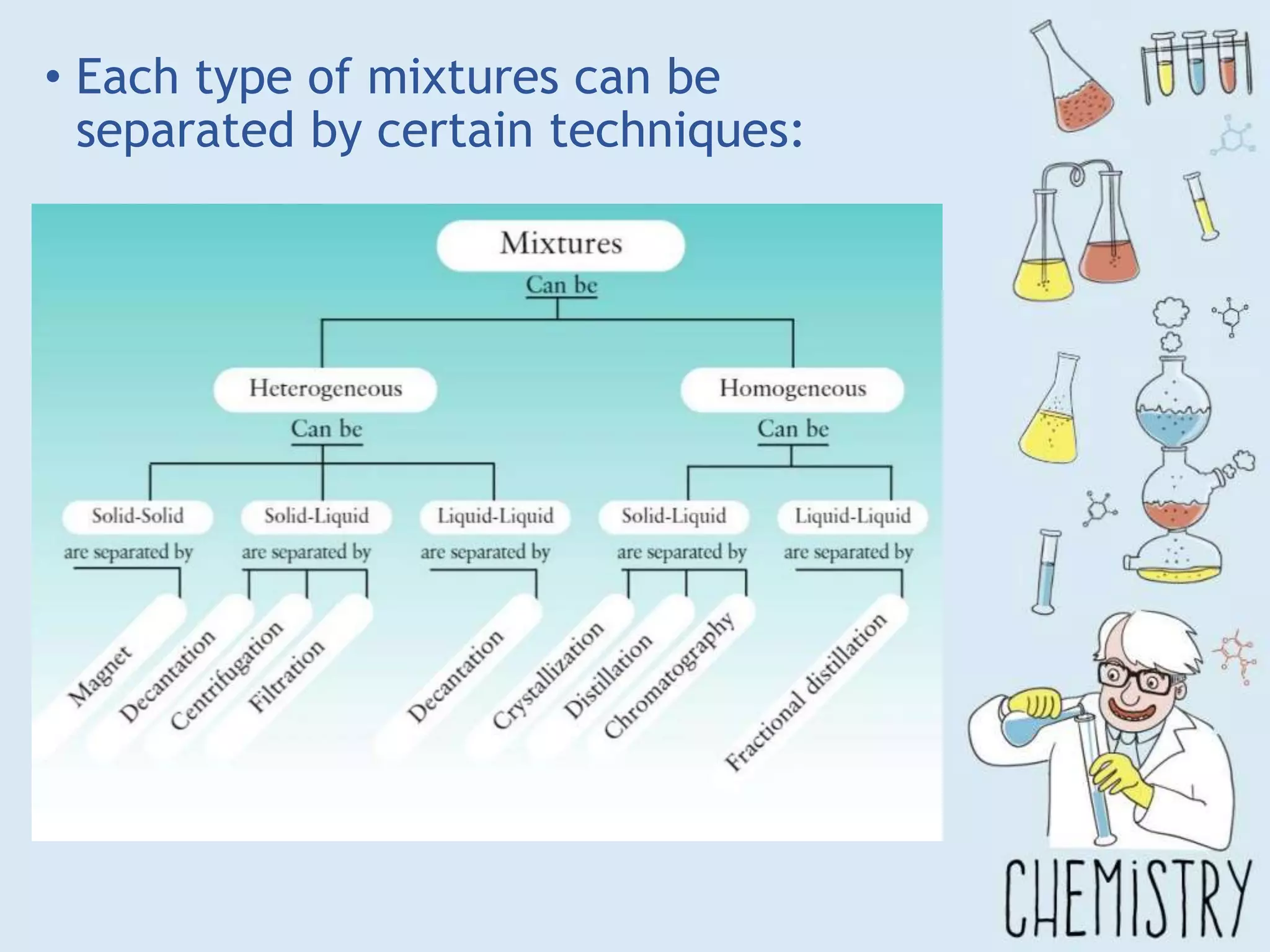
•Mixtures can be separated
into their components by
using physical separation
techniques (methods) such
as decantation, filtration,
distillation, crystallization,
etc…
Examples:
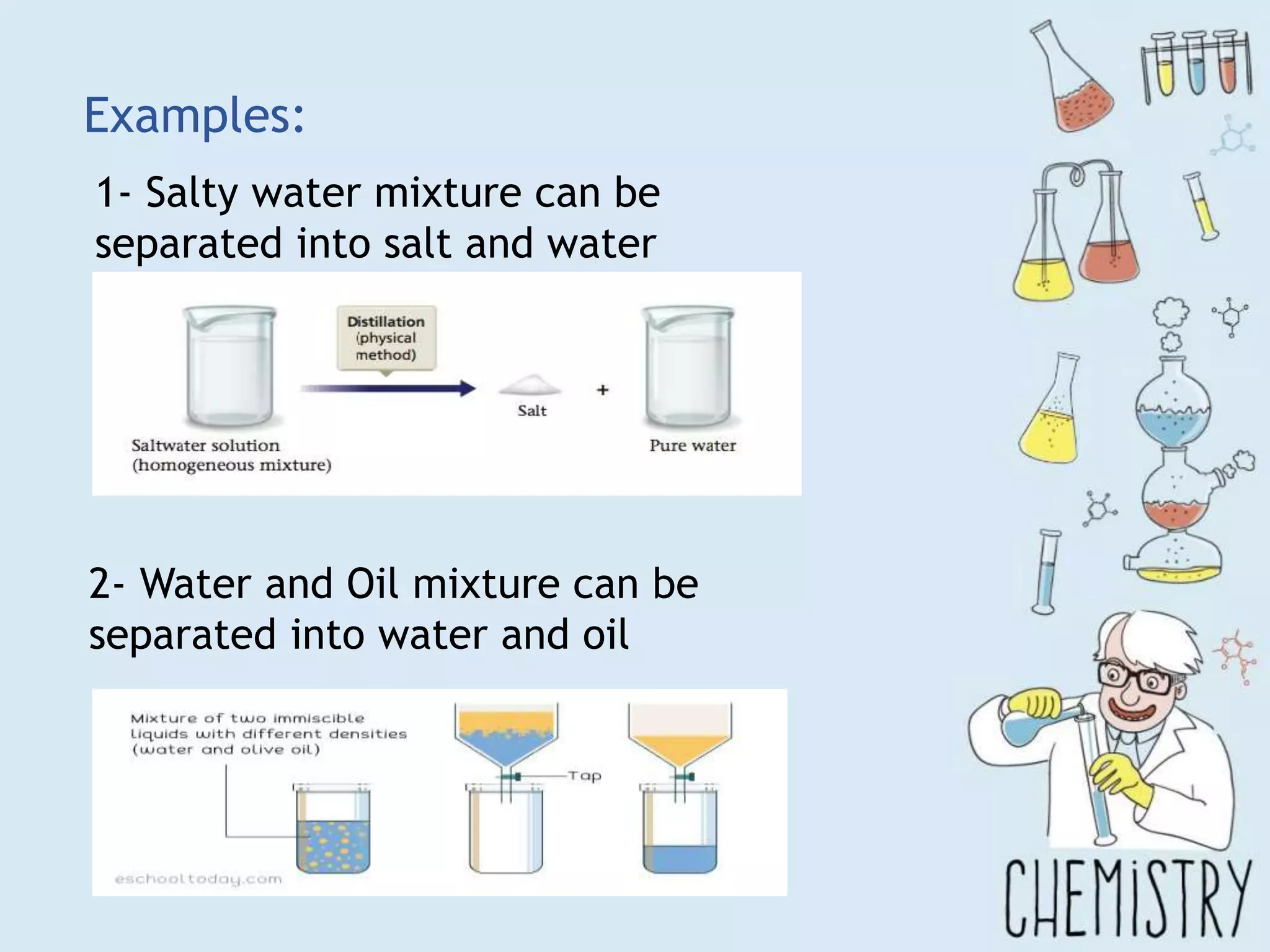
1- Salty water mixture can be
separated into salt and water
2- Water and Oil mixture can be
separated into water and oil
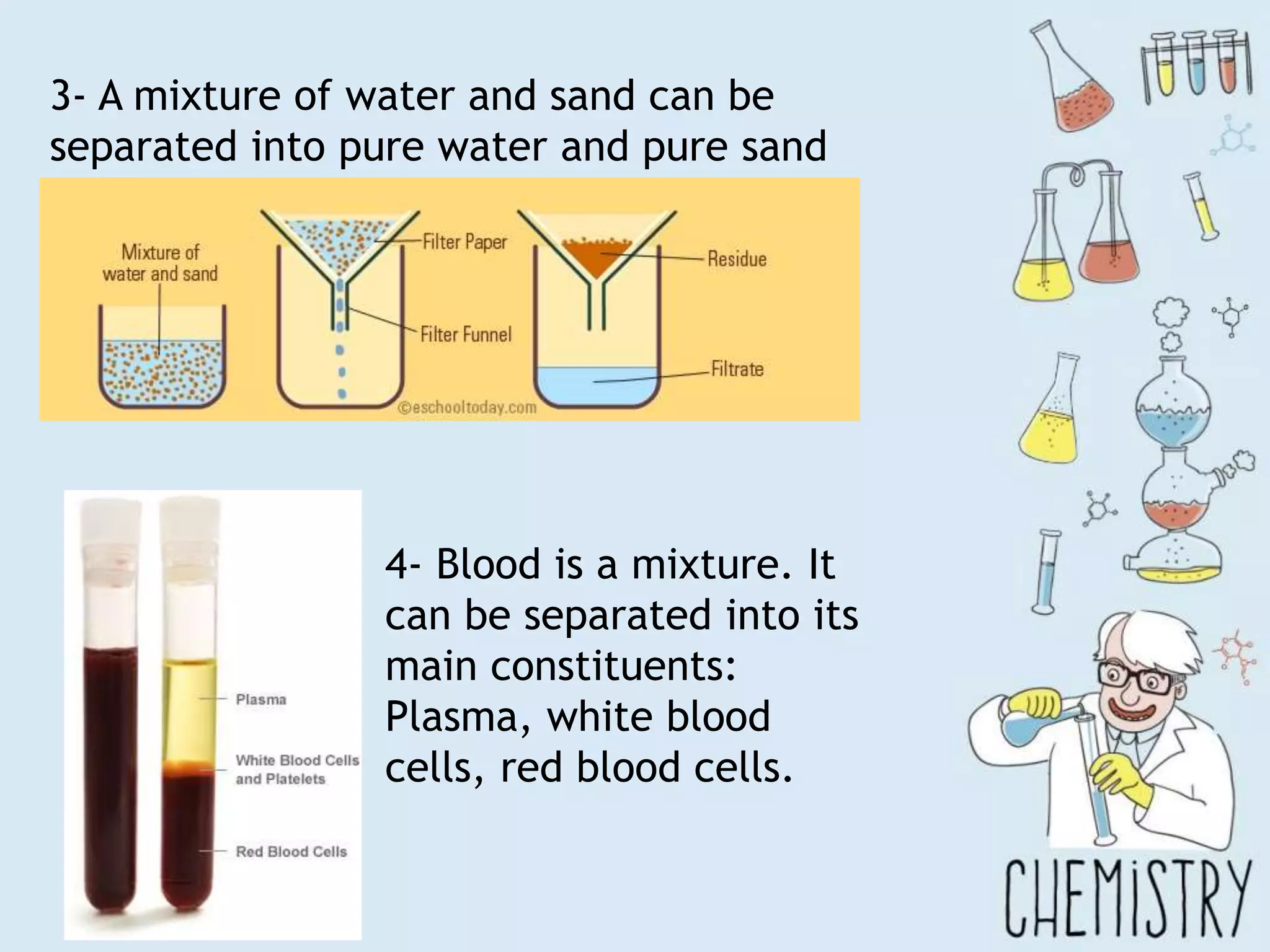
3- A mixture of water and sand can be
separated into pure water and pure sand
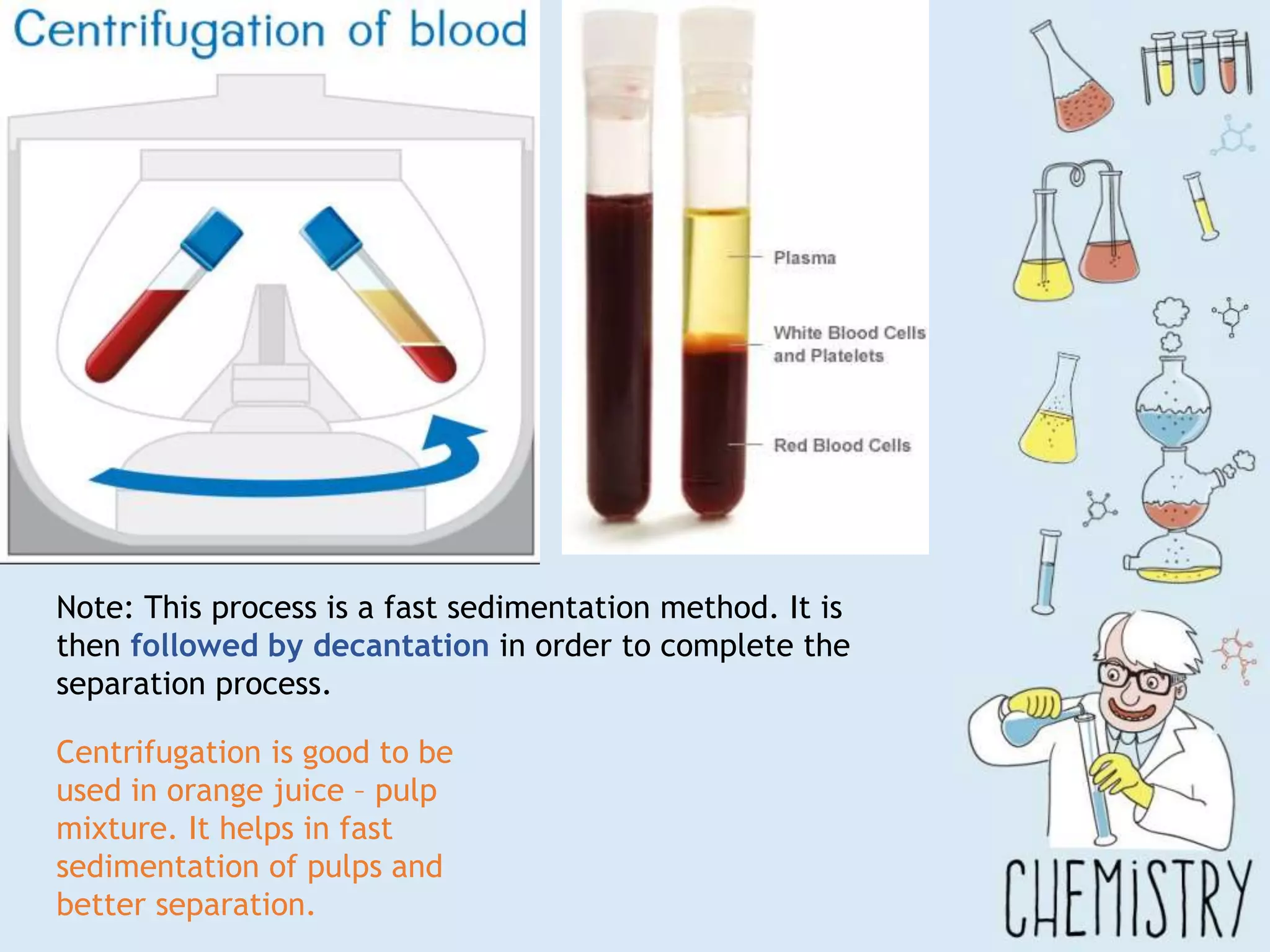
4- Blood is a mixture. It
can be separated into its
main constituents:
Plasma, white blood
cells, red blood cells.
• Each type of mixtures can be
separated by certain techniques:
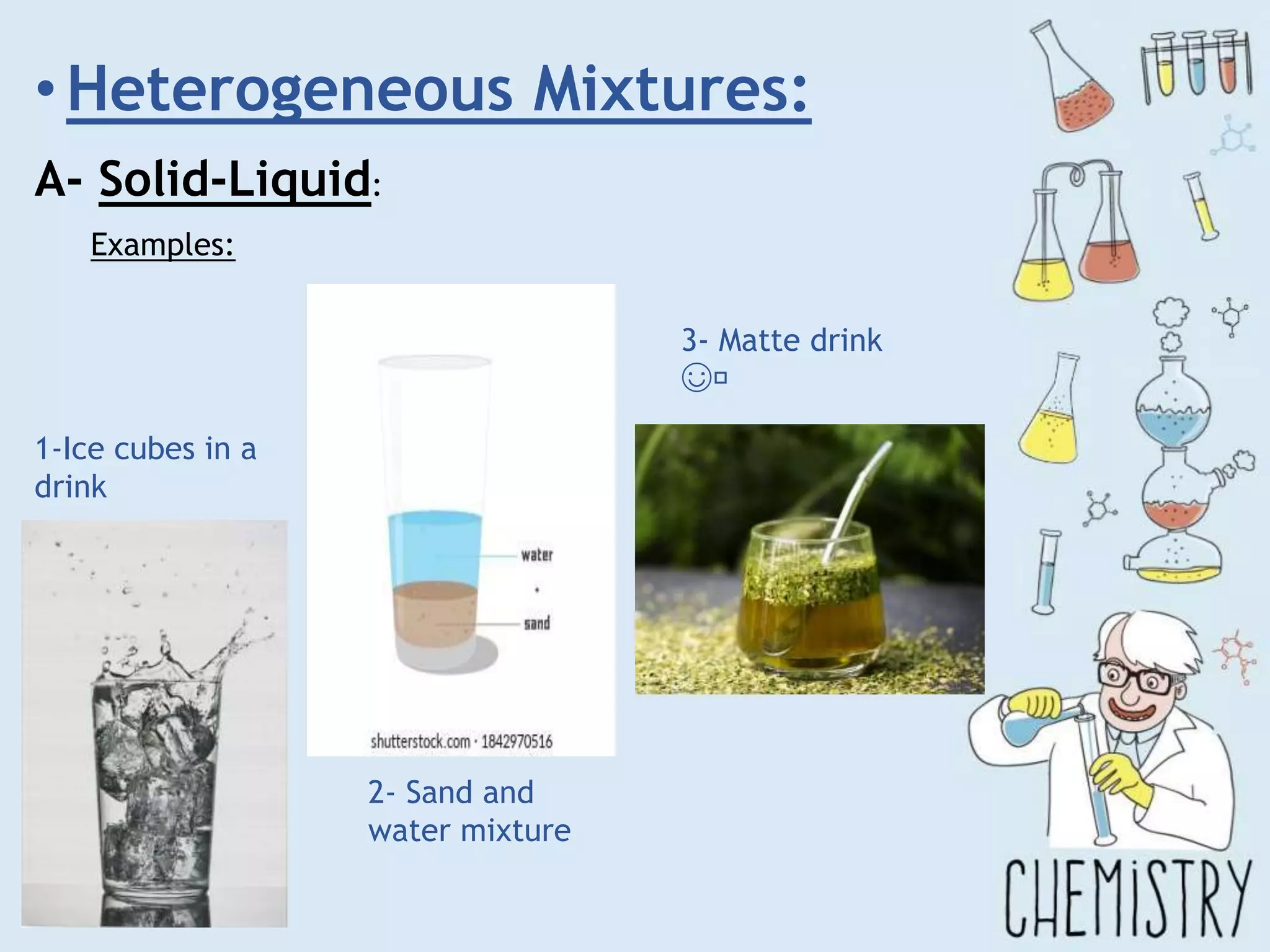
• Heterogeneous Mixtures:
A- Solid-Liquid:
Examples:
1-Ice cubes in a
drink
2- Sand and
water mixture
3- Matte drink
☺️
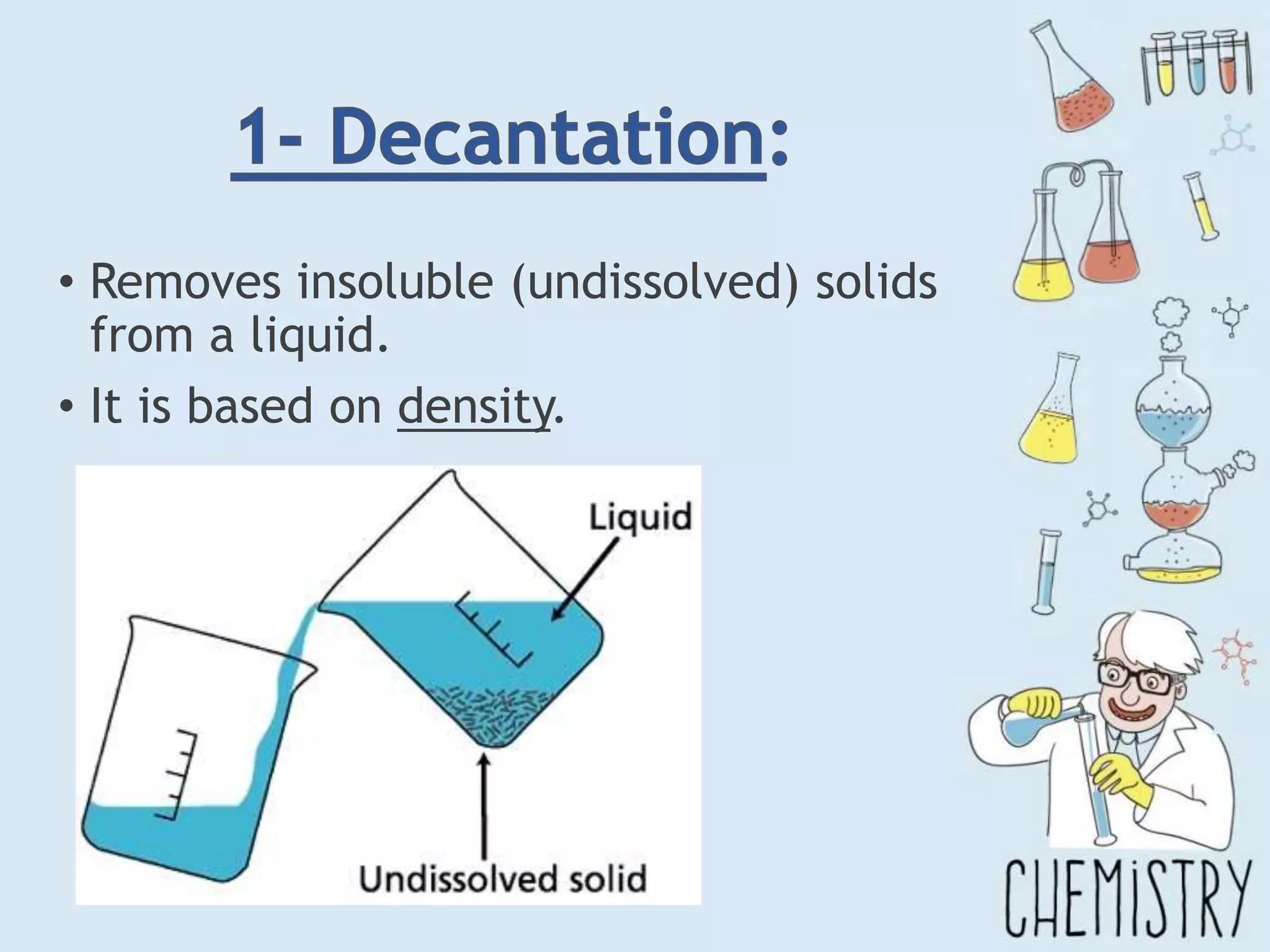
• Removes insoluble (undissolved) solids
from a liquid.
• It is based on density.
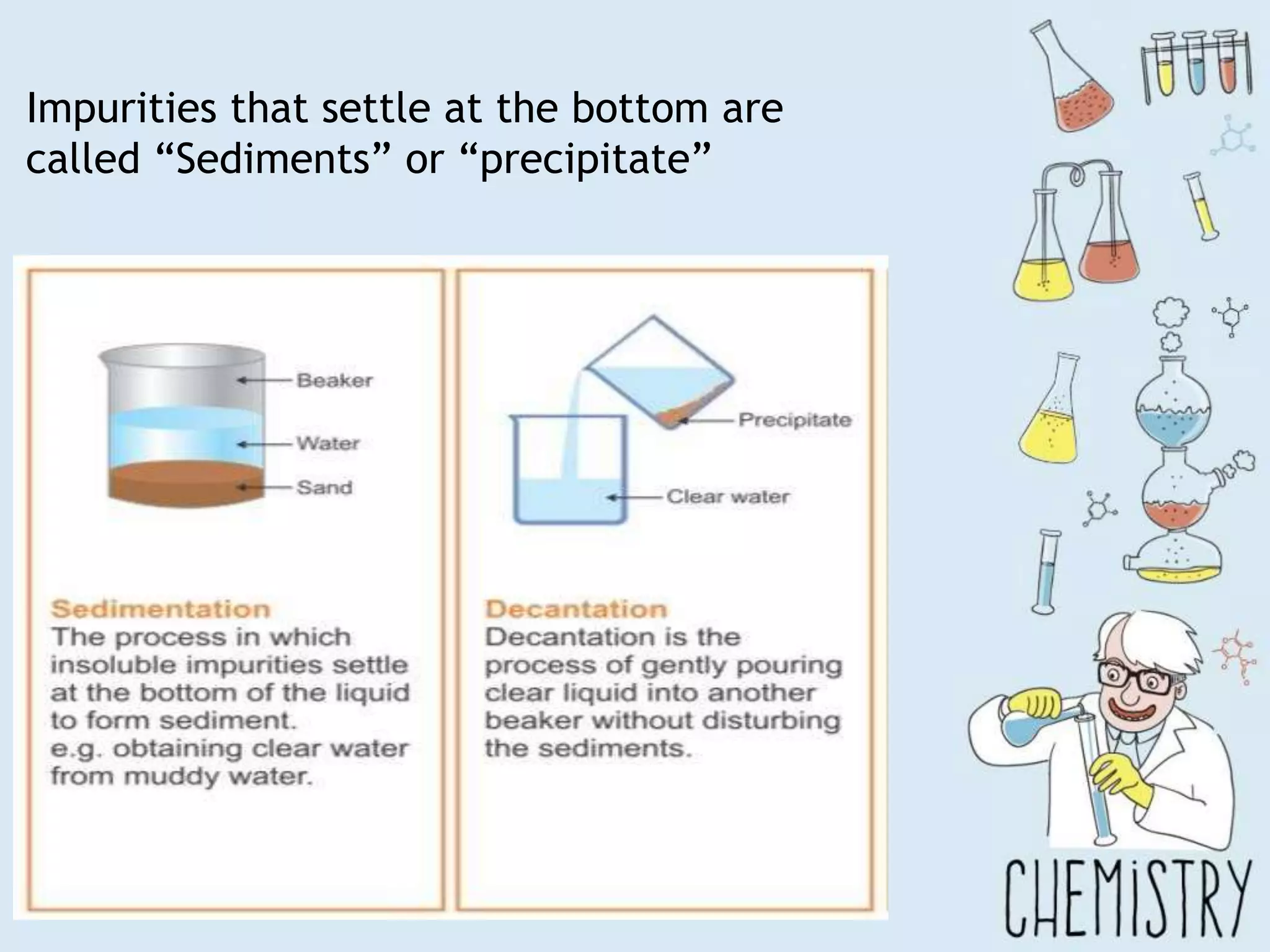
Impurities that settle at the bottom are
called “Sediments” or “precipitate”
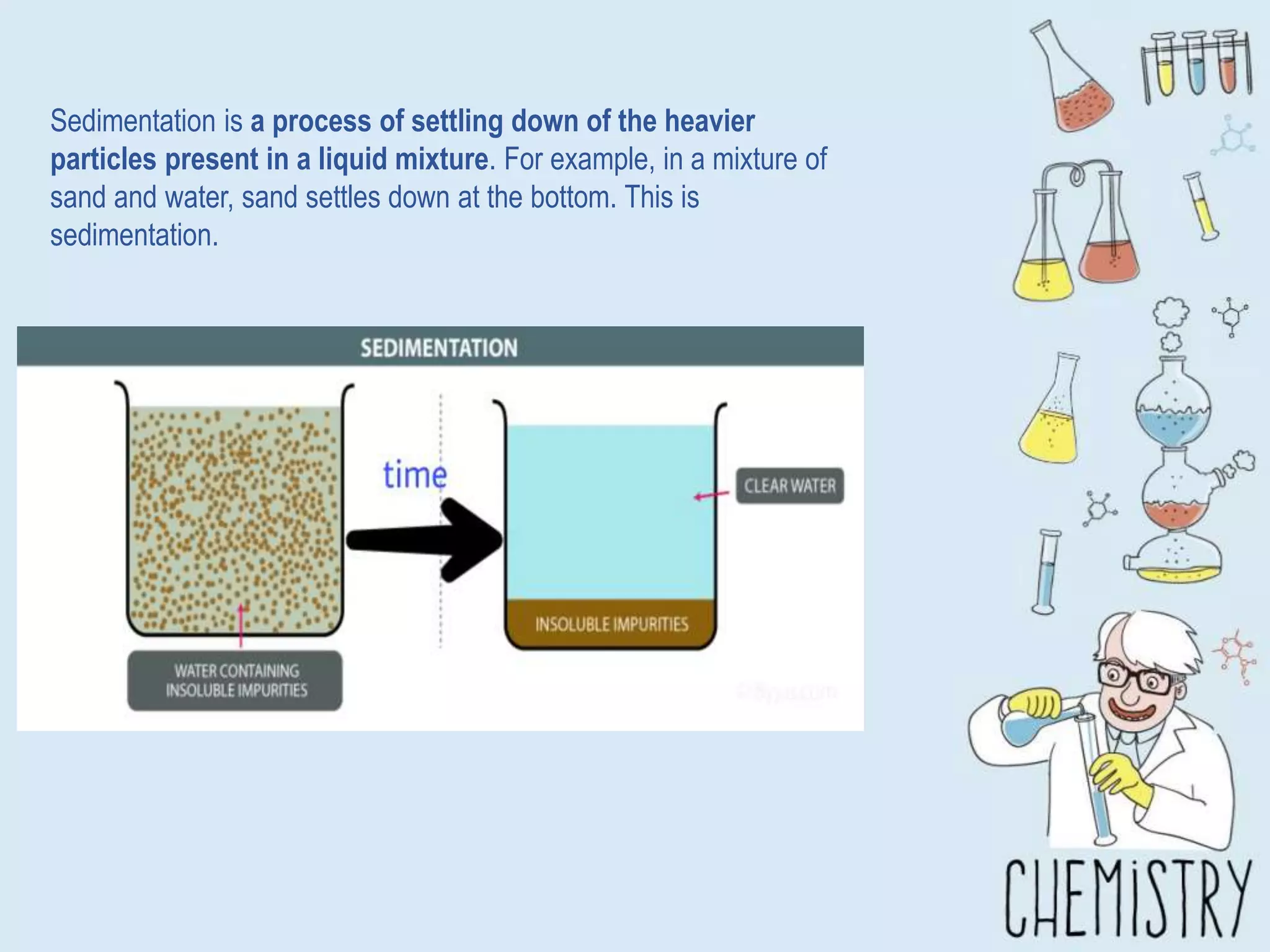
Sedimentation is a process of settling down of the heavier
particles present in a liquid mixture. For example, in a mixture of
sand and water, sand settles down at the bottom. This is
sedimentation.
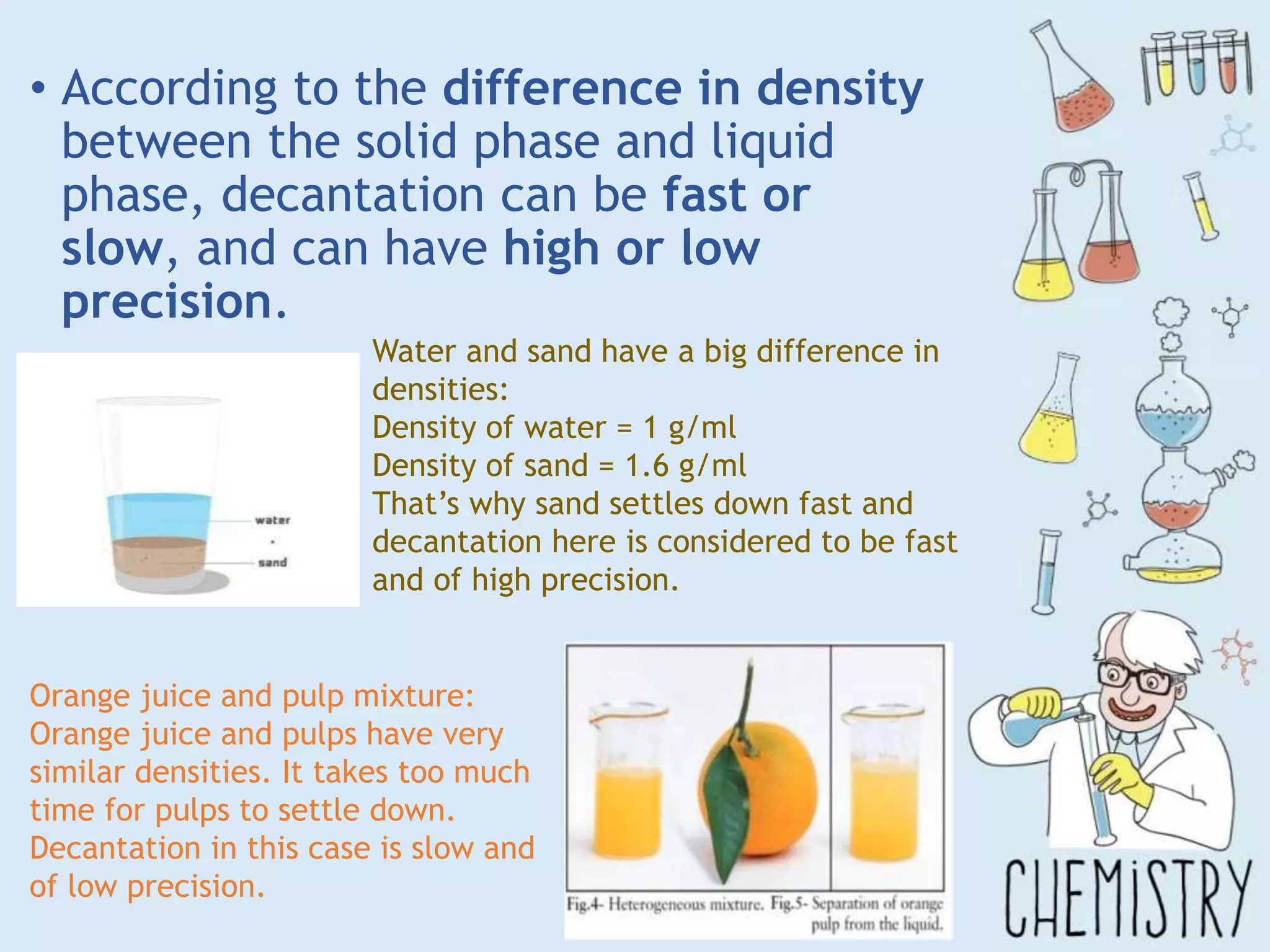
• According to the difference in density
between the solid phase and liquid
phase, decantation can be fast or
slow, and can have high or low
precision.
Water and sand have a big difference in
densities:
Density of water = 1 g/ml
Density of sand = 1.6 g/ml
That’s why sand settles down fast and
decantation here is considered to be fast
and of high precision.
Orange juice and pulp mixture:
Orange juice and pulps have very
similar densities. It takes too much
time for pulps to settle down.
Decantation in this case is slow and
of low precision.
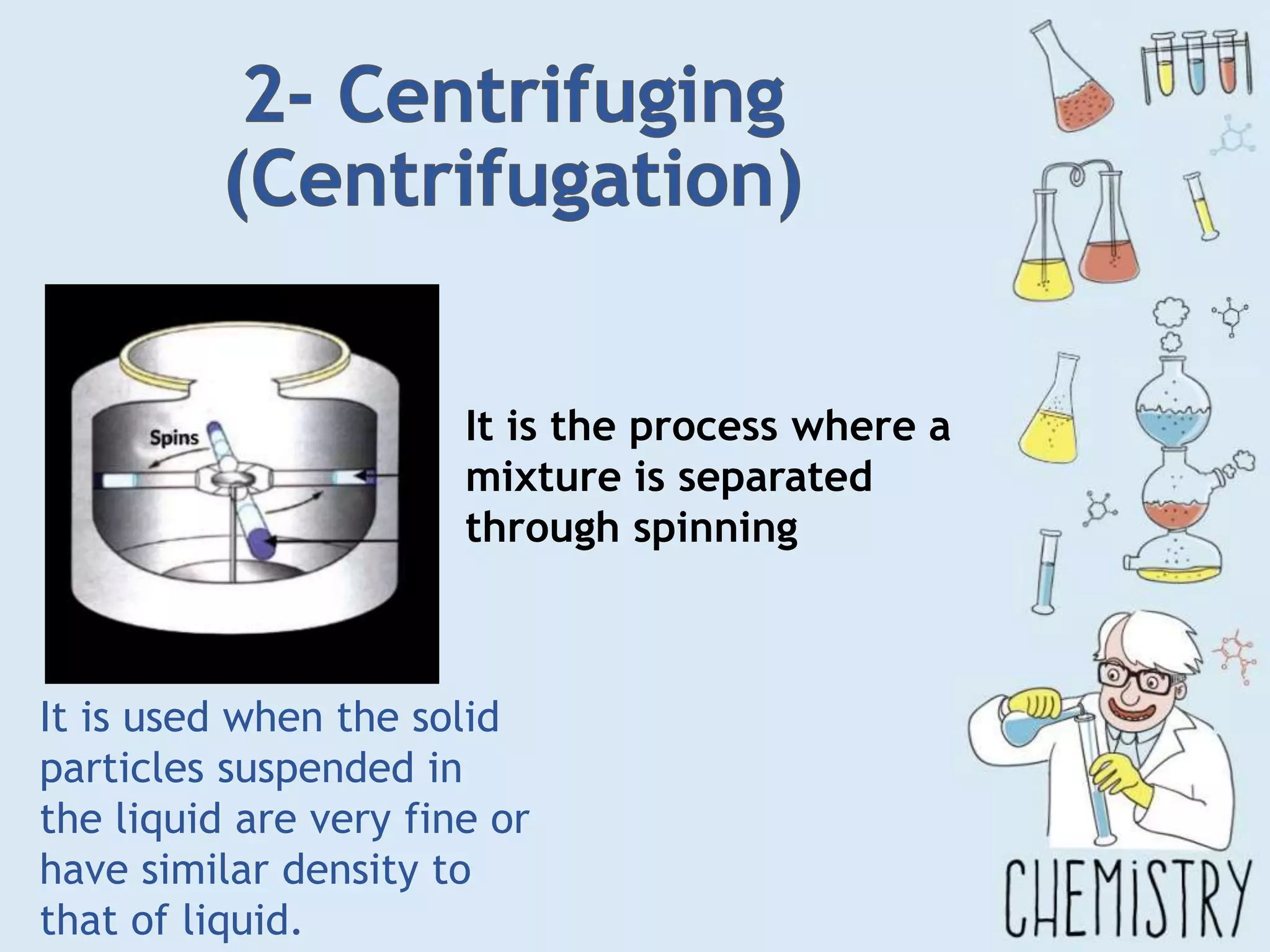
It is the process where a
mixture is separated
through spinning
It is used when the solid
particles suspended in
the liquid are very fine or
have similar density to
that of liquid.
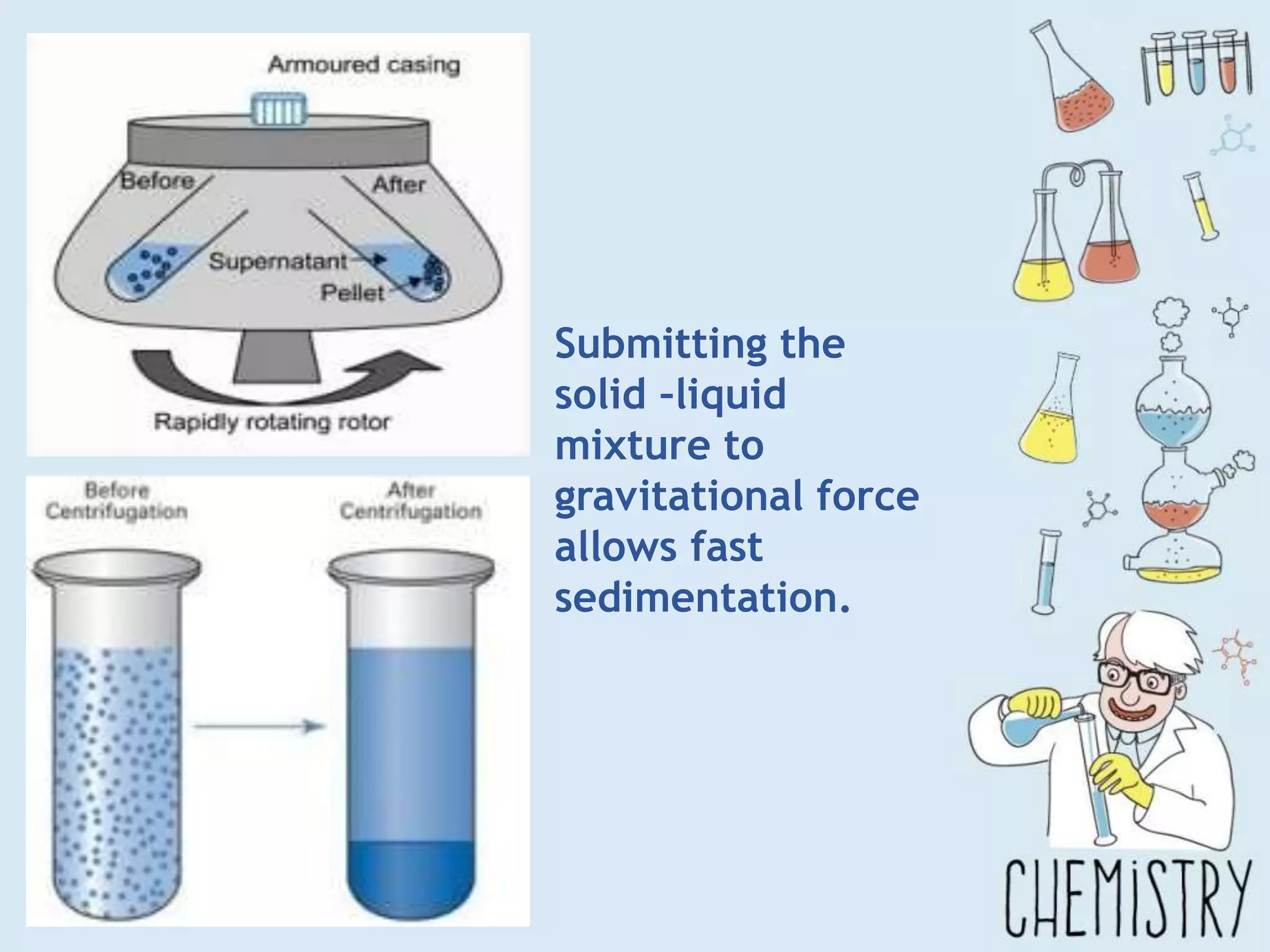
Submitting the
solid –liquid
mixture to
gravitational force
allows fast
sedimentation.
Note: This process is a fast sedimentation method. It is
then followed by decantation in order to complete the
separation process.
Centrifugation is good to be
used in orange juice – pulp
mixture. It helps in fast
sedimentation of pulps and
better separation.
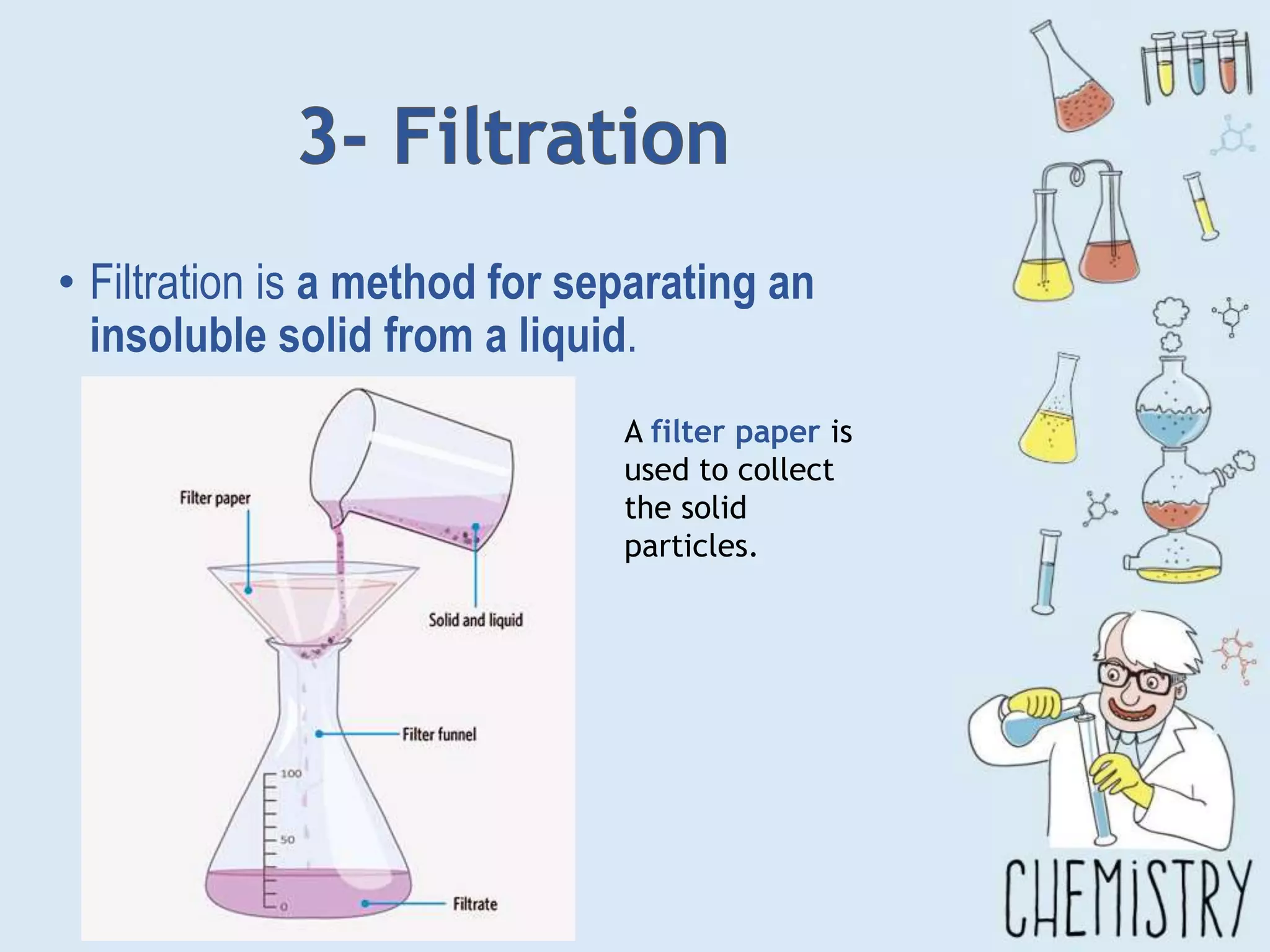
• Filtration is a method for separating an
insoluble solid from a liquid.
A filter paper is
used to collect
the solid
particles.
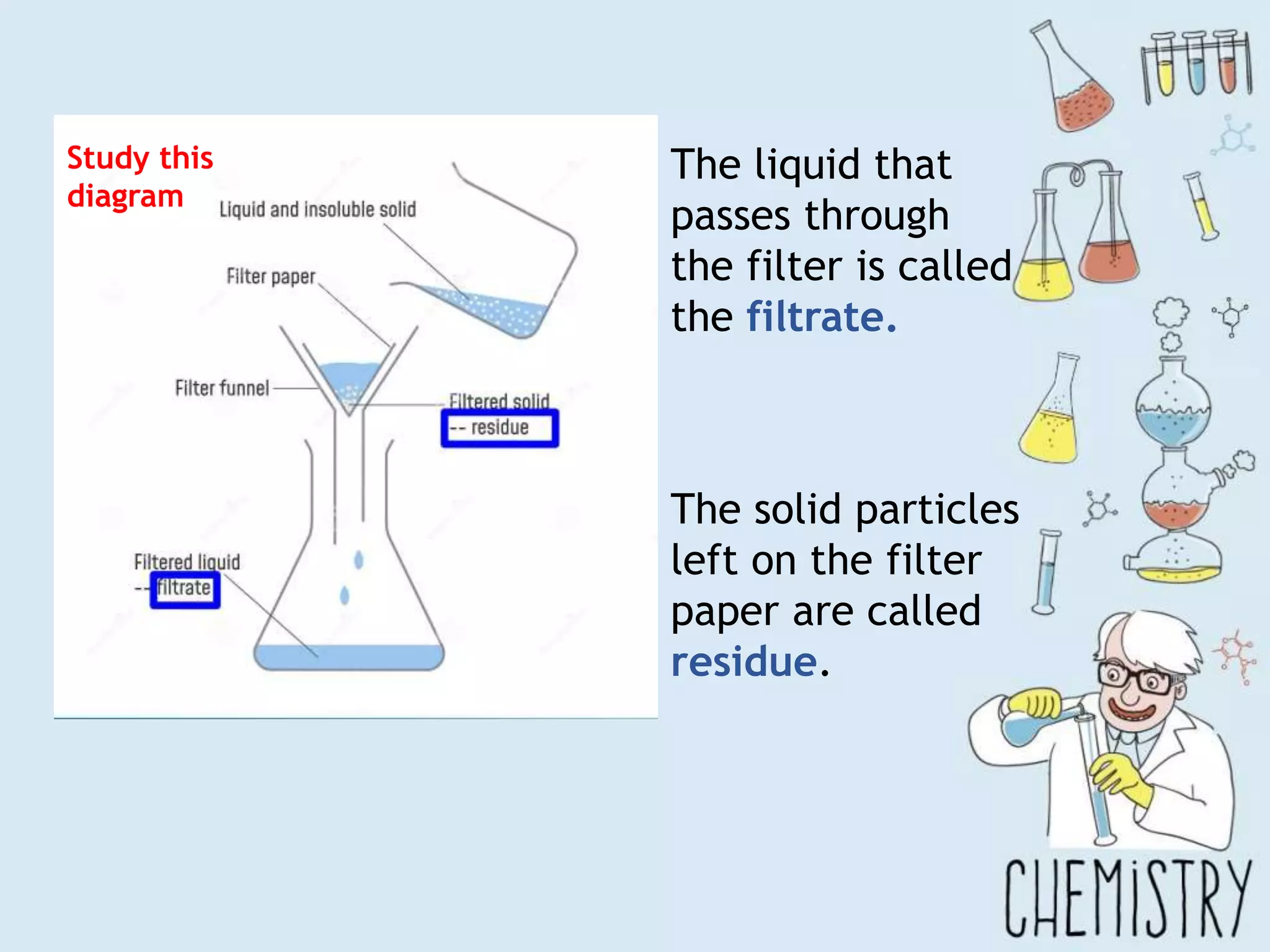
The liquid that
passes through
the filter is called
the filtrate.
The solid particles
left on the filter
paper are called
residue.
Study this
diagram
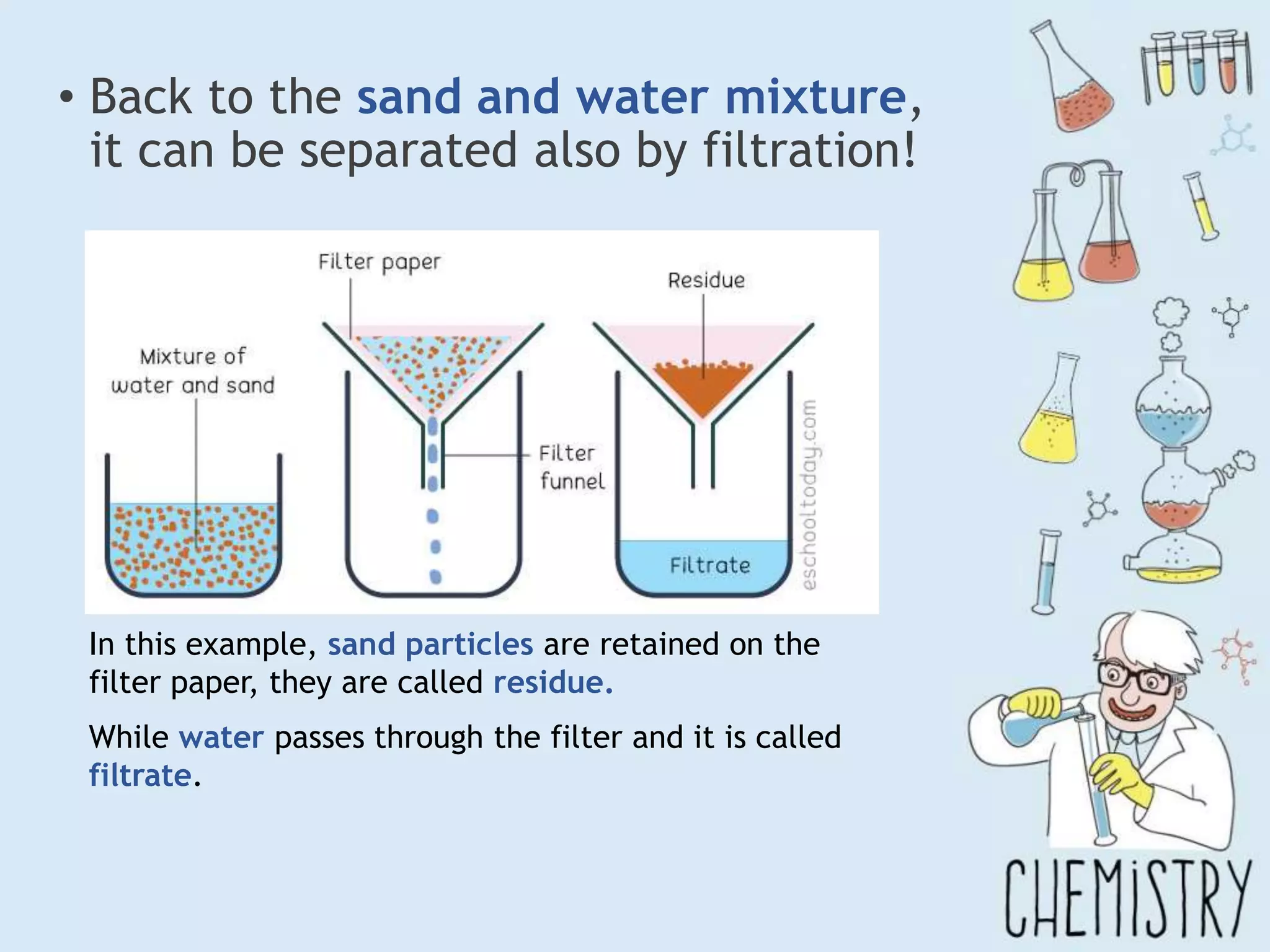
• Back to the sand and water mixture,
it can be separated also by filtration!
In this example, sand particles are retained on the
filter paper, they are called residue.
While water passes through the filter and it is called
filtrate.
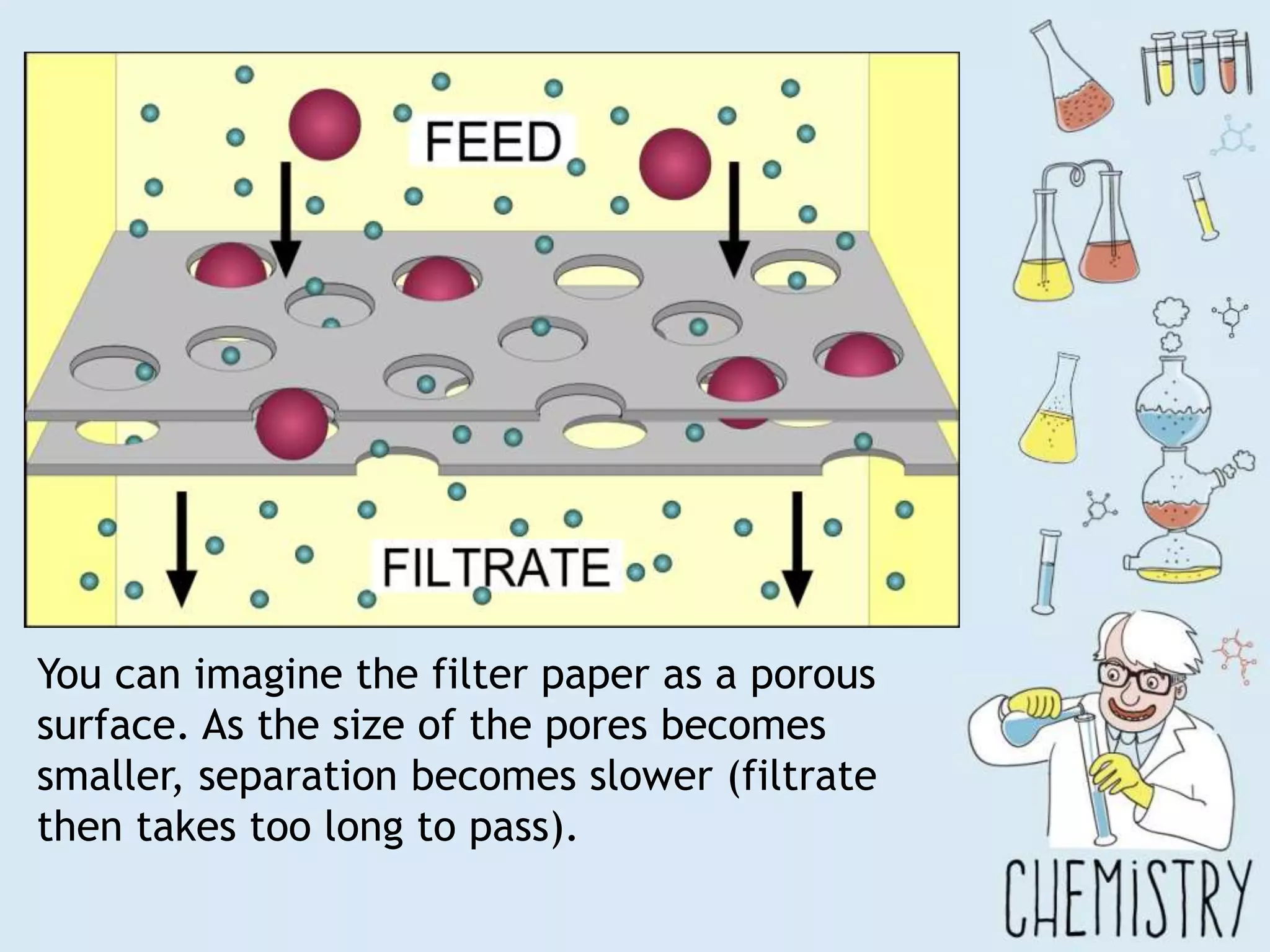
You can imagine the filter paper as a porous
surface. As the size of the pores becomes
smaller, separation becomes slower (filtrate
then takes too long to pass).
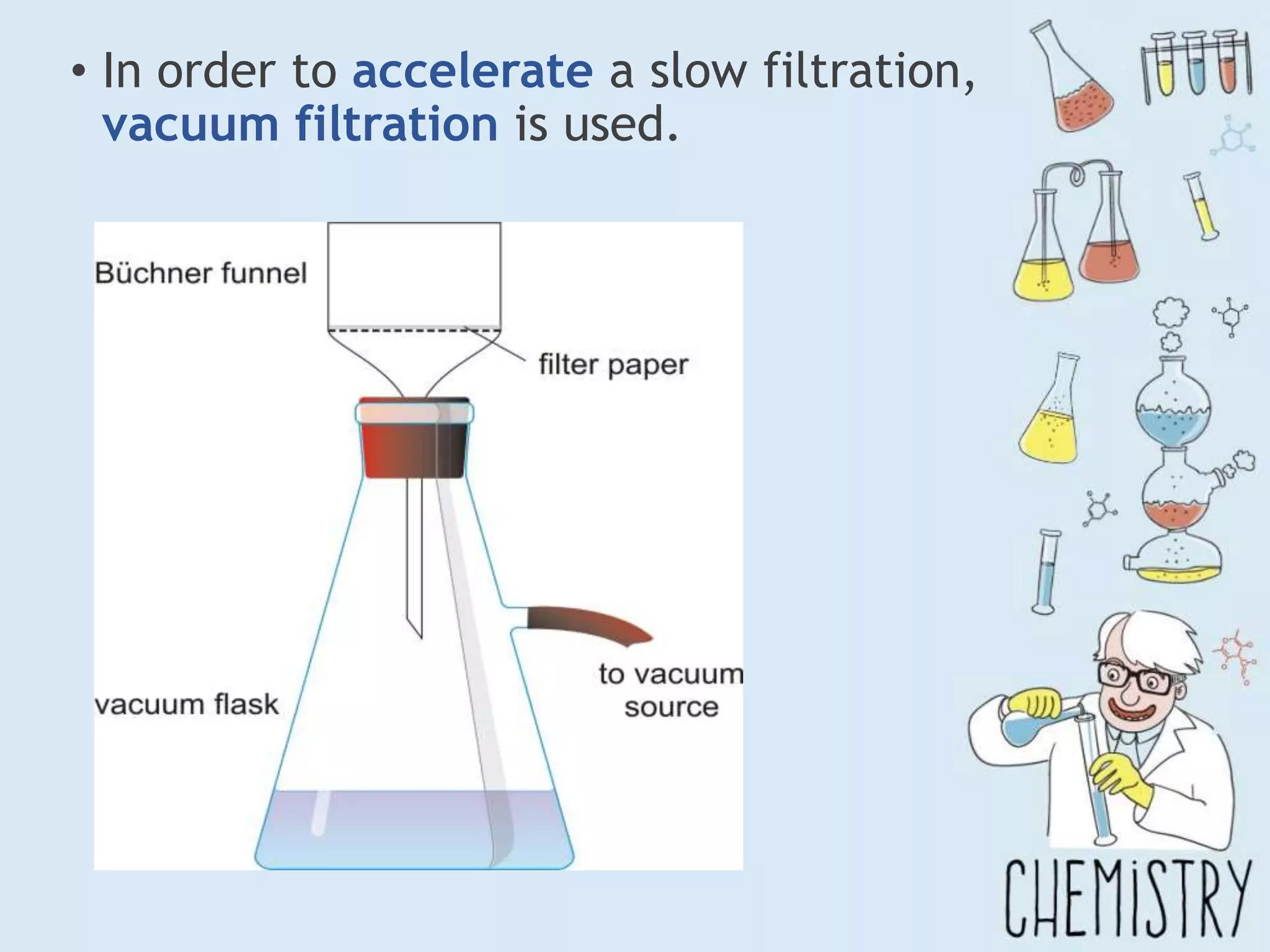
• In order to accelerate a slow filtration,
vacuum filtration is used.
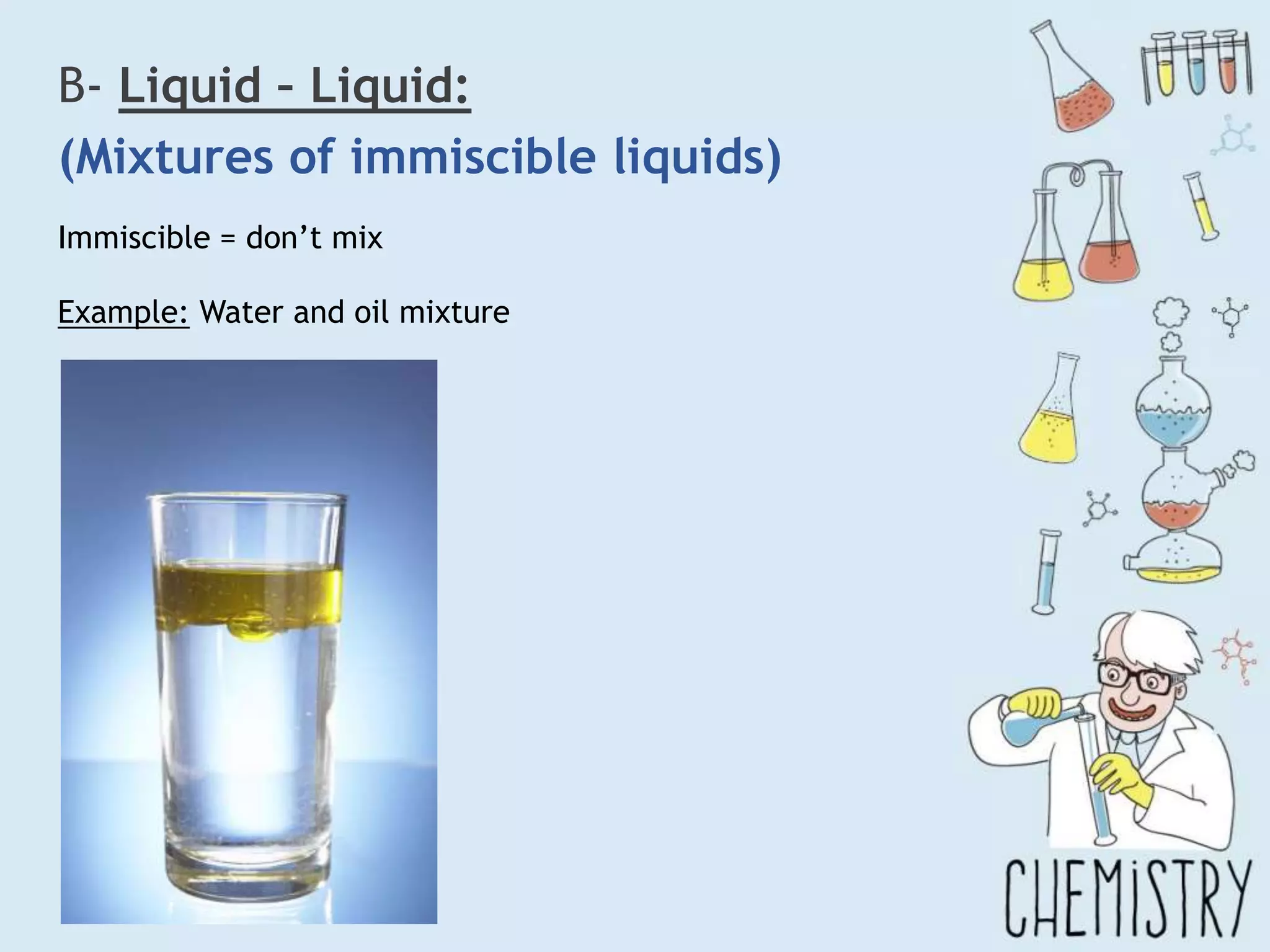
B- Liquid – Liquid:
(Mixtures of immiscible liquids)
Immiscible = don’t mix
Example: Water and oil mixture
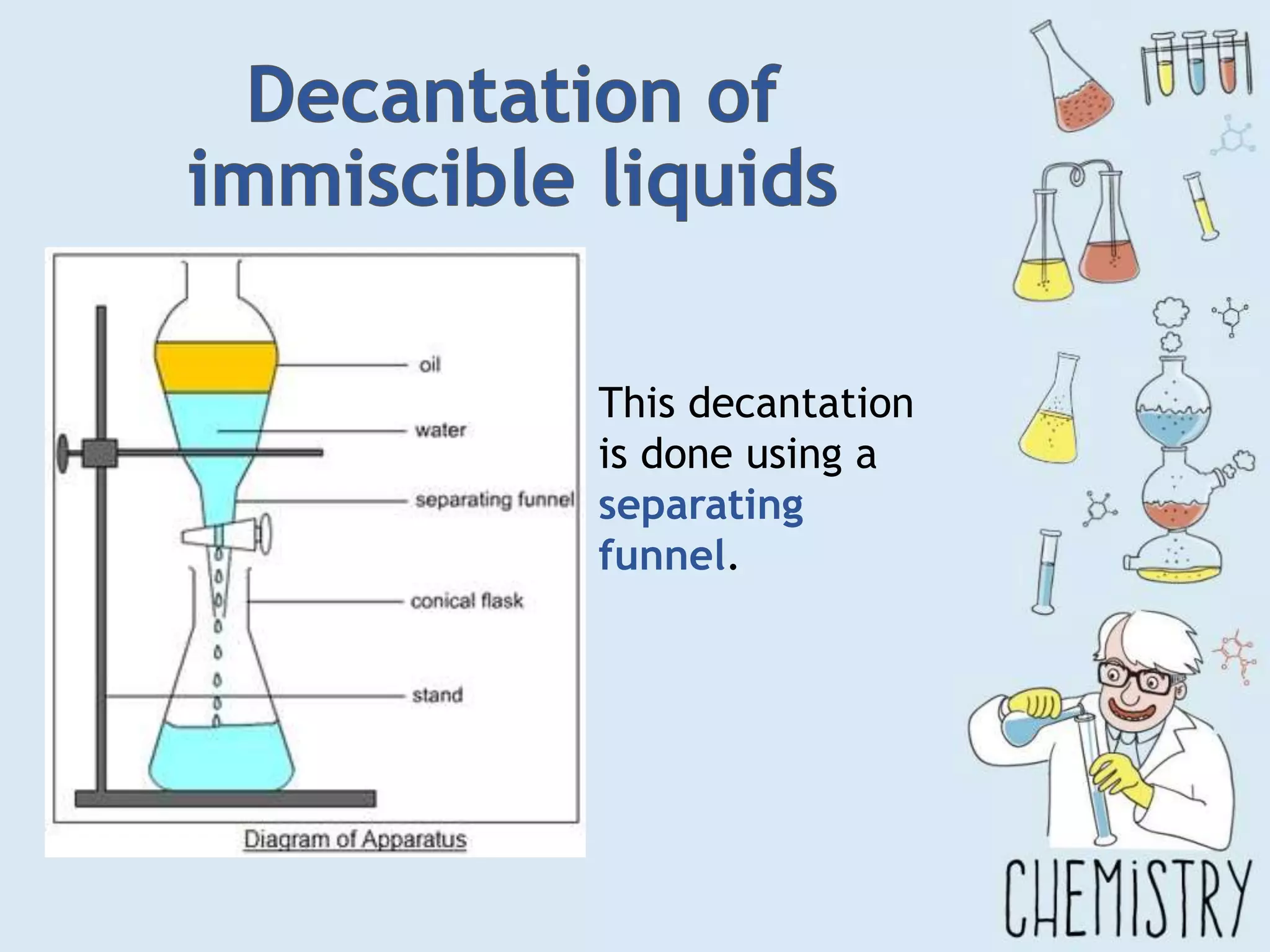
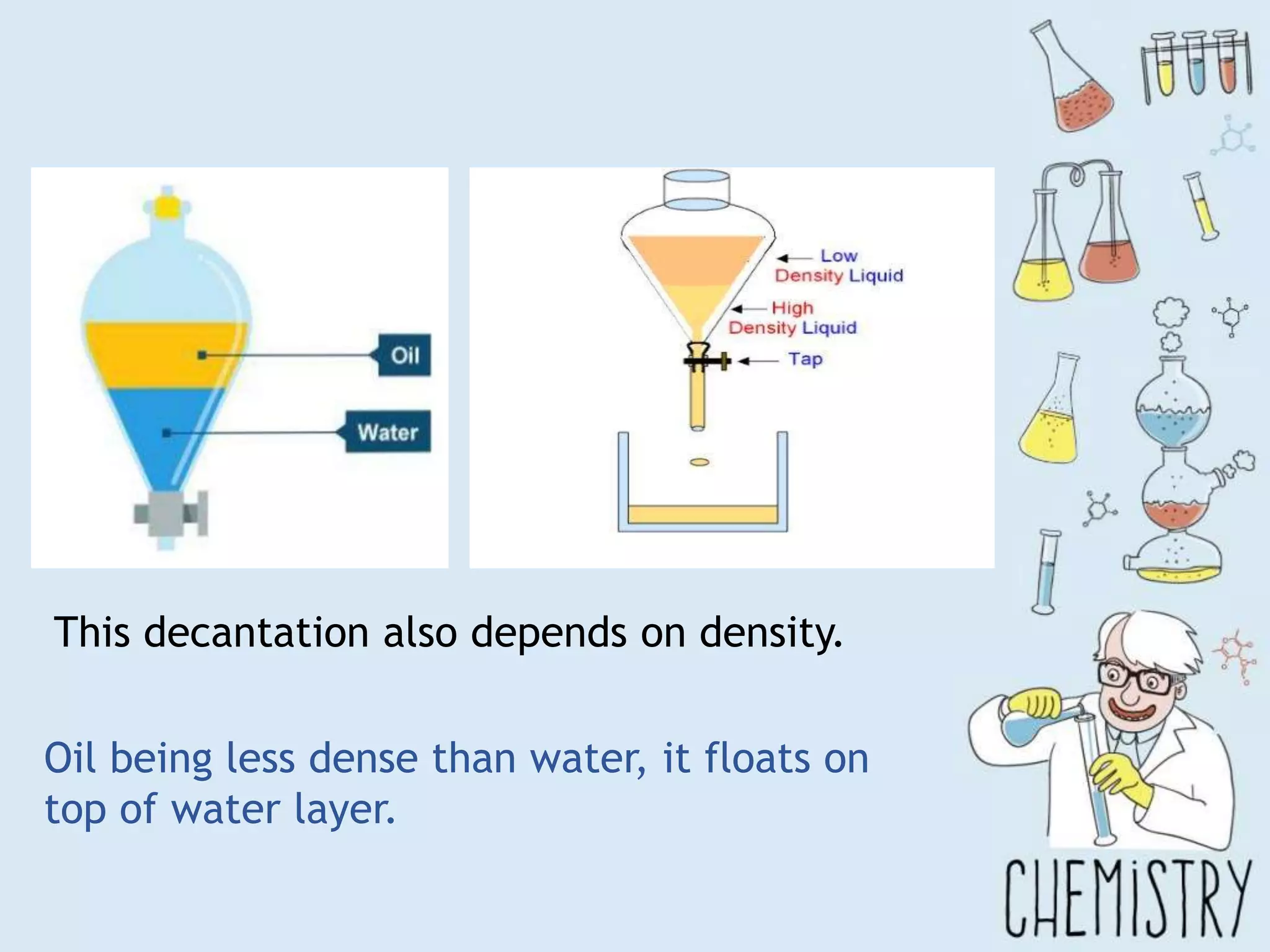
This decantation
is done using a
separating
funnel.
This decantation also depends on density.
Oil being less dense than water, it floats on
top of water layer.
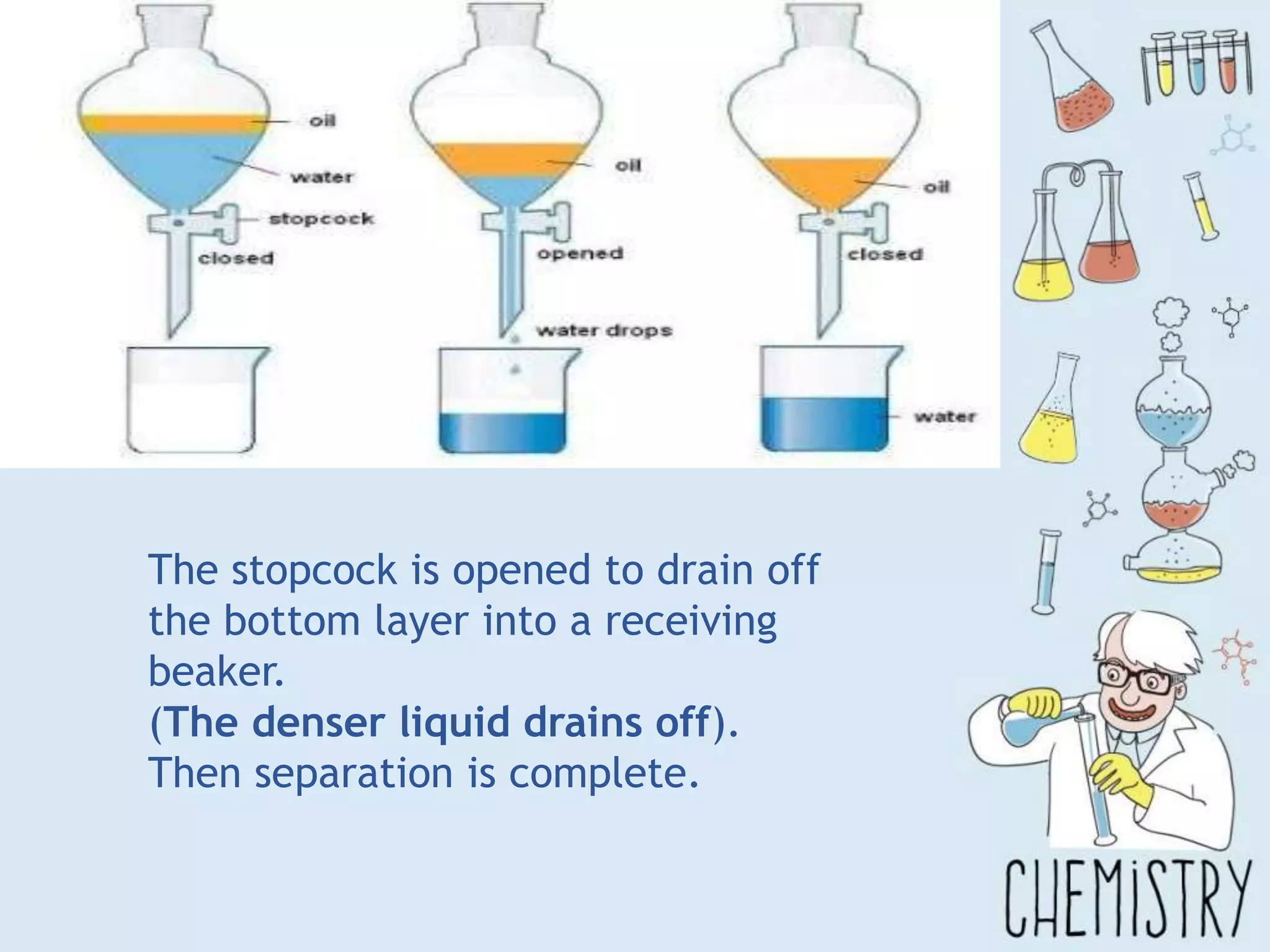
The stopcock is opened to drain off
the bottom layer into a receiving
beaker.
(The denser liquid drains off).
Then separation is complete.
C- Solid-Solid:
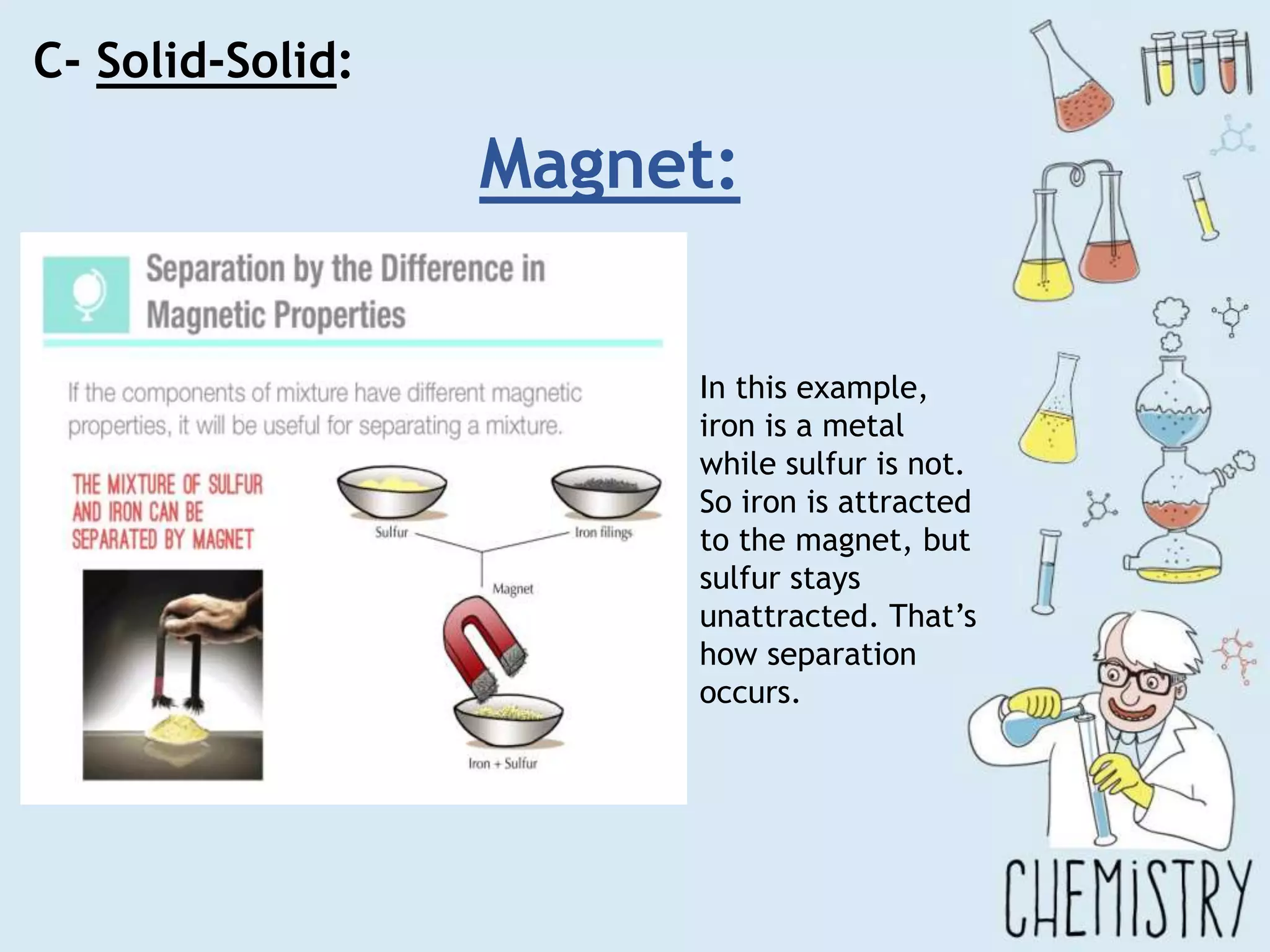
Magnet:
In this example,
iron is a metal
while sulfur is not.
So iron is attracted
to the magnet, but
sulfur stays
unattracted. That’s
how separation
occurs.
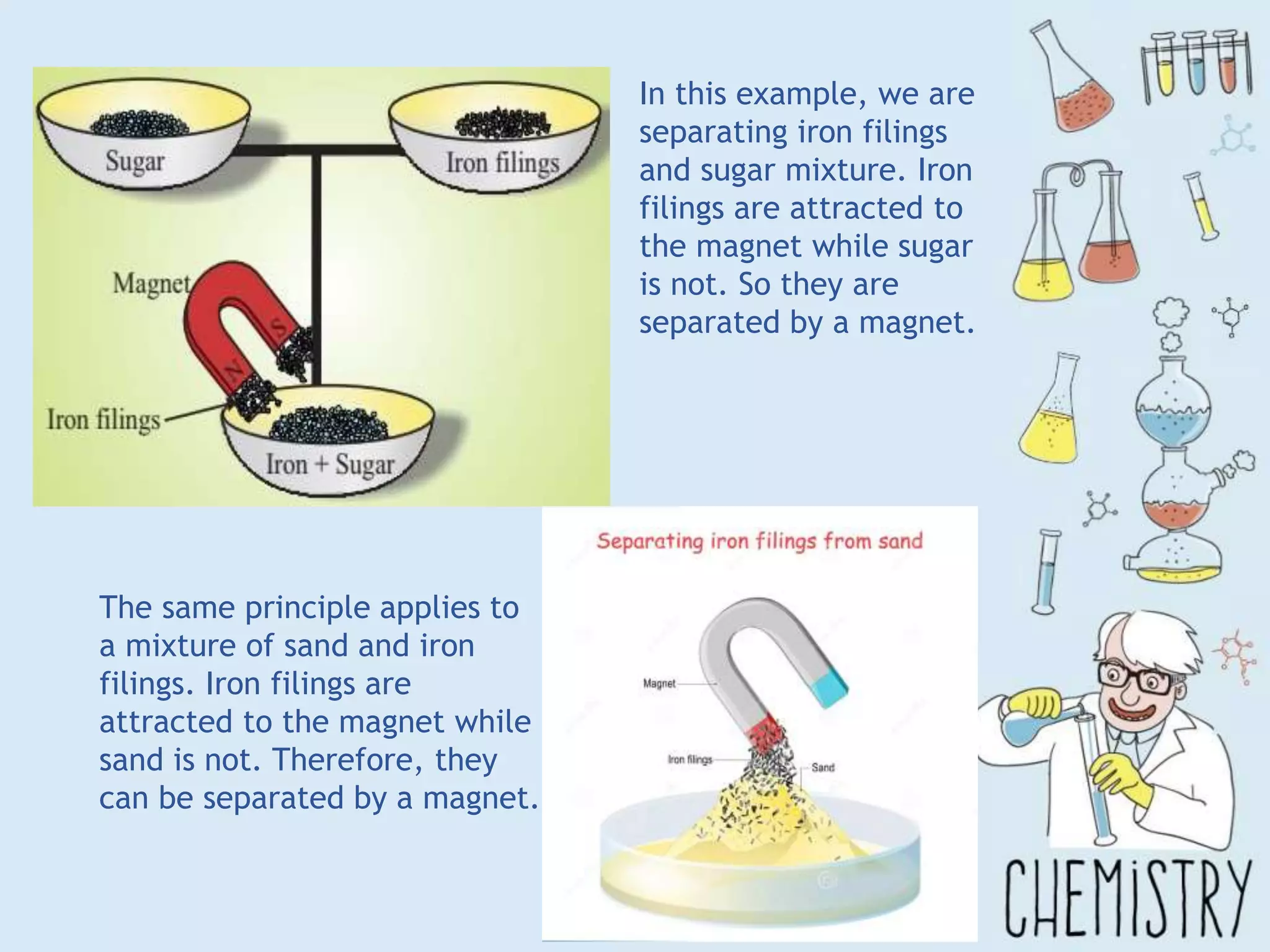
In this example, we are
separating iron filings
and sugar mixture. Iron
filings are attracted to
the magnet while sugar
is not. So they are
separated by a magnet.
The same principle applies to
a mixture of sand and iron
filings. Iron filings are
attracted to the magnet while
sand is not. Therefore, they
can be separated by a magnet.
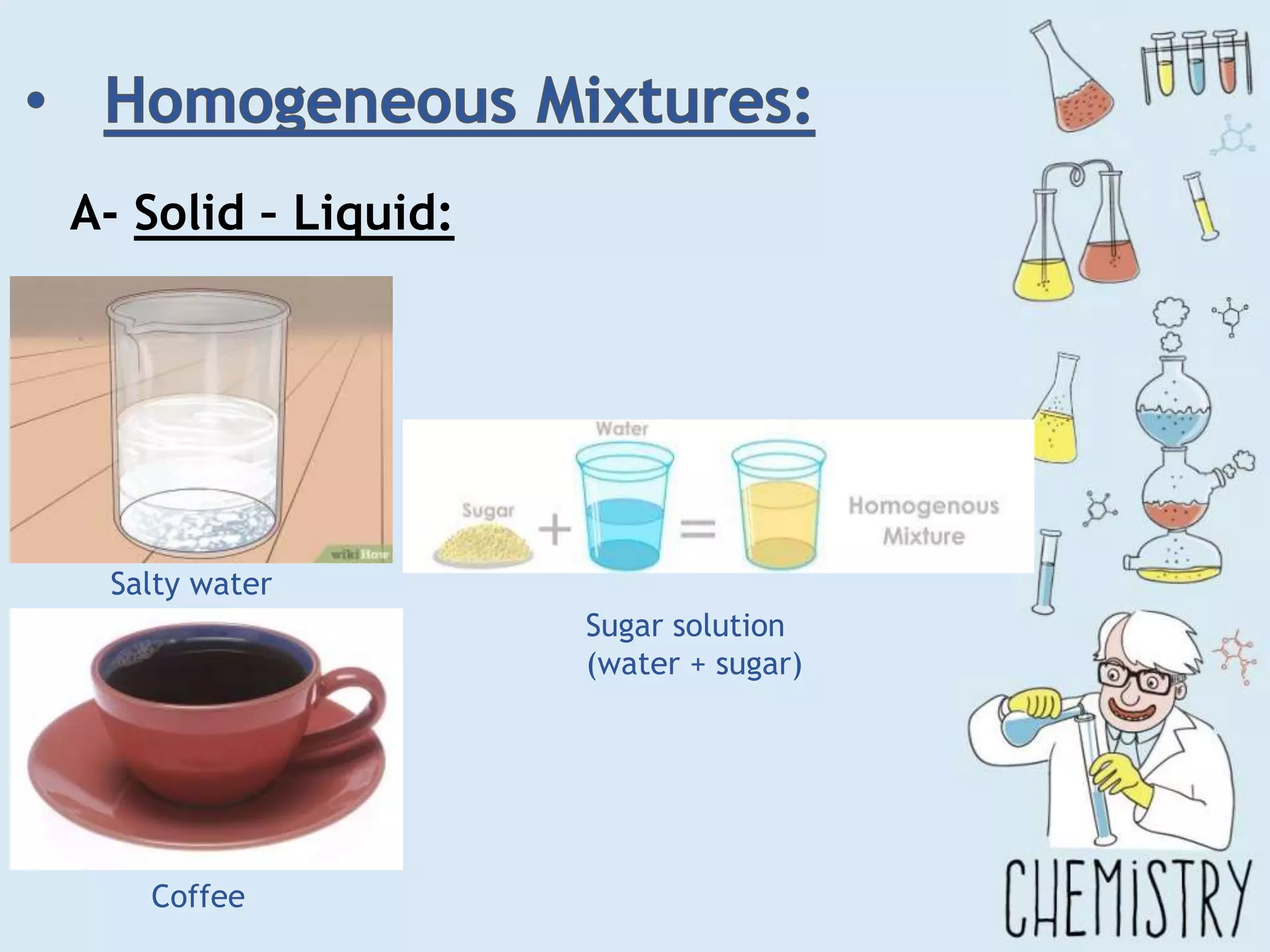
A- Solid – Liquid:
Salty water
Coffee
Sugar solution
(water + sugar)
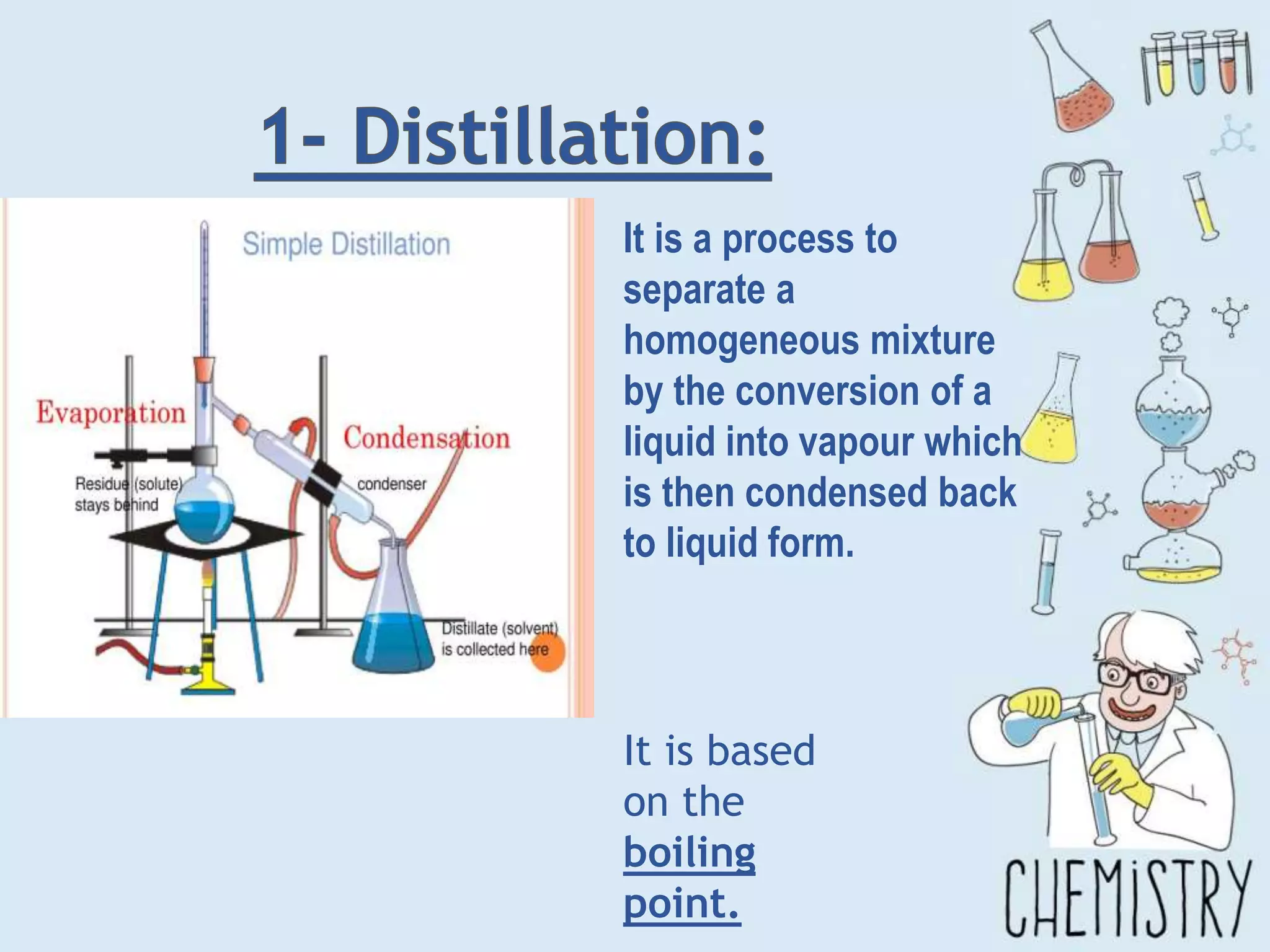
It is a process to
separate a
homogeneous mixture
by the conversion of a
liquid into vapour which
is then condensed back
to liquid form.
It is based
on the
boiling
point.
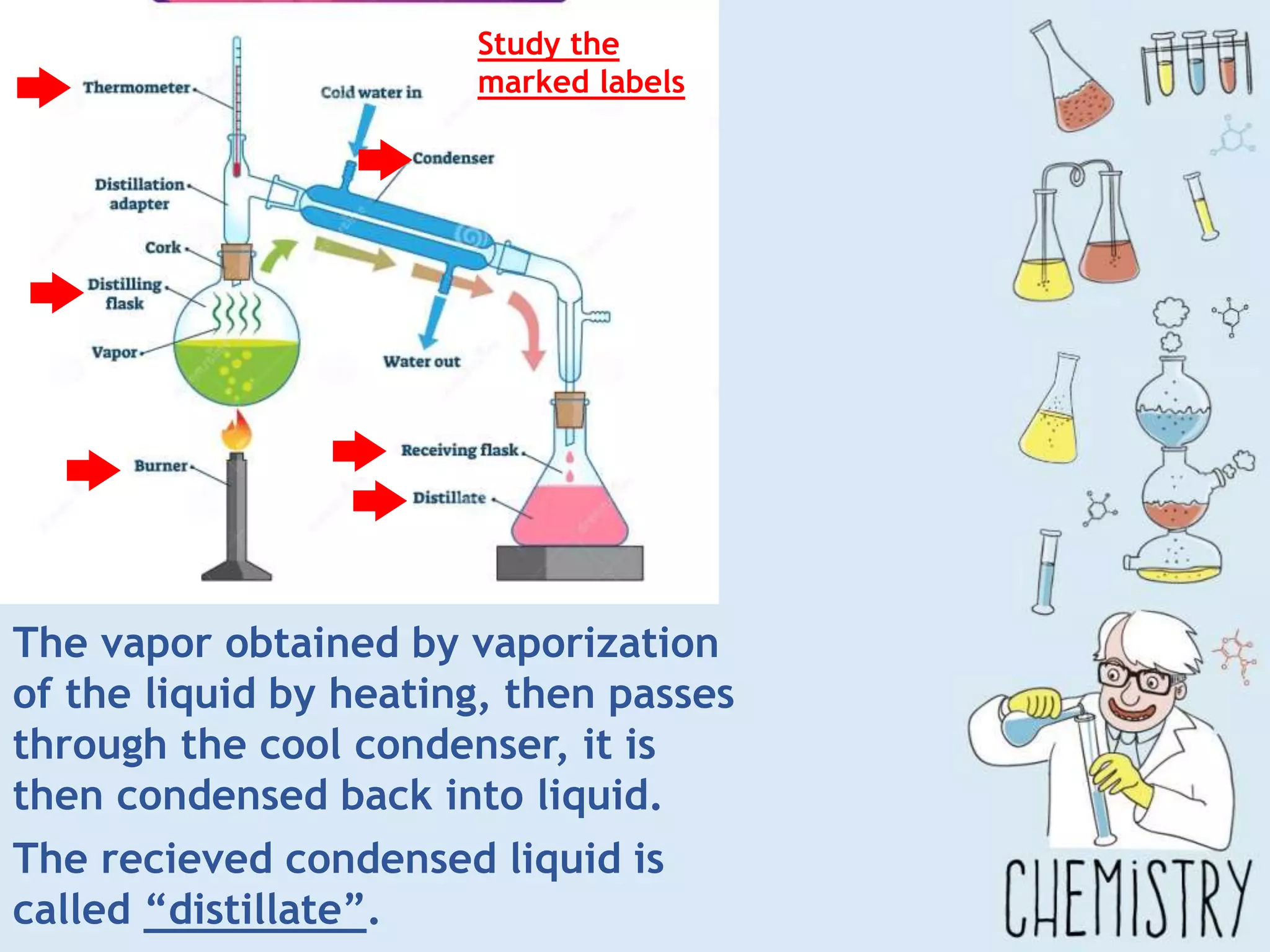
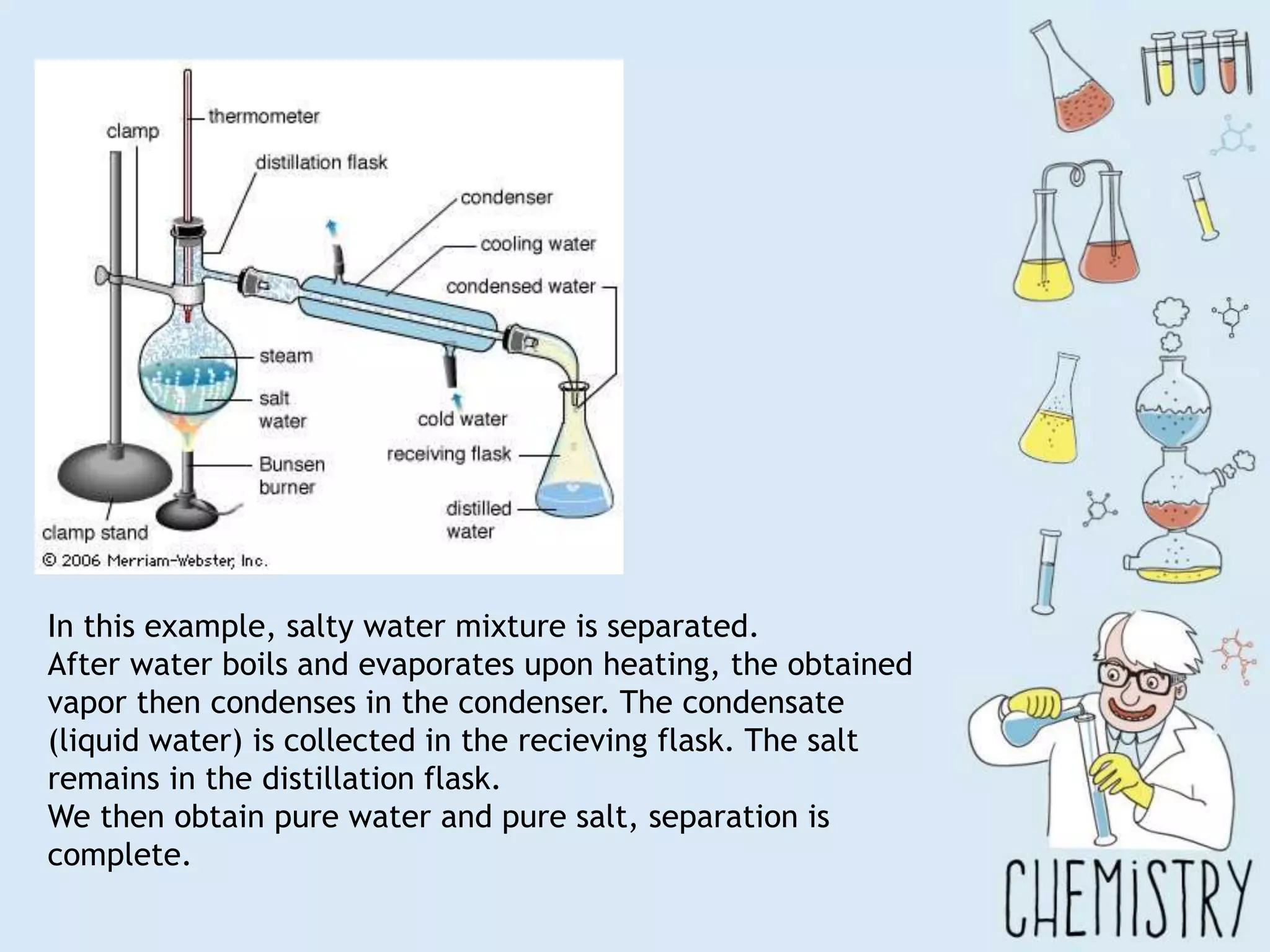
Study the
marked labels
The vapor obtained by vaporization
of the liquid by heating, then passes
through the cool condenser, it is
then condensed back into liquid.
The recieved condensed liquid is
called “distillate”.
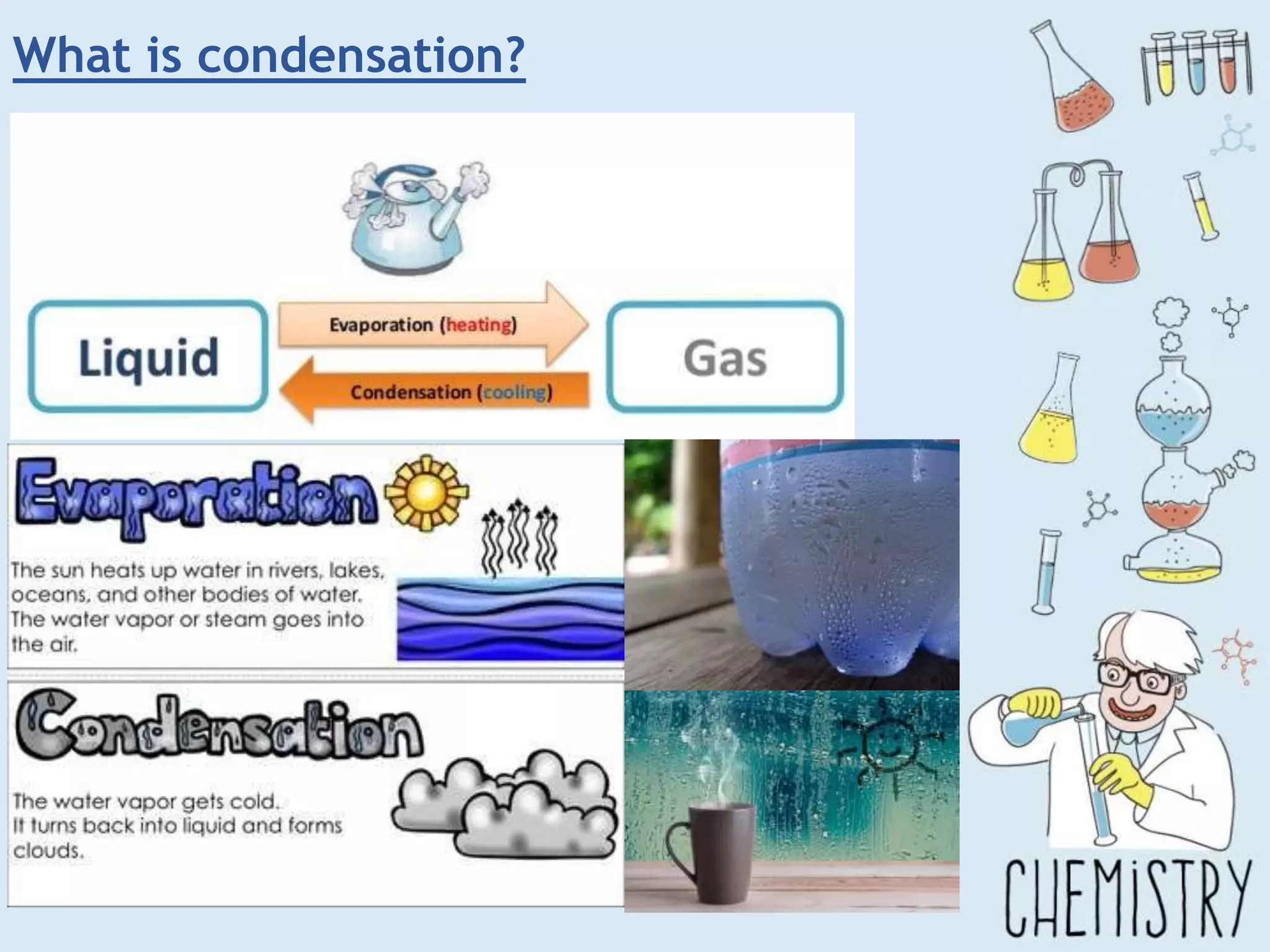
What is condensation?
In this example, salty water mixture is separated.
After water boils and evaporates upon heating, the obtained
vapor then condenses in the condenser. The condensate
(liquid water) is collected in the recieving flask. The salt
remains in the distillation flask.
We then obtain pure water and pure salt, separation is
complete.
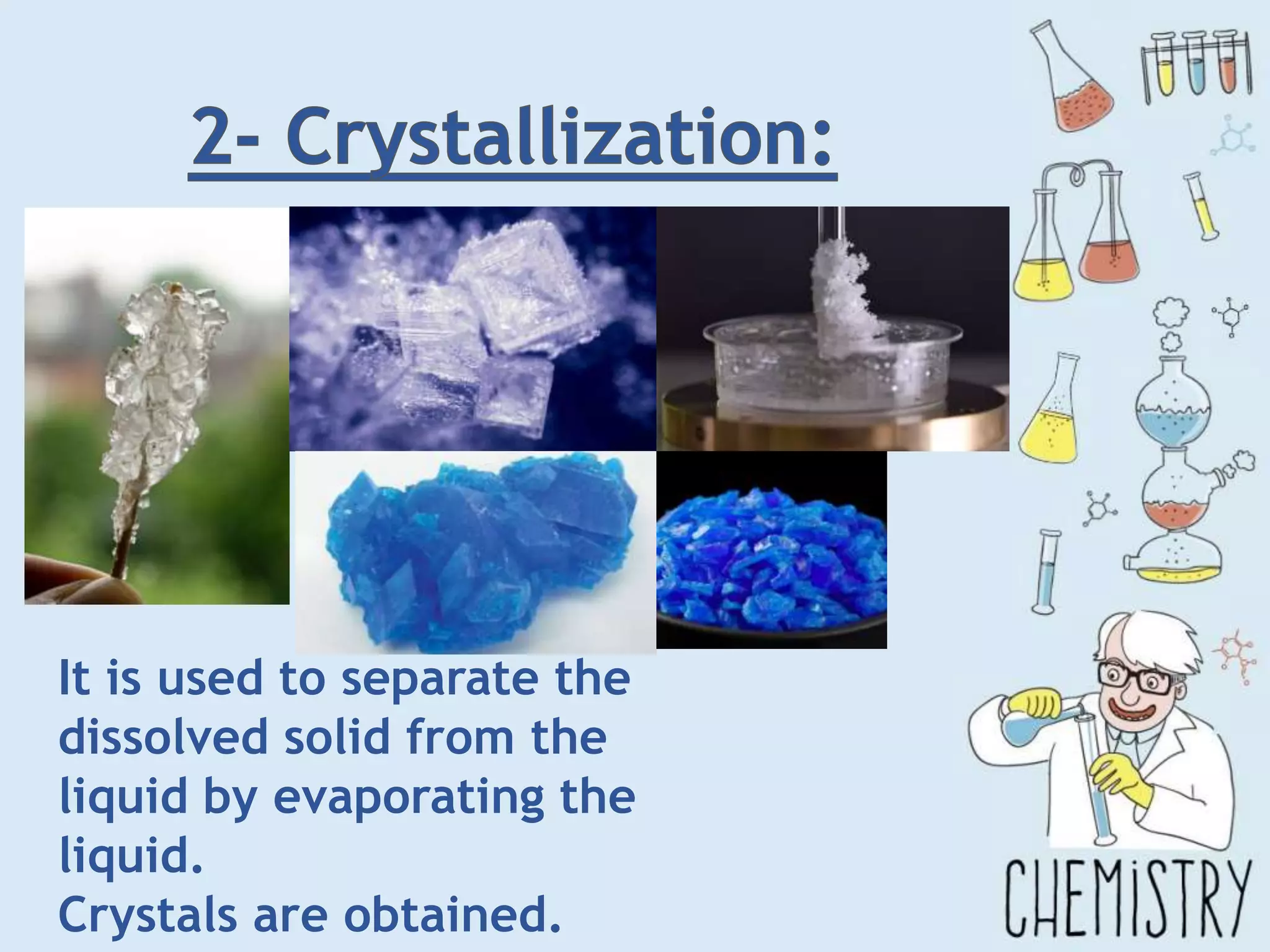
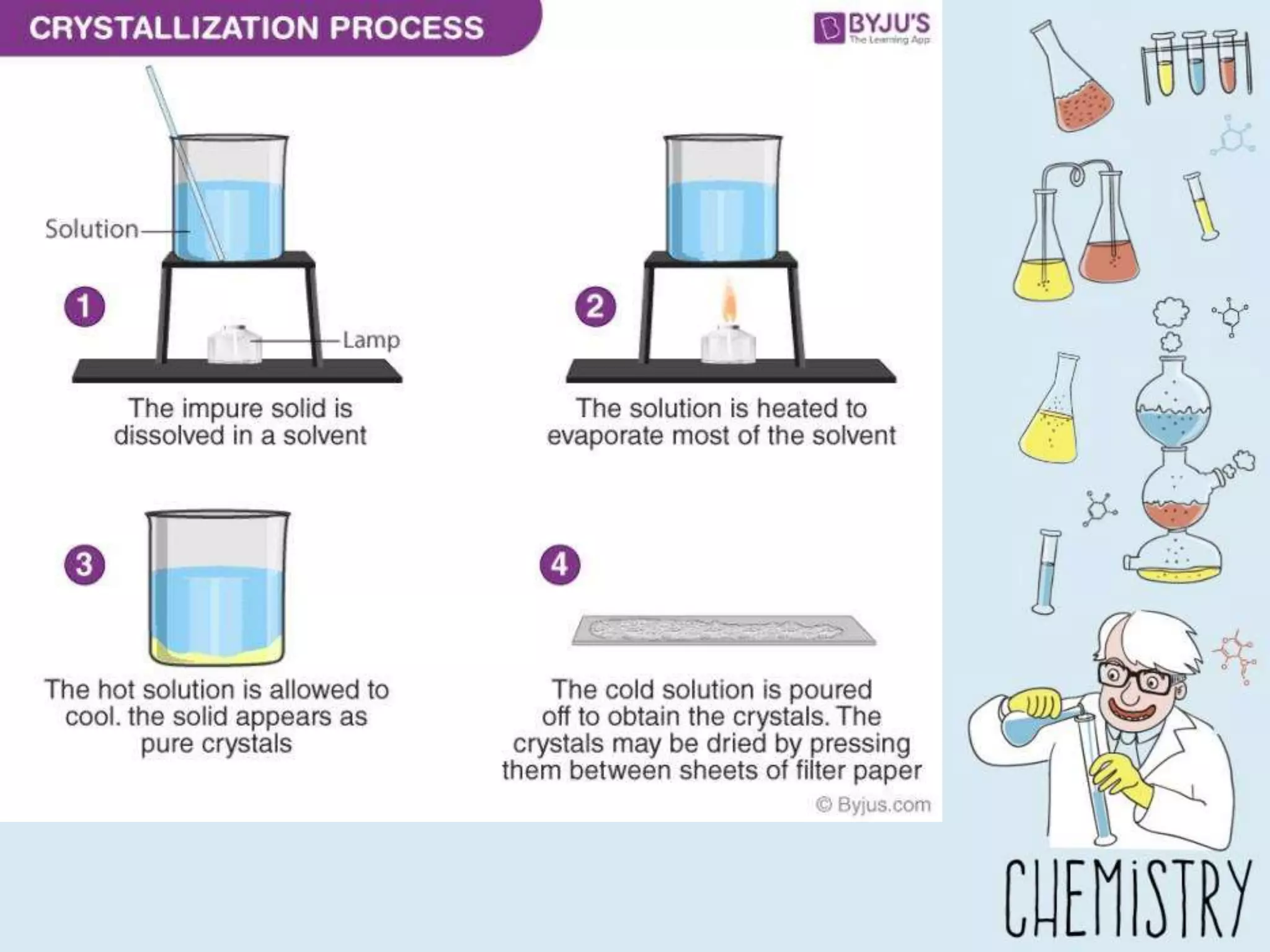
It is used to separate the
dissolved solid from the
liquid by evaporating the
liquid.
Crystals are obtained.
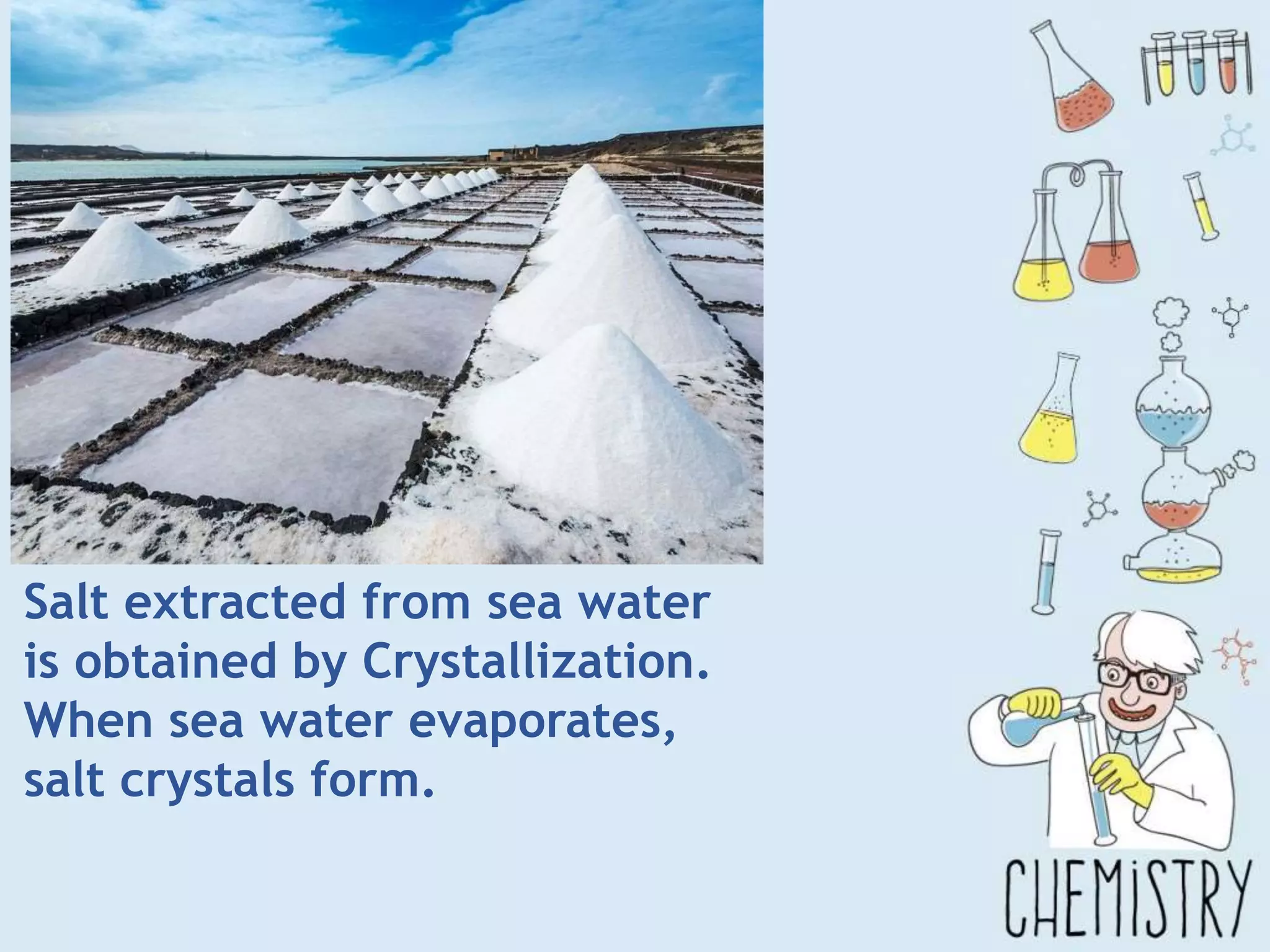
Salt extracted from sea water
is obtained by Crystallization.
When sea water evaporates,
salt crystals form.
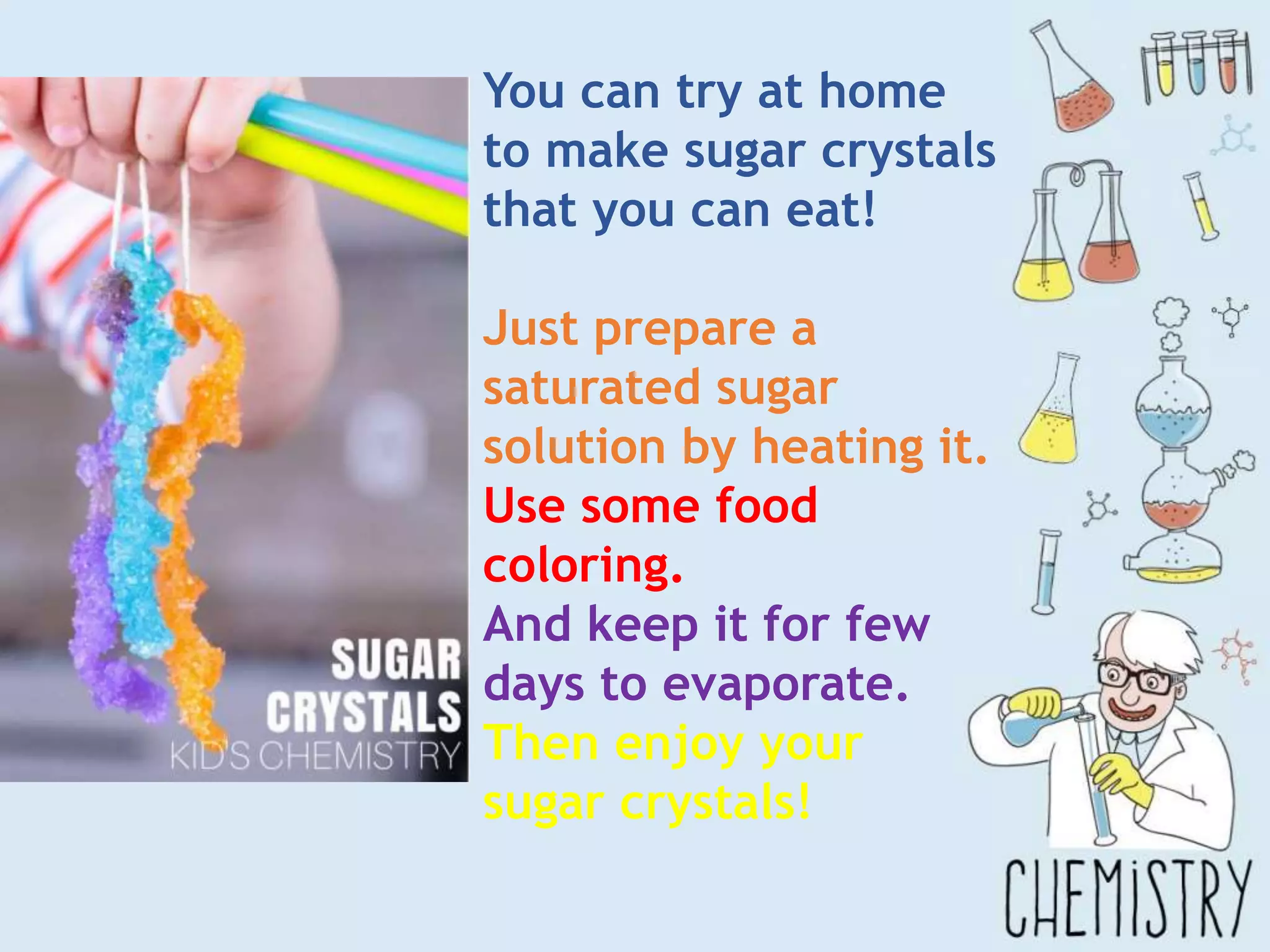
You can try at home
to make sugar crystals
that you can eat!
Just prepare a
saturated sugar
solution by heating it.
Use some food
coloring.
And keep it for few
days to evaporate.
Then enjoy your
sugar crystals!
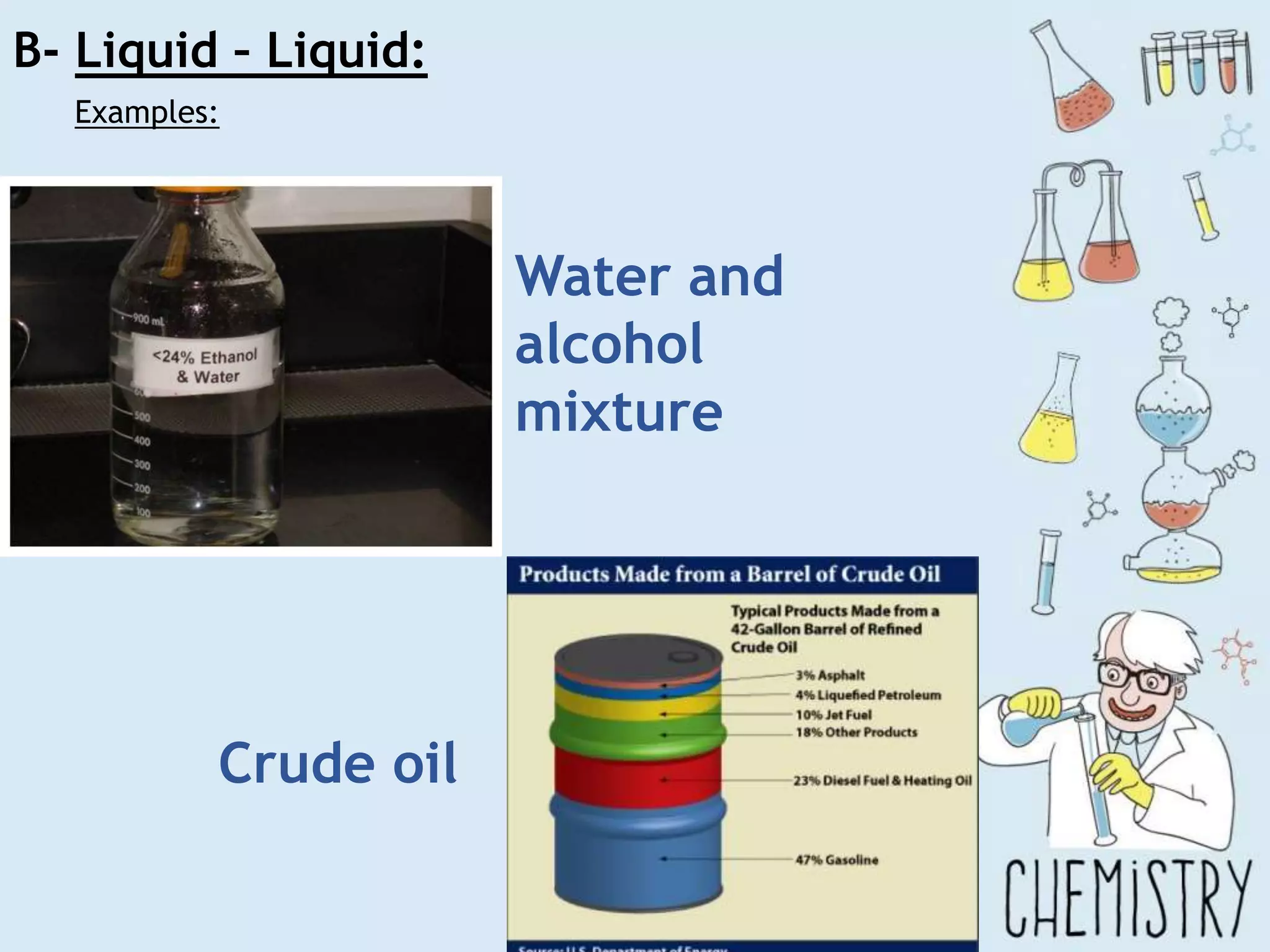
B- Liquid – Liquid:
Examples:
Water and
alcohol
mixture
Crude oil
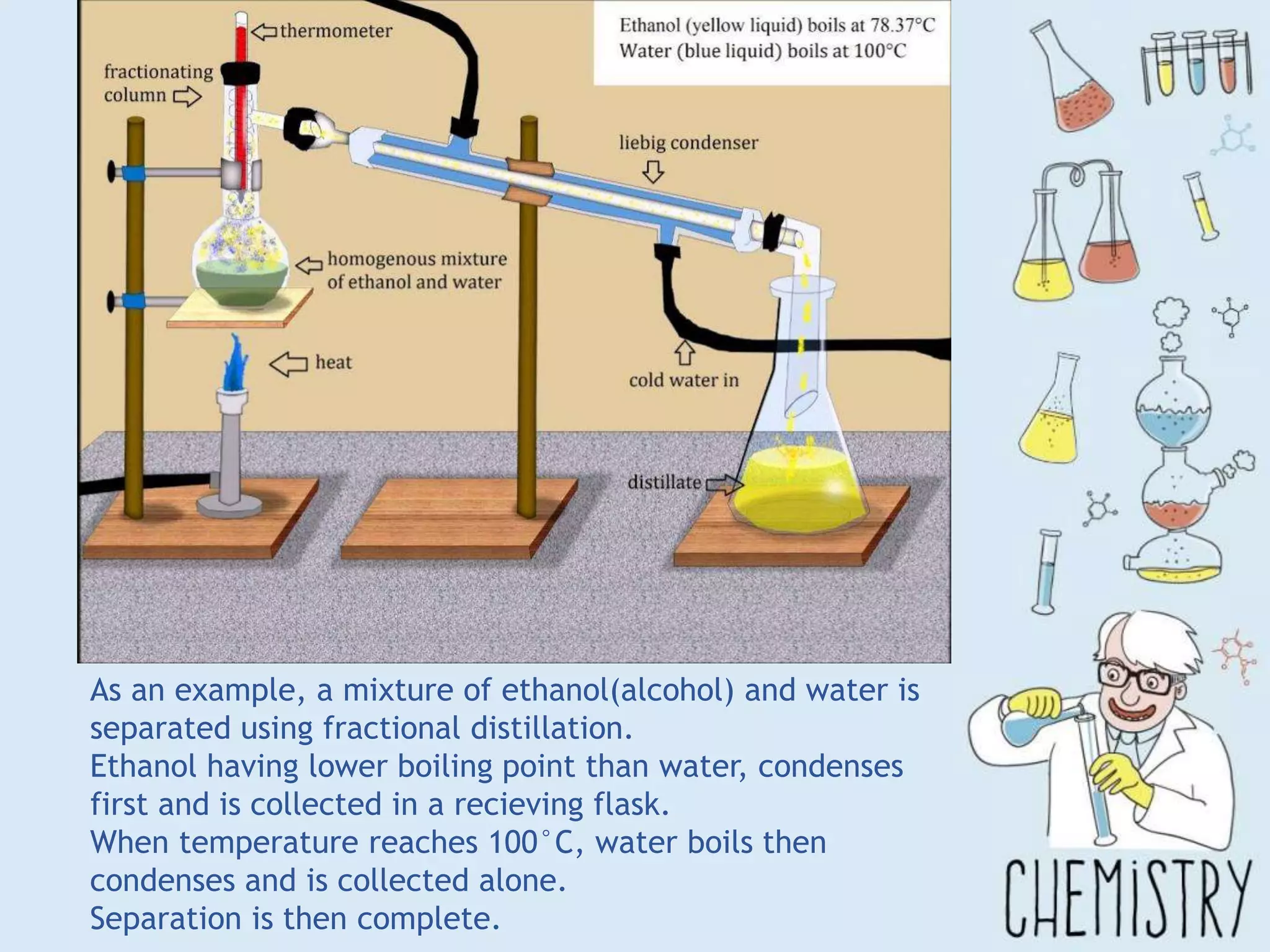
It is similar to the
simple distillation
setup but here a
fractionating
column is used.
It is based on the
difference
between boiling
points of the
liquids in the
mixture.
As an example, a mixture of ethanol(alcohol) and water is
separated using fractional distillation.
Ethanol having lower boiling point than water, condenses
first and is collected in a recieving flask.
When temperature reaches 100°C, water boils then
condenses and is collected alone.
Separation is then complete.
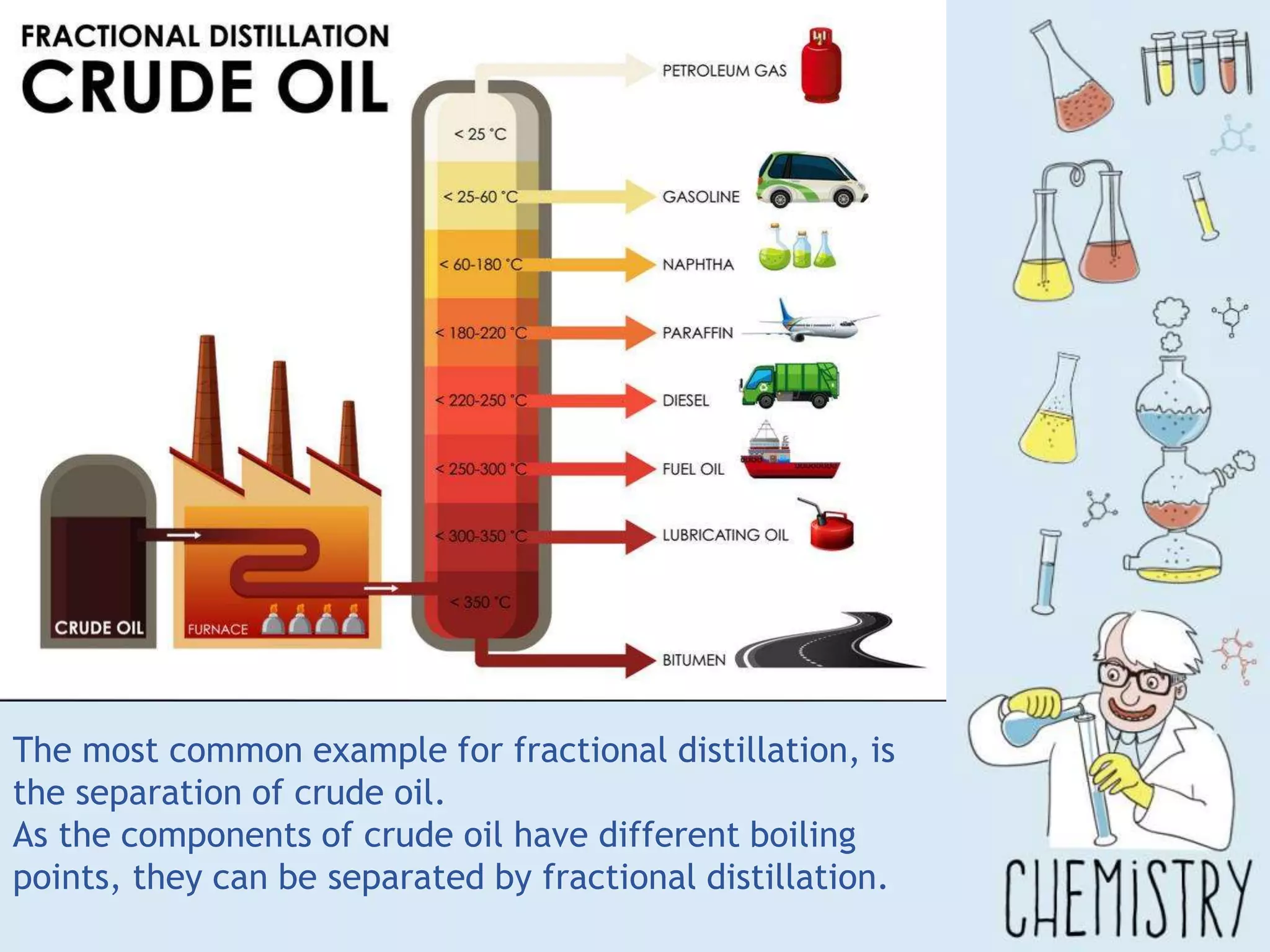
The most common example for fractional distillation, is
the separation of crude oil.
As the components of crude oil have different boiling
points, they can be separated by fractional distillation.
1- Given a mixture of water and substance
“X”:
Knowing that X is a solid, and has a density
of 1.05g/ml , what is the best method to
separate this mixture? Justify your answer.
Propose another efficient method for this
separation.
2- Ahmad wants to separate an orange
juice – pulp mixture, he used centrifuging
to allow fast sedimentation.
Is separation complete after centrifuging?
What is the next step?
Exercises:
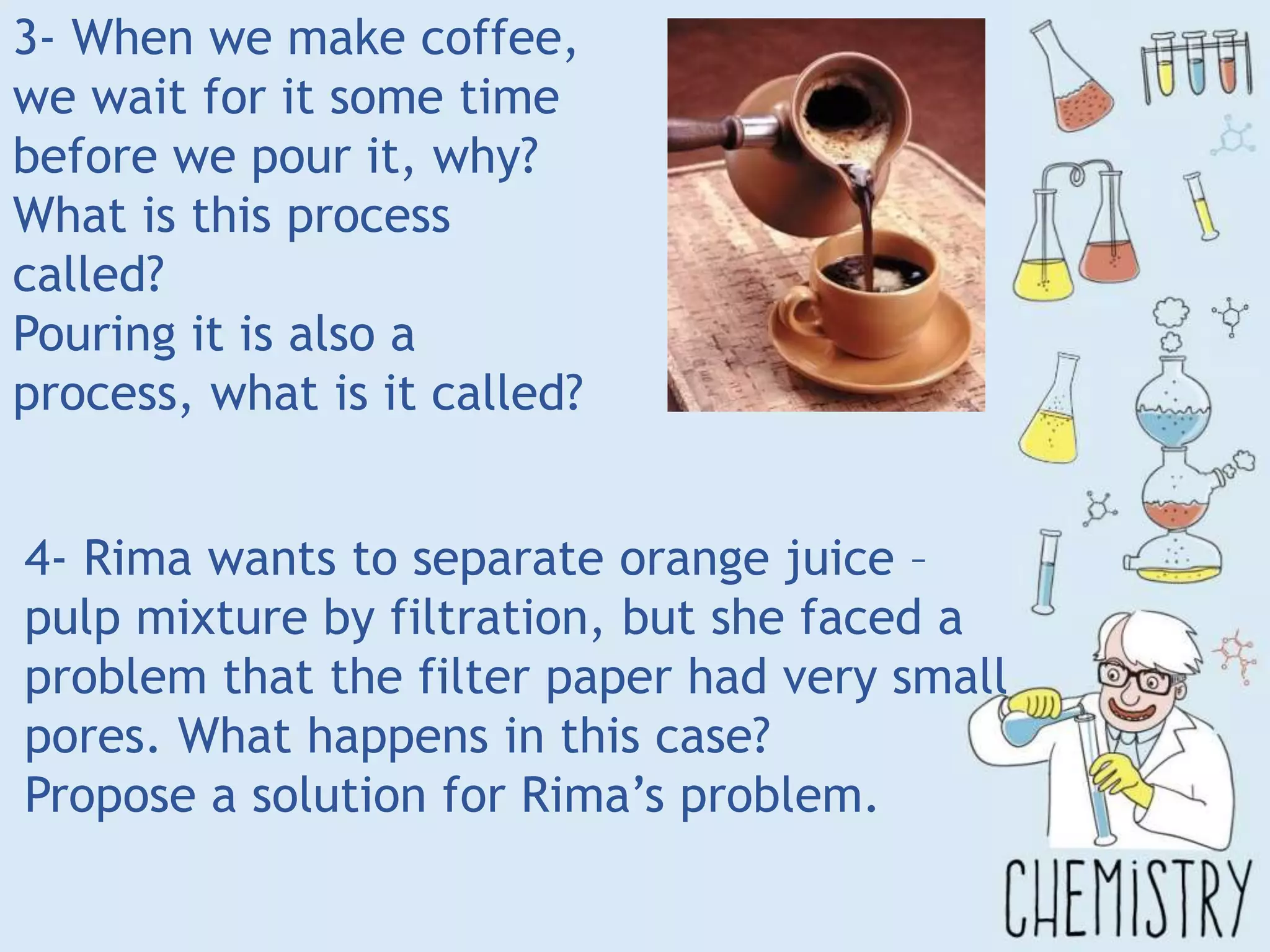
3- When we make coffee,
we wait for it some time
before we pour it, why?
What is this process
called?
Pouring it is also a
process, what is it called?
4- Rima wants to separate orange juice –
pulp mixture by filtration, but she faced a
problem that the filter paper had very small
pores. What happens in this case?
Propose a solution for Rima’s problem.
5- Can we use filtration to separate a salty
water mixture? Why?
What is the best way to separate it then?
Explain.
6- Consider two immiscible liquids A & B.
Density of liquid A : 1.2g/ml
Density of liquid B : 1.8g/ml
a- Which liquid forms the bottom layer?
b- What method do we use to separate
them?
c- What equipment is used for this
technique?
d- Which liquid drains off first during
separation?
7- Fractional distillation is based on a
certain physical property, what is it?
Explain using an example.
8- Decantation is based on a certain
physical property, what is it?
Explain using an example.
9- Maya wants to separate a salty water
mixture, she can use either distillation or
crystallization. Which technique is better in
your opinion? Explain.
10- Propose a method to separate a salt
and sand mixture.

Grade 7 chapter 2 separation techniques

  • 1.
    Unit1 Done by Ms.Sara Chehab
  • 2.
    •Mixtures can beseparated into their components by using physical separation techniques (methods) such as decantation, filtration, distillation, crystallization, etc…
  • 3.
    Examples: 1- Salty watermixture can be separated into salt and water 2- Water and Oil mixture can be separated into water and oil
  • 4.
    3- A mixtureof water and sand can be separated into pure water and pure sand 4- Blood is a mixture. It can be separated into its main constituents: Plasma, white blood cells, red blood cells.
  • 5.
    • Each typeof mixtures can be separated by certain techniques:
  • 6.
    • Heterogeneous Mixtures: A-Solid-Liquid: Examples: 1-Ice cubes in a drink 2- Sand and water mixture 3- Matte drink ☺️
  • 7.
    • Removes insoluble(undissolved) solids from a liquid. • It is based on density.
  • 8.
    Impurities that settleat the bottom are called “Sediments” or “precipitate”
  • 9.
    Sedimentation is aprocess of settling down of the heavier particles present in a liquid mixture. For example, in a mixture of sand and water, sand settles down at the bottom. This is sedimentation.
  • 10.
    • According tothe difference in density between the solid phase and liquid phase, decantation can be fast or slow, and can have high or low precision. Water and sand have a big difference in densities: Density of water = 1 g/ml Density of sand = 1.6 g/ml That’s why sand settles down fast and decantation here is considered to be fast and of high precision. Orange juice and pulp mixture: Orange juice and pulps have very similar densities. It takes too much time for pulps to settle down. Decantation in this case is slow and of low precision.
  • 11.
    It is theprocess where a mixture is separated through spinning It is used when the solid particles suspended in the liquid are very fine or have similar density to that of liquid.
  • 12.
    Submitting the solid –liquid mixtureto gravitational force allows fast sedimentation.
  • 13.
    Note: This processis a fast sedimentation method. It is then followed by decantation in order to complete the separation process. Centrifugation is good to be used in orange juice – pulp mixture. It helps in fast sedimentation of pulps and better separation.
  • 14.
    • Filtration isa method for separating an insoluble solid from a liquid. A filter paper is used to collect the solid particles.
  • 15.
    The liquid that passesthrough the filter is called the filtrate. The solid particles left on the filter paper are called residue. Study this diagram
  • 16.
    • Back tothe sand and water mixture, it can be separated also by filtration! In this example, sand particles are retained on the filter paper, they are called residue. While water passes through the filter and it is called filtrate.
  • 17.
    You can imaginethe filter paper as a porous surface. As the size of the pores becomes smaller, separation becomes slower (filtrate then takes too long to pass).
  • 18.
    • In orderto accelerate a slow filtration, vacuum filtration is used.
  • 19.
    B- Liquid –Liquid: (Mixtures of immiscible liquids) Immiscible = don’t mix Example: Water and oil mixture
  • 20.
    This decantation is doneusing a separating funnel.
  • 21.
    This decantation alsodepends on density. Oil being less dense than water, it floats on top of water layer.
  • 22.
    The stopcock isopened to drain off the bottom layer into a receiving beaker. (The denser liquid drains off). Then separation is complete.
  • 23.
    C- Solid-Solid: Magnet: In thisexample, iron is a metal while sulfur is not. So iron is attracted to the magnet, but sulfur stays unattracted. That’s how separation occurs.
  • 24.
    In this example,we are separating iron filings and sugar mixture. Iron filings are attracted to the magnet while sugar is not. So they are separated by a magnet. The same principle applies to a mixture of sand and iron filings. Iron filings are attracted to the magnet while sand is not. Therefore, they can be separated by a magnet.
  • 25.
    A- Solid –Liquid: Salty water Coffee Sugar solution (water + sugar)
  • 26.
    It is aprocess to separate a homogeneous mixture by the conversion of a liquid into vapour which is then condensed back to liquid form. It is based on the boiling point.
  • 27.
    Study the marked labels Thevapor obtained by vaporization of the liquid by heating, then passes through the cool condenser, it is then condensed back into liquid. The recieved condensed liquid is called “distillate”.
  • 28.
  • 29.
    In this example,salty water mixture is separated. After water boils and evaporates upon heating, the obtained vapor then condenses in the condenser. The condensate (liquid water) is collected in the recieving flask. The salt remains in the distillation flask. We then obtain pure water and pure salt, separation is complete.
  • 30.
    It is usedto separate the dissolved solid from the liquid by evaporating the liquid. Crystals are obtained.
  • 32.
    Salt extracted fromsea water is obtained by Crystallization. When sea water evaporates, salt crystals form.
  • 33.
    You can tryat home to make sugar crystals that you can eat! Just prepare a saturated sugar solution by heating it. Use some food coloring. And keep it for few days to evaporate. Then enjoy your sugar crystals!
  • 34.
    B- Liquid –Liquid: Examples: Water and alcohol mixture Crude oil
  • 35.
    It is similarto the simple distillation setup but here a fractionating column is used. It is based on the difference between boiling points of the liquids in the mixture.
  • 36.
    As an example,a mixture of ethanol(alcohol) and water is separated using fractional distillation. Ethanol having lower boiling point than water, condenses first and is collected in a recieving flask. When temperature reaches 100°C, water boils then condenses and is collected alone. Separation is then complete.
  • 37.
    The most commonexample for fractional distillation, is the separation of crude oil. As the components of crude oil have different boiling points, they can be separated by fractional distillation.
  • 38.
    1- Given amixture of water and substance “X”: Knowing that X is a solid, and has a density of 1.05g/ml , what is the best method to separate this mixture? Justify your answer. Propose another efficient method for this separation. 2- Ahmad wants to separate an orange juice – pulp mixture, he used centrifuging to allow fast sedimentation. Is separation complete after centrifuging? What is the next step? Exercises:
  • 39.
    3- When wemake coffee, we wait for it some time before we pour it, why? What is this process called? Pouring it is also a process, what is it called? 4- Rima wants to separate orange juice – pulp mixture by filtration, but she faced a problem that the filter paper had very small pores. What happens in this case? Propose a solution for Rima’s problem.
  • 40.
    5- Can weuse filtration to separate a salty water mixture? Why? What is the best way to separate it then? Explain. 6- Consider two immiscible liquids A & B. Density of liquid A : 1.2g/ml Density of liquid B : 1.8g/ml a- Which liquid forms the bottom layer? b- What method do we use to separate them? c- What equipment is used for this technique? d- Which liquid drains off first during separation?
  • 41.
    7- Fractional distillationis based on a certain physical property, what is it? Explain using an example. 8- Decantation is based on a certain physical property, what is it? Explain using an example. 9- Maya wants to separate a salty water mixture, she can use either distillation or crystallization. Which technique is better in your opinion? Explain. 10- Propose a method to separate a salt and sand mixture.