Mr. Sanket P. Shinde
Assistant Professor
Pune-Maharashtra.
Mr. S. P. Shinde
❑ Infrared spectroscopy is one of the most important analytical technique
used for determining the functional group present in both inorganic &
organic compounds.
❑ Liquids, solutions, paste, powders, films, fibres, gases, and surfaces can
all be examined with a choice of sampling technique.
❑ IR spectroscopy is a technique based on the vibrations of the atom of a
molecule.
❑ IR spectroscopy measures the vibrations of atoms, through which it is
possible to determine the functional groups.
❑ An infrared spectrum is commonly obtained by passing infrared radiation
through a sample and determining the fraction of the incident radiation
which is absorbed at a particular energy.
❑ The term infra red covers the range of the electromagnetic spectrum
between 0.78 and 1000μm.
2
Mr. S. P. Shinde
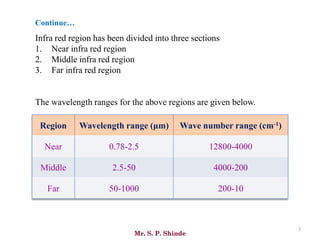
Infra red region has been divided into three sections
1. Near infra red region
2. Middle infra red region
3. Far infra red region
The wavelength ranges for the above regions are given below.
Region Wavelength range (μm) Wave number range (cm-1)
Near 0.78-2.5 12800-4000
Middle 2.5-50 4000-200
Far 50-1000 200-10
Continue…
3
Mr. S. P. Shinde
❑ Atoms or atomic groups in a molecules are in continuous motion with
respect to one another.
❑ IR spectra originate from the difference modes of vibration and rotation of
a molecule, whereas the UV-visible absorption bands are primarily due to
electronic transition.
❑ In order to absorb IR radiation, a molecule must undergo a net change in
dipole moment as a consequence of its vibrational or rotational motion.
❑ The dipole moment is determined by the magnitude of the charge
difference and the distance between the two centers of charge.
❑ The change in bond length or angle due to vibrational or rotational motion
must cause a net change in the dipole moment of the molecule.
4
Mr. S. P. Shinde
❑ No net change in dipole moment occurs during the vibration or rotation
of homonuclear species such as O2, N2, or Cl2; consequently, such
compounds cannot absorb in the IR.
❑ Vibrational modes which do not involve a change in dipole moment are
said to be IR-inactive.
❑ With exception of a few compounds of this type, all molecular species
exhibit IR-active.
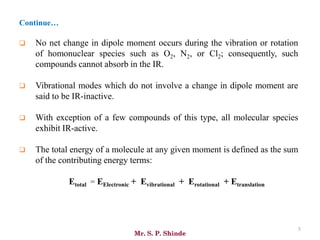
❑ The total energy of a molecule at any given moment is defined as the sum
of the contributing energy terms:
Etotal = EElectronic + Evibrational + Erotational + Etranslation
5
Continue…
Mr. S. P. Shinde
❑ Among these energies the vibrational energy component is a higher
energy term and absorption of energy by a molecule as the component
atoms vibrate about the mean centre of their chemical bonds.
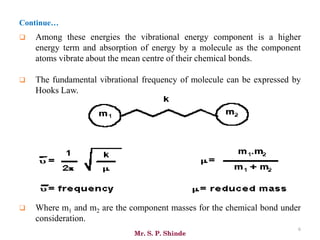
❑ The fundamental vibrational frequency of molecule can be expressed by
Hooks Law.
❑ Where m1 and m2 are the component masses for the chemical bond under
consideration.
6
Continue…
Mr. S. P. Shinde
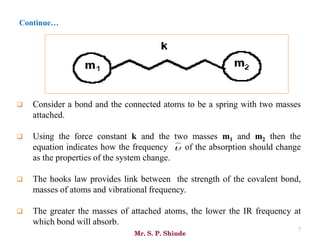
❑ Consider a bond and the connected atoms to be a spring with two masses
attached.
❑ Using the force constant k and the two masses m1 and m2 then the
equation indicates how the frequency of the absorption should change
as the properties of the system change.
❑ The hooks law provides link between the strength of the covalent bond,
masses of atoms and vibrational frequency.
❑ The greater the masses of attached atoms, the lower the IR frequency at
which bond will absorb.

7
Continue…
Mr. S. P. Shinde
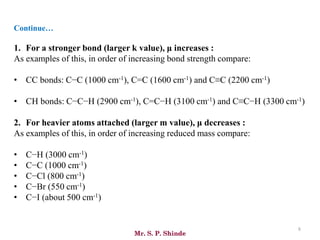
1. For a stronger bond (larger k value), μ increases :
As examples of this, in order of increasing bond strength compare:
• CC bonds: C−C (1000 cm-1), C=C (1600 cm-1) and C≡C (2200 cm-1)
• CH bonds: C−C−H (2900 cm-1), C=C−H (3100 cm-1) and C≡C−H (3300 cm-1)
2. For heavier atoms attached (larger m value), μ decreases :
As examples of this, in order of increasing reduced mass compare:
• C−H (3000 cm-1)
• C−C (1000 cm-1)
• C−Cl (800 cm-1)
• C−Br (550 cm-1)
• C−I (about 500 cm-1)
8
Continue…
Mr. S. P. Shinde
9
Thus Hook’s Law states :
• The vibrational frequency is proportional to the strength of the spring;
the stronger the spring; the higher the frequency.
• The vibrational frequency inversely proportional to the masses at the
ends of the spring; the lighter the weights, the higher the frequency.
As per the Hook’s Law :
• Stronger bonds absorb at higher frequencies.
• Weaker bonds absorb at lower frequencies.
• Bonds between lighter atoms absorb at higher frequencies.
• Bonds between heavier atoms absorb at lower frequencies.
Continue…
Mr. S. P. Shinde
10
• The positions of atoms in molecules are not fixed; they are subject to a
number of different vibrations.
• There are two simplest modes of molecular vibrations in a molecule
which are infrared active and give rise to absorptions as given below.
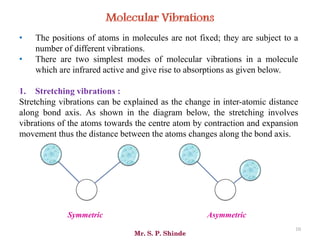
1. Stretching vibrations :
Stretching vibrations can be explained as the change in inter-atomic distance
along bond axis. As shown in the diagram below, the stretching involves
vibrations of the atoms towards the centre atom by contraction and expansion
movement thus the distance between the atoms changes along the bond axis.
Symmetric Asymmetric
Mr. S. P. Shinde
11
There are two types of stretching vibrations :
• Symmetric stretching :
Symmetric stretching involves the change in inter atomic distance in
equal manner whereas asymmetric stretching involves unequal change.
• Asymmetric stretching :
Generally asymmetric stretching vibrations occur at higher frequencies
than symmetric stretching vibrations.
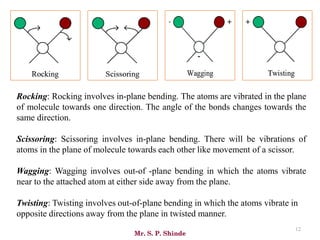
2. Bending vibrations :
• Bending vibrations are explained as change in angle between two bonds.
• The atoms vibrate by changing the bond angle between two atoms.
• They are also called as deformation vibrations.
• Bending vibrations occur at lower frequencies than stretching vibrations.
There are four types of bending vibrations which are as follows.
Mr. S. P. Shinde
12
Rocking: Rocking involves in-plane bending. The atoms are vibrated in the plane
of molecule towards one direction. The angle of the bonds changes towards the
same direction.
Scissoring: Scissoring involves in-plane bending. There will be vibrations of
atoms in the plane of molecule towards each other like movement of a scissor.
Wagging: Wagging involves out-of -plane bending in which the atoms vibrate
near to the attached atom at either side away from the plane.
Twisting: Twisting involves out-of-plane bending in which the atoms vibrate in
opposite directions away from the plane in twisted manner.
Mr. S. P. Shinde
13
• Transition from the ground state to the first excited state absorbs light
strongly in IR region and give rise to intense bands called the fundamental
bands.
• These bands in IR spectrum resulted due to the various stretching and
bending vibrations.
• For example, in a group that contains three or more atoms and at least two
of which are identical like, CH3, CH2, NO2, NH, give rise to two modes of
stretching vibrations that is symmetric and asymmetric.
• The CH3 group gives symmetric stretching vibration at about 2872 cm-1
and an asymmetric stretching vibration at about 2962 cm-1, These types of
bands are called as fundamental bands.
• These absorptions arise from excitation from the ground state to the lowest
energy excited state.
Mr. S. P. Shinde
14
• Vibrational frequency is defined as the rate at which the atoms of a
molecule vibrate.
• The vibrational frequencies for each functional groups are unique.
• Various functional groups vibrate in different frequencies.
• This unique property is used to identify the various functional groups
using IR spectrum.
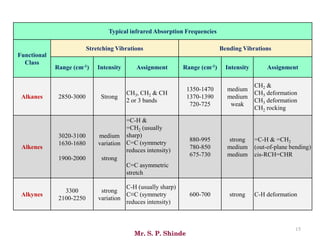
• The following table gives a detailed account on vibrational frequencies
of various functional groups.
Mr. S. P. Shinde
15
Typical infrared Absorption Frequencies
Functional
Class
Stretching Vibrations Bending Vibrations
Range (cm-1) Intensity Assignment Range (cm-1) Intensity Assignment
Alkanes 2850-3000 Strong
CH3, CH2 & CH
2 or 3 bands
1350-1470
1370-1390
720-725
medium
medium
weak
CH2 &
CH3 deformation
CH3 deformation
CH2 rocking
Alkenes
3020-3100
1630-1680
1900-2000
medium
variation
strong
=C-H &
=CH2 (usually
sharp)
C=C (symmetry
reduces intensity)
C=C asymmetric
stretch
880-995
780-850
675-730
strong
medium
medium
=C-H & =CH2
(out-of-plane bending)
cis-RCH=CHR
Alkynes
3300
2100-2250
strong
variation
C-H (usually sharp)
C≡C (symmetry
reduces intensity)
600-700 strong C-H deformation
Mr. S. P. Shinde
16
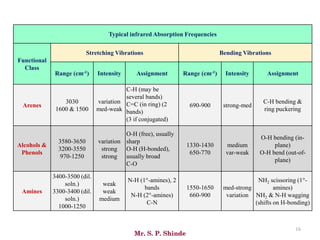
Typical infrared Absorption Frequencies
Functional
Class
Stretching Vibrations Bending Vibrations
Range (cm-1) Intensity Assignment Range (cm-1) Intensity Assignment
Arenes
3030
1600 & 1500
variation
med-weak
C-H (may be
several bands)
C=C (in ring) (2
bands)
(3 if conjugated)
690-900 strong-med
C-H bending &
ring puckering
Alcohols &
Phenols
3580-3650
3200-3550
970-1250
variation
strong
strong
O-H (free), usually
sharp
O-H (H-bonded),
usually broad
C-O
1330-1430
650-770
medium
var-weak
O-H bending (in-
plane)
O-H bend (out-of-
plane)
Amines
3400-3500 (dil.
soln.)
3300-3400 (dil.
soln.)
1000-1250
weak
weak
medium
N-H (1°-amines), 2
bands
N-H (2°-amines)
C-N
1550-1650
660-900
med-strong
variation
NH2 scissoring (1°-
amines)
NH2 & N-H wagging
(shifts on H-bonding)
Mr. S. P. Shinde
17
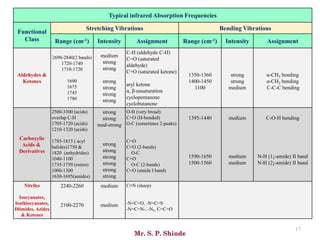
Typical infrared Absorption Frequencies
Functional
Class
Stretching Vibrations Bending Vibrations
Range (cm-1) Intensity Assignment Range (cm-1) Intensity Assignment
Aldehydes &
Ketones
2690-2840(2 bands)
1720-1740
1710-1720
1690
1675
1745
1780
medium
strong
strong
strong
strong
strong
strong
C-H (aldehyde C-H)
C=O (saturated
aldehyde)
C=O (saturated ketone)
aryl ketone
α, β-unsaturation
cyclopentanone
cyclobutanone
1350-1360
1400-1450
1100
strong
strong
medium
α-CH3 bending
α-CH2 bending
C-C-C bending
Carboxylic
Acids &
Derivatives
2500-3300 (acids)
overlap C-H
1705-1720 (acids)
1210-1320 (acids)
1785-1815 ( acyl
halides)1750 &
1820 (anhydrides)
1040-1100
1735-1750 (esters)
1000-1300
1630-1695(amides)
strong
strong
med-strong
strong
strong
strong
strong
strong
strong
O-H (very broad)
C=O (H-bonded)
O-C (sometimes 2-peaks)
C=O
C=O (2-bands)
O-C
C=O
O-C (2-bands)
C=O (amide I band)
1395-1440
1590-1650
1500-1560
medium
medium
medium
C-O-H bending
N-H (1¡-amide) II band
N-H (2¡-amide) II band
Nitriles
Isocyanates,
Isothiocyanates,
Diimides, Azides
& Ketenes
2240-2260
2100-2270
medium
medium
C≡N (sharp)
-N=C=O, -N=C=S
-N=C=N-, -N3, C=C=O
Mr. S. P. Shinde
18
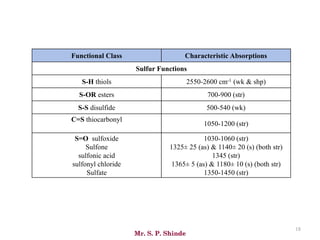
Functional Class Characteristic Absorptions
Sulfur Functions
S-H thiols 2550-2600 cm-1 (wk & shp)
S-OR esters 700-900 (str)
S-S disulfide 500-540 (wk)
C=S thiocarbonyl
1050-1200 (str)
S=O sulfoxide
Sulfone
sulfonic acid
sulfonyl chloride
Sulfate
1030-1060 (str)
1325± 25 (as) & 1140± 20 (s) (both str)
1345 (str)
1365± 5 (as) & 1180± 10 (s) (both str)
1350-1450 (str)
Mr. S. P. Shinde
19
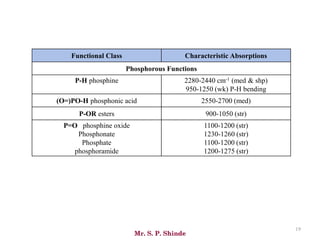
Functional Class Characteristic Absorptions
Phosphorous Functions
P-H phosphine 2280-2440 cm-1 (med & shp)
950-1250 (wk) P-H bending
(O=)PO-H phosphonic acid 2550-2700 (med)
P-OR esters 900-1050 (str)
P=O phosphine oxide
Phosphonate
Phosphate
phosphoramide
1100-1200 (str)
1230-1260 (str)
1100-1200 (str)
1200-1275 (str)
Mr. S. P. Shinde
20
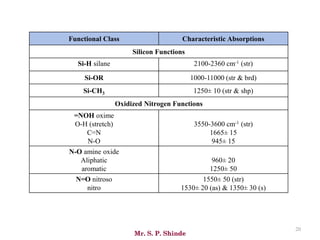
Functional Class Characteristic Absorptions
Silicon Functions
Si-H silane 2100-2360 cm-1 (str)
Si-OR 1000-11000 (str & brd)
Si-CH3 1250± 10 (str & shp)
Oxidized Nitrogen Functions
=NOH oxime
O-H (stretch)
C=N
N-O
3550-3600 cm-1 (str)
1665± 15
945± 15
N-O amine oxide
Aliphatic
aromatic
960± 20
1250± 50
N=O nitroso
nitro
1550± 50 (str)
1530± 20 (as) & 1350± 30 (s)
Mr. S. P. Shinde
21
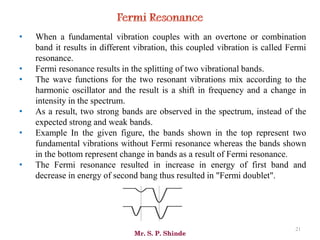
• When a fundamental vibration couples with an overtone or combination
band it results in different vibration, this coupled vibration is called Fermi
resonance.
• Fermi resonance results in the splitting of two vibrational bands.
• The wave functions for the two resonant vibrations mix according to the
harmonic oscillator and the result is a shift in frequency and a change in
intensity in the spectrum.
• As a result, two strong bands are observed in the spectrum, instead of the
expected strong and weak bands.
• Example In the given figure, the bands shown in the top represent two
fundamental vibrations without Fermi resonance whereas the bands shown
in the bottom represent change in bands as a result of Fermi resonance.
• The Fermi resonance resulted in increase in energy of first band and
decrease in energy of second bang thus resulted in "Fermi doublet".
Mr. S. P. Shinde
22
Overtones
• Overtones occur when a vibrational mode is excited from v=0 to v=2,
which is called the first overtone, or v=0 to v=3, the second overtone.
• Overtones are generally not detected in larger molecules.
Combination Bands
• Combination bands are observed when more than two or more
fundamental vibrations are excited simultaneously.
• One reason a combination band might occur is if a fundamental
vibration does not occur because of symmetry.
• Combination implies addition of two frequencies, but it also possible
to have a difference band where the frequencies are subtracted.
Mr. S. P. Shinde
23
Vibrational coupling
• In addition to the vibrations mentioned above, interaction between
vibrations can occur (coupling) if the vibrating bonds are joined to a
single, central atom. This is called as vibrational coupling.
Vibrational coupling is influenced by a number of factors.
1. When a common atom is present between two bonds and during their
vibration coupling of stretching vibrations occurs. When a bond is
common between two vibrating groups then coupling of bending
vibrations occurs.
2. Coupling between a stretching vibration and a bending vibration occurs If
the stretching bond is one side of an angle varied by bending vibration
3. Coupling is greatest when the coupled groups have approximately equal
energies.
4. No coupling is seen between groups separated by two or more bonds.
Mr. S. P. Shinde
24
• A typical infrared spectrum can be visually divided into two regions.
• The left half, above 1500 cm-1 called as Functional group region.
• The right half from 1500-500 cm-1 called as Fingerprint region.
1. Functional group region :
• The first region above 2000 cm-1 usually contains relatively few peaks, but
some very diagnostic information can be found in this region. This region
is called as functional group region.
• First, alkane C- H stretching absorptions just below 3000 cm-1 demonstrate
the presence of saturated carbons, and signals just above 3000 cm-1
demonstrate unsaturation.
• A very broad peak in the region between 3100 and 3600 cm-1 indicates the
presence of exchangeable protons, typically from alcohol, amine, amide or
carboxylic acid groups.
• The frequencies from 2800 to 2000 cm-1 are normally void of other
absorptions, so the presence of alkyne or nitrile groups can be easily seen
here. C = O group show absorption at 1715 cm-1
Mr. S. P. Shinde
25
2. Fingerprint region :
• The region is between 1500 to 500 cm-1 usually contains very
complex bands of absorptions.
• These absorption bands are due to the mainly all manner of bending
vibrations within the molecule. This is called the fingerprint region.
• During interpretations it is more difficult to characterize individual
bonds in this region as compared to the functional group region at
higher wave numbers.
• The importance of the fingerprint region is that each different
compound produces a different pattern of troughs thus useful in
interpretation.
Mr. S. P. Shinde
26
Mr. S. P. Shinde
27
• Fourier Transform Infrared (FT-IR) spectrometry was developed to
overcome the limitations encountered with dispersive instruments.
• The main difficulty was the slow scanning process.
• A method for measuring all of the infrared frequencies simultaneously,
rather than individually as with dispersive instruments
• A very simple optical device called an interferometer was developed.
• The interferometer produces a unique type of signal which has all of
the infrared frequencies "encoded" into it.
• The signal can be measured very quickly usually on the order of one
second or so.
• Thus, the time element per sample is reduced to a matter of a few
seconds rather than several minutes.
Introduction
Mr. S. P. Shinde
28
FTIR spectrometers have several prominent advantages:
1. The signal-to-noise ratio of spectrum is significantly higher than the
previous generation infrared spectrometers.
2. The accuracy of wave number is high. The error is within the range of
±0.01 cm-1
3. The scan time of all frequencies is short (approximately 1 s).
4. The resolution is extremely high (0.1 -0.005 cm-1).
5. The scan range is wide (1000 - 10 cm-1).
6. The interference from stray light is reduced.
Due to these advantages, FTIR Spectrometers have replaced dispersive IR
spectrometers.
Mr. S. P. Shinde
29
Fourier transform infrared spectroscopy is preferred over dispersive or
filter methods of infrared spectral analysis for several reasons:
• It is a non-destructive technique.
• It provides a precise measurement method which requires no
external calibration.
• It can increase speed, collecting a scan every second.
• It can increase sensitivity.
• It has greater optical throughput.
• It is mechanically simple with only one moving part.
Mr. S. P. Shinde
30
• FTIR measures all frequencies simultaneously rather individually using an
interferometer.
• An interferometer is the exceptional component in FTIR compared to the
dispersive IR.
• All of the infrared frequencies are “encoded" into the signal of
interferometer which can be measured very quickly.
• Thus Interferometer is used for the rapid analysis.
• However the measured interferogram signal cannot be interpreted directly.
• Hence frequency spectrum is required which is a plot of the intensity at
each individual frequency to make identification.
• A means of "decoding” the individual frequencies is required.
• This can be accomplished via a well-known mathematical technique
called the Fourier transformation.
Theory
Mr. S. P. Shinde
31
• Most interferometers employ a beamsplitter which takes the incoming
infrared beam and divides it into two optical beams.
• One beam reflects off of a flat mirror which is fixed in place. The other
beam reflects off of a flat mirror which is on a mechanism which allows
this mirror to move a very short distance (typically a few millimeters)
away from the beamsplitter.
• The two beams reflect off of their respective mirrors and are recombined
when they meet back at the beamsplitter.
• Because the path that one beam travels is a fixed length and the other is
constantly changing as its mirror moves, the signal which exits the
interferometer is the result of these two beams “interfering” with each
other.
• The resulting signal is called an interferogram which has the unique
property that every data point (a function of the moving mirror position).
Continue…
Mr. S. P. Shinde
32
FTIR Instrumentation
• The major different between dispersive IR and FTIR is the inclusion of
interferometer.
• All other components are almost same as like that of a dispersive IR
spectrometer.
Components are explained individually as follows.
1. Source of light
2. Interferometer
3. Sample compartment
4. Detector
5. Read out device
Mr. S. P. Shinde
33
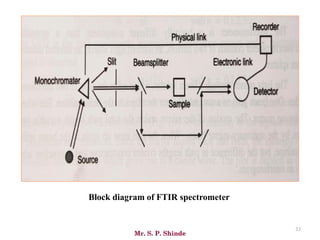
Block diagram of FTIR spectrometer
Mr. S. P. Shinde
34
• IR instruments require a source of radiant energy which emits IR
radiation which must be steady, intense enough for detection and
extend over the desired wavelength.
• In general, an inert solid is electrically heated to a temperature in the
range 1500-2000 K. The heated material will then emit infra red
radiation.
1. Nernst glower:
• The Nernst glower consists of a cylinder made up of rare earth oxides.
• The length of the cylinder is 20mm with a diameter of 1-2mm.
• At the end of the cylinder platinum wires are attached and a current is
passed through the cylinder.
• The Nernst glower can reach temperatures of 2200 K.
1. Source of light
Mr. S. P. Shinde
35
2. Globar source
• The Globar source is a silicon carbide rod (5mm diameter, 50mm long)
which is electrically heated to about 1500 K.
• Water cooling of the electrical contacts is needed to prevent arcing.
• The spectral output is comparable with the Nernst glower, except at
short wavelengths (less than 5mm) where its output becomes larger.
3. Incandescent wire source
• The incandescent wire source is a tightly wound coil of Nichrome wire,
electrically heated to 1100 K.
• It produces a lower intensity of radiation than the Nernst or Globar
sources, but has a longer working life.
Mr. S. P. Shinde
36
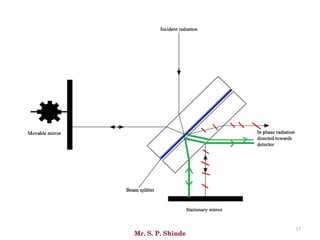
• The interferometer is a basically different component than a
monochromator.
• The interferometer consists of two mirrors, an infrared light source, an
infrared detector, and a beam splitter.
• The light passes through a beam splitter, which splits the light in two
directions at right angles.
• One beam goes to a stationary mirror then back to the beam splitter.
• The other goes to a moving mirror.
• The motion of the mirror makes the total path length variable versus
that taken by the stationary mirror beam.
• When the two meet up again at the beam splitter, they recombine, but
the difference in path lengths creates constructive and destructive
interference thus an interferogram.
2. Interferometer
Mr. S. P. Shinde
37
Mr. S. P. Shinde
38
• The recombined beam passes through the sample.
• The sample absorbs all the different wavelengths characteristic of its
spectrum, and this subtracts specific wavelengths from the
interferogram.
• The detector reports variation in energy versus time for all
wavelengths simultaneously.
• A laser beam is superimposed to provide a reference for the
instrument operation
Continue…
Mr. S. P. Shinde
39
• The sample compartment in FTIR is designed in such a way to
receive the infra red radiation through the sample in a systematic
manner.
• The sample compartment contains cell holders that hold square cells
with optical path lengths of 10 mm.
• The various accessories are attached by replacing these cell holder
units or by replacing the entire sample compartment.
• Among spectrophotometers of medium or higher grade that use
photomultipliers, there are models for which large sample
compartments are made available in order to allow the analysis of
large samples or the attachment of large accessories.
3. Sample Compartment
Mr. S. P. Shinde
40
• Detectors are used to measure the intensity of unabsorbed infrared
radiation. Detectors like thermocouples, Bolometers, thermistors,
Golay cell, and pyroelectric detectors are used.
1. Thermocouples detectors :
• Thermocouples consist of a pair of junctions of different metals; for
example, two pieces of bismuth fused to either end of a piece of
antimony.
• The potential difference (voltage) between the junctions changes
according to the difference in temperature between the junctions.
4. Detectors
Mr. S. P. Shinde
41
2. Pyroelectric detectors:
• Pyroelectric detectors are made from a single crystalline wafer of a
pyroelectric material, such as triglycerine sulphate.
• The properties of a pyroelectric material are such that when an electric
field is applied across it, electric polarisation occurs (this happens in
any dielectric material).
• In a pyroelectric material, when the field is removed, the polarisation
persists.
• The degree of polarisation is temperature dependant.
• So, by sandwiching the pyroelectric material between two electrodes,
a temperature dependant capacitor is made.
• The heating effect of incident IR radiation causes a change in the
capacitance of the material.
• Pyroelectric detectors have a fast response time.
• They are used in most Fourier transform IR instruments.
Mr. S. P. Shinde
42
3. Photoelectric detectors:
• Photoelectric detectors such as the mercury cadmium telluride
detector comprise a film of semiconducting material deposited on a
glass surface, sealed in an evacuated envelope.
• Absorption of IR promotes nonconducting valence electrons to a
higher, conducting, state.
• The electrical resistance of the semiconductor decreases.
• These detectors have better response characteristics than pyroelectric
detectors and are used in FT-IR instruments particularly in GC-FT-IR.
Mr. S. P. Shinde
43
5. Readout Device
• The readout device is the computing system. Now a days a
sophisticated software is involved for the readout.
• It provides the IR spectrum in a convenient way.
• Various operations such as scan speed scan cycle, peaks deletion and
magnifications can be done easily as the system is user friendly.
Mr. S. P. Shinde
44
Advantages of FTIR
• The entire energy from the source gets to the sample, thus signal-to-noise
ratio is improved.
• Resolution is limited by the design of the interferometer. The longer the
path of the moving mirror, the higher the resolution.
• The digitization and computer interface allows multiple scans to be
collected.
• The signal-to-noise ratio of spectrum is significantly higher than the
dispersive infrared spectrometers.
• The accuracy of wavenumber is high. The error is within the range of
±0.01 cm-1
• The scan time of all frequencies is short (approximately 1 s).
• The resolution is extremely high (0.1 -0.005 cm-1).
• The scan range is wide (1000 - 10 cm-1).
• The interference from stray light is reduced. Due to these advantages,
FTIR Spectrometers have replaced dispersive IR spectrometers.
Mr. S. P. Shinde
45
There are different techniques for the analysis using FTIR which are given
below.
1. Specular reflectance
2. Diffusion reflection spectra
3. Transmission (direct and diffuse)
4. Photoacoustic
5. Attenuated total reflectance (ATR)
Different attachments used in Recording FTIR
Mr. S. P. Shinde
46
1. Specular Reflectance (SR)
• Specular Reflectance typically occurs from bulk samples with a glossy
surface such as crystal faces, glasses, and monolithic polymers.
• In this experiment, light is reflected off of a smooth and mirror-like
sample to record its spectrum.
• Specular reflectance is a non-destructive, non-contact technique that is
particularly useful for film thickness measurements and recording spectra
of thin films on metal substrates.
• These spectra may look different from transmission spectra in many ways.
• For example, peaks may be shifted to higher wavenumbers and/or the
presence of derivative shaped which indicate a change in refractive index.
Mr. S. P. Shinde
47
2. Diffuse reflection spectra
• Diffuse reflection spectra of powders and rough surfaces can be
recorded by illuminating these surfaces and collecting the radiation
which is scattered at a wide range of angles with the aid of ellipsoidal
collection mirrors.
• The spectra collected by this technique may exhibit features of
transmission, specular reflection, and/or internal reflection.
• In addition, particle size, angle of illumination, and observation can
affect a sample's observed spectrum.
Mr. S. P. Shinde
48
3. Transmission (TR)
• Transmission spectroscopy involves passing infrared radiation
completely through a sample and measuring the extent of absorption.
• Consequently, significant sample preparation may be required as
concentration, thickness, homogeneity and particle size must all be
considered.
• This technique is suitable for sampling gases, liquids, and solids (fibers,
microtome cuts, thin films, pressed pellets, and mulls).
• The resulting spectrum is an average of the bulk properties of the
sample, which depends on the pathlength or sample thickness, the
absorption coefficient, and the reflectivity of the sample.
• In the case of powders, the spectrum is dependent on both particle size
and their orientation within the pellet.
Mr. S. P. Shinde
49
4. Photoacoustic (PA)
• Photoacoustic spectroscopy (PAS) can be quite complex and difficult
to perform.
• The photoacoustic signal is generated when the infrared radiation
absorbed by a sample is converted to heat within the sample.
• This heat diffuses to the sample surface and into the adjacent gas
atmosphere.
• The thermal expansion of this gas produces the photoacoustic signal.
Mr. S. P. Shinde
50
5. Attenuated Total Reflectance (ATR):
• Among all these techniques ATR is quite popular and widely used.
• FT-IR spectroscopy allows measuring all types of samples whether they
are solid, liquid or gaseous.
• Liquid samples need to be filled into a liquid cell with suitable path
length; solids typically have to be diluted with the IR-inactive KBr and
pressed to the well known “KBr-pellet”.
• However, both types of measurement techniques have their drawbacks
the making and measurement of a suitable KBr pellet are time-consuming
and only experienced operators will get good results.
• In many cases, the pellet will be turbid and the baseline of the resulting
spectrum will drift due to the influence of the resulting stray light.
• Furthermore, the possibility of interactions between the polar KBr and the
sample has to be mentioned.
Mr. S. P. Shinde
51
• In order to overcome these disadvantages of KBr pellets and liquid
cells nowadays IR-measurements are mainly performed in ATR
mode.
• Attenuated Total Reflectance (ATR) is today the most widely used
FTIR sampling tool.
• ATR generally allows qualitative or quantitative analysis of samples
with little or no sample preparation, which results in rapid analysis.
• It has the major advantage that the sampling pathlength is very thin
and the IR beam deeply penetrate into sample.
• This is in contrast to traditional FTIR sampling by transmission
where the sample must be prepared by tedious process such as pellet
or film preparation.
Continue…
Mr. S. P. Shinde
52
Principle of ATR
• The great advantage of ATR is the possibility to measure a wide variety
of solid and liquid samples without any complex sample preparation.
• The ATR crystal consists of an IR transparent material with a high
refractive index and has polished surfaces.
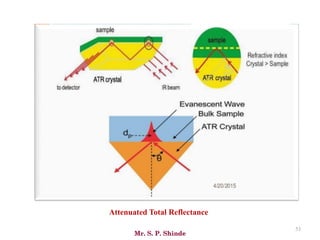
• As shown in the image, the infrared beam enters the ATR crystal at an
angle of typically 45° (relative to the crystal surface) and is totally
reflected at the crystal to sample interface.
• Due to its wave like properties, the light is not reflected directly on the
boundary surface but by a virtual layer within the optically less dense
sample.
• This is called as Goos-Hänchen effect.
Mr. S. P. Shinde
53
Attenuated Total Reflectance
Mr. S. P. Shinde
54
• The fraction of the light wave that reaches into the sample is called
the evanescent wave.
• Its penetration depth is depending on the wavelength, the refractive
indices of ATR crystal and sample and the angle of the entering light
beam.
• Typically it amounts to a few microns (ca. 0.5 - 3 um).
• In those spectral regions where the sample absorbs energy, the
evanescent wave will be attenuated. After one or several internal
reflections, the IR beam exits the ATR crystal and is directed to the
IR-detector.
Continue…
Mr. S. P. Shinde
55
Working of an ATR
• An ATR accessory operates by measuring the changes that occur in an
internally reflected IR beam when the beam comes into contact with a
sample.
• An IR beam is directed onto an optically dense crystal with a high
refractive index at a certain angle.
• This internal reflectance creates an evanescent wave that extends
beyond the surface of the crystal into the sample held in contact with the
crystal.
• Some of the energy of the evanescent wave is absorbed by the sample
and the reflected radiation (some now absorbed by the sample) is
returned to the detector.
• The detector records the attenuated IR beam as an interferogram signal,
which can then be used to generate an IR spectrum.
Mr. S. P. Shinde
56
• ATR is ideal for strongly absorbing or thick samples which often
produce intense peaks when measured by transmission.
• ATR works well for these samples because the intensity of the
evanescent waves decays exponentially with distance from the surface
of the ATR crystal, making the technique generally insensitive to
sample thickness.
• Other solids that are a good fit for ATR include homogeneous solid
samples, the surface layer of a multi-layered solid or the coating on a
solid.
• Even irregular-shaped, hard solids can be analyzed using a hard ATR
crystal material such as diamond. Ideal solids include;
➢ Laminates
➢ Paints
➢ Plastics
➢ Rubbers
➢ Coatings
➢ Natural powders
➢ Solids that can be ground into powder.
Continue…
Mr. S. P. Shinde
57
• ATR is the preferred method for liquid analysis.
• It requires a drop of liquid to be placed on the crystal and it is used for
the analysis of Free-flowing aqueous solutions, viscous liquids,
coatings and biological materials.
Advantages
o The technique requires minimal sample preparation.
o The technique is rapid and the process of cleanup is easy.
o The samples can be analyzed in their natural states thus avoids the
processing of samples.
o The technique is most suitable of thick or strongly absorbing sample
such as black rubber.
Continue…
Mr. S. P. Shinde
58
1. For Solids
• The solids are dissolved in suitable solvents to prepare a concentrated
solution and it is used directly in the IR plates or else the sample is
placed in the IR plates and drop of solvent is placed on it.
• The standard method to prepare solid sample for FTIR spectrometer is
to use KBr.
• About 2 mg of sample and 200 mg KBr are dried and ground.
• The particle size should be unified and less than two micrometers.
• Then, the mixture is squeezed to form transparent pellets which can be
measured directly.
Sample Handling
Mr. S. P. Shinde
59
• The another method is Nujol mull method in which about 5 to 10 mg
of finely ground sample are placed onto the face of a KBr plate, a
small drop of mineral oil is added and the second window is placed on
top.
• With a gentle circular and back-and-forth rubbing motion of the two
windows, evenly distribute the mixture between the plates.
• The mixture should appear slightly translucent, with no bubbles, when
properly prepared.
• The sandwiched plates are placed in the spectrometer and obtain a
spectrum.
Continue…
Mr. S. P. Shinde
60
2. For Liquids
• To prepare a liquid sample to IR analysis, a drop of the liquid is placed
on the face of a highly polished salt plate (such as NaCl, AgCl or
KBr).
• Then a second plate is placed on top of the first plate so as to spread
the liquid in a thin layer between the plates, and clamped the plates
together.
• Finally the liquid is wiped off out of the edge of plate.
• The sandwich plate can be mounted onto the sample holder.
• For liquids with high boiling point or viscous solution, it can be added
in between two NaCl pellets.
• Then the sample is fixed in the cell by skews and measured.
• For volatile liquid sample, it is dissolved in CS2 or CCL to form 10%
solution.
• Then the solution is injected into a liquid cell for measurement.
Mr. S. P. Shinde
61
3. For Gas
• Gas sample needs to be measured in a gas cell with two KBr windows
on each side.
• The gas cell should first be vacuumed.
• Then the sample can be introduced to the gas cell for measurement.
• Sample spectrum to appropriate normal modes of vibrations in the
molecules.
Mr. S. P. Shinde
62
• For interpretation of an IR spectrum the following simple ways are to
be followed.
• At the initial stage one should not attempt to concentrate on all bands
appeared in the IR spectrum.
• Instead, the students should concentrate on the major peaks.
• The authors suggest the students to practice with several IR spectrums
for the typical shape of the peaks and the regions where they appear.
• Some of the tactics for interpretation is explained below.
Analysis and Interpretation of Organic Compounds Based
on FTIR Spectra
Mr. S. P. Shinde
63
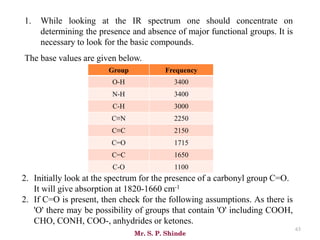
1. While looking at the IR spectrum one should concentrate on
determining the presence and absence of major functional groups. It is
necessary to look for the basic compounds.
The base values are given below.
Group Frequency
O-H 3400
N-H 3400
C-H 3000
C≡N 2250
C≡C 2150
C=O 1715
C=C 1650
C-O 1100
2. Initially look at the spectrum for the presence of a carbonyl group C=O.
It will give absorption at 1820-1660 cm-1
2. If C=O is present, then check for the following assumptions. As there is
'O' there may be possibility of groups that contain 'O' including COOH,
CHO, CONH, COO-, anhydrides or ketones.
Mr. S. P. Shinde
64
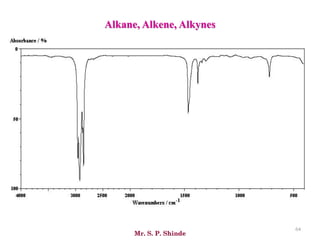
Alkane, Alkene, Alkynes
Mr. S. P. Shinde
65
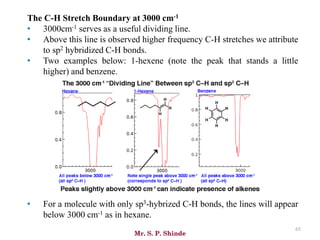
The C-H Stretch Boundary at 3000 cm-1
• 3000cm-1 serves as a useful dividing line.
• Above this line is observed higher frequency C-H stretches we attribute
to sp2 hybridized C-H bonds.
• Two examples below: 1-hexene (note the peak that stands a little
higher) and benzene.
• For a molecule with only sp3-hybrized C-H bonds, the lines will appear
below 3000 cm-1 as in hexane.
Mr. S. P. Shinde
66
• The line at 3000 cm-1 is a useful “border” between alkene C–H (above 3000
cm-1) and alkane C–H (below 3000 cm-1 ) This can quickly help you
determine if double bonds are present.
• A peak in the region around 2200 cm-1 – 2050 cm-1 is a subtle indicator of
the presence of a triple bond [C≡N or C≡C].
Mr. S. P. Shinde
67
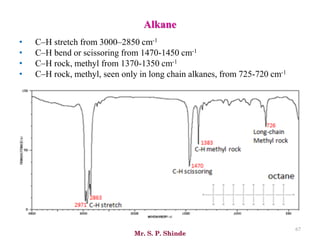
• C–H stretch from 3000–2850 cm-1
• C–H bend or scissoring from 1470-1450 cm-1
• C–H rock, methyl from 1370-1350 cm-1
• C–H rock, methyl, seen only in long chain alkanes, from 725-720 cm-1
Alkane
Mr. S. P. Shinde
68
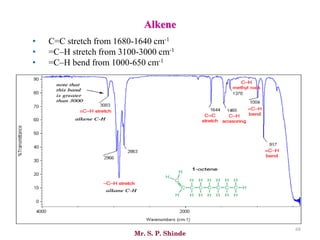
• C=C stretch from 1680-1640 cm-1
• =C–H stretch from 3100-3000 cm-1
• =C–H bend from 1000-650 cm-1
Alkene
Mr. S. P. Shinde
69
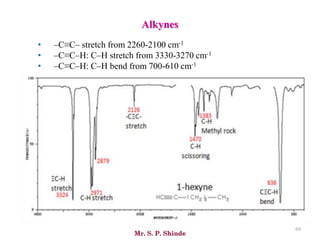
• –C≡C– stretch from 2260-2100 cm-1
• –C≡C–H: C–H stretch from 3330-3270 cm-1
• –C≡C–H: C–H bend from 700-610 cm-1
Alkynes
Mr. S. P. Shinde
70
Alcohols
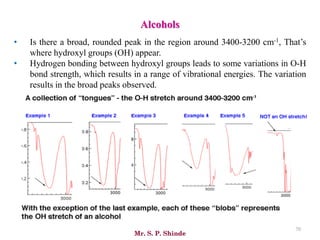
• Is there a broad, rounded peak in the region around 3400-3200 cm-1, That’s
where hydroxyl groups (OH) appear.
• Hydrogen bonding between hydroxyl groups leads to some variations in O-H
bond strength, which results in a range of vibrational energies. The variation
results in the broad peaks observed.
Mr. S. P. Shinde
71
• O–H stretch, hydrogen bonded 3500-3200 cm-1
• C–O stretch 1260-1050 cm-1 (s)
Continue…
Mr. S. P. Shinde
72
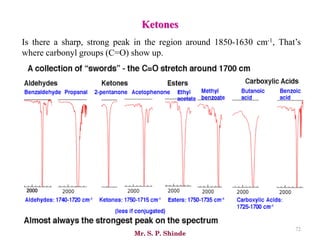
Is there a sharp, strong peak in the region around 1850-1630 cm-1, That’s
where carbonyl groups (C=O) show up.
Ketones
Mr. S. P. Shinde
73
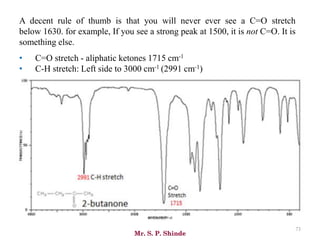
A decent rule of thumb is that you will never ever see a C=O stretch
below 1630. for example, If you see a strong peak at 1500, it is not C=O. It is
something else.
• C=O stretch - aliphatic ketones 1715 cm-1
• C-H stretch: Left side to 3000 cm-1 (2991 cm-1)
Mr. S. P. Shinde
74
Aldehyde
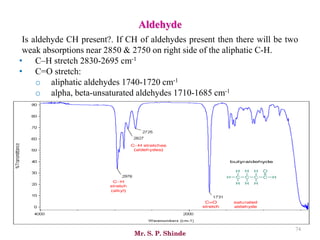
Is aldehyde CH present?. If CH of aldehydes present then there will be two
weak absorptions near 2850 & 2750 on right side of the aliphatic C-H.
• C–H stretch 2830-2695 cm-1
• C=O stretch:
o aliphatic aldehydes 1740-1720 cm-1
o alpha, beta-unsaturated aldehydes 1710-1685 cm-1
Mr. S. P. Shinde
75
Ester
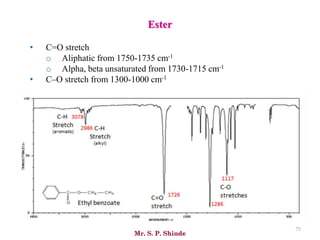
• C=O stretch
o Aliphatic from 1750-1735 cm-1
o Alpha, beta unsaturated from 1730-1715 cm-1
• C–O stretch from 1300-1000 cm-1
Mr. S. P. Shinde
76
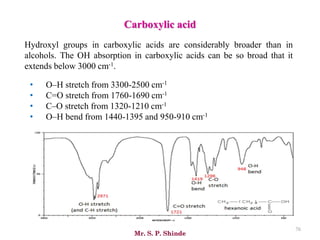
Carboxylic acid
Hydroxyl groups in carboxylic acids are considerably broader than in
alcohols. The OH absorption in carboxylic acids can be so broad that it
extends below 3000 cm-1.
• O–H stretch from 3300-2500 cm-1
• C=O stretch from 1760-1690 cm-1
• C–O stretch from 1320-1210 cm-1
• O–H bend from 1440-1395 and 950-910 cm-1
Mr. S. P. Shinde
77
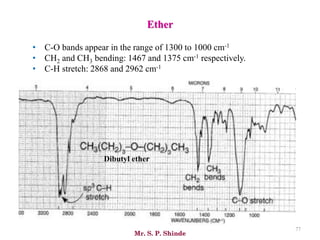
Ether
• C-O bands appear in the range of 1300 to 1000 cm-1
• CH2 and CH3 bending: 1467 and 1375 cm-1 respectively.
• C-H stretch: 2868 and 2962 cm-1
Dibutyl ether
Mr. S. P. Shinde
78
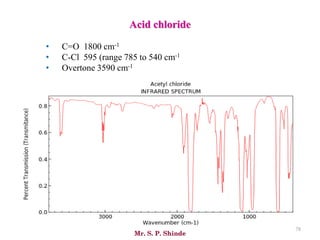
Acid chloride
• C=O 1800 cm-1
• C-Cl 595 (range 785 to 540 cm-1
• Overtone 3590 cm-1
Mr. S. P. Shinde
79
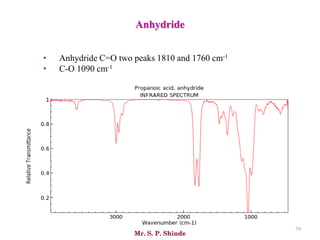
Anhydride
• Anhydride C=O two peaks 1810 and 1760 cm-1
• C-O 1090 cm-1
Mr. S. P. Shinde
80
The position of the C=O stretch varies slightly by carbonyl functional group.
Some ranges (in cm-1 ) are shown below:
1. Aldehydes (1740-1690): benzaldehyde, propanal, pentanal
2. Ketones (1750-1680): 2-pentanone, acetophenone
3. Esters (1750-1735): ethyl acetate, methyl benzoate
4. Carboxylic acids (1780-1710): benzoic acid, butanoic acid
5. Amide (1690-1630): acetamide, benzamide, N,N-dimethyl formamide
(DMF)
6. Anhydrides (2 peaks; 1830-1800 and 1775-1740): acetic anhydride,
benzoic anhydride
Mr. S. P. Shinde
81
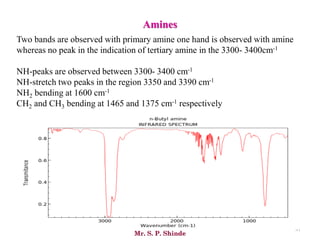
Two bands are observed with primary amine one hand is observed with amine
whereas no peak in the indication of tertiary amine in the 3300- 3400cm-1
NH-peaks are observed between 3300- 3400 cm-1
NH-stretch two peaks in the region 3350 and 3390 cm-1
NH2 bending at 1600 cm-1
CH2 and CH3 bending at 1465 and 1375 cm-1 respectively
Amines
Mr. S. P. Shinde
82
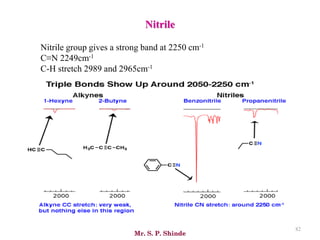
Nitrile
Nitrile group gives a strong band at 2250 cm-1
C≡N 2249cm-1
C-H stretch 2989 and 2965cm-1
Mr. S. P. Shinde
83

Infrared spectroscopy

  • 1.
    Mr. Sanket P.Shinde Assistant Professor Pune-Maharashtra.
  • 2.
    Mr. S. P.Shinde ❑ Infrared spectroscopy is one of the most important analytical technique used for determining the functional group present in both inorganic & organic compounds. ❑ Liquids, solutions, paste, powders, films, fibres, gases, and surfaces can all be examined with a choice of sampling technique. ❑ IR spectroscopy is a technique based on the vibrations of the atom of a molecule. ❑ IR spectroscopy measures the vibrations of atoms, through which it is possible to determine the functional groups. ❑ An infrared spectrum is commonly obtained by passing infrared radiation through a sample and determining the fraction of the incident radiation which is absorbed at a particular energy. ❑ The term infra red covers the range of the electromagnetic spectrum between 0.78 and 1000μm. 2
  • 3.
    Mr. S. P.Shinde Infra red region has been divided into three sections 1. Near infra red region 2. Middle infra red region 3. Far infra red region The wavelength ranges for the above regions are given below. Region Wavelength range (μm) Wave number range (cm-1) Near 0.78-2.5 12800-4000 Middle 2.5-50 4000-200 Far 50-1000 200-10 Continue… 3
  • 4.
    Mr. S. P.Shinde ❑ Atoms or atomic groups in a molecules are in continuous motion with respect to one another. ❑ IR spectra originate from the difference modes of vibration and rotation of a molecule, whereas the UV-visible absorption bands are primarily due to electronic transition. ❑ In order to absorb IR radiation, a molecule must undergo a net change in dipole moment as a consequence of its vibrational or rotational motion. ❑ The dipole moment is determined by the magnitude of the charge difference and the distance between the two centers of charge. ❑ The change in bond length or angle due to vibrational or rotational motion must cause a net change in the dipole moment of the molecule. 4
  • 5.
    Mr. S. P.Shinde ❑ No net change in dipole moment occurs during the vibration or rotation of homonuclear species such as O2, N2, or Cl2; consequently, such compounds cannot absorb in the IR. ❑ Vibrational modes which do not involve a change in dipole moment are said to be IR-inactive. ❑ With exception of a few compounds of this type, all molecular species exhibit IR-active. ❑ The total energy of a molecule at any given moment is defined as the sum of the contributing energy terms: Etotal = EElectronic + Evibrational + Erotational + Etranslation 5 Continue…
  • 6.
    Mr. S. P.Shinde ❑ Among these energies the vibrational energy component is a higher energy term and absorption of energy by a molecule as the component atoms vibrate about the mean centre of their chemical bonds. ❑ The fundamental vibrational frequency of molecule can be expressed by Hooks Law. ❑ Where m1 and m2 are the component masses for the chemical bond under consideration. 6 Continue…
  • 7.
    Mr. S. P.Shinde ❑ Consider a bond and the connected atoms to be a spring with two masses attached. ❑ Using the force constant k and the two masses m1 and m2 then the equation indicates how the frequency of the absorption should change as the properties of the system change. ❑ The hooks law provides link between the strength of the covalent bond, masses of atoms and vibrational frequency. ❑ The greater the masses of attached atoms, the lower the IR frequency at which bond will absorb.  7 Continue…
  • 8.
    Mr. S. P.Shinde 1. For a stronger bond (larger k value), μ increases : As examples of this, in order of increasing bond strength compare: • CC bonds: C−C (1000 cm-1), C=C (1600 cm-1) and C≡C (2200 cm-1) • CH bonds: C−C−H (2900 cm-1), C=C−H (3100 cm-1) and C≡C−H (3300 cm-1) 2. For heavier atoms attached (larger m value), μ decreases : As examples of this, in order of increasing reduced mass compare: • C−H (3000 cm-1) • C−C (1000 cm-1) • C−Cl (800 cm-1) • C−Br (550 cm-1) • C−I (about 500 cm-1) 8 Continue…
  • 9.
    Mr. S. P.Shinde 9 Thus Hook’s Law states : • The vibrational frequency is proportional to the strength of the spring; the stronger the spring; the higher the frequency. • The vibrational frequency inversely proportional to the masses at the ends of the spring; the lighter the weights, the higher the frequency. As per the Hook’s Law : • Stronger bonds absorb at higher frequencies. • Weaker bonds absorb at lower frequencies. • Bonds between lighter atoms absorb at higher frequencies. • Bonds between heavier atoms absorb at lower frequencies. Continue…
  • 10.
    Mr. S. P.Shinde 10 • The positions of atoms in molecules are not fixed; they are subject to a number of different vibrations. • There are two simplest modes of molecular vibrations in a molecule which are infrared active and give rise to absorptions as given below. 1. Stretching vibrations : Stretching vibrations can be explained as the change in inter-atomic distance along bond axis. As shown in the diagram below, the stretching involves vibrations of the atoms towards the centre atom by contraction and expansion movement thus the distance between the atoms changes along the bond axis. Symmetric Asymmetric
  • 11.
    Mr. S. P.Shinde 11 There are two types of stretching vibrations : • Symmetric stretching : Symmetric stretching involves the change in inter atomic distance in equal manner whereas asymmetric stretching involves unequal change. • Asymmetric stretching : Generally asymmetric stretching vibrations occur at higher frequencies than symmetric stretching vibrations. 2. Bending vibrations : • Bending vibrations are explained as change in angle between two bonds. • The atoms vibrate by changing the bond angle between two atoms. • They are also called as deformation vibrations. • Bending vibrations occur at lower frequencies than stretching vibrations. There are four types of bending vibrations which are as follows.
  • 12.
    Mr. S. P.Shinde 12 Rocking: Rocking involves in-plane bending. The atoms are vibrated in the plane of molecule towards one direction. The angle of the bonds changes towards the same direction. Scissoring: Scissoring involves in-plane bending. There will be vibrations of atoms in the plane of molecule towards each other like movement of a scissor. Wagging: Wagging involves out-of -plane bending in which the atoms vibrate near to the attached atom at either side away from the plane. Twisting: Twisting involves out-of-plane bending in which the atoms vibrate in opposite directions away from the plane in twisted manner.
  • 13.
    Mr. S. P.Shinde 13 • Transition from the ground state to the first excited state absorbs light strongly in IR region and give rise to intense bands called the fundamental bands. • These bands in IR spectrum resulted due to the various stretching and bending vibrations. • For example, in a group that contains three or more atoms and at least two of which are identical like, CH3, CH2, NO2, NH, give rise to two modes of stretching vibrations that is symmetric and asymmetric. • The CH3 group gives symmetric stretching vibration at about 2872 cm-1 and an asymmetric stretching vibration at about 2962 cm-1, These types of bands are called as fundamental bands. • These absorptions arise from excitation from the ground state to the lowest energy excited state.
  • 14.
    Mr. S. P.Shinde 14 • Vibrational frequency is defined as the rate at which the atoms of a molecule vibrate. • The vibrational frequencies for each functional groups are unique. • Various functional groups vibrate in different frequencies. • This unique property is used to identify the various functional groups using IR spectrum. • The following table gives a detailed account on vibrational frequencies of various functional groups.
  • 15.
    Mr. S. P.Shinde 15 Typical infrared Absorption Frequencies Functional Class Stretching Vibrations Bending Vibrations Range (cm-1) Intensity Assignment Range (cm-1) Intensity Assignment Alkanes 2850-3000 Strong CH3, CH2 & CH 2 or 3 bands 1350-1470 1370-1390 720-725 medium medium weak CH2 & CH3 deformation CH3 deformation CH2 rocking Alkenes 3020-3100 1630-1680 1900-2000 medium variation strong =C-H & =CH2 (usually sharp) C=C (symmetry reduces intensity) C=C asymmetric stretch 880-995 780-850 675-730 strong medium medium =C-H & =CH2 (out-of-plane bending) cis-RCH=CHR Alkynes 3300 2100-2250 strong variation C-H (usually sharp) C≡C (symmetry reduces intensity) 600-700 strong C-H deformation
  • 16.
    Mr. S. P.Shinde 16 Typical infrared Absorption Frequencies Functional Class Stretching Vibrations Bending Vibrations Range (cm-1) Intensity Assignment Range (cm-1) Intensity Assignment Arenes 3030 1600 & 1500 variation med-weak C-H (may be several bands) C=C (in ring) (2 bands) (3 if conjugated) 690-900 strong-med C-H bending & ring puckering Alcohols & Phenols 3580-3650 3200-3550 970-1250 variation strong strong O-H (free), usually sharp O-H (H-bonded), usually broad C-O 1330-1430 650-770 medium var-weak O-H bending (in- plane) O-H bend (out-of- plane) Amines 3400-3500 (dil. soln.) 3300-3400 (dil. soln.) 1000-1250 weak weak medium N-H (1°-amines), 2 bands N-H (2°-amines) C-N 1550-1650 660-900 med-strong variation NH2 scissoring (1°- amines) NH2 & N-H wagging (shifts on H-bonding)
  • 17.
    Mr. S. P.Shinde 17 Typical infrared Absorption Frequencies Functional Class Stretching Vibrations Bending Vibrations Range (cm-1) Intensity Assignment Range (cm-1) Intensity Assignment Aldehydes & Ketones 2690-2840(2 bands) 1720-1740 1710-1720 1690 1675 1745 1780 medium strong strong strong strong strong strong C-H (aldehyde C-H) C=O (saturated aldehyde) C=O (saturated ketone) aryl ketone α, β-unsaturation cyclopentanone cyclobutanone 1350-1360 1400-1450 1100 strong strong medium α-CH3 bending α-CH2 bending C-C-C bending Carboxylic Acids & Derivatives 2500-3300 (acids) overlap C-H 1705-1720 (acids) 1210-1320 (acids) 1785-1815 ( acyl halides)1750 & 1820 (anhydrides) 1040-1100 1735-1750 (esters) 1000-1300 1630-1695(amides) strong strong med-strong strong strong strong strong strong strong O-H (very broad) C=O (H-bonded) O-C (sometimes 2-peaks) C=O C=O (2-bands) O-C C=O O-C (2-bands) C=O (amide I band) 1395-1440 1590-1650 1500-1560 medium medium medium C-O-H bending N-H (1¡-amide) II band N-H (2¡-amide) II band Nitriles Isocyanates, Isothiocyanates, Diimides, Azides & Ketenes 2240-2260 2100-2270 medium medium C≡N (sharp) -N=C=O, -N=C=S -N=C=N-, -N3, C=C=O
  • 18.
    Mr. S. P.Shinde 18 Functional Class Characteristic Absorptions Sulfur Functions S-H thiols 2550-2600 cm-1 (wk & shp) S-OR esters 700-900 (str) S-S disulfide 500-540 (wk) C=S thiocarbonyl 1050-1200 (str) S=O sulfoxide Sulfone sulfonic acid sulfonyl chloride Sulfate 1030-1060 (str) 1325± 25 (as) & 1140± 20 (s) (both str) 1345 (str) 1365± 5 (as) & 1180± 10 (s) (both str) 1350-1450 (str)
  • 19.
    Mr. S. P.Shinde 19 Functional Class Characteristic Absorptions Phosphorous Functions P-H phosphine 2280-2440 cm-1 (med & shp) 950-1250 (wk) P-H bending (O=)PO-H phosphonic acid 2550-2700 (med) P-OR esters 900-1050 (str) P=O phosphine oxide Phosphonate Phosphate phosphoramide 1100-1200 (str) 1230-1260 (str) 1100-1200 (str) 1200-1275 (str)
  • 20.
    Mr. S. P.Shinde 20 Functional Class Characteristic Absorptions Silicon Functions Si-H silane 2100-2360 cm-1 (str) Si-OR 1000-11000 (str & brd) Si-CH3 1250± 10 (str & shp) Oxidized Nitrogen Functions =NOH oxime O-H (stretch) C=N N-O 3550-3600 cm-1 (str) 1665± 15 945± 15 N-O amine oxide Aliphatic aromatic 960± 20 1250± 50 N=O nitroso nitro 1550± 50 (str) 1530± 20 (as) & 1350± 30 (s)
  • 21.
    Mr. S. P.Shinde 21 • When a fundamental vibration couples with an overtone or combination band it results in different vibration, this coupled vibration is called Fermi resonance. • Fermi resonance results in the splitting of two vibrational bands. • The wave functions for the two resonant vibrations mix according to the harmonic oscillator and the result is a shift in frequency and a change in intensity in the spectrum. • As a result, two strong bands are observed in the spectrum, instead of the expected strong and weak bands. • Example In the given figure, the bands shown in the top represent two fundamental vibrations without Fermi resonance whereas the bands shown in the bottom represent change in bands as a result of Fermi resonance. • The Fermi resonance resulted in increase in energy of first band and decrease in energy of second bang thus resulted in "Fermi doublet".
  • 22.
    Mr. S. P.Shinde 22 Overtones • Overtones occur when a vibrational mode is excited from v=0 to v=2, which is called the first overtone, or v=0 to v=3, the second overtone. • Overtones are generally not detected in larger molecules. Combination Bands • Combination bands are observed when more than two or more fundamental vibrations are excited simultaneously. • One reason a combination band might occur is if a fundamental vibration does not occur because of symmetry. • Combination implies addition of two frequencies, but it also possible to have a difference band where the frequencies are subtracted.
  • 23.
    Mr. S. P.Shinde 23 Vibrational coupling • In addition to the vibrations mentioned above, interaction between vibrations can occur (coupling) if the vibrating bonds are joined to a single, central atom. This is called as vibrational coupling. Vibrational coupling is influenced by a number of factors. 1. When a common atom is present between two bonds and during their vibration coupling of stretching vibrations occurs. When a bond is common between two vibrating groups then coupling of bending vibrations occurs. 2. Coupling between a stretching vibration and a bending vibration occurs If the stretching bond is one side of an angle varied by bending vibration 3. Coupling is greatest when the coupled groups have approximately equal energies. 4. No coupling is seen between groups separated by two or more bonds.
  • 24.
    Mr. S. P.Shinde 24 • A typical infrared spectrum can be visually divided into two regions. • The left half, above 1500 cm-1 called as Functional group region. • The right half from 1500-500 cm-1 called as Fingerprint region. 1. Functional group region : • The first region above 2000 cm-1 usually contains relatively few peaks, but some very diagnostic information can be found in this region. This region is called as functional group region. • First, alkane C- H stretching absorptions just below 3000 cm-1 demonstrate the presence of saturated carbons, and signals just above 3000 cm-1 demonstrate unsaturation. • A very broad peak in the region between 3100 and 3600 cm-1 indicates the presence of exchangeable protons, typically from alcohol, amine, amide or carboxylic acid groups. • The frequencies from 2800 to 2000 cm-1 are normally void of other absorptions, so the presence of alkyne or nitrile groups can be easily seen here. C = O group show absorption at 1715 cm-1
  • 25.
    Mr. S. P.Shinde 25 2. Fingerprint region : • The region is between 1500 to 500 cm-1 usually contains very complex bands of absorptions. • These absorption bands are due to the mainly all manner of bending vibrations within the molecule. This is called the fingerprint region. • During interpretations it is more difficult to characterize individual bonds in this region as compared to the functional group region at higher wave numbers. • The importance of the fingerprint region is that each different compound produces a different pattern of troughs thus useful in interpretation.
  • 26.
    Mr. S. P.Shinde 26
  • 27.
    Mr. S. P.Shinde 27 • Fourier Transform Infrared (FT-IR) spectrometry was developed to overcome the limitations encountered with dispersive instruments. • The main difficulty was the slow scanning process. • A method for measuring all of the infrared frequencies simultaneously, rather than individually as with dispersive instruments • A very simple optical device called an interferometer was developed. • The interferometer produces a unique type of signal which has all of the infrared frequencies "encoded" into it. • The signal can be measured very quickly usually on the order of one second or so. • Thus, the time element per sample is reduced to a matter of a few seconds rather than several minutes. Introduction
  • 28.
    Mr. S. P.Shinde 28 FTIR spectrometers have several prominent advantages: 1. The signal-to-noise ratio of spectrum is significantly higher than the previous generation infrared spectrometers. 2. The accuracy of wave number is high. The error is within the range of ±0.01 cm-1 3. The scan time of all frequencies is short (approximately 1 s). 4. The resolution is extremely high (0.1 -0.005 cm-1). 5. The scan range is wide (1000 - 10 cm-1). 6. The interference from stray light is reduced. Due to these advantages, FTIR Spectrometers have replaced dispersive IR spectrometers.
  • 29.
    Mr. S. P.Shinde 29 Fourier transform infrared spectroscopy is preferred over dispersive or filter methods of infrared spectral analysis for several reasons: • It is a non-destructive technique. • It provides a precise measurement method which requires no external calibration. • It can increase speed, collecting a scan every second. • It can increase sensitivity. • It has greater optical throughput. • It is mechanically simple with only one moving part.
  • 30.
    Mr. S. P.Shinde 30 • FTIR measures all frequencies simultaneously rather individually using an interferometer. • An interferometer is the exceptional component in FTIR compared to the dispersive IR. • All of the infrared frequencies are “encoded" into the signal of interferometer which can be measured very quickly. • Thus Interferometer is used for the rapid analysis. • However the measured interferogram signal cannot be interpreted directly. • Hence frequency spectrum is required which is a plot of the intensity at each individual frequency to make identification. • A means of "decoding” the individual frequencies is required. • This can be accomplished via a well-known mathematical technique called the Fourier transformation. Theory
  • 31.
    Mr. S. P.Shinde 31 • Most interferometers employ a beamsplitter which takes the incoming infrared beam and divides it into two optical beams. • One beam reflects off of a flat mirror which is fixed in place. The other beam reflects off of a flat mirror which is on a mechanism which allows this mirror to move a very short distance (typically a few millimeters) away from the beamsplitter. • The two beams reflect off of their respective mirrors and are recombined when they meet back at the beamsplitter. • Because the path that one beam travels is a fixed length and the other is constantly changing as its mirror moves, the signal which exits the interferometer is the result of these two beams “interfering” with each other. • The resulting signal is called an interferogram which has the unique property that every data point (a function of the moving mirror position). Continue…
  • 32.
    Mr. S. P.Shinde 32 FTIR Instrumentation • The major different between dispersive IR and FTIR is the inclusion of interferometer. • All other components are almost same as like that of a dispersive IR spectrometer. Components are explained individually as follows. 1. Source of light 2. Interferometer 3. Sample compartment 4. Detector 5. Read out device
  • 33.
    Mr. S. P.Shinde 33 Block diagram of FTIR spectrometer
  • 34.
    Mr. S. P.Shinde 34 • IR instruments require a source of radiant energy which emits IR radiation which must be steady, intense enough for detection and extend over the desired wavelength. • In general, an inert solid is electrically heated to a temperature in the range 1500-2000 K. The heated material will then emit infra red radiation. 1. Nernst glower: • The Nernst glower consists of a cylinder made up of rare earth oxides. • The length of the cylinder is 20mm with a diameter of 1-2mm. • At the end of the cylinder platinum wires are attached and a current is passed through the cylinder. • The Nernst glower can reach temperatures of 2200 K. 1. Source of light
  • 35.
    Mr. S. P.Shinde 35 2. Globar source • The Globar source is a silicon carbide rod (5mm diameter, 50mm long) which is electrically heated to about 1500 K. • Water cooling of the electrical contacts is needed to prevent arcing. • The spectral output is comparable with the Nernst glower, except at short wavelengths (less than 5mm) where its output becomes larger. 3. Incandescent wire source • The incandescent wire source is a tightly wound coil of Nichrome wire, electrically heated to 1100 K. • It produces a lower intensity of radiation than the Nernst or Globar sources, but has a longer working life.
  • 36.
    Mr. S. P.Shinde 36 • The interferometer is a basically different component than a monochromator. • The interferometer consists of two mirrors, an infrared light source, an infrared detector, and a beam splitter. • The light passes through a beam splitter, which splits the light in two directions at right angles. • One beam goes to a stationary mirror then back to the beam splitter. • The other goes to a moving mirror. • The motion of the mirror makes the total path length variable versus that taken by the stationary mirror beam. • When the two meet up again at the beam splitter, they recombine, but the difference in path lengths creates constructive and destructive interference thus an interferogram. 2. Interferometer
  • 37.
    Mr. S. P.Shinde 37
  • 38.
    Mr. S. P.Shinde 38 • The recombined beam passes through the sample. • The sample absorbs all the different wavelengths characteristic of its spectrum, and this subtracts specific wavelengths from the interferogram. • The detector reports variation in energy versus time for all wavelengths simultaneously. • A laser beam is superimposed to provide a reference for the instrument operation Continue…
  • 39.
    Mr. S. P.Shinde 39 • The sample compartment in FTIR is designed in such a way to receive the infra red radiation through the sample in a systematic manner. • The sample compartment contains cell holders that hold square cells with optical path lengths of 10 mm. • The various accessories are attached by replacing these cell holder units or by replacing the entire sample compartment. • Among spectrophotometers of medium or higher grade that use photomultipliers, there are models for which large sample compartments are made available in order to allow the analysis of large samples or the attachment of large accessories. 3. Sample Compartment
  • 40.
    Mr. S. P.Shinde 40 • Detectors are used to measure the intensity of unabsorbed infrared radiation. Detectors like thermocouples, Bolometers, thermistors, Golay cell, and pyroelectric detectors are used. 1. Thermocouples detectors : • Thermocouples consist of a pair of junctions of different metals; for example, two pieces of bismuth fused to either end of a piece of antimony. • The potential difference (voltage) between the junctions changes according to the difference in temperature between the junctions. 4. Detectors
  • 41.
    Mr. S. P.Shinde 41 2. Pyroelectric detectors: • Pyroelectric detectors are made from a single crystalline wafer of a pyroelectric material, such as triglycerine sulphate. • The properties of a pyroelectric material are such that when an electric field is applied across it, electric polarisation occurs (this happens in any dielectric material). • In a pyroelectric material, when the field is removed, the polarisation persists. • The degree of polarisation is temperature dependant. • So, by sandwiching the pyroelectric material between two electrodes, a temperature dependant capacitor is made. • The heating effect of incident IR radiation causes a change in the capacitance of the material. • Pyroelectric detectors have a fast response time. • They are used in most Fourier transform IR instruments.
  • 42.
    Mr. S. P.Shinde 42 3. Photoelectric detectors: • Photoelectric detectors such as the mercury cadmium telluride detector comprise a film of semiconducting material deposited on a glass surface, sealed in an evacuated envelope. • Absorption of IR promotes nonconducting valence electrons to a higher, conducting, state. • The electrical resistance of the semiconductor decreases. • These detectors have better response characteristics than pyroelectric detectors and are used in FT-IR instruments particularly in GC-FT-IR.
  • 43.
    Mr. S. P.Shinde 43 5. Readout Device • The readout device is the computing system. Now a days a sophisticated software is involved for the readout. • It provides the IR spectrum in a convenient way. • Various operations such as scan speed scan cycle, peaks deletion and magnifications can be done easily as the system is user friendly.
  • 44.
    Mr. S. P.Shinde 44 Advantages of FTIR • The entire energy from the source gets to the sample, thus signal-to-noise ratio is improved. • Resolution is limited by the design of the interferometer. The longer the path of the moving mirror, the higher the resolution. • The digitization and computer interface allows multiple scans to be collected. • The signal-to-noise ratio of spectrum is significantly higher than the dispersive infrared spectrometers. • The accuracy of wavenumber is high. The error is within the range of ±0.01 cm-1 • The scan time of all frequencies is short (approximately 1 s). • The resolution is extremely high (0.1 -0.005 cm-1). • The scan range is wide (1000 - 10 cm-1). • The interference from stray light is reduced. Due to these advantages, FTIR Spectrometers have replaced dispersive IR spectrometers.
  • 45.
    Mr. S. P.Shinde 45 There are different techniques for the analysis using FTIR which are given below. 1. Specular reflectance 2. Diffusion reflection spectra 3. Transmission (direct and diffuse) 4. Photoacoustic 5. Attenuated total reflectance (ATR) Different attachments used in Recording FTIR
  • 46.
    Mr. S. P.Shinde 46 1. Specular Reflectance (SR) • Specular Reflectance typically occurs from bulk samples with a glossy surface such as crystal faces, glasses, and monolithic polymers. • In this experiment, light is reflected off of a smooth and mirror-like sample to record its spectrum. • Specular reflectance is a non-destructive, non-contact technique that is particularly useful for film thickness measurements and recording spectra of thin films on metal substrates. • These spectra may look different from transmission spectra in many ways. • For example, peaks may be shifted to higher wavenumbers and/or the presence of derivative shaped which indicate a change in refractive index.
  • 47.
    Mr. S. P.Shinde 47 2. Diffuse reflection spectra • Diffuse reflection spectra of powders and rough surfaces can be recorded by illuminating these surfaces and collecting the radiation which is scattered at a wide range of angles with the aid of ellipsoidal collection mirrors. • The spectra collected by this technique may exhibit features of transmission, specular reflection, and/or internal reflection. • In addition, particle size, angle of illumination, and observation can affect a sample's observed spectrum.
  • 48.
    Mr. S. P.Shinde 48 3. Transmission (TR) • Transmission spectroscopy involves passing infrared radiation completely through a sample and measuring the extent of absorption. • Consequently, significant sample preparation may be required as concentration, thickness, homogeneity and particle size must all be considered. • This technique is suitable for sampling gases, liquids, and solids (fibers, microtome cuts, thin films, pressed pellets, and mulls). • The resulting spectrum is an average of the bulk properties of the sample, which depends on the pathlength or sample thickness, the absorption coefficient, and the reflectivity of the sample. • In the case of powders, the spectrum is dependent on both particle size and their orientation within the pellet.
  • 49.
    Mr. S. P.Shinde 49 4. Photoacoustic (PA) • Photoacoustic spectroscopy (PAS) can be quite complex and difficult to perform. • The photoacoustic signal is generated when the infrared radiation absorbed by a sample is converted to heat within the sample. • This heat diffuses to the sample surface and into the adjacent gas atmosphere. • The thermal expansion of this gas produces the photoacoustic signal.
  • 50.
    Mr. S. P.Shinde 50 5. Attenuated Total Reflectance (ATR): • Among all these techniques ATR is quite popular and widely used. • FT-IR spectroscopy allows measuring all types of samples whether they are solid, liquid or gaseous. • Liquid samples need to be filled into a liquid cell with suitable path length; solids typically have to be diluted with the IR-inactive KBr and pressed to the well known “KBr-pellet”. • However, both types of measurement techniques have their drawbacks the making and measurement of a suitable KBr pellet are time-consuming and only experienced operators will get good results. • In many cases, the pellet will be turbid and the baseline of the resulting spectrum will drift due to the influence of the resulting stray light. • Furthermore, the possibility of interactions between the polar KBr and the sample has to be mentioned.
  • 51.
    Mr. S. P.Shinde 51 • In order to overcome these disadvantages of KBr pellets and liquid cells nowadays IR-measurements are mainly performed in ATR mode. • Attenuated Total Reflectance (ATR) is today the most widely used FTIR sampling tool. • ATR generally allows qualitative or quantitative analysis of samples with little or no sample preparation, which results in rapid analysis. • It has the major advantage that the sampling pathlength is very thin and the IR beam deeply penetrate into sample. • This is in contrast to traditional FTIR sampling by transmission where the sample must be prepared by tedious process such as pellet or film preparation. Continue…
  • 52.
    Mr. S. P.Shinde 52 Principle of ATR • The great advantage of ATR is the possibility to measure a wide variety of solid and liquid samples without any complex sample preparation. • The ATR crystal consists of an IR transparent material with a high refractive index and has polished surfaces. • As shown in the image, the infrared beam enters the ATR crystal at an angle of typically 45° (relative to the crystal surface) and is totally reflected at the crystal to sample interface. • Due to its wave like properties, the light is not reflected directly on the boundary surface but by a virtual layer within the optically less dense sample. • This is called as Goos-Hänchen effect.
  • 53.
    Mr. S. P.Shinde 53 Attenuated Total Reflectance
  • 54.
    Mr. S. P.Shinde 54 • The fraction of the light wave that reaches into the sample is called the evanescent wave. • Its penetration depth is depending on the wavelength, the refractive indices of ATR crystal and sample and the angle of the entering light beam. • Typically it amounts to a few microns (ca. 0.5 - 3 um). • In those spectral regions where the sample absorbs energy, the evanescent wave will be attenuated. After one or several internal reflections, the IR beam exits the ATR crystal and is directed to the IR-detector. Continue…
  • 55.
    Mr. S. P.Shinde 55 Working of an ATR • An ATR accessory operates by measuring the changes that occur in an internally reflected IR beam when the beam comes into contact with a sample. • An IR beam is directed onto an optically dense crystal with a high refractive index at a certain angle. • This internal reflectance creates an evanescent wave that extends beyond the surface of the crystal into the sample held in contact with the crystal. • Some of the energy of the evanescent wave is absorbed by the sample and the reflected radiation (some now absorbed by the sample) is returned to the detector. • The detector records the attenuated IR beam as an interferogram signal, which can then be used to generate an IR spectrum.
  • 56.
    Mr. S. P.Shinde 56 • ATR is ideal for strongly absorbing or thick samples which often produce intense peaks when measured by transmission. • ATR works well for these samples because the intensity of the evanescent waves decays exponentially with distance from the surface of the ATR crystal, making the technique generally insensitive to sample thickness. • Other solids that are a good fit for ATR include homogeneous solid samples, the surface layer of a multi-layered solid or the coating on a solid. • Even irregular-shaped, hard solids can be analyzed using a hard ATR crystal material such as diamond. Ideal solids include; ➢ Laminates ➢ Paints ➢ Plastics ➢ Rubbers ➢ Coatings ➢ Natural powders ➢ Solids that can be ground into powder. Continue…
  • 57.
    Mr. S. P.Shinde 57 • ATR is the preferred method for liquid analysis. • It requires a drop of liquid to be placed on the crystal and it is used for the analysis of Free-flowing aqueous solutions, viscous liquids, coatings and biological materials. Advantages o The technique requires minimal sample preparation. o The technique is rapid and the process of cleanup is easy. o The samples can be analyzed in their natural states thus avoids the processing of samples. o The technique is most suitable of thick or strongly absorbing sample such as black rubber. Continue…
  • 58.
    Mr. S. P.Shinde 58 1. For Solids • The solids are dissolved in suitable solvents to prepare a concentrated solution and it is used directly in the IR plates or else the sample is placed in the IR plates and drop of solvent is placed on it. • The standard method to prepare solid sample for FTIR spectrometer is to use KBr. • About 2 mg of sample and 200 mg KBr are dried and ground. • The particle size should be unified and less than two micrometers. • Then, the mixture is squeezed to form transparent pellets which can be measured directly. Sample Handling
  • 59.
    Mr. S. P.Shinde 59 • The another method is Nujol mull method in which about 5 to 10 mg of finely ground sample are placed onto the face of a KBr plate, a small drop of mineral oil is added and the second window is placed on top. • With a gentle circular and back-and-forth rubbing motion of the two windows, evenly distribute the mixture between the plates. • The mixture should appear slightly translucent, with no bubbles, when properly prepared. • The sandwiched plates are placed in the spectrometer and obtain a spectrum. Continue…
  • 60.
    Mr. S. P.Shinde 60 2. For Liquids • To prepare a liquid sample to IR analysis, a drop of the liquid is placed on the face of a highly polished salt plate (such as NaCl, AgCl or KBr). • Then a second plate is placed on top of the first plate so as to spread the liquid in a thin layer between the plates, and clamped the plates together. • Finally the liquid is wiped off out of the edge of plate. • The sandwich plate can be mounted onto the sample holder. • For liquids with high boiling point or viscous solution, it can be added in between two NaCl pellets. • Then the sample is fixed in the cell by skews and measured. • For volatile liquid sample, it is dissolved in CS2 or CCL to form 10% solution. • Then the solution is injected into a liquid cell for measurement.
  • 61.
    Mr. S. P.Shinde 61 3. For Gas • Gas sample needs to be measured in a gas cell with two KBr windows on each side. • The gas cell should first be vacuumed. • Then the sample can be introduced to the gas cell for measurement. • Sample spectrum to appropriate normal modes of vibrations in the molecules.
  • 62.
    Mr. S. P.Shinde 62 • For interpretation of an IR spectrum the following simple ways are to be followed. • At the initial stage one should not attempt to concentrate on all bands appeared in the IR spectrum. • Instead, the students should concentrate on the major peaks. • The authors suggest the students to practice with several IR spectrums for the typical shape of the peaks and the regions where they appear. • Some of the tactics for interpretation is explained below. Analysis and Interpretation of Organic Compounds Based on FTIR Spectra
  • 63.
    Mr. S. P.Shinde 63 1. While looking at the IR spectrum one should concentrate on determining the presence and absence of major functional groups. It is necessary to look for the basic compounds. The base values are given below. Group Frequency O-H 3400 N-H 3400 C-H 3000 C≡N 2250 C≡C 2150 C=O 1715 C=C 1650 C-O 1100 2. Initially look at the spectrum for the presence of a carbonyl group C=O. It will give absorption at 1820-1660 cm-1 2. If C=O is present, then check for the following assumptions. As there is 'O' there may be possibility of groups that contain 'O' including COOH, CHO, CONH, COO-, anhydrides or ketones.
  • 64.
    Mr. S. P.Shinde 64 Alkane, Alkene, Alkynes
  • 65.
    Mr. S. P.Shinde 65 The C-H Stretch Boundary at 3000 cm-1 • 3000cm-1 serves as a useful dividing line. • Above this line is observed higher frequency C-H stretches we attribute to sp2 hybridized C-H bonds. • Two examples below: 1-hexene (note the peak that stands a little higher) and benzene. • For a molecule with only sp3-hybrized C-H bonds, the lines will appear below 3000 cm-1 as in hexane.
  • 66.
    Mr. S. P.Shinde 66 • The line at 3000 cm-1 is a useful “border” between alkene C–H (above 3000 cm-1) and alkane C–H (below 3000 cm-1 ) This can quickly help you determine if double bonds are present. • A peak in the region around 2200 cm-1 – 2050 cm-1 is a subtle indicator of the presence of a triple bond [C≡N or C≡C].
  • 67.
    Mr. S. P.Shinde 67 • C–H stretch from 3000–2850 cm-1 • C–H bend or scissoring from 1470-1450 cm-1 • C–H rock, methyl from 1370-1350 cm-1 • C–H rock, methyl, seen only in long chain alkanes, from 725-720 cm-1 Alkane
  • 68.
    Mr. S. P.Shinde 68 • C=C stretch from 1680-1640 cm-1 • =C–H stretch from 3100-3000 cm-1 • =C–H bend from 1000-650 cm-1 Alkene
  • 69.
    Mr. S. P.Shinde 69 • –C≡C– stretch from 2260-2100 cm-1 • –C≡C–H: C–H stretch from 3330-3270 cm-1 • –C≡C–H: C–H bend from 700-610 cm-1 Alkynes
  • 70.
    Mr. S. P.Shinde 70 Alcohols • Is there a broad, rounded peak in the region around 3400-3200 cm-1, That’s where hydroxyl groups (OH) appear. • Hydrogen bonding between hydroxyl groups leads to some variations in O-H bond strength, which results in a range of vibrational energies. The variation results in the broad peaks observed.
  • 71.
    Mr. S. P.Shinde 71 • O–H stretch, hydrogen bonded 3500-3200 cm-1 • C–O stretch 1260-1050 cm-1 (s) Continue…
  • 72.
    Mr. S. P.Shinde 72 Is there a sharp, strong peak in the region around 1850-1630 cm-1, That’s where carbonyl groups (C=O) show up. Ketones
  • 73.
    Mr. S. P.Shinde 73 A decent rule of thumb is that you will never ever see a C=O stretch below 1630. for example, If you see a strong peak at 1500, it is not C=O. It is something else. • C=O stretch - aliphatic ketones 1715 cm-1 • C-H stretch: Left side to 3000 cm-1 (2991 cm-1)
  • 74.
    Mr. S. P.Shinde 74 Aldehyde Is aldehyde CH present?. If CH of aldehydes present then there will be two weak absorptions near 2850 & 2750 on right side of the aliphatic C-H. • C–H stretch 2830-2695 cm-1 • C=O stretch: o aliphatic aldehydes 1740-1720 cm-1 o alpha, beta-unsaturated aldehydes 1710-1685 cm-1
  • 75.
    Mr. S. P.Shinde 75 Ester • C=O stretch o Aliphatic from 1750-1735 cm-1 o Alpha, beta unsaturated from 1730-1715 cm-1 • C–O stretch from 1300-1000 cm-1
  • 76.
    Mr. S. P.Shinde 76 Carboxylic acid Hydroxyl groups in carboxylic acids are considerably broader than in alcohols. The OH absorption in carboxylic acids can be so broad that it extends below 3000 cm-1. • O–H stretch from 3300-2500 cm-1 • C=O stretch from 1760-1690 cm-1 • C–O stretch from 1320-1210 cm-1 • O–H bend from 1440-1395 and 950-910 cm-1
  • 77.
    Mr. S. P.Shinde 77 Ether • C-O bands appear in the range of 1300 to 1000 cm-1 • CH2 and CH3 bending: 1467 and 1375 cm-1 respectively. • C-H stretch: 2868 and 2962 cm-1 Dibutyl ether
  • 78.
    Mr. S. P.Shinde 78 Acid chloride • C=O 1800 cm-1 • C-Cl 595 (range 785 to 540 cm-1 • Overtone 3590 cm-1
  • 79.
    Mr. S. P.Shinde 79 Anhydride • Anhydride C=O two peaks 1810 and 1760 cm-1 • C-O 1090 cm-1
  • 80.
    Mr. S. P.Shinde 80 The position of the C=O stretch varies slightly by carbonyl functional group. Some ranges (in cm-1 ) are shown below: 1. Aldehydes (1740-1690): benzaldehyde, propanal, pentanal 2. Ketones (1750-1680): 2-pentanone, acetophenone 3. Esters (1750-1735): ethyl acetate, methyl benzoate 4. Carboxylic acids (1780-1710): benzoic acid, butanoic acid 5. Amide (1690-1630): acetamide, benzamide, N,N-dimethyl formamide (DMF) 6. Anhydrides (2 peaks; 1830-1800 and 1775-1740): acetic anhydride, benzoic anhydride
  • 81.
    Mr. S. P.Shinde 81 Two bands are observed with primary amine one hand is observed with amine whereas no peak in the indication of tertiary amine in the 3300- 3400cm-1 NH-peaks are observed between 3300- 3400 cm-1 NH-stretch two peaks in the region 3350 and 3390 cm-1 NH2 bending at 1600 cm-1 CH2 and CH3 bending at 1465 and 1375 cm-1 respectively Amines
  • 82.
    Mr. S. P.Shinde 82 Nitrile Nitrile group gives a strong band at 2250 cm-1 C≡N 2249cm-1 C-H stretch 2989 and 2965cm-1
  • 83.
    Mr. S. P.Shinde 83