ENERGY SOURCES FOR MUSCLES
DR Phiri S B
INTRODUCTION
• Muscle contraction requires energy and muscles work by
converting chemical energy into mechanical work.
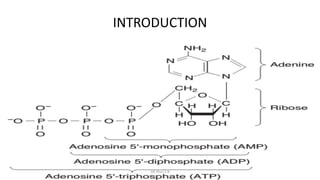
• The immediate source of energy for muscle contraction is ATP,
and ATP is formed by the metabolism of carbohydrates, lipids
and amino acids.
DR Phiri S B
METABOLIC SYSTEMS
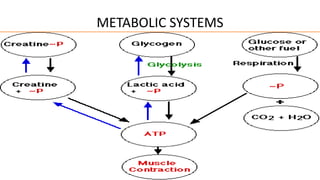
• There are 3 main metabolic systems which provide energy required
for muscle contraction:
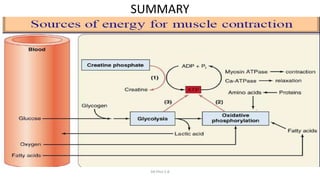
(1) the phosphocreatine-creatine system,
(2) the glycogen-lactic acid system, and
(3) the aerobic system.
DR Phiri S B
PHOSPHOCREATINE-CREATINE SYSTEM• The phosphocreatine-creatine system is used during periods of high
activity (eg. During a 100m dash)
• During periods of high activity, cycling of phosphorylcreatine allows
for quick release of ATP to sustain muscle activity.
• At rest, some ATP in the mitochondria transfers its phosphate to
creatine, so that a phosphorylcreatine store is built up.
• During exercise, the phosphorylcreatine is hydrolyzed at the junction
between the myosin heads and actin, forming ATP from ADP and thus
permitting contraction to continue
DR Phiri S B
GLYCOGEN-LACTIC ACID SYSTEM
The stored glycogen in muscle can be split into glucose and the glucose then used for energy. The
initial stage of this process, called glycolysis, occurs without use of oxygen and, therefore, is said
to be anaerobic metabolism.
During glycolysis, each glucose molecule is split into two pyruvic acid molecules, and energy is
released to form four ATP molecules for each original glucose molecule.
Ordinarily, the pyruvic acid then enters the mitochondria of the muscle cells and reacts with
oxygen to form still many more ATP molecules.
However, when there is insufficient oxygen for this second stage (the oxidative stage) of glucose
metabolism to occur, most of the pyruvic acid then is converted into lactic acid, which diffuses
out of the muscle cells into the interstitial fluid and blood.
Therefore, much of the muscle glycogen is transformed to lactic acid, but in doing so,
considerable amounts of ATP are formed entirely without the consumption of oxygen.
DR Phiri S B
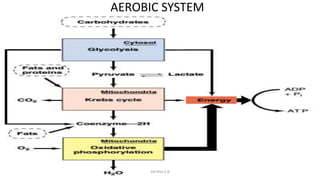
AEROBIC SYSTEM
DR Phiri S B
AT REST/LIGHT EXERCISE
• At rest and during light exercise (i.e., below 50% of maximal
contraction capacity), muscles utilize lipids in the form of free
fatty acids as their energy source.
• As the intensity of exercise increases, lipids alone cannot
supply energy fast enough and so use of carbohydrate
becomes the predominant component in the muscle fuel
mixture.
DR Phiri S B
PROTEINS
• In the absence of other fuels, protein can serve as
an energy source for contraction.
• However, protein is used by muscles for fuel
mainly during dieting and starvation or during
heavy exercise.
DR Phiri S B
SUMMARY
DR Phiri S B
Types of Muscle fiber
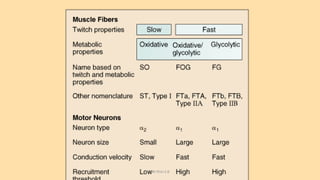
• Slow twitch (I) fibers innervated by alpha 2 motor neurons,
smaller of the two α motor neurons
• Fast twitch (II) fibers innervated by alpha 1 motor neurons,
larger of the two α motor neurons
• Fast twitch (II) fibers have higher excitation threshold and
faster conduction velocity
DR Phiri S B
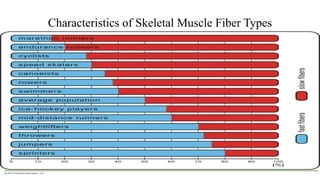
Characteristics of Skeletal Muscle Fiber Types
DR Phiri S B
Properties of motor units
DR Phiri S B
DR Phiri S B
 A single neural stimulation produces a single contraction or
twitch which lasts about 7-100msec
 Sustained muscular contractions require many repeated
stimuli
DR Phiri S B
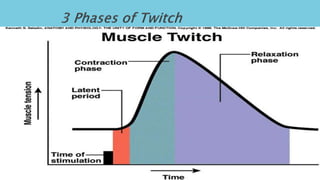
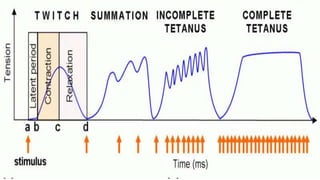
1. Latent period before contraction:
◦ the action potential moves through sarcolemma
◦ causing Ca2+
release
2. Contraction phase:
◦ calcium ions bind
◦ tension builds to peak
3. Relaxation phase:
◦ Ca2+
levels fall
◦ active sites are covered
◦ tension falls to resting levels
DR Phiri S B
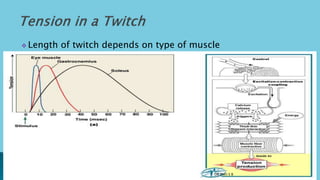
Figure 10–15a (Navigator)
 Length of twitch depends on type of muscle
DR Phiri S B
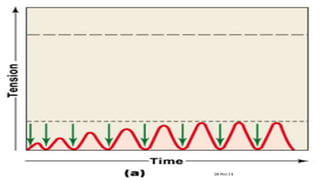
 A phenomenon in cardiac/Skeletal muscle
 The occurrence of a successive increase in amplitude of the
first few contractions of skeletal muscle that has received a
number of stimuli of the same intensity following a quiescent
period. Also called staircase phenomenon
 Repeated stimulations immediately after relaxation phase:
stimulus frequency < 50/second
 Causes a series of contractions with increasing tension
DR Phiri S B
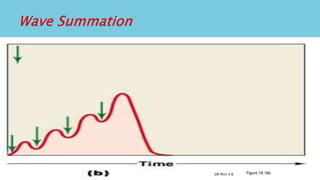
 Increasing tension or summation of twitches
 Occurs if a muscle is stimulated again before full relaxation
 Repeated stimulations before the end of relaxation phase:
stimulus frequency > 50/second
 Causes increasing tension or summation of twitches
Figure 10–16bDR Phiri S B
 Also called tetanized state or tetanus, occurs when a motor unit has
been maximally stimulated by it’s motor neuron
 Occurs when a muscles motor unit is stimulated by multiple impulses
at a sufficiently high frequency
 If stimuli are delivered at a high frequency, the twitches will overlap
resulting in tetanic contractions
 When tetanized, the contracting tension in the muscle remains
constant in a steady state. This is the maximal possible contraction
Incomplete Tetanus
 If rapid stimulation continues
and muscle is not allowed to
relax, twitches reach
maximum level of tension
Complete Tetanus
If stimulation frequency is high
enough, muscle never begins to relax,
and is in continuous contraction
DR Phiri S B
THANK
YOU
Physiology is sweet
DR Phiri S B

10. muscle energy lecture 5

  • 1.
    ENERGY SOURCES FORMUSCLES DR Phiri S B
  • 2.
    INTRODUCTION • Muscle contractionrequires energy and muscles work by converting chemical energy into mechanical work. • The immediate source of energy for muscle contraction is ATP, and ATP is formed by the metabolism of carbohydrates, lipids and amino acids. DR Phiri S B
  • 3.
    METABOLIC SYSTEMS • Thereare 3 main metabolic systems which provide energy required for muscle contraction: (1) the phosphocreatine-creatine system, (2) the glycogen-lactic acid system, and (3) the aerobic system. DR Phiri S B
  • 4.
    PHOSPHOCREATINE-CREATINE SYSTEM• Thephosphocreatine-creatine system is used during periods of high activity (eg. During a 100m dash) • During periods of high activity, cycling of phosphorylcreatine allows for quick release of ATP to sustain muscle activity. • At rest, some ATP in the mitochondria transfers its phosphate to creatine, so that a phosphorylcreatine store is built up. • During exercise, the phosphorylcreatine is hydrolyzed at the junction between the myosin heads and actin, forming ATP from ADP and thus permitting contraction to continue DR Phiri S B
  • 5.
    GLYCOGEN-LACTIC ACID SYSTEM Thestored glycogen in muscle can be split into glucose and the glucose then used for energy. The initial stage of this process, called glycolysis, occurs without use of oxygen and, therefore, is said to be anaerobic metabolism. During glycolysis, each glucose molecule is split into two pyruvic acid molecules, and energy is released to form four ATP molecules for each original glucose molecule. Ordinarily, the pyruvic acid then enters the mitochondria of the muscle cells and reacts with oxygen to form still many more ATP molecules. However, when there is insufficient oxygen for this second stage (the oxidative stage) of glucose metabolism to occur, most of the pyruvic acid then is converted into lactic acid, which diffuses out of the muscle cells into the interstitial fluid and blood. Therefore, much of the muscle glycogen is transformed to lactic acid, but in doing so, considerable amounts of ATP are formed entirely without the consumption of oxygen. DR Phiri S B
  • 6.
  • 7.
    AT REST/LIGHT EXERCISE •At rest and during light exercise (i.e., below 50% of maximal contraction capacity), muscles utilize lipids in the form of free fatty acids as their energy source. • As the intensity of exercise increases, lipids alone cannot supply energy fast enough and so use of carbohydrate becomes the predominant component in the muscle fuel mixture. DR Phiri S B
  • 8.
    PROTEINS • In theabsence of other fuels, protein can serve as an energy source for contraction. • However, protein is used by muscles for fuel mainly during dieting and starvation or during heavy exercise. DR Phiri S B
  • 9.
  • 10.
    Types of Musclefiber • Slow twitch (I) fibers innervated by alpha 2 motor neurons, smaller of the two α motor neurons • Fast twitch (II) fibers innervated by alpha 1 motor neurons, larger of the two α motor neurons • Fast twitch (II) fibers have higher excitation threshold and faster conduction velocity DR Phiri S B
  • 11.
    Characteristics of SkeletalMuscle Fiber Types DR Phiri S B
  • 12.
    Properties of motorunits DR Phiri S B
  • 13.
  • 14.
     A singleneural stimulation produces a single contraction or twitch which lasts about 7-100msec  Sustained muscular contractions require many repeated stimuli DR Phiri S B
  • 15.
    1. Latent periodbefore contraction: ◦ the action potential moves through sarcolemma ◦ causing Ca2+ release 2. Contraction phase: ◦ calcium ions bind ◦ tension builds to peak 3. Relaxation phase: ◦ Ca2+ levels fall ◦ active sites are covered ◦ tension falls to resting levels DR Phiri S B
  • 16.
    Figure 10–15a (Navigator) Length of twitch depends on type of muscle DR Phiri S B
  • 17.
     A phenomenonin cardiac/Skeletal muscle  The occurrence of a successive increase in amplitude of the first few contractions of skeletal muscle that has received a number of stimuli of the same intensity following a quiescent period. Also called staircase phenomenon  Repeated stimulations immediately after relaxation phase: stimulus frequency < 50/second  Causes a series of contractions with increasing tension DR Phiri S B
  • 18.
     Increasing tensionor summation of twitches  Occurs if a muscle is stimulated again before full relaxation  Repeated stimulations before the end of relaxation phase: stimulus frequency > 50/second  Causes increasing tension or summation of twitches Figure 10–16bDR Phiri S B
  • 19.
     Also calledtetanized state or tetanus, occurs when a motor unit has been maximally stimulated by it’s motor neuron  Occurs when a muscles motor unit is stimulated by multiple impulses at a sufficiently high frequency  If stimuli are delivered at a high frequency, the twitches will overlap resulting in tetanic contractions  When tetanized, the contracting tension in the muscle remains constant in a steady state. This is the maximal possible contraction Incomplete Tetanus  If rapid stimulation continues and muscle is not allowed to relax, twitches reach maximum level of tension Complete Tetanus If stimulation frequency is high enough, muscle never begins to relax, and is in continuous contraction DR Phiri S B
  • 20.

Editor's Notes

  • #3 By definition, energy is the property of matter and radiation which is manifested as a capacity to perform work. It is the power derived from physical or chemical resources to provide light and heat, or to work machines. The bonds attaching the last two phosphate radicals to the molecule, are high energy phosphate bonds. Each of these bonds stores 7300 calories of energy per mole of ATP under standard conditions (and even slightly more than this under the physical conditions in the body).
  • #5 Phosphocreatine (also called creatine phosphate) is A chemical compound that has a high-energy phosphate bond. Phosphocreatine can decompose to creatine and phosphate ion, and in doing so release large amounts of energy. In fact, the high-energy phosphate bond of phosphocreatine has more energy than the bond of ATP, 10,300 calories per mole in comparison with 7300. Therefore, phosphocreatine can easily provide enough energy to reconstitute the high-energy bond of ATP. Furthermore, most muscle cells have two to four times as much phosphocreatine as ATP. A special characteristic of energy transfer from phosphocreatine to ATP is that it occurs within a small fraction of a second. Therefore, all the energy stored in the muscle phosphocreatine is almost instantaneously available for muscle contraction, just as is the energy stored in ATP. The combined amounts of cell ATP and cell phosphocreatine are called the phosphagen energy system. These together can provide maximal muscle power for 8 to 10 seconds, almost enough for the 100-meter run. Thus, the energy from the phosphagen system is used for maximal short bursts of muscle power. The creatine phosphate pool is restored by ATP from the various cellular metabolic pathways. Because of the chemical equilibria involved, the concentration of PCr can fall to very low levels before the ATP concentration shows a significant decline. It has been shown experimentally that when 90% of PCr has been used, the ATP concentration has fallen by only 10%. This situation results in a steady source of ATP for contraction that is maintained despite variations in energy supply and demand. Creatine phosphate is the most important storage form of high-energy phosphate; together with some other smaller sources, this energy reserve is sometimes called the creatine phosphate pool.
  • #6 Another characteristic of the glycogen-lactic acid system is that it can form ATP molecules about 2.5 times as rapidly as can the oxidative mechanism of the mitochondria. Therefore, when large amounts of ATP are required for short to moderate periods of muscle contraction, this anaerobic glycolysis mechanism can be used as a rapid source of energy. It is, however, only about one half as rapid as the phosphagen system. Under optimal conditions, the glycogen-lactic acid system can provide 1.3 to 1.6 minutes of maximal muscle activity in addition to the 8 to 10 seconds provided by the phosphagen system, although at somewhat reduced muscle power.
  • #7  Glucose is the preferred fuel for skeletal muscle contraction at higher levels of exercise. At maximal work levels, almost all the energy used is derived from glucose produced by glycogen breakdown in muscle tissue and from bloodborne glucose from dietary sources. Glycogen breakdown increases rapidly during the first tens of seconds of vigorous exercise. This breakdown, and the subsequent entry of glucose into the glycolytic pathway, is catalyzed by the enzyme phosphorylase a. This enzyme is transformed from its inactive phosphorylase b form by a “cascade” of protein kinase reactions whose action is, in turn, stimulated by the increased Ca2 concentration and metabolite (especially AMP) levels associated with muscle contraction. Increased levels of circulating epinephrine (associated with exercise), acting through cAMP, also increase glycogen breakdown. Sustained exercise can lead to substantial depletion of glycogen stores, which can restrict further muscle activity.
  • #8 At lower exercise levels (i.e., below 50% of maximal capacity) fats may provide 50 to 60% of the energy for muscle contraction. Fat, the major energy store in the body, is mobilized from adipose tissue to provide metabolic fuel in the form of free fatty acids. This process is slower than the liberation of glucose from glycogen and cannot keep pace with the high demands of heavy exercise. Moderate activity, with brief rest periods, favours the consumption of fat as muscle fuel. Fatty acids enter the Krebs cycle at the acetyl-CoA-citrate step. Complete combustion of fat yields less ATP per mole of oxygen consumed than for glucose, but its high energy storage capacity (the equivalent of 138 moles of ATP per mole of a typical fatty acid) makes it an ideal energy store. The depletion of body fat reserves is almost never a limiting factor in muscle activity.
  • #9 protein is used by muscles for fuel mainly during dieting and starvation or during heavy exercise. Under such conditions, proteins are broken down into amino acids that provide energy for contraction and that can be resynthesized into glucose (gluconeogenesis) to meet other needs.
  • #10 The major metabolic processes of skeletal muscle. These processes center on the supply of ATP for the actomyosin ATPase of the cross-bridges. Energy sources are numbered in order of their proximity to the actual reactions of the cross-bridge cycle. Energy is used by the cell in an A, B, and C order. The scheme shown here is typical for all types of muscle, although there are specific quantitative and qualitative variations.