SECTOR THEORY
SUKHBIR SINGH
111214052
HOMER HOYT(1895–1984)
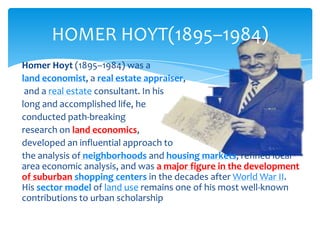
Homer Hoyt (1895–1984) was a
land economist, a real estate appraiser,
and a real estate consultant. In his
long and accomplished life, he
conducted path-breaking
research on land economics,
developed an influential approach to
the analysis of neighborhoods and housing markets, refined local
area economic analysis, and was a major figure in the development
of suburban shopping centers in the decades after World War II.
His sector model of land use remains one of his most well-known
contributions to urban scholarship
Sector Model
theory of urban structure
also known as Hoyt Model
developed in 1939 by Homer Hoyt
states that a city develops in sectors, not
rings
certain areas are more attractive for
different activities because of an
environmental factor or by mere chance.
Hoyt modified the concentric zone model
to account for major transportation
routes
according to this model most major cities
evolved around the nexus of several
important transport facilities such as
railroads, sea ports, and trolly lines that
eminated from the city's center.
Hoyt theorized that cities would tend to
grow in wedge-shaped patterns, or
sectors, eminating from the CBD and
centered on major transportation routes.
It is a monocentric representation of urban areas
He posited a CBD around which other land uses cluster
But important factor is not distance from CBD as in the concentric
zone model, but direction away from CBD
As growth occurs, similar activities
stay in the same area and extend outwards
The Hoyt model realized that transportation (in particular) and
access to resources caused a disruption of the Burgess model.
For example a rail line or major highway to a nearby city may
result in business development to preferentially develop parallel
to the rail line or major highway. So one side of a city may be
completely industrial with another sector may be completely
rural.
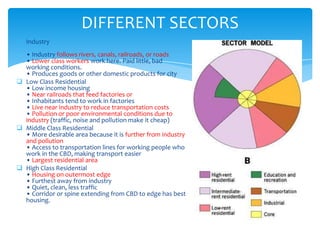
DIFFERENT SECTORS
 Industry
• Industry follows rivers, canals, railroads, or roads
• Lower class workers work here. Paid little, bad
working conditions.
• Produces goods or other domestic products for city
 Low Class Residential
• Low income housing
• Near railroads that feed factories or
• Inhabitants tend to work in factories
• Live near industry to reduce transportation costs
• Pollution or poor environmental conditions due to
industry (traffic, noise and pollution make it cheap)
 Middle Class Residential
• More desirable area because it is further from industry
and pollution
• Access to transportation lines for working people who
work in the CBD, making transport easier
• Largest residential area
 High Class Residential
• Housing on outermost edge
• Furthest away from industry
• Quiet, clean, less traffic
• Corridor or spine extending from CBD to edge has best
housing.
+VE & -VE

Where it does and doesn’t apply (some weaknesses)
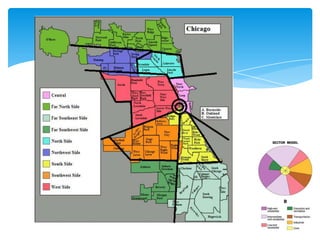
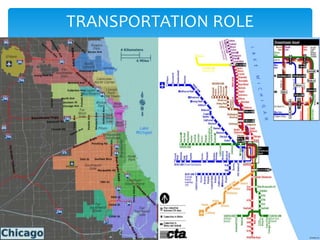
Applies well to Chicago
Low cost housing is near industry and transportation
proving Hoyt’s model
Theory based on 20th century and does not take into
account cars which make commerce easier
With cars, people can live anywhere and further from the
city and still travel to the CBD using their car. Not only do
high-class residents have cars, but also middle and lower
class people may have cars.
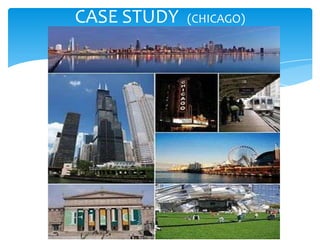
CASE STUDY

(CHICAGO)
BREIF INTRO

Chicago, a city in the U.S. state of Illinois, is the third most
populous city in the United States and the most populous
city in the American Midwest; with approximately
2.7 million residents. Its metropolitan area (also called
"Chicagoland"), which extends
into Indiana and Wisconsin, is the third-largest in the
United States, after those of New York City and Los
Angeles, with an estimated 9.5 million people. Chicago is
the county seat of Cook County,though a small portion of
the city limits also extends into DuPage County.
TRANSPORTATION ROLE
CASE STUDY (SHIVAJINAGAR)
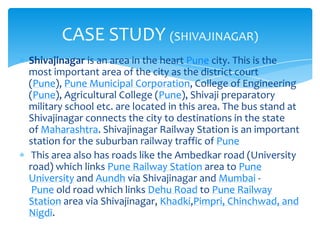
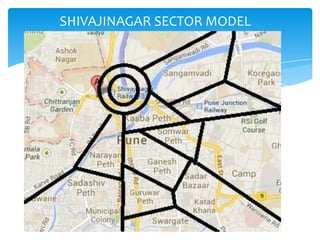
Shivajinagar is an area in the heart Pune city. This is the
most important area of the city as the district court
(Pune), Pune Municipal Corporation, College of Engineering
(Pune), Agricultural College (Pune), Shivaji preparatory
military school etc. are located in this area. The bus stand at
Shivajinagar connects the city to destinations in the state
of Maharashtra. Shivajinagar Railway Station is an important
station for the suburban railway traffic of Pune
This area also has roads like the Ambedkar road (University
road) which links Pune Railway Station area to Pune
University and Aundh via Shivajinagar and Mumbai Pune old road which links Dehu Road to Pune Railway
Station area via Shivajinagar, Khadki,Pimpri, Chinchwad, and
Nigdi.
SHIVAJINAGAR SECTOR MODEL
inference

Decentralization (or decentralisation) is the process of
redistributing or dispersing functions, powers, people or
things away from a central location or authority.[1][2] While
decentralization, especially in the governmental sphere, is
widely studied and practiced, there is no common
definition or understanding of decentralization. The
meaning of decentralization may vary in part because of
the different ways it is
Benefits—less tax,have to leave some space for residential
use
Mixed land use

Mixed-use development is — in a broad sense — any
urban, suburban or village development, or even a single
building, that blends a combination of
residential, commercial, cultural, institutional, or industrial
uses, where those functions are physically and functionally
integrated, and that provides pedestrian
connections.[1][2] The term ("a mixed-use development")
may also be used more specifically to refer to a mixed-use
real estate development project — a building, complex of
buildings, or district of a town or city that is developed for
mixed-use by a private developer, (quasi-)governmental
agency, or a combination thereof
benefits include:[3]
greater housing variety and density
reduced distances between
housing, workplaces, retail businesses, and other
destinations
more compact development
stronger neighborhood character
pedestrian and bicycle-friendly environments
Special landuse city
Knowledge city—dubai ,alwar
IT city—silicion valley,banglore

Sector theory

  • 1.
  • 2.
    HOMER HOYT(1895–1984) Homer Hoyt(1895–1984) was a land economist, a real estate appraiser, and a real estate consultant. In his long and accomplished life, he conducted path-breaking research on land economics, developed an influential approach to the analysis of neighborhoods and housing markets, refined local area economic analysis, and was a major figure in the development of suburban shopping centers in the decades after World War II. His sector model of land use remains one of his most well-known contributions to urban scholarship
  • 3.
    Sector Model theory ofurban structure also known as Hoyt Model developed in 1939 by Homer Hoyt states that a city develops in sectors, not rings certain areas are more attractive for different activities because of an environmental factor or by mere chance. Hoyt modified the concentric zone model to account for major transportation routes according to this model most major cities evolved around the nexus of several important transport facilities such as railroads, sea ports, and trolly lines that eminated from the city's center. Hoyt theorized that cities would tend to grow in wedge-shaped patterns, or sectors, eminating from the CBD and centered on major transportation routes.
  • 4.
    It is amonocentric representation of urban areas He posited a CBD around which other land uses cluster But important factor is not distance from CBD as in the concentric zone model, but direction away from CBD As growth occurs, similar activities stay in the same area and extend outwards The Hoyt model realized that transportation (in particular) and access to resources caused a disruption of the Burgess model. For example a rail line or major highway to a nearby city may result in business development to preferentially develop parallel to the rail line or major highway. So one side of a city may be completely industrial with another sector may be completely rural.
  • 5.
    DIFFERENT SECTORS  Industry •Industry follows rivers, canals, railroads, or roads • Lower class workers work here. Paid little, bad working conditions. • Produces goods or other domestic products for city  Low Class Residential • Low income housing • Near railroads that feed factories or • Inhabitants tend to work in factories • Live near industry to reduce transportation costs • Pollution or poor environmental conditions due to industry (traffic, noise and pollution make it cheap)  Middle Class Residential • More desirable area because it is further from industry and pollution • Access to transportation lines for working people who work in the CBD, making transport easier • Largest residential area  High Class Residential • Housing on outermost edge • Furthest away from industry • Quiet, clean, less traffic • Corridor or spine extending from CBD to edge has best housing.
  • 6.
    +VE & -VE Whereit does and doesn’t apply (some weaknesses) Applies well to Chicago Low cost housing is near industry and transportation proving Hoyt’s model Theory based on 20th century and does not take into account cars which make commerce easier With cars, people can live anywhere and further from the city and still travel to the CBD using their car. Not only do high-class residents have cars, but also middle and lower class people may have cars.
  • 7.
  • 8.
    BREIF INTRO Chicago, acity in the U.S. state of Illinois, is the third most populous city in the United States and the most populous city in the American Midwest; with approximately 2.7 million residents. Its metropolitan area (also called "Chicagoland"), which extends into Indiana and Wisconsin, is the third-largest in the United States, after those of New York City and Los Angeles, with an estimated 9.5 million people. Chicago is the county seat of Cook County,though a small portion of the city limits also extends into DuPage County.
  • 10.
  • 11.
    CASE STUDY (SHIVAJINAGAR) Shivajinagaris an area in the heart Pune city. This is the most important area of the city as the district court (Pune), Pune Municipal Corporation, College of Engineering (Pune), Agricultural College (Pune), Shivaji preparatory military school etc. are located in this area. The bus stand at Shivajinagar connects the city to destinations in the state of Maharashtra. Shivajinagar Railway Station is an important station for the suburban railway traffic of Pune This area also has roads like the Ambedkar road (University road) which links Pune Railway Station area to Pune University and Aundh via Shivajinagar and Mumbai Pune old road which links Dehu Road to Pune Railway Station area via Shivajinagar, Khadki,Pimpri, Chinchwad, and Nigdi.
  • 12.
  • 13.
    inference Decentralization (or decentralisation)is the process of redistributing or dispersing functions, powers, people or things away from a central location or authority.[1][2] While decentralization, especially in the governmental sphere, is widely studied and practiced, there is no common definition or understanding of decentralization. The meaning of decentralization may vary in part because of the different ways it is Benefits—less tax,have to leave some space for residential use
  • 14.
    Mixed land use Mixed-usedevelopment is — in a broad sense — any urban, suburban or village development, or even a single building, that blends a combination of residential, commercial, cultural, institutional, or industrial uses, where those functions are physically and functionally integrated, and that provides pedestrian connections.[1][2] The term ("a mixed-use development") may also be used more specifically to refer to a mixed-use real estate development project — a building, complex of buildings, or district of a town or city that is developed for mixed-use by a private developer, (quasi-)governmental agency, or a combination thereof
  • 15.
    benefits include:[3] greater housingvariety and density reduced distances between housing, workplaces, retail businesses, and other destinations more compact development stronger neighborhood character pedestrian and bicycle-friendly environments
  • 16.
    Special landuse city Knowledgecity—dubai ,alwar IT city—silicion valley,banglore