1SN Panigrahi
SN Panigrahi 2
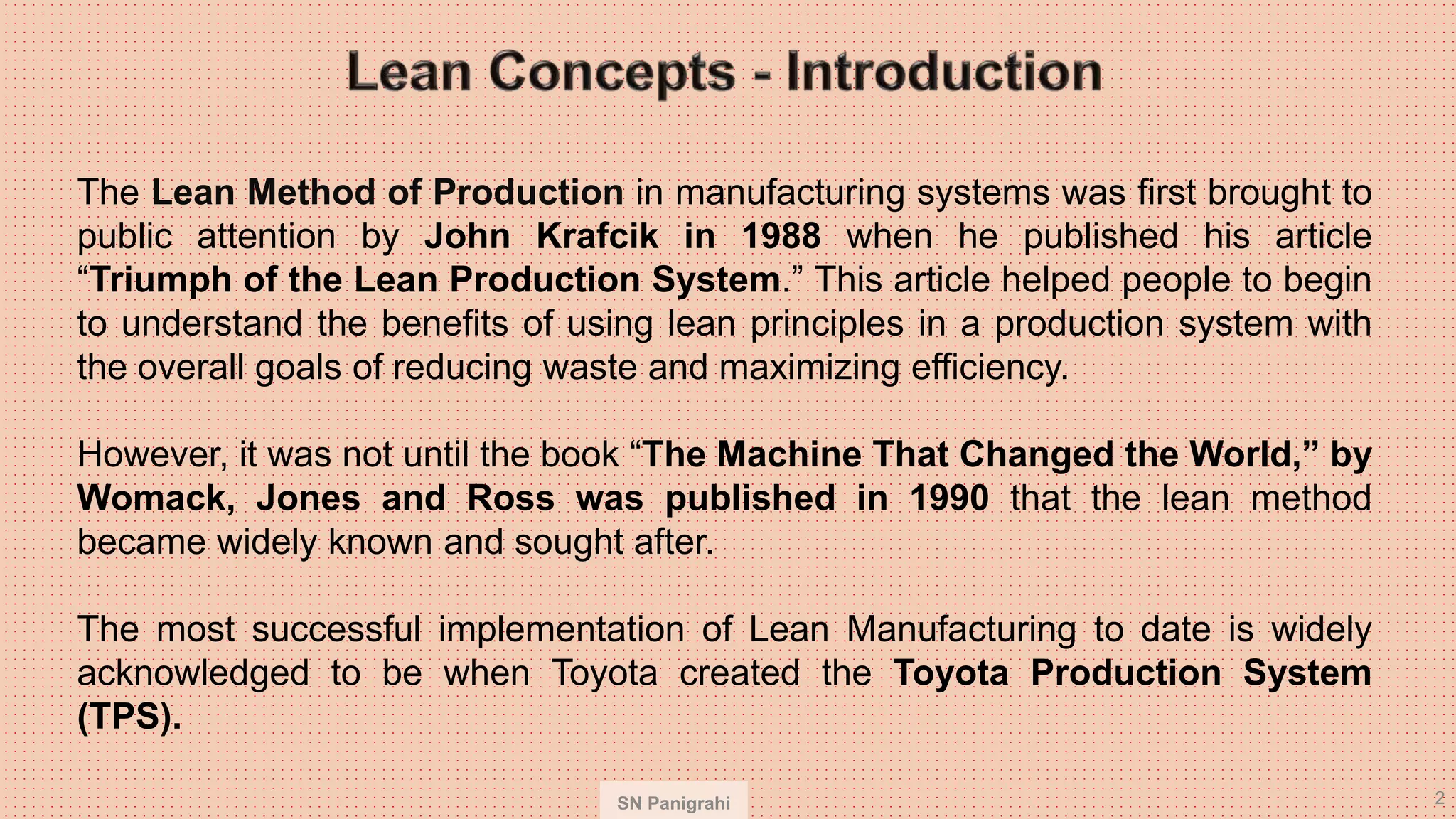
The Lean Method of Production in manufacturing systems was first brought to
public attention by John Krafcik in 1988 when he published his article
“Triumph of the Lean Production System.” This article helped people to begin
to understand the benefits of using lean principles in a production system with
the overall goals of reducing waste and maximizing efficiency.
However, it was not until the book “The Machine That Changed the World,” by
Womack, Jones and Ross was published in 1990 that the lean method
became widely known and sought after.
The most successful implementation of Lean Manufacturing to date is widely
acknowledged to be when Toyota created the Toyota Production System
(TPS).
3
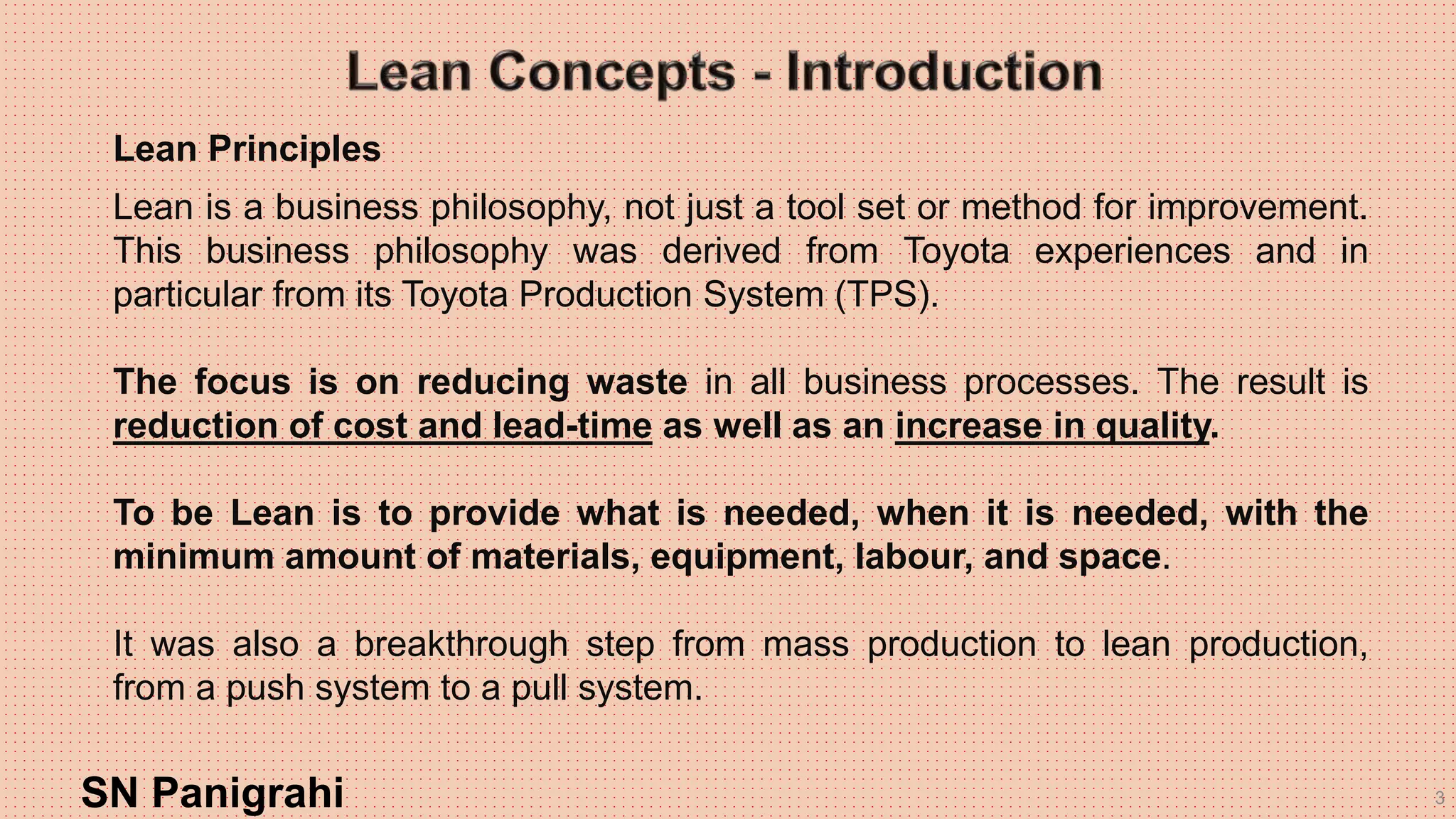
Lean Principles
Lean is a business philosophy, not just a tool set or method for improvement.
This business philosophy was derived from Toyota experiences and in
particular from its Toyota Production System (TPS).
The focus is on reducing waste in all business processes. The result is
reduction of cost and lead-time as well as an increase in quality.
To be Lean is to provide what is needed, when it is needed, with the
minimum amount of materials, equipment, labour, and space.
It was also a breakthrough step from mass production to lean production,
from a push system to a pull system.
SN Panigrahi
SN Panigrahi 4
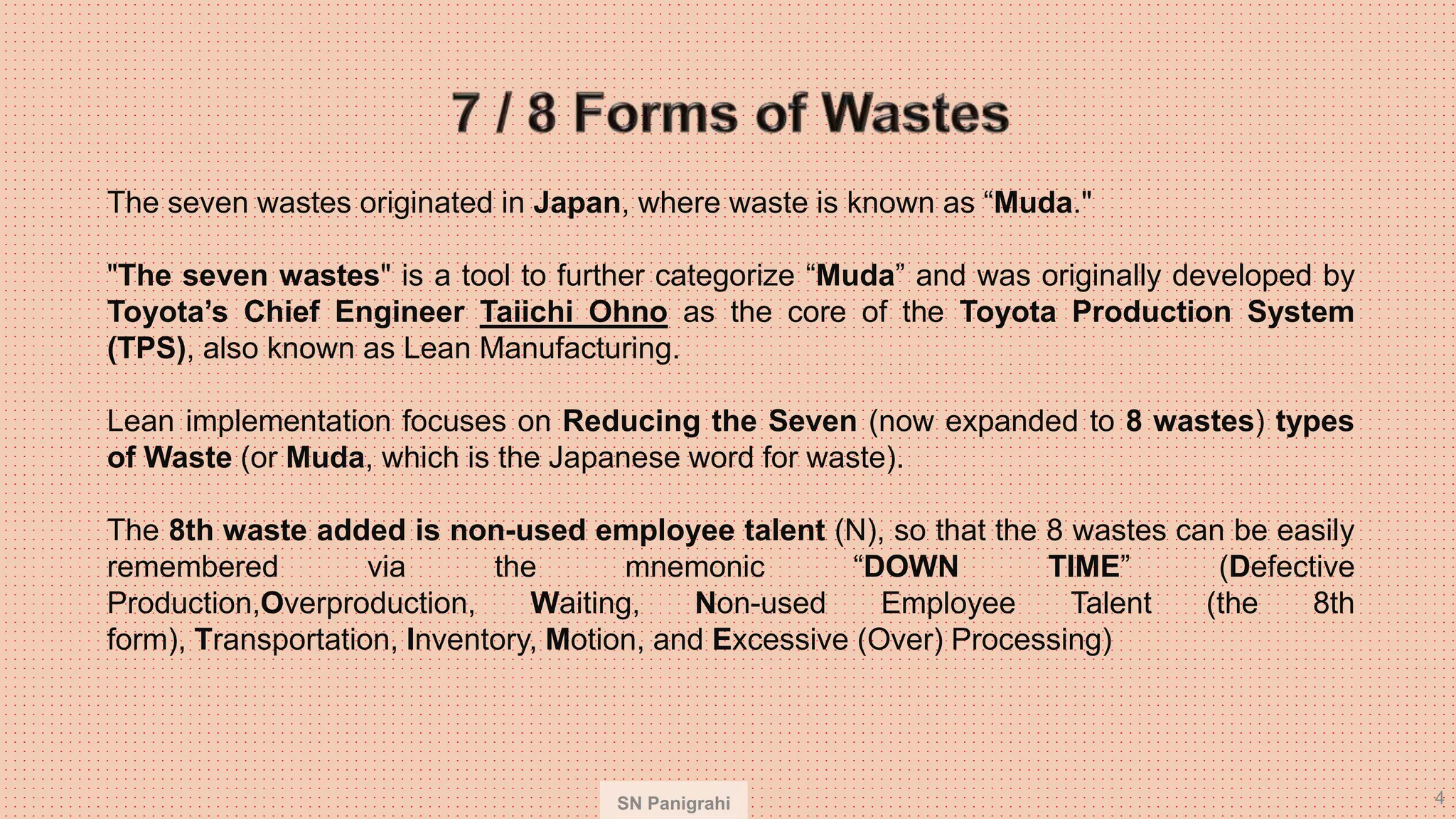
The seven wastes originated in Japan, where waste is known as “Muda."
"The seven wastes" is a tool to further categorize “Muda” and was originally developed by
Toyota’s Chief Engineer Taiichi Ohno as the core of the Toyota Production System
(TPS), also known as Lean Manufacturing.
Lean implementation focuses on Reducing the Seven (now expanded to 8 wastes) types
of Waste (or Muda, which is the Japanese word for waste).
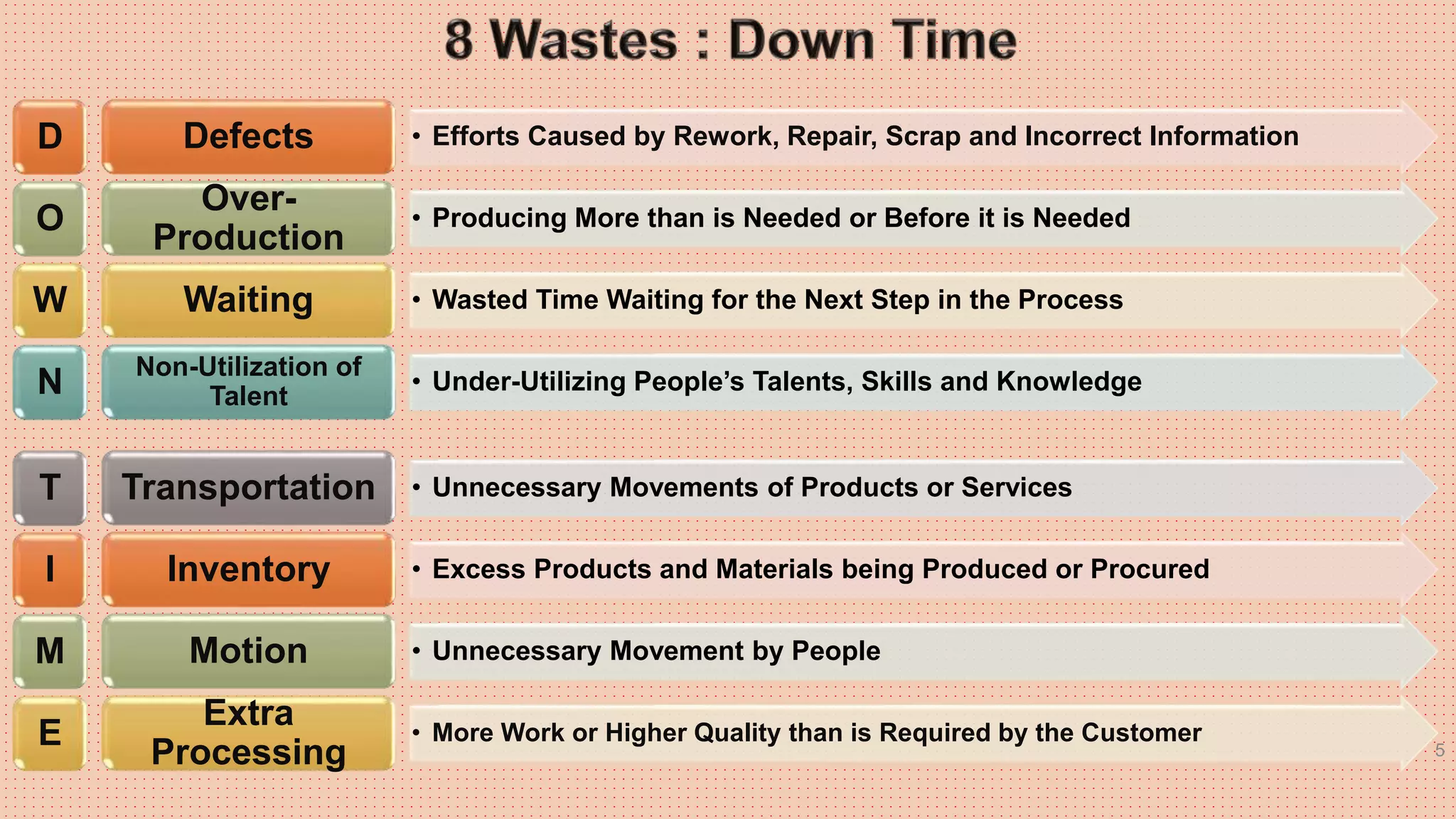
The 8th waste added is non-used employee talent (N), so that the 8 wastes can be easily
remembered via the mnemonic “DOWN TIME” (Defective
Production,Overproduction, Waiting, Non-used Employee Talent (the 8th
form), Transportation, Inventory, Motion, and Excessive (Over) Processing)
5
• Efforts Caused by Rework, Repair, Scrap and Incorrect InformationDefects
• Producing More than is Needed or Before it is Needed
Over-
Production
• Wasted Time Waiting for the Next Step in the ProcessWaiting
• Under-Utilizing People’s Talents, Skills and Knowledge
Non-Utilization of
Talent
• Unnecessary Movements of Products or ServicesTransportation
• Excess Products and Materials being Produced or ProcuredInventory
• Unnecessary Movement by PeopleMotion
• More Work or Higher Quality than is Required by the Customer
Extra
Processing
D
O
W
N
T
I
M
E
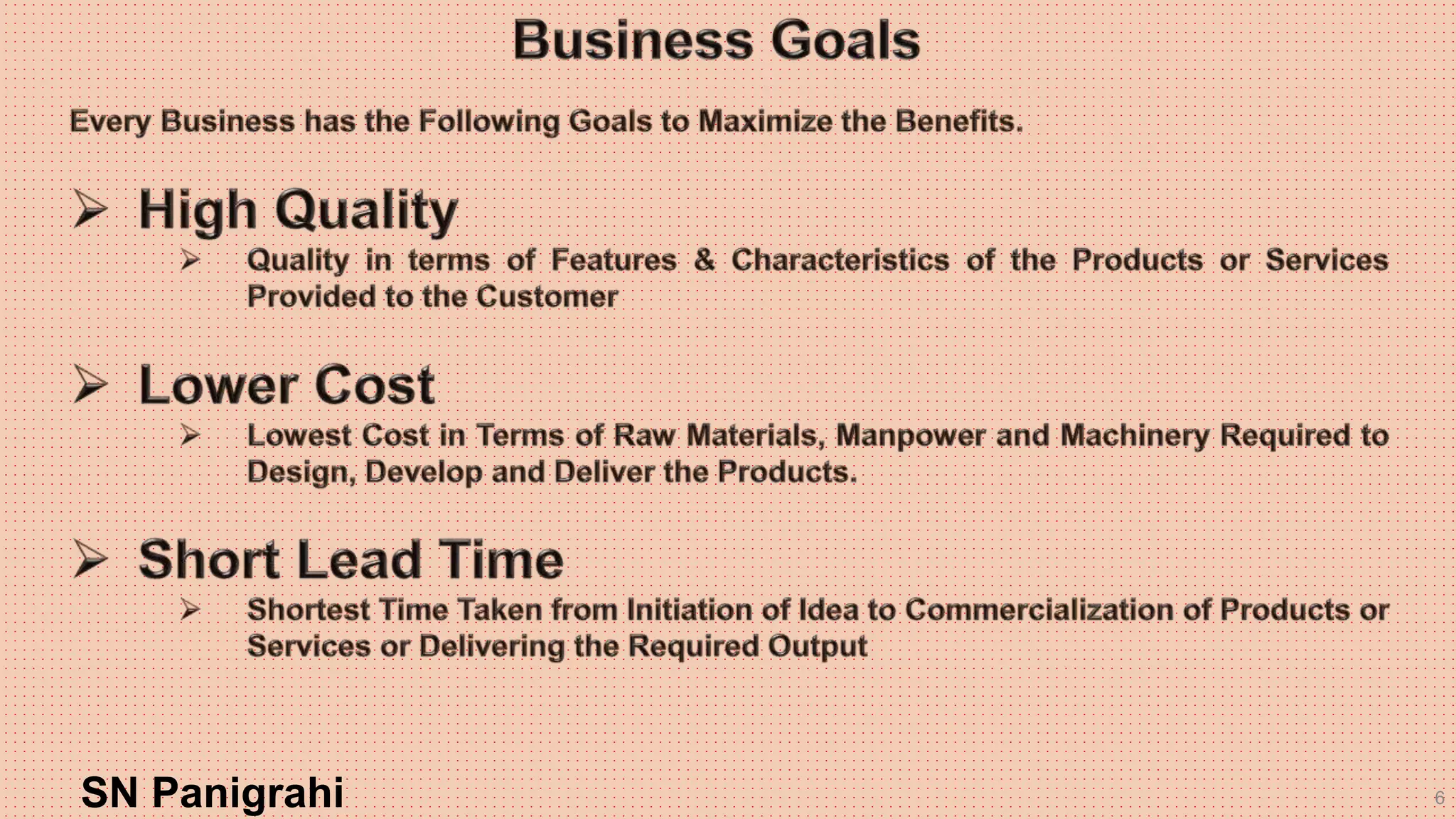
6SN Panigrahi
7
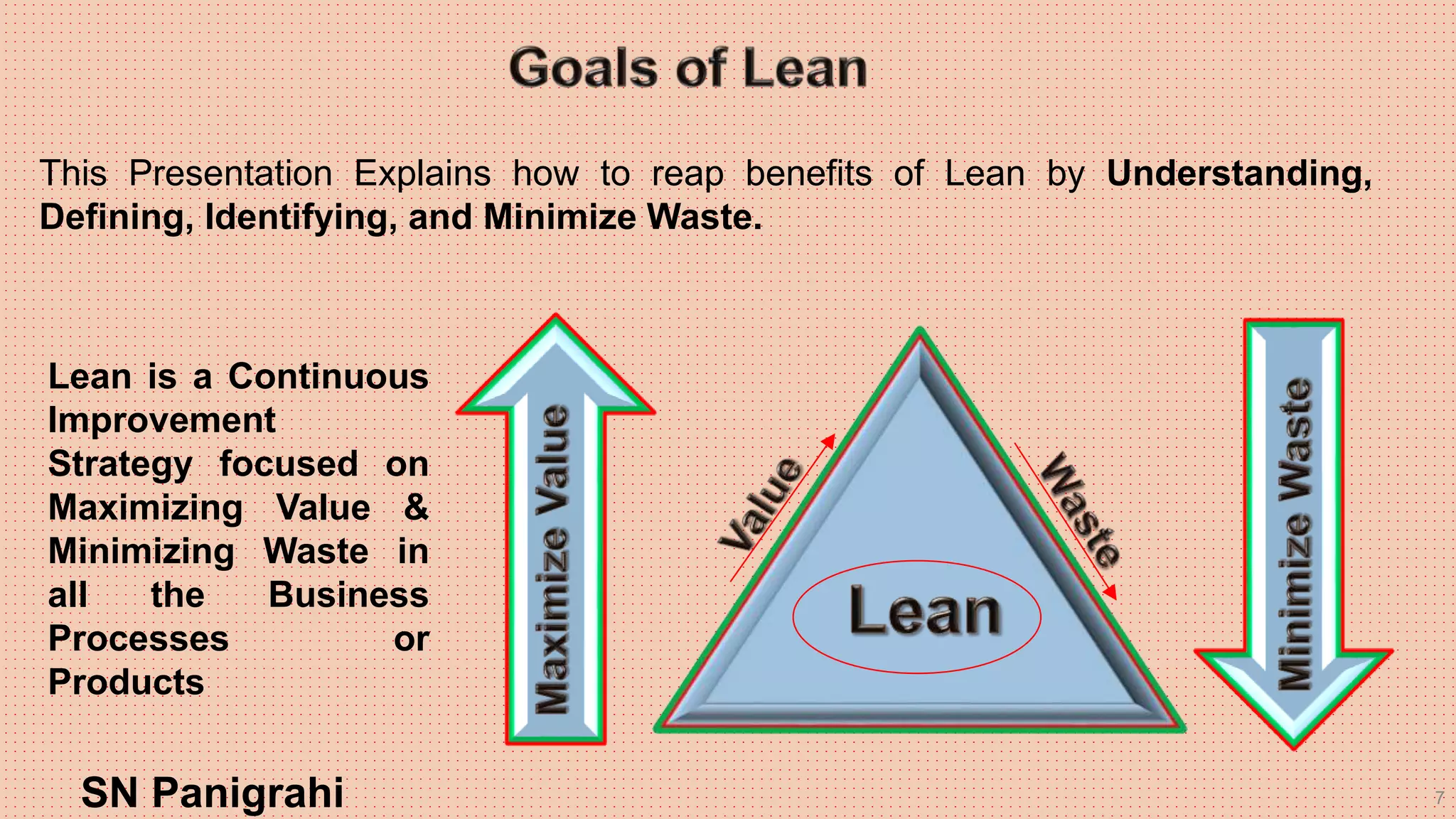
This Presentation Explains how to reap benefits of Lean by Understanding,
Defining, Identifying, and Minimize Waste.
Lean is a Continuous
Improvement
Strategy focused on
Maximizing Value &
Minimizing Waste in
all the Business
Processes or
Products
SN Panigrahi
8
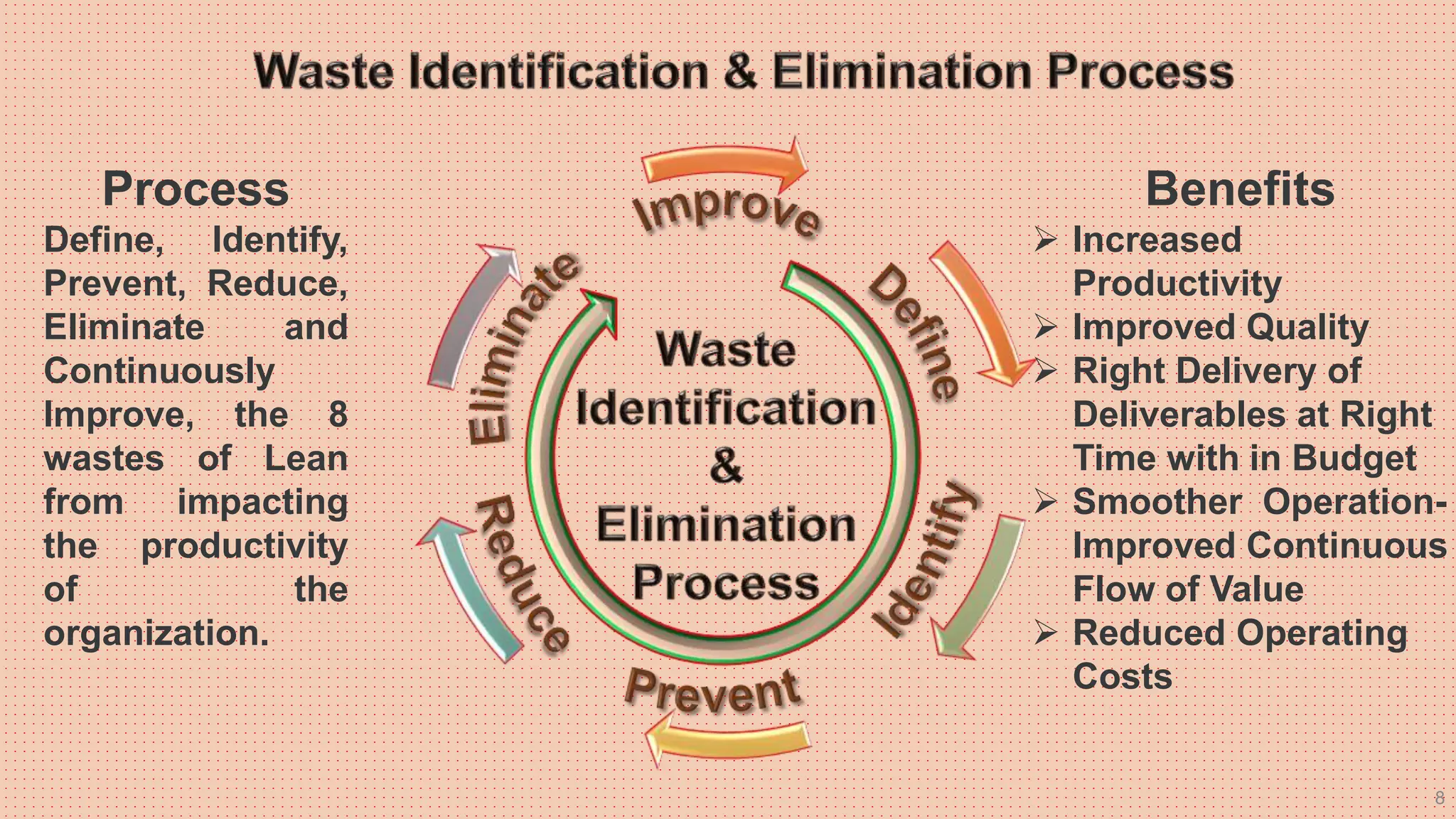
Process
Define, Identify,
Prevent, Reduce,
Eliminate and
Continuously
Improve, the 8
wastes of Lean
from impacting
the productivity
of the
organization.
Benefits
 Increased
Productivity
 Improved Quality
 Right Delivery of
Deliverables at Right
Time with in Budget
 Smoother Operation-
Improved Continuous
Flow of Value
 Reduced Operating
Costs
9
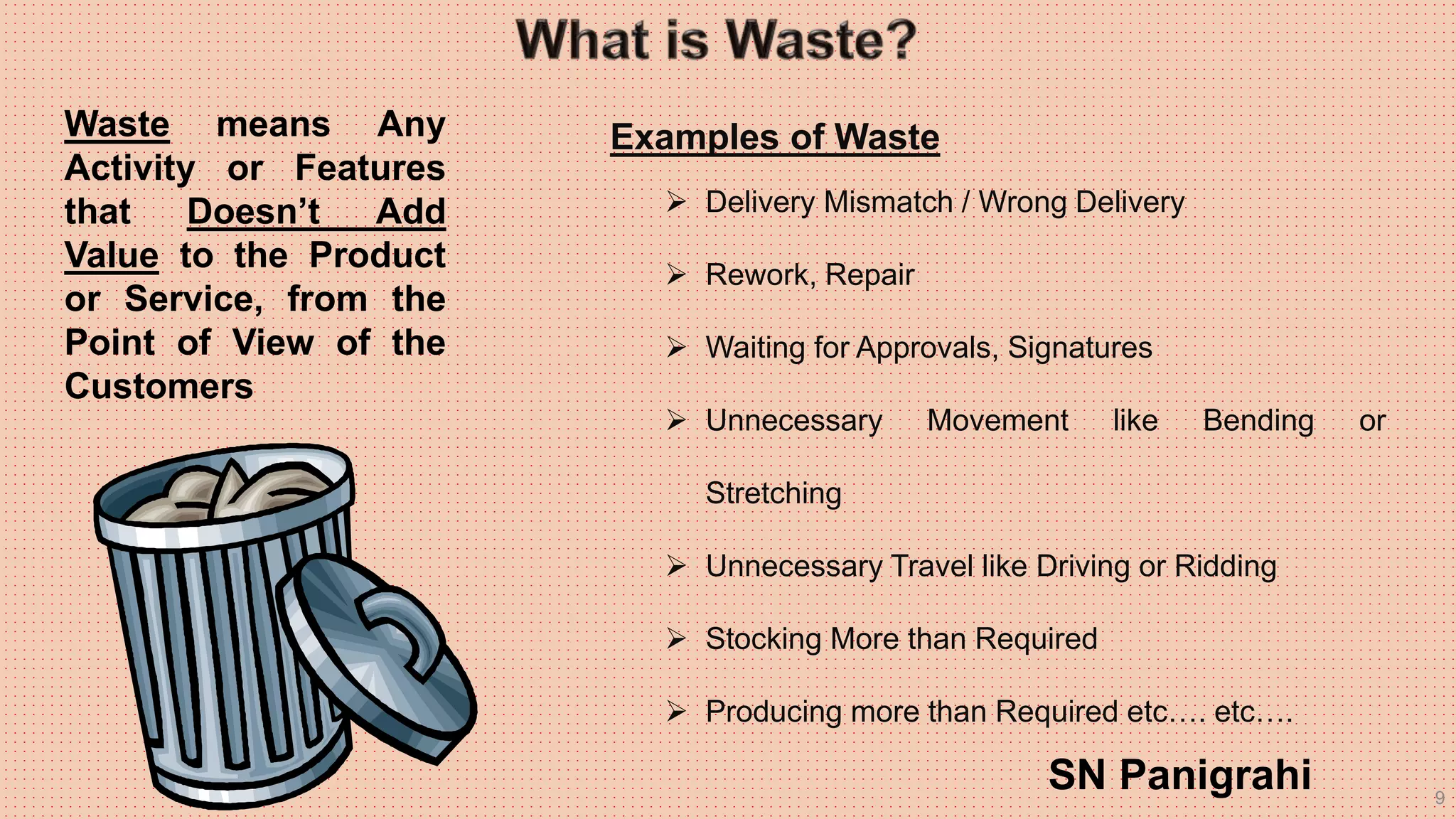
Waste means Any
Activity or Features
that Doesn’t Add
Value to the Product
or Service, from the
Point of View of the
Customers
Examples of Waste
 Delivery Mismatch / Wrong Delivery
 Rework, Repair
 Waiting for Approvals, Signatures
 Unnecessary Movement like Bending or
Stretching
 Unnecessary Travel like Driving or Ridding
 Stocking More than Required
 Producing more than Required etc…. etc….
SN Panigrahi
10
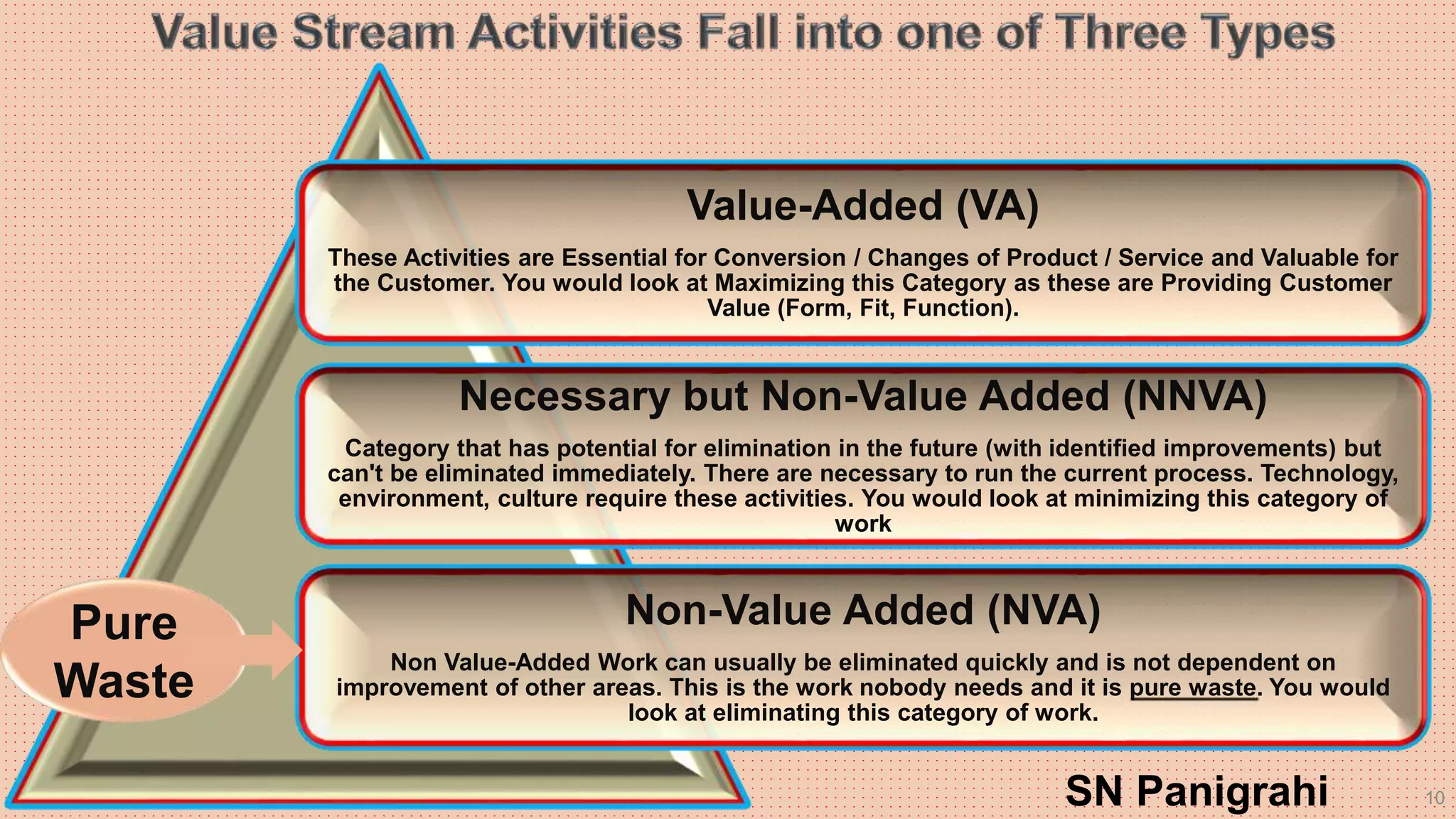
Value-Added (VA)
These Activities are Essential for Conversion / Changes of Product / Service and Valuable for
the Customer. You would look at Maximizing this Category as these are Providing Customer
Value (Form, Fit, Function).
Necessary but Non-Value Added (NNVA)
Category that has potential for elimination in the future (with identified improvements) but
can't be eliminated immediately. There are necessary to run the current process. Technology,
environment, culture require these activities. You would look at minimizing this category of
work
Non-Value Added (NVA)
Non Value-Added Work can usually be eliminated quickly and is not dependent on
improvement of other areas. This is the work nobody needs and it is pure waste. You would
look at eliminating this category of work.
SN Panigrahi
Pure
Waste
11
In order to Improve Efficiency, Effectiveness, and Profitability, focus relentlessly on eliminating
all aspects of the process that add no value from your customer’s perspective.
Muda or Waste Reduction / Elimination is a key concept in Lean management. The Benefits of
Reduction / Elimination are:
 Identifying & Eliminating the Wastes will help you Optimize Resources and Increase
Profitability.
 By working to eliminate these wastes, an organization can achieve considerable
Improvements in their Operating Efficiency.
 It will also help you realize the exact parts of the work process where you can improve.
 It will enable you to see if an activity is a necessary or pure waste.
SN Panigrahi
12
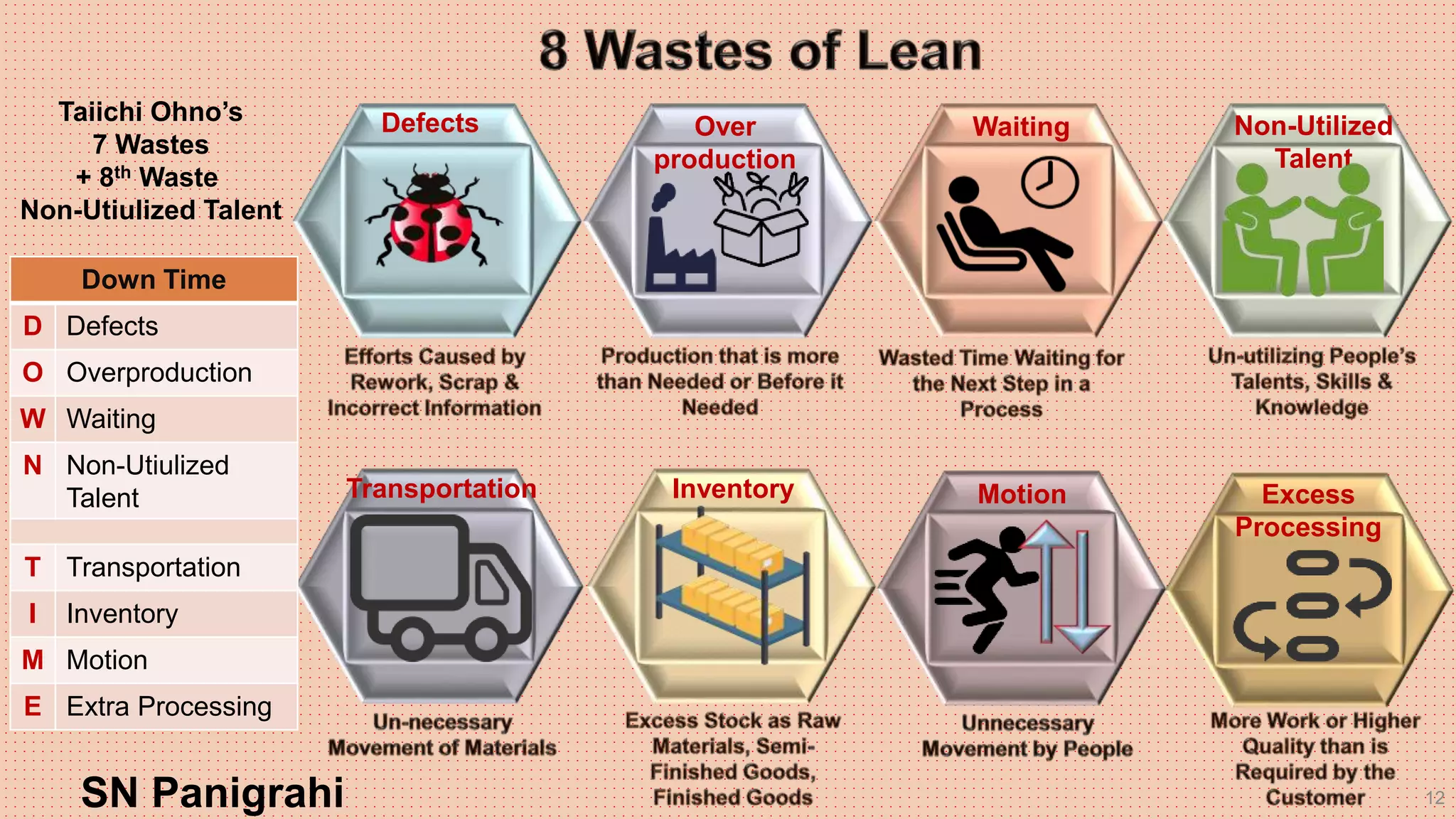
Defects Over
production
Waiting Non-Utilized
Talent
Transportation Excess
Processing
Inventory Motion
Down Time
D Defects
O Overproduction
W Waiting
N Non-Utiulized
Talent
T Transportation
I Inventory
M Motion
E Extra Processing
Taiichi Ohno’s
7 Wastes
+ 8th Waste
Non-Utiulized Talent
SN Panigrahi
13
Defects are any
 Imperfection,
 Deficiency,
 Flaw,
 Weakness,
 Wrong Doing,
 Limitation or undesired outcome (Defective) within a Product, Service or Process
 Faulty Forecast, Faulty Planning & Estimates etc.
Defective Product (Material Defects – Short / Excess Delivery, Damaged Delivery),
Defective Service (Improper Sign-offs, Unsatisfactory or Incomplete Service, Late Delivery of Services),
Defective Process (Unclear Processes and Rules of Engagement, Process Inconsistencies, Incomplete
Documentation, Ineffective Communication and Team Misalignment);
The waste that is generated by defects is defined as every Resource & Effort that goes into creating the defect,
Containing it, Reworking it, Extra Materials Involved and ultimately Dispossessing it from every aspect of the
business.
SN Panigrahi
Defects
14SN Panigrahi
Defects
Every bit of scrap Costs Money and Time – Money for the Materials, Resource to pay staff, Utilities
etc to do it again, but also means that you have to push another planned job back in the queue in order
to get the rework out! It’s all cost and less cash for the business.
Paperwork (including electronic) tracking for defects and waste removal isn’t free. Defects that actually
reach the customer can cause greater pain, with loss of not only that customer, but many others from viral
word-of-mouth dissatisfaction. Some experts estimate defects have a 10x negative impact on a company.
Waste Related to Costs for Inspection of Defects in Materials and Processes, Customer Complaints
and Repairs / Rectifications
Defects involve scrap or material that is thrown out or
reworked…and much more. Concessions may be made to a
customer or Discounted-sale pricing may be used so defective
material can be sold. In addition, the quality control system that must
be put in place for an out-of-control process has high inspection
costs.
15
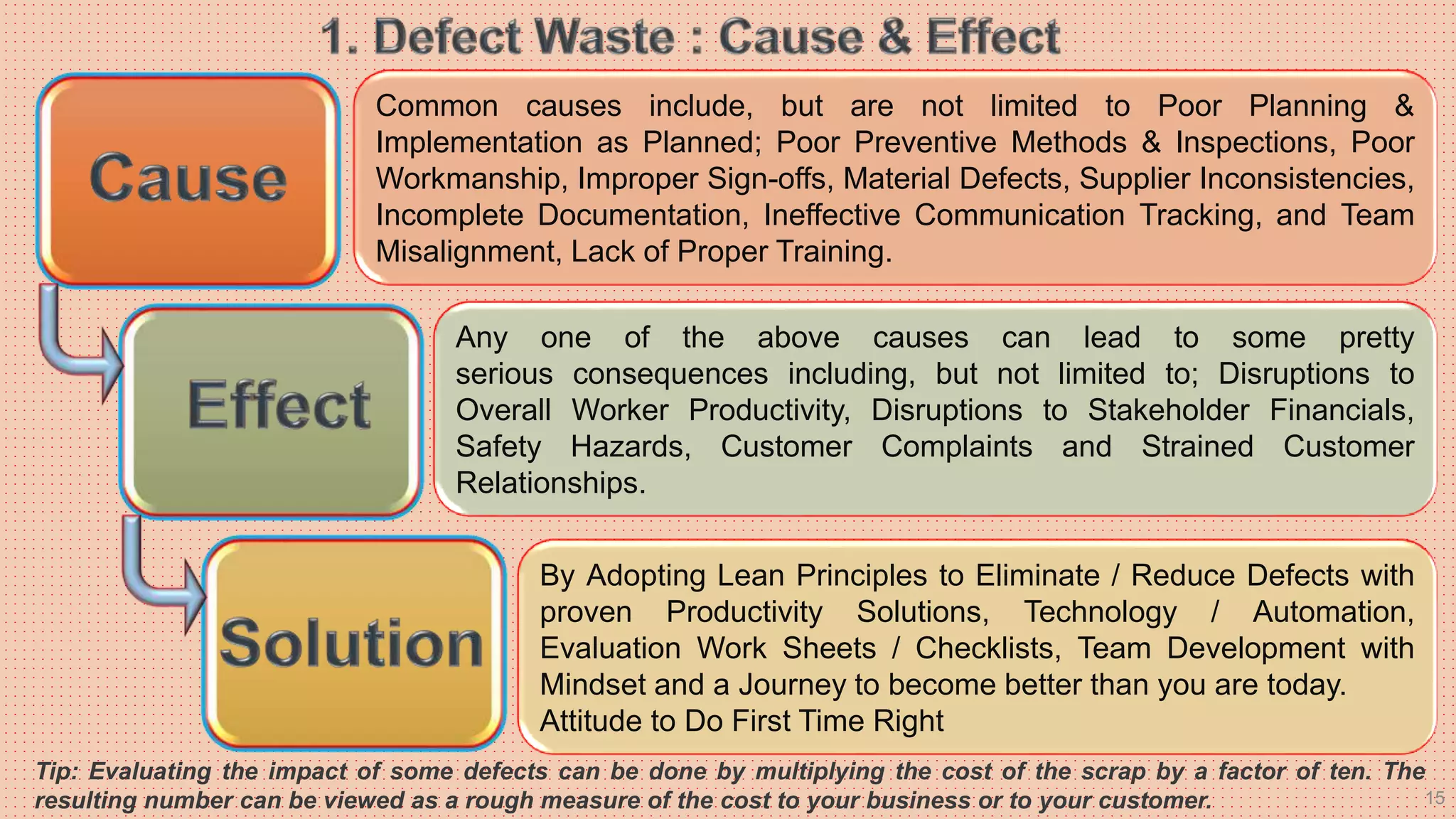
Common causes include, but are not limited to Poor Planning &
Implementation as Planned; Poor Preventive Methods & Inspections, Poor
Workmanship, Improper Sign-offs, Material Defects, Supplier Inconsistencies,
Incomplete Documentation, Ineffective Communication Tracking, and Team
Misalignment, Lack of Proper Training.
Any one of the above causes can lead to some pretty
serious consequences including, but not limited to; Disruptions to
Overall Worker Productivity, Disruptions to Stakeholder Financials,
Safety Hazards, Customer Complaints and Strained Customer
Relationships.
By Adopting Lean Principles to Eliminate / Reduce Defects with
proven Productivity Solutions, Technology / Automation,
Evaluation Work Sheets / Checklists, Team Development with
Mindset and a Journey to become better than you are today.
Attitude to Do First Time Right
Tip: Evaluating the impact of some defects can be done by multiplying the cost of the scrap by a factor of ten. The
resulting number can be viewed as a rough measure of the cost to your business or to your customer.
16
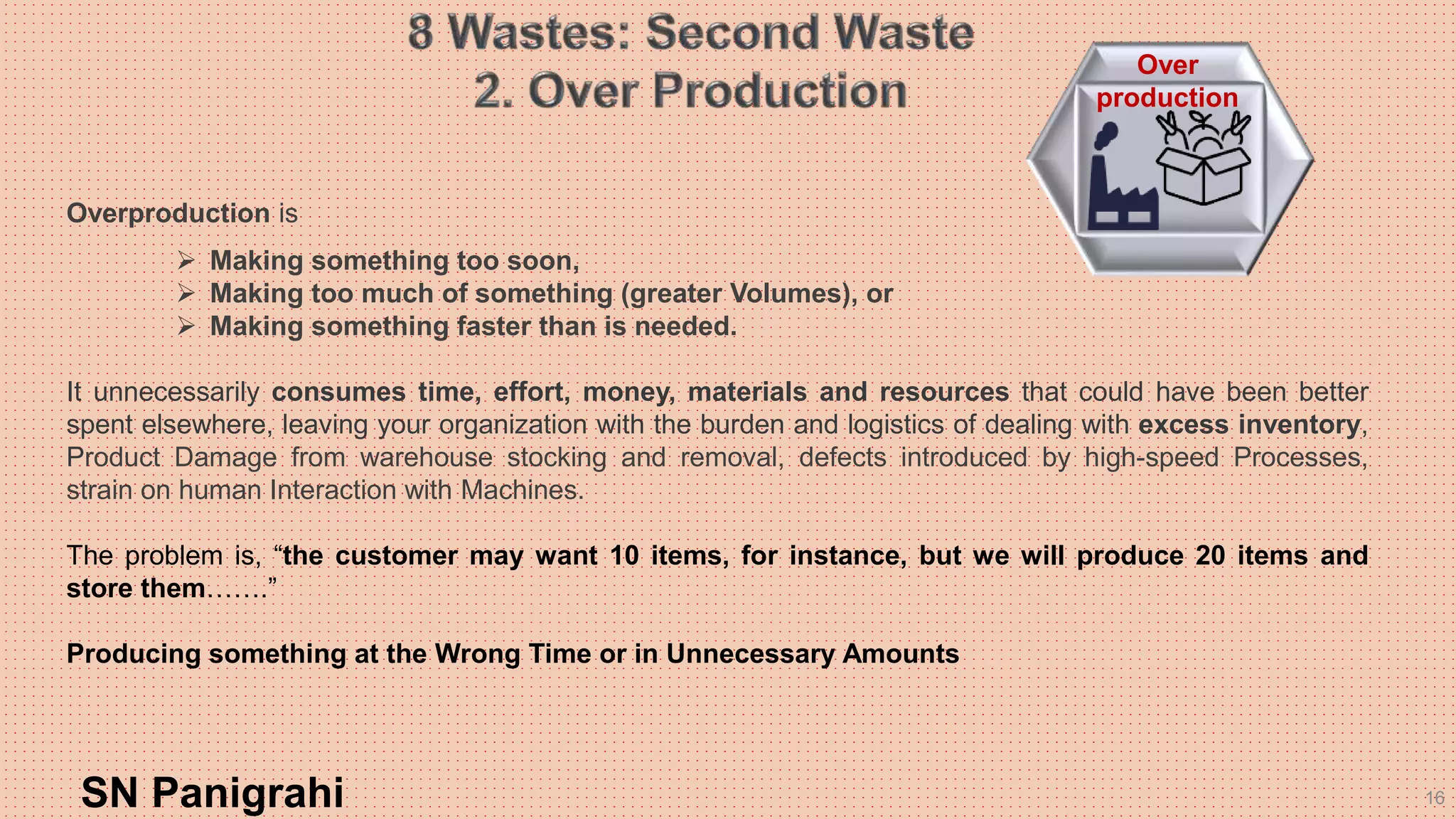
Overproduction is
 Making something too soon,
 Making too much of something (greater Volumes), or
 Making something faster than is needed.
It unnecessarily consumes time, effort, money, materials and resources that could have been better
spent elsewhere, leaving your organization with the burden and logistics of dealing with excess inventory,
Product Damage from warehouse stocking and removal, defects introduced by high-speed Processes,
strain on human Interaction with Machines.
The problem is, “the customer may want 10 items, for instance, but we will produce 20 items and
store them…….”
Producing something at the Wrong Time or in Unnecessary Amounts
SN Panigrahi
Over
production
17
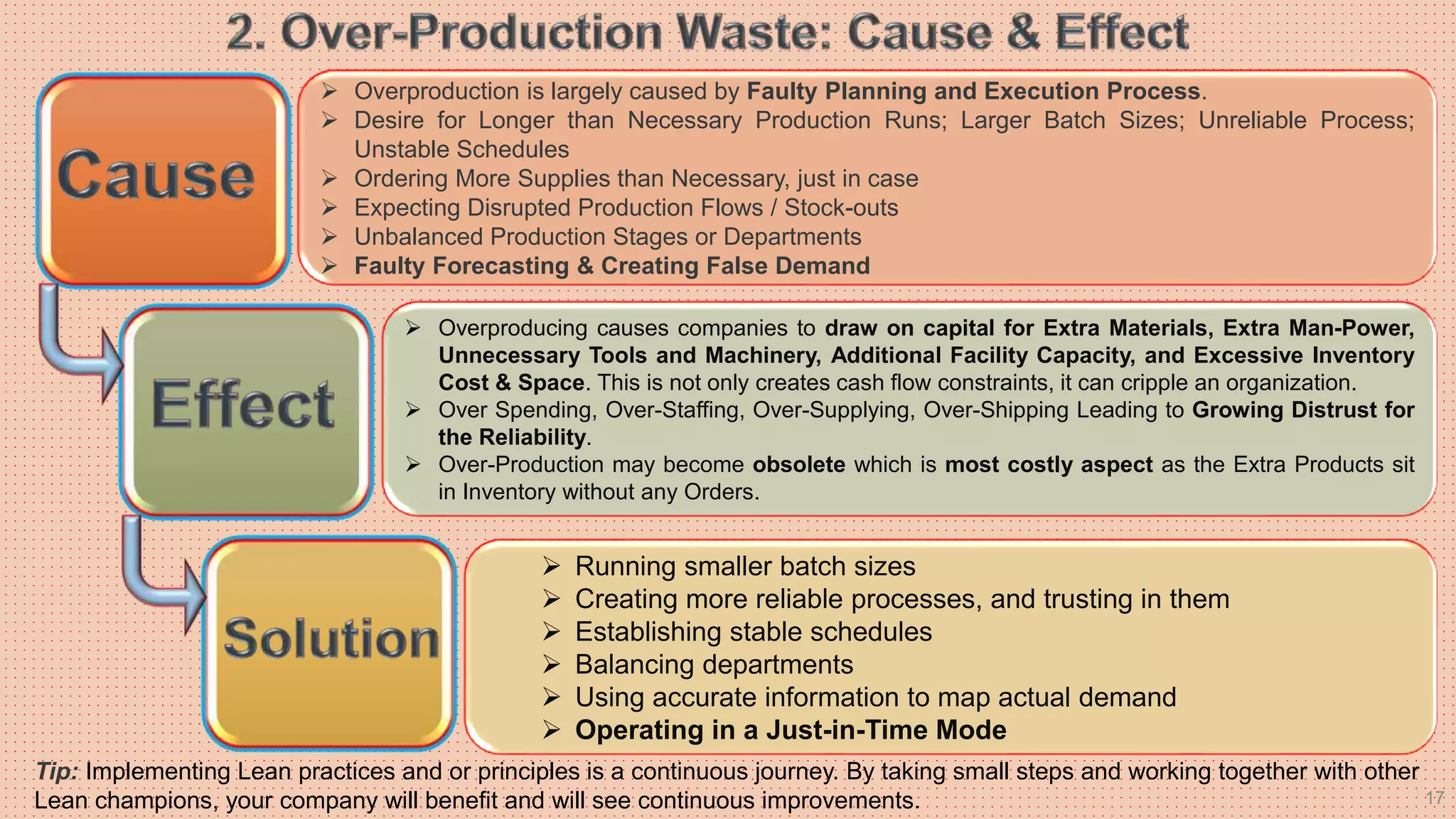
 Overproduction is largely caused by Faulty Planning and Execution Process.
 Desire for Longer than Necessary Production Runs; Larger Batch Sizes; Unreliable Process;
Unstable Schedules
 Ordering More Supplies than Necessary, just in case
 Expecting Disrupted Production Flows / Stock-outs
 Unbalanced Production Stages or Departments
 Faulty Forecasting & Creating False Demand
 Overproducing causes companies to draw on capital for Extra Materials, Extra Man-Power,
Unnecessary Tools and Machinery, Additional Facility Capacity, and Excessive Inventory
Cost & Space. This is not only creates cash flow constraints, it can cripple an organization.
 Over Spending, Over-Staffing, Over-Supplying, Over-Shipping Leading to Growing Distrust for
the Reliability.
 Over-Production may become obsolete which is most costly aspect as the Extra Products sit
in Inventory without any Orders.
 Running smaller batch sizes
 Creating more reliable processes, and trusting in them
 Establishing stable schedules
 Balancing departments
 Using accurate information to map actual demand
 Operating in a Just-in-Time Mode
Tip: Implementing Lean practices and or principles is a continuous journey. By taking small steps and working together with other
Lean champions, your company will benefit and will see continuous improvements.
18
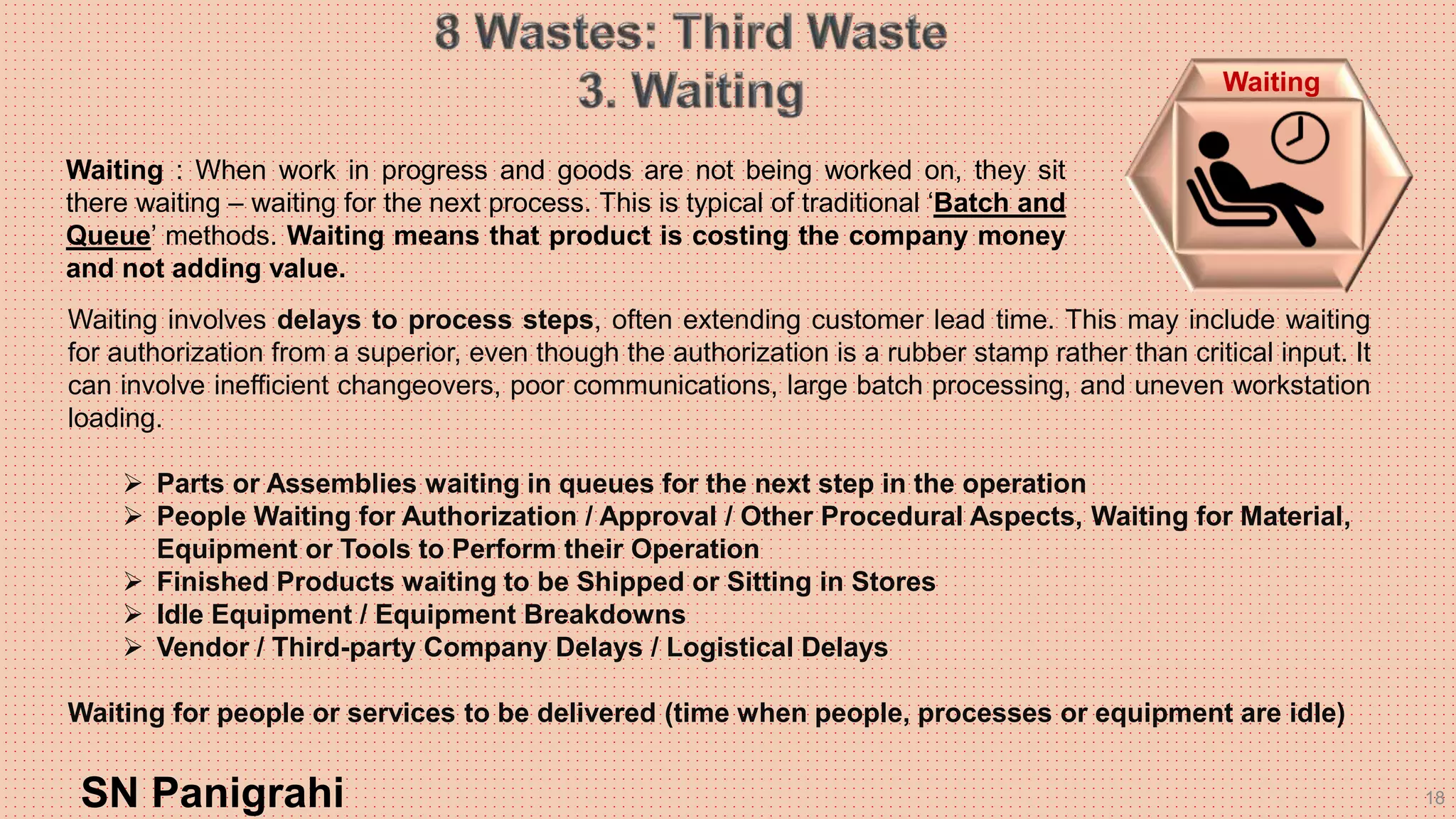
Waiting involves delays to process steps, often extending customer lead time. This may include waiting
for authorization from a superior, even though the authorization is a rubber stamp rather than critical input. It
can involve inefficient changeovers, poor communications, large batch processing, and uneven workstation
loading.
 Parts or Assemblies waiting in queues for the next step in the operation
 People Waiting for Authorization / Approval / Other Procedural Aspects, Waiting for Material,
Equipment or Tools to Perform their Operation
 Finished Products waiting to be Shipped or Sitting in Stores
 Idle Equipment / Equipment Breakdowns
 Vendor / Third-party Company Delays / Logistical Delays
Waiting for people or services to be delivered (time when people, processes or equipment are idle)
SN Panigrahi
Waiting
Waiting : When work in progress and goods are not being worked on, they sit
there waiting – waiting for the next process. This is typical of traditional ‘Batch and
Queue’ methods. Waiting means that product is costing the company money
and not adding value.
19
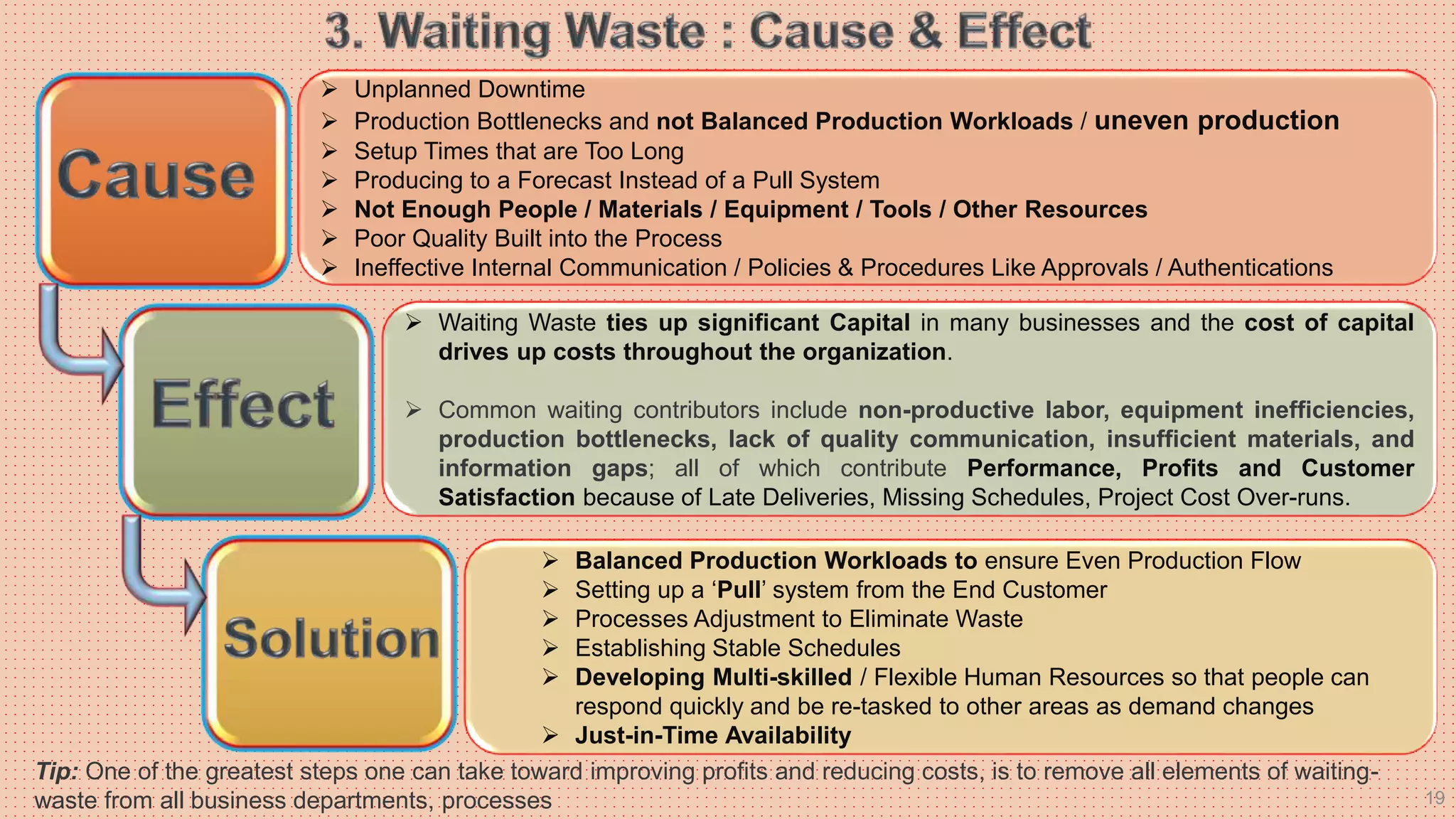
 Unplanned Downtime
 Production Bottlenecks and not Balanced Production Workloads / uneven production
 Setup Times that are Too Long
 Producing to a Forecast Instead of a Pull System
 Not Enough People / Materials / Equipment / Tools / Other Resources
 Poor Quality Built into the Process
 Ineffective Internal Communication / Policies & Procedures Like Approvals / Authentications
 Waiting Waste ties up significant Capital in many businesses and the cost of capital
drives up costs throughout the organization.
 Common waiting contributors include non-productive labor, equipment inefficiencies,
production bottlenecks, lack of quality communication, insufficient materials, and
information gaps; all of which contribute Performance, Profits and Customer
Satisfaction because of Late Deliveries, Missing Schedules, Project Cost Over-runs.
 Balanced Production Workloads to ensure Even Production Flow
 Setting up a ‘Pull’ system from the End Customer
 Processes Adjustment to Eliminate Waste
 Establishing Stable Schedules
 Developing Multi-skilled / Flexible Human Resources so that people can
respond quickly and be re-tasked to other areas as demand changes
 Just-in-Time Availability
Tip: One of the greatest steps one can take toward improving profits and reducing costs, is to remove all elements of waiting-
waste from all business departments, processes
20
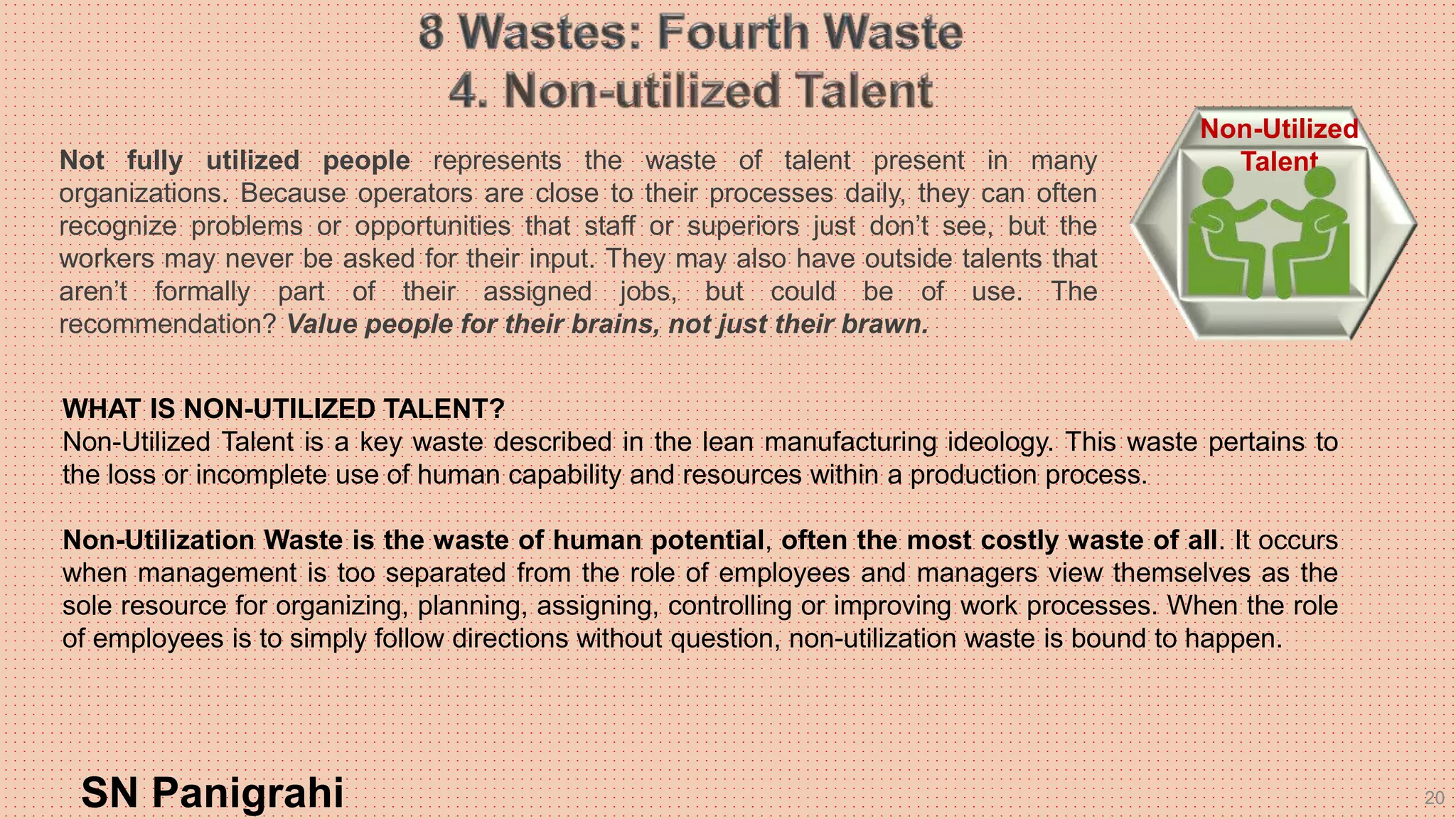
WHAT IS NON-UTILIZED TALENT?
Non-Utilized Talent is a key waste described in the lean manufacturing ideology. This waste pertains to
the loss or incomplete use of human capability and resources within a production process.
Non-Utilization Waste is the waste of human potential, often the most costly waste of all. It occurs
when management is too separated from the role of employees and managers view themselves as the
sole resource for organizing, planning, assigning, controlling or improving work processes. When the role
of employees is to simply follow directions without question, non-utilization waste is bound to happen.
SN Panigrahi
Non-Utilized
TalentNot fully utilized people represents the waste of talent present in many
organizations. Because operators are close to their processes daily, they can often
recognize problems or opportunities that staff or superiors just don’t see, but the
workers may never be asked for their input. They may also have outside talents that
aren’t formally part of their assigned jobs, but could be of use. The
recommendation? Value people for their brains, not just their brawn.
21
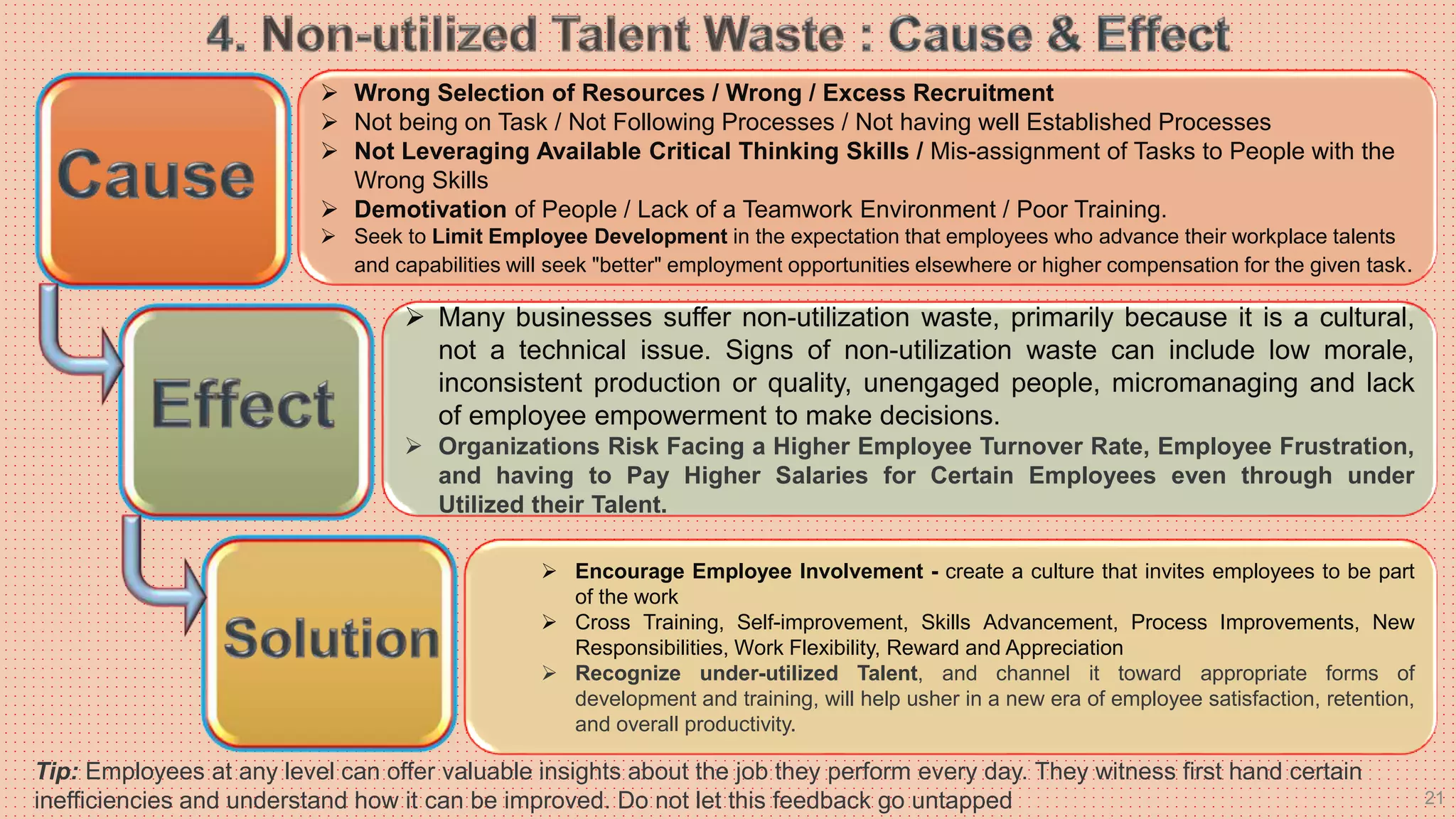
 Wrong Selection of Resources / Wrong / Excess Recruitment
 Not being on Task / Not Following Processes / Not having well Established Processes
 Not Leveraging Available Critical Thinking Skills / Mis-assignment of Tasks to People with the
Wrong Skills
 Demotivation of People / Lack of a Teamwork Environment / Poor Training.
 Seek to Limit Employee Development in the expectation that employees who advance their workplace talents
and capabilities will seek "better" employment opportunities elsewhere or higher compensation for the given task.
 Many businesses suffer non-utilization waste, primarily because it is a cultural,
not a technical issue. Signs of non-utilization waste can include low morale,
inconsistent production or quality, unengaged people, micromanaging and lack
of employee empowerment to make decisions.
 Organizations Risk Facing a Higher Employee Turnover Rate, Employee Frustration,
and having to Pay Higher Salaries for Certain Employees even through under
Utilized their Talent.
 Encourage Employee Involvement - create a culture that invites employees to be part
of the work
 Cross Training, Self-improvement, Skills Advancement, Process Improvements, New
Responsibilities, Work Flexibility, Reward and Appreciation
 Recognize under-utilized Talent, and channel it toward appropriate forms of
development and training, will help usher in a new era of employee satisfaction, retention,
and overall productivity.
Tip: Employees at any level can offer valuable insights about the job they perform every day. They witness first hand certain
inefficiencies and understand how it can be improved. Do not let this feedback go untapped
22
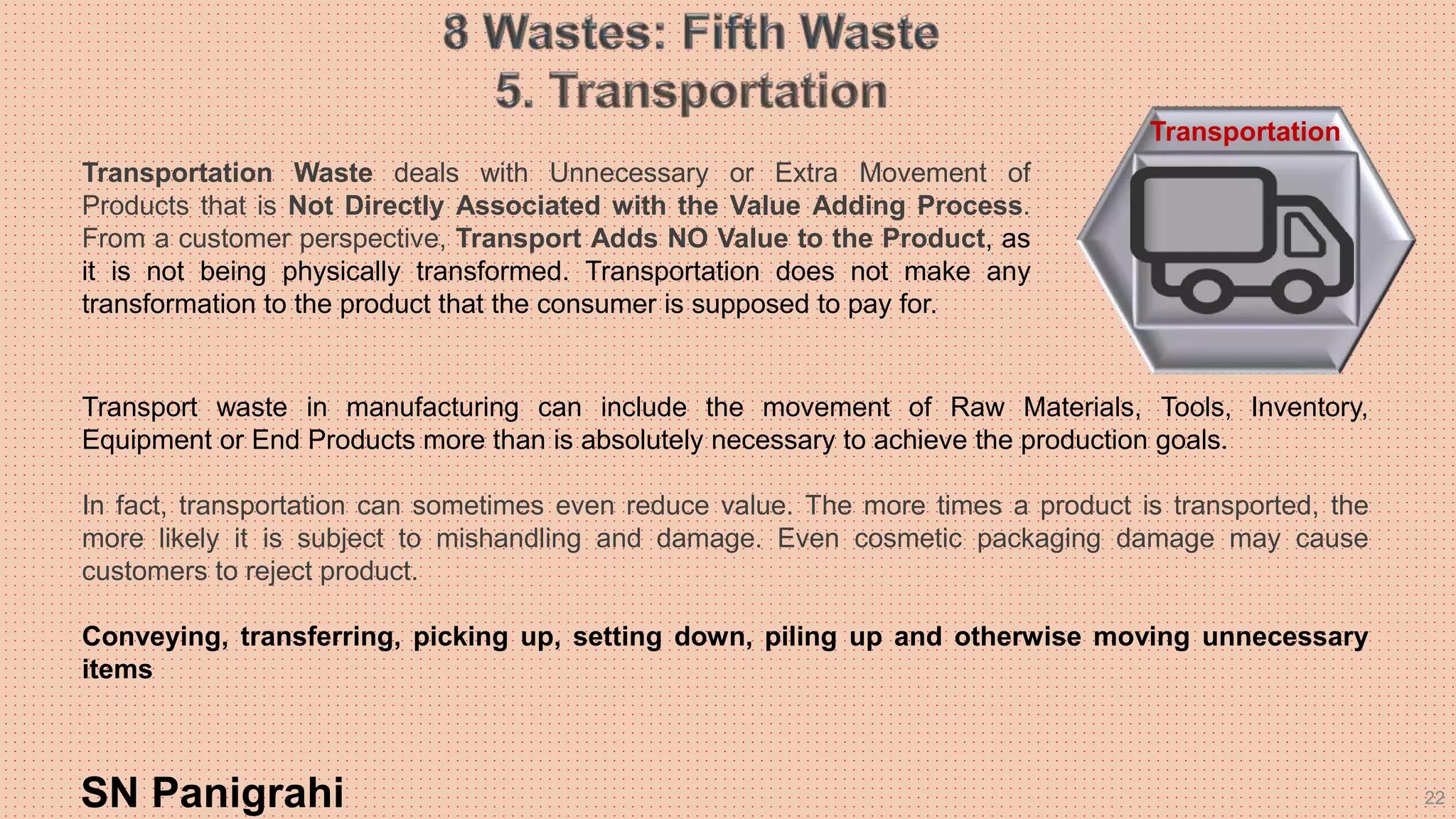
Transport waste in manufacturing can include the movement of Raw Materials, Tools, Inventory,
Equipment or End Products more than is absolutely necessary to achieve the production goals.
In fact, transportation can sometimes even reduce value. The more times a product is transported, the
more likely it is subject to mishandling and damage. Even cosmetic packaging damage may cause
customers to reject product.
Conveying, transferring, picking up, setting down, piling up and otherwise moving unnecessary
items
SN Panigrahi
Transportation
Transportation Waste deals with Unnecessary or Extra Movement of
Products that is Not Directly Associated with the Value Adding Process.
From a customer perspective, Transport Adds NO Value to the Product, as
it is not being physically transformed. Transportation does not make any
transformation to the product that the consumer is supposed to pay for.
23
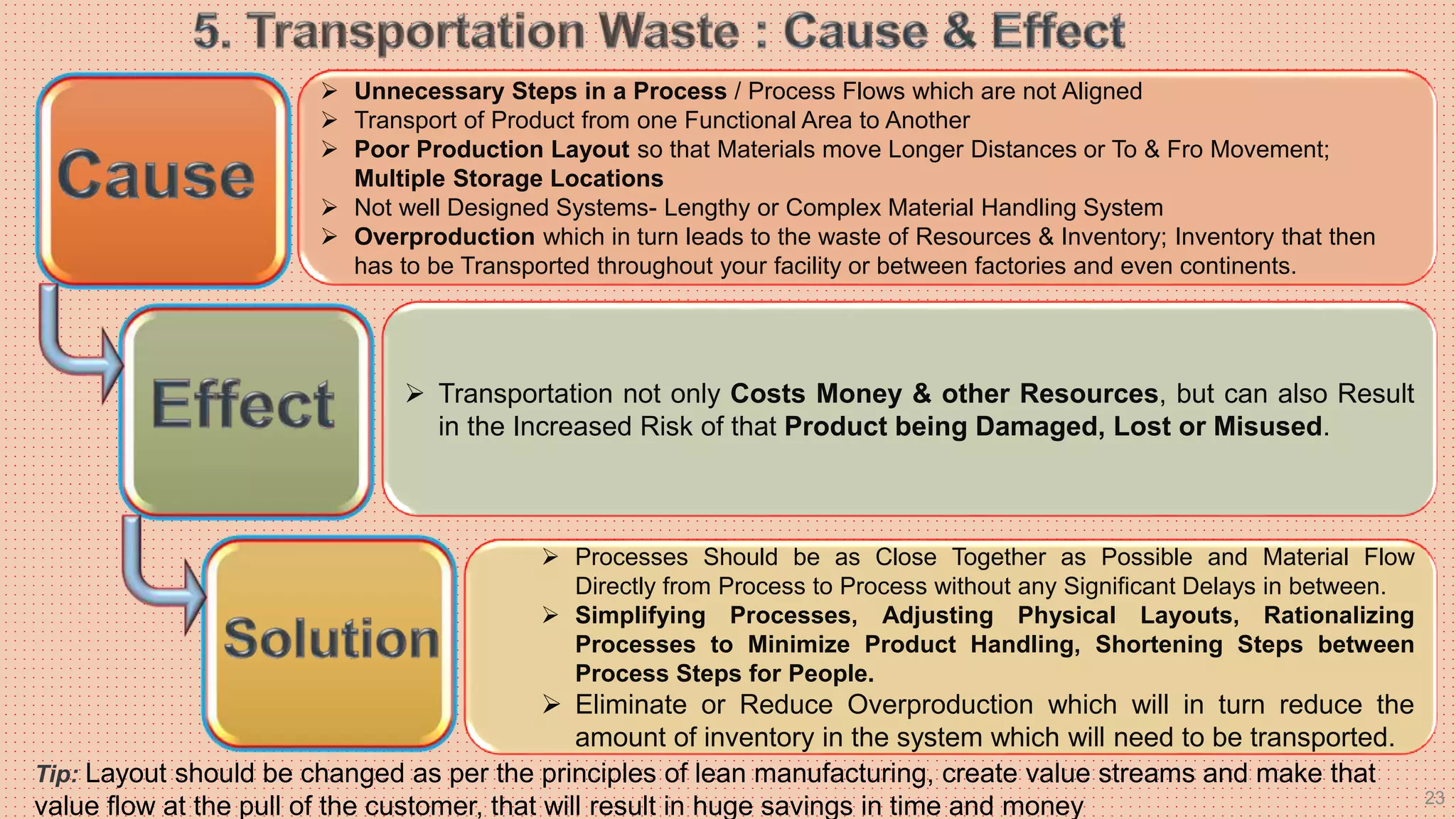
 Unnecessary Steps in a Process / Process Flows which are not Aligned
 Transport of Product from one Functional Area to Another
 Poor Production Layout so that Materials move Longer Distances or To & Fro Movement;
Multiple Storage Locations
 Not well Designed Systems- Lengthy or Complex Material Handling System
 Overproduction which in turn leads to the waste of Resources & Inventory; Inventory that then
has to be Transported throughout your facility or between factories and even continents.
 Transportation not only Costs Money & other Resources, but can also Result
in the Increased Risk of that Product being Damaged, Lost or Misused.
 Processes Should be as Close Together as Possible and Material Flow
Directly from Process to Process without any Significant Delays in between.
 Simplifying Processes, Adjusting Physical Layouts, Rationalizing
Processes to Minimize Product Handling, Shortening Steps between
Process Steps for People.
 Eliminate or Reduce Overproduction which will in turn reduce the
amount of inventory in the system which will need to be transported.
Tip: Layout should be changed as per the principles of lean manufacturing, create value streams and make that
value flow at the pull of the customer, that will result in huge savings in time and money
24
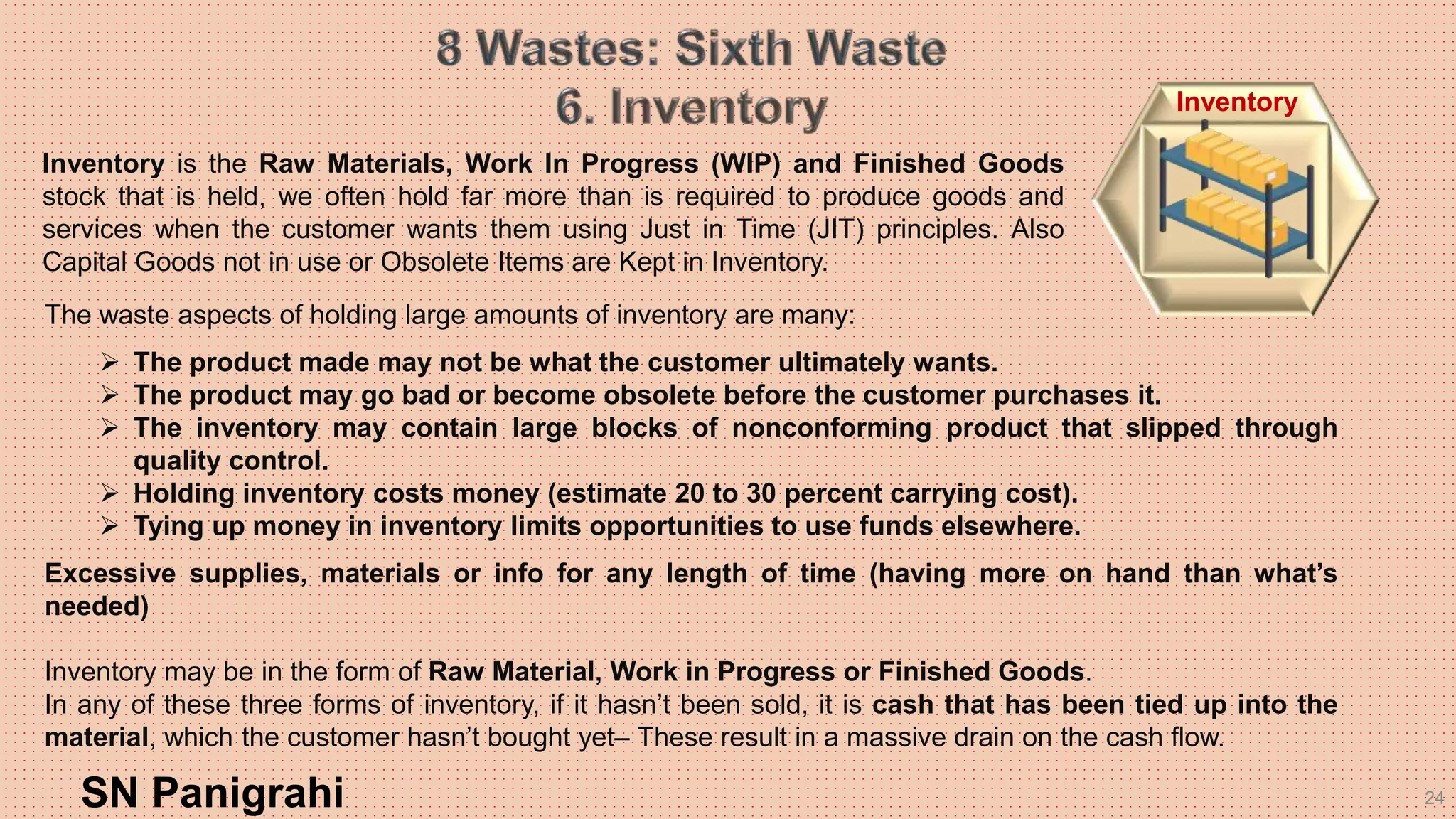
The waste aspects of holding large amounts of inventory are many:
 The product made may not be what the customer ultimately wants.
 The product may go bad or become obsolete before the customer purchases it.
 The inventory may contain large blocks of nonconforming product that slipped through
quality control.
 Holding inventory costs money (estimate 20 to 30 percent carrying cost).
 Tying up money in inventory limits opportunities to use funds elsewhere.
Excessive supplies, materials or info for any length of time (having more on hand than what’s
needed)
Inventory may be in the form of Raw Material, Work in Progress or Finished Goods.
In any of these three forms of inventory, if it hasn’t been sold, it is cash that has been tied up into the
material, which the customer hasn’t bought yet– These result in a massive drain on the cash flow.
SN Panigrahi
Inventory
Inventory is the Raw Materials, Work In Progress (WIP) and Finished Goods
stock that is held, we often hold far more than is required to produce goods and
services when the customer wants them using Just in Time (JIT) principles. Also
Capital Goods not in use or Obsolete Items are Kept in Inventory.
25
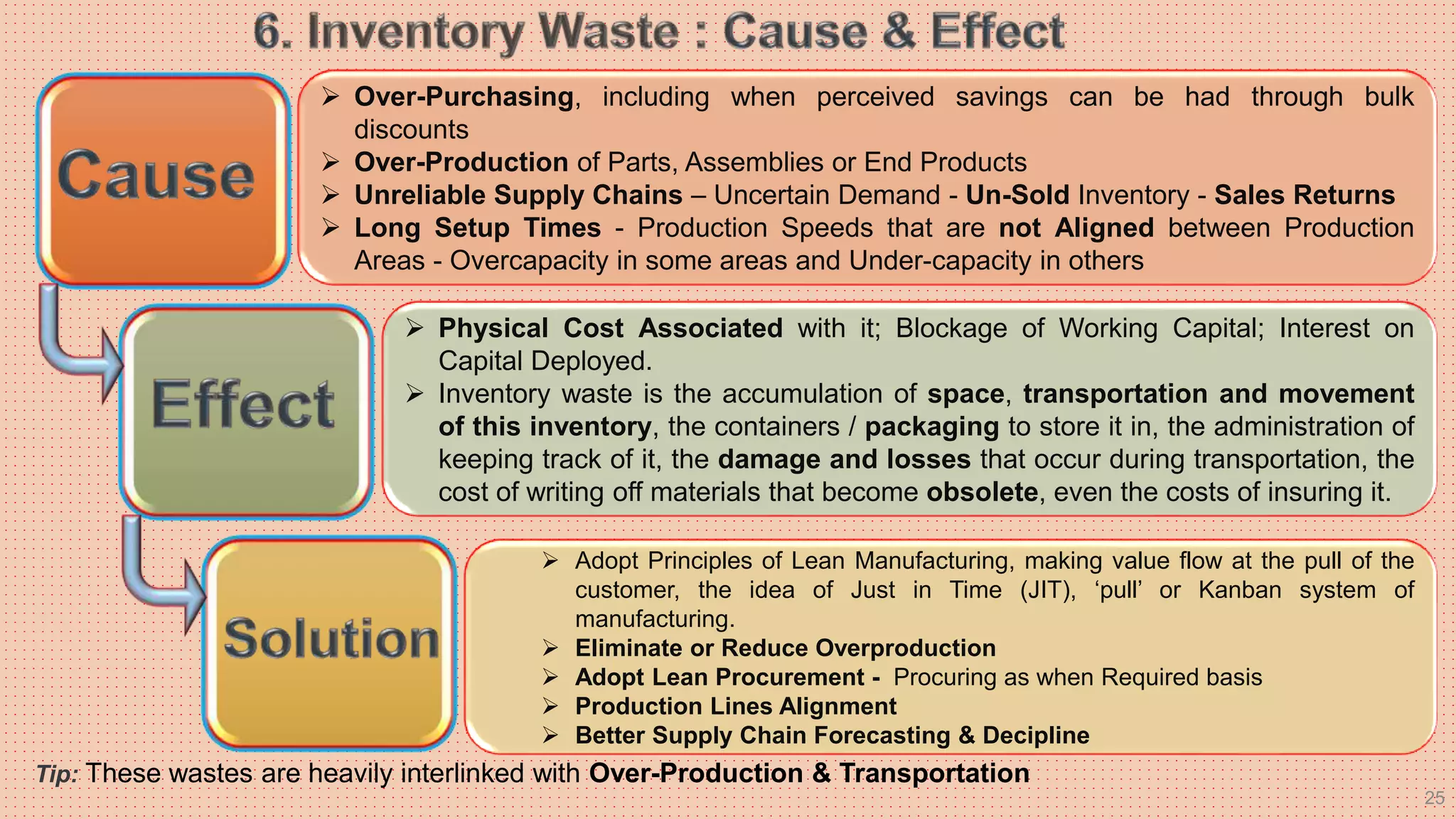
 Over-Purchasing, including when perceived savings can be had through bulk
discounts
 Over-Production of Parts, Assemblies or End Products
 Unreliable Supply Chains – Uncertain Demand - Un-Sold Inventory - Sales Returns
 Long Setup Times - Production Speeds that are not Aligned between Production
Areas - Overcapacity in some areas and Under-capacity in others
 Physical Cost Associated with it; Blockage of Working Capital; Interest on
Capital Deployed.
 Inventory waste is the accumulation of space, transportation and movement
of this inventory, the containers / packaging to store it in, the administration of
keeping track of it, the damage and losses that occur during transportation, the
cost of writing off materials that become obsolete, even the costs of insuring it.
 Adopt Principles of Lean Manufacturing, making value flow at the pull of the
customer, the idea of Just in Time (JIT), ‘pull’ or Kanban system of
manufacturing.
 Eliminate or Reduce Overproduction
 Adopt Lean Procurement - Procuring as when Required basis
 Production Lines Alignment
 Better Supply Chain Forecasting & Decipline
Tip: These wastes are heavily interlinked with Over-Production & Transportation
26
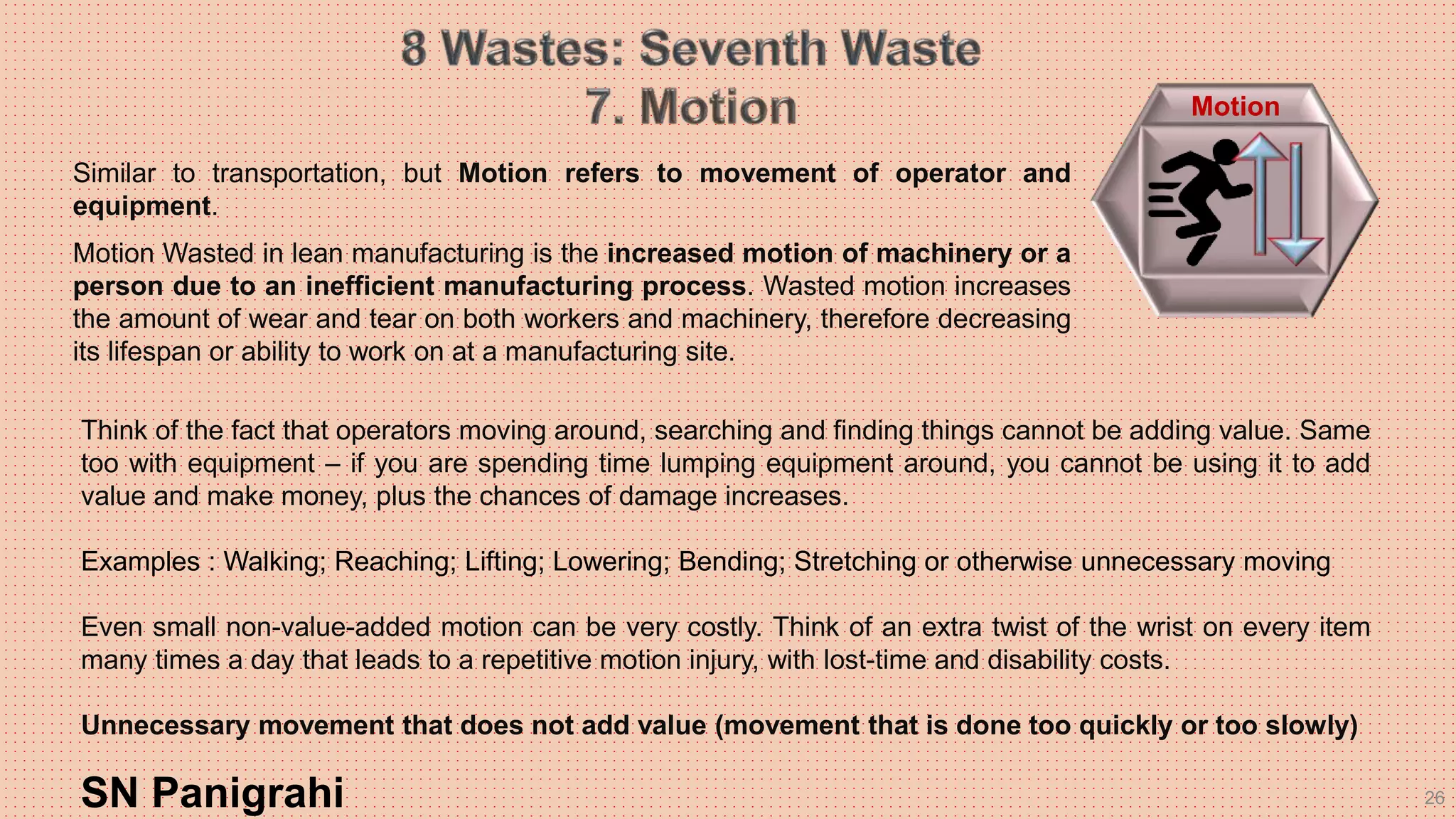
Think of the fact that operators moving around, searching and finding things cannot be adding value. Same
too with equipment – if you are spending time lumping equipment around, you cannot be using it to add
value and make money, plus the chances of damage increases.
Examples : Walking; Reaching; Lifting; Lowering; Bending; Stretching or otherwise unnecessary moving
Even small non-value-added motion can be very costly. Think of an extra twist of the wrist on every item
many times a day that leads to a repetitive motion injury, with lost-time and disability costs.
Unnecessary movement that does not add value (movement that is done too quickly or too slowly)
SN Panigrahi
Motion
Similar to transportation, but Motion refers to movement of operator and
equipment.
Motion Wasted in lean manufacturing is the increased motion of machinery or a
person due to an inefficient manufacturing process. Wasted motion increases
the amount of wear and tear on both workers and machinery, therefore decreasing
its lifespan or ability to work on at a manufacturing site.
27
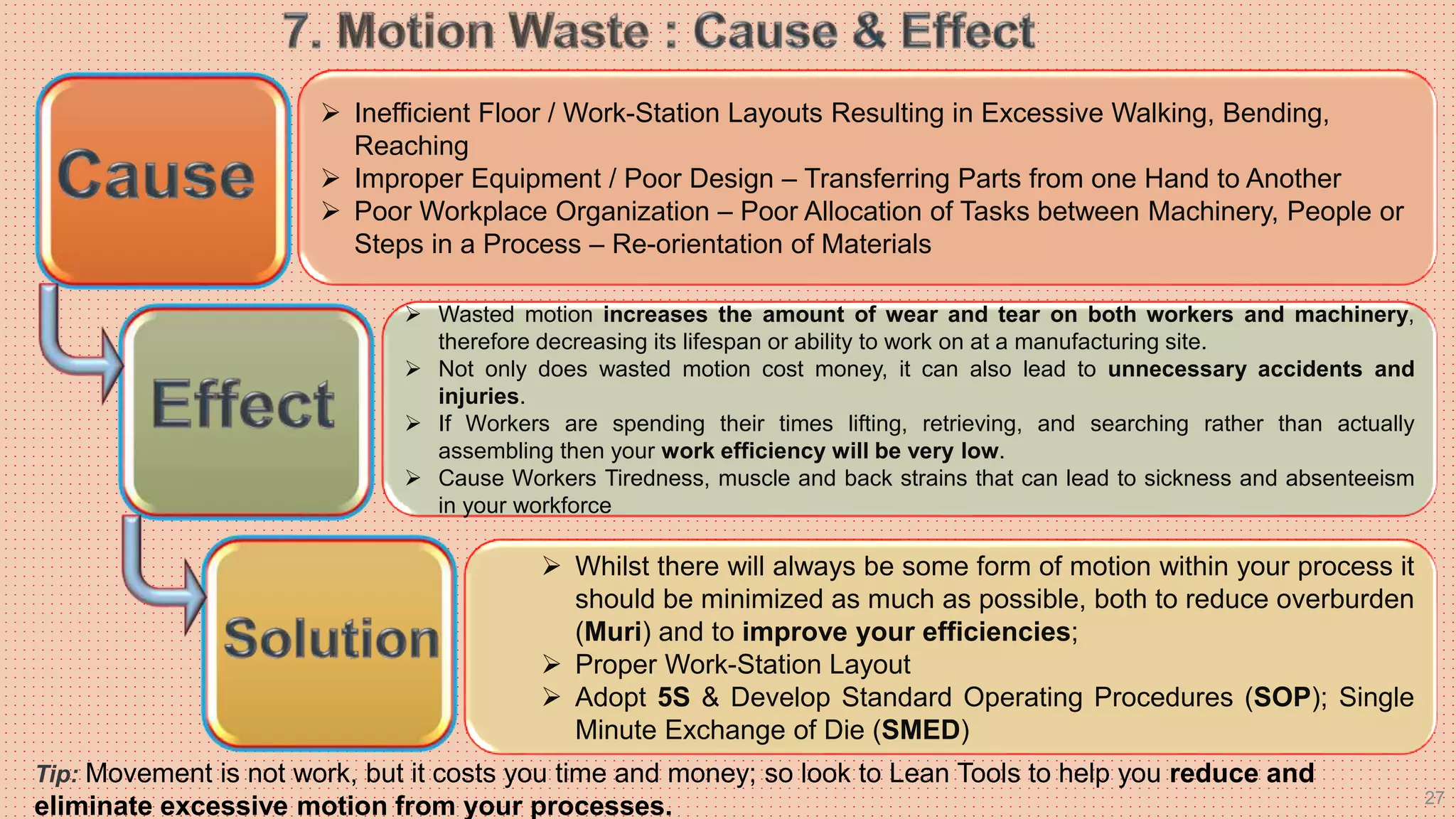
 Inefficient Floor / Work-Station Layouts Resulting in Excessive Walking, Bending,
Reaching
 Improper Equipment / Poor Design – Transferring Parts from one Hand to Another
 Poor Workplace Organization – Poor Allocation of Tasks between Machinery, People or
Steps in a Process – Re-orientation of Materials
 Wasted motion increases the amount of wear and tear on both workers and machinery,
therefore decreasing its lifespan or ability to work on at a manufacturing site.
 Not only does wasted motion cost money, it can also lead to unnecessary accidents and
injuries.
 If Workers are spending their times lifting, retrieving, and searching rather than actually
assembling then your work efficiency will be very low.
 Cause Workers Tiredness, muscle and back strains that can lead to sickness and absenteeism
in your workforce
 Whilst there will always be some form of motion within your process it
should be minimized as much as possible, both to reduce overburden
(Muri) and to improve your efficiencies;
 Proper Work-Station Layout
 Adopt 5S & Develop Standard Operating Procedures (SOP); Single
Minute Exchange of Die (SMED)
Tip: Movement is not work, but it costs you time and money; so look to Lean Tools to help you reduce and
eliminate excessive motion from your processes.
28
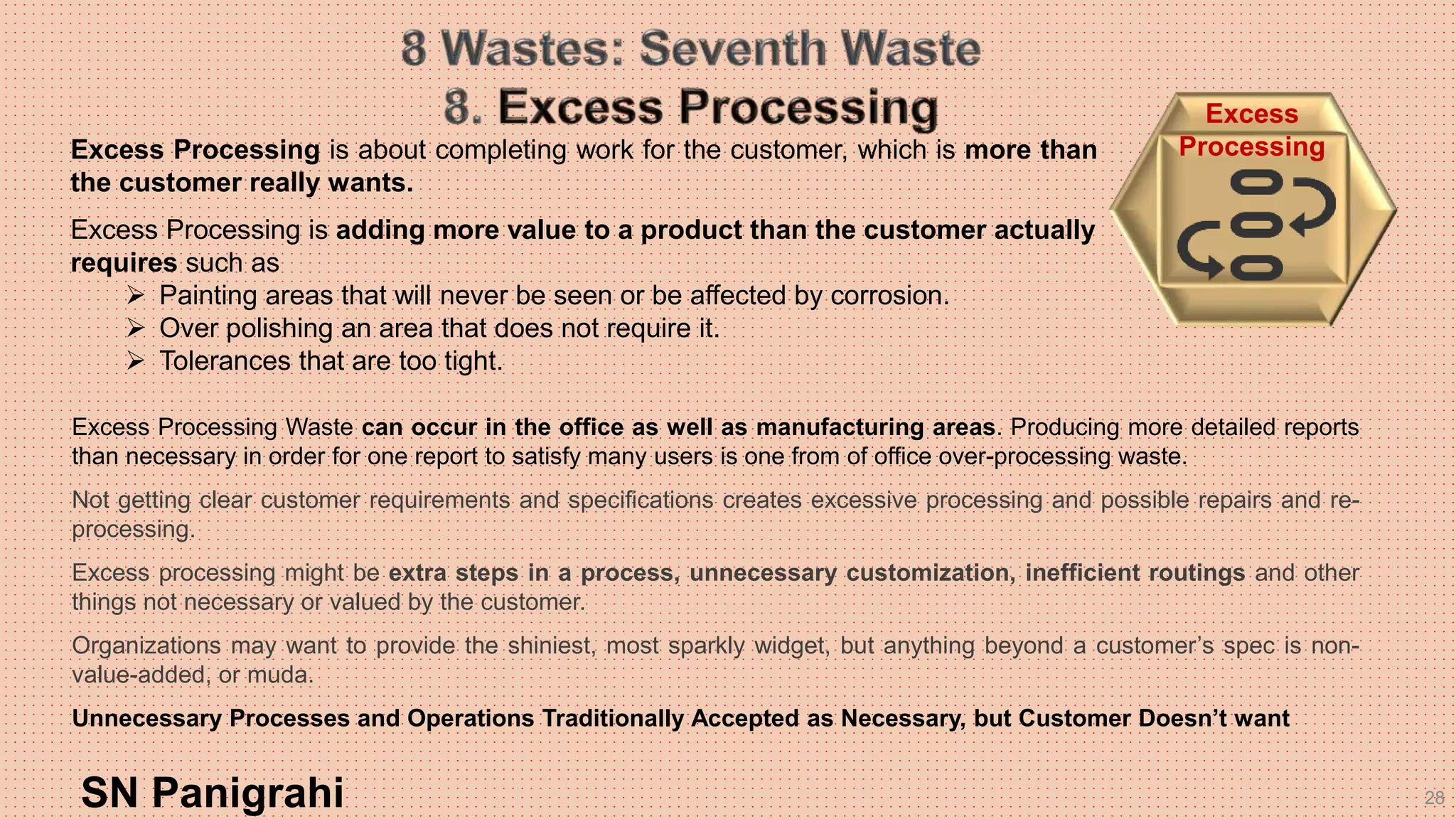
Excess Processing Waste can occur in the office as well as manufacturing areas. Producing more detailed reports
than necessary in order for one report to satisfy many users is one from of office over-processing waste.
Not getting clear customer requirements and specifications creates excessive processing and possible repairs and re-
processing.
Excess processing might be extra steps in a process, unnecessary customization, inefficient routings and other
things not necessary or valued by the customer.
Organizations may want to provide the shiniest, most sparkly widget, but anything beyond a customer’s spec is non-
value-added, or muda.
Unnecessary Processes and Operations Traditionally Accepted as Necessary, but Customer Doesn’t want
SN Panigrahi
Excess
ProcessingExcess Processing is about completing work for the customer, which is more than
the customer really wants.
Excess Processing is adding more value to a product than the customer actually
requires such as
 Painting areas that will never be seen or be affected by corrosion.
 Over polishing an area that does not require it.
 Tolerances that are too tight.
29
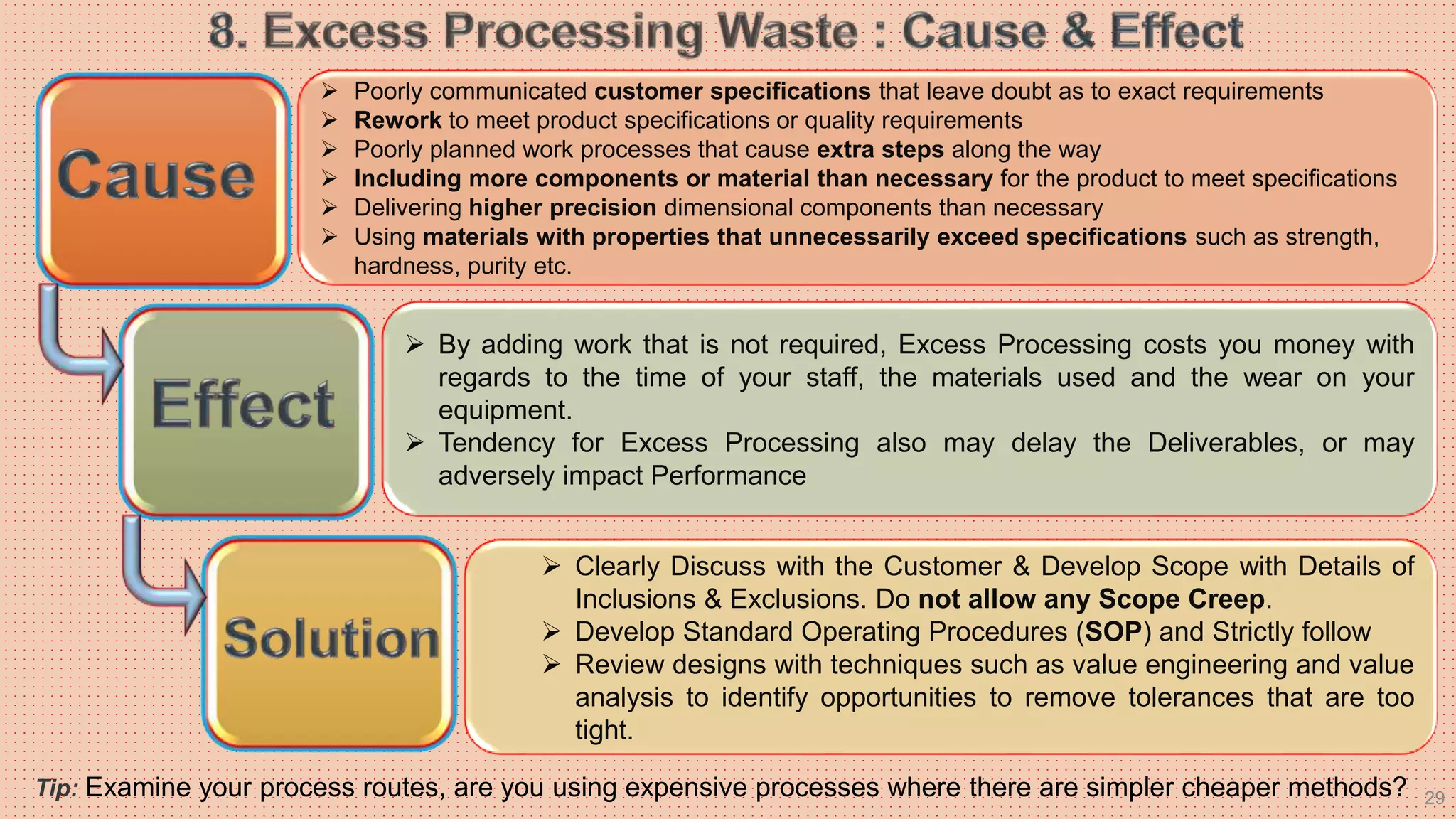
 Poorly communicated customer specifications that leave doubt as to exact requirements
 Rework to meet product specifications or quality requirements
 Poorly planned work processes that cause extra steps along the way
 Including more components or material than necessary for the product to meet specifications
 Delivering higher precision dimensional components than necessary
 Using materials with properties that unnecessarily exceed specifications such as strength,
hardness, purity etc.
 By adding work that is not required, Excess Processing costs you money with
regards to the time of your staff, the materials used and the wear on your
equipment.
 Tendency for Excess Processing also may delay the Deliverables, or may
adversely impact Performance
 Clearly Discuss with the Customer & Develop Scope with Details of
Inclusions & Exclusions. Do not allow any Scope Creep.
 Develop Standard Operating Procedures (SOP) and Strictly follow
 Review designs with techniques such as value engineering and value
analysis to identify opportunities to remove tolerances that are too
tight.
Tip: Examine your process routes, are you using expensive processes where there are simpler cheaper methods?
30
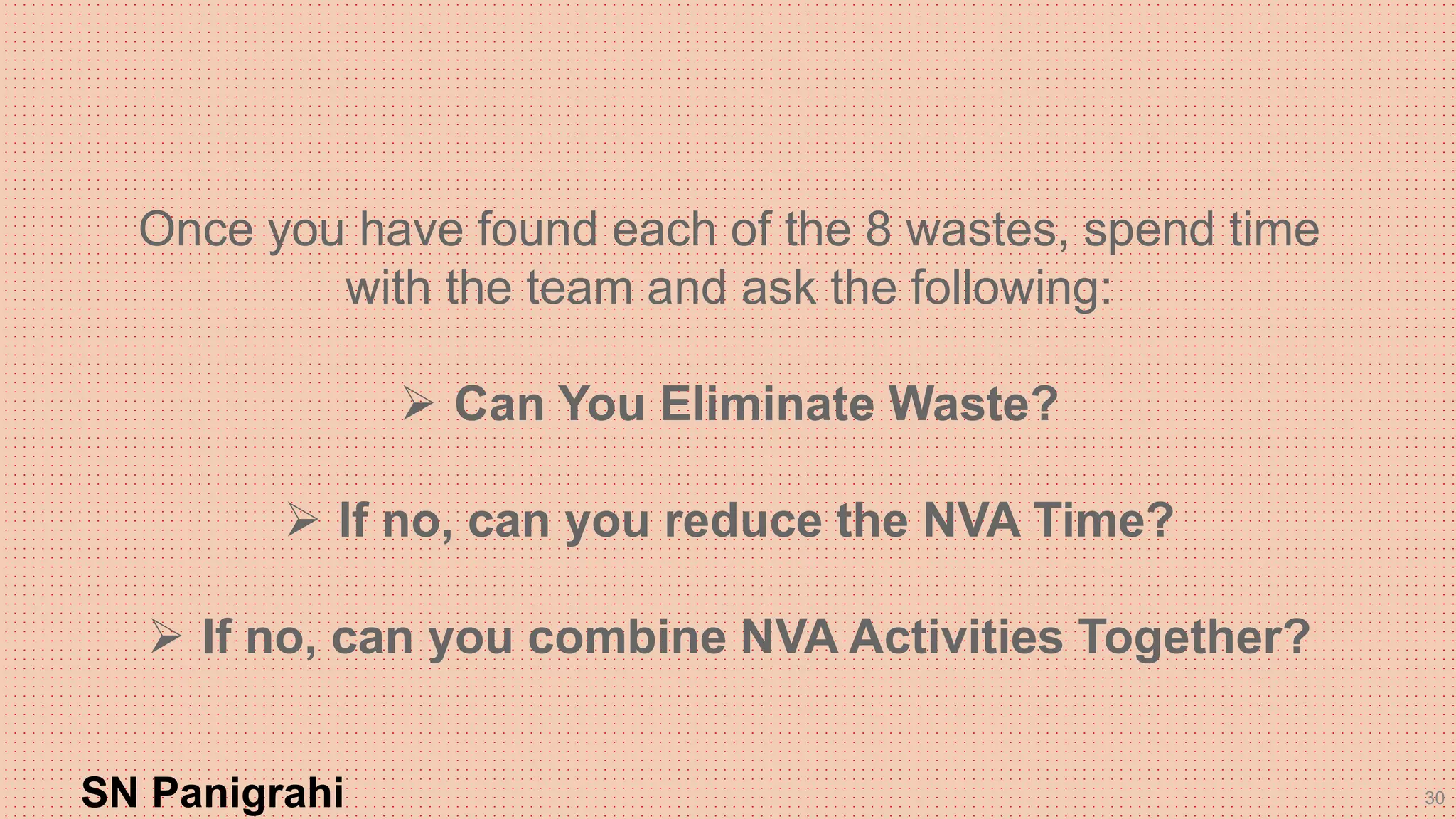
Once you have found each of the 8 wastes, spend time
with the team and ask the following:
 Can You Eliminate Waste?
 If no, can you reduce the NVA Time?
 If no, can you combine NVA Activities Together?
SN Panigrahi
31
32
https://www.youtube.com/channel/UCVZ
ScNa_leR8XbYINEwTFwQ/videos
SN Panigrahi
33
Contact Details:
SN Panigrahi
9652571117
snpanigrahi1963@gmail.com 34

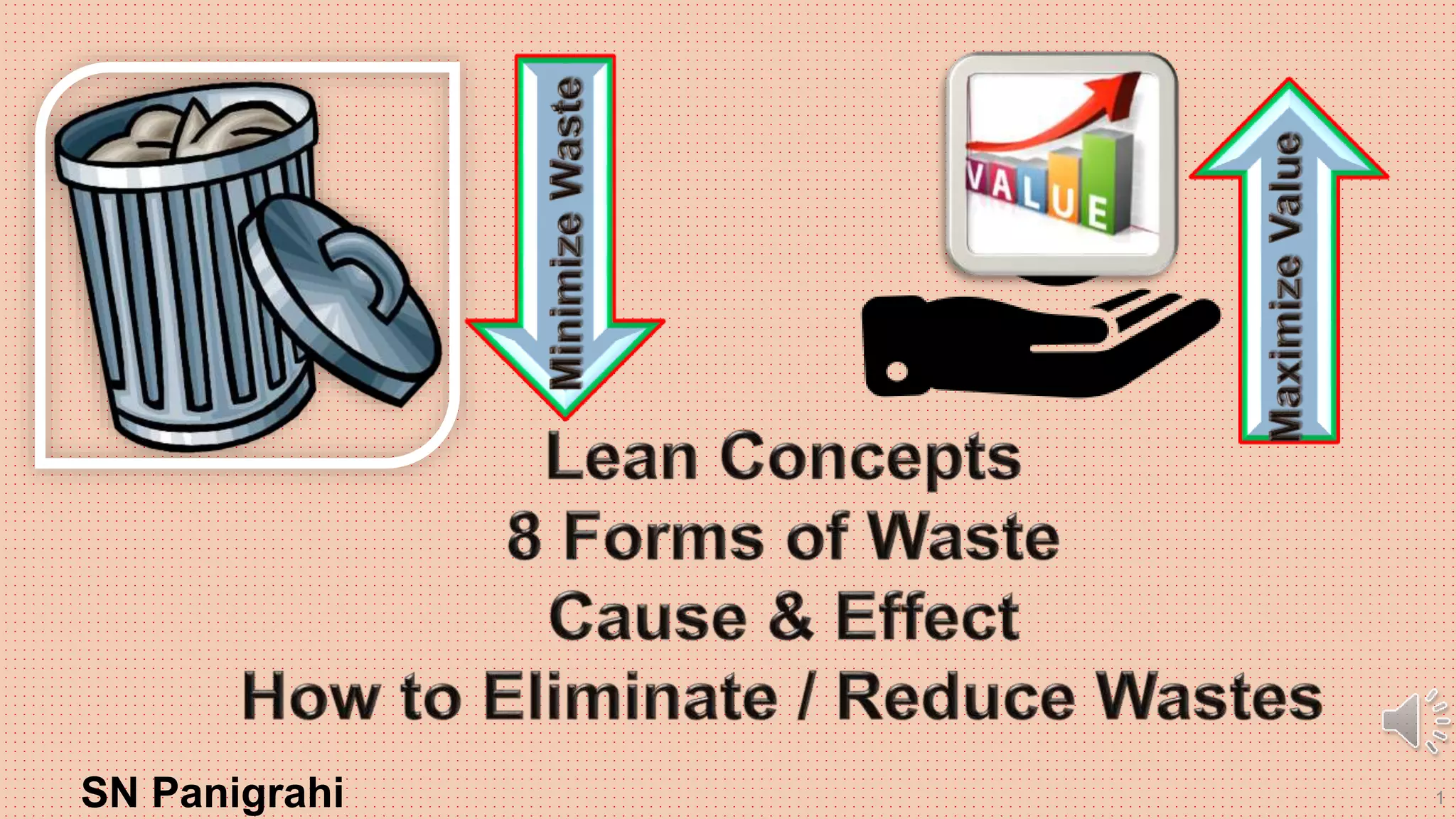
Lean Concepts "8 Forms of Waste Cause & Effect : How to Eliminate / Reduce Wastes" By SN Panigrahi

  • 1.
  • 2.
    SN Panigrahi 2 TheLean Method of Production in manufacturing systems was first brought to public attention by John Krafcik in 1988 when he published his article “Triumph of the Lean Production System.” This article helped people to begin to understand the benefits of using lean principles in a production system with the overall goals of reducing waste and maximizing efficiency. However, it was not until the book “The Machine That Changed the World,” by Womack, Jones and Ross was published in 1990 that the lean method became widely known and sought after. The most successful implementation of Lean Manufacturing to date is widely acknowledged to be when Toyota created the Toyota Production System (TPS).
  • 3.
    3 Lean Principles Lean isa business philosophy, not just a tool set or method for improvement. This business philosophy was derived from Toyota experiences and in particular from its Toyota Production System (TPS). The focus is on reducing waste in all business processes. The result is reduction of cost and lead-time as well as an increase in quality. To be Lean is to provide what is needed, when it is needed, with the minimum amount of materials, equipment, labour, and space. It was also a breakthrough step from mass production to lean production, from a push system to a pull system. SN Panigrahi
  • 4.
    SN Panigrahi 4 Theseven wastes originated in Japan, where waste is known as “Muda." "The seven wastes" is a tool to further categorize “Muda” and was originally developed by Toyota’s Chief Engineer Taiichi Ohno as the core of the Toyota Production System (TPS), also known as Lean Manufacturing. Lean implementation focuses on Reducing the Seven (now expanded to 8 wastes) types of Waste (or Muda, which is the Japanese word for waste). The 8th waste added is non-used employee talent (N), so that the 8 wastes can be easily remembered via the mnemonic “DOWN TIME” (Defective Production,Overproduction, Waiting, Non-used Employee Talent (the 8th form), Transportation, Inventory, Motion, and Excessive (Over) Processing)
  • 5.
    5 • Efforts Causedby Rework, Repair, Scrap and Incorrect InformationDefects • Producing More than is Needed or Before it is Needed Over- Production • Wasted Time Waiting for the Next Step in the ProcessWaiting • Under-Utilizing People’s Talents, Skills and Knowledge Non-Utilization of Talent • Unnecessary Movements of Products or ServicesTransportation • Excess Products and Materials being Produced or ProcuredInventory • Unnecessary Movement by PeopleMotion • More Work or Higher Quality than is Required by the Customer Extra Processing D O W N T I M E
  • 6.
  • 7.
    7 This Presentation Explainshow to reap benefits of Lean by Understanding, Defining, Identifying, and Minimize Waste. Lean is a Continuous Improvement Strategy focused on Maximizing Value & Minimizing Waste in all the Business Processes or Products SN Panigrahi
  • 8.
    8 Process Define, Identify, Prevent, Reduce, Eliminateand Continuously Improve, the 8 wastes of Lean from impacting the productivity of the organization. Benefits  Increased Productivity  Improved Quality  Right Delivery of Deliverables at Right Time with in Budget  Smoother Operation- Improved Continuous Flow of Value  Reduced Operating Costs
  • 9.
    9 Waste means Any Activityor Features that Doesn’t Add Value to the Product or Service, from the Point of View of the Customers Examples of Waste  Delivery Mismatch / Wrong Delivery  Rework, Repair  Waiting for Approvals, Signatures  Unnecessary Movement like Bending or Stretching  Unnecessary Travel like Driving or Ridding  Stocking More than Required  Producing more than Required etc…. etc…. SN Panigrahi
  • 10.
    10 Value-Added (VA) These Activitiesare Essential for Conversion / Changes of Product / Service and Valuable for the Customer. You would look at Maximizing this Category as these are Providing Customer Value (Form, Fit, Function). Necessary but Non-Value Added (NNVA) Category that has potential for elimination in the future (with identified improvements) but can't be eliminated immediately. There are necessary to run the current process. Technology, environment, culture require these activities. You would look at minimizing this category of work Non-Value Added (NVA) Non Value-Added Work can usually be eliminated quickly and is not dependent on improvement of other areas. This is the work nobody needs and it is pure waste. You would look at eliminating this category of work. SN Panigrahi Pure Waste
  • 11.
    11 In order toImprove Efficiency, Effectiveness, and Profitability, focus relentlessly on eliminating all aspects of the process that add no value from your customer’s perspective. Muda or Waste Reduction / Elimination is a key concept in Lean management. The Benefits of Reduction / Elimination are:  Identifying & Eliminating the Wastes will help you Optimize Resources and Increase Profitability.  By working to eliminate these wastes, an organization can achieve considerable Improvements in their Operating Efficiency.  It will also help you realize the exact parts of the work process where you can improve.  It will enable you to see if an activity is a necessary or pure waste. SN Panigrahi
  • 12.
    12 Defects Over production Waiting Non-Utilized Talent TransportationExcess Processing Inventory Motion Down Time D Defects O Overproduction W Waiting N Non-Utiulized Talent T Transportation I Inventory M Motion E Extra Processing Taiichi Ohno’s 7 Wastes + 8th Waste Non-Utiulized Talent SN Panigrahi
  • 13.
    13 Defects are any Imperfection,  Deficiency,  Flaw,  Weakness,  Wrong Doing,  Limitation or undesired outcome (Defective) within a Product, Service or Process  Faulty Forecast, Faulty Planning & Estimates etc. Defective Product (Material Defects – Short / Excess Delivery, Damaged Delivery), Defective Service (Improper Sign-offs, Unsatisfactory or Incomplete Service, Late Delivery of Services), Defective Process (Unclear Processes and Rules of Engagement, Process Inconsistencies, Incomplete Documentation, Ineffective Communication and Team Misalignment); The waste that is generated by defects is defined as every Resource & Effort that goes into creating the defect, Containing it, Reworking it, Extra Materials Involved and ultimately Dispossessing it from every aspect of the business. SN Panigrahi Defects
  • 14.
    14SN Panigrahi Defects Every bitof scrap Costs Money and Time – Money for the Materials, Resource to pay staff, Utilities etc to do it again, but also means that you have to push another planned job back in the queue in order to get the rework out! It’s all cost and less cash for the business. Paperwork (including electronic) tracking for defects and waste removal isn’t free. Defects that actually reach the customer can cause greater pain, with loss of not only that customer, but many others from viral word-of-mouth dissatisfaction. Some experts estimate defects have a 10x negative impact on a company. Waste Related to Costs for Inspection of Defects in Materials and Processes, Customer Complaints and Repairs / Rectifications Defects involve scrap or material that is thrown out or reworked…and much more. Concessions may be made to a customer or Discounted-sale pricing may be used so defective material can be sold. In addition, the quality control system that must be put in place for an out-of-control process has high inspection costs.
  • 15.
    15 Common causes include,but are not limited to Poor Planning & Implementation as Planned; Poor Preventive Methods & Inspections, Poor Workmanship, Improper Sign-offs, Material Defects, Supplier Inconsistencies, Incomplete Documentation, Ineffective Communication Tracking, and Team Misalignment, Lack of Proper Training. Any one of the above causes can lead to some pretty serious consequences including, but not limited to; Disruptions to Overall Worker Productivity, Disruptions to Stakeholder Financials, Safety Hazards, Customer Complaints and Strained Customer Relationships. By Adopting Lean Principles to Eliminate / Reduce Defects with proven Productivity Solutions, Technology / Automation, Evaluation Work Sheets / Checklists, Team Development with Mindset and a Journey to become better than you are today. Attitude to Do First Time Right Tip: Evaluating the impact of some defects can be done by multiplying the cost of the scrap by a factor of ten. The resulting number can be viewed as a rough measure of the cost to your business or to your customer.
  • 16.
    16 Overproduction is  Makingsomething too soon,  Making too much of something (greater Volumes), or  Making something faster than is needed. It unnecessarily consumes time, effort, money, materials and resources that could have been better spent elsewhere, leaving your organization with the burden and logistics of dealing with excess inventory, Product Damage from warehouse stocking and removal, defects introduced by high-speed Processes, strain on human Interaction with Machines. The problem is, “the customer may want 10 items, for instance, but we will produce 20 items and store them…….” Producing something at the Wrong Time or in Unnecessary Amounts SN Panigrahi Over production
  • 17.
    17  Overproduction islargely caused by Faulty Planning and Execution Process.  Desire for Longer than Necessary Production Runs; Larger Batch Sizes; Unreliable Process; Unstable Schedules  Ordering More Supplies than Necessary, just in case  Expecting Disrupted Production Flows / Stock-outs  Unbalanced Production Stages or Departments  Faulty Forecasting & Creating False Demand  Overproducing causes companies to draw on capital for Extra Materials, Extra Man-Power, Unnecessary Tools and Machinery, Additional Facility Capacity, and Excessive Inventory Cost & Space. This is not only creates cash flow constraints, it can cripple an organization.  Over Spending, Over-Staffing, Over-Supplying, Over-Shipping Leading to Growing Distrust for the Reliability.  Over-Production may become obsolete which is most costly aspect as the Extra Products sit in Inventory without any Orders.  Running smaller batch sizes  Creating more reliable processes, and trusting in them  Establishing stable schedules  Balancing departments  Using accurate information to map actual demand  Operating in a Just-in-Time Mode Tip: Implementing Lean practices and or principles is a continuous journey. By taking small steps and working together with other Lean champions, your company will benefit and will see continuous improvements.
  • 18.
    18 Waiting involves delaysto process steps, often extending customer lead time. This may include waiting for authorization from a superior, even though the authorization is a rubber stamp rather than critical input. It can involve inefficient changeovers, poor communications, large batch processing, and uneven workstation loading.  Parts or Assemblies waiting in queues for the next step in the operation  People Waiting for Authorization / Approval / Other Procedural Aspects, Waiting for Material, Equipment or Tools to Perform their Operation  Finished Products waiting to be Shipped or Sitting in Stores  Idle Equipment / Equipment Breakdowns  Vendor / Third-party Company Delays / Logistical Delays Waiting for people or services to be delivered (time when people, processes or equipment are idle) SN Panigrahi Waiting Waiting : When work in progress and goods are not being worked on, they sit there waiting – waiting for the next process. This is typical of traditional ‘Batch and Queue’ methods. Waiting means that product is costing the company money and not adding value.
  • 19.
    19  Unplanned Downtime Production Bottlenecks and not Balanced Production Workloads / uneven production  Setup Times that are Too Long  Producing to a Forecast Instead of a Pull System  Not Enough People / Materials / Equipment / Tools / Other Resources  Poor Quality Built into the Process  Ineffective Internal Communication / Policies & Procedures Like Approvals / Authentications  Waiting Waste ties up significant Capital in many businesses and the cost of capital drives up costs throughout the organization.  Common waiting contributors include non-productive labor, equipment inefficiencies, production bottlenecks, lack of quality communication, insufficient materials, and information gaps; all of which contribute Performance, Profits and Customer Satisfaction because of Late Deliveries, Missing Schedules, Project Cost Over-runs.  Balanced Production Workloads to ensure Even Production Flow  Setting up a ‘Pull’ system from the End Customer  Processes Adjustment to Eliminate Waste  Establishing Stable Schedules  Developing Multi-skilled / Flexible Human Resources so that people can respond quickly and be re-tasked to other areas as demand changes  Just-in-Time Availability Tip: One of the greatest steps one can take toward improving profits and reducing costs, is to remove all elements of waiting- waste from all business departments, processes
  • 20.
    20 WHAT IS NON-UTILIZEDTALENT? Non-Utilized Talent is a key waste described in the lean manufacturing ideology. This waste pertains to the loss or incomplete use of human capability and resources within a production process. Non-Utilization Waste is the waste of human potential, often the most costly waste of all. It occurs when management is too separated from the role of employees and managers view themselves as the sole resource for organizing, planning, assigning, controlling or improving work processes. When the role of employees is to simply follow directions without question, non-utilization waste is bound to happen. SN Panigrahi Non-Utilized TalentNot fully utilized people represents the waste of talent present in many organizations. Because operators are close to their processes daily, they can often recognize problems or opportunities that staff or superiors just don’t see, but the workers may never be asked for their input. They may also have outside talents that aren’t formally part of their assigned jobs, but could be of use. The recommendation? Value people for their brains, not just their brawn.
  • 21.
    21  Wrong Selectionof Resources / Wrong / Excess Recruitment  Not being on Task / Not Following Processes / Not having well Established Processes  Not Leveraging Available Critical Thinking Skills / Mis-assignment of Tasks to People with the Wrong Skills  Demotivation of People / Lack of a Teamwork Environment / Poor Training.  Seek to Limit Employee Development in the expectation that employees who advance their workplace talents and capabilities will seek "better" employment opportunities elsewhere or higher compensation for the given task.  Many businesses suffer non-utilization waste, primarily because it is a cultural, not a technical issue. Signs of non-utilization waste can include low morale, inconsistent production or quality, unengaged people, micromanaging and lack of employee empowerment to make decisions.  Organizations Risk Facing a Higher Employee Turnover Rate, Employee Frustration, and having to Pay Higher Salaries for Certain Employees even through under Utilized their Talent.  Encourage Employee Involvement - create a culture that invites employees to be part of the work  Cross Training, Self-improvement, Skills Advancement, Process Improvements, New Responsibilities, Work Flexibility, Reward and Appreciation  Recognize under-utilized Talent, and channel it toward appropriate forms of development and training, will help usher in a new era of employee satisfaction, retention, and overall productivity. Tip: Employees at any level can offer valuable insights about the job they perform every day. They witness first hand certain inefficiencies and understand how it can be improved. Do not let this feedback go untapped
  • 22.
    22 Transport waste inmanufacturing can include the movement of Raw Materials, Tools, Inventory, Equipment or End Products more than is absolutely necessary to achieve the production goals. In fact, transportation can sometimes even reduce value. The more times a product is transported, the more likely it is subject to mishandling and damage. Even cosmetic packaging damage may cause customers to reject product. Conveying, transferring, picking up, setting down, piling up and otherwise moving unnecessary items SN Panigrahi Transportation Transportation Waste deals with Unnecessary or Extra Movement of Products that is Not Directly Associated with the Value Adding Process. From a customer perspective, Transport Adds NO Value to the Product, as it is not being physically transformed. Transportation does not make any transformation to the product that the consumer is supposed to pay for.
  • 23.
    23  Unnecessary Stepsin a Process / Process Flows which are not Aligned  Transport of Product from one Functional Area to Another  Poor Production Layout so that Materials move Longer Distances or To & Fro Movement; Multiple Storage Locations  Not well Designed Systems- Lengthy or Complex Material Handling System  Overproduction which in turn leads to the waste of Resources & Inventory; Inventory that then has to be Transported throughout your facility or between factories and even continents.  Transportation not only Costs Money & other Resources, but can also Result in the Increased Risk of that Product being Damaged, Lost or Misused.  Processes Should be as Close Together as Possible and Material Flow Directly from Process to Process without any Significant Delays in between.  Simplifying Processes, Adjusting Physical Layouts, Rationalizing Processes to Minimize Product Handling, Shortening Steps between Process Steps for People.  Eliminate or Reduce Overproduction which will in turn reduce the amount of inventory in the system which will need to be transported. Tip: Layout should be changed as per the principles of lean manufacturing, create value streams and make that value flow at the pull of the customer, that will result in huge savings in time and money
  • 24.
    24 The waste aspectsof holding large amounts of inventory are many:  The product made may not be what the customer ultimately wants.  The product may go bad or become obsolete before the customer purchases it.  The inventory may contain large blocks of nonconforming product that slipped through quality control.  Holding inventory costs money (estimate 20 to 30 percent carrying cost).  Tying up money in inventory limits opportunities to use funds elsewhere. Excessive supplies, materials or info for any length of time (having more on hand than what’s needed) Inventory may be in the form of Raw Material, Work in Progress or Finished Goods. In any of these three forms of inventory, if it hasn’t been sold, it is cash that has been tied up into the material, which the customer hasn’t bought yet– These result in a massive drain on the cash flow. SN Panigrahi Inventory Inventory is the Raw Materials, Work In Progress (WIP) and Finished Goods stock that is held, we often hold far more than is required to produce goods and services when the customer wants them using Just in Time (JIT) principles. Also Capital Goods not in use or Obsolete Items are Kept in Inventory.
  • 25.
    25  Over-Purchasing, includingwhen perceived savings can be had through bulk discounts  Over-Production of Parts, Assemblies or End Products  Unreliable Supply Chains – Uncertain Demand - Un-Sold Inventory - Sales Returns  Long Setup Times - Production Speeds that are not Aligned between Production Areas - Overcapacity in some areas and Under-capacity in others  Physical Cost Associated with it; Blockage of Working Capital; Interest on Capital Deployed.  Inventory waste is the accumulation of space, transportation and movement of this inventory, the containers / packaging to store it in, the administration of keeping track of it, the damage and losses that occur during transportation, the cost of writing off materials that become obsolete, even the costs of insuring it.  Adopt Principles of Lean Manufacturing, making value flow at the pull of the customer, the idea of Just in Time (JIT), ‘pull’ or Kanban system of manufacturing.  Eliminate or Reduce Overproduction  Adopt Lean Procurement - Procuring as when Required basis  Production Lines Alignment  Better Supply Chain Forecasting & Decipline Tip: These wastes are heavily interlinked with Over-Production & Transportation
  • 26.
    26 Think of thefact that operators moving around, searching and finding things cannot be adding value. Same too with equipment – if you are spending time lumping equipment around, you cannot be using it to add value and make money, plus the chances of damage increases. Examples : Walking; Reaching; Lifting; Lowering; Bending; Stretching or otherwise unnecessary moving Even small non-value-added motion can be very costly. Think of an extra twist of the wrist on every item many times a day that leads to a repetitive motion injury, with lost-time and disability costs. Unnecessary movement that does not add value (movement that is done too quickly or too slowly) SN Panigrahi Motion Similar to transportation, but Motion refers to movement of operator and equipment. Motion Wasted in lean manufacturing is the increased motion of machinery or a person due to an inefficient manufacturing process. Wasted motion increases the amount of wear and tear on both workers and machinery, therefore decreasing its lifespan or ability to work on at a manufacturing site.
  • 27.
    27  Inefficient Floor/ Work-Station Layouts Resulting in Excessive Walking, Bending, Reaching  Improper Equipment / Poor Design – Transferring Parts from one Hand to Another  Poor Workplace Organization – Poor Allocation of Tasks between Machinery, People or Steps in a Process – Re-orientation of Materials  Wasted motion increases the amount of wear and tear on both workers and machinery, therefore decreasing its lifespan or ability to work on at a manufacturing site.  Not only does wasted motion cost money, it can also lead to unnecessary accidents and injuries.  If Workers are spending their times lifting, retrieving, and searching rather than actually assembling then your work efficiency will be very low.  Cause Workers Tiredness, muscle and back strains that can lead to sickness and absenteeism in your workforce  Whilst there will always be some form of motion within your process it should be minimized as much as possible, both to reduce overburden (Muri) and to improve your efficiencies;  Proper Work-Station Layout  Adopt 5S & Develop Standard Operating Procedures (SOP); Single Minute Exchange of Die (SMED) Tip: Movement is not work, but it costs you time and money; so look to Lean Tools to help you reduce and eliminate excessive motion from your processes.
  • 28.
    28 Excess Processing Wastecan occur in the office as well as manufacturing areas. Producing more detailed reports than necessary in order for one report to satisfy many users is one from of office over-processing waste. Not getting clear customer requirements and specifications creates excessive processing and possible repairs and re- processing. Excess processing might be extra steps in a process, unnecessary customization, inefficient routings and other things not necessary or valued by the customer. Organizations may want to provide the shiniest, most sparkly widget, but anything beyond a customer’s spec is non- value-added, or muda. Unnecessary Processes and Operations Traditionally Accepted as Necessary, but Customer Doesn’t want SN Panigrahi Excess ProcessingExcess Processing is about completing work for the customer, which is more than the customer really wants. Excess Processing is adding more value to a product than the customer actually requires such as  Painting areas that will never be seen or be affected by corrosion.  Over polishing an area that does not require it.  Tolerances that are too tight.
  • 29.
    29  Poorly communicatedcustomer specifications that leave doubt as to exact requirements  Rework to meet product specifications or quality requirements  Poorly planned work processes that cause extra steps along the way  Including more components or material than necessary for the product to meet specifications  Delivering higher precision dimensional components than necessary  Using materials with properties that unnecessarily exceed specifications such as strength, hardness, purity etc.  By adding work that is not required, Excess Processing costs you money with regards to the time of your staff, the materials used and the wear on your equipment.  Tendency for Excess Processing also may delay the Deliverables, or may adversely impact Performance  Clearly Discuss with the Customer & Develop Scope with Details of Inclusions & Exclusions. Do not allow any Scope Creep.  Develop Standard Operating Procedures (SOP) and Strictly follow  Review designs with techniques such as value engineering and value analysis to identify opportunities to remove tolerances that are too tight. Tip: Examine your process routes, are you using expensive processes where there are simpler cheaper methods?
  • 30.
    30 Once you havefound each of the 8 wastes, spend time with the team and ask the following:  Can You Eliminate Waste?  If no, can you reduce the NVA Time?  If no, can you combine NVA Activities Together? SN Panigrahi
  • 31.
  • 32.
  • 33.
  • 34.