Lean Manufacturing
K.Manjula
Assistant Professor
Department of Business Administration
St Joseph Engineering College.
Module-3
Concept of Lean Manufacturing; meaning of lean manufacturing; History of Lean
Operations, Types of Waste, “5S” Technique of Eliminating the Waste, Lean
Operations in the service sector, Role of Leadership, Lean Operations and Just In
Time(JIT).
Lean Operations in the service sector
Concept of lean manufacturing
Lean manufacturing concepts are more than producing the
same product or service faster – Lean is about building
quality into every part of the process, while systematically
driving out waste from every part of the process, so you
deliver a better product or service faster.
Organizations draw upon a wide range of Lean manufacturing concepts to help
them achieve goals like:
● Eliminating or reducing waste
● Improving quality
● Reducing lead time
● Minimizing unnecessary expenses
Meaning of lean manufacturing
Lean manufacturing is a production process based on an
ideology of maximising productivity while simultaneously
minimising waste within a manufacturing operation. The lean
principle sees waste is anything that doesn’t add value that the
customers are willing to pay for.
Types of Waste
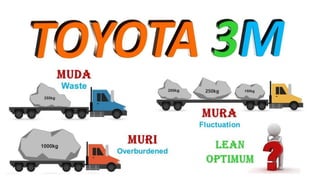
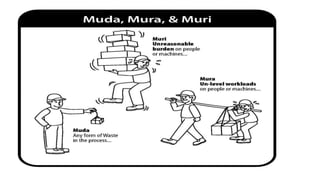
Toyota, which is the originator of the ‘lean operations’ movement, classifies waste
into three categories, viz.,
1. MUDA
2. MURI
3. MURA
MUDA
Lean manufacturing, a management philosophy primarily derived from the
Toyota Production System, focuses on eliminating waste—called
“Muda”— within a manufacturing system. It takes into account many kinds
of waste, including the waste of excessive human motion, and aims to
integrate each step of production into a holistic, efficient process that
reduces cost and improves overall revenue.
Overproduction
The most serious of the wastes, overproduction can cause all other types of wastes and
results in excess inventory. Stocking too much of a product that goes unused has obvious
costs: storage, wasted materials, and excessive capital tied up in useless inventory.
Depending, of course, on the product in question, overproduction can have very serious
environmental effects. More raw materials than necessary are consumed; the product may
spoil or become obsolete, which requires that it be tossed; and, if the product involves
hazardous materials, more hazardous materials than necessary are wasted, resulting in
extra emissions, extra costs of waste disposal, possible worker exposure, and potential
environmental problems resulting from the waste itself.
Inventory
Inventory waste refers to the waste produced by unprocessed inventory. This
includes the waste of storage, the waste of capital tied up in unprocessed
inventory, the waste of transporting the inventory, the containers used to hold
inventory, the lighting of the storage space, etc. Moreover, having excess
inventory can hide the original wastes of producing said inventory.
The environmental impacts of inventory waste are packaging, deterioration or
damage to work-in-process, additional materials to replace damaged or obsolete
inventory, and the energy to light—as well as either heat or cool—inventory space.
Motion
Wasteful motion is all of the motion, whether by a person or a machine, that could be
minimized. If excess motion is used to add value that could have been added by less, than
that margin of motion is wasted. Motion could refer to anything from a worker bending over
to pick something up on the factory floor to additional wear and tear on machines, resulting
in capital depreciation that must be replaced.
There are many environmental costs from excess motion. One obvious one is the needless
waste of materials used to replace worn machines; another one could be the health
resources for overburdened employees, who might not have needed them if motion had
been minimized.
Defects
Defects refer to a product deviating from the standards of its design or
from the customer’s expectation. Defective products must be replaced;
they require paperwork and human labor to process it; they might
potentially lose customers; the resources put into the defective product
are wasted because the product is not used. Moreover, a defective
product implies waste at other levels that may have led to the defect to
begin with; making a more efficient production system reduces defects
and increases the resources needed to address them in the first place.
Over-processing
Over-processing refers to any component of the process of manufacture that is unnecessary.
Painting an area that will never be seen or adding features that will not be used are
examples of over-processing. Essentially, it refers to adding more value than the customer
requires.
The environmental impact involves the excess of parts, labor, and raw materials consumed
in production. Time, energy, and emissions are wasted when they are used to produce
something that is unnecessary in a product; simplification and efficiency reduce these
wastes and benefit the company and the environment.
Waiting
Waiting refers to wasted time because of slowed or halted production in one step of the
production chain while a previous step is completed. To take the classic example, the
production line, if one task along the chain takes longer than another, than any time the
employee in charge of the next task spends waiting is wasted. The task that takes more time
must be made more efficient, other employees must be hired to help, or the workflow must
be better coordinated or scheduled in order to make up for this wasted time.
The environmental impact comes from the wasted labor and energy from lighting, heating, or
cooling during the waiting period. Additionally, material can be spoiled, and components
could be damaged because of an inefficient workflow.
Transport
Transport is moving materials from one position to another. The transport itself adds no
value to the product, so minimizing these costs is essential. This means having one
plant closer to another in the production chain, or minimizing the costs of transportation
using more efficient methods. Resources and time are used in handling material,
employing staff to operate transportation, training, implement safety precautions, and
using extra space. Transport can also cause the waste of waiting, as one part of the
production chain must wait for material to arrive.
Environmental costs to waiting include gas emissions, transportation packaging used,
possible damage to the product en route, as well as a whole host of other wastes
involving transporting hazardous materials.
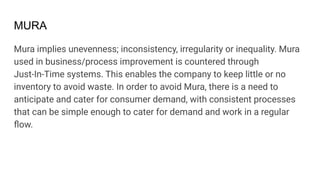
MURA
Mura implies unevenness; inconsistency, irregularity or inequality. Mura
used in business/process improvement is countered through
Just-In-Time systems. This enables the company to keep little or no
inventory to avoid waste. In order to avoid Mura, there is a need to
anticipate and cater for consumer demand, with consistent processes
that can be simple enough to cater for demand and work in a regular
flow.
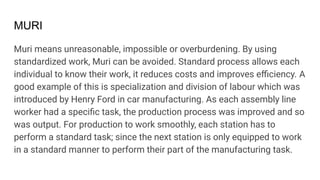
MURI
Muri means unreasonable, impossible or overburdening. By using
standardized work, Muri can be avoided. Standard process allows each
individual to know their work, it reduces costs and improves efficiency. A
good example of this is specialization and division of labour which was
introduced by Henry Ford in car manufacturing. As each assembly line
worker had a specific task, the production process was improved and so
was output. For production to work smoothly, each station has to
perform a standard task; since the next station is only equipped to work
in a standard manner to perform their part of the manufacturing task.
“5S” Technique of Eliminating the Waste
5S is a system to reduce waste and optimize productivity through
maintaining an orderly workplace and using visual cues to achieve more
consistent operational results. Implementation of this method "cleans up"
and organizes the workplace basically in its existing configuration, and it is
typically the first lean method which organizations implement.
https://study.com/academy/lesson/the-5s-approach-to-waste-elimination-for-lean-b
usinesses.html#quiz-course-links
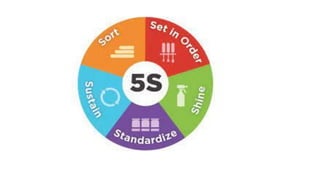
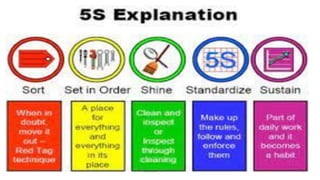
Sort - Seiri
After your 5S pilot team has done its homework, audited, conducted training, etc.,
for the first targeted location, Step 1 is Sort. Criteria are set for removing—by
red-tagging—all tools, materials, equipment, etc. not needed to get a job done.
How frequently a tool or any other item is used for a job determines where it will
be placed or located. When red-tagging, ask:
• Is this item needed?
• If it is needed, is it needed in this quantity?
• If it is needed, how frequently is it used?
• If it is needed, where should it be located?
Items used hour by hour or day by day should be kept within arm’s
reach of the point of use. Items or equipment used once a week or
once a month should be kept within the work area. Less frequently
used items should be stored in a more distant location. Unneeded
or obsolete items should be stored in a designated holding area.
Systematize or Set in Order- Seiton
Workers at this point conduct an honest needs assessment. What do I
need to do my job? Where should I locate each item I need? How many of
each item do I really need? Shadow boards can be set up within easy
reach of workstations, with the shape of each frequently used item
outlined for organized placement and easy, quick access. List and
prominently post for the information of every employee where items are
to be found. Employees must know where to quickly find every item. Label
storage lockers, cabinets, drawers, cupboards, etc. so employees know
what content is contained within.
Sweep or Shine- Seiso
This is the point in the 5S process where daily cleaning becomes a habit.
The work space is cleaned before starting the job and before closing down
the job. Ten or 15 minutes should be set aside daily for sweep and shine
activity. Use this daily cleaning routine to inspect the work space and
equipment for defects.
Seiketsu- Standardise
What has been done in the earlier three stages of 5S has to
become standardised. Work practices should be standardised
and should be identical across all workstations doing the same
particular job. This will enable all employees doing the same job
to work in any work-station with the same tools and supplies that
are in the same location in every station.
Self-discipline or Sustain-Shitsuke
It takes self-discipline on the part of everyone in your organization
to sustain 5S and achieve its many benefits. Visual
communications—message boards, storytelling boards,
scoreboards, signs, banners, posters, etc.—are critical to sustaining
self-discipline.
Organizations typically seek to reinforce 5S messages in multiple
formats until it becomes "the way things are done."
Lean Operations in the service sector
Services, in a large part, can be intangible.
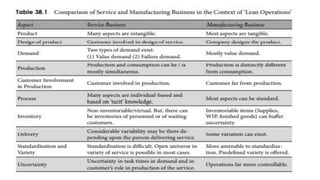
Comparison of service and manufacturing in the context of “Lean”
When the work ( inputs and operations) or output involves knowledge- gathering,
analysis and dissemination or decision, the inputs and outputs could defy metrics.
● Not all ‘lean’ manufacturing ideas can translate from factory floor to
consultants desk or the doctor’s chair.
● It is therefore, natural to have reservations regarding the application of ‘lean’
ideas to knowledge work in particular and to services in general. Service
industries tend to lag behind manufacturing in the improvement of operations.
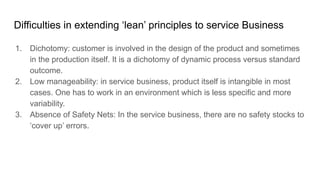
Difficulties in extending ‘lean’ principles to service Business
1. Dichotomy: customer is involved in the design of the product and sometimes
in the production itself. It is a dichotomy of dynamic process versus standard
outcome.
2. Low manageability: in service business, product itself is intangible in most
cases. One has to work in an environment which is less specific and more
variability.
3. Absence of Safety Nets: In the service business, there are no safety stocks to
‘cover up’ errors.
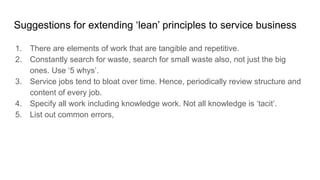
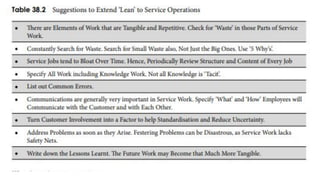
Suggestions for extending ‘lean’ principles to service business
1. There are elements of work that are tangible and repetitive.
2. Constantly search for waste, search for small waste also, not just the big
ones. Use ‘5 whys’.
3. Service jobs tend to bloat over time. Hence, periodically review structure and
content of every job.
4. Specify all work including knowledge work. Not all knowledge is ‘tacit’.
5. List out common errors,
Search for Small Waste, Not Just the Big One
Large wastes would already have been removed. Hence, there is a need to
care about the small stuff. Constantly ask “Why?” A value stream map would
indicate the areas of waste. Track each step and question it. 5 Whys: There is
a Japanese technique called ‘5 Whys’. A ‘why’ would elicit a reply. This reply
needs to be questioned again as to ‘why?’ The reply to it is further subjected
another ‘why?’ This should go on (5 is only a symbolic large number) until one
is satisfied to have found the root cause. Since by their very name and nature
services apparently seem to be serving the customer, the nonvalue added
work tends to get hidden. Thus, it is hard to locate waste and a persistent
‘why?’ is essential.
Service Jobs Tend to Bloat Over Time. Hence, Periodically
Review Structure and Content of Every Job
Since a service job is unstructured and because it could have inputs during its
conduct from various quarters including the customer, it has a tendency to expand
over a period of time, with more and more low-value tasks added on to it. This
leads to (a) too much work (muri) and (b) unnecessary work (muda). This in turn
leads to bottlenecks (mura), delays in completing the job, overburdening of
employees (muri) and slippages in quality (muda), etc. Hence, a periodic review of
the content of jobs is necessary.
Specify All Work Including Knowledge Work
Specification of a job would involve putting down on paper all details about the
‘what’, ‘when’, ‘where’ and ‘how to’ of the job, viz. its micro-contents,
interconnections, sequencing, timings, and desired result. At first, knowledge work
would seem like a nebulous entity defying any specification because it is
supposed to be ‘in the head of the worker’, consisting considerably of ‘intuition’,
difficult to be put down into replicable and concrete steps.
Role of Leadership
‘Lean operations’ is not just a bunch of techniques, although techniques are
important. Adopting JIT or Toyota Production System requires a change in the
business philosophy. Lean thinking goes a step beyond JIT. It requires a cultural
change in the organisation. The lean thinking has to get internalised in the
organisation. In this context, the commitment of top leaders to lean philosophy is
vital.
‘Lean values and behaviour
Without the inculcation of proper values and organisational behaviour, any effort
to make operations lean will meet with only fleeting success. Similar problem is
encountered with the introduction of JIT system in an organisation without
appropriate preparation of the mindset. Lean operations are a little more rigorous.
The lean values have to percolate and touch all people in the organisation. The
top leadership has to formulate those values and set the ball rolling.
Team Effort
Lean is a team game. It requires the participation of all in the organisation and
even all those connected to the organisation. One of the roles of top leadership is
to facilitate team work. And, this team has to be gently maneuvered towards the
‘lean’ way. In a while, the entire team has to start ‘eating, sleeping and dreaming’
lean.
Continuous Vigil and Continuous Improvement
In fact, ‘lean operations’ require participation on a continual basis. ‘Lean
operations’ is not a one time affair. The leadership has to not only set the ball
rolling, but see that the lean game goes on. One has to be constantly on the
lookout for waste so that it is removed. Wastes tend to creep into the processes
over time. Methods may evolve, sources and resources get to be different,
machines undergo modifications, people and their moves may change. All these
may bring in wastes with them. The team – the organisation – has to be vigilant
and should eliminate waste as soon as it is spotted.
Kaizen: Moreover, the organisation has to strive for continuous improvement.
Lean thinking does not accept status quo. Nothing is ever good enough. Kaizen is
a vital part of lean philosophy.
Jishu Kanri: This Japanese term refers to ‘voluntary management’ group – a
small group that meets regularly to share, study and solve problems related to
their area of activity. Jishu Kanri projects may involve waste elimination, and
improvements in quality, workplace safety, environment, etc.
Gengitsu: While this Japanese word translates as ‘real thing’, what is implied is
that the top leadership must go to the ‘actual place’ of work (also Gemba in
Japanese), have a first hand knowledge of the wastes, the improvements taking
place and the possibilities of further improvement. ‘Real thing’ also means that one
should know the ‘actual facts’, i.e. one has to be ever vigilant for opportunities for
improvement and should go to the real root of any problem. In short, one must
face the facts and go to the root of them. Gengitsu applies to everybody in or
connected to the organisation.
Just in Time (JIT)
JIT is a system where we produce the required goods only at the time when they
are needed and in the quantity that is needed; and this system holds good for
finished products and semi-finished products, both.
If such a situation materialises, the inventories of the finished goods and
work-in-progress would be almost nil.
Now, if we make our raw materials suppliers agree that they should deliver their
goods only at the time and in the quantities we need them to, then we are almost
eliminating raw materials inventories as well. We shall then have virtually zero
inventories (or near about zero).
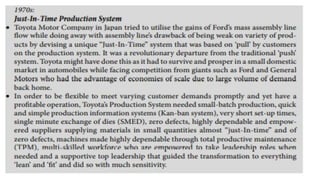
● The Just-In-Time (J-I-T) production system founded by Taiichi Ohno (a
Vice-President at Toyota) and first successfully implemented at the Toyota
Motor Company’s plants in Japan and now being tried at various
manufacturing industries all over the world.
Kanban pizza
https://www.youtube.com/watch?v=Mdyyyu41dZ4
LEAN OPERATIONS AND JIT
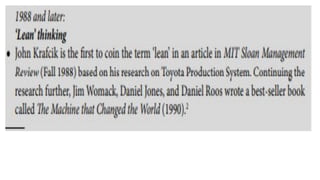
JIT system is very close to ‘lean manufacturing’ in its attributes and hence, both of
these are sometimes clubbed together. While JIT is the forerunner of ‘lean
manufacturing’, the two overlap substantially. However, there are some differences
between the two, because ‘lean operations’ are a further improvement on the
principles governing JIT.
1. JIT Accentuates Only One Dimension of Lean Manufacturing
JIT relies heavily on improvements in ‘flow’. Implementation of smooth flow
exposes most of the problems. Waste reduction happens as a consequence. That
is, by making all production operations closer to a line production, it spots and
removes the inefficiencies due to stoppages associated with intermittent
production. Uniform or ‘even’ flow compels even (i.e. standardised) processes,
even quality (zero defects), even supply of materials, even running of equipment,
and even empowerment across the entire manpower.
2. Lean Operations Expand Human Capability
Lean goes one step further than JIT and consists of work-systems that expand
human capabilities. Lean operations explicitly encourage creative problem solving
by the workers. Waste or ‘non-value adding activities’ are eliminated with mainly
an internal effort, i.e. by the employees of the organisation. In fact, since a lot of
waste is small waste, it can generally be noticed mainly by those who are close to
the daily operations.
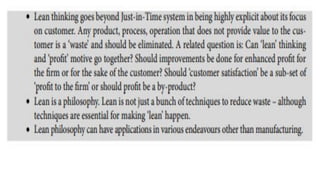
3. Lean is Direct About its Focus on ‘Customer Satisfaction’
In ‘lean’, any operations done for any purpose other than providing value to the
customer is waste. ‘Pull production’ is a bare necessity under this dictum. In fact,
nothing is ‘push’. Lean operations do not believe in ‘push’ of any kind. ‘Lean’
checks for ‘value’ to the customer at every point and for every action.
Example: It is said that Sony’s digital Walkman was better engineered than
Apple’s iPod, but was less popular. It is said, Sony overlooked the aspect of ease
of use to the customer.
4. Profit motive in JIT and Lean: Emphasis is different
Lean is, indeed, very concerned with customer service. So much so that one is
tempted to ask: What happens to the profit motive? Is profit only a by-product? In
this aspect, JIT and Lean may have some conflict. ‘Lean operations’ seems to be
the natural progression of Operations Management as a discipline towards its
increasing outward focus on service to customer and service to the society.
5. Lean is an Evolutionary Concept
Main method of ‘lean’ is not the tools or techniques or a predetermined flow
system, but the reduction of Muda, Muri and Mura. Lean is an evolutionary
concept. These differences should not take the credit away from the Toyota
Production System or JIT. Certainly, JIT brought in an entirely new emphasis on
customer satisfaction. Its concept of single unit flow system – where it combines
the benefits of very small lot production and a flow system of production – has
been an extraordinary development in the field of manufacturing management. In
fact, its attempt to make the flow even has singularly brought out various ‘wastes’
– of inventory, of overproduction, of large production runs and of not having good
quality the first time itself, among other. It showed the world as to how a
production system could be linked to the customer demand and, therefore, how
the production function could play a critical role in organisational strategy. ‘

Lean manufacturing

  • 1.
    Lean Manufacturing K.Manjula Assistant Professor Departmentof Business Administration St Joseph Engineering College.
  • 2.
    Module-3 Concept of LeanManufacturing; meaning of lean manufacturing; History of Lean Operations, Types of Waste, “5S” Technique of Eliminating the Waste, Lean Operations in the service sector, Role of Leadership, Lean Operations and Just In Time(JIT).
  • 3.
    Lean Operations inthe service sector
  • 4.
    Concept of leanmanufacturing Lean manufacturing concepts are more than producing the same product or service faster – Lean is about building quality into every part of the process, while systematically driving out waste from every part of the process, so you deliver a better product or service faster.
  • 5.
    Organizations draw upona wide range of Lean manufacturing concepts to help them achieve goals like: ● Eliminating or reducing waste ● Improving quality ● Reducing lead time ● Minimizing unnecessary expenses
  • 6.
    Meaning of leanmanufacturing Lean manufacturing is a production process based on an ideology of maximising productivity while simultaneously minimising waste within a manufacturing operation. The lean principle sees waste is anything that doesn’t add value that the customers are willing to pay for.
  • 12.
    Types of Waste Toyota,which is the originator of the ‘lean operations’ movement, classifies waste into three categories, viz., 1. MUDA 2. MURI 3. MURA
  • 13.
    MUDA Lean manufacturing, amanagement philosophy primarily derived from the Toyota Production System, focuses on eliminating waste—called “Muda”— within a manufacturing system. It takes into account many kinds of waste, including the waste of excessive human motion, and aims to integrate each step of production into a holistic, efficient process that reduces cost and improves overall revenue.
  • 14.
    Overproduction The most seriousof the wastes, overproduction can cause all other types of wastes and results in excess inventory. Stocking too much of a product that goes unused has obvious costs: storage, wasted materials, and excessive capital tied up in useless inventory. Depending, of course, on the product in question, overproduction can have very serious environmental effects. More raw materials than necessary are consumed; the product may spoil or become obsolete, which requires that it be tossed; and, if the product involves hazardous materials, more hazardous materials than necessary are wasted, resulting in extra emissions, extra costs of waste disposal, possible worker exposure, and potential environmental problems resulting from the waste itself.
  • 15.
    Inventory Inventory waste refersto the waste produced by unprocessed inventory. This includes the waste of storage, the waste of capital tied up in unprocessed inventory, the waste of transporting the inventory, the containers used to hold inventory, the lighting of the storage space, etc. Moreover, having excess inventory can hide the original wastes of producing said inventory. The environmental impacts of inventory waste are packaging, deterioration or damage to work-in-process, additional materials to replace damaged or obsolete inventory, and the energy to light—as well as either heat or cool—inventory space.
  • 16.
    Motion Wasteful motion isall of the motion, whether by a person or a machine, that could be minimized. If excess motion is used to add value that could have been added by less, than that margin of motion is wasted. Motion could refer to anything from a worker bending over to pick something up on the factory floor to additional wear and tear on machines, resulting in capital depreciation that must be replaced. There are many environmental costs from excess motion. One obvious one is the needless waste of materials used to replace worn machines; another one could be the health resources for overburdened employees, who might not have needed them if motion had been minimized.
  • 17.
    Defects Defects refer toa product deviating from the standards of its design or from the customer’s expectation. Defective products must be replaced; they require paperwork and human labor to process it; they might potentially lose customers; the resources put into the defective product are wasted because the product is not used. Moreover, a defective product implies waste at other levels that may have led to the defect to begin with; making a more efficient production system reduces defects and increases the resources needed to address them in the first place.
  • 18.
    Over-processing Over-processing refers toany component of the process of manufacture that is unnecessary. Painting an area that will never be seen or adding features that will not be used are examples of over-processing. Essentially, it refers to adding more value than the customer requires. The environmental impact involves the excess of parts, labor, and raw materials consumed in production. Time, energy, and emissions are wasted when they are used to produce something that is unnecessary in a product; simplification and efficiency reduce these wastes and benefit the company and the environment.
  • 19.
    Waiting Waiting refers towasted time because of slowed or halted production in one step of the production chain while a previous step is completed. To take the classic example, the production line, if one task along the chain takes longer than another, than any time the employee in charge of the next task spends waiting is wasted. The task that takes more time must be made more efficient, other employees must be hired to help, or the workflow must be better coordinated or scheduled in order to make up for this wasted time. The environmental impact comes from the wasted labor and energy from lighting, heating, or cooling during the waiting period. Additionally, material can be spoiled, and components could be damaged because of an inefficient workflow.
  • 20.
    Transport Transport is movingmaterials from one position to another. The transport itself adds no value to the product, so minimizing these costs is essential. This means having one plant closer to another in the production chain, or minimizing the costs of transportation using more efficient methods. Resources and time are used in handling material, employing staff to operate transportation, training, implement safety precautions, and using extra space. Transport can also cause the waste of waiting, as one part of the production chain must wait for material to arrive. Environmental costs to waiting include gas emissions, transportation packaging used, possible damage to the product en route, as well as a whole host of other wastes involving transporting hazardous materials.
  • 23.
    MURA Mura implies unevenness;inconsistency, irregularity or inequality. Mura used in business/process improvement is countered through Just-In-Time systems. This enables the company to keep little or no inventory to avoid waste. In order to avoid Mura, there is a need to anticipate and cater for consumer demand, with consistent processes that can be simple enough to cater for demand and work in a regular flow.
  • 24.
    MURI Muri means unreasonable,impossible or overburdening. By using standardized work, Muri can be avoided. Standard process allows each individual to know their work, it reduces costs and improves efficiency. A good example of this is specialization and division of labour which was introduced by Henry Ford in car manufacturing. As each assembly line worker had a specific task, the production process was improved and so was output. For production to work smoothly, each station has to perform a standard task; since the next station is only equipped to work in a standard manner to perform their part of the manufacturing task.
  • 25.
    “5S” Technique ofEliminating the Waste 5S is a system to reduce waste and optimize productivity through maintaining an orderly workplace and using visual cues to achieve more consistent operational results. Implementation of this method "cleans up" and organizes the workplace basically in its existing configuration, and it is typically the first lean method which organizations implement.
  • 28.
  • 29.
    Sort - Seiri Afteryour 5S pilot team has done its homework, audited, conducted training, etc., for the first targeted location, Step 1 is Sort. Criteria are set for removing—by red-tagging—all tools, materials, equipment, etc. not needed to get a job done. How frequently a tool or any other item is used for a job determines where it will be placed or located. When red-tagging, ask: • Is this item needed? • If it is needed, is it needed in this quantity? • If it is needed, how frequently is it used? • If it is needed, where should it be located?
  • 30.
    Items used hourby hour or day by day should be kept within arm’s reach of the point of use. Items or equipment used once a week or once a month should be kept within the work area. Less frequently used items should be stored in a more distant location. Unneeded or obsolete items should be stored in a designated holding area.
  • 31.
    Systematize or Setin Order- Seiton Workers at this point conduct an honest needs assessment. What do I need to do my job? Where should I locate each item I need? How many of each item do I really need? Shadow boards can be set up within easy reach of workstations, with the shape of each frequently used item outlined for organized placement and easy, quick access. List and prominently post for the information of every employee where items are to be found. Employees must know where to quickly find every item. Label storage lockers, cabinets, drawers, cupboards, etc. so employees know what content is contained within.
  • 32.
    Sweep or Shine-Seiso This is the point in the 5S process where daily cleaning becomes a habit. The work space is cleaned before starting the job and before closing down the job. Ten or 15 minutes should be set aside daily for sweep and shine activity. Use this daily cleaning routine to inspect the work space and equipment for defects.
  • 33.
    Seiketsu- Standardise What hasbeen done in the earlier three stages of 5S has to become standardised. Work practices should be standardised and should be identical across all workstations doing the same particular job. This will enable all employees doing the same job to work in any work-station with the same tools and supplies that are in the same location in every station.
  • 34.
    Self-discipline or Sustain-Shitsuke Ittakes self-discipline on the part of everyone in your organization to sustain 5S and achieve its many benefits. Visual communications—message boards, storytelling boards, scoreboards, signs, banners, posters, etc.—are critical to sustaining self-discipline. Organizations typically seek to reinforce 5S messages in multiple formats until it becomes "the way things are done."
  • 35.
    Lean Operations inthe service sector Services, in a large part, can be intangible.
  • 36.
    Comparison of serviceand manufacturing in the context of “Lean” When the work ( inputs and operations) or output involves knowledge- gathering, analysis and dissemination or decision, the inputs and outputs could defy metrics. ● Not all ‘lean’ manufacturing ideas can translate from factory floor to consultants desk or the doctor’s chair. ● It is therefore, natural to have reservations regarding the application of ‘lean’ ideas to knowledge work in particular and to services in general. Service industries tend to lag behind manufacturing in the improvement of operations.
  • 38.
    Difficulties in extending‘lean’ principles to service Business 1. Dichotomy: customer is involved in the design of the product and sometimes in the production itself. It is a dichotomy of dynamic process versus standard outcome. 2. Low manageability: in service business, product itself is intangible in most cases. One has to work in an environment which is less specific and more variability. 3. Absence of Safety Nets: In the service business, there are no safety stocks to ‘cover up’ errors.
  • 39.
    Suggestions for extending‘lean’ principles to service business 1. There are elements of work that are tangible and repetitive. 2. Constantly search for waste, search for small waste also, not just the big ones. Use ‘5 whys’. 3. Service jobs tend to bloat over time. Hence, periodically review structure and content of every job. 4. Specify all work including knowledge work. Not all knowledge is ‘tacit’. 5. List out common errors,
  • 42.
    Search for SmallWaste, Not Just the Big One Large wastes would already have been removed. Hence, there is a need to care about the small stuff. Constantly ask “Why?” A value stream map would indicate the areas of waste. Track each step and question it. 5 Whys: There is a Japanese technique called ‘5 Whys’. A ‘why’ would elicit a reply. This reply needs to be questioned again as to ‘why?’ The reply to it is further subjected another ‘why?’ This should go on (5 is only a symbolic large number) until one is satisfied to have found the root cause. Since by their very name and nature services apparently seem to be serving the customer, the nonvalue added work tends to get hidden. Thus, it is hard to locate waste and a persistent ‘why?’ is essential.
  • 43.
    Service Jobs Tendto Bloat Over Time. Hence, Periodically Review Structure and Content of Every Job Since a service job is unstructured and because it could have inputs during its conduct from various quarters including the customer, it has a tendency to expand over a period of time, with more and more low-value tasks added on to it. This leads to (a) too much work (muri) and (b) unnecessary work (muda). This in turn leads to bottlenecks (mura), delays in completing the job, overburdening of employees (muri) and slippages in quality (muda), etc. Hence, a periodic review of the content of jobs is necessary.
  • 44.
    Specify All WorkIncluding Knowledge Work Specification of a job would involve putting down on paper all details about the ‘what’, ‘when’, ‘where’ and ‘how to’ of the job, viz. its micro-contents, interconnections, sequencing, timings, and desired result. At first, knowledge work would seem like a nebulous entity defying any specification because it is supposed to be ‘in the head of the worker’, consisting considerably of ‘intuition’, difficult to be put down into replicable and concrete steps.
  • 45.
    Role of Leadership ‘Leanoperations’ is not just a bunch of techniques, although techniques are important. Adopting JIT or Toyota Production System requires a change in the business philosophy. Lean thinking goes a step beyond JIT. It requires a cultural change in the organisation. The lean thinking has to get internalised in the organisation. In this context, the commitment of top leaders to lean philosophy is vital.
  • 46.
    ‘Lean values andbehaviour Without the inculcation of proper values and organisational behaviour, any effort to make operations lean will meet with only fleeting success. Similar problem is encountered with the introduction of JIT system in an organisation without appropriate preparation of the mindset. Lean operations are a little more rigorous. The lean values have to percolate and touch all people in the organisation. The top leadership has to formulate those values and set the ball rolling.
  • 47.
    Team Effort Lean isa team game. It requires the participation of all in the organisation and even all those connected to the organisation. One of the roles of top leadership is to facilitate team work. And, this team has to be gently maneuvered towards the ‘lean’ way. In a while, the entire team has to start ‘eating, sleeping and dreaming’ lean.
  • 48.
    Continuous Vigil andContinuous Improvement In fact, ‘lean operations’ require participation on a continual basis. ‘Lean operations’ is not a one time affair. The leadership has to not only set the ball rolling, but see that the lean game goes on. One has to be constantly on the lookout for waste so that it is removed. Wastes tend to creep into the processes over time. Methods may evolve, sources and resources get to be different, machines undergo modifications, people and their moves may change. All these may bring in wastes with them. The team – the organisation – has to be vigilant and should eliminate waste as soon as it is spotted.
  • 49.
    Kaizen: Moreover, theorganisation has to strive for continuous improvement. Lean thinking does not accept status quo. Nothing is ever good enough. Kaizen is a vital part of lean philosophy. Jishu Kanri: This Japanese term refers to ‘voluntary management’ group – a small group that meets regularly to share, study and solve problems related to their area of activity. Jishu Kanri projects may involve waste elimination, and improvements in quality, workplace safety, environment, etc.
  • 50.
    Gengitsu: While thisJapanese word translates as ‘real thing’, what is implied is that the top leadership must go to the ‘actual place’ of work (also Gemba in Japanese), have a first hand knowledge of the wastes, the improvements taking place and the possibilities of further improvement. ‘Real thing’ also means that one should know the ‘actual facts’, i.e. one has to be ever vigilant for opportunities for improvement and should go to the real root of any problem. In short, one must face the facts and go to the root of them. Gengitsu applies to everybody in or connected to the organisation.
  • 51.
    Just in Time(JIT) JIT is a system where we produce the required goods only at the time when they are needed and in the quantity that is needed; and this system holds good for finished products and semi-finished products, both. If such a situation materialises, the inventories of the finished goods and work-in-progress would be almost nil. Now, if we make our raw materials suppliers agree that they should deliver their goods only at the time and in the quantities we need them to, then we are almost eliminating raw materials inventories as well. We shall then have virtually zero inventories (or near about zero).
  • 52.
    ● The Just-In-Time(J-I-T) production system founded by Taiichi Ohno (a Vice-President at Toyota) and first successfully implemented at the Toyota Motor Company’s plants in Japan and now being tried at various manufacturing industries all over the world.
  • 53.
  • 54.
    LEAN OPERATIONS ANDJIT JIT system is very close to ‘lean manufacturing’ in its attributes and hence, both of these are sometimes clubbed together. While JIT is the forerunner of ‘lean manufacturing’, the two overlap substantially. However, there are some differences between the two, because ‘lean operations’ are a further improvement on the principles governing JIT.
  • 55.
    1. JIT AccentuatesOnly One Dimension of Lean Manufacturing JIT relies heavily on improvements in ‘flow’. Implementation of smooth flow exposes most of the problems. Waste reduction happens as a consequence. That is, by making all production operations closer to a line production, it spots and removes the inefficiencies due to stoppages associated with intermittent production. Uniform or ‘even’ flow compels even (i.e. standardised) processes, even quality (zero defects), even supply of materials, even running of equipment, and even empowerment across the entire manpower.
  • 56.
    2. Lean OperationsExpand Human Capability Lean goes one step further than JIT and consists of work-systems that expand human capabilities. Lean operations explicitly encourage creative problem solving by the workers. Waste or ‘non-value adding activities’ are eliminated with mainly an internal effort, i.e. by the employees of the organisation. In fact, since a lot of waste is small waste, it can generally be noticed mainly by those who are close to the daily operations.
  • 57.
    3. Lean isDirect About its Focus on ‘Customer Satisfaction’ In ‘lean’, any operations done for any purpose other than providing value to the customer is waste. ‘Pull production’ is a bare necessity under this dictum. In fact, nothing is ‘push’. Lean operations do not believe in ‘push’ of any kind. ‘Lean’ checks for ‘value’ to the customer at every point and for every action. Example: It is said that Sony’s digital Walkman was better engineered than Apple’s iPod, but was less popular. It is said, Sony overlooked the aspect of ease of use to the customer.
  • 58.
    4. Profit motivein JIT and Lean: Emphasis is different Lean is, indeed, very concerned with customer service. So much so that one is tempted to ask: What happens to the profit motive? Is profit only a by-product? In this aspect, JIT and Lean may have some conflict. ‘Lean operations’ seems to be the natural progression of Operations Management as a discipline towards its increasing outward focus on service to customer and service to the society.
  • 59.
    5. Lean isan Evolutionary Concept Main method of ‘lean’ is not the tools or techniques or a predetermined flow system, but the reduction of Muda, Muri and Mura. Lean is an evolutionary concept. These differences should not take the credit away from the Toyota Production System or JIT. Certainly, JIT brought in an entirely new emphasis on customer satisfaction. Its concept of single unit flow system – where it combines the benefits of very small lot production and a flow system of production – has been an extraordinary development in the field of manufacturing management. In fact, its attempt to make the flow even has singularly brought out various ‘wastes’ – of inventory, of overproduction, of large production runs and of not having good quality the first time itself, among other. It showed the world as to how a production system could be linked to the customer demand and, therefore, how the production function could play a critical role in organisational strategy. ‘