Week 8
Induction Fallacies
DR. RUSSELL RODRIGO
Induction
Fallacies
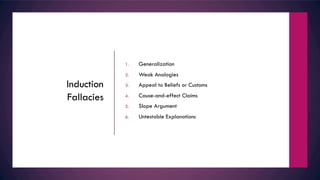
1. Generalization
2. Weak Analogies
3. Appeal to Beliefs or Customs
4. Cause-and-effect Claims
5. Slope Argument
6. Untestable Explanations
Induction
Fallacies
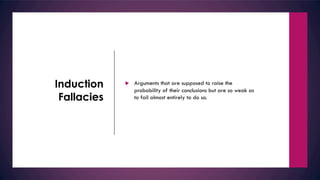
u Arguments that are supposed to raise the
probability of their conclusions but are so weak as
to fail almost entirely to do so.
1. Hasty generalization
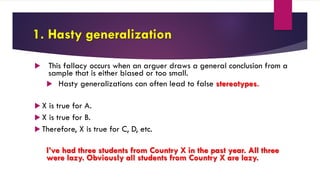
u This fallacy occurs when an arguer draws a general conclusion from a
sample that is either biased or too small.
u Hasty generalizations can often lead to false stereotypes.
u X is true for A.
u X is true for B.
u Therefore, X is true for C, D, etc.
I’ve had three students from Country X in the past year. All three
were lazy. Obviously all students from Country X are lazy.
Examples
1. The food in L.A. is lousy, judging from this meal.
2. This city has a very high crime rate; therefore, it will be
dangerous to shop in this neighborhood.
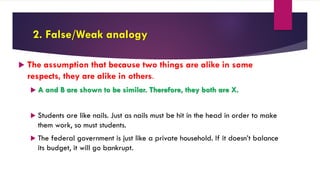
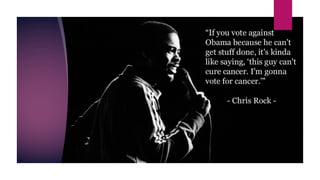
2. False/Weak analogy
u The assumption that because two things are alike in some
respects, they are alike in others.
u A and B are shown to be similar. Therefore, they both are X.
u Students are like nails. Just as nails must be hit in the head in order to make
them work, so must students.
u The federal government is just like a private household. If it doesn’t balance
its budget, it will go bankrupt.
3. Appeal to tradition/common belief
u is a common fallacy in which a thesis is deemed correct on the basis that it is
correlated with some past or present tradition. The appeal takes the form of "this is
right because we've always done it this way."
Ø X is old or traditional. Therefore X is correct or better.
Ø Scolding a student who misbehaves is still the best way to instill discipline
because it has been done by teachers and parents in the past.
u An appeal to tradition essentially makes two assumptions that are not necessarily true:
u The old way of thinking was proven correct when introduced
u The past justifications for the tradition are still valid at present.
Examples
1. This is the right way; it’s way it has always been done.
2. We have always gotten out of school before Memorial Day, so you cannot
change the school calendar to have students attend school after Memorial Day.
3. My family has always gotten together for Christmas on Christmas night. I cannot
ask them to move it now that we are married because that's the way they have
always done it.
4. Post Hoc Fallacy
u A happened before B.
u (unstated) B was
caused by something
(that happened
before B).
u Therefore, A caused B.
Examples
1. After I took Zicam, my cold went away fast. Therefore, taking Zicam caused
my cold to go away fast.
2. Every day the sun comes up right after the rooster crows; therefore, the
rooster causes the sun to come up.
3. Our soccer team was losing until I bought new shoes. We have not lost a
game since I got my lucky shoes!
5. Slope Argument/Slippery Slope
u The Slippery Slope fallacy is an argument that rests on an
unsupported warning that is controversial and tendentious, to the
effect that something will progress by degrees to an undesirable
outcome. (A tendentious assertion is one that is slanted toward a
particular point of view).
u Example
u We should not require gun owners to carry liability insurance, because if we
do that, before long they will repeal the Second amendment.
Examples
1. If we allow the children to choose the movie
this time, they are going to expect to be able
to choose the school they go to or the doctors
they visit.
2. If you allow the students to redo this test, they
are going to want to redo every assignment
for the rest of the year.
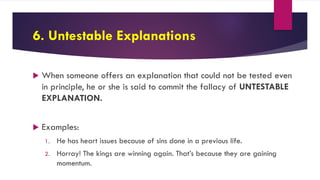
6. Untestable Explanations
u When someone offers an explanation that could not be tested even
in principle, he or she is said to commit the fallacy of UNTESTABLE
EXPLANATION.
u Examples:
1. He has heart issues because of sins done in a previous life.
2. Horray! The kings are winning again. That’s because they are gaining
momentum.
Worksheet
Production: Debate
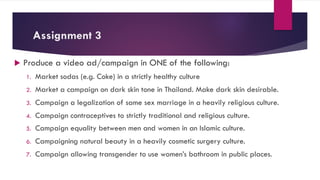
Assignment 3
u Produce a video ad/campaign in ONE of the following:
1. Market sodas (e.g. Coke) in a strictly healthy culture
2. Market a campaign on dark skin tone in Thailand. Make dark skin desirable.
3. Campaign a legalization of same sex marriage in a heavily religious culture.
4. Campaign contraceptives to strictly traditional and religious culture.
5. Campaign equality between men and women in an Islamic culture.
6. Campaigning natural beauty in a heavily cosmetic surgery culture.
7. Campaign allowing transgender to use women’s bathroom in public places.

LIB440 Week 8 Induction Fallacies

  • 1.
  • 2.
    Induction Fallacies 1. Generalization 2. WeakAnalogies 3. Appeal to Beliefs or Customs 4. Cause-and-effect Claims 5. Slope Argument 6. Untestable Explanations
  • 3.
    Induction Fallacies u Arguments thatare supposed to raise the probability of their conclusions but are so weak as to fail almost entirely to do so.
  • 4.
    1. Hasty generalization uThis fallacy occurs when an arguer draws a general conclusion from a sample that is either biased or too small. u Hasty generalizations can often lead to false stereotypes. u X is true for A. u X is true for B. u Therefore, X is true for C, D, etc. I’ve had three students from Country X in the past year. All three were lazy. Obviously all students from Country X are lazy.
  • 5.
    Examples 1. The foodin L.A. is lousy, judging from this meal. 2. This city has a very high crime rate; therefore, it will be dangerous to shop in this neighborhood.
  • 6.
    2. False/Weak analogy uThe assumption that because two things are alike in some respects, they are alike in others. u A and B are shown to be similar. Therefore, they both are X. u Students are like nails. Just as nails must be hit in the head in order to make them work, so must students. u The federal government is just like a private household. If it doesn’t balance its budget, it will go bankrupt.
  • 8.
    3. Appeal totradition/common belief u is a common fallacy in which a thesis is deemed correct on the basis that it is correlated with some past or present tradition. The appeal takes the form of "this is right because we've always done it this way." Ø X is old or traditional. Therefore X is correct or better. Ø Scolding a student who misbehaves is still the best way to instill discipline because it has been done by teachers and parents in the past. u An appeal to tradition essentially makes two assumptions that are not necessarily true: u The old way of thinking was proven correct when introduced u The past justifications for the tradition are still valid at present.
  • 9.
    Examples 1. This isthe right way; it’s way it has always been done. 2. We have always gotten out of school before Memorial Day, so you cannot change the school calendar to have students attend school after Memorial Day. 3. My family has always gotten together for Christmas on Christmas night. I cannot ask them to move it now that we are married because that's the way they have always done it.
  • 10.
    4. Post HocFallacy u A happened before B. u (unstated) B was caused by something (that happened before B). u Therefore, A caused B.
  • 11.
    Examples 1. After Itook Zicam, my cold went away fast. Therefore, taking Zicam caused my cold to go away fast. 2. Every day the sun comes up right after the rooster crows; therefore, the rooster causes the sun to come up. 3. Our soccer team was losing until I bought new shoes. We have not lost a game since I got my lucky shoes!
  • 12.
    5. Slope Argument/SlipperySlope u The Slippery Slope fallacy is an argument that rests on an unsupported warning that is controversial and tendentious, to the effect that something will progress by degrees to an undesirable outcome. (A tendentious assertion is one that is slanted toward a particular point of view). u Example u We should not require gun owners to carry liability insurance, because if we do that, before long they will repeal the Second amendment.
  • 13.
    Examples 1. If weallow the children to choose the movie this time, they are going to expect to be able to choose the school they go to or the doctors they visit. 2. If you allow the students to redo this test, they are going to want to redo every assignment for the rest of the year.
  • 14.
    6. Untestable Explanations uWhen someone offers an explanation that could not be tested even in principle, he or she is said to commit the fallacy of UNTESTABLE EXPLANATION. u Examples: 1. He has heart issues because of sins done in a previous life. 2. Horray! The kings are winning again. That’s because they are gaining momentum.
  • 15.
  • 16.
  • 17.
    Assignment 3 u Producea video ad/campaign in ONE of the following: 1. Market sodas (e.g. Coke) in a strictly healthy culture 2. Market a campaign on dark skin tone in Thailand. Make dark skin desirable. 3. Campaign a legalization of same sex marriage in a heavily religious culture. 4. Campaign contraceptives to strictly traditional and religious culture. 5. Campaign equality between men and women in an Islamic culture. 6. Campaigning natural beauty in a heavily cosmetic surgery culture. 7. Campaign allowing transgender to use women’s bathroom in public places.