SIMPLE PRESENT
Aida salsabila
uzlifatus salsabilah
What is Simple
Present?
definition and
purpose
•simple present tense is a tense that porposed for
a. telling reguler habbits or daily routine
e.g : i play sooccer every friday
the school opens every morning at 7 A.M
b. telling facts or generalization
e.g : Cats like milk
Jakarta is the Capital Of Indonesia
c. telling Scheduled events in the near future
e.g : The bus leaves tonight at 6 P.M
The party starts at 8 o'clock
Simple Present Tense Use Verb 1 in its pattern
e.g : love, walk, buy, bring
However, there is something that must be consider in using simple
present tense. It is the subject-verb agreement.
Verb, in the simple present tense, can change into verb + s/es
according to the subject where it attached.
Grammar Rules
The use of s/es in the verb are related to the subject of the
sentence.
If the subject is a 3rd person singular (he, she, it, names), the
verb
should be attached with s/es in the end.
For example:
I live in Yogyakarta.
He lives in Yogyakarta.
They live in Yogyakarta.
Andrew lives in Yogyakarta.
GRAMMAR RULES
We can add an-s almost in every end of the verbs.
However, it is not always all the verbs can be added by -s. There
are verbs that should be added by -es instead of -s.
The verbs that can be added by -es are one which ends in:
-0, -ss, -ch, and -x
e.g.
i go to the market. Donny goes to the market.
He goes to the market. They go to the market.
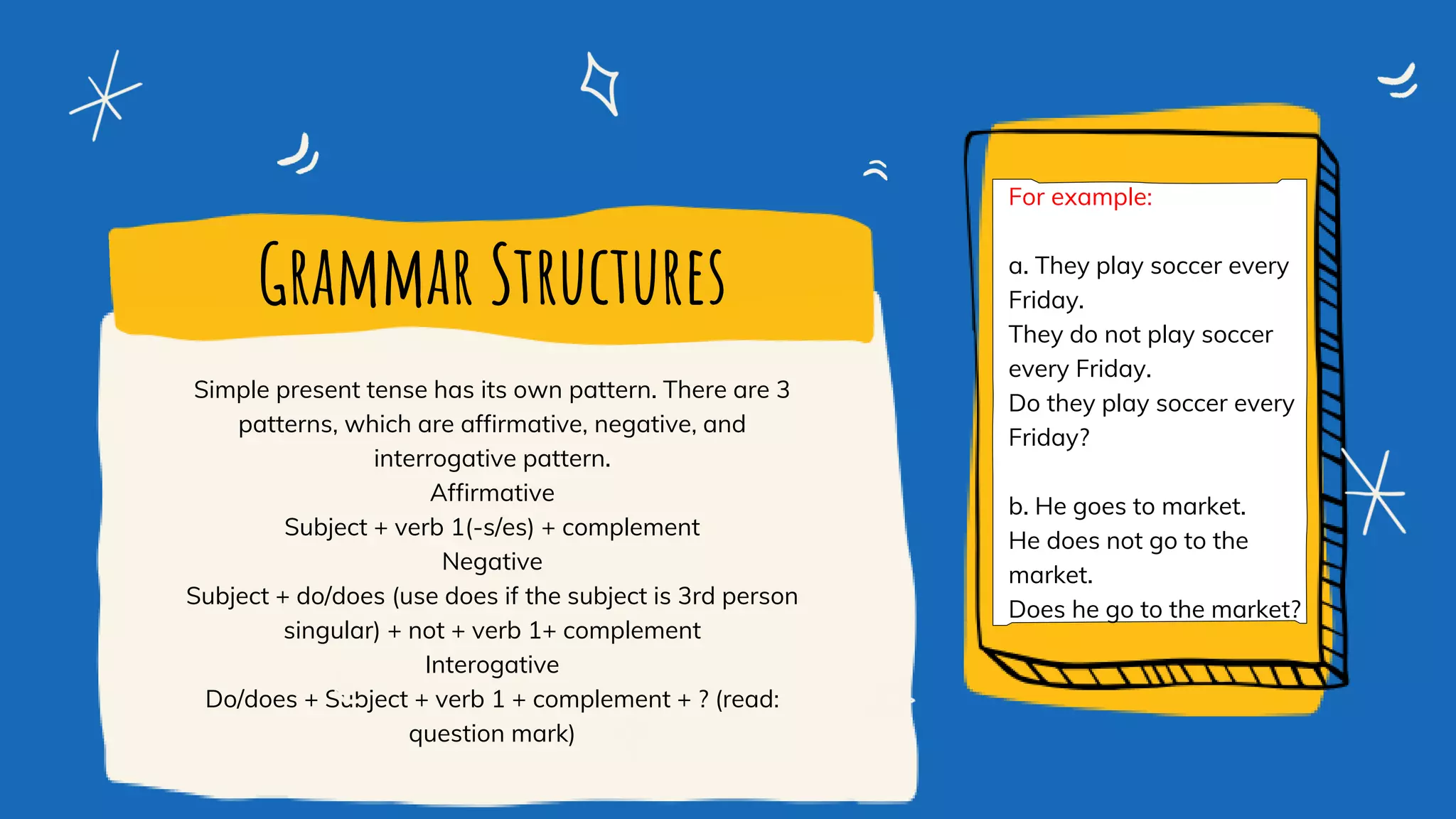
Simple present tense has its own pattern. There are 3
patterns, which are affirmative, negative, and
interrogative pattern.
Affirmative
Subject + verb 1(-s/es) + complement
Negative
Subject + do/does (use does if the subject is 3rd person
singular) + not + verb 1+ complement
Interogative
Do/does + Subject + verb 1 + complement + ? (read:
question mark)
Grammar Structures
For example:
a. They play soccer every
Friday.
They do not play soccer
every Friday.
Do they play soccer every
Friday?
b. He goes to market.
He does not go to the
market.
Does he go to the market?
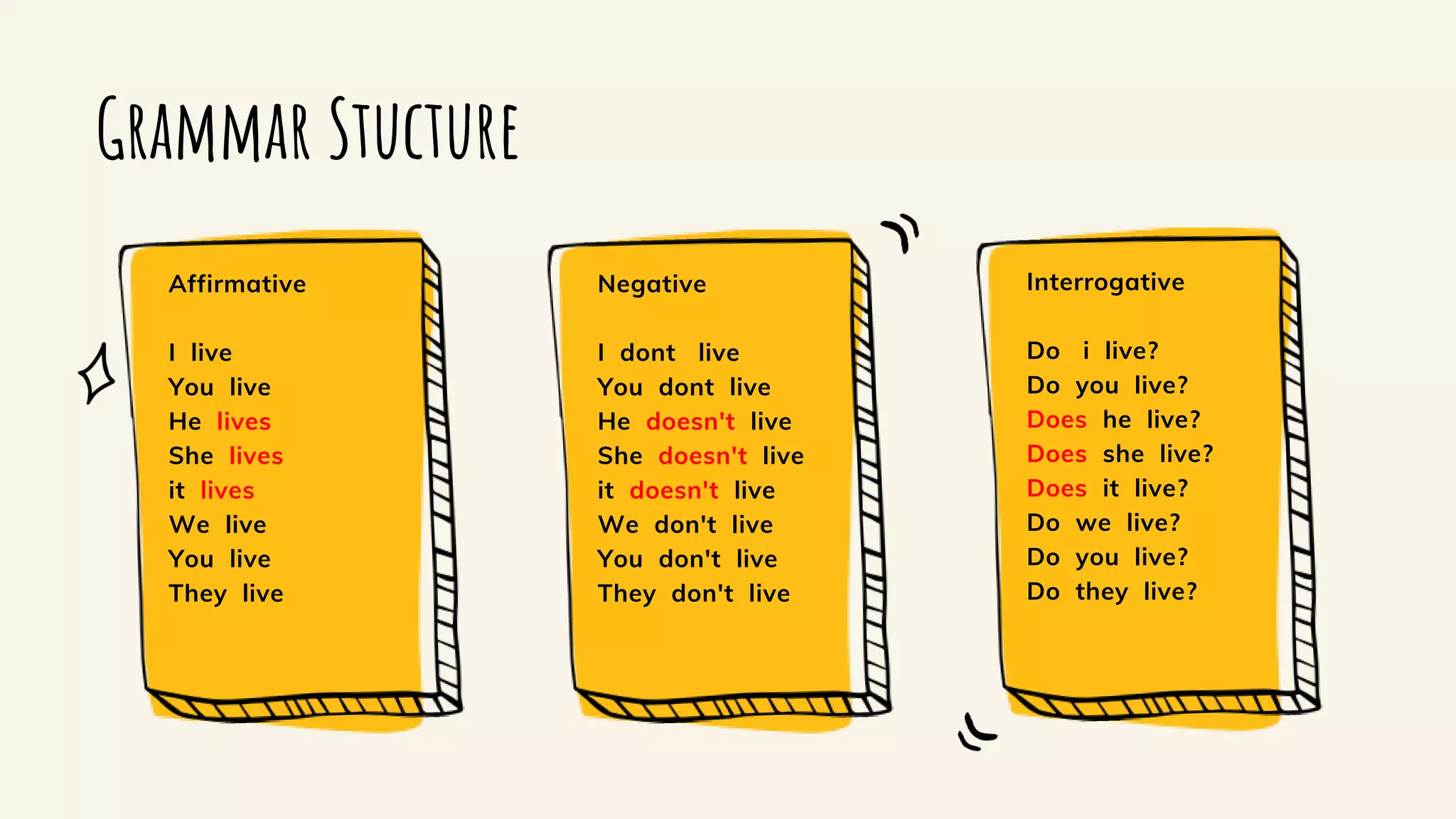
Grammar Stucture
Affirmative
I live
You live
He lives
She lives
it lives
We live
You live
They live
Negative
I dont live
You dont live
He doesn't live
She doesn't live
it doesn't live
We don't live
You don't live
They don't live
Interrogative
Do i live?
Do you live?
Does he live?
Does she live?
Does it live?
Do we live?
Do you live?
Do they live?
CONGRATULATIONS! YOU JUST HAVE
LEARNT SIMPLE PRESENT TENSE!

simple present tense ppt contoh.pptx

  • 1.
  • 2.
  • 3.
    definition and purpose •simple presenttense is a tense that porposed for a. telling reguler habbits or daily routine e.g : i play sooccer every friday the school opens every morning at 7 A.M b. telling facts or generalization e.g : Cats like milk Jakarta is the Capital Of Indonesia c. telling Scheduled events in the near future e.g : The bus leaves tonight at 6 P.M The party starts at 8 o'clock
  • 4.
    Simple Present TenseUse Verb 1 in its pattern e.g : love, walk, buy, bring However, there is something that must be consider in using simple present tense. It is the subject-verb agreement. Verb, in the simple present tense, can change into verb + s/es according to the subject where it attached. Grammar Rules
  • 5.
    The use ofs/es in the verb are related to the subject of the sentence. If the subject is a 3rd person singular (he, she, it, names), the verb should be attached with s/es in the end. For example: I live in Yogyakarta. He lives in Yogyakarta. They live in Yogyakarta. Andrew lives in Yogyakarta.
  • 6.
    GRAMMAR RULES We canadd an-s almost in every end of the verbs. However, it is not always all the verbs can be added by -s. There are verbs that should be added by -es instead of -s. The verbs that can be added by -es are one which ends in: -0, -ss, -ch, and -x e.g. i go to the market. Donny goes to the market. He goes to the market. They go to the market.
  • 7.
    Simple present tensehas its own pattern. There are 3 patterns, which are affirmative, negative, and interrogative pattern. Affirmative Subject + verb 1(-s/es) + complement Negative Subject + do/does (use does if the subject is 3rd person singular) + not + verb 1+ complement Interogative Do/does + Subject + verb 1 + complement + ? (read: question mark) Grammar Structures For example: a. They play soccer every Friday. They do not play soccer every Friday. Do they play soccer every Friday? b. He goes to market. He does not go to the market. Does he go to the market?
  • 8.
    Grammar Stucture Affirmative I live Youlive He lives She lives it lives We live You live They live Negative I dont live You dont live He doesn't live She doesn't live it doesn't live We don't live You don't live They don't live Interrogative Do i live? Do you live? Does he live? Does she live? Does it live? Do we live? Do you live? Do they live?
  • 9.
    CONGRATULATIONS! YOU JUSTHAVE LEARNT SIMPLE PRESENT TENSE!