ENTAILMENTS AND PRESUPPOSITIONS /SEMANTICS AND PRAGMATICS BLANCA
ESTELA FLORES OTOÑO 2019
1
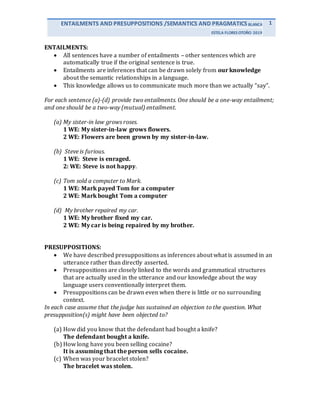
ENTAILMENTS:
 All sentences have a number of entailments – other sentences which are
automatically true if the original sentence is true.
 Entailments are inferences that can be drawn solely from our knowledge
about the semantic relationships in a language.
 This knowledge allows us to communicate much more than we actually “say”.
For each sentence (a)-(d) provide two entailments. One should be a one-way entailment;
and one should be a two-way (mutual) entailment.
(a) My sister-in law grows roses.
1 WE: My sister-in-law grows flowers.
2 WE: Flowers are been grown by my sister-in-law.
(b) Steve is furious.
1 WE: Steve is enraged.
2: WE: Steve is not happy.
(c) Tom sold a computer to Mark.
1 WE: Mark payed Tom for a computer
2 WE: Mark bought Tom a computer
(d) My brother repaired my car.
1 WE: My brother fixed my car.
2 WE: My car is being repaired by my brother.
PRESUPPOSITIONS:
 We have described presuppositions as inferences about what is assumed in an
utterance rather than directly asserted.
 Presuppositions are closely linked to the words and grammatical structures
that are actually used in the utterance and our knowledge about the way
language users conventionally interpret them.
 Presuppositions can be drawn even when there is little or no surrounding
context.
In each case assume that the judge has sustained an objection to the question. What
presupposition(s) might have been objected to?
(a) How did you know that the defendant had bought a knife?
The defendant bought a knife.
(b) How long have you been selling cocaine?
It is assuming that the person sells cocaine.
(c) When was your bracelet stolen?
The bracelet was stolen.
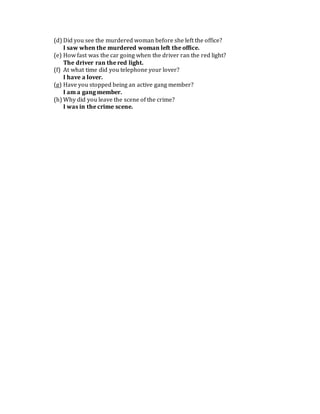
(d) Did you see the murdered woman before she left the office?
I saw when the murdered woman left the office.
(e) How fast was the car going when the driver ran the red light?
The driver ran the red light.
(f) At what time did you telephone your lover?
I have a lover.
(g) Have you stopped being an active gang member?
I am a gang member.
(h) Why did you leave the scene of the crime?
I was in the crime scene.

Entailments presupposition activities

  • 1.
    ENTAILMENTS AND PRESUPPOSITIONS/SEMANTICS AND PRAGMATICS BLANCA ESTELA FLORES OTOÑO 2019 1 ENTAILMENTS:  All sentences have a number of entailments – other sentences which are automatically true if the original sentence is true.  Entailments are inferences that can be drawn solely from our knowledge about the semantic relationships in a language.  This knowledge allows us to communicate much more than we actually “say”. For each sentence (a)-(d) provide two entailments. One should be a one-way entailment; and one should be a two-way (mutual) entailment. (a) My sister-in law grows roses. 1 WE: My sister-in-law grows flowers. 2 WE: Flowers are been grown by my sister-in-law. (b) Steve is furious. 1 WE: Steve is enraged. 2: WE: Steve is not happy. (c) Tom sold a computer to Mark. 1 WE: Mark payed Tom for a computer 2 WE: Mark bought Tom a computer (d) My brother repaired my car. 1 WE: My brother fixed my car. 2 WE: My car is being repaired by my brother. PRESUPPOSITIONS:  We have described presuppositions as inferences about what is assumed in an utterance rather than directly asserted.  Presuppositions are closely linked to the words and grammatical structures that are actually used in the utterance and our knowledge about the way language users conventionally interpret them.  Presuppositions can be drawn even when there is little or no surrounding context. In each case assume that the judge has sustained an objection to the question. What presupposition(s) might have been objected to? (a) How did you know that the defendant had bought a knife? The defendant bought a knife. (b) How long have you been selling cocaine? It is assuming that the person sells cocaine. (c) When was your bracelet stolen? The bracelet was stolen.
  • 2.
    (d) Did yousee the murdered woman before she left the office? I saw when the murdered woman left the office. (e) How fast was the car going when the driver ran the red light? The driver ran the red light. (f) At what time did you telephone your lover? I have a lover. (g) Have you stopped being an active gang member? I am a gang member. (h) Why did you leave the scene of the crime? I was in the crime scene.