Hepatic Encephalopathy
A short review
&
update
6.4.2012
Dr. Rushdan Zakariah
Trainee Medical Officer, MU II
DMCH
Hepatic Encephalopathy
A complex neuropsychiatric syndrome:
 Disturbances in consciousness
 Alteration in personality
 With or without fluctuating neurologic
signs, asterixis or flapping tremor
 Distinctive electroencephalographic
changes
Hepatic Encephalopathy
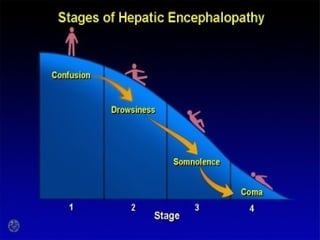
 May be acute and reversibleacute and reversible or chronicchronic
and progressiveand progressive
 In severe cases, irreversible coma and
death may occur
 Acute episodes may recur with variable
frequency
Hepatic Encephalopathy
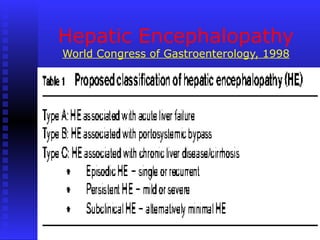
World Congress of Gastroenterology, 1998
Hepatic Encephalopathy
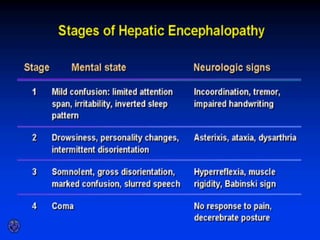
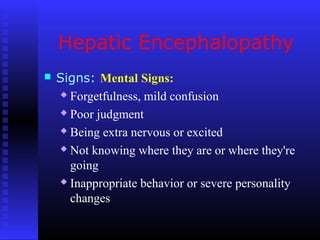
 Signs: Mental Signs:
 Forgetfulness, mild confusion
 Poor judgment
 Being extra nervous or excited
 Not knowing where they are or where they're
going
 Inappropriate behavior or severe personality
changes
Hepatic Encephalopathy
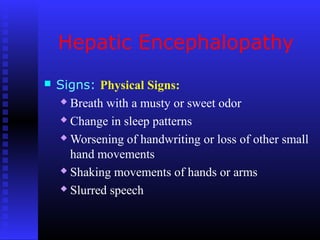
 Signs: Physical Signs:
 Breath with a musty or sweet odor
 Change in sleep patterns
 Worsening of handwriting or loss of other small
hand movements
 Shaking movements of hands or arms
 Slurred speech
Epidemiology of HE
 ApproximatelyApproximately 5.55.5 million people in the USmillion people in the US
have cirrhosis, a major cause of complicationshave cirrhosis, a major cause of complications
and deathand death
 In those with Cirrhosis, the risk of developingIn those with Cirrhosis, the risk of developing
hepatic encephalopathy ishepatic encephalopathy is 20%20% per year and atper year and at
any time aboutany time about 30 - 45%30 - 45% of people withof people with
cirrhosis exhibit evidence of overtcirrhosis exhibit evidence of overt
encephalopathyencephalopathy
Precipitating Factors
 Miscellaneous:
 Constipation
 Surgery
 Hypothyroidism
 Progressive liver disease
Pathogenesis
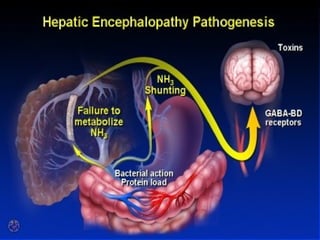
 In healthy subjects, nitrogen containing
compounds from the intestine, generated by
gut bacteria from food are transported by
the portal vein to the liver, where 80–90%
are metabolized & excreted immediately
 This process is impaired in HE because the
hepatocytes are incapable of metabolizing
the waste products
Pathogenesis
 Other waste products include mercaptans,
short-chain fatty acids and phenol
 BDZ like compounds have been detected at
increased levels as well as abnormalities in
the GABA neurotransmission system
 Dysregulation of the serotonin system
 Depletion of zinc and accumulation of
manganese may play a role
Pathogenesis
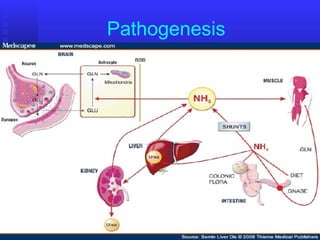
Ammonia plays a central role
 Small intestine: The degradation ofThe degradation of
glutamine produce ammoniaglutamine produce ammonia
 Large intestine: Breakdown of urea andBreakdown of urea and
proteins by normal floraproteins by normal flora
 Muscle: Proportion to muscle workProportion to muscle work
 Kidney: Ammonia production increasesAmmonia production increases
when hypokalemia develops and diureticwhen hypokalemia develops and diuretic
therapy is in usetherapy is in use
Pathogenesis
 In case of CLDIn case of CLD Ammonia accumulate in theaccumulate in the
systemic circulationsystemic circulation
 Ammonia can cross BBB and metabolizedAmmonia can cross BBB and metabolized
by astrocytes (30% of the brain cell)by astrocytes (30% of the brain cell)
Glutamate Glutamine
 Glutamine increases osmotic pressure inGlutamine increases osmotic pressure in
astrocytes which become swollenastrocytes which become swollen
Ammonia
Pathogenesis
Aims of treatment
 Identification & removal of theIdentification & removal of the
underlying precipitating factorsunderlying precipitating factors
 Reduction of nitrogenous load from gutReduction of nitrogenous load from gut
 Assessment of the need for long termAssessment of the need for long term
therapytherapy
Treatment Options
 Nutritional management:Nutritional management: Pt. should avoidPt. should avoid
prolong period of protein restrictionprolong period of protein restriction
 Bowel cleansing:Bowel cleansing: Mainstay of treatmentMainstay of treatment
 Antibiotics:Antibiotics: Therapeutic alternative toTherapeutic alternative to
laxativeslaxatives
 Flumazinil:Flumazinil: For those who used to take BDZFor those who used to take BDZ
 Bromocriptine:Bromocriptine: May improve extraMay improve extra
pyramidal signspyramidal signs
Non-absorbable
Disaccharides
 Lactulose and LactitolLactulose and Lactitol
 Dosage:30g to 60g daily, based
on clinical sign and 2 to 4 stools
daily
 Degrade into short-chain organic
acids in colon
 Cannot be hydrolyzed or
absorbed in small intestine
Adverse Effects
of Disaccharides
 Flatulence
 Diarrhoea
 Profuse diarrhoea may lead to
hypovolemia and electrolyte
imbalance --> Aggravate HEAggravate HE
Antibiotics
Kumar & Clark’s recommend-Kumar & Clark’s recommend-
 Metronidazole may be effective inmay be effective in
acute situation but its prolong useacute situation but its prolong use
causes peripheral neuropathycauses peripheral neuropathy
 Neomycin should be avoided due toshould be avoided due to
its severe adverse reactions i.e.its severe adverse reactions i.e.
ototoxicity, nephrotoxicityototoxicity, nephrotoxicity
 Rifaximin is mainly unabsorbed &is mainly unabsorbed &
well tolerated for long termwell tolerated for long term
References
1. http://en.wikipedia.org/wiki/Hepatic_encephalopathy
2. http://emedicine.medscape.com/Hepatic
encephalopathy
3. www.liverfoundation.org/abouttheliver/info/hepaticen
cephalopathy
4. N England J Med 2010;362:1071-81
5. Aliment. Pharmacol. Thesis. 31 (5): 537–47
6. www.xifaxan550.com
THAT`S ALL !THAT`S ALL !
THANKSTHANKS 

Hepatic encephalopathy, short review & update

  • 1.
    Hepatic Encephalopathy A shortreview & update 6.4.2012 Dr. Rushdan Zakariah Trainee Medical Officer, MU II DMCH
  • 2.
    Hepatic Encephalopathy A complexneuropsychiatric syndrome:  Disturbances in consciousness  Alteration in personality  With or without fluctuating neurologic signs, asterixis or flapping tremor  Distinctive electroencephalographic changes
  • 3.
    Hepatic Encephalopathy  Maybe acute and reversibleacute and reversible or chronicchronic and progressiveand progressive  In severe cases, irreversible coma and death may occur  Acute episodes may recur with variable frequency
  • 6.
    Hepatic Encephalopathy World Congressof Gastroenterology, 1998
  • 7.
    Hepatic Encephalopathy  Signs:Mental Signs:  Forgetfulness, mild confusion  Poor judgment  Being extra nervous or excited  Not knowing where they are or where they're going  Inappropriate behavior or severe personality changes
  • 8.
    Hepatic Encephalopathy  Signs:Physical Signs:  Breath with a musty or sweet odor  Change in sleep patterns  Worsening of handwriting or loss of other small hand movements  Shaking movements of hands or arms  Slurred speech
  • 9.
    Epidemiology of HE ApproximatelyApproximately 5.55.5 million people in the USmillion people in the US have cirrhosis, a major cause of complicationshave cirrhosis, a major cause of complications and deathand death  In those with Cirrhosis, the risk of developingIn those with Cirrhosis, the risk of developing hepatic encephalopathy ishepatic encephalopathy is 20%20% per year and atper year and at any time aboutany time about 30 - 45%30 - 45% of people withof people with cirrhosis exhibit evidence of overtcirrhosis exhibit evidence of overt encephalopathyencephalopathy
  • 11.
    Precipitating Factors  Miscellaneous: Constipation  Surgery  Hypothyroidism  Progressive liver disease
  • 12.
    Pathogenesis  In healthysubjects, nitrogen containing compounds from the intestine, generated by gut bacteria from food are transported by the portal vein to the liver, where 80–90% are metabolized & excreted immediately  This process is impaired in HE because the hepatocytes are incapable of metabolizing the waste products
  • 13.
    Pathogenesis  Other wasteproducts include mercaptans, short-chain fatty acids and phenol  BDZ like compounds have been detected at increased levels as well as abnormalities in the GABA neurotransmission system  Dysregulation of the serotonin system  Depletion of zinc and accumulation of manganese may play a role
  • 14.
    Pathogenesis Ammonia plays acentral role  Small intestine: The degradation ofThe degradation of glutamine produce ammoniaglutamine produce ammonia  Large intestine: Breakdown of urea andBreakdown of urea and proteins by normal floraproteins by normal flora  Muscle: Proportion to muscle workProportion to muscle work  Kidney: Ammonia production increasesAmmonia production increases when hypokalemia develops and diureticwhen hypokalemia develops and diuretic therapy is in usetherapy is in use
  • 16.
    Pathogenesis  In caseof CLDIn case of CLD Ammonia accumulate in theaccumulate in the systemic circulationsystemic circulation  Ammonia can cross BBB and metabolizedAmmonia can cross BBB and metabolized by astrocytes (30% of the brain cell)by astrocytes (30% of the brain cell) Glutamate Glutamine  Glutamine increases osmotic pressure inGlutamine increases osmotic pressure in astrocytes which become swollenastrocytes which become swollen Ammonia
  • 17.
  • 18.
    Aims of treatment Identification & removal of theIdentification & removal of the underlying precipitating factorsunderlying precipitating factors  Reduction of nitrogenous load from gutReduction of nitrogenous load from gut  Assessment of the need for long termAssessment of the need for long term therapytherapy
  • 19.
    Treatment Options  Nutritionalmanagement:Nutritional management: Pt. should avoidPt. should avoid prolong period of protein restrictionprolong period of protein restriction  Bowel cleansing:Bowel cleansing: Mainstay of treatmentMainstay of treatment  Antibiotics:Antibiotics: Therapeutic alternative toTherapeutic alternative to laxativeslaxatives  Flumazinil:Flumazinil: For those who used to take BDZFor those who used to take BDZ  Bromocriptine:Bromocriptine: May improve extraMay improve extra pyramidal signspyramidal signs
  • 20.
    Non-absorbable Disaccharides  Lactulose andLactitolLactulose and Lactitol  Dosage:30g to 60g daily, based on clinical sign and 2 to 4 stools daily  Degrade into short-chain organic acids in colon  Cannot be hydrolyzed or absorbed in small intestine
  • 21.
    Adverse Effects of Disaccharides Flatulence  Diarrhoea  Profuse diarrhoea may lead to hypovolemia and electrolyte imbalance --> Aggravate HEAggravate HE
  • 22.
    Antibiotics Kumar & Clark’srecommend-Kumar & Clark’s recommend-  Metronidazole may be effective inmay be effective in acute situation but its prolong useacute situation but its prolong use causes peripheral neuropathycauses peripheral neuropathy  Neomycin should be avoided due toshould be avoided due to its severe adverse reactions i.e.its severe adverse reactions i.e. ototoxicity, nephrotoxicityototoxicity, nephrotoxicity  Rifaximin is mainly unabsorbed &is mainly unabsorbed & well tolerated for long termwell tolerated for long term
  • 23.
    References 1. http://en.wikipedia.org/wiki/Hepatic_encephalopathy 2. http://emedicine.medscape.com/Hepatic encephalopathy 3.www.liverfoundation.org/abouttheliver/info/hepaticen cephalopathy 4. N England J Med 2010;362:1071-81 5. Aliment. Pharmacol. Thesis. 31 (5): 537–47 6. www.xifaxan550.com
  • 24.
    THAT`S ALL !THAT`SALL ! THANKSTHANKS 