Project Based Learning
(PBL)
as a technique for
Formative Assessment
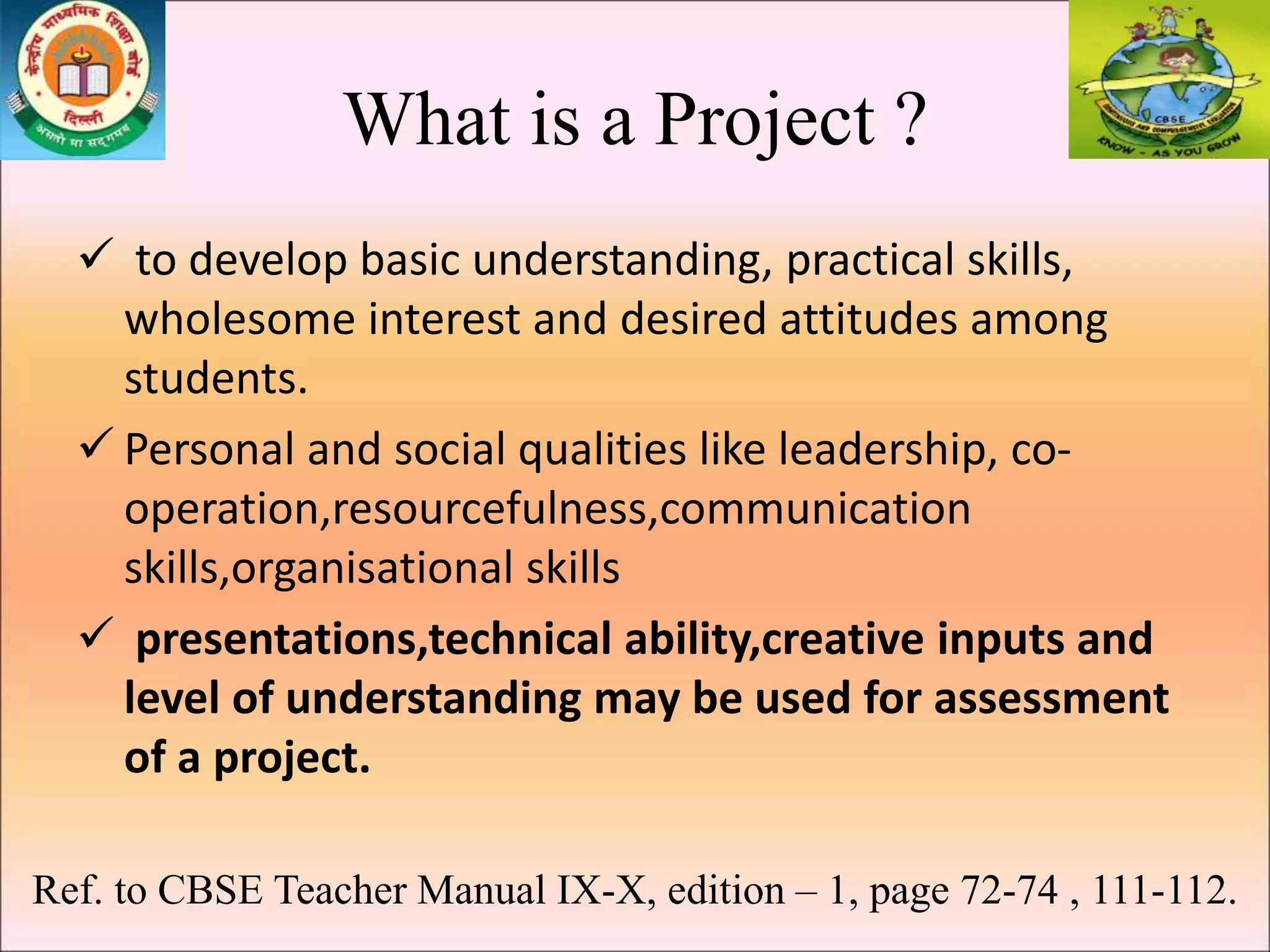
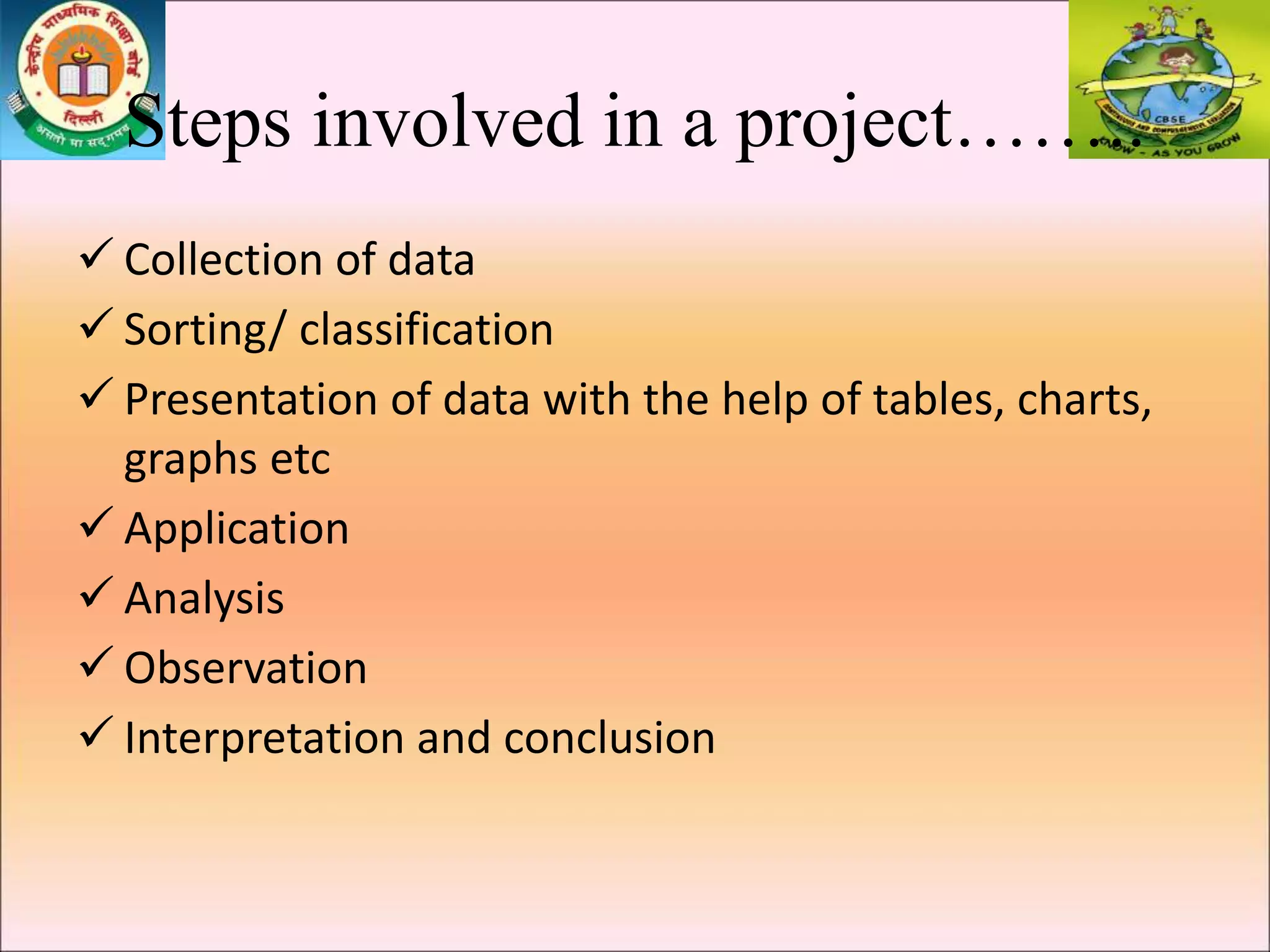
Group or Individual
What is a Project ?
 to develop basic understanding, practical skills,
wholesome interest and desired attitudes among
students.
 Personal and social qualities like leadership, co-
operation,resourcefulness,communication
skills,organisational skills
 presentations,technical ability,creative inputs and
level of understanding may be used for assessment
of a project.
Ref. to CBSE Teacher Manual IX-X, edition – 1, page 72-74 , 111-112.
Steps involved in a project……..
 Collection of data
 Sorting/ classification
 Presentation of data with the help of tables, charts,
graphs etc
 Application
 Analysis
 Observation
 Interpretation and conclusion
Example…
Collect five pictures each of
inventors and discoverers
Is it a project or just collection
of data?
Example…
Collect five pictures each of
inventors and discoverers and
categorise them on the basis of
invention or discovery
Collection of data & classification
Example…
Write down how their discovery
or invention has made your
life easier ?
application
Example…
What is the difference between
discovery and invention? Pick out
one example each of a discovery
and invention and list out the
differences
analysis
Who do you think is more
important –
a discoverer or an inventor?
Give reasons
evaluation
Take a simple working toy. Study
its structure and functioning.
Design a new toy with the same
principle using zero cost material
synthesis
A Sample
Social Science Project
Resource Development
Class X
Level 1
 Students will prepare a simple project on Soil types
in Geography. (Choose any one soil found in India)
Project content:
 Formation of the soil
 Features of the soil
 Areas where the soil found
 Location of the soil on physical map of India
Level 1 Contd.
 Length of the project: 3-4 pages
 Project to be done in Geography note-book.
Instructions:
 collect information on the selected soil type then
tabulate the collected information according to the
given parameters.
 Student will discuss the information with the teacher
and then present it with their own creativity in their
notebook.
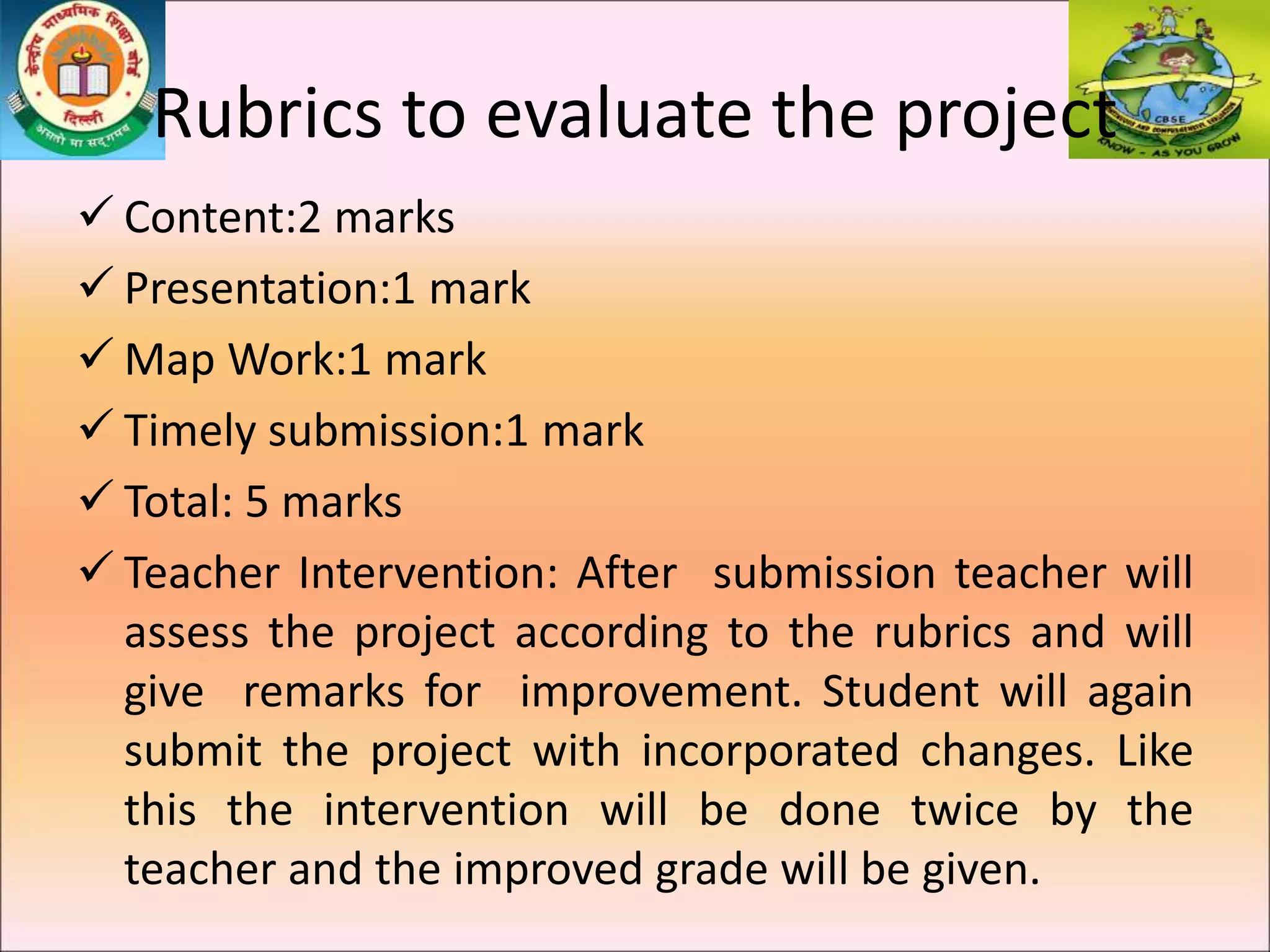
Rubrics to evaluate the project
 Content:2 marks
 Presentation:1 mark
 Map Work:1 mark
 Timely submission:1 mark
 Total: 5 marks
 Teacher Intervention: After submission teacher will
assess the project according to the rubrics and will
give remarks for improvement. Student will again
submit the project with incorporated changes. Like
this the intervention will be done twice by the
teacher and the improved grade will be given.
Level 2 Geography + Science
 Same topic soil can be given as a collaborative
project where geography teacher will assess
according to the parameters in level 1 and science
teacher will assess the following:
 Properties of the soil
 Kind of micro-organisms in the soil
 Effect of living organism on the soil
 Effect of soil on micro-organisms
 Write an autobiography of an earthworm or write a
letter to the Editor of a newspaper informing him
about a factory that is causing pollution in the soil.
 Prepare a PPT on the types of soil, micro-organisms,
their interdependence on each other.
 Geography and science teacher will assess the
content, IT teacher will assess the technology skills
and English teacher will assess the language part.
Level 3 Geography + Science + IT +
English Language
Going Beyond…
 Imagine you are a nitrogen fixing bacteria. Present
your argument on why should you be there in the
soil
 Imagine you are a soil without micro-organisms.
State your reasons why you wish to have them.
 Enact out the role of various micro-organisms
 Create a jingle on micro-organisms present in the soil
and their functions
 Draw the different types of soils, and the kind of
crops grown in them
 Through a choreography depict the different types of
soil and the micro-organisms present in them
 Create a garden with different types of soil using clay,
pop, sand etc and put placards
 You will have to prepare rubrics for each if you are
assessing the students for FA
 Any other cross curricular link
Going Beyond
A Sample
Math Project
Volume and Surface Area
Class IX
Objective
• Students will be able to
 Identify regular 3 D shapes in their environment and
make a list of their findings
 Classify these solids into cubes, cuboids, cylinders,
cones, spheres etc
 Draw a net of a cylinder and hence derive a formula
for the Total and Lateral surface area of a cylinder
 Compare the surface areas of any two given cylinder
 Identify the effect of changing the radius and height
of a cylinder on the surface area of a cylinder
 Create a crossword puzzle based on the above
concepts
Steps associated with
the project…..
 Ask your family members to help you look for various
solid objects / shapes at home. According to their
shapes, segregate them into cubes, cuboids, cylinders,
spheres and tabulate your findings.
 Take a cylindrical object made out of cardboard/paper
and cut it open so as to view the net of a cylinder.on
the basis of your observation, draw a net of a cylinder.
 After completing the design of the net, put the
cylinder together. Try to compute the surface area of
your cylinder.
 What do you think will happen to the surface area
when you enlarge the radius and height of your
cylinder? Write your hypothesis.
 By actual calculations, check whether your
hypothesis was correct or not.
 What do you conclude about the effect of radius and
height on the surface area of a cylinder ?
Previous Knowledge
 Review the concept of 2D and 3D shapes
 Review the area of a rectangle and circle
 Review the properties (circumference, radius, etc.) of
a circle
 Introduce and prepare the students for the surface
area of a cylinder
 Define surface area
A Sample
Project on integration of
Chemistry, Physics,Biology,
Mathematics
Improvement in food resources
Class IX
Level-1: To detect the presence of
food adulterants in the given food
samples in the chemistry lab
Project content
 Metanil yellow in Dal
 Argenome oil in edible oil
 Water in milk
 Sugar in honey
Level –2 : Chemistry + physics
The same project of chemistry may be continued
and integrated with physics where the physics
teacher will assess how adulteration in milk is
detected.
Project content
Name of the instrument
Working of the instrument with the help of a labeled
diagram
Use of instrument to conduct an experiment to
detect adulteration in milk(Lab activity)
Specify the principle for working of this instrument
Level-3:Chem+phy+bio
The same project may be continued and integrated
with biology where the biology teacher will ensure
the following in the project:
Components of balanced diet
Importance of each nutrient
Definition of balanced diet
The effects of adulterants on human body
List the daily requirement of each nutrient(in grams)
in a balanced diet
Level-4: chem+physics+bio+maths
The same project may be continued in maths
where the science and the maths teacher will
ensure the following in the project:
 Tabulate the food items consumed by you in a day(in
grams)
 Comment on whether your diet is balanced or not.
 Out of the listed items, how many items can be tested for
adulteration?
 Compute the ratio of adulterated food items to non
adulterated food items.
 Calculate the percentage of adulteration in your diet.
 List the daily requirement of each nutrient(with SI unit)
in a balanced diet
Rubrics to assess the project….
 Creativity(originality)
 Neatness(Organization and cleanliness)
 Content(authentic,accurate &relevant info)
 Presentation(overall effect, in front of the class)
 Submission on time
Interventions
Intervention – 1
 The project is collected on the specified date and
checked for completion of project
 The teacher ensures completion of all defined objectives
 In case of any objective not being met the teacher
returns the project to the child with adequate mentoring
and guidance and asks the student to submit it on a
specified date
Intervention – 2
 The teacher reviews the project in totality and returns it
with necessary guidance and asks the student to submit
it on a specified date
Now, the project is ready for assessment !
What is an interdisciplinary project?
• It is a project involving two or more academic
subjects which are distinct.
• e. g. Mathematics and English
• Science and Mathematics
• Mathematics and Social Science
• Social Science and English
What is the purpose of taking up such
projects?
• All subjects are interconnected in some or the
other way. These kinds of projects will help
students in exploring a topic from all its
perspectives. Each student has to do at least
one project work in each subject. So,
interdisciplinary project will provide an
opportunity to work on one topic and the
same work will be assessed by different
subject teachers.
Examples of Interdisciplinary projects
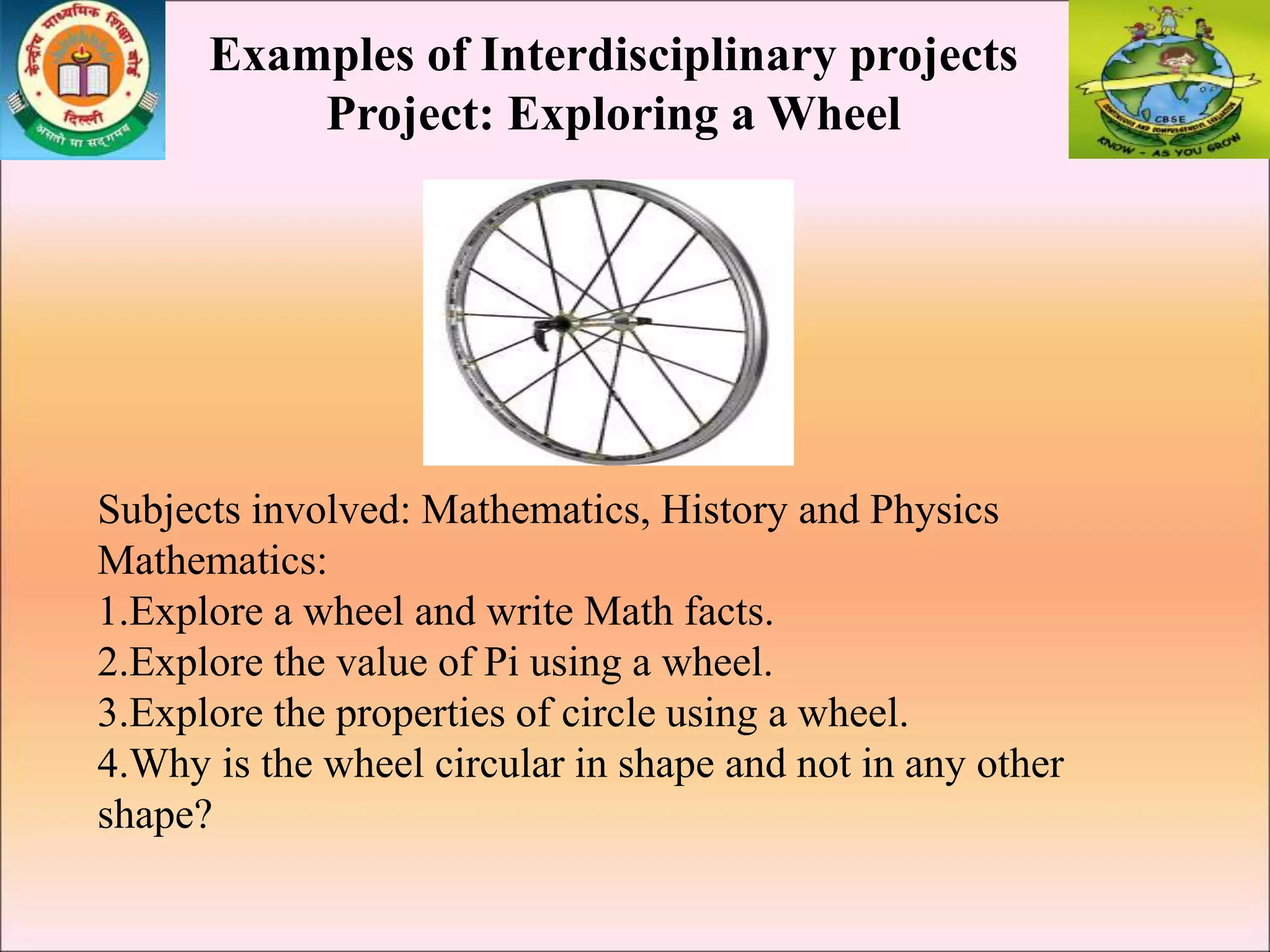
Project: Exploring a Wheel
Subjects involved: Mathematics, History and Physics
Mathematics:
1.Explore a wheel and write Math facts.
2.Explore the value of Pi using a wheel.
3.Explore the properties of circle using a wheel.
4.Why is the wheel circular in shape and not in any other
shape?
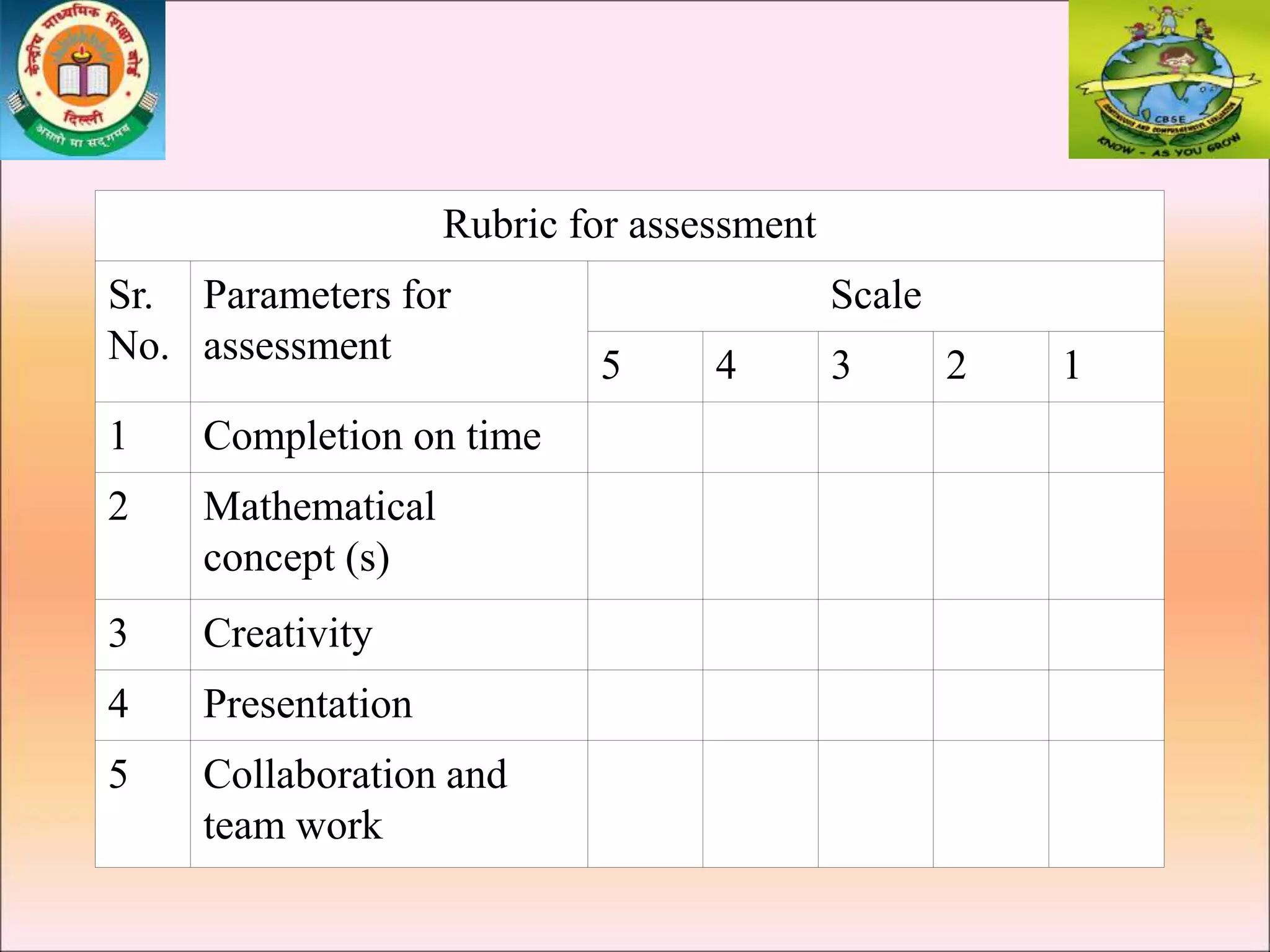
Rubric for assessment
Sr.
No.
Parameters for
assessment
Scale
5 4 3 2 1
1 Completion on time
2 Mathematical
concept (s)
3 Creativity
4 Presentation
5 Collaboration and
team work
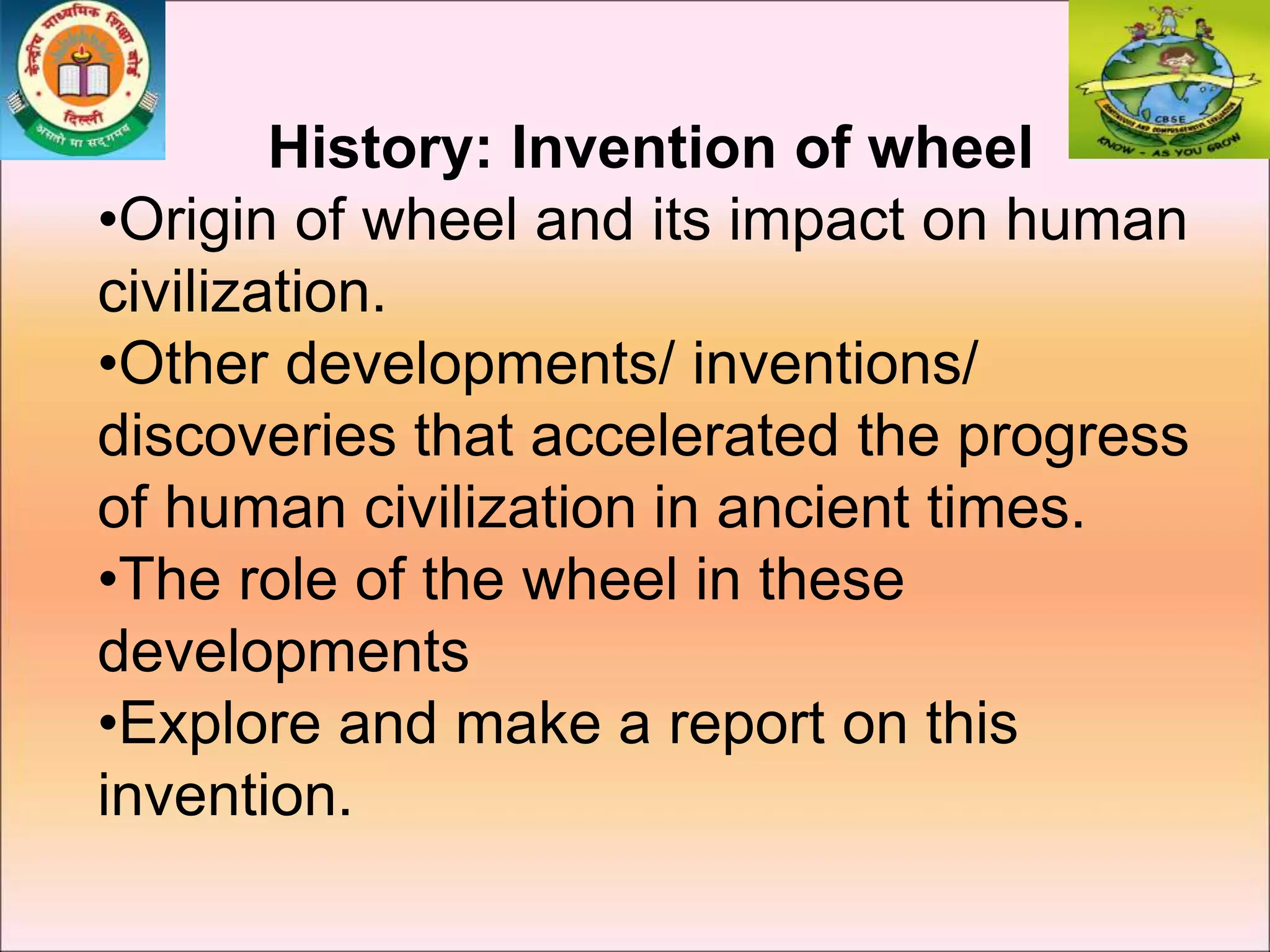
History: Invention of wheel
•Origin of wheel and its impact on human
civilization.
•Other developments/ inventions/
discoveries that accelerated the progress
of human civilization in ancient times.
•The role of the wheel in these
developments
•Explore and make a report on this
invention.
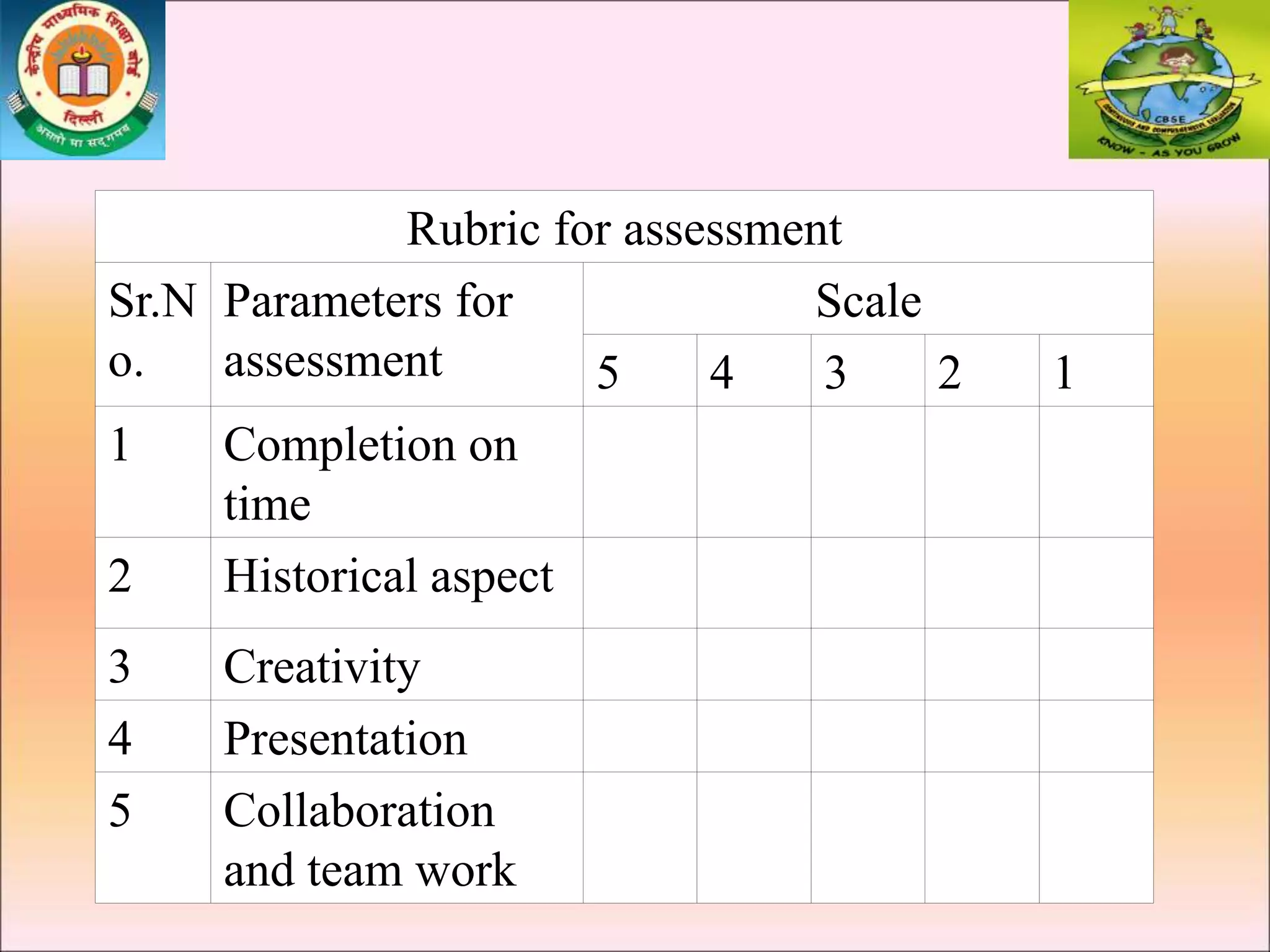
Rubric for assessment
Sr.N
o.
Parameters for
assessment
Scale
5 4 3 2 1
1 Completion on
time
2 Historical aspect
3 Creativity
4 Presentation
5 Collaboration
and team work
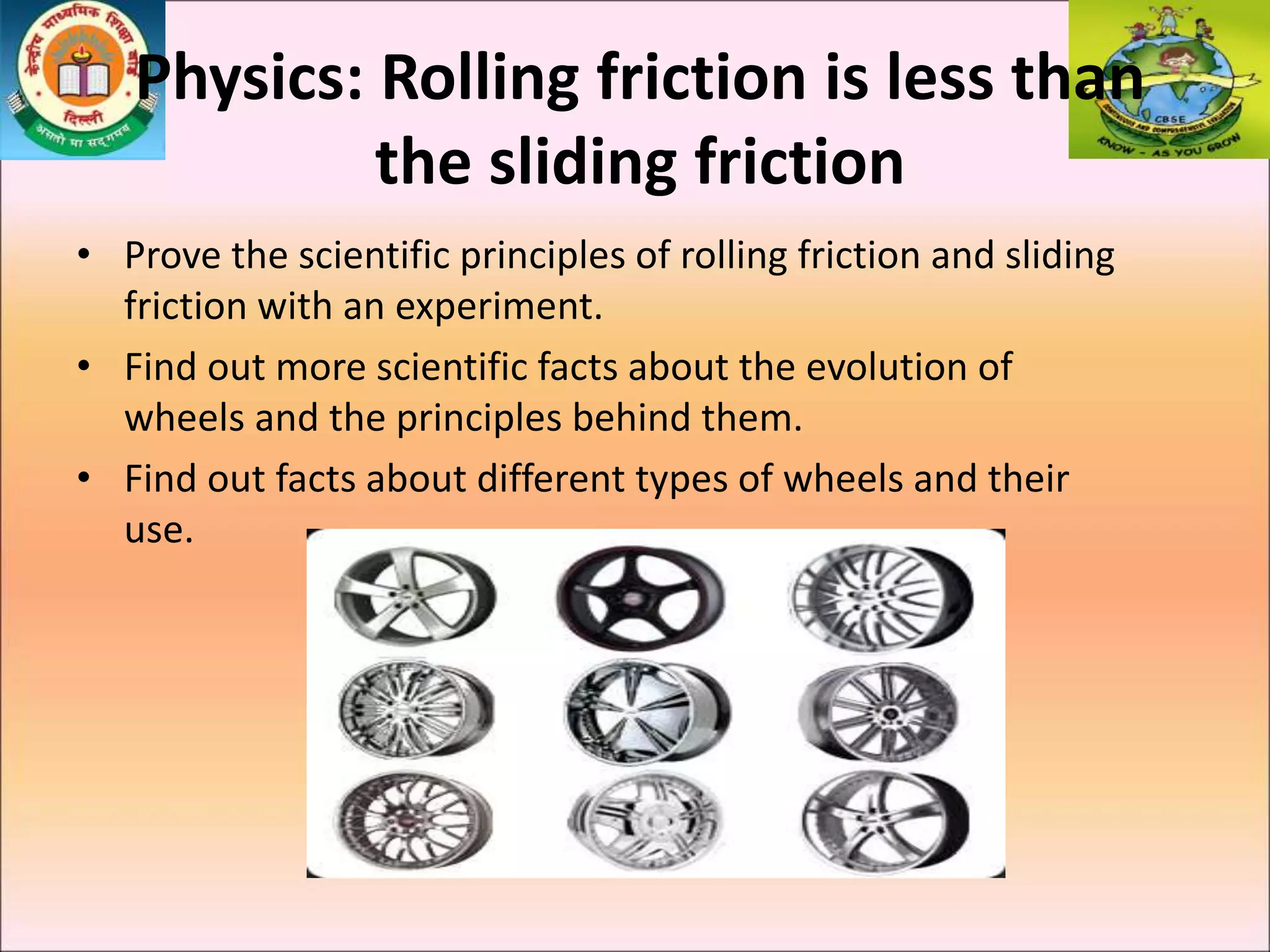
Physics: Rolling friction is less than
the sliding friction
• Prove the scientific principles of rolling friction and sliding
friction with an experiment.
• Find out more scientific facts about the evolution of
wheels and the principles behind them.
• Find out facts about different types of wheels and their
use.
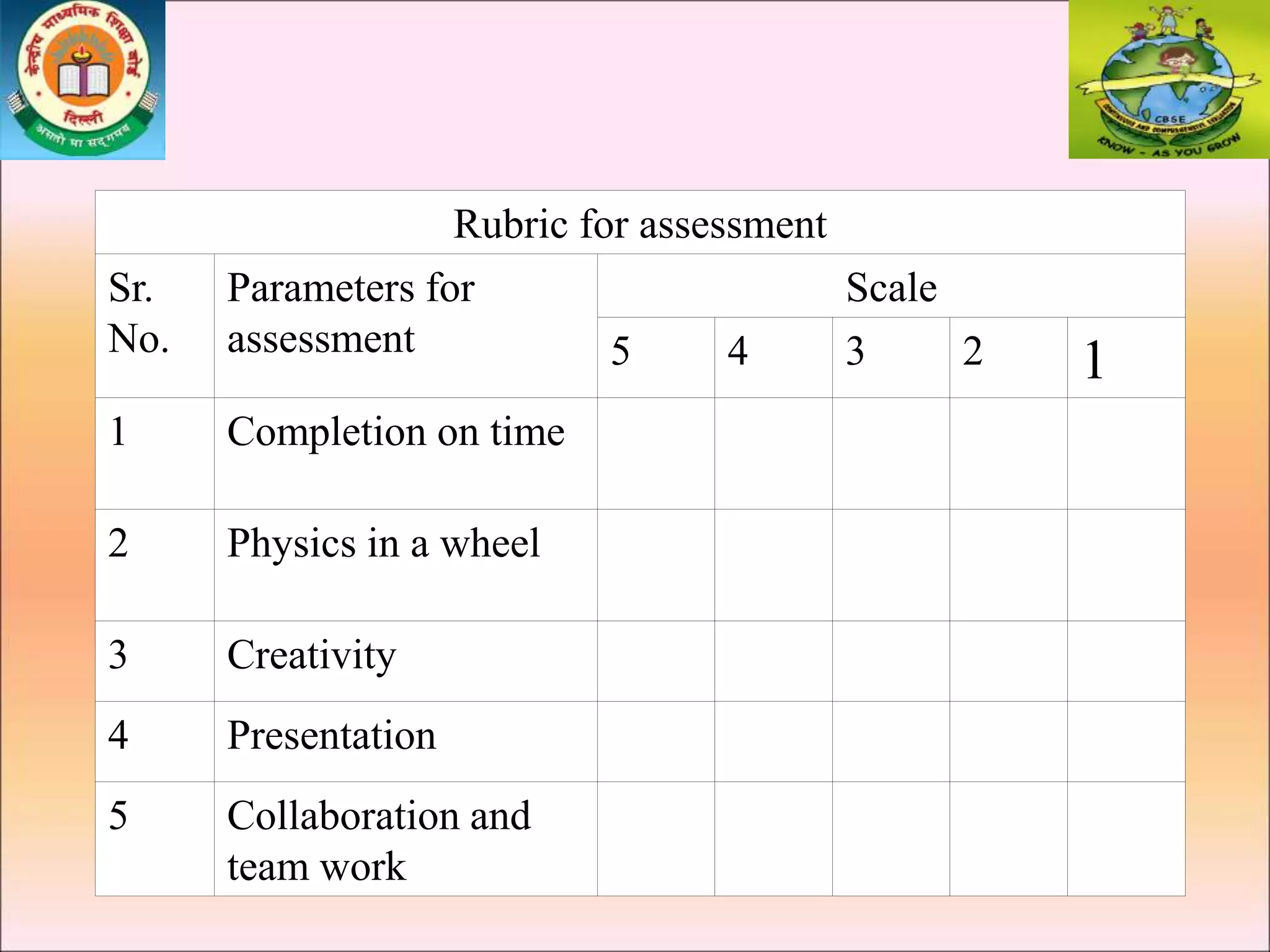
Rubric for assessment
Sr.
No.
Parameters for
assessment
Scale
5 4 3 2 1
1 Completion on time
2 Physics in a wheel
3 Creativity
4 Presentation
5 Collaboration and
team work
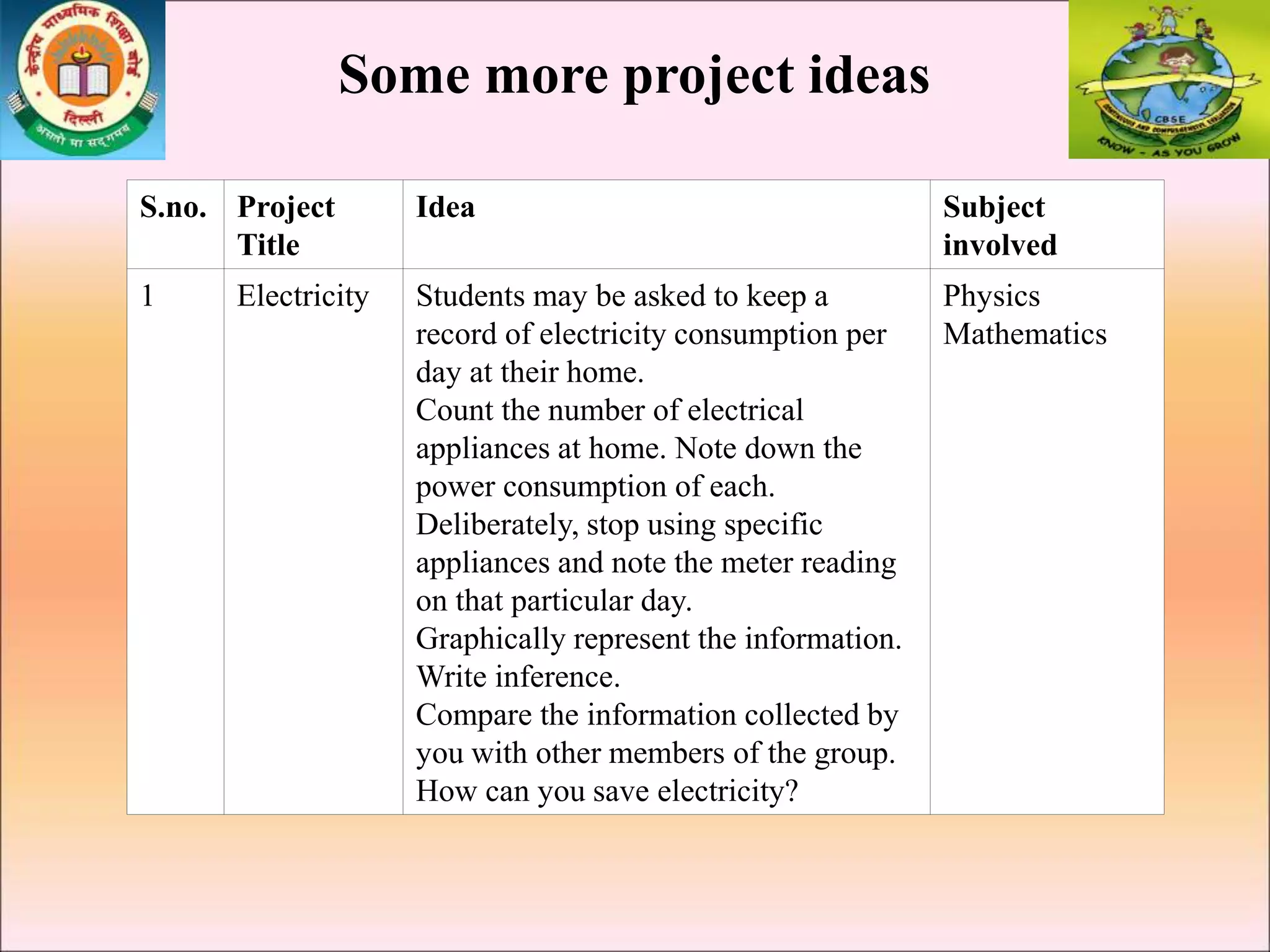
Some more project ideas
S.no. Project
Title
Idea Subject
involved
1 Electricity Students may be asked to keep a
record of electricity consumption per
day at their home.
Count the number of electrical
appliances at home. Note down the
power consumption of each.
Deliberately, stop using specific
appliances and note the meter reading
on that particular day.
Graphically represent the information.
Write inference.
Compare the information collected by
you with other members of the group.
How can you save electricity?
Physics
Mathematics
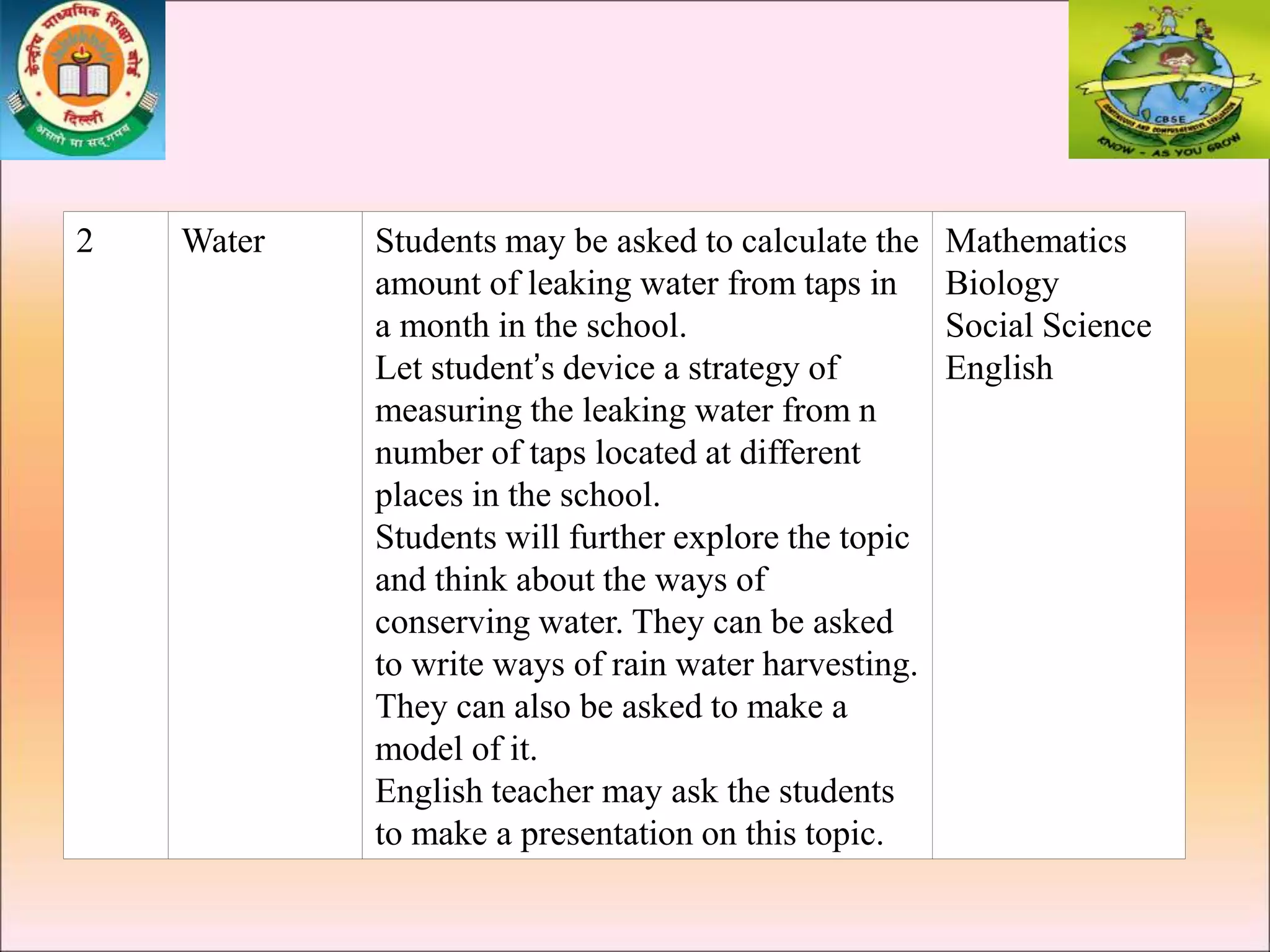
2 Water Students may be asked to calculate the
amount of leaking water from taps in
a month in the school.
Let student’s device a strategy of
measuring the leaking water from n
number of taps located at different
places in the school.
Students will further explore the topic
and think about the ways of
conserving water. They can be asked
to write ways of rain water harvesting.
They can also be asked to make a
model of it.
English teacher may ask the students
to make a presentation on this topic.
Mathematics
Biology
Social Science
English
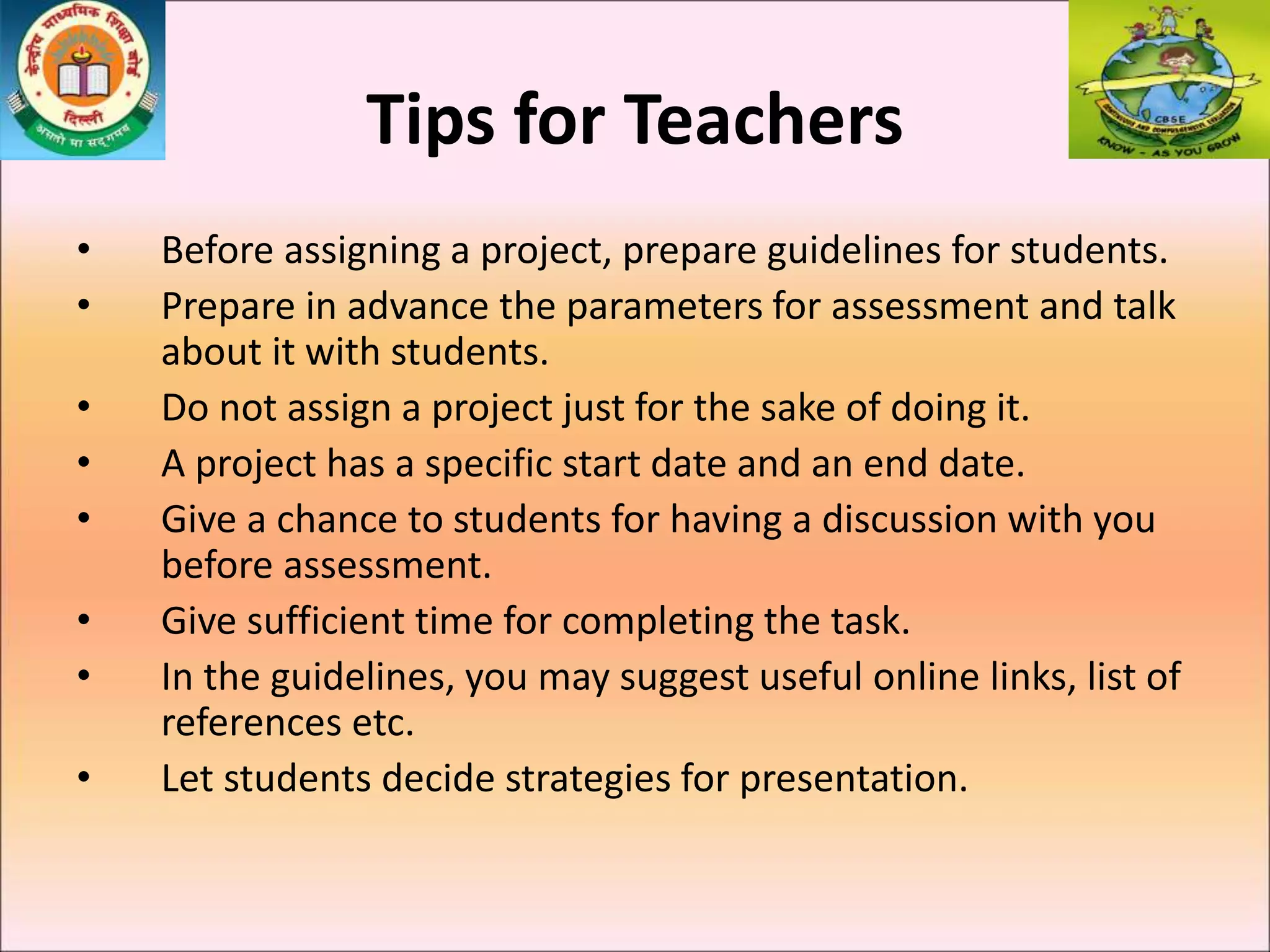
Tips for Teachers
• Before assigning a project, prepare guidelines for students.
• Prepare in advance the parameters for assessment and talk
about it with students.
• Do not assign a project just for the sake of doing it.
• A project has a specific start date and an end date.
• Give a chance to students for having a discussion with you
before assessment.
• Give sufficient time for completing the task.
• In the guidelines, you may suggest useful online links, list of
references etc.
• Let students decide strategies for presentation.
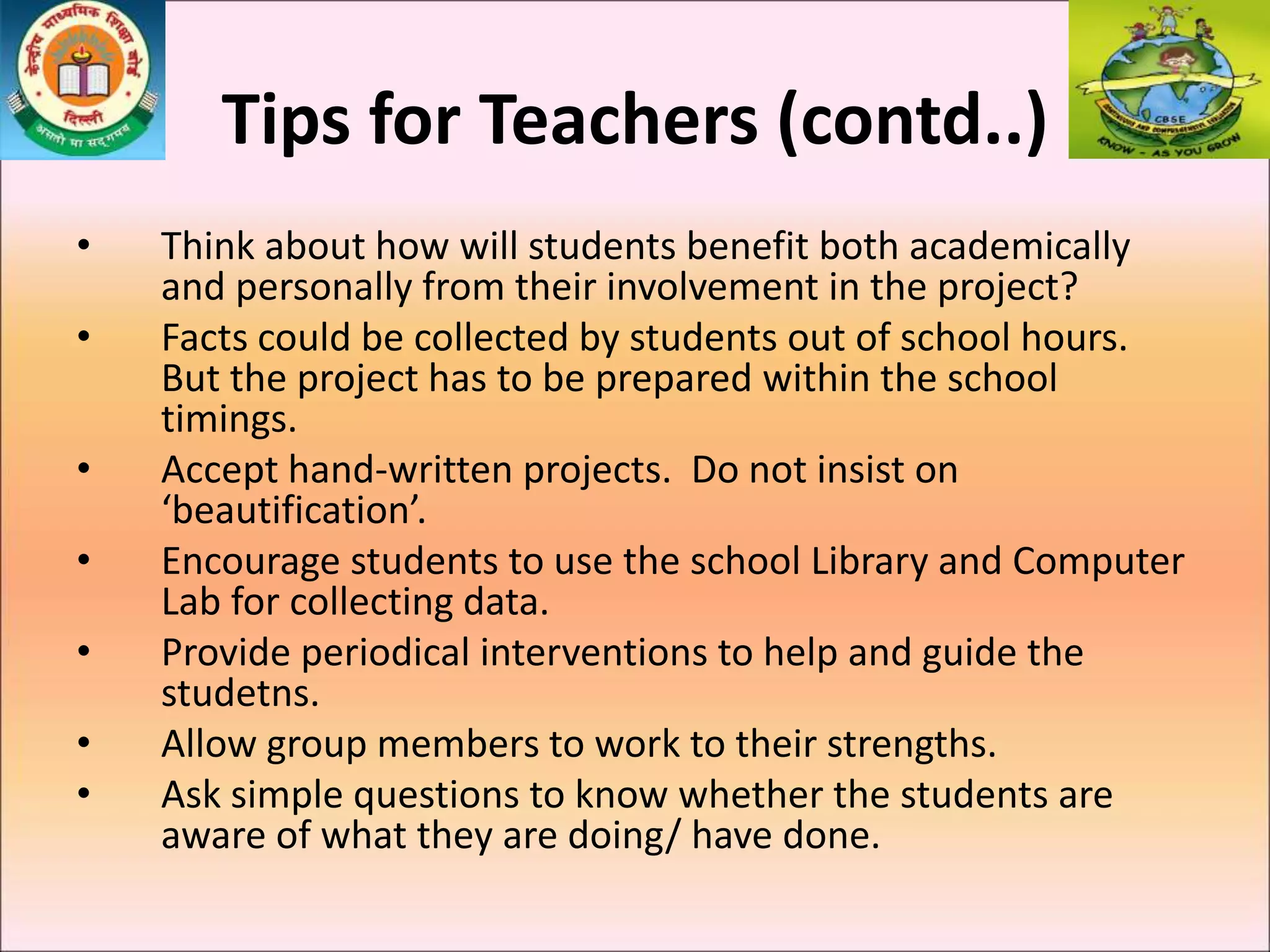
Tips for Teachers (contd..)
• Think about how will students benefit both academically
and personally from their involvement in the project?
• Facts could be collected by students out of school hours.
But the project has to be prepared within the school
timings.
• Accept hand-written projects. Do not insist on
‘beautification’.
• Encourage students to use the school Library and Computer
Lab for collecting data.
• Provide periodical interventions to help and guide the
studetns.
• Allow group members to work to their strengths.
• Ask simple questions to know whether the students are
aware of what they are doing/ have done.

4. Project Based Learning (2).ppt

  • 1.
    Project Based Learning (PBL) asa technique for Formative Assessment
  • 2.
  • 3.
    What is aProject ?  to develop basic understanding, practical skills, wholesome interest and desired attitudes among students.  Personal and social qualities like leadership, co- operation,resourcefulness,communication skills,organisational skills  presentations,technical ability,creative inputs and level of understanding may be used for assessment of a project. Ref. to CBSE Teacher Manual IX-X, edition – 1, page 72-74 , 111-112.
  • 4.
    Steps involved ina project……..  Collection of data  Sorting/ classification  Presentation of data with the help of tables, charts, graphs etc  Application  Analysis  Observation  Interpretation and conclusion
  • 5.
    Example… Collect five pictureseach of inventors and discoverers Is it a project or just collection of data?
  • 6.
    Example… Collect five pictureseach of inventors and discoverers and categorise them on the basis of invention or discovery Collection of data & classification
  • 7.
    Example… Write down howtheir discovery or invention has made your life easier ? application
  • 8.
    Example… What is thedifference between discovery and invention? Pick out one example each of a discovery and invention and list out the differences analysis
  • 9.
    Who do youthink is more important – a discoverer or an inventor? Give reasons evaluation
  • 10.
    Take a simpleworking toy. Study its structure and functioning. Design a new toy with the same principle using zero cost material synthesis
  • 11.
    A Sample Social ScienceProject Resource Development Class X
  • 12.
    Level 1  Studentswill prepare a simple project on Soil types in Geography. (Choose any one soil found in India) Project content:  Formation of the soil  Features of the soil  Areas where the soil found  Location of the soil on physical map of India
  • 13.
    Level 1 Contd. Length of the project: 3-4 pages  Project to be done in Geography note-book. Instructions:  collect information on the selected soil type then tabulate the collected information according to the given parameters.  Student will discuss the information with the teacher and then present it with their own creativity in their notebook.
  • 14.
    Rubrics to evaluatethe project  Content:2 marks  Presentation:1 mark  Map Work:1 mark  Timely submission:1 mark  Total: 5 marks  Teacher Intervention: After submission teacher will assess the project according to the rubrics and will give remarks for improvement. Student will again submit the project with incorporated changes. Like this the intervention will be done twice by the teacher and the improved grade will be given.
  • 15.
    Level 2 Geography+ Science  Same topic soil can be given as a collaborative project where geography teacher will assess according to the parameters in level 1 and science teacher will assess the following:  Properties of the soil  Kind of micro-organisms in the soil  Effect of living organism on the soil  Effect of soil on micro-organisms
  • 16.
     Write anautobiography of an earthworm or write a letter to the Editor of a newspaper informing him about a factory that is causing pollution in the soil.  Prepare a PPT on the types of soil, micro-organisms, their interdependence on each other.  Geography and science teacher will assess the content, IT teacher will assess the technology skills and English teacher will assess the language part. Level 3 Geography + Science + IT + English Language
  • 17.
    Going Beyond…  Imagineyou are a nitrogen fixing bacteria. Present your argument on why should you be there in the soil  Imagine you are a soil without micro-organisms. State your reasons why you wish to have them.  Enact out the role of various micro-organisms  Create a jingle on micro-organisms present in the soil and their functions  Draw the different types of soils, and the kind of crops grown in them
  • 18.
     Through achoreography depict the different types of soil and the micro-organisms present in them  Create a garden with different types of soil using clay, pop, sand etc and put placards  You will have to prepare rubrics for each if you are assessing the students for FA  Any other cross curricular link Going Beyond
  • 19.
    A Sample Math Project Volumeand Surface Area Class IX
  • 20.
    Objective • Students willbe able to  Identify regular 3 D shapes in their environment and make a list of their findings  Classify these solids into cubes, cuboids, cylinders, cones, spheres etc  Draw a net of a cylinder and hence derive a formula for the Total and Lateral surface area of a cylinder  Compare the surface areas of any two given cylinder  Identify the effect of changing the radius and height of a cylinder on the surface area of a cylinder  Create a crossword puzzle based on the above concepts
  • 21.
    Steps associated with theproject…..  Ask your family members to help you look for various solid objects / shapes at home. According to their shapes, segregate them into cubes, cuboids, cylinders, spheres and tabulate your findings.  Take a cylindrical object made out of cardboard/paper and cut it open so as to view the net of a cylinder.on the basis of your observation, draw a net of a cylinder.  After completing the design of the net, put the cylinder together. Try to compute the surface area of your cylinder.
  • 22.
     What doyou think will happen to the surface area when you enlarge the radius and height of your cylinder? Write your hypothesis.  By actual calculations, check whether your hypothesis was correct or not.  What do you conclude about the effect of radius and height on the surface area of a cylinder ?
  • 23.
    Previous Knowledge  Reviewthe concept of 2D and 3D shapes  Review the area of a rectangle and circle  Review the properties (circumference, radius, etc.) of a circle  Introduce and prepare the students for the surface area of a cylinder  Define surface area
  • 24.
    A Sample Project onintegration of Chemistry, Physics,Biology, Mathematics
  • 25.
    Improvement in foodresources Class IX
  • 26.
    Level-1: To detectthe presence of food adulterants in the given food samples in the chemistry lab Project content  Metanil yellow in Dal  Argenome oil in edible oil  Water in milk  Sugar in honey
  • 27.
    Level –2 :Chemistry + physics The same project of chemistry may be continued and integrated with physics where the physics teacher will assess how adulteration in milk is detected. Project content Name of the instrument Working of the instrument with the help of a labeled diagram Use of instrument to conduct an experiment to detect adulteration in milk(Lab activity) Specify the principle for working of this instrument
  • 28.
    Level-3:Chem+phy+bio The same projectmay be continued and integrated with biology where the biology teacher will ensure the following in the project: Components of balanced diet Importance of each nutrient Definition of balanced diet The effects of adulterants on human body List the daily requirement of each nutrient(in grams) in a balanced diet
  • 29.
    Level-4: chem+physics+bio+maths The sameproject may be continued in maths where the science and the maths teacher will ensure the following in the project:  Tabulate the food items consumed by you in a day(in grams)  Comment on whether your diet is balanced or not.  Out of the listed items, how many items can be tested for adulteration?  Compute the ratio of adulterated food items to non adulterated food items.  Calculate the percentage of adulteration in your diet.  List the daily requirement of each nutrient(with SI unit) in a balanced diet
  • 30.
    Rubrics to assessthe project….  Creativity(originality)  Neatness(Organization and cleanliness)  Content(authentic,accurate &relevant info)  Presentation(overall effect, in front of the class)  Submission on time
  • 31.
    Interventions Intervention – 1 The project is collected on the specified date and checked for completion of project  The teacher ensures completion of all defined objectives  In case of any objective not being met the teacher returns the project to the child with adequate mentoring and guidance and asks the student to submit it on a specified date Intervention – 2  The teacher reviews the project in totality and returns it with necessary guidance and asks the student to submit it on a specified date Now, the project is ready for assessment !
  • 32.
    What is aninterdisciplinary project? • It is a project involving two or more academic subjects which are distinct. • e. g. Mathematics and English • Science and Mathematics • Mathematics and Social Science • Social Science and English
  • 33.
    What is thepurpose of taking up such projects? • All subjects are interconnected in some or the other way. These kinds of projects will help students in exploring a topic from all its perspectives. Each student has to do at least one project work in each subject. So, interdisciplinary project will provide an opportunity to work on one topic and the same work will be assessed by different subject teachers.
  • 34.
    Examples of Interdisciplinaryprojects Project: Exploring a Wheel Subjects involved: Mathematics, History and Physics Mathematics: 1.Explore a wheel and write Math facts. 2.Explore the value of Pi using a wheel. 3.Explore the properties of circle using a wheel. 4.Why is the wheel circular in shape and not in any other shape?
  • 35.
    Rubric for assessment Sr. No. Parametersfor assessment Scale 5 4 3 2 1 1 Completion on time 2 Mathematical concept (s) 3 Creativity 4 Presentation 5 Collaboration and team work
  • 36.
    History: Invention ofwheel •Origin of wheel and its impact on human civilization. •Other developments/ inventions/ discoveries that accelerated the progress of human civilization in ancient times. •The role of the wheel in these developments •Explore and make a report on this invention.
  • 37.
    Rubric for assessment Sr.N o. Parametersfor assessment Scale 5 4 3 2 1 1 Completion on time 2 Historical aspect 3 Creativity 4 Presentation 5 Collaboration and team work
  • 38.
    Physics: Rolling frictionis less than the sliding friction • Prove the scientific principles of rolling friction and sliding friction with an experiment. • Find out more scientific facts about the evolution of wheels and the principles behind them. • Find out facts about different types of wheels and their use.
  • 39.
    Rubric for assessment Sr. No. Parametersfor assessment Scale 5 4 3 2 1 1 Completion on time 2 Physics in a wheel 3 Creativity 4 Presentation 5 Collaboration and team work
  • 40.
    Some more projectideas S.no. Project Title Idea Subject involved 1 Electricity Students may be asked to keep a record of electricity consumption per day at their home. Count the number of electrical appliances at home. Note down the power consumption of each. Deliberately, stop using specific appliances and note the meter reading on that particular day. Graphically represent the information. Write inference. Compare the information collected by you with other members of the group. How can you save electricity? Physics Mathematics
  • 41.
    2 Water Studentsmay be asked to calculate the amount of leaking water from taps in a month in the school. Let student’s device a strategy of measuring the leaking water from n number of taps located at different places in the school. Students will further explore the topic and think about the ways of conserving water. They can be asked to write ways of rain water harvesting. They can also be asked to make a model of it. English teacher may ask the students to make a presentation on this topic. Mathematics Biology Social Science English
  • 42.
    Tips for Teachers •Before assigning a project, prepare guidelines for students. • Prepare in advance the parameters for assessment and talk about it with students. • Do not assign a project just for the sake of doing it. • A project has a specific start date and an end date. • Give a chance to students for having a discussion with you before assessment. • Give sufficient time for completing the task. • In the guidelines, you may suggest useful online links, list of references etc. • Let students decide strategies for presentation.
  • 43.
    Tips for Teachers(contd..) • Think about how will students benefit both academically and personally from their involvement in the project? • Facts could be collected by students out of school hours. But the project has to be prepared within the school timings. • Accept hand-written projects. Do not insist on ‘beautification’. • Encourage students to use the school Library and Computer Lab for collecting data. • Provide periodical interventions to help and guide the studetns. • Allow group members to work to their strengths. • Ask simple questions to know whether the students are aware of what they are doing/ have done.