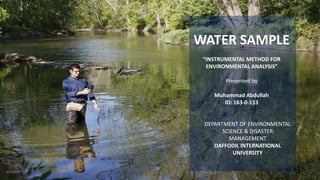
WATER SAMPLE
“INSTRUMENTAL METHOD FOR
ENVIRONMENTAL ANALYSIS”
Presented by
Muhammad Abdullah
ID: 163-0-153
DEPARTMENT OF ENVIRONMENTAL
SCIENCE & DISASTER
MANAGEMENT
DAFFODIL INTERNATIONAL
UNIVERSITY
WHAT IS SAMPLING ?
In research terms a sample is a group of people, objects, or items that are
taken from a larger population for measurement. The sample should be
representative of the population to ensure that we can generalize the
findings from the research sample to the population as a whole.
WATER SAMPLING
Water sampling is the process of taking a portion of water for
analysis or other testing, e.g. drinking water to check that it
complies with relevant water quality standards, or river water to
check for pollutants, or bathing water to check that it is safe for
bathing, or intrusive water in a building to identify its source.
TYPES OF WATER SAMPLING
GRAB SAMPLING COMPOSITE SAMPLING
A composite sample is a
mixture of grab samples taken
at different times or locations
and pooled together to
provide one sample.
A grab sample is a discrete
sample which is collected at a
specific location at a certain
point in time.
WATER SAMPLING PROCEDURE
1. Research purpose
2. Identification of the sampling point
3. Take all the instruments, note book, sampling materials, cooling box
4. Ware gloves and take the sampling bags or sampling bottles
5. Record field data
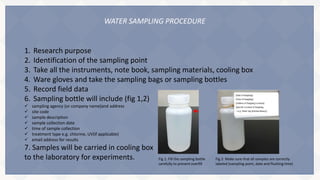
6. Sampling bottle will include (fig 1,2)
 sampling agency (or company name)and address
 site code
 sample description
 sample collection date
 time of sample collection
 treatment type e.g. chlorine, UV(if applicable)
 email address for results
7. Samples will be carried in cooling box
to the laboratory for experiments. Fig 1: Fill the sampling bottle
carefully to prevent overfill
Fig 2: Make sure that all samples are correctly
labeled (sampling point, date and flushing time)
PARAMETERS OF WATER SAMPLING FOR TREATMENT
Physical & Chemical Parameter
BOD- Biological oxygen demand
COD- Chemical oxygen demand
TSS- Total suspended solid
TDS- Total dissolved solid
pH
DO- Dissolved Oxygen
Redox Potential
Turbidity
Color & Odor
Hydrogen Sulphide as H2S
Organic Matter by KMnO4
Total Nitrogen, Ammonia, Nitrate, Nitrite, Phosphate, Sodium etc.
Heavy metals (Zn, Cr, Ni, Cd, Pb, As, Fe)
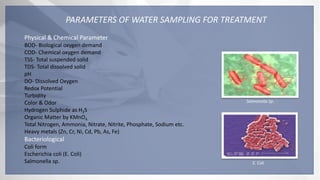
Bacteriological
Coli form
Escherichia coli (E. Coli)
Salmonella sp. E. Coli
Salmonella Sp.
INSTRUMENTS OF WATER SAMPLING
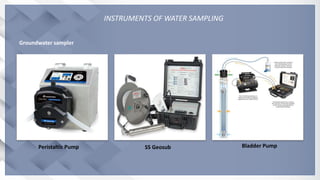
Groundwater sampler
Peristaltic Pump Bladder PumpSS Geosub
INSTRUMENTS OF WATER SAMPLING
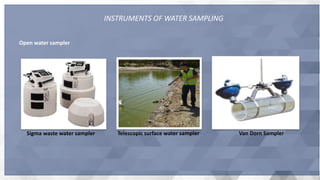
Open water sampler
Sigma waste water sampler Telescopic surface water sampler Van Dorn Sampler
INSTRUMENTS OF WATER SAMPLING
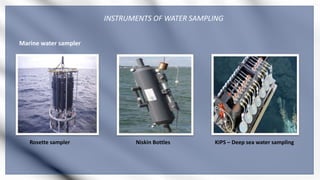
Marine water sampler
Rosette sampler Niskin Bottles KIPS – Deep sea water sampling
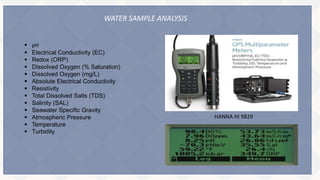
WATER SAMPLE ANALYSIS
 pH
 Electrical Conductivity (EC)
 Redox (ORP)
 Dissolved Oxygen (% Saturation)
 Dissolved Oxygen (mg/L)
 Absolute Electrical Conductivity
 Resistivity
 Total Dissolved Salts (TDS)
 Salinity (SAL)
 Seawater Specific Gravity
 Atmospheric Pressure
 Temperature
 Turbidity
HANNA HI 9829
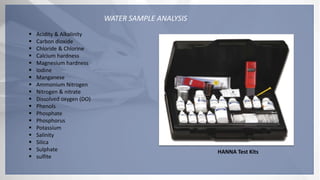
WATER SAMPLE ANALYSIS
 Acidity & Alkalinity
 Carbon dioxide
 Chloride & Chlorine
 Calcium hardness
 Magnesium hardness
 Iodine
 Manganese
 Ammonium Nitrogen
 Nitrogen & nitrate
 Dissolved oxygen (DO)
 Phenols
 Phosphate
 Phosphorus
 Potassium
 Salinity
 Silica
 Sulphate
 sulfite
HANNA Test Kits
WATER SAMPLE ANALYSIS
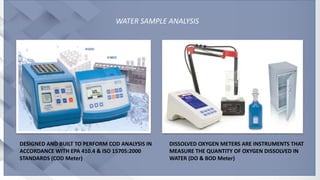
DISSOLVED OXYGEN METERS ARE INSTRUMENTS THAT
MEASURE THE QUANTITY OF OXYGEN DISSOLVED IN
WATER (DO & BOD Meter)
DESIGNED AND BUILT TO PERFORM COD ANALYSIS IN
ACCORDANCE WITH EPA 410.4 & ISO 15705:2000
STANDARDS (COD Meter)
WATER SAMPLE ANALYSIS
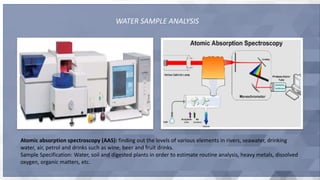
Atomic absorption spectroscopy (AAS): finding out the levels of various elements in rivers, seawater, drinking
water, air, petrol and drinks such as wine, beer and fruit drinks.
Sample Specification: Water, soil and digested plants in order to estimate routine analysis, heavy metals, dissolved
oxygen, organic matters, etc.
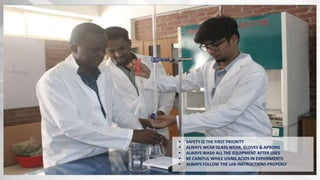
 SAFETY IS THE FIRST PRIORITY
 ALWAYS WEAR GLASS WEAR, GLOVES & APRONS
 ALWAYS WASH ALL THE EQUIPMENT AFTER USES
 BE CAREFUL WHILE USING ACIDS IN EXPERIMENTS
 ALWAYS FOLLOW THE LAB INSTRUCTIONS PROPERLY
Water Sampling and analysis instruments

Water Sampling and analysis instruments

  • 1.
    WATER SAMPLE “INSTRUMENTAL METHODFOR ENVIRONMENTAL ANALYSIS” Presented by Muhammad Abdullah ID: 163-0-153 DEPARTMENT OF ENVIRONMENTAL SCIENCE & DISASTER MANAGEMENT DAFFODIL INTERNATIONAL UNIVERSITY
  • 2.
    WHAT IS SAMPLING? In research terms a sample is a group of people, objects, or items that are taken from a larger population for measurement. The sample should be representative of the population to ensure that we can generalize the findings from the research sample to the population as a whole.
  • 3.
    WATER SAMPLING Water samplingis the process of taking a portion of water for analysis or other testing, e.g. drinking water to check that it complies with relevant water quality standards, or river water to check for pollutants, or bathing water to check that it is safe for bathing, or intrusive water in a building to identify its source.
  • 4.
    TYPES OF WATERSAMPLING GRAB SAMPLING COMPOSITE SAMPLING A composite sample is a mixture of grab samples taken at different times or locations and pooled together to provide one sample. A grab sample is a discrete sample which is collected at a specific location at a certain point in time.
  • 5.
    WATER SAMPLING PROCEDURE 1.Research purpose 2. Identification of the sampling point 3. Take all the instruments, note book, sampling materials, cooling box 4. Ware gloves and take the sampling bags or sampling bottles 5. Record field data 6. Sampling bottle will include (fig 1,2)  sampling agency (or company name)and address  site code  sample description  sample collection date  time of sample collection  treatment type e.g. chlorine, UV(if applicable)  email address for results 7. Samples will be carried in cooling box to the laboratory for experiments. Fig 1: Fill the sampling bottle carefully to prevent overfill Fig 2: Make sure that all samples are correctly labeled (sampling point, date and flushing time)
  • 6.
    PARAMETERS OF WATERSAMPLING FOR TREATMENT Physical & Chemical Parameter BOD- Biological oxygen demand COD- Chemical oxygen demand TSS- Total suspended solid TDS- Total dissolved solid pH DO- Dissolved Oxygen Redox Potential Turbidity Color & Odor Hydrogen Sulphide as H2S Organic Matter by KMnO4 Total Nitrogen, Ammonia, Nitrate, Nitrite, Phosphate, Sodium etc. Heavy metals (Zn, Cr, Ni, Cd, Pb, As, Fe) Bacteriological Coli form Escherichia coli (E. Coli) Salmonella sp. E. Coli Salmonella Sp.
  • 7.
    INSTRUMENTS OF WATERSAMPLING Groundwater sampler Peristaltic Pump Bladder PumpSS Geosub
  • 8.
    INSTRUMENTS OF WATERSAMPLING Open water sampler Sigma waste water sampler Telescopic surface water sampler Van Dorn Sampler
  • 9.
    INSTRUMENTS OF WATERSAMPLING Marine water sampler Rosette sampler Niskin Bottles KIPS – Deep sea water sampling
  • 10.
    WATER SAMPLE ANALYSIS pH  Electrical Conductivity (EC)  Redox (ORP)  Dissolved Oxygen (% Saturation)  Dissolved Oxygen (mg/L)  Absolute Electrical Conductivity  Resistivity  Total Dissolved Salts (TDS)  Salinity (SAL)  Seawater Specific Gravity  Atmospheric Pressure  Temperature  Turbidity HANNA HI 9829
  • 11.
    WATER SAMPLE ANALYSIS Acidity & Alkalinity  Carbon dioxide  Chloride & Chlorine  Calcium hardness  Magnesium hardness  Iodine  Manganese  Ammonium Nitrogen  Nitrogen & nitrate  Dissolved oxygen (DO)  Phenols  Phosphate  Phosphorus  Potassium  Salinity  Silica  Sulphate  sulfite HANNA Test Kits
  • 12.
    WATER SAMPLE ANALYSIS DISSOLVEDOXYGEN METERS ARE INSTRUMENTS THAT MEASURE THE QUANTITY OF OXYGEN DISSOLVED IN WATER (DO & BOD Meter) DESIGNED AND BUILT TO PERFORM COD ANALYSIS IN ACCORDANCE WITH EPA 410.4 & ISO 15705:2000 STANDARDS (COD Meter)
  • 13.
    WATER SAMPLE ANALYSIS Atomicabsorption spectroscopy (AAS): finding out the levels of various elements in rivers, seawater, drinking water, air, petrol and drinks such as wine, beer and fruit drinks. Sample Specification: Water, soil and digested plants in order to estimate routine analysis, heavy metals, dissolved oxygen, organic matters, etc.
  • 14.
     SAFETY ISTHE FIRST PRIORITY  ALWAYS WEAR GLASS WEAR, GLOVES & APRONS  ALWAYS WASH ALL THE EQUIPMENT AFTER USES  BE CAREFUL WHILE USING ACIDS IN EXPERIMENTS  ALWAYS FOLLOW THE LAB INSTRUCTIONS PROPERLY