
ASTHMA
MANAGEMENT
Magnitude of the Problem
 15- 20 million asthmatics in India.
 A recent study conducted in Delhi established
asthma prevalence to be 12% in
schoolchildren.
 Significant cause of school/work absence.
 Health care expenditures very high.
 Morbidity and mortality are on the rise.
JAPI 2002; Vol 50: 462.
The Treatment Gap in Asthma
 Patients are not detected
 Do not seek medical attention
 No access to health service
 Missed diagnosis (bronchitis, LRTI)
Current Understanding of Asthma
 A chronic inflammatory disorder of the
airway
 Infiltration of mast cells, eosinophils
and lymphocytes
 Airway hyperresponsiveness
 Recurrent episodes of wheezing,
coughing and shortness of breath
 Widespread, variable and often
reversible airflow limitation
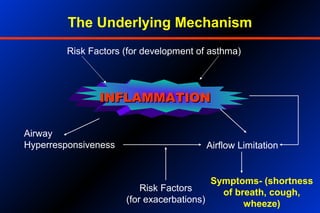
The Underlying Mechanism
INFLAMMATIONINFLAMMATION
Risk Factors (for development of asthma)
Airway
Hyperresponsiveness Airflow Limitation
Symptoms- (shortness
of breath, cough,
wheeze)
Risk Factors
(for exacerbations)
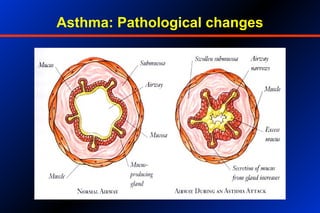
Asthma: Pathological changes
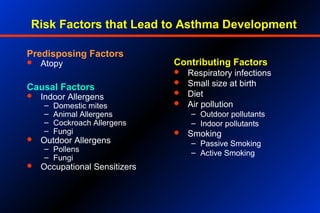
Risk Factors that Lead to Asthma Development
Predisposing Factors
 Atopy
Causal Factors
 Indoor Allergens
– Domestic mites
– Animal Allergens
– Cockroach Allergens
– Fungi
 Outdoor Allergens
– Pollens
– Fungi
 Occupational Sensitizers
Contributing Factors
 Respiratory infections
 Small size at birth
 Diet
 Air pollution
– Outdoor pollutants
– Indoor pollutants
 Smoking
– Passive Smoking
– Active Smoking
DIAGNOSIS OF ASTHMA
 History and patterns of symptoms
 Physical examination
 Measurements of lung function
PATIENT HISTORY
 Has the patient had an attack or recurrent
episodes of wheezing?
 Does the patient have a troublesome cough,
worse particularly at night, or on awakening?
 Does the patient cough after physical activity
(eg. Playing)?
 Does the patient have breathing problems
during a particular season (or change of
season)?
 Do the patient’s colds ‘go to the chest’
or take more than 10 days to resolve?
 Does the patient use any medication
(e.g. bronchodilator) when symptoms
occur? Is there a response?
If the patient answers “YES” to any of
the above questions, suspect asthma.
Physical Examination
Wheeze -
Usually heard without a stethoscope
Dyspnoea -
Rhonchi heard with a stethoscope
Use of accessory muscles
Remember -
Absence of symptoms at the time of examination
does not exclude the diagnosis of asthma
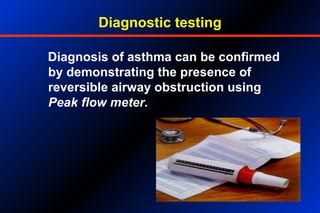
Diagnostic testing
Diagnosis of asthma can be confirmed
by demonstrating the presence of
reversible airway obstruction using
Peak flow meter.
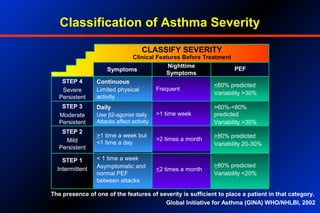
Classification of Asthma Severity
STEP 4
Severe
Persistent
STEP 3
Moderate
Persistent
STEP 2
Mild
Persistent
STEP 1
Intermittent
The presence of one of the features of severity is sufficient to place a patient in that category.
Global Initiative for Asthma (GINA) WHO/NHLBI, 2002
Symptoms
Nighttime
Symptoms
PEF
CLASSIFY SEVERITY
Clinical Features Before Treatment
Continuous
Limited physical
activity
Daily
Use β2-agonist daily
Attacks affect activity
>1 time a week but
<1 time a day
< 1 time a week
Asymptomatic and
normal PEF
between attacks
Frequent
>1 time week
>2 times a month
<2 times a month
<60% predicted
Variability >30%
>60%-<80%
predicted
Variability >30%
>80% predicted
Variability 20-30%
>80% predicted
Variability <20%
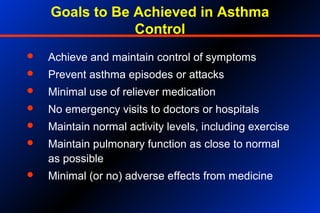
Goals to Be Achieved in Asthma
Control
 Achieve and maintain control of symptoms
 Prevent asthma episodes or attacks
 Minimal use of reliever medication
 No emergency visits to doctors or hospitals
 Maintain normal activity levels, including exercise
 Maintain pulmonary function as close to normal
as possible
 Minimal (or no) adverse effects from medicine
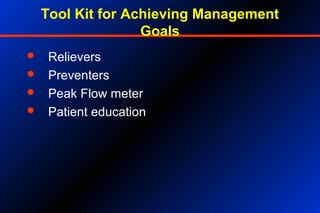
Tool Kit for Achieving Management
Goals
 Relievers
 Preventers
 Peak Flow meter
 Patient education
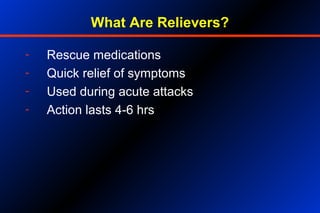
What Are Relievers?
- Rescue medications
- Quick relief of symptoms
- Used during acute attacks
- Action lasts 4-6 hrs
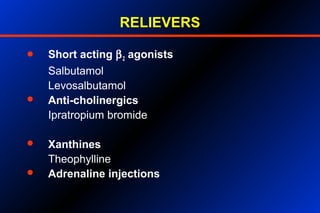
RELIEVERS
 Short acting β2 agonists
Salbutamol
Levosalbutamol
 Anti-cholinergics
Ipratropium bromide
 Xanthines
Theophylline
 Adrenaline injections
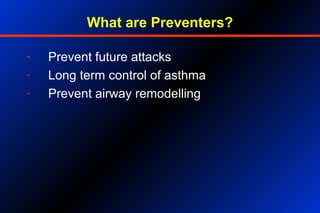
What are Preventers?
- Prevent future attacks
- Long term control of asthma
- Prevent airway remodelling
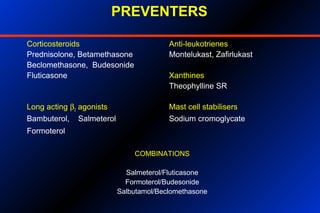
PREVENTERS
Corticosteroids Anti-leukotrienes
Prednisolone, Betamethasone Montelukast, Zafirlukast
Beclomethasone, Budesonide
Fluticasone Xanthines
Theophylline SR
Long acting β2 agonists Mast cell stabilisers
Bambuterol, Salmeterol Sodium cromoglycate
Formoterol
COMBINATIONS
Salmeterol/Fluticasone
Formoterol/Budesonide
Salbutamol/Beclomethasone
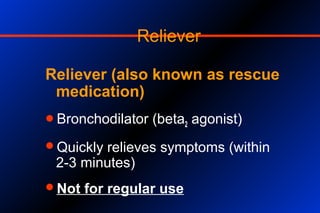
Reliever
Reliever (also known as rescue
medication)
Bronchodilator (beta2 agonist)
Quickly relieves symptoms (within
2-3 minutes)
Not for regular use
Rescue Medication
SALBUTAMOL INHALER
100 mcg:
1 or 2 puffs as necessary
LEVOSALBUTAMOL INHALER
50 mcg :
1 or 2 puffs as necessary
Anti-inflammatory
Takes time to act (1-3 hours)
Long-term effect (12-24 hours)
Only for regular use
(whether well or not well)
Preventer
ICS + LABA
Which LABA ?
Formoterol: Immediate relief (as fast as
salbutamol)
12 hours effect
Can be combined with
budesonide
Ideal combination
Formoterol ( fast relief and sustained
relief ) +
Budesonide ( twice or even once daily
use )
Dose: 1- 4 puffs ( OD/BD )
Another combination
Salmeterol + Fluticasone
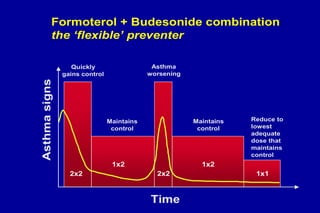
Formoterol + Budesonide combination
the ‘flexible’ preventer
Asthmasigns
Time
2x2 2x2 1x1
1x21x2
Quickly
gains control
Maintains
control
Asthma
worsening
Maintains
control
Reduce to
lowest
adequate
dose that
maintains
control
All Asthma Drugs Should Ideally Be
Taken Through The Inhaled Route.
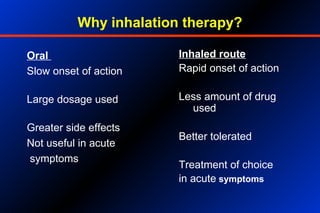
Why inhalation therapy?
Oral
Slow onset of action
Large dosage used
Greater side effects
Not useful in acute
symptoms
Inhaled route
Rapid onset of action
Less amount of drug
used
Better tolerated
Treatment of choice
in acute symptoms
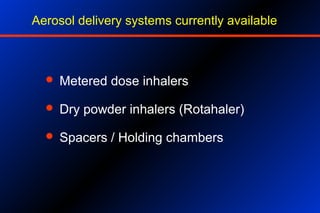
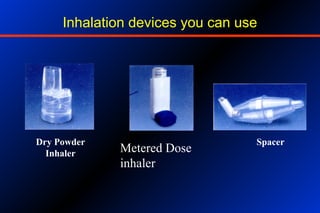
Aerosol delivery systems currently available
 Metered dose inhalers
 Dry powder inhalers (Rotahaler)
 Spacers / Holding chambers
SpacerDry Powder
Inhaler Metered Dose
inhaler
Inhalation devices you can use
Advantages of Spacer
 No co-ordination required
 No cold - freon effect
 Reduced oropharyngeal deposition
 Increased drug deposition in the lungs
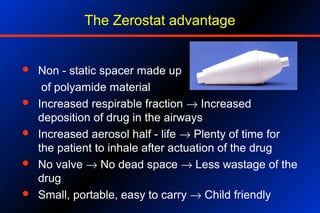
The Zerostat advantage
 Non - static spacer made up
of polyamide material
 Increased respirable fraction → Increased
deposition of drug in the airways
 Increased aerosol half - life → Plenty of time for
the patient to inhale after actuation of the drug
 No valve → No dead space → Less wastage of the
drug
 Small, portable, easy to carry → Child friendly
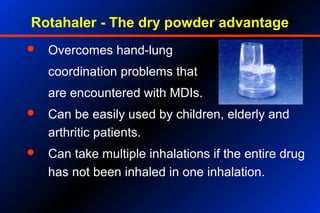
Rotahaler - The dry powder advantage
 Overcomes hand-lung
coordination problems that
are encountered with MDIs.
 Can be easily used by children, elderly and
arthritic patients.
 Can take multiple inhalations if the entire drug
has not been inhaled in one inhalation.
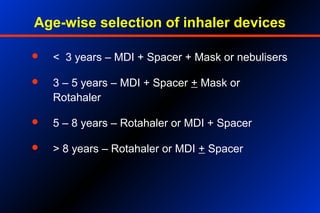
Age-wise selection of inhaler devices
 < 3 years – MDI + Spacer + Mask or nebulisers
 3 – 5 years – MDI + Spacer + Mask or
Rotahaler
 5 – 8 years – Rotahaler or MDI + Spacer
 > 8 years – Rotahaler or MDI + Spacer
Patient Education in the Clinic
 Explain nature of the disease (i.e.
inflammation)
 Explain action of prescribed drugs
 Stress need for regular, long-term therapy
 Allay fears and concerns
 Peak flow reading
 Treatment diary / booklet
Key Messages
 Asthma is a common disorder
 It can happen to anybody
 It is not caused by supernatural forces
 Asthma is not contagious
 It produces recurrent attacks of cough with
or without wheeze
 Between attacks people with asthma lead
normal lives as anyone else
 In most cases there is some history of
allergy in the family.
Key Messages
 Asthma can be effectively controlled, although it cannot
be cured.
 Effective asthma management programs include
education, objective measures of lung function,
environmental control, and pharmacologic therapy.
 A stepwise approach to pharmacologic therapy is
recommended. The aim is to accomplish the goals of
therapy with the least possible medication.

Asthma

  • 1.
  • 2.
    Magnitude of theProblem  15- 20 million asthmatics in India.  A recent study conducted in Delhi established asthma prevalence to be 12% in schoolchildren.  Significant cause of school/work absence.  Health care expenditures very high.  Morbidity and mortality are on the rise. JAPI 2002; Vol 50: 462.
  • 3.
    The Treatment Gapin Asthma  Patients are not detected  Do not seek medical attention  No access to health service  Missed diagnosis (bronchitis, LRTI)
  • 4.
    Current Understanding ofAsthma  A chronic inflammatory disorder of the airway  Infiltration of mast cells, eosinophils and lymphocytes  Airway hyperresponsiveness  Recurrent episodes of wheezing, coughing and shortness of breath  Widespread, variable and often reversible airflow limitation
  • 5.
    The Underlying Mechanism INFLAMMATIONINFLAMMATION RiskFactors (for development of asthma) Airway Hyperresponsiveness Airflow Limitation Symptoms- (shortness of breath, cough, wheeze) Risk Factors (for exacerbations)
  • 6.
  • 7.
    Risk Factors thatLead to Asthma Development Predisposing Factors  Atopy Causal Factors  Indoor Allergens – Domestic mites – Animal Allergens – Cockroach Allergens – Fungi  Outdoor Allergens – Pollens – Fungi  Occupational Sensitizers Contributing Factors  Respiratory infections  Small size at birth  Diet  Air pollution – Outdoor pollutants – Indoor pollutants  Smoking – Passive Smoking – Active Smoking
  • 8.
    DIAGNOSIS OF ASTHMA History and patterns of symptoms  Physical examination  Measurements of lung function
  • 9.
    PATIENT HISTORY  Hasthe patient had an attack or recurrent episodes of wheezing?  Does the patient have a troublesome cough, worse particularly at night, or on awakening?  Does the patient cough after physical activity (eg. Playing)?  Does the patient have breathing problems during a particular season (or change of season)?
  • 10.
     Do thepatient’s colds ‘go to the chest’ or take more than 10 days to resolve?  Does the patient use any medication (e.g. bronchodilator) when symptoms occur? Is there a response? If the patient answers “YES” to any of the above questions, suspect asthma.
  • 11.
    Physical Examination Wheeze - Usuallyheard without a stethoscope Dyspnoea - Rhonchi heard with a stethoscope Use of accessory muscles Remember - Absence of symptoms at the time of examination does not exclude the diagnosis of asthma
  • 12.
    Diagnostic testing Diagnosis ofasthma can be confirmed by demonstrating the presence of reversible airway obstruction using Peak flow meter.
  • 13.
    Classification of AsthmaSeverity STEP 4 Severe Persistent STEP 3 Moderate Persistent STEP 2 Mild Persistent STEP 1 Intermittent The presence of one of the features of severity is sufficient to place a patient in that category. Global Initiative for Asthma (GINA) WHO/NHLBI, 2002 Symptoms Nighttime Symptoms PEF CLASSIFY SEVERITY Clinical Features Before Treatment Continuous Limited physical activity Daily Use β2-agonist daily Attacks affect activity >1 time a week but <1 time a day < 1 time a week Asymptomatic and normal PEF between attacks Frequent >1 time week >2 times a month <2 times a month <60% predicted Variability >30% >60%-<80% predicted Variability >30% >80% predicted Variability 20-30% >80% predicted Variability <20%
  • 14.
    Goals to BeAchieved in Asthma Control  Achieve and maintain control of symptoms  Prevent asthma episodes or attacks  Minimal use of reliever medication  No emergency visits to doctors or hospitals  Maintain normal activity levels, including exercise  Maintain pulmonary function as close to normal as possible  Minimal (or no) adverse effects from medicine
  • 15.
    Tool Kit forAchieving Management Goals  Relievers  Preventers  Peak Flow meter  Patient education
  • 16.
    What Are Relievers? -Rescue medications - Quick relief of symptoms - Used during acute attacks - Action lasts 4-6 hrs
  • 17.
    RELIEVERS  Short actingβ2 agonists Salbutamol Levosalbutamol  Anti-cholinergics Ipratropium bromide  Xanthines Theophylline  Adrenaline injections
  • 18.
    What are Preventers? -Prevent future attacks - Long term control of asthma - Prevent airway remodelling
  • 19.
    PREVENTERS Corticosteroids Anti-leukotrienes Prednisolone, BetamethasoneMontelukast, Zafirlukast Beclomethasone, Budesonide Fluticasone Xanthines Theophylline SR Long acting β2 agonists Mast cell stabilisers Bambuterol, Salmeterol Sodium cromoglycate Formoterol COMBINATIONS Salmeterol/Fluticasone Formoterol/Budesonide Salbutamol/Beclomethasone
  • 20.
    Reliever Reliever (also knownas rescue medication) Bronchodilator (beta2 agonist) Quickly relieves symptoms (within 2-3 minutes) Not for regular use
  • 21.
    Rescue Medication SALBUTAMOL INHALER 100mcg: 1 or 2 puffs as necessary LEVOSALBUTAMOL INHALER 50 mcg : 1 or 2 puffs as necessary
  • 22.
    Anti-inflammatory Takes time toact (1-3 hours) Long-term effect (12-24 hours) Only for regular use (whether well or not well) Preventer
  • 23.
    ICS + LABA WhichLABA ? Formoterol: Immediate relief (as fast as salbutamol) 12 hours effect Can be combined with budesonide
  • 24.
    Ideal combination Formoterol (fast relief and sustained relief ) + Budesonide ( twice or even once daily use ) Dose: 1- 4 puffs ( OD/BD ) Another combination Salmeterol + Fluticasone
  • 25.
    Formoterol + Budesonidecombination the ‘flexible’ preventer Asthmasigns Time 2x2 2x2 1x1 1x21x2 Quickly gains control Maintains control Asthma worsening Maintains control Reduce to lowest adequate dose that maintains control
  • 26.
    All Asthma DrugsShould Ideally Be Taken Through The Inhaled Route.
  • 27.
    Why inhalation therapy? Oral Slowonset of action Large dosage used Greater side effects Not useful in acute symptoms Inhaled route Rapid onset of action Less amount of drug used Better tolerated Treatment of choice in acute symptoms
  • 28.
    Aerosol delivery systemscurrently available  Metered dose inhalers  Dry powder inhalers (Rotahaler)  Spacers / Holding chambers
  • 29.
    SpacerDry Powder Inhaler MeteredDose inhaler Inhalation devices you can use
  • 30.
    Advantages of Spacer No co-ordination required  No cold - freon effect  Reduced oropharyngeal deposition  Increased drug deposition in the lungs
  • 31.
    The Zerostat advantage Non - static spacer made up of polyamide material  Increased respirable fraction → Increased deposition of drug in the airways  Increased aerosol half - life → Plenty of time for the patient to inhale after actuation of the drug  No valve → No dead space → Less wastage of the drug  Small, portable, easy to carry → Child friendly
  • 32.
    Rotahaler - Thedry powder advantage  Overcomes hand-lung coordination problems that are encountered with MDIs.  Can be easily used by children, elderly and arthritic patients.  Can take multiple inhalations if the entire drug has not been inhaled in one inhalation.
  • 33.
    Age-wise selection ofinhaler devices  < 3 years – MDI + Spacer + Mask or nebulisers  3 – 5 years – MDI + Spacer + Mask or Rotahaler  5 – 8 years – Rotahaler or MDI + Spacer  > 8 years – Rotahaler or MDI + Spacer
  • 34.
    Patient Education inthe Clinic  Explain nature of the disease (i.e. inflammation)  Explain action of prescribed drugs  Stress need for regular, long-term therapy  Allay fears and concerns  Peak flow reading  Treatment diary / booklet
  • 35.
    Key Messages  Asthmais a common disorder  It can happen to anybody  It is not caused by supernatural forces  Asthma is not contagious  It produces recurrent attacks of cough with or without wheeze  Between attacks people with asthma lead normal lives as anyone else  In most cases there is some history of allergy in the family.
  • 36.
    Key Messages  Asthmacan be effectively controlled, although it cannot be cured.  Effective asthma management programs include education, objective measures of lung function, environmental control, and pharmacologic therapy.  A stepwise approach to pharmacologic therapy is recommended. The aim is to accomplish the goals of therapy with the least possible medication.

Editor's Notes

  • #24 Formoterol would be the long-acting beta2-agonist of choice. This drug amazingly acts as fast as salbutamol, but has a prolonged 12 hour effect as well. Therefore it combines immediate relief with sustained relief. This makes it the ideal beta2-agonist for use in asthma. The beauty is that Formoterol can be combined with Budesonide in the same inhaled formulation today and therefore provides the ideal combination for long-term use.
  • #25 This combination is available today in both metered dose and dry powder inhalers (Rotacaps). It is available in 3 different Rotacap strengths where the dose of formoterol remains constant but the budesonide dose varies according to the need (severity of asthma); i.e. 100, 200 and 400 mcg of budesonide in 3 different Rotacaps.