

UNICOM EA FORUMRichard Veryard September 2011Next Generation Enterprise Architecture
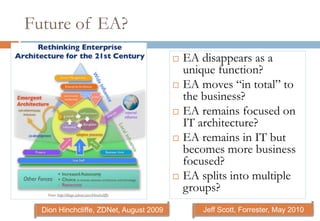
Future of EA?EA disappears as a unique function?EA moves “in total” to the business?EA remains focused on IT architecture?EA remains in IT but becomes more business focused?EA splits into multiple groups?Jeff Scott, Forrester, May 2010Dion Hinchcliffe, ZDNet, August 2009
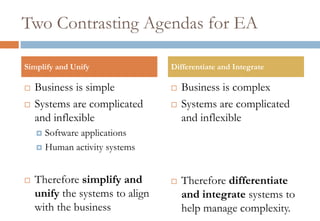
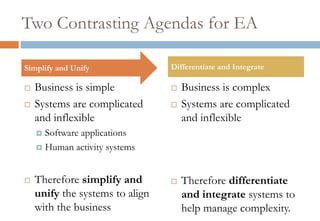
Two Contrasting Agendas for EABusiness is simpleSystems are complicated and inflexibleSoftware applicationsHuman activity systemsTherefore simplify and unify the systems to align with the businessBusiness is complexSystems are complicated and inflexibleTherefore differentiate and integrate systems to help manage complexity.Simplify and UnifyDifferentiate and Integrate
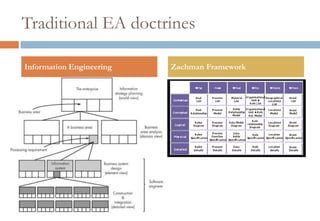
Traditional EA doctrinesInformation EngineeringZachman Framework
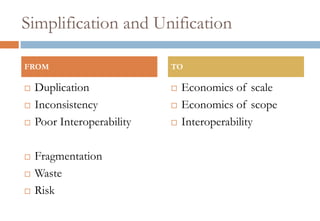
Simplification and UnificationDuplicationInconsistencyPoor InteroperabilityFragmentationWasteRiskEconomics of scaleEconomics of scopeInteroperabilityFROMTO
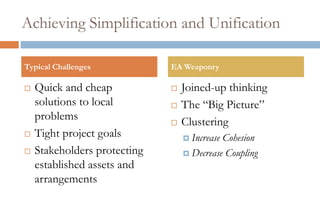
Achieving Simplification and UnificationQuick and cheap solutions to local problemsTight project goalsStakeholders protecting established assets and arrangementsJoined-up thinkingThe “Big Picture”ClusteringIncrease CohesionDecrease CouplingTypical ChallengesEA Weaponry
From Small Picture …
… to Bigger Picture
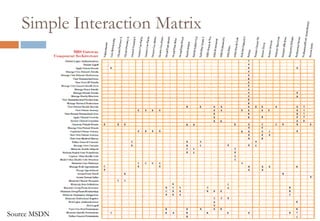
Simple Interaction MatrixSource MSDN
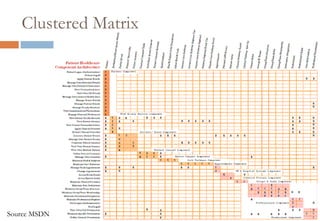
Clustered MatrixSource MSDN
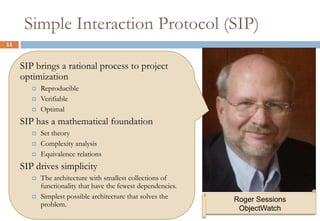
Simple Interaction Protocol (SIP) 11SIP brings a rational process to project optimizationReproducibleVerifiableOptimalSIP has a mathematical foundationSet theoryComplexity analysisEquivalence relationsSIP drives simplicityThe architecture with smallest collections of functionality that have the fewest dependencies.Simplest possible architecture that solves the problem.Roger SessionsObjectWatch
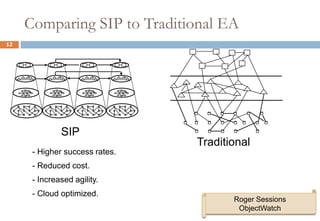
12Comparing SIP to Traditional EASIPTraditional- Higher success rates.- Reduced cost.- Increased agility.- Cloud optimized.Roger SessionsObjectWatch
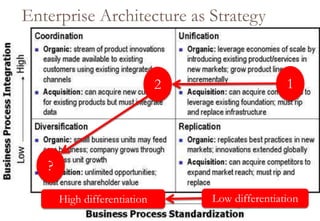
Enterprise Architecture as Strategy12?Low differentiationHigh differentiation
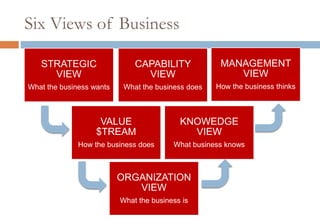
Six Views of Business
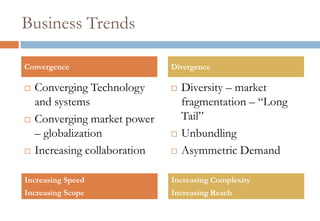
Business TrendsConverging Technology and systemsConverging market power – globalizationIncreasing collaborationDiversity – market fragmentation – “Long Tail”UnbundlingAsymmetric DemandConvergenceDivergenceIncreasing SpeedIncreasing ScopeIncreasing ComplexityIncreasing Reach
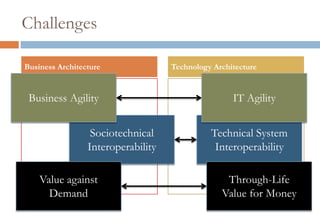
ChallengesBusiness ArchitectureTechnology ArchitectureIT AgilityBusiness AgilityTechnical System InteroperabilitySociotechnical InteroperabilityThrough-LifeValue for MoneyValue against Demand
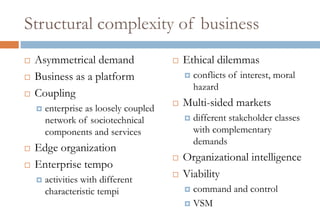
Structural complexity of businessAsymmetrical demand Business as a platformCouplingenterprise as loosely coupled network of sociotechnical components and servicesEdge organizationEnterprise tempoactivities with different characteristic tempiEthical dilemmasconflicts of interest, moral hazardMulti-sided marketsdifferent stakeholder classes with complementary demandsOrganizational intelligenceViabilitycommand and controlVSM
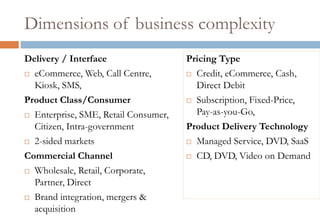
Dimensions of business complexityDelivery / Interface 	eCommerce, Web, Call Centre, Kiosk, SMS, Product Class/ConsumerEnterprise, SME, Retail Consumer, Citizen, Intra-government2-sided marketsCommercial ChannelWholesale, Retail, Corporate, Partner, DirectBrand integration, mergers & acquisitionPricing TypeCredit, eCommerce, Cash, Direct DebitSubscription, Fixed-Price, Pay-as-you-Go, Product Delivery TechnologyManaged Service, DVD, SaaSCD, DVD, Video on Demand
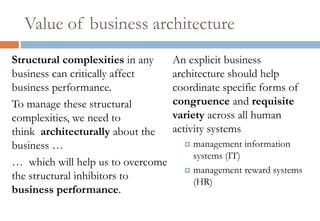
Value of business architecture Structural complexities in any business can critically affect business performance.To manage these structural complexities, we need to think  architecturallyabout the business ……  which will help us to overcome the structural inhibitors to business performance.An explicit business architecture should help coordinate specific forms of congruence and requisite variety across all human activity systemsmanagement information systems (IT) management reward systems (HR)
Two Contrasting Agendas for EASimplify and UnifyBusiness is simpleSystems are complicated and inflexibleSoftware applicationsHuman activity systemsTherefore simplify and unify the systems to align with the businessBusiness is complexSystems are complicated and inflexibleTherefore differentiate and integrate systems to help manage complexity.Differentiate and Integrate
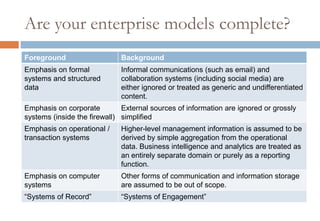
Are your enterprise models complete?
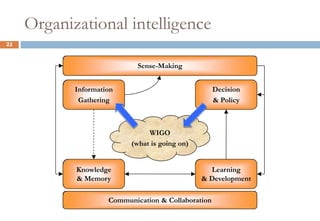
InformationGatheringDecision& PolicyWIGO(what is going on)Learning& DevelopmentKnowledge& MemoryOrganizational intelligence22Sense-MakingCommunication & Collaboration
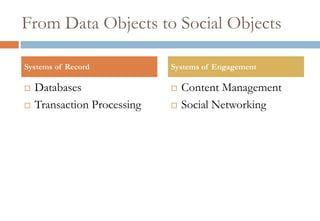
From Data Objects to Social ObjectsDatabasesTransaction ProcessingContent ManagementSocial NetworkingSystems of RecordSystems of Engagement
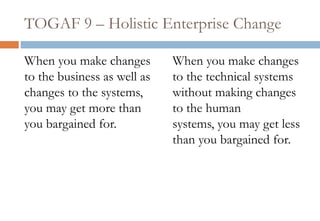
TOGAF 9 – Holistic Enterprise ChangeWhen you make changes to the business as well as changes to the systems, you may get more than you bargained for.When you make changes to the technical systems without making changes to the human systems, you may get less than you bargained for.
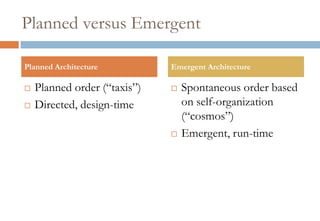
Planned versus EmergentPlanned order (“taxis”)Directed, design-timeSpontaneous order based on self-organization (“cosmos”)Emergent, run-timePlanned ArchitectureEmergent Architecture
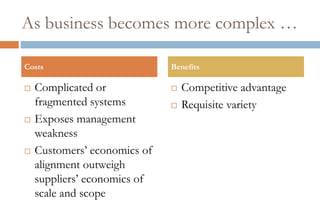
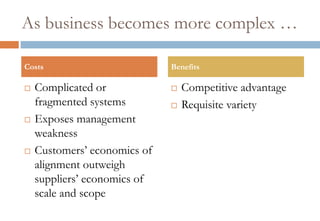
As business becomes more complex …Complicated or fragmented systemsExposes management weaknessCustomers’ economics of alignment outweigh suppliers’ economics of scale and scopeCompetitive advantageRequisite varietyCostsBenefits
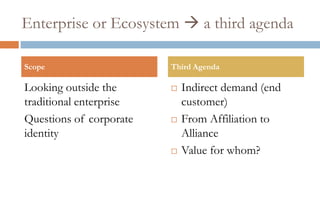
Enterprise or Ecosystem  a third agendaLooking outside the traditional enterpriseQuestions of corporate identityIndirect demand (end customer)From Affiliation to AllianceValue for whom?ScopeThird Agenda
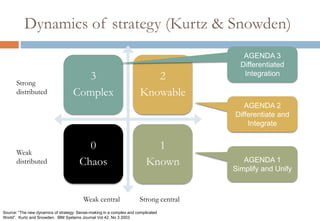
Dynamics of strategy (Kurtz & Snowden)AGENDA 3Differentiated IntegrationStrongdistributedAGENDA 2Differentiate and IntegrateWeakdistributedAGENDA 1Simplify and UnifyStrong centralWeak centralSource: “The new dynamics of strategy: Sense-making in a complex and complicated World”.  Kurtz and Snowden.  IBM Systems Journal Vol 42, No 3 2003
As business becomes more complex …Complicated or fragmented systemsExposes management weaknessCustomers’ economics of alignment outweigh suppliers’ economics of scale and scopeCompetitive advantageRequisite varietyCostsBenefits
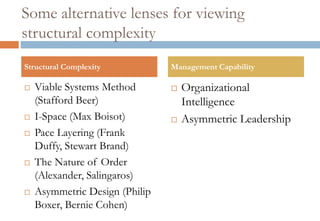
Some alternative lenses for viewing structural complexityViable Systems Method (Stafford Beer)I-Space (Max Boisot)Pace Layering (Frank Duffy, Stewart Brand)The Nature of Order (Alexander, Salingaros)Asymmetric Design (Philip Boxer, Bernie Cohen)Organizational IntelligenceAsymmetric Leadership Structural ComplexityManagement Capability
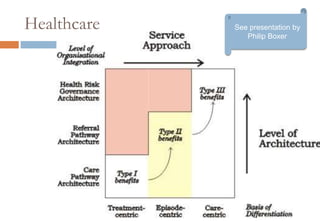
HealthcareSee presentation by Philip Boxer
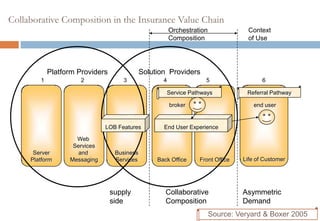
Collaborative Composition in the Insurance Value ChainOrchestrationCompositionContext of UseSolution  ProvidersPlatform Providers123456ServerPlatformWeb Servicesand MessagingBusinessServicesBack OfficeFront OfficeLife of CustomerService PathwaysReferral Pathwaybrokerend userLOB FeaturesEnd User ExperiencesupplysideCollaborativeCompositionAsymmetricDemandSource: Veryard & Boxer 2005
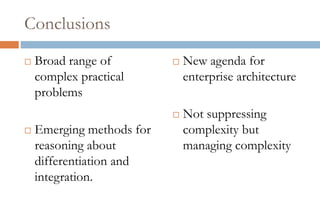
ConclusionsBroad range of complex practical problemsEmerging methods for reasoning about differentiation and integration.New agenda for enterprise architectureNot suppressing complexity but managing complexity
Future EventsBusiness Architecture BootcampNovember  22-23Organizational Intelligence WorkshopNovember  24RVsoapbox.BlogSpot.comFuture EventsOther Material and Links

Next Generation Enterprise Architecture

  • 1.
    UNICOM EA FORUMRichardVeryard September 2011Next Generation Enterprise Architecture
  • 2.
    Future of EA?EAdisappears as a unique function?EA moves “in total” to the business?EA remains focused on IT architecture?EA remains in IT but becomes more business focused?EA splits into multiple groups?Jeff Scott, Forrester, May 2010Dion Hinchcliffe, ZDNet, August 2009
  • 3.
    Two Contrasting Agendasfor EABusiness is simpleSystems are complicated and inflexibleSoftware applicationsHuman activity systemsTherefore simplify and unify the systems to align with the businessBusiness is complexSystems are complicated and inflexibleTherefore differentiate and integrate systems to help manage complexity.Simplify and UnifyDifferentiate and Integrate
  • 4.
    Traditional EA doctrinesInformationEngineeringZachman Framework
  • 5.
    Simplification and UnificationDuplicationInconsistencyPoorInteroperabilityFragmentationWasteRiskEconomics of scaleEconomics of scopeInteroperabilityFROMTO
  • 6.
    Achieving Simplification andUnificationQuick and cheap solutions to local problemsTight project goalsStakeholders protecting established assets and arrangementsJoined-up thinkingThe “Big Picture”ClusteringIncrease CohesionDecrease CouplingTypical ChallengesEA Weaponry
  • 7.
  • 8.
  • 9.
  • 10.
  • 11.
    Simple Interaction Protocol(SIP) 11SIP brings a rational process to project optimizationReproducibleVerifiableOptimalSIP has a mathematical foundationSet theoryComplexity analysisEquivalence relationsSIP drives simplicityThe architecture with smallest collections of functionality that have the fewest dependencies.Simplest possible architecture that solves the problem.Roger SessionsObjectWatch
  • 12.
    12Comparing SIP toTraditional EASIPTraditional- Higher success rates.- Reduced cost.- Increased agility.- Cloud optimized.Roger SessionsObjectWatch
  • 13.
    Enterprise Architecture asStrategy12?Low differentiationHigh differentiation
  • 14.
    Six Views ofBusiness
  • 15.
    Business TrendsConverging Technologyand systemsConverging market power – globalizationIncreasing collaborationDiversity – market fragmentation – “Long Tail”UnbundlingAsymmetric DemandConvergenceDivergenceIncreasing SpeedIncreasing ScopeIncreasing ComplexityIncreasing Reach
  • 16.
    ChallengesBusiness ArchitectureTechnology ArchitectureITAgilityBusiness AgilityTechnical System InteroperabilitySociotechnical InteroperabilityThrough-LifeValue for MoneyValue against Demand
  • 17.
    Structural complexity ofbusinessAsymmetrical demand Business as a platformCouplingenterprise as loosely coupled network of sociotechnical components and servicesEdge organizationEnterprise tempoactivities with different characteristic tempiEthical dilemmasconflicts of interest, moral hazardMulti-sided marketsdifferent stakeholder classes with complementary demandsOrganizational intelligenceViabilitycommand and controlVSM
  • 18.
    Dimensions of businesscomplexityDelivery / Interface eCommerce, Web, Call Centre, Kiosk, SMS, Product Class/ConsumerEnterprise, SME, Retail Consumer, Citizen, Intra-government2-sided marketsCommercial ChannelWholesale, Retail, Corporate, Partner, DirectBrand integration, mergers & acquisitionPricing TypeCredit, eCommerce, Cash, Direct DebitSubscription, Fixed-Price, Pay-as-you-Go, Product Delivery TechnologyManaged Service, DVD, SaaSCD, DVD, Video on Demand
  • 19.
    Value of businessarchitecture Structural complexities in any business can critically affect business performance.To manage these structural complexities, we need to think  architecturallyabout the business …… which will help us to overcome the structural inhibitors to business performance.An explicit business architecture should help coordinate specific forms of congruence and requisite variety across all human activity systemsmanagement information systems (IT) management reward systems (HR)
  • 20.
    Two Contrasting Agendasfor EASimplify and UnifyBusiness is simpleSystems are complicated and inflexibleSoftware applicationsHuman activity systemsTherefore simplify and unify the systems to align with the businessBusiness is complexSystems are complicated and inflexibleTherefore differentiate and integrate systems to help manage complexity.Differentiate and Integrate
  • 21.
    Are your enterprisemodels complete?
  • 22.
    InformationGatheringDecision& PolicyWIGO(what isgoing on)Learning& DevelopmentKnowledge& MemoryOrganizational intelligence22Sense-MakingCommunication & Collaboration
  • 23.
    From Data Objectsto Social ObjectsDatabasesTransaction ProcessingContent ManagementSocial NetworkingSystems of RecordSystems of Engagement
  • 24.
    TOGAF 9 –Holistic Enterprise ChangeWhen you make changes to the business as well as changes to the systems, you may get more than you bargained for.When you make changes to the technical systems without making changes to the human systems, you may get less than you bargained for.
  • 25.
    Planned versus EmergentPlannedorder (“taxis”)Directed, design-timeSpontaneous order based on self-organization (“cosmos”)Emergent, run-timePlanned ArchitectureEmergent Architecture
  • 26.
    As business becomesmore complex …Complicated or fragmented systemsExposes management weaknessCustomers’ economics of alignment outweigh suppliers’ economics of scale and scopeCompetitive advantageRequisite varietyCostsBenefits
  • 27.
    Enterprise or Ecosystem a third agendaLooking outside the traditional enterpriseQuestions of corporate identityIndirect demand (end customer)From Affiliation to AllianceValue for whom?ScopeThird Agenda
  • 28.
    Dynamics of strategy(Kurtz & Snowden)AGENDA 3Differentiated IntegrationStrongdistributedAGENDA 2Differentiate and IntegrateWeakdistributedAGENDA 1Simplify and UnifyStrong centralWeak centralSource: “The new dynamics of strategy: Sense-making in a complex and complicated World”. Kurtz and Snowden. IBM Systems Journal Vol 42, No 3 2003
  • 29.
    As business becomesmore complex …Complicated or fragmented systemsExposes management weaknessCustomers’ economics of alignment outweigh suppliers’ economics of scale and scopeCompetitive advantageRequisite varietyCostsBenefits
  • 30.
    Some alternative lensesfor viewing structural complexityViable Systems Method (Stafford Beer)I-Space (Max Boisot)Pace Layering (Frank Duffy, Stewart Brand)The Nature of Order (Alexander, Salingaros)Asymmetric Design (Philip Boxer, Bernie Cohen)Organizational IntelligenceAsymmetric Leadership Structural ComplexityManagement Capability
  • 31.
  • 32.
    Collaborative Composition inthe Insurance Value ChainOrchestrationCompositionContext of UseSolution ProvidersPlatform Providers123456ServerPlatformWeb Servicesand MessagingBusinessServicesBack OfficeFront OfficeLife of CustomerService PathwaysReferral Pathwaybrokerend userLOB FeaturesEnd User ExperiencesupplysideCollaborativeCompositionAsymmetricDemandSource: Veryard & Boxer 2005
  • 33.
    ConclusionsBroad range ofcomplex practical problemsEmerging methods for reasoning about differentiation and integration.New agenda for enterprise architectureNot suppressing complexity but managing complexity
  • 34.
    Future EventsBusiness ArchitectureBootcampNovember 22-23Organizational Intelligence WorkshopNovember 24RVsoapbox.BlogSpot.comFuture EventsOther Material and Links

Editor's Notes

  • #3 http://blogs.forrester.com/jeff_scott/10-05-16-future_eahttp://www.zdnet.com/blog/hinchcliffe/pragmatic-new-models-for-enterprise-architecture-take-shape/674
  • #4 There are actually three contrasting agendas, but we’ll save the third agenda until later in the presentation. It is not clear to what extent the third agenda still counts as EA.1. simplify around single (simple) business model: single definition of 'market' qua single-sided market.2. differentiate business models and integrate to span their differences: multiple definitions of 'market' qua single-sided markets.3. differentiate business models AND differentiate the modes of integration: multiple 'markets' within multiple contexts-of-use qua multi-sided markets.(PJB)
  • #5 http://csis.pace.edu/~marchese/cs615sp/L3New/L3new.htmlhttp://en.wikipedia.org/wiki/Zachman_Framework
  • #8 http://demandingchange.blogspot.com/2009/12/getting-big-picture.html
  • #10 Function versus data CRUD matrixhttp://msdn.microsoft.com/en-us/library/aa480036.aspx
  • #11 http://msdn.microsoft.com/en-us/library/aa480036.aspx
  • #14 Operating Model Quadrants (Adapted by Clive Finkelstein from Figure 2.3 of “Enterprise Architecture as Strategy”)http://esvc000904.wic047u.server-web.com/ten/ten38.htmhttp://rvsoapbox.blogspot.com/2010/05/differentiation-and-integration.html
  • #20 http://rvsoapbox.blogspot.com/2010/10/selling-business-architecture.html
  • #21 There are actually three contrasting agendas, but we’ll save the third agenda until later in the presentation. It is not clear to what extent the third agenda still counts as EA.1. simplify around single (simple) business model: single definition of 'market' qua single-sided market.2. differentiate business models and integrate to span their differences: multiple definitions of 'market' qua single-sided markets.3. differentiate business models AND differentiate the modes of integration: multiple 'markets' within multiple contexts-of-use qua multi-sided markets.(PJB)
  • #25 http://rvsoapbox.blogspot.com/2009/02/togaf-9-holistic-enterprise-change.html
  • #28 3. differentiate business models AND differentiate the modes of integration: multiple 'markets' within multiple contexts-of-use qua multi-sided markets
  • #32 http://www.asymmetricdesign.com/archives/72