ITSM Sourcing specialization 2008-2009 Shared Services, Collaboration and Crowdsourcing
Agenda Shared Services Collaboration as a sourcing solution 4 th  generation sourcing and Crowdsourcing Explanation of learning Task 3 about Sourcing
But first: how about the outcome of the Digital Selftest?
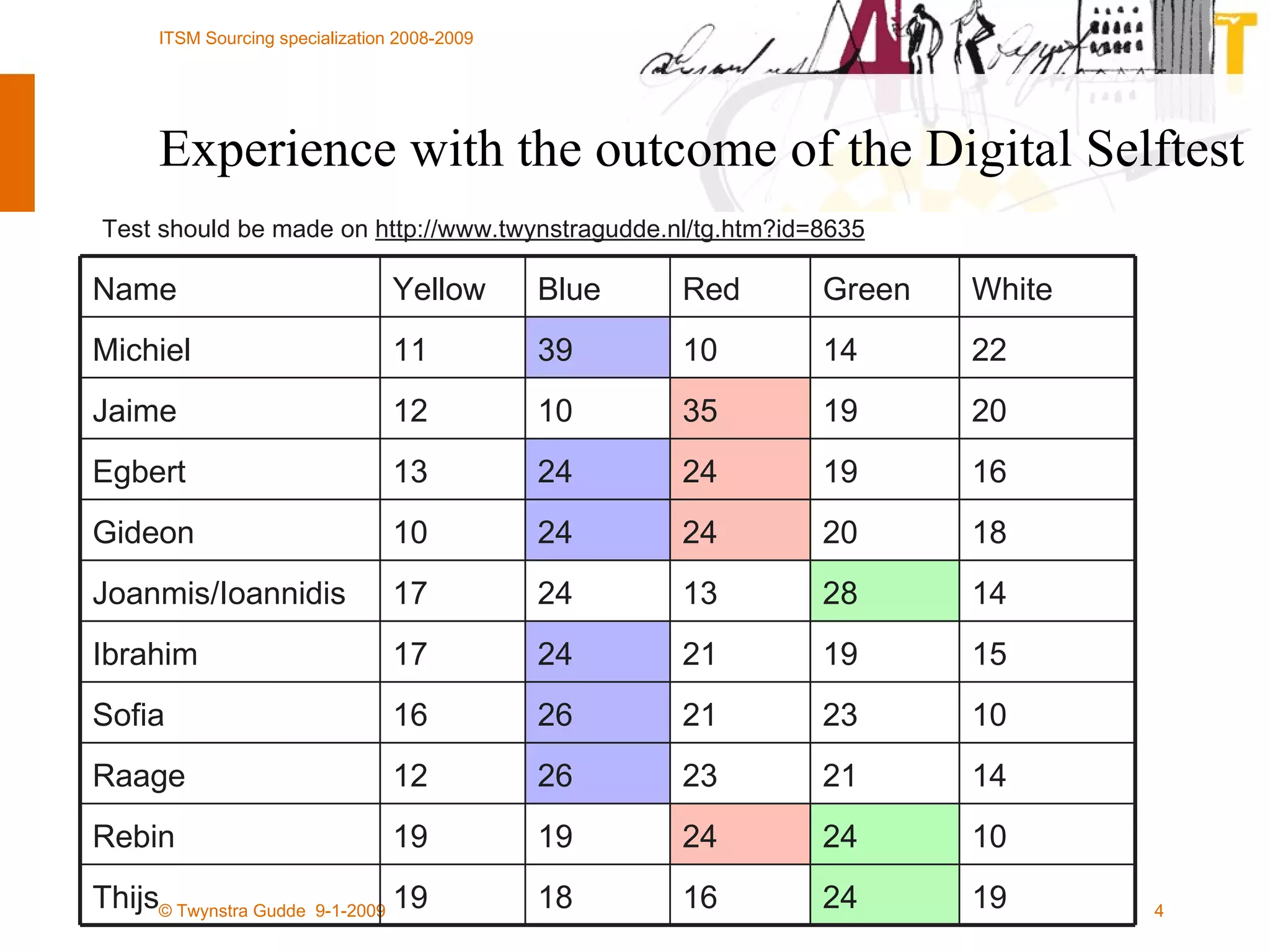
Experience with the outcome of the Digital Selftest Test should be made on  http://www.twynstragudde.nl/tg.htm?id=8635 10 24 24 19 19 Rebin 18 20 24 24 10 Gideon 16 19 24 24 13 Egbert 20 19 35 10 12 Jaime 22 14 10 39 11 Michiel 19 24 16 18 19 Thijs 14 21 23 26 12 Raage 10 23 21 26 16 Sofia 15 19 21 24 17 Ibrahim 14 28 13 24 17 Joanmis/Ioannidis White Green Red Blue Yellow Name
Conclusion IT Service management and Sourcing is all about people People can share energy, knowledge and power together when they are aware of the differences and the comparability Organizational Change Management can help to manage the right interventions
Shared Services
Definition and goal of a Shared Service Center (SSC) We speak about an SSC as supporting processes within an organization on an approximately similar way, are delivered a new, semi-autonomous unit and on the basis of agreements it provides services to other units The goal of an SSC is generally to improve the service quality while cutting costs SSC versus centralization, service-oriented versus task
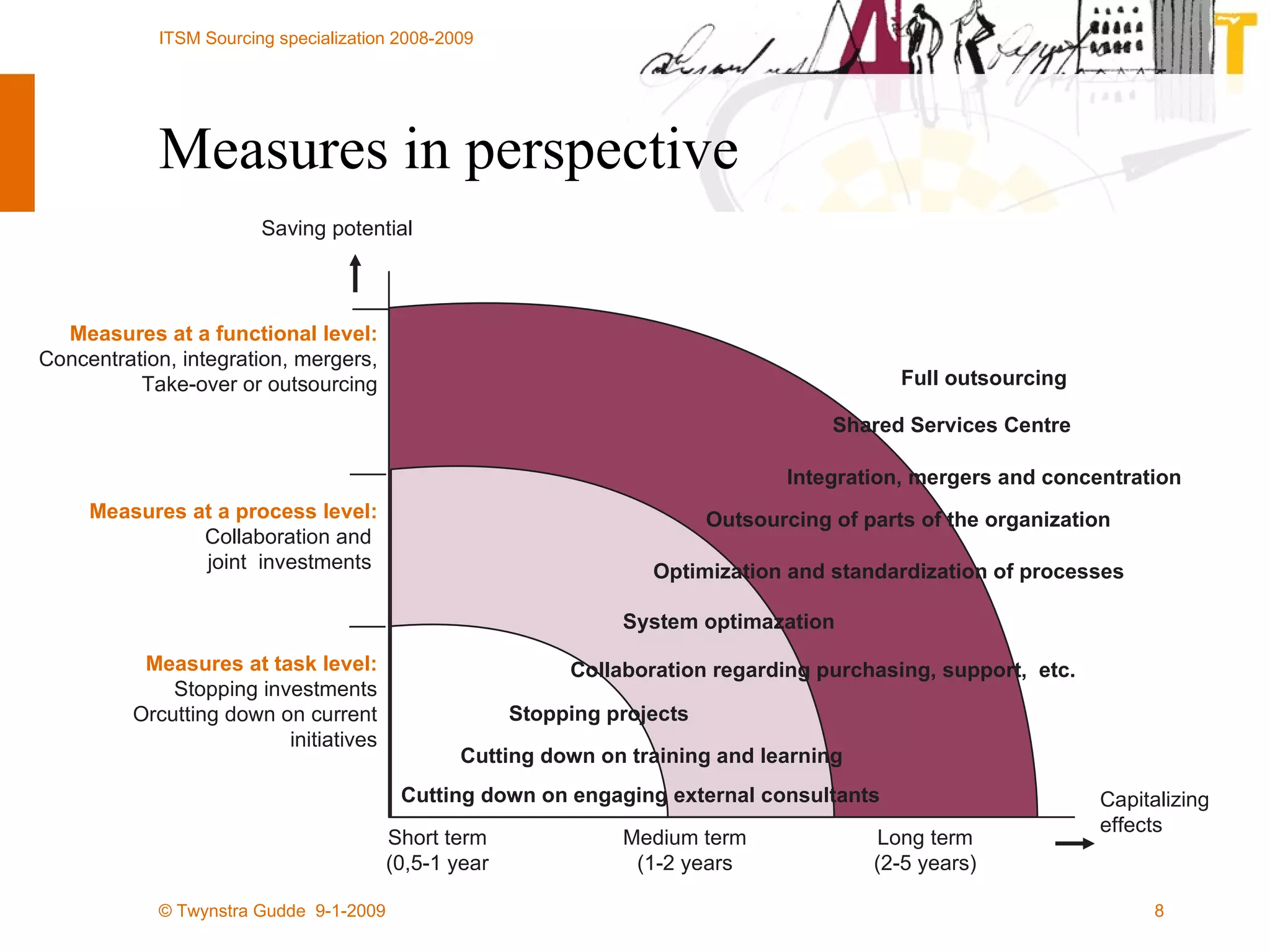
Measures in perspective Measures at task level: Stopping investments Orcutting down on current initiatives Measures at a process level: Collaboration and  joint  investments  Measures at a functional level: Concentration, integration, mergers, Take-over or outsourcing Saving potential Short term (0,5-1 year Medium term (1-2 years Long term (2-5 years) Stopping projects Cutting down on training and learning Cutting down on engaging external consultants System optimazation Collaboration regarding purchasing, support,  etc. Optimization and standardization of processes Integration, mergers and concentration Outsourcing of parts of the organization Shared Services Centre Full outsourcing Capitalizing effects
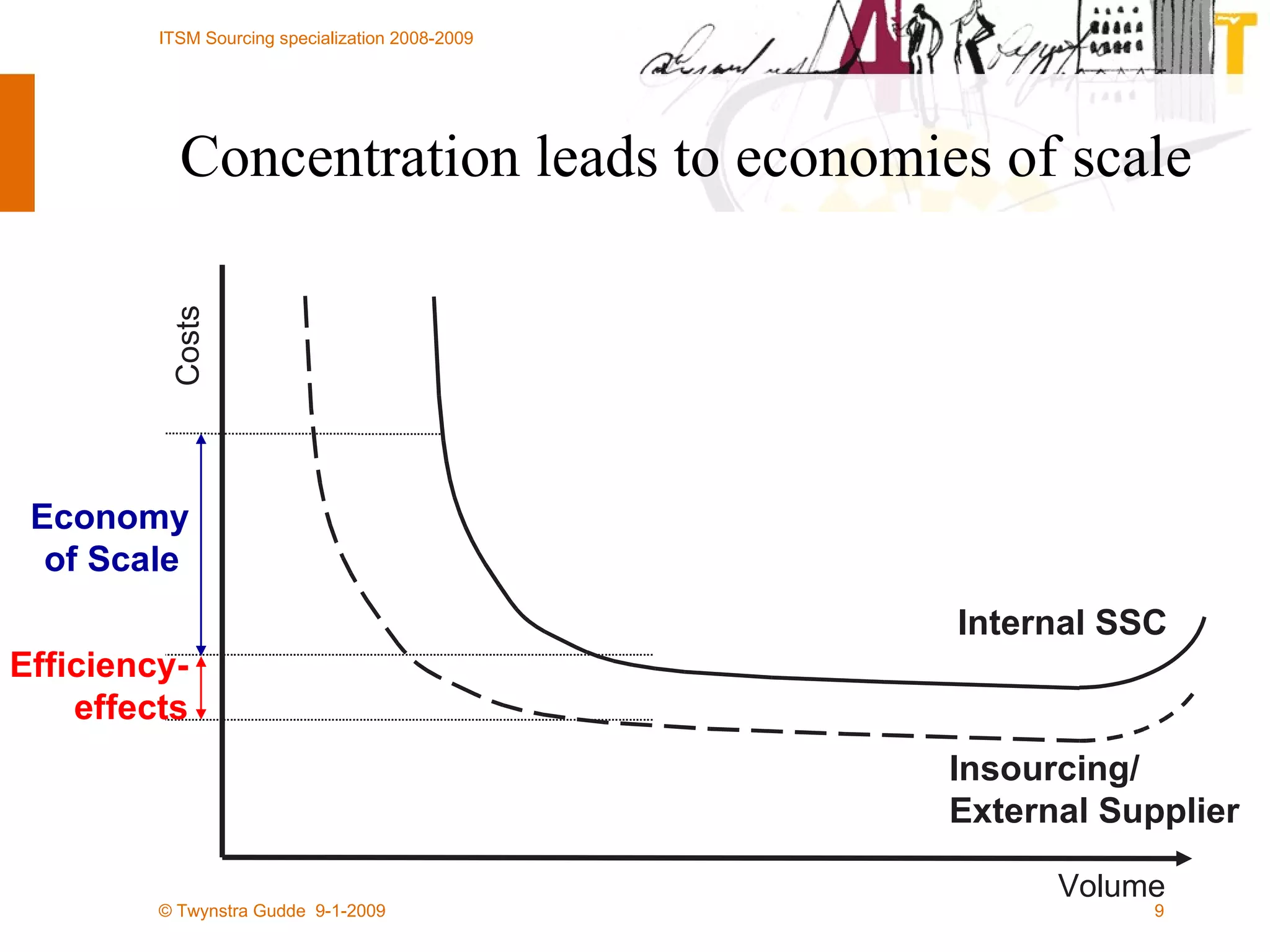
Concentration leads to economies of scale Internal SSC Insourcing/ External Supplier Costs Volume Efficiency- effects Economy of Scale
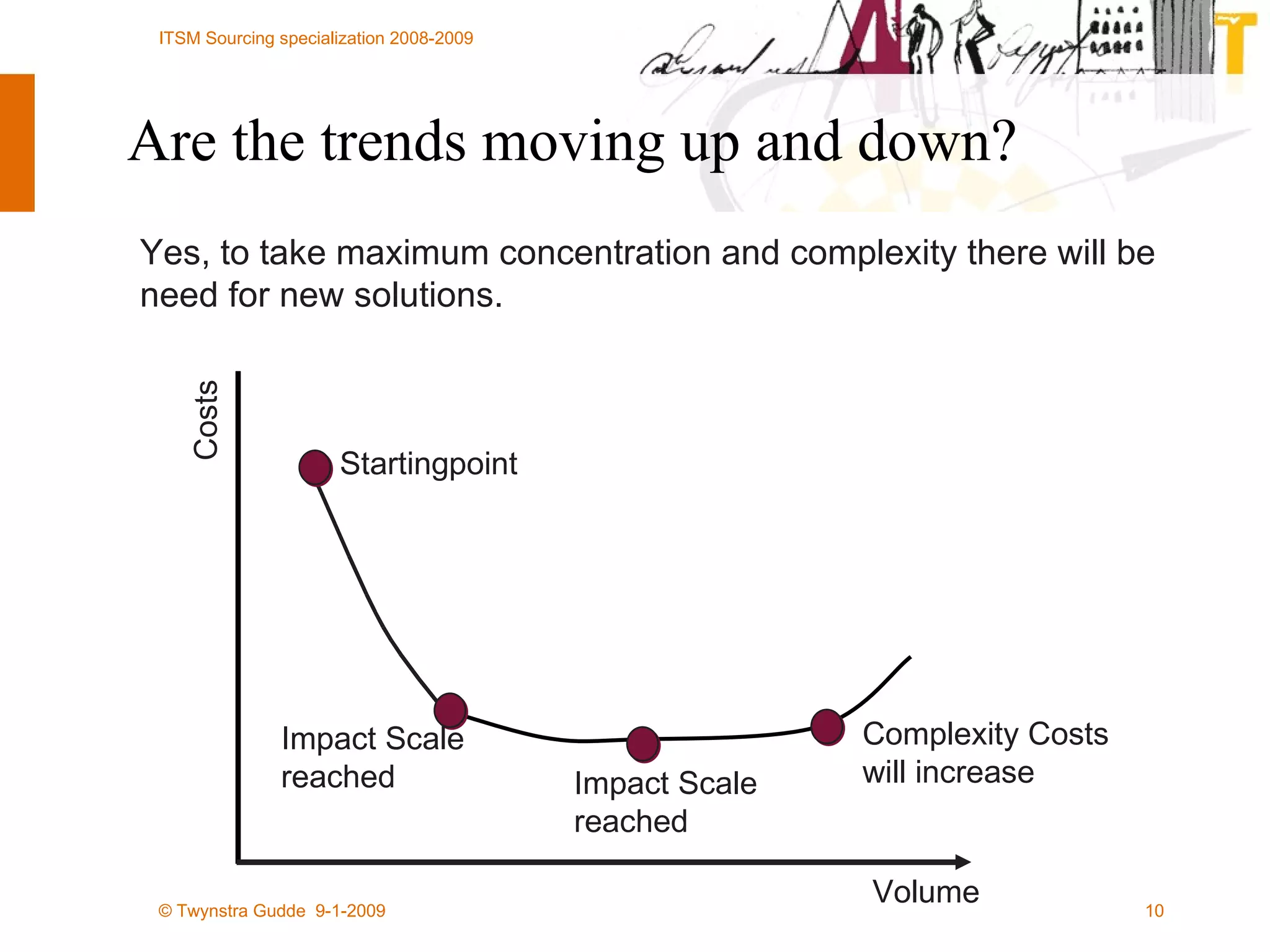
Are the trends moving up and down? Yes, to take maximum concentration and complexity there will be need for new solutions. Costs Volume Startingpoint Impact Scale  reached Impact Scale  reached Complexity Costs  will increase
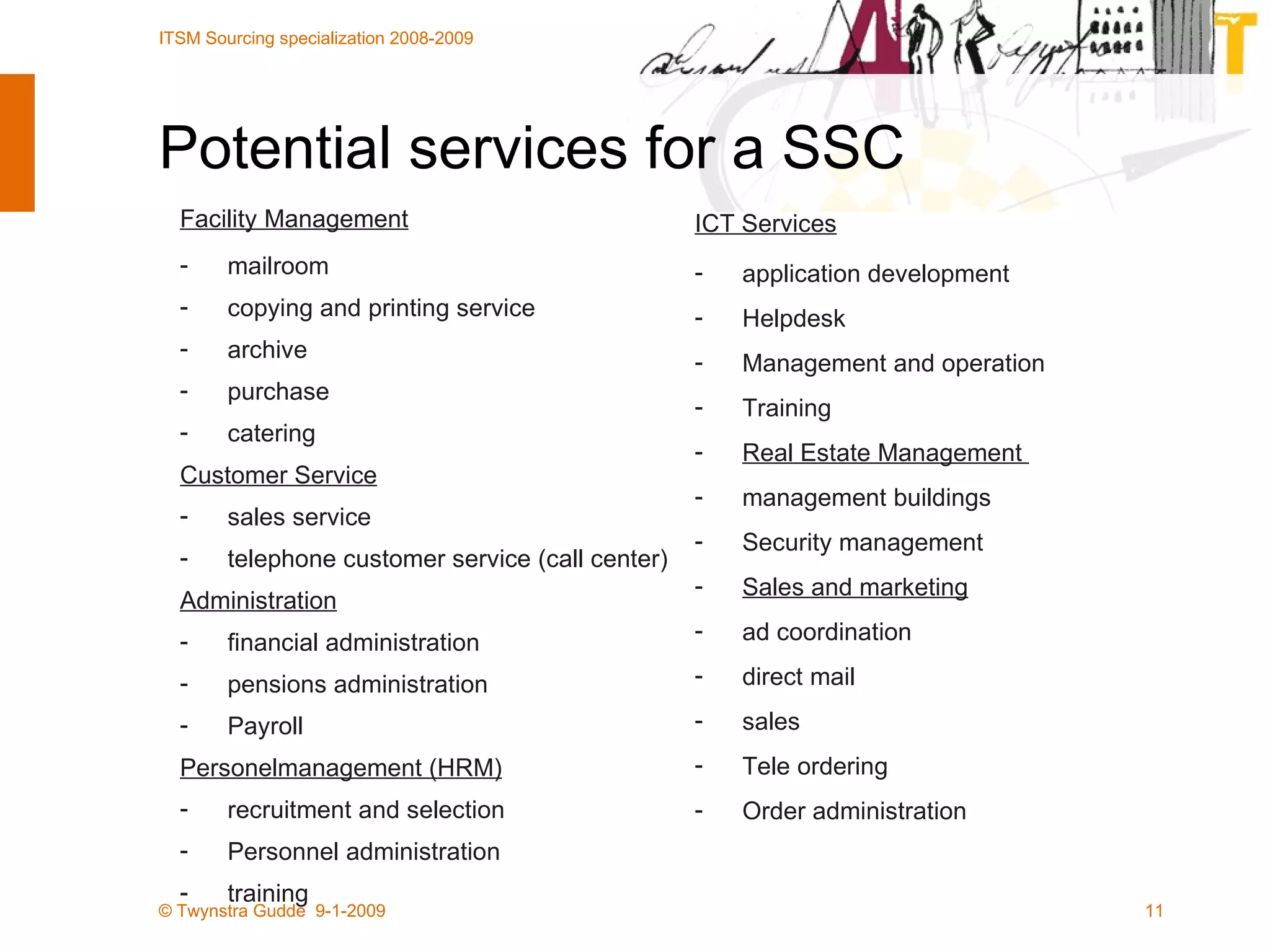
Potential services for a SSC Facility Management mailroom  copying and printing service archive  purchase  catering Customer Service sales service telephone customer service (call center) Administration financial administration  pensions administration  Payroll Personelmanagement (HRM) recruitment and selection  Personnel administration training ICT Services application development Helpdesk  Management and operation  Training Real Estate Management  management buildings Security management Sales and marketing ad coordination  direct mail  sales Tele ordering  Order administration
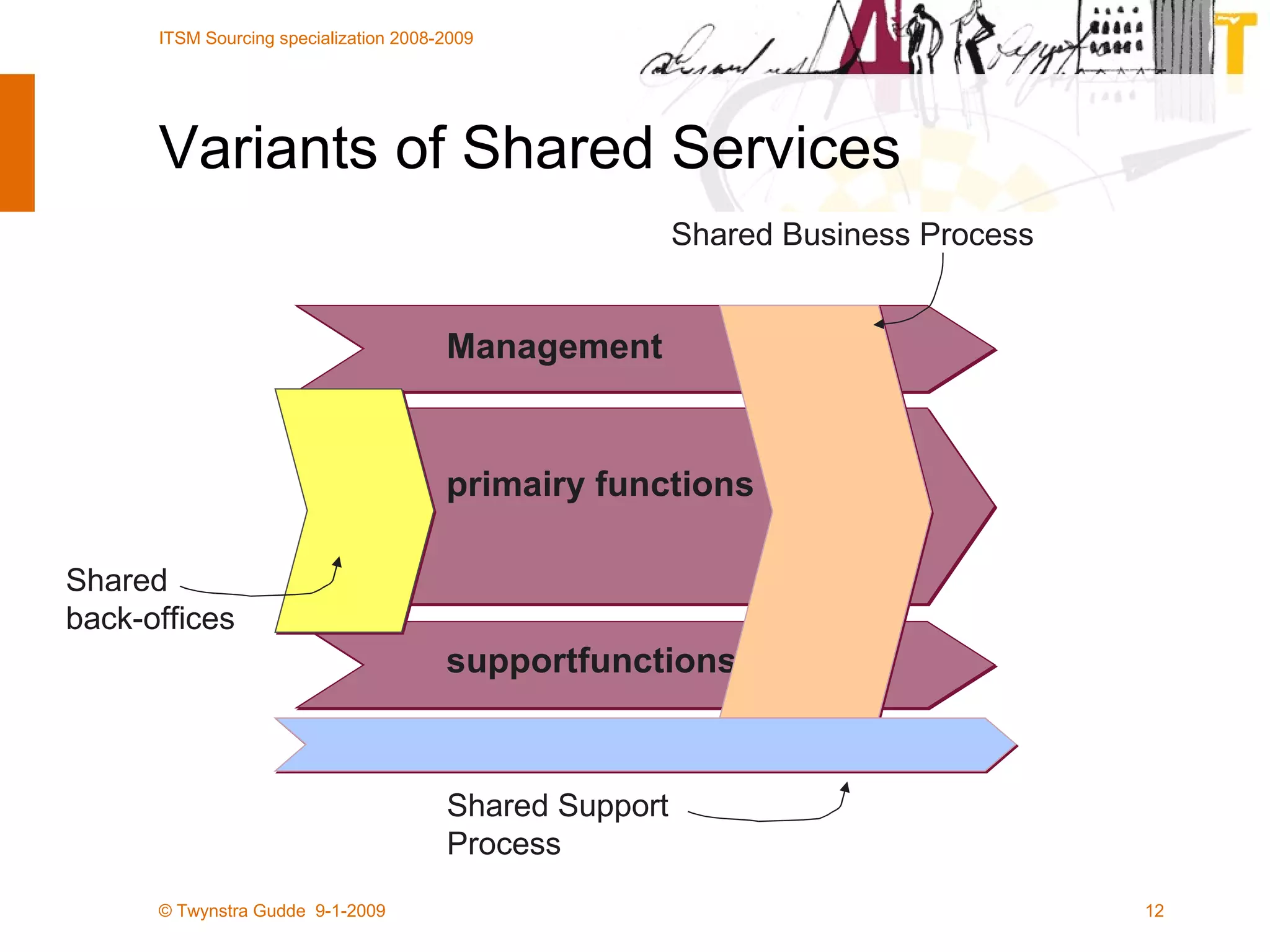
Variants of Shared Services supportfunctions Management   primairy functions Shared Support Process Shared Business Process Shared back-offices
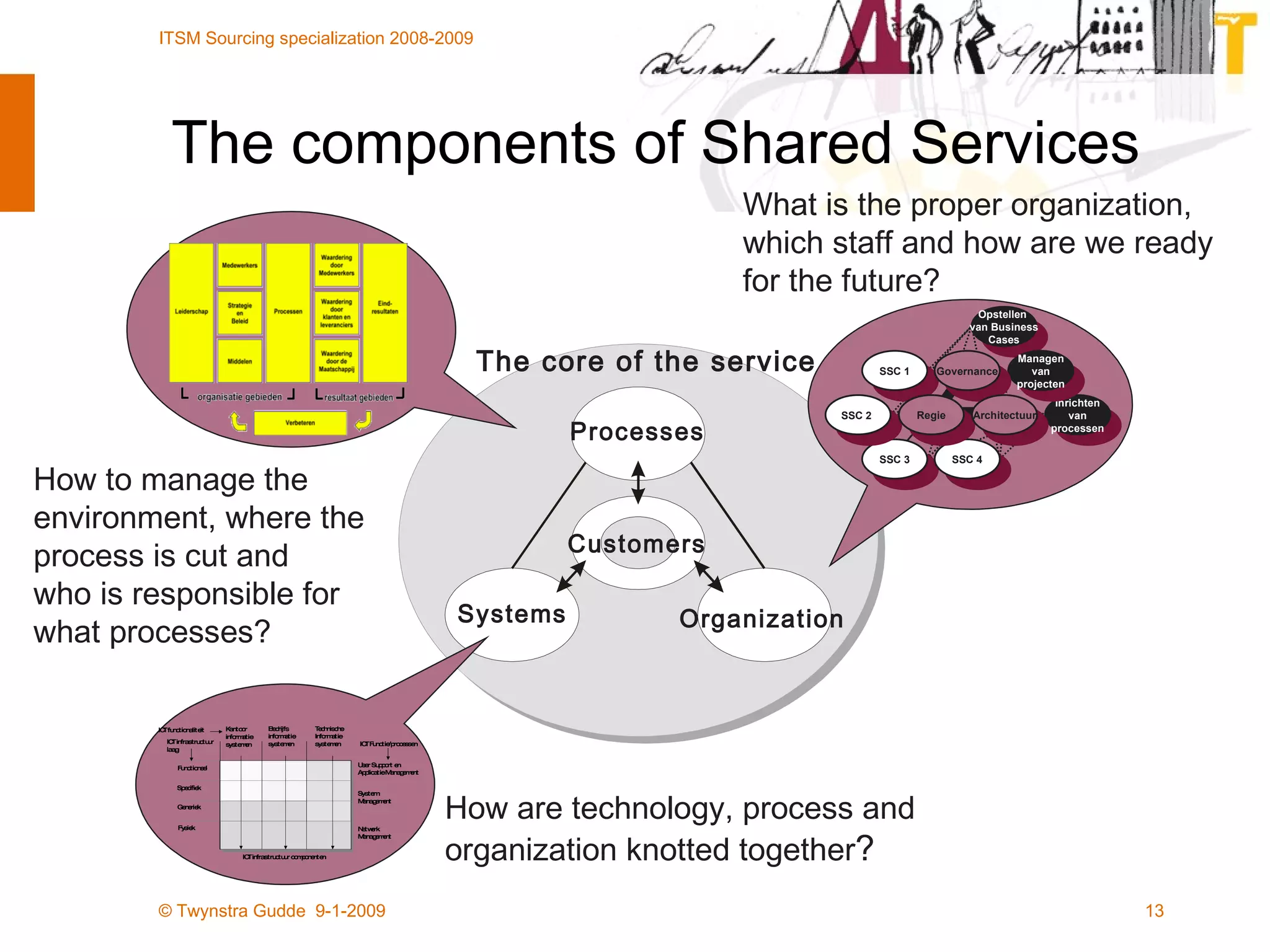
The components of Shared Services How to manage the  environment, where the  process is cut and  who is responsible for  what processes? What is the proper organization, which staff and how are we ready for the future? How are technology, process and organization knotted together ? The core of the service Processes Organization Systems Customers SSC 1 SSC 3 SSC 2  SSC 4 Opstellen  van Business Cases Inrichten van processen Managen van projecten Governance Regie Architectuur
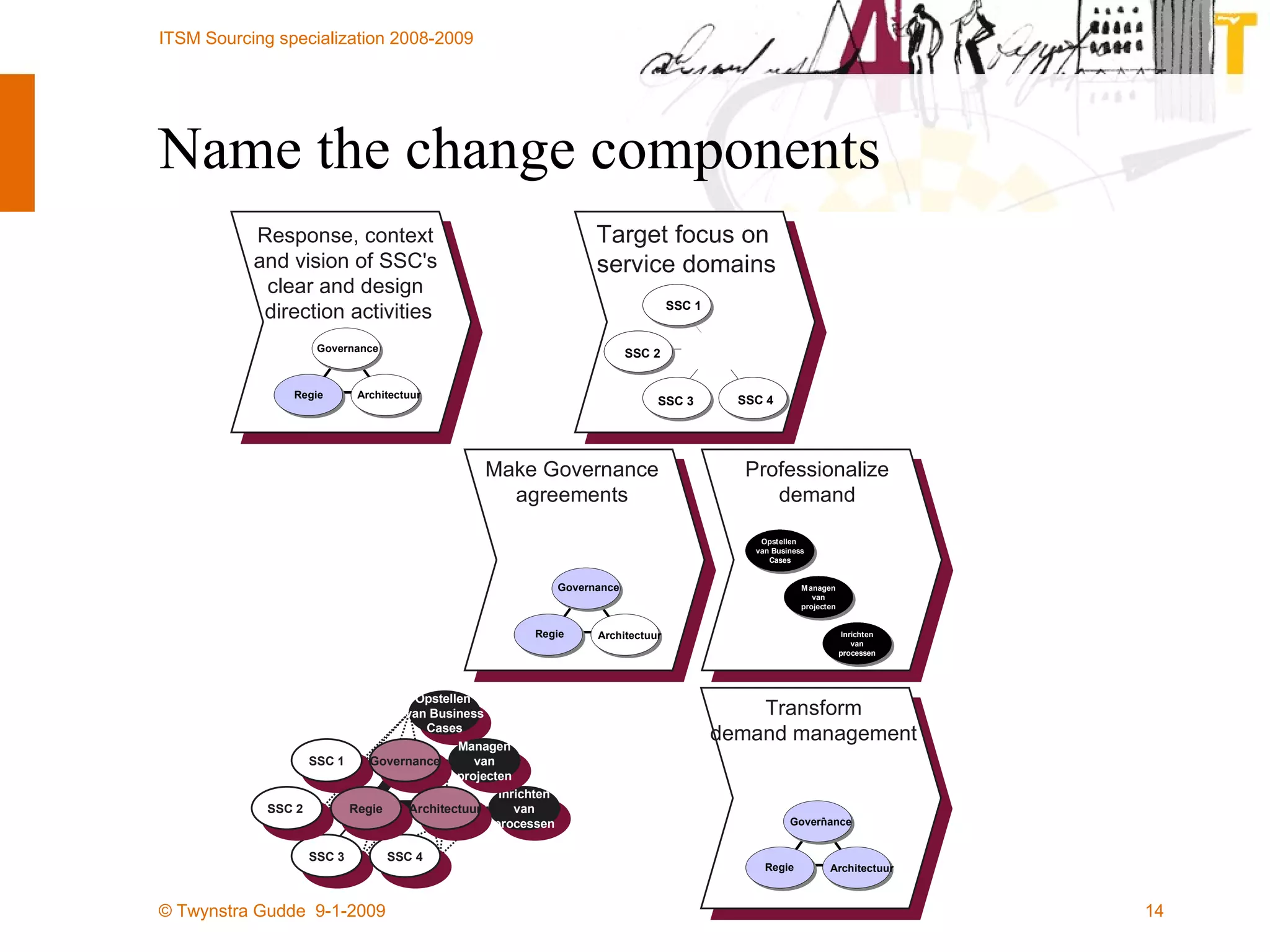
Name the change components Ontwikkelen maatwerk Ontwikkelen maatwerk Beheer infrastructuur Beheer infrastructuur Beheer & draaien  pakketten Beheer & draaien  pakketten Support/ Helpdesk Support/ Helpdesk Ontwikkelen maatwerk SSC 1 Beheer infrastructuur SSC 3 Beheer & draaien  pakketten SSC 2 Support/ Helpdesk SSC 4 Response, context  and vision of SSC's  clear and design  direction activities Target focus on  service domains ICT - governance Governance Regie Regie Architectuur Architectuur Make Governance agreements Professionalize demand ICT - governance Governance Regie Regie Architectuur Architectuur Transform demand management ICT - governance - Governance Regie Regie Architectuur Architectuur SSC 1 SSC 3 SSC 2  SSC 4 Opstellen  van Business Cases Inrichten van processen Managen van projecten Governance Regie Architectuur
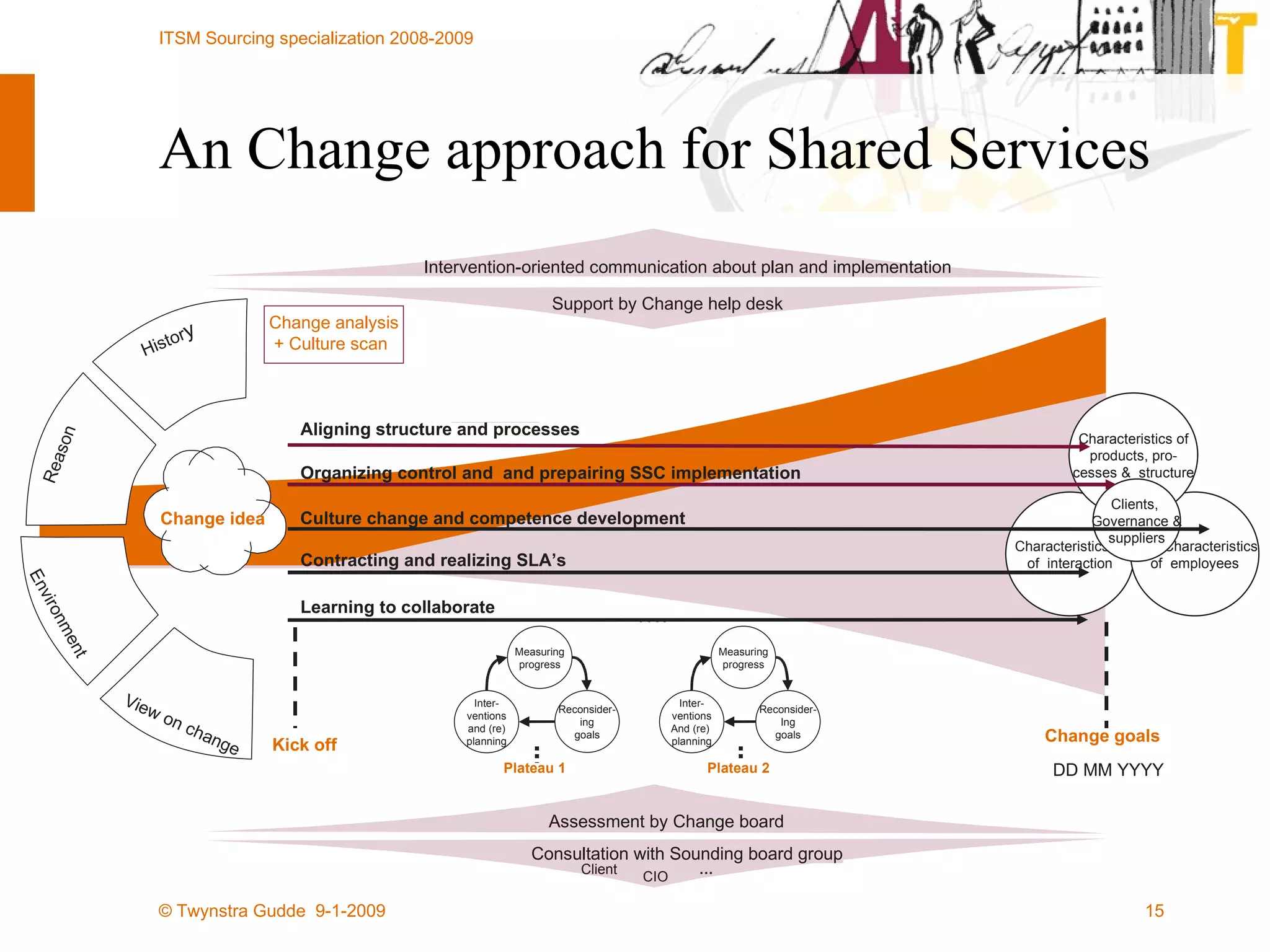
An Change approach for Shared Services … . Change idea Intervention-oriented communication about plan and implementation Support by Change help desk Assessment by Change board Consultation with Sounding board group CIO Client … Characteristics  of  interaction Characteristics of  employees Characteristics of products, pro- cesses &  structure Clients,  Governance & suppliers Histor y Reason Environment View on change Kick off Change analysis + Culture scan DD MM YYYY Change goals Aligning structure and processes Organizing control and  and prepairing SSC implementation Contracting and realizing SLA’s Culture change and competence development Learning to collaborate Inter- ventions And (re)  planning Reconsider- Ing goals Measuring progress Plateau 2 Inter- ventions and (re) planning Reconsider- ing goals Measuring progress Plateau 1
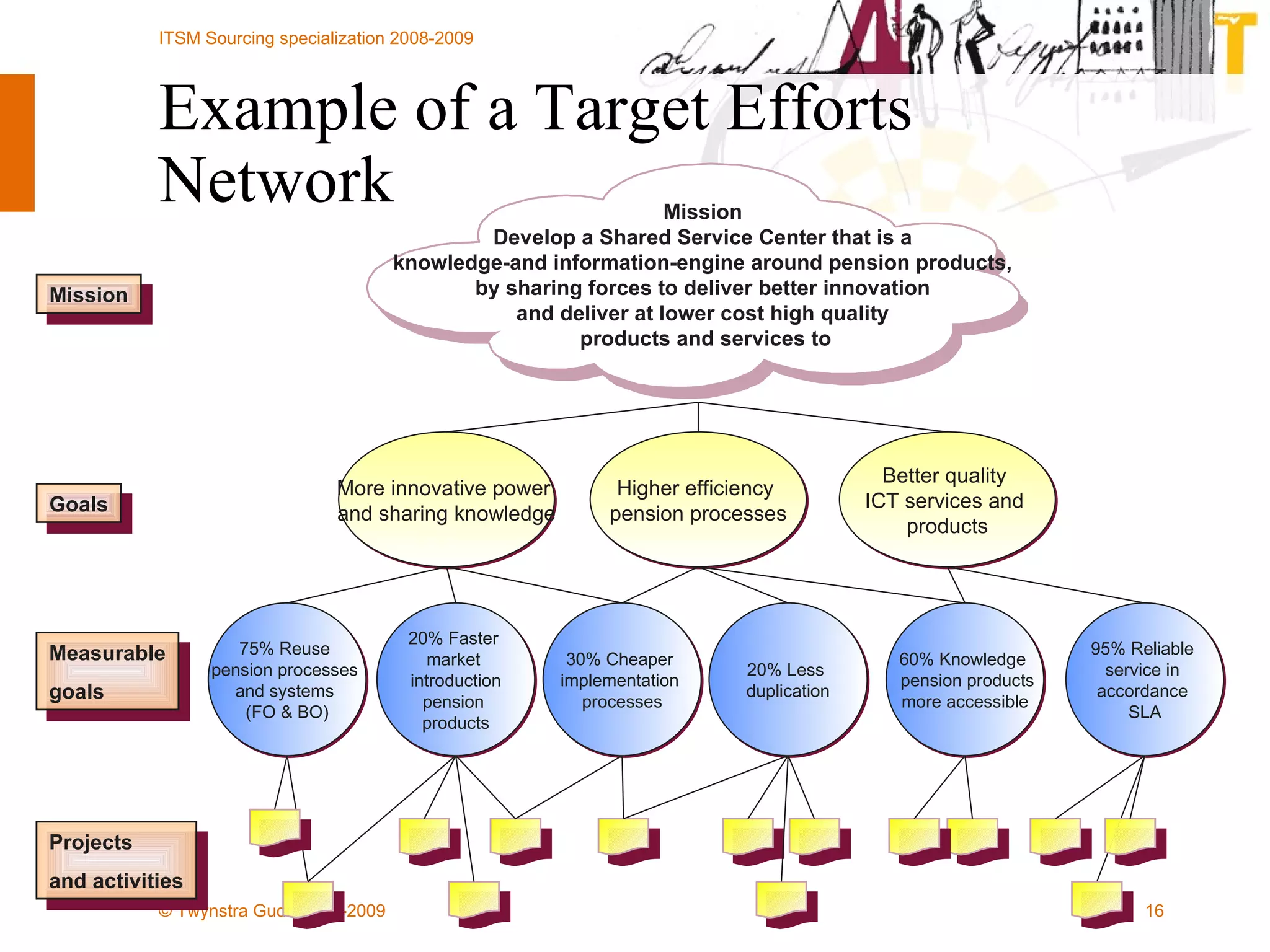
Example of a Target Efforts Network More innovative power  and sharing knowledge Higher efficiency  pension processes Better quality  ICT services and  products 75% Reuse  pension processes  and systems  (FO & BO) 20% Faster  market  introduction pension  products 30% Cheaper  implementation  processes 20% Less  duplication 60% Knowledge    pension products  more accessible 95% Reliable  service in  accordance  SLA Mission Goals Measurable goals Projects and activities Mission  Develop a Shared Service Center that is a  knowledge-and information-engine around pension products,  by sharing forces to deliver better innovation  and deliver at lower cost high quality  products and services to
Collaboration
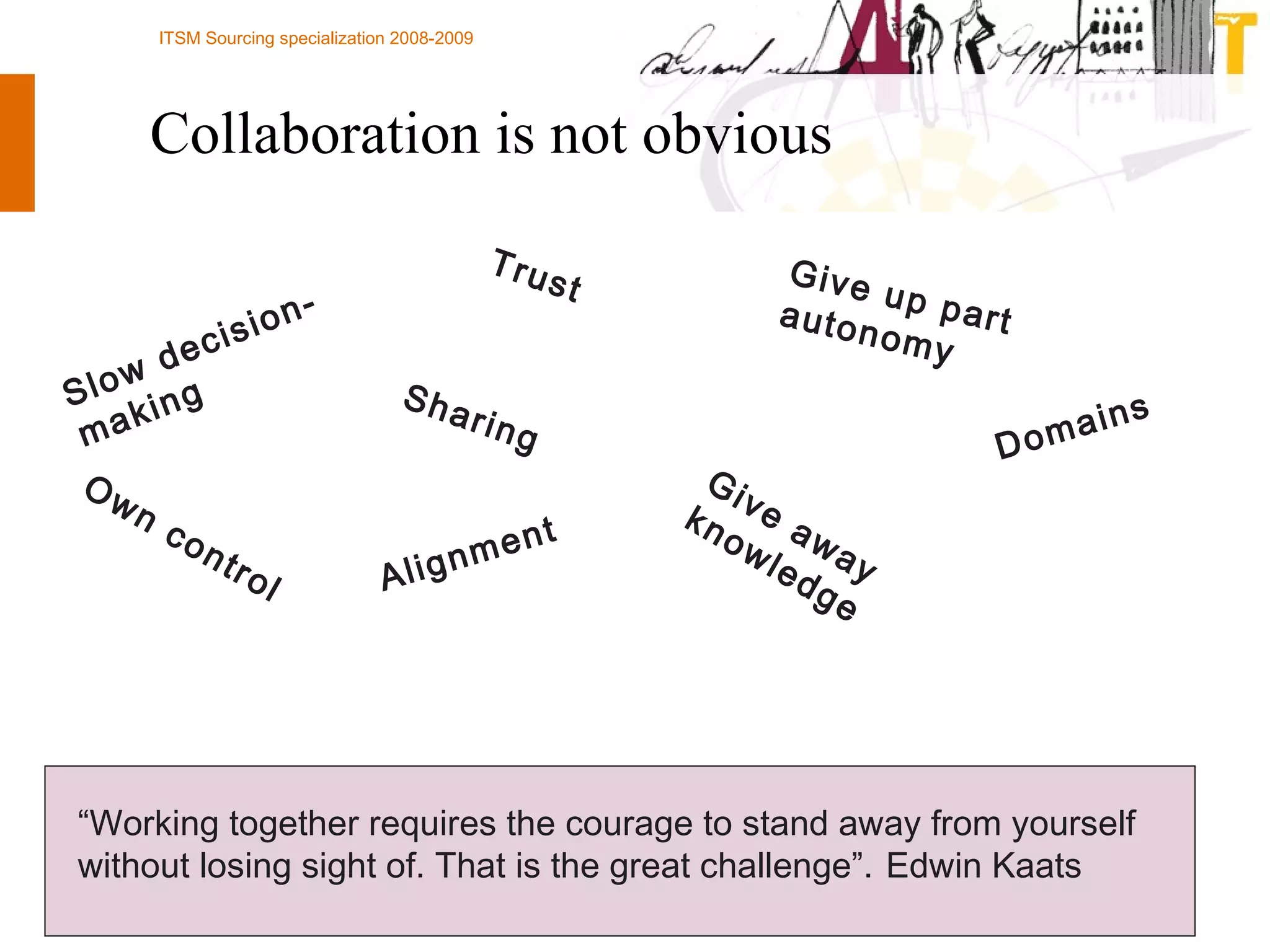
Collaboration is not obvious “ Working together requires the courage to stand away from yourself without losing sight of. That is the great challenge”.   Edwin Kaats Own control Give up part autonomy Alignment Domains Give away knowledge Slow decision-making Sharing Trust
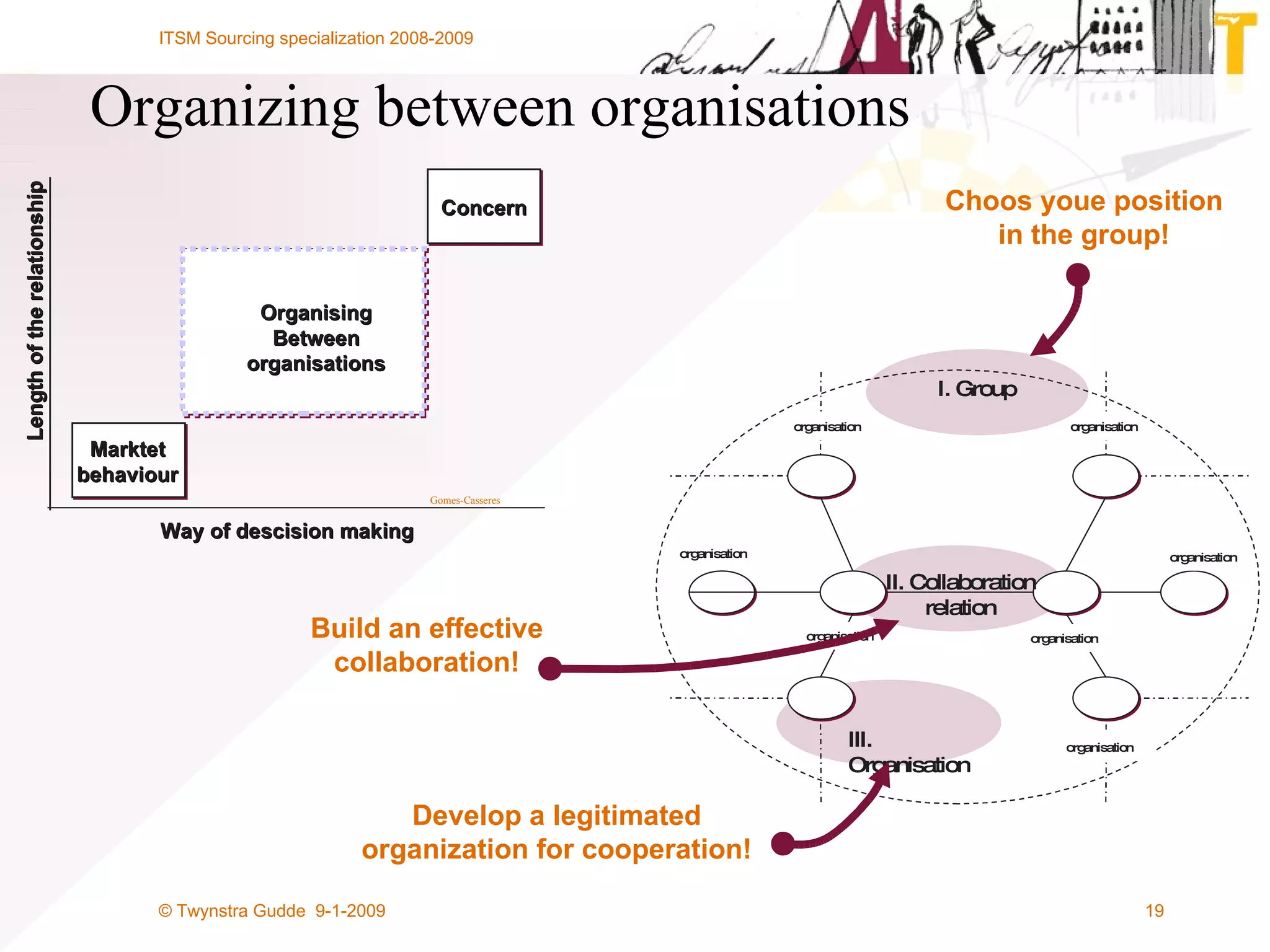
Organizing between organisations Choos youe position in the group! Build an effective collaboration! Develop a legitimated organization for cooperation! Way of descision making Length of the relationship Marktet behaviour Organising Between organisations Concern Gomes-Casseres organisation organisation III. Organisation II. Collaboration relation organisation organisation organisation organisation I. Group organisation
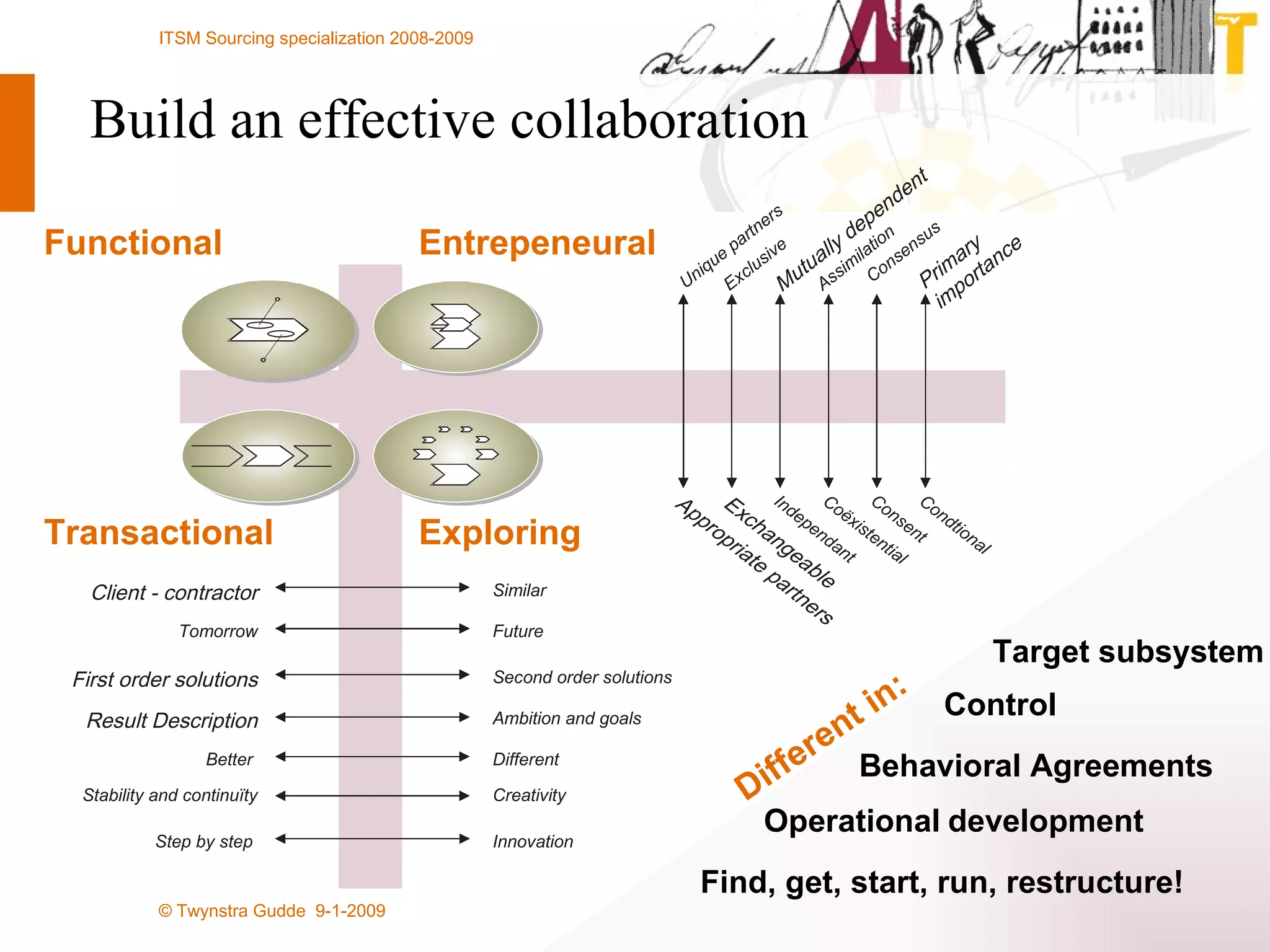
Build an effective collaboration  Consent Condtional Assimilation Independant Exchangeable Appropriate partners Consensus Primary importance Coëxistential Mutually dependent Exclusive Unique partners Better Different Stability and continuïty Creativity Result Description Ambition and goals First order solutions Second order solutions Tomorrow Future Client - contractor Similar Step by step Innovation Transactional Exploring Functional Entrepeneural Control Target subsystem Behavioral Agreements Operational   development Different in: Find, get, start, run, restructure!
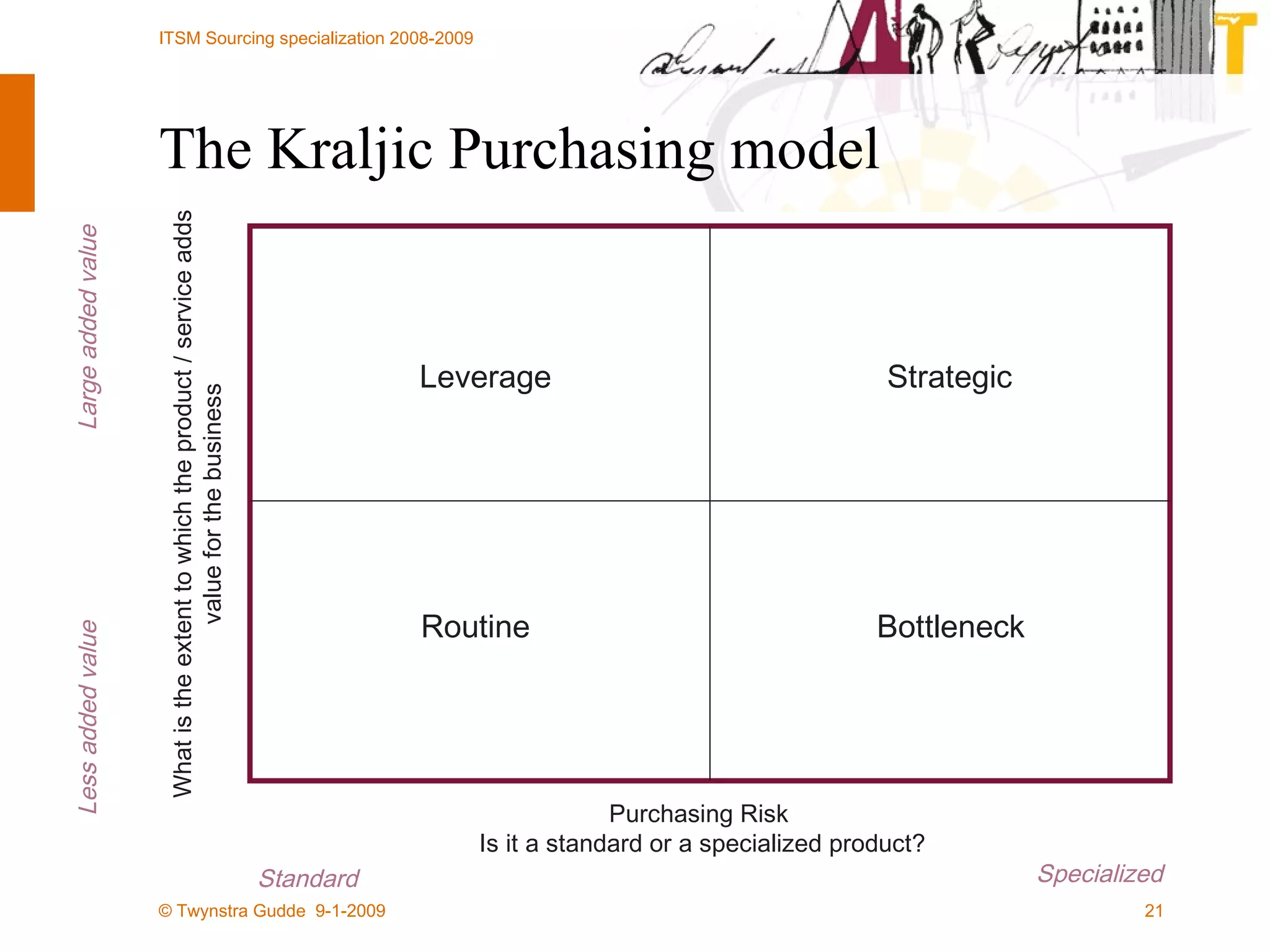
The Kraljic Purchasing model Purchasing Risk  Is it a standard or a specialized product? What is the extent to which the product / service adds value for the business Less added value Large added value Standard Specialized Strategic Leverage Bottleneck  Routine
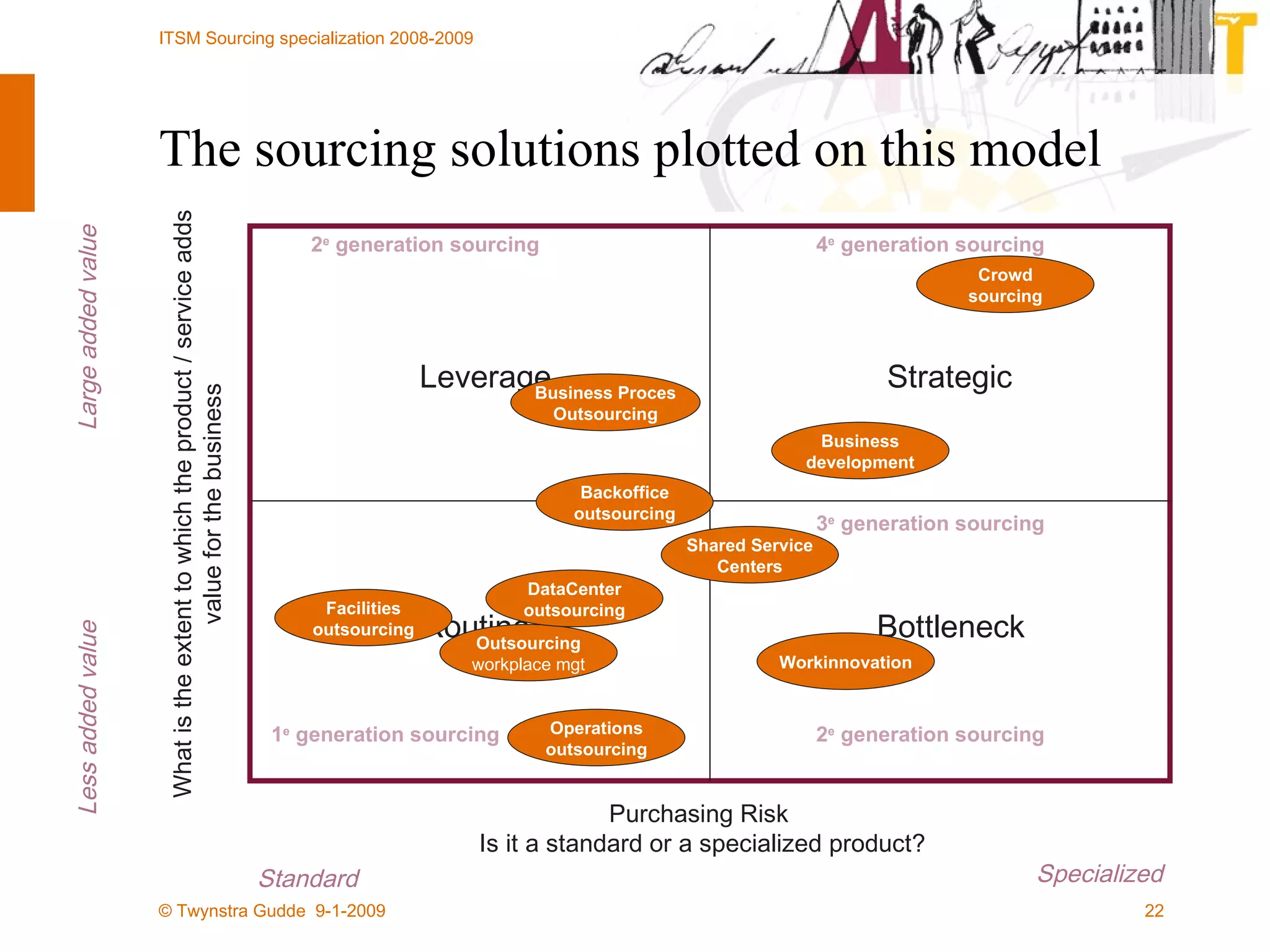
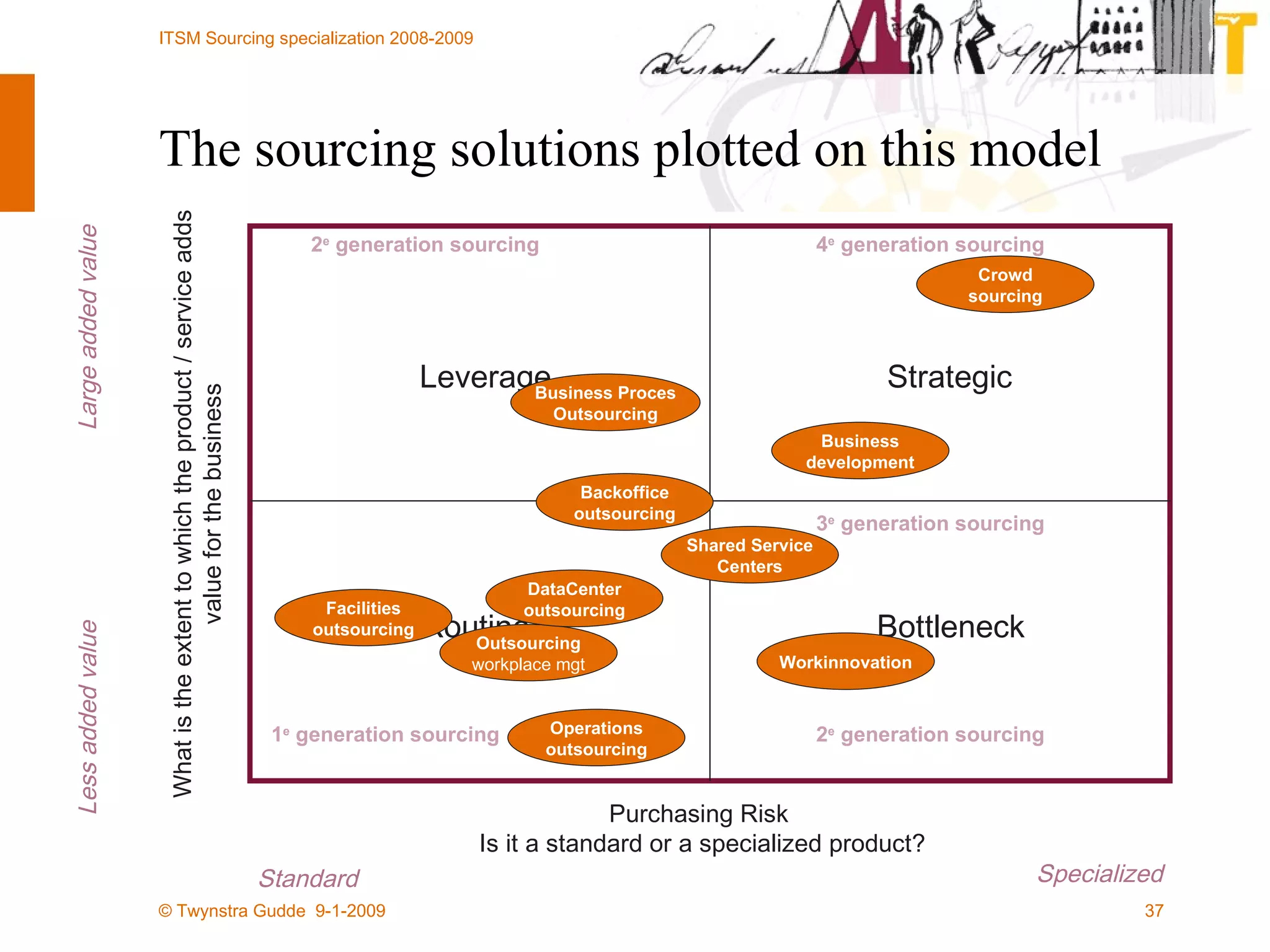
The sourcing solutions plotted on this model Purchasing Risk  Is it a standard or a specialized product? What is the extent to which the product / service adds value for the business Less added value Large added value Standard Specialized Strategic Leverage Bottleneck  Routine Business Proces Outsourcing Backoffice outsourcing Outsourcing workplace mgt Business development Shared Service Centers DataCenter outsourcing Facilities outsourcing Workinnovation 1 e  generation sourcing 2 e  generation sourcing 4 e  generation sourcing 3 e  generation sourcing 2 e  generation sourcing Crowd sourcing Operations outsourcing
Crowd Sourcing
Definition of Crowd Sourcing Due to deep changes in technology, demographics, business, the economy and the world, we are entering a new age in which people take part in the economy like never before.  The growing accessibility of information technologies puts the tools required to collaborate, create value and compete at everybody’s fingertips.  This new mode of innovation and value creation is called crowd sourcing, peer production or peering.
Building the Community of the Future While hierarchies are not vanishing, profound changes in the nature of technology, demographics and the global economy are giving rise to powerful new models of production based on community, collaboration and self-organization rather than on hierarchy and control. Smart companies are encouraging, rather than fighting, the heaving growth of massive online communities. As a growing number of firms see the benefits of mass collaboration, this new way of organizing will displace the traditional corporate structures as the economy’s primary engine of wealth creation.
Internet is the infrastructure for the crowd New low-cost collaborative infrastructures — from free Internet telephony to open-source software to global outsourcing platforms — allow thousands of individuals and small producers to co-create products, access markets and delight customers in ways that only large corporations could manage in the past. People can contribute to the “digital commons” at very little cost to themselves, which makes collective action attractive. Indeed, peer production is a very social activity.
Four principles of Crowd Sourcing Crowdsourcing is based on four powerful new ideas: Openness Peering Sharing Acting globally
Being Open Today, companies that make their boundaries porous to external ideas and human capital outperform companies that rely solely on their internal resources and capabilities.  People and institutions that interact with firms are gaining unprecedented access to important information about corporate behavior, operations and performance.
Peering Peering succeeds because it leverages selforganization —  a style of production that works more effectively than hierarchical management for certain tasks.  Its greatest impact today is in the production of software, media, entertainment and culture.
Sharing Smart firms are treating intellectual property (IP) like a mutual fund — they manage a balanced portfolio of IP assets, some protected and some shared. Of course companies need to protect critical IP. But companies can’t protect knowledge and should encourage sharing
Acting Globally The new globalization is both causing and caused by changes in collaboration and the way firms orchestrate capability to pioneer and produce things.  Winning companies will need to know the world, including its markets, technologies and people.
The Lego Prosumer Community One of the earliest, and still most vibrant, prosumer communities has formed around Lego products. Lego itself has become a flagship for how to get your customers deeply involved in cocreating and co-innovating products. Though Lego is perhaps best known for making little interlocking plastic bricks, the company is increasingly focusing on high-tech toys. With Lego Mindstorms, for example, users build real robots out of programmable bricks that can be turned into two-legged walking machines, or into just about anything a teenage mind can envision. When the product first made its debut in 1998, marketing officials were surprised to discover that the robotic toys were popular not only with teenagers but with adult hobbyists eager to improve on them. Within three weeks of its release, user groups had sprung up and tinkerers had reverse engineered and reprogrammed the sensors, motors, and controller devices at the heart of the Mindstorms robotic system. When users sent their suggestions to Lego, the company initially threatened lawsuits. When users rebelled, Lego finally came around, and ultimately incorporated user ideas. It even wrote a "right to hack" into the Mindstorms software license, giving hobbyists explicit permission to let their imaginations run wild. Today Lego uses mindstorms.lego.com to encourage tinkering with its software. The company benefits hugely from the work of this volunteer business web. Each time a customer posts a new application for Mindstorms, the toy becomes more valuable. The Mindstorms experience has proven to be so successful that Lego has transferred its customer-centric development practices to its more conventional Lego brick toys with a service that lets customers design their own custom Lego sets.
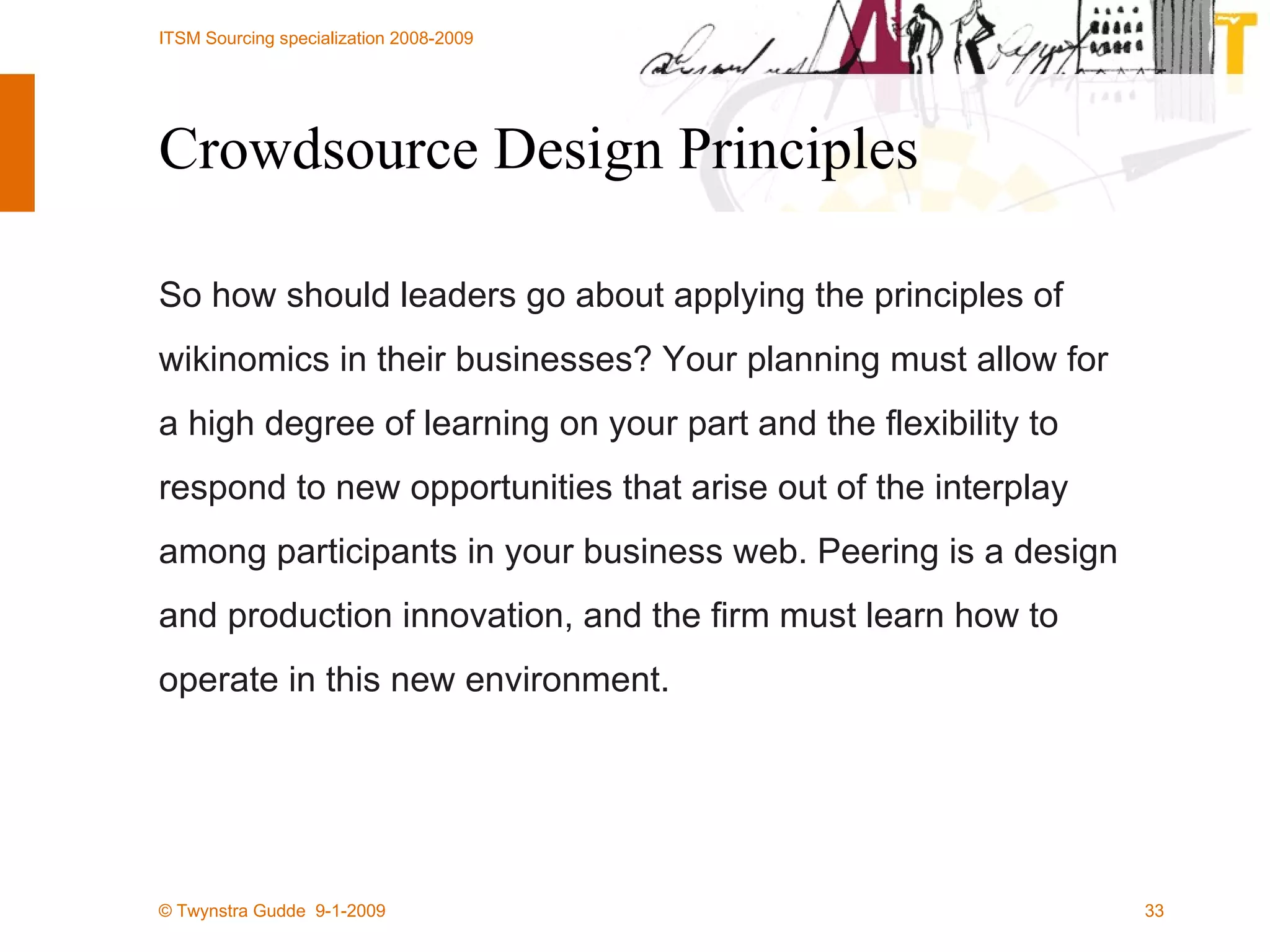
Crowdsource Design Principles So how should leaders go about applying the principles of wikinomics in their businesses? Your planning must allow for a high degree of learning on your part and the flexibility to respond to new opportunities that arise out of the interplay among participants in your business web. Peering is a design and production innovation, and the firm must learn how to operate in this new environment.
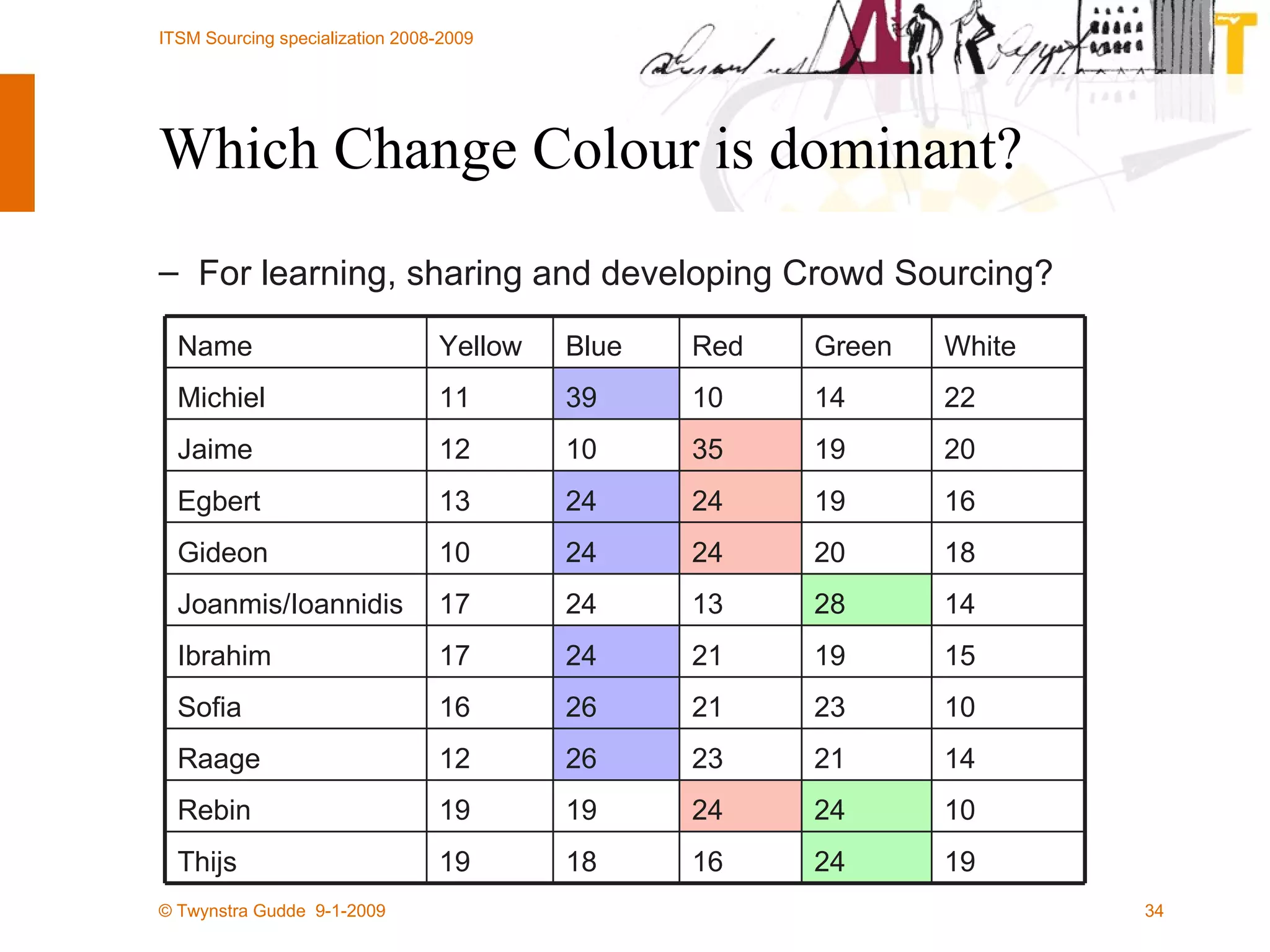
Which Change Colour is dominant? For learning, sharing and developing Crowd Sourcing? 10 24 24 19 19 Rebin 18 20 24 24 10 Gideon 16 19 24 24 13 Egbert 20 19 35 10 12 Jaime 22 14 10 39 11 Michiel 19 24 16 18 19 Thijs 14 21 23 26 12 Raage 10 23 21 26 16 Sofia 15 19 21 24 17 Ibrahim 14 28 13 24 17 Joanmis/Ioannidis White Green Red Blue Yellow Name
Which examples do we have together? Of crowd sourcing In an IT Service Management Environment
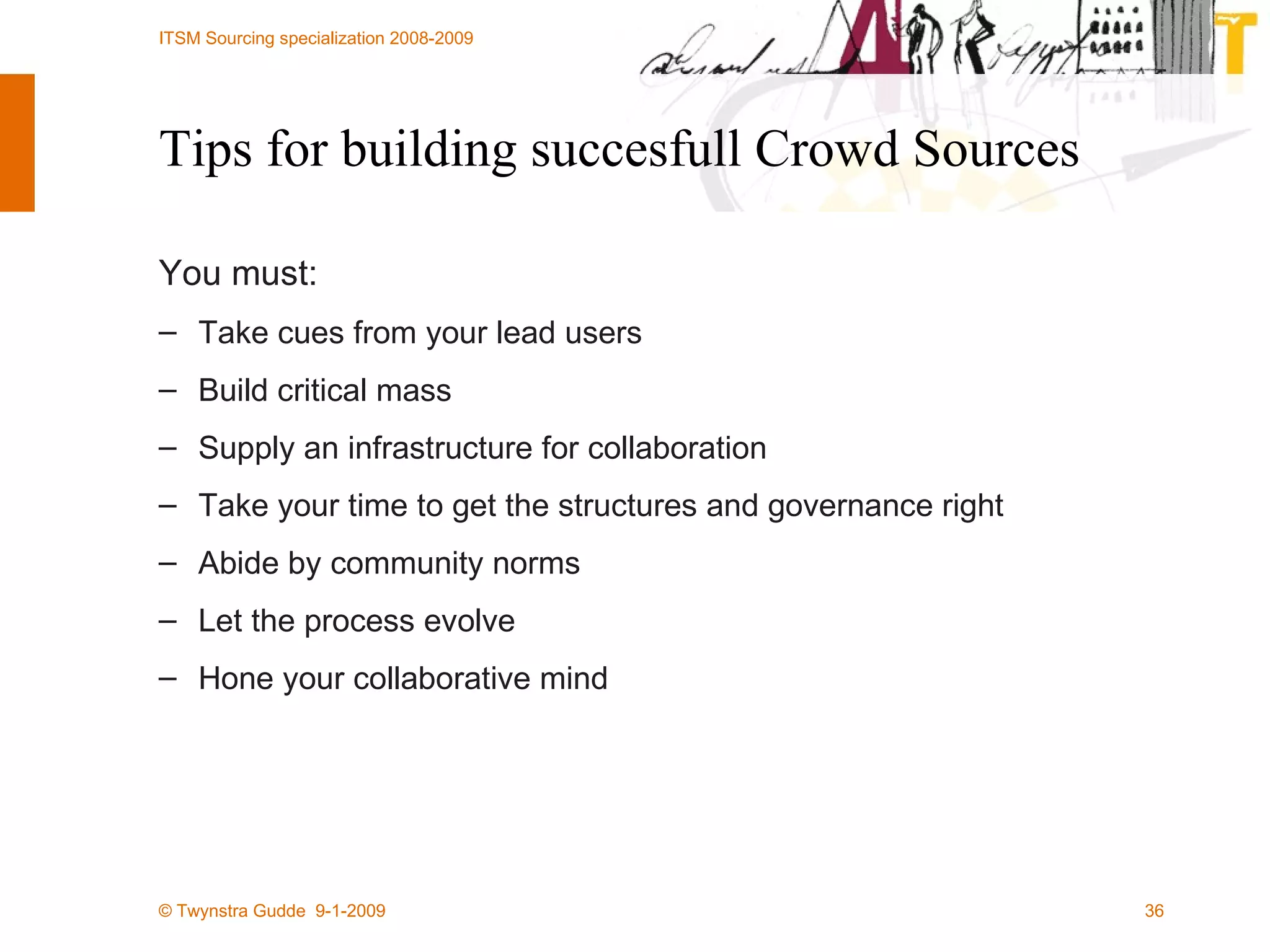
Tips for building succesfull Crowd Sources You must: Take cues from your lead users Build critical mass Supply an infrastructure for collaboration Take your time to get the structures and governance right Abide by community norms Let the process evolve Hone your collaborative mind
The sourcing solutions plotted on this model Purchasing Risk  Is it a standard or a specialized product? What is the extent to which the product / service adds value for the business Less added value Large added value Standard Specialized Strategic Leverage Bottleneck  Routine Business Proces Outsourcing Backoffice outsourcing Outsourcing workplace mgt Business development Shared Service Centers DataCenter outsourcing Facilities outsourcing Workinnovation 1 e  generation sourcing 2 e  generation sourcing 4 e  generation sourcing 3 e  generation sourcing 2 e  generation sourcing Crowd sourcing Operations outsourcing
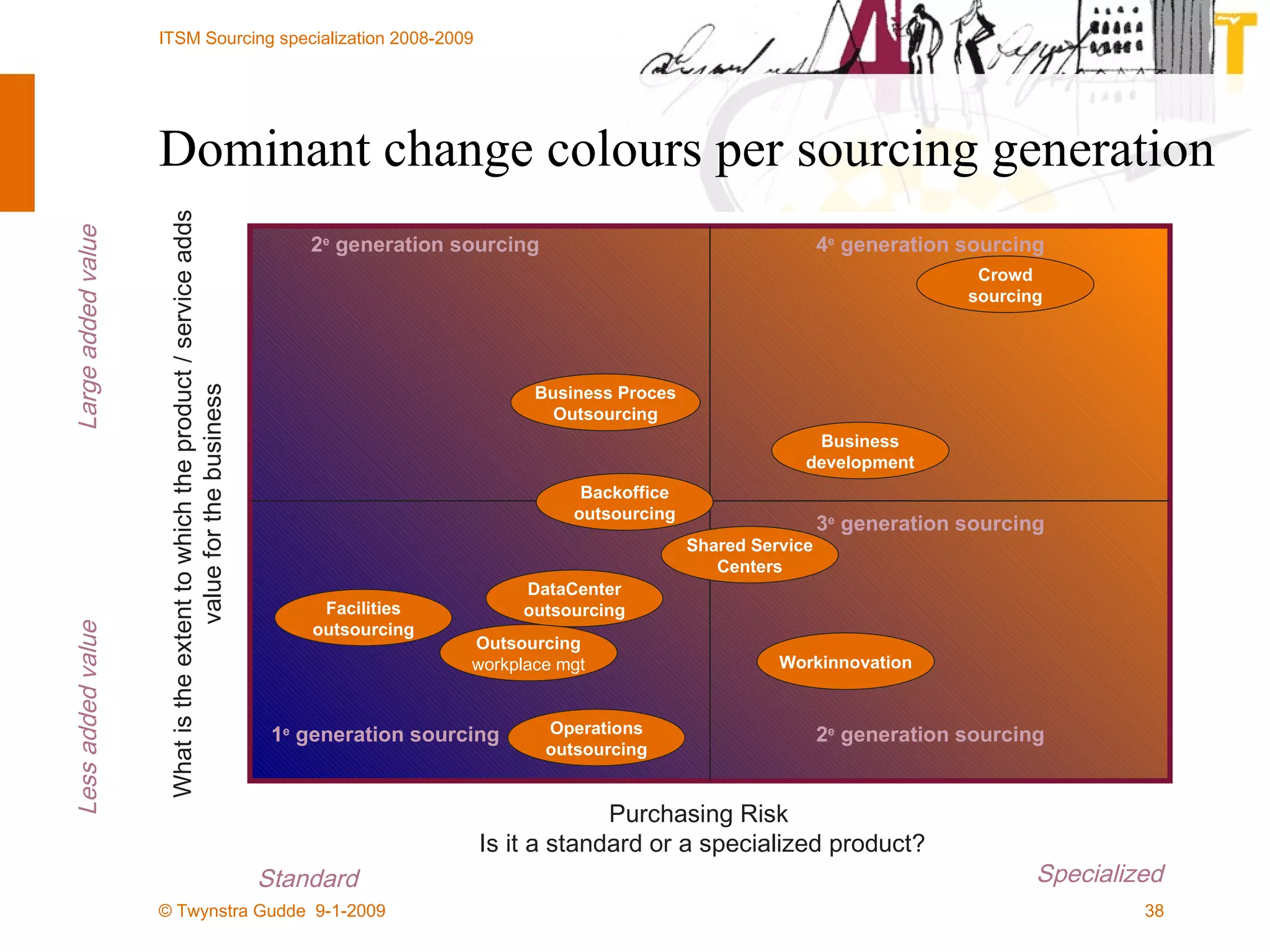
Dominant change colours per sourcing generation Purchasing Risk  Is it a standard or a specialized product? What is the extent to which the product / service adds value for the business Less added value Large added value Standard Specialized Business Proces Outsourcing Backoffice outsourcing Outsourcing workplace mgt Business development Shared Service Centers DataCenter outsourcing Facilities outsourcing Workinnovation 1 e  generation sourcing 2 e  generation sourcing 4 e  generation sourcing 3 e  generation sourcing 2 e  generation sourcing Crowd sourcing Operations outsourcing
All rights reserved. No part of this presentation may be reproduced or published in any form or by any means without the prior written permission of Twynstra Gudde. Frank Willems [email_address] www.twynstragudde.nl

Sourcing Lecture 4 Shared Services Collaboration And Crowdsourcing

  • 1.
    ITSM Sourcing specialization2008-2009 Shared Services, Collaboration and Crowdsourcing
  • 2.
    Agenda Shared ServicesCollaboration as a sourcing solution 4 th generation sourcing and Crowdsourcing Explanation of learning Task 3 about Sourcing
  • 3.
    But first: howabout the outcome of the Digital Selftest?
  • 4.
    Experience with theoutcome of the Digital Selftest Test should be made on http://www.twynstragudde.nl/tg.htm?id=8635 10 24 24 19 19 Rebin 18 20 24 24 10 Gideon 16 19 24 24 13 Egbert 20 19 35 10 12 Jaime 22 14 10 39 11 Michiel 19 24 16 18 19 Thijs 14 21 23 26 12 Raage 10 23 21 26 16 Sofia 15 19 21 24 17 Ibrahim 14 28 13 24 17 Joanmis/Ioannidis White Green Red Blue Yellow Name
  • 5.
    Conclusion IT Servicemanagement and Sourcing is all about people People can share energy, knowledge and power together when they are aware of the differences and the comparability Organizational Change Management can help to manage the right interventions
  • 6.
  • 7.
    Definition and goalof a Shared Service Center (SSC) We speak about an SSC as supporting processes within an organization on an approximately similar way, are delivered a new, semi-autonomous unit and on the basis of agreements it provides services to other units The goal of an SSC is generally to improve the service quality while cutting costs SSC versus centralization, service-oriented versus task
  • 8.
    Measures in perspectiveMeasures at task level: Stopping investments Orcutting down on current initiatives Measures at a process level: Collaboration and joint investments Measures at a functional level: Concentration, integration, mergers, Take-over or outsourcing Saving potential Short term (0,5-1 year Medium term (1-2 years Long term (2-5 years) Stopping projects Cutting down on training and learning Cutting down on engaging external consultants System optimazation Collaboration regarding purchasing, support, etc. Optimization and standardization of processes Integration, mergers and concentration Outsourcing of parts of the organization Shared Services Centre Full outsourcing Capitalizing effects
  • 9.
    Concentration leads toeconomies of scale Internal SSC Insourcing/ External Supplier Costs Volume Efficiency- effects Economy of Scale
  • 10.
    Are the trendsmoving up and down? Yes, to take maximum concentration and complexity there will be need for new solutions. Costs Volume Startingpoint Impact Scale reached Impact Scale reached Complexity Costs will increase
  • 11.
    Potential services fora SSC Facility Management mailroom copying and printing service archive purchase catering Customer Service sales service telephone customer service (call center) Administration financial administration pensions administration Payroll Personelmanagement (HRM) recruitment and selection Personnel administration training ICT Services application development Helpdesk Management and operation Training Real Estate Management management buildings Security management Sales and marketing ad coordination direct mail sales Tele ordering Order administration
  • 12.
    Variants of SharedServices supportfunctions Management primairy functions Shared Support Process Shared Business Process Shared back-offices
  • 13.
    The components ofShared Services How to manage the environment, where the process is cut and who is responsible for what processes? What is the proper organization, which staff and how are we ready for the future? How are technology, process and organization knotted together ? The core of the service Processes Organization Systems Customers SSC 1 SSC 3 SSC 2 SSC 4 Opstellen van Business Cases Inrichten van processen Managen van projecten Governance Regie Architectuur
  • 14.
    Name the changecomponents Ontwikkelen maatwerk Ontwikkelen maatwerk Beheer infrastructuur Beheer infrastructuur Beheer & draaien pakketten Beheer & draaien pakketten Support/ Helpdesk Support/ Helpdesk Ontwikkelen maatwerk SSC 1 Beheer infrastructuur SSC 3 Beheer & draaien pakketten SSC 2 Support/ Helpdesk SSC 4 Response, context and vision of SSC's clear and design direction activities Target focus on service domains ICT - governance Governance Regie Regie Architectuur Architectuur Make Governance agreements Professionalize demand ICT - governance Governance Regie Regie Architectuur Architectuur Transform demand management ICT - governance - Governance Regie Regie Architectuur Architectuur SSC 1 SSC 3 SSC 2 SSC 4 Opstellen van Business Cases Inrichten van processen Managen van projecten Governance Regie Architectuur
  • 15.
    An Change approachfor Shared Services … . Change idea Intervention-oriented communication about plan and implementation Support by Change help desk Assessment by Change board Consultation with Sounding board group CIO Client … Characteristics of interaction Characteristics of employees Characteristics of products, pro- cesses & structure Clients, Governance & suppliers Histor y Reason Environment View on change Kick off Change analysis + Culture scan DD MM YYYY Change goals Aligning structure and processes Organizing control and and prepairing SSC implementation Contracting and realizing SLA’s Culture change and competence development Learning to collaborate Inter- ventions And (re) planning Reconsider- Ing goals Measuring progress Plateau 2 Inter- ventions and (re) planning Reconsider- ing goals Measuring progress Plateau 1
  • 16.
    Example of aTarget Efforts Network More innovative power and sharing knowledge Higher efficiency pension processes Better quality ICT services and products 75% Reuse pension processes and systems (FO & BO) 20% Faster market introduction pension products 30% Cheaper implementation processes 20% Less duplication 60% Knowledge   pension products more accessible 95% Reliable service in accordance SLA Mission Goals Measurable goals Projects and activities Mission Develop a Shared Service Center that is a knowledge-and information-engine around pension products, by sharing forces to deliver better innovation and deliver at lower cost high quality products and services to
  • 17.
  • 18.
    Collaboration is notobvious “ Working together requires the courage to stand away from yourself without losing sight of. That is the great challenge”. Edwin Kaats Own control Give up part autonomy Alignment Domains Give away knowledge Slow decision-making Sharing Trust
  • 19.
    Organizing between organisationsChoos youe position in the group! Build an effective collaboration! Develop a legitimated organization for cooperation! Way of descision making Length of the relationship Marktet behaviour Organising Between organisations Concern Gomes-Casseres organisation organisation III. Organisation II. Collaboration relation organisation organisation organisation organisation I. Group organisation
  • 20.
    Build an effectivecollaboration Consent Condtional Assimilation Independant Exchangeable Appropriate partners Consensus Primary importance Coëxistential Mutually dependent Exclusive Unique partners Better Different Stability and continuïty Creativity Result Description Ambition and goals First order solutions Second order solutions Tomorrow Future Client - contractor Similar Step by step Innovation Transactional Exploring Functional Entrepeneural Control Target subsystem Behavioral Agreements Operational development Different in: Find, get, start, run, restructure!
  • 21.
    The Kraljic Purchasingmodel Purchasing Risk Is it a standard or a specialized product? What is the extent to which the product / service adds value for the business Less added value Large added value Standard Specialized Strategic Leverage Bottleneck Routine
  • 22.
    The sourcing solutionsplotted on this model Purchasing Risk Is it a standard or a specialized product? What is the extent to which the product / service adds value for the business Less added value Large added value Standard Specialized Strategic Leverage Bottleneck Routine Business Proces Outsourcing Backoffice outsourcing Outsourcing workplace mgt Business development Shared Service Centers DataCenter outsourcing Facilities outsourcing Workinnovation 1 e generation sourcing 2 e generation sourcing 4 e generation sourcing 3 e generation sourcing 2 e generation sourcing Crowd sourcing Operations outsourcing
  • 23.
  • 24.
    Definition of CrowdSourcing Due to deep changes in technology, demographics, business, the economy and the world, we are entering a new age in which people take part in the economy like never before. The growing accessibility of information technologies puts the tools required to collaborate, create value and compete at everybody’s fingertips. This new mode of innovation and value creation is called crowd sourcing, peer production or peering.
  • 25.
    Building the Communityof the Future While hierarchies are not vanishing, profound changes in the nature of technology, demographics and the global economy are giving rise to powerful new models of production based on community, collaboration and self-organization rather than on hierarchy and control. Smart companies are encouraging, rather than fighting, the heaving growth of massive online communities. As a growing number of firms see the benefits of mass collaboration, this new way of organizing will displace the traditional corporate structures as the economy’s primary engine of wealth creation.
  • 26.
    Internet is theinfrastructure for the crowd New low-cost collaborative infrastructures — from free Internet telephony to open-source software to global outsourcing platforms — allow thousands of individuals and small producers to co-create products, access markets and delight customers in ways that only large corporations could manage in the past. People can contribute to the “digital commons” at very little cost to themselves, which makes collective action attractive. Indeed, peer production is a very social activity.
  • 27.
    Four principles ofCrowd Sourcing Crowdsourcing is based on four powerful new ideas: Openness Peering Sharing Acting globally
  • 28.
    Being Open Today,companies that make their boundaries porous to external ideas and human capital outperform companies that rely solely on their internal resources and capabilities. People and institutions that interact with firms are gaining unprecedented access to important information about corporate behavior, operations and performance.
  • 29.
    Peering Peering succeedsbecause it leverages selforganization — a style of production that works more effectively than hierarchical management for certain tasks. Its greatest impact today is in the production of software, media, entertainment and culture.
  • 30.
    Sharing Smart firmsare treating intellectual property (IP) like a mutual fund — they manage a balanced portfolio of IP assets, some protected and some shared. Of course companies need to protect critical IP. But companies can’t protect knowledge and should encourage sharing
  • 31.
    Acting Globally Thenew globalization is both causing and caused by changes in collaboration and the way firms orchestrate capability to pioneer and produce things. Winning companies will need to know the world, including its markets, technologies and people.
  • 32.
    The Lego ProsumerCommunity One of the earliest, and still most vibrant, prosumer communities has formed around Lego products. Lego itself has become a flagship for how to get your customers deeply involved in cocreating and co-innovating products. Though Lego is perhaps best known for making little interlocking plastic bricks, the company is increasingly focusing on high-tech toys. With Lego Mindstorms, for example, users build real robots out of programmable bricks that can be turned into two-legged walking machines, or into just about anything a teenage mind can envision. When the product first made its debut in 1998, marketing officials were surprised to discover that the robotic toys were popular not only with teenagers but with adult hobbyists eager to improve on them. Within three weeks of its release, user groups had sprung up and tinkerers had reverse engineered and reprogrammed the sensors, motors, and controller devices at the heart of the Mindstorms robotic system. When users sent their suggestions to Lego, the company initially threatened lawsuits. When users rebelled, Lego finally came around, and ultimately incorporated user ideas. It even wrote a "right to hack" into the Mindstorms software license, giving hobbyists explicit permission to let their imaginations run wild. Today Lego uses mindstorms.lego.com to encourage tinkering with its software. The company benefits hugely from the work of this volunteer business web. Each time a customer posts a new application for Mindstorms, the toy becomes more valuable. The Mindstorms experience has proven to be so successful that Lego has transferred its customer-centric development practices to its more conventional Lego brick toys with a service that lets customers design their own custom Lego sets.
  • 33.
    Crowdsource Design PrinciplesSo how should leaders go about applying the principles of wikinomics in their businesses? Your planning must allow for a high degree of learning on your part and the flexibility to respond to new opportunities that arise out of the interplay among participants in your business web. Peering is a design and production innovation, and the firm must learn how to operate in this new environment.
  • 34.
    Which Change Colouris dominant? For learning, sharing and developing Crowd Sourcing? 10 24 24 19 19 Rebin 18 20 24 24 10 Gideon 16 19 24 24 13 Egbert 20 19 35 10 12 Jaime 22 14 10 39 11 Michiel 19 24 16 18 19 Thijs 14 21 23 26 12 Raage 10 23 21 26 16 Sofia 15 19 21 24 17 Ibrahim 14 28 13 24 17 Joanmis/Ioannidis White Green Red Blue Yellow Name
  • 35.
    Which examples dowe have together? Of crowd sourcing In an IT Service Management Environment
  • 36.
    Tips for buildingsuccesfull Crowd Sources You must: Take cues from your lead users Build critical mass Supply an infrastructure for collaboration Take your time to get the structures and governance right Abide by community norms Let the process evolve Hone your collaborative mind
  • 37.
    The sourcing solutionsplotted on this model Purchasing Risk Is it a standard or a specialized product? What is the extent to which the product / service adds value for the business Less added value Large added value Standard Specialized Strategic Leverage Bottleneck Routine Business Proces Outsourcing Backoffice outsourcing Outsourcing workplace mgt Business development Shared Service Centers DataCenter outsourcing Facilities outsourcing Workinnovation 1 e generation sourcing 2 e generation sourcing 4 e generation sourcing 3 e generation sourcing 2 e generation sourcing Crowd sourcing Operations outsourcing
  • 38.
    Dominant change coloursper sourcing generation Purchasing Risk Is it a standard or a specialized product? What is the extent to which the product / service adds value for the business Less added value Large added value Standard Specialized Business Proces Outsourcing Backoffice outsourcing Outsourcing workplace mgt Business development Shared Service Centers DataCenter outsourcing Facilities outsourcing Workinnovation 1 e generation sourcing 2 e generation sourcing 4 e generation sourcing 3 e generation sourcing 2 e generation sourcing Crowd sourcing Operations outsourcing
  • 39.
    All rights reserved.No part of this presentation may be reproduced or published in any form or by any means without the prior written permission of Twynstra Gudde. Frank Willems [email_address] www.twynstragudde.nl