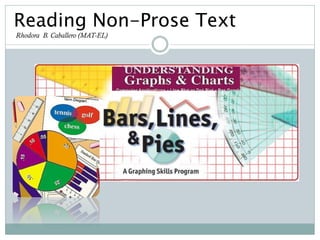
Reading Non-Prose Text
Rhodora B. Caballero (MAT-EL)
Reading Non-Prose Text
The information
you wish to get from
books is not only presented in sentences,
but also in graphic forms like charts, maps,
and tables.
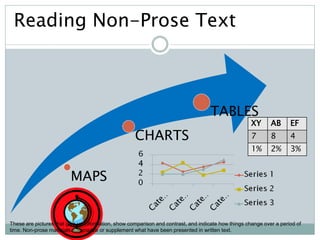
MAPS
CHARTS
TABLES
XY AB EF
7 8 4
1% 2% 3%
Reading Non-Prose Text
These are pictures that give us information, show comparison and contrast, and indicate how things change over a period of
time. Non-prose materials summarize or supplement what have been presented in written text.
Non-prose reading consists of
disconnected words and
numbers instead of the
sentences and paragraphs.
Reading Non-Prose Text
Each time you need information
from a train schedule, a graph,
a menu, an ad, or the like, then,
you are reading non-prose
materials.
Reading Non-Prose Text
Non-prose materials are also referred to as GRAPHIC Aids or VISUALS. They contain valuable information which, when written
in sentences or paragraphs may be difficult to understand.
Concepts
Processes
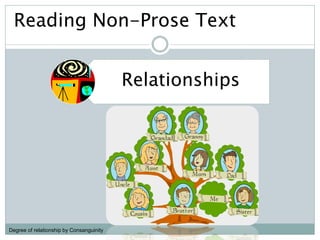
Relationships
Reading Non-Prose Text
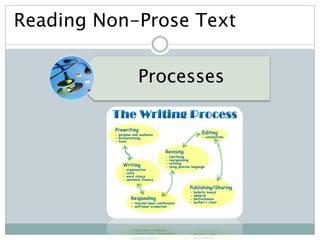
Concepts, processes, relationships, experiences and situations can be effectively demonstrated in concise format and spaced
in non-prose forms without having to go through several ages of prose materials.
Concepts
Reading Non-Prose Text
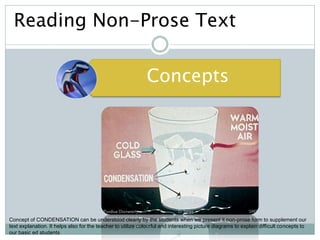
Concept of CONDENSATION can be understood clearly by the students when we present it non-prose form to supplement our
text explanation. It helps also for the teacher to utilize colourful and interesting picture diagrams to explain difficult concepts to
our basic ed students
Processes
Reading Non-Prose Text
Relationships
Reading Non-Prose Text
Degree of relationship by Consanguinity
a
•Present data in an organized and systematic
ways
b
•Allow the reader to absorb the information fast
and efficiently
c
• Explain abstract concepts, processes, relationships in a
concrete manner
d
•Provide only the useful and relevant data
Uses of Non-Prose Materials
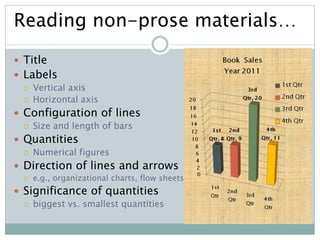
 Title
 Labels
 Vertical axis
 Horizontal axis
 Configuration of lines
 Size and length of bars
 Quantities
 Numerical figures
 Direction of lines and arrows
 e.g., organizational charts, flow sheets
 Significance of quantities
 biggest vs. smallest quantities
Reading non-prose materials…
Types of non-prose materials
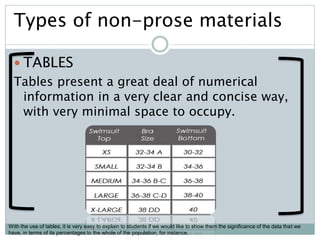
 TABLES
Tables present a great deal of numerical
information in a very clear and concise way,
with very minimal space to occupy.
With the use of tables, it is very easy to explain to students if we would like to show them the significance of the data that we
have, in terms of its percentages to the whole of the population, for instance.
Types of non-prose materials
 FIGURES (GRAPHS/CHARTS)
GRAPHS
 PIE GRAPH
 BAR GRAPH
 BUBBLE GRAPH
 LINE GRAPH
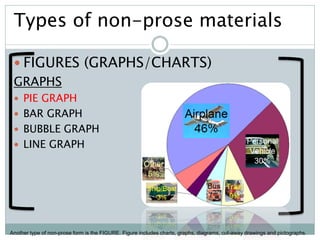
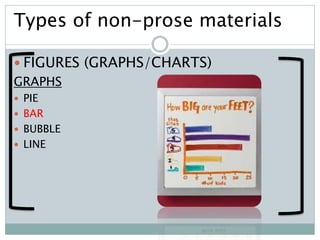
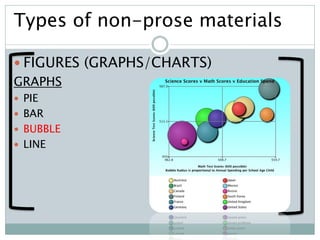
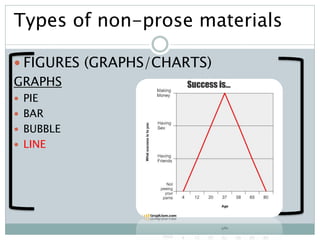
Another type of non-prose form is the FIGURE. Figure includes charts, graphs, diagrams, cut-away drawings and pictographs.
Types of non-prose materials
 FIGURES (GRAPHS/CHARTS)
GRAPHS
 PIE
 BAR
 BUBBLE
 LINE
Types of non-prose materials
 FIGURES (GRAPHS/CHARTS)
GRAPHS
 PIE
 BAR
 BUBBLE
 LINE
Types of non-prose materials
 FIGURES (GRAPHS/CHARTS)
GRAPHS
 PIE
 BAR
 BUBBLE
 LINE
Types of non-prose materials
 FIGURES (GRAPHS/CHARTS)
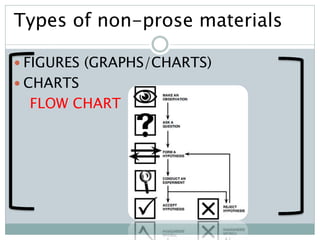
 CHARTS
FLOW CHART
Types of non-prose materials
 FIGURES (GRAPHS/CHARTS)
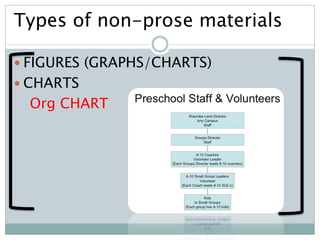
 CHARTS
Org CHART
Types of non-prose materials
 EXHIBITS
An actual item that may be attached to a
report as a sample of an object or
product being discussed (e.g., swatches,
yarns, or other items not too bulky to
lie almost flat on the paper.)
Types of non-prose materials
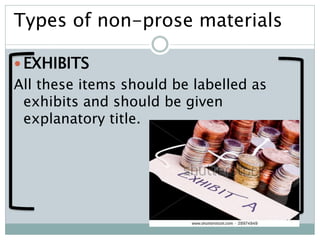
 EXHIBITS
All these items should be labelled as
exhibits and should be given
explanatory title.
Types of non-prose materials
 POETRY
Is a great non-prose material that can activate
imagination and interpretation skills.
Through poems, students can learn
 History (among others)
 Emotions/ Feelings
 Fiction / Fantasy
 Biographies
All in just few lines that rhyme.
Types of non-prose materials
 STICKERS / COMIC STRIPS / CARTOONS
Using comic strips is a fun way to read
for children, especially for student who
are very visual, and those who love
comic strips (basically all children)
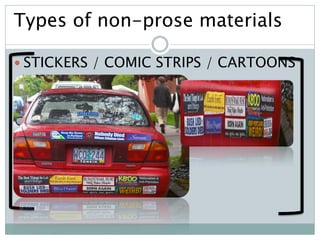
Types of non-prose materials
 STICKERS / COMIC STRIPS / CARTOONS
Non-traditional non-prose materials
 STICKERS / COMIC STRIPS / CARTOONS
Teachers have many sources of comic
strips, stickers, and cartoons inside and
outside of the classroom, so it’s a good
idea to use them in a reading class for
children.
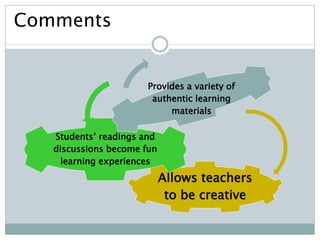
Allows teachers
to be creative
Students’ readings and
discussions become fun
learning experiences
Provides a variety of
authentic learning
materials
Comments

Reading non prose texts

  • 1.
    Reading Non-Prose Text RhodoraB. Caballero (MAT-EL)
  • 2.
    Reading Non-Prose Text Theinformation you wish to get from books is not only presented in sentences, but also in graphic forms like charts, maps, and tables.
  • 3.
    MAPS CHARTS TABLES XY AB EF 78 4 1% 2% 3% Reading Non-Prose Text These are pictures that give us information, show comparison and contrast, and indicate how things change over a period of time. Non-prose materials summarize or supplement what have been presented in written text.
  • 4.
    Non-prose reading consistsof disconnected words and numbers instead of the sentences and paragraphs. Reading Non-Prose Text
  • 5.
    Each time youneed information from a train schedule, a graph, a menu, an ad, or the like, then, you are reading non-prose materials. Reading Non-Prose Text Non-prose materials are also referred to as GRAPHIC Aids or VISUALS. They contain valuable information which, when written in sentences or paragraphs may be difficult to understand.
  • 6.
    Concepts Processes Relationships Reading Non-Prose Text Concepts,processes, relationships, experiences and situations can be effectively demonstrated in concise format and spaced in non-prose forms without having to go through several ages of prose materials.
  • 7.
    Concepts Reading Non-Prose Text Conceptof CONDENSATION can be understood clearly by the students when we present it non-prose form to supplement our text explanation. It helps also for the teacher to utilize colourful and interesting picture diagrams to explain difficult concepts to our basic ed students
  • 8.
  • 9.
    Relationships Reading Non-Prose Text Degreeof relationship by Consanguinity
  • 10.
    a •Present data inan organized and systematic ways b •Allow the reader to absorb the information fast and efficiently c • Explain abstract concepts, processes, relationships in a concrete manner d •Provide only the useful and relevant data Uses of Non-Prose Materials
  • 11.
     Title  Labels Vertical axis  Horizontal axis  Configuration of lines  Size and length of bars  Quantities  Numerical figures  Direction of lines and arrows  e.g., organizational charts, flow sheets  Significance of quantities  biggest vs. smallest quantities Reading non-prose materials…
  • 12.
    Types of non-prosematerials  TABLES Tables present a great deal of numerical information in a very clear and concise way, with very minimal space to occupy. With the use of tables, it is very easy to explain to students if we would like to show them the significance of the data that we have, in terms of its percentages to the whole of the population, for instance.
  • 13.
    Types of non-prosematerials  FIGURES (GRAPHS/CHARTS) GRAPHS  PIE GRAPH  BAR GRAPH  BUBBLE GRAPH  LINE GRAPH Another type of non-prose form is the FIGURE. Figure includes charts, graphs, diagrams, cut-away drawings and pictographs.
  • 14.
    Types of non-prosematerials  FIGURES (GRAPHS/CHARTS) GRAPHS  PIE  BAR  BUBBLE  LINE
  • 15.
    Types of non-prosematerials  FIGURES (GRAPHS/CHARTS) GRAPHS  PIE  BAR  BUBBLE  LINE
  • 16.
    Types of non-prosematerials  FIGURES (GRAPHS/CHARTS) GRAPHS  PIE  BAR  BUBBLE  LINE
  • 17.
    Types of non-prosematerials  FIGURES (GRAPHS/CHARTS)  CHARTS FLOW CHART
  • 18.
    Types of non-prosematerials  FIGURES (GRAPHS/CHARTS)  CHARTS Org CHART
  • 19.
    Types of non-prosematerials  EXHIBITS An actual item that may be attached to a report as a sample of an object or product being discussed (e.g., swatches, yarns, or other items not too bulky to lie almost flat on the paper.)
  • 20.
    Types of non-prosematerials  EXHIBITS All these items should be labelled as exhibits and should be given explanatory title.
  • 21.
    Types of non-prosematerials  POETRY Is a great non-prose material that can activate imagination and interpretation skills. Through poems, students can learn  History (among others)  Emotions/ Feelings  Fiction / Fantasy  Biographies All in just few lines that rhyme.
  • 22.
    Types of non-prosematerials  STICKERS / COMIC STRIPS / CARTOONS Using comic strips is a fun way to read for children, especially for student who are very visual, and those who love comic strips (basically all children)
  • 23.
    Types of non-prosematerials  STICKERS / COMIC STRIPS / CARTOONS
  • 24.
    Non-traditional non-prose materials STICKERS / COMIC STRIPS / CARTOONS Teachers have many sources of comic strips, stickers, and cartoons inside and outside of the classroom, so it’s a good idea to use them in a reading class for children.
  • 25.
    Allows teachers to becreative Students’ readings and discussions become fun learning experiences Provides a variety of authentic learning materials Comments