Michele Chandler
RED4348
FEAP #2 The Learning environment
1. Smart Chart
2.Think Pair Share
3. Previewing Text
4. Pre teach Vocabulary
5. Make Connections
A smart chart is similar to a three column KWL chart. The
first column is “K”, What we Know. The second column is
“W”, What we want to know. The third column is “L”, What
we learned. The difference is that a smart chart has a fourth
column “Background”.
Students write down ideas, discuss with a fellow peer, and
then share collaborative ideas with the rest of the class. This
strategy promotes interaction between the students and the
non-fiction book being presented. Furthermore, it also can
expose students to different perspectives, while activating
students’ schema (prior knowledge) and schemata
(background knowledge).
Point out the organization of the book and explain the
purpose of footnotes, time lines, visual aids, glossaries, etc.
Getting the student familiar with what to expect to see in non
fiction text
Finding a set of key vocabulary words that students will need
to know in order to understand a text. Find vocabulary that
they will not determine from the text alone.
Jot a topic of study on the whiteboard and allow students to
come up and jot down what they know about the topics.
Create a Venn diagram showing how subjects overlap or how
textbooks relate to novels.
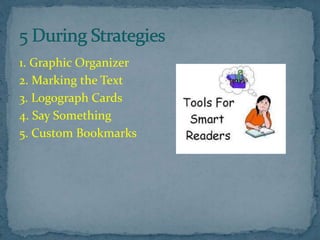
1. Graphic Organizer
2. Marking the Text
3. Logograph Cards
4. Say Something
5. Custom Bookmarks
Graphic organizers (some of which are also called concept
maps, entity relationship charts, and mind maps). They help
the student convert and compress a lot of seemingly
disjointed information into a structured, simple-to-read,
graphic display. The resulting visual display conveys complex
information in a simple-to-understand manner.
Marking text with sticky notes and highlighters helps readers
pay attention and remember what they read.
Students write a vocabulary word on one side of the card and
write the definition and draw a picture depicting the word on
the other side of the card.
Students get into groups of two or three and take turns
reading a portion of a text aloud. As they read, they
occasionally pause to "say something" about what was read.
The partners respond, then a different student continues the
reading until they pause to say something.
Allow students to create bookmarks that assist in reading. Mark
My Words: A bookmark for recording interesting or unusual
words. Every few days, spend ten minutes reviewing the words
students recorded and place them on a chart in the room. Marking
Time: Use these to mark how setting changes or the changes in a
historical time period. Question Mark: Students can record their
questions as they read and include the page number so they can
revisit that part of the text. Mark Who? Students can record
information about characters or historical figures. Mark the Bold:
Students record each bold work they encounter as they read and
write the definition in their own words on the back. Once a week,
have students review the terms and study with a partner.
1. Comprehension Check
2. Exit Slips
3. RAFT
4. Twitter Summaries
5. Oral Reports
Give students the main idea of a text and ask them to write
down the details that support it.
Students complete a set of questions or respond to a prompt
at the end of lesson to check for understanding.
RAFT writing assignments ask students to respond in a
certain Role, to a certain Audience, in various Formats, and
address a certain Topic.
Students must summarize the text in 140 characters or less.
Are a way for a student to do research on a chosen topic,
which requires the student to read multiple forms of text,
and then transfer the facts and ideas into a summary, or an
outline into their own words. Students will then present
their report to the class.
Boyton,A. & Blevins, W. (2003) 5 Keys to reading
nonfiction,New York, NY.: Scholastics
Bursuck, W. D., & Damer, M. (2011). Teaching reading to
students who are at risk or have disabilities a multi-tier
approach. (2nd ed.). Upper Saddle River, New Jersey:
Pearson Education, Inc.
Campbell, E. (2001). Reading rockets. Retrieved from:
http://www.readingrockets.org/search?cx=0049978276
99593338140:nptllrzhp78&cof=FORID:11&ie=UTF-
8&as_q=Before, during, after reading strategies

Ca1 reading strategy methods

  • 1.
    Michele Chandler RED4348 FEAP #2The Learning environment
  • 2.
    1. Smart Chart 2.ThinkPair Share 3. Previewing Text 4. Pre teach Vocabulary 5. Make Connections
  • 3.
    A smart chartis similar to a three column KWL chart. The first column is “K”, What we Know. The second column is “W”, What we want to know. The third column is “L”, What we learned. The difference is that a smart chart has a fourth column “Background”.
  • 4.
    Students write downideas, discuss with a fellow peer, and then share collaborative ideas with the rest of the class. This strategy promotes interaction between the students and the non-fiction book being presented. Furthermore, it also can expose students to different perspectives, while activating students’ schema (prior knowledge) and schemata (background knowledge).
  • 5.
    Point out theorganization of the book and explain the purpose of footnotes, time lines, visual aids, glossaries, etc. Getting the student familiar with what to expect to see in non fiction text
  • 6.
    Finding a setof key vocabulary words that students will need to know in order to understand a text. Find vocabulary that they will not determine from the text alone.
  • 7.
    Jot a topicof study on the whiteboard and allow students to come up and jot down what they know about the topics. Create a Venn diagram showing how subjects overlap or how textbooks relate to novels.
  • 8.
    1. Graphic Organizer 2.Marking the Text 3. Logograph Cards 4. Say Something 5. Custom Bookmarks
  • 9.
    Graphic organizers (someof which are also called concept maps, entity relationship charts, and mind maps). They help the student convert and compress a lot of seemingly disjointed information into a structured, simple-to-read, graphic display. The resulting visual display conveys complex information in a simple-to-understand manner.
  • 10.
    Marking text withsticky notes and highlighters helps readers pay attention and remember what they read.
  • 11.
    Students write avocabulary word on one side of the card and write the definition and draw a picture depicting the word on the other side of the card.
  • 12.
    Students get intogroups of two or three and take turns reading a portion of a text aloud. As they read, they occasionally pause to "say something" about what was read. The partners respond, then a different student continues the reading until they pause to say something.
  • 13.
    Allow students tocreate bookmarks that assist in reading. Mark My Words: A bookmark for recording interesting or unusual words. Every few days, spend ten minutes reviewing the words students recorded and place them on a chart in the room. Marking Time: Use these to mark how setting changes or the changes in a historical time period. Question Mark: Students can record their questions as they read and include the page number so they can revisit that part of the text. Mark Who? Students can record information about characters or historical figures. Mark the Bold: Students record each bold work they encounter as they read and write the definition in their own words on the back. Once a week, have students review the terms and study with a partner.
  • 14.
    1. Comprehension Check 2.Exit Slips 3. RAFT 4. Twitter Summaries 5. Oral Reports
  • 15.
    Give students themain idea of a text and ask them to write down the details that support it.
  • 16.
    Students complete aset of questions or respond to a prompt at the end of lesson to check for understanding.
  • 17.
    RAFT writing assignmentsask students to respond in a certain Role, to a certain Audience, in various Formats, and address a certain Topic.
  • 18.
    Students must summarizethe text in 140 characters or less.
  • 19.
    Are a wayfor a student to do research on a chosen topic, which requires the student to read multiple forms of text, and then transfer the facts and ideas into a summary, or an outline into their own words. Students will then present their report to the class.
  • 20.
    Boyton,A. & Blevins,W. (2003) 5 Keys to reading nonfiction,New York, NY.: Scholastics Bursuck, W. D., & Damer, M. (2011). Teaching reading to students who are at risk or have disabilities a multi-tier approach. (2nd ed.). Upper Saddle River, New Jersey: Pearson Education, Inc. Campbell, E. (2001). Reading rockets. Retrieved from: http://www.readingrockets.org/search?cx=0049978276 99593338140:nptllrzhp78&cof=FORID:11&ie=UTF- 8&as_q=Before, during, after reading strategies