Presentation Topic:
Clinical Anatomy Of
Peritoneum
Presented By:
Dr. Nayyab Tariq
Dr. of Physical Therapist - DPT
CONTENTS
Movement of Peritoneal Fluid
Peritoneal Infection
Internal Abdominal Hernia
Greater Omentum
Ascites
Peritoneal Pain
Peritoneal Dialysis
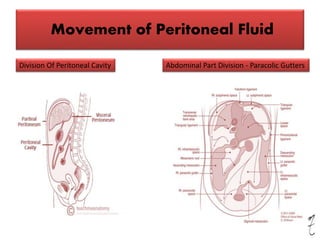
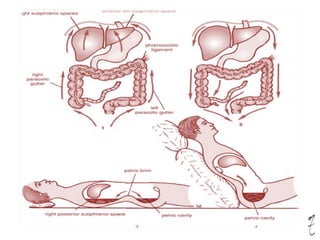
Movement of Peritoneal Fluid
Division Of Peritoneal Cavity Abdominal Part Division - Paracolic Gutters
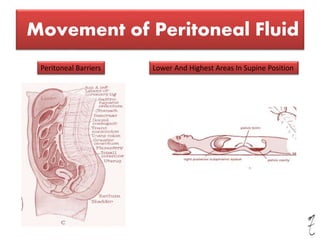
Movement of Peritoneal Fluid
Peritoneal Barriers Lower And Highest Areas In Supine Position
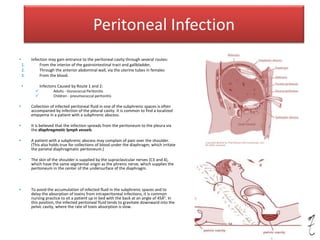
Peritoneal Infection
• Infection may gain entrance to the peritoneal cavity through several routes:
1. From the interior of the gastrointestinal tract and gallbladder,
2. Through the anterior abdominal wall, via the uterine tubes in females
3. From the blood.
• Infectons Caused by Route 1 and 2:
 Adults - Gonococcal Peritonitis
 Children - pneumococcal peritonitis
• Collection of infected peritoneal fluid in one of the subphrenic spaces is often
accompanied by infection of the pleural cavity. It is common to find a localized
empyema in a patient with a subphrenic abscess.
• It is believed that the infection spreads from the peritoneum to the pleura via
the diaphragmatic lymph vessels.
• A patient with a subphrenic abscess may complain of pain over the shoulder.
(This also holds true for collections of blood under the diaphragm, which irritate
the parietal diaphragmatic peritoneum.)
• The skin of the shoulder is supplied by the supraclavicular nerves (C3 and 4),
which have the same segmental origin as the phrenic nerve, which supplies the
peritoneum in the center of the undersurface of the diaphragm.
• To avoid the accumulation of infected fluid in the subphrenic spaces and to
delay the absorption of toxins from intraperitoneal infections, it is common
nursing practice to sit a patient up in bed with the back at an angle of 45°. In
this position, the infected peritoneal fluid tends to gravitate downward into the
pelvic cavity, where the rate of toxin absorption is slow.
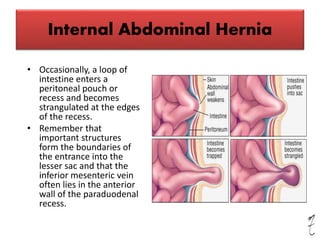
Internal Abdominal Hernia
• Occasionally, a loop of
intestine enters a
peritoneal pouch or
recess and becomes
strangulated at the edges
of the recess.
• Remember that
important structures
form the boundaries of
the entrance into the
lesser sac and that the
inferior mesenteric vein
often lies in the anterior
wall of the paraduodenal
recess.
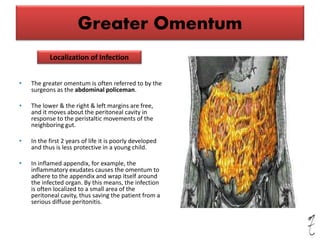
Greater Omentum
• The greater omentum is often referred to by the
surgeons as the abdominal policeman.
• The lower & the right & left margins are free,
and it moves about the peritoneal cavity in
response to the peristaltic movements of the
neighboring gut.
• In the first 2 years of life it is poorly developed
and thus is less protective in a young child.
• In inflamed appendix, for example, the
inflammatory exudates causes the omentum to
adhere to the appendix and wrap itself around
the infected organ. By this means, the infection
is often localized to a small area of the
peritoneal cavity, thus saving the patient from a
serious diffuse peritonitis.
Localization of Infection
Greater Omentum
The greater omentum has beenfound to
plug the neck of a hernial sac and
prevent the entrance of coils of
small intestine.
Surgeons sometimes
use the omentum
to buttress an intestinal Anastomosis
or in the closure of a perforated
gastric or duodenal ulcer.
Greater Omentum as a Hernial Plug
Greater Omentum in Surgery
Greater Omentum
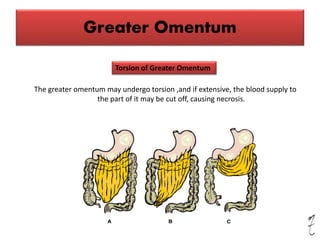
The greater omentum may undergo torsion ,and if extensive, the blood supply to
the part of it may be cut off, causing necrosis.
Torsion of Greater Omentum
Ascities
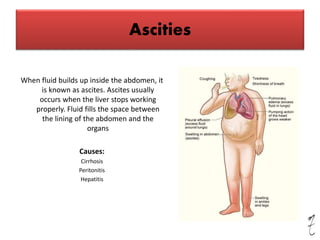
When fluid builds up inside the abdomen, it
is known as ascites. Ascites usually
occurs when the liver stops working
properly. Fluid fills the space between
the lining of the abdomen and the
organs
Causes:
Cirrhosis
Peritonitis
Hepatitis
Peritoneal Pain
• The parietal peritoneum lining the anterior abdominal wall is supplied by the
lower six thoracic nerve and 1st lumber nerve. Abdominal pain originating from the
parietal peritoneum is therefore of the somatic type and can be precisely localized,
it is usually serve.
• An inflamed parietal peritoneum is extremely sensitive to stretching. This fact is
made use of clinically in diagnosing peritonitis. Pressure is applied to the
abdominal wall with a signal finger over the site of the inflammation. The pressure
is then removed by suddenly withdrawing the finger. The abdominal wall
rebounds, resulting in extreme local pain, which is known as rebound tenderness.
• It should always be remembered that the parietal peritoneum in the pelvis is
innervated by the obturator nerve and can be palpated by mean of a rectal or
viginal examination. An inflamed appendix may hang down into the pelvis and
irritate the parietal peritoneum. A pelvic examination can detect extreme
tenderness of the parietal peritoneum on the right side.
From the parietal peritoneum
Peritoneal Pain
• The visceral peritoneum, including the mesenteries, is innervated by
autonomic afferent nerves. Stretch caused by over distention of a viscous
or pulling on a mesentery gives rise to the sensation of pain. The sites of
origin of visceral pain.
• Because the GIT arises embryologically a midline structure and receives a
bilateral nerve supply, pain is referred to the midline. Pain arising from an
abdominal viscus is dull and poorly localized.
From the visceral peritoneum
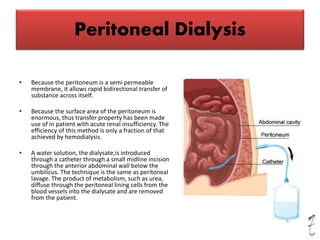
Peritoneal Dialysis
• Because the peritoneum is a semi permeable
membrane, it allows rapid bidirectional transfer of
substance across itself.
• Because the surface area of the peritoneum is
enormous, thus transfer property has been made
use of in patient with acute renal insufficiency. The
efficiency of this method is only a fraction of that
achieved by hemodialysis.
• A water solution, the dialysate,is introduced
through a catheter through a small midline incision
through the anterior abdominal wall below the
umbilicus. The technique is the same as peritoneal
lavage. The product of metabolism, such as urea,
diffuse through the peritoneal lining cells from the
blood vessels into the dialysate and are removed
from the patient.
Thanks For Your Patience
So… Do You Have Any Questions For Me?

Clinical anatomy of peritoneum

  • 1.
    Presentation Topic: Clinical AnatomyOf Peritoneum Presented By: Dr. Nayyab Tariq Dr. of Physical Therapist - DPT
  • 2.
    CONTENTS Movement of PeritonealFluid Peritoneal Infection Internal Abdominal Hernia Greater Omentum Ascites Peritoneal Pain Peritoneal Dialysis
  • 3.
    Movement of PeritonealFluid Division Of Peritoneal Cavity Abdominal Part Division - Paracolic Gutters
  • 4.
    Movement of PeritonealFluid Peritoneal Barriers Lower And Highest Areas In Supine Position
  • 6.
    Peritoneal Infection • Infectionmay gain entrance to the peritoneal cavity through several routes: 1. From the interior of the gastrointestinal tract and gallbladder, 2. Through the anterior abdominal wall, via the uterine tubes in females 3. From the blood. • Infectons Caused by Route 1 and 2:  Adults - Gonococcal Peritonitis  Children - pneumococcal peritonitis • Collection of infected peritoneal fluid in one of the subphrenic spaces is often accompanied by infection of the pleural cavity. It is common to find a localized empyema in a patient with a subphrenic abscess. • It is believed that the infection spreads from the peritoneum to the pleura via the diaphragmatic lymph vessels. • A patient with a subphrenic abscess may complain of pain over the shoulder. (This also holds true for collections of blood under the diaphragm, which irritate the parietal diaphragmatic peritoneum.) • The skin of the shoulder is supplied by the supraclavicular nerves (C3 and 4), which have the same segmental origin as the phrenic nerve, which supplies the peritoneum in the center of the undersurface of the diaphragm. • To avoid the accumulation of infected fluid in the subphrenic spaces and to delay the absorption of toxins from intraperitoneal infections, it is common nursing practice to sit a patient up in bed with the back at an angle of 45°. In this position, the infected peritoneal fluid tends to gravitate downward into the pelvic cavity, where the rate of toxin absorption is slow.
  • 7.
    Internal Abdominal Hernia •Occasionally, a loop of intestine enters a peritoneal pouch or recess and becomes strangulated at the edges of the recess. • Remember that important structures form the boundaries of the entrance into the lesser sac and that the inferior mesenteric vein often lies in the anterior wall of the paraduodenal recess.
  • 8.
    Greater Omentum • Thegreater omentum is often referred to by the surgeons as the abdominal policeman. • The lower & the right & left margins are free, and it moves about the peritoneal cavity in response to the peristaltic movements of the neighboring gut. • In the first 2 years of life it is poorly developed and thus is less protective in a young child. • In inflamed appendix, for example, the inflammatory exudates causes the omentum to adhere to the appendix and wrap itself around the infected organ. By this means, the infection is often localized to a small area of the peritoneal cavity, thus saving the patient from a serious diffuse peritonitis. Localization of Infection
  • 9.
    Greater Omentum The greateromentum has beenfound to plug the neck of a hernial sac and prevent the entrance of coils of small intestine. Surgeons sometimes use the omentum to buttress an intestinal Anastomosis or in the closure of a perforated gastric or duodenal ulcer. Greater Omentum as a Hernial Plug Greater Omentum in Surgery
  • 10.
    Greater Omentum The greateromentum may undergo torsion ,and if extensive, the blood supply to the part of it may be cut off, causing necrosis. Torsion of Greater Omentum
  • 11.
    Ascities When fluid buildsup inside the abdomen, it is known as ascites. Ascites usually occurs when the liver stops working properly. Fluid fills the space between the lining of the abdomen and the organs Causes: Cirrhosis Peritonitis Hepatitis
  • 12.
    Peritoneal Pain • Theparietal peritoneum lining the anterior abdominal wall is supplied by the lower six thoracic nerve and 1st lumber nerve. Abdominal pain originating from the parietal peritoneum is therefore of the somatic type and can be precisely localized, it is usually serve. • An inflamed parietal peritoneum is extremely sensitive to stretching. This fact is made use of clinically in diagnosing peritonitis. Pressure is applied to the abdominal wall with a signal finger over the site of the inflammation. The pressure is then removed by suddenly withdrawing the finger. The abdominal wall rebounds, resulting in extreme local pain, which is known as rebound tenderness. • It should always be remembered that the parietal peritoneum in the pelvis is innervated by the obturator nerve and can be palpated by mean of a rectal or viginal examination. An inflamed appendix may hang down into the pelvis and irritate the parietal peritoneum. A pelvic examination can detect extreme tenderness of the parietal peritoneum on the right side. From the parietal peritoneum
  • 13.
    Peritoneal Pain • Thevisceral peritoneum, including the mesenteries, is innervated by autonomic afferent nerves. Stretch caused by over distention of a viscous or pulling on a mesentery gives rise to the sensation of pain. The sites of origin of visceral pain. • Because the GIT arises embryologically a midline structure and receives a bilateral nerve supply, pain is referred to the midline. Pain arising from an abdominal viscus is dull and poorly localized. From the visceral peritoneum
  • 14.
    Peritoneal Dialysis • Becausethe peritoneum is a semi permeable membrane, it allows rapid bidirectional transfer of substance across itself. • Because the surface area of the peritoneum is enormous, thus transfer property has been made use of in patient with acute renal insufficiency. The efficiency of this method is only a fraction of that achieved by hemodialysis. • A water solution, the dialysate,is introduced through a catheter through a small midline incision through the anterior abdominal wall below the umbilicus. The technique is the same as peritoneal lavage. The product of metabolism, such as urea, diffuse through the peritoneal lining cells from the blood vessels into the dialysate and are removed from the patient.
  • 15.
    Thanks For YourPatience So… Do You Have Any Questions For Me?