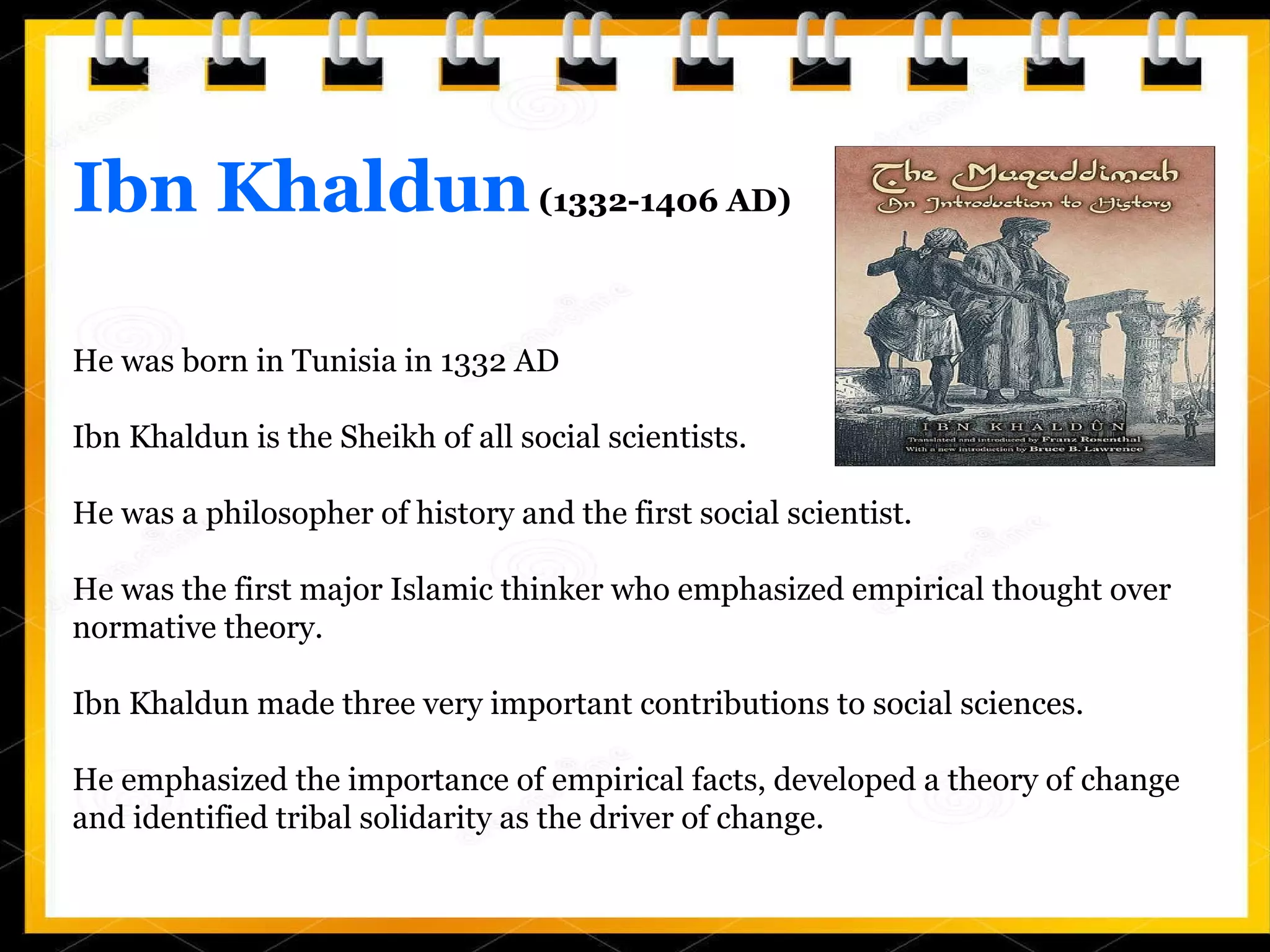
Ibn Khaldun was a 14th century Tunisian philosopher and historian who is considered a founder of sociology. He emphasized empirical evidence over normative theories and identified tribal solidarity ("asabiyya") as the driving force behind the rise and fall of civilizations. His major work, Muqaddimah, analyzed the psychological, economic, environmental and social factors that contribute to the development of human societies. He viewed society as a living organism and studied how social change occurs in cyclical patterns over generations. Ibn Khaldun is regarded as the father of sociology due to his pioneering research on social dynamics, the concept of asabiyya, and his scientific methodology in studying history and society.