Abbas Ibn Firnas (810–887 A.D.)
THE MAN WHO GAVE US WINGS
 
 
Abbas Ibn Firnas was born in Ronda, southern Spain, in 810.
He was the first man to make a controlled flight in human history.
In 852 Ibn Firnas demonstrated an early parachute by jumping from the muezzin of
the Grand Mosque in Cordoba. The parachute is described by John H. Lienhard
(Engineers of our Ingenuity radio programme, USA, 2004) as being a huge wing-
like cloak.
Whilst this parachute was not enough to break his fall completely it apparently
managed to slow him down sufficiently that he only sustained minor injuries.
For the next 23 years Ibn Firnas devoted himself to studying birds and refining his
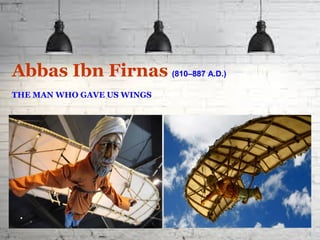
machine. His design appears to be that of a hang-glider which had two sets of wings
to adjust altitude and direction.
In 875 at the age of 65 Ibn Firnas attempted to fly using this machine.
In front of a large crowd he had invited Ibn Firnas proclaimed”Presently, I shall
take leave of you.
By guiding these wings up and down, I should ascend like the birds.
If all goes well, after soaring for a time I should be able to return safely to your
side”. With this said, Ibn Firnas launched himself from a mountain and
managed to do a full circuit coming back to where he had taken off. Described
as “flying faster than a phoenix” by the court poet who witnessed his display.
However, he had provided no mechanism for landing which resulted in him
crash-landing and injuring his back. He discovered later that he had failed to
provide a stability mechanism similar to a bird’s tail which would have allowed
him to slow down his landing.
Other Achievements:
Ibn Firnas is credited with designing a water clock called Al-Maqata
He devised a means to manufacture glass from sand to make silica and quartz glass.
Ibn Firnas’ new mix could create glass so clear that one contemporary poet
Al-Buhturi claimed that it was as if the contents were standing on its own without
the presence of a glass.
He also developed a way of cutting rock crystal allowing him to create Andalusian
drinking glasses.
He went on to use this glass to create fine lenses to magnify and correct eyesight.
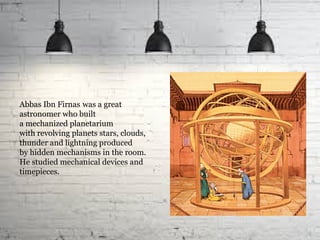
Abbas Ibn Firnas was a great
astronomer who built
a mechanized planetarium
with revolving planets stars, clouds,
thunder and lightning produced
by hidden mechanisms in the room.
He studied mechanical devices and
timepieces.
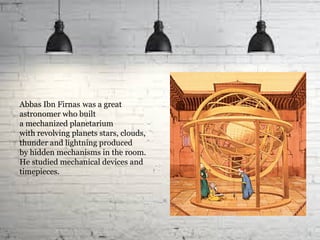
Abbas Ibn Firnas was a great
astronomer who built
a mechanized planetarium
with revolving planets stars, clouds,
thunder and lightning produced
by hidden mechanisms in the room.
He studied mechanical devices and
timepieces.

Abbas Ibn Firnas (The World's First Pilot)

  • 1.
    Abbas Ibn Firnas(810–887 A.D.) THE MAN WHO GAVE US WINGS  
  • 2.
      Abbas Ibn Firnaswas born in Ronda, southern Spain, in 810. He was the first man to make a controlled flight in human history. In 852 Ibn Firnas demonstrated an early parachute by jumping from the muezzin of the Grand Mosque in Cordoba. The parachute is described by John H. Lienhard (Engineers of our Ingenuity radio programme, USA, 2004) as being a huge wing- like cloak. Whilst this parachute was not enough to break his fall completely it apparently managed to slow him down sufficiently that he only sustained minor injuries. For the next 23 years Ibn Firnas devoted himself to studying birds and refining his machine. His design appears to be that of a hang-glider which had two sets of wings to adjust altitude and direction.
  • 3.
    In 875 atthe age of 65 Ibn Firnas attempted to fly using this machine. In front of a large crowd he had invited Ibn Firnas proclaimed”Presently, I shall take leave of you. By guiding these wings up and down, I should ascend like the birds. If all goes well, after soaring for a time I should be able to return safely to your side”. With this said, Ibn Firnas launched himself from a mountain and managed to do a full circuit coming back to where he had taken off. Described as “flying faster than a phoenix” by the court poet who witnessed his display. However, he had provided no mechanism for landing which resulted in him crash-landing and injuring his back. He discovered later that he had failed to provide a stability mechanism similar to a bird’s tail which would have allowed him to slow down his landing.
  • 4.
    Other Achievements: Ibn Firnasis credited with designing a water clock called Al-Maqata He devised a means to manufacture glass from sand to make silica and quartz glass. Ibn Firnas’ new mix could create glass so clear that one contemporary poet Al-Buhturi claimed that it was as if the contents were standing on its own without the presence of a glass. He also developed a way of cutting rock crystal allowing him to create Andalusian drinking glasses. He went on to use this glass to create fine lenses to magnify and correct eyesight.
  • 5.
    Abbas Ibn Firnaswas a great astronomer who built a mechanized planetarium with revolving planets stars, clouds, thunder and lightning produced by hidden mechanisms in the room. He studied mechanical devices and timepieces.
  • 6.
    Abbas Ibn Firnaswas a great astronomer who built a mechanized planetarium with revolving planets stars, clouds, thunder and lightning produced by hidden mechanisms in the room. He studied mechanical devices and timepieces.