CHAPTER – 4
HEAT
Friday, December 1, 2017 RAVI PRAKASH SINGH 1
CLASS :- VII
MADE BY :- RAVI PRAKASH SINGH
SUBJECT :- PHYSICS
HEAT
Friday, December 1, 2017 RAVI PRAKASH SINGH 2
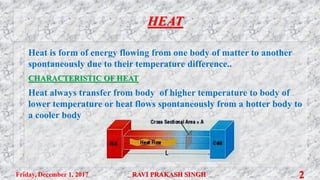
Heat is form of energy flowing from one body of matter to another
spontaneously due to their temperature difference..
CHARACTERISTIC OF HEAT
Heat always transfer from body of higher temperature to body of
lower temperature or heat flows spontaneously from a hotter body to
a cooler body
Hot and cold :-
Friday, December 1, 2017 RAVI PRAKASH SINGH 3
Hot and cold :-
In our daily life we come across a number of objects. Some of them
are hot and some of them are cold. E.g. - Tea is hot and ice is cold.
Some objects are hotter than others and some are colder than others.
We often decide which object is hotter than the other by touching the
objects.
We cannot always rely on our sense of touch to decide how hot or how
cold an object is. The hotness of an object is measured by its
temperature.
When we add heat to body, motion of its particle increase
When we remove heat from body, motion of its particle decrease
TEMPERATURE
Temperature is a measure of the degree of hotness or
coldness of an object.
The temperature of something tells us how hot or cold
something is.
Friday, December 1, 2017 RAVI PRAKASH SINGH 4
EFFECT OF HEAT
When body is heated various types of physical & chemical change take place.
 PHYSICAL CHANGES
a) CHANGE IN TEMPERATURE
On adding heat to body, its temperature increase.
On removal of heat from body, its temperature decrease.
b) CHANGE OF STATE
On addition or removal of heat to/from body, there is change in state of body.
Ex- change of ice to water on addition of heat etc.
c) THERMAL EXPANSION
The phenomenon of expansion of matter on heating is called thermal
expansion.
 CHEMICAL CHANGES
On heating reactant , many case chemical changes take place.
Friday, December 1, 2017 RAVI PRAKASH SINGH 5
MEASUREMENT OF TEMPERATURE :-
 Temperature is measured by a device called thermometer.
 Temperature is measured in degrees.
 Temperature is measured on two scales:
Celsius and Fahrenheit.
 °C is the symbol for the Celsius scale.
 °F is the symbol for the Fahrenheit scale.
 The Fahrenheit scale is the most popular in the United States.
 Celsius Scale is most commonly used in the Canada.
 THERMOMETER :-
 Thermometer is an instrument that is used to measure temperature
Friday, December 1, 2017 RAVI PRAKASH SINGH 6
37 °C 98.6 °F
Measurement of temperature
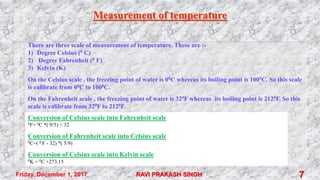
There are three scale of measurement of temperature. These are :-
1) Degree Celsius (0 C)
2) Degree Fahrenheit (0 F)
3) Kelvin (K)
On the Celsius scale , the freezing point of water is 00C whereas its boiling point is 1000C. So this scale
is calibrate from 00C to 1000C.
On the Fahrenheit scale , the freezing point of water is 320F whereas its boiling point is 2120F. So this
scale is calibrate from 320F to 2120F.
Conversion of Celsius scale into Fahrenheit scale
0F= 0C *( 9/5) + 32
Conversion of Fahrenheit scale into Celsius scale
0C=( 0 F - 32) *( 5/9)
Conversion of Celsius scale into Kelvin scale
0K = 0C +273.15
Friday, December 1, 2017 RAVI PRAKASH SINGH 7
CLINICAL THERMOMETERS
The thermometer that
measures the temperature of
our body is called clinical
thermometer.
Friday, December 1, 2017 RAVI PRAKASH SINGH 8
(Kink)
CONSTRUCTION OF CLINICAL THERMOMETER
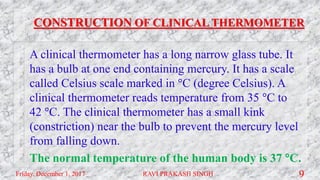
A clinical thermometer has a long narrow glass tube. It
has a bulb at one end containing mercury. It has a scale
called Celsius scale marked in °C (degree Celsius). A
clinical thermometer reads temperature from 35 °C to
42 °C. The clinical thermometer has a small kink
(constriction) near the bulb to prevent the mercury level
from falling down.
The normal temperature of the human body is 37 °C.
Friday, December 1, 2017 RAVI PRAKASH SINGH 9
READING A CLINICAL THERMOMETER
Friday, December 1, 2017 RAVI PRAKASH SINGH 10
Wash the thermometer with an antiseptic solution. Hold it
firmly and give it a few jerks to bring the level of mercury
below 35 °C. Then place the bulb of the thermometer under
your tongue. After one minute take out the thermometer and
note the reading. This will be your body temperature.
DIGITAL THERMOMETERS
Digital (electronic) thermometers
are preferred over conventional
mercury thermometer.
Digital thermometers are easy to
read because it gives LCD
Display of the temperature of the
person.
They are also mercury free.
Friday, December 1, 2017 RAVI PRAKASH SINGH 11
LABORATORY THERMOMETER :-
Friday, December 1, 2017 RAVI PRAKASH SINGH 12
A laboratory thermometer has
a long narrow glass tube. It has
a bulb at one end containing
mercury. It has a scale marked
in °C (degree Celsius). The
range of a laboratory
thermometer is generally from
- 10 °C to 110 °C.
MEASURING TEMPERATURE WITH A LABORATORY THERMOMETER
Friday, December 1, 2017 RAVI PRAKASH SINGH 13
Take some tap water in a beaker. Dip
the thermometer in the water so that
the bulb of the thermometer does not
touch the bottom or the sides of the
beaker. Hold the thermometer
vertically. The mercury level rises.
Wait till the level of mercury becomes
steady. Note the level of mercury. This
will be the temperature of the water.
6) TRANSFER OF HEAT :-
Friday, December 1, 2017 RAVI PRAKASH SINGH 14
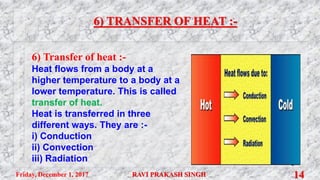
6) Transfer of heat :-
Heat flows from a body at a
higher temperature to a body at a
lower temperature. This is called
transfer of heat.
Heat is transferred in three
different ways. They are :-
i) Conduction
ii) Convection
iii) Radiation
CONDUCTION
Friday, December 1, 2017 RAVI PRAKASH SINGH 15
Conduction is the process by which heat is transferred in solids from the
hotter end to the colder end.
Activity :-
Take an iron or aluminium rod or strip. Fix a few wax pieces on at equal
distances. Clamp the rod to a stand. Heat the other end of the rod. The wax
pieces begin to melt and fall down from the heated end. This shows that
heat is transferred from the hotter end to the colder end by conduction.
Q
Q
CONDUCTION
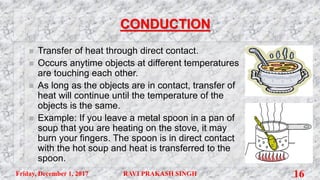
 Transfer of heat through direct contact.
 Occurs anytime objects at different temperatures
are touching each other.
 As long as the objects are in contact, transfer of
heat will continue until the temperature of the
objects is the same.
 Example: If you leave a metal spoon in a pan of
soup that you are heating on the stove, it may
burn your fingers. The spoon is in direct contact
with the hot soup and heat is transferred to the
spoon.
Friday, December 1, 2017 RAVI PRAKASH SINGH 16
CONDUCTORS AND INSULATORS :-
Friday, December 1, 2017 RAVI PRAKASH SINGH 17
Conductors :- Conductors are materials which allow heat to
pass through them easily. E.g. :- iron, aluminium, copper etc.
Insulators :- Insulators are materials which do not allow heat
to pass through them easily. E.g. :- wood, plastic, glass,
rubber, air, water etc.
Insulators
Conductors
CONVECTION
Friday, December 1, 2017 RAVI PRAKASH SINGH 18
Convection is the process by which heat is transferred in liquids and gases
from the hotter part to the colder part.
Activity :- Take some water in a round bottom flask. Keep it on a tripod stand.
Put a crystal of potassium permanganate in it. Heat it with a burner. The water
at the bottom becomes hot and rises up and cold water from the top moves
down. This water becomes hot and rises up and cold water from the top
moves down and the process continues till all the water gets heated. This
shows that heat is transferred by convection.
Convection
 The transfer of energy in a liquid or gas.
 When part of a gas or liquid is heated, the
particles it is made up of move faster and
spread out more.
 The moving particles bump into other
particles, causing them to move faster and
spread out more.
Friday, December 1, 2017 RAVI PRAKASH SINGH 19
CONVECTION IN AIR
Friday, December 1, 2017 RAVI PRAKASH SINGH 20
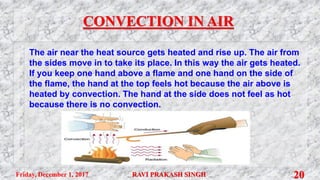
The air near the heat source gets heated and rise up. The air from
the sides move in to take its place. In this way the air gets heated.
If you keep one hand above a flame and one hand on the side of
the flame, the hand at the top feels hot because the air above is
heated by convection. The hand at the side does not feel as hot
because there is no convection.
SEA BREEZE AND LAND BREEZE :-
Friday, December 1, 2017 RAVI PRAKASH SINGH 21
i) Sea breeze :-
During the day the land gets heated faster than the sea. So the air above the land
gets heated becomes hotter and rises up and cool air from the sea moves towards
the land. This is called sea breeze.
ii) Land breeze :-
During the night sea cools down slowly than the land. So the hot air above the sea
rises up and cool air from the land moves towards the sea. This called land breeze.
SEA & LAND BREEZES, MONSOONS
Friday, December 1, 2017 RAVI PRAKASH SINGH 22
SEA BREEZE…
Air moves
from the
sea during
the day.
Friday, December 1, 2017 RAVI PRAKASH SINGH 23
LAND BREEZE….
air moves
from the
land at
night
Friday, December 1, 2017 RAVI PRAKASH SINGH 24
RADIATION :-
Friday, December 1, 2017 RAVI PRAKASH SINGH 25
Radiation is the process by which heat is transferred from one place
to another without the help of any medium. E.g. :- The heat from the
sun reaches the earth by radiation.
When we sit near a fire we feel warm due to the heat radiated by the
fire. All hot bodies radiate heat.
Heat From the Sun
 You can feel the sun warm your skin on a sunny day.
 This is because the energy causes the particles in
your skin to move faster = more heat energy.
Friday, December 1, 2017 RAVI PRAKASH SINGH 26
DARK COLOURED SURFACES AND COLOURED SURFACES
Friday, December 1, 2017 RAVI PRAKASH SINGH 27
Dark coloured surfaces absorb more heat than light coloured surfaces
Take two tin cans of the same size. Paint the outer surface of one black and the other
white. Pour equal amounts of water in each and leave them in sunlight for about one
hour. Measure the temperature of water in both the cans. The water in the black can is
warmer than the water in the white can.
Dark coloured surfaces radiate more heat than light coloured surfaces
Take two tin cans of the same size. Paint the outer surface of one black and the other
white. Pour equal amounts of hot water of the same temperature (say 600C). Leave them
in a room or shade for 10 to 15 minutes. Measure the temperature of water in both the
cans. The water in the black can is cooler than the water in the white can.
KINDS OF CLOTH WE WEAR IN SUMMER AND WINTER
Friday, December 1, 2017 RAVI PRAKASH SINGH 28
Dark coloured surfaces absorb more heat than light
coloured surfaces.
Dark coloured surfaces radiate more heat than light
coloured surfaces.
We wear dark coloured clothes in winter because it
absorbs more heat and keep us warm.
We wear light coloured clothes in summer because it
reflects most of the heat and keeps us cool.
We wear woolen clothes in winter because wool is a
poor conductor of heat and the air in between the wool
fibers prevents loss of heat from our body. So we feel
warm.
CONDUCTION , CONVECTION & RADIATION
Friday, December 1, 2017 RAVI PRAKASH SINGH 29
WIND
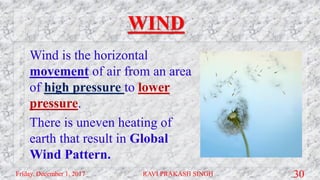
Wind is the horizontal
movement of air from an area
of high pressure to lower
pressure.
There is uneven heating of
earth that result in Global
Wind Pattern.
Friday, December 1, 2017 RAVI PRAKASH SINGH 30
TWO TYPES OF WINDS
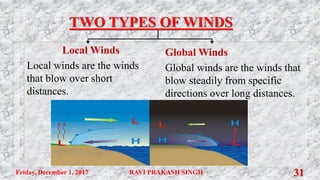
Local Winds
Local winds are the winds
that blow over short
distances.
Global Winds
Global winds are the winds that
blow steadily from specific
directions over long distances.
Friday, December 1, 2017 RAVI PRAKASH SINGH 31
WIND
Wind is caused by:
1) Differences in
temperature.
2) Differences in
pressure.
Friday, December 1, 2017 RAVI PRAKASH SINGH 32
DIFFERENCES IN TEMPERATURE
 1. Warm air rises.
– Warming air make the molecules
move faster and spread out.
– This makes the air less dense.
– Less dense air is light and will
rise.
Friday, December 1, 2017 RAVI PRAKASH SINGH 33
DIFFERENCES IN TEMPERATURE
 2. Cold air sinks.
– Cooling air makes the
molecules move slower
and group together.
– This makes the air more
dense.
– More dense air will sink.
Friday, December 1, 2017 RAVI PRAKASH SINGH 34
DIFFERENCES IN PRESSURE
 1. Rising air creates Low pressure.
– If air is lifted up, that means there is Less air
pushing down on Earth.
 2. Sinking air creates High pressure.
– If air is sinking, then air is pushing down on the
surface of Earth with a High amount of pressure.
Friday, December 1, 2017 RAVI PRAKASH SINGH 35
Friday, December 1, 2017 RAVI PRAKASH SINGH 36

Chapter – 4 heat class_7

  • 1.
    CHAPTER – 4 HEAT Friday,December 1, 2017 RAVI PRAKASH SINGH 1 CLASS :- VII MADE BY :- RAVI PRAKASH SINGH SUBJECT :- PHYSICS
  • 2.
    HEAT Friday, December 1,2017 RAVI PRAKASH SINGH 2 Heat is form of energy flowing from one body of matter to another spontaneously due to their temperature difference.. CHARACTERISTIC OF HEAT Heat always transfer from body of higher temperature to body of lower temperature or heat flows spontaneously from a hotter body to a cooler body
  • 3.
    Hot and cold:- Friday, December 1, 2017 RAVI PRAKASH SINGH 3 Hot and cold :- In our daily life we come across a number of objects. Some of them are hot and some of them are cold. E.g. - Tea is hot and ice is cold. Some objects are hotter than others and some are colder than others. We often decide which object is hotter than the other by touching the objects. We cannot always rely on our sense of touch to decide how hot or how cold an object is. The hotness of an object is measured by its temperature. When we add heat to body, motion of its particle increase When we remove heat from body, motion of its particle decrease
  • 4.
    TEMPERATURE Temperature is ameasure of the degree of hotness or coldness of an object. The temperature of something tells us how hot or cold something is. Friday, December 1, 2017 RAVI PRAKASH SINGH 4
  • 5.
    EFFECT OF HEAT Whenbody is heated various types of physical & chemical change take place.  PHYSICAL CHANGES a) CHANGE IN TEMPERATURE On adding heat to body, its temperature increase. On removal of heat from body, its temperature decrease. b) CHANGE OF STATE On addition or removal of heat to/from body, there is change in state of body. Ex- change of ice to water on addition of heat etc. c) THERMAL EXPANSION The phenomenon of expansion of matter on heating is called thermal expansion.  CHEMICAL CHANGES On heating reactant , many case chemical changes take place. Friday, December 1, 2017 RAVI PRAKASH SINGH 5
  • 6.
    MEASUREMENT OF TEMPERATURE:-  Temperature is measured by a device called thermometer.  Temperature is measured in degrees.  Temperature is measured on two scales: Celsius and Fahrenheit.  °C is the symbol for the Celsius scale.  °F is the symbol for the Fahrenheit scale.  The Fahrenheit scale is the most popular in the United States.  Celsius Scale is most commonly used in the Canada.  THERMOMETER :-  Thermometer is an instrument that is used to measure temperature Friday, December 1, 2017 RAVI PRAKASH SINGH 6 37 °C 98.6 °F
  • 7.
    Measurement of temperature Thereare three scale of measurement of temperature. These are :- 1) Degree Celsius (0 C) 2) Degree Fahrenheit (0 F) 3) Kelvin (K) On the Celsius scale , the freezing point of water is 00C whereas its boiling point is 1000C. So this scale is calibrate from 00C to 1000C. On the Fahrenheit scale , the freezing point of water is 320F whereas its boiling point is 2120F. So this scale is calibrate from 320F to 2120F. Conversion of Celsius scale into Fahrenheit scale 0F= 0C *( 9/5) + 32 Conversion of Fahrenheit scale into Celsius scale 0C=( 0 F - 32) *( 5/9) Conversion of Celsius scale into Kelvin scale 0K = 0C +273.15 Friday, December 1, 2017 RAVI PRAKASH SINGH 7
  • 8.
    CLINICAL THERMOMETERS The thermometerthat measures the temperature of our body is called clinical thermometer. Friday, December 1, 2017 RAVI PRAKASH SINGH 8 (Kink)
  • 9.
    CONSTRUCTION OF CLINICALTHERMOMETER A clinical thermometer has a long narrow glass tube. It has a bulb at one end containing mercury. It has a scale called Celsius scale marked in °C (degree Celsius). A clinical thermometer reads temperature from 35 °C to 42 °C. The clinical thermometer has a small kink (constriction) near the bulb to prevent the mercury level from falling down. The normal temperature of the human body is 37 °C. Friday, December 1, 2017 RAVI PRAKASH SINGH 9
  • 10.
    READING A CLINICALTHERMOMETER Friday, December 1, 2017 RAVI PRAKASH SINGH 10 Wash the thermometer with an antiseptic solution. Hold it firmly and give it a few jerks to bring the level of mercury below 35 °C. Then place the bulb of the thermometer under your tongue. After one minute take out the thermometer and note the reading. This will be your body temperature.
  • 11.
    DIGITAL THERMOMETERS Digital (electronic)thermometers are preferred over conventional mercury thermometer. Digital thermometers are easy to read because it gives LCD Display of the temperature of the person. They are also mercury free. Friday, December 1, 2017 RAVI PRAKASH SINGH 11
  • 12.
    LABORATORY THERMOMETER :- Friday,December 1, 2017 RAVI PRAKASH SINGH 12 A laboratory thermometer has a long narrow glass tube. It has a bulb at one end containing mercury. It has a scale marked in °C (degree Celsius). The range of a laboratory thermometer is generally from - 10 °C to 110 °C.
  • 13.
    MEASURING TEMPERATURE WITHA LABORATORY THERMOMETER Friday, December 1, 2017 RAVI PRAKASH SINGH 13 Take some tap water in a beaker. Dip the thermometer in the water so that the bulb of the thermometer does not touch the bottom or the sides of the beaker. Hold the thermometer vertically. The mercury level rises. Wait till the level of mercury becomes steady. Note the level of mercury. This will be the temperature of the water.
  • 14.
    6) TRANSFER OFHEAT :- Friday, December 1, 2017 RAVI PRAKASH SINGH 14 6) Transfer of heat :- Heat flows from a body at a higher temperature to a body at a lower temperature. This is called transfer of heat. Heat is transferred in three different ways. They are :- i) Conduction ii) Convection iii) Radiation
  • 15.
    CONDUCTION Friday, December 1,2017 RAVI PRAKASH SINGH 15 Conduction is the process by which heat is transferred in solids from the hotter end to the colder end. Activity :- Take an iron or aluminium rod or strip. Fix a few wax pieces on at equal distances. Clamp the rod to a stand. Heat the other end of the rod. The wax pieces begin to melt and fall down from the heated end. This shows that heat is transferred from the hotter end to the colder end by conduction. Q Q
  • 16.
    CONDUCTION  Transfer ofheat through direct contact.  Occurs anytime objects at different temperatures are touching each other.  As long as the objects are in contact, transfer of heat will continue until the temperature of the objects is the same.  Example: If you leave a metal spoon in a pan of soup that you are heating on the stove, it may burn your fingers. The spoon is in direct contact with the hot soup and heat is transferred to the spoon. Friday, December 1, 2017 RAVI PRAKASH SINGH 16
  • 17.
    CONDUCTORS AND INSULATORS:- Friday, December 1, 2017 RAVI PRAKASH SINGH 17 Conductors :- Conductors are materials which allow heat to pass through them easily. E.g. :- iron, aluminium, copper etc. Insulators :- Insulators are materials which do not allow heat to pass through them easily. E.g. :- wood, plastic, glass, rubber, air, water etc. Insulators Conductors
  • 18.
    CONVECTION Friday, December 1,2017 RAVI PRAKASH SINGH 18 Convection is the process by which heat is transferred in liquids and gases from the hotter part to the colder part. Activity :- Take some water in a round bottom flask. Keep it on a tripod stand. Put a crystal of potassium permanganate in it. Heat it with a burner. The water at the bottom becomes hot and rises up and cold water from the top moves down. This water becomes hot and rises up and cold water from the top moves down and the process continues till all the water gets heated. This shows that heat is transferred by convection.
  • 19.
    Convection  The transferof energy in a liquid or gas.  When part of a gas or liquid is heated, the particles it is made up of move faster and spread out more.  The moving particles bump into other particles, causing them to move faster and spread out more. Friday, December 1, 2017 RAVI PRAKASH SINGH 19
  • 20.
    CONVECTION IN AIR Friday,December 1, 2017 RAVI PRAKASH SINGH 20 The air near the heat source gets heated and rise up. The air from the sides move in to take its place. In this way the air gets heated. If you keep one hand above a flame and one hand on the side of the flame, the hand at the top feels hot because the air above is heated by convection. The hand at the side does not feel as hot because there is no convection.
  • 21.
    SEA BREEZE ANDLAND BREEZE :- Friday, December 1, 2017 RAVI PRAKASH SINGH 21 i) Sea breeze :- During the day the land gets heated faster than the sea. So the air above the land gets heated becomes hotter and rises up and cool air from the sea moves towards the land. This is called sea breeze. ii) Land breeze :- During the night sea cools down slowly than the land. So the hot air above the sea rises up and cool air from the land moves towards the sea. This called land breeze.
  • 22.
    SEA & LANDBREEZES, MONSOONS Friday, December 1, 2017 RAVI PRAKASH SINGH 22
  • 23.
    SEA BREEZE… Air moves fromthe sea during the day. Friday, December 1, 2017 RAVI PRAKASH SINGH 23
  • 24.
    LAND BREEZE…. air moves fromthe land at night Friday, December 1, 2017 RAVI PRAKASH SINGH 24
  • 25.
    RADIATION :- Friday, December1, 2017 RAVI PRAKASH SINGH 25 Radiation is the process by which heat is transferred from one place to another without the help of any medium. E.g. :- The heat from the sun reaches the earth by radiation. When we sit near a fire we feel warm due to the heat radiated by the fire. All hot bodies radiate heat.
  • 26.
    Heat From theSun  You can feel the sun warm your skin on a sunny day.  This is because the energy causes the particles in your skin to move faster = more heat energy. Friday, December 1, 2017 RAVI PRAKASH SINGH 26
  • 27.
    DARK COLOURED SURFACESAND COLOURED SURFACES Friday, December 1, 2017 RAVI PRAKASH SINGH 27 Dark coloured surfaces absorb more heat than light coloured surfaces Take two tin cans of the same size. Paint the outer surface of one black and the other white. Pour equal amounts of water in each and leave them in sunlight for about one hour. Measure the temperature of water in both the cans. The water in the black can is warmer than the water in the white can. Dark coloured surfaces radiate more heat than light coloured surfaces Take two tin cans of the same size. Paint the outer surface of one black and the other white. Pour equal amounts of hot water of the same temperature (say 600C). Leave them in a room or shade for 10 to 15 minutes. Measure the temperature of water in both the cans. The water in the black can is cooler than the water in the white can.
  • 28.
    KINDS OF CLOTHWE WEAR IN SUMMER AND WINTER Friday, December 1, 2017 RAVI PRAKASH SINGH 28 Dark coloured surfaces absorb more heat than light coloured surfaces. Dark coloured surfaces radiate more heat than light coloured surfaces. We wear dark coloured clothes in winter because it absorbs more heat and keep us warm. We wear light coloured clothes in summer because it reflects most of the heat and keeps us cool. We wear woolen clothes in winter because wool is a poor conductor of heat and the air in between the wool fibers prevents loss of heat from our body. So we feel warm.
  • 29.
    CONDUCTION , CONVECTION& RADIATION Friday, December 1, 2017 RAVI PRAKASH SINGH 29
  • 30.
    WIND Wind is thehorizontal movement of air from an area of high pressure to lower pressure. There is uneven heating of earth that result in Global Wind Pattern. Friday, December 1, 2017 RAVI PRAKASH SINGH 30
  • 31.
    TWO TYPES OFWINDS Local Winds Local winds are the winds that blow over short distances. Global Winds Global winds are the winds that blow steadily from specific directions over long distances. Friday, December 1, 2017 RAVI PRAKASH SINGH 31
  • 32.
    WIND Wind is causedby: 1) Differences in temperature. 2) Differences in pressure. Friday, December 1, 2017 RAVI PRAKASH SINGH 32
  • 33.
    DIFFERENCES IN TEMPERATURE 1. Warm air rises. – Warming air make the molecules move faster and spread out. – This makes the air less dense. – Less dense air is light and will rise. Friday, December 1, 2017 RAVI PRAKASH SINGH 33
  • 34.
    DIFFERENCES IN TEMPERATURE 2. Cold air sinks. – Cooling air makes the molecules move slower and group together. – This makes the air more dense. – More dense air will sink. Friday, December 1, 2017 RAVI PRAKASH SINGH 34
  • 35.
    DIFFERENCES IN PRESSURE 1. Rising air creates Low pressure. – If air is lifted up, that means there is Less air pushing down on Earth.  2. Sinking air creates High pressure. – If air is sinking, then air is pushing down on the surface of Earth with a High amount of pressure. Friday, December 1, 2017 RAVI PRAKASH SINGH 35
  • 36.
    Friday, December 1,2017 RAVI PRAKASH SINGH 36