CLUSTER COMPUTING
(COMPUTER ARCHITECTURE AND PARALLEL PROCCESING)
RAGURAM R.(18MU35)
M.E- EMBEDDED AND REAL-TIME SYSTEMS
PSG COLLEGE OF TECHNOLOGY
START
OVERVIEW:
 WHAT IS CLUSTER?
 STAND ALONE SERVER/STANDARD SERVER
 SERVER WITH REDUNDANCY
 WAYS OF CLUSTERS
 TYPES OF CLUSTERS
 CLUSTER COMPONENTS
 CLASSIFICATIONS OF CLUSTER
 APPLICATIONS OF CLUSTERS
 BENEFITS OF CLUSTERS
 CONCLUSION
2
WHAT IS CLUSTER?
 Cluster computing is the technique of linking two or more computers into a network in
to take advantage of the parallel processing power of those computers.
 Clusters are commonly connected through fast local area networks.
 In cluster computing each node within a cluster is an independent system, with its own
operating system, private memory, and, in some cases, its own file system.
 Cluster computing can used as a relatively low- cost form of parallel processing for scientific
and other applications that lend themselves to parallel operations.
3
STAND ALONE SERVER/STANDARD SERVER:
 Stand alone server means there is only one OS and other components to service the work
the clients.
 Client can use the server with the help of IP address.
 Main disadvantage of this as if any fault in any components clients cant make use of it.
NETWORK
SWITCH
192.28.2.1
4
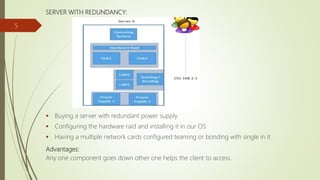
SERVER WITH REDUNDANCY:
 Buying a server with redundant power supply
 Configuring the hardware raid and installing it in our OS
 Having a multiple network cards configured teaming or bonding with single in it
Advantages:
Any one component goes down other one helps the client to access.
5
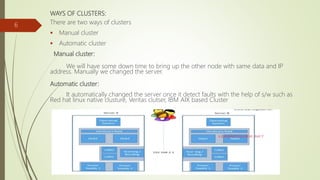
WAYS OF CLUSTERS:
There are two ways of clusters
 Manual cluster
 Automatic cluster
Manual cluster:
We will have some down time to bring up the other node with same data and IP
address. Manually we changed the server.
Automatic cluster:
It automatically changed the server once it detect faults with the help of s/w such as
Red hat linux native clusture, Veritas clutser, IBM AIX based Cluster
6
TYPES OF CLUSTERS:
There are three types of clusters,
 High Availability or FailoverClusters
 Load Balancing Cluster
 Parallel/Distributed Processing Clusters
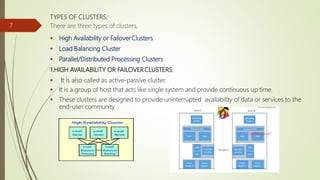
1.HIGH AVAILABILITY OR FAILOVERCLUSTERS:
 It is also called as active-passive cluster.
 It is a group of host that acts like single system and provide continuous up time.
 These clusters are designed to provide uninterrupted availability of data or services to the
end-user community.
7
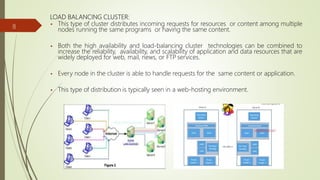
LOAD BALANCING CLUSTER:
 This type of cluster distributes incoming requests for resources or content among multiple
nodes running the same programs or having the same content.
 Both the high availability and load-balancing cluster technologies can be combined to
increase the reliability, availability, and scalability of application and data resources that are
widely deployed for web, mail, news, or FTP services.
 Every node in the cluster is able to handle requests for the same content or application.
 This type of distribution is typically seen in a web-hosting environment.
8
PARALLEL/DISTRIBUTED PROCESSING CLUSTERS
• parallel processing was performed by multiple processors in a specially designed parallel
computer.
• These are systems in which multiple processors share a single memory and bus interface
within a single computer.
• These types of cluster increase availability, performance, and scalability for applications,
particularly computationally or data intensive tasks.
9
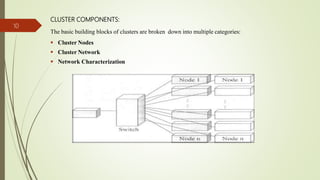
CLUSTER COMPONENTS:
The basic building blocks of clusters are broken down into multiple categories:
 Cluster Nodes
 Cluster Network
 Network Characterization
10
CLASSIFICATIONS OF CLUSTER:
 Open cluster
 Close cluster
OPEN CLUSTURE:
All node can be seen from outside, hence it required more IP’s and security concern. But
they are more flexible and used for internet or web server task[1].
CLOSE CLUSTER:
Hide most of the cluster behind the gateway node. Consequently they need less IP’s and
provides better security. These are good for computing task[2].
1.Open clusture 2.close clusture
11
APPLICATIONS OF CLUSTERS:
There are three primary categories of applications that use parallel clusters:
1.Compute IntensiveApplication.
2.Data or I/O IntensiveApplications.
3.Transaction IntensiveApplications.
Some other applications are,
 Earthquake simulation.
 Google Search Engine
 Image Rendring
12
BENEFITS OF CLUSTERS:
 Great processing power
 Availability
 Expandability‘
 Reliability
 Cost efficient
13
CONCLUSION:
 Cluster computing offers a comparatively cheap alternative to large server main frame
computer solutions.
 Cluster based super computer seen everywhere in now a days
 New trends in H/w & S/W technologies are likely to make clusters more promising
14
Thank you……
END.

Cluster computings

  • 1.
    CLUSTER COMPUTING (COMPUTER ARCHITECTUREAND PARALLEL PROCCESING) RAGURAM R.(18MU35) M.E- EMBEDDED AND REAL-TIME SYSTEMS PSG COLLEGE OF TECHNOLOGY START
  • 2.
    OVERVIEW:  WHAT ISCLUSTER?  STAND ALONE SERVER/STANDARD SERVER  SERVER WITH REDUNDANCY  WAYS OF CLUSTERS  TYPES OF CLUSTERS  CLUSTER COMPONENTS  CLASSIFICATIONS OF CLUSTER  APPLICATIONS OF CLUSTERS  BENEFITS OF CLUSTERS  CONCLUSION 2
  • 3.
    WHAT IS CLUSTER? Cluster computing is the technique of linking two or more computers into a network in to take advantage of the parallel processing power of those computers.  Clusters are commonly connected through fast local area networks.  In cluster computing each node within a cluster is an independent system, with its own operating system, private memory, and, in some cases, its own file system.  Cluster computing can used as a relatively low- cost form of parallel processing for scientific and other applications that lend themselves to parallel operations. 3
  • 4.
    STAND ALONE SERVER/STANDARDSERVER:  Stand alone server means there is only one OS and other components to service the work the clients.  Client can use the server with the help of IP address.  Main disadvantage of this as if any fault in any components clients cant make use of it. NETWORK SWITCH 192.28.2.1 4
  • 5.
    SERVER WITH REDUNDANCY: Buying a server with redundant power supply  Configuring the hardware raid and installing it in our OS  Having a multiple network cards configured teaming or bonding with single in it Advantages: Any one component goes down other one helps the client to access. 5
  • 6.
    WAYS OF CLUSTERS: Thereare two ways of clusters  Manual cluster  Automatic cluster Manual cluster: We will have some down time to bring up the other node with same data and IP address. Manually we changed the server. Automatic cluster: It automatically changed the server once it detect faults with the help of s/w such as Red hat linux native clusture, Veritas clutser, IBM AIX based Cluster 6
  • 7.
    TYPES OF CLUSTERS: Thereare three types of clusters,  High Availability or FailoverClusters  Load Balancing Cluster  Parallel/Distributed Processing Clusters 1.HIGH AVAILABILITY OR FAILOVERCLUSTERS:  It is also called as active-passive cluster.  It is a group of host that acts like single system and provide continuous up time.  These clusters are designed to provide uninterrupted availability of data or services to the end-user community. 7
  • 8.
    LOAD BALANCING CLUSTER: This type of cluster distributes incoming requests for resources or content among multiple nodes running the same programs or having the same content.  Both the high availability and load-balancing cluster technologies can be combined to increase the reliability, availability, and scalability of application and data resources that are widely deployed for web, mail, news, or FTP services.  Every node in the cluster is able to handle requests for the same content or application.  This type of distribution is typically seen in a web-hosting environment. 8
  • 9.
    PARALLEL/DISTRIBUTED PROCESSING CLUSTERS •parallel processing was performed by multiple processors in a specially designed parallel computer. • These are systems in which multiple processors share a single memory and bus interface within a single computer. • These types of cluster increase availability, performance, and scalability for applications, particularly computationally or data intensive tasks. 9
  • 10.
    CLUSTER COMPONENTS: The basicbuilding blocks of clusters are broken down into multiple categories:  Cluster Nodes  Cluster Network  Network Characterization 10
  • 11.
    CLASSIFICATIONS OF CLUSTER: Open cluster  Close cluster OPEN CLUSTURE: All node can be seen from outside, hence it required more IP’s and security concern. But they are more flexible and used for internet or web server task[1]. CLOSE CLUSTER: Hide most of the cluster behind the gateway node. Consequently they need less IP’s and provides better security. These are good for computing task[2]. 1.Open clusture 2.close clusture 11
  • 12.
    APPLICATIONS OF CLUSTERS: Thereare three primary categories of applications that use parallel clusters: 1.Compute IntensiveApplication. 2.Data or I/O IntensiveApplications. 3.Transaction IntensiveApplications. Some other applications are,  Earthquake simulation.  Google Search Engine  Image Rendring 12
  • 13.
    BENEFITS OF CLUSTERS: Great processing power  Availability  Expandability‘  Reliability  Cost efficient 13
  • 14.
    CONCLUSION:  Cluster computingoffers a comparatively cheap alternative to large server main frame computer solutions.  Cluster based super computer seen everywhere in now a days  New trends in H/w & S/W technologies are likely to make clusters more promising 14
  • 15.