Virtualization in Cloud Computing
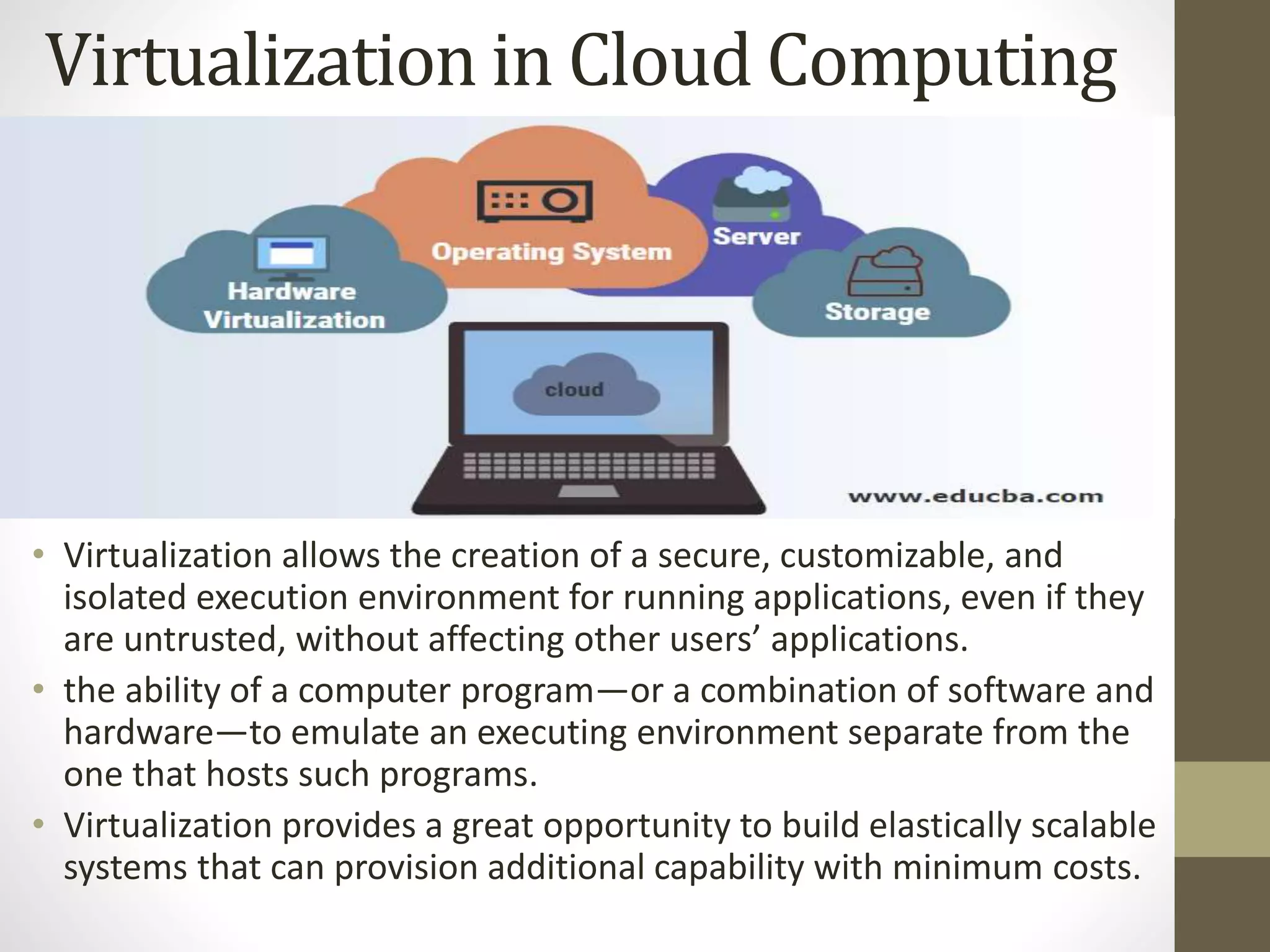
• Virtualization allows the creation of a secure, customizable, and
isolated execution environment for running applications, even if they
are untrusted, without affecting other users’ applications.
• the ability of a computer program—or a combination of software and
hardware—to emulate an executing environment separate from the
one that hosts such programs.
• Virtualization provides a great opportunity to build elastically scalable
systems that can provision additional capability with minimum costs.
• The term virtualization is often synonymous with hardware
virtualization.
Virtualization technologies have gained renewed interested recently
due to the confluence of several phenomena:
• Increased performance and computing capacity.
• Underutilized hardware and software resources.
• Lack of space.
• Greening initiatives.
• Rise of administrative costs.
Characteristicsof virtualizedenvironments
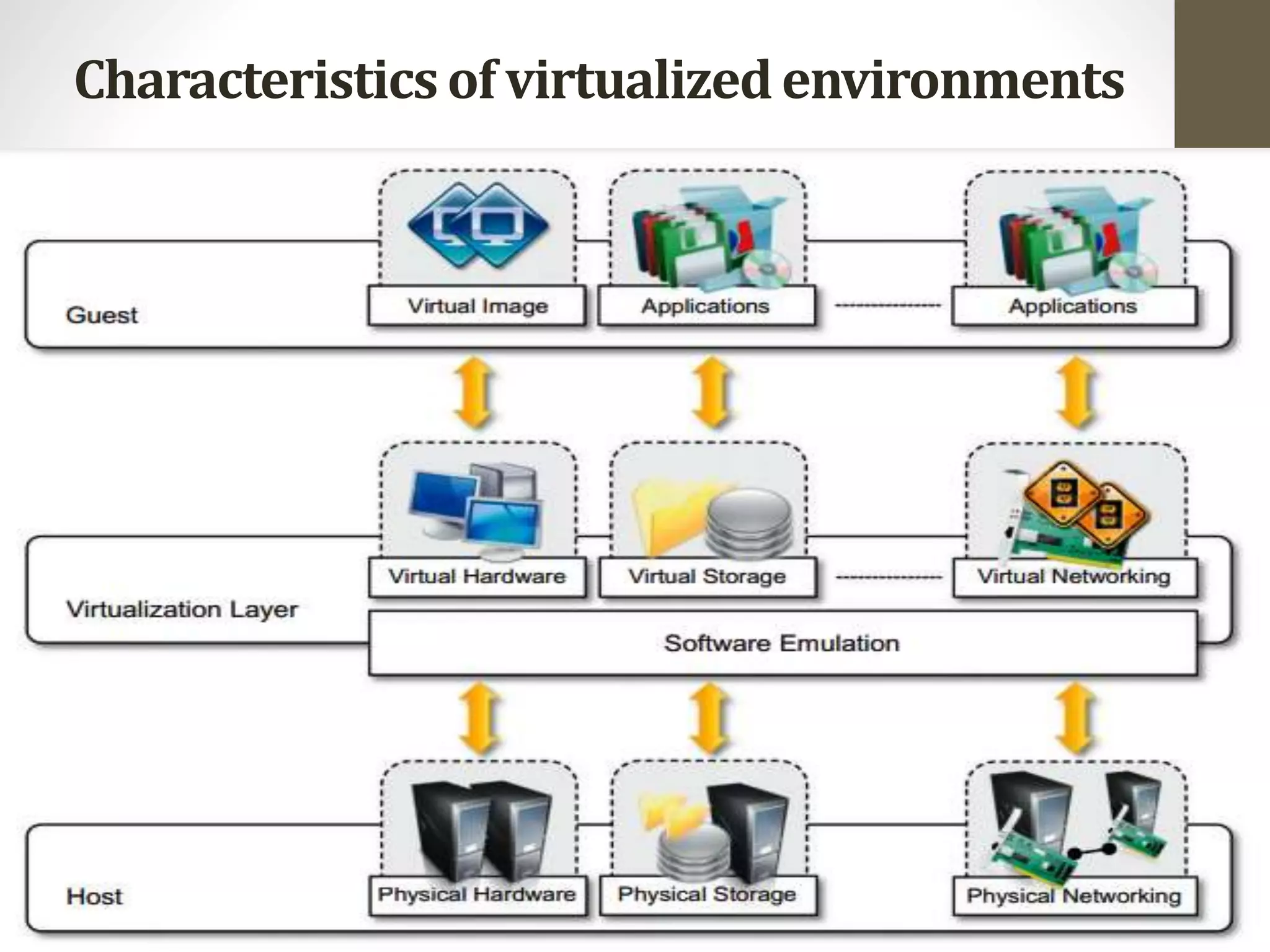
The main common characteristic of all these different
implementations is the fact that the virtual environment is created
by means of a software program.
The ability to use software to emulate such a wide variety of
environments creates a lot of opportunities, previously less attractive
because of excessive overhead introduced by the virtualization layer.
The technologies of today allow profitable use of virtualization and
make it possible to fully exploit the advantages that come with it.
Such advantages have always been characteristics of virtualized
solutions.
Increased security
The virtual machine represents an emulated environment in which
the guest is executed.
All the operations of the guest are generally performed against the
virtual machine, which then translates and applies them to the host.
This level of indirection allows the virtual machine manager to
control and filter the activity of the guest, thus preventing some
harmful operations from being performed.
Managed execution
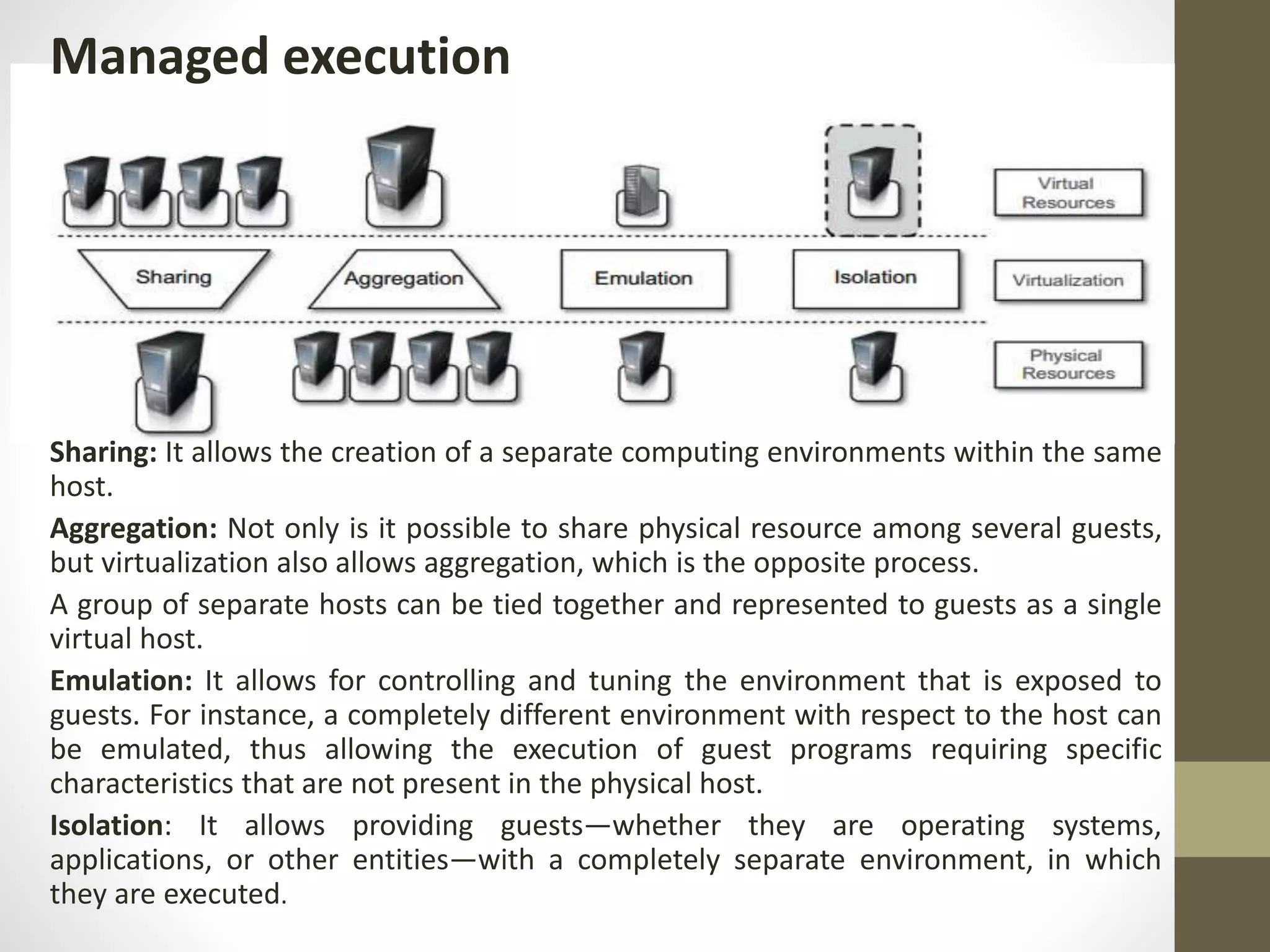
Sharing: It allows the creation of a separate computing environments within the same
host.
Aggregation: Not only is it possible to share physical resource among several guests,
but virtualization also allows aggregation, which is the opposite process.
A group of separate hosts can be tied together and represented to guests as a single
virtual host.
Emulation: It allows for controlling and tuning the environment that is exposed to
guests. For instance, a completely different environment with respect to the host can
be emulated, thus allowing the execution of guest programs requiring specific
characteristics that are not present in the physical host.
Isolation: It allows providing guests—whether they are operating systems,
applications, or other entities—with a completely separate environment, in which
they are executed.
Portability
It applies in different ways according to the specific type of virtualization
considered.
In the case of a hardware virtualization solution, the guest is packaged into a
virtual image that, in most cases, can be safely moved and executed on top of
different virtual machines.
In the case of programming-level virtualization, as implemented by the JVM
or the .NET runtime, the binary code representing application components
(jars or assemblies) can be run without any recompilation on any
implementation of the corresponding virtual machine.
One version of the application, in most cases, is able to run on different
platforms with no changes
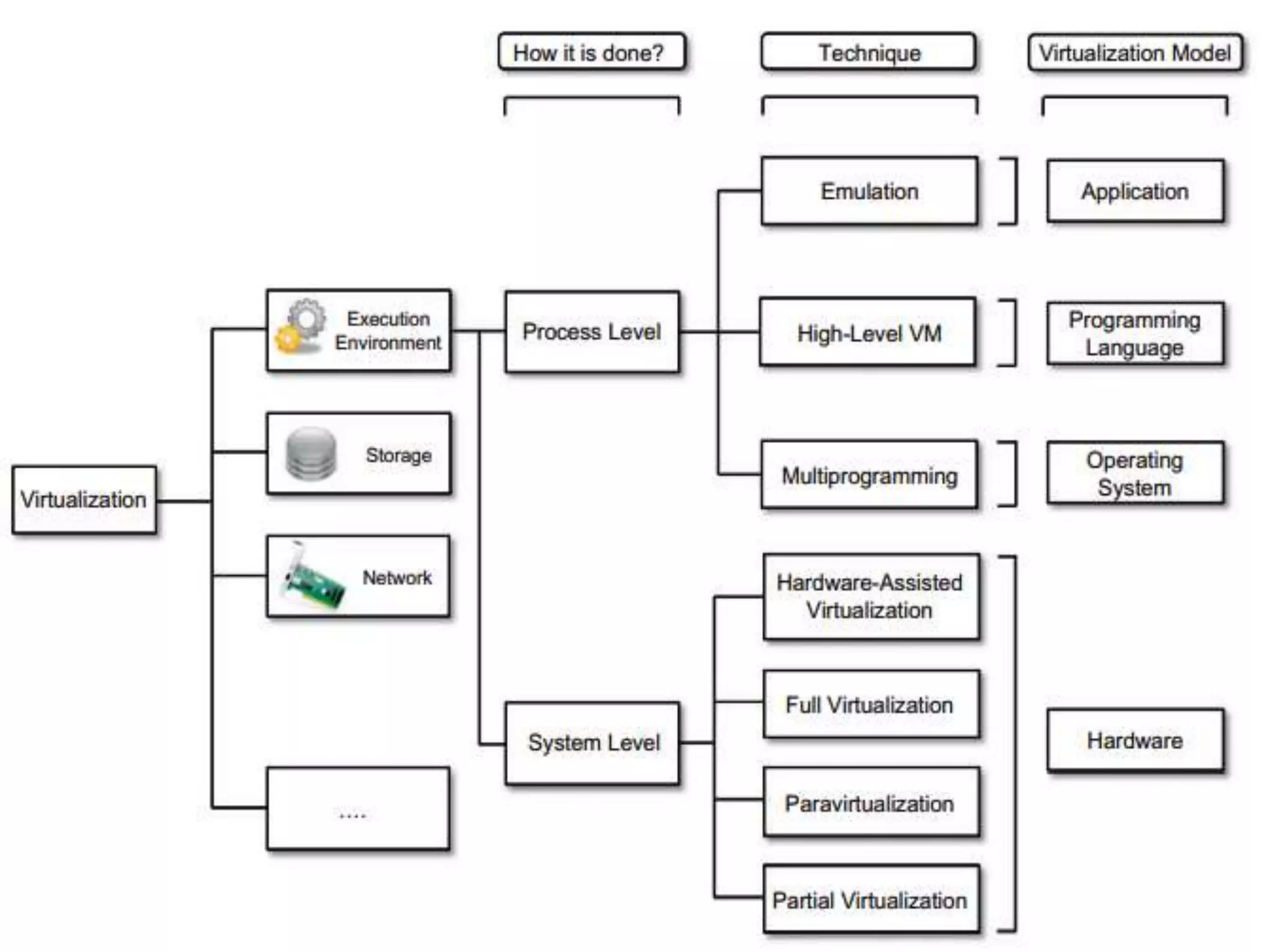
Taxonomy of Virtualization Techniques
• Virtualization covers a wide range of emulation techniques that are
applied to different areas of computing.
• Virtualization is mainly used to emulate execution environments,
storage, and networks.
• Process-level techniques are implemented on top of an existing
operating system, which has full control of the hardware.
• System-level techniques are implemented directly on hardware and
do not require—or require a minimum of support from—an existing
operating system.
Execution virtualization
Execution virtualization includes all techniques that aim to emulate an
execution environment that is separate from the one hosting the
virtualization layer.
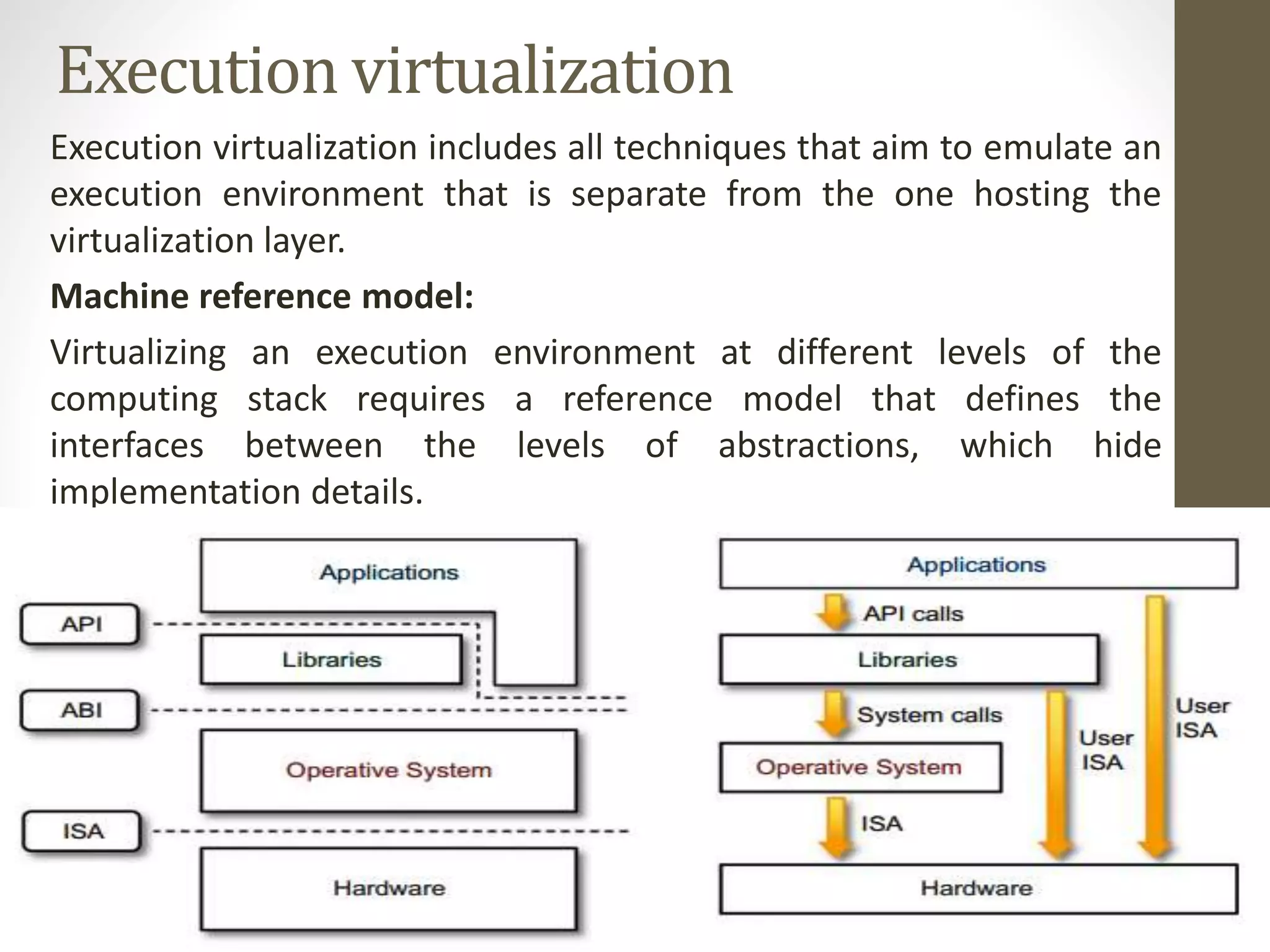
Machine reference model:
Virtualizing an execution environment at different levels of the
computing stack requires a reference model that defines the
interfaces between the levels of abstractions, which hide
implementation details.
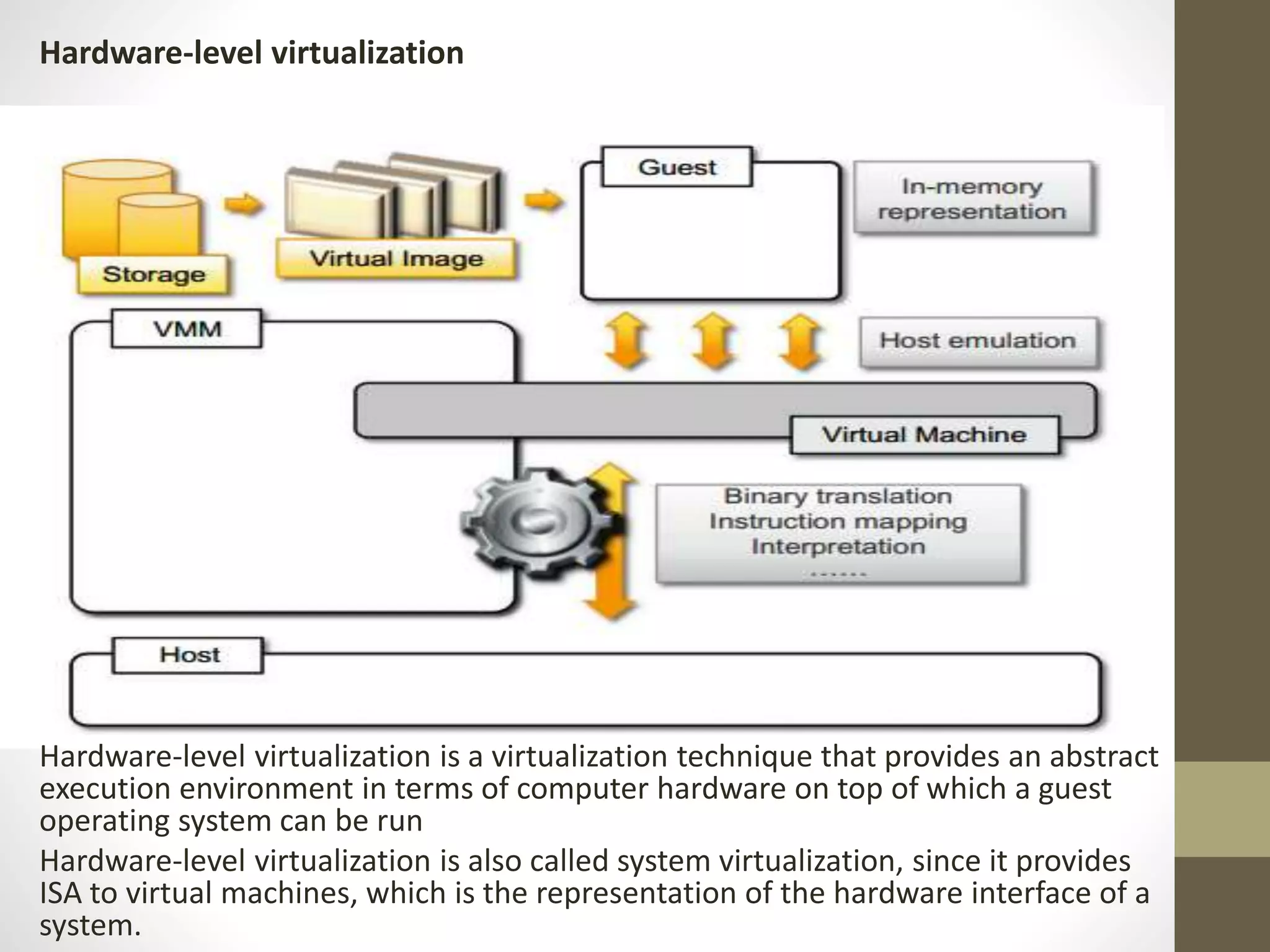
Hardware-level virtualization
Hardware-level virtualization is a virtualization technique that provides an abstract
execution environment in terms of computer hardware on top of which a guest
operating system can be run
Hardware-level virtualization is also called system virtualization, since it provides
ISA to virtual machines, which is the representation of the hardware interface of a
system.
Programming language-level virtualization:
It is mostly used to achieve ease of deployment of applications, managed
execution, and portability across different platforms and operating systems.
It consists of a virtual machine executing the byte code of a program, which is the
result of the compilation process.
Application-level virtualization:
Its allowing applications to be run in runtime environments that do not natively
support all the features required by such applications.
These techniques are mostly concerned with partial file systems, libraries, and
operating system component emulation.
Interpretation: Every source instruction is interpreted by an emulator for executing
native ISA instructions, leading to poor performance. Interpretation has a minimal
start-up cost but a huge overhead, since each instruction is emulated.
Binary translation: Every source instruction is converted to native instructions with
equivalent functions. After a block of instructions is translated, it is cached and
reused.
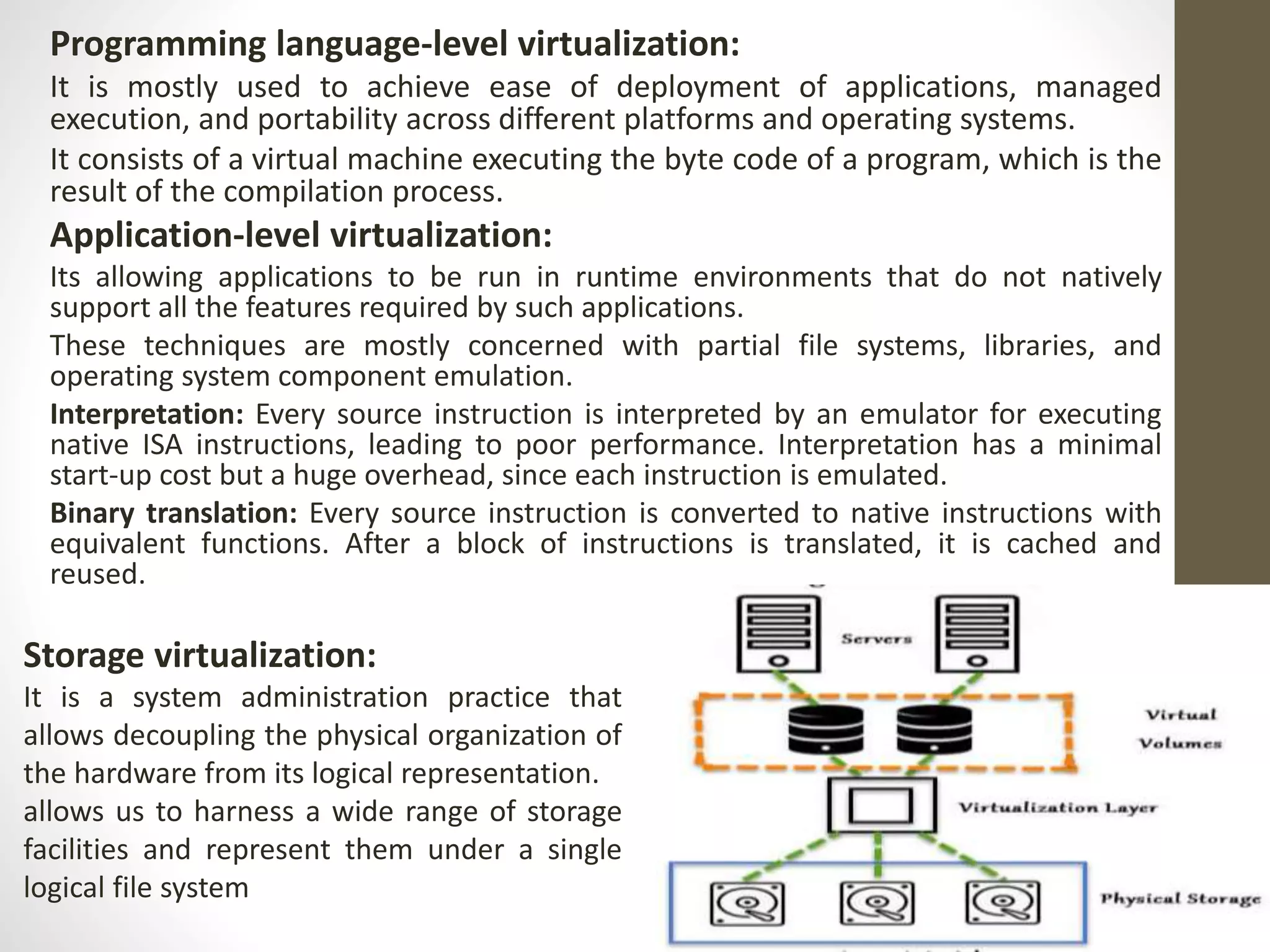
Storage virtualization:
It is a system administration practice that
allows decoupling the physical organization of
the hardware from its logical representation.
allows us to harness a wide range of storage
facilities and represent them under a single
logical file system
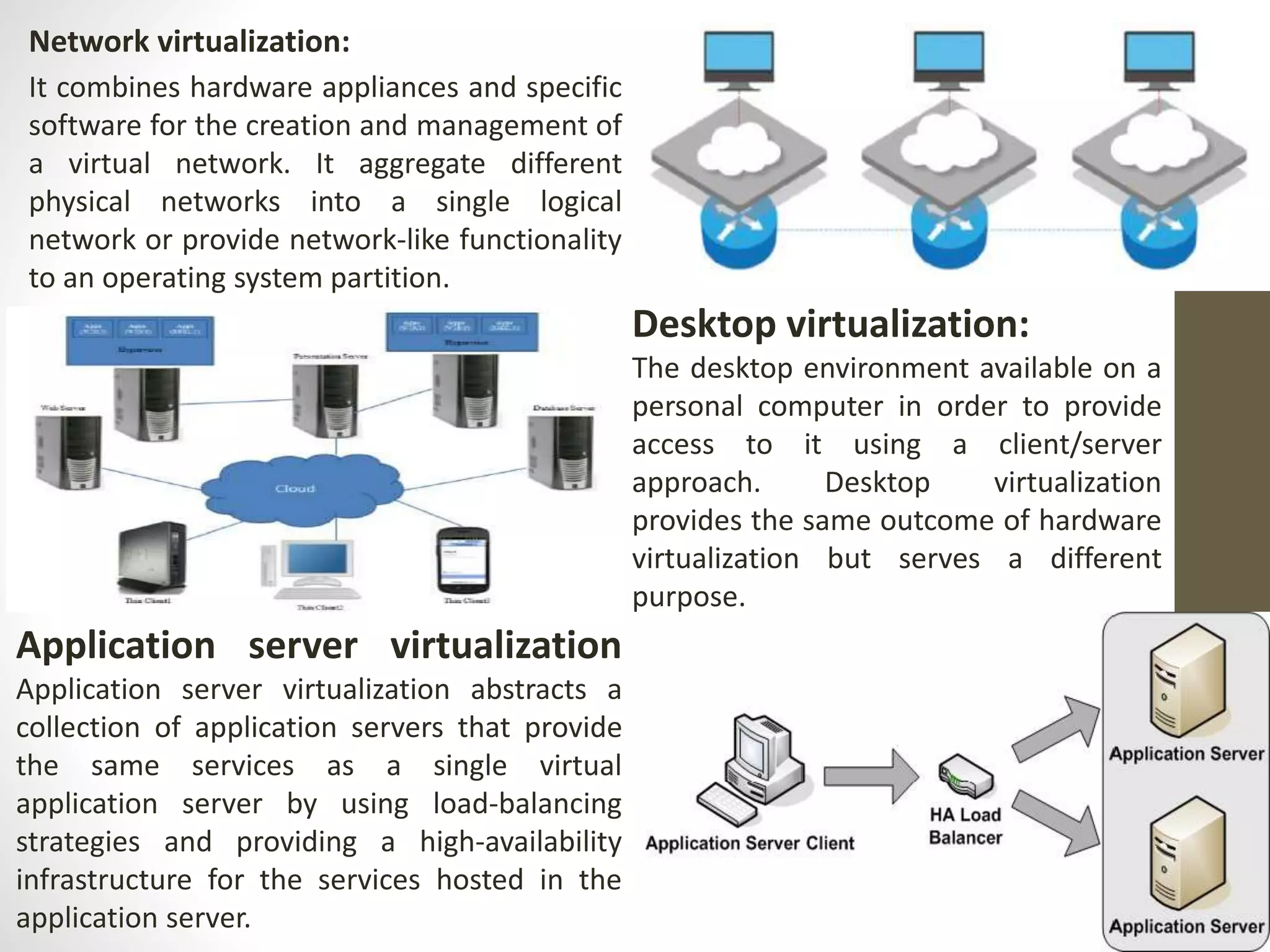
Network virtualization:
It combines hardware appliances and specific
software for the creation and management of
a virtual network. It aggregate different
physical networks into a single logical
network or provide network-like functionality
to an operating system partition.
Application server virtualization
Application server virtualization abstracts a
collection of application servers that provide
the same services as a single virtual
application server by using load-balancing
strategies and providing a high-availability
infrastructure for the services hosted in the
application server.
Desktop virtualization:
The desktop environment available on a
personal computer in order to provide
access to it using a client/server
approach. Desktop virtualization
provides the same outcome of hardware
virtualization but serves a different
purpose.
It allows for the appropriate degree of customization, security,
isolation, and manageability that are fundamental for delivering IT
services on demand.
Virtualization technologies are primarily used to offer configurable
computing environments and storage.
Hardware virtualization is an enabling factor for solutions in the
Infrastructure-as-a-Service (IaaS) market segment.
Programming language virtualization is a technology leveraged in
Platform-as-a-Service (PaaS) offerings.
Virtualization and cloud computing
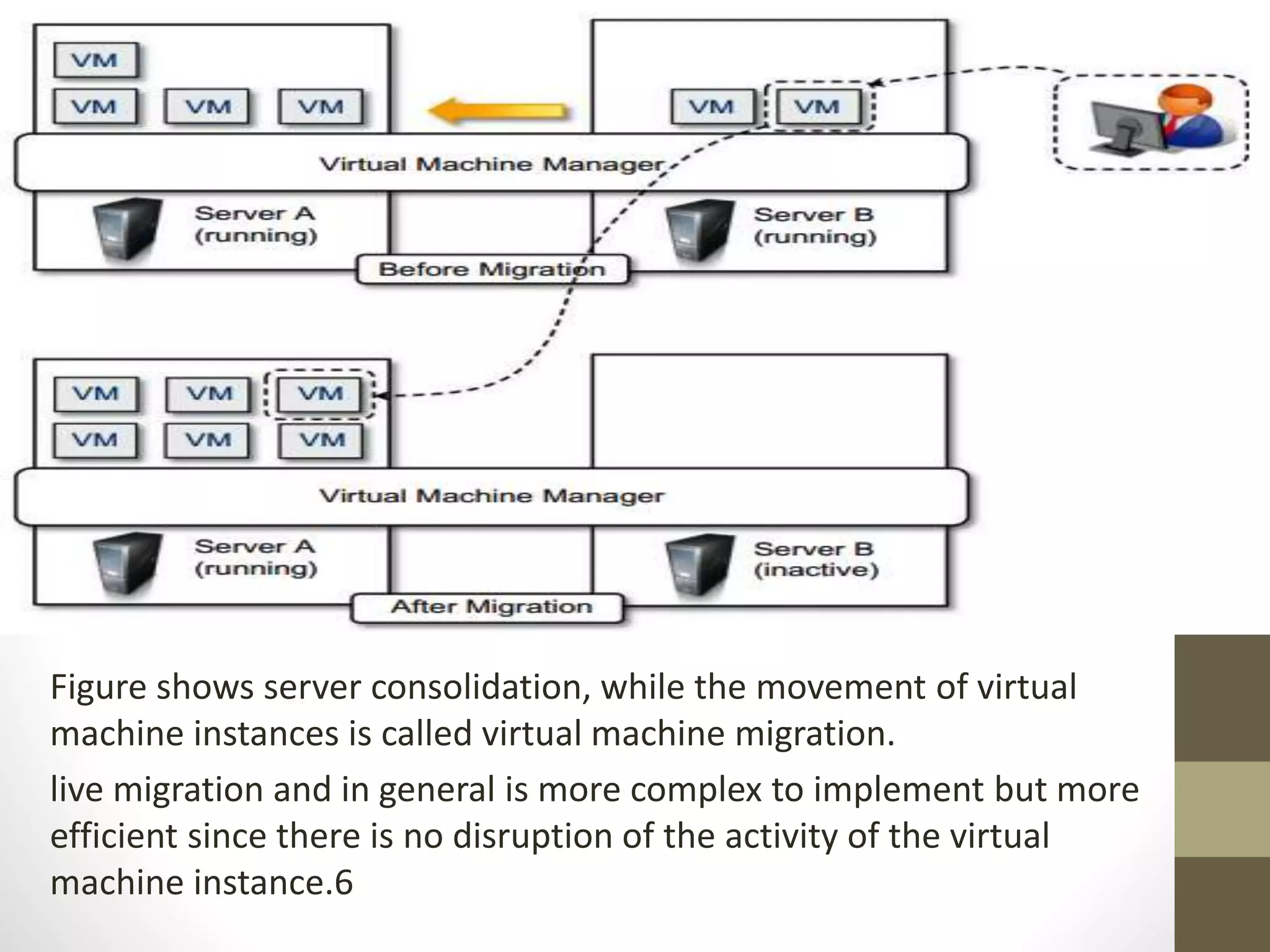
Figure shows server consolidation, while the movement of virtual
machine instances is called virtual machine migration.
live migration and in general is more complex to implement but more
efficient since there is no disruption of the activity of the virtual
machine instance.6
Pros and cons of virtualization
Advantages:
Managed execution and Isolation: these two characteristics allow
building secure and controllable computing environments.
A virtual execution environment can be configured as a sandbox, thus
preventing any harmful operation to cross the borders of the virtual
host.
Portability and self-containment: It used to execution virtualization
techniques.
Virtual machine instances are normally represented by one or more
files that can be easily transported with respect to physical systems.
Portability and self-containment contribute to reducing the costs of
maintenance, since the number of hosts is expected to be lower
than the number of virtual machine instances
Pros and cons of virtualization
Disadvantages:
Performance degradation:
• Maintaining the status of virtual processors
• Support of privileged instructions
• Support of paging within VM
• Console functions
Inefficiency and degraded user experience:
Some of the specific features of the host cannot be exposed by the
abstraction layer and then become inaccessible.
Security holes and new threats:
In the case of hardware virtualization, malicious programs can preload
themselves before the operating system and act as a thin virtual machine
manager toward it.
The operating system is then controlled and can be manipulated to extract
sensitive information of interest to third parties.
Technology examples
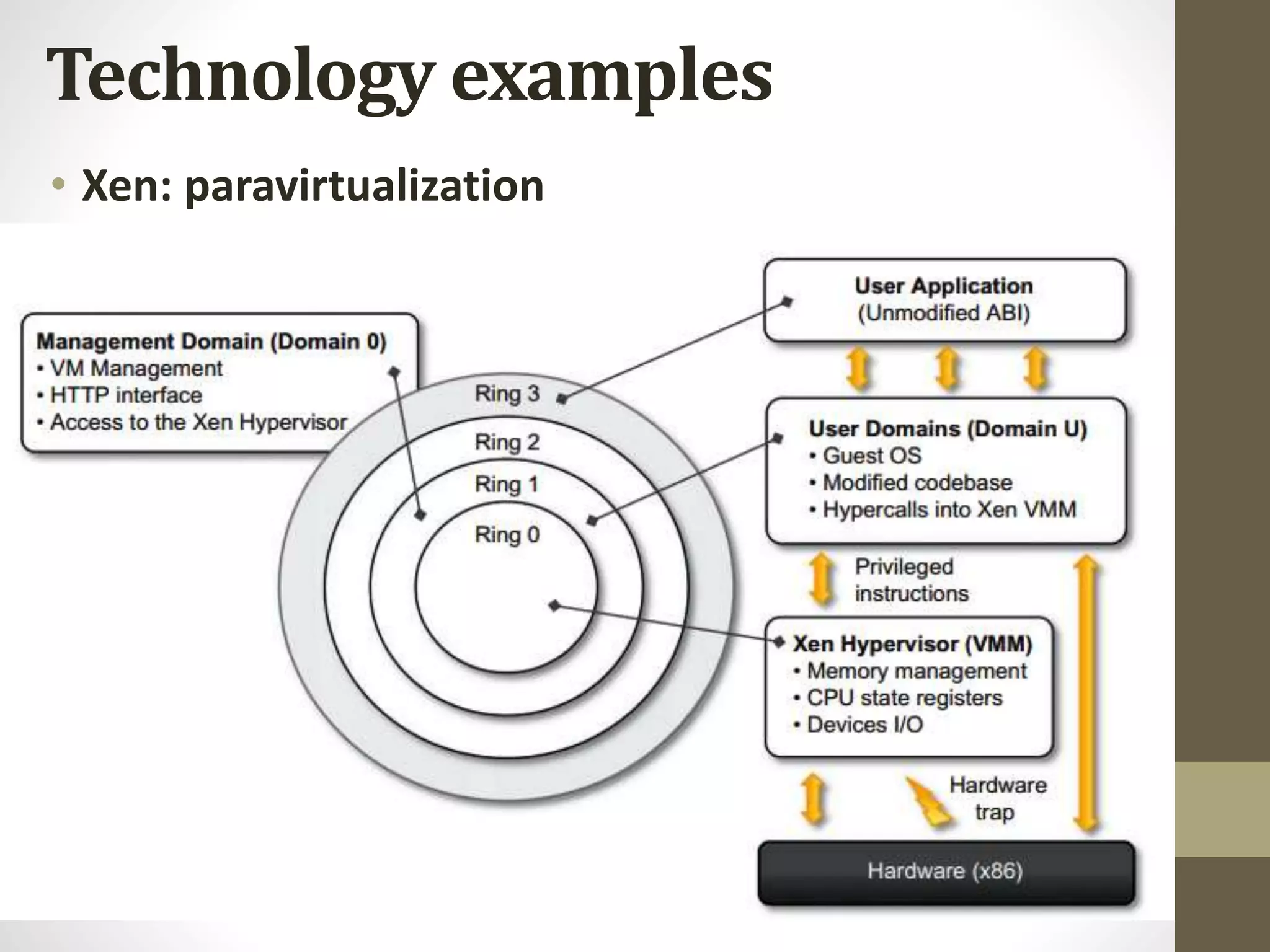
• Xen: paravirtualization
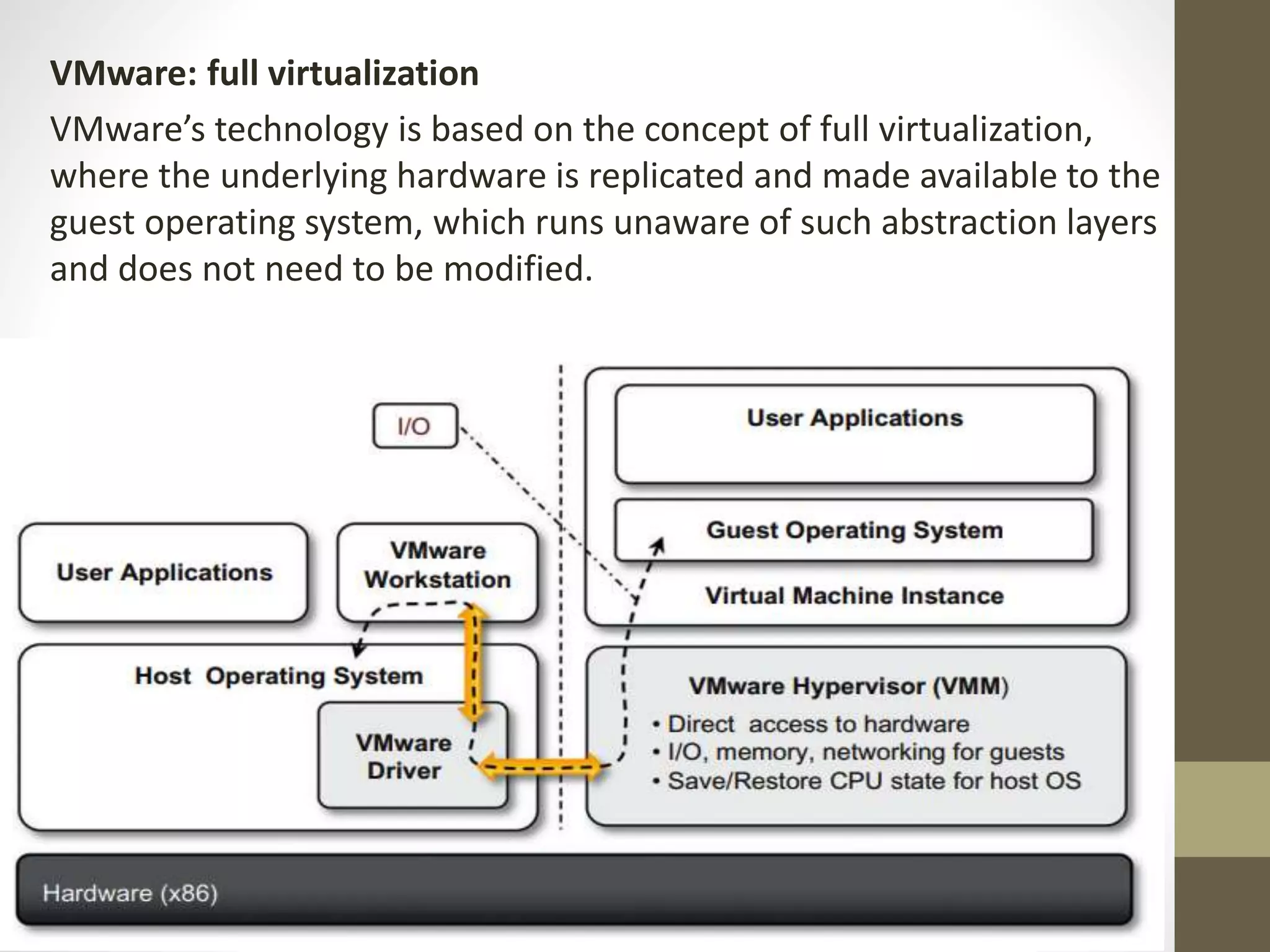
VMware: full virtualization
VMware’s technology is based on the concept of full virtualization,
where the underlying hardware is replicated and made available to the
guest operating system, which runs unaware of such abstraction layers
and does not need to be modified.

Cloud Computing_Unit 1- Part 2.pptx

  • 1.
    Virtualization in CloudComputing • Virtualization allows the creation of a secure, customizable, and isolated execution environment for running applications, even if they are untrusted, without affecting other users’ applications. • the ability of a computer program—or a combination of software and hardware—to emulate an executing environment separate from the one that hosts such programs. • Virtualization provides a great opportunity to build elastically scalable systems that can provision additional capability with minimum costs.
  • 2.
    • The termvirtualization is often synonymous with hardware virtualization. Virtualization technologies have gained renewed interested recently due to the confluence of several phenomena: • Increased performance and computing capacity. • Underutilized hardware and software resources. • Lack of space. • Greening initiatives. • Rise of administrative costs.
  • 3.
  • 4.
    The main commoncharacteristic of all these different implementations is the fact that the virtual environment is created by means of a software program. The ability to use software to emulate such a wide variety of environments creates a lot of opportunities, previously less attractive because of excessive overhead introduced by the virtualization layer. The technologies of today allow profitable use of virtualization and make it possible to fully exploit the advantages that come with it. Such advantages have always been characteristics of virtualized solutions. Increased security The virtual machine represents an emulated environment in which the guest is executed. All the operations of the guest are generally performed against the virtual machine, which then translates and applies them to the host. This level of indirection allows the virtual machine manager to control and filter the activity of the guest, thus preventing some harmful operations from being performed.
  • 5.
    Managed execution Sharing: Itallows the creation of a separate computing environments within the same host. Aggregation: Not only is it possible to share physical resource among several guests, but virtualization also allows aggregation, which is the opposite process. A group of separate hosts can be tied together and represented to guests as a single virtual host. Emulation: It allows for controlling and tuning the environment that is exposed to guests. For instance, a completely different environment with respect to the host can be emulated, thus allowing the execution of guest programs requiring specific characteristics that are not present in the physical host. Isolation: It allows providing guests—whether they are operating systems, applications, or other entities—with a completely separate environment, in which they are executed.
  • 6.
    Portability It applies indifferent ways according to the specific type of virtualization considered. In the case of a hardware virtualization solution, the guest is packaged into a virtual image that, in most cases, can be safely moved and executed on top of different virtual machines. In the case of programming-level virtualization, as implemented by the JVM or the .NET runtime, the binary code representing application components (jars or assemblies) can be run without any recompilation on any implementation of the corresponding virtual machine. One version of the application, in most cases, is able to run on different platforms with no changes
  • 7.
    Taxonomy of VirtualizationTechniques • Virtualization covers a wide range of emulation techniques that are applied to different areas of computing. • Virtualization is mainly used to emulate execution environments, storage, and networks. • Process-level techniques are implemented on top of an existing operating system, which has full control of the hardware. • System-level techniques are implemented directly on hardware and do not require—or require a minimum of support from—an existing operating system.
  • 9.
    Execution virtualization Execution virtualizationincludes all techniques that aim to emulate an execution environment that is separate from the one hosting the virtualization layer. Machine reference model: Virtualizing an execution environment at different levels of the computing stack requires a reference model that defines the interfaces between the levels of abstractions, which hide implementation details.
  • 10.
    Hardware-level virtualization Hardware-level virtualizationis a virtualization technique that provides an abstract execution environment in terms of computer hardware on top of which a guest operating system can be run Hardware-level virtualization is also called system virtualization, since it provides ISA to virtual machines, which is the representation of the hardware interface of a system.
  • 11.
    Programming language-level virtualization: Itis mostly used to achieve ease of deployment of applications, managed execution, and portability across different platforms and operating systems. It consists of a virtual machine executing the byte code of a program, which is the result of the compilation process. Application-level virtualization: Its allowing applications to be run in runtime environments that do not natively support all the features required by such applications. These techniques are mostly concerned with partial file systems, libraries, and operating system component emulation. Interpretation: Every source instruction is interpreted by an emulator for executing native ISA instructions, leading to poor performance. Interpretation has a minimal start-up cost but a huge overhead, since each instruction is emulated. Binary translation: Every source instruction is converted to native instructions with equivalent functions. After a block of instructions is translated, it is cached and reused. Storage virtualization: It is a system administration practice that allows decoupling the physical organization of the hardware from its logical representation. allows us to harness a wide range of storage facilities and represent them under a single logical file system
  • 12.
    Network virtualization: It combineshardware appliances and specific software for the creation and management of a virtual network. It aggregate different physical networks into a single logical network or provide network-like functionality to an operating system partition. Application server virtualization Application server virtualization abstracts a collection of application servers that provide the same services as a single virtual application server by using load-balancing strategies and providing a high-availability infrastructure for the services hosted in the application server. Desktop virtualization: The desktop environment available on a personal computer in order to provide access to it using a client/server approach. Desktop virtualization provides the same outcome of hardware virtualization but serves a different purpose.
  • 13.
    It allows forthe appropriate degree of customization, security, isolation, and manageability that are fundamental for delivering IT services on demand. Virtualization technologies are primarily used to offer configurable computing environments and storage. Hardware virtualization is an enabling factor for solutions in the Infrastructure-as-a-Service (IaaS) market segment. Programming language virtualization is a technology leveraged in Platform-as-a-Service (PaaS) offerings. Virtualization and cloud computing
  • 14.
    Figure shows serverconsolidation, while the movement of virtual machine instances is called virtual machine migration. live migration and in general is more complex to implement but more efficient since there is no disruption of the activity of the virtual machine instance.6
  • 15.
    Pros and consof virtualization Advantages: Managed execution and Isolation: these two characteristics allow building secure and controllable computing environments. A virtual execution environment can be configured as a sandbox, thus preventing any harmful operation to cross the borders of the virtual host. Portability and self-containment: It used to execution virtualization techniques. Virtual machine instances are normally represented by one or more files that can be easily transported with respect to physical systems. Portability and self-containment contribute to reducing the costs of maintenance, since the number of hosts is expected to be lower than the number of virtual machine instances
  • 16.
    Pros and consof virtualization Disadvantages: Performance degradation: • Maintaining the status of virtual processors • Support of privileged instructions • Support of paging within VM • Console functions Inefficiency and degraded user experience: Some of the specific features of the host cannot be exposed by the abstraction layer and then become inaccessible. Security holes and new threats: In the case of hardware virtualization, malicious programs can preload themselves before the operating system and act as a thin virtual machine manager toward it. The operating system is then controlled and can be manipulated to extract sensitive information of interest to third parties.
  • 17.
    Technology examples • Xen:paravirtualization
  • 18.
    VMware: full virtualization VMware’stechnology is based on the concept of full virtualization, where the underlying hardware is replicated and made available to the guest operating system, which runs unaware of such abstraction layers and does not need to be modified.