Arab Oil & Natural Gas website
Presents
Liquefied Petroleum Gas LPG
Part.1
Sweetening processes
What is LPG?
 Liquefied petroleum gas (LPG) includes propane, butane, butadiene,
isopropane, propylene, and vinyl chloride monomer, which are all by-
products of the production of oil and natural gas. LPGs have a variety
of uses including as a cooking/heating fuel, refinery feedstock,
automotive power, and numerous other plastics and chemicals
applications.
another definition of LPG is that LPG is a mixture of commercial
butane and commercial propane having both saturated and
unsaturated hydrocarbons.
Gas Sweetening
 Sour Gas contains either components
H2S or CO2.
 H2S is by far the most dangerous but
CO2 can cause problems with solids
formation in compression and cooling.
 Both these components are acid gases
and are removed by similar
“sweetening” processes.
Introduction
Quality requirements for gas entering LPG plants include:
 Shall not contain more than 23 mg of H2S per m3. (16 ppmv)
 Shall not contain more than 115 mg of total Sulphur per m3
 Shall not contain more than 2% by volume of CO2.
 Sweetening processes remove sour and undesirable gases from the
gas stream:
 H2S - Hydrogen Sulphide
 CO2 - Carbon Dioxide
 COS - Carbonyl Sulphide
 CS2 - Carbon Disulphide
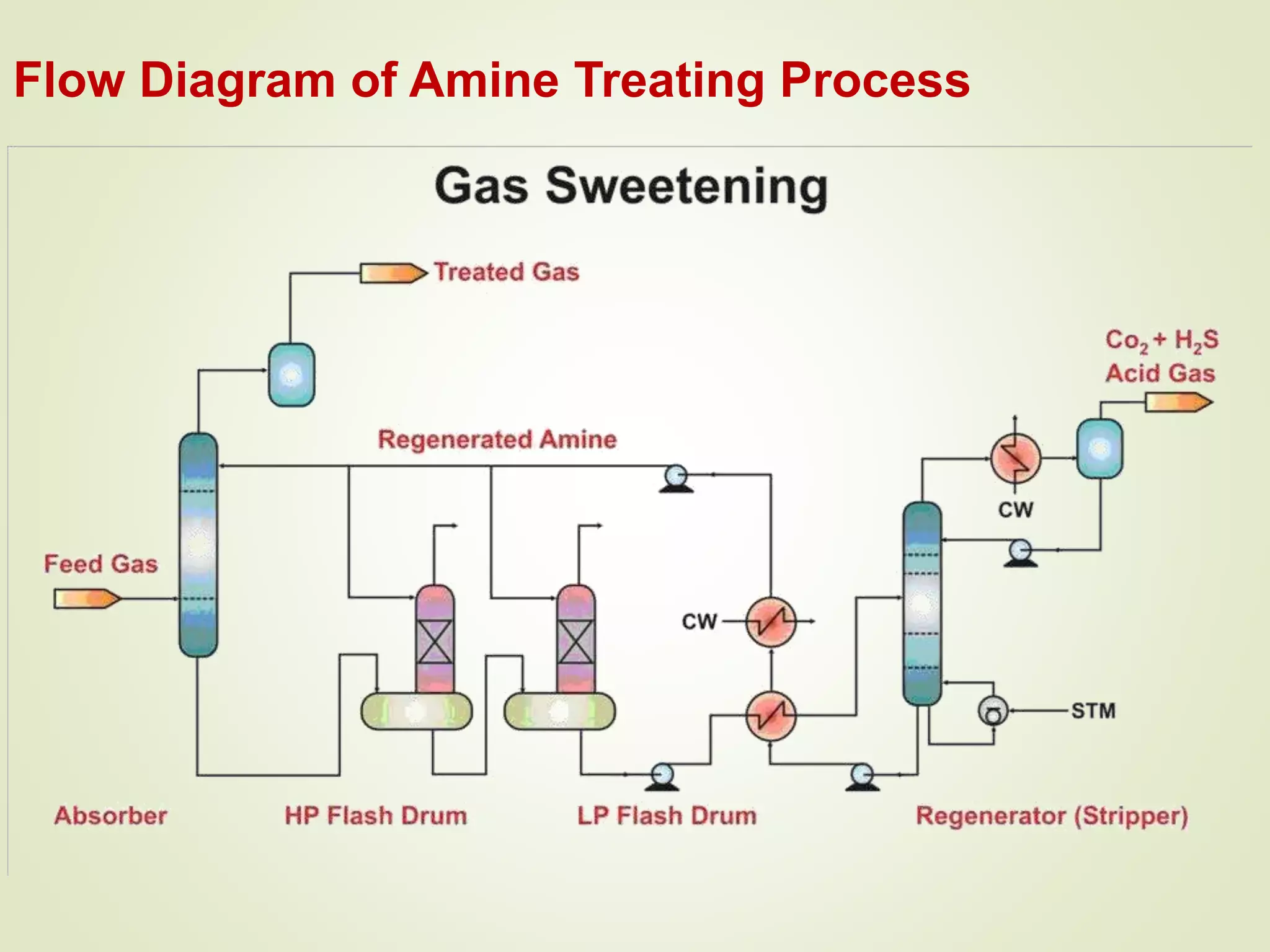
Basic Flow Diagram of Amine Treating Process
for CO2 and H2S Removal
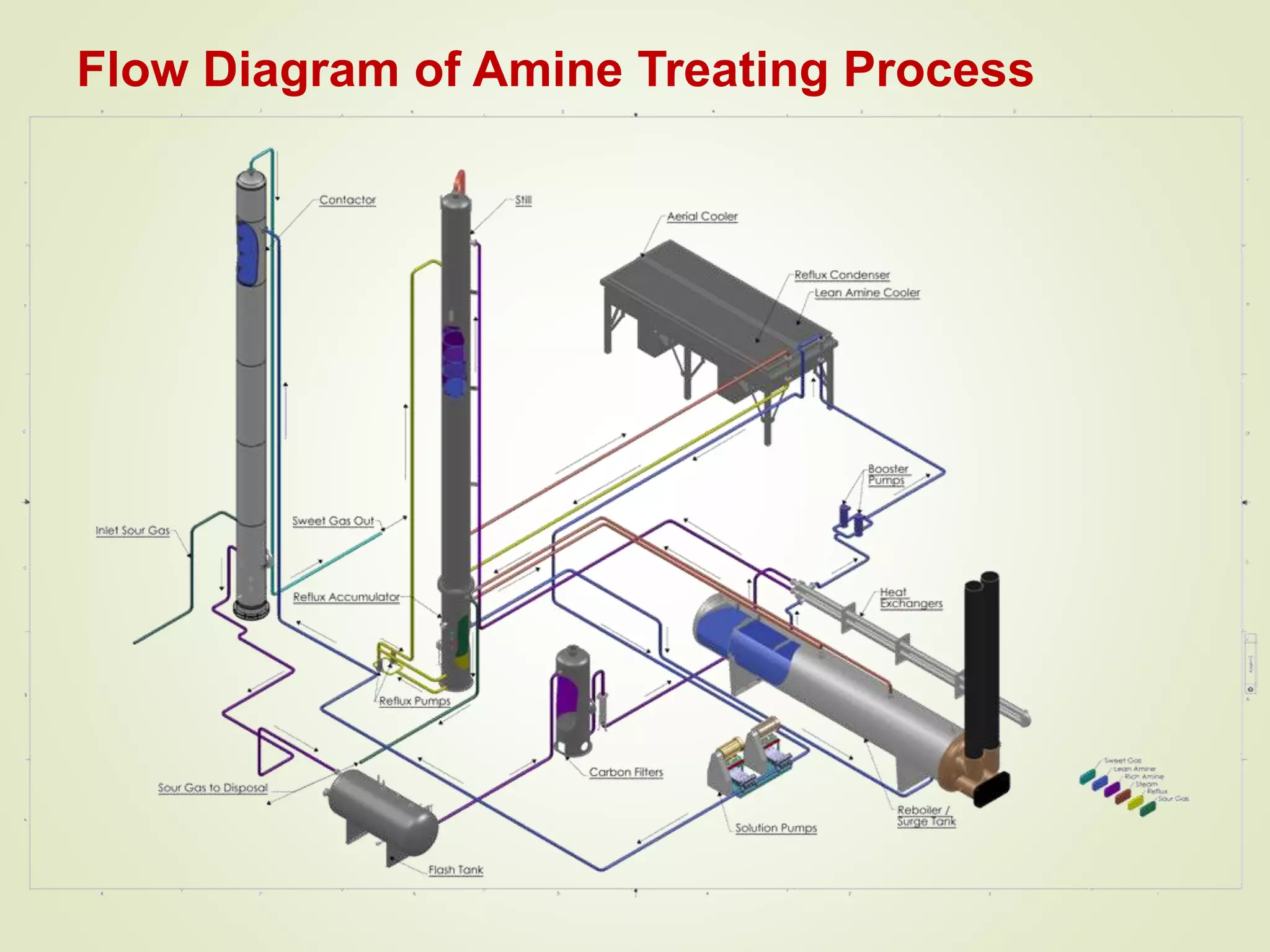
Flow Diagram of Amine Treating Process
Reasons for Sweetening
Safety and Environmental Protection
Product Specification
Corrosion Prevention
Improved Heating Values
CO2 Solid formation (cryogenic operations)
Economics (sometimes)
 sour gas is supplied to the sweetening system from the inlet
separator and the condensate stabilizer.
 sour products recovered in this process are further processed in a
sulphur recovery unit (SRU)
 if the volume is low enough (less than 1 tonne of sulphur per day in
the inlet gas), the gases are incinerated and released to atmosphere
as CO2 and SO2.
 various types of sweetening processes are employed in industry
today. All processes utilize a solid or liquid desiccant to recover the
sour component. After the desiccant has recovered the sour
component it must be regenerated to release the sour components
so it can be reused.
 The most common liquid desiccants in use are “amines”.
Typical amine sweetening process
Inlet Separator
 Removal of liquids and/or solids
 Separator should be sized to handle surge
capacity.
 Poor separator design can cause problems in
the treating facilities.
Contactor
 Sour gas enters the bottom of the tower and moves upward through the trays
 H2S and CO2 in the gas react with the liquid amine solution and are removed from the gas stream.
 The reaction is often assisted by placing fresh lean amine on various trays down the tower. This
ensures that the gas will contact lean amine a few times as it moves up the tower.
 As the sweet gas leaves the tower, it is often contacted with water to remove any amine that has
vaporized and is travelling with the gas. The top 2 or 3 trays may be used for this function. This is
considered a “water wash” section of the tower.
 The water wash is often used if the contactor temperature is especially high or if MEA is used as the
amine.
Outlet Separator
 The sweetened gas is passed through a separator to remove any amine solution
(or liquid water) that may be travelling with the gas flow
 The gas is now saturated with water and must proceed through dehydration
facilities to lower the water dew point before sale.
Flash Drum
 From the contactor, the amine may enter a flash drum to allow any hydrocarbon
an opportunity to leave the amine solution.
 From the contactor, the amine may enter a flash drum to allow any hydrocarbon an
opportunity to leave the amine solution.
Heat Exchanger (HTEX)
 The rich amine passes through a heat
exchanger where it picks up heat from the hotter
lean amine on its way to the contactor.
 Since this service is clean, plate and frame
exchangers can be used, but often a more
common shell and tube exchanger is put in
service.
Stripper
 The rich amine enters the stripper, where hot acid gas and steam heat the rich
amine, removing the H2S and CO2 that is bound into the product.
Reboiler
 The amine at the bottom of the stripper tower is heated to 105oC – 140oC
(depending on the type of amine being used).
 This causes the acid gas/amine reaction to reverse and the acid gas vaporizes
with steam from the amine solution.
 The acid gas/steam vapour re-enters the stripper and contacts new rich amine
on its way out the top.
Condenser
After leaving the top of the stripper tower, the acid
gas/steam vapour is cooled to remove heat and
condense out the water from the flow.
The water is separated in a reflux drum and returned
to the stripper tower as a liquid.
The acid gas vapour is sent downstream to a Sulphur
Recovery Unit (SRU).
If the plant has a gas sulphur inlet rate of less than 1
tonne/day (this is a very small amount), the acid gas
may be incinerated. Burning the H2S creates SO2
which is a monitored pollutant.
Reclaimer
a reclaimer may be used in MEA or DGA service.
A reclaimer heats a slipstream of the amine from the
reboiler to higher temperatures.
In MEA service, a caustic solution is added to
increase the pH of the mixture.
This higher temperature (and higher pH) cleans out
some products of “side reactions” and an amine
sludge is created.
Mercury Removal
Mercury was not identified in the feed gas as a
contaminant but is almost certainly there.
Mercury removal is required to protect aluminium
equipment operating below -39°C from corrosion.
Mercury removal is increasingly common for
environmental protection.
Removal is achieved by adsorption on a fixed bed
of activated carbon. When the bed is spent it is
replaced.
The supplier takes back and smelts the spent
adsorbent.
Mercury Removal
Activated Carbon
Adsorption Bed
Gas to NGL
Recovery
Gas from
Dehydration
Mercury removal
 The amalgamation of mercury and aluminum causes weak
spots which will fail and cause leak .
 It is difficult to continue the process of making LNG when this
occurs .
 To prevent this , mercury guard system have been established
which remove mercury according to the reaction
Hg + S HgS
 Mercury sulphied is then adsorbed on the activated carbon bed which
must be replaced periodically after the bed is spent ( usually each 6
years ) .
Active S
for more FREE movies, visit:
Arab Oil & Natural Gas website
www.Arab-Oil-NaturalGas.com

LPG part1

  • 1.
    Arab Oil &Natural Gas website Presents
  • 2.
    Liquefied Petroleum GasLPG Part.1 Sweetening processes
  • 3.
    What is LPG? Liquefied petroleum gas (LPG) includes propane, butane, butadiene, isopropane, propylene, and vinyl chloride monomer, which are all by- products of the production of oil and natural gas. LPGs have a variety of uses including as a cooking/heating fuel, refinery feedstock, automotive power, and numerous other plastics and chemicals applications. another definition of LPG is that LPG is a mixture of commercial butane and commercial propane having both saturated and unsaturated hydrocarbons.
  • 4.
    Gas Sweetening  SourGas contains either components H2S or CO2.  H2S is by far the most dangerous but CO2 can cause problems with solids formation in compression and cooling.  Both these components are acid gases and are removed by similar “sweetening” processes.
  • 5.
    Introduction Quality requirements forgas entering LPG plants include:  Shall not contain more than 23 mg of H2S per m3. (16 ppmv)  Shall not contain more than 115 mg of total Sulphur per m3  Shall not contain more than 2% by volume of CO2.  Sweetening processes remove sour and undesirable gases from the gas stream:  H2S - Hydrogen Sulphide  CO2 - Carbon Dioxide  COS - Carbonyl Sulphide  CS2 - Carbon Disulphide
  • 6.
    Basic Flow Diagramof Amine Treating Process for CO2 and H2S Removal
  • 7.
    Flow Diagram ofAmine Treating Process
  • 8.
    Flow Diagram ofAmine Treating Process
  • 9.
    Flow Diagram ofAmine Treating Process
  • 10.
    Reasons for Sweetening Safetyand Environmental Protection Product Specification Corrosion Prevention Improved Heating Values CO2 Solid formation (cryogenic operations) Economics (sometimes)
  • 11.
     sour gasis supplied to the sweetening system from the inlet separator and the condensate stabilizer.  sour products recovered in this process are further processed in a sulphur recovery unit (SRU)  if the volume is low enough (less than 1 tonne of sulphur per day in the inlet gas), the gases are incinerated and released to atmosphere as CO2 and SO2.  various types of sweetening processes are employed in industry today. All processes utilize a solid or liquid desiccant to recover the sour component. After the desiccant has recovered the sour component it must be regenerated to release the sour components so it can be reused.  The most common liquid desiccants in use are “amines”.
  • 12.
  • 13.
    Inlet Separator  Removalof liquids and/or solids  Separator should be sized to handle surge capacity.  Poor separator design can cause problems in the treating facilities. Contactor  Sour gas enters the bottom of the tower and moves upward through the trays  H2S and CO2 in the gas react with the liquid amine solution and are removed from the gas stream.  The reaction is often assisted by placing fresh lean amine on various trays down the tower. This ensures that the gas will contact lean amine a few times as it moves up the tower.  As the sweet gas leaves the tower, it is often contacted with water to remove any amine that has vaporized and is travelling with the gas. The top 2 or 3 trays may be used for this function. This is considered a “water wash” section of the tower.  The water wash is often used if the contactor temperature is especially high or if MEA is used as the amine.
  • 14.
    Outlet Separator  Thesweetened gas is passed through a separator to remove any amine solution (or liquid water) that may be travelling with the gas flow  The gas is now saturated with water and must proceed through dehydration facilities to lower the water dew point before sale. Flash Drum  From the contactor, the amine may enter a flash drum to allow any hydrocarbon an opportunity to leave the amine solution.  From the contactor, the amine may enter a flash drum to allow any hydrocarbon an opportunity to leave the amine solution.
  • 15.
    Heat Exchanger (HTEX) The rich amine passes through a heat exchanger where it picks up heat from the hotter lean amine on its way to the contactor.  Since this service is clean, plate and frame exchangers can be used, but often a more common shell and tube exchanger is put in service. Stripper  The rich amine enters the stripper, where hot acid gas and steam heat the rich amine, removing the H2S and CO2 that is bound into the product.
  • 16.
    Reboiler  The amineat the bottom of the stripper tower is heated to 105oC – 140oC (depending on the type of amine being used).  This causes the acid gas/amine reaction to reverse and the acid gas vaporizes with steam from the amine solution.  The acid gas/steam vapour re-enters the stripper and contacts new rich amine on its way out the top.
  • 17.
    Condenser After leaving thetop of the stripper tower, the acid gas/steam vapour is cooled to remove heat and condense out the water from the flow. The water is separated in a reflux drum and returned to the stripper tower as a liquid. The acid gas vapour is sent downstream to a Sulphur Recovery Unit (SRU). If the plant has a gas sulphur inlet rate of less than 1 tonne/day (this is a very small amount), the acid gas may be incinerated. Burning the H2S creates SO2 which is a monitored pollutant.
  • 18.
    Reclaimer a reclaimer maybe used in MEA or DGA service. A reclaimer heats a slipstream of the amine from the reboiler to higher temperatures. In MEA service, a caustic solution is added to increase the pH of the mixture. This higher temperature (and higher pH) cleans out some products of “side reactions” and an amine sludge is created.
  • 19.
    Mercury Removal Mercury wasnot identified in the feed gas as a contaminant but is almost certainly there. Mercury removal is required to protect aluminium equipment operating below -39°C from corrosion. Mercury removal is increasingly common for environmental protection. Removal is achieved by adsorption on a fixed bed of activated carbon. When the bed is spent it is replaced. The supplier takes back and smelts the spent adsorbent.
  • 20.
    Mercury Removal Activated Carbon AdsorptionBed Gas to NGL Recovery Gas from Dehydration
  • 21.
    Mercury removal  Theamalgamation of mercury and aluminum causes weak spots which will fail and cause leak .  It is difficult to continue the process of making LNG when this occurs .  To prevent this , mercury guard system have been established which remove mercury according to the reaction Hg + S HgS  Mercury sulphied is then adsorbed on the activated carbon bed which must be replaced periodically after the bed is spent ( usually each 6 years ) . Active S
  • 22.
    for more FREEmovies, visit: Arab Oil & Natural Gas website www.Arab-Oil-NaturalGas.com