Acid Gas Treating
Chapter 10
Based on presentation by Prof. Art Kidnay
Updated: January 4, 2019
Copyright © 2019 John Jechura (jjechura@mines.edu)
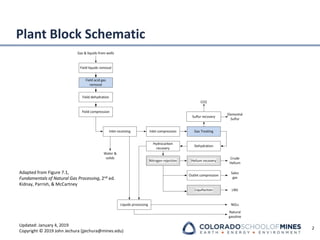
Plant Block Schematic
2
Adapted from Figure 7.1,
Fundamentals of Natural Gas Processing, 2nd ed.
Kidnay, Parrish, & McCartney
Updated: January 4, 2019
Copyright © 2019 John Jechura (jjechura@mines.edu)
Topics
Chemical Absorption Processes
Physical Absorption
Adsorption
Cryogenic Fractionation
Membranes
Nonregenerable H2S Scavengers
Biological Processes
Safety and Environmental Considerations
3
Updated: January 4, 2019
Copyright © 2019 John Jechura (jjechura@mines.edu)
Gas treating
Gas treating involves removing
contaminants to sufficiently
low levels to meet
specifications
▪ Primary focus on removing “acid
gases”
• Carbon dioxide (CO2)
• Hydrogen sulfide (H2S)
• Plus other sulfur species
▪ Other contaminants
• Mercury
• Ammonia
• Elemental sulfur
• Arsenic
The acid gas problem
▪ H2S is highly toxic
▪ H2S combustion gives SO2 – toxic
& leads to acid rain
▪ CO2 is a diluent in natural gas –
corrosive in presence of H2O
Purification levels
▪ H2S: Pipeline quality gas requires
0.25 grains/100 scf (4 ppmv)
▪ CO2: pipeline quality gas may
allow up to 4 mole%
• Cryogenic applications need
less than 50 ppmv
4
Updated: January 4, 2019
Copyright © 2019 John Jechura (jjechura@mines.edu)
Two step process
Two steps
▪ Remove the acid gases from natural gas
▪ Dispose of the acid gases
Disposition
▪ CO2
• Vent to atmosphere
• EOR – Enhanced Oil Recovery
• Sequestration
▪ H2S
• Incineration or venting (trace amounts)
• React with scavengers (e.g. iron sponge)
• Convert to elemental sulfur
• Injection into suitable underground formation
5
Updated: January 4, 2019
Copyright © 2019 John Jechura (jjechura@mines.edu)
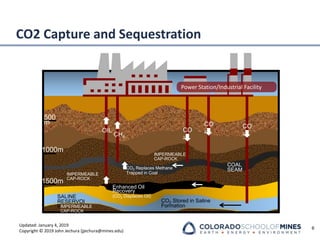
Power Station/Industrial Facility
CO
2
CO
2
CO
2
COAL
SEAM
CH4
OIL
500
m
1000m
1500m
SALINE
RESERVOI
R
Enhanced Oil
Recovery
(CO2 Displaces Oil)
CO2 Stored in Saline
Formation
CO2 Replaces Methane
Trapped in Coal
IMPERMEABLE
CAP-ROCK
IMPERMEABLE
CAP-ROCK
IMPERMEABLE
CAP-ROCK
CO2 Capture and Sequestration
6
Updated: January 4, 2019
Copyright © 2019 John Jechura (jjechura@mines.edu)
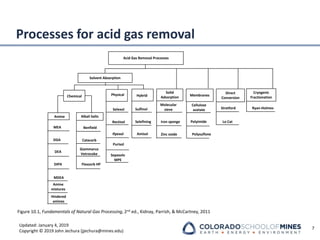
Processes for acid gas removal
7
Physical
Chemical
Amine
MEA
DGA
DEA
DIPA
MDEA
Catacarb
Giammarco
Vetrocoke
Flexsorb HP
Benfield
Selexol
Rectisol
Sulfinol
Selefining
Amisol
Lo Cat
Solvent Absorption
Acid Gas Removal Processes
Alkali Salts
Ryan-Holmes
Purisol
Cryogenic
Fractionation
Stretford
Direct
Conversion
Iron sponge
Zinc oxide
Solid
Adsorption
Hybrid
Ifpexol
Sepasolv
MPE
Membranes
Molecular
sieve
Amine
mixtures
Hindered
amines
Cellulose
acetate
Polyimide
Polysulfone
Figure 10.1, Fundamentals of Natural Gas Processing, 2nd ed., Kidnay, Parrish, & McCartney, 2011
Updated: January 4, 2019
Copyright © 2019 John Jechura (jjechura@mines.edu)
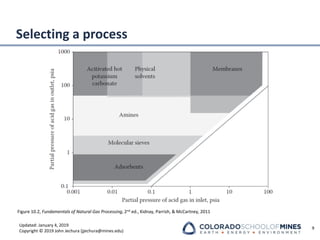
Selecting a process
Factors for selecting process
▪ Type & concentration of impurities
▪ Hydrocarbon composition of the gas
▪ Pressure & temperature of the gas
▪ Specifications for outlet gas
▪ Volume of gas to be processed
Four possible scenarios
▪ Only CO2
▪ Only H2S
▪ Both CO2 and H2S
▪ Both CO2 and H2S present but selectively remove H2S
• Allow CO2 slip
8
Updated: January 4, 2019
Copyright © 2019 John Jechura (jjechura@mines.edu)
Selecting a process
9
Figure 10.2, Fundamentals of Natural Gas Processing, 2nd ed., Kidnay, Parrish, & McCartney, 2011
Updated: January 4, 2019
Copyright © 2017 John Jechura (jjechura@mines.edu)
Chemical Absorption Processes
Updated: January 4, 2019
Copyright © 2019 John Jechura (jjechura@mines.edu)
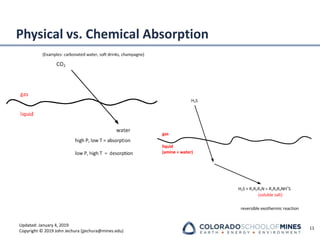
Physical vs. Chemical Absorption
11
Updated: January 4, 2019
Copyright © 2019 John Jechura (jjechura@mines.edu)
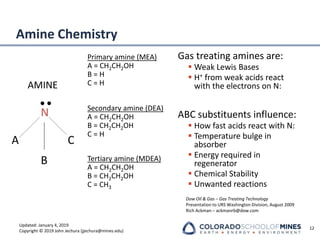
Amine Chemistry
Gas treating amines are:
▪ Weak Lewis Bases
▪ H+ from weak acids react
with the electrons on N:
ABC substituents influence:
▪ How fast acids react with N:
▪ Temperature bulge in
absorber
▪ Energy required in
regenerator
▪ Chemical Stability
▪ Unwanted reactions
12
AMINE
N
A
B
C
l
l
Primary amine (MEA)
A = CH2CH2OH
B = H
C = H
Secondary amine (DEA)
A = CH2CH2OH
B = CH2CH2OH
C = H
Tertiary amine (MDEA)
A = CH2CH2OH
B = CH2CH2OH
C = CH3
Dow Oil & Gas – Gas Treating Technology
Presentation to URS Washington Division, August 2009
Rich Ackman – ackmanrb@dow.com
Updated: January 4, 2019
Copyright © 2019 John Jechura (jjechura@mines.edu)
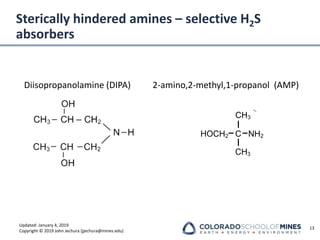
Sterically hindered amines – selective H2S
absorbers
13
Diisopropanolamine (DIPA)
HOCH2 C NH2
CH3
CH3
2-amino,2-methyl,1-propanol (AMP)
Updated: January 4, 2019
Copyright © 2019 John Jechura (jjechura@mines.edu)
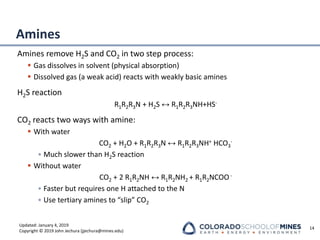
Amines
Amines remove H2S and CO2 in two step process:
▪ Gas dissolves in solvent (physical absorption)
▪ Dissolved gas (a weak acid) reacts with weakly basic amines
H2S reaction
R1R2R3N + H2S ↔ R1R2R3NH+HS-
CO2 reacts two ways with amine:
▪ With water
CO2 + H2O + R1R2R3N ↔ R1R2R3NH+ HCO3
-
• Much slower than H2S reaction
▪ Without water
CO2 + 2 R1R2NH ↔ R1R2NH2 + R1R2NCOO-
• Faster but requires one H attached to the N
• Use tertiary amines to “slip” CO2
14
Updated: January 4, 2019
Copyright © 2019 John Jechura (jjechura@mines.edu)
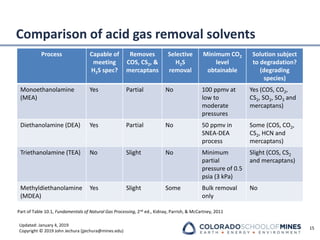
Comparison of acid gas removal solvents
Process Capable of
meeting
H2S spec?
Removes
COS, CS2, &
mercaptans
Selective
H2S
removal
Minimum CO2
level
obtainable
Solution subject
to degradation?
(degrading
species)
Monoethanolamine
(MEA)
Yes Partial No 100 ppmv at
low to
moderate
pressures
Yes (COS, CO2,
CS2, SO2, SO3 and
mercaptans)
Diethanolamine (DEA) Yes Partial No 50 ppmv in
SNEA-DEA
process
Some (COS, CO2,
CS2, HCN and
mercaptans)
Triethanolamine (TEA) No Slight No Minimum
partial
pressure of 0.5
psia (3 kPa)
Slight (COS, CS2
and mercaptans)
Methyldiethanolamine
(MDEA)
Yes Slight Some Bulk removal
only
No
15
Part of Table 10.1, Fundamentals of Natural Gas Processing, 2nd ed., Kidnay, Parrish, & McCartney, 2011
Updated: January 4, 2019
Copyright © 2019 John Jechura (jjechura@mines.edu)
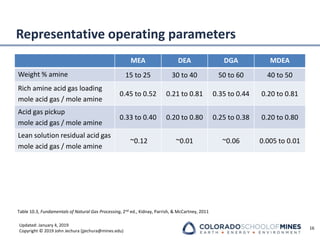
Representative operating parameters
MEA DEA DGA MDEA
Weight % amine 15 to 25 30 to 40 50 to 60 40 to 50
Rich amine acid gas loading
mole acid gas / mole amine
0.45 to 0.52 0.21 to 0.81 0.35 to 0.44 0.20 to 0.81
Acid gas pickup
mole acid gas / mole amine
0.33 to 0.40 0.20 to 0.80 0.25 to 0.38 0.20 to 0.80
Lean solution residual acid gas
mole acid gas / mole amine
~0.12 ~0.01 ~0.06 0.005 to 0.01
16
Table 10.3, Fundamentals of Natural Gas Processing, 2nd ed., Kidnay, Parrish, & McCartney, 2011
Updated: January 4, 2019
Copyright © 2019 John Jechura (jjechura@mines.edu)
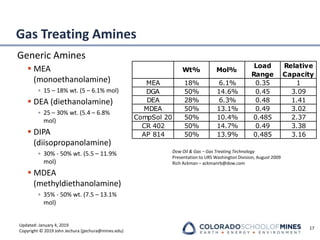
Gas Treating Amines
Generic Amines
▪ MEA
(monoethanolamine)
• 15 – 18% wt. (5 – 6.1% mol)
▪ DEA (diethanolamine)
• 25 – 30% wt. (5.4 – 6.8%
mol)
▪ DIPA
(diisopropanolamine)
• 30% - 50% wt. (5.5 – 11.9%
mol)
▪ MDEA
(methyldiethanolamine)
• 35% - 50% wt. (7.5 – 13.1%
mol)
17
Wt% Mol%
Load
Range
Relative
Capacity
MEA 18% 6.1% 0.35 1
DGA 50% 14.6% 0.45 3.09
DEA 28% 6.3% 0.48 1.41
MDEA 50% 13.1% 0.49 3.02
CompSol 20 50% 10.4% 0.485 2.37
CR 402 50% 14.7% 0.49 3.38
AP 814 50% 13.9% 0.485 3.16
Dow Oil & Gas – Gas Treating Technology
Presentation to URS Washington Division, August 2009
Rich Ackman – ackmanrb@dow.com
Updated: January 4, 2019
Copyright © 2019 John Jechura (jjechura@mines.edu)
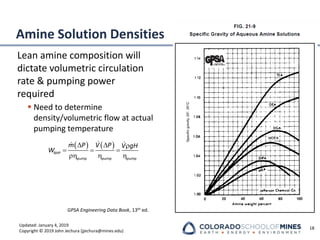
Amine Solution Densities
Lean amine composition will
dictate volumetric circulation
rate & pumping power
required
▪ Need to determine
density/volumetric flow at actual
pumping temperature
18
GPSA Engineering Data Book, 13th ed.
( ) ( )
  
= = =
  
BHP
pump pump pump
m P V P V gH
W
Updated: January 4, 2019
Copyright © 2019 John Jechura (jjechura@mines.edu)
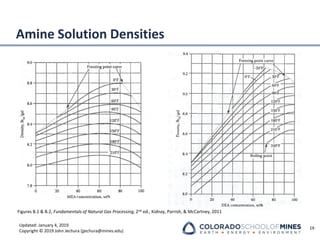
Amine Solution Densities
19
Figures B.1 & B.2, Fundamentals of Natural Gas Processing, 2nd ed., Kidnay, Parrish, & McCartney, 2011
Updated: January 4, 2019
Copyright © 2019 John Jechura (jjechura@mines.edu)
Typical Amine Treating Plant
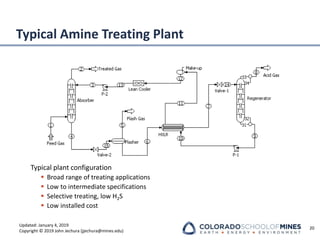
Typical plant configuration
▪ Broad range of treating applications
▪ Low to intermediate specifications
▪ Selective treating, low H2S
▪ Low installed cost
20
Updated: January 4, 2019
Copyright © 2019 John Jechura (jjechura@mines.edu)
Amine Tower Parameters
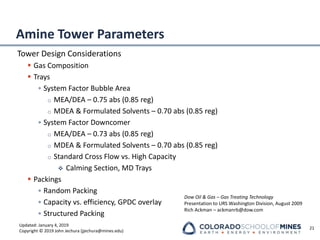
Tower Design Considerations
▪ Gas Composition
▪ Trays
• System Factor Bubble Area
o MEA/DEA – 0.75 abs (0.85 reg)
o MDEA & Formulated Solvents – 0.70 abs (0.85 reg)
• System Factor Downcomer
o MEA/DEA – 0.73 abs (0.85 reg)
o MDEA & Formulated Solvents – 0.70 abs (0.85 reg)
o Standard Cross Flow vs. High Capacity
❖ Calming Section, MD Trays
▪ Packings
• Random Packing
• Capacity vs. efficiency, GPDC overlay
• Structured Packing
21
Dow Oil & Gas – Gas Treating Technology
Presentation to URS Washington Division, August 2009
Rich Ackman – ackmanrb@dow.com
Updated: January 4, 2019
Copyright © 2019 John Jechura (jjechura@mines.edu)
Amine Tower Parameters
Absorber design considerations
▪ Pinch points limit
• Top of tower lean pinch
• Temperature bulge maximum
• Bottom of tower rich pinch
• Confidence level in VLE
▪ Temperature profile indicator
22
Absorber Temperature Profiles
Liquid Phase
1
2
3
4
5
6
7
8
9
10
11
12
13
14
15
16
17
18
19
20
21
22
23
24
80 100 120 140 160 180 200
Temperature [°F]
Stage
C-1 Conservative
C-2 Controlled Efficient
C-3 Intercooler
Updated: January 4, 2019
Copyright © 2019 John Jechura (jjechura@mines.edu)
Amine Approximate Guidelines
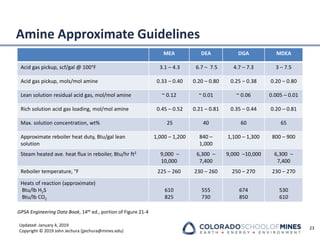
MEA DEA DGA MDEA
Acid gas pickup, scf/gal @ 100°F 3.1 – 4.3 6.7 – 7.5 4.7 – 7.3 3 – 7.5
Acid gas pickup, mols/mol amine 0.33 – 0.40 0.20 – 0.80 0.25 – 0.38 0.20 – 0.80
Lean solution residual acid gas, mol/mol amine ~ 0.12 ~ 0.01 ~ 0.06 0.005 – 0.01
Rich solution acid gas loading, mol/mol amine 0.45 – 0.52 0.21 – 0.81 0.35 – 0.44 0.20 – 0.81
Max. solution concentration, wt% 25 40 60 65
Approximate reboiler heat duty, Btu/gal lean
solution
1,000 – 1,200 840 –
1,000
1,100 – 1,300 800 – 900
Steam heated ave. heat flux in reboiler, Btu/hr ft2 9,000 –
10,000
6,300 –
7,400
9,000 –10,000 6,300 –
7,400
Reboiler temperature, °F 225 – 260 230 – 260 250 – 270 230 – 270
Heats of reaction (approximate)
Btu/lb H2S
Btu/lb CO2
610
825
555
730
674
850
530
610
23
GPSA Engineering Data Book, 14th ed., portion of Figure 21-4
Updated: January 4, 2019
Copyright © 2019 John Jechura (jjechura@mines.edu)
Amine System Initial Design
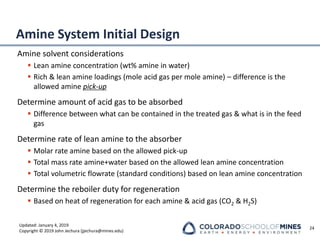
Amine solvent considerations
▪ Lean amine concentration (wt% amine in water)
▪ Rich & lean amine loadings (mole acid gas per mole amine) – difference is the
allowed amine pick-up
Determine amount of acid gas to be absorbed
▪ Difference between what can be contained in the treated gas & what is in the feed
gas
Determine rate of lean amine to the absorber
▪ Molar rate amine based on the allowed pick-up
▪ Total mass rate amine+water based on the allowed lean amine concentration
▪ Total volumetric flowrate (standard conditions) based on lean amine concentration
Determine the reboiler duty for regeneration
▪ Based on heat of regeneration for each amine & acid gas (CO2 & H2S)
24
Updated: January 4, 2019
Copyright © 2019 John Jechura (jjechura@mines.edu)
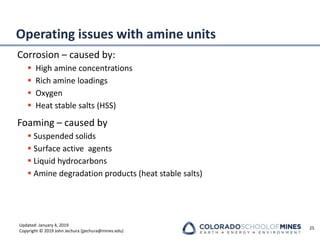
Operating issues with amine units
Corrosion – caused by:
▪ High amine concentrations
▪ Rich amine loadings
▪ Oxygen
▪ Heat stable salts (HSS)
Foaming – caused by
▪ Suspended solids
▪ Surface active agents
▪ Liquid hydrocarbons
▪ Amine degradation products (heat stable salts)
25
Updated: January 4, 2019
Copyright © 2019 John Jechura (jjechura@mines.edu)
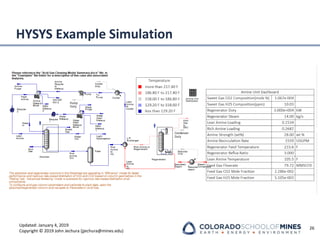
HYSYS Example Simulation
26
Updated: January 4, 2019
Copyright © 2019 John Jechura (jjechura@mines.edu)
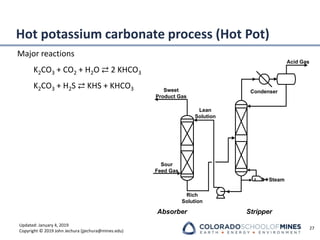
Hot potassium carbonate process (Hot Pot)
Major reactions
K2CO3 + CO2 + H2O ⇄ 2 KHCO3
K2CO3 + H2S ⇄ KHS + KHCO3
27
contactor
Sour
Feed Gas
Sweet
Product Gas
Rich
Solution
Lean
Solution
Acid Gas
Absorber
Steam
Condenser
Stripper
Updated: January 4, 2019
Copyright © 2017 John Jechura (jjechura@mines.edu)
Physical Absorption
Updated: January 4, 2019
Copyright © 2019 John Jechura (jjechura@mines.edu)
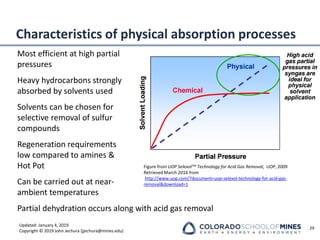
Characteristics of physical absorption processes
Most efficient at high partial
pressures
Heavy hydrocarbons strongly
absorbed by solvents used
Solvents can be chosen for
selective removal of sulfur
compounds
Regeneration requirements
low compared to amines &
Hot Pot
Can be carried out at near-
ambient temperatures
Partial dehydration occurs along with acid gas removal
29
Figure from UOP SelexolTM Technology for Acid Gas Removal, UOP, 2009
Retrieved March 2016 from
http://www.uop.com/?document=uop-selexol-technology-for-acid-gas-
removal&download=1
Updated: January 4, 2019
Copyright © 2019 John Jechura (jjechura@mines.edu)
Comparison of chemical and physical solvents
Advantages Disadvantages
Chemical Solvent
(e.g., amines, hot
potassium carbonate)
Relatively insensitive to H2S
and CO2 partial pressure
High energy requirements for
regeneration of solvent
Can reduce H2S and CO2 to
ppm levels
Generally not selective
between CO2 and H2S
Amines are in a water
solution and thus the treated
gas leaves saturated with
water
Physical solvents
(e.g., Selexol,
Rectisol)
Low energy requirements for
regeneration
May be difficult to meet H2S
specifications
Can be selective between H2S
and CO2
Very sensitive to acid gas
partial pressure
30
Updated: January 4, 2019
Copyright © 2019 John Jechura (jjechura@mines.edu)
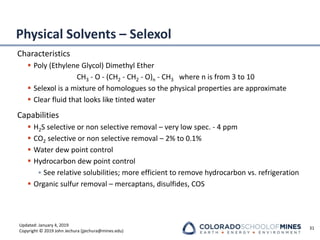
Physical Solvents – Selexol
Characteristics
▪ Poly (Ethylene Glycol) Dimethyl Ether
CH3 - O - (CH2 - CH2 - O)n - CH3 where n is from 3 to 10
▪ Selexol is a mixture of homologues so the physical properties are approximate
▪ Clear fluid that looks like tinted water
Capabilities
▪ H2S selective or non selective removal – very low spec. - 4 ppm
▪ CO2 selective or non selective removal – 2% to 0.1%
▪ Water dew point control
▪ Hydrocarbon dew point control
• See relative solubilities; more efficient to remove hydrocarbon vs. refrigeration
▪ Organic sulfur removal – mercaptans, disulfides, COS
31
Updated: January 4, 2019
Copyright © 2019 John Jechura (jjechura@mines.edu)
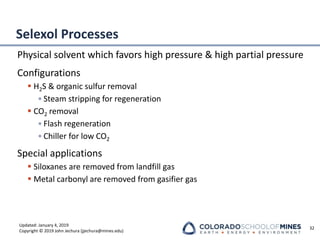
Selexol Processes
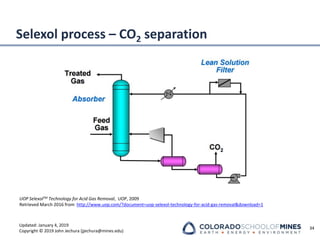
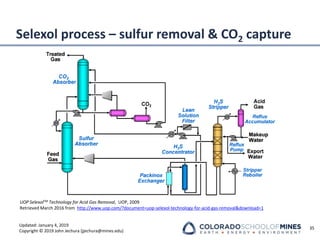
Physical solvent which favors high pressure & high partial pressure
Configurations
▪ H2S & organic sulfur removal
• Steam stripping for regeneration
▪ CO2 removal
• Flash regeneration
• Chiller for low CO2
Special applications
▪ Siloxanes are removed from landfill gas
▪ Metal carbonyl are removed from gasifier gas
32
Updated: January 4, 2019
Copyright © 2019 John Jechura (jjechura@mines.edu)
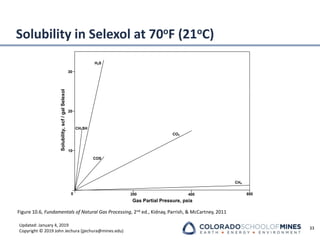
Solubility in Selexol at 70oF (21oC)
33
0
10
20
30
200 400 600
Gas Partial Pressure, psia
Solubility,
scf
/
gal
Selexol
CH4
CO2
H2S
COS
CH3SH
Figure 10.6, Fundamentals of Natural Gas Processing, 2nd ed., Kidnay, Parrish, & McCartney, 2011
Updated: January 4, 2019
Copyright © 2019 John Jechura (jjechura@mines.edu)
Selexol process – CO2 separation
34
UOP SelexolTM Technology for Acid Gas Removal, UOP, 2009
Retrieved March 2016 from http://www.uop.com/?document=uop-selexol-technology-for-acid-gas-removal&download=1
Updated: January 4, 2019
Copyright © 2019 John Jechura (jjechura@mines.edu)
Selexol process – sulfur removal & CO2 capture
35
UOP SelexolTM Technology for Acid Gas Removal, UOP, 2009
Retrieved March 2016 from http://www.uop.com/?document=uop-selexol-technology-for-acid-gas-removal&download=1
Updated: January 4, 2019
Copyright © 2017 John Jechura (jjechura@mines.edu)
Membranes
Updated: January 4, 2019
Copyright © 2019 John Jechura (jjechura@mines.edu)
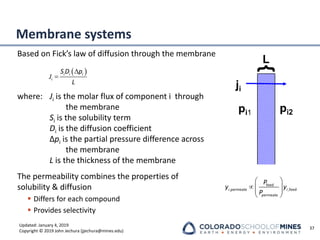
Membrane systems
Based on Fick’s law of diffusion through the membrane
where: Ji is the molar flux of component i through
the membrane
Si is the solubility term
Di is the diffusion coefficient
Δpi is the partial pressure difference across
the membrane
L is the thickness of the membrane
The permeability combines the properties of
solubility & diffusion
▪ Differs for each compound
▪ Provides selectivity
37
( )

= i i i
i
S D p
J
L
 
 
 
 
feed
,permeate ,feed
permeate
i i
P
y y
P
Updated: January 4, 2019
Copyright © 2019 John Jechura (jjechura@mines.edu)
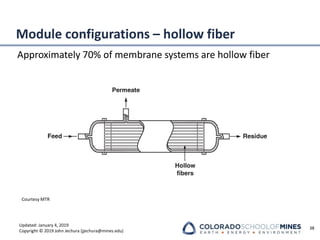
Module configurations – hollow fiber
Approximately 70% of membrane systems are hollow fiber
Low Pressure, Bore-Side Gas Feed Module
38
Courtesy MTR
Updated: January 4, 2019
Copyright © 2019 John Jechura (jjechura@mines.edu)
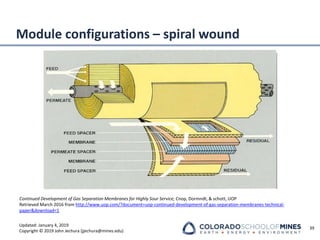
Module configurations – spiral wound
39
Continued Development of Gas Separation Membranes for Highly Sour Service, Cnop, Dormndt, & schott, UOP
Retrieved March 2016 from http://www.uop.com/?document=uop-continued-development-of-gas-separation-membranes-technical-
paper&download=1
Updated: January 4, 2019
Copyright © 2019 John Jechura (jjechura@mines.edu)
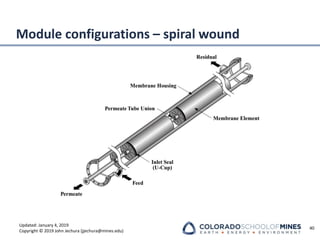
Module configurations – spiral wound
40
Updated: January 4, 2019
Copyright © 2019 John Jechura (jjechura@mines.edu)
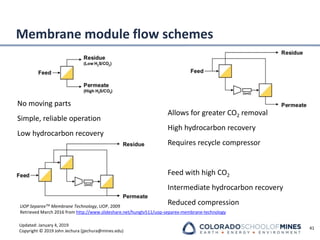
Membrane module flow schemes
No moving parts
Simple, reliable operation
Low hydrocarbon recovery
Allows for greater CO2 removal
High hydrocarbon recovery
Requires recycle compressor
Feed with high CO2
Intermediate hydrocarbon recovery
Reduced compression
41
UOP SeparexTM Membrane Technology, UOP, 2009
Retrieved March 2016 from http://www.slideshare.net/hungtv511/uop-separex-membrane-technology
Updated: January 4, 2019
Copyright © 2019 John Jechura (jjechura@mines.edu)
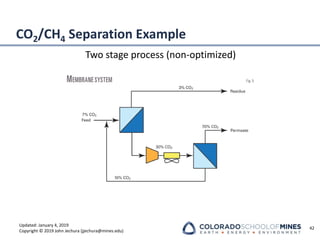
CO2/CH4 Separation Example
Two stage process (non-optimized)
42
Updated: January 4, 2019
Copyright © 2019 John Jechura (jjechura@mines.edu)
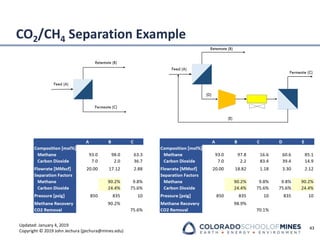
CO2/CH4 Separation Example
43
Feed (A)
Retentate (B)
Permeate (C)
(D)
(E)
Feed (A)
Retentate (B)
Permeate (C)
Updated: January 4, 2019
Copyright © 2017 John Jechura (jjechura@mines.edu)
Adsorption
Updated: January 4, 2019
Copyright © 2019 John Jechura (jjechura@mines.edu)
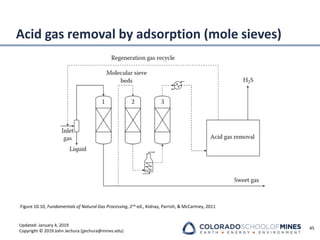
Acid gas removal by adsorption (mole sieves)
45
Figure 10.10, Fundamentals of Natural Gas Processing, 2nd ed., Kidnay, Parrish, & McCartney, 2011
Updated: January 4, 2019
Copyright © 2017 John Jechura (jjechura@mines.edu)
Nonregenerable H2S Scavengers
Updated: January 4, 2019
Copyright © 2019 John Jechura (jjechura@mines.edu)
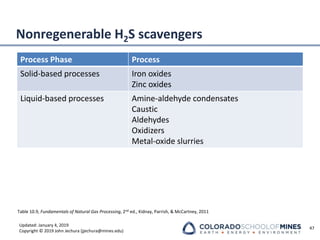
Nonregenerable H2S scavengers
Process Phase Process
Solid-based processes Iron oxides
Zinc oxides
Liquid-based processes Amine-aldehyde condensates
Caustic
Aldehydes
Oxidizers
Metal-oxide slurries
47
Table 10.9, Fundamentals of Natural Gas Processing, 2nd ed., Kidnay, Parrish, & McCartney, 2011
Updated: January 4, 2019
Copyright © 2017 John Jechura (jjechura@mines.edu)
Summary
Updated: January 4, 2019
Copyright © 2019 John Jechura (jjechura@mines.edu)
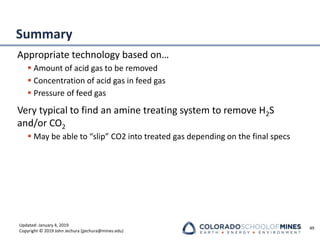
Summary
Appropriate technology based on…
▪ Amount of acid gas to be removed
▪ Concentration of acid gas in feed gas
▪ Pressure of feed gas
Very typical to find an amine treating system to remove H2S
and/or CO2
▪ May be able to “slip” CO2 into treated gas depending on the final specs
49
Updated: January 4, 2019
Copyright © 2017 John Jechura (jjechura@mines.edu)
Supplemental Slides
Updated: January 4, 2019
Copyright © 2019 John Jechura (jjechura@mines.edu)
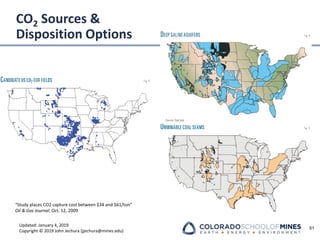
CO2 Sources &
Disposition Options
51
“Study places CO2 capture cost between $34 and $61/ton”
Oil & Gas Journal, Oct. 12, 2009

00_Presentation_important_GasTreating.pdf

  • 1.
    Acid Gas Treating Chapter10 Based on presentation by Prof. Art Kidnay
  • 2.
    Updated: January 4,2019 Copyright © 2019 John Jechura (jjechura@mines.edu) Plant Block Schematic 2 Adapted from Figure 7.1, Fundamentals of Natural Gas Processing, 2nd ed. Kidnay, Parrish, & McCartney
  • 3.
    Updated: January 4,2019 Copyright © 2019 John Jechura (jjechura@mines.edu) Topics Chemical Absorption Processes Physical Absorption Adsorption Cryogenic Fractionation Membranes Nonregenerable H2S Scavengers Biological Processes Safety and Environmental Considerations 3
  • 4.
    Updated: January 4,2019 Copyright © 2019 John Jechura (jjechura@mines.edu) Gas treating Gas treating involves removing contaminants to sufficiently low levels to meet specifications ▪ Primary focus on removing “acid gases” • Carbon dioxide (CO2) • Hydrogen sulfide (H2S) • Plus other sulfur species ▪ Other contaminants • Mercury • Ammonia • Elemental sulfur • Arsenic The acid gas problem ▪ H2S is highly toxic ▪ H2S combustion gives SO2 – toxic & leads to acid rain ▪ CO2 is a diluent in natural gas – corrosive in presence of H2O Purification levels ▪ H2S: Pipeline quality gas requires 0.25 grains/100 scf (4 ppmv) ▪ CO2: pipeline quality gas may allow up to 4 mole% • Cryogenic applications need less than 50 ppmv 4
  • 5.
    Updated: January 4,2019 Copyright © 2019 John Jechura (jjechura@mines.edu) Two step process Two steps ▪ Remove the acid gases from natural gas ▪ Dispose of the acid gases Disposition ▪ CO2 • Vent to atmosphere • EOR – Enhanced Oil Recovery • Sequestration ▪ H2S • Incineration or venting (trace amounts) • React with scavengers (e.g. iron sponge) • Convert to elemental sulfur • Injection into suitable underground formation 5
  • 6.
    Updated: January 4,2019 Copyright © 2019 John Jechura (jjechura@mines.edu) Power Station/Industrial Facility CO 2 CO 2 CO 2 COAL SEAM CH4 OIL 500 m 1000m 1500m SALINE RESERVOI R Enhanced Oil Recovery (CO2 Displaces Oil) CO2 Stored in Saline Formation CO2 Replaces Methane Trapped in Coal IMPERMEABLE CAP-ROCK IMPERMEABLE CAP-ROCK IMPERMEABLE CAP-ROCK CO2 Capture and Sequestration 6
  • 7.
    Updated: January 4,2019 Copyright © 2019 John Jechura (jjechura@mines.edu) Processes for acid gas removal 7 Physical Chemical Amine MEA DGA DEA DIPA MDEA Catacarb Giammarco Vetrocoke Flexsorb HP Benfield Selexol Rectisol Sulfinol Selefining Amisol Lo Cat Solvent Absorption Acid Gas Removal Processes Alkali Salts Ryan-Holmes Purisol Cryogenic Fractionation Stretford Direct Conversion Iron sponge Zinc oxide Solid Adsorption Hybrid Ifpexol Sepasolv MPE Membranes Molecular sieve Amine mixtures Hindered amines Cellulose acetate Polyimide Polysulfone Figure 10.1, Fundamentals of Natural Gas Processing, 2nd ed., Kidnay, Parrish, & McCartney, 2011
  • 8.
    Updated: January 4,2019 Copyright © 2019 John Jechura (jjechura@mines.edu) Selecting a process Factors for selecting process ▪ Type & concentration of impurities ▪ Hydrocarbon composition of the gas ▪ Pressure & temperature of the gas ▪ Specifications for outlet gas ▪ Volume of gas to be processed Four possible scenarios ▪ Only CO2 ▪ Only H2S ▪ Both CO2 and H2S ▪ Both CO2 and H2S present but selectively remove H2S • Allow CO2 slip 8
  • 9.
    Updated: January 4,2019 Copyright © 2019 John Jechura (jjechura@mines.edu) Selecting a process 9 Figure 10.2, Fundamentals of Natural Gas Processing, 2nd ed., Kidnay, Parrish, & McCartney, 2011
  • 10.
    Updated: January 4,2019 Copyright © 2017 John Jechura (jjechura@mines.edu) Chemical Absorption Processes
  • 11.
    Updated: January 4,2019 Copyright © 2019 John Jechura (jjechura@mines.edu) Physical vs. Chemical Absorption 11
  • 12.
    Updated: January 4,2019 Copyright © 2019 John Jechura (jjechura@mines.edu) Amine Chemistry Gas treating amines are: ▪ Weak Lewis Bases ▪ H+ from weak acids react with the electrons on N: ABC substituents influence: ▪ How fast acids react with N: ▪ Temperature bulge in absorber ▪ Energy required in regenerator ▪ Chemical Stability ▪ Unwanted reactions 12 AMINE N A B C l l Primary amine (MEA) A = CH2CH2OH B = H C = H Secondary amine (DEA) A = CH2CH2OH B = CH2CH2OH C = H Tertiary amine (MDEA) A = CH2CH2OH B = CH2CH2OH C = CH3 Dow Oil & Gas – Gas Treating Technology Presentation to URS Washington Division, August 2009 Rich Ackman – ackmanrb@dow.com
  • 13.
    Updated: January 4,2019 Copyright © 2019 John Jechura (jjechura@mines.edu) Sterically hindered amines – selective H2S absorbers 13 Diisopropanolamine (DIPA) HOCH2 C NH2 CH3 CH3 2-amino,2-methyl,1-propanol (AMP)
  • 14.
    Updated: January 4,2019 Copyright © 2019 John Jechura (jjechura@mines.edu) Amines Amines remove H2S and CO2 in two step process: ▪ Gas dissolves in solvent (physical absorption) ▪ Dissolved gas (a weak acid) reacts with weakly basic amines H2S reaction R1R2R3N + H2S ↔ R1R2R3NH+HS- CO2 reacts two ways with amine: ▪ With water CO2 + H2O + R1R2R3N ↔ R1R2R3NH+ HCO3 - • Much slower than H2S reaction ▪ Without water CO2 + 2 R1R2NH ↔ R1R2NH2 + R1R2NCOO- • Faster but requires one H attached to the N • Use tertiary amines to “slip” CO2 14
  • 15.
    Updated: January 4,2019 Copyright © 2019 John Jechura (jjechura@mines.edu) Comparison of acid gas removal solvents Process Capable of meeting H2S spec? Removes COS, CS2, & mercaptans Selective H2S removal Minimum CO2 level obtainable Solution subject to degradation? (degrading species) Monoethanolamine (MEA) Yes Partial No 100 ppmv at low to moderate pressures Yes (COS, CO2, CS2, SO2, SO3 and mercaptans) Diethanolamine (DEA) Yes Partial No 50 ppmv in SNEA-DEA process Some (COS, CO2, CS2, HCN and mercaptans) Triethanolamine (TEA) No Slight No Minimum partial pressure of 0.5 psia (3 kPa) Slight (COS, CS2 and mercaptans) Methyldiethanolamine (MDEA) Yes Slight Some Bulk removal only No 15 Part of Table 10.1, Fundamentals of Natural Gas Processing, 2nd ed., Kidnay, Parrish, & McCartney, 2011
  • 16.
    Updated: January 4,2019 Copyright © 2019 John Jechura (jjechura@mines.edu) Representative operating parameters MEA DEA DGA MDEA Weight % amine 15 to 25 30 to 40 50 to 60 40 to 50 Rich amine acid gas loading mole acid gas / mole amine 0.45 to 0.52 0.21 to 0.81 0.35 to 0.44 0.20 to 0.81 Acid gas pickup mole acid gas / mole amine 0.33 to 0.40 0.20 to 0.80 0.25 to 0.38 0.20 to 0.80 Lean solution residual acid gas mole acid gas / mole amine ~0.12 ~0.01 ~0.06 0.005 to 0.01 16 Table 10.3, Fundamentals of Natural Gas Processing, 2nd ed., Kidnay, Parrish, & McCartney, 2011
  • 17.
    Updated: January 4,2019 Copyright © 2019 John Jechura (jjechura@mines.edu) Gas Treating Amines Generic Amines ▪ MEA (monoethanolamine) • 15 – 18% wt. (5 – 6.1% mol) ▪ DEA (diethanolamine) • 25 – 30% wt. (5.4 – 6.8% mol) ▪ DIPA (diisopropanolamine) • 30% - 50% wt. (5.5 – 11.9% mol) ▪ MDEA (methyldiethanolamine) • 35% - 50% wt. (7.5 – 13.1% mol) 17 Wt% Mol% Load Range Relative Capacity MEA 18% 6.1% 0.35 1 DGA 50% 14.6% 0.45 3.09 DEA 28% 6.3% 0.48 1.41 MDEA 50% 13.1% 0.49 3.02 CompSol 20 50% 10.4% 0.485 2.37 CR 402 50% 14.7% 0.49 3.38 AP 814 50% 13.9% 0.485 3.16 Dow Oil & Gas – Gas Treating Technology Presentation to URS Washington Division, August 2009 Rich Ackman – ackmanrb@dow.com
  • 18.
    Updated: January 4,2019 Copyright © 2019 John Jechura (jjechura@mines.edu) Amine Solution Densities Lean amine composition will dictate volumetric circulation rate & pumping power required ▪ Need to determine density/volumetric flow at actual pumping temperature 18 GPSA Engineering Data Book, 13th ed. ( ) ( )    = = =    BHP pump pump pump m P V P V gH W
  • 19.
    Updated: January 4,2019 Copyright © 2019 John Jechura (jjechura@mines.edu) Amine Solution Densities 19 Figures B.1 & B.2, Fundamentals of Natural Gas Processing, 2nd ed., Kidnay, Parrish, & McCartney, 2011
  • 20.
    Updated: January 4,2019 Copyright © 2019 John Jechura (jjechura@mines.edu) Typical Amine Treating Plant Typical plant configuration ▪ Broad range of treating applications ▪ Low to intermediate specifications ▪ Selective treating, low H2S ▪ Low installed cost 20
  • 21.
    Updated: January 4,2019 Copyright © 2019 John Jechura (jjechura@mines.edu) Amine Tower Parameters Tower Design Considerations ▪ Gas Composition ▪ Trays • System Factor Bubble Area o MEA/DEA – 0.75 abs (0.85 reg) o MDEA & Formulated Solvents – 0.70 abs (0.85 reg) • System Factor Downcomer o MEA/DEA – 0.73 abs (0.85 reg) o MDEA & Formulated Solvents – 0.70 abs (0.85 reg) o Standard Cross Flow vs. High Capacity ❖ Calming Section, MD Trays ▪ Packings • Random Packing • Capacity vs. efficiency, GPDC overlay • Structured Packing 21 Dow Oil & Gas – Gas Treating Technology Presentation to URS Washington Division, August 2009 Rich Ackman – ackmanrb@dow.com
  • 22.
    Updated: January 4,2019 Copyright © 2019 John Jechura (jjechura@mines.edu) Amine Tower Parameters Absorber design considerations ▪ Pinch points limit • Top of tower lean pinch • Temperature bulge maximum • Bottom of tower rich pinch • Confidence level in VLE ▪ Temperature profile indicator 22 Absorber Temperature Profiles Liquid Phase 1 2 3 4 5 6 7 8 9 10 11 12 13 14 15 16 17 18 19 20 21 22 23 24 80 100 120 140 160 180 200 Temperature [°F] Stage C-1 Conservative C-2 Controlled Efficient C-3 Intercooler
  • 23.
    Updated: January 4,2019 Copyright © 2019 John Jechura (jjechura@mines.edu) Amine Approximate Guidelines MEA DEA DGA MDEA Acid gas pickup, scf/gal @ 100°F 3.1 – 4.3 6.7 – 7.5 4.7 – 7.3 3 – 7.5 Acid gas pickup, mols/mol amine 0.33 – 0.40 0.20 – 0.80 0.25 – 0.38 0.20 – 0.80 Lean solution residual acid gas, mol/mol amine ~ 0.12 ~ 0.01 ~ 0.06 0.005 – 0.01 Rich solution acid gas loading, mol/mol amine 0.45 – 0.52 0.21 – 0.81 0.35 – 0.44 0.20 – 0.81 Max. solution concentration, wt% 25 40 60 65 Approximate reboiler heat duty, Btu/gal lean solution 1,000 – 1,200 840 – 1,000 1,100 – 1,300 800 – 900 Steam heated ave. heat flux in reboiler, Btu/hr ft2 9,000 – 10,000 6,300 – 7,400 9,000 –10,000 6,300 – 7,400 Reboiler temperature, °F 225 – 260 230 – 260 250 – 270 230 – 270 Heats of reaction (approximate) Btu/lb H2S Btu/lb CO2 610 825 555 730 674 850 530 610 23 GPSA Engineering Data Book, 14th ed., portion of Figure 21-4
  • 24.
    Updated: January 4,2019 Copyright © 2019 John Jechura (jjechura@mines.edu) Amine System Initial Design Amine solvent considerations ▪ Lean amine concentration (wt% amine in water) ▪ Rich & lean amine loadings (mole acid gas per mole amine) – difference is the allowed amine pick-up Determine amount of acid gas to be absorbed ▪ Difference between what can be contained in the treated gas & what is in the feed gas Determine rate of lean amine to the absorber ▪ Molar rate amine based on the allowed pick-up ▪ Total mass rate amine+water based on the allowed lean amine concentration ▪ Total volumetric flowrate (standard conditions) based on lean amine concentration Determine the reboiler duty for regeneration ▪ Based on heat of regeneration for each amine & acid gas (CO2 & H2S) 24
  • 25.
    Updated: January 4,2019 Copyright © 2019 John Jechura (jjechura@mines.edu) Operating issues with amine units Corrosion – caused by: ▪ High amine concentrations ▪ Rich amine loadings ▪ Oxygen ▪ Heat stable salts (HSS) Foaming – caused by ▪ Suspended solids ▪ Surface active agents ▪ Liquid hydrocarbons ▪ Amine degradation products (heat stable salts) 25
  • 26.
    Updated: January 4,2019 Copyright © 2019 John Jechura (jjechura@mines.edu) HYSYS Example Simulation 26
  • 27.
    Updated: January 4,2019 Copyright © 2019 John Jechura (jjechura@mines.edu) Hot potassium carbonate process (Hot Pot) Major reactions K2CO3 + CO2 + H2O ⇄ 2 KHCO3 K2CO3 + H2S ⇄ KHS + KHCO3 27 contactor Sour Feed Gas Sweet Product Gas Rich Solution Lean Solution Acid Gas Absorber Steam Condenser Stripper
  • 28.
    Updated: January 4,2019 Copyright © 2017 John Jechura (jjechura@mines.edu) Physical Absorption
  • 29.
    Updated: January 4,2019 Copyright © 2019 John Jechura (jjechura@mines.edu) Characteristics of physical absorption processes Most efficient at high partial pressures Heavy hydrocarbons strongly absorbed by solvents used Solvents can be chosen for selective removal of sulfur compounds Regeneration requirements low compared to amines & Hot Pot Can be carried out at near- ambient temperatures Partial dehydration occurs along with acid gas removal 29 Figure from UOP SelexolTM Technology for Acid Gas Removal, UOP, 2009 Retrieved March 2016 from http://www.uop.com/?document=uop-selexol-technology-for-acid-gas- removal&download=1
  • 30.
    Updated: January 4,2019 Copyright © 2019 John Jechura (jjechura@mines.edu) Comparison of chemical and physical solvents Advantages Disadvantages Chemical Solvent (e.g., amines, hot potassium carbonate) Relatively insensitive to H2S and CO2 partial pressure High energy requirements for regeneration of solvent Can reduce H2S and CO2 to ppm levels Generally not selective between CO2 and H2S Amines are in a water solution and thus the treated gas leaves saturated with water Physical solvents (e.g., Selexol, Rectisol) Low energy requirements for regeneration May be difficult to meet H2S specifications Can be selective between H2S and CO2 Very sensitive to acid gas partial pressure 30
  • 31.
    Updated: January 4,2019 Copyright © 2019 John Jechura (jjechura@mines.edu) Physical Solvents – Selexol Characteristics ▪ Poly (Ethylene Glycol) Dimethyl Ether CH3 - O - (CH2 - CH2 - O)n - CH3 where n is from 3 to 10 ▪ Selexol is a mixture of homologues so the physical properties are approximate ▪ Clear fluid that looks like tinted water Capabilities ▪ H2S selective or non selective removal – very low spec. - 4 ppm ▪ CO2 selective or non selective removal – 2% to 0.1% ▪ Water dew point control ▪ Hydrocarbon dew point control • See relative solubilities; more efficient to remove hydrocarbon vs. refrigeration ▪ Organic sulfur removal – mercaptans, disulfides, COS 31
  • 32.
    Updated: January 4,2019 Copyright © 2019 John Jechura (jjechura@mines.edu) Selexol Processes Physical solvent which favors high pressure & high partial pressure Configurations ▪ H2S & organic sulfur removal • Steam stripping for regeneration ▪ CO2 removal • Flash regeneration • Chiller for low CO2 Special applications ▪ Siloxanes are removed from landfill gas ▪ Metal carbonyl are removed from gasifier gas 32
  • 33.
    Updated: January 4,2019 Copyright © 2019 John Jechura (jjechura@mines.edu) Solubility in Selexol at 70oF (21oC) 33 0 10 20 30 200 400 600 Gas Partial Pressure, psia Solubility, scf / gal Selexol CH4 CO2 H2S COS CH3SH Figure 10.6, Fundamentals of Natural Gas Processing, 2nd ed., Kidnay, Parrish, & McCartney, 2011
  • 34.
    Updated: January 4,2019 Copyright © 2019 John Jechura (jjechura@mines.edu) Selexol process – CO2 separation 34 UOP SelexolTM Technology for Acid Gas Removal, UOP, 2009 Retrieved March 2016 from http://www.uop.com/?document=uop-selexol-technology-for-acid-gas-removal&download=1
  • 35.
    Updated: January 4,2019 Copyright © 2019 John Jechura (jjechura@mines.edu) Selexol process – sulfur removal & CO2 capture 35 UOP SelexolTM Technology for Acid Gas Removal, UOP, 2009 Retrieved March 2016 from http://www.uop.com/?document=uop-selexol-technology-for-acid-gas-removal&download=1
  • 36.
    Updated: January 4,2019 Copyright © 2017 John Jechura (jjechura@mines.edu) Membranes
  • 37.
    Updated: January 4,2019 Copyright © 2019 John Jechura (jjechura@mines.edu) Membrane systems Based on Fick’s law of diffusion through the membrane where: Ji is the molar flux of component i through the membrane Si is the solubility term Di is the diffusion coefficient Δpi is the partial pressure difference across the membrane L is the thickness of the membrane The permeability combines the properties of solubility & diffusion ▪ Differs for each compound ▪ Provides selectivity 37 ( )  = i i i i S D p J L         feed ,permeate ,feed permeate i i P y y P
  • 38.
    Updated: January 4,2019 Copyright © 2019 John Jechura (jjechura@mines.edu) Module configurations – hollow fiber Approximately 70% of membrane systems are hollow fiber Low Pressure, Bore-Side Gas Feed Module 38 Courtesy MTR
  • 39.
    Updated: January 4,2019 Copyright © 2019 John Jechura (jjechura@mines.edu) Module configurations – spiral wound 39 Continued Development of Gas Separation Membranes for Highly Sour Service, Cnop, Dormndt, & schott, UOP Retrieved March 2016 from http://www.uop.com/?document=uop-continued-development-of-gas-separation-membranes-technical- paper&download=1
  • 40.
    Updated: January 4,2019 Copyright © 2019 John Jechura (jjechura@mines.edu) Module configurations – spiral wound 40
  • 41.
    Updated: January 4,2019 Copyright © 2019 John Jechura (jjechura@mines.edu) Membrane module flow schemes No moving parts Simple, reliable operation Low hydrocarbon recovery Allows for greater CO2 removal High hydrocarbon recovery Requires recycle compressor Feed with high CO2 Intermediate hydrocarbon recovery Reduced compression 41 UOP SeparexTM Membrane Technology, UOP, 2009 Retrieved March 2016 from http://www.slideshare.net/hungtv511/uop-separex-membrane-technology
  • 42.
    Updated: January 4,2019 Copyright © 2019 John Jechura (jjechura@mines.edu) CO2/CH4 Separation Example Two stage process (non-optimized) 42
  • 43.
    Updated: January 4,2019 Copyright © 2019 John Jechura (jjechura@mines.edu) CO2/CH4 Separation Example 43 Feed (A) Retentate (B) Permeate (C) (D) (E) Feed (A) Retentate (B) Permeate (C)
  • 44.
    Updated: January 4,2019 Copyright © 2017 John Jechura (jjechura@mines.edu) Adsorption
  • 45.
    Updated: January 4,2019 Copyright © 2019 John Jechura (jjechura@mines.edu) Acid gas removal by adsorption (mole sieves) 45 Figure 10.10, Fundamentals of Natural Gas Processing, 2nd ed., Kidnay, Parrish, & McCartney, 2011
  • 46.
    Updated: January 4,2019 Copyright © 2017 John Jechura (jjechura@mines.edu) Nonregenerable H2S Scavengers
  • 47.
    Updated: January 4,2019 Copyright © 2019 John Jechura (jjechura@mines.edu) Nonregenerable H2S scavengers Process Phase Process Solid-based processes Iron oxides Zinc oxides Liquid-based processes Amine-aldehyde condensates Caustic Aldehydes Oxidizers Metal-oxide slurries 47 Table 10.9, Fundamentals of Natural Gas Processing, 2nd ed., Kidnay, Parrish, & McCartney, 2011
  • 48.
    Updated: January 4,2019 Copyright © 2017 John Jechura (jjechura@mines.edu) Summary
  • 49.
    Updated: January 4,2019 Copyright © 2019 John Jechura (jjechura@mines.edu) Summary Appropriate technology based on… ▪ Amount of acid gas to be removed ▪ Concentration of acid gas in feed gas ▪ Pressure of feed gas Very typical to find an amine treating system to remove H2S and/or CO2 ▪ May be able to “slip” CO2 into treated gas depending on the final specs 49
  • 50.
    Updated: January 4,2019 Copyright © 2017 John Jechura (jjechura@mines.edu) Supplemental Slides
  • 51.
    Updated: January 4,2019 Copyright © 2019 John Jechura (jjechura@mines.edu) CO2 Sources & Disposition Options 51 “Study places CO2 capture cost between $34 and $61/ton” Oil & Gas Journal, Oct. 12, 2009