DIRECT DYE
Introduction
• Also known as substantive dyes
– Have excellent substantivity for cellulosic textile materials
(Cotton, Viscose etc.)
• Have direct affinity for cellulosic fibres when applied from an aqueous
solution
• Direct dyes are sodium salts of aromatic sulphonic acids and most of
them contain azo group as the main chromophore
– Can be denoted as DSO3Na
– (Many of the direct dyes are based on direct amines)
• These dyes are Sodium salts of aromatic sulphonic acids
Properties of Direct Dyes
• Direct dyes are soluble in water
• Have affinity for cellulose and protein fibres specially wool
• Chemically the dyes are represented as sodium salts of sulphonic acids
(DSO3Na)
• When dissolved in water, dye molecules get dissociated into ions
• DSO3Na DSO3
- + Na+
• During dyeing the textile material absorbs coloured anions from the
dye solution. This is followed by the diffusion of molecules into the
fibres where they are finally anchored by means of physical forces
• Owing to their water solubility, the dye possess poor wash fastness
• Light fastness is however, is poor to moderate, even good in some
cases
• The fastness properties of these dyes can be improved slightly by
means of certain after treatments
Classification of Direct Dyes
• Class A: Self-levelling Dyes
– Dyeing may be uneven in the initial stages but they get levelled on
prolonged dyeing because of better migration properties
– Do not require salt for exhaustion
• Class B: Salt-controllable Dyes
– Do not migrate well
– Require salt addition for increased exhaustion
– If uneven dyeing takes place initially, it is very difficult to correct the
dyeing
• Class C: Temperature –controllable dyes
– Similar to Class B type
– Levelling properties is poor
– Sensitive to salt and exhaustion cannot be controlled with salt alone
– Exhaustion is controlled by controlled rise of dye bath temperature
Mechanism of Dyeing
• When cotton is immersed in a solution of a direct dye the following
mechanism takes place
– Adsorbsion
• Dye molecules move towards the fibre
• Get adsorbed on the fibre surface
– Absorbsion or penetration
• Adsorbed dye penetrate inside the fibre structure
• Gradually penetrate or ‘diffuse’ inside the structure
• Rate of penetration depends on the molecular structure of the dye and
dyeing condition
• Greater the penetration of the dye in the fibre, better and brighter is the
dyeing
– Fixation
• Fixation takes place by means of hydrogen bonds and vanderwaals
forces of attraction
Effect of Electrolytes
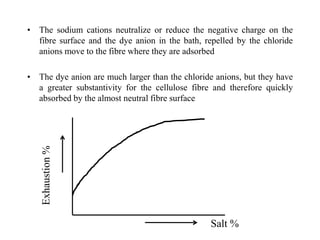
• Addition of salt in dyeing promotes exhaustion
• When cellulose are immersed in water they acquire a small negative
charge known as ‘zeta potential’
• In an aqueous bath containing both fibre and direct dye, the latter being
anionic will be repelled by the negative surface charge on the fibre
– Little or no exhaustion will take place
• When electrolyte such as Sodium Chloride (NaCl) is added to the bath,
it ionizes into sodium cations and chloride anions
• The sodium cations neutralize or reduce the negative charge on the
fibre surface and the dye anion in the bath, repelled by the chloride
anions move to the fibre where they are adsorbed
• The dye anion are much larger than the chloride anions, but they have
a greater substantivity for the cellulose fibre and therefore quickly
absorbed by the almost neutral fibre surface
Salt %
Exhaustion%
Effect of Temperature
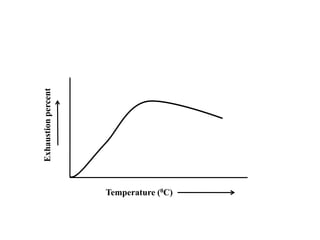
• The amount of dye taken by the fibre depends on the temperature of
dyeing
• The rate of dyeing increases with rise in temperature
• So, uneven dyeing can take place at elevated temperature
• Therefore, it is always advised to start the dyeing the dyeing at room
temperature and then the temperature is raised to maximum dyeing
temperature
• As the temperature rises, the rate at which equilibrium is attained
increases until it reaches the maximum
– Affinity however decreases with further increase in temperature
Temperature (0C)
Exhaustionpercent
Effect of Liquor Ratio
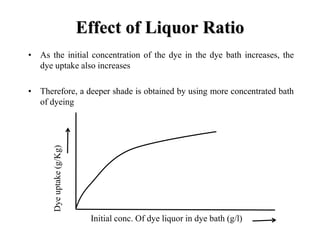
• As the initial concentration of the dye in the dye bath increases, the
dye uptake also increases
• Therefore, a deeper shade is obtained by using more concentrated bath
of dyeing
Initial conc. Of dye liquor in dye bath (g/l)
Dyeuptake(g/Kg)
Dyeing of Cotton
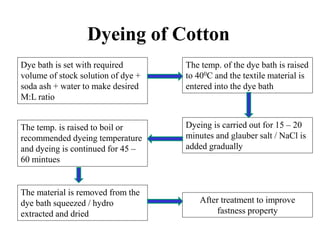
Dye bath is set with required
volume of stock solution of dye +
soda ash + water to make desired
M:L ratio
The temp. of the dye bath is raised
to 400C and the textile material is
entered into the dye bath
Dyeing is carried out for 15 – 20
minutes and glauber salt / NaCl is
added gradually
The temp. is raised to boil or
recommended dyeing temperature
and dyeing is continued for 45 –
60 mintues
The material is removed from the
dye bath squeezed / hydro
extracted and dried
After treatment to improve
fastness property
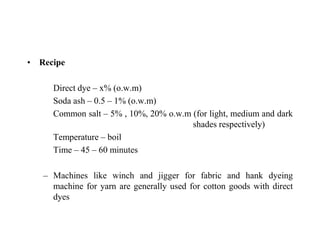
• Recipe
Direct dye – x% (o.w.m)
Soda ash – 0.5 – 1% (o.w.m)
Common salt – 5% , 10%, 20% o.w.m (for light, medium and dark
shades respectively)
Temperature – boil
Time – 45 – 60 minutes
– Machines like winch and jigger for fabric and hank dyeing
machine for yarn are generally used for cotton goods with direct
dyes
After Treatment
• To improve the fastness property
– By increasing the molecular weight and thus decreasing the
solubility in water after dyeing
– Cannot be applicable for all the dyes as colour of the final product
changes
1. Treatment with Metallic salts
• Treatment with copper salts
• Treatment with chromium compounds
2. Treatment with formaldehyde
• Treatment with Copper salts
– Certain dyestaffs have seen that reacting with copper improves remarkable
light fastness property
– The dyed material is treated in a bath containing
Copper sulphate – 0.5 % to 2% (owf)
Acetic Acid – 0.5% to 2% (owf)
Temperature – 800 C
Time – 30 – 45 minutes
– The material is then rinsed and dried
• Treatment with Chromium compounds
– Chromium atoms can be introduced in the molecular structure of certain
direct dyes resulting in more complex structures
– Washing fastness is improved
– This treatment however, does not alter their light fastness properties
– The dyed material is treated in a bath containing
Pottasium di-chromate – 2 - 3%
Acetic acid – 2 – 3 %
Temperature – At boil
Time – 30 minutes
– The material is then rinsed and dried
• A combination of the treatments with copper and chromium compounds
can be employed to get improvements in washing as well as light
fastness properties
• The dyed material is to be treated in a bath containing
Pottasium di-chromate – 0.5 % (owm)
Copper sulphate – 0.5 – 2% (owm)
Acetic acid – 1 – 5% (owm)
Temperature – 800 C
Time – 30 minutes
• The material is then rinsed and dried
• Treatment with formaldehyde
– Increasing the relative size of the dye molecules of some direct dyes
can also be achieved by treatment with formaldehyde
– Washing fastness is enhanced
– The dyed material are treated in a bath containing
Formaldehyde – 2 – 3% (owm)
Acetic Acid – 1% (owm)
Temperature – 60 – 700 C
Time – 30 minutes
– The material is then rinsed and dried

Direct dye

  • 1.
  • 2.
    Introduction • Also knownas substantive dyes – Have excellent substantivity for cellulosic textile materials (Cotton, Viscose etc.) • Have direct affinity for cellulosic fibres when applied from an aqueous solution • Direct dyes are sodium salts of aromatic sulphonic acids and most of them contain azo group as the main chromophore – Can be denoted as DSO3Na – (Many of the direct dyes are based on direct amines) • These dyes are Sodium salts of aromatic sulphonic acids
  • 3.
    Properties of DirectDyes • Direct dyes are soluble in water • Have affinity for cellulose and protein fibres specially wool • Chemically the dyes are represented as sodium salts of sulphonic acids (DSO3Na) • When dissolved in water, dye molecules get dissociated into ions • DSO3Na DSO3 - + Na+ • During dyeing the textile material absorbs coloured anions from the dye solution. This is followed by the diffusion of molecules into the fibres where they are finally anchored by means of physical forces
  • 4.
    • Owing totheir water solubility, the dye possess poor wash fastness • Light fastness is however, is poor to moderate, even good in some cases • The fastness properties of these dyes can be improved slightly by means of certain after treatments
  • 5.
    Classification of DirectDyes • Class A: Self-levelling Dyes – Dyeing may be uneven in the initial stages but they get levelled on prolonged dyeing because of better migration properties – Do not require salt for exhaustion • Class B: Salt-controllable Dyes – Do not migrate well – Require salt addition for increased exhaustion – If uneven dyeing takes place initially, it is very difficult to correct the dyeing • Class C: Temperature –controllable dyes – Similar to Class B type – Levelling properties is poor – Sensitive to salt and exhaustion cannot be controlled with salt alone – Exhaustion is controlled by controlled rise of dye bath temperature
  • 6.
    Mechanism of Dyeing •When cotton is immersed in a solution of a direct dye the following mechanism takes place – Adsorbsion • Dye molecules move towards the fibre • Get adsorbed on the fibre surface – Absorbsion or penetration • Adsorbed dye penetrate inside the fibre structure • Gradually penetrate or ‘diffuse’ inside the structure • Rate of penetration depends on the molecular structure of the dye and dyeing condition • Greater the penetration of the dye in the fibre, better and brighter is the dyeing – Fixation • Fixation takes place by means of hydrogen bonds and vanderwaals forces of attraction
  • 7.
    Effect of Electrolytes •Addition of salt in dyeing promotes exhaustion • When cellulose are immersed in water they acquire a small negative charge known as ‘zeta potential’ • In an aqueous bath containing both fibre and direct dye, the latter being anionic will be repelled by the negative surface charge on the fibre – Little or no exhaustion will take place • When electrolyte such as Sodium Chloride (NaCl) is added to the bath, it ionizes into sodium cations and chloride anions
  • 8.
    • The sodiumcations neutralize or reduce the negative charge on the fibre surface and the dye anion in the bath, repelled by the chloride anions move to the fibre where they are adsorbed • The dye anion are much larger than the chloride anions, but they have a greater substantivity for the cellulose fibre and therefore quickly absorbed by the almost neutral fibre surface Salt % Exhaustion%
  • 9.
    Effect of Temperature •The amount of dye taken by the fibre depends on the temperature of dyeing • The rate of dyeing increases with rise in temperature • So, uneven dyeing can take place at elevated temperature • Therefore, it is always advised to start the dyeing the dyeing at room temperature and then the temperature is raised to maximum dyeing temperature • As the temperature rises, the rate at which equilibrium is attained increases until it reaches the maximum – Affinity however decreases with further increase in temperature
  • 10.
  • 11.
    Effect of LiquorRatio • As the initial concentration of the dye in the dye bath increases, the dye uptake also increases • Therefore, a deeper shade is obtained by using more concentrated bath of dyeing Initial conc. Of dye liquor in dye bath (g/l) Dyeuptake(g/Kg)
  • 12.
    Dyeing of Cotton Dyebath is set with required volume of stock solution of dye + soda ash + water to make desired M:L ratio The temp. of the dye bath is raised to 400C and the textile material is entered into the dye bath Dyeing is carried out for 15 – 20 minutes and glauber salt / NaCl is added gradually The temp. is raised to boil or recommended dyeing temperature and dyeing is continued for 45 – 60 mintues The material is removed from the dye bath squeezed / hydro extracted and dried After treatment to improve fastness property
  • 13.
    • Recipe Direct dye– x% (o.w.m) Soda ash – 0.5 – 1% (o.w.m) Common salt – 5% , 10%, 20% o.w.m (for light, medium and dark shades respectively) Temperature – boil Time – 45 – 60 minutes – Machines like winch and jigger for fabric and hank dyeing machine for yarn are generally used for cotton goods with direct dyes
  • 14.
    After Treatment • Toimprove the fastness property – By increasing the molecular weight and thus decreasing the solubility in water after dyeing – Cannot be applicable for all the dyes as colour of the final product changes 1. Treatment with Metallic salts • Treatment with copper salts • Treatment with chromium compounds 2. Treatment with formaldehyde
  • 15.
    • Treatment withCopper salts – Certain dyestaffs have seen that reacting with copper improves remarkable light fastness property – The dyed material is treated in a bath containing Copper sulphate – 0.5 % to 2% (owf) Acetic Acid – 0.5% to 2% (owf) Temperature – 800 C Time – 30 – 45 minutes – The material is then rinsed and dried
  • 16.
    • Treatment withChromium compounds – Chromium atoms can be introduced in the molecular structure of certain direct dyes resulting in more complex structures – Washing fastness is improved – This treatment however, does not alter their light fastness properties – The dyed material is treated in a bath containing Pottasium di-chromate – 2 - 3% Acetic acid – 2 – 3 % Temperature – At boil Time – 30 minutes – The material is then rinsed and dried
  • 17.
    • A combinationof the treatments with copper and chromium compounds can be employed to get improvements in washing as well as light fastness properties • The dyed material is to be treated in a bath containing Pottasium di-chromate – 0.5 % (owm) Copper sulphate – 0.5 – 2% (owm) Acetic acid – 1 – 5% (owm) Temperature – 800 C Time – 30 minutes • The material is then rinsed and dried
  • 18.
    • Treatment withformaldehyde – Increasing the relative size of the dye molecules of some direct dyes can also be achieved by treatment with formaldehyde – Washing fastness is enhanced – The dyed material are treated in a bath containing Formaldehyde – 2 – 3% (owm) Acetic Acid – 1% (owm) Temperature – 60 – 700 C Time – 30 minutes – The material is then rinsed and dried