



BGMEA University of Fashion &
Technology
Welcome to my
presentation on
Disperse Dye
Submitted To-
Zinia Anzuman Ara
Lecturer
Dept. Of AMT
BGMEA University of Fashion
& Technology
Submitted By-
Khandaker Ataur Rahman
ID: 171-195-0-145
Disperse Dyes
• The term “disperse dye” have been applied to the organic
colouring substances which are free from ionizing groups, are
of low water solubility and are suitable for dyeing
hydrophobic fibres.
• Disperse dyes are the only water insoluble dyes that dye
polyester and acetate fibers. Disperse dye molecules are the
smallest dye molecules among all dyes.
• Disperse dyes are used for dyeing man made cellulose and
synthetic fibres specially acetate and polyester fibers and
sometimes nylon and acrylic fibres.
• Carrier or dispersing agents are required for dyeing with
disperse dyes.
• Disperse dyes have fair to good light fastness with rating
about 4-5.
➢ MECHANISM OF DISPERSE DYE
Wander Wall’s Forces.
High affinity for Fibers.
Attraction between Fiber Surface and the Dye
Molecule.
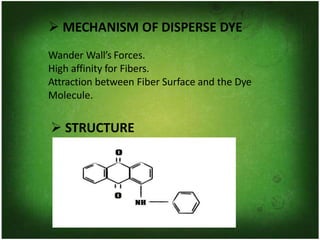
➢ STRUCTURE
➢ SOLUBILITY
Non-Soluble in Water.
➢ CHARGEABILITY
Neutral Charge.
Penetrate Because of Transition State of Synthetic Fibers.
➢ ENVIRONMENT BEHAVIOUR
Non-Environmental Friendly.
Human effect dyeing method.
➢ FASTNESS PROPERTIES
Washing
Lightening
Crocking
: Good .
: Good .
: Good .
Gas Fume Fade : Average .
➢ APPLIANCES
They are Applied to Synthetic Fibers such as
Acetate, Triacetate, Polyester, Nylon and Acrylic.
➢ COLOUR RANGE
Wide Range of Colors.
Bright and Lighter Shades.
Major Colors: Pale Yellow and Blue.
➢ COST
Cheap method for dyeing process .
Other agents used in
Polyester dyeing
➢ Dispersing Agent
• It increases the solubility of the dye in water .
• It helps to increase the rate of the dye exhaustion .
➢ Leveling Agent
•Leveling agents hold the rate of the dyeing and
helps to get uniform dyeing.
➢Buffer
•These agents protect the dye from reduction in
high temperature bath .
❖ High temperature dyeing process .
❖ Thermosol process.
High Temperature Dyeing Process
•High temperature dyeing of polyester can be done in
Beam Dyeing machines , Jet dyeing machines
and Pressure Jiggers .
•This method dye applied under pressure at
temperature of about 130`c .
•Heating help to swell the highly compact
polyester polymer and make available
more space for the dye molecule to enter
in to the amorphous region of the fiber .
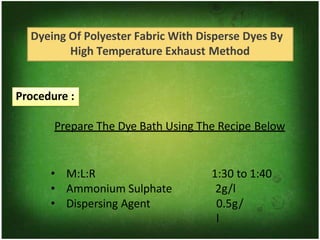
Dyeing Of Polyester Fabric With Disperse Dyes By
High Temperature Exhaust Method
Procedure :
Prepare The Dye Bath Using The Recipe Below
• M:L:R
• Ammonium Sulphate
• Dispersing Agent
1:30 to 1:40
2g/l
0.5g/
l
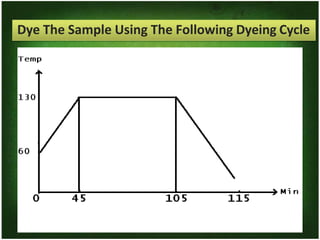
Dye The Sample Using The Following Dyeing Cycle
Dyeing With Disperse Dye
( High Temperature Exhaust Method )
• First the dye bath is made with the dye , dispersing agent and
the temperature is raised to 60`C .
• Next , Formic acid and Ammonium-Sulphate added till the pH is 5-6 .
• The dyeing should be continued and the temperature is raised to
130`C over period of 45 min.
• Then temperature reaches 130`C dyeing is done for 1 hour .
• Rinsed the sample with cold water .
• Removal the disperse dye on the surface of the fabric by
using Caustic Soda and Sodium Hydrosulphite and rinsed , Neutralize
the sample.
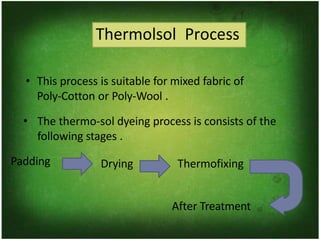
Thermolsol Process
• This process is suitable for mixed fabric of
Poly-Cotton or Poly-Wool .
• The thermo-sol dyeing process is consists of the
following stages .
Padding
After Treatment
Drying Thermofixing
➢ Padding
The Padding Carried Out At 30 - 40`C With The
Following Ingredients
• Dispensing Agent
• Water
• Disperse dye
• Acetic Acid ( pH 6 – 7 )
• Wetting Agent
• Neutral alginate thickener
Thermosol Process
• After padding the cloth with the dye and the other
dried .
• Next stage is fixation of the disperse dye , the cloth is passed
through a hot air pin stenter for 60 second at 190 – 210 `C.
• After heat treatment the cloth washed .
Prepared By-
Khandaker Ataur Rahman
Email-
marjokapu1997@gmail.com
Concept & Design By-
KAR Nation

''Presentation On Disperse Dye''

  • 1.
    BGMEA University ofFashion & Technology
  • 2.
  • 3.
    Submitted To- Zinia AnzumanAra Lecturer Dept. Of AMT BGMEA University of Fashion & Technology Submitted By- Khandaker Ataur Rahman ID: 171-195-0-145
  • 4.
    Disperse Dyes • Theterm “disperse dye” have been applied to the organic colouring substances which are free from ionizing groups, are of low water solubility and are suitable for dyeing hydrophobic fibres. • Disperse dyes are the only water insoluble dyes that dye polyester and acetate fibers. Disperse dye molecules are the smallest dye molecules among all dyes.
  • 5.
    • Disperse dyesare used for dyeing man made cellulose and synthetic fibres specially acetate and polyester fibers and sometimes nylon and acrylic fibres. • Carrier or dispersing agents are required for dyeing with disperse dyes. • Disperse dyes have fair to good light fastness with rating about 4-5.
  • 6.
    ➢ MECHANISM OFDISPERSE DYE Wander Wall’s Forces. High affinity for Fibers. Attraction between Fiber Surface and the Dye Molecule. ➢ STRUCTURE
  • 7.
    ➢ SOLUBILITY Non-Soluble inWater. ➢ CHARGEABILITY Neutral Charge. Penetrate Because of Transition State of Synthetic Fibers. ➢ ENVIRONMENT BEHAVIOUR Non-Environmental Friendly. Human effect dyeing method.
  • 8.
    ➢ FASTNESS PROPERTIES Washing Lightening Crocking :Good . : Good . : Good . Gas Fume Fade : Average . ➢ APPLIANCES They are Applied to Synthetic Fibers such as Acetate, Triacetate, Polyester, Nylon and Acrylic.
  • 9.
    ➢ COLOUR RANGE WideRange of Colors. Bright and Lighter Shades. Major Colors: Pale Yellow and Blue. ➢ COST Cheap method for dyeing process .
  • 10.
    Other agents usedin Polyester dyeing ➢ Dispersing Agent • It increases the solubility of the dye in water . • It helps to increase the rate of the dye exhaustion .
  • 11.
    ➢ Leveling Agent •Levelingagents hold the rate of the dyeing and helps to get uniform dyeing. ➢Buffer •These agents protect the dye from reduction in high temperature bath .
  • 12.
    ❖ High temperaturedyeing process . ❖ Thermosol process.
  • 13.
    High Temperature DyeingProcess •High temperature dyeing of polyester can be done in Beam Dyeing machines , Jet dyeing machines and Pressure Jiggers . •This method dye applied under pressure at temperature of about 130`c . •Heating help to swell the highly compact polyester polymer and make available more space for the dye molecule to enter in to the amorphous region of the fiber .
  • 14.
    Dyeing Of PolyesterFabric With Disperse Dyes By High Temperature Exhaust Method Procedure : Prepare The Dye Bath Using The Recipe Below • M:L:R • Ammonium Sulphate • Dispersing Agent 1:30 to 1:40 2g/l 0.5g/ l
  • 15.
    Dye The SampleUsing The Following Dyeing Cycle
  • 16.
    Dyeing With DisperseDye ( High Temperature Exhaust Method ) • First the dye bath is made with the dye , dispersing agent and the temperature is raised to 60`C . • Next , Formic acid and Ammonium-Sulphate added till the pH is 5-6 . • The dyeing should be continued and the temperature is raised to 130`C over period of 45 min. • Then temperature reaches 130`C dyeing is done for 1 hour . • Rinsed the sample with cold water . • Removal the disperse dye on the surface of the fabric by using Caustic Soda and Sodium Hydrosulphite and rinsed , Neutralize the sample.
  • 17.
    Thermolsol Process • Thisprocess is suitable for mixed fabric of Poly-Cotton or Poly-Wool . • The thermo-sol dyeing process is consists of the following stages . Padding After Treatment Drying Thermofixing
  • 18.
    ➢ Padding The PaddingCarried Out At 30 - 40`C With The Following Ingredients • Dispensing Agent • Water • Disperse dye • Acetic Acid ( pH 6 – 7 ) • Wetting Agent • Neutral alginate thickener
  • 19.
    Thermosol Process • Afterpadding the cloth with the dye and the other dried . • Next stage is fixation of the disperse dye , the cloth is passed through a hot air pin stenter for 60 second at 190 – 210 `C. • After heat treatment the cloth washed .
  • 20.
    Prepared By- Khandaker AtaurRahman Email- marjokapu1997@gmail.com Concept & Design By- KAR Nation