DISCUSS IN GROUPS:
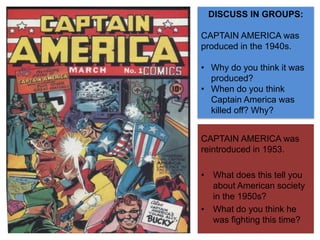
CAPTAIN AMERICA was
produced in the 1940s.
• Why do you think it was
produced?
• When do you think
Captain America was
killed off? Why?
CAPTAIN AMERICA was
reintroduced in 1953.
• What does this tell you
about American society
in the 1950s?
• What do you think he
was fighting this time?
A Divided Union: The USA 1945-1970
Key Areas of Study:
• McCarthyism and the Red Scare
• Civil Rights in the 1950s
• The impact of Martin Luther King and Black Power
• Protest movements: students, women and anti-Vietnam
• Nixon and Watergate
Paper 1: Assessment Rubric will be the same as for the
Germany Unit
Google Classroom: f8i1bu
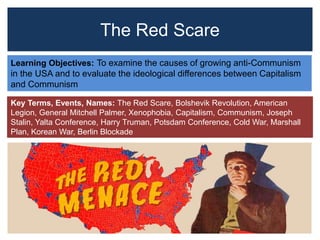
The Red Scare
Learning Objectives: To examine the causes of growing anti-Communism
in the USA and to evaluate the ideological differences between Capitalism
and Communism
Key Terms, Events, Names: The Red Scare, Bolshevik Revolution, American
Legion, General Mitchell Palmer, Xenophobia, Capitalism, Communism, Joseph
Stalin, Yalta Conference, Harry Truman, Potsdam Conference, Cold War, Marshall
Plan, Korean War, Berlin Blockade
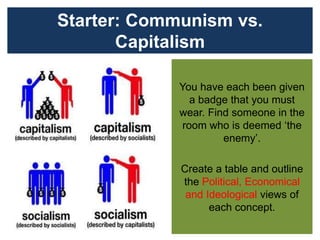
Starter: Communism vs.
Capitalism
You have each been given
a badge that you must
wear. Find someone in the
room who is deemed ‘the
enemy’.
Create a table and outline
the Political, Economical
and Ideological views of
each concept.
What was the ‘Red
Scare’?
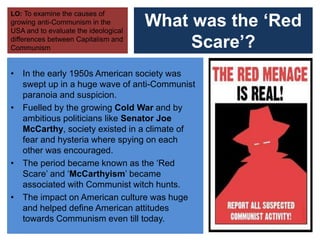
• In the early 1950s American society was
swept up in a huge wave of anti-Communist
paranoia and suspicion.
• Fuelled by the growing Cold War and by
ambitious politicians like Senator Joe
McCarthy, society existed in a climate of
fear and hysteria where spying on each
other was encouraged.
• The period became known as the ‘Red
Scare’ and ‘McCarthyism’ became
associated with Communist witch hunts.
• The impact on American culture was huge
and helped define American attitudes
towards Communism even till today.
LO: To examine the causes of
growing anti-Communism in the
USA and to evaluate the ideological
differences between Capitalism and
Communism
The First Red Scare
1917
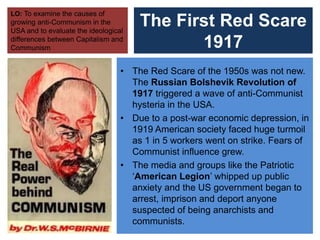
• The Red Scare of the 1950s was not new.
The Russian Bolshevik Revolution of
1917 triggered a wave of anti-Communist
hysteria in the USA.
• Due to a post-war economic depression, in
1919 American society faced huge turmoil
as 1 in 5 workers went on strike. Fears of
Communist influence grew.
• The media and groups like the Patriotic
‘American Legion’ whipped up public
anxiety and the US government began to
arrest, imprison and deport anyone
suspected of being anarchists and
communists.
LO: To examine the causes of
growing anti-Communism in the
USA and to evaluate the ideological
differences between Capitalism and
Communism
The First Red Scare
1917
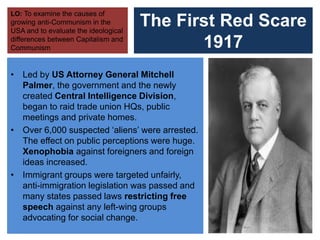
• Led by US Attorney General Mitchell
Palmer, the government and the newly
created Central Intelligence Division,
began to raid trade union HQs, public
meetings and private homes.
• Over 6,000 suspected ‘aliens’ were arrested.
The effect on public perceptions were huge.
Xenophobia against foreigners and foreign
ideas increased.
• Immigrant groups were targeted unfairly,
anti-immigration legislation was passed and
many states passed laws restricting free
speech against any left-wing groups
advocating for social change.
LO: To examine the causes of
growing anti-Communism in the
USA and to evaluate the ideological
differences between Capitalism and
Communism
How did a 2nd Red
Scare form?
• Fears of Communism subsided during WW2
(1939-1945) as the USA and USSR became
Allies to fight Fascist Germany and Japan.
• However, success in the war left both
nations as the biggest superpowers in the
world. Disagreements over the division of
post-War Europe and Asia led to growing
mistrust and fears.
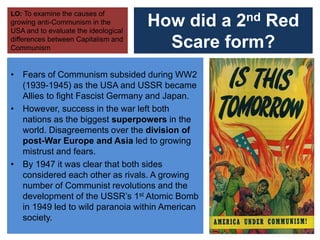
• By 1947 it was clear that both sides
considered each other as rivals. A growing
number of Communist revolutions and the
development of the USSR’s 1st Atomic Bomb
in 1949 led to wild paranoia within American
society.
LO: To examine the causes of
growing anti-Communism in the
USA and to evaluate the ideological
differences between Capitalism and
Communism
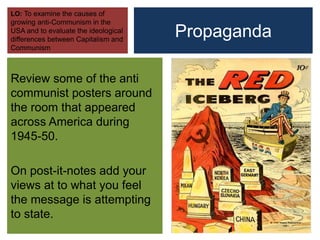
Propaganda
Review some of the anti
communist posters around
the room that appeared
across America during
1945-50.
On post-it-notes add your
views at to what you feel
the message is attempting
to state.
LO: To examine the causes of
growing anti-Communism in the
USA and to evaluate the ideological
differences between Capitalism and
Communism
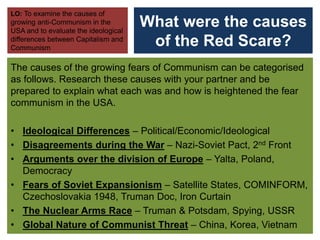
What were the causes
of the Red Scare?
The causes of the growing fears of Communism can be categorised
as follows. Research these causes with your partner and be
prepared to explain what each was and how is heightened the fear
communism in the USA.
• Ideological Differences – Political/Economic/Ideological
• Disagreements during the War – Nazi-Soviet Pact, 2nd Front
• Arguments over the division of Europe – Yalta, Poland,
Democracy
• Fears of Soviet Expansionism – Satellite States, COMINFORM,
Czechoslovakia 1948, Truman Doc, Iron Curtain
• The Nuclear Arms Race – Truman & Potsdam, Spying, USSR
• Global Nature of Communist Threat – China, Korea, Vietnam
LO: To examine the causes of
growing anti-Communism in the
USA and to evaluate the ideological
differences between Capitalism and
Communism
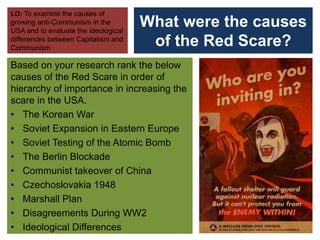
What were the causes
of the Red Scare?
Based on your research rank the below
causes of the Red Scare in order of
hierarchy of importance in increasing the
scare in the USA.
• The Korean War
• Soviet Expansion in Eastern Europe
• Soviet Testing of the Atomic Bomb
• The Berlin Blockade
• Communist takeover of China
• Czechoslovakia 1948
• Marshall Plan
• Disagreements During WW2
• Ideological Differences
LO: To examine the causes of
growing anti-Communism in the
USA and to evaluate the ideological
differences between Capitalism and
Communism
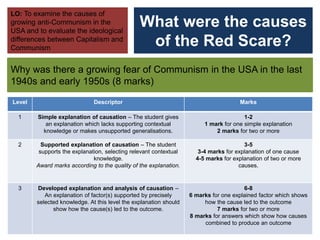
What were the causes
of the Red Scare?
Why was there a growing fear of Communism in the USA in the last
1940s and early 1950s (8 marks)
LO: To examine the causes of
growing anti-Communism in the
USA and to evaluate the ideological
differences between Capitalism and
Communism
Level Descriptor Marks
1 Simple explanation of causation – The student gives
an explanation which lacks supporting contextual
knowledge or makes unsupported generalisations.
1-2
1 mark for one simple explanation
2 marks for two or more
2 Supported explanation of causation – The student
supports the explanation, selecting relevant contextual
knowledge.
Award marks according to the quality of the explanation.
3-5
3-4 marks for explanation of one cause
4-5 marks for explanation of two or more
causes.
3 Developed explanation and analysis of causation –
An explanation of factor(s) supported by precisely
selected knowledge. At this level the explanation should
show how the cause(s) led to the outcome.
6-8
6 marks for one explained factor which shows
how the cause led to the outcome
7 marks for two or more
8 marks for answers which show how causes
combined to produce an outcome

Reasons for the Red Scare

  • 1.
    DISCUSS IN GROUPS: CAPTAINAMERICA was produced in the 1940s. • Why do you think it was produced? • When do you think Captain America was killed off? Why? CAPTAIN AMERICA was reintroduced in 1953. • What does this tell you about American society in the 1950s? • What do you think he was fighting this time?
  • 2.
    A Divided Union:The USA 1945-1970 Key Areas of Study: • McCarthyism and the Red Scare • Civil Rights in the 1950s • The impact of Martin Luther King and Black Power • Protest movements: students, women and anti-Vietnam • Nixon and Watergate Paper 1: Assessment Rubric will be the same as for the Germany Unit Google Classroom: f8i1bu
  • 3.
    The Red Scare LearningObjectives: To examine the causes of growing anti-Communism in the USA and to evaluate the ideological differences between Capitalism and Communism Key Terms, Events, Names: The Red Scare, Bolshevik Revolution, American Legion, General Mitchell Palmer, Xenophobia, Capitalism, Communism, Joseph Stalin, Yalta Conference, Harry Truman, Potsdam Conference, Cold War, Marshall Plan, Korean War, Berlin Blockade
  • 4.
    Starter: Communism vs. Capitalism Youhave each been given a badge that you must wear. Find someone in the room who is deemed ‘the enemy’. Create a table and outline the Political, Economical and Ideological views of each concept.
  • 5.
    What was the‘Red Scare’? • In the early 1950s American society was swept up in a huge wave of anti-Communist paranoia and suspicion. • Fuelled by the growing Cold War and by ambitious politicians like Senator Joe McCarthy, society existed in a climate of fear and hysteria where spying on each other was encouraged. • The period became known as the ‘Red Scare’ and ‘McCarthyism’ became associated with Communist witch hunts. • The impact on American culture was huge and helped define American attitudes towards Communism even till today. LO: To examine the causes of growing anti-Communism in the USA and to evaluate the ideological differences between Capitalism and Communism
  • 6.
    The First RedScare 1917 • The Red Scare of the 1950s was not new. The Russian Bolshevik Revolution of 1917 triggered a wave of anti-Communist hysteria in the USA. • Due to a post-war economic depression, in 1919 American society faced huge turmoil as 1 in 5 workers went on strike. Fears of Communist influence grew. • The media and groups like the Patriotic ‘American Legion’ whipped up public anxiety and the US government began to arrest, imprison and deport anyone suspected of being anarchists and communists. LO: To examine the causes of growing anti-Communism in the USA and to evaluate the ideological differences between Capitalism and Communism
  • 7.
    The First RedScare 1917 • Led by US Attorney General Mitchell Palmer, the government and the newly created Central Intelligence Division, began to raid trade union HQs, public meetings and private homes. • Over 6,000 suspected ‘aliens’ were arrested. The effect on public perceptions were huge. Xenophobia against foreigners and foreign ideas increased. • Immigrant groups were targeted unfairly, anti-immigration legislation was passed and many states passed laws restricting free speech against any left-wing groups advocating for social change. LO: To examine the causes of growing anti-Communism in the USA and to evaluate the ideological differences between Capitalism and Communism
  • 8.
    How did a2nd Red Scare form? • Fears of Communism subsided during WW2 (1939-1945) as the USA and USSR became Allies to fight Fascist Germany and Japan. • However, success in the war left both nations as the biggest superpowers in the world. Disagreements over the division of post-War Europe and Asia led to growing mistrust and fears. • By 1947 it was clear that both sides considered each other as rivals. A growing number of Communist revolutions and the development of the USSR’s 1st Atomic Bomb in 1949 led to wild paranoia within American society. LO: To examine the causes of growing anti-Communism in the USA and to evaluate the ideological differences between Capitalism and Communism
  • 9.
    Propaganda Review some ofthe anti communist posters around the room that appeared across America during 1945-50. On post-it-notes add your views at to what you feel the message is attempting to state. LO: To examine the causes of growing anti-Communism in the USA and to evaluate the ideological differences between Capitalism and Communism
  • 10.
    What were thecauses of the Red Scare? The causes of the growing fears of Communism can be categorised as follows. Research these causes with your partner and be prepared to explain what each was and how is heightened the fear communism in the USA. • Ideological Differences – Political/Economic/Ideological • Disagreements during the War – Nazi-Soviet Pact, 2nd Front • Arguments over the division of Europe – Yalta, Poland, Democracy • Fears of Soviet Expansionism – Satellite States, COMINFORM, Czechoslovakia 1948, Truman Doc, Iron Curtain • The Nuclear Arms Race – Truman & Potsdam, Spying, USSR • Global Nature of Communist Threat – China, Korea, Vietnam LO: To examine the causes of growing anti-Communism in the USA and to evaluate the ideological differences between Capitalism and Communism
  • 11.
    What were thecauses of the Red Scare? Based on your research rank the below causes of the Red Scare in order of hierarchy of importance in increasing the scare in the USA. • The Korean War • Soviet Expansion in Eastern Europe • Soviet Testing of the Atomic Bomb • The Berlin Blockade • Communist takeover of China • Czechoslovakia 1948 • Marshall Plan • Disagreements During WW2 • Ideological Differences LO: To examine the causes of growing anti-Communism in the USA and to evaluate the ideological differences between Capitalism and Communism
  • 12.
    What were thecauses of the Red Scare? Why was there a growing fear of Communism in the USA in the last 1940s and early 1950s (8 marks) LO: To examine the causes of growing anti-Communism in the USA and to evaluate the ideological differences between Capitalism and Communism Level Descriptor Marks 1 Simple explanation of causation – The student gives an explanation which lacks supporting contextual knowledge or makes unsupported generalisations. 1-2 1 mark for one simple explanation 2 marks for two or more 2 Supported explanation of causation – The student supports the explanation, selecting relevant contextual knowledge. Award marks according to the quality of the explanation. 3-5 3-4 marks for explanation of one cause 4-5 marks for explanation of two or more causes. 3 Developed explanation and analysis of causation – An explanation of factor(s) supported by precisely selected knowledge. At this level the explanation should show how the cause(s) led to the outcome. 6-8 6 marks for one explained factor which shows how the cause led to the outcome 7 marks for two or more 8 marks for answers which show how causes combined to produce an outcome