Post World War I Chaos
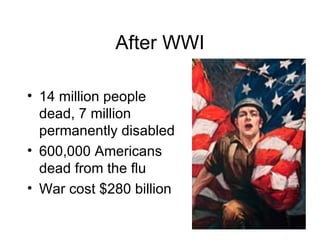
After WWI 14 million people dead, 7 million permanently disabled 600,000 Americans dead from the flu War cost $280 billion
In Europe Politically Monarchies overthrown in Russia, Austria-Hungary, Germany, Ottoman Empire Bolsheviks rose to power in 1917 Economically Devastated European economies, made US #1 Britain lost power of world’s financial center Reparations imposed on Germany crippled them Socially A whole generation of men died Culturally: France was in ruins
In the U.S. Politically: Wilson failed to join League of Nations Economically Huge increase in demand for consumer goods Led to inflation Farmers had less demand, big surplus Available jobs attracted African Americans northward Socially Women went to work 19th Amendment passed in 1919, ratified 1920 African American population shift caused uneasy race relations
What might happen in the 1920’s? What problems/opportunities might arise?
Prosperity and Intolerance PROSPERITY New products New industries New ways of doing business Expanded the economy INTOLERANCE Flu - medical crisis Reduced demand in farms and factories Returning soldiers struggle to find jobs Hatred towards the Germans
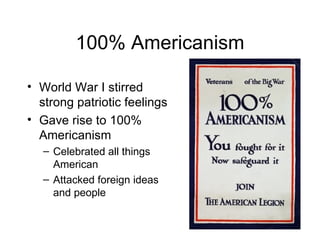
100% Americanism World War I stirred strong patriotic feelings Gave rise to 100% Americanism Celebrated all things American Attacked foreign ideas and people
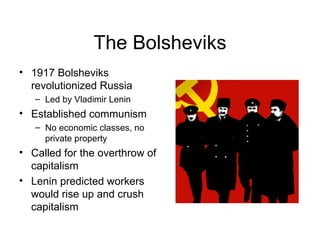
The Bolsheviks 1917 Bolsheviks revolutionized Russia Led by Vladimir Lenin Established communism No economic classes, no private property Called for the overthrow of capitalism Lenin predicted workers would rise up and crush capitalism
How might Americans react?
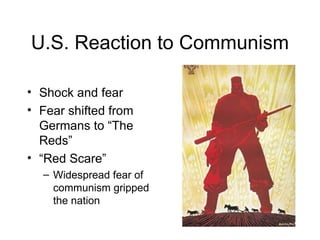
U.S. Reaction to Communism Shock and fear Fear shifted from Germans to “The Reds” “ Red Scare” Widespread fear of communism gripped the nation
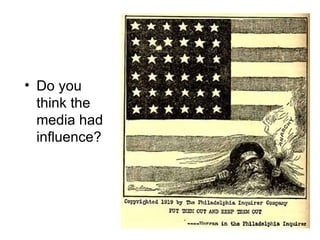
Do you think the media had influence?
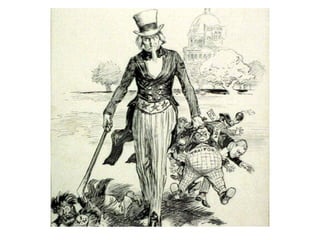
The Palmer Raids A. Mitchell Palmer - Attorney General  Leader in federal government’s anti-communist campaign Led attacks on suspected radicals “ Palmer raids” Justified his actions with wartime laws Aliens, just belonging to certain groups meant deportation Arrested thousands of people in suspected radical groups
 
Labor Strife In 1919, over 4 million workers involved in 3,000+ labor strikes War ended - economy sank Demand declined Hurt many industries Soldiers returned to lack of jobs High turnover Red Scare made people fear that workers would rise up, overthrow the government
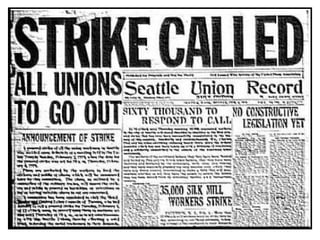
Labor Strikes Seattle General Strike, Feb. 6-11, 1919 Nations first major general strike Workers of all industries Nothing gained by workers Boston Police Strike, Sept. 9-13, 1919 Police force went on strike Governor Calvin Coolidge brought in state militia to end the strike Nothing gained United Mine Workers Strike, Sept. 1919 Very few gains
 
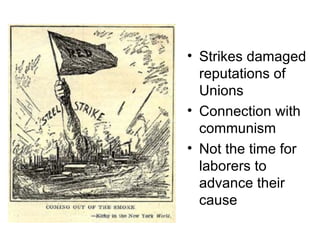
Strikes damaged reputations of Unions Connection with communism Not the time for laborers to advance their cause
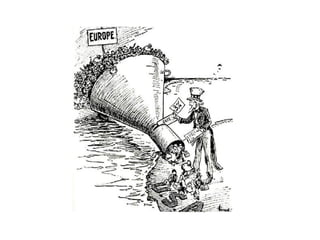
Limiting Immigration Scarce jobs, Red Scare did not favor foreigners in the U.S. Rise of nativism Distrust of foreigners Clash between earlier immigrants and newer ones Nativists were often Protestants from N and W Europe immigrated pre-1900 New immigrants often Jews, Catholics from S and E Europe Citizens, laborers favored restrictions
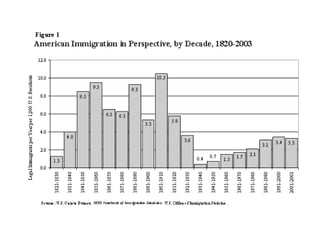
Limiting Immigration 1921 - Fed. Gov. established quotes of immigrants to be allowed into U.S. National Origins Act - 1924 Set quotas for each country at 2% of the number of people from that country who lived in the U.S. in 1890 Huge limitations on E and S Europeans Almost all immigration from Asian countries
 
 
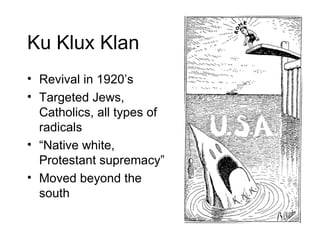
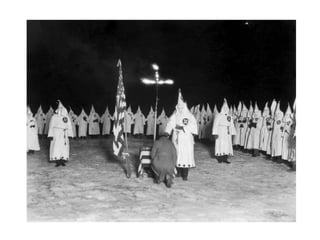
Ku Klux Klan Revival in 1920’s Targeted Jews, Catholics, all types of radicals “ Native white, Protestant supremacy” Moved beyond the south
 
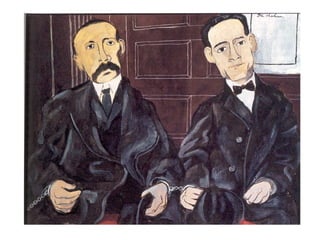
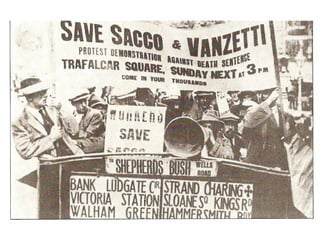
Sacco and Vanzetti Massachusetts court case in 1920 Two Italian immigrants, Nicola Sacco and Bartolomeo Vanzetti, arrested for armed robbery and murder Self proclaimed anarchists Very little evidence against them On trial for political beliefs Convicted, sentenced to death  Executed in 1927
 
 
Review What were the causes and effects of the first Red Scare? How did labor strife grow during postwar years? How did the U.S. limit immigration after WWI?
For next class… Read up on current events Read Chapter 9 Briefing to President Harding

1920s Postwar Havoc

  • 1.
  • 2.
    After WWI 14million people dead, 7 million permanently disabled 600,000 Americans dead from the flu War cost $280 billion
  • 3.
    In Europe PoliticallyMonarchies overthrown in Russia, Austria-Hungary, Germany, Ottoman Empire Bolsheviks rose to power in 1917 Economically Devastated European economies, made US #1 Britain lost power of world’s financial center Reparations imposed on Germany crippled them Socially A whole generation of men died Culturally: France was in ruins
  • 4.
    In the U.S.Politically: Wilson failed to join League of Nations Economically Huge increase in demand for consumer goods Led to inflation Farmers had less demand, big surplus Available jobs attracted African Americans northward Socially Women went to work 19th Amendment passed in 1919, ratified 1920 African American population shift caused uneasy race relations
  • 5.
    What might happenin the 1920’s? What problems/opportunities might arise?
  • 6.
    Prosperity and IntolerancePROSPERITY New products New industries New ways of doing business Expanded the economy INTOLERANCE Flu - medical crisis Reduced demand in farms and factories Returning soldiers struggle to find jobs Hatred towards the Germans
  • 7.
    100% Americanism WorldWar I stirred strong patriotic feelings Gave rise to 100% Americanism Celebrated all things American Attacked foreign ideas and people
  • 8.
    The Bolsheviks 1917Bolsheviks revolutionized Russia Led by Vladimir Lenin Established communism No economic classes, no private property Called for the overthrow of capitalism Lenin predicted workers would rise up and crush capitalism
  • 9.
  • 10.
    U.S. Reaction toCommunism Shock and fear Fear shifted from Germans to “The Reds” “ Red Scare” Widespread fear of communism gripped the nation
  • 11.
    Do you thinkthe media had influence?
  • 12.
    The Palmer RaidsA. Mitchell Palmer - Attorney General Leader in federal government’s anti-communist campaign Led attacks on suspected radicals “ Palmer raids” Justified his actions with wartime laws Aliens, just belonging to certain groups meant deportation Arrested thousands of people in suspected radical groups
  • 13.
  • 14.
    Labor Strife In1919, over 4 million workers involved in 3,000+ labor strikes War ended - economy sank Demand declined Hurt many industries Soldiers returned to lack of jobs High turnover Red Scare made people fear that workers would rise up, overthrow the government
  • 15.
    Labor Strikes SeattleGeneral Strike, Feb. 6-11, 1919 Nations first major general strike Workers of all industries Nothing gained by workers Boston Police Strike, Sept. 9-13, 1919 Police force went on strike Governor Calvin Coolidge brought in state militia to end the strike Nothing gained United Mine Workers Strike, Sept. 1919 Very few gains
  • 16.
  • 17.
    Strikes damaged reputationsof Unions Connection with communism Not the time for laborers to advance their cause
  • 18.
    Limiting Immigration Scarcejobs, Red Scare did not favor foreigners in the U.S. Rise of nativism Distrust of foreigners Clash between earlier immigrants and newer ones Nativists were often Protestants from N and W Europe immigrated pre-1900 New immigrants often Jews, Catholics from S and E Europe Citizens, laborers favored restrictions
  • 19.
    Limiting Immigration 1921- Fed. Gov. established quotes of immigrants to be allowed into U.S. National Origins Act - 1924 Set quotas for each country at 2% of the number of people from that country who lived in the U.S. in 1890 Huge limitations on E and S Europeans Almost all immigration from Asian countries
  • 20.
  • 21.
  • 22.
    Ku Klux KlanRevival in 1920’s Targeted Jews, Catholics, all types of radicals “ Native white, Protestant supremacy” Moved beyond the south
  • 23.
  • 24.
    Sacco and VanzettiMassachusetts court case in 1920 Two Italian immigrants, Nicola Sacco and Bartolomeo Vanzetti, arrested for armed robbery and murder Self proclaimed anarchists Very little evidence against them On trial for political beliefs Convicted, sentenced to death Executed in 1927
  • 25.
  • 26.
  • 27.
    Review What werethe causes and effects of the first Red Scare? How did labor strife grow during postwar years? How did the U.S. limit immigration after WWI?
  • 28.
    For next class…Read up on current events Read Chapter 9 Briefing to President Harding