TASK-BASED
LANGUAGETEACHING
By Rajdip Gohel
Sem:- 3
Paper 12:- English LanguageTeaching-1
What is a task?
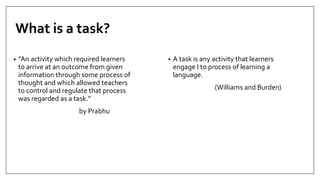
• “An activity which required learners
to arrive at an outcome from given
information through some process of
thought and which allowed teachers
to control and regulate that process
was regarded as a task.”
by Prabhu
• A task is any activity that learners
engage I to process of learning a
language.
(Williams and Burden)
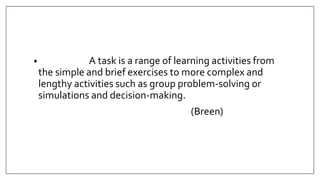
• A task is a range of learning activities from
the simple and brief exercises to more complex and
lengthy activities such as group problem-solving or
simulations and decision-making.
(Breen)
What isTask-Based LanguageTeaching?
• Task-based language teaching (TBLT) is a type of instruction that relies on
the use of authentic target language to do meaningful tasks.
• TBLT is also referred to as task-based instruction (TBI) and can be
considered a branch of communicative language teaching (CLT).
• The assessment of learning is mainly based on task outcome and not only
on the accurate use of the target language. For this reason,TBLT is believed
to be effective in learning target language fluency and developing student
confidence.
Characteristics ofTBL
•It is based on the use of tasks.
•Students learn by interacting.
•It’s focused on the use of authentic language.
•Errors are part of a natural learning.
•The focus is on process rather than product.
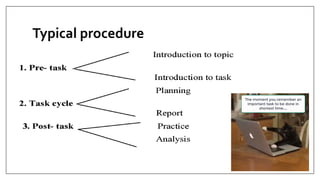
Typical procedure
Advantages ofTBLT
• As the tasks are likely to be familiar to the students, students are more
likely to be engaged, which may further motivate them in their learning.
• Allows more meaningful communication.
• The aim is that the learners’ interlanguage will gain implicit language
knowledge while doing tasks.
• TBLT allows meaningful communication to occur during the
accomplishment of tasks.
Disadvantages ofTBLT
• TBLT requires resources beyond the textbooks and related
materials usually found in language classrooms.
• Evaluation of task-based instruction can be difficult.The nature
of task-based learning does not allow it to be objectively
measurable.
So what?
• It may help to encourage students to use the target language
actively and meaningfully.
• But still, many aspects ofTBL have to be justified such as task
type, task sequencing and evaluation of task performance.

English Language Teaching

  • 1.
    TASK-BASED LANGUAGETEACHING By Rajdip Gohel Sem:-3 Paper 12:- English LanguageTeaching-1
  • 2.
    What is atask? • “An activity which required learners to arrive at an outcome from given information through some process of thought and which allowed teachers to control and regulate that process was regarded as a task.” by Prabhu • A task is any activity that learners engage I to process of learning a language. (Williams and Burden)
  • 3.
    • A taskis a range of learning activities from the simple and brief exercises to more complex and lengthy activities such as group problem-solving or simulations and decision-making. (Breen)
  • 4.
    What isTask-Based LanguageTeaching? •Task-based language teaching (TBLT) is a type of instruction that relies on the use of authentic target language to do meaningful tasks. • TBLT is also referred to as task-based instruction (TBI) and can be considered a branch of communicative language teaching (CLT). • The assessment of learning is mainly based on task outcome and not only on the accurate use of the target language. For this reason,TBLT is believed to be effective in learning target language fluency and developing student confidence.
  • 5.
    Characteristics ofTBL •It isbased on the use of tasks. •Students learn by interacting. •It’s focused on the use of authentic language. •Errors are part of a natural learning. •The focus is on process rather than product.
  • 6.
  • 7.
    Advantages ofTBLT • Asthe tasks are likely to be familiar to the students, students are more likely to be engaged, which may further motivate them in their learning. • Allows more meaningful communication. • The aim is that the learners’ interlanguage will gain implicit language knowledge while doing tasks. • TBLT allows meaningful communication to occur during the accomplishment of tasks.
  • 8.
    Disadvantages ofTBLT • TBLTrequires resources beyond the textbooks and related materials usually found in language classrooms. • Evaluation of task-based instruction can be difficult.The nature of task-based learning does not allow it to be objectively measurable.
  • 9.
    So what? • Itmay help to encourage students to use the target language actively and meaningfully. • But still, many aspects ofTBL have to be justified such as task type, task sequencing and evaluation of task performance.