jonbroome@builtintelligence.com
+44 (0) 7970 428 929
NEC3 Compensation Events :
agreeing contractual change
promptly, amicable and constructively
Dr Jon Broome
BEng (Hons) PhD MAPM MIoD
Director i/c Marketing
jonbroome@builtintelligence.com
+44 (0) 7970 428 929
Objectives.
To give you some practical tips within a process
for agreeing compensation events,
so that :
o they are agreed more quickly, amicably and
accurately for less ‘hassle’
o the Employer gets better /more work for less
o the Contractor gets more profit.
jonbroome@builtintelligence.com
+44 (0) 7970 428 929
Programme
1. A very little bit about me.
2. Overview of the compensation event
process as defined in the contract
3.Process & Tips
4. Reflection & Take-Out
jonbroome@builtintelligence.com
+44 (0) 7970 428 929
A very little bit about me &
the NEC3.
Genuine NEC Geek.
Involvement in NEC goes back 20+ years
when did a PhD on its practical use
Contributions acknowledged in the full
Engineering & Construction Contract.
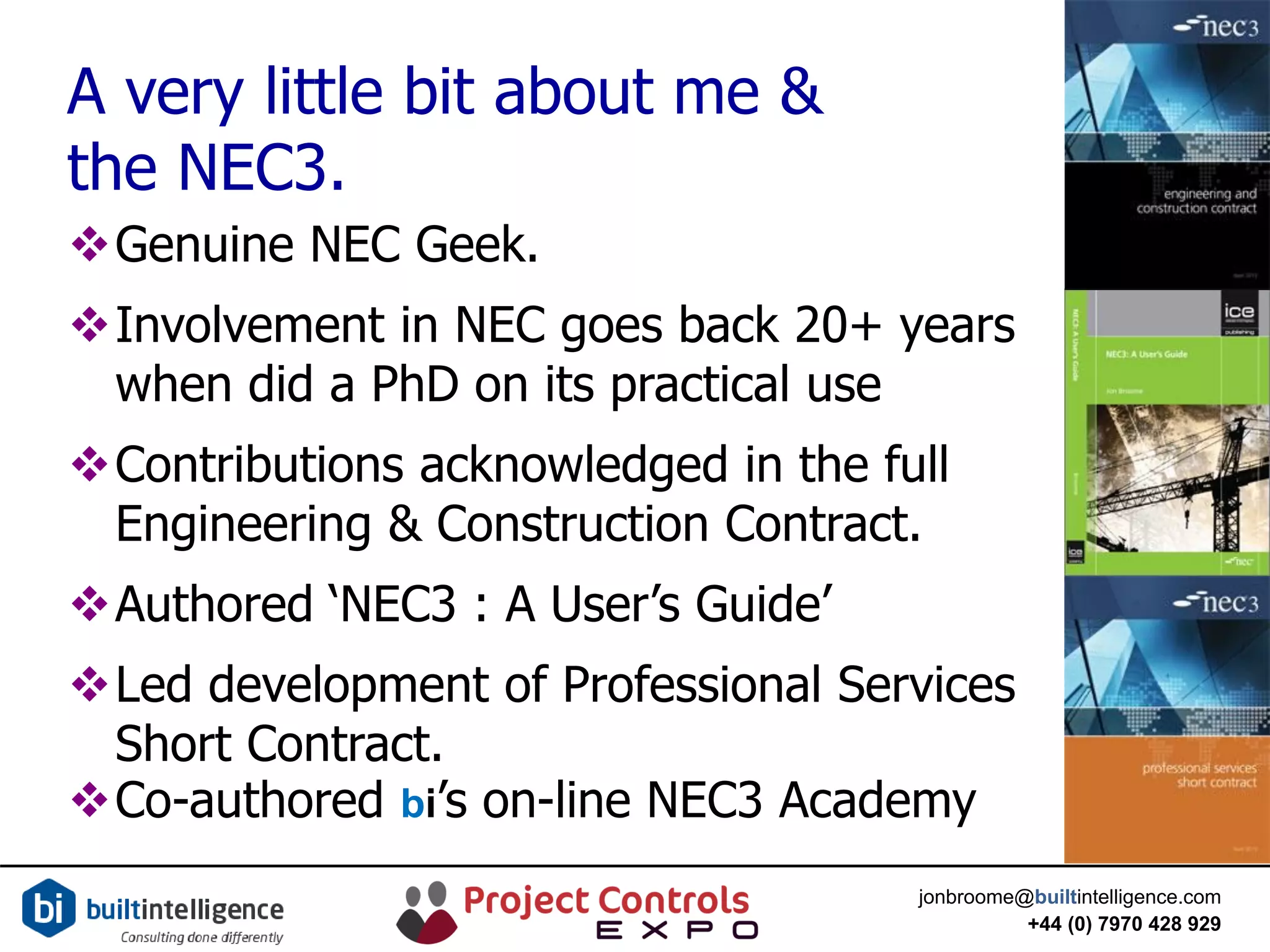
Authored ‘NEC3 : A User’s Guide’
Led development of Professional Services
Short Contract.
Co-authored bi’s on-line NEC3 Academy
jonbroome@builtintelligence.com
+44 (0) 7970 428 929
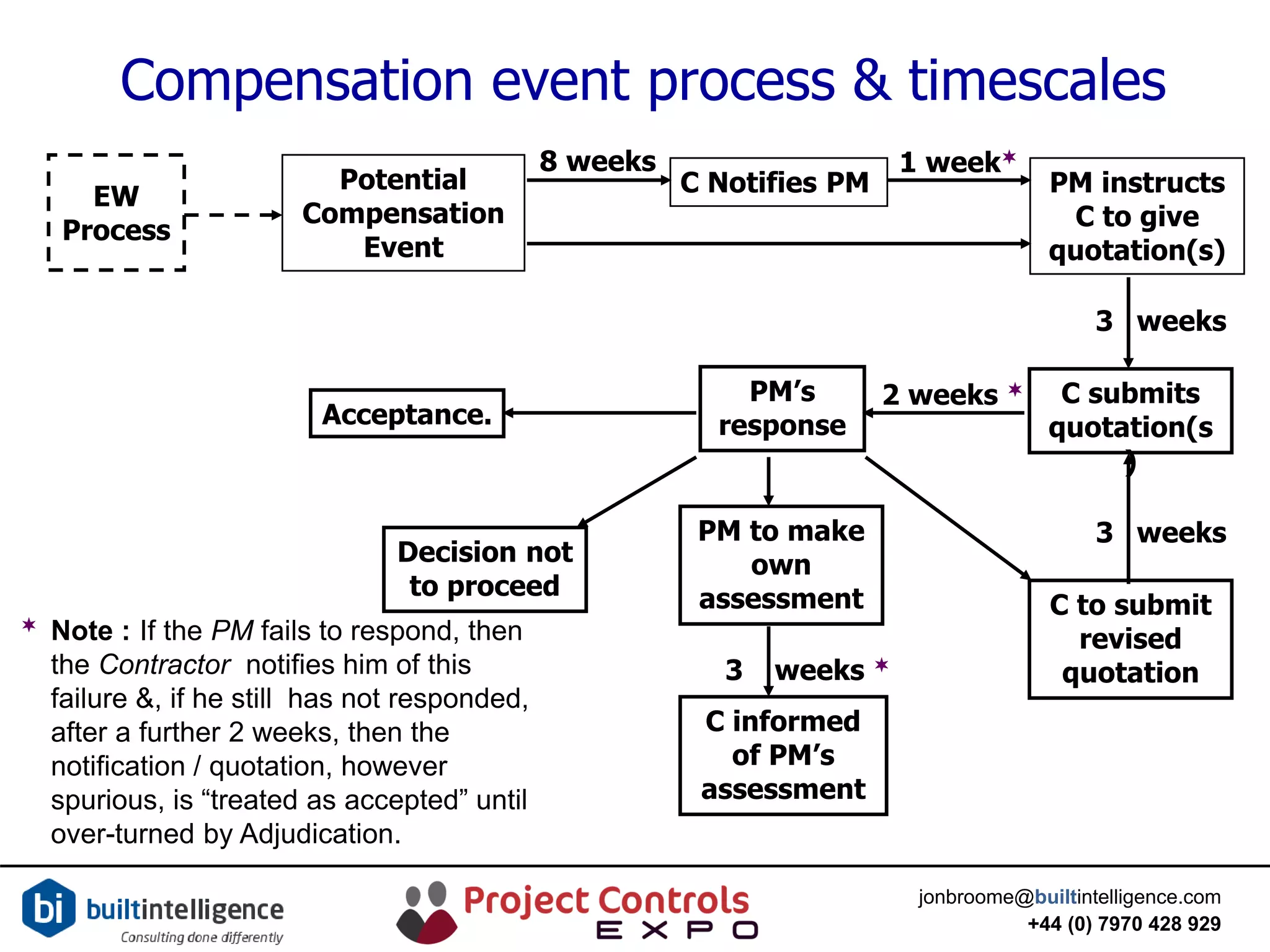
Compensation event process & timescales
Potential
Compensation
Event
C Notifies PM PM instructs
C to give
quotation(s)
8 weeks 1 week
C submits
quotation(s
)
3 weeks
PM’s
response
2 weeks 
Acceptance.
Decision not
to proceed
PM to make
own
assessment C to submit
revised
quotation
C informed
of PM’s
assessment
3 weeks
3 weeks 
 Note : If the PM fails to respond, then
the Contractor notifies him of this
failure &, if he still has not responded,
after a further 2 weeks, then the
notification / quotation, however
spurious, is “treated as accepted” until
over-turned by Adjudication.
EW
Process
jonbroome@builtintelligence.com
+44 (0) 7970 428 929
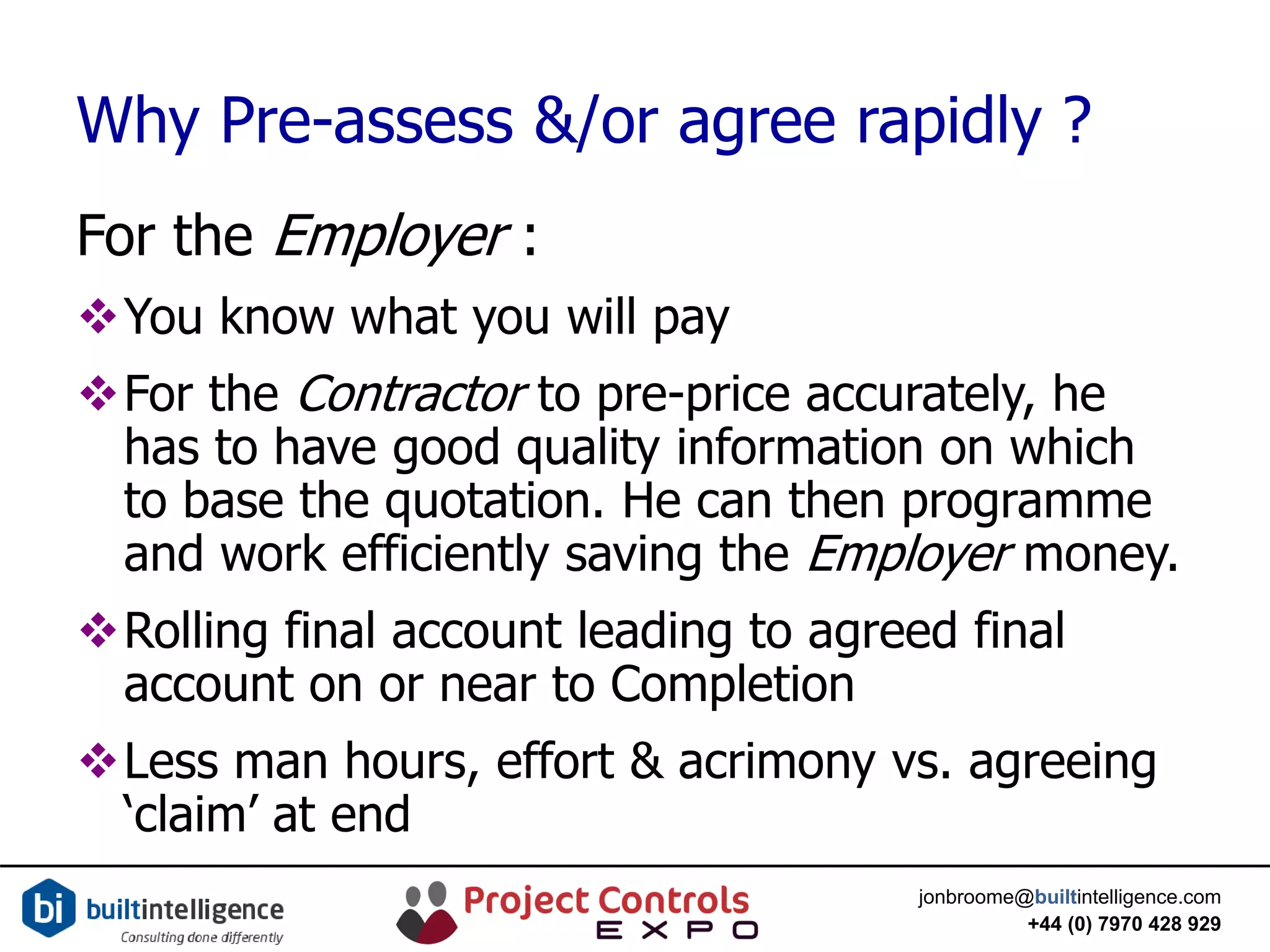
Why Pre-assess &/or agree rapidly ?
For the Employer :
You know what you will pay
For the Contractor to pre-price accurately, he
has to have good quality information on which
to base the quotation. He can then programme
and work efficiently saving the Employer money.
Rolling final account leading to agreed final
account on or near to Completion
Less man hours, effort & acrimony vs. agreeing
‘claim’ at end
jonbroome@builtintelligence.com
+44 (0) 7970 428 929
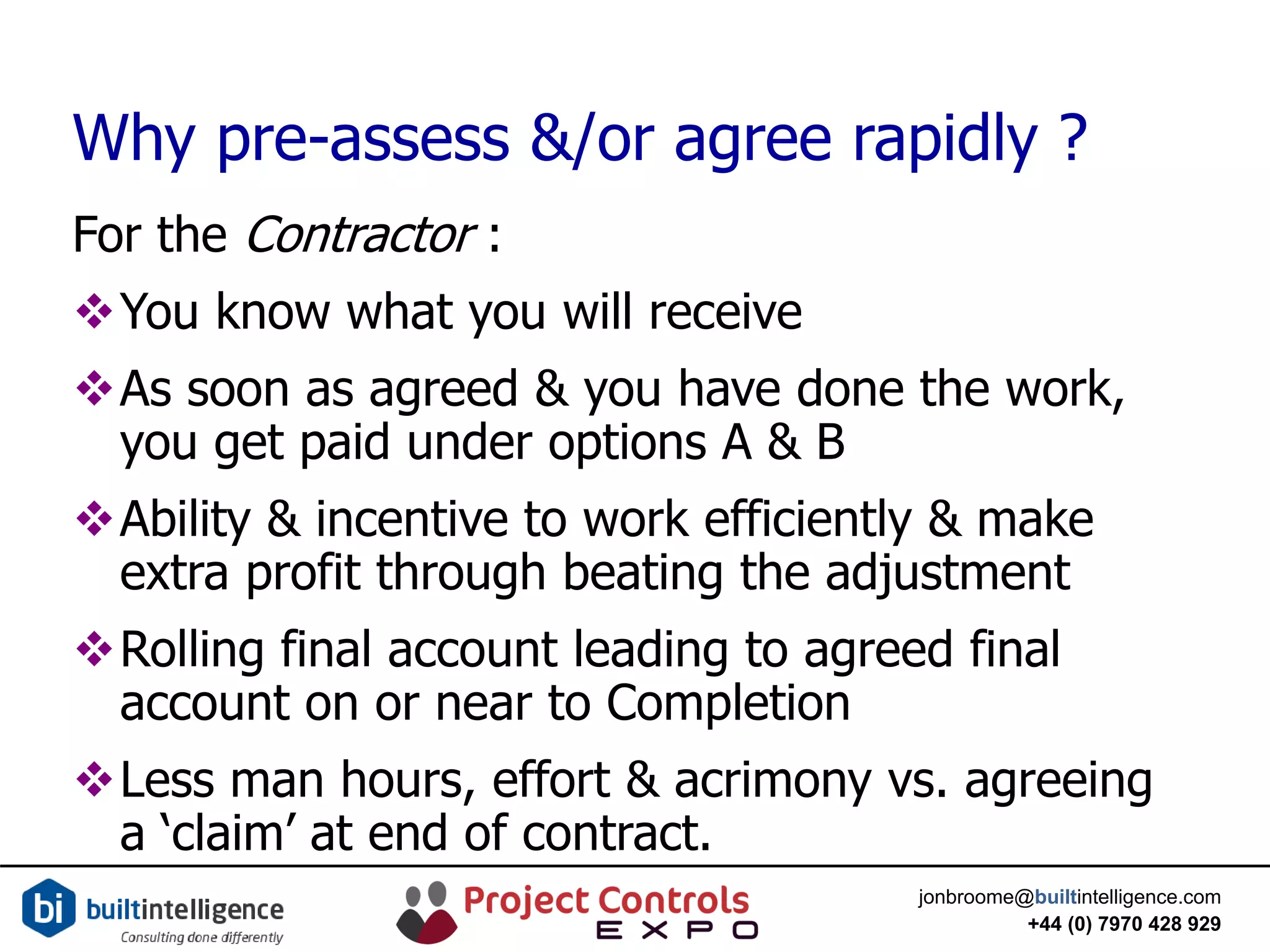
Why pre-assess &/or agree rapidly ?
For the Contractor :
You know what you will receive
As soon as agreed & you have done the work,
you get paid under options A & B
Ability & incentive to work efficiently & make
extra profit through beating the adjustment
Rolling final account leading to agreed final
account on or near to Completion
Less man hours, effort & acrimony vs. agreeing
a ‘claim’ at end of contract.
jonbroome@builtintelligence.com
+44 (0) 7970 428 929
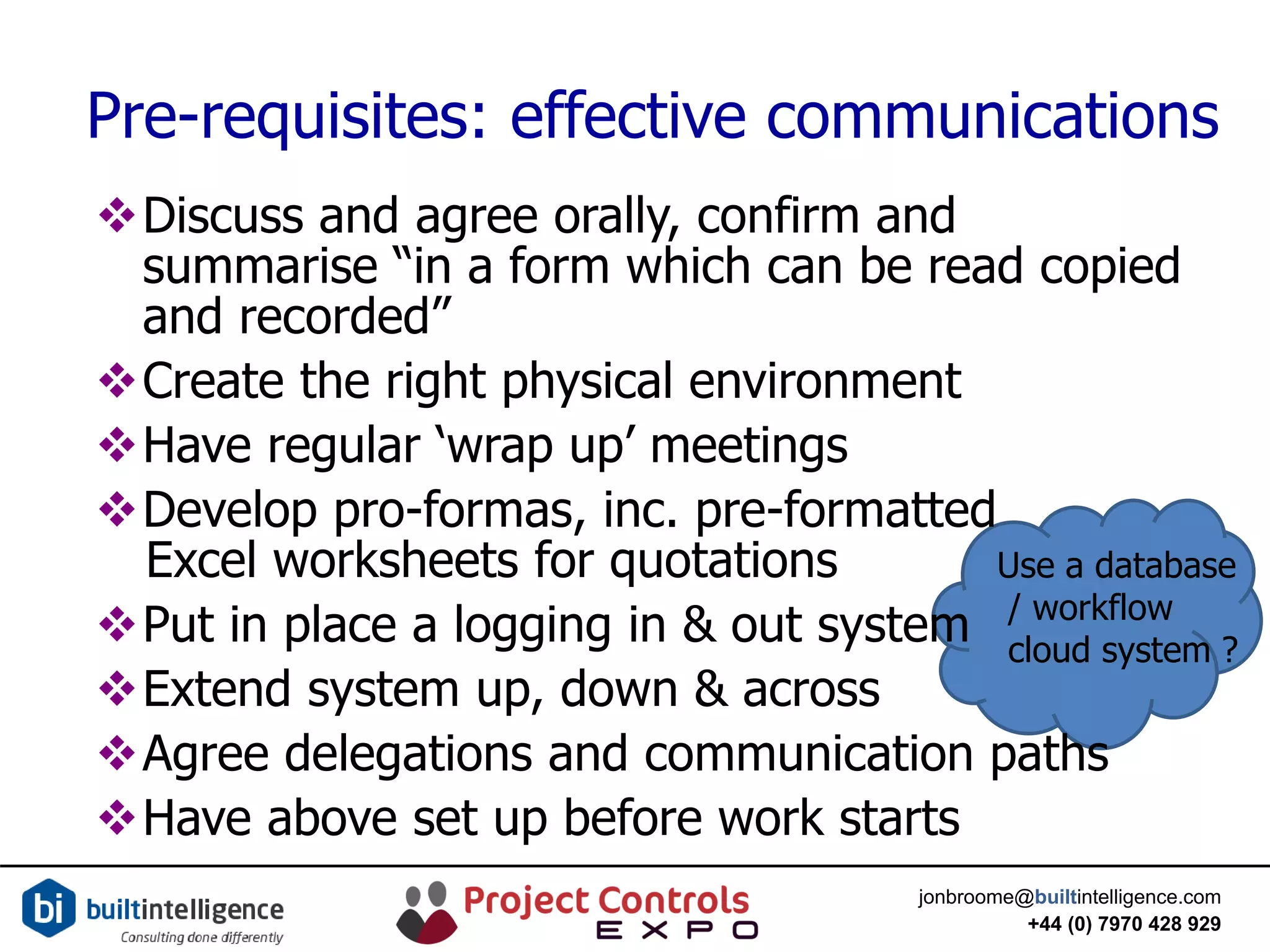
Pre-requisites: effective communications
Use a database
/ workflow
cloud system ?
Discuss and agree orally, confirm and
summarise “in a form which can be read copied
and recorded”
Create the right physical environment
Have regular ‘wrap up’ meetings
Develop pro-formas, inc. pre-formatted
Excel worksheets for quotations
Put in place a logging in & out system
Extend system up, down & across
Agree delegations and communication paths
Have above set up before work starts
jonbroome@builtintelligence.com
+44 (0) 7970 428 929
Overview of process
Agree in approximate order :
 the cause & consequences (if not managed) of the CE
 the outcome that you want + any constraints
 the likely risks & how they will be allocated & any (other)
assumptions
 the change in methods and resources including
allowance for disruption
 any time delay
 the change in Defined Costs + Fee of the above four
bullets
 communicate & iterate on the above
jonbroome@builtintelligence.com
+44 (0) 7970 428 929
The Cause & ‘Do-nothing’ Consequences
 In order to identify Areas for Improvement
o Identify under which CE heading it falls in order to
allocate the cost to it
o Separate out into changes / breaches by
Employer, designer, Project Manager, Supervisor &
other stakeholders to make parties accountable
 Agree the ‘do-nothing’ consequences of it as gives
insight into how to solve it. E.g. if it is on the critical
path and is happening now, then
(a) solve now, not at next fortnightly meeting and
(b) spend a bit more on direct costs to save delay &
disruption costs.
jonbroome@builtintelligence.com
+44 (0) 7970 428 929
The Outcome + Constraints
Not the problem, but what you want instead e.g.
no time delay or minimum cost, max certainty, a
good physical description of the change etc. .
Described clearly so that the Contractor can give
an accurate quotation without lots of
unnecessary risk in it. If not done, then likely to
lead to a re-quote which is extra work for both
parties.
State any additional constraints upfront.
jonbroome@builtintelligence.com
+44 (0) 7970 428 929
Assessing & managing risk
- relevant clauses
63.6 : “Assessment of the effect of a compensation event
includes risk allowances for cost and time for
matters which have a significant chance of occurring
and are at the Contractor’s risk under this contract.”
61.6 : “If the Project Manager decides that the effects of a
compensation event are too uncertain to be forecast
reasonably, he states assumptions about the event
in his instruction to the Contractor to submit
quotations. Assessment of the event is based upon
these assumptions. If any of them is later to have
been found to have been wrong, the Project
Manager notifies a correction” and this is a CE under
clause 60.1 (17).
jonbroome@builtintelligence.com
+44 (0) 7970 428 929
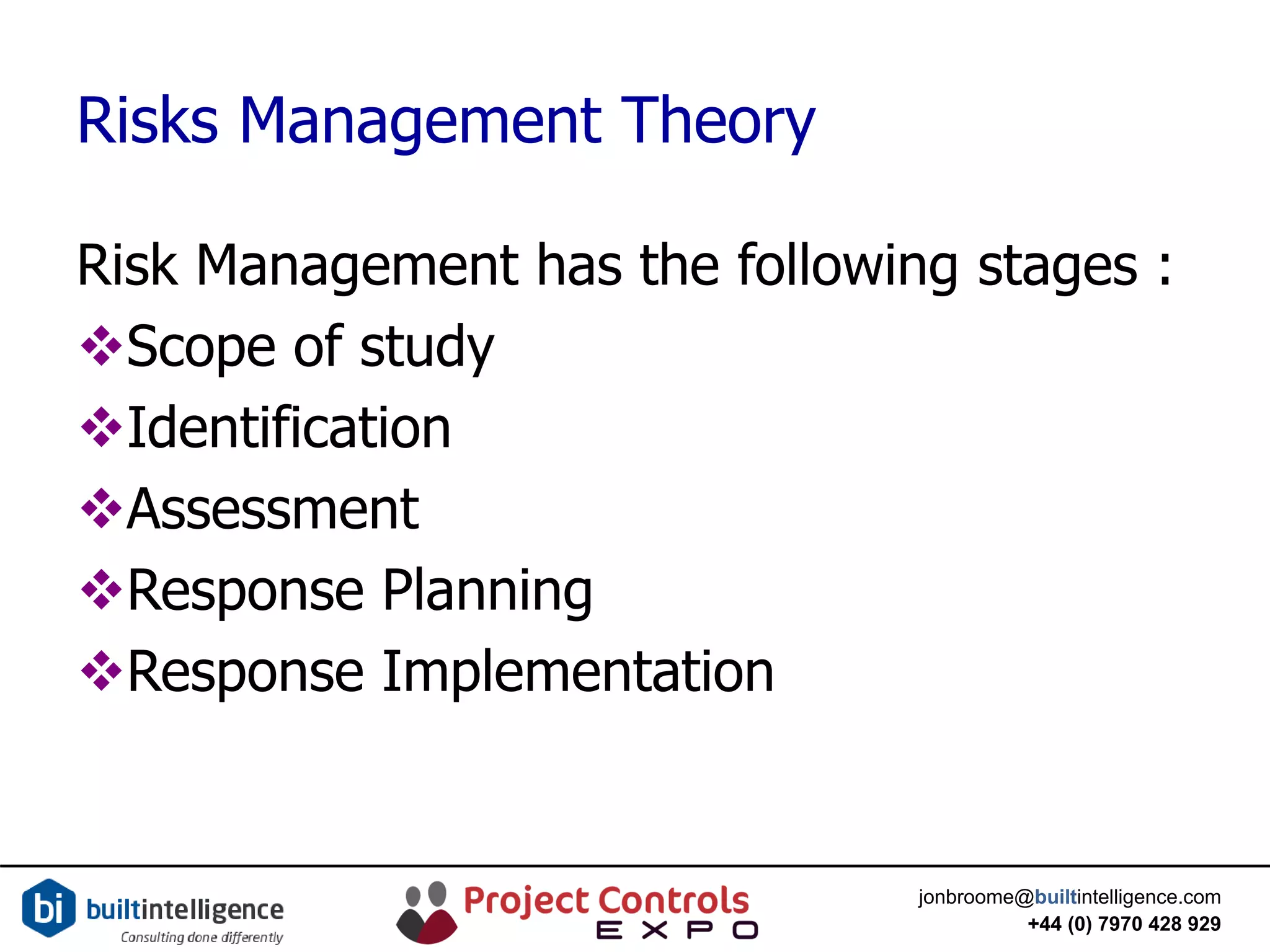
Risks Management Theory
Risk Management has the following stages :
Scope of study
Identification
Assessment
Response Planning
Response Implementation
jonbroome@builtintelligence.com
+44 (0) 7970 428 929
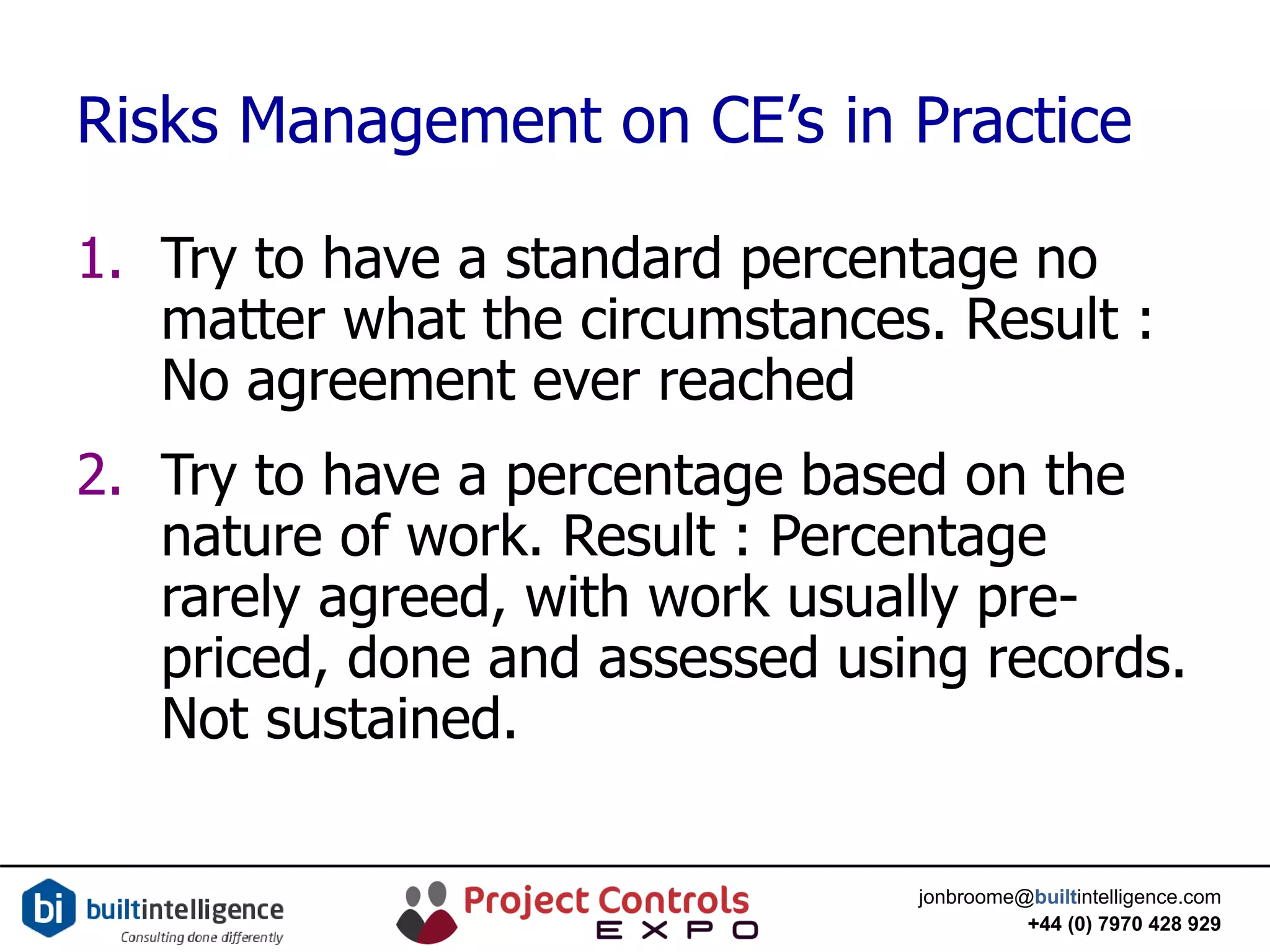
Risks Management on CE’s in Practice
1. Try to have a standard percentage no
matter what the circumstances. Result :
No agreement ever reached
2. Try to have a percentage based on the
nature of work. Result : Percentage
rarely agreed, with work usually pre-
priced, done and assessed using records.
Not sustained.
jonbroome@builtintelligence.com
+44 (0) 7970 428 929
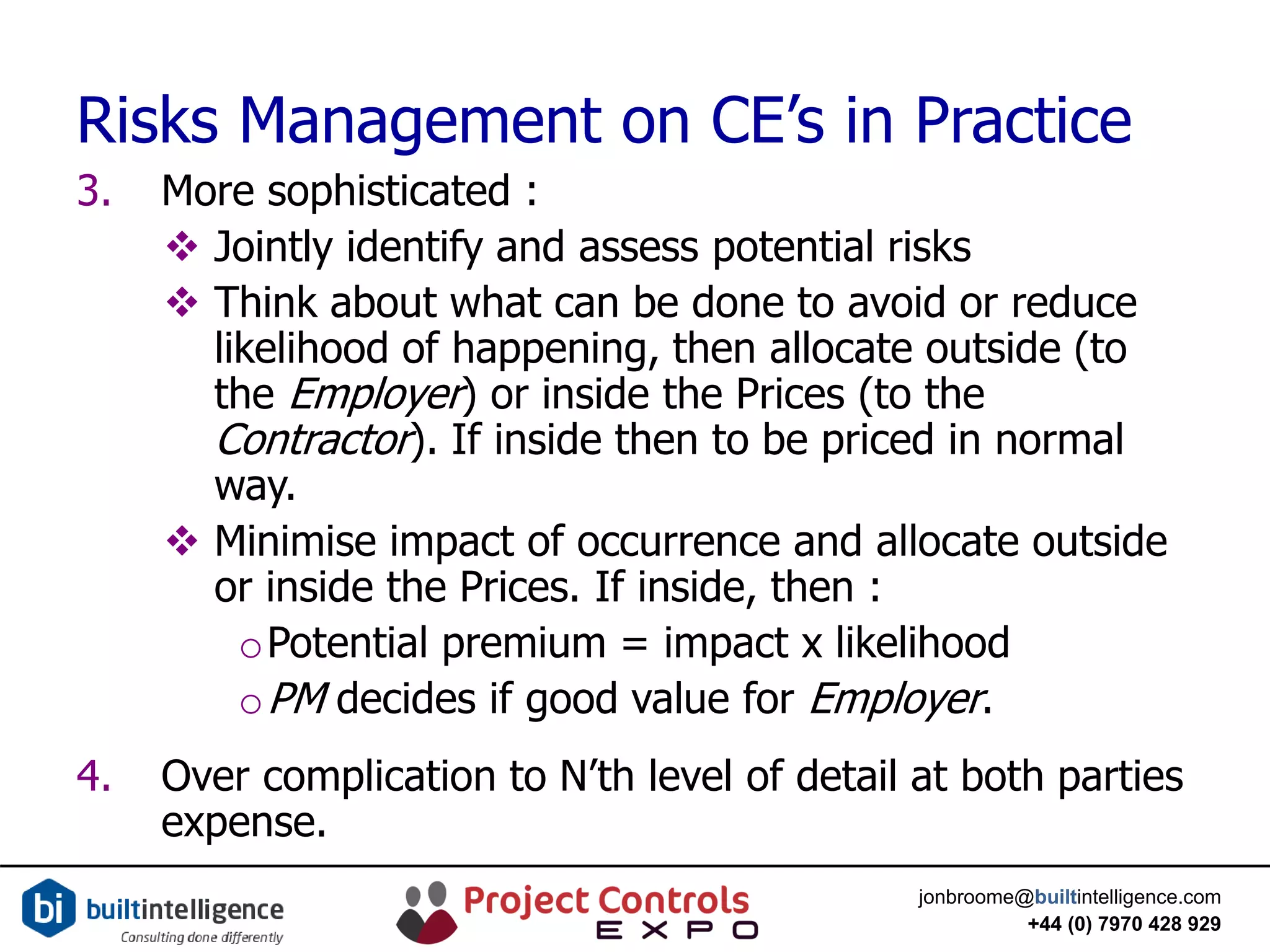
Risks Management on CE’s in Practice
3. More sophisticated :
 Jointly identify and assess potential risks
 Think about what can be done to avoid or reduce
likelihood of happening, then allocate outside (to
the Employer) or inside the Prices (to the
Contractor). If inside then to be priced in normal
way.
 Minimise impact of occurrence and allocate outside
or inside the Prices. If inside, then :
oPotential premium = impact x likelihood
oPM decides if good value for Employer.
4. Over complication to N’th level of detail at both parties
expense.
jonbroome@builtintelligence.com
+44 (0) 7970 428 929
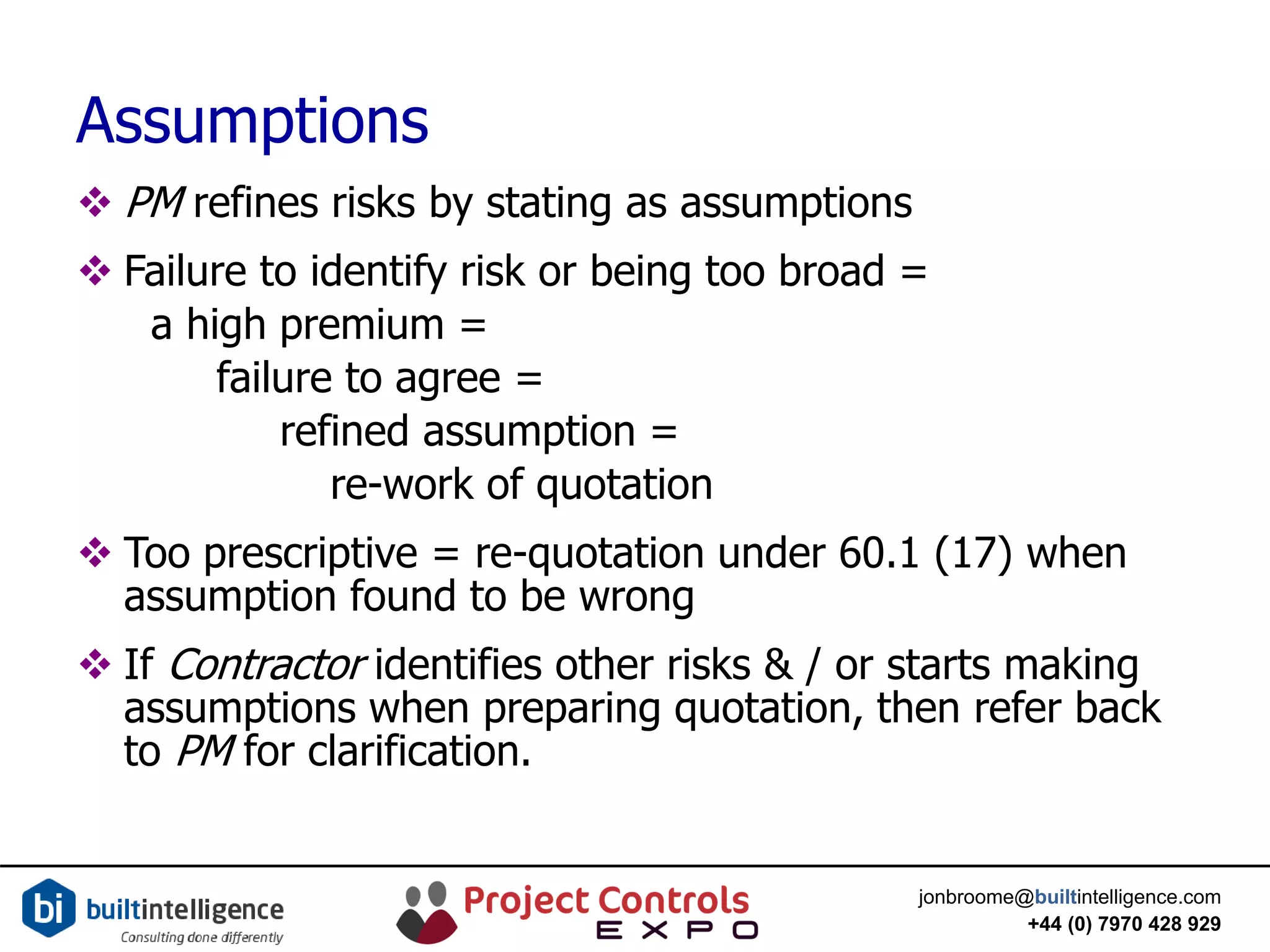
Assumptions
 PM refines risks by stating as assumptions
 Failure to identify risk or being too broad =
a high premium =
failure to agree =
refined assumption =
re-work of quotation
 Too prescriptive = re-quotation under 60.1 (17) when
assumption found to be wrong
 If Contractor identifies other risks & / or starts making
assumptions when preparing quotation, then refer back
to PM for clarification.
jonbroome@builtintelligence.com
+44 (0) 7970 428 929
Other ways of dealing with uncertainty
 Break the compensation event down into
separate compensation events e.g. re-
design and the price the re-design. This
can include leaving out large unknown
‘Plant’ costs.
 Extend time scales by agreement under
clause 62.5.
jonbroome@builtintelligence.com
+44 (0) 7970 428 929
Change in methods & resources
PM can have input as is paying
Use Contractor’s expertise
PM’s who paid for Contractor’s expertise
thought that got good value.
Note : the literal meaning of ‘preparing the quotation’ is
writing it up, not planning & organising the work.
Once change in method is agreed then
can agree change in resources
jonbroome@builtintelligence.com
+44 (0) 7970 428 929
Assessing Delay & Disruption
Use a standard assumption. Something like :
“Provide a quotation for the direct costs only
with the assumption of no delay and disruption.
Any delay & disruption will be assessed at the
end of the month as an additional compensation
event together with other compensation events
in which this same assumption is stated”.
Then ‘wrap-up’ delay & disruption as a CE under
clause 60.1 (17) at the end of each & every
month.
jonbroome@builtintelligence.com
+44 (0) 7970 428 929
Assessing disruption
 No magic formula, but
o more detailed programme makes its assessment
easier
o programme is updated regularly
o difference is a few days / a week at most each
month vs weeks and months at end of contract
o people who are there can agree it, versus year(s)
old incomplete records
 Before re-submitting programme, agree a
‘round up’ CE for delay & disruption over past
month
jonbroome@builtintelligence.com
+44 (0) 7970 428 929
Delay Cost
Related to extra time on site, but …
Some of these cost are covered in
percentages for People / Working Area
overheads
Do not pay twice if Employer
jonbroome@builtintelligence.com
+44 (0) 7970 428 929
Change in Defined Costs
Put costs to change risk items, direct resources,
disruption and delay
Use Contract Cost Manual agreed at start of contract
and added to once a resource has been used
If the compensation events are worked out in the
Contractor’s QS’s room then supplier &
Subcontractor rates, quotes, invoices & receipts etc.
can be viewed there and then without need for
photocopying / scanning.
If a cost-based contract, can also be verified by
Project Manager’s QS having read-only access to
Contractor’s accounting system.
jonbroome@builtintelligence.com
+44 (0) 7970 428 929
Communicate & Iterate
Money is emotive. If PM does not
understand where the time & costs are
coming from then will automatically reject.
Work out jointly before formal submission
for acceptance
Both parties gain advantages, as well as
reducing ‘negatives’ acting on project
jonbroome@builtintelligence.com
+44 (0) 7970 428 929
Overview Re-visited
Agree in approximate order :
 the cause & consequences (if not managed) of the CE
 the outcome that you want + any constraints
 the likely risks & how they will be allocated & any (other)
assumptions
 the change in methods and resources including
allowance for disruption
 any time delay
 the change in Defined Costs + Fee of the above four
bullets
 communicate & iterate on the above
jonbroome@builtintelligence.com
+44 (0) 7970 428 929
Final Review
As an individual :
What one ‘take-out’ from my talk can you take
away and apply.
Other practical tips ?
jonbroome@builtintelligence.com
+44 (0) 7970 428 929
Contact details :
 Tel : 07970 428 929
 Email : jonbroome@builtintelligence.com
 For lots of freebie resources (and some paid for),
go to our website www.builtintelligence.com
 For our Q&A database, visit our Reachback
desktop at http://reachback.builtintelligence.com
or download as app from Google or Apple store.
jonbroome@builtintelligence.com
+44 (0) 7970 428 929
! Thank you !

M5 - NEC3 Compensation Events:agreeing contractual change promptly, amicable and constructively

  • 1.
    jonbroome@builtintelligence.com +44 (0) 7970428 929 NEC3 Compensation Events : agreeing contractual change promptly, amicable and constructively Dr Jon Broome BEng (Hons) PhD MAPM MIoD Director i/c Marketing
  • 2.
    jonbroome@builtintelligence.com +44 (0) 7970428 929 Objectives. To give you some practical tips within a process for agreeing compensation events, so that : o they are agreed more quickly, amicably and accurately for less ‘hassle’ o the Employer gets better /more work for less o the Contractor gets more profit.
  • 3.
    jonbroome@builtintelligence.com +44 (0) 7970428 929 Programme 1. A very little bit about me. 2. Overview of the compensation event process as defined in the contract 3.Process & Tips 4. Reflection & Take-Out
  • 4.
    jonbroome@builtintelligence.com +44 (0) 7970428 929 A very little bit about me & the NEC3. Genuine NEC Geek. Involvement in NEC goes back 20+ years when did a PhD on its practical use Contributions acknowledged in the full Engineering & Construction Contract. Authored ‘NEC3 : A User’s Guide’ Led development of Professional Services Short Contract. Co-authored bi’s on-line NEC3 Academy
  • 5.
    jonbroome@builtintelligence.com +44 (0) 7970428 929 Compensation event process & timescales Potential Compensation Event C Notifies PM PM instructs C to give quotation(s) 8 weeks 1 week C submits quotation(s ) 3 weeks PM’s response 2 weeks  Acceptance. Decision not to proceed PM to make own assessment C to submit revised quotation C informed of PM’s assessment 3 weeks 3 weeks   Note : If the PM fails to respond, then the Contractor notifies him of this failure &, if he still has not responded, after a further 2 weeks, then the notification / quotation, however spurious, is “treated as accepted” until over-turned by Adjudication. EW Process
  • 6.
    jonbroome@builtintelligence.com +44 (0) 7970428 929 Why Pre-assess &/or agree rapidly ? For the Employer : You know what you will pay For the Contractor to pre-price accurately, he has to have good quality information on which to base the quotation. He can then programme and work efficiently saving the Employer money. Rolling final account leading to agreed final account on or near to Completion Less man hours, effort & acrimony vs. agreeing ‘claim’ at end
  • 7.
    jonbroome@builtintelligence.com +44 (0) 7970428 929 Why pre-assess &/or agree rapidly ? For the Contractor : You know what you will receive As soon as agreed & you have done the work, you get paid under options A & B Ability & incentive to work efficiently & make extra profit through beating the adjustment Rolling final account leading to agreed final account on or near to Completion Less man hours, effort & acrimony vs. agreeing a ‘claim’ at end of contract.
  • 8.
    jonbroome@builtintelligence.com +44 (0) 7970428 929 Pre-requisites: effective communications Use a database / workflow cloud system ? Discuss and agree orally, confirm and summarise “in a form which can be read copied and recorded” Create the right physical environment Have regular ‘wrap up’ meetings Develop pro-formas, inc. pre-formatted Excel worksheets for quotations Put in place a logging in & out system Extend system up, down & across Agree delegations and communication paths Have above set up before work starts
  • 9.
    jonbroome@builtintelligence.com +44 (0) 7970428 929 Overview of process Agree in approximate order :  the cause & consequences (if not managed) of the CE  the outcome that you want + any constraints  the likely risks & how they will be allocated & any (other) assumptions  the change in methods and resources including allowance for disruption  any time delay  the change in Defined Costs + Fee of the above four bullets  communicate & iterate on the above
  • 10.
    jonbroome@builtintelligence.com +44 (0) 7970428 929 The Cause & ‘Do-nothing’ Consequences  In order to identify Areas for Improvement o Identify under which CE heading it falls in order to allocate the cost to it o Separate out into changes / breaches by Employer, designer, Project Manager, Supervisor & other stakeholders to make parties accountable  Agree the ‘do-nothing’ consequences of it as gives insight into how to solve it. E.g. if it is on the critical path and is happening now, then (a) solve now, not at next fortnightly meeting and (b) spend a bit more on direct costs to save delay & disruption costs.
  • 11.
    jonbroome@builtintelligence.com +44 (0) 7970428 929 The Outcome + Constraints Not the problem, but what you want instead e.g. no time delay or minimum cost, max certainty, a good physical description of the change etc. . Described clearly so that the Contractor can give an accurate quotation without lots of unnecessary risk in it. If not done, then likely to lead to a re-quote which is extra work for both parties. State any additional constraints upfront.
  • 12.
    jonbroome@builtintelligence.com +44 (0) 7970428 929 Assessing & managing risk - relevant clauses 63.6 : “Assessment of the effect of a compensation event includes risk allowances for cost and time for matters which have a significant chance of occurring and are at the Contractor’s risk under this contract.” 61.6 : “If the Project Manager decides that the effects of a compensation event are too uncertain to be forecast reasonably, he states assumptions about the event in his instruction to the Contractor to submit quotations. Assessment of the event is based upon these assumptions. If any of them is later to have been found to have been wrong, the Project Manager notifies a correction” and this is a CE under clause 60.1 (17).
  • 13.
    jonbroome@builtintelligence.com +44 (0) 7970428 929 Risks Management Theory Risk Management has the following stages : Scope of study Identification Assessment Response Planning Response Implementation
  • 14.
    jonbroome@builtintelligence.com +44 (0) 7970428 929 Risks Management on CE’s in Practice 1. Try to have a standard percentage no matter what the circumstances. Result : No agreement ever reached 2. Try to have a percentage based on the nature of work. Result : Percentage rarely agreed, with work usually pre- priced, done and assessed using records. Not sustained.
  • 15.
    jonbroome@builtintelligence.com +44 (0) 7970428 929 Risks Management on CE’s in Practice 3. More sophisticated :  Jointly identify and assess potential risks  Think about what can be done to avoid or reduce likelihood of happening, then allocate outside (to the Employer) or inside the Prices (to the Contractor). If inside then to be priced in normal way.  Minimise impact of occurrence and allocate outside or inside the Prices. If inside, then : oPotential premium = impact x likelihood oPM decides if good value for Employer. 4. Over complication to N’th level of detail at both parties expense.
  • 16.
    jonbroome@builtintelligence.com +44 (0) 7970428 929 Assumptions  PM refines risks by stating as assumptions  Failure to identify risk or being too broad = a high premium = failure to agree = refined assumption = re-work of quotation  Too prescriptive = re-quotation under 60.1 (17) when assumption found to be wrong  If Contractor identifies other risks & / or starts making assumptions when preparing quotation, then refer back to PM for clarification.
  • 17.
    jonbroome@builtintelligence.com +44 (0) 7970428 929 Other ways of dealing with uncertainty  Break the compensation event down into separate compensation events e.g. re- design and the price the re-design. This can include leaving out large unknown ‘Plant’ costs.  Extend time scales by agreement under clause 62.5.
  • 18.
    jonbroome@builtintelligence.com +44 (0) 7970428 929 Change in methods & resources PM can have input as is paying Use Contractor’s expertise PM’s who paid for Contractor’s expertise thought that got good value. Note : the literal meaning of ‘preparing the quotation’ is writing it up, not planning & organising the work. Once change in method is agreed then can agree change in resources
  • 19.
    jonbroome@builtintelligence.com +44 (0) 7970428 929 Assessing Delay & Disruption Use a standard assumption. Something like : “Provide a quotation for the direct costs only with the assumption of no delay and disruption. Any delay & disruption will be assessed at the end of the month as an additional compensation event together with other compensation events in which this same assumption is stated”. Then ‘wrap-up’ delay & disruption as a CE under clause 60.1 (17) at the end of each & every month.
  • 20.
    jonbroome@builtintelligence.com +44 (0) 7970428 929 Assessing disruption  No magic formula, but o more detailed programme makes its assessment easier o programme is updated regularly o difference is a few days / a week at most each month vs weeks and months at end of contract o people who are there can agree it, versus year(s) old incomplete records  Before re-submitting programme, agree a ‘round up’ CE for delay & disruption over past month
  • 21.
    jonbroome@builtintelligence.com +44 (0) 7970428 929 Delay Cost Related to extra time on site, but … Some of these cost are covered in percentages for People / Working Area overheads Do not pay twice if Employer
  • 22.
    jonbroome@builtintelligence.com +44 (0) 7970428 929 Change in Defined Costs Put costs to change risk items, direct resources, disruption and delay Use Contract Cost Manual agreed at start of contract and added to once a resource has been used If the compensation events are worked out in the Contractor’s QS’s room then supplier & Subcontractor rates, quotes, invoices & receipts etc. can be viewed there and then without need for photocopying / scanning. If a cost-based contract, can also be verified by Project Manager’s QS having read-only access to Contractor’s accounting system.
  • 23.
    jonbroome@builtintelligence.com +44 (0) 7970428 929 Communicate & Iterate Money is emotive. If PM does not understand where the time & costs are coming from then will automatically reject. Work out jointly before formal submission for acceptance Both parties gain advantages, as well as reducing ‘negatives’ acting on project
  • 24.
    jonbroome@builtintelligence.com +44 (0) 7970428 929 Overview Re-visited Agree in approximate order :  the cause & consequences (if not managed) of the CE  the outcome that you want + any constraints  the likely risks & how they will be allocated & any (other) assumptions  the change in methods and resources including allowance for disruption  any time delay  the change in Defined Costs + Fee of the above four bullets  communicate & iterate on the above
  • 25.
    jonbroome@builtintelligence.com +44 (0) 7970428 929 Final Review As an individual : What one ‘take-out’ from my talk can you take away and apply. Other practical tips ?
  • 26.
    jonbroome@builtintelligence.com +44 (0) 7970428 929 Contact details :  Tel : 07970 428 929  Email : jonbroome@builtintelligence.com  For lots of freebie resources (and some paid for), go to our website www.builtintelligence.com  For our Q&A database, visit our Reachback desktop at http://reachback.builtintelligence.com or download as app from Google or Apple store.
  • 27.