Introduction to PMP Exam and PMI Framework PMBOK 3 rd  Edition By  Uzma Tauseef, PMP
Preparing for the PMP Exam PMP Exam Requirements Examination Fee Submitting the Application Scheduling the Exam Studying for the Exam Exam Strategy After the Exam
Clarity in Mind Its very possible to pass on the first attempt!! Don’t Worry  How should I start my preparation? Its Boring  
PMP Exam Requirements Applicants with a bachelor’s degree or global equivalent must meet the following requirements Minimum 4,500 hours PM experience Minimum 36 months PM experience within the prior 72 months Minimum 35 contact hours of PM instruction Applicants who do not have a bachelor’s degree, but instead have a high school diploma, associate’s degree, or global equivalent, must meet the following requirements Minimum 7,500 hours PM experience Minimum 60 months PM experience within the prior 96 months Minimum 35 contact hours of PM instruction Who has less experience can do CAPM (Certified Associate in Project Management) Minimum 1,500 hours of work on a project team Minimum 23 contact hours of PM instruction
Examination Fee
Overview of Exam Questions Once you pass the exam, your score is irrelevant.
Overview of Exam Questions Situational –  Mathematical –  Approximately 8 to 10 formula-related questions will be on the exam. Recall –  Fairly short, often easier, questions that test memory or knowledge. Diagram –  Either draw a network diagram or interpret drawn-out graphs or diagrams to determine the correct answer.  More Than One Correct Answer –  In cases where multiple answers could be correct, choose the most correct or most appropriate one according to PMI. Double Negatives –  The test uses double negatives or questions asking you to remove the false statement. Sometimes it is easier to read the question by turning it into a positive. For example, if the question states, “All of the following statements are false except…” look for the one true statement. Wordy Questions –
Submitting the Application Register yourself on  www.pmi.org  . This requires details of your project management experience Define your project role, give project description and the hours spent in the process groups You are further required to break down the hours spent on different processes in each process group You have to show a non-overlapping hours leading and directing project tasks In a single project you need not have experience in all process groups but overall this is necessary Don’t waste too much time on the application
Scheduling the Exam Submit the payment After your application is accepted you will be asked to submit the payment Your application may be audited. Keep documentation (copies of certificates/diplomas, attestation from supervisor) Schedule your exam After payment you will get a scheduling notice You then have to go to Prometric website to schedule the exam Scheduling helps you to focus on the exam and prepare your study strategy
Studying for the exam Work out your study schedule and stick to it! Spread out your study schedule so that you are not cramming in the last few days An hour or so during work days and 3-4 hours on the  weekends works for 9-to-6 work timings ensuring you are not totally ignoring your family life Studying for the exam The PMBOK Guide is not a study guide, it’s a reference tool. It is not very pleasant reading. Choose a PMP prep book(Rita’s one) for guidance and read at least three times It is not a project management knowledge test, it tests you PMI version of Project Management and its terminology. You do not have to memorize all the inputs and outputs
Using Rita’s Book as a Stand-alone First-Go Read Chapter1 and 2 carefully, skim Chapter 3, Don’t try to attempt any exercise Read Chapter 4 to Chapter 13 without attempting any exercise Go through all corresponding chapters in PMBOK Guide just to make sure, all topics covered. Second-Go Read from Chapter 4 -13 with exercises. Your score will be around 50-60%. Don’t worry, Rita's Exercises considered tough ones. Also get help with PM network Diagram, audios, videos or websites  Prepare Cheat sheet for last moments revision Read Lesson Learned on  www.pmhub.net  forums
Scope Management Product scope.  The features and functions that characterize a product, service, or result Project scope.  The work that needs to be accomplished to deliver a product, service, or result with the specified features and functions. Scope verification  focuses on customer acceptance of a deliverable Product verification  is focused on making sure all the work is completed satisfactorily. WBS : Work packages broken by 8/80 hour rule.
Scope Management WBS Benefits : Estimating, Staffing, Risk, Activities, Scheduling, NW Diagram, Budgeting & Control.  WBS does not show dependencies. Scope Baseline  – Approved detailed 1.project Scope statement, 2.WBS and 3.WBS dictionary  WBS Dictionary : No + Control Acc., Statement of Work, Responsible, Schedules & Milestones etc.
Sample Work Breakdown Structure
Time Management The Project Time Management Knowledge Area includes the processes required to accomplish timely completion of the project
 
Rolling Wave Plan:Plan as you progress. WBS    Work Package for estimation. Estimation at WBS is also OK. Network Diagram :Activity Sequencing Network Diagram Methods are Precedence Diagramming Method or AON. Arrow Diagramming Method or AOA PDM, AON Dependencies: F-S, S-S, F-F, S-F. Dependency Types: Mandatory, Discretionary and External. Time Management WBS Control Acnts Work Pckgs Activities WBS Dictionary
Time Management GERT and System Dynamics models (Not PDM or ADM) allow for loops or conditional branches. Lead = Start Before predecessor. Lag  = Inserted waiting time. Float = Slack ( LS – ES or LF – EF) Total Float: Delay without effecting overall project or intermediary milestones. Free Float: Delay without effecting Early Start of Successor. Project Float: Delay without effecting externally imposed deadline. Dummy Activity: Used to show a logical relationship in the ADM.
Time Management Activity Resource/Time Estimation Analogous Estimation = Overall Project Estimate used for Top-Down. Analogous to a previous work. Parametric Estimation = Based on historic data eg. LOC. Can be Regression or Learning Curve. Regression  = Track two variables to predict (Scatter diagram) Learning Curve = 100 room painted will take less tie as compared to 1st room. Schedule NW Analysis: PERT PERT (O + 4 x ML + P) / 6 Std Deviation  (P-O) / 6
Time Management CPM: Gives Longest Path, Earliest & Latest all the Project Activities can Start and Finish.  Schedule Compression Methods:  Fast Tracking = Doing CP Activities in Parallel.  Those were originally planned in series. Crashing : Least increment in cost without effecting scope, Moving resources around within the project What-If Analysis: Monte Carlo analysis + 3 Pt Est(Cost, time, Risk).    Probability of Completion of X by Y. CCM: Make NWD for ML Est.    Schedule Each Activity as Late as Possible + Resource Dependencies. Resource Leveling –Resource Histogram
Cost Management The Project Cost Management Knowledge Area includes the processes required to accomplish timely completion of the project within budget.
 
Cost Management Life Cycle Costing: Includes Acquisition, Operating, and disposal costs. Cost Types:  Variable Vs Fixed (Changes with production) Direct Vs Indirect (Indirect = Taxes, benefits) Estimations: Top-Down, Bottom-Up, Analogous BU=+ (Accurate, Monitoring, buy-in from team), – (Difficult, Padding by team, clear req. required) AN: + (Quick, Management Expectations), – (Less accurate, difficult if req. are uncertain
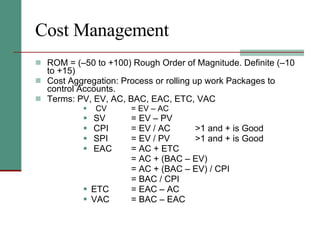
Cost Management ROM = (–50 to +100) Rough Order of Magnitude. Definite (–10 to +15) Cost Aggregation: Process or rolling up work Packages to control Accounts. Terms: PV, EV, AC, BAC, EAC, ETC, VAC CV = EV – AC SV = EV – PV CPI = EV / AC >1 and + is Good SPI = EV / PV >1 and + is Good EAC = AC + ETC = AC + (BAC – EV) = AC + (BAC – EV) / CPI = BAC / CPI ETC = EAC – AC VAC = BAC – EAC
Reserves Types: Contingency (for Risks) and Management (for unseen things). Accounting Stds:  NPV IRR Payback Period Opportunity Cost Sunk Cost Law of Diminishing Returns Working Capital  Current Assets – Current Liabilities Depreciation: Straight-Line = Same Dep each year Accelerated = (Double & Accelerated Declining). Cost Management Project Ctrl Acts Wrk Pkgs Activities Cost Budget Mgmt Rsrvs Cost Baseline Cntngncy Rsvrs
Quality Management The Project Quality Management Knowledge Area includes the processes required to determine and execute quality policies, objectives and responsibilities
 
Quality Management Quality the degree to which project fulfills requirements. Quality is planned, designed and built in – not inspected in. Planning Marginal Analysis: Optimal Quality    When Incremental Cost =  Incremental Revenue Gold platting adds no value to the project. Std: (UN Convention on Contracts for Int. Sale of Goods, ISO 9000, Occupational Safety & Health Adm.) Assurance  Any instance where there is an evaluation of the quality  standards. Quality Audits (Inspections),  Process Analysis (Lessons leaned from first few installations)
Quality Management Control  Population/Sample Mutual Exclusivity: Two events cannot occur in a single trial. (Coin Flip either Head or Tail) Normal Distribution: Bell Curve Statistical Independence: A head does not affect probability of Head or Tail in next flip. Std. Deviation: How far are you from mean. 6 Sigma: ± 1, 2, 3, 6    (68.26 95.46 99.73 99.99985) Tools Cause and Effect Diagram  Flow Chart, Histogram Pareto Chart Run Chart: Shows history pattern of variations. Scatter Diagram: Track two variables to see if change in one effects other
Quality Management Control Chart: Upper and Lower Control Limits: Mean (Average): Specification Limit: Out of Control: A point either outside Control Limit or Rule of 7. Assignable Cause: A data point (eg. Rule of 7) which requires investigation.
Human Resource Management The Project Human Resource Management Knowledge Area includes the processes required to organize and manage the project team.
 
Human Resource Management Roles Project Manager Project Sponsor/Initiator Team  Functional Manager Project Stakeholders Halo Effect: Assumption that the person good at a technology will be good project manager.
Exercise – Roles and Responsibilities Two project team members are having disagreement There is change to overall project deliverable A functional manager is trying to pull out a team member off the project to do other work  There is not enough resource to complete the project An activity needs more time and will cause the project to be delayed An activity needs more time without causing the project to be delayed A team member is not performing
Human Resource Management Leadership Styles Directing: Telling others what to do Facilitating: Coordinating the input of others Coaching: Instructing others Supporting: Provides assistance on the way. Autocratic: Making decisions without input. Consultative: Inviting ideas from others Consensus: Problem solving in a group with decision-making based on group agreement.
Human Resource Management Team Building War room or  Co-Location: Placing most of the team members at same location to create Team Building. Team Conflicts: Caused due to the following reasons (in decreasing order of occurrences). Schedules Project Priorities Resources Technical Opinions Administration Procedures Cost Personality
Human Resource Management Problem Solving Techniques: (from best to worst): Problem Solving or Confrontation: (analyze facts & find a solution) - win-win situation. Compromising: (Find the middle route). loose-loose situation. Withdrawal or Avoidance Smoothing (Emphasize the agreements) Forcing :(Do it my way) - win-loose situation. Project Manager's Power: PM may yield authority over the team in one of the following ways: Referent – PM referring to the authority someone in a higher position Formal - Power due to position Technical - Strong technical skills Coercive - Afraid of the power the PM holds
Exercise – Conflict Resolution Techniques Let us do a little of what both of you suggested Let’s calm down and get the job done  Since we cant decide the purchase of new computers, we will have to wait until our meeting next week Mary, you say that the project should include the purchase of new computers, Steve, you say project can use existing computers, I suggest we perform the test on existing computers to determine if it needs to be replaced. What if we get the new computers for the design activity on the project and use the existing computers for the monitoring functions Lets deal with the issue next week We have talked about new computers enough. I do not want to get the computers and that is it.
Human Resource Management Motivational Theories: Expectancy Theory: People put in more efforts as they expect to be rewarded for their efforts. McGregory Theory of X and Y: X = Always watched. Y =Self-motivated. Herzberg Theory: Poor hygiene factors (salary, cleanliness etc.) destroy motivation but good hygiene alone does not improve motivation. Motivation factors for employees:  Work, responsibility, growth, recognition etc. Maslow's Hierarchy of needs: When a lower level is met, employee attempts to reach the next: Self-fulfillment    Esteem    Social    Safety    Physiology
Communications Management The Communication Management Knowledge Area includes the processes required to ensure timely and appropriate information distribution among the project stakeholders.
 
Communication Management Effective Communication Methods Nonverbal: Using Body Language Aprox. 55%. Para-lingual: Using Pitch & Tone. Feedback: “Did you understand what I said?” Effective Listening Methods Active Listening: receiver confirms. Para-lingual: Using Pitch & Tone. Feedback: Like I am not sure!
Communication Management Communication Types: Formal Written: Complex Problems, Plans Formal Verbal:  Presentations speeches etc. Informal Written: Memos, Emails, Notes etc. Informal Verbal: Meetings, Conversations Communication Channels Formula =  N * (N-1) / 2 Comm. Blockers: Noise, Distance, Improper encoding, Rude Remarks,  Language, Culture. Time Spent 70-90% on communications, ~50% in meetings. Types of Reporting: Status, Progress, Trend, Forecasting, Variance, EV, Lessons Learned
Risk Management  The Risk Management Knowledge Area includes the processes required to increase the probability of positive events and decrease the probability of events adverse to the project.
 
Risk Management Opportunities = Positive Risks Risk Factors = Probability + Range of possible outcomes + Expected Timing + Anticipated Frequency. Categories:  External, Internal, Technical, Unforeseen Technology, Customer, Supplier, Customer’s Customer, Cultural, Resistance to Change etc. By Source: Schedule, Resource, Performance, Cost, Quality, Scope, Customer Satisfaction. Risk Identification: Done in All Phases, Requires WBS & Scope, Involve all Team Members.
Risk Management Identification Techniques: Brainstorming, Delphi, Interviewing, Root cause Analysis, SWOT. Strategies for Negative Risks or Threats Avoidance (elimination)  Mitigation (reduction). Transfer Strategy for positive Risks or opps Exploit Share Enhance Strategy for both Acceptance
Risk Management Residual Risks  – Risks that are expected to remain after planned responses have been taken, as well as those have been deliberately accepted. Secondary Risks  – Risks that arise as a direct outcome of implementing a risk response. Recommended Corrective Actions  – For Risk monitor and Control include Contingency  plans and workaround plans .  Workaround  Unplanned response to negative risk events (requires to be impacted by the risk first). Work around plans are not initially planned but are required to deal with emerging risks that were previously unidentified or accepted. Contingency Plan  Planned action steps to be taken if an identified residual risk occurs. (e.g. developing alternative activity sequences). It is for the risks which are accepted. Contingency Reserve:  calculated based on the quantitative analysis of the project and organization’ risk thresholds. Fall Back Plan:  It is plan executed when contingency plan is not effective.
Procurement Management The Procurement Management Knowledge Area includes the processes required to purchase and acquire the Services, products from outside the project team.
 
Procurement Management Make or Buy Decision Contract Type Selection Cost Reimbursable Time and Material Fixed Price Statement of Work Types Performance Functional  Design Procurement Documents Request for proposal Request for Quotation Invitation for Bid Information for Sellers  Contract Statement of work
Contract Types:  CR: Cost reimbursable T&M: Time and Material FP: Fixed Price CPFF: Cost Plus Fixed Fee CPPC: Cost Plus % of Cost CPIF: Cost Plus Incentive Fee CPAF: Cost Plus Award Fee FP: Fixed Price FFP: Firm Fixed Price FPIF: Fixed Price Incentive Fee FPEPA: Fixed Price Economic Price Adj . Procurement Management
Procurement Management Advertising Bidder Conference Qualified Seller List Proposal, Bid, Price Quote Seller Selection Method Weighting System Independent Estimate Screening system Presentations Negotiations
Professional Ethics The Professional and social responsibility involves ensuring that our actions are always in line with legal requirements and ethical standards.
Professional Ethics Responsibility to the Profession: Be truthful  Report Code violations  Disclose conflicts of interest  Comply with laws  Respect intellectual property rights  Support the Code  Responsibility to Customers and the Public: Be truthful Maintain professional integrity (satisfy the scope of your professional services)  Respect the confidentiality of sensitive information  Refrain from gift or compensation giving/receiving where inappropriate  Ensure conflicts of interest do not interfere with client's interest or professional judgment
Professional Ethics Dos (Global Projects) Develop your cultural self-awareness.  Set realistic expectations for self & others. Accept that you will make mistakes, but remain confident.  Be patient.  Slow down. Make relationships.  Keep your sense of humor.  Keep your integrity.  Stay objective. Minimize blame. Don’ts (Global Projects) Assume similarity.  Try to adopt the orientations of the other culture. Adaptation does not mean adoption.  Dwell on comparing the other culture with your own.  Evaluate other culture in terms of good & bad.  Assume that just being yourself is enough to bring you cross-cultural success.

PMP preparation and PMI Framework

  • 1.
    Introduction to PMPExam and PMI Framework PMBOK 3 rd Edition By Uzma Tauseef, PMP
  • 2.
    Preparing for thePMP Exam PMP Exam Requirements Examination Fee Submitting the Application Scheduling the Exam Studying for the Exam Exam Strategy After the Exam
  • 3.
    Clarity in MindIts very possible to pass on the first attempt!! Don’t Worry How should I start my preparation? Its Boring 
  • 4.
    PMP Exam RequirementsApplicants with a bachelor’s degree or global equivalent must meet the following requirements Minimum 4,500 hours PM experience Minimum 36 months PM experience within the prior 72 months Minimum 35 contact hours of PM instruction Applicants who do not have a bachelor’s degree, but instead have a high school diploma, associate’s degree, or global equivalent, must meet the following requirements Minimum 7,500 hours PM experience Minimum 60 months PM experience within the prior 96 months Minimum 35 contact hours of PM instruction Who has less experience can do CAPM (Certified Associate in Project Management) Minimum 1,500 hours of work on a project team Minimum 23 contact hours of PM instruction
  • 5.
  • 6.
    Overview of ExamQuestions Once you pass the exam, your score is irrelevant.
  • 7.
    Overview of ExamQuestions Situational – Mathematical – Approximately 8 to 10 formula-related questions will be on the exam. Recall – Fairly short, often easier, questions that test memory or knowledge. Diagram – Either draw a network diagram or interpret drawn-out graphs or diagrams to determine the correct answer. More Than One Correct Answer – In cases where multiple answers could be correct, choose the most correct or most appropriate one according to PMI. Double Negatives – The test uses double negatives or questions asking you to remove the false statement. Sometimes it is easier to read the question by turning it into a positive. For example, if the question states, “All of the following statements are false except…” look for the one true statement. Wordy Questions –
  • 8.
    Submitting the ApplicationRegister yourself on www.pmi.org . This requires details of your project management experience Define your project role, give project description and the hours spent in the process groups You are further required to break down the hours spent on different processes in each process group You have to show a non-overlapping hours leading and directing project tasks In a single project you need not have experience in all process groups but overall this is necessary Don’t waste too much time on the application
  • 9.
    Scheduling the ExamSubmit the payment After your application is accepted you will be asked to submit the payment Your application may be audited. Keep documentation (copies of certificates/diplomas, attestation from supervisor) Schedule your exam After payment you will get a scheduling notice You then have to go to Prometric website to schedule the exam Scheduling helps you to focus on the exam and prepare your study strategy
  • 10.
    Studying for theexam Work out your study schedule and stick to it! Spread out your study schedule so that you are not cramming in the last few days An hour or so during work days and 3-4 hours on the weekends works for 9-to-6 work timings ensuring you are not totally ignoring your family life Studying for the exam The PMBOK Guide is not a study guide, it’s a reference tool. It is not very pleasant reading. Choose a PMP prep book(Rita’s one) for guidance and read at least three times It is not a project management knowledge test, it tests you PMI version of Project Management and its terminology. You do not have to memorize all the inputs and outputs
  • 11.
    Using Rita’s Bookas a Stand-alone First-Go Read Chapter1 and 2 carefully, skim Chapter 3, Don’t try to attempt any exercise Read Chapter 4 to Chapter 13 without attempting any exercise Go through all corresponding chapters in PMBOK Guide just to make sure, all topics covered. Second-Go Read from Chapter 4 -13 with exercises. Your score will be around 50-60%. Don’t worry, Rita's Exercises considered tough ones. Also get help with PM network Diagram, audios, videos or websites Prepare Cheat sheet for last moments revision Read Lesson Learned on www.pmhub.net forums
  • 12.
    Scope Management Productscope. The features and functions that characterize a product, service, or result Project scope. The work that needs to be accomplished to deliver a product, service, or result with the specified features and functions. Scope verification focuses on customer acceptance of a deliverable Product verification is focused on making sure all the work is completed satisfactorily. WBS : Work packages broken by 8/80 hour rule.
  • 13.
    Scope Management WBSBenefits : Estimating, Staffing, Risk, Activities, Scheduling, NW Diagram, Budgeting & Control. WBS does not show dependencies. Scope Baseline – Approved detailed 1.project Scope statement, 2.WBS and 3.WBS dictionary WBS Dictionary : No + Control Acc., Statement of Work, Responsible, Schedules & Milestones etc.
  • 14.
  • 15.
    Time Management TheProject Time Management Knowledge Area includes the processes required to accomplish timely completion of the project
  • 16.
  • 17.
    Rolling Wave Plan:Planas you progress. WBS  Work Package for estimation. Estimation at WBS is also OK. Network Diagram :Activity Sequencing Network Diagram Methods are Precedence Diagramming Method or AON. Arrow Diagramming Method or AOA PDM, AON Dependencies: F-S, S-S, F-F, S-F. Dependency Types: Mandatory, Discretionary and External. Time Management WBS Control Acnts Work Pckgs Activities WBS Dictionary
  • 18.
    Time Management GERTand System Dynamics models (Not PDM or ADM) allow for loops or conditional branches. Lead = Start Before predecessor. Lag = Inserted waiting time. Float = Slack ( LS – ES or LF – EF) Total Float: Delay without effecting overall project or intermediary milestones. Free Float: Delay without effecting Early Start of Successor. Project Float: Delay without effecting externally imposed deadline. Dummy Activity: Used to show a logical relationship in the ADM.
  • 19.
    Time Management ActivityResource/Time Estimation Analogous Estimation = Overall Project Estimate used for Top-Down. Analogous to a previous work. Parametric Estimation = Based on historic data eg. LOC. Can be Regression or Learning Curve. Regression = Track two variables to predict (Scatter diagram) Learning Curve = 100 room painted will take less tie as compared to 1st room. Schedule NW Analysis: PERT PERT (O + 4 x ML + P) / 6 Std Deviation (P-O) / 6
  • 20.
    Time Management CPM:Gives Longest Path, Earliest & Latest all the Project Activities can Start and Finish. Schedule Compression Methods: Fast Tracking = Doing CP Activities in Parallel. Those were originally planned in series. Crashing : Least increment in cost without effecting scope, Moving resources around within the project What-If Analysis: Monte Carlo analysis + 3 Pt Est(Cost, time, Risk).  Probability of Completion of X by Y. CCM: Make NWD for ML Est.  Schedule Each Activity as Late as Possible + Resource Dependencies. Resource Leveling –Resource Histogram
  • 21.
    Cost Management TheProject Cost Management Knowledge Area includes the processes required to accomplish timely completion of the project within budget.
  • 22.
  • 23.
    Cost Management LifeCycle Costing: Includes Acquisition, Operating, and disposal costs. Cost Types: Variable Vs Fixed (Changes with production) Direct Vs Indirect (Indirect = Taxes, benefits) Estimations: Top-Down, Bottom-Up, Analogous BU=+ (Accurate, Monitoring, buy-in from team), – (Difficult, Padding by team, clear req. required) AN: + (Quick, Management Expectations), – (Less accurate, difficult if req. are uncertain
  • 24.
    Cost Management ROM= (–50 to +100) Rough Order of Magnitude. Definite (–10 to +15) Cost Aggregation: Process or rolling up work Packages to control Accounts. Terms: PV, EV, AC, BAC, EAC, ETC, VAC CV = EV – AC SV = EV – PV CPI = EV / AC >1 and + is Good SPI = EV / PV >1 and + is Good EAC = AC + ETC = AC + (BAC – EV) = AC + (BAC – EV) / CPI = BAC / CPI ETC = EAC – AC VAC = BAC – EAC
  • 25.
    Reserves Types: Contingency(for Risks) and Management (for unseen things). Accounting Stds: NPV IRR Payback Period Opportunity Cost Sunk Cost Law of Diminishing Returns Working Capital Current Assets – Current Liabilities Depreciation: Straight-Line = Same Dep each year Accelerated = (Double & Accelerated Declining). Cost Management Project Ctrl Acts Wrk Pkgs Activities Cost Budget Mgmt Rsrvs Cost Baseline Cntngncy Rsvrs
  • 26.
    Quality Management TheProject Quality Management Knowledge Area includes the processes required to determine and execute quality policies, objectives and responsibilities
  • 27.
  • 28.
    Quality Management Qualitythe degree to which project fulfills requirements. Quality is planned, designed and built in – not inspected in. Planning Marginal Analysis: Optimal Quality  When Incremental Cost = Incremental Revenue Gold platting adds no value to the project. Std: (UN Convention on Contracts for Int. Sale of Goods, ISO 9000, Occupational Safety & Health Adm.) Assurance Any instance where there is an evaluation of the quality standards. Quality Audits (Inspections), Process Analysis (Lessons leaned from first few installations)
  • 29.
    Quality Management Control Population/Sample Mutual Exclusivity: Two events cannot occur in a single trial. (Coin Flip either Head or Tail) Normal Distribution: Bell Curve Statistical Independence: A head does not affect probability of Head or Tail in next flip. Std. Deviation: How far are you from mean. 6 Sigma: ± 1, 2, 3, 6  (68.26 95.46 99.73 99.99985) Tools Cause and Effect Diagram Flow Chart, Histogram Pareto Chart Run Chart: Shows history pattern of variations. Scatter Diagram: Track two variables to see if change in one effects other
  • 30.
    Quality Management ControlChart: Upper and Lower Control Limits: Mean (Average): Specification Limit: Out of Control: A point either outside Control Limit or Rule of 7. Assignable Cause: A data point (eg. Rule of 7) which requires investigation.
  • 31.
    Human Resource ManagementThe Project Human Resource Management Knowledge Area includes the processes required to organize and manage the project team.
  • 32.
  • 33.
    Human Resource ManagementRoles Project Manager Project Sponsor/Initiator Team Functional Manager Project Stakeholders Halo Effect: Assumption that the person good at a technology will be good project manager.
  • 34.
    Exercise – Rolesand Responsibilities Two project team members are having disagreement There is change to overall project deliverable A functional manager is trying to pull out a team member off the project to do other work There is not enough resource to complete the project An activity needs more time and will cause the project to be delayed An activity needs more time without causing the project to be delayed A team member is not performing
  • 35.
    Human Resource ManagementLeadership Styles Directing: Telling others what to do Facilitating: Coordinating the input of others Coaching: Instructing others Supporting: Provides assistance on the way. Autocratic: Making decisions without input. Consultative: Inviting ideas from others Consensus: Problem solving in a group with decision-making based on group agreement.
  • 36.
    Human Resource ManagementTeam Building War room or Co-Location: Placing most of the team members at same location to create Team Building. Team Conflicts: Caused due to the following reasons (in decreasing order of occurrences). Schedules Project Priorities Resources Technical Opinions Administration Procedures Cost Personality
  • 37.
    Human Resource ManagementProblem Solving Techniques: (from best to worst): Problem Solving or Confrontation: (analyze facts & find a solution) - win-win situation. Compromising: (Find the middle route). loose-loose situation. Withdrawal or Avoidance Smoothing (Emphasize the agreements) Forcing :(Do it my way) - win-loose situation. Project Manager's Power: PM may yield authority over the team in one of the following ways: Referent – PM referring to the authority someone in a higher position Formal - Power due to position Technical - Strong technical skills Coercive - Afraid of the power the PM holds
  • 38.
    Exercise – ConflictResolution Techniques Let us do a little of what both of you suggested Let’s calm down and get the job done Since we cant decide the purchase of new computers, we will have to wait until our meeting next week Mary, you say that the project should include the purchase of new computers, Steve, you say project can use existing computers, I suggest we perform the test on existing computers to determine if it needs to be replaced. What if we get the new computers for the design activity on the project and use the existing computers for the monitoring functions Lets deal with the issue next week We have talked about new computers enough. I do not want to get the computers and that is it.
  • 39.
    Human Resource ManagementMotivational Theories: Expectancy Theory: People put in more efforts as they expect to be rewarded for their efforts. McGregory Theory of X and Y: X = Always watched. Y =Self-motivated. Herzberg Theory: Poor hygiene factors (salary, cleanliness etc.) destroy motivation but good hygiene alone does not improve motivation. Motivation factors for employees: Work, responsibility, growth, recognition etc. Maslow's Hierarchy of needs: When a lower level is met, employee attempts to reach the next: Self-fulfillment  Esteem  Social  Safety  Physiology
  • 40.
    Communications Management TheCommunication Management Knowledge Area includes the processes required to ensure timely and appropriate information distribution among the project stakeholders.
  • 41.
  • 42.
    Communication Management EffectiveCommunication Methods Nonverbal: Using Body Language Aprox. 55%. Para-lingual: Using Pitch & Tone. Feedback: “Did you understand what I said?” Effective Listening Methods Active Listening: receiver confirms. Para-lingual: Using Pitch & Tone. Feedback: Like I am not sure!
  • 43.
    Communication Management CommunicationTypes: Formal Written: Complex Problems, Plans Formal Verbal: Presentations speeches etc. Informal Written: Memos, Emails, Notes etc. Informal Verbal: Meetings, Conversations Communication Channels Formula = N * (N-1) / 2 Comm. Blockers: Noise, Distance, Improper encoding, Rude Remarks, Language, Culture. Time Spent 70-90% on communications, ~50% in meetings. Types of Reporting: Status, Progress, Trend, Forecasting, Variance, EV, Lessons Learned
  • 44.
    Risk Management The Risk Management Knowledge Area includes the processes required to increase the probability of positive events and decrease the probability of events adverse to the project.
  • 45.
  • 46.
    Risk Management Opportunities= Positive Risks Risk Factors = Probability + Range of possible outcomes + Expected Timing + Anticipated Frequency. Categories: External, Internal, Technical, Unforeseen Technology, Customer, Supplier, Customer’s Customer, Cultural, Resistance to Change etc. By Source: Schedule, Resource, Performance, Cost, Quality, Scope, Customer Satisfaction. Risk Identification: Done in All Phases, Requires WBS & Scope, Involve all Team Members.
  • 47.
    Risk Management IdentificationTechniques: Brainstorming, Delphi, Interviewing, Root cause Analysis, SWOT. Strategies for Negative Risks or Threats Avoidance (elimination) Mitigation (reduction). Transfer Strategy for positive Risks or opps Exploit Share Enhance Strategy for both Acceptance
  • 48.
    Risk Management ResidualRisks – Risks that are expected to remain after planned responses have been taken, as well as those have been deliberately accepted. Secondary Risks – Risks that arise as a direct outcome of implementing a risk response. Recommended Corrective Actions – For Risk monitor and Control include Contingency plans and workaround plans . Workaround Unplanned response to negative risk events (requires to be impacted by the risk first). Work around plans are not initially planned but are required to deal with emerging risks that were previously unidentified or accepted. Contingency Plan Planned action steps to be taken if an identified residual risk occurs. (e.g. developing alternative activity sequences). It is for the risks which are accepted. Contingency Reserve: calculated based on the quantitative analysis of the project and organization’ risk thresholds. Fall Back Plan: It is plan executed when contingency plan is not effective.
  • 49.
    Procurement Management TheProcurement Management Knowledge Area includes the processes required to purchase and acquire the Services, products from outside the project team.
  • 50.
  • 51.
    Procurement Management Makeor Buy Decision Contract Type Selection Cost Reimbursable Time and Material Fixed Price Statement of Work Types Performance Functional Design Procurement Documents Request for proposal Request for Quotation Invitation for Bid Information for Sellers Contract Statement of work
  • 52.
    Contract Types: CR: Cost reimbursable T&M: Time and Material FP: Fixed Price CPFF: Cost Plus Fixed Fee CPPC: Cost Plus % of Cost CPIF: Cost Plus Incentive Fee CPAF: Cost Plus Award Fee FP: Fixed Price FFP: Firm Fixed Price FPIF: Fixed Price Incentive Fee FPEPA: Fixed Price Economic Price Adj . Procurement Management
  • 53.
    Procurement Management AdvertisingBidder Conference Qualified Seller List Proposal, Bid, Price Quote Seller Selection Method Weighting System Independent Estimate Screening system Presentations Negotiations
  • 54.
    Professional Ethics TheProfessional and social responsibility involves ensuring that our actions are always in line with legal requirements and ethical standards.
  • 55.
    Professional Ethics Responsibilityto the Profession: Be truthful Report Code violations Disclose conflicts of interest Comply with laws Respect intellectual property rights Support the Code Responsibility to Customers and the Public: Be truthful Maintain professional integrity (satisfy the scope of your professional services) Respect the confidentiality of sensitive information Refrain from gift or compensation giving/receiving where inappropriate Ensure conflicts of interest do not interfere with client's interest or professional judgment
  • 56.
    Professional Ethics Dos(Global Projects) Develop your cultural self-awareness. Set realistic expectations for self & others. Accept that you will make mistakes, but remain confident. Be patient. Slow down. Make relationships. Keep your sense of humor. Keep your integrity. Stay objective. Minimize blame. Don’ts (Global Projects) Assume similarity. Try to adopt the orientations of the other culture. Adaptation does not mean adoption. Dwell on comparing the other culture with your own. Evaluate other culture in terms of good & bad. Assume that just being yourself is enough to bring you cross-cultural success.